Vilma Santos-Recto is a popular multi-awarded actress and politician in the Republic of the Philippines. *** She is known as "Queen of Philippine Movies," "Queenstar," "Grand Slam Queen," "Box Office Queen," and "Star for All Seasons." *** This website is mostly about her iconic film career.
Basic Information: Directed: Eddie Garcia; Story: Orlando Nadres; Cast: Vilma Santos, Christopher De Leon, Tommy Abuel, Ricky Davao, Gelli De Belen, Cherie Gil, Jacklyn Jose, Liza Lorena, Richard Reynoso, Roi Vinzon; Executive producer: Vic del Rosario Jr.; Original Music: George Canseco; Cinematography: Joe Batac Jr.; Film Editing: Ike Jarlego Jr.; Production Design: Elmer Manapur; Theme Songs: “Imortal” performed by Basil Valdez
Plot Description: The first time they laid eyes on each other, they knew from that very moment that they were destined to be together. But their love was not meant to be consummated instantly-they had to wait. But their waiting spanned not just year but lifetimes. The time comes that they meet again. But now, they must break the walls that have for so long kept them apart. They must fight for their love because now is their last chance. – Viva Films
Film Achievement: 1989 FAMAS Best Director – Eddie Garcia; 1989 FAMAS Best Story – Orlando Nadres; 1989 FAMAS Nomination Best Actor – Christopher De Leon; 1989 FAMAS Nomination Best Picture; 1989 Gawad Urian Nomination Best Actor – Christopher De Leon; 1989 Metro Manila Film Festival Best Actress – Vilma Santos; 1989 Metro Manila Film Festival Best Film
Film Reviews: We saw the movie “Imortal” starring Vilma Santos and Christopher de Leon, and directed by Eddie Garcia, which won most of the awards in the last Metro-Manila Festival. It was awful. People who make such movies, and those who hand out awards to them, thoroughly deserve each other. In its asinine plot, “Imortal” tells of the immortal love between two siblings with a common father — a doctor Christopher de Leon and Vilma Santos who becomes a nun, wife of an impotent husband, adulteress and a whore. They never make it because movie censor Manoling Morato would have gotten mad, but in the next generation, the daughter of the whore with foreigner (without AIDS, we hope) — also played by a younger Vilma Santos — marries the son of the doctor, played by a young Christopher de Leon, in a psychedelic wedding in the year 2016 AD. In the year 2016, youngsters Vilma (with brown skin and blue eyes) and Boyet are singing Happy Birthday to the father Old Christopher, a senile old man in a wheel chair. “Happy Birthday, Papa,” says Vilma as she kisses him on the cheek; he does not respond so she panics: “Papa… Papa… PAPA!” He does not answer because he is dead. According to the movie script, the father Christopher was born in 1954, which makes him in 2016 only 62 years of age — much younger than Director Eddie Garcia or even Dolphy, hardly an age to be senile and dying.
There are other laughable scenes. Vilma says, “My husband is (music rises ominously) — my husband is (music again) IMPOTENT (music rises to a climax)!” You’d think the husband just contracted the AIDS virus or got castrated by Sparrow units! Shucks, I know several husbands who just can’t do it anymore, and I hear no heavy music when their wives complain. As a matter of fact, wives prefer their husbands to be impotent, rather than be sexually active with other women. Another terrible scene. The car ridden by Christopher and wife Cherie Gil falls off a cliff. Cherie who is pregnant is mortally wounded and dies. And Christopher looks at his dead wife, and holds aloft a new born baby complete with umbilical cord. This is absurd without a caesarian operation by a doctor. The worst scene is when Christopher digs up the corpse of Vilma at the cemetery, amidst thunder, lightning, wind and rain, and embraces her passionately, while she exhibits no rigor mortis, and apparently no smell of formalin. You don’t find this kind of idiocy in a television commercial. Most of my grandchildren, including Angeli who is only four months of age, enjoy commercials more than dramas.
Some TV commercials can tell the story vividly, memorably, with impact in 30 seconds, better than two hours of unmitigated nincompoopery in filmed dramas. A simple love story is telescoped into a heartwarming half a minute of the Lizl Lebron commercial for San Miguel — boy meets girl against the parents’ wishes, in the tennis court, Fort Santiago in the rain, in the balcony — and ends as he gives her a engagement ring. Actresses with a roomful of acting awards can never match the birth of love and passion in the virginal innocence of this young girl. The same love story is retold in the Ligaw ad of Jollibee chronicling the Filipino traditional courtship — the chaperoned visit, permission to take the girl out for a snack, “Sigurado ka bang sa Jollibee?” the first tentative holding of hands, and the sudden appearance of papa — a slice of true life experience every young person can identify with, more than the bizarre events of “Imortal.” Movies are a director’s medium, the stage is an actor’s medium, a TV commercial is the medium of the advertiser who pays for the ad. The advertiser conducts enough studies to justify the expenditure in a logical way: product and consumer research to determine the most compelling reason to buy the product; careful attention to story boards, makeup, hair style, with no waste, irrelevances or digressions — long before shooting even starts.
A commercial of 30 seconds takes from P800,000 to P2 million to produce or as much as P67,000 per second. A movie of two hours or 9,600 seconds may take P5 million to produce, or P520 per second. A commercial costs as 128 times as much as a movie. Del Monte’s Spaghetti Sauce’s Godfather ad, mechado sauce’s Candida ad, and ketchup’s Family Dinner ad; the San Miguel series with Fernando Poe Jr., Tawa Marcelo and Freddie Aguilar; Jollibee’s Lola ad; and the Sarsi ad — are technical and artistic masterpieces. The Hope cigarette ads are colonial, sexist and insulting to the intelligence, as are those of Vos Brandy, White Castle Whisky and Old Captain Rum. But even the worst TV ad is better than “Imortal.” – Hilarion M. Henares Jr., January 14, 1990, Philippine Daily Inquirer (READ MORE)
“…Jacklyn is cast with Vilma Santos and Christopher De Leon in Viva’s “Immortal.” This is Vilma and Christopher’s first film together after several years of making movies separately. Although Jacklyn is cast in a supporting role, she is excited in doing the dramatic opus since it is a Vilma starrer. Jacklyn is vocal to admit that she is an avid fan of Vilma. This is the second time she co-stars with her favorite idol. The first one was on a TV dramatic special “Lamat sa Kristal,” which was produced by Vilma herself. Besides, Jacklyn is also happy to note that she will be directed by one of her favorite directors, Eddie Garcia…” – Eddie O. Liboon (READ MORE)
“Dahil Father’s Day ngayon, nais nating bigyan ng magandang tribute ang nakilala nang ama ng maraming artista ng iba’t ibang henerasyon na si Eddie Garcia. Hindi lang mahusay na bida at kontrabida si Eddie kundi mahusay rin siya bilang isang film director. Taong 1961 nang idirek ni Eddie ang kanyang unang pelikula titled “Karugtong Ng Kahapon” kunsaan bida sina Mario Montenegro, Rita Gomez, Ric Rodrigo at Marlene Dauden. Higit na 36 movies pa ang dinirek ni Eddie na iba-iba ang tema…Imortal (1989), Ito ang pinakamalaking cast na dinirek ni Eddie at pinagbidahan ito nina Vilma Santos at Christopher de Leon. Kasama rin sina Ricky Davao, Cherie Gil, Jaclyn Jose, Tommy Abuel, Liza Lorena at marami pang iba.
Kuwento ito ng walang kamatayan na pag-iibigan nila Nic at Sandra na nabuhay at namatay sa iba’t ibang katauhan sa mga nagdaang taon. Hanggang sa nagkasama na rin sila at mag-isang dibdib. Isa ito sa official entries sa 1989 Metro Manila Film Festival at napanalunan nito ang 11 awards including Best Picture, Best Director, Best Actress, Best Actor at Best Supporting Actress for Cherie Gil. Nanalo rin si Eddie bilang Best Director sa FAMAS…” – Ruel Mendoza, Abante, 15 June 2019 (READ MORE)
“Hindi ako naniniwala…Putang…anong karapatan mong sabihin sa akin yan?! Diyos ka ba?! Ikaw ba na nagbigay ng buhay sa akin?! Sino ka ba?…Akala mo alam n’yo nang lahat ayoko nito! Akala mo alam n’yong lahat hah..Ayoko nito…ayoko nito..ayoko pang mamatay!…anong mangyayari sa mga anak ko…mga putang ina n’yo…ayoko nito!” – Dolzura Cortez
Basic Information: Directed: Laurice Guillen; Story: Dolzura Cortez; Screenplay: Ricardo Lee; Cast: Vilma Santos, Christopher De Leon, Charito Solis, Jackie Aquino, Christine Bersola, Noni Buencamino, Maila Gumila, Mia Gutierrez, Gigette Reyes, Gilleth Sandico, Eula Valdez, Mikee Villanueva, Nonie Buecamino, Jaime Blanch, John Caddi, Tess Dumpit, Chris Michelena, Sharme Centenera, Ernie Zarate, Pocholo Montes, Gil Portes; Executive producer: Orly Ilacad; Original Music: Nonong Buencamino; Cinematography: Eduardo Jacinto; Film Editing: Efren Jarlego; Production Design: Edgar Martin Littaua; Sound: Monching Reyes; Theme Songs: “Dahil Mahal Kita” sung by Ogie Alcasid
Plot Description: Based on Ma. Ceres P. Doyo’s award-winning series in the Philippine Daily Inquirer, this film chronicles the life of Dolzura Cortez, the first Filipina to bravely come out in public and admit she was afflicted with AIDS; thus finally giving a face to an AIDS patient. – Philippine Movies Data base, Geocities web site
This Philippine drama chronicles the colorful life of Dolzura Cortez, the first publicly recognized AIDS patient in the Philippines. The film begins with a brief examination of Cortez’s pre-AIDS life. Initially she lived in a small village with her cruel husband and three kids. The spunky woman leaves them and moves to the big city where she engages in several affairs. Her second marriage to a rich foreigner does not last long. To support her children, Dolly begins an all woman “contract worker” agency. This also serves to facilitate her love of night-life. Tragedy comes to Dolzura after she collapses on a dance floor one night and learns that she has full-blown AIDS. At a Manila hospital she meets ex-lover Paulo, an AIDS researcher who encourages to tell her story publicly. The courageous woman does and she becomes instrumental in spreading AIDS awareness to the islands. – Sandra Brennan, All Movie Guide, The New York Times web site
Ma. Dolzura Cortez (d. 1992) is the first Filipino AIDS victim who came out in the open to tell about her life and how she acquired the AIDS virus. Her life story was made into the 1993 Filipino film Dahil Mahal Kita (English “Because I Love You: The Dolzura Cortez Story”), directed by Laurice Guillen and starring Vilma Santos as Cortez. – Wikepedia web-site
“…Life story of the Philippine’s first publicly acknowledged AIDS patient, a woman who leaves her husband in her home village for the big city. Here she indulges in love-affairs that end her second marriage with a wealthy foreigner…” – British Film Institute (READ MORE)
Film Achievements: 1993 Film Academy of the Philippines Best Actress – Vilma Santos; 1993 URIAN Best Actress – Vilma Santos; 1993 URIAN Best Music – Nonong Buencamino; 1993 STAR Best Actress – Vilma Santos; 1993 Manila Film Festival Best Actres – Vilma Santos; 1993 Movie Magazine Best Actress – Vilma Santos; 1993 Intrigue Magazine Reader’s Choice Best Actress – Vilma Santos; 1993 New Fame Magazine Reader’s Choice Best Actress – Vilma Santos; 1993 FAMAS Circle of Excellence -Vilma Santos; 1993 URIAN Best Director nomination – Laurice Guillen; 1993 URIAN Best Picture nomination – Octo Arts; Special screening – the 1994 San Francisco Asian-American International Film Festival; Special screening – the 1994 Amsterdam Film Festival.
Film Reviews: “…If eroticism and sadomasochistic reverberations were ignited in Midnight Passion, Guillen’s The Dolzura Cortez Story (Dahil Mahal Kita, 1993) broke new ground in another direction. It was not only one of the first films to tackle AIDS as a reality by giving it a real human face, but also a rare revelation for its protagonist’s confession that the absence of sexual intimacy as a diseased outsider created a profound ache. This connection of alienation to desire startlingly brings out the humane aspects of the AIDS tragedy. Like her other films, Dolzura Cortez was a strong woman who never allowed herself to be viewed as a victim…” – Vinita Ramani, Big O Magazine (READ MORE)
This Philippine drama chronicles the colorful life of Dolzura Cortez, the first publicly recognized AIDS patient in the Philippines. The film begins with a brief examination of Cortez’s pre-AIDS life. Initially she lived in a small village with her cruel husband and three kids. The spunky woman leaves them and moves to the big city where she engages in several affairs. Her second marriage to a rich foreigner does not last long. To support her children, Dolly begins an all woman “contract worker” agency. This also serves to facilitate her love of night-life. Tragedy comes to Dolzura after she collapses on a dance floor one night and learns that she has full-blown AIDS. At a Manila hospital she meets ex-lover Paulo, an AIDS researcher who encourages to tell her story publicly. The courageous woman does and she becomes instrumental in spreading AIDS awareness to the islands. It was the first movie on AIDS in the Philippines that provided ‘a name and a face’ among the 50 recorded lives that were lost to AIDS in 1992. This movie was utilized as a focus of discussion by some health care personnel to express their thoughts, opinions and recommendations regarding the use of cinema as a powerful tool for AIDS information dissemination. – You and Aids web-site
The “Dolzura Cortez Story” was the Philippines’ first movie on AIDS that provided ‘a name and a face’ among the 50 recorded lives that were lost to AIDS in 1992. This movie was utilized as a focus of discussion by some health care personnel to express their thoughts, opinions and recommendations regarding the use of cinema as a powerful tool for AIDS information dissemination. Responding to a newspaper advertisement looking for a person with AIDS, Ms. Dolzura Cortez agreed to have her life story serialized in print and later developed into a movie. The “Dolzura Cortez Story” was subsequently produced as the Philippines’ first movie on AIDS which documented the real experiences of a person living with AIDS in the country. The author reports findings from a study conducted to determine the social impact of the movie as perceived by some health care personnel. Specifically, it aimed to identify the messages that health care providers derived from watching the movie and to make recommendations on how this and subsequent films could serve as an effective tool for AIDS education. 134 health care personnel representing 13 regional hospitals from all over the country watched the film, then answered a questionnaire.
The sample was of mean age 35.6 years, 84.3% female, and with mean experience of 10.1 years. 20.1% were doctors, 21.6% nurses, 32.4% social workers, and 25.4% other health personnel. 22.9% had direct experience caring for persons with AIDS and 32.8% knew someone with AIDS. Although these participants perceived some simple and subtle messages from the movie, they also noted its shortcomings. The movie lacked realism; overemphasized the dangers of having multiple sex partners at the expense of warning about other risk factors for HIV transmission; the counsellor pressured the patient and failed to provide enough information on infection control; the psychosocial, economic, and spiritual concerns of people with AIDS were not addressed; and there were some misinterpretations and twisted truths about AIDS facts and the story itself. The respondents suggested that health care providers and people directly involved in AIDS education and counseling be involved in the production of such movies. Moreover, documentary pictures and testimonial footage of the woman would have added realism, while additional basic information about AIDS could have been mentioned in either the movie or a trailer. – NCBI web site
‘Dolzura Cortez Story’ is an artistic and brilliant film from Manila’s finest director. The movie’s leading actress, Ms. Santos, played her part so powerfully, and is very convincing as Dolzura, the first Filipino HIV/AIDS patient to come- out to the public. The movie is a thought- provoking film, ready to challenge the Filipino idea of what is right and what is wrong. – “A thought- provoking, honest film from Philippine’s finest director” by Jonard, IBDB web site, March 11, 2000
“…The 1990s saw Charito Solis graduate to mother and grandmother roles, which she had done with frequency in the 1980s. In another nod to her age, she finally allowed herself to be billed above Vilma Santos, then acknowledged as the Longest-Reigning Box Office Queen of Philippine Movies, albeit above-the-title in films such as Ipagpatawad Mo (1992) and Dahil Mahal Kita: The Dolzura Cortez Story (1993)…” – Gypsy Baldovino and Yolly Tiangco (READ MORE)
Defining Moments – “…Other scoops are spectacular in terms of their instant impact or how they led to defining moments in Philippine history. An example of a high-impact scoop was the Dolzura Cortez story by Ceres Doyo in 1992. On the other hand, a February 2001 story on the last days of the Estrada administration, as reported by then Executive Secretary Edgardo Angara, was an example of a scoop that changed the course of our history. Cortez was the first Filipino with full-blown Acquired Immune Deficiency Syndrome (AIDS) to come out and tell her story. Past interviews with Filipinos afflicted with AIDS had been on condition that no names were mentioned and no photographs were taken. Cortez not only allowed the publication of her name but also her photograph. She also gave the Inquirer a photograph of herself before she got AIDS. Her before-and-after-AIDS pictures were revealing?they showed the readers how ravaging the disease could be. Cortez’s story serialized from Aug. 31 to Sept, 3, 1992, gave AIDS a “name and face.” It got tremendous response from readers and helped raise awareness of the disease. Doyo also won a number of awards and a full-length movie was produced on Cortez’s life….” – Lawrence de Guzman, Minerva Generalao, Philippine Daily Inquirer, 29 Nov 2010 (READ MORE)
“…Previously, HIV/AIDS “victims” were seen either as homosexual men, or women who worked in the sex industry. The former stereotype was even turned into a mainstream 1993 Hollywood movie Philadelphia that won a best actor Academy Award for Tom Hanks. The latter, on the other hand, was the subject of a 1993 Filipino film The Dolzura Cortez Story starring Vilma Santos. As a disease, AIDS was highly misunderstood two decades ago. Religious fanatics considered it “a punishment from God” for the sexual excesses of its victims. While a complete falsehood, there was some truth to the other mistaken belief about AIDS—that it would lead to certain death for whoever had the disease, which had no known cure. Fast forward to 2013 and Filipinos still generally remain in the dark about HIV/AIDS…” – Beting Laygo Dolor, Manila Times, 14 August 2013 (READ MORE)
Basic Information: Directed: Danilo Cabreira; Cast: Vilma Santos, Ramon ‘Bong’ Revilla Jr., Anthony Alonzo, Vic Vargas, Archie Adamos, Telly Babasa, Perla Bautista, Manjo del Mundo, King Gutierrez, Subas Herrero, Edgar Mande, Ros Olgado, Tom Olivar, Oliver Osorio, Mat Ranillo III, Edwin Reyes, Ruby Rodriguez, Vic Varrion, Jane Zaleta; Executive producer: Charo Santos-Concio
Plot Description: Lt. Daniel Santiago (Ramon ‘Bong’ Revilla, Jr.) is a police officer who captures the infamous Warlito Gan (Anthony Alonzo), leader of a notorious crime syndicate. Wanting to take revenge on Lt. Santiago, Warlito Gan moves his group of corrupt police officers to pin a murder to Santiago. And despite efforts of defending himself, Santiago loses his fight to the staunch lawyer Vera Villaverde (Vilma Santos). Having no hope of finding justice in court, Lt. Santiago desperately escapes prison and takes Vera as hostage. Luckily, Vera learns of Daniel’s situation and decides to help him clear his name. But going back won’t be simple, for Vera and Daniel will have to survive the horde of assassins Warlito Gan unleashed after them. – ABS-CBN (READ MORE)
Film Achievement: “…Revilla followed his father’s footsteps when he entered the showbiz industry with the movie “Dugong Buhay.” He has done various films and won a couple of acting awards. Revilla was conferred Best Actor by the Filipino Academy of Movie Arts and Sciences (FAMAS) Awards for the movie “Relaks Ka Lang Sagot Kita” in 1994…” – Gerome Vedeja (READ MORE)
Basic Information: Directed: Laurice Guillen; Story: Salvador Royales; Screenplay: Emmanuel H. Borlaza, Salvador Royales; Cast: Vilma Santos, Richard Gomez, Gloria Romero, Charo Santos-Concio, Kristine Garcia, Carmina Villaroel, Jeffrey Santos, Eula Valdez, William Lorenzo, Tony Carreon, Metring David, Lillian Laing, Vangie Labalan, Terence Baylon; Executive producer: Charo Santos-Concio; Original Music: Nonong Buencamino; Cinematography: Romeo Vitug; Film Editing: Efren Jarlego; Production Design: Edgar Martin Littaua; Art Direction: Bert Habal; Sound: Vic Macamay; Theme song performed by Dulce; Released: August 15 1999
Plot Description: An oppressed housemaid has transformed herself into a wealthy and powerful business mogul through sheer dint of talent, ambition and driving need to avenge herself on her tormentors. She comes back to the scene of her most abject debasement with the sole intent of humiliating the family who once made her life such a living hell. Unknowingly, she gets to exact revenge on the very person who turns out to be her own daughter by the son of her former mistress. – Database of Philippine Movies (READ MORE)
Film Achievement: 1990 Gawad Urian: Best Direction – Laurice Guillen; Best Editing – Efren Jarlego; Best Cinematography – Romeo Vitug; 1990 FAP: Best Cinematography – Romeo Vitug; Best Story Adaptation – Emmanuel H. Borlaza, Salvador Royales; 1990 FAMAS: Best Child Actor Nomination – Terence Baylon; Best Supporting Actor Nomination – Jeffrey Santos; 1990 Gawad Urian: Best Actress Nomination – Vilma Santos; Best Picture1990 Gawad Urian Nomination; Best Production Design 1990 Gawad Urian Nomination – Edgar Martin Littaua; Best Screenplay 1990 Gawad Urian Nomination – Emmanuel H. Borlaza, Salvador Royales; Best Supporting Actress 1990 Gawad Urian Nomination – Kristine Garcia; Best Supporting Actress 1990 Gawad Urian Nomination – Carmina Villaroel; The 2014 Cinema One Originals Film Festival – Digitally Restored Selection
Film Reviews: At first glance, the story may look inane and stale. No question about women moviegoers and fans who eagerly lap up most soap operas indiscriminately. But the movie hasn’t been very popular with a lot of film buffs, intellectuals and the movie press. The most criticized part of the movie is when the oppressed heroine, a housemaid (Vilma Santos), is locked up and chained in a barn when the mean, witch-like mistress of the hacienda (Gloria Romero at her wicked best) hears about her pregnancy, with no other than the dona’s son (Richard Gomez) as the father-to-be. Absurd! Incredible! Too lowbrow! These were the common complaints hurled against the movie, as though recent real-life incidents reported in the front pages about supposedly civilized masters in southern Philippines torturing their servants never happened. That the script is filled with knots and tangles, compounded by intense, passionate and exag¬gerated situations, would seem to lend credence to the criticisms.
Fortunately, director Laurice Guillen has more faith in her material, more respect. For she has not only come up with a beautifully-photographed, well-edited and generally superbly-acted melodrama. She has also held up to us a mirror of the dreams and aspirations, the frustrations, suffer¬ing and uncomplicated lifestyle of the so-called masa. Moments of the heroine’s unmitigated oppres¬sion in the hands of her evil mistress is age-old reality in Philippine life and, quite logically, litera¬ture. Her soul nearly scarred by her excruciating, degrading experience, she somehow manages not only to survive but also to rise from her humble, bleak origins, when she leaves the hellhole and finds hope and rewards in the city. In true melodramatic fashion, she plots out her revenge, but alas, even in carrying it out, she must pay dearly, nearly tragically. Feminist observers may easily notice that in this picture – as in, they would say, Philippine society -it is the women who run things. They domineer and dominate, manipulating the men, even the men they love. True enough, from the very beginning, it is the mistress and her poor servant who move things, decide, and tell men what to do. It is they who plot out schemes and plan their destiny.
The same is true even with the minor characters, those played by Kristine Garcia (who virtually drags the farm stud into a stormy affair and pushes him to run away with her), Eula Valdez (who pulls the trigger that ends a chapter in the drama), Charo Santos (the single mother and self-made tycoon) and Carmina Villarroel (the young woman who tries to extricate herself from the mess which her quarreling mother and grandmother have created). For their part, the men are pushed around, fooled and overtaken by events: the weakling lover (Gomez), the perpetually horny stablehand (Wil¬liam Lorenzo) and the young and rich heir (Jeffrey Santos). All in all, it is a glossy and well-crafted movie, with marvelous performances by Ms. Santos and Ms. Romero. – Mario A. Hernando, MPP (READ MORE)
The power of the script to carry weight to a movie works here, which shows that no matter how famous your actors are, it doesn’t guarantee critics’ approval. After being glued for depression and revenge for two and a half hours (even if you’ll know what will happen next), viewers will be put into sleep. There are many scenes that should’ve been erased and combined. Performances-wise, thumbs-up is given to Eula Valdez as the maid who falls in love with William Lorenzo, the gardener who uses Vilma Santos in the first half of the movie. Even the dialogue is weak. Barely watchable. 3.5/10 – OSCAR99, IMDB – (READ MORE)
“…The scene where the avenging Floreida (Vilma) to Gloria’s Octavia- wine-in-your face thing, followed by Vilma’s hysterical laughter is, to my mind the best scene in the movie. Catharsis at its best. Two great actresses. Bow!…” – Mario O. Garces (READ MORE)
“…Sino ba si Mr. Romantiko? Siya po si Mr. Salvador Royales…na siyang may concepto rin ng nasabing programa. Isa siyang magaling na writer sa radio at pelikula. Ayon sa kaniyang kuwento sa akin…siya ang kauna-unahang sumulat ng Maalala Mo Kaya sa ABS-CBN…na may pamagat na “Sapatos”. Marami siyang isinulat na pelikula sa Seiko Films…at may mga Radio Drama rin siya na ginawang pelikula….isa sa natatandaan ko ang “Kailan Mahuhugasan ang Kasalanan” at “Kapag Langit Ang Humatol” na pinagbidahan ni Vilma Santos, na pawang naging block buster. Kaya hindi matatawaran ang angking talino ni Mr. Romantiko sa pagsusulat. Mula sa kaniya marami rin akong natutunan na ini-aapply ko ngayon sa aking pagsusulat sa radio drama. Kaya masasabi ko na mapalad ako na nakilala ko ang isang taong tulad niya…” – Komixrama (READ MORE)
“…The whole-afternoon affair gave Ate Vi time to bond with Manay Ichu, the “second mother“ she hasn’t seen lately. Ate Vi recalled for the nth time how Manay Ichu and the late Atty. Espiridion Laxa saved her from the poor house, helping her with BIR (tax), financial, and career woes. The actress made memorable films for Manay Ichu, including “Rubia Servios,“ directed by Lino Brocka. Brocka triggered memories about a film she made for Vision, produced by Charo Santos and Simon Ongpin (Where is he?), in which this columnist had a “role.“ Vision offered Ate Vi two project. The true story of a crusading lady doctor to be directed by Brocka. A radio serial by Salvador Royales, “Kapag Langit ang Humatol.“ She wanted to do a Brocka film, but this columnist objected, telling Ate Vi, “You don’t need another award, you need a blockbuster.“ Ate Vi listened and “obeyed.“ The radio serial was a huge, huge hit. And even critically acclaimed, giving Laurice Guillen the best director award from the Manunuri (Urian)…” – Ronald Constantino, Feb 15 2012, Tempo (READ MORE)
“…Also in the Cinema One Originals Festival restored classics lineup are: Kapag Langit ang Humatol, a drama directed by Laurice Guillen starring Vilma Santos as an oppressed housemaid who transforms herself into a successful businesswoman. Richard Gomez plays the leading man of the Star for All Seasons…Completing the list is Anak, the heartwarming OFW story directed by Rory Quintos starring Vilma Santos and Claudine Barretto. Released in 2000, it was the highest-grossing movie of that year and one of the biggest blockbusters in Star Cinema’s history. The unveiling at 2014 C1 Originals marks the first time the restored version of Anak will be seen on the big screen…” – Isah V. Red, Manila Standard Today, 08 Nov 2014 (READ MORE)
Basic Information: Direction: Ike Jarlego Jr.; Cast: Christopher De Leon, Charito Solis, Pilar Pilapil, Timmy Cruz, Ruby Moreno, Antoinette Taus, Melissa Mumay Santiago, Bing Loyzaga, Matthew Mendoza; Theme Songs: “Hanggang Ngayo’y Mahal” performed by Jaya
Plot Description: The wife feels that the two have grown apart and before they will start to hate each other, she decides on a trial separation from her husband. – Pelikula.net (READ MORE)
“…Restaurant owner Margot (Vilma Santos) often reproaches her dentist husband Leo (Christopher De Leon) for his irresponsible and disorganized ways, reaching a point where Margot finds no reason for them to stay together. Margot wants out of their marriage and their temporary separation becomes difficult for their two kids Patricia (Antoinette Taus) and Pauline (Melisse “Mumay” Santiago) but a delight to Mrs. Perez (Charito Solis), Margot’s meddling mother in-law who never liked her. Their estrangement eventually ends in annulment, a trying process for Margot who has to derogate Leo’s character in court to win her case. But after all, Leo still loves Margot despite her hurtful testimonies…” – TFC Now (READ MORE)
Film Achievement: 1998 Nominated FAMAS Award Best Child Actress Antoinette Taus; 1998 Nominated Star Awards for Movies Actress of the Year Vilma Santos
Film Review: “…You know, it’s amazing because we’ve never been linked to each other and yet the public loves seeing our movies together. Siguro it’s because we have this unbelievable chemistry. We know each other so well that tinginan lang on screen, we already know what to do to make a take very good…” – Mario E. Bautista (READ MORE)
“…She loves her husband despite his irresponsible ways. She continues to stand by him despite his flaws. But one day she tells herself that she can no longer live with his dereliction. So she suggests that they separate. He loves her still but he has to agree with her decision. So they go on separate ways: he takes a new girlfriend while she starts to date other men. Things are smooth between them, but the separation takes its toll on their children. The eldest daughter begins to rebel while her younger child starts making up stories…” – Mav Shack (READ MORE)
“Aalis ka rin ba, Judith? Naiintindihan mo ba kung para saan yung ginawa nila?…sanay akong tinatalikuran at iniiwanan. Alam mo bang yan ang istorya ng buhay ko.” – Lilia Chiong Yang
“Pinuntahan n’yo ba ako rito para awayin?…silang dalawa,,,mahal ko silang dalawa, bago ko pa man naging boyfriend si Michael, naging asawa si Paul, magkakasama na kami, kaya mahal ko silang dalawa, mahirap bang intindihin ‘yon?…walang batas na nagsasabing bawal magmahal ng dalawa….” – Lilia Chiong Yang
This slideshow requires JavaScript.
Basic Information: Directed: Joel Lamangan; Story: Lily Monteverde, Roselle Monteverde-Teo, Roy Iglesias, Joel Lamangan; Screenplay: Roy C. Iglesias; Cast: Vilma Santos, Christopher De Leon, Jay Manalo, Boots Anson-Roa, Carlo Aquino, Amy Austria, Sheryl Cruz, Eddie Garcia, Jean Garcia, Patrick Garcia, Karylle, Angel Locsin, Angelica Panganiban, Allan Paule, Cherry Pie Picache, John Prats, Dennis Trillo, Gardo Versoza; Executive producer: Charo Santos-Concio, Malou N. Santos; Original Music: Jesse Lucas; Cinematography: Rolly Manuel; Film Editing: Tara Heinberger; Production Design: Rodell Cruz; Sound: Albert Michael Idioma; Theme Songs: “Pagbigyan Ang Puso Ko” composed by Ito Rapadas, sung by Karylle and Jerome John Hughes and produced by Bella Tan’s Universal Records, music video was directed by Jeffrey Tan
Plot Description: Anti-crime crusader Lilia Chiong Yang (MISS VILMA SANTOS) seems to have everything a woman could want and need: a husband (JAY MANALO) who pampers her; children (PATRICK GARCIA, KARYLLE, ANGEL LOCSIN) whom any parent would be proud of; and the respect & admiration of the most powerful people in the land. But just as Lilia prepares for her 25th wedding anniversary celebration, a chance encounter in Thailand with her first love Michael (CHRISTOPHER DE LEON) throws Lilia’s life into chaos. So begins the resumption of a relationship that threatens to unravel the delicate threads connecting Lilia to the other people in her life. “Mano Po 3” is a heartfelt tearjerker which was declared Best Picture at the 2004 Metro Manila Film Festival Philippines. Vilma Santos and Christopher de Leon also won well-deserved awards for Best Actress and Best Actor, respectively, in this moving film about the choices we must make for the sake of those we love. Also starring: Karylle, Angel Locsin, Patrick Garcia, Angelica Panganiban, Carlo Aquino, John Prats & Dennis Trillo – Regal Films
Film Achievement: 2004 Metro Manila Film Festival Best Picture – Mac Productions; 2004 Metro Manila Film Festival Best Actress – Vilma Santos; 2004 Metro Manila Film Festival Best Actor – Christopher de Leon; 2004 Metro Manila Film Festival Best Story – Lily Monteverde, Roselle Monteverde-Teo, Roy Iglesias, Joel Lamangan; 2004 Metro Manila Film Festival Best Production Design – Rodell Cruz; 2004 Metro Manila Film Festival Best Original Theme Song – Ito Rapadas; 2004 Metro Manila Film Festival Best Festival Parade Float – Mac Productions; 2004 STAR Best Actress – Vilma Santos; 2004 STAR Best Supporting Actor – Jay Manalo; 2004 STAR Best Theme Song – Ito Rapadas; 2004 FAMAS Best Musical Score – Jesse Lucas; 2004 Philippine Official Entry – 2005 8th Shanghai International Film Festival; 2004 Gawad Suri Best Picture – MAQ Productions; 2004 Gawad Suri Best Actress – Vilma Santos; 2004 Gawad Suri Best Director – Joel Lamangan
Other Film Achievements: 2004 Metro Manila Film Festival, Male Star of the Night – Christopher de Leon; 2004 Metro Manila Film Festival, Female Star of the Night – Vilma Santos; 2004 FAP Best Actor nomination – Christopher De Leon; 2004 FAP Best Actress nomination – Vilma Santos; 2004 FAP Best Screenplay nomination – Roy C. Iglesias; 2004 FAP Best Supporting Actor nomination – Eddie Garcia; 2004 URIAN Best Actress nomination – Vilma Santos; 2004
Film Reviews: They say if you strike the third time, you’re out. Thank goodness, it’s not a strike the third time, instead, it’s a homerun hit for the third sequel of this franchise. “Mano Po 3: My Love” was as grand as the first two but with simple well-written story line. The film managed to iron out the past and present events through flashbacks and thanks to the editor (Tara Heinberger), the continuity of each scene were smooth. Mano Po 3: My Love is a life story of Chinese-Filipino anti-crime crusade, Lilia Chiong Yang. A Chinese couple who left Fujian, China in 1959, brought her here. Her mother beg this couple to bring her with them because she’s going to be put into the orphanage just because she is a girl and having so many baby girl, the Chinese government will not support them financially. Living now in the Philippines and now a young adult (Angelica Panganiban), Lilia met and fell in love with Michael (Cogie Domingo), her classmate and fellow activist. Together with Paul (Patrick Garcia), their classmate, they engaged into activism during the martial law. One night, during the curfew hours, they got into trouble and were hunted down by the military. Michael sacrificed himself and was caught. Lilia was pregnant with Michael’s child but he already left the country and so, Lilia fell to the hands of Paul.
Now, a mature Lilia (Vilma Santos), her quiet life was rattled when Michael (Christopher DeLeon) came back. They accidentally met in Thailand; Michael decided to win her back. Both were surprised to learn that Paul (Jay Manalo) deceived them by not giving all of Michael’s letters to Lilia when he left the country. With Lilia being a popular media personality, people have started talking, gossiping about Lilia’s secret affair with another man particularly in the Chinese community. It also added stress to her family and eventually they turned their back to their own mother. Finally, it all comes down to Lilia making decision on which man to choose. She finally decided to stay with her husband despite her undying love for Michael. Then the tragic end. Lilia’s anti-crime activism created her enemies. One of them tragically killed Paul. Again, her family blamed her. The end part of the film was a typical Regal tradition – that of reconciliations. Lilia’s family accepted her again and all wounds got heal. And what happened to Lilia and Michael? They remained friends as Lilia realized they are not really meant for each other.
People are saying that her scene in the car where Paul (Jay Manalo) was shot was reminiscent of her death scene in “Relasyon.” Yes, there was a touch of it but the scene in MP3 was more intense because it’s shorter and the pacing was faster. Christopher as Michael deserves his best actor award during the film festival. Finally, Lamangan managed to control Christopher’s dialogue mannerism. Christopher has the tendency to starts his line with “well….” Probably because the MP3’s script was tighter and requires him to follow strictly each lines because each lines most of the time have other meanings. For example, when the three of them finally met, Christopher said: “Isa sa mga natutunan ko nuon sa kilusan is Honesty.” Which he is actually saying to Paul that he is dishonest and deceitful; particularly for not giving to Lilia, all of his letters when he left the country during the martial law years. As Paul, Jay Manalo, despite his young look managed to convinced us with his restraint performance. I wonder if Philip Salvador would give as strong performance as Jay Manalo in this role. Jay showed us that he’s indeed one of our great actors today. Sheryl Cruz didn’t do much as Bernadette. Her performance was one dimensional, a trap for villain roles. And all can be blamed to the three writers – Roy Iglesias, Lily Monteverde and Joel Lamangan. Maybe because they concentrated their efforts to established the three main characters and so they neglected the others. Eddie Garcia and Boots Anson Roa played the usual supporting roles but Boots gave us the most memorable lines in all of the movies showed in 2004: “hindi ka puedeng magmahal sa dalawa lalake…” of course, with her Chinese accent.
Vilma also will not be far behind with her lines: “hindi ka ba sasama sa kanila Judith? Alam mo ba kung para saan ang kanilang ginawa?… sanay na akong tinatalikuran at iniiwanan yang ang storya ng buhay ko…” Vilma’s performance here was an example of how she matured and became an A1 actress. From the start to the end, she transformed herself to be the character. She became Lilia Chiong Yang. Here are the highlights…
Her scene in Tagaytay Highland.
Her breakfast scene with her family, where all except for one, left her.
The scene where she and Paul finally met Michael in a restaurant was full of irony and sarcasm.
The scene where Bernadette and three other relatives one of them was Boots Anson Roa confronted Lilia. Like a true fighter and speaking in Mandarin, she told them, she’ll be back in five minutes and if they’re all still in her office they will see the worst of her.
The scene where Lilia and Paul were in a middle of an argument and suddenly they calmed themselves down because their dressmakers arrived (to measure their sizes for the clothes their going to wear on their wedding anniversary) was poignant and funny at the same time.
Then Paul’s death scene that followed the hospital scene.
All in all, a controlled, restraint, riveting performance. How can someone not noticed? If I will evaluate “Mano Po 3: My Love”, I will give the film an A for its excellent production and magnificent performances.
Vilma versus Nora – In seeing both films, Vilma gave a far more superior performance than Nora Aunor’s “Naglalayag.” Again, how can anyone not noticed? I mean, it could probably be blamed to their directors. Lamangan able to come up with a far more superior script and direction than De Los Reyes. Vilma’s role composed of so many highlights that are so hard to pick which one is the best compare to one from Nora’s film. Funny both Vilma and Nora’s film has some similarities. Both have a scene were they both accepted an award and they have to do speeches in front of adoring audiences. Another similarities, the two characters have to dealt with the gossiping and the bad publicity that their personal lives creates affecting their respective communities. Although in Naglalayag, Nora’s character wasn’t fully established as how’s her overall standing/status in the community. Now the difference, Vilma’s crisped delivery of lines came as natural, even when she talks in Tagalog, English or Cantonese/ Mandarin but Nora’s delivery of lines were as awkward as a kid trying to learn how to speak English for the first time. Her tendency to make “SSSS” sound in every English word she has on her lines were very distracting to audience and at times laughable. Her clothes are dated too, for a rich judge, one may wonder if she’s just a thrifty judge or just don’t know how to dress up, the opposite can be said with Vilma, her pink/orangey gown on the death scene was elegant. Admittedly, both Vilma and Nora have no fear of showing their age. There was a scene in both movies where they didn’t wear any make up and their faces showed their real ages. Overall, Nora’s performance lacks control and finesse while Vilma’s performance excels in restraints and effectiveness. Nora’s not credible as Dorinda, the judge while Vilma became Lilia Chiong Yang, the anti-crime crusade activist and businesswoman. – RV
Other Reviews: The performances of Christopher De Leon and Vilma Santos are great. It’s a great movie, the director made a good job. The flow of events and the pace of the story are nicely plotted. You won’t feel unease when Michael Lim (Christopher) come back to Lilia Chiong (Vilma) and interfered with her “happy” married life. Compare to the passed 2 Mano Po movies, Mano Po 3 doesn’t have enough Chinese tales, it can stand alone as a pure love story movie without involvement of Chinese culture. In my personal opinion, if Christopher De Leon character was a pure Filipino, and if the reason why he was separated from Vilma was due to rejection from Vilma’s Chinese parents, and Vilma was arranged-marriage “kai-siaw” to Paul (Jay Manalo), then this would be a better Chinese foundation as the background for Christopher and Vilma to met after 25 years. It might not be a happy ending, but it was a rational ending given the circumstances of the events. This movie will definitely make you cry in the end. – IMDB
Some people were pointing out that there was nothing new shown in this movie that was not already shown in previous films. However since this is the first Mano Po movie I have watched I actually found the screenplay satisfactory. Nothing great but nonetheless it was ample. One thing that I found refreshing was the fact that this film was less of a mellow dramatic soap opera type of drama, which is prevalent in Philippine movies. Yes there are no shouting and slapping matches in this one. There were some sub-plots, which seemed unnecessary such as the story of the children of Lilia. In terms of performances, I thought that the lead actors did a splendid job in acting out their roles. Vilma Santos did a great job and really deserved her best actress honour at the MMFF. Certainly her efforts overshadowed those of here co-stars, Christopher De Leon and Jay Manalo. It’s a shame really that her duties in Lipa are keeping her from other movies. Eddie Garcia, I thought could have done a better job in delivering his lines. I realize that he is playing a character that was not that fluent in Filipino but some of his words were just garbled and found it hard to understand. My only gripe maybe in the casting of Jay Manalo as the husband of Lilia. In the story Manalo is portrayed as the same age as De Leon and Santos which frankly I find hard to believe since Manalo looks many years younger. In terms of production, I thought Regal Films did a good job in setting an overall atmosphere by bringing in good costumes and props. It was also nice to see them speaking in Chinese so as to make the situations more authentic and believable. – IMDB
It is indeed a sad day in Philippine cinema when this movie, mano po 3 (which is an installment in a series of stories, totally unconnected with each other, about filipino-Chinese in the Philippines), won in the Metro Manila Film Festival. It is as if the film festival has turned into an award giving that celebrates mediocrity. What ever happened to the high standards that the film fest clung to in the past? Indeed, it is sad to see GERIATRIC actors Vilma Santos and Christopher de Leon portray roles that they have exceptionally portrayed before in their lustrous 40 years in Philippine show business. To even think of casting these superb actors in roles that are at least 15 years their junior, that defies their age, is indeed insulting to the intelligence of the Filipino viewers. But hey! Nobody’s complaining! Right? In fact, they both won the Best Actors awards in the said film fest! Sad, sad, sad… (Trivia: It seems that Vilma Santos cannot appear in any movie without clinging to a white hankie, see for yourself!) Question: Is there a dearth of good Filipino actors? Why can’t the director, Joel Lamangan, cast actors that befit the role… I used to admire Mr. Lamangan but after seeing this movie, I don’t know anymore…And the movie is just a futile exercise in method acting, and is just full of empty rhetorics. I’m sure the Chinese community in the Philippines were scandalized by this shallow portrayal of their values, of their identity and of their personalities! I mourn for Philippine cinema! I’m sure Lino Brocka must be turning in his grave now for the sad state of the movies in the Philippines. – IMDB – Matthew Ashley from Sturgeon Bay, Wisconsin
“Mano Po 3: My Love” is far better off than the previous Mano Po movies. If the other to MP movies talked about family and home, this 3rd franchise talks about the most universal language of all: Love. This is about Lilia Chiong-Yang (Vilma Santos) a Chinese-Filipino woman. She was torn from her first and only love, and ended up marrying the person she didn’t want (Jay Manalo). One faithful day, she met up with her old love Michael (Christopher De Leon) and things began to get rocky then. He wanted her to choose between her family and the only man she truly loved. The good thing about this movie is she made a decision in the end. For me, this third and last installment was the best among the rest. The movie made me laugh, cry, angry, sad and everything else. That’s really rare the Philippines’ movie industry now. Vilma Santos did a wondrous job in portraying her role. After her 2-year absence in the movie industry, she still had the touch. The only thing i didn’t like about the movie was Jay Manalo. He really was too young to be Vilma’s husband in the movie. They were supposed to be the same age though, but remarkably he did a very good job playing his role as well. How can we not forget Boyet? He was marvelous! Without him, this movie wouldn’t be the best one yet. People say this is such an ordinary love story, but in my eyes, this is the best Filipino movie ever made in my time. Teenagers like me and adults could easily understand the plot. I’m not surprised why when I tried to watch the movie, it was sold out. It’s THAT good. – IMDB
The measure of a good movie is if it can transport you to another world or another time and make you forget na hindi pala totoo ang nakikita mo on screen. Dahil sa magagaling at pinagkaka-gastusan na pelikula abroad, we have higher standards each year, even for our own Metro Manila Film Festival. Mano Po III, My Love is one of the entries of Regal Entertainment. Regal’s matriarch Lily Monteverde says the film outfit really spent for this movie kasi last na ito sa Mano Po series.
It is a love story that spans generations. Lilia Chiong (Vilma Santos) is born in China to a poor family. Ipinanganak siya sa isang family na marami ng anak na babae, something that was considered a curse in China at that time. Her mother gave her away to spare her life, and she ended up with a couple who brought her and raised her in the Philippines. The young Lilia (played by Angelica Panganiban) has a childhood sweetheart Michael Lim (the young one is played by Carlo Aquino). The two are inseperable and vow eternal love against the wishes of their loved ones. Their best friend Paul Yang (John Prats) helps them through troubled times. During Martial Law, the three friends are in danger of being caught by the military and Michael sacrifices himself for his friends. Michael leaves the country and is never heard from again. Since Lilia is carrying his child, Paul marries her and cares for their eldest (Patrick Garcia) as his own.
In present-day Philippines, Lilia is a prominent anti-crime advocate. Her life in endangered when she pinpoints police officers involved in crime. Meanwhile, on a business trip in Thailand, Lilia meets up with Michael after many years. In their reminiscing they discover that Michael had been writing Lilia for a long time but Paul (older version played by Jay Manalo), out of love for Lilia, hid his letters from her. Since Paul’s wife had since died, Lilia is now struggling about whether she should leave her faithful (yet deceptive) husband of 25 years. In the meantime, she is losing her family with the rumors going around about her and Michael. The best part about this film is the decision Lilia makes in the end so I will not spoil that for you.
The film is shot in the Philippines, China and Thailand and all its sets are remarkably authentic. The bluish hue in the shots in old-time China give it a sad feeling of poverty and hardship. The bright colors and amazing scenery of Thailand give the sense of excitement and anticipation. Parts of the film were also taken in tagaytay Highlands, a perfect site for Michael to profess his love for Lilia. Also notable are the shots of traditional Chinese theater performances and festivities like the dragon dance. Karylle, who plays Lilia’s daughter, does a song and dance number with traditional Chinese dress.
Authentically Chinese –I noted that there were some Filipino-Chinese members of the audience who were delighted at some phrases used in their language. I was amazed at how convincingly the cast spoke although I’m no expert. What is truly portrayed is the Chinese love for family and respect for tradition. The role of Eddie Garcia, who plays Lilia’s devoted adoptive father, is one of the most touching in the film. Though not her biological father, the Chiong patriarch is loving, faithful and understanding of his daughter to the very end.
Undying love – Mano Po III is definitely a showcase for Philippine cinema. It is basically a love story, but without any melodrama. Kudos for Joel Lamangan who brings out much emotion without ranting and violent tears that other filmmakers find so necessary to tell a story. Christopher de Leon and Vilma Santos are both subdued but effective in their portrayal of restrained lovers. One particular scene with Christopher, Vilma and Jay is a highlight of the film. It is a scene where the three are having a seemingly innocent conversation about business but with underlying dialogues about love and betrayal. The screenplay written by Roy Iglesias is exceptional, witty and effective. The credible acting would not be possible without such a script. In all, Mano Po is a must-see this filmfest. It was sold out the first time I tried to see it, but it was worth the wait. – ABS-CBN
“For the purported final entry in an envisioned trilogy. Regal matriarch Lily Monteverde has pulled out all the stops. The story is centered squarely on Mayor Vi and Boyet, whose cozy chemistry still crackles with a romantic thrill even after 24 movies together.” – Andrew Paredes, Manila Standard
“As a love story, it is romantic as romantic can be – passionate even. And you really have to give it to the durable love team of Vilma Santos and Christopher de Leon to be able to pull off a material like Mano Po 3 and give the kilig effect of expected by most viewers and fans of love stories. It is handsomely-mounted, glossy and very entertaining. Its production values are far more superior compared to other local movies.” – Butch Francisco, Philippine Star
“Kahanga-hanga ang ipankitang pagpapahalaga ng pelikula sa pamilya at pagaasawa.” – CINEMA (Catholic Initiative for Enlightened Movie Appreciation)
MAQ Productions’ “Mano Po 3: My Love,” starring the legendary screen pairing of Mayor Vilma Santos and Christopher de Leon, began principal photography last week. The energy of the cast and crew was electric, everyone knows that there is something unique and special about the project. Directed by Joel Lamangan from a screenplay by Roy Iglesias, “MP3” will be the last in executive producer Lily Yu Monteverde’s anthology of dramatic, culturally-enriching films about the experiences of Chinese-Filipinos of Chinoys in the Philippines. “Mano Po 3” also stars the most popular artists of film and television, including Boots Anson-Roa, Sheryl Cruz, Jay Manalo, Carlo Aquino, John Prats, Angelica Panganiban, Angel Locsin, Dennis Trillo, Karylle, Patrick Garcia, and Eddie Garcia.
The main cast members recently returned from an exhausting but creatively rewarding pictorial in Beijing, China to shoot publicity stills and scenes to be used in the movie. The photogenic actors were filmed in distinctly Chinese environs such as Wangfujiang Street, the Summer Palace, Ming�s Tomb and the Great Wall of China. MAQ is proud to share these exclusive photographs with this publication. The beautiful photos were taken by award-winning lensman Raymond Isaac under the creative supervision of Jun Poblador. Ace photographers Richard Chen and Jay Alonzo shot second unit stills. The general public will also have a chance to see the best photographs from the film in the special “Mano Po 3” exhibit which will coincide with the film’s release this Christmas.
Currently, the inspired cast & crew are working non-stop to bring Mother Lily’s unique vision to the screen in time for the Metro Manila Film Festival, and she’s sparing no expense to bring her most personal project to the screen. In between shooting, the stars are learning how to speak Fookien and Mandarin Chinese from linguist Jubilee Ong. In terms of the sets, an authentic Chinese village is being erected at a cost of over three million pesos. Conceived and executed by award-winning production designer Rodell Cruz, the expensive set will be seen in the film’s opening scenes. “I’m going all out with “Mano Po 3,” declares Mother Lily. “The moviegoers deserve the best movie we can give them, and if that means spending more money, so be it.” The script for “Mano Po 3: My Love” was ranked first among all scripts submitted to the Metro Manila Film Festival Philippines (MMFFP) Committee. – “MP3: A vision becoming a reality”- Manila Bulletin
“Mother (Lily) and I haven’t even discussed money matters yet!” That, according to Lipa City Mayor Vilma Santos, is the truth (and nothing but?) about her and the Regal Matriarch. You see, a minor issue cropped up about Vilma’s talent fee for Mano Po 3, intended by Regal Films for the Metro Manila Filmfest in December. Was Vilma really asking for P7 million (later reduced to P4 million)? That was the ticklish P7-million question. “As I was saying,” Vilma said during a phone chat with Funfare (she was in Lipa City busy with the preparations for the celebration of the city’s 57th foundation this week), “ang usapan namin ni Mother ay hindi pa umaabot sa talent fee ko. So far, we’ve been discussing only the script.” But Vilma admitted that she “got hurt” when the matter about her talent fee leaked to the press. “What I know is that I gave a copy of my Star Cinema contract to Regal so more or less they’d know,” said Vilma. “Everything was supposed to be confidential. I don’t know kung paano nakarating sa press.” Vilma added that she was touched when Mother Lily called her up to say she felt sorry for the incident. “How nice of her,” said Vilma. All’s well that ends well.
“The project goes on,” assured Vilma who will play the matriarch (similar to those played by Boots Anson-Roa and Susan Roces in Mano Po parts 1 and 2 respectively) of a Chinese clan, with Judy Ann Santos as one of her children. “May konting inaayos na lang sa script. I have to do the movie because it’s my commitment to Mother. Si Mother pa!” Cameras are expected to, hopefully, start grinding for Mano Po 3 first week of September and principal photography will, hopefully, be finished in time for the Metro Filmfest. “We’re again going to shoot some scenes in Shanghai,” said Mother Lily, “just like we did for Mano Po 1 and 2. Ate Vi will be in those scenes.” Last seen in Star Cinema’s Dekada ’70 (shown at the 2001 Metro Filmfest), Vilma has been begging off from doing movies because of her pressing obligations as Lipa City mayor. But Mano Po 3 is too good a project to let pass. “Besides,” said Vilma, “commitment ko kay Mother, e!” – Ricardo F. Lo, Philippine Star, August 10, 2004
Joel Lamangan’s Mano Po, My Love dominated the Metro Manila Film Festival awards Wedenesday evening when it won all the top awards – Best Picture, Best Actor (Christopher de Leon), Best Actress (Vilma Santos) and Best Director (Lamangan). In the Philippine movie industry, the term Best Picture actually means the least bad movie of the crop. By that measure, Mano Po 3 perhaps does deserve the award. At least Mano Po 3 is slickly and tastefully produced. It boasts of a prestigious cast and tries to address a few pressing issues that affect the Chinese community in the Philippines. All the looks good on paper and the movie does look good most of the time but the resulting movie, like its two predecessors, falls short on expectations….Without the Chinese trappings, Mano Po 3: My Love is a typical Vilma Santos movie designed to highlight all the wonderful elements that make her a star for all seasons. Again, she sobs, laughs and acts pensive in that distinctive fashion Santos is famous for in one sudsy scene after another. Yet even as an emblematic Vilma Santos movie, Mano Po 3 is below par. The Star was better in other films that had better material. In this movie, screenwriter Roy Iglesias and director Joel Lamangan shamelessly force the star to imitate Meryl Streep in a scene stolen from Clint Eastwood’s Bridges of Madison County (1995). And like the two first installments, Mano Po 3 features some strange casting. Jay Manalo is supposed to be a contemporary of de Leon and Santos but when you see them together, Manalo looks more like their son than a classmate. Lamangan’s storytelling is fluid and deliberate but being deliberate can be deadly when almost every scene is all talk. Talk is fine if the words are inspiring but when the lines are pallid and of the telenovela variety, we’s just rather stick to the Korean soap they show on TV. While actors deliver modulated performances, this writer feels that Christopher de Leon’s role is too small to warrant a best actor nomination and award. I think he should have listed in the supporting category but I’m opening a can of worms here. Let’s just be thankful that this is the last Mano Po movie to be ever made. (Star rating: one star 1/2 out of four) – Dennis Ladaw, The Manila Times, Feb 28, 2005 (READ MORE)
“…Lamangan seems to be fond of this. In Mano Po 3, the teary scene in the car where Vilma Santos must eventually make her choice between Jay Manalo and Christopher de Leon, is an unabashed copying of a similar scene in The Bridges of Madison Country, where Meryl Streep must also make her choice between her husband and Clint Eastwood. Needless to say, Eastwood’s film has more resonance…” – Ian Rosales Casocot, Eating The Sun, blog, Nov 2005 (READ MORE)
“Buong buhay ko yan na lang lagi ang sinasabi nila sa akin…wala kang magagawa eto ang gusto ng asawa mo…wala kang magagawa eto ang kapalaran mo…wala kang magagawa dahil dapat…putris naman, dapat hindi ganuon…tapos sasabihin ng daddy n’yo hindi lang ang anak ko ang pinatay hindi lang ang anak ko ang dinukot…lalo akong nanggigigil, lalo akong nagagalit dahil kung nanay ka talaga, hindi ka lang dapat nanganganak kundi naipaglaban mo rin ang anak mo dapat kaya mong pumatay para sa anak mo…gusto ko lang malaman bakit nila pinatay ang anak ko…hindi masamang tao ang anak ko, kahit sa oras na ito humarap ako sa diyos kahit sa dimonyo hindi masamang tao ang anak ko…hindi masamang tao ang anak ko!” – Amanda Bartolome
“You could stop being proud of me! Nagsawa na ako sa ganuon, gusto ko naman ngayon ako mismo just for a change, maging proud sa sarili ko!” – Amanda Bartolome
This slideshow requires JavaScript.
Basic Information: Directed: Chito S. Roño; Story: Lualhati Bautista; Screenplay: Lualhati Bautista; Cast: Vilma Santos, Christopher De Leon, Piolo Pascual, Marvin Agustin, Kris Aquino, Ana Capri, Dimples Romana, Jhong Hilario, Carlos Agassi, Danilo Barrios, Carlo Muñoz, Tirso Cruz III, Orestes Ojeda, John Wayne Sace, Marianne de la Riva, Manjo del Mundo, Cacai Bautista; Executive producer: Charo Santos-Concio; Original Music: Nonong Buencamino; Cinematography: Neil Daza; Film Editing: Jess Navarro; Production Design: Manny Morfe; Sound: Albert Michael Idioma, Alex Tomboc; Theme Songs: “Hanggang” sung by Wency Cornejo; Released date: 25 December 2002
Plot Description: Dekada 70 is a story of a family caught in the midst of a tumultuous time in Philippine history – the martial law years. Amanda (Vilma Santos) and Julian (Christopher Deleon) is a picture of a middle class couple with conservative ideologies, who must deal with raising their children, five boys – Jules (Piolo Pascual), Isagani (Carlos Agassi), Emmanuel (Marvin Agustin), Jason (Danilo Barrios) and Bingo (John Sace) in an era marked by passion, fear, unrest and social chaos. As siblings struggle to accept the differences of their ideologies, as a father faces the painful dissent of his children, a mother’s love will prove to be the most resonant in the unfolding of this family’s tale, will awaken to the needs of her own self, as she embarks on a journey of discovery to realize who she is as a wife, amother, a woman and a Filipino. – Star Cinema
“…Amanda and Julian are a middle-class couple who live in Manila in the 1970’s. Their oldest son is influenced by communism at his university. The second son gets a girl pregnant and marries her. But at the same time he joins the US army. The third son wants to be a journalist. The fourth son is fooling around with a girl. The film portrays the Philippines in the 1980’s, when President Marcos declared martial law, through the viewpoint of a middle-class family…” – Fukuoka (READ MORE)
“…Drama. Portrait of a middle-class Filipino family as they change over a period of repression…” – British Film Institute (READ MORE)
Film Achievement: 2003 Cinemanila International Film Festival Best Actress – Vilma Santos; 2003 Cinemanila International Film Festival Netpac Special Mention Award – Chito S. Roño; 2002 FAP Best Actress – Vilma Santos; 2002 URIAN Best Actress – Vilma Santos; 2002 STAR Best Actress – Vilma Santos; 2002 YCC Best Performer (tie) – Vilma Santos, Piolo Pascual; 2002 Gawad Tanglaw Best Actress – Vilma Santos; 2002 One’s RAVE Awards Best Performance – Vilma Santos; 2002 FAMAS Best Supporting Actor – Piolo Pascual; 2002 FAP Best Supporting Actor – Piolo Pascual; 2002 URIAN Best Picture – Star Cinema; 2002 URIAN Best Screenplay – Lualhati Bautista; 2002 URIAN Best Supporting Actor – Piolo Pascual; 2002 YCC Best Film – Star Cinema; Philippines’ Official Entry at the 76th Academy Awards (OSCAR) Best Foreign Language Film; Philippines’ Official Entry: 2003 Toronto International Film Festival; 2003 Hawai International Film Festival; 15tth Ankara International Film Festival; 5th Makati CineManila International Film Festival; Montreal International Film Festival; 22nd San Francisco International Asian American Film Festival; 6th San Diego Asian Film Festiva; Tous les Cinema du Monde (Cinemas of the World) 2005 Cannes Film Festival
Other Film Achievements: 2002 FAP Best Actor nomination – Christopher De Leon; 2002 FAP Best Director nomination – Chito S. Roño; 2002 FAP Best Picture nomination – Star Cinema; 2002 FAP Best Production Design nomination – Manny Morfe; 2002 FAP Best Screenplay nomination – Lualhati Bautista; 2002 FAP Best Story nomination – Lualhati Bautista; 2002 URIAN Best Actor nomination – Christopher De Leon; URIAN Best Director nomination – Chito S. Roño; 2002 URIAN Best Production Design nomination – Manny Morfe; 2002 URIAN Best Sound nomination – Albert Michael Idioma, Alex Tomboc; 2002; Official Selection: Moviemov: Italian Cinema Now 2012; Official Selection: 11th FilmAsia (2015) Czech Republic
Film Festival Box Office Result – “…The combined efforts of Star for All Seasons Vilma Santos and drama king Christopher de Leon failed to life “Dekada ’70” from its initial No. 5 standing on the box office list. The Chito Rono period drama, did not move from the fifth place since the start of the festival, despite heavy promo blitx provided by producer Star Cinema and its sister company ABS-CBN. “Dekada ’70” earned only a total of P37,945,673.25…” – Marinel R. Cruz, Philippine Daily Inquirer, Jan 15, 2003 (READ MORE)
Film Reviews: “Films on and about Martial Law have one thing in common: They all include scenes of political violence, often brutal. Asian cultural studies scholar Laurence Marvin Castillo says these allow the viewers to “experience the drama and the brutality of the era by making them identify with those who experience the horrors of the dictatorship onscreen, arousing the individual or collective sense of horror, pity, disgust and rage.” Sitting through actor Piolo Pascual being electrocuted and sleeping naked on an ice box in the commercially successful and acclaimed film “Dekada ’70”, written by the prolific Lualhati Bautista, can make the viewers squirm. The audience were made to feel the desperation of mother Amanda Bartolome (Vilma Santos) and father Julian (Christopher De Leon) in looking for their missing sons. The ordeal leads to Amanda’s political awakening. “This is also why scenes of political torture, brutality and other forms of political violence are a staple in films about the Martial Law, if only to arouse indignation over the visible inhumanity perpetrated by the dictatorial forces,” Castillo says. Castillo is a PhD candidate at the Asia Institute of the University of Melbourne and a literary and cultural studies professor at the University of the Philippines Los Baños.” – Kristine Joy Patag, Philstar, 26 September 2020 (READ MORE)
“…On it’s 11th year of presenting Asian cinema to Czech audiences, 2015 FilmAsia, the Czech Republic’s premier Asian film festival, is putting Filipino cinema in focus for the first time. Initiated by Czech Embassy in Manila, in cooperation with the Film Development Council of the Philippines (FDCP), this year’s FilmAsia premieres six Filipino feature films, old and new. Among the films brought to Prague are the recently rediscovered and restored classic Genghis Khan (1950) directed by Manuel Conde which opened the festival on Dec. 4, and the acclaimed political family drama Dekada ’70 (2002) based on the novel by Lualhati Bautista, a film which mirrors the similar experience of the Czechs, who were also fighting for their democracy in the 1970s and 1980s while under communist rule. “As only a single Philippine film, The King of Sulu and the Emperor of China by Eddie Romero, ever entered the Czech film distribution [system] as long as a quarter a century ago, and not more than a dozen, often independent, films have been screened at Czech film festivals in recent years, this very first Philippine selection will be a unique glimpse into otherwise unknown cinematography in my country,” said Czech Ambassador to the Philippines Jaroslav Olša, Jr. The core of the Philippine focus are three independent Filipino films namely Lihis (2013), Sonata (2013), and Badil (2013), all co-produced by the FDCP. And to give the Czech audiences a glimpse of Philippine superhero films, the iconic Philippine superheroine will get the opportunity to fly over Prague with the Czech premier of Darna, starring Vilma Santos. “As the only Asian film festival in the Czech Republic, FilmAsia offers Czechs a glimpse of the best of what Asian cinema can offer,” said Karla Stojáková, the festival´s director and producer who has a long history of cooperation with Asian filmmakers. “Therefore I was happy to share the idea of Ambassador Jaroslav Olša, Jr. to present Filipino cinematography for the very first time in our country. Our festival is entering second decade this year and so it is symbolic and oportunity for our film enthusiasts to discover another Asian cinematography.” In previous years, FilmAsia has featured award-winning works by notable directors in the Asian region, among them Park Chan-wook, Kim Ki-duk, Hou Hsia-hsien, Johnnie To, Wong Kar-wai, Tsai Ming-liang, and Takashi Miike…” – Interaksyon, 07 December 2015 (READ MORE)
Relevant Films for Millenials – “…For the millennial generation who want to learn more about the relevant films during the martial law period, I would highly recommend the book Re-viewing Filipino Cinema by Bienvenido Lumbera, National Artist for Literature. I have not seen all the films during and about martial law. But, I remember those that I would highly recommend…Dekada 70 was produced in 2002 but is about the story of a Filipino family during martial law. The essential story is about Amanda (Vilma Santos) and Julian (Christopher de Leon) who are raising their five sons during the repressive dictatorship of Ferdinand Marcos. The parents are apolitical but their sons turn to various forms of activism as a result of life under martial law. Eventually, the family becomes the victim of extremist violence and Amanda soon becomes a dissident. The film director was Chito S. Rono…There is no question that in today’s digital world, people – students, laborers, rich, poor – prefer film to reading books. Film has become the most powerful means of recreation; but, they can also be a means for education. Film may be the best medium to teach millennials and future generations about the true and unrevised version of Philippine history…” – Elfren S. Cruz, The Philippine Star, 24 September 2017 (READ MORE)
No. 26 of 50 Best Films of the 21st Century – “…Today, close to ten national film festivals showcase feature-length and short films every year, and around fifty festivals, not to mention the increasing number of filmmaking workshops, exclusively show short films in many campuses, local cinemas, and alternative venues around the country. While local film enthusiasts are being spoiled by the availability of choices offered by the increasing number of filmfests, distribution of independent films is still a nightmare. Unlike mainstream pictures that can be readily accessed as DVDs or pay-per-view content even many years after their dates of release, audiences wanting to catch indie films need to watch them during their release in select venues (which are mostly located in Metro Manila), otherwise, chances of seeing them being viewed again are not very high, especially if their themes are not geared for mainstream consumption. It’s a good thing that efforts are being made both by government and the private sector (FDCP’s regional cinematheques and its partnership with SM for CineLokal, the UP Film Institute, TBA’s Cinema ’76, Cinema One channel) to feature indie films released in earlier years at affordable rates. The various filmfests have different arrangements with filmmakers regarding ownership and distribution rights, and some are more proactive in marketing their entries than others. A few filmmakers (like Lav Diaz, Khavn dela Cruz, and other younger indie filmmakers producing their own films) directly make their films available for a modest fee to interested viewers. Also, online streaming platforms such Culture Unplugged, iflix, iTunes, Netflix, Vimeo, Hooq, and Viddsee (for short films) will surely play a bigger role in the near future. At present, only 11 of the top 50 films below can be viewed in iflix.
Forming a canon of modern classics is an obviously herculean task, so we’ve invited 33 critics, academics, archivists, and reviewers who have closely followed Philippine cinema’s output since the turn of the century to name their 10 favorite local films since 2001 (technically the first year of the 21st century). The voters relayed to us that it was a very challenging but fun undertaking. A total of 163 films received votes: of the top 50, 3 are documentaries, 14 are made by filmmakers who are based or primarily working outside Metro Manila (proof that regional cinema has made a lasting impact on the modern national cinematic landscape), and a whopping 46 are produced independently. Here are the top 50 films of the 21st century so far…No. 26 – Dekada ‘70, Chito Roño, 2002…“Hangga’t patuloy na inililibing sa puntod ng kasaysayan ang panahong (Batas Militar), patuloy na magmumulto ang mga Pilipinong itinimbuwang ng karahasan sa gitna ng pambansang pakikibaka laban sa diktadura. Ito ang halaga ng pelikulang Dekada ’70 na hindi kayang igpawan ng mga kaalinsabay nito-pagbalik-tanaw sa panahong nagluwal sa mga bayaning walang pangalan tungo sa paglaya ng bayan. Habang nagsasawalang kibo ang maraming Pilipino sa tunay na kabuluhan ng panahong ito, patuloy na gagamitin ng iba’t ibang pwersa ang kilusang naipundar ng luha at dugo ng mga Pilipinong nagmahal sa sariling bayan. Isang testimonya ang pelikula sa kamalayang hindi magagapi at patuloy na magsasatinig sa katotohanan.” – Ariel Valerio, Young Critics Circle…” – Pinoy Rebyu, Filipino Film Aggregator (READ MORE)
In critical acclaim and commercial grade, Lualhati Bautista’s “Dekada ‘70” is the most significant Filipino novel in the 1980’s. That’s just about saying it is also the most difficult to adapt to other versions, notably film. Chito Rono and Star Cinema have taken on that challenge and the result is what to many estimates is the best movie of the 2002 Metro Manila Film festival, not withstanding the vastly different estimation of the jurors.
“Dekada ‘70” is difficult to adapt partly because as a best-selling novel, it is like a film that has already been made in the minds of its many readers. But a bigger difficulty it poses to adapters is its social realism since it is basically a chronicle of the Marcos era. Its time-bound character makes it difficult to transcribe on screen in as much as a logistical gulf divides the original material from its realization in another medium. But perhaps the biggest difficulty is generational. Despite the fact the Marcos dictatorship aand its overthrow were historic turning points, they seem to have receded from the collective memory, particularly the memory of the young, as a result of the nation’s failure to come to grips with them, so that up to now, the Marcoses have made inroads at political rehabilitation and young Filipinos know more about the crimes and misdemeanors of the American presidency and the glamour of Hollywood than the depredations of Marcos.
The logistical gulf can be bridged by resources (and Star Cinema has plenty of them), but it requires a creative vision on the part of the filmmakers and creative faith on the part of the audience to make a socio-political novel spring to life. In coming up with the creative vision to complement a largely hypothetical creative faith on the part of Filipino moviegoers. Rono and his cast and production have achieved a rare feat. They have made a socio-political novel come alive with urgency and import. The movie is largely successful because it is defined by an economy of focus (the Bartolome family), of vantage point (the developing sensibility of Amanda, the mother character), and of milieu and setting (the Philippines in the ‘70s under martial law). The novel was written from a woman’s point of view, and it is the particular strength of the film that it underscores the patriarchy of much of Philippine society in terms both macro (the military dictatorship) and micro (Bartolome’s excruciatingly macho husband Julian, played convincingly by Christopher de Leon, and her all-male brood).
Rono and Bautista, who writes her own adaptation, have obviously worked very closely in fleshing out the novel on screen. The result is an effective and even subtle tableau of scenes to present the Bartolome family’s struggles from the late ‘60s to ‘70s that not only set the domestic drama, but also prefigure the wider social and historical saga unfolding before the nation. No scene is wasted, no useless pandering to the viewer’s sense of spectacle or penchant for soap opera is even attempted. The competent production design, the agile editing, the stark photography (which impresses even the Paris-based Filipino-Spanish painter Sanso who calls it comparative to the best in Europe) ensures a panoply of images that is immediate, recognizable, and keen. Like Regal Films, Star Cinema has been compelled to throw in its stable of stars so that the Bartolome siblings look distractingly too much like a boy band. But because they play well-thought-out characters, their damage is put to a minimum. In some cases, like Piolo Pascual as Jules, the young communist rebel, the effect is heart-wrenching.
Pascual plays, along with Vilma Santos as Amanda, one of the centers of gravity of the movie; the other center consists of Santos and Christopher de Leon. As arguably the first unabashedly feminist Filipino novel, “Dekada” shows a woman’s awakening to her nature and gender through the men of her life-her husband and her first born. Their age, generation and preoccupation divide both men, and Amanda serves as their bridge and transition. In the process, Amanda herself is transformed. She becomes herself. The most moving scenes of the movie are of Jules and Amanda meeting on the sly and forced to carry on mother-and-son endearments hurriedly because of the threat of arrest. But the most poignant scene is Julian and Amanda confronted with the terrible loneliness of their advanced years, left by their children, he turning away from her to hide his tears, and she asking him to face her and not to be ashamed. It helps that the scene is played by Santos and De Leon, truly one of Filipino cinema’s most effective screen couples. As Amanda, Vilma Santos shows again why Brocka, before he died, had likened her to water. “She can register anything,” he said. In “Dekada”, its the same Santos of vigor and transparency. The only difference is the depth, the resonance, and the greater confidence. Can she ever go wrong? – Lito B. Zulueta, Philippine Daily Inquirer, 30 December 2002
For the Philippines, the seventies was more than just a period of shaggy hair, bell-bottom jeans, platform shoes, and disco music. It represented the rise of the conjugal dictatorship of Ferdinand and Imelda Marcos, a U.S.-sponsored regime characterized by military repression and wholesale human rights violations. Conversely, it was also the fecund period for the sociopolitical awakening and involvement of many Filipinos; the humus for the renowned religious-political event, the 1986 EDSA People Power Revolution. Dekada 70 journeys with the central character Amanda Bartolome (Vilma Santos), the reticent wife of an alpha-male husband, and the worrying mother of a boisterous all-male brood. Thoroughly relegated to domesticity in a world slathered in testosterone, Amanda begins to undergo a transformation when her family becomes imbricated in the sociopolitical realities brought about by the Marcos dictatorship. The declaration of Martial Law, the lifting of the writ of habeas corpus, the curfews and police searches, all these could have easily floated past Amanda’s head had her sons not found themselves caught in the crossfire between the government and the pro-democracy movements. As one son after another faces the oppressive forces of the dictatorship, Amanda gradually realizes that the personal is political. While chanting slogans for sociopolitical change, she finds her own voice and comes to terms with the fullness of her own person.
It is notable that in the film, the divine presence is sublimated in the refusal to acquiesce to societal structures that perpetuate injustice. The characters’ eyes are opened to the dehumanizing impact of such oppressive structures and they join in the prophetic denunciation of what they have identified as “not-God.” This importantly resonates with the praxical imperative associated with theologies of liberation, which configure God as imbricated in the collective protest of the oppressed. Amanda then, in her “conversion to justice,” can be seen as synechdochic of the epiphanous becoming of Filipinos as a true people of the eucharist.
Based on an awarded novel of the same title, Dekada 70 essays Amanda’s personal and political journey is a patient navigation of each year of the seventies. To director Roňo’s credit, the film has a clear focus and steadily gets to its point through engaging but inobtrusive camerawork. The politically-charged scenes are strident enough to be visually disturbing, yet tempered enough to work on a more psychological level. There are touches of seventies style Filipino humor that foreign audiences might miss; they effectively establish that this is a real, average Filipino family trying to navigate through the eye of the political storm. The acting is generally impressive, most especially that of lead actress Santos, who gives a luminous, sensitive performance. Santos essays the transformation of Amanda so effectively that we do see clearly at the end of the film that there has been a fundamental change in her character.
If there is something to be faulted about the film, it is Roňo’s failure to keep melodramatic moments in check. The funeral sequence of one of Amanda�s sons, for instance, becomes an over-extended session of copious tears. The rich story material of Dekada 70 could do away with such “in your face” paroxysms, which only work to dull the film’s cutting edge political trajectory. Nonetheless, it cannot be denied that Roňo had created a noteworthy, epic-scale Filipino film, and on a Third World budget at that. It also cannot be denied that Roňo had not forgotten the sentence of history on his home country. Neither will Filipino audiences. – Antonio D. Sison, Institure for Pastoral Initiatives, University of Nebraska, Vol. 8 No. 1 April 2004, Unomaha.edu web site
I admire the director of this movie for being able to make a dramatic film based on a ground-breaking novel. It really pays tribute to the Philippines’ Martial Law history. I really felt the seventies in this film. Too bad, this one didn’t qualify for an Oscar Award in 2002. But it doesn’t matter at all. This is really and excellent film. Vilma Santos once again acted like a superior actress who kbows no bounds. Christopher de Leon was okay. All their children did a good job acting. I also admire the make up designers of the movie who made everything fit to the seventies: the house, the furniture, the clothes, the hairstyle, the fashion and etc. I also liked the ending as well and the soundtrack song. It was really touching.People who like based-on-history films should really watch this one. – IMDB
What the other critics said about Vilma Santos’ performance in Dekada 70…
“Santos’ Amanda effortlessly and movingly chronicles the changed consciousness of the family and the country, with understatement her most reliable tool. Pic begins and ends with images of Santos at the forefront of a political demonstration, and nothing, from first image to last, for 128 minutes, is allowed to spontaneously or slyly deviate from the logic of her consciousness-raising.” – Ronnie Scheib, Variety Magazine
“…about Vilma’s performance in “Dekada ‘70”: Some jurors, viewers and reviewers have expressed dissappointment over it because they regard it as too passive, low-key, unemotional, too much taken up with observation, and reflection instead of action. Thus, it doesn’t deserve the best actress award. We disagree. We think that, precisely because Vilma’s portrayal was so restrained for the most part, it was more difficult to achieve. It’s far easier to rant and rave, to “feel” bigtime, to run the gamut of emotions from A to Z- but, if Vilma did that, she would have gone against her character’s nature, as written…during the first half of the film, Vilma’s character occasionally felt unhappy, taken for granted or unappreciated as a person, but she held her emotions in check to keep the peace in the family. It was only later, when the national trauma of martial law rule affected her sons in various tragic ways, that she found the voice and rediscovered the heart to assert herself as a person and to give her emotions full play. We submit that Vilma’s portrayal is excellent precisely because she vivified he character as the wife and mother was in the ‘70s. Her thematic and emotional high points towards the end of the film rivetting, but it was her quieter, more controlled moments that showcased Vilma’s true gift as an actress. During those moments, Vilma didn’t just observe what was going on, she was constantly conflicted only, she had been programmed not to speak out because it wasn’t her “place”. Thus, when she finally changes and expresses herself in the end, the contrast makes her transformation all the more stunning. In the movie’s first half, Vilma is such a good actress that, although she may not be the active element in her family (her husband is), she is quietly involved in each and every scene, and every new development is seen from her point of view. Even better, despite her relative lack of dialogue at this point, we can “read” her thoughts on her face as clearly as though she were speaking. And we see her slowly changing before our very eyes, gradually overcoming her reticence, discovering her true worth, and finally finding and expressing her true self. This is very difficult to do, as any true thespian will affirm. Which is why, unlike some people who dismiss Vilma’s portrayal as passive and weak, we think it ranks among her best, right up there with her performances in and fully deserving of the filmfest’s coveted best actress trophy.” – Nestor Torre, Philippine Daily Inquirer
“…Last seen in ANAK (SFIAAFF ‘01), Vilma Santos delivers an understated, profoundly moving performance as the matriarch whose awakening redefines the traditional mother and wife role she donned for years. This is the story of an incredible character that survived an unforgettable decade.” – Michael Magnaye, San Francisco Premiere, 22nd San Francisco International Asian American Film Festival
“…The reason “Sister Stella L” will probably end up better appreciated is that the movie was shown during the martial law era. The movie was relevant to the times and Vilma was portraying an activist nun, a role not usually associated with the Star for all Seasons… As the mother, Vilma does justice to her character, holding back her strong emotions until the end, when she finally confronts Christopher de Leon and wants to break up with him. Despite the many tragic events that befall her character, Vilma chooses to underplay her role except at key points towards the end of the movie. Boyet is his usual competent self as the chauvinistic husband of Vilma who is forced to change when his wife breaks out of her shell. Piolo Pascual also deserves mention for his realistic portrayal of the activist turned NPA rebel…” – Edmund L. Sicam, Philippine Daily Inquirer
“…Unlike Vilma Santos’ Sister Stella L. character, who becomes politicized practically overnight, her Amanda role in “Dekada ‘70” takes longer to mature politically (almost the whole decade). And she goes through a very painful process because she experiences the abuses of the marcos regime by seeing her own children suffer. With Vilma hurting inside and suffering almost in silence, we have here in “Dekada ‘70” some very moving dramatic scenes that are mostly devoid of hysterics but are still very effective nonetheless. Actually, we see yet another facet of Vilma Santos’ acting talent in this film. In the story, she goes through guilt (with the fate of one of her sons), pain, anguish and anxiety (particularly with the eldest, Piolo)-plus discontent as a plain housewife who wants to do something more with her life other than to keep house for her husband and kids. The great actress that she is, Vilma is able to manifest clearly the different layers of her character in a very quiet manner, which-you have to admit-is quite difficult to achieve. But Vilma-after all these decades -can do no wrong anymore in the field of acting. Although it’s not the greatest performance of her career (it’s still Sister Stella L), her portrayal of Amanda in “Dekada ‘70” is no doubt one of her finest. More importantly, her role (and her approach to it) is different from the hundreds of other roles she has done in the past…” – Butch Francisco, The Philippine Star
In Chito S. Roño’s superb “Dekada ’70,” a family in the Marcos-era Philippines has a domineering father and five sons, but it is the mother (Vilma Santos) who provides the mental stamina. She fights for her family in ways the father can’t even dream of. “To give birth to these children isn’t enough,” she says. “You have to defend them, protect them.” That’s the ’70s. In 30 years, that kind of woman will deal with difficult questions of divorce and motherhood, one in which women want freedom, yet must be willing to share blame when something goes wrong. The young woman who leaves her husband and thinks about aborting her pregnancy in South Korean filmmaker Gina Kim’s “Invisible Light” is an experimental example. Moon’s great performance in “A Good Lawyer’s Wife” almost makes you believe wrong is right, and, taken with her much-lauded portrayal of a girl with cerebral palsy in “Oasis,” reveals her as one of the world’s best actresses. Hollywood, take note. – G. Allen Johnson, San Francisco Chronicle March 4, 2004 (READ MORE)
“…2002, Vilma failed to win as Best Actress sa 2002 MMFF para sa major film na Dekada ‘70, megged by Chito Rono and produced by Star Cinema. Hindi naman nabigo ang Vilmanians sa mga sumunod na awarding, in early 2003, dahil kay Vilma napunta ang Best Actress trophies na kaloob ng Star Awards, FAP at Gawad Urian. Pati ng minor award-giving body na binubuo ng mga academician, ang PASADO (Pampelikulang Samahan ng mga Dalubguro). At ang kanyang ikalawang Best Performance award mula sa YCC-Film Desk in its annual Circle Citations. Panlaban ng bansa ang The Seventies (Dekada ‘70) sa 4th Makati CineManila International Film Festival (organized by Direk Tikoy Aguiluz). The film won a special jury prize at Best Actress award for Vilma (her second claim to international fame)…” – William Reyes (READ MORE)
“…Actually, we see yet another facet of Vilma Santos’ acting talent in this film. In the story, she goes through guilt (with the fate of one of her sons), pain, anguish and anxiety (particularly with the eldest, Piolo plus discontent as a plain housewife who wants do something more with her life other than to keep house for her husband and kids. The great actress that she is. Vilma is able to manifest clearly the different layers of her character in a very quiet manner, which you have to admit is quite difficult to achieve. But Vilma after all these decades can do no wrong anymore in the field of acting. Although it’s not the greatest performance of her career (it’s still Sister Stella L. ), her portrayal of Amanda in Dekada ’70 is no doubt one of her finest. More importantly, her role (and her approach to it) is different from the hundreds of other roles she has done in the past. The role of Christopher de Leon as Amanda’s husband, Julian, unfortunately, is not as important as the female lead (I think it was even less significant in the book). But you have to salute de Leon for not allowing himself to be completely overshadowed by the central character played by Vilma and the other elements in the story. To his credit, he still gives a memorable performance in the film. Technically, Dekada ’70 is way above average like most other productions of Star Cinema. The cinematography for one is intelligent. It doesn’t try to look bright and cheerful. In fact, it wonderfully adjusts to the gloomy atmosphere of the period especially at the height of Martial Law when there was fear all over the country…” – The Philippine Star (READ MORE)
“…In this sense, the ultimate triumph of Dekada ’70 lies not so much in recounting the horrors of Martial Law but in taking into account how one can embrace social change and follow the path towards struggle. This is dramatized in the metaphorical odyssey taken by the film’s central figure, a wife and mother named Amanda Bartolome. At first, she would think that pleasing her husband and raising her five boys are all that matters in life. When monstrosities entailed by the turbulent times would prove otherwise, she would come to realize that to be a dutiful wife and loving mother means nothing amidst the social landscape without the wheels of justice, suffused with the spilt blood of oppression and severely debilitated by rampant poverty. The abiding wife and caring mother would then stop just tending to her home to reach out to the larger society that she would find in need too of her cradling. The symbolic trek Amanda would set out to embark on could nevertheless be hers alone. It must also be the inspiring odyssey involving countless others that audiences may do well to emulate for the valor and resolve they exemplify in taking up a cause. Dekada ’70 pays homage to them as well. The film is also recognized for Best Screenplay, Best Achievement in Sound which includes music and Best Performance by the mother-and-son team of Vilma Santos and Piolo Pascual…” – Nonoy L. Lauzon, NCCA, 23 June 2003 (READ MORE)
Philippine’s Entry to the Oscar – “…Santos’ performance is so vivid and insightful that we can see her changing in front of our very eyes…We were enthralled…we were moved. And we valued the film’s important contribution to the very urgent task of reminding everyone of the trauma in our collective lives that was the martial law period of the ’70s,” noted Nestor Torre of Inquirer News Service. Chito Rono’s Dekada ‘70 made its world premier at the Asian American International Film Festival in June of 2003. The film has also won numerous domestic awards…Judging by the number of awards, one could easily classify Dekada ‘70 a success, but unfortunately box office figures are considered classified in the Philippines so it impossible to tell exactly how well the movie did domestically. However, Nonoy Lauzon of the University of Philippines Film Institute and president of the Young Critics Circle, which named Dekada ‘70 Best Film of the Year (2002), stated “Sources who request anonymity place the domestic take of Dekada ‘70 at P53, 962,413 (in Philippine peso) or roughly 1.079 million in US dollars. For a Filipino film to be counted as a blockbuster, it must break the P100M mark.” So obviously, this was by no means a mega-hit, yet it was selected to represent the Philippines as the film submitted to the 2004 Oscars for possible nomination. A film is selected to be submitted for an Academy Award nomination by The Film Academy of the Philippines, which creates a committee for this purpose. “The committee reviews and picks the best film from among those shown within the period stipulated by AMPAS rules. A film sent to the Oscars has finished its commercial run in the country such that the distinction could not at all be said to make an impact on the film’s profitability,” according to Lauzon. While being submitted for possible nomination is surely gratifying to the makers of the film, only when it is actually nominated will Filipino films and their makers gain more credibility in the U.S. and in their own country, where Hollywood imports drown out the domestic films…” – Sara Stokoe, Additional research by Shirley Hsu, Asia Media UCLA (READ MORE)
Educational Value – “…As expected, the beginning has a brief prologue with the country’s political climate before jetting off to deal with the Seventies in a year-by-year basis, mostly revolving around a rotation of drama between a married couple’s five growing boys, and their growing involvement in the country’s politics. (Down with imperialism, down with feudalism, up with communism, etc.) The momentum moves along smoothly from 1970 ‘til 1975, with the title-marked year at each transition helping to feel a sense of accomplishment in Cliffs Notes-ian breakdown. But, as much of the familial drama heats up (this son joins a militant group, that son writes communist propaganda, another son gets a girl pregnant, et al), circa ‘76-‘79, the pacing is botched and things are slowed down a great deal without a separation of time. During that period, though not to much surprise, the perspective is tendentious to the repressed mother, whom all of her children find to be the voice of reason and understanding, as much as their father tries to play it cool. It remains soap-operatic without any stretch of the imagination (well into the epilogue in 1983), though despite many of its faults, there is a certain educational value consistent throughout and applied systematically via the various functions each of the children entail. Lualhati Bautista adapts her own best-selling novel, and feminist agenda aside, the story and the movie would crack without the mother character, and the solidifying presence of Vilma Santos, whose only unfortunate requirement is to give voice to all of the repressed Filipinas at once. Directed by Chito S. Roño; with Christopher De Leon, Piolo Pascual, Marvin Agustin, Carlos Agassi, Danilo Barrios, and John Wayne Sace…” – Greg Muskewitz, efilmcritic (READ MORE)
Brutal Effects – “…The mother in Dekada ’70 is played by the attractive Vilma Santos (Amanda). She ably portrays the loving mother and the trials and tribulations of a woman. Her husband, played by Christopher De Leon, is a very truthful rendition of a middle-class man from an Asian country in the 70s. The sons, two out of five are played by Piolo Pascual and Marvin Agustin, heed different callings. One becomes a radical leftist. Another one joins the U.S. Navy. Yet another becomes a writer. Everything is represented. Obviously the choices are going to lead to conflict and strife. It is how Amanda navigates the life she has chosen and how she deals with the men in her life that gives us a compelling story. There were times when the script didn’t feel entirely “tight,” but perfection is not what this film is aiming for–it is the message…This was a dark time for the Philippines. The film lets us feel that reality…Dekada ’70 was a contribution from the Philippines which realistically portrayed the Marcos dictatorship. What might have been perceived as a “benevolent” authoritarian government by some, was a nightmare to many of its people. Because of the fact that they followed the American line, I think we were led to believe that things were not so bad. In fact, the brutal effects of a government that turned to martial law are clearly shown in this movie–as it affects a family. A family of boys, one would assume that the audience would get a male-dominated version of reality. But, the story really revolves around the mother…” – Mukul Khurana, San Diego Asian Filmfestival.blogspot.ca, September 30, 2005 (READ MORE)
State Fascism – “…The film was successful in presenting state fascism so vividly. Violent dispersal of protest actions. Curfew imposition. Forced disappearances. Salvaging. But the horror that was martial rule was best reflected in the torture scenes, which were based on actual testimonies of the victims’ relatives. After Marcos was ousted by the 1986 people uprising, almost 6,000 persons were killed, 737 missing, 35,000 tortured and 70,000 arrested. Ruins of the Marcos bust flashed to my mind. It could only tell so much of the ire earned by the Marcoses. What struck me most was that I realized I was not only looking at the past but also at the present state of human rights in the country. A dear friend was shot while pleading for her life. Another colleague abducted and harassed. Another one raped. Perpetrators were men in uniform. The victims were plain civilians…” – Ronalyn Olea, Bulatlat (READ MORE)
“Sana sa tuwing umiinom ka ng alak…habang hinihitit mo ang sigarilyo mo at habang nilulustay mo ang perang pinapadala ko! Sana maisip mo rin kung ilang pagkain ang tiniis kong hindi kainin para lang makapagpadala ako ng malaking pera rito. Sana habang nakahiga ka diyan sa kutson mo, natutulog, maisip mo rin kung ilang taon akong natulog mag-isa nabang nangungulila ako sa yakap ng mga mahal ko. Sana maisip mo kahit kaunti kung gaano kasakit sa akin ang mag-alaga ng mga batang hindi ko kaanoano samantalang kayo, kayong mga anak ko hindi ko man lang maalagaan. Alam mo ba kung gaano kasakit iyon sa isang ina? Alam mo bang gaano kasakit iyon? Kung hindi mo ako kayang ituring bilang isang ina. Respetuhin mo man lang ako bilang isang tao. Yung lang Carla…yun man lang.” – Josie Agbisit
This slideshow requires JavaScript.
Basic Information: Directed: Rory B. Quintos; Story: Raymond Lee, Ricardo Lee; Screenplay: Raymond Lee, Ricardo Lee; Cast: Vilma Santos, Claudine Barretto, Joel Torre, Amy Austria, Cherry Pie Picache, Baron Geisler, Leandro Muñoz, Gino Paul Guzman, Sheila Mae Alvero, Tess Dumpit, Jodi Sta. Maria, Cris Michelena, Hazel Ann Mendoza, Daniel Morial, Odette Khan, Troy Martino, John Lapuz, Jojo Saguin, Archie Adamos, Jiro Manio, Don Laurel, Nellie Sy, Andrew Chua, Jet Filipino, Manny Mendoza, Ron Christopher Flores, Mark Anthony Madronio, Aida Espiritu, Macy Masucol, Me-an Vargas, Girlie Alcantara, Jessette Prospero, Lawrence A. Roxas, Lui Villaruz, Sarji Ruiz, Mark De Guzman, Yiu Pong Lau, Zott Vincent Cailipan, Renan Giljang, Butch Jarlos, Aimee Marasigan, Ailyngail Mary Navarro; Executive Producers: Charo Santos Concio, Malou N. Santos; Original Music: Jessie Lasaten; Cinematography: Joe Batac; Film Editing: George Jarlego; Production Design: Danny Santiago, Nuel C. Naval; Sound: Ramon Reyes; Theme Songs: “Anak” written and composed by Freddie Aguilar, sung by Sharon Cuneta; Released: 2000 119 minutes color 35mm Star Cinema Productions
Plot Description: The main character is a Filipina Overseas Contract Worker, one of the many residents of the archipelago who is forced to leave her family and take a higher paying job in a more prosperous Asian country. While she is working her employer refuses to let her take a vacation, nor does he deliver her mail to her. She is unaware, therefore, that her husband has died. When she finally returns to the Philippines, she is met with resentment and hatred by her children. The movie studies how she overcomes these feelings and rebuilds the relationship with her family. – IMDB
Vilma Santos in her most dramatic role for a long time is back in “Anak”. She plays a mother trapped between providing to her family and being with them when she is most needed. In contrast to her sacrifices is an ungrateful daughter, played by Claudine Barretto. Also in the cast are Amy Austria, Cherrie Pie Picache, Baron Geisler and Leandro Munoz. – Mininova
This is the story of a mother’s agony and her desperate attempt to piece back the broken fragments of her shattered family. Josie (Vilma Santos) returns to Manila after working as a Domestic Helper in Hong Kong for ten years. Her beloved husband, Rudy (Joel Torre), who died five years ago, was good-natured, loving and kind but was not a good provider. She was forced out of financial need to go abroad and slave under abusive employers in order to provide a better life for the family. But her happy expectation of a joyful reunion with her beloved children is dashed to pieces when she finds that her absence, her family has fallen apart: her first-born, Carla (Claudine Barretto), has run loose and wild for lack of guidance; her son, Michael (Baron Geisler), is in deep trouble in school; and her youngest, Daday (Sheila Junsay), doesn’t even know who she is. Josie is a stranger to her own family. She tries to maintain a happy and cheerful exterior while desperately trying to reach out to her children but they continue to repel her tender appeals. Ironically, it is Daday, her youngest who grew up without knowing her, who first opens her own heart and embraces her into the family. Unknown to Josie, her two elder children harbours a deep and painful resentment toward her.
In their minds, their mother does not care for them. She had left for abroad even when they cried and begged her not to, and she did not even bother to come home to be with them for their father’s funeral. But Carla and Michael do not know their mother’s side of the story. Josie was devastated upon hearing of Rudy’s death but she had been unable to go home because her employers cruelly kept her locked inside the house. And she had endured another five years of hard labour knowing that her family would need money then, more than ever. Josie’s problem, despite all her desperate efforts, becomes worse and worse. She loses all of her savings in a failed business venture, Michael is kicked out of school, and worst of all, Carla becomes pregnant by one of her many lovers. Josie is horrible aggrieved when Carla, in a fit of helpless fury, throws at Josie’s face all her years of pent-up anger and resentment. She blames Josie for the aimless, ruined life. Josie was never here to give her love, she says, that is why she seeks it in the arms of men. Finally, Josie admits defeat. She has failed bitterly in her role as a mother. What is the right thing for her to do? Should she stay or should she go? Will she have the courage to try to reclaim her family, or will she take the easier way out and return to her familiar life in Hong Kong? – Star Cinema
A mother in anguish makes a last-ditch effort to piece back together the broken fragments of her shattered family. After ten years of working as a domestic helper in Hong Kong, she comes home to Manila but not to be greeted with a joyful reunion with her loved ones. She longs for her late husband who was kind and loving but not a good provider. Her firstborn has run wild for lack of guidance. Her only son is in deep trouble in school. Her youngest doesn’t even recognize her. She comes to realize that her children harbor resentment toward her as she left for abroad despite pleas for her not to and for the crucial fact that she missed their father’s funeral five years ago. Despite all indications to the contrary, she is determined to overcome all hindrances to still succeed in her maternal role. – UP Shots 6 Film Artists from Diliman (READ MORE)
Film Achievement: Philippines’ Official Entry to the Foreign Language Film Category to 73rd Academy Awards (OSCAR); Philippines’ Official Entry to the 2001 Fukuoka Asian Film Festival; Philippines’ Official Entry to the 2001 Fort Lauderdale International Film Festival; Philippines’ Official Entry to the 2001 San Francisco Asian American Film Festival; 2000 STAR Best Actress – Vilma Santos; 2000 FAP Best Screenplay – Ricardo Lee, Raymond Lee; 2000 FAP Best Supporting Actress – Amy Austria; Best Picture – 2000 Catholic Mass Media Awards; 2000 PASADO Best Picture – Star Cinema; 2000 PASADO Best Actress – Vilma Santos; 2000 GMMSF Box Office Queen – Vilma Santos
P14-M on Opening Day – The latest movie of Lipa Mayor Vilma Santos, “Anak,” grossed P14M when it opened last Wednesday, making it the third-in-a-row smash hit offering from Star Cinema. Two other big hits produced by Star Cinema were the Sharon Cuneta-Richard Gomez starrer “Minsan, Minahal Kita” and “Tunay Na Tunay, Gets Mo, Gets Ko,” which starred Robin Padilla and Jolina Magdangal. Moviegoers who went to watch “Anak” (Star Cinema’s latest offering for Mother’s Day) were only women, but also men. It was also heartwarming that people of all ages and from all levels of society are undoubtedly drawn by the heart-rending theme of the movie. The dramatic film tackles the plight of an overseas Filipino worker (played by Vilma Santos) who comes home again to a family in shambles after working in Hongkong for several years. “Anak” is directed by Rory Quintos from a well researched screenplay by Ricardo Lee and Raymund Lee. It also stars Claudine Barreto as the self-destructing and rebellious daughter who turns her mother’s (Vilma’s) homecoming into a veritable hell. Observes Malou Santos, managing director of Star Cinema, producer of Anak: “Siguro ang appeal ng ‘Anak’ stems from its plot, with which Filipino families can easily identify. May kamag-anak man silang overseas worker o hindi. Kasi, more than dealing with the story of an OFW, ‘Anak’ tackles family disputes, this time set in a contemporary setting and situation.” “Nakatulong din na parehong magaling sina Vi at Claudine sa pelikula. Pati na ang kanilang mga co-stars na sina Baron (Geisler), Cherry Pie (Picache) and Amy Austria. Kahit na si Joel Torre, na very special lang ang participation sa pelikula, proved to be a standout,” Ms. Santos further stated. – Sol Jose Vanzi, May 14, 2000 (READ MORE)
“…Anak, the movie by ABS-CBN’s film outfit Star Cinema, is a box-office hit. On its first day alone, the movie garnered more than P14 million at the tills. The Vilma Santos-starrer is the centerpiece of the projects and services being offered by the network and its various subsidiaries for Overseas Filipino Workers. Fittingly, the premiere of Anak was held in Hong Kong where a large number of Filipina OFWs are based. The global premiere was sponsored by ABS-CBN International, Forex Cargo and Marigold Commercial Enterprises…” – The Philippine Star, May 19, 2000 (READ MORE)
P160 million – “…Star Cinema’s “Anak,” directed by Rory Quintos and topbilled by Vilma Santos and Claudine Barretto as the mother and daughter at odds, will be submitted for consideration as the country’s entry to next year’s (73rd) Oscars in the Best Foreign Language Film category. It will have to compete with more than a hundred other films from countries around the world for the five slots as finalists. Anak was unanimously chosen by the Board of Governors (BOG) of the Film Academy of the Philippines as the country’s lone entry. The BOG picked Anak over two other films, Mike de Leon’s “Bayaning Third World” and Carlitos Siguion-Reyna’s “Azucena.” The film’s subtitled print will be sent to the Academy of Motion Pictures Arts and Sciences (AMPAS) in California next month. “Anak” is the highest-grossing (more than P160 million) Star Cinema project, shown in various parts of the world. It dramatizes the plight of OFWs and the effects of their absence on their families here….” – Ricardo F. Lo, October 04, 2000, The Philippine Star (READ MORE)
2000 Box Office Queen – “…The Guillermo Mendoza Memorial Scholarship Foundation, Inc. is staging the 31st annual Box Office King and Queen of Philippine Movies coronation night on April 4 at the UP Theater. Telecast date is on April 21 on RPN-9. This private foundation is headed by civic leader Corazon M. Samaniego, daughter of the late Guillermo Mendoza who was once a noted politician and philanthropist in Bulacan. Middle of this week, the members of the board of judges of this award-giving body (with Necy Marco Llarena as chairperson) sat down to deliberate on the winners of this yearly popularity contest. Lipa City Mayor Vilma Santos was voted Box Office Queen because of the strong showing at the tills of her film Anak last summer. Produced by Star Cinema and directed by Rory Quintos, Anak was one of the top-grossing films of the year 2000. Robin Padilla, on the other hand, was voted Box Office King of Philippine Movies. Padilla’s two movies last year were big winners at the box office: Kailangan Ko’y Ikaw with Viva Films and Tunay na Tunay — Gets Mo, Gets Ko, released under Star Cinema…Veteran performers Dolphy and Gloria Romero are also being honored as All-Time Favorite Actor and Actress. Dolphy may have lost in the Best Actor race in last December’s Metro Manila Film Festival, but he still made quite a splash in Gil Portes’ Markova: Comfort Gay. And Gloria? After so many decades, she’s once more the toast of the town – thanks to Tanging Yaman…Maribeth Bicharra should also be very happy with the list of winners in this year’s Guillermo Mendoza Memorial Scholarship Foundation awards rites. Her VIP was voted almost unanimously as the Most Popular Dance Group. In the television category, Rudy Fernandez’s Kasangga on Channel 7 was picked as the Most Popular TV Program…” – Butch Francisco, The Star, Feb. 25, 2001, Reposted by: Sol Jose Vanzi (READ MORE)
Big Success – “…Goodbye, Dragon; hello, Snake!…The movie industry, like its counterparts in all of Asia, got a much-needed shot-in-the-arm when the FPJ starrer Ang Dalubhasa ushered Year 2000 in with a merry ring at the box office (followed by half a dozen others as the months rolled by, such as Star Cinema’s Anak, Tunay na Tunay and Kahit Isang Saglit; Viva Films’ Kailangan Ko’y Ikaw, etc.; and Regal Films’ Laro sa Baga, etc.). The industry hasn’t fully recovered yet from the prolonged “slump” but it’s getting there, thank you!…The Big Success Of Vilma Santos In Anak. Lipa City Mayor Vilma Santos scored a smash hit by playing an OFW (Overseas Filipino Worker) who comes home after years of working as a domestic in Hong Kong to a hostile daughter (played by Claudine Barretto). Anak was the year’s biggest hit, raking in more than P150 million, shown to capacity crowds not only from Aparri to Jolo but also in other countries (like Japan, Hong Kong, Italy. etc.). There’s hope for the movie industry, yes?…Happy days are here again!…” – Ricky Lo, Philippine Star, Dec. 31, 2000, Reposted by: Sol Jose Vanzi (READ MORE)
Star Awards – “…At about the same time last Saturday night (March 10) that a nervous contestant at the 2001 Bb. Pilipinas Pageant was telling an excited SRO audience at the Araneta Coliseum to “Keep quiet!” while she tarried to answer a simple question from judge Gloria Diaz, 1969 Miss Universe (you know, “Which would you rather be, beautiful but not too smart or smart but not too beautiful”), the members of the Philippines Movie Press Club (PMPC), led by President Nora Calderon, were giving away trophies at the 17th PMPC Star Awards For Movies at the nearby UP Theater in Diliman, Quezon City. As in the Bb. Pilipinas Pageant, the winners at the Star Awards caught a lot of people “unaware,” turning that little Saturday night into one of big surprises such as, “What!?! Tanging Yaman won only one award (that of New Movie Actress of the Year for Janette McBride)?” And how can a member of the movie press be chosen, ehem, Darling of the Press? A case of, you know, “I love my own?” Anyway, will the Urian Awards come up with more “surprises” (they have to be “different,” you know) or the Film Academy Awards or the FAMAS? Movie of the Year: Bayaning Third World (Cinema Artist Phil.); Movie Director of the Year: Mike De Leon (Bayaning Third World/Cinema Artist Phil.); Movie Actress of the Year: Vilma Santos (Anak/Star Cinema); Movie Actor of the Year: Carlos Morales (Laro sa Baga/Regal Films); Movie Supporting Actress of the Year: Angel Aquino (Laro sa Baga/Regal Films); Movie Supporting Actor of the Year: Jeffrey Quizon (Markova: Comfort Gay/RVQ Production); Ulirang Artista Awardee: Boots Anson-Roa…” – Sol Jose Vanzi, March 12, 2001 (READ MORE)
Gloria Romero’s First Gawad Urian – “…Veteran actor Eddie Garcia and actress Gloria Romero bagged their very first Gawad Urian award for best lead actor and best lead actress Saturday night at the Manunuri ng Pelikulang Pilipino’s (MPP) 24th Gawad Urian awards at the University of the Philippines Theater in Quezon City…Romero, who won for her performance in “Tanging Yaman,” was in a tight race for the lead actress award with seven-time Urian best actress awardee Vilma Santos. “This is my first time to receive an award from the Manunuri and I would like to share this especially to Ms. Vilma Santos who I think deserves this as much”…Other major awards were given to Regal Film’s “Tuhog” for best picture; Laurice Guillen, best director for “Tanging Yaman”; Monique Wilson, best supporting actress for “Laro sa Baga,” and Jeffrey Quizon, best supporting actor for “Markova”…Urian’s sidetrack was the honoring of films, directors, and performances for the past decade via the Gawad ng Dekada. This segment pulled out acting recognitions for Richard Gomez, Vilma Santos, and Nora Aunor…This year’s crop of film critics comprising the Manunuri were MPP President Agustin Sotto, Grace Javier Alfonso, Butch Francisco, Mario Heranando, Bienvenido Lumbera, Ellen Paglinauan, Miguel Rapatan, Nicanor Tiongson, Rolando Tolentino, and Lito Zulueta…” – Sol Jose Vanzi, March 26, 2001 (READ MORE)
Film Reviews: “…Sa awiting iyan ni Freddie Aguilar, sinasabi na…Life is colorful because…Life is full of sacrifices…Life is full of challenges…Life is full of love, happiness and sadness…Life is a matter of choice. Sa kantang ito, sinasabi na ang nilalaman ng pelikula. Ganito nga siguro ang buhay, parang kanta, puno ng drama, saya, sakripisyo, pagsubok, at iba pa. Ito ang nakita ko sa pelikulang Anak (2000) ni Rory Quintos na pinagbibidahan nina Josie (Vilma Santos) at Carla (Claudine Barreto). Isang makabagbag damdamin, nakakaantig ng puso at nakakaiyak na pelikula. Isa na ito marahil sa mga pelikulang aking iniyakan. Marahil ganun din kayo. Sino ba naming hindi maiiyak sa kwento ng buhay pamilya ng ating mga tauhan. Pelikula man ang kanilang ginaganapan, isa naman itong makatotohanang pangyayari sa buhay ng marami sa atin…Sa pelikulang ito, malaki talaga ang papel ng mga ina sa anak. Sabi nga sa pelikula, ang ina kahit isakripisyo na nyan lahat hindi pa rin sapat. Kahit maghirap na yan kakatrabaho para lang maibigay ang mga pangangailangn ng mga anak, hindi pa rin sya mabuting ina. Siguro nga dahil hindi kayang higitan ng anumang salapi, materyal na bagay, luho at kung ano pa man ang pagmamahal, pag-aaruga, suporta at presensya ng isang ina. Na kahit maghirap ka, okay lang basta andyan yung nanay mo, kasama mo. Para naman sa mga magulang o OFWs, alam natin na hindi madali ang pinagdadaanan nila sa iba’t-ibang panig ng mundo. At alam din natin na sa bawat pakikipagsapalaran nila doon, pamilya ang pangunahing dahilan. Kaya sana, huwag silang mawalan ng oras sa pamilya. Oras na tanging pinakainaasam-asam ng kanilang mga mahal sa buhay. Sa pelikulang ito rin naipakita kung ano ang pinagdadaanan ng mga anak kapag malayo sa piling ng kanilang mga ina. Ngunit, hindi sana laging humantong sa pagrerebelde. Na sana unawain natin ang mga sakripisyong ginagawa ng mga magulang o ina nating OFWS. Mahirap makipagsapalaran lalo pa’t malalayo ka sa mga taong mahal mo. Kung kaya’t huwag natin sila sisihin sa kung ano man ang sa tingin nating pagkukulang nila bagkus pasalamatan natin sila at mas lalo pang pahalagahan at mahalin. Kung gaano tayo naghihirap pag wala sila, doble rin ang paghihirap nila na hindi tayo kasama…” – Elay Co, elayco20.wordpress.com, 28 September 2014 (READ)
Sabado ang aming regular movie day at ang SM Megamall ang paborito naming theater complex na pinupuntahan dahil nga for the usual amenities-restoran, shopping mall at iba pang panoorin. Tunay ngang kamangha-mangha ang aming nasaksihan nang Sabado ’yon, May 13, 2000 dahil punum-puno ang apat na sinehang pinaglalabasan ng pelikulang “Anak” ni Vilma Santos. The movie opened May 10, 2000, Wednesday. Kasama ang ilang kaibigang Vilmanians, hindi namin ininda ang hirap at haba ng pila ng mga manonood. Sa totoo lang, may advantage na agad sa mga manonood pag pelikula ni Ate Vi ang panonoorin dahil nga Vilma Santos ’yan. Pangit man ang istorya basta ang bidang aktres ay si Ate Vi, may mapupuri ka namang akting. Sa puntong ito, hindi ka bibiguin ng aktres, at kadalasan pa nga lalagpasan pa niya ang ating expectations gaya sa Anak. Masasabi naming sa akting lang ni Ate Vi, sulit na ang oras mo sa pelikulang ito. In fairness, well made for a melodrama ang Anak. At saka worth the price of admission na Php 50. Kung tutuusin, kasabay noon ang pagpapalabas ng pelikulang Music of the Heart na pinagbibidahan naman ni Meryll Streep na magkatulad ang tema-tungkol sa mga single mothers na nagtataguyod sa buhay ng kanilang mga anak. Pero kung akting at akting din lamang ang pag-uusapan, hindi naman mahuhuli si Ate Vi kay Meryll Streep. Kahit sabihing paborito namin ang numero unong aktres at long time fan niya kami.
Produced by Star Cinema and directed by Rory B.Quintos from a story by Ricky Lee and Raymond Lee, Vilma again plays a mother. This time in conflict with her three children who can’t accept the reality that their mother has to sacrifice the family to work as a domestic helper in Hongkong, only to come home 6 years later finding in shambles the same family that she’s working hard to keep intact. Ate Vi plays the role of Josie, a DH in Hongkong who, for a number of years, has not come home in her desire to bring more dollars to her family. Pagakatapos ng anim na taon bilang DH sa Hongkong, bumalik sa Pinas si Josie para makapiling ang mga anak pero hindi na sila nagkakilanlan ng mga ugali. Slowly, she realizes that her children resented her absence. Her eldest, Carla played by Claudine Barretto has become a rebellious adolescent. Naging adik at palipat-lipat ng lalake. Maiinis ka talaga sa kanyang pagrerebelde. Isinisisi sa pagtatrabaho ng ina sa Hongkong ang kanyang panlalake, paglalasing, paninigarilyo at pagkawala ng direksyon sa buhay. Her second child, the only boy, Michael played by Baron Geisler has turned to be a wayward kid. Her youngest na si Daday played by Sheila May Alvar hardly recognizes her.
Simple lang ang istorya. Pinatingkad lang ang pelikula ng matitinding dialogues. Tamang-tama ang pasok ng flashback scenes na nagpapaliwanag sa behavior ng mga tauhan.Kung tutuusi’y hindi na iba ang tema ng pelikula, pero ang pagkakaiba nito ay ang mga artistang nagbibigay buhay sa papel na kanilang ginagampanan. Damangdama namin ang panonood, naluluha-luha na kami sa mga eksenang napapanood. Grabeng lines, nanggagaling sa puso kaya tumatagos sa puso. Pagdating sa pagliltanya ni Ate Vi nang tuhog na tuhog, yung makapanindig-balahibong linyang marami siyang pinalampas na pagkalam ng sikmura para lang maipadala niya ang pambili sa kanyang mga anak. Ibang klase.Masikip sa dibdib, tahimik kang luluha dahil sapul na sapul ka ng kanyang pagganap. Sa tunay na buhay nga nama’y mas masakit at nakakakuha ng simpatiya ang paimpit na pag-iyak, at yun si Josie na ginagampanan ni buong ningning ni Ate Vi. Walang pakialam ang aktres sa magiging hitsura niya sa telon. Sinunod ni Ate Vi ang kagustuhan ng direktor. Ginawa niya ang hinihingi ng papel na maging deglamorize para mas maging makatotohanan ang kanyang pagbibigay buhay. Sa kanyang pag-iyak ay masisilip mo ang nagagait din niyang mga ugat sa leeg at kamay niya. Sa eksenang talagang sinusumbatan na niya si Claudine, she still amazes us on how she delivers the lines with varying degree of intensity na naaayon sa bawat bitiwang salita.
Alam namin at ng lahat kung gaano kahusay ang isang Vilma Santos, pero sa pelikulang ito ay ipinakita niya, she’s not just an instinctive actress, she’s soooo brilliant. Maririnig mo ang kaliwa’t kanang singhutan at sipunan ng mga katabi ko sa upuan. Hindi ko sila pinapansin dahil tahimik din akong nagpapahid ng luha para hindi mahalata. Bakit sila lang ba ang marunong umiyak? Remarkable din ang akting na ipinakita ni Claudine. Si Baron ay ginulat kami sa quiet acting niya. Amy Austria and Cherry Pie Picache delightful as the earthy DH friends of Josie. The movie is a certified tearjerker. I even found myself on the verge of tears in a couple of scenes. There’s nothing great about it. But what makes this movie worth watching is the transformation of Ate Vi as an actor. Anak ang pamagat ng pelikula pero kuwento ito ng isang ina. Lahat ng nakapanood ng pelikulang ito ay isa lang ang kanilang halos na pakorus na sinasabi, ibang klase talagang aktres si Ate Vi, kapos pa kung tutuusin para sa kanya ang taguring Star for All Seasons, dahil walang ibang makagaganap sa ganung uri ng papel ka natural, kungdi isang Vilma Santos lang. Paminsan-minsan mang gumawa ng pelikula si Ate Vi ay sulit naman, wala kang itatapon. ’Yun naman kasi ang tatak ni isang VILMA SANTOS, ang paggawa ng mga obra maestrang habam panahon nating maaalaala. Basta ang lahat ay pinag-uusapan ang tungkol sa pelikula dahil sa word-of-mouth component ng movie audiences. Anak grossed Php 14 Million on its opening day. Umabot ng Php 200 Million na nationwide box-office take, ranking number 2 sa box-office champion of all times. Talagang ayaw pa rin paawat at nakagugulat ang top box-office performance ng No.1 star-actress ng bansa for so many years now. May mga nagsasabing Php 5 Million ang ibinigay na bonus ng Star Cinema kay Ate Vi at may nang-iintriga naman kung ano daw ang talent fee ng aktres ay iyon din ang katumbas ng bonus nito, Php 10 Million? Naging very generous naman si Ate Vi to share her blessings sa mga miyembro ng showbiz media, na isa rin kami na tumanggap ng biyayang yon galing sa aming hinahangaang aktres. – Willie Fernandez, V magazine, Issue No. 5 2006
What the other critics said about Vilma Santos’ Anak…
Where to begin? Anak (or ‘The Child’ as it is known in the West) is an absolutely amazing movie, a movie so powerful that it deserves to be watched by everyone. The Story is set around Josie and her family, Many years ago – Josie had to leave her family and become a domestic over-seas so she that she could provide money to support her family, when Josies husband dies, Josie returns to her family to take over her job as mother, but when she returns, her family is anything but loving and welcoming. The acting in this movie is magnificent, I had never heard of Vilma Santos until I watched Anak, however after seeing it I had to rent out some of her other movies, the emotion shown by Vilma, and the other actors is amazing and at times, you really can find yourself believing that this family is real. There were times in the movie I laughed, times I cried, but I loved every second of it, and it blows almost every Hollywood movie out of the water. Anak just goes to show that a movie does not need to have sex, drugs & violence, and also not be a Children’s movie to be excellent and a must-see for the entire family. – Astrid Flava, LA, CA USA, 28 November 2004, IMDB Web site
There are drawbacks in Anak, small aspects that could be left out or be more emphasized; but forget that petty cash because…Just as I had forgotten the reason for making movies, that not all movies are justified merely as a moneymaking device where profit, spin off products and the inclusion of at least one major Hollywood movie star are dominant ingredients in the narrative formula; just as I had misplaced the argument for film production itself, Anak puts it all right again. Quintos peels away every superfluous non-significant element and leaves us with a nucleus so pure, so strong and so universally true that it touches all of us. Separation from loved ones, sacrifices and the complexity of family relations are key components of the narrative that, propelled by brilliant acting, drives this highly realistic and touching story forward. And realism and emotions are clues to what makes Anak such a gripping tale. In other, more conventional, ‘touching’ films I often feel left off with an awkward, almost embarrassed, feeling of having been tricked to tears by elementary storytelling mechanisms. But the feeling of a natural, almost improvised acting in Anak, conveys everyday life as well as the intense moments with an exceptional credibility which makes the overall narrative so strong it should leave its audience feeling that this is one of the primary reasons for storytelling. – Thingstad, Melbourne, Australia, 6 July 2004, IMDB
I absolutely loved this film! At first, I was a bit skeptic, but man….what great acting!! It seemed so real…not far from reality. Claudine did a great job as the snot nose brat of a daughter and Vilma was awesome as the loving, but misunderstood mother. It’s a great movie…go rent it! – Donna, Maryland USA, IMDB
The Philippine president praises the Overseas Filipino Workers (OFW) as hero. This is nothing more than delusive. The reality of OFWs is almost slavery exporting. In this film, Josie, the mother, was locked in the house while her master and his family were on long vacation. That was why she could not attend her husband’s funeral! Total remittance from the OFWs, who send most of their earnings from such humiliating work, amounts nearly US$ 10B annually. This film raises a serious issue in Philippine society, however, I think most of Philippine politicians may not even recognize how desperate a country which relies on exporting their people for such slavery jobs. They leave their family because they love family. Mother leaves her children whom she wants to embrace always, and works for them sacrificing everything. Children feel they are abandoned by their mother even they know their daily life is supported by her remittance. Mother’s love ends up with broken relationship. What a tragedy! The life of the family looks not bad in Philippine standard. In fact their house is large enough even in Japanese standard. However, their father, who looks a good man, do not have stable job, if not minimal income which is hard to afford their life. In fact, even working abroad as a maid is a kind of status. I don’t understand why the mother does not cancel going to Hong Kong and choose yet another life, to live with her family with less income, after reconciliation with her daughter. Unless Filipinos decide to quit working overseas for little money, I think this country would not become better. By the way, this is the first film I saw Vilma Santos. Her performance is superb. Few actresses can act both comical and serious sides of the same character. – Furuya Shiro, Kumamoto, Japan, IMDB
A topical dilemma for Filipinas — whether to take lucrative long-term jobs abroad and provide for their families’ future or stay home and play a more active role in their children’s lives — propels “Anak”, femme helmer Rory B. Quintos’ seventh feature. Vivid hook for domestic conflict makes this well-acted drama compelling until hitherto restrained approach succumbs to bathos in the last quarter. Offshore, best prospects outside fest circuit lie in TV sales. Bubbly, indomitable Josie (Vilma Santos) is thrilled to be returning home at last, having spent several years as a live-in nanny for Hong Kong yuppies — and enduring some serious mistreatment in that capacity. Loaded with presents and savings to invest in a business scheme, she gets a big welcome from everyone but her own children. Latter three have grown up without her, suffering especially since their father died in a workplace accident. While little Daday (Shiela May Alvero) and teenage Michael (Baron Geisler) soon get over their initial awkwardness, eldest offspring Carla (Claudine Barretto) remains bitterly resentful toward mom’s perceived abandonment. She goads Josie with serial boyfriends and open hostility before running away, straight into drug-abusive squalor. Limning complex emotions with subtlety and humor, pic resists melodrama until the dam abruptly burst after 90 minutes; ill-judged pileup of crying scenes, plot crises and more crying ensues. Josie’s final decision to leave for H.K. once again makes little sense, beyond its providing an excuse for “Anak’s” fourth hysterical-sobbing-at-the-airport sequence. That’s too bad, since early reels observe parent-child relationships with considerable delicacy. Quintos’ fluid handling of potentially claustrophobic, mawkish material underplays script’s more obvious gambits until they overwhelm pic. Veteran local star Santos is in fine form, while Barretto lends impressive shading to what might have been a stock sexy “bad girl” role. Tech package is polished. – Dennis Harvey, Variety Magazine, 19 March 2001
Maganda ang “Anak” pero palpak ang istorya at editing – Naku, sigurado kaming maglalaway ang mga Noranian kapag napanood nila itong “Anak” ni Vilma Santos. Paano’y bagay na bagay din kay Nora ang papel na ginampanan ni Ate Vi. pero dito sa “Anak”, walang pakundangan niyang inagaw ng tuluyan kay Ate Guy ang korona, pati na nag trono at sentro sa pagganap bilang tsimay…Halos tatlong dekada na naming napapanood si Vilma Santos sa pelikula, at alam namin mahusay siyang aktres. Kaya naming inakala na wala nang mapipiga pa sa kanya. Pero nagulat kami sa ipinakita niyang husay sa pelikulang “Anak” ng Star Cinema. Isa na marahil ito sa pinakamahusay na pagganap na aming nasaksihan mula sa isang Vilma Santos, at sa kahit na sino pang aktres, kasama na sina Nora Aunor at Elizabeth Oropesa…Naghudyat din ang “Anak” sa pagsibol ng isang bagong Vilma na hindi de-kahon ang ginagampanang papel. Nasanay na kasi kaming mapanood siya bilang magandang kabit, sosyal na asawa o isang modernong nanay…walang duda na ang pinakamapuwersang panghatak ng “Anak” ay ang galing ni Vilma. Lutang na lutang ang husay niya, mula simula hanggang wakas ng pelikula. Pero may tatlong eksenang mahirap malimutan. Una, yong tagpo kung saan umiihit siya ng tawa dahil sa kababawan nilang magkakabarkada, hanggang mauwi ang kanyang mga ngiti sa iyak dahil naalala niya ang sariling problema sa mga anak. Pabulosa rin para sa amin ang sumbatan nila ni Claudine sa bandang huli ng pelikula. Ke mereseng magmukhang kobra ang kanyang leeg, sanhi ng nag-iigtingan ugat dahil sa galit, at magkangiwi-ngiwi ang kanyang mukha sa tindi ng pagtatampo, wala siyang pakialam. Nakakaloka rin yung eksena nang pumasok siya sa kuwarto ni Claudine, at makitang may lalaking nakahiga sa kama nito. Ang galing-galing mo talaga, Ate Vi!…” – Gypsy Baldovino, Kabayan
A veritable tearjerker – “I’ve seen Vi act well in several movies. She has a volume of work which I truly admire. “Anak”, though, takes the cake. Perhaps, because of its universal appeal…I cried, especially in her confrontation scene with Claudine. That scene which shows her enumerating the hard work she had to go through just to be able to give her and her siblings a good life….” – Ethel Ramos, Malaya, 11 May 2000
It’s crying time in HK – “Vilma, as expected, turns in another “winning” performance (far better than her “Bata, Bata…Paano ka Ginawa?” acting) while Claudine is a big revelation as the rebellious daughter, so hateful (especially when she’s answering back at her mother) that when, in the final confrontation scene, Vilma slaps her and throws clothes at her and, okay, okay, “Lumayas ka sa bahay kung ayaw mo akong makita,” the crying audience erupted into an approving applause…” – Ricardo F. Lo, The Philippine Star, 09 May 2000
All Hers To Give – “The slick production is turned into art by its star Vilma Santos. Her magnetic star quality makes her look so wrong for the part and yet she makes it all her own. She’s a natural comedianne and a great tragedienne-her look of resignation is heartbreaking. Vilma discards the glittering clothes and make-up for Anak, but she still looks youthful. It wouldn’t come as a surprise if the sensitive young actor playing her son would go on to play her leading man a few years from now…” – Dennis Ladaw
Another View on Anak – “Actually, this film does not only tug at your heartstrings. It also tries to escape every nerve ending in your body. But despite its excesses, “Anak” is still a quality movie. It is a very well-made commercial film with a heart. This movie has three things going for it: a relevant subject matter , its thorough research and the wonderful performance of Vilma Santos. In this film, Vilma goes through a wide range of emotions from a spoiler of a mother to one who has had it with her ingrate of a daughter – and from a fun-loving barkada (to fellow domestic helpers Amy Austria and Cherry Pie Picache) who knows how to appreciate the simple joys of life to that of a breadwinner willing to slave it out for the sake of her children. This may not be a classic Vilma Santos performance in the tradition of “Sister Stella L”, “Relasyon”, and “Bata, Bata…Paano ka Ginawa?”, but it is definitely an inspired one. In fact, no other actress could have pulled it off the way she did – marvelously, if I may say.” – Butch Francisco, People’s Journal – 26 May 2000
Anak Belongs to Vilma – “Mas mahusay para sa amin ang pagkakaganap ni Vilma Santos sa “Anak” kaysa sa “Bata, Bata…Paano ka Ginawa?”. Hindi malayong humakot na naman siya ng award rito…But the film still belongs to Vilma, who goes through an entire spectrum of varied emotions as Josie, mula sa katuwaan at excitement niya sa pagbabalik sa Pilipinas (natural na natural ‘yung pagiging aligaga niya habang namamahagi ng pasalubong sa mga anak niya), ang disappointment niya nang matanto niyang hindi na niya kilala ang mga batang binalikan niya, hanggang sa finally ay sumambulat siya sa tagpong pinagsasampal na rin niya si Claudine at pinalalayas. It’s a bravura sequence and the performance is magnificent…” – Mario E. Bautista
“…If this movie is to be judged by the amount of tears shed by various actors during the performance and the amount of tears which are expected to be shed by the audience, then I think this film can be rated in the five gallons category rather than that of the five stars. Vilma Santos, as expected, effectively portrayed a role of a mother trying to reach out to her children who at first sees her as a stranger. The efforts and the hardships she acted relate the whole theme of the film. Claudine Barretto, on the other hand, though equipped with natural acting prowess, was not that believable and was disgusting at some moments. In particular, I would like to single out the performance of Baron Geisler. He didn’t have a whole lot lines in the movie but the impact of his facial expressions and body language were very powerful. As what said a while ago, this film was an inspired picture from Aguilar’s “Anak.” Every single line of the song pertains to the story of Josie and her children. The happiness and sacrifices of parents when their child is born were both seen as Josie showed the same feeling for her children upon seeing them as well as the sufferings she experienced in Hong Kong in order to give her family enough money for living. The line “Nagdaan pa ang mga araw at ang landas mo’y naligaw, ikaw ay nalulong sa masamng bisyo,” was also illustrated as Carla gets involve in men, sex and drugs and showing her mother her hatred for her. But all stories that end well, Carla repented and asked for forgiveness and vice-versa. This scene was literally the portrayal of the line “At and iyong mata’y biglang lumuha ng ‘di mo napapansin. Nagsisisi at sa isip mo’y nalaman mong ika’y nagkamali…” – Rodel GuerreroREAD MORE
“…TV/Film director Rory Quintos is a self-confessed Vilmanian so when she was given a chance to direct the latest Vilma Santos movie, “Anak,” Rory was admittedly star struck. “I was intimidated by Vilma,” Rory offers. “The fact that I’m her fan made it difficult for me.” No wonders on the first two weeks of filming, Rory discloses she could not get herself to give instructions to Vilma. Even if she had worked with the superstar in two previous films – “Ipagpatawad Mo” and “Kapag Langit ang Humatol” as assistant director to Laurice Guillen. Rory was initially uncomfortable with the actress. Thankfully, it was Vilma herself who opened the communication line with the director. Sensing they had no rapport on the set, Vilma sat down with Rory and the result was a more harmonious working relationship. Being a director is a dream fulfilled for Rory, who had always wanted to be a director since her childhood days…She considers “Anak” her most challenging work to date because she has Vilma in the cast. As director, she even did researched on Vilma’s role and talked to overseas Filipino workers. The movie is about a mother’s struggle to keep her family intact being away for 10 years.” Rory explaines. “We wanted to make the movie as realistic as possible so we listened to the experiences of OFWs…”Anak,” which is inspired by Freddie Aguilar’s haunting ballad, is Star Cinema’s Mother’s Day offering, opening May 10 in local theaters. Vilma flew to Hong Kong to grace the Asian premiere of the movie yesterday at the Cine Metro Theater in Kowloon. The film will also be shown in Milan, San Francisco, Tokyo and Dubai…” – Leah Salterio Gatdula, Philippine Daily Inquirer, May 8, 2000 (READ MORE)
“…To best understand how Filipino women have changed in the course of time, let us quote Lea’s final words: “OO, natuklasan ko ang mga bagay na hindi ko siguro natuklasan kung pinahawakan ko lang sa iba ang pagkatao ko. Hindi ako nagpakulong, sinikap kong lumaya. At mula sa paglaya ko sa makitid na papel ng isang babae, natiyak ko na ang kalayaan nga pala, sa higit na pangmalawakang kahulugan nito, ay hindi nahihingi kundi ipinakikipaglaban. Hindi lahat ng hinuhuli’y kriminal, at hindi lahat ng diyos ay may dangal! Hindi ako natatako. Babae ako at malakas ako. Ako ang tagapagsilang ng tao, pambuhay ng sanggol ang dibdib ko. Hindi porke ina na ‘ko’y tumigil na ‘ko sa paglaki. Hindi porke babae ako’y maiiwan ako sa labanan. Para sa kaligtasan ng lipunan at kinabukasan ng mga anak ko sa digmaan ng mga uri’t prinsipyo, sa mapayapa man o madugong pagbabago, magtiwala kayo…sasama ako!” We need more Josies adn Leas in our society tody, The time is ripe for Filipino women to rise above the society’s traditional views and coventions. Although ultimate freedom and due recognition of gender equlity remain a struggle and a serious concern, Filipino women are slowly gaining a strong foothold. In a book dedication written by Bautista to this writer, she wroteL “Ang mga kamay na nag-uugoy ng duyan ay kaya ring magtumba ng alon sa dagat.” And we belive that a freer woman is better mother. And every Filipino family needs her. Every family must have her. We remember what Vilma said in our interview with her during the last shooting day of her film “Bata, Bata…” “I would like to be remembered as a mother who would give her life to her children anytime…” She’s an accomplished actress, and many will remember her for that. But Vilma would rather be a mother in her films, in her life…” – Veron Dionisio, Philippine Daily Inquirer, Jul 29, 2000 (READ MORE)
“…Anak” is particularlay effective in that it strides for balance and realism. Scriptwriters Ricky Lee and Raymond Lee (no relations) told of basing and validating the situation in the movie on the real life experiences of Filipina domestics in Hong Kong, though much of the film takes place here. Director Rory Quintos is to be commended for the light and unobtusive tough she gives to what could be melodramatic material. The ensemble acting is also remarkable, with Claudine Barretto giving a fairly impressive turn as the troubled and self-destructive daughter, and Amy Austria and Cherry Pie Picache delightful as the earthy DH friends of the beleaguered Josie. Still, this is one movie that truly belongs to Vilma Santos, who is even more affecting and effective here than in “Bata, Bata…Paano Ka Ginawa?” for which she harvested many awards. As Josie, she is feisty and bubbly, steely and sof-hearted, the combination of grit and goodness that is the bedrock of every Pinay mother’s heart. Before the screening, she told the audience that after making the movie, she was more than ever determined to pursue a career in government to better help the OFWs. But watching her as Josie, I thought, it is not as a governement official that an actor like Vilma best helps people. it’s precisely as an actor, giving life to women like Josie and “standing up for the character,” that Vilma and artists like her help us understand people and take them into our hearts…” – Rina Jimenez-David, Philippine Daily Inquirer, May 10, 2000 (READ MORE)
“…Anak: is a bittersweet account of a mother’s dilemma: the money she brings in assures her children’s physical well-being, but her absence during their crucial growing years leaves them with a shaky foundation that takes its terrible toll on them, asw well as on her, when she finally decides to come home. Rory B. Quintos’ films hits intense emotional highs, especially in scene involving its veteran lead player, Vilma Santos, who feels her role so much that she comes across as a symbol of all mothers torn between their love for their children, and their need to earn money by working abroad to give their children a better life. Her pain is exarcerbated when they show their resentment over her long absences, as though she didn’t suffer from the separation as much as or even more than they…Instead, the movie keeps harping on the love-hate drama between “martyr” mother and “rebel” daughter, with Claudine’s character sinking deeper into her pit of anger and recrimination. All too soon, the pattern becomes tedious, and we keep hoping that the movie discovers other, more productive dramatic and thematic avenues to explore. To make things worse, Claudine acts her guts out in her “hurt and angry” scenes, but she can’t seem to rise to the thespic occassion…Whatever the reason, she falls short of the mark, particularly in her demanding confrontation scenes with Vilma. For her part, the veteran actress is given major dramatic challenges in this movie, and she meets them with her intensity and commitment. More, she embraces them, pushing her scenes “beyond acting,” into emotional reality that is truly moving…” – Nestor U. Torre, Philippine Daily Inquirer, May 14, 2000 (READ MORE)
Off-Beat Role – Multi-awarded actress Vilma Santos, popularly known as The Star For All Seasons” because of her consistent crowd-drawing power, has finally decided on the next film project to star in. Once again playing an off-beat but close to reality role, Vilma will reprise the role of an overseas worker who returns home to the Philippines with a personality, physical appearance and outlook drastically different from the meek person that she was when she left the country to seek employment abroad. Ably performing as well in her true-life roles as Mayor of Lipa City and wife of Batangas Congressman Ralph Recto, Ms. Vilma Santos has been very selective about the movies and the roles she accepts. The new project, tentatively titled “Anak” will be directed by Rory Quintos, whose last work was the popular TV drama series “Esperanza” which lasted two years on the air. Vilma’s last movie was the award-winning Star Cinema presentation “Bata, Bata, Paano Ka Ginawa?” “Anak” will also feature Clauudine Barreto as Vilma’s daughter. Claudine is understandably excited over being in the same movie with Vilma for the first time, and is getting ready to pit her acting talent against the undisputed drama queen of Philippine movies. – Sol Jose Vanzi, Aug. 12, 1999 (READ MORE)
About the Director – Rory B. Quintos is among the few Filipino female directors who have successfully inched her way to a profession mostly dominated by men. After graduating from the University of the Philippines, she began her career on television. She got her break as a freelance production assistant for different stations. Later on, she worked as floor director, production manager, associate producer and assistant director for various production outfits. Her stint as assistant director paved the way for a directorial career. Way back in college, Rory already had a growing interest in directing. She was lucky to have met a few people in the industry who were more than willing to give her the break that she deserved. Her directorial job for an episode of the drama anthology show, Maalaala Mo Kaya, inspired her to pursue her career as a feature film director. The first full-length film she directed was Basta’t Kasama Kita under Star Cinema Productions in 1995. She followed it up with more smash hits and crowd favorites such as Mangarap Ka (1996), Sa Aking Mga Kamay (1996), Paano ang Puso Ko (1997); Ipaglaban Mo—The Movie II (1997) and Kay Tagal Kang Hinintay (1998). The niche that Rory has successfully carved for herself as one of Philippine cinema’s well respected woman directors is further reinforced as she megged the much-heralded drama in tribute to overseas Filipino workers. Anak (2000) topbilled by Star for All Seasons Vilma Santos is to date the highest-grossing Filipino film ever made and the country’s official entry for the Best Foreign-Language Film Category of Oscars 2001. – UP Shots 6 Film Artists from Diliman (READ MORE)
Significant Movie – “…Other important movies of the year 2000…”Anak“(Star Cinema), the year’s most successful movie sometimes leans toward the mawkish, the result perhaps of its director’s protracted work on TV where the success of production is determined by how well they can populate an episode with bathos and melodrama the better to maintain the ratings and keep the advertising coming. But in its honest look at the domestic wages of migrant labor and the utterly moving performances of Vilma Santos and Baron Geisler, it is a significant movie…” – Lito B. Zulueta, Philippine Daily Inquirer, 01 Jan 2001, pA21 (READ MORE)
At Fukuoka – “…The Philippines also makes a particularly strong showing at Fukuoka (Focus on Asia Filmfest), what with the screening of Rory B. Quintos’ “Anak (Child)” and the retrospective showing of seven of Marilou Diaz-Abaya’s best films. These movies have had a strong impact on audience at Fukuoka because they deal with important themes, but make it a point to personalize them by focusing on individuals rather than stereotypes…” – Nestor U. Torre, Philippine Daily Inquirer, 02 Oct 2001, pA20 (READ MORE)
“…If there is one thing that stands out from all the shining, shimmering jewels that ought to be praised in Anak, it should be the top-notch acting of Claudine Barretto and Baron Geisler. Seriously. Who would have thought that two of the most notorious scandal-making Filipino actors of today were once brilliant performers whose portrayals equal, if not exceed, that of Vilma Santos’? Carla (Barretto) is the rebellious child and the one who weaves the main conflict of the story. Carla is a liberated character, taking all the drugs and having sex with any man she likes. Her fierceness, strength, and the uncontrollable swearing is what we exactly know of Claudine Barretto today. There are moments that we want to take Barretto’s role for ourselves and maybe make a twist on how she do things, but most of the time we just sat there at the sofa watching and hating her – then loving her altogether at the end of the film. On the other hand, Michael (Geisler) is an awkward teenager who finds it difficult to interact with every living soul save for his family. He is the typical bookworm with a certain peculiarity that some of the girls might like. This is exactly the catch. Baron Geisler is known for abusing women and causing many commotions in petty bars, and just one look at him and you could easily say he’s nothing sort of peculiar. His performance in Anak will remind you of Logan Lerman in Perks of Being a Wallflower. Every nuance, every expression, every delivery of lines is done in an engaging and poignant manner. Perhaps it’s the irony between Geisler and his character that is alluring, or perhaps not. Still, it just goes to show that popular actors are popular for a reason…” – Rick Patriarca, Rick Review, 27 September 2014 (READ MORE)
“…Also in the Cinema One Originals Festival restored classics lineup are: Kapag Langit ang Humatol, a drama directed by Laurice Guillen starring Vilma Santos as an oppressed housemaid who transforms herself into a successful businesswoman. Richard Gomez plays the leading man of the Star for All Seasons…Completing the list is Anak, the heartwarming OFW story directed by Rory Quintos starring Vilma Santos and Claudine Barretto. Released in 2000, it was the highest-grossing movie of that year and one of the biggest blockbusters in Star Cinema’s history. The unveiling at 2014 C1 Originals marks the first time the restored version of Anak will be seen on the big screen…” – Isah V. Red, Manila Standard Today, 08 Nov 2014 (READ MORE)
“…Film lovers from the Philippines and Hong Kong community packed the opening night of the 5th Philippine Film Festival on November 14 at the Hong Kong Visual Arts Centre Theatre. The critically acclaimed film “Anak” (Child), starring actress and now Batangas governor, Ms. Vilma Santos, was shown as the opening night film. “Anak” tells the story of a Filipino worker who left her family in the Philippines to take on a job as a household service worker in Hong Kong. Upon her return to the Philippines, she is met with resentment by her children. “Anak” was a heart-rending movie that moved viewers to tears. Prior to the film screening, a cocktail reception was held with guests from the consular corps, academe, media, and the Filipino community. The event featured Filipino food and cocktails such as suman panna cotta, adobo and mango-ginger mojito. This year’s festival pays tribute to overseas Filipino workers and features “Anak”, “Milan”, “Caregiver”, “Balikbayan Box” and “Purok 7”. Regular screening is on November 16 and 23. The film festival is an annual activity of the Philippine Consulate General in Hong Kong SAR organized in cooperation with the Film Development Council of the Philippines to promote the Philippine cinematic arts in Hong Kong. The event was supported by Genting Hong Kong Limited, Smart-PLDT Hong Kong, San Miguel, Prime Credit and Destileria Limtuaco…” – Department of Foreign Affairs, November 2014 (READ MORE)
In the 70’s, the Republic of the Philippines was suffering under the midst of then- President Ferdinand Marcos’ reign as ruler. It was in September 21st, 1972, that he chained close whatever inkling of democracy the Filipinos had by declaring Martial Law. Unfortunately, it was a rule of a a twisted sort: the nation would be under the rule of the Armed Forces, but contrary to its definition, Marcos’ Martial Law kept himself in power. Dekada ’70 (Translated into English, the 70’s decade) is a bittersweet tale of love in the face of hate, hope in the face oppression, and new life in the midst of death. It is a novel of a mother, her examination of her oft-unappreciated role in modern society, and how she struggles to find for herself a sense of purpose and identity while suffering through the very pit of the nation’s disintegration. It is a novel of a mother and her family, how society around her affects her family. It is a tale of she becomes torn between the letter of the law or her responsibility as a mother.
Dekada ’70 tells of how under hate, greed and corruption, one normal person transcends beyond right and wrong: instead learns that it is freedom that entails survival. Set in the 70’s, urban Metro Manila, Amanda Bartolome is a middle-class mother of five young men. Amanda acts as a supposed symbolism of detachment. First of all, she was a mother, a housewife; such were not considered integral parts of society during those times. She was not the breadwinner; she did not experience the foremost effects of the decline of the Philippines economy back then. She was a member of the middle class; her family did not take money, like the rich, nor did her family suffer the worst of the financial crises, like the poor. The lives of Amanda’s children each went in different directions in the story, and each varied. Her eldest son was Jules. Jules grew up normally, similar to every other ideal family. His upbringing was that of what ideally conformed to normal standards and circumstances. Being the eldest, however, Jules lived, and more importantly, matured through the shock caused by the declaration of President Marcos’ martial law. Thus, Jules lived his adolescence exposed to rebellious reading material, and inevitably molded his mind into that of guerilla. Jules grew up to become a member of the communist New People’s Army, and his evolution came full circle.
Amanda and the father, Julian, had suspicions of their son’s inclination to become an anti-Government winger when they found copies of rebellious pamphlets lying around the house. It was when they confronted their son with it that he told them of his decision. At first, the conflict that had arisen was unbearable. But eventually, as parents, they grew to accept their son, and became proud of him. In fact, heir home became a constant place of recreation for Jules, and more often than not he would come by with a friend. The friend of Jules whom Amanda had become the fondest of was Doming. Doming stayed with their family for quite a while, because he was recuperating from an injury. The family became close to the young man because, among other things, he reminded them of their son Jules. But, it was all too late when they realized that Doming was an operative of the government all this time. He exposed Jules. His friendship was all a front. Jules was subsequently sent to prison. Possibly the most successful of the children was Isagani, their second child. With Jules becoming a rebel, they became more careful with how they handled Isagani, or Gani, as they fondly called him. Gani then grew up to become a sailor, and became the family’s cream of the crop.Gani, however, quickly became the goat of the family because he had made the simplest mistake of getting a girl, his girlfriend Evelyn, pregnant. Naturally, being a Catholic country, the parents insisted on marriage. Alas, their lives were nothing but hollow imitations of couples in love, without enough of the very essence that keeps two people together. Their separation was inevitable; Gani never lived the shame down.
Ironically, it was the third Bartolome offspring that provided himself with the most secure future. Emmanuel lived the same life as his elder brothers, but knew that the extreme left and the extreme right had no place in society. He called for peaceful evolution, change in the form of expression. He wanted to become a writer, a noble profession, one exceptionally crafted for someone of Emmanuel’s ability. His problem was, his father violently objected to his son’s decision, due to practical reasons. There is no good pay for a writer. Jason was Julian’s favorite among his children. He was also the opposite of Emmanuel. While Emmanuel was studious and hardworking, Jason was a typical teenager. He joined rallies to make noise, not express a message. He was a constant failure in school, albeit his problems were self-inflicted. He stole from his parents. He lied to them. However, in the midst of the first three brothers’ hardships, it was Jason’s happy-go-lucky demeanor that provided Amanda and Julian with a well-needed dose of happiness. Unfortunately, in the end, it was Jason’s felonious tendencies that caused hm his life; it wasn’t his fault, but he was out with his usual round of pecadillos that the police accidentally killed Jason. Sometime before he was sent to prison, Jules himself met a girl he wanted to marry. And unlike Gani, he truly loved this woman, Marah, and also got her pregnant. While in prison, he married Marah, and so there was the first addition to their family. The youngest son was Benjamin. After all had come to pass, he was in the middle of his teens. – library.thinkquest.org (READ MORE)
Last but definitely not the least. The Mano Po series by Regal Films closes at the 2004 Metro Manila Film Festival with Mano Po 3: My Love, following Mano Po 1: My Family and Mano Po 2: My Home, again with Joel Lamangan at the helm (Mano Po 2 was megged by Erik Matti). And to celebrate the culmination of Local Movies’ only successful trilogy, sustained with a big cast and astronomical budget, Regal Matriarch moved heaven and earth to enlist Vilma Santos, The Star For All Seasons, as lead actress opposite Mano Po “veteran” Christopher “Boyet” de Leon, marking the loveteam’s 23rd movie together since 1975. Funfare/Conversation’s Toronto-based “international correspondent” Ferdinand Lapuz has listed down (chronologically) Vilma and Boyet’s starrers:
1975 – Tagulan sa Tagaraw (the first movie of Alma Moreno)
1977 – Masarap, Masakit ang Umibig (with Mat Ranillo III)
1978 – Ikaw ay Akin (with Nora Aunor); Nakawin Natin ang Bawat Sandali
1979 – Pinay American Style (with Bembol Roco and Cocoy Laurel); Disco Fever (first film of Rio Locsin); Magkaribal (with Alma Moreno)
1980 – Gusto Kita, Mahal Ko Siya (with Romeo Vasquez, shot in the US)
1981 – Pakawalan Mo Ako (with Anthony Castelo, with Vilma winning her second FAMAS Best Actress trophy); Karma (with Vilma winning as Best Actress at that year’s Metro Filmfest)
1982 – Sinasamba Kita (with Lorna Tolentino and Phillip Salvador); Relasyon (with Vilma scoring a Best Actress grand slam); Haplos (with Rio Locsin)
1983 – Paano Ba ang Mangarap?; Minsan Pa Nating Hagkan ang Nakaraan (with Eddie Garcia); Broken Marriage (with Vilma winning her second consecutive Urian trophy)
1989 – Imortal (with both Vilma and Boyet winning as Best Actress and Best Actor at that year’s Metro Filmfest)
1991 – Ipagpatawad Mo (with Vilma winning her fifth Urian trophy, after Relasyon, Broken Marriage, Sister Stella L. and Pahiram ng Isang Umaga)
1993 – Dahil Mahal Kita, The Dolzura Cortez Story (with Vilma winning as Best Actress at the Manila Filmfest and second Best Actress grand slam minus the FAMAS which elevated her to its Hall of Fame in 1988)
1994 – Nagiisang Bituin (with Aga Muhlach)
1997 – Hanggang Ngayon Ika’y Minamahal
2002 – Dekada ’70 (with Vilma winning her fourth grand slam; she scored her third with Bata, Bata, Paano Ka Ginawa? in 1998).
There. Twenty-three all in all (including Mano Po 3). Count ‘em.
From Oct. 4 to 8, Vilma and Boyet, together with the other stars of Mano Po 3 led by Mother Lily, were in Beijing for a photo shoot (both for the press releases and the movie’s MTV) with Raymund Isaac. The STAR’s contributing celebrity photographer Richard Chen was a member of 50-strong entourage.
Two days after they came back, Vilma sat down for a free-wheeling Conversation.
Why Mano Po 3 of all the offers? “Something new kasi, e. I want something that will make me look good naman for a change, ‘yung maayos naman ako. In my previous movies (Bata, Bata, Paano Ka Ginawa?; Anak; and Dekada ’70), I played a housewife forever wearing a duster. The public might get used to seeing me in duster, so I want a movie whose plot suits me and a role which requires me to wear nice clothes.”
You started shooting the other day. Have the “issues” been ironed out? “There was really no issue except in the casting. But Mother (Lily) has the last say on that. Well, it’s already Sheryl (Cruz) in the final cast, so that’s it.”
What about your talent fee? Have you settled that (minor) issue? “No problem. Mother knows how much I am worth.”
How long are you shooting for the movie? “Supposedly 25 days. I can shoot three days a week, mostly on weekends.”
So you didn’t shoot any scene in Beijing? “Mostly pictorials and some shots for the MTV.”
During your four days there, did you have a chance to see the sights? “Not much, not many. In a way, yes, I was able to visit the scenic spots because we did our pictorials there, like the Summer Palace, Tiananmen Square and the Great Wall which are the places tourists go to.”
I heard that you walked in The Great Wall. You had such stamina, huh? “Oh, yes, I did walk. I was in rubber shoes. But during the pictorial, I changed to high heels because I was wearing cheongsam(s). Since we moved from one spot to another, I would sometimes walk on high heels.”
Fit na fit ka, huh! “Because I exercise regularly… at least twice a week, no matter how tired I am. I do the treadmill and Taebo as soon as I go home from work.”
And your diet? “I eat anything but in moderation. I seldom eat rice.”
Which of the scenic spots in Beijing impressed you the most? “Of course, The Great Wall. One of the wonders of the world, isn’t it? Correct me if I’m wrong but I learned from the tourist guide that it took many, many years – I’m just not sure how many years – to build The Great Wall. And they used clay to start building it!”
Is it true that you’re planning to build a Great Wall around Lipa City? “Ha, ha, ha, ha, ha, ha, ha!”
It’s good that you were able to go on tour. “A bit. We were tired but we were happy. We were a good company; walang killjoy. Mother saw to it that we were comfortable. She booked us in a nice hotel; the food was, wow, talagang masarap! She really pampered us.”
It was your first time in Beijing. Don’t you have any plan of going back as a tourist, maybe with your family? “I’ll go back – definitely! It will purely be a holiday, no work at all. The goods are very nice – the tablecloths, pillowcases, etc. But I hardly bought anything because we were busy with work. Besides, where would we put those things? We brought several suitcases, all right, but they were packed with our costumes, most of them bulky. Next time, I’ll go there to relax and enjoy.”
Did you study Chinese for your role? “I did. Every member of the cast was taught how to speak Fookien by a tutor. Two days before we flew to Beijing, hayun, I could already speak some Chinese, such as ni hao ma? (Are you okay?), shi-shi (Thank you) and chay hui (Goodbye).”
Did you and the other members of the cast have time to bond? “Oh, yes, we did. Actually, our Beijing trip was the start of our bonding. During the presscon last month, not all of us knew one another very well, especially the bagets (new faces) in the cast. Nag-bonding talaga kami doon. Everybody was professional. We enjoyed each other’s company.”
How many times have you worked with Boots? “Tita Boots… let me see. A few times but the last time was years ago. I think I was very young then.”
Eddie Garcia? “Oh, several times already! He even directed me in some pictures. Our last project together was Imortal.”
Jay Manalo? “My first time with him and my first time, too with direk Joel and Sheryl (Cruz).”
Let’s make it clear. Sheryl is playing not your daughter but your sister-in-law (Bernadette). “That’s right. In the story, Bernadette is the one member of the clan who’s always with me. Later on, we clash. Sheryl and I have confrontation scenes. Sheryl’s character is close to me but when she learns that I’m seeing the character of Boyet, she fights with me. Bernadette, the sister of Jay’s character, is a stickler for Chinese customs and tradition and when she realizes that I’m breaking some, she really fights with me.”
Bernadette is the same role originally intended for Judy Ann Santos, right? “Or so I heard.”
Either Sheryl or Judy Ann would have been okay with you? “Okay lang kahit sino sa kanila. I’d rather not comment anymore about it.”
Among the bagets cast, you’ve worked with only Carlo Aquino (in Bata, Bata, Paano ka Ginawa? which won a few awards for him) and Angelica Panganiban (in Lipa Masssacre). Of course, the other bagets must be “intimidated” to be working with the Vilma Santos. “I hope they are not.”
How do you reassure them? “It’s also my first time to work with Karylle, Dennis (Trillo), Angel (Locsin), Patrick (Garcia) and John (Prats). When we met, they greeted me, all right, but I noticed that they were somewhat shy. So I embraced them and asked, ‘Kumusta na?’ Dennis is the most quiet of them all, so I told him, ‘Why are you so quiet?’ I touched his face and asked him to join in the fun. By and by, they were relaxed na and comfortable with me.”
You really have a way with the young ones, like Piolo Pascual, Marvin Agustin, Carlos Agassi and Danilo Barrios who worked with you in Dekada ’70. “Until now, they get in touch; they call. I call them anak and they call me Mommy. They call me regularly. We talk about their work and their problems. With them, I’m just Vilma Santos, their friend, and not Vilma Santos the actress or the Mayor. Ordinaryo lang ako sa kanila.”
Of course, you and Boyet have worked on 22 movies already (with Mano Po 3 as the 23rd). “I think Boyet and I are the longest-running loveteam in Philippine movie history.”
Amazing, ‘no, considering that there’s no love angle between you in real life. “Ibang klase ang chemistry namin.”
Has Boyet ever tried to court you (when you were still both single)? “A, basta. Platonic kami. Whether kami o hindi, what’s important is that the public loves us and believes in us.”
In Mano Po 3, you don’t play husband and wife… “…No, we don’t. Jay plays my husband but Boyet is my first love. We did have a relationship when we were young (played by Carlo and Angelica), pero di kami nagkatuluyan because of the Chinese custom which paired me off with Jay. Then, Boyet and I meet again when we already have respective families.”
As lolo and lola? (Knocking on wood) “Not yet. Not now!”
Of the 22 movies you’ve done with Boyet, which three would you consider most memorable? “Relasyon, definitely (The movie, directed by Ishmael Bernal, won a Best Actress grand slam for Vilma. – RFL). Tagulan sa Tagaraw because it was our first (in 1975, directed by Celso Ad. Castillo). Ang dami! All of them are memorable – Broken Marriage, Ipagpatawad Mo, Dolzura Cortez Story, Dekada ’70, all of them!”
If you and Boyet were a real-life couple, who would you be? “Who do you think? Which couple ba is interesting and colorful?”
You and Ralph. (Laughs and laughs) “Not yet. Marami pang sequels at subplots ang buhay namin. Many things can still happen.”
Twenty years from now, what’s the ideal film for you and Boyet? “Something like On Golden Pond (starring Henry Fonda and Katharine Hepburn). Ang ganda! When we are old and grey and we’re still a loveteam, Boyet and I should do a movie like that.”
You’re turning, well, 51 on Nov. 3. What are your thoughts on growing, ehem, wiser? “Ano, e…First, I’m not scared of growing old, especially if you learn many things as you mature. I still don’t feel that I’m 50-plus; feeling ko I’m only 38.”
How do you preserve your looks? “Attitude. I’m a very positive person. I don’t store up negative feelings. It’s unhealthy, di ba? I take good care of myself by exercising regularly and eating the right food.”
Aside from Eskinol, what do you apply on your face? “As much as possible, I don’t apply anything on my face. I have a sensitive face kasi; maa-allergy lang ako. What’s important is not to sleep with make-up on. I put hot compress before I sleep para bumukas ang pores ko and cold compress before I put on make-up para sumara ang pores ko. Besides that, I don’t apply anything else.”
Haven’t you ever thought of any “enhancing” surgery? “Like lipo? Thank God, I don’t need it yet. I’m not against it. Maybe someday, why not? But not now.”
So every part of you is natural. “I don’t need that kind of thing yet, not even Botox. Maybe someday…but not yet, not now. All of us grow old and nobody can stop it. What’s important is to grow old gracefully…and still be pleasant to be with and pleasing to look at.”
What’s the best thing about being a Golden Girl? “That you’ve learned a lot, you’ve learned your lessons and you have a purpose in life. That’s the most important thing. Now that I’ve matured, I begin to realize that, in your later years when you look back, what really matters is what good things you’ve done and what kind of legacy you’re leaving behind and not how much money you’re leaving behind.”
How would you sum up your present state of being? “Heaven!” – Source: “RICKY LO CONVERSATIONS: MANO PO, ATE VI!” by Ricky Lo, Philippine Star, Oct. 24, 2004

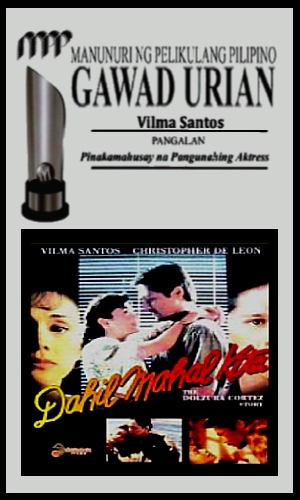
 Star For All Seasons
You must be logged in to post a comment.