The Feminist Centennial Festival Report

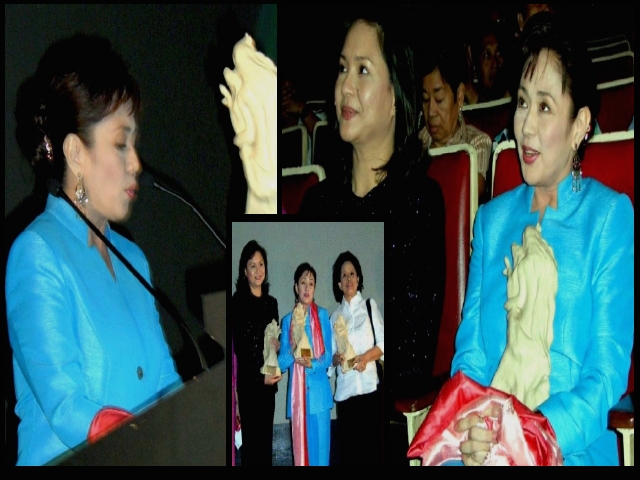
AWARDS - DIWATA 2Once again, the wind wafts yet another welcome scent of victory for the Philippines Movie Queen and Star for all Seasons at the Feminist Centennial Festival at the Cineplex, Shangri-La Plaza last night. She is indeed a national treasure.

Once again, the wind wafts yet another welcome scent of victory for the Philippines Movie Queen and Star for all Seasons at the Feminist Centennial Festival at the Cineplex, Shangri-La Plaza last night. She is indeed a national treasure.

We belong to thousands of Filipinos who wish for her to be the next National Artist of the land. Lately, we hear that it will be a choice between her and the late FPJ. For sure, the numerous or countless recognitions, honorary doctorates, lifetime achievements and this latest honor given by the NGO-GO Feminist Centennial Media Committee and the Communication Foundation for Asia cemented Ate Vi’s stronger bid to clench the National Artist title. And if this happens, yan ang talagang “heaven!” The awards night was by invitation only.

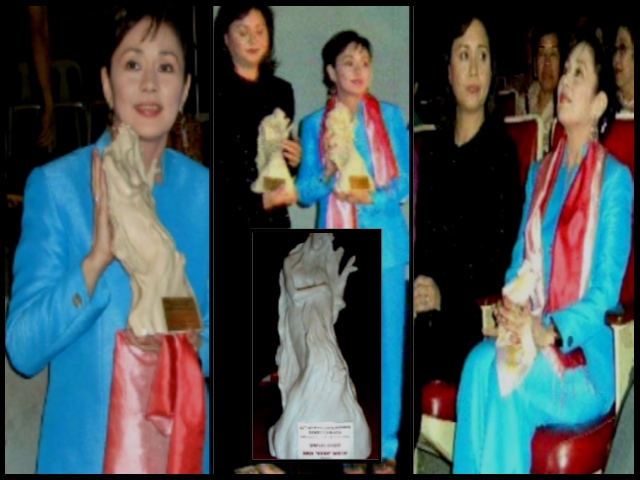
Against our better sense, we tried our luck and waited on cue. There is reason to be optimistic. Our beloved Ate Vi is one of the 6 distinguished honorees. Having prior commitments with her constituents in Lipa, we believe that there must be a representation in her behalf. And our patience paid off. We were accommodated by the working committee at the reception. We proudly introduced ourselves as member of Vision and VSSI (Vilma Santos Solid International). Present to witness the ceremony include Eric, Noel, Al, Zaldy, Paulo and myself. We were a small contingent occupying a better section of the theater against the batallion of diehard Noranians, how did this happened?! Ms. Boots Anson Roa accepted the trophy (in her her behalf) and read the passionate and meaningful thank you message of Ate Vi. some insights.

I am posting some of the write-ups included in the festival programme: 6 reasons to celebrate we salute six icons of Philippine cinema…for their invaluable contributions to the film industry… for being legendary…and passionate about their art… and for being women. Marilou Diaz-Abaya, director. Despite the risks of being categorized as a “woman’s director,” Marilou Diaz-Abaya staked her claim on the genre with the trilogy of films – Moral, Brutal and Karnal – that explored the realities of women’s lives and challenged social mores and rigid expectations of women.

In the decade of political turmoil and rapid social change, Diaz-Abaya’s films, while anchored in intensely personal stories, enlarged upon the intimate limits of women’s lives to raise sharp and cutting questions about Philippine society and gender relations, thereby triggering debate, discourse, and ultimately, the transformation of the Filipina’s sense of self and her situation. Lualhati Bautista, screenwriter. Known for creating strong, independent women characters asserting their autonomy and engagement in the society, Lualhati Bautista has given today’s women compelling role models to provide alternative modes of behavior, attitudes, and relations. At the same time, she uses the women’s stories as prisms on the political and social condition illuminating and reflecting women’s realities and aspirations in all their vivid color and artist to make films that combine artistry and innovation with commercial viability and social commentary.

Through Star Cinema, Santos-Consio has shown that it is possible to meet the demands of commercial cinema without compromising one’s commitment to quality and to delivering meaningful and compelling stories. Lily Yu-Monteverde, producer. Has been “mother” to the Philippine movie industry in so many ways.

Through the last four decades, she has produced more than 200 movies, some of them born of her own stories, most shaped by her sensibilities ans instincts for what the market wants and demands. Even as the Philippine movie industry struggles out of the doldrums, “Mother” Lily continues to make movies simply because, as she declared at the recent ceremony, she “loves the movies.”

Even as she kept Regal Films profitable with commercial offerings that covered almost all genres, “Mother” Lily also paid back her debt to the Philippine cinema by financing and allowing the country’s foremost film artists to create works that today endure as some of the best Filipino movies ever made. Nora Aunor, actor. Though “icon” is today a much-overused word, to call Nora Aunor an “icon” of Philippine movies would not be an overstatement. From her beginning as a singer and pop idol, Nora tapped unexpected reserves of experience and sensitivity to transform herself into an excellent actor, in the process acquiring a body of work that includes some of the finest movies of “Golden Age” of local cinema in the 1970’s and 1980’s, particularly Himala, Tatlong Taong Walang Diyos, Ina Ka ng Anak Mo, and Bona. Vilma Santos, actor.

AWARDS - DIWATA 1From the moment she allowed herself to break out of her “teen-idol” persona in Burlesk Queen, there was no stopping Vilma Santos in her search for artistic maturity and challenge. In the process, she has dared take on roles that could have potentially marred her image but instead provided her depth and complexity as an artist while strengthening her appeal at the box office. The designer-sculptor’s words.

According to Julie Lluch: “the feminist struggle is not so much about equality as it is about the power and freedom to be truly woman and truly human. Being a woman is to know herself as diffrent and separate, beautiful and free. As she taps the wellspring of the spirit within, she is ready to leap and soar to a fully creative life – a life she share’s with man, with whom she builds the kind of world they both want for themselves and their children.”

At the conclusion of the program, seriously or half in jest, we shook hands and congratulated Ms. Charo Santos-Consio and Director Marilou Diaz-Abaya. We proudly introduced ourselves and averred that the occassion would have been more meaningful and significant had Ate Vi made it to the event and personally accepted her trophy. We told Director Marilou that we are only a small representation of the Vilmanians. We were thrilled and happy when she raised her hand and told us “count me in!” She asked us to extend her regards to Ate Vi and that she truly misses her.

Congratulations to all the distinguished honorees most especially to our beloved Ate Vi! Mabuhay po kayo and GOD bless. To the men and women behind the Feminist Centennial Festival and other affiliations and cooperating groups, our heartfelt gratitude and Mabuhay po kayong lahat!!! – June Sison, V Mag, No. 12 2009 (READ MORE)

The All-Time Fantasy Movie Queen

MEMORABILIA - Lipad Darna Lipad (1973)

Why? Pati ba naman sa fantasy films si ate Vi pa rin ang Reyna? Why kaya? There are more than a thousand reasons why. No other actress, past and present has successfully transform from one super heroine to another. Think of Darna, Kampanerang Kuba, Dyesebel and immediately the name of Queen Vi will surface in your mind. Nanjan pa ang Wonder Vi, Vilma and the Beep Beep Minica at ang Phantom Lady. Mayron ngang isa jan na pilit sumabay pero sumablay naman hayun at Super ‘G’apang sa takilya.

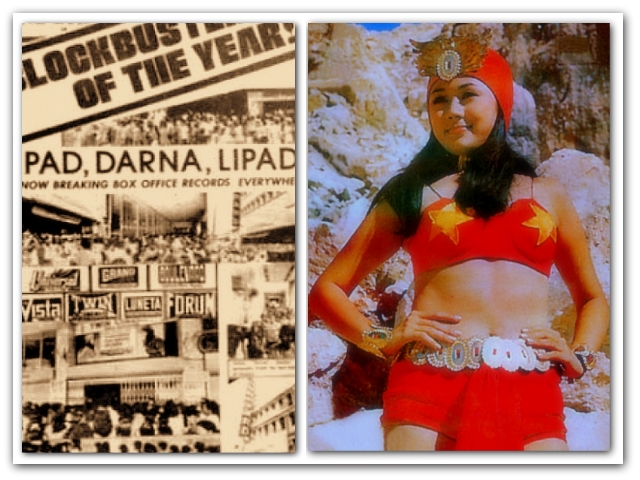
Darna x4 – Si Queen Vi lang po ang nag-iisang aktres na gumanap ng Darna ng apat na beses at ang lahat ng mga ito ay pawang nagsipagtagumpay sa takilya. Sino ang makakalimot na ang respectable actress in the person of Ms. Gloria Romero ay papayag na maging Babaing Impakta? Ang pabulosong Celia Rodriguez bilang Valentina at isa pang mahusay na aktres na si Liza Lorena bilang Babaing Lawin sa Lipad Darna Lipad? Sumabog ang takilya sa mga sinehan, pinilahan ng lahat ng klaseng tao, bata, matanda, lalaki, babae, bakla, tomboy. Tinaguriang super blockbuster ang Lipad Darna Lipad ni ate Vi. Marami ang napatunganga, namangha, napatingala at humanga sa taas ng lipad ni Darna sa himpapawid. Hindi pa nasiyahan ang mga tao, muling pumaimbulog sa ere si Reyna Vilma sa Darna and the Giants, at muli sa Darna and the Planet Women at muli pa sa Darna at Ding. Marami na ang naging Darna before and after ate Vi, but most, if not all of them are just one-time Darna. Ngayon, sino ang Darna ng mga Darna, sino pa kundi ang Reyna ng mga Reyna, si Queen Vilma!

The Dyesebel Charm – Marami ang nakasaksi kung paano nakipagsabayan si Dyesebel sa Ang Agila at ang Lawin ni late FPJ and Former President Erap. Dalawa sa pinakamalalaking ibon ng industriya, nilunod ng isang sirena. It was actually a feat for Dyesebel to beat Agila at Lawin sa takilya. Just imagine, two top action stars together in a film against Dyesebel! I remember very well na na-pre-empt pa nga ang Dyesebel dahil the original movie starring Edna Luna was shown before our Queen Vi’s Manila Filmfest entry hit the wide screen. But still, Dyesebel at ang Mahiwagang Kabibe turned out to be a big big winner at the tills. Iba’t ibang aktres na ang gumanap ng Dyesebel after ate Vi pero nananatili pa rin siyang nakatatak sa isipan ng mga tao and not Alma, Alice or even Charlene or Edna Luna. Pero bakit si Queen Vi? Kasi nga po, iba ang charisma ng ating Reyna. She has this certain magnetic charm na mahirap ipaliwanag.

The Beauty Within – Lately nga, Andang (for Sandra) of Kampanerang Kuba fame had joined the fantaserye club. Ginawa nga lamang Imang ang pangalan, short for Fatima. Pinapangit, pinagmukhang mabantot at sooper dugyot, pero lovable pa rin si Andang. Kinawawa, kinutya, inalipusta pero wagi pa rin sa bandang huli. Sounds familiar, right? Di ba ganyan din ang naranasan ni ate Vi at patuloy na nararanasan sa mga taong nabubuhay sa nakaraan at pinagtampuhan na ng panahon?

Pero, naririto pa rin si Queen Vi at patuloy na nagbibigay kasiyahan sa mas nakararaming tao, dahil ang naging pananggalang niya ay katatagan at bukal na kagandahan ng loob. Ang mga karangalang patuloy na inaani ni ate Vi ay hindi lamang pansarili kundi para sa buong bansang Pilipinas at mga Pilipino.

Sino ngayon ang maaaring bumura o pantayan man lamang ang record ni ate Vi sa pagiging All Time Queen of Fantasy Films? Ooooops, sorry! Wala pa akong natatanaw. Kayo meron ba? – Eddie Lozano, V Magaznie no. 12 2009 (READ MORE)

Rewind: the year was 1973 (Photos)

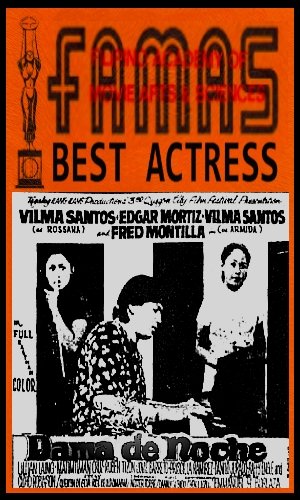
One of Ate Vi’s banner year was 1973. Not only she earned her first best actress award for 1972’s Dama De Noche (FAMAS), she established herself as the most bankable actress of the year. Hit after hit, she broke all box office records!

1973 Film List

FILMS - OPHELIA AND PARISOphelia at Paris -– Vi co-starred with Victor Laurel ; directed by Celia Diaz Laurel; Victor Laurel Productions (Jan)

FILMS - Now And Forever 3Now and Forever – Vi– With Edgar Mortiz directed by Ishmael Bernal; TIIP Valentine Special (Feb)

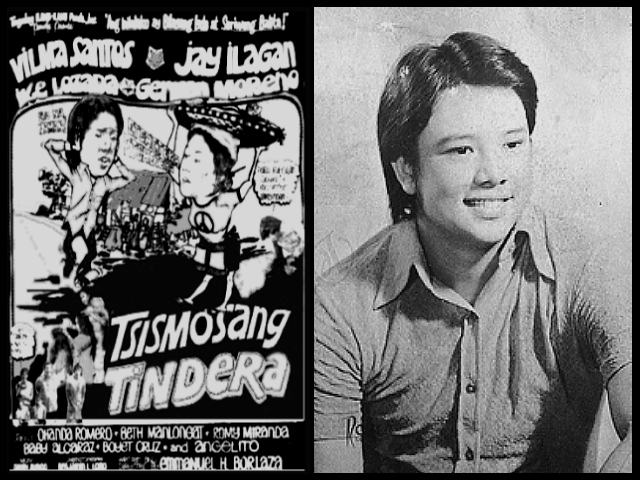
FILMS - Tsismosang Tindera 2Tsismosang Tindera -– Vi With Jay Ilagan, Ike Lozada, German Moreno directed by Emmanuel H Borlaza; TIIP “Ang naglalako ng bilasang isda at sariwang balita” (Feb)

FILM - Lipad Darna Lipad 1973Lipad, Darna, Lipad -– Vi With Gloria Romero, Celia Rodriguez, Liza Lorena; directed by Emmanuel Borlaza, Elwood Perez, Joey Gosiengfiao; TIIP 23 (Mar)

FILMS - Carinosa 3Cariñosa -– Vi With Manny DeLeon, yoyoy Villmae, Chanda Romero, Angelito; driected by Romy Susara; TIIP 05 (May)

FILM - Dyesebel at ang Mahiwagang Kabibe 1973Dyesebel at ang Mahiwagang Kabibe – Vi With Divina Valencia, Mina Aragon, Rossana Marquez, Romeo Miranda; directed by Emmanuel H Borlaza TTP Tagalog Ilang-Ilang Productions; Winner!!! 8th Manila Film Festival Top Grosser Best Musical Picture. (Jun)

FILMS - Anak ng Aswang 4Anak ng Aswang -– Vi With Gloria Romero, Daisy Romouldez, Rossana Marquez, Lucita Soriano, Edgar Mortiz, Leopoldo Salcedo, Nick Romano, German Moreno; Roma Films directed by Romy V Susara (Sep)

FILMS - Wonder Vi (1973)Wonder Vi -– Vi With George Estregan, Marissa Delgado, Nick Romano; directed by Arsenio Boots Bautista JE Productions (Sep)

FILMS - MARIA CINDERELLAMaria Cinderella -– Vi With Jay Ilagan, Blanca Gomez,, Florence Aguilar, Romeo Miranda; directed by Emmanuel H. Borlaza; TIIP Entry to 43 Quezon City Film Festival (Oct)

FILMS - Darna and the Giants 7Darna and the Giants –- Vi With Helen Gamboa, Loretta Marquez, Rossana Marquez, Divina Valencia, Romeo Miranda, Dondon Nakar directed by Emmanuel Borlaza TIIP (Dec) – RV, (READ MORE)

Why Vilma Santos is the Star for All Seasons

MEMORABILIA - Vilma! (3)

ARTICLES - Glamourous Life  White 1After 55 years in the business, 200 films, four Grand Slam Best Actress Awards, and a Hall of Fame recognition from FAMAS, Vilma Santos is still one of the most sought after and effective actresses of our time. No wonder she is called the Star for All Seasons. If you will tell me that I am ‘The Vilma Santos,’ that is because I worked hard for this,” said the actress-turned-Batangas Governor.

BORN TO BE A STAR – Maria Rosa Vilma Tuazon Santos was born on November 3, 1953 to Milagros Tuazon, a pharmacist from San Isidro, Nueva Ecija, and Amado Santos, a former movie extra from Bamban, Tarlac. As a child, Vilma loved listening to radio dramas. “Bata pa ako maarte na talaga ako! Kapag fiesta sa lugar namin maraming taong pumupunta sa bahay namin, ang mama at papa ko ‘Sige, Vi, sayaw! Ipakita mo, anak!’ At dahil maarte ako sasayaw naman ako.” At a family reunion when Vi was nine years old, the brother-in-law of her mother’s cousin, G. Amaury Agra who was a cameraman for Sampaguita Pictures, came for a visit. Agra convinced Mrs. Santos to bring Vi to the studio to audition for a part in the movie Anak, Ang Iyong Ina. There they saw a long line of children with actors Bella Flores and Eddie Garcia. “Pumila ako pero sabi ng mama ko hindi daw doon, sa ibang audition ako dapat. Pero nagpumilit akong pumila,”she re-called. With her improvised dialogue and acting, she wowed Doc Jose R. Perez and Azucena Vera of Sampaguita Pictures. Doc Perez then told the young Vilma, “Ikaw si Trudis Liit.”

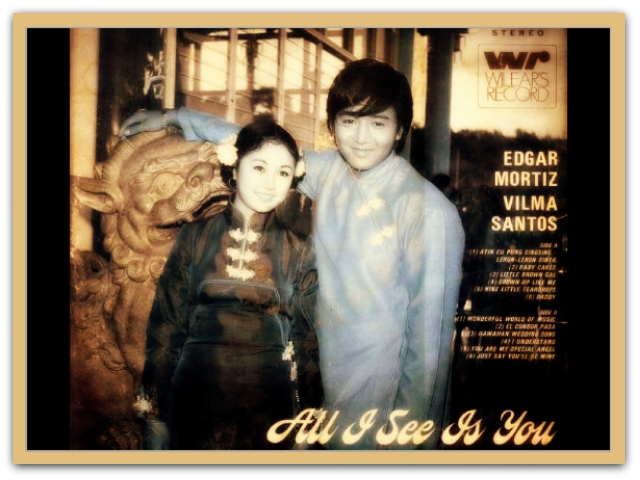
MEMORABILIA - Vi & Bot  1972MEETING ‘BOT’ – In 1969, the 14-year old Vilma met Edgar ‘Bobot’ Mortiz, a rising recording star and undefeated champion in Tawag ng Tanghalan,” at a teen show entitled “Eskwelahang Munti.” Movie producers thought of establishing a Vi and Bot love team, and in 1970, the two were launched in the film “Young Love.” Thrown together constantly, Bobot and Vilma became a real-life couple in 1971. But Bobot feels shy talking about the details of the teenage relationship with SSM. Nagka-inlaban din naman kami. Ayoko na nga pinag-uusapan e! Pero sandali lang naman. “Nagka-develop-an din kami, dala na rin siguro ng madalas na magkasama kami.” Sadly, the relationship ended three years later, and the love team was eventually disbanded. Vilma and Bobot never did a movie after that but have managed to remain good friends.

MEMORABILIA - Vi @ Vilma! (2)GREAT ACTING, BAD ATTITUDE – Vilma is not ashamed to admit that even she was a “bad girl” in her mid-20s. Typical of her behavior then was her refusal to show up for a film shoot. The call time was 9AM; at 1PM, she got into her car. On the way to the shooting, she told her driver, “Ayoko na mag-shooting. Ihinto mo na lang diyan. Kakain na lang ako. Sabihin mo masakit ang tiyan ko.” Another time, she ran off to Baguio, just for the heck of it, without informing the producers of a TV Christmas special that she wasn’t planning on showing up. Veteran entertainment writer Ronald Constantino believes Vilma’s crazy days were a result of her private struggles, from tax problems to personal heartaches. Siguro din kasi dahil hindi pa siya nagma-mature as a person at baka ‘yun ‘yung time na marami siyang problema, finances and love life. Pinagdaanan niya ‘yun pero nalampasan din niya.” Later, as she matured, Vilma became more serious with her work. Rory Quintos, the director of Vilma’s 2000 Star Cinema film Anak, says Vi’s professionalism made her job much easier. “Dumadating si Ate Vi sa set nang naka-costume at make-up na. Kapag naka-set up na ‘yung mga gamit sa location, pagdating niya start na agad. That was a big help most especially when we shot in Hong Kong. Wala siyang pakialam na siya si Vilma Santos. Natulog siya doon sa maid’s quarters, kumakain ng kung ano ano, umuupo kahit saan. Natulog siya sa sidewalk, nasubsob sa basurahan. Wala siya talagang arte sa katawan.”

MEMORABILIA - Mature Vilma circa 2000s 1FAMILY, POLITICS, CAREER – After her first marriage to Edu Manzano ended, Vi met Ralph Recto, the grandson of the late stateman Claro M. Recto. Vi married Ralph in Decembver of 1992, the year when Ralph was first elected as Congressman of Lipa City, Batangas. Wanted to devote more time as a wife an try to have a child with Ralph (they had Ryan Christian Recto in March 1996), Vi wrapped up her long-running variety show “Vilma” in 1995. From then on, Vilma did only movies and was seldom seen on TV. She also entered politics, first as Mayor of Lipa City, then as Governor of Batangas. Constantino believes that this further elevated Vi’s star status. “Mabuti nga rin siguro na bihira na siya makita ng mga tao kasi nami-miss siya. Masd lumalakas nga ang excitement ng mga tao every time na siya ay gagawa ng pelikula.” Now she is ready for an onscreen comeback. This year, after six years of not making movies, Vilma is starrin g in In My Life, a film produced by Star Cinema with John Lloyd Cruz and her son Luis Manzano. She has as simple formula for career success. “Love your career and it will love you back. Don’t take your career for granted. Also, kailangan ng hard work, smart work, grace of God. Kapag may kulang sa tatlong ‘yan, mahihirapan ang kahit sino. Sa Ano mang larangan o propesyon kailangan ng hard work para magtagumpay.” – Napoleon Quintos, Star Studio, September 2009 (READ MORE)

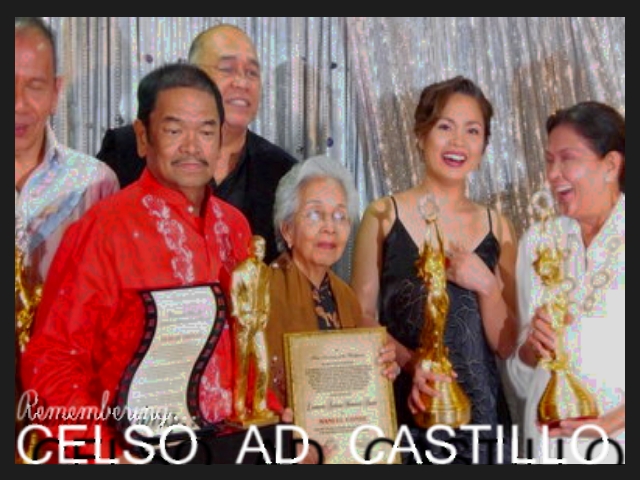
The Kid Uninterrupted, Celso Ad Castillo (Sep 12 1943 – November 26, 2012)

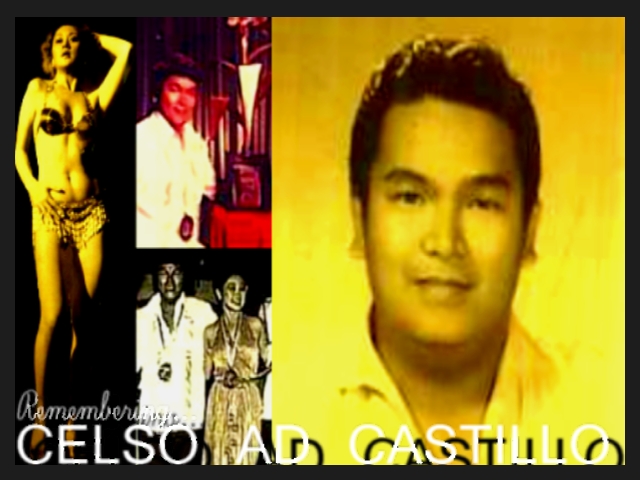
ARTICLES - Remembering Castillo 11Note: With so many format errors, we decided to reprint and repost this article as a tribute to the Kid. “Fair disclosure” in in effect here, infringement is not intended and no commercial profit gained in republishing this piece. Celso Ad Castillo was born on September 12, 1943, he died November 26, 2012 on apparent heart attack. During that time, he was reportedly working on his autobiography, which was released last year and promoted by his son, Christopher Castillo.

“As a child, he had the second-run theater circuit in downtown Manila as playground; his first “playmates” were King Kong, Suzie Wong and Gene Kelly. “I could barely understand American slang, but I was mesmerized by the light and shadows, the framing, the composition, the rhythm, the editing,” recalls acclaimed filmmaker Celso Ad. Castillo. Before young Celso even started school, his father Dominador had taken him to watch Hollywood movies “from MGM musicals to Elia Kazan” dramas.

“He was a film buff,” recounts Direk Celso, known as The Kid of Philippine Movies. “My aunt and uncles were also crazy about movies.” Dominador, who was also a lawyer, komiks novelist and producer for Larry Santiago Productions, was hesitant to allow young Celso to join show business. Teenaged Celso protested that he was merely following in his father’s footsteps. Dominador had created the classic komiks heroine “Cofradia,” immortalized by Gloria Romero in the Sampaguita film version in 1953 and Gina Alajar in the 1970s.

ARTICLES - Remembering Castillo 14Like father… – “I started out as a komiks illustrator,” Celso relates. “I’m also fond of drawing.” He eventually wrote the komiks novels “Tartaro,” “Vampira” and “Palalong Kuba.” After all, he notes, stories about dragons, mermaids and vampires were “part of my childhood memories.” He acknowledges that his komiks sojourn primed him for filmmaking: “It taught me how to visualize the frame.” Yes, komiks panels were the first storyboards for this English Literature graduate. “Komiks also taught me how to choose commercially viable projects.”

From there, Celso, at the tender age of 18, crossed over to the movies as scriptwriter. “I started by doing spoofs of James Bond films. For Chiquito, I wrote “James Bandong, Secret Agent 02-10.” For Dolphy, “Dr. Yes.” VM Cinematic Films took notice because these movies had done very well at the tills. “VM gave me my first break, “Misyong Mapanganib” in 1965. It starred Tito Galla, Ruby Regala, and Helen Gamboa in her first starring role,” Celso says. “Local movies” whiz kid was also a law student at the time. “My father allowed me to direct only because I promised to continue my law studies.”

Potboilers – He churned out six potboilers, one after the other, among them “Zebra Jungle Girl” with Ruby Regala and “Mansanas sa Paraiso” with Stella Suarez. He admits that, inevitably, both his legal and film endeavors suffered. “I was flunking in school and my first seven movies were half-baked. I had to make a choice.” Celso’s gambit yielded his first critical success, “Nympha,” a black-and-white bomba film starring Rizza. “I wanted to prove that sex films could be artistic if they didn’t offend the sensibilities and intelligence of moviegoers,” he explains. The cache brought about by “Nympha” allowed him to make “The Virgin,” again with Rizza. “[It was] my first avant-garde movie,” he remembers fondly. “Eighty percent of the film had no dialogue. The story was told through ballads.”

Alas, “The Virgin” wasn’t as profitable as “Nympha.” With candor, he says, “It was a big flop. It was ahead of its time. Moviegoers were stumped “they couldn’t understand why no one was talking!” The indie maverick then surprised the industry by plunging head first into the mainstream. After megging “Ang Gangster at ang Birhen” (with Dante Rivero and Hilda Koronel) for Lea Productions, Celso caught the eye of Fernando Poe Jr.

Da King’s Direk – “At 26, I was directing the King of Philippine movies,” he reminisces with pride. “Asedillo,” his first outing with Da King, was not just a box-office smash; it also won a Famas Best Actor trophy for FPJ in 1972. “That movie started our collaboration. In a span of two years, we made three more movies: “Santo Domingo,” “Ang Alamat” and “Esteban.” Working with Da King, Celso felt obliged to prove his worth because, “You had to earn his respect.”

After those four action movies, Celso was itching for another change of pace. “I wanted to go freelance to do my kind of movies, innovative and experimental films that are commercial at the same time.” His next gambit, “Ang Mahiwagang Daigdig ni Pedro Penduko,” starring Ramon Zamora, hit the jackpot as well. “I never wanted to be boxed in one genre. So I followed up the fantasy movie “Penduko” with a kung-fu flick, “Return of the Dragon,” also with Ramon. I also made a zombie film with Alona Alegre entitled “Kung Bakit Dugo ang Kulay ng Gabi.”

In 1974, he crafted the horror hit “Patayin Mo sa Sindak si Barbara,” for FPJ’s wife, Susan Roces. They followed it up with “Maligno,” for which Susan won Famas Best Actress in 1978. Celso says, “When it was first shown, people didn’t know what to make of “Maligno.” But I recently caught it on cable. I almost cried at the end. It was surreal and grotesque.” By then, Celso had become the master of the unexpected. After casting sweet Sampaguita star Susan in gothic tales, he re-imagined Miss Universe Gloria Diaz into “Ang Pinakamagandang Hayop sa Balat ng Lupa,” in 1975.

Wet Look – Celso wistfully describes “Hayop” as “the killer” because it started the “wet look trend and single-handedly demolished the predominantly macho star system.” He remembers that, before “Hayop,” female stars were mere “adornment” in local movies. “Pang-display. “Hayop” [changed that].” He continued to give prominence to women in his films, most notably “Burlesk Queen,” an entry in the 1977 Metro Manila Film Festival. “That movie created a furor at the film fest,” he says. “Furor” is really an understatement.

“Burlesk” swept the awards in that year’s MMFF, resulting in a controversy that led to the wholesale return of trophies. In spite of the scandal, “Burlesk” is still regarded by critics as the “quintessential” Filipino film. “Hinamon ni Brocka si Tinio ng suntukan (Lino Brocka dared Rolando Tinio to a fight),” Celso remembers. “Tinio, who was the head of the jury, heralded “Burlesk” as the most beautiful Filipino film past, present and future.”

In Memoriam 2012 8 - Celso Ad CastilloVi’s Turnaround – Adding fuel to the fire, “Burlesk” had stunned moviegoers because it unveiled a new Vilma Santos?from ingénue to wanton woman. Vilma says of “Burlesk marked a transition in my career. Working with Celso Kid is a privilege. He’s a genius.” With good humor, Vilma recalls a “quarrel” on the set of “Pagputi ng Uwak, Pag-itim ng Tagak,” which she produced in 1978. “It took so long to finish. I lost money on that. But we’re still friends. “Burlesk” and “Pagputi” brought a lot of honor to me.”

Gloria Diaz agrees: “Not too many people [would appreciate] his style [of filmmaking]. He’s a no-nonsense guy kasi. I consider myself lucky that I got to work with the best.” In “Burlesk” and “Pinakamagandang Hayop,” as in all his films, Celso challenged his stars to improvise, “not to stick to the script [and] say the lines… from the hearts.”

Love Letter – In the case of “Burlesk,” that’s because it was, for him, a love letter to his youth. “That was about my adolescence. I was a regular in Clover, Inday Theater, Grand Opera House. I watched Canuplin and Bayani Casimiro. I witnessed both the peak and the decline of bodabil,” he remarks. If there’s a common thread in his 61 movies, he points out, it’s that each one seeks to capture on film “a time of transition.”

He expounds: “Burlesk” was about the end of the bodabil era; “Pagputi,” the Huk movement; “Ang Alamat ni Julian Makabayan,” the Philippine revolution. Coincidentally “Julian Makabayan” signaled Celso’s own personal transformation. “In 1983, I attended the Asean Film Festival in Malaysia, where “Julian” was an entry. In my brief stay there, I discovered Islam. Six years later, I returned to Malaysia, to convert.”

Islam, he says, allowed him to “mellow and discover myself. Islam is a tough religion. Perfect for the hard-headed.” The serenity that he thus found can be gleaned from his subsequent choice of address: Siniloan, Laguna, location for his major works. He waxes poetic here: “Siniloan was where I was born. That place has everything, ricefields, mountains, rivers.” Nowadays, he spends most of his time in his chestnut farm there. At the time of this conversation (just before the recent holidays) he is ready to harvest. “I’m always busy with something,” he insists.

ARTICLES - Remembering Castillo 18Lifetime Achievement – Being the recipient of two Lifetime Achievement honors in 2007 (from the Famas and the Film Academy of the Philippines), Celso thought it was also apropos to pick up a long-shelved project: His biography, “Celso Kid of the Philippine Movies” by independent filmmaker Ron Bryant. “Ron was my student in the Celso Ad. Castillo Filmmaking Institute in 1999,” he says. Celso played the role of Epy Quizon’s paralytic father in Ron’s award-winning Cinemalaya film, “Rotonda,” in 2006. “He’s a very professional actor,” Ron says of his mentor. “He never meddled in my directing and remained focus on his acting.”

Ron, however, points out that the Celso book project has evolved into a “documentary.” “The scope is too wide, especially in the context of 1970s Filipino cinema,” Ron explains. He hails Celso as a true vanguard of “the indie spirit.” “He made inventive films on a shoestring budget.” Coming full circle, Celso is now tinkering with digital technology, with two indie movies in the works “Sanib 2” and “OFW.”/p>

The technology is new, but trust Celso to rely on the same “improvisational” tricks with his actors. “OFW” actor Coco Martin says he finds The Kid’s method exciting. “On the set, we keep improving the dialogue. It’s a different experience. Direk Celso is so cool!” Proof that Direk Celso is hip and happening still can very well rest in the fact that his old films are continuously being remade on both the big and small screens.

After “Pedro Penduko,” his “Patayin sa Sindak si Barbara” and “Maligno” have been turned into teleseryes by ABS-CBN 2. His “Pinakamagandang Hayop” has also been snapped up by GMA 7. If you ask him, reviving his old movies is the ultimate tribute. As bonus, his 1984 film “Snake Sisters” has been picked up by British firm Mondo Macabro for DVD distribution abroad.

ARTICLES - Remembering Castillo 2Dream Project – Says critic Pete Tombs of Mondo Macabro: “I think he’s one of the most visually gifted filmmakers to come out of the Philippines. A true original.” Celso is positive, “I’m far from slowing down. I’m more aggressive now. My goal is to make an international movie soon!”

That dream project would be “Where Willows Grow,” which is set in the Land Down Under and tells the story of a Filipino mail-order bride who becomes the prime suspect in the murder of her Australian husband. “My wish,” he concludes, “is for my films to transcend their ethnic origin and merge with different cultures of the world.” – Bayani San Diego Jr., Philippine Daily Inquirer, 29 January 2008 (READ MORE)

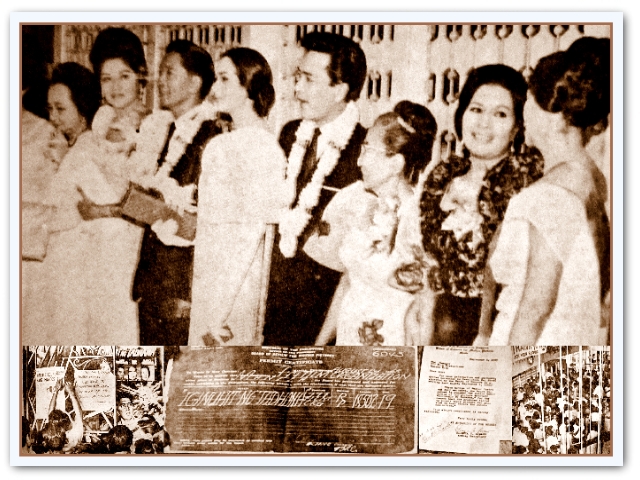
Special Film: Iginuhit ng Tadhana: The Ferdinand E. Marcos Story (1965)

MEMORABILIA - 1965 Iginuhit ng Tadhana Premierre

“…Iginuhit ng Tadhana: The Ferdinand E. Marcos Story (1965) (Carved by Destiny) is a movie based on the life of Ferdinand Marcos prior to his ascendancy as President of the Philippines. The movie was chronological in setting, featuring Marcos as a young boy in his hometown, as a brilliant student, and up to the time that he was unjustly imprisoned as a suspect in the murder of the political rival of his father. The movie then moves up to his acquittal, his career as a young congressman and senator, and up to the time that he married Imelda Marcos. The movie was shown in Manila as additional campaign material for Marcos’ candidacy for the Presidential race, which he eventually won. The movie portrayed Marcos as a person who is more than just a politician…” – Wikipilipinas (READ MORE)

“…Marcos knew the power of the medium of film. Earlier on, Marcos produced a film biography using the most popular stars for his first presidential campaign. He ran against Macapagal who also came up with a film biography to boost his reelection bid. Marcos would also use another film Iginuhit ng Tadhana (Written by Destiny, 1965) to campaign for a second term. The two Marcos film bios would be the only successful political films—commercial and election wise—as other film biographies in the post-Marcos period by senatorial and presidential aspirants would prove dismal, unhelpful for election bids. The post-Marcos period liberalized the political and economic scene. It conventionalized and intensified the election of movie and sports stars, and even television news hosts to national politics. Television stations were sequestered by the government, the largest of which, however, was returned to its pre-martial law owners. ABS-CBN would become the leading television station until after 2000, allowing two of its news anchors to become senators…” – Rolando Tino (READ MORE)

Source: Ganito Sila Noon

FILM REVIEW: THE HEALING

The Plot: – “…Stories about the Filipino tradition of going to faith healers for guidance and treatment of ailments have not yet been tackled in-depth in movies. And in our film, the viewers will not just be horrified, they’ll somehow be challenged to think as to how faith healing has already been part of our culture…” – ABS-CBN News (READ MORE)

The Reviews: “…Created in the same campy mold as Chito Roño’s other horror “Feng Shui”, the film gambled on giving Vilma Santos a project that was expected to earn money and provide cheap thrills. I am not sure about the box office returns but it did provide some scares when I saw it. Plot is about a neighborhood who is embroiled in a karma-like situation. The neighbors are having a second lease on life with their own set of illnesses after a life insurance agent’s dad was attended to by a faith healer named Elsa (who happens to be the name of Nora Aunor’s character in the masterpiece “Himala”). It may be low in coming up with a compact and weighty story to connect with but at least it gave its main chunk of meat a good production value and execution. The one involving a Chinese temple is my favorite. I also have to note that Jerrold Tarog did a wonderful job in the editing department. The ending, for instance, did not linger much on the drama and the realizations. Star Cinema also released two versions of the film. One is R18 which contains more gore and the other, to reach to a wider audience (read: more money), R13. Friends who might appreciate it: Vilmanians, no less…” – Manuel Pangaruy Jr., Tagailog Specials Presents, 28 October 2012 (READ MORE)

“…We are glad director Chito Roño has found his mojo in making effective horror flicks. After “Feng Shui,” which was truly scary, his next works like “Sukob,” “T2” and “Bulong” were quite inferior. He’s now back in top form in “The Healing,” which really works as a thriller. After seeing it, we’re no longer surprised the MTRCB gave its uncut version a rating of R-18 (although there’s an expurgated version that’s R-13) as he really upped the ante in the violence factor. It has a decapitation scene right in the middle of a busy street, a self immolation scene, necks being slashed, a stomach split open with the intestines spilling out, a bloodbath in a massage parlor where several defenseless people were killed and in a Chinese temple were monks were massacred, and most ruthless of all, a little girl being impaled in a flagpole. Those scenes are already shocking and horrifying enough as they are. In “Feng Shui,” the series of terrifying events was triggered by a cursed bagua. This time, the killings take place after Vilma Santos as Seth, an insurance executive, takes her ailing father (Robert Arevalo) to a faith healer (Daria Ramirez).

Her dad gets healed overnight so her ailing neighbors ask Seth to accompany them to the same faith healer: Ces Quesada who can’t speak, Ynez Veneracion who has a breast tumor, Janice de Belen’s blind daughter, Pokwang and Cris Villanueva who are afflicted with skin disease and Kim Chiu, who has a kidney problem. They do get healed, but the healing also doomed them and turn them into violent killers. We won’t go into detail as to why this happened, so as not to spoil it for you, but suffice it to say that Roño and his scriptwriter, Roy Iglesias, try their best to come up with a believable explanation of its root cause that stems from the concept of “huwag mong buhayin ang bangkay.” Chito manages to sustain the feeling of dread and anticipation throughout the movie. And of course, it works because we feel for Ate Vi as Seth. It’s not her fault that the series of gory incidents happened but she’s the one being hounded by the ghostly spirits in the story since she’s the one who brought all the patients to the faith healer. Running against time, she then tries to reverse the curse by going to its source. All the graphic killing scenes are staged convincingly for maximum gruesome effect and it’s effective as all the actors deliver.

Pokwang is truly quite chilling when she turns into a monstrous entity with superhuman strength throwing people down from a tall building. Even perennial Roño actor Jhong Hilario stands out in a short but menacing role, the nature of which we can’t reveal here. The special effects involving the bulging and rotating left eye of all the killers is a touch of genius. Vilma is subjected to a lot of stressful scenes in the movie as she fights for dear life. We have to suspend our disbelief a bit in the scenes where she gets violently mauled, stabbed, hit by a chair, repeatedly hurled down into the floor, but it did elicit a lot of deafening screams from the theatre crowd. Some of her fans feel she should have just done another drama but we can understand her desire to flex her wings and do a vehicle of this sort. When we saw the movie, a lot of viewers were young people who enjoy watching scary films like this. With this, Ate Vi has successfully reached out to a new demographic, with the help of a young star like Kim Chiu, who in all fairness, also does well in her dual roles. For us, it’s a very wise decision indeed. And Chito Roño shows here to younger horror directors like Topel Lee, Richard Somes and Jerrold Tarog (Tarog did a fine job of scoring and editing the movie) that he remains to be the master of the genre who can be even playful with the orchestrated color scheme of the costumes worn by his characters in the movie…” – Mario Bautista, Malaya, Aug 6 2012 (READ MORE)

“…Director Chito S. Roño is a veteran in doing horror movies. In 2004, he helmed the box-office hit Feng Shui, an answer to the Asian horror movie phenomenon. The Healing, on the other hand, can be considered an answer to Hollywood’s torture-and-gore horror movie phenomenon. It may be the first local horror film to do so, and thus it is refreshing to watch. There is no shortage of shocking gore in The Healing. There are lots and lots of blood; horror movie fans will not be disappointed. The movie is also made more fun by moments of fan service, that recalls several niches of pop culture that seem to be taboo in Philippine mainstream cinema. There’s a small child wielding a ninja weapon killing groups of monks, before jumping to her death. There’s a beheading using a giant knife. There are many more. The story also offers something new, away from familiar themes like haunted houses and vengeful ex-girlfriends. It exploits the Filipino tradition of faith healing, and the consequences of tapping this alternative form of therapy. What’s most admirable is the fact that The Healing’s actors went to great lengths to provide credence to the story. Vilma Santos, for instance, gets stabbed multiple times that you’d wonder how she can take these intense physical scenes at her age. Kim Chiu should also be praised for her handling of her character, Cookie. Her early scenes when she needs to act sick are believable and downright affecting. In summary, The Healing is suited for Pinoy horror fans. It is fun as it is shocking, and non-squeamish viewers should have no problem having a good time…” – Mark Angelo Ching, PEP, July 30, 2012 (READ MORE)

“…Santos’ spine-tingler is far from original, but as it tweaks the narrative conceit that has made “Final Destination” a box-office-busting film franchise, the movie finds innovative ways to establish an atmosphere of impending doom that keeps viewers on the edge of their seats: You feel that something gruesome is about to transpire, you just don’t know how it will play out—or when! The Star for All Seasons decided to make the film because she wanted to add something “new” to her formidable oeuvre—and, with “The Healing,” Santos accomplishes exactly that. The role doesn’t require her to do much except run in circles or look worried or scared. But, she displays flashes of dramatic brilliance when she is hounded by guilt, a motivation that presents her with forks in the road that just might lead to the resolution of the horrifying story’s main conflict. More than anything, it’s a treat to see the durable actress on the big screen again. The horror-thriller genre she dabbles in effectively introduces her to a younger (and wider) viewing demographic that derives pleasure from getting scared out of its wits…” – Rito P. Asilo, Philippine Daily Inquirer, July 28, 2012 (READ MORE)

“…The reason I like Chito Rono’s horror movies, and the reason I see most of them in the theatre, is because suspense-horror is a completely original genre, completely divorced from the hang-ups and expectations of movies that involve real people doing somewhat credible things. I remember when Chito Rono did a suspense project DAHAS, topbilled by Maricel Soriano and Richard Gomez. It was one of a kind. Very engaging just like the Healing. Kim Chiu, among other characters has lesser exposure here but a huge revelation. She epitomizes the typical Asian character on every horror films we watched. Her make-up was perfect and she looks so fresh on the movie. Pokwang, Janice and Martin Del Rosario did a great job as support role. Their characters are very important and happy to see Janice De Belen again on the big screen. Pokwang gave a little taste of comic on her dialogues, which gave everyone to catch their breath in preparation to next scene. Martin Del Rosario is a real charmer. Again the focus of the film is the story, its suspense package and for Vilma Santos, which they succeeded. I suggest everyone should watch the uncut version, brave the director’s cut as there seems to be obvious reason why some of the scenes are not included on R13. DISLIKE: There’s one thing I don’t like, they are trying to blur some of Vilma Santos physical feature. That looks very obvious on the big screen. But you will love the color coding (that’s for you to find out). Star Cinema gave another reason for everyone to go back to movie houses and appreciate local films. It’s another excellent film of 2012…The Movie is in honor of Vilma’s 50th anniversary, Star Cinema gathered an all-star highly acclaimed powerhouse cast composed of Kim, Janice de Belen, Mark Gil, Martin del Rosario, Allan Paule, Cris Villanueva, Daria Ramirez, Ces Quesada, Ynez Veneracion, Simon Ibarra, Abi Bautista, Joel Torre, Chinggoy Alonso, Mon Confiado, Carmi Martin and Pokwang. I am giving THE HEALING 10 out of 10…” – Rod Magaru (READ MORE)

“…After the first character dies, you already know how the story would go. The suspense you feel as you watch grows, but this is in anticipation of the gory way the next character will die, not because you do not know what will happen next. To Rono’s credit, each “death scene” would top the last one as far as gore and blood are concerned. The cast did well, too. Vilma Santos is Vilma Santos. She will always be bigger than her roles. This is not to say that she did not perform well; she did. But, watching her, you see Vilma more than Seth – too strong to ignore. Kim Chiu appeared in very few scenes despite her second billing. As with her performances on TV, she would have done better if she injected more energy into her role. I did not know Martin del Rosario before this movie, but he delivered very well in his crucial role as Jed. I’m not really sure why Ynez Veneracion had to show her right boob in a scene – maybe for old times’ sake.

Several camera angles used by Mr. Rono were very well-planned and executed, maximizing the tension onscreen. Like other productions (movies and theater plays) I watch nowadays, there was color coordination in the outfits/costumes of the characters onscreen. In “The Healing,” though, I did not quite get why a certain color was chosen to be the “theme” of a scene. It was too obvious, that when a scene’s color scheme continued into an unrelated scene, it became distracting. Many common scare tactics and music were employed in the film. Thankfully, there was no Sadako-like creature in this one (if you still don’t know who Sadako is, Google “The Ring” Japanese version — or search on YouTube). Overall, “The Healing” is okay. It is similar to other horror films in the way the friends of the lead female character are dying around her and it is up to her to break the curse. If it was Kris Aquino who played Seth instead of Vilma Santos, the movie would just be “Feng Shui” all over again…” – Fred Hawson, Rappler, Aug 12 2012 (READ MORE)

“…The movie has a cohesive plot. The editing is brisk. The story telling is to the point. The jolts, the surprises, the building tension as the plot thickens makes you squirm from your seat. You can’t take your eyes off the screen so as not to miss the details, the foreshadowing, the conflict resolution. From the impressive opening credits, to the alternate theme colors of blue, red, yellow & white, you know the movie is special. The ensemble acting reminds you of such sleuth movies as Murder on the Orient Express & Death on the Nile, where Rono is able to flesh out the best from each actor or actress, no matter how small the role is, whether in a group or singly . I particularly like Janice De Belen, Pokwang, Robert Arevalo (in a groovy role that Sildenafil users could relate to), Kim Chiu, Joel Torre & Martin Del Rosario. Vilma Santos is in almost every frame. It is a most restrained performance, akin to her Urian winning Amanda Bartolome character in Dekada 70 where she has mastered “doing less is more.” As the key figure or the cause of the sad fate of her friends, Vilma is able to effectively use her eyes to show fear, guilt, sadness, even remorse. Her best scenes are when she tells her son Martin to not leave Kim from his sight, while calling from a cell phone, her confrontation scene with Kim in a car while Martin is driving the van & her hair raising, thrilling confrontation scene with Kim, the evil twin…” – Mar Garces (READ MORE)

“…The film is, by turn, violent and the sexy episode given clinical treatment. The breast of Ynez Veneracion (as Greta) is fondled matter-of-factly to show that the cancerous lumps are no longer there. The series of death – suicide and murder, keep the moviegoers on the edge, screaming here and there and up to the very end when the ‘sanib’ victim Kim Chiu (as Cookie) opens her eyes. Rono has a perfect acting ensemble to make this film credible and engaging. Even with the limited exposure and dialogue that she had, Daria Ramirez was great acting personified in The Healing. Pokwang (as Alma) was another revelation. Here, Rono doesn’t allow her to take another crack at her comic talents and emerges a natural performer. Everyone has defining moments in this film from Kim Chiu (as Cookie), Janice de Belen (as Cita), Robert Arevalo (as Odong), Martin del Rosario (as Jed), Mark Gil (as Val), Carmi Martin, Cris Villanueva (as Ding), Allan Paule (as Ruben), Ces Quesada (as Chona), Chinggoy Alonzo and Simon Ibarra (as Rex), among others. Joel Torre -as the healer’s brother- turns in another winning performance. This is my first horror film with Vilma Santos in it and I must say that she acquitted herself very well. Her subtle acting in The Healing was reminiscent of Audrey Hepburn in Wait Until Dark. I think she should do more horror film with Rono. Like it or not, The Healing is my Horror Film of the Year…” – Pablo A. Tariman (READ MORE)

“…The movie queen has also reached out to new media. In the weeks leading to the movie’s showing, and during its entire run, the blogosphere is abuzz with news and features on its star. Bloggers, who are slowly eclipsing the legit press in prestige, a powerful bloc who are not paid purveyors of gossip and publicity stunts, are one in their admiration and praise for the screen icon. One thing that “The Healing” has achieved is it gained for Vilma Santos a new following. Not only has Vilma encroached on the horror-suspense niche, but with the film’s R-13 rating, she has also reintroduced herself to the younger segments of the population. Vilma’s insistence on challenging herself by doing different projects paid off, she has just made herself current, still, and very much a big, dominant fixture in popular culture, notwithstanding the new crop of stars that have come up and populated the scene. One palpable proof is her movie has set a trend in Philippine cinema: a slew of horror-suspense flicks followed suit after its huge success in the box-office. Philippine horror-suspense is usually associated with Kris Aquino, but Vilma has given the genre a new meaning and dimension…” – RRI Espinoza (READ MORE)

“…Whilst the script is somewhat threadbare the vistas, cinematography and overall presentation feels on par with that of its contemporaries. It’s just a shame that the screenplay fails to capitalize more on its own interesting premise. Whilst some light is shed upon the peculiar push-pull of Healers and the country’s strong catholic heritage; more time seems to of been placed upon moving the characters to the next set piece, complimented by some overly expository dialogue and a few to many ham-fisted deliveries. Having said that though, The Healing marks the mid-point of an exciting time for the Filipino horror industry. With titles such as Feng-Shui, Ouija and The Road seeing some overseas success, one hopes that a marriage of script, production and budget isn’t to far away. For now though The Healing represents a curio for the discerning viewer, or perhaps instead, a seed from which greater films will eventually flourish…” – John H. Marshall, Japan Cinema (READ MORE)