Vilma Santos-Recto is a popular multi-awarded actress and politician in the Republic of the Philippines. *** She is known as "Queen of Philippine Movies," "Queenstar," "Grand Slam Queen," "Box Office Queen," and "Star for All Seasons." *** This website is mostly about her iconic film career.
“…In a musical era of 1970s, “Inspiration” was quite an experimental film, with no musical numbers, better screenplay, well-written characters. Nestor and Bernal works well in establishing the character of Jay and Vilma. Their dialouges are not “corny” and very realistic. There is no over the top dramatic scenes inserted between musical numbers here. The parent played wonderfully by Merle Tuazon and Carlos Salazar were convincing. Although both Vilma and Jay played their roles effectively, Lilian Laing steals the film as Lola Jane. She was bubly and funny, a sex-starved, karate black belter, polo game afficianado, who loves life and considering she playing the old grandma who is also the solution to all the complication in life. Bernal was on his element here, a good story teller, pre-”Dalawang Pugad Isang Ibon, Pahiram Ng Isang Umaga and Relasyon.” Although he is directing a light comedy, written by Nestor Torre Jr., he managed to established all the characters without relying on corny dialouges common in this era…” – RV (READ MORE)
Ishmael Bernal (1938–1996) (30 September 1938 – 2 June 1996) was an acclaimed Filipino film, stage and television director. He was also an actor and screenwriter. Noted for his melodramas particularly with feminist and moral issues, his 1982 film Himala (Miracle) is often cited as one of the greatest Filipino films of all time. He is a National Artist of the Philippines. – Wikipedia (READ MORE)
FAIR USE NOTICE (NOT FOR COMMERCIAL USE): This site contains copyrighted materials the use of which has not always been specifically authorized by the copyright owner. We are making such material available in our efforts to preserve the film legacies of actress, Vilma Santos, and to make her career information available to future generations. We believe this is NOT an infringement of any such copyrighted materials as in accordance to the the fair dealing clauses of both the Canadian and U.S. Copyright legislation, both of which allows users to engage in certain activities relating to research, private study, criticism, review, or news reporting. We are making an exerted effort to mention the source of the material, along with the name of the author, performer, maker, or broadcaster for the dealing to be fair, again in accordance with the allowable clauses. – Wikipedia (READ MORE)
The oldest award giving body in the Philippines was the Filipino Academy of Movie Arts and Sciences simply called FAMAS. It was launch two years after the Maria Clara awards folded in 1951. FAMAS shared the same name with the American film academy; AMPAS until the later complained and the Filipino organization have to change theirs into the current acronym. FAMAS created a history of controversies throughout their more than sixty years in award-giving business mostly due to their questionable selection of winners. In 2006, FAMAS experienced another setback when two groups divided the organization due to a controversial election of its officers. As the legal battle settled, the battling groups decided to just hand out their own awards, one used the name FAMAS and the other the Maria Clara Awards. Like its infancy, the Maria Clara Awards did not reach its maturity and died the second time. This is not the first time FAMAS experience disgruntled “break-away” members forming their own award. Prior to 1976, FAMAS retained their status as the most prestigious recognition a Filipino actor could have. Charito Solis, who won best actress at the Asian Film Festival in 1967 used to proudly bring her FAMAS trophies on the film set to intimidate starlets and to instigate professionalism. The breakaway group of critics wish to distinguish themselves from FAMAS by successfully branded their award as not for actors who overtly act in films, they catered to the ones who are restrained and controlled. Hence, the term “Pang-FAMAS na acting” was born, which means over-acting.
The new group of practicing critics handed out their first award in 1976 and called themselves as the Manunuri ng Pelikulang Pilipino (The Filipino Film Critics) and their awards as Gawad Urian. The critics created a name for its credible choices of winners throughout the years. This untainted reputation made the Gawad Urian, the most sought after award in the Philippines.
Two years after the critics handed out their Gawad Urian, the Catholic Church joined the derby by handing out their own version of movie awards. The Catholic Mass Media Awards came to fruition in 1978 with the late Cardinal Jaime Sin in charge of the ceremony. CMMA honour not only films but also television, print, radio, and recently advertisement.
Five years afterwards, came the establishment of the Philippines’ counterpart of OSCAR. Consists of different guilds, the very first academy awards, now called Luna Awards, handed out in 1983. After 25 years, the Luna Awards cemented a reputation as “the popularity contest awards,” which means each guild votes for their favourites and not necessarily about merits. They tried very hard to adopt a new set of voting rules including different nominating group that represented each guild to resolve this issues but like the OSCAR, the results are sometimes questionable. The common consensus was that the Luna Awards remained far behind Gawad Urian. Two years after the creation of Film Academy of the Philippines’ Luna awards, another group joined the award giving business.
The Philippines Movie Press Club or the PMPC handed out their first Star awards in 1985. The Star awards were considered the Philippines’ counterpart of the Golden Globes. And like the Golden Globes, the Star also honours television. The only difference is that the Star Awards hands out their film and televisions ceremonies separately. Consists of publicists and entertainment writers, who are member of PMPC (Philippine Movie Press Club) the Star Awards followed the footsteps of Gawad Urian with very credible choices of winners but just like FAMAS, the Star Awards experienced the same fate with a disgruntled members formed their own version of the same awards. The Entertainment Press Society was born with their Golden Screen Awards in 2004.
Today, in addition to the Gawad Urian, FAMAS, Luna, CMMA, Star Awards, and Golden Screen, we also have the PASADO awards from an organization of academics; the YCC, Young Critics Circle Awards from a group of film students; the Gawad Tanglaw from an organization of film and arts’ instructors. Lately, the OMG Awards by the internet company, Yahoo Philippines, and the MTRC Awards by the board of censors joined the now, overcrowded award giving bodies.
Before 1982, the word grandslam were only used in sports. The term grandslam according to Wikipedia in terms of tennis is a singles player or doubles team that wins all four major tournaments (Australian, French, Wimbledon, US) in the same calendar year, is said to have achieved the “Grand Slam” or a “Calendar Year Grand Slam,” just like what Steffi Graf, the retired German tennis superstar did in 1988. Meanwhile the American Heritage dictionary described the term “grand slam” as follows: first, the winning of all the tricks during the play of one hand in bridge and other whist-derived card games. Second, the winning of all the major or specified events, especially on a professional circuit. And third, in baseball, a home run hit when three runners are on base. From this set of definitions comes the term “grand slam best actress” which basically winning all the best actresses awards from all major award giving bodies. And in 1983, the four majors were FAMAS, Gawad Urian, CMMA, and the FAP (or Luna now).
Figure 1: Best Actress from FAMAS, Gawad Urian, Film Academy of the Philippines, and CMMA
The Beginning – The Marcos administration created the Film Academy of the Philippines in 1981 under the guidance of first lady Imelda Marcos and Imee Marcos as Experimental Cinema of the Philippines’ director-general. ECP started to ambitiously produced films to showcase local talents for its inaugural Manila International Film Festival. The organization produced two memorable films, Peque Gallaga’s period film, “Oro, Plata, Mata” and Ishmael Bernal’s French influenced film, “Himala.” Come Gawad Urian night, both films received its stiff competitions from three other films, Mike Deleon’s “Batch ’81,” Lino Brocka’s “Cain at Abel” and Marilou Diaz Abaya’s “Moral.” For the Manunuri, the previous year produced only two stand out films, Mike De Leon’s Kisap Mata and Laurice Guillen’s Salome. A big contradiction this year, as not only they have the tasks of sorting out the best in each categories from these five films mentioned above but also other worthy films. Famous with their long heated debates, the local critics added the following films in their list of best films: Nora Aunor’s “Mga Uod at Rosas,” Vilma Santos’ “Relasyon” and Hilda Koronel’s “PX.” The three were cited not only for the overall production but also for the performances of the film’s lead actresses. Also cited were, ECP’s delicate horror film, “Haplos” directed by Jose Perez and two Lino Brocka films, the comedy “Palipat-lipat, Papalit-palit” and the drama “In this Corner.”
For Vilma Santos, The previous year, Pakawalan Mo Ako was a huge summer hit that earned Vilma a surprised best actress in FAMAS. That year also released Ex-Wife and Hiwalay, about marital problems. Art imitating life, as there were reports that Vilma and now, ex-husband, Edu Manzano were having some marital problems. But Vilma as trooper as she is, any personal troubles were not publicly noticeable as she goes on with her work, business as usual. Also, Vilma gave birth to her eldest son Luis “Lucky” Manzano.
By December of 1981, her film festival entry, Karma earned her another surprise best actress trophy after the FAMAS gave her the nod for Pakawalan Mo Ako. In an unrelated news, the entertainment industry were shocked to found that matinee idol, Alfie Anido died on Dec 31st. Like the death of Julie Vega and Rico Yan, it is still unknown the reason behind Anido’s death.
She is determined to make 1982 another successful year. She released a total of six films, out of six; two were certified record breakers, “Sinasamba Kita (I Idolized You)” released in August and “Gaano Kadalas ang Minsan? (How Many Times is Once),” released in November, both produced by Viva Films. The other four films (Relasyon, T-Bird at Ako, Never Ever Say Goodbye, Haplos) were mild hits. All of her hard work paid off because as early as January of the 1983 she was already poised to reap major awards.
Meanwhile for Nora Aunor, 1982 were a mixed bag of mild hits and failed opportunities. “Mga Uod at Rosas,” her collaboration with Lorna Tolentino and director Romy Zusara produced a mixed reviews from the critics. Her excellent performance did not help as the film were just mild hit with the audience. Her follow up films, “Annie Sabungera” and “Palenke Queen” both comedies also did not do well at the box office making the expectation from her next film higher, as she teamed-up with the hottest star of 1982, her closest rival, Vilma Santos in Danny Zialcita’s fast paced film, “T-bird at Ako.” T-bird’s high expectation wasn’t realized as the film earned just a modest income.
By December, all eyes were focused again on Nora and her most ambitious project to date, Ishmael Bernal’s “Himala,” produced by the Imee Marcos’ Experimental Cinema of the Philippines. The film was an entry to the Metro Manila film festival. Nora Aunor was again proclaimed the “queen of local festival” as she won her third Metro Manila Film Festival best actress. Nora’s momentum was rising and she was conditioned to make some serious dent in the following year’s award giving seasons. Critics were all going “gaga” with Aunor’s gigantic performance as Elsa. They said Himala was very effective in communicating its film’s message; it has moving moments and raw power.
Communicated It Really Well – “…Nestor Torre…he finds Batch ’81 the best movie made in 1982. “The movie had something very important to say and it communicated it very well…As for the best actress, it’s Nora Aunor in Himala. “It was a good role, and she communicated it very well. At least, Nora wasn’t api here for a change, It was quite a complicated role, but she handled it very well….Other choices were Gina Alajar and Lorna Tolentino in Moral…Vilma Santos, Nestor notes, is admittedly a “very hard worker but her physical structure really makes it difficult for her to be really effective—hindi malalim—and her voice is not that expressive.” Nestor adds, though, once in a while, Vilma “transcends her physical limitations, as in Rubia Servios…” – Nestor Torre Jr. (film critic), Parade Magazine, January 19, 1983
Moving Moments – “…Best Films: (in the order of preference) 1. Oro, Plata, Mata and Batch ’81; 2. Relasyon and Himala; 3. Moral. Best Directors: (in no particular order) 1. Ishmael Bernal for Relasyon and Himala; 2. Peque Gallaga for Oro Plata Mata; 3. Mike de Leon for Batch ’81. Actresses: 1. Vilma Santos for Relasyon; 2. Nora Aunor for Himala and Uod at Rosas; 3. Sandy Andolong for Moral and Oro Plata Mata; 4. Gina Alajar for Moral. Actors: 1. Mark Gil for Batch ’81 and Palipat-lipat, Papalit-palit; 2. Joel Torre for Oro Plata Mata; 3. Christopher de Leon for Relasyon. Most movies are usually flawed, and those in my list are no exception. However, apart from the standard criteria I am applying to them (the classic from and content balance), I am giving much weight on impact and emotional power. So, my top two are Oro and Batch. Himala is an ambitious film and much flawed, but it has visual beauty and emotional wallop.
Relasyon is more modest in scope, but I think is more successful on its own terms. Moral has many good things going for it, from direction and writing, to performances, but it does not match the four other films in impact (though it has some moving moments) and originality…” – Mario Hernando (film critic), Parade Magazine, January 19, 1983
Raw Power – “…Ding Nolledo…confesses to liking Himala “very much” but mentions that he hasn’t seen Oro Plata Mata…because the film exudes “raw power,” not to mention the excellent acting and the direction, which was like early Fellini, especially the middle part…Ding doesn’t agree with Moral’s rave reviews because “I’ve seen Moral in about 369 other films.” It’s not that original, he implies. As for best actress, it’ll have to be Nora in Himala. “She reminds me of the young Anna Magnani. Besides, the script fitted her to a T. The role practically coincides with what she is in real life…” – Wilfrido Nolledo (novelist, screenwriter, film critic), Parade Magazine, January 19, 1983
Himala won nine out of eleven local festival awards. A sort of repeat of what Vilma’s “Burlesk Queen” achieved in 1977 but without the complaints or sour grapes.
Body of Work – The success of Himala in the December festival has been overshadowed by the commercial success of Vilma Santos’ body of work. In fact, on Dec 14, 1982, Channel 9’s talk show, Let’s Talk Movies recognized Vilma Santos as their best actress for her body of work. Nora Aunor was nominated for her films excluding her epic movie Himala which was not qualified due to the show’s fiscal year requirements which covers December 1981 to November 1982 (More about this below).
On January 20, 1983, Vilma was crowned the Box Office Queen by the Metro Manila Theaters Association in their very first The 1st Cinehan Awards. Reporter Meg Mendoza wrote in an article for Prime Magazine, “…Vilma gave Viva Films its first biggest hit in Sinasamba Kita earning over P7M in Metro Manila alone. Then came T-Bird at Ako (a mild hit), Never Ever Say Goodbye (a sorry miss), Gaano Kadalas ang Minsan? (her biggest hit for that year) and Haplos. As early as January 20, 1983, Vilma began to reap several victories when she was awarded by the Metro Manila Theaters Association on their first Cinehan Awards together with Fernando Poe, Jr. held at the Philippine Plaza.
National Artist Nick Joaquin, in an article that came out in the Bulletin Today on February 11, 1983 wrote: “By emerging as box-office queen, Vilma Santos proved herself to be the Philippine Cinema’s Superstar – a title, it’s to be realized now, that can be bestowed only by the Cinehan.” So, on Cinehan Awards Night, Vilma was the very picture of the conquering heroine, drawing all eyes as she glowed and glittered, a rapture of radiance in her strapless white gown with lilac sash – and in white gloves yet! In her triumph joined both cinema and cinehan. Her pictures were all well done – and they also did very well at the box-office. In the same awards night, Ambassador Jaime Zobel de Ayala, another recipient of the Cinehan, upon receiving his award from Dean Lucresia Kasilag said: “I’m only a little bit sorry that Vilma didn’t give me the award. But it’s all right, I’ll try again next year. You’re my favorite star, you’re my muse! I’ll suffer in silence…”
Ironically, few weeks after her crowning as box office queen, Vilma released Ayaw Kong Maging Kerida, the result was average, proving the Romeo Vasquez and Vilma Santos screen charisma has subsided immensely.
Not to be outdone with Vilma’s latest feat, Nora’s “Himala” competed in the 1983 Berlin International Film Festival the following month. The film was the Philippines’ sole entry. The rave reviews were solid, Aunor’s performance was recognized by a nomination but unfortunately, according to Bernal, she lost the race by a mere vote. Would a similar fate awaits Aunor as the local award giving seasons begins?
First Major – By late February, the award-giving season in the country started. In their website, the Catholic Mass Media Awards recalled, “…The Archdiocese of Manila, through His Eminence Archbishop Jaime L. Cardinal Sin, organized the Catholic Mass Media Awards (CMMA) in 1978, in observance of the International Social Communication Day (established by the Universal Church to stress the importance of mass media and to instill a sense of responsibility in communicators). An outstanding way, in radio, print, advertising, television, and film. It was first given out in 1978; since then the CMMA was held every year onwards. In 1980, His Holiness Pope John Paul II graced the awarding ceremonies. Handing out personally the trophies to the winners, the Pontiff illustrated the significant place of mass media in today’s society, and its pervasive influence in the lives of the people…”
Just the previous year, the CMMA praised Nora Aunor’s acting in the late Mario O’harra film, “Bakit Bughaw ang Langit?” and she was adjudged their best actress. There is a great chance that Nora would repeat the feat, as many expected the church would favor a well-crafted film with religious theme.
On February 29, 1983, the fight between Nora Aunor’s “goliath” type of performance in “Himala (Miracle)” versus the “davidian” type of performance in Vilma Santos’ “Relasyon (the affair)” begins. The media were partly right, CMMA gave their best picture, screenplay, supporting actor/actress to Himala. But despite its, taboo story of a mistress, the Catholic Church’s award giving body favoured Vilma’s sympathetic performance.
Vilma won the first bout. Nora left empty-handed. The first blood has been drawn and Noranians, Nora Aunor’s fanatic fans were furious. The fight didn’t stop at the Catholic Mass Media Awards. The next one was a big one.
Second Major – Noranians expected a third Urian best actress considering the magnitude of Aunor’s performance in Himala and the positive reviews it received. Positive reviews that were written by the Manunuri critics themselves. Noranians dismissed Vilma’s win at the CMMA and expected that metal sculpted trophy was in the bag already. By the way, who are these critics anyway?
Practicing Film Critics – Movie writer, Billy R. Balbastro described the Manunuris: “…The Manunuri ng Pelikulang Filipino…is an organization of practicing film critics established in 1976. Most came from the Academe then with Nestor U. Torre becoming its first president. The Manunuri had its Gawad Urian in simple one hour-long rites at the CCP then. Dr. Bienvenido Lumbera Jr. became its second president. Other presidents include: Mario Hernando, Butch Francisco, Agustin “Hammy” Sotto, Gigi Javier Alfonso of UP. Each critic-member is expected to write regularly film reviews or film criticism which must be published in national publications. Each year too they give out awards for achievements in the movie industry, thus joining the FAMAS, the Film academy of the Philippines and the Philippine Movie Press Club’s Star Awards in this aspect of endeavor. During their first decade (1976 to 1985), they also came up with their Stars of the Decade: Nora Aunor, Vilma Santos, Vic Silayan and Phillip Salvador. The members of the Manunuri are: Mario Hernando (editor of Sunday Malaya), Bienvenido Lumbera Jr.(1993 Ramon Magsaysay awardee for journalism, literature and creative communication), Nicanor Tiongson (former artistic director of the Cultural Center of the Philippines, and former MTRCB chair), Butch Francisco (TV personality), Agustin “Hammy” Sotto (founding president of the Society of Film Archivists), Paul Daza (columnist), Gigi Javier Alfonso (dean of the UP-Diliman Open University and professor at the UP College of Mass Communication –UP-CMC), Ellen Paglinauan (dean of UP-CMC), Bro. Miguel Rapatan (DLSU), and Lito Zulueta (Inquirer sub-editor and faculty member of the UST Faculty of Arts and Letters)…”
The 1973 Scandal – Speaking of co-winner or “tie,” writer Rolfie Velasco pointed out in his article, “…FAMAS was the sole award-giving body for film in the Philippines from 1952 until 1976, when the Manunuri ng Pelikulang Pilipino (MPP) formed the Gawad URIAN (FAMAS was also contested by the Manila Film Festival, established in the 1960s, but a film festival cannot be considered as a major award-giving body). From 1952 to 1976, FAMAS alone has awarded the most foremost performers and craftsmen of Filipino films, from screen legend Rosa Rosal to master director Gerardo de Leon. Winning a FAMAS Award became the target obsession for many film craftsmen, for it was, after all, the Philippines’ counterpart of the Oscars. The awards itself, then held mostly in the Manila Hotel, was the biggest annual event in the Philippine movie industry…In 1973, the FAMAS was rocked by a terrible scandal. It awarded the first tie in the lead categories in the history of Philippine cinema. Before this, the only recorded tie was in 1968, when Tito Arevalo and Tony Maiquez shared the Best Musical Score honors. Because of the popular nominees with their loyal supporters, the tie in the 1973 best actress category became a hot topic with both Boots Anson-Roa (Tatay Na Si Erap) and Vilma Santos (Dama De Noche) sharing the honors. Because a tie in the lead categories was unheard of, the public dissented the vote. Therefore, for the next years, the FAMAS invited film critics to be members of its nominating and awarding committee. These critics left the FAMAS in 1976 to form MPP and subsequently, the Gawad Urian (Urian Award), named after the Tagalog word for gold standard…”
On April 15, 1983, the Gawad Urian was set to give out their hardware. It was known by many, that the critics or the Manunuris were pro-Nora Aunor. They gave Aunor their very first best actress award in 1976 for her excellent performance in “Tatlong Taong Walang Diyos (three years without God)”. They also gave Aunor a second nod in 1980 in her wonderful performance in “Bona” with Gina Alajar as co-winner.
When the winner was read, even Vilma was surprised. After so many years of snubs, she finally received the recognition she truly deserved. The critics finally came to their senses and recognized Vilma’s explosive and giant killer performance.
By winning the Gawad Urian, Vilma defeated not only Nora but also Lorna Tolentino and Gina Alajar both equally gave a felt performance in the feminist film, “Moral.”
Adding cherry to an already sumptuous plate, at the same night, on April 15, 1983, Vilma have to rush to another ceremony, she was crowned by the Guillermo Mendoza Memorial Foundation as the 1982 – 83 Box Office Queen of Philippine Movies at the Celebrity Sports Plaza with Fernando Poe Jr as the Box Office King, her second crown/title after January’s Cinehan Awards.
This was Vilma’s second major best actress wins in the same calendar year. She was half way there. People are now starts talking about the possibility of Vilma winning all the best actress awards.
Not to be outdone, Noranians regained from their disappointments as Nora Aunor received an award from a socio-political group, the TOWNS on April 23, 1983. Nora Aunor received (The Outstanding Women in the Nation’s Service) or simply TOWNS award from the former first lady, Madame Imelda Romualdez Marcos, at the Plenary Hall of the Philippine Convention Center. With the first lady handing out the TOWNS to Nora, people are started to insinuate that Nora Aunor’s defeat in two previous majors are politically motivated.
Third Major – The next race was the very first Luna Awards, back then, simply called the Film Academy Awards, Philippines’ counterpart of OSCAR.
On April 27, 1983 the First Film Academy of the Philippines Awards were held at the Manila Film Center. The FAP official web site provided some basic information about The Luna Awards, “…Established in 1981 as mandated by Executive Order No. 640-A, the Academy has been able to forge an alliance among the various guilds of the movie industry. Serving as the umbrella organization, the Film Academy oversees the welfare of the guilds thru an assortment of subsidies, projects and opportunities that would bring about the upgrading of the knowledge and expertise of the guild members. The principal function of the Academy is to give awards in recognition of the artistic and technical excellence of the performances and to accentuate the value of quality works of the people behind the outstanding films shown during the year. The Annual Luna Awards is intended to provide the necessary motivation in enhancing the craftsmanship of movie industry workers that will eventually uplift the quality of local films. The Academy also assists in the staging and managing of the annual Metro Manila Film Festival from which proceeds the Film Academy gets a share. Delegates to foreign film festivals are primarily sent thru the intercession of the Academy. The Academy also spearheads the collaboration of the movie industry with government agencies in order to gain opportunities for the guilds and its members…”
Academy insider, Jose N. Carreon wrote: “…At seven o’clock on a Wednesday evening on April 27, 1983, the Film Academy of the Philippines held its first ever awards night for distinguished works and performances in films exhibited in 1982. The venue was the Manila Film Center, one of the cultural edifices that were constructed under the auspices of former First Lady, Madame Imelda Romualdez-Marcos…The first ever Academy award winner was the late Rodolfo ‘Boy’ Garcia who was adjudged the best supporting actor for his role in Ito Ba ang Ating mga Anak?…Liza Lorena was best supporting actress for her role in Oro, Plata, Mata…The late Vic Macamay won the best sound award for Gaano Kadalas ang Minsan?…The best cinematography award was won by Romy Vitug for Sinasamba Kita…Sinasamba Kita by the late George Canseco was voted the best original song…The late Orlando Nadres won the best screenplay adaptation for Sinasamba Kita…Romy Suzara won as best director for Uod at Rosas…Manay Ichu’s MVP Pictures’ Batch ’81 was voted the first best picture of the academy awards…With the stage overflowing with showbiz people, the best actor and best actress awards were announced. Philip Salvador (for Cain at Abel) was declared best actor over Robert Arevalo (Santa Claus is Coming to Town), Mark Gil (Batch ’81), Christopher de Leon (Relasyon) and Joel Torre (Oro, Plata, Mata). The last winner of the night turned out to be Vilma Santos who was best actress for her performance in Relasyon. The other aspirants were Gina Alajar (Moral), Nora Aunor (Himala), Coney Reyes-Mumar (Pedring Taruc) and Lorna Tolentino (Moral). Then everything was history. After 25 years, we remember and we celebrate and we recommit ourselves for another quarter of a century. The Film Academy of the Philippines and its Luna Awards live on…”
Vilma Santos faces again a stiff resistance from Nora Aunor. In the end, Vilma received her fourth best actress award. And like when Nora received her TOWNS award, the former first lady, Imelda Marcos handed out the very first Academy award best actress to Vilma.
Vilma won her third major best actress in the same calendar year. One short of a complete overhaul.
Fourth Major – The award season of 1983 ended with the handing out of the FAMAS. The Manila Film Center was jam packed with not only celebrities but also a boisterous group of Noranians and Vilmanians. Unfortunately, Nora Aunor wasn’t nominated for her gigantic role of Elsa in “Himala” instead, she was nominated for her portrayal of an underdog lover of the late Johnny Delgado in Romy Zusara’s “Mga Uod at Rosas (The Worms and Roses)”. The competition didn’t stop with Vilma’s “Relasyon,” Noranians were worried about the other nominees too. Hilda Koronel was cited for her solo starrer, “PX” and Alma Moreno was nominated for her daring role as Cristina Gaston in the “Diary of Cristina Gaston.” The list of Nominees were completed with the inclusion of two veterans: Mona Lisa for her supposed to be supporting role in “Cain at Abel” and Liza Lorena for her surprising role in “Santa Claus is Coming to Town.” With this list comes a lesser expectation from Noranians, as Nora wasn’t nominated for her more intense role as Elsa. But this didn’t bother them as they raided the Manila Film Centre with so much fanfare.
The unofficial FAMAS website declared the winners, “…The 31st FAMAS Awards was held at the Manila Film Center on May 28, 1983. The Best Picture went to Cine Suerte’s Cain at Abel defeating Gaano Kadalas Ang Minsan [Viva Films], Himala [Experimental Cinema of the Philippines], Ang Panday: Ikatlong Yugto [FPJ Productions] and Sinasamba Kita [Viva Films]. The Best Actor went to Anthony Alonzo for Bambang defeating Christopher de Leon for Relasyon, Dolphy for My Heart Belongs to Daddy, George Estregan for Lalaki Ako, Dindo Fernando for Gaano Kadalas Ang Minsan, Fernando Poe, Jr. for Ang Panday: Ikatlong Yugto, and Philip Salvador for Cain at Abel. The best supporting Actor went to Tommy Abuel for Gaano Kadalas Ang Minsan while the best supporting Actress went to Sandy Andolong for Moral. Eddie Garcia won the best director Sinasamba Kita defeating Marilou Diaz-Abaya for Moral, Ishmael Bernal for Himala, Lino Brocka for Cain at Abel, Fernando Poe, Jr. for Ang Panday: Ikatlong Yugto and Danny Zialcita for Gaano Kadalas Ang Minsan. Gaano Kadalas Ang Minsan also won the best story for Tom Adrales; best screenplay for Tom Adrales and Danny Zialcita; best editing for Ike Jarlego, Jr.; best musical score and theme song for George Canseco and best sound for Vic Macamay. Joseph Estrada received the Hall of Famer Award for winning five times as producer. The most anticipated award was for best actress which went to Vilma Santos for Relasyon defeating Nora Aunor for Mga Uod at Rosas, Hilda Koronel for PX, Mona Lisa for Cain at Abel, Liza Lorena for Santa Claus is Coming to Town, Alma Moreno for The Diary of Cristina Gaston ..”
Unfortunately, for Noranians, their idol went empty handed again for the last time. Vilma claimed her fourth major best actress in one calendar year. The night for Vilmanians didn’t stop from Vilma’s win. Eddie Garcia won the best director award for a Vilma Santos’ blockbuster film, “Sinasamba Kita.”
Noranians were all mad as hell. Writer Bum D. Tenorio Jr., in his article for Philippine Star, described how the feisty Noranians reacted on Vilma’s win on their home turf, the Gawad Urian, “…Talk about Himala, it was because of this movie that two ladies in my neighborhood got into a nasty hair-pulling fight. Nora could have won the grand slam for Best Actress in all the award-giving bodies for this movie in 1982 except that her archrival and now Batangas Gov. Vilma Santos won for the movie “Relasyon” in the Gawad Urian. The feisty Noranians in the neighborhood could not accept this, while the Vilmanians gloated. This irreconcilable difference unfortunately turned ugly. In those days, fans were fiercely loyal. When Vilmanians talked about “Wonder V,” expect Noranians to come up with “Super G.” When Vilmanians mentioned how they got scared in “Phantom Lady,” expect a multitude of Noranians to thwart their claim by discussing “Fe, Esperanza, Caridad,” Nora’s suspense thriller. Even when Nora and Vilma starred together in a movie, say “Pinagbuklod ng Pag-Ibig” or the legendary “T-Bird at Ako,” competition between fans of both camps still raged. But in my community, the Noranians always prevailed!…”
Paranoia seeped in their brain as they hypothesized the reasons why Nora failed to win any awards. Sabotage according to them was the only reason. The political repercussion of the film being made under the Marcos administration resulted Nora Aunor being ignored by all award-giving bodies! Never mind that Vilma Santos deserved all the wins. Vilma Santos swept the entire best actress in four major award-giving bodies in one calendar year. The tag line “grand slam” was born.
In addition to the above majors, talk show, “Let’s talk movies” came up with their own film awards on its anniversary presentation at the end of 1982. The hosts, Behn Cervantes (filmmaker, film critic), Armida Siguion Reyna (film actress, producer) and Mario Bautista (movie reporter, critic, columnist) were quoted as who they think deserve the year’s accolade.
Behn Cervantes: “…Behn’s choice for best movie of 1982 comes easy, with one qualification (he has not seen Oro, Plata, Mata). “It’s Batch ’81 because it was innovative and more daring…As for the choice of best actress, “mahirap iyan,” Behn admits spontaneously. “It’s a difficult choice between Gina Alajar in Moral and Nora Aunor in Himala. Gina was beautifully flamboyant and effective as the funky character in Moral, while Nora was very cinematic in Himala. Nora is one actress who knows how to use her medium…Vilma is also good. She knows her craft, but somehow, at the moment of truth, physically she doesn’t quite hit me. There’s something very cutesified about it…”
Armida Siguion Reyna: “…Armida has said it in her TV show Let’s Talk Movies and she’s saying it again: her choice for best movie not only for the film fest but for the entire 1982 is Moral. “It’s very ‘today,’ NOW. You really get to identify with the characters in the movie…After Moral, Armida chooses Oro, Plata, Mata and Cain at Abel, respectively, as among 1982’s best…Armida chooses Vilma Santos as best actress for her performance in Relasyon. “I can’t explain my choice in the beautiful language of the Manunuri but I go by gut and alam kong maganda.” She is also more inclined toward Vilma because the actress made a number of good movies last year…”
Mario E. Bautista: “…For us, sinuman ang manalo kina Vilma Santos o Lorna Tolentino ay okey lang. Both Gina and Nora have won the Urian best actress awards twice. Gina for Brutal and Salome, Nora for Tatlong Taong Walang Diyos and Bona. Napakagaling ni Gina in portraying the role of the trying hard Kathy in Moral. Hindi biru-biro ang ganoong character na gagawin mong sympathetic dahil mas malamang na lumabas itong ridiculous lang kaysa nakakakuha ng simpatiya. But Gina succeeded in making her Kathy both ridiculous and sympathetic. As Elsa, Nora’s case is that of star and role merging into one, fitting into each other perfectly dahil alam nating ang karisma ni Guy sa kanyang fans ay siya ring karisma ni Elsa sa kanyang naging followers. Pero palagay namin, kung hindi magta-tie sina Lorna at Vilma, mananalo ng solo si Vilma Santos. Vi has never won the Urian. She should have gotten it in 1977 for Burlesk Queen but the trophy went to Daria Ramirez in Sinong Kasiping. Maraming acting highlights ang papel ni Vi bilang Marilou sa Relasyon. Sa confrontation scenes nila ni Boyet, superb siya roon sa tagpong sinusumbatan niya ito dahil ginagawa na lamang siyang tau-tauhan. Ang acting niya sa death scene ni Boyet na hindi malaman ang gagawin sa katarantahan is also awesome to behold…”
Unfortunately, despite their highly praises of Nora Aunor, the talk show hosts gave their nod to Vilma Santos due to their technical rules. An article from Movie Flash explained: “…In celebration of its first anniversary, Channel 9’s Let’s Talk Movies will have a special presentation on December 14 from 9:30 to 11:30 pm. The talk show hosted by Armida Siguion-Reyna, Behn Cervantes and Mario E. Bautista will distribute seven major awards to deserving artists who excelled in local pictures shown from Dec, 1981 to November, 1982. The Let’s Talk Movies awards differ from those of other award-giving bodies in that they honor a director or performer not for just a single work or performance in one movie but for a body of outstanding works or performances shown during the said fiscal year. This is in line with the show’s aim to help uplift local movies. To qualify, a nominee should have at least two significant contributions. Nominees for…best actress…are Gina Alajar (Init o Lamig, Pusong Uhaw), Nora Aunor (Uod at Rosa, T-bird, Rock ‘n Roll, Palengke Queen), Amy Austria (Katas ng Langis, Waywaya, Pusong Uhaw), Vilma Santos (Karma, Relasyon, T-bird, Sinasamba Kita, Never Ever Say Goodbye) and Maricel Soriano (Galawgaw, Mother Dear, Schoolgirls)…An award for best producer will be given to the company which has produced the most number of outstanding films during the year. Special citations will be given to movie personnel who made worthy contributions to the industry during the year…”
While Vilmanians celebrated their idol’s historical win, Nora Aunor redeemed their broken ego by lining up to the 1983 Manila International Film Festival on June 24th, Himala was chosen as the opening gala film together with Hollywood film, Gandhi as the closing.
After the awards season of 1983, Vilma Santos released three more films after the disappointment, Ayaw Kong Maging Kerida.
On June 9th, Viva Films released Paano Ba ang Mangarap? that turned out to be another box office hit. Few months afterwards, Regal films released Bernal’s Broken Marriage, the follow-up film after the successful grand slam film, Relasyon.
Finally, four days after Vi’s birthday, Viva Films released Marilou Diaz-Abaya’s drama, Minsan pa Natin Hagkan Ang Nakaraan, another box office hit. This film plus the two films mentioned above confirmed her bankable status. Not to be outshine again, “Himala” continued its relentless fight for recognition, winning the bronze prize at the 1983 Chicago International Film Festival on November of 1983 (Nov 4-18 1983).
Vilma Santos made history. The first grand slam win of Vilma Santos was repeatedly analyzed over and over again. Mostly to give accolade to Nora Aunor.
Joel David, in his article titled “Performances of the Age” wrote: “…the outstanding performance of the period belongs to that of Nora Aunor in Himala, which was honoured only by the MMFF….In Himala the director and writer seemed to have agreed to a mutual stand-off, thus amplifying the theatrical potential of an expansive locale with a protracted takes; stage-trained talents ensured the competent execution of histrionic stylizations, with the climax set on an open-air platform before a hysterical audience. It was a truly great actress’ opportunity of a lifetime, and Nora Aunor seized it and made it not just her role, but her film as well. Not since Anita Linda in Gerardo de Leon’s Sisa (circa the first Golden Age) had there been such a felicitous exploitation by a performer of ideal filmmaking conditions – and in this instance, Himala has the decided advantage of being major-league and universal….”
Arnel Resma Ramos’ article titled “Himala Revisited” praised Nora’s complex role: “…we believe that Nora Aunor should have swept all the best actress awards for that particular year…Aunor had the more complex role and only an actress of her calibre can pull off the part with much persuasion. It calls for a restrained, self-effacing acting style. And Aunor, the consummate actress that she was…strikes not a false note in her performance. It is, in one word, mesmerizing. And Himala is without a scintilla of a doubt the pinnacle of her cinematic achievements.”
In recent years, Himala was recognized in many film exhibitions around the world. Even international television network fell on the prey and held an international internet poll, raising Himala to its highest glory, proclaiming the film as one of Asia’s best film. They hail, finally, Aunor were given the citations its truly deserved!
Again, never mind that Vilma Santos gave the most effective performance in the history of local movie screen. The fact is, no matter what they do or say they can’t change history. Vilma Santos was the very first “grand slam” best actress winner.
The history continues – Three years after Vilma Santos registered the very first grand slam win, Philip Salvador replicated the honours by winning all the best actor in 1985 via Lino Brocka’s political drama, ‘Bayan Ko kapit sa Patalim.’ Salvador won five majors as Star Awards were added to the four. The next year, 1986, Nida Blanca followed suit with a best supporting actress grand slam for her outstanding performance in the film, “Magdusa Ka.” Then four years after Blanca’s came the most awaited turn for Vilma’s rival.
Noranians were ecstatic as their idol claimed all the best actress hardwares of 1990 for “Andrea Paano Ba Ang Maging Isang Ina.” A deserving consolation as the film bombed at the box office. Nora’s stiffest competition came from Vilma’s two films, Lino Brocka’s “Hahamakin Lahat,” and Laurice Guillen’s “Kapag Langit ang Humatol.” But the table was turned and Nora claimed almost all of the major awards except from CMMA where she was declared runner up to Gina Alajar.
By 1990, CMMA was relegated into the minor league of award giving bodies replaced by much more popular Star Awards. Two years after Nora Aunor claimed the honour as grand slam winner, Lorna Tolentino took the crown for her effective performance in 1992′s “Narito Ang Puso Ko.”
Then back to Vilma again. – In 1993, Vilma Santos successfully relived the life of the first PWA in Laurence Guillen’s “Dahil Mahal Kita: Dolzura Cortez Story.” Not only the film recorded the second grand slam win for Vilma as best actress of 1993, the film was also a smashed hit. The two years intervals prove to be a normal pattern as Vilma’s closest rival took all the trophies again in 1995.
Nora Aunor hit the jackpot via true to life film, the “Flor Contemplacion Story.” And not only did she won the grand slams, she added an international recognition winning the best actress at Cairo International Film Festival. In addition to the majors, Aunor also received the best performer from YCC and the box office queen title from the Guillermo Mendoza Memorial Scholarship Foundation, Inc. (GMMSFI).
The next years, two actresses claimed the grand slam honours. Sharon Cuneta as best actress for her effective performance in “Madrasta (the Stepmother)” and the best supporting actress awards for Gina Alajar in “Mulanay, Sa Pusod Ng Paraiso.”
Then back to Vilma Santos again after two years for the third time. Vilma Santos won all the best actress awards for 1998′s “Bata Bata Paano Ka Ginawa (Lea’s Story)”. Then like Aunor in 1995, she added an international recognition with her grand slam win. Vilma was cited as the best actress at the Brussels International Film Festival. And also received the YCC-Film Desk’s best performer award.
By 1999, the grand slams wins were alive and kicking. Elizabeth Oropeza won all the best actress hardwares for her very intense performance as a prostitute in 1998′s “Bulaklak Ng Maynila.” The same year, an unknown actress Glydel Mercado, surprised everyone as she won all the best supporting actress awards coincidentally from a Nora Aunor comeback vehicle, “Sidhi.”
Then in 2002, Vilma Santos for the fourth time claimed the grand slam title by winning all the best actress awards for her superb performance in the film, “Dekada 70 (the seventies).” At the same time, Vilma’s co-star, Piolo Pascual declared his arrival to the big league of fine acting by winning all the best supporting actor awards. The film also gave Vilma her second international recognition winning the best actress from Cinemanila International Film Festival. In addition, she also received hardwares from PASADO (Pampelikulang Samahan ng mga Dalubguro) and YCC-Film Desk in its annual Circle Citations.
In Conclusion – For Noranians, Nora Aunor should be given the honour as the very first grand slam win in 1976 as they argued Aunor won the best actress from FAMAS and Gawad Urian, the only major award giving bodies back then. Unfortunately, this wins didn’t create the tag line, grand slam. Also, Vilma Santos, as film producer won all the best picture award in 1978 for Pagputi ng Uwak Pagitim ng Tagak from FAMAS and Gawad Urian, still the only major award giving bodies. Unfortunately, no one said this is a grand slam win.
It was only when Vilma Santos won four majors in 1983 did the tag line “grand slam” came to its birth at least in Philippine award giving film history. And so, history will record Vilma’s achievements as the very first actress who claimed all four major best actresses in one calendar year based on the true meaning of the word “grand slam.” She is also the current record holder of the most grand slam wins, four [Relasyon (1982); Dahil Mahal Kita – The Dulzora Cortez Story (1993); Bata, Bata, Paano Ka Ginawa? (1998); and “Dekada 70” (2002)]. – Florencio “Rendt” Viray, V Magazine 2007, (READ MORE)
Mula sa mga Aninong Gumagalaw by Cesar Hernando – “Cesar Hernando’s Mula sa Mga Aninong Gumagalaw: Behind The Scenes 1971-2001 collects snapshots taken by the artist over te course of three decades working in Philippine Cinema. A Fine Arts graduate from the University of Santo Tomas, he begas as assistant director to National Artist Ishmael Bernal for his debut feature, Pagdating sa Dulo (1971). Later on, he would garner accolades and awards for his meticulously researched and imaginative designs for Mike de Leon’s kisapmata (1981) and AKO Batch ’81 (1982) as well as for Maryo J. de los Reyes’s Tagos ng Dugo (1987) starring Vilma Santos. But aside from the mainstream, he was also a key figure in the underground cinema of the 1980s — a precursor to the “indie” scene in the 2000s — by collaborating with a new generation of filmmakers including Palm D’Or recipient, Raymond Red. He would do production design on the latter’s first full-length feature, Bayani (1993). Hernando would also design Lav Diaz’s five-hour film, Batang West Side (2001). The term “aninong gumagalaw” is a literal translation in Filipino of “moving shadows” and was commonly used to refer to motion pictures in the 30’s and 40’s. All the images in the exhibition were all photographed using film. Likewise, all of the movies from where these images were taken were shot on Super 9 and 35mm films. Hernando has done some short deature films in 35mm like Maalinsangan ang Gabi (1993), Motorsiklo (2001), and Kagat ng Dilim (2006) starring Piolo Pascual. He is also a graphic designer and a professor at the University of the Philippines’ College of Fine Arts.” ****The exhibit runs from 15 July to 28 AUgust 2011 at the Bulwagang Fernando Amorsolo (Small Gallery) 4th floor, Cultural Center of the Philippines, CCP Complex, Roxas Boulevard, PAsay City. Museum Hours: 10am to 6pm daily, except Mondays and holidays. Admission is Free. For particulars, contact CCP Visual Arts at 8323702. – masscomm.upd.edu.ph (READ MORE)
Cesar Hernando’s Mula sa Mga Aninong Gumagalaw: Behind The Scenes 1971-2001 collects snapshots taken by the artist over te course of three decades working in Philippine Cinema. A Fine Arts graduate from the University of Santo Tomas, he begas as assistant director to National Artist Ishmael Bernal for his debut feature, Pagdating sa Dulo (1971). Later on, he would garner accolades and awards for his meticulously researched and imaginative designs for Mike de Leon’s kisapmata (1981) and AKO Batch ’81 (1982) as well as for Maryo J. de los Reyes’s Tagos ng Dugo (1987) starring Vilma Santos. But aside from the mainstream, he was also a key figure in the underground cinema of the 1980s — a precursor to the “indie” scene in the 2000s — by collaborating with a new generation of filmmakers including Palm D’Or recipient, Raymond Red. He would do production design on the latter’s first full-length feature, Bayani (1993). Hernando would also design Lav Diaz’s five-hour film, Batang West Side (2001). – masscomm.upd.edu.ph (READ MORE)
Haven’t work with Nora Yet – “…Cesar feels sad that he didn’t get to work with Nora Aunor in any of her movies and to this day regrets not having accepted the late director, Ishmael Bernal’s invitation to visit the set of “Himala” in Laoag at the time of its shoot in the early ’80s. Nevertheless, it was Cesar who designed the famous poster of “Himala,” which he says, Bernal liked very much. Moving shadows: Cesar Hernando’s “Mula Sa Mga Aninong Gumagalaw: Behind The Scenes 1971-2001” collects snapshots taken by the artist over the course of three decades working in Philippine cinema. A Fine Arts graduate from the University of Santo Tomas, he began as assistant director to National Artist Ishmael Bernal for his debut feature, “Pagdating sa Dulo” (1971). Later on, he would garner accolades and awards for his meticulously researched and imaginative designs for Mike de Leon’s “Kisapmata” (1981) and “AKO Batch ’81” (1982) as well as for Maryo J. de los Reyes’ “Tagos ng Dugo” (1987) starring Vilma Santos. But aside from the mainstream, he was also a key figure in the underground cinema of the 1980s – a precursor to the “indie” scene in the 2000s – by collaborating with a new generation of filmmakers including Palm D’ Or recipient, Raymond Red…” – Nestor Cuartero (READ MORE)
Kamera Obskura – “…A fictitious Filipino silent film is unearthed and unspooled in “Kamera Obskura.” Creating a “lost” movie about a prison escapee who acquires a magical movie camera and becomes a political pawn, helmer Raymond Red succeeds marvelously in conceptual and visual terms, but his soundtrack strategy is likely to sharply divide audiences. World-preemed at Cinemalaya, where it won a director prize, “Kamera” looks set for limited theatrical exposure locally and high visibility on the fest circuit. Real-life Filipino film archivists Teddy Co, Cesar Hernando and Ricky Orellana call a press conference to announce that an old film has been discovered in a warehouse. Minus credits and its final reel, the technically sophisticated black-and-white feature is thought to date from the late 1920s or early 1930s, a barren period in Filipino cinema. With tantalizing mystery surrounding its authorship and precise date of production, the movie is presented without interruption for approximately 70 minutes. Red and his technical team expertly capture the look and feel of silent cinema with the first images of Juan (Pen Medina, also co-scripting), a bedraggled prisoner who has served 20 years in solitary. Crawling through a tunnel into a dank cell, Juan uses a tiny shaft of sunlight and his spectacle lenses to create a camera obscura effect and “see” the outside word…” – Richard Kuipers, Variety, Aug 12 2012 (READ MORE)
The Writer – “…I’d say I’m not really a writer. I always think in images. And from the images, I create concepts. I took up a film course at the Film Institute of the Philippines, held at Pamantasan ng Lungsod ng Maynila (University of the City of Manila). Among my classmates was Doy del Mundo, who would write Lino Brocka‘s Maynila sa Mga Kuko ng Liwanag, and Mike de Leon’s films – Itim, Kakabakaba Ka Ba?, Kisapmata, Batch ’81. Doy introduced me to Mike de Leon, the grandson of Dona Sisang and owner of LVN Studio, and he’d bring me there to watch old LVN movies in 16mm or 35mm film formats (!) (Now, you can watch these films on DVDs). From FIP, I got to work as assistant director to Ishmael Bernal‘s first film Pagdating sa Dulo in 1971…Mainstream writing for a film means having big budgets like the English-titled rom-com movies of Star Cinema. Writing for independent movies are more experimental in nature. The films I’ve worked for as production designer for Cinemalaya projects of Raymond Red (Kamera Obskura) and Mes de Guzman (Diablo) have scripts but don’t have dialogues (!) kaya manipis ang scripts. They improvise on the set and let the actors do their own dialogue as long as it’s within the concept of the story. I’ve tried this with my own film Puso ng Kadiliman [Heart of Darkness] which is still on post-production stage. It is about an hour or so, and has no dialogue…” – Charlene F. Sawit, Postcards on Writing 5: Cesar Hernando tells stories through cinema, July 5 2012 (READ MORE)
Cesar Hernando – “…a University of Santo Tomas Fine Arts graduate, started as an as assistant director to National Artist Ishmael Bernal for Pagdating…Since then, he has emerged into one of Philippine cinema’s respected figures, winning awards for his designs in films like Kisapmata and Tagos ng Dugo, among others. He has also worked with some of the best directors in the independent cinema like Raymond Red in Bayani (1993) and Lav Diaz in Batang West Side. A filmmaker himself, Hernando also directed some films like Maalinsangan ang Gabi (1993), Motorsiklo (2001), and Kagat ng Dilim (2006)..” – Terence Krishna V. Lopez, Behind the scene photos of Philippine cinema’s greatest films, Bulatlat, July 20 2011 (READ MORE)
Eddie Villavicencio Peregrina (11 November 1944 – 30 April 1977), better known as Eddie Peregrina, was a singer and leading matinee idol of the 1970s. Dubbed as “the Original Jukebox King,” he was most famous for hit songs such as What Am I Living For, Together Again, Two Lovely Flowers and Mardy, among others. He died at the age of 32 after a freak car accident in EDSA…Eddie’s Mustang car collided with a trailer truck in EDSA Shaw underpass in 1977. He died a month and a week later (April 30, 1977) at the age of 32 at Polymedic Hospital due to internal hemorrhage. His early and tragic death shocked his millions of fans nationwide. – Wikipedia (READ MORE)
Alfie Anido (December 31, 1959 – December 30, 1981) was a popular Filipino matinee idol best remembered for his death at the age of twenty one. He was the eldest of four children of Alberto Anido and Sara Serrano, and was the brother of Albert Anido, another Filipino actor. Born Alfonso Serrano Anido, he was also a fashion and commercial model before he became a contract star for Regal Films, a leading Filipino film production company. He was dubbed as one of the Regal Babies, along with then-young actors such as Gabby Concepcion, William Martinez, Albert Martinez, Jimi Melendez, Maricel Soriano, Snooky Serna and Dina Bonnevie. He was famously linked with Bonnevie, his co-star in the 1980 camp classic Temptation Island. At the time of his entry into show business, he was in college at the Ateneo de Manila University taking up Management. To date, an air of mystery still surrounds the circumstances behind Anido’s death. The official version, contemporaneously reported in the mainstream Manila media, was that Anido had shot himself in a suicide.
This version has not been officially or authoritatively contradicted to this day. However, immediately after his death, rumors quickly spread that Anido was actually murdered, and that such fact was covered up owing to the prominence of the personalities allegedly involved. Fingers started pointing to the direction of the family of an ex-girlfriend whose father was a high ranking government official, Minister of Defense Juan Ponce Enrile. The rumor gained traction in Manila, which was then under the throes of the authoritarian rule of Ferdinand Marcos, whose government controlled the mass media during that period. Other versions on the death of Anido were printed in the alternative press such as the Philippine Collegian, the official student organ of the University of the Philippines, a hotbed of anti-Marcos activism. While the rumor that Alfie Anido was murdered still persists, with the aura of an urban legend, the fact remains that no evidence has been put forth to rebut the official version of a suicide. – Wikipedia (READ MORE)
Julie Pearl Apostol Postigo, better known by her stage name Julie Vega (May 21, 1968 – May 6, 1985), was a Filipina child actress, singer and commercial model. She remains very popular and well loved in her native Philippines, years after her sudden death at the age of 16 that triggered a massive outpouring of nationwide grief that is still vividly remembered by Filipino showbiz fans today. She won two FAMAS Awards for Best Child Actress during her brief showbiz career…Vega’s life story was most notably shown on film through The Life Story of Julie Vega, which was shown shortly after her death. Nadia Montenegro portrayed the ill-fated movie and soap opera actress and singer, Jimmy Morato and Alicia Alonzo portrayed her parents, while her real-life brother Steve and babysitter Flor Argawanon appeared as themselves. That’s Entertainment mainstays Jestoni Alarcon, John Regala and Hero Bautista also portrayed her brothers in the film. On television, through the October 2, 2003 episode of Maalaala Mo Kaya entitled Unan (Tagalog for Pillow) played by Angelica Panganiban. Vega’s parents were portrayed by Michael de Mesa and Rio Locsin. The said episode was well-received by both critics and Julie Vega fans alike and is noted for its use of actual footage of Vega’s burial which featured not only fans but also celebrities like Fernando Poe, Jr., Chiquito, Nida Blanca, Herbert Bautista and best friend Janice De Belen in mourning her death. The video footage was lent to the Maalaala Mo Kaya producers for the episode by the Postigos themselves. – Wikipedia (READ MORE)
Joel Alano (Joseph Emmanuel Alano in real life) was one of the most promising young actors of the 80s. He died of heart attack at the age of 21 years old. Today, October 28 is the 22nd death anniversary of the late actor.- James DR (READ MORE)
Rodel Naval (February 16, 1953 – June 11, 1995) was a well-known singer, songwriter and actor from the Philippines. He is best remembered for such songs as “Lumayo Ka Man” and “Muli”. Rodel was the last one in the family of seven kids to arrive in Toronto. He came to Canada as landed immigrant sometime in 1980. After a year in Toronto, Rodel decided to try his luck in Los Angeles, California. He had three live major concert performances at the Ebell Theatre, the Scottish Rite Temple and at the Ambassador Hotel. It was during one of these concerts that a talent scout discovered him and made an offer for him to perform at Las Vegas and Lake Tahoe. After Rodel had performed several times at Imperial Hotel in Las Vegas, his talent scout offered him to sign a contract as regular feature of the club. Few days before his new stint began, the stage of the club collapsed and several days later, the talent scout died of heart attack. Depressed, he went back to Los Angeles…He died on June 11, 1995, at age 42, barely three months after his father had died. He died of pneumocystis carinii pneumonia. The public had little knowledge of what he was going through, though very much apparent of pain was his signature song “Lumayo Ka Man”, whose music may have been inspired but the words were written by Rodel while grieving his mother’s death. Infused with emotion and quiet suffering, the public had little knowledge that the hit love song was his cry to heaven for a mother taken too soon. He left behind not only beautiful memories for his family and his fans but also several songs which Rodel did not have time to popularize because of his illness. – Wikipedia (READ MORE)
Ricardo Carlos Castro Yan (March 14, 1975 – March 29, 2002) was a Filipino matinee idol, model, actor and entrepreneur. He was under an exclusive contract in the ABS-CBN Broadcasting Network and was a member of their circle of home-grown talent named Star Magic. He was a Youth Spokesman for the Department of Education, touring the Philippines for free to promote education among youths, as well as establishing “Pinoy ‘Yan!”, a non-profit organization that aims to make young people stay in school and value education…Yan is one of four children, a grandson of former Foreign Affairs Secretary retired Gen. Manuel Yan. He was the brother of TV host Bobby Yan and, at the time of his death, was the boyfriend of Claudine Barretto. – Wikipedia (READ MORE)
11th death anniversary – “…Bukas, March 29, ang 11th death anniversary ni Rico Yan na bangungot ang ikinamatay sa Dos Palmas Resort, Palawan. Good Friday bukas at Good Friday din nang sumakabilang-buhay ang aktor noong 2002. Hindi pa uso noon ang social media pero mabilis na kumalat ang balita dahil sa mga text message na umikot at gumimbal sa showbiz. Bago namatay si Rico, nakatikim siya ng blockbuster movie dahil pinilahan sa mga sinehan ang Got 2 Believe, ang pelikula nila ng kanyang ex-girlfriend na si Claudine Barretto. Nailihim nina Rico at Claudine na hiwalay na sila habang ipino-promote nila ang Got 2 Believe na mahigit isang buwan na ipinalabas sa mga sinehan. Nakiramay ako noon sa mga naulila ni Rico. Pumunta ako sa burol niya sa La Salle Greenhills. Mainit na noon ang network war ng ABS-CBN at GMA 7 kaya nang dumating ako, humingi pa ng clearance sa kinauukulan ang security guard ng La Salle Greenhills dahil Kapuso raw ako. Dumagsa ang fans ni Rico sa La Salle Greenhills dahil sa kagustuhan nila na makita sa huling pagkakataon ang aktor na kanilang iniidolo. Inabangan ng media ang pagdalaw noon ni Claudine sa burol ng kanyang ex-boyfriend…” – Lolit Solis, Pilipino Star Ngayon March 28 2013 (READ MORE)
Ronnel Victor – “Former movie star Ronnel Victor, known for his boy-next-door roles, succumbed to cancer of the colon yesterday in Chicago, Illinois (2 p.m. Manila times). He turned 32 last June 21. “We done everything,” Victor’s first cousin Marnie Ommalin told the Inquirer from Dipolog City yesterday. She said Ronnel has a tissue transplant last January following months of chemotherapy for the cancer. Ronnel – real name, Ronnel Isip – became comatose after he suffered massive rectal bleeding last Sunday, the cousin said. He died yesterday after months of confinement at the St. Francis Hospital in Illinois. The cancer was diagnosed June 2000. The biopsy showed that the disease was already in the third stage. Colonic cancer is characterized by the presence of masses in the large intestine and sporadic changes in bowel movement. “His family was at his bedside when he passed away,” Omamalin said. “Before he died, he wanted to stay with his family.” The actor’s remains will no longer be flown to the Philippines and will instead be cremated in Chicago, the cousin said. Ronnel is survived by his parents, two siblings, two children and his partner of six years. The actor had left show business in 1993 but he recorded a Visayan album in 1996. He was a member of German Moreno’s “That’s Entertainment” on television and was discovered for show business by the late comedian-TV host Ike Lozada who also managed his career for awhile. From TV, Ronnel went on to make movies and was paired with the likes of Lotlot de Leon, Rita AVila and Sheryl Cruz. He starred in a number of youth-oriented movies mostly for Robbie Tan’s Seiko Films where he was a contract star. From playing boy-next-door roles, Ronnel later shifted to character roles. He played the role of a seminarianin the 1987 hit “Working Girls 2″ which starred Gloria Diaz, Dina Bonnevie and Dang Cecillio.” – Leah Saltero and Marinel Cruz, Philippine Daily Inquirer, Jul 2, 2002 (READ MORE)
Miguel Rodriguez was a soulwinner and former Filipino actor. A handsome hunk with features that made him look a bit like the late actor Chistopher Reeve, Miguel Rodriguez gave Richard Gomez a run for his money. Actually, the two were once together in the sitcom “Palibhasa Lalake” with Joey Marquez completing the wackiness…Mystery remains to cloak the death of actor and once-upon-a-time politician Miguel Rodriguez whose to His Gunshot body was discovered last February 7, 1998 by household help inside his house in BF Homes Internal Village, Talon, Las Piñas City…Speculations are running high on the real cause of the actor’s death. A certain Bernadette Puno, who claimed to be a cousin of Rodriguez, said the actor died due to “collapsed pancreas.” The autopsy report has not been released yet. Mediamen rushed to St. Jerome’s Parish Church in Ayala, Alabang, Muntinlupa City. – Wikipedia (READ MORE)
Sister Stella L. (1984) is the award-winning masterpiece by Mike De Leon. It’s about a nun, Sister Stella Legaspi, who becomes involved in labor strikes after learning about the government’s neglect of the poor and the working class. Her sworn duty to fight for the poor and the oppressed turns personal when her journalist friend Nick Fajardo is tortured and the union leader Dencio is kidnapped and killed. What follows is her eye-opening and the tear-jerking battle against cruelty and injustice. The film broke censorship barriers back in 1984, during the final years of the US-backed Marcos dictatorship, for its realistic portrayal of labor struggles, and extrajudicial killings, hauntingly mirroring the reality of Philippine society today under Gloria Macapagal-Arroyo. – Filipinas for the Rights and Empowerment (READ MORE)
Miguel Pamintuan de Leon, also known as Mike de Leon (born May 24, 1947) is a Filipino film director, cinematographer, scriptwriter and film producer. – Wikipedia (READ MORE)
FAIR USE NOTICE (NOT FOR COMMERCIAL USE): This site contains copyrighted materials the use of which has not always been specifically authorized by the copyright owner. We are making such material available in our efforts to preserve the film legacies of actress, Vilma Santos, and to make her career information available to future generations. We believe this is NOT an infringement of any such copyrighted materials as in accordance to the the fair dealing clauses of both the Canadian and U.S. Copyright legislation, both of which allows users to engage in certain activities relating to research, private study, criticism, review, or news reporting. We are making an exerted effort to mention the source of the material, along with the name of the author, performer, maker, or broadcaster for the dealing to be fair, again in accordance with the allowable clauses. – Wikipedia (READ MORE)
“…William Leary (deceased), my one and only business & appointments manager…” – Vilma Santos
The Musical Era – “…The success of Vi & Bot love team was evident with numerous films and it was only a matter of time that the idea of having Vilma have her own album came in 1969. There was a market and demand for Vilma’s very own long-playing vinyl. William Leary, Vilma’s manager asked musical director Dannie Subido to gather songs that will suit Vilma’s limited range. It was reported that Subido find the project challenging. They have to find songs that are light but will still give Vilma’s fans enjoyment. They decided to make it fun and sort of child like. They also wanted to make sure that the songs reflect Vilma’s current state of mind, that of a growing teenager. Sort of like early Britney, “no longer a child not yet a woman.” Her promotional interview clearly confirmed some of the issues teenagers are experiencing during this time. Body image, sex education, adulthood, friendship, and dating are some of the topics the album tackled which are topics that are still relevant today. “…as a singer…gosh…I feel a funny thing inside every time na naiisip kong, I was not a born singer. But every time I hear my records play, I couldn’t help but kid myself that I was made after all.” She commented when asked to evaluate herself as singer. What she really meant by that line, “I made it” is that by making her record a success no one cannot say that she cannot be sell records. This success proves that she can be a successful singer like her closest rival, Nora…” – RV (READ MORE)
Be Mindful – “…Ang nasirang si William Leary ang isa sa mga nagmahal kay Governor Vi. Noong kabataan ni Vi ay si William ang kanyang naging manager. Alagang alaga ni William si Vi. Noong early ’70s ang mga kabataang artista ay dapat na marunong kumanta at may isinaplakang awitin. At dahil sa kanyang pagmamahal kay Vi kaya’t nagtatag siya ng isang recording company, ang Wilears Record, kung saan iginawa niya si Vi ng mga isinaplakang awitin. Hindi naman nabigo si William dahil ang unang singles ni Vi na may pamagat na Sixteen ay naging Gold Record at si Vi pa nga ay naging nominado bilang Most Promising Singer sa Awit Awards. Sa pananagumpay ng awiting Sixteen, na sinulat ni Danny Subido ay naging pamagat pa din ito ng kanyang pelikula katambal si Edgar Mortiz. Natatandaan ko pa noon na pinagsabihan kaming mga Vis ni William na mag-ingat sa mga pananalita lalo na sa mga press people dahil kay Vi nagre-reflect ang mga negatibong ginagawa ng mga Vis. Katulad na lang noong 1984 CMMA awards night kung saan nominated si Vi sa Sister Stella L samantalang si Nora Aunor ay sa Bulaklak Ng City Jail, at si Nora ang nagwagi…..nagtanong si Manny Nava sa mga madre sa Archbishop Palace kung saan ginanap ang awards night kung bakit si Nora ang nanalo samantalang si Vi, katulad nila ay isang madre sa Sister Stella L…..sumagot ang madre na ang mga mata ni Nora ang nagpanalo sa kanya…..na sinagot ni Manny ng for your eyes only pala kaya nanalo si Nora?…” – Alfonso Valencia (READ MORE)
The Interview – “…It was a tough assignment. It was something that we never wanted to do, but nobody has ever said no to Mars Ravelo, and certainly we couldn’t be the first to do that. He wanted me to write a story about Vilma Santos. I have never written anything about her before. I haven’t met her personally even if I have been in the business for some time. I made all the possible alibis, but it came to the point that I was pushed to the wall. All of those assigned to write about Nora Aunor have done their piece. All those assigned to write about Vilma have also written theirs except me. One afternoon I bumped with Cleo Cruz who told me that Uncle Mars has asked her to help me make an appointment for interview with Vilma. She did more than that. She actually set up the interview. She told me that the following day Vilma will be shooting in an apartment in Cubao, and that her manager William Leary will also be there to meet me. I am left with no choice. The following day I went to the shooting set in Cubao. True to her words, William Leary was there. He told me everything has been set up and I might as well take the chance since there is a shooting break at that time. He led me to a small air conditioned room where Vilma stays. After a brief introduction with each other, a very formal interview started.
There was an issue then. Vilma Santos married Edu Manzano in the US, a story that both of them denied. I asked Vilma the question, and the answer was a short smile, and she showed us her wedding ring. We asked for details and she was kind enough to tell us everything that happened. We also asked her if it is true that she’s on the family way, she said yes, three months. We were surprised, why is Vilma Santos telling us all of these when she has denied it earlier, and she knows what we can write about all of those things. However no word was spoken and we went on with the interview. What we planned to be no more than a ten minute interview lasted for three hours. We can just imagine how the people on the set hated us then. After the interview we said goodbye, but alas Vilma Santos herself asked for a favor. She said she told us everything, but please don’t write about it yet until after her movie with Boyet de Leon then was shown. We never said yes to her request, meaning she said it all and it is up to us to write about it or not. To be honest, our first plan was to write all about it. It will be an expose. It will be a controversial story, and how can Miss Santos deny the taped interview? When we got home that evening, we sat in front of our typewriter and started writing our story. We talked about so many things, and we wrote almost all of them. When we finished, we were too sleepy we did not even copy read what we have written.
We were awaken by a call the following morning. Uncle Mars has learned that we already did the interview and he wants us to bring the story to him immediately. In a hurry, we got everything and went to Uncle Mars’ office. We gave him the manuscripts, and told him we didn’t even have time to copy read them. “It’s alright,” was his answer. His red pencil in hand, he started to read them. He was so quiet, and when he finished reading, he smiled at us and said just one word, “beautiful”. He immediately called the typesetter and asked that my article be set immediately. Then I excused myself and left. The article came out in Bulaklak Magazine. To our surprise, it ran for five pages. Why was it that long, “because the manuscript was also long”? And the worst was I wasn’t able to write that Vilma really married Edu in the US and that she was three months on the family way. I can’t believe it. I looked for my original manuscript; it was the same as what was published. I never thought that the article would be that long, and it would be that good. The next thing I heard was, “someone hates you”. Then came another incident. My good friend Lourdes Carvajal, more popularly known as Inday Badiday, or Ate Luds, yes she was the queen of intrigues, invited us to her show. The Metro Manila Film Festival was about to start. During one commercial break, she asked everyone’s opinion, “who do you think will be the festival’s best actress?”
To her surprise, we answered Vilma Santos. She laughed aloud and said, “but I bet you can’t say that on air”. We said we can. She challenged us to a bet, we accepted the challenge. When we went back on the air, Ate Luds immediately asked us who we felt would be the festival’s best actress, and we answered Vilma Santos. Everyone on the studio was surprised but of course we meant what we say. That article which we wrote and that television interview with Ate Luds turned the tides for us. And mind you, there is no turning back. We accidentally met Vilma Santos at the Broadcast City a few days after, and she was very nice. She thanked us for the article we wrote, and told us how she appreciates it that I kept to myself the things she told me in confidence. She also thanked us for our comment on television. And it seems we were suddenly awaken, hey no one has ever done that before. No one has ever thanked us for what we have written about them. And it really changed the tides. We left showbusiness for some time, tried some other beats, and we were away from all of the stars and the rumors and intrigues that showbusiness has to offer. We thought we will just have a quiet life, but one day Tita Nene Riego called us up, telling us that another respected editor at that time, Eddie Roque, is inviting us to write for his magazine. Suddenly we found ourselves in showbusiness again. We met new stars, but of course Vilma Santos was still there. She has remained as popular as before. She has also remained as nice as before. So to this day, Vilma Santos has been a friend. We may not agree on some issues. We may not like her all the time, but Vilma is still a friend no matter what. There were times when we would be Vilma’s critic, but wait till someone else says something bad and we feel we should be at her side to defend her. It is very seldom that you make friends in showbusiness, and for us Vilma is really a friend. For us, Vilma is not “the star for all seasons”. She is the star for all reasons. …” – Ed de Leon (READ MORE)
William’s Baby – “…Ang istoryang ito ay matagal nang ikinukuwento sa akin ni William. Wala pa akong asawa, pangarap na ni William na magawa ang pelikula. He had the story at hand. Siya talaga ang nag-negotiate para makuha ang istorya. Noong una nga raw, ayaw pumayag ni Baby Tsina at ng kanyang asawa dahil gusto na nilang kalimutan yun. Eh, si William alam ko yan kung magpilit, tsaka personal kasi niyang kilala si Baby Tsina, nakuha rin ang istorya,” salaysay ni Vilma…”Noong una kong mabasa ang script, ayoko sanang maniwala na nangyari talaga yun. Masyadong cinematic, eh. Para bang sa pelikula at sa komiks lang nangyayari. Until the day nga that I met the real Baby Tsina. Nang siya na ang makuwento sa akin ng naging buhay niya, lalo na after the crime at sa loob Correctional, saka ko lang nalaman na ang nakalagay sa script ay kulang pa pala. Mas matindi ang istorya niya, pero hindi na maaring isamang lahat sa pelikula. Baka namang masyadong humaba eh. Malakas ang istorya. I think the story alone will sell the movie. Lalo na kung iisiping isa itong celebrated case at nasundan ng mga tao noon sa mga diyaryo. Front page stories pa raw lagi iyang si Baby Tsina noon eh…” – Ariel Francisco (READ MORE)
Turning Point – “…The decisive divergence is Burlesk Queen. ‘I took a risk playing Burlesk Queen, Celso Ad. Castillo directing. I was 24. My American manager, William Leary, had persuaded me to accept the role. He had been my manager since he convinced me to do a record, Sixteen, that made good. I was no longer with Sampaguita but I went back there from time to time to make sweet sweet movies or musicals. That was my style. Then I did Burlesk Queen. It turned out to be a turning point. I won an acting award. Suddenly I was the drama queen. Celso Ad. Castillo is really good. In a way it was that film that made me a real actress. It changed my sweet image. And it made good at the boxoffice. ”However, later relations with Castillo proved to be painful. ‘I already had my production company, VS Films, and I got him as director for Pagputi ng Uwak. He really gave me a hard time on that film: it was two years in the making! And it sank VS Films into debt. Celso and I had a fight. As a director he’s very good but as an artist he has his quirks: merong sumpong. I hear he now works in Malaysia: sayang, he was good for Philippine movies. Pagputi ng Uwak nearly ruined me, financially and mentally, but it turned out to be a firstrate film and it won a lot of awards, it won VS Films a lot of prestige. But I still prefer Burlesk Queen.” The five productions of VS Films, which included Rosas sa Putikan, directed by Maning Borlaza, and Halik sa Paa, Halik sa Kamay, costarring Vilma with Eddie Rodriguez, all made money, including Pagputi ng Uwak. Nevertheless, by the time she had to shut it down, VS Films had her drowning in six million pesos’ worth of red ink. It took her some seven years to pay off that montrous debt. And it meant having to go back to making movies that were ‘pambata at pangmasa” movies like Darna and Dyesebel and Wonder Vi….” – Quijano De Manila (Nick Joaquin), Philippine Graphic Magazine 05 November 1990 (READ MORE)
The Records – “…Gaano kadalas ang Minsan? Grossed 7.3 Million in its few days run in Metro Manila in 1982 outgrossing “Sinasamba Kita” for Philippine movies all-time box office tally. With inflation and currency rate in consideration that will be around 95 million. But thats not the only exciting thing about these film. It was the only film that Vilma Santos and Hilda Koronel did while atleast when Hilda was still at her peak. Ofcourse, Ate Vi’s career remained as hot as ever while Koronel now accepts supporting roles. It was obvious that year that Hilda was also more glamourous than Vilma but looking at the two right now, Vilma maintained that slim, youthful look while Hilda struggled and visibly gained so much weight she can be mistaken as Ate Vi’s aunt or mother! After Gaano Kadalas, Hilda did a few more leading roles under Viva Films even co-starred with Nora Aunor but didn’t get the same results as Gaano. But like what William Leary says, “mahirap matalbugan si Vilma, Vilma is Vilma in any season and whatever movie!”…” – RV (READ MORE)
Aling Pag-ibig Pa? – Pat Castillo; Music Ding Achacoso; Lyrics Jose F. Lacaba; Guitar Lyncir Lagunzad
Manggagawa – Rody Vera; Music Ding Achacoso; Lyrics Jose Almojuela
Sangandaan – Pat Castillo; Music Ding Achacoso; Lyrics Jose F. Lacaba; Guitar Lyncir Lagunzad
Aling Pag-Ibig Pa? (Instrumental)
Manggagawa (Instrumental)
SIDE TWO:
Bayan Ko – Wea Various Artists (Celeste Legaspi, Apo Hiking Society, Janet Basco, Marco Sison, Leo Valdez, Ivy Violan, Dulce, Noel Trinidad, Subas Herrero)
Prisoner’s Lament – Apo Hiking Society
Bayan Kong Pilipinas – Celeste Legaspi
Psalm 12 (Help Us) – Celeste Legaspi
Buntong Hininga – Paul Toledo
Philippine Copyrights by Wea Records 1984
The Lyrics
Sangandaan
Walang komplikasyon
Ang buhay mo noon:
Kalooban mo’y panatag,
Kalangitan ay maliwanag,
Ang daan ay tuwid at patag
Sa buhay mo noon.
Ngunit bawat pusong naglalakbay,
Dumarating sa sangandaan:
Ngayong narito ka,
Kailangang magpasiya.
Aling landas ang susundin ng puso?
Saan ka liligaya, saan mabibigo?
Saan ka tutungo?
Kay daling sumunod
Sa hangin at agos:
Aasa ka na ang dalangin,
Gagabay sa ‘yong damdamin.
Ngunit saan ka dadalhin
Ng hangin at agos?
Alam mong bawat pusong nagmamahal,
Dumarating sa sangandaan:
Ngayong narito ka,
Kailangang magpasiya.
Aling landas ang susundin ng puso?
Saan ka liligaya, saan mabibigo?
Saan ka tutungo?
Aling pag-ibig pa?
Aling pag-ibig pa
Ang hihigit kaya
Sa pag-ibig ko sa iyo,
Bayan ko?
Sa hirap at ginhawa,
Sa ligaya’t dalita,
Ako’y kasa-kasama mo.
Kung ang gintong palay
Ay kumakaway,
Katabi mo ako sa bukid,
Bayan ko.
Kung tigang ang lupa
At di ka makaluha,
Ako ang magdidilig.
Kung ang bulaklak
Ay humahalimuyak,
Igagawa kita ng kuwintas,
Bayan ko.
Kung namiminsala
Ang bagyo’t baha,
Ako’y may kubong ligtas.
May pag-ibig pa bang
Higit na dakila
Sa pag-ibig ko sa iyo,
Bayan ko?
Wala na nga, wala.
Wala na nga, wala.
Wala na nga, wala.
Bayan Ko
Ang bayan kong Pilipinas
Lupain ng ginto’t bulaklak
Pag-ibig na sa kanyang palad
Nag-alay ng ganda’t dilag
At sa kanyang yumi at ganda
Dayuhan ay nahalina
Bayan ko, binihag ka
Nasadlak sa dusa
CHORUS
Ibon mang may layang lumipad
Kulungin mo at umiiyak
Bayan pa kayang sakdal-dilag
Ang ‘di magnasang makaalpas
Pilipinas kong minumutya
Pugad ng luha at dalita
Aking adhika
Makita kang sakdal laya
Bayan Kong Pilipinas
Ang bayan kong minamahal
ang bayan kong Pilipinas
Sa dugong pinuhunanan
Makamtan lang ang kalayaan
O bayan kong minumutya
Ako’y handang magpakasakit
Ang buhay ko’y nakalaan
sa iyo mahal kong bayan
Perlas ng Silanganan
May likas kang kayamanan
Dahil dito’y inagaw ka ng mga dayuhan
Kaya dapat kang bantayan
Ingatan ka mahal kong bayan
The Singers
Pat Castillo – “…We met Pat recently at Jackie Magno’s show at the new Merk’s Place on Arnaiz opposite the Rennaissance Hotel. Starting with small talk, we asked Pat of her current activities and found she was busy with facilitating, mentoring and coaching. All three involve guiding the individual discover his fears, doubts and talents, while helping him improve on the positive and hurdle the negative. A lifestyle coach described her job akin to that of a sports coach saying, “I get to challenge my clients like no one else. I am their mentor, cheer leader and sounding board.” And obviously, the job is for one who loves people, has massive patience, and thrives on challenges. Pat has had movie stars, young girls preparing for a beauty pageant, political clients gearing up for an election. And for this job, Pat uses the name Patricia Castillo. Coaching and mentoring grew as a career in the US when organizational changes brought upon by mergers and acquisitions found the need for companies to prepare their key personnel for new challenges. Soon, its effects filtered down to the rank and file, and to individuals who found the exercise enhancing and inspiring. Pat relates one day getting interested in a book Coaching published by a behavioral institute in Australia, so off she went to Australia for lessons. Soon she was accepting clients who found out about her new career. “I realized I really liked performing in front of people, and that coaching was just another medium…” – Bibsy M. Carballo, The Philippine Star, May 01, 2011 (READ MORE)
Janet Basco – “…born as Janet Mabasco, is a Filipino singer. She is known for her hits “You Made Me Live Again”, “Minsan Pa” and “My Girl, My Woman, My Friend” in a duet with Jose Mari Chan. In the music video version of this song, she is seen sitting on the sofa eating popcorn and has a date with him…” – Wikipedia (READ MORE)
Marco Sison – “…But even Imogene can’t dismiss the appeal of Marco who was responsible for some of the chart-topping songs of the ’80s and ’90s, among them Make Believe, Always, My Love Will See You Through and Si Aida, Si Lorna O Si Fe,” says Edmund. “While many of his contemporaries have gone gray, Marco seemed to have found the fountain of youth and managed to preserve not only his suave looks, physique and vitality, but also his impeccable Student Canteen voice that could put many younger singers to shame. Hear him sing the Latin beat Sway and see how a middle-aged man can bring sexy back.” Edmund was impressed by Marco’s jaw-dropping performance with his medley of Basil Valdez’s greatest hits. “Belting Gaano Kadalas Ang Minsan, Hanggang Sa Dulo ng Walang Hanggan, Tuwing Umuulan, Nais Ko and Sana Ay Ikaw Na Nga, capped with Ngayon at Kailanman, he sent chills down the spine of his audience, who reciprocated him with defeaning applause and cheers.” “He never overdoes his singing because he knows his voice is superb just the way it is,” Edmund quotes Zoila Mendoza of Manhattan’s DNZ Travel and Tours as saying. “No screamfest, just pure talent…and sincerity…” – Ricardo F. Lo, The Philippine Star, October 24, 2007 (READ MORE)
Leo Valdez – “…Though Valdez is now established in the international and local musical theater scene, he used to see himself more as a singer than an actor. “Initially I thought it was quite daunting,” says Valdez on first trying his hand at performing in Manila. The boy from Negros shares, “Manila seemed so big… It was like New York – ‘If you can make it here, you can make it anywhere’.” And, indeed, Valdez did make it in the big city. Valdez became a household name when he interpreted “Magsimula Ka” in the Metropop festival song writing contest. “It became, and still is, my ‘national anthem’,” Valdez says. Winning the contest led to invitations to perform and travel abroad. It also paved the way for Valdez to perform at the Metropolitan Theater, upon the invitation of the late Conching Sunico, where he headlined five musical extravaganzas. In one of these, he sang Sa Ugoy ng Duyan. “You could hear a pin drop,” he describes the performance, and how the hushed audience held on to every note…” – Ida Anita Q.del Mundo, The Philippine Star, Nov 04, 2012 (READ MORE)
Ivy Violan – “…Filipino singer most popular in the 1980s. She started singing at the young age of 2 1/2 years with her brothers in the group called Ivy and Velboys. As she grew up, she joined bands such as Sangkatutak Band and the Royal Flush Music Society. She later formed her own band called 8th of September band. In 1981, with the help of Rico J. Puno and musical director Homer Flores, she went solo…” – Wikipilipinas (READ MORE)
Dulce – “…Maria Teresa Abellare Llamedo Cruzata, better known as “Dulce”, is a Filipino singer and theater actress most famous for the hit song ‘Ako Ang Nasawi, Ako ang Nagwagi’…Dulce was born to a poor family in Villa Bulsita, Bulacao, Pardo, Cebu City. She started singing at the age of two. Her highest educational attainment was only elementary. She immediately went to Manila when opportunity came to pursue a singing career. She went on to win on many singing competitions including the popular “Tawag ng Tanghalan”, upon which she started her career, and the Second Metropop Festival on which she sang one of the late George Canseco’s compositions. Gracing recording studios, she became a singing sensation…” – Wikipilipinas (READ MORE)
Noel Trinidad – “…Comedy icon Noel Trinidad created the multi-award winning television show Champoy, which remains to this day a classic. He has done it all, movies, television and stage. He returned to performing on stage in Xanadu after a 10-year absence. Noel plays the role of Danny Maguire, a former musician who trades in his passion for arts for big business. It was the role Gene Kelly played in the feature film version of the stage musical. Noel joins Rachel Alejandro and Felix Rivera in the magical madcap roller skating musical comedy. Directed by Bobby Garcia, Xanadu will have repeat performances on Nov. 19 to Dec. 5 at…” – Boy Abunda, The Philippine Star, Sep 27, 2010 (READ MORE)
Subas Herrero – “…Ricardo Wright Herrero (born April 3, 1943), better known as Subas Herrero, is a Filipino actor, comedian and singer and he has an American and Mexican descent. He is the father of Cutuy Herrero, current vocalist of local Filipino band Chapter 2. As an actor, Subas Herrero has performed in movies such as “Bakekang”, released in 1978, “Karapatan ko ang pumatay… Kapitan Guti”(1990), and “Gao ya xian”(1995). He played his role as a main villain to Fernando Poe, Jr., Ramon Revilla, Joseph Estrada, Rudy Fernandez and lots of action stars in the past and present Filipino action films and as co-starrer in a comedy films with Dolphy, Chiquito, Redford White and Tito, Vic and Joey. In 1986, Herrero and Noel Trinidad went live on Philippine TV calling the public to join the crowds at EDSA calling for the ouster of President Ferdinand Marcos. After the People Power Revolution, Herrero recorded “Handog ng Pilipino sa Mundo” along with 14 Filipino artists, celebrating the peaceful revolt. After suffering a stroke in 2000, Herrero retired from the TV industry. Despite being sick, he took part in the EDSA Revolution of 2001 (EDSA II) to call for the ouster of then Philippine President Joseph Estrada….” – Wikipedia (READ MORE)
Rody Vera – “…a playwright, singer, and actor for the theater. He has written more than 20 plays, a few of which have won in national literary contests in the Philippines. He has also written plays for Filipino-American theater groups in Chicago, New York, and other cities. Rody has travelled extensively in North America, Europe, and Asia, teaching and performing drama. He has participated in several collaborative productions with theater groups based in Japan (Black Tent Theater, Rinkogun, Setagaya Public Theater), Singapore (The Necessary Stage), and New York (International Wow Company). Rody is currently heading a group of young playwrights called the Writers’ Bloc, the major organizer of the annual Virgin Laboratory Theater Festival in Manila…” – Kyoto Views Sea (READ MORE)
APO – “…The Apolinario Mabini Hiking Society, later popularly known as APO Hiking Society or, simply, Apo, was a Filipino musical group, often called as the “Beatles of the Philippines.” The group had its fledgling beginnings in 1969 at the Ateneo de Manila high school, with thirteen members: Lito de Joya, Sonny Santiago, Gus Cosio, Renato Garcia, Chito Kintanar, Kenny Barton, Bruce Brown, Butch Dans, Kinjo Sawada, Ric Segreto, Goff Macaraeg, Doden Besa, Jim Paredes, and Boboy Garovillo. The group’s name was created from the acronym AMHS representing their school with a witty twist having an irreverent reference to the paralytic Philippine revolutionary intellectual and hero, Apolinario Mabini, and later shortened to “Apo”, an Ilocano term for a wise man or a Tagalog term of grandchildren, and later re-branded to “APO” (all caps). (Contrary to popular belief, the “Apo” name was not a reference to the Philippine volcano, Mount Apo.) As the students advanced into college, Danny Javier joined the group. After graduation, the majority of its members left to pursue individual careers, with only three members remaining, made up of Jim Paredes, Boboy Garovillo and Danny Javier…In October 1987, during their annual US tour, the APO became the first Filipino pop artists with Marco Sison to perform at the Main Hall of New York’s prestigious Carnegie Hall. They also performed at the equally prestigious Massey Hall in Toronto, Canada’s music capital. Both concerts, as well as the other shows held during that particular concert tour, were sold out. The APO were also the first Filipino artists to perform in a public concert in the Kingdom of Saudi Arabia. In 1987, they were one of the first Filipino artists to be recorded on compact disc. And in 1994, they were awarded the first Dangal ng Musikang Pilipino by Awit Awards – the Filipino equivalent of the Grammy. They have also been conferred the Tanglaw Ng Lahi Award, the highest accolade given by Jesuits in the field of culture and arts…” – Wikipedia (READ MORE)
Celeste Legaspi – “…born March 18, 1950, is a Filipino singer and actress. Her singles and albums reached gold or platinum status during the 1970s and 1980s. She is the daughter of National Artist for Visual Arts Cesar Legaspi. She spearheaded the Organisasyon ng Pilipinong Mang-aawit (OPM), a group which aimed to promote and propagate Original Pilipino music. She is married to Nonoy Gallardo, one of the premier OPM composers. Legaspi is a successful recording artist, having produced albums and singles that reached gold and platinum status during the ’70s and ’80s. Her album Ako si Celeste under Blackgold Records was awarded gold, and produced hit singles “Saranggola ni Pepe”, “Tuliro”, and “Gaano Ko Ikaw Kamahal?”. The Celeste album spawned the famous “Mamang Sorbetero”. Her albums Bagong Plaka, Lumang Kanta Vols. 1 and 2 albums under Wea Records both reached the double platinum mark. She won several awards including Outstanding Performance award from the Song Festival in Tokyo, Japan, where she sang “Puso Mong Nagmamahal” (1976), Tinig Awards for live entertainment (1977, 1979, and 1990), and the Aliw Award for Entertainer of the Year (1978)…” – Wikipedia (READ MORE)
Paul Toledo – “…Circa 1980s singer-songwriter Paul Toledo died 10 p.m. Thursday from a heart attack inside a taxi in a southern Manila suburb. His remains lie at the Funeraria Filipinas in Pamplona, Las Piñas City, along the Alabang-Zapote Road, fronting the Pamplona Uno barangay hall. The website of the Performers Right Society of the Philippines (PRSP) lists songs like “pasosyal-sosyal” and “Lumba, Lumba” as among Toledo’s compositions, which he also sang. These pieces are vaguely remembered now as novelty songs which became popular in the 1980s…” – ABS-CBN News (READ MORE)
Basic Information: Direction: Vilma Santos; Cast: Dawn Zulueta, Ariel Rivera, Ali Sotto, Bernardo Bernardo, Tom Taus, AJ Galvez and Armando Goyena; Production Co.: Vilma Santos Productions, Inc.
Plot Description: No Available Data
Film Accomplishment: Vilma Santos’ directorial debut.
Film Review “…Although Vilma directed a well-received TV movie before (“Lazarito”), she still wishes to direct a full-length film feature soon. She holds in high esteem her favorite lady directors like Laurice Guillen, Marilou Diaz-Abaya, Rory Quintos, and Olive Lamasan. She would like to work with Peque Gallaga in the future and hopes to be reunited with Chito Rono and Mike de Leon who have both directed her best films…” – Paolo Salas, Celebrity Chronicle, Nov 2006 (READ MORE)
“…Ang mentor ni Vi sa pagiging direktor ay si Joel Torre. Nakapagdirek si Vi ng isang telemovie na may pamagat na Lazarito kung saan tampok dito sina Dawn Zulueta, Ariel Rivera at Tom Taus, Jr…Kabilang naman sa ginawang telemovie ni Vi ay ang Lamat Sa Kristal, Katuparan, Once There Was A Love, Correctional, Bugso at Maalaala Mo Kaya: Regalo episode…” – Alfonso Valencia (READ MORE)
“…Ang dream ko naman talaga—nung hindi ko alam na papasok ako sa pulitika—ay makapagdirek ng movie. Yun yung next step ko, parang maging Laurice Guillen, Marilou Diaz-Abaya. Nagpapaturo na nga ako ng anggulo! Yun ang dream ko talaga. But she was quick to point out that she already directed a telemovie for GMA-7 in the past. Titled Lazarito, it starred Dawn Zulueta and Ariel Rivera. “Nakapag-direct na ako para sa TV, pero ang dami ko pang mali. Nung mag-e-edit na ako, wala na akong material. Nung nag-shoot kasi ako, eksakto lang. Lesson learned: dapat pala ang dami mo talagang dapat [i-shoot]…” – Jocelyn Dimaculangan (READ MORE)
Ipinamana Kay Rory – “…Sa kanyang paghahanda sa “kaganapan” ng kanyang buhay, nakakalungkot mang isipin, ay may mga projects na sana ay gagawin ni Direk Marilou, pero hindi na niya nagawa. “Ikaw Ang Pag-Ibig is my last film. It’s my swan song,” aniya. Binanggit din ni Direk Marilou ang mga bagong project na katuwang na lamang siya sa pagre-reseach at pagsulat ng screenplay. “I wish Olive [Lamasan] would directed John Lloyd Cruz in Juan Luna, which I’m researching on and co-writing with Ricky Lee. “O yung Nana Rosa, ipinamana ko yun kay Rory Quintos. Ang Nana Rosa, base sa totoong kuwento ni Nana Rosa Henson, na naging “comfort woman” noong Second World War sa Pilipinas, ay laan para kay Vilma Santos na ididirek sana ni Ishmael Bernal. Sabi ni Direk Marilou, “Hindi na si Ate Vi [ang gaganap]. Hahanap sila ng bagong artista for Nana Rosa…They wanted me to direct…ipinamamana ko na kina Olive at Rory…Next year, God willing, I was supposed to direct it, but nung nag-stage 4 ako, I told Ricky, ‘Isulat mo na, ako ang magre-research…Wag kang matakot…Tapos, sabi ko, ‘Olive, it’s time for you to do something like this. You do this…She’s ripe na, e,” sabi pa ni Direk Marilou. On her part, nakasulat na rin ng dalawang libro si Direk Marilou habang nasa kundisyong “unreliable” ang kanyang health condition. “The first one is Moonlit Seasons and then Reefs of Paradise. Both [about] underwater ‘yan,” banggit pa niya. Magku-collaborate din daw sila ni Ricky para sa isang “double memoir” na tala ng marami nilang pagsasama sa iba’t ibang proyekto at mga taong naging bahagi niyon…” – William R. Reyes, PEP (READ MORE)
Nora-Coco-Vilma – “May planong pelikula ang Star Cinema na ang magiging bida ay sina Nora Aunor, Coco Martin at Vilma Santos. Kinumpirma ito ng source namin sa numero unong film outfit sa bansa nang tawagan namin kamakailan. Drama movie raw ito na pamamahalaan ng isang dekalibreng director. Pero nagpahayag na si Governor Vi na hindi niya magagawa ang movie offer dahil sa pagiging busy niya para sa darating na kampanyahan, kaya papalitan na siya ng ibang aktres pero tuloy pa rin si Coco Martin. Bilang paghahanda sa pagpasok ni Nora sa Star Cinema, ang ABS CBN film outfit mismo ang gumawa ng paraan para maipalabas uli sa mga sinehan ang classic movie ni Ate Guy na Himala. Ginastusan nang husto ng Star Cinema ang restoration ng naturang movie ni Nora na parang bago lang gawin kapag pinanood. Pero update ng source namin, nadismaya raw ang executives ng Star Cinema sa resulta ng Himala. Umasa silang kikita ito nang husto, pero kabaligtaran ang nangyari. In fact, nagfirst day last day ang Himala sa mga sinehan. Wala talagang naganap na himala. Sa totoo lang, napapaisip kami kung naipalabas na nga ba ito o hindi pa. Wala man lamang kasi kaming naramdaman na naipalabas na pala ito. So, itutuloy pa rin ng Star ang movie with Ate Guy? “Well, pupuwede pa rin naman sanang ituloy `yun, pero nang sumemplang pa rin sa takilya ngayon ang Thy Womb, mukhang may kalabuan nang matutuloy `yun,“ sey pa ng source namin…” – Jimi Escala, Balita, Jan 01 2013 (READ MORE)
Stage Play – Vilma Santos had a meeting with her Vilmanians the other Friday at Max’s Libis. She reported that she had finally finished shooting her “Maalaala Mo Kaya” episode with Ricky Davao and Maja Salvador, directed by Olive Lamasan. “One year in the making ito, bale two episodes, but it’s really worth it and I’m impressed with the work of Direk Olive,” she says. “It’s based on the true story of a woman from Lipa.” She said she got an offer to do a stage play at the CCP. She’s willing to try the theatre but when she was told she has to rehearse for two months, she had to turn it down as she still has her duties as Lipa City mayor to attend to. She revealed she has new movie offers, but most of them are heavy drama. She wants to do something lighter that will be more appealing to the masa. Last March 8, Vilma was given the First Diwata Award in celebration of International Women’s Day. That coincided with the 16th International Women’s Film Festival by the UP Film Institute, the longest-running women’s filmfest in the country. She was cited for her roles in films like Sister Stella L, Relasyon, The Dolzura Cortez Story, Bata, Bata, Paano Ka Ginawa? and Dekada ’70, which are about women empowerment. She was honored with Lily Monteverde, Charo Santos-Concio and writer Lualhati Bautista. Vilma was warmly applauded by an adulating crowd and she delivered a very inspirational message, saying: “I strongly believe in these films with strong messages. It’s about time men believe in women empowerment. Don’t underestimate us, women and artists!” Ate Vi left Thursday with husband Sen. Ralph Recto to attend the investiture rites of our new cardinal in Rome (she was personally invited). After that, she will take a cruise with Ralph and meet with her family in Los Angeles. – Mario Bautista, People’s Journal, March 26 2006 (READ MORE)
Flores De Mara – It was last year when we officially heard about “Flores De Mara.” It was an event. With the advent of gay-theme movies like Brokeback Mountain and TransAmerica in Hollywood, it would be another milestone project for Vilma and the Vilmanians! Imagine the conservative Filipino church condemning anything about the gay life, it promises a controversial, scandalous film. The plot was Ate Vi will play a mother of not one but three gay sons. Three young actors lined-up, willing to take the risk just to be billed with the Queen of Philippine Cinema. But like the unpredictable Philippine weather, Flores De Mara met its untimely death early this year. Reports of so many script revisions, casting and director changes, plus the restricted availability of Ate Vi were the cause of this Star Cinemas project being shelved. By February of this year, a new development arised when Lily Monteverde, Regal films big momah, announced she is now doing the project. Same plot (a mother of three gays) tentatively titled, “Manay Po.” Cherie Pie Picache fresh from her best supporting actress win for another comedy, “I Will Survive” took the leading role from Ate Vi and Joel Lamangan in the driver seat as the director. It is worth noting that Lamangan ventured in a string of gay induced films in the past. The latest one was “Aishite Imasu,” where Dennis Trillo portrayed a transvestite who fell in loved with a rebellious soldier. Aishite was a good attempt to show how people tend to dehumanized the gay people. “Manay Po” is set in today’s society where people are more tolerant and accepting. It will be exciting to see if Lamangan will treat these three gay characters as normal, respectable people and not your typical Aids patient or flambouyant caricatures that has been portrayed in many Filipino films in the past. I believe its time for Filipinos to accept and respect our gay brothers and sisters. – RV, V Magazine, No. 7 (READ MORE)
Isda – “Sasabak muna sa matinding kampanyahan si Governor Vilma Santos-Recto bago simulan ang paggawa ng indie film na balak isali sa Cinemalaya indie filmfest. Kinumpirma sa amin ng Batangas governor na on-going na ang preparasyon para sa kauna-unahang indie movie niya na ididirek ni Jeffrey Jeturian. Ilang taon ding niligawan ang Star for All Seasons na gumawa ng indie movie. Unang in-offer noon sa kanya ang movie na “Isda” (Chery Pie Picache did this film under the direction of Adolf Alix, Jr.).” Pero dahil sa schedules, hindi niya nagawa ito. Open naman si Ate Vi sa paggawa ng indie. Naiintriga rin kasi siya kung bakit patok na patok ngayon ang indie. So, sa text ng gobernadora sa amin, malamang na magawa niya ’yon this year after ng campaign period. “One day at a time muna. Eleksyon na kaya hinay-hinay muna ako,” saad pa ni Gov. Vilma sa text niya sa amin.” – Jun Nardo, People’s Journal, January 03 2013
Mater Dolorosa – “…Nasulat naman noon na na-offer din ang Isda ni Direk Adolf Alix kay Ate Vi (for Cinemalaya 2011), maging ang Mater Dolorosa ng same director (for Cinema One Originals 2012), pero sadyang ‘di pa nga siguro nakatakdang mag-indie film si Vilma…” – Mell T Navarro, Pinyparazzi, Jan 04 2013 (READ MORE)
“…It’s really meant for her and she even agreed to produce it,” says Adolf. “But then, TV5 didn’t allow her, so isinali ko sa Cinema One at nakuha naman as one of three entries in Category A that’s given a budget of P2 million. Dahil hindi puede si Ate Guy, then we considered other actresses who can do the role at napunta nga ito kay Direk Gina Alajar who’s also very good in it. Wag ng magalit ang Noranians dahil we have to meet the deadline of Cinema One at si Ate Guy naman ang hindi pumuede.” The role of Lourdes Lagrimas, Mater Dolorosa, is a very challenging one as she’s the female counterpart of Don Vito Corleone in “The Godfather”. She’s the Ma Barker who heads the illegal activities in an old district in Manila. As a crime lord, she’s notorious for doing criminal acts from jueteng and sakla to carnapping and drug trafficking. She faces competition from a man who wants to be the new king of the underworld, Phillip Salvador. Also in the cast are Alessandra de Rossi, Cogie Domingo, Carlo Aquino, Joem Bascon and Mercedes Cabral…” – Showbiz-portal (READ MORE)
“…Ikinuwento ni Ate Vi sa PEP na pagkatapos ng The Healing ni Direk Chito Roño, ang offer na indie movie ni Adolf Alix ang posible niyang maging next movie. Tapos na niyang basahin ang script nito at gustung-gusto niya raw itong gawin. Kuwento ni Ate Vi, “Istorya ito ng isang ina na Ma Barker ang dating.” Si Ma Barker ay isang ina ng mga gangster na kinatatakutan noon sa Amerika. “Isang matapang na nanay ako dito na illegal ang lahat ng trabaho ng mga anak. “’Tapos, isang anak niya napatay; then yung isang anak pa, e, nasangkot sa drugs. “Kumbaga, maganda ang story at ang daming twist. “At saka pati ang dialogue, gustung-gusto ko. “Medyo maghihiganti rin ako rito sa pumatay sa anak ko… maganda talaga.” Isang inang nagmumura, parang palaging galit, at bungangera ang papel ni Ate Vi sa magiging kauna-unahan niyang indie movie kung sakaling matuloy ito. Pero ayon kay Ate Vi, depende pa rin yun sa pelikula niyang The Healing at sa Star Cinema. “Nakausap ko na si Alix [Adolf], sabi ko sa kanya, pag-usapan namin kung papaano ko magagawa. “Pero sa totoo lang talaga, gusto kong gawin at very challenging ang role…” – Jimi C. Escala, PEP, May 04 2012 (READ MORE)
La Independencia – “…Early 20th century Philippines. The sounds of war signal the arrival of the Americans. A mother and son flee to the mountains, hoping for a quiet life. One day, the son discovers a wounded woman in the middle of the forest, and decides to bring her home. Years pass. Man, woman and child live in isolation from the growing chaos all over the country. But a coming storm soon threatens their existence, and American troops draw nearer…” – Festival Cannes (READ MORE)
“…In the 1980s they made movies that defied commercial considerations, she recalled, much in the same way that today’s independent filmmakers are “daring and different.” After turning down Raya Martin’s “La Independencia” (the role went to Tetchie Agbayani) two years ago, Santos almost did an indie this year – Adolfo Alix Jr.’s “Isda.” The role of a slum dweller who gives birth to a fish went to Cherry Pie Picache. Santos’ schedule didn’t allow her to accept the offer, but talks are ongoing with Alix. “I heard Adolf is working with scriptwriter Lualhati Bautista on another project,” she told the Philippine Daily Inquirer. Bautista penned the novels/screenplays of Santos’ Urian-winning films “Bata, Bata Paano Ka Ginawa” (1998) and “Dekada ’70” (2002). Santos said she closely follows the progress of indie filmmakers. “I ask my staff to buy DVDs of indie films, which I watch in my free time.” Among her favorites are Jeffrey Jeturian’s “Kubrador” and Brillante Mendoza’s “Lola.” “I get inspired watching veterans like Gina Pareño (“Kubrador”) and Anita Linda (“Lola”),” she said. “They’re amazing…” – Bayani San Diego Jr., Philippine Daily Inquirer, Aug 13 2011 (READ MORE)
“…Independent filmmaker Raya Martin has made history as the first Filipino to receive a 120,000-euro (P7-million) grant from the French government for his upcoming film “Independencia,” about a mother and son who run off to the mountains during the American occupation. “Independencia” is the first indie film of award-winning actress and Batangas governor Vilma Santos, line producer Arleen Cuevas told Inquirer Entertainment. “Fonds Sud Cinema” is a financial aid awarded by the French Ministry of Culture and Communication and French Ministry of Foreign Affairs to film productions in developing countries. Since 1984, the grant has funded over 400 documentaries, animation and feature films. Martin also won a Prince Claus Fund Grant of 15,000 euros (P960,000) in last year’s CineMart Awards in Rotterdam. The film was named Best CineMart Project of 2007. He likewise bagged the Hubert Bals Fund of the 2007 Rotterdam International Film Festival. Looking for local partner. “We are looking for a local partner [for ‘Independencia’],” said Cuevas. “Filming is tentatively set in September.” Written by Martin and Ramon Sarmiento, “Independencia” is a family drama set in the early 1900s. “We had a meeting with Vilma yesterday,” said Cuevas in a phone interview on Friday. “She liked the script and promised to fix her schedule.” Martin was the first Filipino to be granted a six-month filmmaking residency at the Festival du Cannes’ Cinefondation in France…” – Marinel Cruz, Philippine Daily Inquirer, Jan 28 2008 (READ MORE)
Naglalayag – “…Critics in the preview would whisper that this is Nora Aunor in a Vilma Santos role. Which is quite true for two reasons: that Vilma’s persona is more amenable to Dorinda’s instincts and that two of the films of the director wrestling with the theme of a “scandalous” May-December romance (Sinungaling Mong Puso) and the myth of menstrual blood (Tagos ng Dugo) starred Vilma. But Nora’s turbulent involvement with a younger man in real life is testament enough that she embodies this temperament as well. And that it is she, more than Vilma, who is inclined to flesh out the process of menopause (idiomatic translation of naglalayag) and mortality (the horror of age)—as well as of youth and allure—as personal and sociological afflictions, a motivation that reminds us of local titles like Halik sa Paa, Halik sa Kamay; Raquel at Rafael; Ligaw na Bulaklak; Mrs. Teresa Abad, Ako Po Si Bing; Totoo Ba ang Tsismis?; Tag-araw, Tag-ulan; Nagsimula sa Puso; Alaga; and Bayarang Puso; among others…” – Manila Standard, June 22 2004 (READ MORE)
“…A May-December love story. Nora fell in love with a poor taxi driver played convincingly by Yul Servo. The film achieved the festival’s best picture honour together with the best director award for Maryo J. delos Reyes and the coveted Best Actress for Nora Aunor. The film was first offered to Vilma Santos but she turned it down and Maryo De Los Reyes decided to give the project to Vilma’s rival, Nora…” – RV (READ MORE)
Annie Batungbakal – Prior to Nora Aunor securing the movie rights to this project and with several successful dance genre films, supporters of Vilma Santos expected that the project will go to her. Adding to the speculation was the fact that Vilma Santos is the “Dancer” and Nora Aunor is the “Singer.” Also, the film requires the lead actor to dance in several production numbers. According to the media and her supporter, the role fit Vilma to a T. But the fate of Annie landed on Nora, she bought the film and decided to shut her critics by learning how to dance. To the surprise of many and even the Noranians, Nora managed to dance her way to the bank. The film did well at the box office. To this days, Vi’s supporters still feel the disappointment of Vi not playing Annie B, who was a sales lady in the day and a dancing queen at night. Here are some notes…
Father J Gutierrez: “…During this time nagtampo naman si Kuya Eddie kay Ate Vi sa dahilang hindi ko na maalala. Kaya ng nangyari nabaligtad ang kanilang loyalty. Si Ate Luds panay si Ate Vi ang prino-promote sa radio program niya while si Kuya Eddie naman ay napunta kay Nora. Bumibisita ang mga Vilmanians noon sa radio program ni Ate Luds at ang mga Noranians sa radio program ni Kuya Eddie. This was also the time yung kainitan kung sino ang dapat gumanap na Annie Batungbakal. Many believed that na bagay na bagay yung role kay Ate Vi. Since she is considered as the Dancing Queen. But lo and behold, napunta yung role kay Nora. Balita ko she bought the rights to make it into a movie yata. Naalala ko rin noon si Kuya Eddie ilagan panay ang patugtog ng mga kantang ikaw ang superstar ng buhay ko (tama ba ang title, Kuya Charlz?) at yung ngang Anie Batungbakal dedicated kay Nora. Si Ate Luds naman may kantang dedicated kay Ate Vi. If I am not mistaken ito yung kantang “Pinakamagandang babae sa balat ng lupa” (Tama ba yung title, Kambal?) or is it “Ikaw ang Miss Universe ng Buhay Ko?” whatever the song was, palaging pina-patugtog ni Ate Luds iyon dedicated para kay Ate Vi at sa mga Vilmanians as well. Then one day just as nagkabati sina Ate Luds at Nora, nagkabati din sina Ate Vi at Kuya Eddie. So to be fair to both, ang ginawa ni Kuya Eddie Ilagan pinapatugtog niya pareho yung mga kantang dedicated for Ate Vi and Nora…”
F Gabriel: “…There was a time that he wrote a story for Vilma pero hanggang kwento lang siya hindi naman nagmaterialized dahil hindi naman niya ginagawa in writing. Binabangit lang niya sa Radio program niya yung plot ng story like yung “Kulaspira, Basag ang pula.” Kakatawa ang title pero gusto niya na luka-luka daw si Ate Vi dito or something like that. Meron pa ngang Annie Batungbakal na base sa hit song ng Hotdogs pero naunahan siya ng NV production at ginawang movie ni Guy. Inis na inis noon si Ike sa radio program niya pero wala naman siyang laban kasi nga hanggang kwento lang siya sa radio, walang black & white. Sabi pa nga niya si Guy daw ay mahusay kumanta pero sa sayaw daw ay mas bagay kay Vi ang Annie Batungbakal. Gosh, everyday ay naririnig ko sa radio program niya ang plot na plano niya for the said movie, naka-program na nga sa utak ko na para kay Ate Vi yon eh…”
Magkailanman – “…Magpakailanman was originally created by GMA Entertainment TV Group as a one-season inspirational drama special intended for the celebration of World Meeting of Families in January 23–24, 2003. Actress, Vilma Santos was the original choice of the network to host the show. It went to Mel Tiangco after the former refused the offer. Because of the overwhelming positive feedback from viewers and critics, and high ratings, the network decided to make it as a regular weekly drama anthology. It is originally shown every Monday night. The show premiered with the Bakit Ako Mahihiya? (lit. Why Should I Be Ashamed?), an episode about the life of former “Jukebox Queen”, Didith Reyes. On its second season, the network decided to move the show from Monday night to Thursday night timeslot. The Janet Clemente Story served as the show’s second season pilot episode. Because of its continues leadership in the ratings game, the show toppled the longest drama anthology “Maalaala Mo Kaya”, which later prompted to change its schedule from Thursday nights to Fridays. But after MMK changed its timeslot, the ratings of Magpakailanman began to decline, and later on, the management decided to axe the show. After a four-year hiatus and due to the growing clamor to revive the program, GMA Network decided to have Magpakailanman returned into the boobtube. The returning drama anthology premiered on November 17, 2012 and it again competes against MMK, which has been airing also every Saturday since 2008. Mel Tiangco retains as the show’s presenter…” – GMA KapusoTV Shows, 19 Oct 2013 (READ MORE)
Definition – An independent film is a professional film production resulting in a feature film that is produced mostly or completely outside of the major film studio system. In addition to being produced and distributed by independent entertainment companies, independent films are also produced and/or distributed by subsidiaries of major film studios. Independent films are sometimes distinguishable by their content and style and the way in which the filmmakers’ personal artistic vision is realized. Usually, but not always, independent films are made with considerably lower film budgets than major studio films. Generally, the marketing of independent films is characterized by limited release, but can also have major marketing campaigns and a wide release. Independent films are often screened at local, national, or international film festivals before distribution (theatrical and/or retail release). An independent film production can rival a mainstream film production if it has the necessary funding and distribution. – Wikipedia (READ MORE)
Critical vs Commercial – “…Some small independent films achieve nothing more than critical acclaim at film festivals while others achieve that, as well as financial success. This can happen if a “buzz” is created about a small film. Independent film distribution companies can offer a decent deal for independent films that do well at film festivals. They need to supply movies to hundreds of countries and thousands of cable and satellite TV channels all over the world. The film festival circuit provides them with a lot of good, yet cheap films to purchase. But every once in a while a small independent film gets so much media attention at a film festival that it is purchased by a major film studio and screened in major theaters all over the country. Case in point; The Blair Witch Project. The first official public screening was on January 23rd, 1999 at the Sundance Film Festival. Writer-directors Daniel Myrick and Eduardo Sanchez made this film for $25,000. By the end of the festival they sold their movie for 1.1 million dollars to Artisan Entertainment, who then went on to make $248 million dollars with this little movie!…” – Make Independent Films (READ MORE)
The Right to Control – “…So, now with the abridged history lesson of independent film under our belt let’s revisit our initial question, “what is an independent film”? Well, in reality there exists varying levels of independence. What it really boils down in the end is control. The ability of a filmmaker who has a vision and is able to stick to that vision with no compromises. A studio may partly fund or distribute a director’s film and yet it can still bear the title as an “independent”. With some level of studio involvement the end result may look more polished or reach a wider audience but if the director’s singular vision remains intact, in my opinion, it’s independent. As a brief afterthought, if a filmmaker makes the decision to self-finance, self-produce and self-distribute their film then by all means they deserve the right to market, promote and boast that their film is “100% Independent….” – Stephen Reilly (READ MORE)
What Makes an Indie an Indie
Low budget and/or if the film is funded or bought by a major studio, finance is less than 50% of the average mainstream film budget
Normally films with subtitles and with non-mainstream actors
Normally films with non-escapist, mega-expensive or formulaic theme
Normally with controversial subject matter or experimental film techniques using digital equipment
Screened in several prestigious competitions or film festivals
Exhibited in smaller venues or film art house and if it shown in megaplexes, it’s on a limited run
Films made outside the control of dominant major films studios
Filmmaker makes the decision to self-finance, self-produce and self-distribute/promote (100% Independent)
Work of Passion – “…Last Monday, the 1987 CCP Independent Cinema and Video Competition opened without much fanfare and with only few people in attendance. As a matter of fact, no one from the CCP’s top brass except for CCP Coordinator for Film, Hammy Sotto – graced the affair to launch the first short film and video competition under the new regime. Sad, but the event dramatizes the state of independent film making in this country: generally, the indifference and lack of interest on the part of the movie audience, not even the film students were there to lend support and a perceived feeling of distrust on the part of the film community. Nevertheless, it was an auspicious start as 27 short films were shown with about half of them of undoubtedly festival quality. The list represented shor-film output for two years (1985-1986). The same festival was not held last year because of the disbandment of the Experimental Cinema of the Philippines after the so-called February revold. With the subsequent reorganization of the Cultural Center of the Philippinbes, a coordinating center for film was created, one of its aims is to continue the tradition of giving recognition to the short-film makers who have excelled in a field that, “let’s face it, has remained unappreciated in this country. Despite ist lack of support, independent film making (I prefer the term “independent”over short-film making, which traditionally referes to the 8 and 16 mm films, because the former includes the 35 mm films and even video which are produced separate from the mainstream commercial cinema), has given us something which is sorely lacking in our daily movie fare. Independent cinemas is primarily a work of passion. It is cinema which tells of man’s unexplored fears and joys, a cinema that disturbs, a cinema that inspires…” – Mikr Feria, Manila Standard, 02 Aug 1987, p14 (READ MORE)
Blogger vs Reviewer – “…In this era of blogging, anyone and everyone who has access to a computer can be a film reviewer. But local moviegoers also don’t care as they don’t purposefully turn on their laptops just to read a movie review on line. And sadly, a lot of those who write blogs do not even have a good mastery of the English language and their distorted grammar often just give us a headache. Lately, though, the way the critics groups have totally rejected mainstream films released to wider, broader audiences to favor films only they themselves have seen and nobody else saw, has become truly quite disturbing. Are they really helping the movies that they choose to win? Are they really helping the local film industry at all? If you’d study the indie films that reaped awards in recent years, like “Damgo ni Eleuteria” (which we personally like), “Tirador”, “Shieka”, “Himpapawid”, etc. none of these films got a wide release even after winning awards. For that matter, Lav Diaz is one of our best known indie filmmakers and his 4 to 8-hour films have won accolades abroad, like “Ebolusyon”, “Death in the Land of Encantos”, “Melancholia” and the recent Cannes Filmfest entry, “Norte, Hangganan ng Kasaysayan”. But sadly, they were never shown in our commercial theatres and only a handful of avid cineastes saw them. The most familiar Lav Diaz films remain to be his “pito-pito” flicks “Kriminal ng Barrio Concepcion” and “Hubad sa Ilalim ng Buwan…” – Mario E. Bautista, Showbiz Portal, 23 June 2013 (READ MORE)
Vilma Santos’ Indie Projects:
Lamat sa Kristal (1988) – “…Vilma Santos went through with the taping of her first drama special, Lamat sa Kristal, during the rage of killer typhoon Unsang. While it wrought havoc in the entire nation and claimed numerous lives and destroyed properties, the whole production made good use of the terribly bad weather to set the mood for the top actress’ tele-movie. Indeed, there’s nothing like Mother Nature providing the real atmosphere, as the stars and crew braced the strong winds and heavy rains. To the said stars and crew the showbiz rule “the show must go on” still holds true, no matter what the weather is…” – Meg mendoza (READ MORE)
Lazarito (1990s) – “…Ang dream ko naman talaga—nung hindi ko alam na papasok ako sa pulitika—ay makapagdirek ng movie. Yun yung next step ko, parang maging Laurice Guillen, Marilou Diaz-Abaya. Nagpapaturo na nga ako ng anggulo! Yun ang dream ko talaga. But she was quick to point out that she already directed a telemovie for GMA-7 in the past. Titled Lazarito, it starred Dawn Zulueta and Ariel Rivera. “Nakapag-direct na ako para sa TV, pero ang dami ko pang mali. Nung mag-e-edit na ako, wala na akong material. Nung nag-shoot kasi ako, eksakto lang. Lesson learned: dapat pala ang dami mo talagang dapat [i-shoot]…” – Jocelyn Dimaculangan (READ MORE)
Ekstra, The Bit Player (2013) – “…We screened the edited materials of the film yesterday (without the ending) and the performance of the entire cast is something we are so proud of. Nobody was trying to upstage anyone. It was team work – pure and simple. A brilliant cast!!! I ended up with tears on my eyes – because I could not stop laughing and laughing with how the story was unfolding, with so many hilarious real life incidents that an ekstra has to go through. Then again, without knowing it, I found myself in tears, and this time for a different reason — because of the atrocities that TV production people have to face due to the economics of the industry, the people at the bottom of the line like the extras often end up having to bear the brunt. Time for a wake up call maybe?…” – Mario Bautista, Showbiz Portal, 18 Mar 2013 (READ MORE)










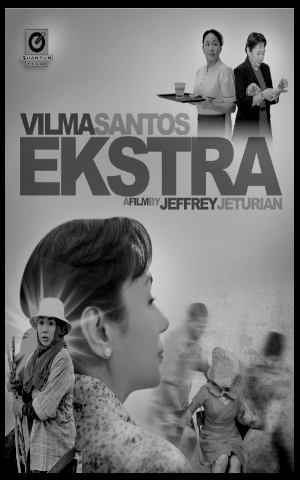
 Star For All Seasons
You must be logged in to post a comment.