FILM REVIEW: PALIMOS NG PAGIBIG (Video)

This slideshow requires JavaScript.

“Okay you’re fertile and I’m barren…pero sa mga pangyayari…para kang karinderyang bukas sa lahat ng gustong kumain!” – Fina

The Plot: On the outside, it looks like a marriage made in heaven. But inside the thick walls of what they call home, theirs is a relationship waiting to crumble. They have been wanting a child for so long, but the wife does not have the capacity to bear a child. And when her husband cannot take it any longer, he decides to end his misery once and for all. – IMDB

The story is about an infertile couple who never had a child of their own. The husband, frustrated by his wife’s infertility, hired somebody who was willing to carry his child. The hired woman got pregnant but she fell in love with the child’s father. The husband falsely adopted the child, hiding the fact from his wife that the child was his own. All the attention the husband gave to the child drove his wife to jealousy. To complicate things, the husband eventually had a secret affair with the child’s mother, and this affair produced another baby. The mistress left the newborn baby at the footsteps of the husband’s house. The wife then took care of the baby, and the children grew without their adoptive mother knowing that the two kids were fruits of her husband’s secret love affair. – Wikipilipinas

The Reviews: “…Eddie Garcia first directed Vilma in the Marcos film, Pinagbuklod Ng Langit. She reprised the role of eldest of the Marcos children, Imee and again co-starred with movie queen, Gloria Romero and dramatic actor, Luis Gonzales. Garcia directed Vilma again in 1982′s box Office Record Breaker, Sinasamba Kita. Three more hit films follows that gave us memorable movie lines like “Para Kang Karinderyang bukas sa lahat ng gustong kumain” in Palimos Ng Pag-ibig and “Si Val, si Val, si Val na walang malay!…” – (READ MORE)

“…Hit novels serialized in Aliwan Komiks were also adapted into movies:“Blusang Itim” by Elena M. Patron and Joey Celerio;“Pardina” by Jim Fernandez and Sonny Trinidad;“The Family Tree” by Pablo S. Gomez and Louie Celerio;“Palimos ng Pag-ibig” by Nerissa G. Cabral and Ernie H. Santiago;“Anak ni Zuma” by Jim Fernandez and Ben Maniclang;“Kamay ni Hilda” by Pablo S. Gomez and Louie Celerio…” – Wikipilipinas (READ MORE)

“…Palimos ng Pag-ibig (Filipino: “Begging for Love”) was a movie in 1985 and turned into a TV series in 2007 for the first installment of Sineserye Presents. This was from the original story by Nerissa Cabral. This movie was home of the famous tagline: “Para kang karenderiang bukas sa lahat ng gustong kumain!” (You’re like a restaurant that’s open to anyone who wants to eat!), In context of prostitution reference…” – Wikipedia (READ MORE)

“…Ang surrogacy or womb for hire, eh isang katotohanan na na­pagtanto nating lahat. Tinalakay ito in all its melodrama splendor sa Palimos ng Pag-Ibig, ang pelikula nina Vilma Santos, Edu Manzano at Dina Bonnevie. Sa movie, si Fina Alcaraz (Ate Vi) ay may infertile uterus. Desi­rous ang kanyang husband na si Rodel (Doods) to have a biological child so he hired Ditas (Miss D) na isang baby maker for a fee. Walang pros and cons ang surrogacy issue sa movie lalo na’t galing ang material sa komiks. Ang pinaka­memorable sa movie eh ang linya ni Vilma na, “Para kang ka­rinderyang bukas sa lahat ng gustong kumain.” Sosyalera si Ate Vi sa movie pero she can say lines like these…” – Alwin Ignacio, Abante Tonite, 22 March 2015 (READ MORE)

RELATED READING:
IMDB: Palimos ng pag-ibig (1986)
IMDB: Eddie Garcia
IMDB: Dina Bonnevie
IMDB: Edu Manzano
Eddie Garcia From Wikipedia
Vilma Santos’ Top 10 Film Directors (part three)
50 Famous Lines from Pinoy Movies (Video)

FILM REVIEW: BURLESK QUEEN

This slideshow requires JavaScript.

The Plot: To support her paralytic father, Chato (Vilma Santos) works as a utility girl for a burlesque star Virgie Nite (Rosemary Gil). But when Virgie gets drunk on the night of her scheduled show, Chato pitches in for her. And she becomes an instant sensation. Enthused by the initial acceptance of the audience, she defies her father’s admonitions and presents herself to the manager. And thus, becoming the new burlesque queen. – IMDB

To support her paralytic father, Chato (Vilma Santos) works as a utility girl at Inday Theater for a burlesque star Virgie Nite (Rosemary Gil). Chato desperately wants to earn money to help her ailing and paralyzed father. When Virgie gets drunk on the night of her scheduled show, Chato pitches in for her, and she becomes an instant sensation. Enthused by the initial acceptance of the audience, she defies her father’s admonitions and presents herself to the manager, thus, becoming the new burlesque queen. The aberrant lifestyle of a burlesque performer leads Chato to a misguided existence. She becomes pregnant and is abandoned by the father of her baby. Desperate for cash, she agrees to appear in a lavish stage show. In front of a screaming male audience, Chato bumps and grinds in a tour de force performance, unaware of the danger to her pregnancy. – Wikipilipinas

Chato (vilma Santos) performs girl Friday jobs for Virgie Knight (Rosemarie Gil), a burlesue star, to support her paralytic father. Harboring a secret desire to be a burlesque star herself, Chato grabs at her chance one night by taking over when Virgie get herself scandalously drunk because her parasitic lover, Ander (Roldan Aquino), blew out of town with another woman. Mang Roque (Leopoldo Salcedo), Chato’s father, learns about Chato’s onstage performance and vehemently restrains his daughter from doing it again. Chato meekly agrees. The story is set during the 50s, at a time when genuine burlesque, as an art and a form of entertainment, was dying, in large part due to the indefatigable agitation of traditional moralists, and the local politicians’ accommodation to these demands. To circumvent her father’s wishes, Chato and the burlesque show impresario, Louie Fernando (Joonee Gamboa), devise a stage personality for the young girl – she assumes the stage monicker of Tzarina, the masked goddess. Chato is irretrievably drawn into the whirlpool of the burlesque. Meanwhile, she carries on an affair with Jessie (Rolly Quizon), a law student and son of an anspiring politico. Mang Roque, finally burdened by his inutility, commit suicide; Chato and Jessie elope and the girl leaves the burlesque theater, apparently fo good. When Chato’s savings dwindle, Jessie is easily lured by his mother to return home and once again pursue his law studies. Pregnant and abandoned, Chato finds her life seemingly at a deadend. Her situation reflects the tragedy that hovers over Louie’s troupe and theater. Louie decides to hold a grand burlesque show to prove once and for all that burlesque is an art. Chato agrees to dance again in this show of shows. The film ends in a tour de force as Chato’s greatest performance grinds and bumps to a shattering climax. – Video48.blogspot.com

The Reviews: “…1977 propelled Filipino actresses to greater heights in Castillo’s Burlesk Queen which, incidentally made Vilma Santos an indubitable superstar. After Burlesk Queen, every actress then wanted to portray burlesque roles…” – Celso Ad Castillo Web-site (READ MORE).

“I have my own orientation in film criticism…because we’re Third World, to me a film is, first of all, a social document, then an educational tool, and third, an aesthetic experience. If I have to name three important Tagalog movies of all time based on these criteria, they would have to be Brocka’s Maynila sa Mga Kuko ng Liwanag – acutally I can name four – Castillo’s Burlesk Queen, Romero’s Aguila, Gallaga’s Oro, Plata, Mata.” – Rafael Ma. Guerrero, Film critic (READ MORE)

“…Tuloy-tuloy ‘yun…(the hospital scense with Vilma and Leopoldo Salcedo) nag-experiment ako noong una, kumuha ako ng second take, pero di ko na rin tinapos. Perfect na iyong una. Alam mo bang nang gawin namin ang eksenang iyon tatlo kaming umiiyak sa set? Ako, si Vilma, at si Leopoldo? Dalang-dala si Leopoldo sa pagsasalita ni Vilma, lumuha siya kahit patay siya dapat doon. Buti na lang di siya nakuha ng kamera…(Kung Nahirapan ka ba kay Vilma?) …Oo, hindi sa acting dahil mahusay talaga siya kundi sa scheduling. Alam mo kasi it takes time before I can really get into the mood of a picture, mga two weeks, tapos kapag nandiyan na, that’s the stage when I’m ready to give my life to the project. Tapos biglang walang shooting ng two weeks dahil busy siya sa ibang pelikula…” – Ricardo Lee, Manila Magazine, Dec 1- 31, 1977

“…More remarkable than Santos’ portrayal of the doomed burlesque dancer, is Castillo’s filmmaking. Set within the very patriarchal lower class Manila, Castillo posits the burlesque theater as not merely, as impassioned Louie points out, a place for highbrow entertainment for the masses, but also the window for the film’s female lead to become superior to her male oppressors. It’s a difficult metaphor to execute but Castillo successfully does so. The dancer, scantilly clad amidst the cheers and jeers of horny men, is easily regarded as the victim of exploitation. But in the film’s case, the stage becomes the dancer’s opportunity for leverage which is impossible in the outside world. The stage provides Chato ease from the outside world’s patriarchal clutches. She becomes financially stable on her own, temporarily free from her father’s influences, and powerful over thousands of men. Interestingly, Castillo stages a poetically sequenced scene of Chato’s devirginization within the theater. Jessie attempts to make love to Chato inside her dressing room, and the latter submits to the former’s sexual advances. Interspersed between their lovemaking (take note of the ballad that plays in the background as the lyrics talk of love amidst the entire world’s disapproval, very typical of the romantic declarations that inevitably falter over time) are scenes from the stage, a circus act of horrid penetrations: of a woman being juggled by a man, several magic acts, and more importantly, of a man hammering a nail inside his nostril, then puncturing his eye socket with a metal stick, finally commencing with him swallowing a long blade. Castillo’s juxtaposing Chato’s first sexual act with acts of unnatural and bizarre penetrations of the human body impart a clear message of invasion, of Chato’s theater where she is the goddess (her stage name is Tsarina the goddess) and almighty over all the men who watch her. The theater is no longer the same sanctuary; in a way, the theater’s magic has been tainted. She becomes pregnant and decides to stop dancing pursuant to her relationship with Jessie and pregnancy. Her devirginization within the theater becomes symbolic of her surrender to the outside patriarchal forces…Burlesk Queen is much more than a gripping commercial melodrama. It is also a scathing commentary on the sexual politics that has become the atmosphere of Philippine society: of hardworking women and the good-for-nothing men they serve; of a patriarchal society gone awry. It is also a fervent reminder of the redemptive and equalizing power of art. Multi-faceted, committedly acted, and very well-directed, Burlesk Queen, I opine, is an unsung masterpiece.” – Oggs Cruz (READ MORE)

“…Maging ang paglakad ng panahon ay nararamdaman din ng manonood kahit hindi ikuwento o ipakita ang kinagawiang pamamaraan at ulat ng “nalalaglag na dahon ng kalendaryo o dahon ng puno kaya”. Sunod-sunod na cuts na nagpapakita sa uri ng palabas sa tanghalang kinabibilangan ni Vilma ang ginawa ni Celso. Saka ito sinundan ng kuha naman sa bahay nina Vilma at Rollie. Nag-iinit ng tubig si Vilma habang nakikinig ng dula sa radyo tungkol sa buhay ng isang asawang tamad at iresponsable. Ganoon nga ang nangyayari sa buhay ng dalawa, at may kasunod ring “abangan sa susunod na kabanata”. Sa paghihiwalay ng dalawa, sapat na ring iparinig ang awiting You’re All I Want For Christmas, para buhayin ang irony na nagaganap sa relasyon ng dalawa. Kung makinis ang exposition at pagbuhay sa conflict ng istorya, malinaw rin ang paghahanda sa wakas ng pelikula. Si Rose na laos na ay naging mumurahing puta. Si Dexter kahit hindi ipakita ay maliwanag na sumama na sa ibang lalaki. Si Roldan ay may bago nang kabit at napatay sa spiral staircase ng tanghalan na siya rin niyang dinadaanan sa paghahatid sa dalawang naunang kabit. Si Rollie, ang mama’s boy, ay natural bawiin ng ina. Si Vilma ay nagsayaw-nang-nagsayaw. Sa simula’y mahinhin at nakangiti at kaakit-akit hanggang sa pagbilis ng pulso ng tambol at pompiyang ay naubusan ng ngiti, tumagaktak ang pawis at manghina ang ligwak ng kanyang balakang, upang sa pagbuhay sa damdamin ng manonood ay siya namang maging dahilan ng pagkalaglag ng sanggol na kanyang dinadala. Sa labas, matapos ang pagtatanghal, may tatlong bagabundong naiwan na nakatangkod sa larawang pang ‘come on’ ng burlesk queen, habang ang kadilima’y bumabalot sa kapaligiran…” – Jun Cruz Reyes, Miyembro, Manunuri ng Pelikulang Pilipino, Manila magazine December 1977 (READ MORE)

“…It was 1977 with an exceptional film, Burlesk Queen, that Castillo got his fIrst critical recognition. Entered in that year’s Metro Manil Film Festival, it was adjudged the Best Picture, won forhim a Best Director Award as well as nine other artistic awards. It told a young girl in Manila in the 50’s who wanted to become a burlesque dancer. It showed a subdued Castillo. He seemed in this film, to have held back his passion for visual impact to give way to his new mastery of film grammar. His characters cried and whimpered, they did not scream and curse. They delievered dissertations on art, not imprecations of wrath, which had set the pitch of his previous films. The critics fought bitterly over Burlesk Queen. In that festival, he was contending with film makers who enjoyed a high reputation among the country’s most avid film critics. Upon winning the award, Castillo instantly became the favorite beating boy of the critics who did not appreciate Burlesk Queen. To prove to them his worth, Castillo did Pagputi ng Uwak, a 50’s epic set in his favorite Southern Tagalog locale. It was the most lavish of all his productions and had all the elements of a “great” Filipino film. He exploited the many religious and social rituals typical of the region. The film featured the two most critically acclaimed performers of the time, Bembol Roco, Jr. and Vilma Santos, with the cinematography of Romy Vitug complementing Castillo’s visual sense. And it touched on civil unrest to underline the film director’s social awareness. Pagputi ng Uwak was a visual fest, an artistic and socially responsive film aimed at the critics. It was also Castillo’s first commercial failure after a string of more than 20 minor and major box-office hits…In just a decade, Castillo, with all his audacity and dramatic excesses, has claimed his place as one of the most versatile and genuinely interesting filmmakers in the Philippines today…” – Rosauro de la Cruz (READ MORE)

RELATED READING:

FILM REVIEW: PAGPUTI NG UWAK PAGITIM NG TAGAK

This slideshow requires JavaScript.

“…sabi mo pa nga nuon mahal na mahal mo ako…sabi mo pa na hindi magbabago ang pagtingin mo sa akin…dahil papaano mo papatayin ang hangin? Paano mo papatayin ang ulan? Paano mo papatayin ang araw? Sabi mo pa nga hindi mo na ako iiwan kahit na anong mangyari…kaya naisip ko nuon magpaligaw na ako sa’yo…kahit hindi pa pumuputi ang uwak, o umi-itim ang tagak…” – Julie

The Plot: “Pag-puti ng Uwak, Pag-itim ng Tagak” is a pulsating love story that recaptures the nostalgic fifties, the exciting era of mass hysteria, and the golden years of the rock and roll fever inflicted by screaming, wiggling hip-shaking foreign pop idols dominated by Elvis Presley, Bill Haley, Little Richard, Pat Boone, Doris Day and the Platters. “Pag-puti ng Uwak,Pag-itim ng Tagak” is more than a love story. It is also a commentary – a satire rich with humor injected into a moral, psychological, sociological, and cultural aspect, outlook, and values of the said bygone era. “Pag-puti ng Uwak, Pag-itim ng Tagak”, is a poigant rich-girl-meets poor boy love story of Julie Monserat and Candido Ventura – two love-struck starry eyed youths who fought for their right to love each other, here is a story that touches social conflict – the perennial clashes and discrimination between the rich and the poor. Julie grew up under the custody of her two wealthy spinster aunts Beatriz and Miguela Monserrat. Julie enjoyed everything, except the right to love her own father – Maestro Juan Roque, the poor town teacher. Julie met Dido a student-combo player. They fell in love with each other and had secret affairs. The aunts hated Dido for his ” lowly breeding and ear-splitting music”, thus rejecting him in favor of the town mayor’s son. Julie eventually got pregnant. They planned an elopement but was foiled. The conflict between the lovers and the Monserrat exploded into a series of scandals that rocked the whole town of Sta. Inez…” – Celso Ad Castillo (READ MORE)

“…Malakas ang deconstruction ng “Romeo and Juliet” sa obra na ito. Maraming reference (pinaka-given na siguro na ang pangalan ni Vilma Santos dito ay Julie) sa tragedy ni Shakespeare. Dito ko nakita si Celso Ad in a different light. Nage-gets ko ang poesiya ng mga nature shots n’ya sa ibang pelikula pero rito, klarong klaro ang pagkahilig n’ya sa literary classic. Pinakagusto kong shot eh ‘yung terrace scene na malakas maka-tribute. Wala kasi akong katiting na abiso tungkol sa pedigree ng pelikula at masayang naglalaro sa isip ko ang mga reference hanggang sa sumabog ito sa dulo na nagbigay konklusyon sa mga hinagap. Maraming eksena na may kilometric line si Vilma rito. Napaalala rin sa akin ang era kung saan ang sukatan ng isang pagiging aktres ay nasa haba ng mga linya na kayang mamemorya. Pinagsamang sensuality at controlled acting ang pinamalas n’ya. Maigting din ang chemistry nila ni Bembol Roco rito…” – Manuel Pangaruy Jr., Tagailog Specials Presents, 02 August 2013 (READ MORE)

Kuwento ng magkasintahang pinaghiwalay, na ipinaloob sa isang panahong dinadaluyong ang lipunang Pilipinong rebelyong Hukbalahap. Iyan ang buod ng ‘Pagputi ng Uwak, Pag-itim ng Tagak’. Dekada ng 1950 noon, at sa pista ng matandang bay an ng Santa Ines ay nagkatagpu-tagpo sina Julie Monserrat (Vilma Santos), Dido Ventura (Bembol Roco) at Maestro Juan Roque (Joonee Gamboa). Mula sa mayaman at makapangyarihang pamilya si Julie, isang ulilang pinalaki at pinapag-aral sa Maynila ng kanyang mga tiyang matandang dalagang sina Beatriz (Adul de Leon) at Miguela (Angie Ferro). Si Dido ay maralitang binatang ang Ina (Mona Lisa) ay may iwing poot sa mga Monserrat na kumamkam sa kanilang lupain at naging dahilan ng kanilang paghihirap. Si Maestro Roque naman ay kilalang kompositor at biyolinista na umuwi sa Santa Ines upang tapusin ang kanyang sarsuwelang pinamagatang “Pangarap ng Bagong Umaga.” Sa unang pagkikita pa lamang ay napusuan ni Dido si Jutie. Nagkahulihan ng loob ang dalawa, at isang gabi’ypinangahasang akyatin ni Dido si Julie sa kuwarto nito. Ang kanilang pagtatalik ay humantong sa pagtatanan. Nang magbalik ang magkasintahan upang humingi ng pahintulot na sila’y pakasal, si Julie ay pinamili ng kanyang mga tiya sa maginhawang buhay na kanyang kinagisnan, at sa walang-katiyakang hinaharap bilang asawa ni Dido. Nagdalawang-isip si Julie, at pinili niyang manatili sa pangangalaga ng kanyang mga tiya.

Masamang-masama ang loob ni Dido sa nangyari. Nang siya ay laitin ng kanyang kasintahang si Cristy (Olivia O’Hara), sinaktan niya ito. Nalaman ni Claro (Robert Talabis) ang ginawa ni Dido sa kanyang kapatid, at nagharap ang dalawa sa isang labanang mano-a-mano. Napatay ni Dido si Claro. Alkalde ng bayan ang ama (Mervin Samson) nina Cristy at Claro, kaya’t pinakitos nito ang mga pulis upang iligpit si Dido. Nang gabing lihim na kunin si Dido sa kulungan upang patayin, inambus ng mga Huk ang sasakyan ng mga pulis. Tiyo ni Dido ang pinuno ng mga Huk na si Kumander Salome (Lito Anzures). Sumamang namundok si Dido sa kanyang Tiyo. Minsang dumalaw sa bahay ng mga Monserrat si Maestro Roque, siya ay hinamak ng magkapatid na Beatriz at Miguela. Mula na rin sa mga tiya ni Julie, natuklasan niya na anak pala niya si Julie sa patay nang si Ana Monserrat. Nang magkahiwalay sina Julie at Dido, nalaman ni Maestro Roque na buntis si Julie. Ito ay dinalaw niya sa konserbatoryong pinag-aaralan ng dalaga sa pagka-biyolinista. Ipinagtapat niyang siya ang ama ni Julie. Tinalikdan ni Julie ang kanyang ama, subalit ang pagdalaw na iyon ang naging dahilan upang magpasiya ang dalaga na huwag ipaampon ang kanyang anak na isisilang. Nilakad ni Maestro Roque na pagtagpuing muli sina Julie at Dido. Isang gabi ng Mahal na Araw, nagkita ang magkasintahan at nakilala ni Dido ang kanyang anak kay Julie. Natunugan ng mga espiya ng gobyerno ang pagbaba sa bayan ng mga rebeldeng pinamumunuan ni Kumander Salome. Ang uha ng anak nina Julie at Dido ay nangibabaw sa masinsing putukang lumipol kina Dido at mga kasama. – Manunuri (READ MORE)

It is the 1950’s at the height of the Huk (local Communist armed forces) movement, in a part of the country beset with agrarian unrest. During the town fiesta of Santa Ines, Julie Monserrat is introduced to Dido Ventura and Maestro Juan Roque, an old musician. Julie, an orphan who comes from the local aristocracy, is on vacation from school in Manila, and is staying with her two spinster aunts Beatriz and Miguela. Dido Ventura, a young man from a poor family, lives with his mother who nurses an old grievance against the Monserrats; she believes they grabbed the Ventura’s property. Maestro Juan Roque, a well-known composer and violinist, has just returned to Santa Ines to finish a zarzuela he has been planning to write for a long time. Dido falls in love with Julie at their first meeting. One night, he sneaks into the spinsters’ house and spends a passionate night with Julie. The brief liaison leads to their elopement. When the two lovers return to ask for the aunts’ blessing, Julie is made to choose between a life of poverty and uncertainty with Dido, or a life of comfort and respectability with her aunts. Julie chooses to stay with her aunts. Dido is shaken by the turn of events.

He meets Cristy, his girlfriend, who insults him for the embarrassing situation he has gotten himself into. Dido turns roughly against the girl and beats her up. Cristy’s brother finds out about this and challenges him to a fist fight. Dido kills Cristy’s brother. Cristy’s father, who is the town mayor, decides to dispose of Dido immediately. But when his secret police nab Dido one night, the jeep taking them to Dido’s execution is ambushed by a band of Huk rebels led by Kumander Salome, Dido’s uncle. Saved, Dido decides to join his rebel uncle in the mountains. Meanwhile, Maestro Roque, on a visit to the spinsters’ old house to talk about Julie’s violin lessons, finds out that Julie is actually his own daughter by one of the Monserrat sisters now deceased. Julie herself is pregnant with Dido’s child. The old musician’s visit to her house and the ensuing revelatin make he decide to keep the baby. Maestro Roque arranges for Julie and Dido to meet again. On the night of Good Friday, Dido leaves the rebel camp to see his newborn child. Kumander Salome decides to go along with the young man. Government spies learn of this and an ambush is set. The child of Julie and Dido is the only survivor and witness of the masscre that ends the film. – Rosauro de la Cruz (READ MORE)

The Reviews: “…Compared to Burlesk Queen, Pagputi ng Uwak is less of a technical mess. Particularly exceptional are the shots of rustic religious rituals; unfortunately their use does not progress beyond the literal level. This makes for increasing predictability toward the picture’s end, as when the preparations for a military massacre are intercut with recitations of the tribulations of Jesus Christ. Attempts at authenticity appear to have been assiduous, but the project may have also proved too ambitious in this aspect. Thus one can find high-tension wires and Scotch-tinted car windows, not to mention recent beautification accomplishments, making their way into a 1950s period movie. Performance-wise Pagputi ng Uwak leaves a lot more to be desired. Among the cast, only Mona Lisa manages to pull off a convincing characterization as Bembol Roco’s mother. Angie Ferro and Adul de Leon, as Vilma Santos’ spinster aunts, are no better than caricatures: funny maybe, but quite incredible. Joonee Gamboa has mellowed since his rudimental portrayal of an impresario in Burlesk Queen; his role, however, is far less significant this time, reduced as it is to playing the intermediary between star-crossed characters. Executive producer Vilma Santos does better outside camera range. Her production is financially and artistically liberal, the sort the local audience has been deprived of since the dissolution of the previous censors board. Her performance though is about as effective as that of a drama guild’s star performer: she renounces her lover like she would a final exam, and later professors love for him like she would a teen idol. The same applies to Bembol Roco, about whose character more will be said later; suffice it to say that he still has yet to employ under-acting to his advantage. Meanwhile he and Santos are the industry’s star couple, and there one has the trappings of the star system at work again. Is there nothing at all to be said in favor of the movie? Come to think of it, Burlesk Queen did have a saving grace, and it is this same virtue – intention – which redeems Pagputi ng Uwak. In his works Castillo the artist seeks to depict the Filipino as only a fellow Filipino will understand, particularly in terms of pride and sentiment – values associated in Western aesthetics with melodrama. Which is what makes Castillo easy prey for local culture vultures: with technical excellence as a basic requisite for deserving favor, he falls short at first try; infatuation with alien modes of behavior further ensures their alienation from the obviously progressive statements he wishes to make…” – Joel David, Philippine Collegian/The Urian Anthology 1970-1979, 26 July 1978 (READ MORE)

“…Castillo-watchers who had to cringe at the amount of its acting that Castillo allowed or demanded from his actors and actresses, will be gratified at the quiet intensity of the performances in Pagputi ng Uwak. Although one is never convinced that Vilma Santos can indeed bow music out of violin, her characterization of Julie displays the maturing talent of an actress fast learning to explore and shape her emotional resources in creating a character. Bembol Roco is disadvantaged by the script’s focus on Julie, but he impressively communicates the change in Dido from reckless teenager to hardened rebel. The acting highlights in the film, however, are provided by the three capable stage performers playing supporting roles. At long last Jonee Gamboa has been allowed to shed the irritatingly mannered caricatures he has been made to do in his previous films. As Maestro Juan Roque, he gives a serene portrait of a man who sublimates the turmoil of his inner life into the music he plays and composes in a performance memorable for its restraint and sincerity. Angie Ferro tends to be over-empphatic in places, but her portrayal of Miguela effectively keeps the role from degenerating into a contra vida stereotype by touching it up with humor that is broad yet never out of character. It is Adul de Leon, however, who emerges luminously as a character actress of the first magnitude. Her interpretation of Beatriz is a piece of complex character portraiture all the more admirable for having made a role of rather limited range so persuasively human. Good performances are not unusual in Filipino movies. What is rare is that coming together of temperaments and skills that make film art possible. In Pagputi ng Uwak, Castillo’s work does not display anything that he has not already shown in his previous films. The fondness for story material that reeks of social overtones, the lyrical exuberance with which he invests starkly realistic situations, and the intensely theatrical confrontations among his characters – these have been qualities evident even in Castillo’s lesser works, where they are often pushed to absurd lengths. What has happened in Pagput ng Uwak is that the director has been able to bring to a focus his varied talents, and found fellow artists with temperaments congenial to his. With cinematographer Romy Vitug and musical director George Canseco, he seem to have found working partners who share his penchant for the poetic, and their collaboration has resulted in a film where narrative imagery and music fuse into a memorable whole…” – Bienvenido Lumbera (READ MORE)

Putting in place a dialectic that analyzes social reality as at once a corrupted condition and a transformable possibility. In this situation, Dido’s idealism is undercut as an illusion by Julie (Vilma Santos), a jaded but nevertheless sensible young woman who in turn opens herself up to a revision of consciousness. This dialectic, or reflexive reflection is important to scan the contradictions of milieu and to probe the context of whatever human action plays out. Without such dynamic, which eludes most films which dare to tackle historical reality of epochal significance, all manner of practice is ultimately facile and anomalous and rendering romance as a vital agent in the articulation of difference, the engagement with a higher force and the summoning of a love that transcends the limitations of conspiratorial cacophony. A film nourished by this premise cannot fail. The personas of spinster sisters Beatriz (Angie Ferro) and Miguela (Adul de Leon) along with Joonee Gamboa as music teacher and violinist Roque San Victores are rounded out. And society is a charged terrain of armed revolt, state control and resistance. Direction, screenplay, cinematography, editing, production design, music and the performance of a sensitive cast contribute to the comprehensive competence of Pagputi Ng Uwak… Pag-Itim Ng Tagak…” – Jojo De Vera, Sari-saring Sineng Pinoy (READ MORE)

“…This is the one film this year that could have made it to the classics, given good material, Romeo Vitug, and some good acting (Joonie Gamboa and Adul De Leon are stands out). There is too much background however; a weak establishment of relationship; an incredible move from the rebel group risking their lives for a solitary personal interest; the failure to bring out the Maestro’s (Joonie) reaction to the tragedy in an affair in which he is greatly involved. The triangle here is fascinating: arts, politics, and the heart. The maestro’s art recovers for him what frustrations of the heart reduce: the lover’s taking to underground activities plays a similar role; the woman’s art provides escape from emotional confusion. The heart, neglected, must sooner or later take its toll – and politics, strangely, because the least developed angle in the film (Bembol’s character is insufficiently portrayed), simultaneously takes its toll, in tragic proportions. It would be excellent if it were within the directorial intention to comment that, in fact, neglect of the political ultimately destroys everything. Such an extent, however, is believed by the fact that the ideal political figure in the film condones the needless risking of an entire group for a single romantic resolutions. Art, politics, and love come to a bad end, but what are the tones of this fatality? Or is it indeed fatality in the director’s vision? Let us close up on this vision. There are touches that have poetry and economy. The development of the courtship into a certain depth of involvement (undialogued lyrical scenes between Vilma and Bembol); a poignant moment of the affair is visually emphasized in a shot of the stairway, now empty, by which the woman seeks the lover she had just rejected; the agitation and the impending bid for resolution by the two aunts in the car coming from Manila where the heroine had refused to let them have their way in her affair as her mother before her had been too weak to do) – to name a few. It is discordant in a directorial angle that controls such elements rather well to splash local color profusely and allow the heroine’s talky summary in the end. If this show of extremes is calculated, an indication, let us say, of the nature of the Filipino character, the act of indicating is not established. That is, if the Filipino, as Castillo sees in him, is unfortunately often swamped by ceremonies, traditions and the like so much that he loses sense of self-direction, etc., this must be developed, and not slumped upon the final scene when the love-resolution is intruded upon by the pasyon, and finally by the deadly dogma of politics. Of course, again, it might be that this is how the view from the angle is, where by all comes to a tragic end, firstly, against all human idealism and praxis (an option that is too anti-man); sporadic superfluity which gives nothing, not even meaning. Many may not accept this as a valid realism. And, in any case, what happens then to art as an instrument not only of image-reflectiions, but also of reconstruction?” – Petronila Cleto, Pelikula, Atbp (READ MORE)

“…It was 1977 with an exceptional film, Burlesk Queen, that Castillo got his frist critical recognition. Entered in that year’s Metro Manil Film Festival, it was adjudged the Best Picture, won forhim a Best Director Award as well as nine other artistic awards. It told a young girl in Manila in the 50’s who wanted to become a burlesque dancer. It showed a subdued Castillo. He seemed in this film, to have held back his passion for visual impact to give way to his new mastery of film grammar. His characters cried and whimpered, they did not scream and curse. They delievered dissertations on art, not imprecations of wrath, which had set the pitch of his previous films. The critics fought bitterly over Burlesk Queen. In that festival, he was contending with film makers who enjoyed a high reputation among the country’s most avid film critics. Upon winning the award, Castillo instantly became the favorite beating boy of the critics who did not appreciate Burlesk Queen. To prove to them his worth, Castillo did Pagputi ng Uwak, a 50’s epic set in his favorite Southern Tagalog locale. It was the most lavish of all his productions and had all the elements of a “great” Filipino film. He exploited the many religious and social rituals typical of the region. The film featured the two most critically acclaimed performers of the time, Bembol Roco, Jr. and Vilma Santos, with the cinematography of Romy Vitug complementing Castillo’s visual sense. And it touched on civil unrest to underline the film director’s social awareness. Pagputi ng Uwak was a visual fest, an artistic and socially responsive film aimed at the critics. It was also Castillo’s first commercial failure after a string of more than 20 minor and major box-office hits…In just a decade, Castillo, with all his audacity and dramatic excesses, has claimed his place as one of the most versatile and genuinely interesting filmmakers in the Philippines today…” – Rosauro de la Cruz (READ MORE)

RELATED READING:

FILM REVIEW: RUBIA SERVIOS

This slideshow requires JavaScript.

The Plot: Sa umpisa ng pelikula, makikitang nag-aaral pa lamang si Rubia (Vilma Santos), Norman Ignacio (Mat Ranillo III) at Willie Trizon (Philip Salvador). Masugid na manliligaw ni Rubia si Willie kahit na alam na nito na may nobyo na siya’t pakakasal na sila sa pagkatapos ng taon. Nang malaman ni Willie na pakakasal na si Rubia ay naging desperado ito’t plinano na kidnapin si Rubia. Isang araw habang naghihintay ito ng taxi sa kalye ay hinablot siya nga pat na lalaki na tauhan ni Willie. Dinalo siya ni Willie sa isang cottage sa Cavite. Nagtangka si Rubia na tumakas at tumakbo sa labas. Duon siya ginahasa ni Willie sa tabing dagat. Matapos gahasain ay nagtangkang magpakalunod si Rubia ngunit pinigil siya ni Willie at binalik sa cottage. Pinag-isipan ni Rubia kung paano niya mapipilit si Willie na pawalan siya. Tinanong niya si Willie kung anong gusto nitong mangyari. Sinabi nitong gusto niyang pakasalan siya. Pumayag si Rubia na magpakasal ngunit kailangan nitong ipaalam sa kanyang mga magulang ang nangyari sa kanya. Natagpuan naman ng pamilya ni Rubia siya sa ospital at duon nito nagpasya na maghabla. Matapos ang hearing sa korte sa kabila ng pagmamakaawa ng pamilya ni Willie ay nasentensiyahan siya ng anim na taon sa bilanguan at magbayad ng 70,000 pesos. Samantala nanatiling nakakulong sa kuwarto si Rubia matapos ang kaso. Pinilit ni Norman na kausapin ang katipan at dito nalaman niya na ang dahilan ng pagkukulong sa kuwarto ni Rubia’y buntis ito. Pinasya ni Norman na bigyan ng pangalan ang pinabuntis ni Rubia at nagpakasal ang dalawa.

Nanatiling tahimik ang buhay ng dalawa’t nagkaroon pa sila ng isa pang anak. Nang 3 years old na ang batang naging anak niya kay Willie’y nag-umpisang mangulo na naman ito. Si Willie’y nakalabas ng kulungan pagkatapos ng tatlong taon lamang. Nung una’y pinagkaila ni Rubia sa asawa ang mga tawag ni Willie. Ngunit napuna na rin ito ni Norman nang mapuna niyang madalas ang asawa na umuuwi ng maaga sa bahay at nag-umpisang uminom ng valium at naging magugulatin ito. Pinagtapat na rin ni Rubia sa asawa ang panggugulo ni Willie at pumayag ito na payagan si Rubia na makipagkita kay Willie. Nang malaman ni Rubia kung saan sila magkikita’y si Norman ang pumunta sa usapan. Ang resulta’y nabugbog ito ng mga tauhan ni Willie. Dahil rito’y naging maliwanag na hindi sila titigilan ni Willie lalo pa’t minsa’y takutin si Rubia nang wala si Norman sa bahay at pumunta si Willie’t pinatay ang aso nila. Wala naman magawa ang mga polis dahil wala silang hard evidence na si Willie nga’y nanggugulo sa buhay nila. Pinasya ni Norman at Rubia na umalis na nang bansa at bumalik sa Canada kung saan sila ilang taon ring nag-aral bago naging doctor. Pinasya rin nila na ibigay sa kanyang mga magulang ang dalawang bata para sa kanilang safety.

Sa kasamaang palad, kinidnap ni Willie ang anak nila ni Rubia na si Vivian. Nagpunta sila sa mga pulis ngunit wala pa ring magawa ang mga ito dahil wala silang ebidensiya. Kinontak ni Willie si Vivian at gusto nitong makipagkita siya rito. Pumayag si Norman ngunit sumonod rin ito sa usapan. Kasama ng kanyang mga alagad iniwanan ni Willie ang magasawa at binantaan na sa susunod magsisisi sila sa kanilang ginawa dahil nga ang usapan ay si Rubia lamang ang gusto niyang makita. Tinakot pa ni Willie si Rubia’t kumuha ito ng bankay na bata at isinuot ang damit ng anak ni Rubia. Nalathala ito sa mga diyaryo at pinuntahan ni Rubia ang bankay laking pasasalamat nito’t hindi ang anak ang bangkay. Dahil rito’y nagpasya na si Rubia na kitain si Willie na hindi alam ni Norman. Kinita nga ni Rubia si Willie ngunit nasundan rin pala si Rubia ni Norman. Sa tulong ng mga alagad ni Willie ay itinali ng mga ito sa puno si Norman at muling ginahasa nito si Rubia sa harap ni Norman. Nagsisigaw ito ngunit walang siyang nagawa. Kahit ayaw ni Rubia ay napapayag rin siya dahil papatayin ni Willie ang kanyang asawa. Pagkatapos nito’y binugbog ng mga tauhan ni Willie si Norman at sinama si Rubia papunta sa kanilang anak. Sa dagat papunta sa isla kung saan naruon si Vivian ay kinausap ni Willie ang dino-dios niyang si Rubia. Pinangako nito na matututunan rin niyang mahalin siya. Hindi napansin ni Willie na nakahawak si Rubia sa sagwan ng bangka at ilang ulit nitong pinalo sa ulo ang nabiglang si Willie habang sinasabi ang salitang “hayup!” Hinanap nito ang baril at pinagbabaril rin niya ang nahulog sa dagat na si Willie. Narating ni Rubia ang isla at duon nito nakita ang kanyang anak na buhay na buhay at tinatawag ang kanyang pangalan. The End. – RV

The Reviews: “The second rape scene in “Rubia Servios” which stars Vilma Santos, is reminiscent of the rape scene in “Santiago”, shown in 1970. Instead of Caridad Sanchez as the wife who is assaulted in full view of husband Mario O’Hara, it has Vilma Santos and Mat Ranillo III. This coincidence is not surprising since Brocka also directed Santiago, and O’Hara, who has since graduated from supporting roles, is the scriptwriter for “Rubia Servios”. Vilma does not expose much skin and Philip Salvador (as the attacker) has his pants on, but the scene could well be one of the most realistic rape scenes on screen in a long, long time. The anguish in Vilma’s face and the lust in philip’s eyes blended so well the effect was dramatic rather than sensual. The real climax of the film, however, is the killing of Philip by Vilma with a paddle aboard a motorboat at sea. Lino Brocka, who directs Vilma for the first time, succeeded in muffling her sobs even in the most hysterical moments. To our mind, “Rubia Servios” is geared towards mature audiences. It is engrossing despite the lack of fancy camera shots and an almost chronological presentation.” – Ricky Lo (READ MORE)

Kung uri ang paguusapan, de-kalidad ang Rubia Servios. Kaya lamang, may sabit. Maraming butas ang iskrip ni mario O’Hara. Ang istorya ng Rubia Servios ay batay sa mga legal story ni Aida Sevilla Mendoza, at ito’y pumapaksa sa babaeng ginahasa ng kanyang masugid na manliligaw. Si Rubia (Vilma Santos) ay isang medical student na may kasintahang kaeskuweala, si Norman (Mat Ranillo III). Balak nilang magpakasal pagkatapos ng kanilang pag-aaral. Karibal ni Norman si Willie (Philip Salvador) na ayaw tumanggap ng kabiguan sa pag-ibig. Anak siya ng mayaman at maipluwensiyang pamilya sa Kabite. Kaya nang tapatin siya ng dalaga na wala siyang maaasahan, kinidnap niya si Rubia sa isang bahay-bakasyunan at ginahasa ito. Nang magkaroon ng pagkakataon ang babae, tumakas ito at isinuplong si Willie. Idinemanda ang lalaki at nahatulang mabilanggo ng anim na taon. Paglabas ng lalaki sa bilangguan, ginulo na naman niya ang buhay ng babae na ngayo’y asawa na ni Norman at may dalawang anak (ang una’y anak niya kay Willie). Dahil sa pananakot ng hui, nakipagtagpo si Rubia, at muli na namang ginahasa sa sementeryo sa harapan pa naman ng asawa. Kinidnap ni Willie ang anak niya para gawing pain sa pagtatagpo nila ni Rubia at para sumama na tio sa kanya. Ngunit nagkakaroon na naman ng pagkakaton ang babae na lumaban at sa bangka, hinampas niya si Willie ng sagwan, at pagkatapos ay binaril ang lalaki hanggang sa ito’y tuluyan nang malunod.

Simplistiko ang materyal at lalong simplistiko ang pamamaraan ni O’Hara sa karakterisasyon. Nagmumukha tanga ang mga tauhan (si Rubia at si Norman) samantalang medical students at naturingang doktor pa naman sial. Tinatakot na sila’y hindi pa sila humingi ng proteksiyon sa pulis. Ginahasa na si Rubia ay nakipagtagpo pa sa sementeryong madilim nang nag-iisa at nagpaganda pa mandin siya nang husto. At ang asawa niya’y wala ring utak. Biro mong sinundan ang asawa sa sementeryo nang nag-iisa! Dapat nga palang magkaganito sila kung napakakitid ng kanilang utak. Sa direksiyon ni Brocka, lumitaw ang galing ni Vilma Santos, at nakontrol ang labis na pagpapagalaw ng kanyang labi. Mahusay din ang eksena ng gahasa. Si Philip Salvador naman ay tulad sa isang masunuring estudyante na sinusunod lahat ang direksiyon ng guro. Kitang-kita mo sa kanyang pagganap ang bawat tagubiling pinaghihirapan niyang masunod: kilos ng mata, buntong-hininga, galaw ng daliri, kislot ng kilay. Limitado ang kanyang kakayahan at makikia ito sa kanyang mukha (na limitado rin). Walang-wala rtio si Mat Ranillo III, na parang pinabayaan para lalong lumitaw ang papel at pag-arte ni Salvador. Samantala, ang kamera ni Conrado Salvador ay hindi gaanong nakalikha ng tension at suspense, bukod sa napakaliwanang ng disenyo ng produksiyon ang pagbabago ng mga tauhan sa loob ng pitong taon batay sa estilo ng damit at buhok. – Justino M. Dormiendo, Surian: Si Nora At Vilma sa Gitna ng Basura, Sagisag, Feb 1979 (READ MORE)

Para sa akin naging matagumpay si Vilma sa kanyang pagganap bilang si Rubia Servios. Isang tour de force. Nuong una ko itong napanood sa Avenida ay namangha ako sa kanyang galing. Ngayon pagkatapos ng dalawanput siyam na taon pinanood ko muli ito’y hindi nababawasan ang aking pagkamangha sa galing niya. Paano mo ba isasalarawan ang babae na nagahasa? Paano mo ba isasalarawan ang babaeng nakidnapan ng anak at muling nagahasa sa harap pa mismo ng asawa mo? Isang mahirap na papel. At naisalarawan ito ni Vilma nang makatotohanan. Walang mga pagpopokos ng kamera para mag-emote. Makatotohanang pagganap. Special mention sina Mat Ranillo III at Philip Salvador. Dapat ay napahalagahan sila sa pamamagitan ng nomination subalit naging maramot ang organisasyon ng pestibal at isang acting awards lamang ang binigay nila. Panalo sana si Philip Salvador ng best actor award rito dahil damang dama mo ang kanyang karakter. Makikita rin kung gaano kaganda ng kanyang katawan. Meron eksena siya na nakaswimming trunks lang at talagang alaga pa niya ang kanyang katawan nuon. Si Mat naman ay sana nanominate bilang best supporting actor. Mahusay rin siya lalo na sa eksena kung saan nakatali siya sa puno at wala siyang nagawa ng pagsamantalahan muli si Rubia sa harapan niya ni Philip. Technically, nang panoorin ko itong pelikulang ito ay maganda ang resulta ngunit nang panoorin ko muli ng ilang beses ngayon ay makikita ang ilang flaws. Una na ang cinematography ni Conrado Baltazar. Maraming eksena ay hindi nasa tamang angulo. Merong eksena na nagsasalita si Ate Vi pero ang nakikita lamang ay ang kanyang nuo. Ang musical score ni Freddie Aguilar ay parang hindi bagay sa tema ng pelikula. Pati ang theme song na “Pagsubok” parang pang-politika at very “folksy” ang dating. Merong isang butas ang screenplay ni Mario O Harra. Nang umalis si Philip para iwanan si Vivian, ang anak niyang kinidnap, nang umalis ito’y sumakay ito ng kotse, pagkatapos nang dalhin niya si Rubia sa banding huli’y sumakay naman sila ng boat. Medyo nakaligtaan nila ang isang detalye na ito. Mabilis ang pacing na pelikula at maraming mga eksena talaga si Vilma na makikita mo ang pagaalaga ni Lino. Sayang nga lamang at hindi ito nakita ng mga hurado ng pestibal at maging ang mga manunuri ng taong iyon. – RV (READ MORE)

“…Perhaps, the most in “your face” reality-based role was Rubia Servios. Another transformation. An acting vehicle that even Madonna can’t accomplished, yes even with Evita! I considered Rubia as her most daring and demanding role surpassing Chato’’s BQ. Not only the role required her to be physical but also she has to show the emotion of being battered and abused, inside and outside. The pain in her face was visible while crawling in the beach. The rage in her face showed when she smacked the rapist, Philip Salvador using the boat paddle near the end. I can still feel it, the revenge. I remember I swore a number of times while watching her lift that paddle in the air and aimed at her rapist (Sige pa! Pataying mo ang hayup na iyan! I told to myself.) But the most poignant connection about this film and her role now as politician was her awareness of the abuse Filipina women has become accustomed to. There are a lot of Rubias who doesn’t have the courage to face their assailant. There are so many of them who will have no chance to avenge their fate. Most people will even think that they have provoked the rapist to rape them and they are partly to blame. Vilma as Rubia has made her emphatized the victims and be tough on crime like this. Rape, Crime & Justice, three issues that Vilma have to faced every single day as a mayor…” – RV (READ MORE)

“Rubia Servios,” on the other hand, does not dilute the message. Willy (Phillip Salvador), the son of a powerful and wealthy figure, is portrayed as totally evil, devoid of any redeeming quality. To screenwriter Mario O’Hara and director Lino Brocka, the province is the same as the city. Rubia Servios (Vilma Santos) is raped both in the city and in the country. Rubia kills Willy in the country. Violence unites all places. It is the “unity” of conception, scripting, design, and direction, in fact, that “Rubia Servios” is superior to “Atsay.” Lino Brocka does not waste shots in is attempt to create a Filipino classical tragedy. He subordinates everything to the building up of one emotion in the viewer, that of hatred of Willy. So despicable does Willy become at the end that, when he is murdered by Rubia, no viewer can say that Rubia is at fault. And yet, morally speaking, no one is allowed to take the law into his own hands. The law, in fact, put Willy in prison for the first rape. There is no reason to think that the law will not put Willy to death for the second rape. By conditioning the reader to condone Rubia’s revenge, Brocka succeeds in questioning one of our deeply-rooted moral beliefs.

“…Mula sa isang real life legal story ang Rubia Servios, namumuhunan ito sa ideya na ang masasaksihan ng mga manonood sa iskrin ay hindi likhang-isip lamang kundi talagang nangyari sa tunay na buhay. Hinimok ni Lino Brocka sa kanyang pelikula na pagmasdan ang babae sa konteksto ng ating lipunan. Bakit ganito ang nangyayari sa kababaihan? Dahil tinatanggap nating maging ganoon ang kanilang kundisyon sa lipunan. Kung pagkakasala ang pabayaang maghari ang mayayamang may kapangyarihan, nararapat lamang na ituwid ang pagkakasalang ito. Sa mga nakakaalam ng mga pelikula ni Brocka, pamilyar ang paggamit sa estratehiya ng melodrama. Sa ganitong paraan, ang focus ay ang paghihirap na pinagdaraanan ng pangunahing tauhang babae at ito ang nakababagbag sa damdamin ng manonood. Ngunit sa pagpuntirya ng emosyon, hindi matamaan ang paglinaw sa tunay na isyu. Si Vilma Santos bilang Rubia Servios ay hindi lamang mahusay na gumanap sa buhay ni Rubia kundi naging isa ring makapangyarihang talinghaga na nakapagpalusog sa teksto ng pelikula. Sa kabuuan, inaangkin ng pelikulang Rubia Servios ang kapangyarihan nitong lumikha ng katotohanan mula sa masalimuot na materyal ng reyalidad. Sa ganitong proseso, nailalantad ang isang piraso ng reyalidad upang mapanood, masuri at mabigyang-kahulugan. Sa kabilang banda, hindi rin makakatakas ang pelikula sa mga diskursong kumakanlong sa mismong puinupuna at tinutuligsa nito…” – Jojo Devera, Sari-saring Sineng Pinoy (READ MORE)

“…Rubia Servios, on the other hand, does not dilute the message. Willy (Phillip Salvador), the son of a powerful and wealthy figure, is portrayed as totally evil, devoid of any redeeming quality. To screenwriter Mario O’Hara and director Lino Brocka, the province is the same as the city. Rubia Servios (Vilma Santos) is raped both in the city and in the country. Rubia kills Willy in the country. Violence unites all places. It is the “unity” of conception, scripting, design, and direction, in fact, that Rubia Servios is superior to Atsay. Lino Brocka does not waste shots in his attempt to create a Filipino classical tragedy. He subordinates everything to the building up of one emotion in the viewer, that of hatred of Willy. So despicable does Willy become at the end that, when he is murdered by Rubia, no viewer can say that Rubia is at fault. And yet, morally speaking, no one is allowed to take the law into his own hands. The law, in fact, put Willy in prison for the first rape. There is no reason to think that the law will not put Willy to death for the second rape. By conditioning the reader to condone Rubia’s revenge, Brocka succeeds in questioning one of our deeply rooted moral beliefs. The unity that characterizes Rubia Servios contrasts sharply with the tendency of Eddie Garcia in Atsay to exploit Vitug’s versatility even at the expense of tightness. There are shots in Atsay, for example, which could easily be cut without hurting the film’s integrity. Even the train sequence, one of the best sequences in Atsay, is far too long. Rubia Servios is Lino Brocka’s film; Atsay is Romeo Vitug’s. Nora does an excellent acting job; but so does Vilma Santos, and Rubia is a much more demanding and difficult role. Edgardo M. Reyes is an established literary figure, but Mario O’Hara is much better screenwriter. Overall, Atsay may be much more impressive than Rubia Servios. In terms of challenging our moral and legal convictions, however, Rubia Servios is much more significant.” – Isagani Cruz, TV Times 1979 (READ MORE)

FILM REVIEW: DARNA AND THE GIANTS


The Plot: The second film after the massive success of Lipad Darna Lipa (Fly Darna Fly), Vilma Santos returned as Darna/Narda in Darna and the Giants. Directed by Emmanuel H. Borlaza, Giants was about X3X (Helen Gamboa) who infected ordinary people with serum that made them giants. The giants played havoc to the city and thank goodness Darna eliminated them before demonic X3X conquered the whole world. Now paired with Don Don Nakar as Ding, Vilma radiated the screen for the second time. Kudos to the tricky special effects that made the giants realistic. Ike Lozada stole the film though. His scenes were the funniest in years. Darna used a huge church bell to defeat him. It was unclear why the fat giant, Ike, were allergic to the sound of the church bell. Darna rung the bell to great effects, making the giant Ike felt excruciating pain in his ears. Darna then threw the bell on Ike’s head suffocating him to his immediate death. That alone made everyone’s theatre tickets worth every penny! And lots of pennies as the film became one of two Darna movies that featured Vilma Santos and both films became big box office hits of 1973. – RV (READ MORE)

Vilma Santos Stars in “Darna and the Giants” – Darna fights Alien Invaders and battles “X3X”, an intergalactic Warrior-Queen whose science performs genetic engineering on earthlings and turns them into Giants to bring the Planet Earth to it’s knees. Until Darna eventually kicks the crap out of her and the Giants. – International Hero (READ MORE)

The Reviews: “…Unang ginampaman ni Vilma Santos ang papel ni Darna sa Lipad, Darna Lipad! (Sine Pilipino, 1973). Isang pelikulang may tatlong kasaysayan kung saan nakaharap nito ang palagiang kalabang sina Valentina, Ang Babaeng Lawin at ang Impakta. Sa pagkakataong ito ay mga higante naman ang kinaharap ni Darna. Masasabing, sa pagganap ng aktres bilang Darna tuluyang bumulusok ang kanyang kasikatan. Tunay na akmang-akma dito ang pisikal na kaanyuan ni Darna. Nabigyan din ito ng panibagong bihis nang umpisahan ng aktres ang paglabas sa papel ni Darna. Sa mga naunang pelikula, kadalasa’y dalagita si Narda, at nag-iibang anyo lamang ito kung nilunok na ang batong nagbibigay kapangyarihan bilang Darna. Dahilan sa si Vilma Santos ang naatasang gumanap bilang Darna ay kinailangang ito rin ang lumabas bilang Narda. Sinimulan ng nobelistang si Mars Ravelo ang pagsusulat ng Darna taong 1947 sa magasing Bulaklak. Unang isinapelikula ito ng Royal Films noong 1951 na nagtampok kay Rosa del Rosario samantalang ginampanan naman ni Cristina Aragon ang papel ni Valentina at si Mila Nimfa naman ang gumanap na Narda. Masasabing tanging si Vilma Santos lamang ang nag-iisang aktres na gumanap bilang Darna sa apat na pagkakataon. Isang uri ng pagganap na tunay na nagluklok kay Darna bilang malaking bahagi ng kulturang Pilipino. Sa bawat pagkakataong ito ay tunay na inangkin ni Vilma Santos ang katauhan ni Darna na patuloy na nagbigay aliw sa mga manonood ng sineng Pinoy…” – Jojo De Vera, Sari-Saring Sineng Pinoy (READ MORE)

“Sine Pilipino got then hot young star Vilma Santos to essay the role of Darna. But the problem was, Vilma was hesitant to wear the two-piece costume. So, during their photo shoot for the publicity photos of the new Darna movie, she wore the Darna costume on top of her body stocking. Vilma was finally convinced by producers Douglas Quijano and William Leary to lose the body stocking and wear just the costume on the day of the press conference. The press people were surprised on seeing how sexy Vilma was in her Darna costume, which was back to the original red bikini and gold stars. Lipad, Darna, Lipad! (1973) is the first and only trilogy of the superheroine. It was a box-office hit on its first day of showing and considered a turning point in Vilma’s career. It was also the first Darna movie where Darna and Narda was played by the same actress. Unfortunately, there is no existing copy left of this classic film. Vilma starred in three more Darna films: Darna and the Giants (1974) and Darna vs. the Planetwomen (1975), which were both under Tagalog Ilang-Ilang Productions, and Darna and Ding (1980) under Niño Muhlach’s D’Wonder Films. Darna and the Giants was the continuation of Vilma’s first Darna movie and Darna again wore the gold bikini costume, while Darna vs. the Planetwomen was a rebooted version of the Darna origin, with Vilma’s Narda this time portrayed as a crippled teenager who was given a magical stone by a mysterious source. The costume is back to red this time with the stars on Darna’s bra also colored red and the headpiece, all gold. Darna and Ding was the last time Vilma played Darna. Her costume this time was sexier and more revealing. In this movie, she was joined by Ding who now has his own superpowers.” – Rico J Rod (READ MORE)

“…For the second time around Vilma, proves that her first Darna was no fluke. Darna And The Giants vanquished all of her box office competitors. Very creative special effects by Tommy Marcelino consider it was made early in the 70’s. Sex kitten Divina Valencia as one of the giants as well as Ike Lozada, Max Alvarado, Zandro Zamora and many more. Vilma was the third actress to play the dual role of a teen-age Narda, Darna. Gina Pareno had two alter ego’s in her own version as well as Liza Moreno played Narda and Darna in Sputnik VS. Darna. Vilma also changed Darna’s transformation in all of her Darna films by using a flash of light instead of the thick smoke. She dons a retro version of Darna with shiny gold and red costume and matching platform boots. In this film Vilma was no hold bars. Romy V. Susara and Leody M. Diaz choreograped Darna’s awesome fight scenes. Continuing where “Lipad, Darna, Lipad” left off, Narda (Vilma Santos) and Ding (Dondon Nakar) encountered their greatest challenge yet – The Alien Warrior Queen-“X3X” (Helen Gamboa) and her alien minions. In this latest adventure, X3X terrorizes Narda’s village and captures several of the townsfolk and transforming them into mindless Giants who went on a rampage across the countryside in the hopes of conquering the earth without the use of nuclear weapons. When Narda’s suitor Romy (Romeo Miranda) is captured, the threat of the alien Queen becomes personal. With a Global threat such as this, will Darna’s courage and powers be up to the challenge? Watch and find out!! “Darna and the Giants” Also stars- Katy Dela Cruz as “Lola”, and an all-star cast of 70’s icons with cameos from Leopoldo Salcedo, Edgar Mortiz, Eddie Peregrina, Nick Romano, Lotis Key, Tony Ferrer (as Falcon) & more. “Darna and the Giants” produced by Tagalog-Ilang Ilang production and directed by Emmanuel H. Borlaza with Darna Theme composed by Sunny Ilacad (Vicor)…” – Eric Cueto (READ MORE)

“…Dramatically speaking, Darna and the Giants is more consistent (and coherent) than the later Darna at Ding (the only other of the series I’ve seen to date). The early narrative focuses on the home life of Narda, the romantic advances of a local young man and the bothersome antics of Ding. There’s quite a lot of singing here (Narda’s wooer is a musician), including an amusing moment where the cast spontaneously erupts into a Tagalog reworking of Singin’ in the Rain while doing household chores. There are the expected comic interludes, like a guitar-toting suitor realizing he’s been serenading a homosexual man as opposed to an attractive rural woman, but fewer than one might imagine, and once the aliens have landed things take a more serious turn. Darna and the Giants actually shows us the aftermath of a giant attack before introducing the giants themselves, with Darna and Ding visiting an impromtu outdoors hospital for the many victims. It’s not a happy sight, as a husband watches his wife die in agony and a young woman searches futily for her lost mother. When the giants are revealed they turn out to be intolerable bullies who fight amongst themselves before being sent out to frighten the local population into submission. And frighten they do! The giants prove to be a nasty bunch, crushing people beneath their feet and using uprooted power poles to swat at them like bugs. Houses are picked up and shaken about with their occupants still inside, only to be tossed casually aside when the giant’s attention is otherwise diverted. The death on display is quite graphic for all-ages entertainment, and ensures that our sympathies are squarely with Darna when she flies in to give the over-sized miscreants their just deserves…I can’t help but wonder if there isn’t a simple political message to Darna and the Giants.

The film was released just two years after president Ferdinand Marcos instituted martial law in the Philippines. The resulting censorship of opposition opinions in the media (scripts for films had to be screened by the government before production was allowed to begin) would have prevented direct opposition to Marcos’ methods to be espoused, but the simple story of a 006giant army trampling on the rights of the general populace could easily have slipped by as pure fantasy. Even if not directly relatable to that contemporary situation, the conflict undoubtedly played well with a country occupied in the past by everyone from the Spanish to the English to the imperial Japanese. This was the big Christmas season release for Tagalog Ilang-Ilang Productions, and it’s obvious that a good deal of money was put into it. The plentiful special effects moments were devised by effects man Jessie Sto. Domingo and special photographer Tommy Marcelino. The giants are brought to life through simple photographic effects and, more frequently, the use of massive forced-perspective setups requiring hundreds of extras to run about in the background while the giants stand among scaled miniatures in the foreground. It all looks pretty quaint by the industry standards of today, but the shear enthusiasm of those involved is deserving of admiration all the same. I imagine this was quite a succesful domestic release in its time, the star power of the beautiful Vilma Santos being more the enough to guarantee healthy ticket sales. The rest of the cast is full of recognizable industry regulars. Divina Valencia [Pussy Cat, Queen of the Wild Bunch] receives second billing in spite of her few lines, but has definite screen presence as a giant in a Viking helmet. Max Alvarado, who seems to be in just about every Filipino film production since 1950, has a prominent role as a giant as well – a role he would reprise in the fantastic opener for Darna at Ding…” – Kevin Pyrtle, WTF-FILM (READ MORE)

RELATED READING:

FILM REVIEW: D’LUCKY ONES


The Plot: Tina (Eugene Domingo) and Lea (Pokwang) are best friends who are also avid fans of Vilma Santos. They were inseparable until Lea decides to leave the country and go to Korea. They promise that someday they will really become one big happy family when their children get married. Years after, by virtue of an old vow, Lucky Girl (Sandara Park) and Lucky Boy (Joseph Bitangcol) are forced to be together by their mothers. Problem is, they hate each other’s guts. But, just when they’re falling for each other, love plays a trick on the meddling moms which threatens to bring the young lovers apart – IMDB (READ MORE)

The Reviews: D’Lucky Ones is one of those oddball, low budget comedies that still fill movie theaters in The Philippines. Hollywood would never make this movie, not because Americans have so much better tastes in films, but because it now costs too much to make B films (as they used to churn out in droves). That’s television’s job. Two best friends are both avid fans of actress Vilma Santos. They know her movies by heart. When one takes a job in South Korea, they promise that her daughter will marry the other one’s son when they both are old enough. They name the girl Lucky Girl and the boy Lucky Boy after one of Vilma’s children, Luis “Lucky” Manzano. Of course they don’t consult the children, who hate each other because of an incident they both remember differently, at a party when they were both young. When the one friend returns to The Philippines with her daughter, the girl is determined to get her revenge on Lucky Boy. What follows is a typical screwball sequence of events and misunderstandings. Lucky Girl winds up staying in the same apartment with Lucky Boy, to hide out from her mother and her plans to marry the girl to Lucky Boy, and doesn’t understand who Lucky Boy is, and gradually starts to fall in love with him. Lucky Boy, however, is working hard to get his revenge on Lucky Girl. He even gets her arrested for picking flowers at the entrance to Lunetta (Rizal Park). Considering the things that go on in the park, you’d think the police would have other things to worry about besides picking flowers, but it’s funny just for that.

Then there’s the silly subplot where the two friends, while trying to search for Lucky Girl, somehow fall in with a handsome young man, and both of them are fighting each other for his attention. It’s clear that he has no romantic interest in either one, who are both old enough to be his mother, but he’s hanging around as a friend. The two mothers go to a bar and join in a dance contest to impress the young man. They make their two children look incredibly mature by comparison. There’s one intense scene between Lucky Girl and her mother where Lucky Girl learns that her South Korean father abused her mother, and all the inlaws hated her because she was Filipino rather than Korean. Many times they would not allow her stay in the house with her daughter, but she begged for food on the streets. Watching Vilma Santos movies was her escape from this reality. This may also make Lucky Girl rethink her preference for living in South Korea over The Philippines (she’d been planning to return to the only country she knew as home. Heck, she only knew how to speak Tagalog from her mother forcing her to watch Vilma Santos movies.) The ending is obvious. Send the Vilma Santos fans to a Vilma Santos reunion party and get Ate Vi (Older Sister Vi) to patch up the two friends. And then everybody gets to dance. Hey, it’s The Philippines. Make sure you are better able to survive catastrophes than the crew and passengers of The Titanic. Get emergency preparedness kits now. Disabled and senior citizens need to check out an emergency medical alert system. – That Awesome TV (READ MORE)

“It’s obvious that ABS-CBN values Vilma Santos so much. After making a movie that is an unabashed tribute to her from start to finish, “D Lucky Ones,” they now feature her in the 15th anniversary presentation of “Maalaala Mo Kaya.” “We love Vi as she’s not only a nice person but also a true professional, a committed artist who loves her craft,” says Charo Santos, top ABSCBN executive and host of “Maalaala Mo Kaya.” “Fan na niya ako since her Vi and Bobot days and Iove seen her evolution as a person and as an actress. Kahanga-hanga talaga siya at ang kanyang magandang kalooban, it just radiates. You cannot fake that dahil galing talaga ‘yun sa loob. We’ve long been inviting her to guest in “Maalaala” and she was the one who gave us this story of Mrs. Daisy Hernandez, a mother so devoted to her eldest daughter who had cerebral palsy.” “I met Daisy at the SPED, special education school for special children, in Lipa,” says Ate Vi. “I met her daughter, April. Then I didn’t see her for sometime and I found April has died na pala. I told her to write down her story then I gave it to Malou Santos who thought of doing it for “Maalaala.” We started taping this last year, pero magka-conflict ang skeds namin ni Direk Olive Lamasan, so it took 6 and a half days to tape it over a period of one year at natiyempo sa anniversary ng ‘Maalaala’ at pang-Mother’s Day presentation pa.” “This is the show’s 777th episode,” adds Charo. “Maalaala has been made into a film in 1994 that gave awards to its stars, Aiko Melendez and Chin Chin Gutierrez. It has given the break to many directors like Wenn Deramas, Jerry Sineneng, Rory Quintos, Gilbert Perez, Mac Alejandre, Lauren Dyogi, Ricky Davao and Michael de Mesa. We’re proud to have Vi for our anniversary show that will be shown on May 4 and 11.” We’ve seen the preview of the episode, entitled “Regalo,” and it’s really a tearjerker that aims to wring your tearducts dry. Her fans will surely be proud of their idol anew as she shines in several scenes where she gets to deliver kilometric lines. It’s a great acting vehicle for any actress worth her salt and Ate Vi truly does justice to the role of a mother who does everything to support her disabled child only to lose her later to a viral infection. All throughout the death and wake of April” (convincingly played by Maja Salvador), Vilma is not shown crying at all. She finally breaks down after the funeral while talking to her husband (Ricky Davao, who’s equally great) and delivers some lines that will surely be added to the list of classic dialogues she has uttered in her past films and that were all used in “D Lucky Ones.” If you’re a parent with a special child, you’d be able to identify with her role. But even if you’re not, you’d still be affected by this true story of unconditional love and sacrifice. Incidentally, we finally got to see “D Lucky Ones” and we’d like to congratulate Director Wenn Deramas for succeeding to make us laugh. There are many hilarious scenes in the movie that even non-Vilmanians will appreciate, thanks to the fine performances of Eugene Domingo, Sandara Park and Pokwang. Eugene is the best among them as she doesn’t exert too much effort in tickling us. Sandy is also a natural comedienne, but Pokwang can go over the top at the times she should have been restrained a bit. The film has two highlights. First is the dance showdown between Eugene and Pokwang at the Phi Bar where they get to re-create the intricate production numbers Ate Vi used to do in her TV show. The second one is the film’s climax where Ate Vi makes a special guest appearance to reconcile the warring Eugene and Pokwang and then does a dance number with the entire cast. Most local comedies fail to make us laugh, but this one really works. – Charlie Gomez (READ MORE)

“Stand out sina Pokwang at Eugene Domingo sa D’ Lucky Ones, kung tutuusin supporting roles lamang sila dito. Nag-mukhang sina Sandara Park at Joseph Bitangcol ang supporting, dahil nadala nila ang tunay na ibig sabihin ng pagiging isang tagahanga. Litaw na litaw ang paghango ng mga linya mula sa mga pelikulang Sister Stella L., Bata, Bata Paano Ka Ginawa at iba pang pelikulang pinagbibidahan ni Ate Vi. Oo, sila nga ay die hard fans ni Vilma Santos, at dahil dito, ang pelikula ay isang Success. Well, it’s a crime to say that Pokwang and Domingo are supporting roles, in the first place, they are the ones who named their kids “Lucky”. Lucky girl and Lucky boy. How sweet ain’t it? Every single bit revolves around the two mothers, they practically OWN the movie, everytime they are on screen they demand presence. Especially, on the Vilma quote bits, they deliver each line right to the pulp. It was so hilarious because i’ve seen those films, and they’ve captured Vilma’s nuances and mannerisms.There was one part in the film when Eugene Domingo started quoting Vilma Santos in the film, Pahiram ng Isang Umaga, complete with the white free flowing dress, they even shot it on the beach, it’s oozing with cheese, it good, if you get my drift. If that wasn’t enough, they even had a dance showdown at a comedy bar, according to Pokwang, they’re just dancing just like Vilma did in the movie Burlesk Queen. Forget about Park and Bitangcol, the film belong to the two stars of all season. Majority of the jokes in the film will be lost in translation to those not familiar with Vilma’s films, and to this note, it is a film not for everyone.” – Eboy Donato (READ MORE)

“It’s been called the ?happiest movie? of this summer season, and indeed laughter rings out often and loudly in the movie house while “D’ Lucky Ones” is being shown. Much of the credit for the laughter and guffaws, as well as the charm and overall lighthearted feeling of the movie, goes to the tandem of Pokwang and Eugene Domingo. Playing a pair of die-hard Vilmanians (fans of Vilma Santos, for those out of the show-biz loop) who end up lifelong best friends who “pledge” their children to each other, the comediennes ham it up shamelessly and set the film’s blistering pace of razor-sharp dialog and comic antics. The two had previously made a name for themselves as “supporting” characters, comic foil to romantic leads or as “best friends” to beleaguered heroines. Most TV viewers, though, will remember them as “housemaids” in one telenovela and sitcom or another, a role that every aspirant in these parts needs to nail, it seems, before she can join the comic sorority. They might have been stuck indefinitely in this purgatory of second leads had it not been for “D’ Lucky Ones,” a movie that puts them front and center, gives them plenty of room and screen time to show off their chops, and allows them to mouth lines that parody the most memorable scenes from Ate Vi’s body of work-at once familiar and risible.

While the “lucky ones” in the movie are actually Sandara Park and Joseph Bitangcol, who play Pokwang’s and Eugene’s “Lucky Girl” and “Lucky Boy” respectively, the movie really centers around the mothers, who so dominate and beguile that I found myself distressed and bothered each time the movie left them and devoted time to the “love story” angle. I’M sorry to say that Park and Bitangcol, notwithstanding their “real-life” romantic relationship, hardly register any chemistry between them. Park is difficult to understand, since she has a tendency to let her Filipino lines run together. Bitangcol has yet to feel at ease before the camera, since his acting seems to consist mainly of poses and facial mannerisms. At times, one can even catch him sneaking a furtive look at the camera when he shouldn’t. So it’s safe to say that the movie succeeds despite them, which is why I hope producers don’t attribute any magical box-office prowess to the youngsters. Instead, they should pay attention to the newly gained clout of Pokwang and Domingo who, like Ai-Ai de las Alas, labored in obscurity before proving that screen charisma has little to do with an actor’s looks or figure, and everything to do with the ability to connect with the audience. Perhaps it also helps that “D’ Lucky Ones” takes a fond look at fandom, an occupational hazard for any consumer of entertainment fare, and the lengths fans go just to pay homage to their object of affection, adoration and adulation. The “Nora” and “Vilma” fans are particularly fascinating, since the two women commanded extraordinary levels of loyalty in their heyday and even today, no matter the intriguing twists and turns of their life stories.

MY friend Peachy and I-whom I roped into watching “D’Lucky Ones” after all family members refused my importuning-had an interesting discussion about the nature of Vilmanians and Noranians. We both agreed that the overall tone of the movie, which is “happy” and “sunny” and pastel-toned, wouldn’t have been possible if it had been about Nora’s fans. And this is because Nora’s oeuvre is dominated by darker and grimmer movies that don’t lend themselves easily to comic parody or satire. I consider myself a Noranian, but the film turned me into a Vilmanian, and when Ate Vi no less turned up at the movie’s finale, I felt a thrill, vicariously diving into Pokwang’s and Eugene’s obsession. I also felt a surge of appreciation and gratitude for the work of Vilma and Nora, who have dominated show business in the last decades, coming up with a truly admirable line-up of movies, showing courage in their choice of new challenges and off-beat characters, and maintaining a hold on their fans’ affections. Fans can be pests, that’s true. They tend to take their “ownership” over their idols much too seriously, to the extent of stalking them, dictating their love lives and setting up outsize expectations. But over the years, they can provide a source of affirmation and validation, especially when the bloom of one’s stardom has started to fade. Neither is this a one-way street. As Pokwang’s character reveals, watching Vilma’s movies and tracking her career provided her the only source of solace in the years she spent as a contract wife in Korea, looked down upon by her in-laws and reduced to a superfluity. Indeed, amid the vexations of daily life, being a fan provides escape and entertainment, another level of reality and a pleasant diversion. Not a bad bargain, that.” – Rina Jimenez, April 30, 2006 (READ MORE)

“…I have no question about the talents of Eugene Domingo and Pokwang when it comes to making people laugh. They know how to deliver. They give good punchlines. They can make both a simple dialogue or an already very funny line to come to terms with their humor altogether. Their characters as big Vilma Santos fans who have vowed to marry their children when the right time comes work for the comedy. But the thing is, removing all the other characters in the movie, the comedy can stand alone with Eugene and Pokwang only. Candy contributes to the humor but her character is not a vital thing in the story. Sandara doesn’t give the right timing to deliver a dramatic line or transcend the needed emotion for a scene. Nevertheless, her ‘krung-krung’ aura adds up to the comedy. Joseph has a very superficial acting. He has no depth for his character and he seems to just read and deliver his lines coming from the script. JR Valentin’s role is obviously made for the fun and for that added spice to the story’s conflict. He seems like the usual sex object exploited in the big screen (this time the sex object is a guy!) and he seems to work after all. He knows how to carry himself for the scenes without upstaging or downstaging Eugene and Pokwang. He blends with them for his sex object role. The dance numbers remind me of the 80′s flicks where such production numbers are always present in a number of flicks of the era. It’s like the 80′s dance numbers meet present day novelty songs. They are fun and the masses seem too enjoy it well. The production design and lighting department are not so impressing for this movie. Eugene’s face has not changed a bit during the flashback scenes. Additional effort for the make-up could have saved it. The room of Joseph looks newly-arranged by the art department. The set and props all look brand new when in reality, some things should have looked a bit crumpled or fading. But the funny wardrobe of Pokwang and Eugene looks effective for the genre. The editing is not seemless. Though for just a few seconds, I have noticed an overexposed shot after the bus scene. The closeup shot of Sandara during a dramatic scene with Pokwang is out of focus…” – Rianne Hill Soriano (READ MORE)

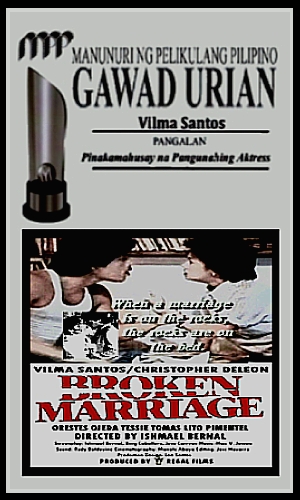
FILM REVIEW: BROKEN MARRIAGE


The Plot: After ten years and two children, Rene and Ellen find their marriage on the brink of breaking up. They seem to have fallen out of love and life has become a series of verbal hussies and conflicts. They decide that the only way out is a temporary separation. Rene, a police reporter, and Ellen, who is a television production assistant, begin to live apart from each other. Rene moves into his friend’s apartment while Ellen has to cope with running a household by herself. But they soon begin to feel the effects of their separation. A series of events that follow drastically change their lives. Rene is mauled for his expose of a gambling casino owned by a high ranking government official. He is forced to stay temporarily in the house of Ellen’s mother. As he recuperates from his injuries, both he and Ellen attempt to rebuild their shattered relationship. – Manunuri (READ MORE)

Demanding careers and two children have left Ellen (Vilma Santos) and Rene (Christopher De Leon) with a rocky marriage. A trial separation follows, and soon enough, the consideration of divorce — a serious taboo in Filipino culture in 1983. Orestes Ojeda co-stars as a new flame who lights up Ellen’s life. Prolific director Ishmael Bernal directs a heart-tugging script that he co-wrote with Bing Caballero and Jose Carreon. – Netflix (READ MORE)

The Reviews: Broken Marriage comes as a second wave to the noisy ripple created by Vilma Santos’s award-winning performance in Relasyon. The Regal people have banged their bongos so much harder this time that viewers will expect that Ms. Santos’ cards for this year’s awards derby will be more than secure. The hint is that Broken Marriage is a Vilma Santos movie. Lest the moviegoer expect too much from this year’s quadruple winning best actress, he should be forewarned that the movie is about, well, a broken marriage.

After more than 10 years of marriage, two young persons find each other repugnant. Ellen is a television floor director who hops from one set to the other shooting sitcoms and soaps. Her husband, Rene, complements her rapid lifestyle in investigative reporting. The movie commences with Ellen coming home in the morning from overtime with a crew party on the side. Rene greets her with an ugly nag. The house turns topsy-turvy as they proceed to hurl invectives against each other.

The exchange is extremely exhilarating; and just as the viewer breathes a sigh of relief, another quarrel starts and ensues as if it were the final assault.

Eventually, they decide to separate at the cost of their boy’s understanding nod and their little girl’s distaste. Rene moves to a house populated with such absurd characters as an artist who carves sexy sculptures, a friendly bit-part actor, and a gay art director who cuddles the upstart. Ellen, meanwhile, has to see to it that the children are not left out in their school activities – even standing as an athletic parent during one of her boy’s scouting engagements. She also has to check the advances of her bodyache-complaining producer, to whom she later gives in anyway.

Gradually, the two people realize the great loss that comes with division. Ellen, with the two children, is forced to move to her mother’s place after her house is burglarized, thus realizing the difficulty of an unmanned house. Rene substitutes a whore in the absence of his wife’s caresses. It is when Rene gets beaten up by a city mayor’s goons for nearly publishing a detrimental article and is constrained to recuperate in his mother-in-law’s house that the couple starts patching up the seams of the rent relationship. The ending is of course happy: reconciliation, what else?

Comparisons dawn inexorably: how does Broken Marriage fare as a follow-up to the bravura of Relasyon? This is tough inquiry. If intentions were to be the starting point, then the new movie is a better achievement. Relasyon, judging from its title, was supposed to be about a man and other woman relationship; but the feminist tendencies of our cinema had pinned the movie to a fateful drift: the travails of the modern mistress. Broken Marriage never swerves from its goal; from start to finish it is a portrait of two persons and the bond which they discover smothering and smoldering.

But the ordinary moviegoer does not assess by artist’s intentions – he does not even care about the artist (I mean here the one behind the work. On one hand, the film in front of him is the present; and on the other hand, it is the past. Broken Marriage is made to appear to him as a sequel to Relasyon. The process of integrating the past and the present is a challenge for him. For him are opened two avenues: to start with past and proceed with present; or start with present and proceed with past. If he chose the former, the condemnation for Broken Marriage would clang like a wild cymbal. If he chose the latter, the outcome is a laudatory comment).

Nonetheless, one has to prove that the new movie can stand on its own feet. What Relasyon sadly lacked (albeit not too sadly) was humor. Broken Marriage has tons of it – the caustic swaps, the funny characterizations, the clever plottings – so that the audience’s conditioned response for a supposedly serious movie shifts irrevocably to playful irreverence. Vintage Ishmael Bernal.

It is a masterly stroke – the proverbial Bernal sleight-of-hand at work, this time with more gusto and style. If the Inquisition were still around, he would be branded and burned seven times as a heretic for turning a marriage gone sour into an off-beat frolic suddenly turned sweet – at least, to the viewer’s mirth-hungry belly.

But none may claim that Bernal’s treatment loses its mark of delineating the disadvantages of separation. The humor chisels the message so that it comes to us shining and double-edged, while doing its duty of alleviating an otherwise gloomy impression which accompanies every disillusioning subject matter.

Not only does it come through humorously but also simply. Nowhere is the strain which anyone expects from grave subjects present here. It is as if the dreary topic had been borne on the Lord’s shoulders so that the yoke – and audiences love to be martyrs of maudlin tears – becomes, this rare time, light and easy. The scene where Rene visits his family and finds Ellen and the children agitated by the swift burglary of the house, and the producer wrily comments “Mahirap talaga ang walang lalaki sa bahay”(It’s difficult to have no man in the house) is casual but very biting so that the urgency of the hero returning to his gamily throbs mercilessly like a set clock.

In the same way, Bernal shows Ellen’s retrospective mood minus the conventional flashback: her younger sister is engaged to be married, and Ellen watches the two lovebirds running like children, with a bright but painful smile, even with jealousy, knowing that after the ceremonies, the two will lose the innocence which tradition stifles. This is a repetition of the technique Bernal used in Relasyon – the mistress attending the wedding of her cousin – with just the same effect, namely, sympathy.

The screenplay plunges right into the boiling point, the issues hurled to the foreground like machine-gun fire, the familiar scenes of hatred and division treated like aimless confetti so that the audience neither breathes nor is excused. It jolts us at the outset and after the terrible whipping, when the squabbles lessen and finally ebb into peace, we realize that these two handsome people must have had only one tragic flaw: they did not keep mum for a while.

Manolo Abaya’s cinematography dances with the jetstyle rhythm of the two protagonists. From the clever blocking of the morningjumble scenes to the hurried bustle of the television studio, Abaya’s camera sweeps avidly and flawlessly. In his hands, the incessant quarrels of Rene and Ellen seem like a vengeful lovemaking. The long shots, conventions of a Bernal, are more developed here. Above all, Abaya’s camera has humor and pathos.

The production design never digresses from its limited scope but manages to make poetry out of cluttered rooms and artificial television set-ups. The claustrophobia one feels at the outset of the movie with the couple’s disorderly room easily renders the hopelessness of the two people’s situation. The music filters the emotions of the characters with a detached but effective air. Jesus Navarro’s splendid editing is a breathless canvass of cosmopolitan animation.

The supporting actors are remarkable. Spanky Manikan as a loony reporter getting loonier everyday must not be denied mention; so with the actors who play the sculptor and the gay art director. Lito Pimentel as the gay’s idol is a relaxed performer with a talent for effortlessness.

Christopher de Leon endows the character of Rene with the right sense of machismo and basic weakness. When Rene is compelled to act maturely, De Leon unflinchingly turns him even more childish with useless tantrums; and when Rene finally learns his lesson, De Leon adds a boyish smile as if the lesson were amusing. We watch De Leon, elated and entertained: he is never so old as to appear too distant nor is he too young as to seem undocile. Broken Marriage is a gift to this actor. He is not propelled here to be more manly; since his character is made to contribute to a lot of oversights, De Leon’s doesn’t have to put a mask of strength: he just has to be himself and act with ease.

Vilma Santos is not about to be a letdown, not this time when the most important female roles are coming her way. A new intelligence she infuses in the character Ellen. Like De Leon, she turns Ellen into a woman-child, but the stress is less on her part as she has done similar roles before. Her beautiful face is flush receptive: the quiet moments of just observing the people around her are moments of perfect acting. Her body moves with an agility that is both funny and dramatic. Her two monologues – the first with her friends in the cafe when she informs them that she is bored, and the second with Rene when she tells him that they are not children anymore – are her best scenes: the camera lingers upon her countenance and she enunciates in return with ironic ease. She should watch out for next year’s awards race – there is simply no stopping her at the moment. – Joselito Zulueta, Sine Manila – 1983 (READ MORE)

Mahigit sampung taong nagsasama bilang mag-asawa sina Ellen (Vilma Santos), floor director sa isang programang pantelebisyon at Rene (Christopher de Leon), isang investigative reporter. Sa simula pa lamang ng Broken Marriage (Regal Films, 1983) mapapansing pag-uwi pa lamang ni Ellen mula sa trabaho, pakikipagtalo agad ang isinasalubong ni Rene dito. Ipinakita ng pelikula ang tumitinding alitan sa pagitan ng mag-asawa hanggang sa mapagdesisyunan nilang pansamantalang maghiwalay. Pilit na ipinaintindi ng mga ito ang di pagkakaunawaan sa kanilang dalawang anak. Nanirahan si Rene sa isang bahay na pinamumugaran ng isang grupo ng mga absurd characters na matatagpuan sa pelikula. May iskultor, isang bit player at ang kinakasama nitong baklang art director. Di naglaon, napilitang makisama ni Ellen at ng mga anak sa poder ng kanyang ina sa dahilang pinagnakawan ang kanilang bahay dala ng kawalan ng lalaking magtataguyod dito. Nang mapag-alamang ilalathala ni Rene ang isang artikulong maglalantad sa katiwalian ng isang opisyal ng lokal na pamahalaan ay agad itongipinagulpi upang mapigilan ang pag-publisa ng artikulo. Pansamantalang tumigil si Rene kasama ng asawa’t anak sa bahay ng kanyang biyenan upang magpagaling at dito naayos ng dalawa ang kanilang pagsasama. Ang pagtatapos? Muling nabuo ang kanilang pamilya.

Paano malalampasan ng Broken Marriage ang Relasyon? Kung pagbabasehan ang intensiyon ng direktor, higit itong nakaaangat sa Relasyon. Mula simula hanggang sa pagtatapos nito, hindi lumihis ang Broken Marriage sa mensaheng nais nitong ipahatid. Mahusay ang pagsasalarawan ni Ishmael Bernal sa domestikong suliranin ng mag-asawa bagama’t sumasang-ayon sa patriyarkal na gahum habang pinagbibigyan nito ang di inaasahang pagkamulat ng lalaking protagonista ay nagpakita ding ganap sa semiotikong detalye ng kompleksidad ng resolusyon sa pansariling loob. Ang sensitibong paglikha ni Vilma Santos kay Ellen ay isang marubdob at personal na layon kung ihahambing sa kanyang pagsasakarakter ng papel ni Marilou bilang kerida sa Relasyon. Hinamon ni Ellen ang kumbensiyonal na depinisyon ng pagiging asawa at pagkaina sa paghahanap ng mga alternatibo sa gitna ng makainang pagpapalaki sa mga anak. Ginawan niya si Ellen ng sariling silid kung saan nakahanap ito ng solitaryong kanlungan nang hindi pinuputol ang pakikipag-ugnayan sa asawa. Iniugnay ni Ellen ang ang kanyang pribadong hapdi sa spectrum ng kanyang relasyon. Samantala, nakatutok ang tunggalian sa Broken Marriage hindi lamang kay Vilma Santos kundi kay Christopher de Leon. Nasa asawang lalaki ang bulto ng suliranin kaya sa kanya umiikot ang kuwento, ang relasyon ni Rene kay Ellen at ang relasyon ni Rene sa kanyang mga anak. Ang maalam na pagpasok ni de Leon sa katauhan ni Rene ang lumiligalig sa mga kontradiksiyong talamak sa sistemang patriarkal. Kaakibat ng Broken Marriage ang manipestasyon ni Bernal sa pagbibigay ng representasyon sa reyalidad at partikular na pagsasaayos ng iba’t-ibang elementong kaagapay sa masining na pagbuo ng pelikula. – Jojo DeVera, Sari-saring Sineng Pinoy (READ MORE)

Ishmael Bernal: “…O, bakit parang lutang ka diyan? Porke’t naka-grand slam ka, feeling mo, magaling ka na?…” Bernal scolded Vi when she reported to the set of Broken Marriage, still high after her grand slam wins for Relasyon and a little unmotivated. – Richard Bolisay, Lilok Pelikula, 15 May 2010 (READ MORE)

“… Reportedly Ms. Santos, buoyed by the many acting awards earned by the previous film, was so eager to do well in the new production that Bernal got irritated, locked her in a bathroom, and delivered to her an ultimatum: she was not coming out till she got over her ‘hysteria.’ One sees what made the latter so successful, the same time watching this one sees why Bernal didn’t want to simply duplicate that success. Relasyon was a lean and elegantly told melodrama that took a sidelong glance at the institution of Filipino marriage; in Broken Marriage Bernal wanted to examine the institution directly, without the oblique glances. He didn’t want to film some doomed struggle to keep love alive but something less dramatic, far more difficult to capture: the aftermath of a protracted war, where the ultimate casualty is married love. He in effect didn’t want Ms. Santos at her perkiest and most energetic–he wanted her exhausted, looking for a way out, and to her credit Ms. Santos delivers exactly this with her performance…” – Noel Vera, Critique After Dark, 08 April 2012 (READ MORE)

“…In Filipino melodramas, the heroines often lean on against a hostile environment. Some no less combative women have created a permanent place in the film industry of the country…Lino Brocka and Ishmael Bernal devoted themselves repeatedly with a strong social and political consciousness of the popular form of melodrama. More than Brocka himself Bernal frequently focused on strong female characters that need to manage their lives under unfavorable circumstances. In his films female stars in the spotlight, without the problems of everyday life would go by the board. With Vilma Santos in 1982 he turned Relasyon, wherein the main character wants to escape from a stifling marriage and not only emotionally, but also legally reaches its limits (a year later with Santos Bernal turned the thematically similar mounted Broken Marriage). Was produced Relasyon of Lily Monteverde , who plays an influential role in the Philippine film industry today. Already at the beginning of the 20th century there were in the studios and production companies in the country powerful women who ruled with a firm hand and were addressed by their subordinates even as mothers. “Mother Lily” made his mark as a hard nosed business woman, often more economic than artistic interests followed, understandably, not just friends. The young director Raya Martin let her in his short film Long Live Philippine Cinema! (2009) even to death to save the Philippine cinema…” – Michael Kienzl, Critic.de, 10 Sep 2014 (READ THE TRANSLATION)

“Reportedly Ms. Santos, buoyed by the many acting awards earned by Relasyon, was so eager to do well in the new production that Bernal got irritated, locked her in a bathroom, and delivered to her an ultimatum: she was not coming out till she got over her ‘hysteria.’ One sees what made the latter so successful, the same time watching this one sees why Bernal didn’t want to simply duplicate that success. Relasyon was a lean and elegantly told melodrama that took a sidelong look at the institution of Filipino marriage; in Broken Marriage Bernal wanted to focus on the institution sans oblique glances. He didn’t want to film some doomed struggle to keep love alive but something less dramatic, far more difficult to capture: the aftermath of a protracted war, where the ultimate casualty is married love. He in effect didn’t want Ms. Santos at her perkiest and most energetic–he wanted her exhausted, looking for a way out, and to her credit Ms. Santos delivers.” – Noel Vera, Critic After Dark, 13 September 2014 (READ MORE)

RELATED READING:
Wikipedia: Ishmael Bernal
Ishmael Bernal (1938-1996)
The Films of Ishmael Bernal Circa 1971-79, Part One
The Films of Ishmael Bernal Circa 1980-94, Part Two
Tribute to Ishmael Bernal
The new ‘Working Girls’ front and center
Ishmael Bernal (1938-1996)
The Films of Ishmael Bernal Circa1980-96, Part Two
Remember The Face: Bernal Film Director
The Bernal-Santos Collaborations
Promising “Inspiration”
Inspiration (1972)
Now and Forever (1973)
Dalawang Pugad Isang Ibon
Ikaw ay Akin
Good Morning Sunshine
Relasyon
Broken Marriage
Pahiram ng Isang Umaga

FILM REVIEW: Kampanerang Kuba’s religious rituals and miracles

Kampanerang Kuba started with Andang (Vilma Santos), a hunch back bell-ringer running away from the people in the market. She was accuse of stealing. When she got back from the church (where she lives and work), she was confronted and physically assaulted by Tateng (Celia Rodriguez) for no justifiable reason. Thankfully, Father Damian, the old sick priest intervened. He has long been her protector. Andang felt sad when she found out that Father Damian is leaving. On his absence, a young priest, Father Agaton (Edgar Mortiz) will take over. Aside from ringing the bell, Andang clean and feed the piglets (owned by Ellen and Tateng, they are the church’s caretakers). She normally eats with her bare hands while talking to her patron saint, Saint Martin. She talks and treats the idol along side the church’s bell towers like they are humans. Meanwhile, Tateng, the daughter of the head caretaker, Ellen (Patria Plata), is a sex maniac who loves to abuse Andang. She also seduce men in exchange of material things like jewelry.

One time Andang caught Tateng having sex with Crispin (Dindo Fernando) inside the church, when Tateng found out that she was around, she physically abuse her. Then the following day, while feeding the piglets, Tateng verbally abuse her. Andang retaliate and the two had mud-wrestling inside pig pen. Tateng’s mother Ellen was about to join the fight when Father Agaton arrived and intervened. The next day, a group of women arrived and accused Tateng of accepting gifts from their husband that they own. When Tateng overheard the loud complaints, she quickly went to Andang and pretended she wanted to make amends and gave her a necklace. When the group of women finally faced Tateng, she lied and told them to look for the jewelry at Andang.

The women then went to Andang and accused her of stealing. Afraid of her safety, Andang went to the church’s roof telling them that if they will not stop, she will jump. Tateng convinced Andang not to jump and that she is her friend. The trusting Andang came back and was welcome by the women with physical assaults. They tied her down with a long rope and dragged her on the ground until Crispin, who riding the horse (where Andang was tied down) reached the town’s mountain hill where he threw Andang’s lifeless body. When Andang miraculously regained consciousness, she was seen talking to her patron saint, Saint Martin. He blessed her and was able to bring her back to the church. There, she was blessed by the Virgin Mary. A holy miracle happened, flower petals falls down from the sky and holy lights beams Andang. She slowly changed from the ugly hunch back girl into a beautiful woman. As turned out she became Sandra Belmonte. A woman long gone and who were once the topic of town gossips. Sandra’s two sister found her into the church the next day. Surprised and very thankful, they brought her back to their big home. Andang now assumed the identity of Sandra. Sandra as it turned out has suitor, Roel (Ernie Garcia) who she didn’t like. She also discovered that she missed her life as Andang and now sure that she is in love with Father Agaton.

Can’t control her feelings anymore, she went to the church for the Catholic ritual of confession. And with Father Agaton, she confess her love for him. Tateng overheard this, and coerced the priest to have sex with her in exchange for her silence but failed. In retaliation, she spread this information to the town’s people. Headed by Tateng’s admirer, Max Alvarado, the priest was confronted by the angry people. The priest denied the affair. The town’s people decided to tied the priest into a post and burn him. This is because the priest doesn’t want leave the church. When Sandra who was with Roel, discovered what was happening, she luckily escape madness and went inside the church to pray to Saint Martin. Her pray were answered by the sudden ringing of the church’s bells followed by a loud thunder. It started to rain killing the fire and saving the poor priest. It was a miracle. Tateng’s sinful mind cleared and she ask Father Agaton’s forgiveness, who gladly obliged. Father Agaton then search for Sandra when her suitor Roel appeared. They both went to the church tower and saw Andang instead. The end.

Kampanerang Kuba’s convoluted long story maybe attributed to the original comics material written by Pablo Gomez. A good director should iron out all the unbelievable plots specially all the one-dimensional characters. For example, Celia Rodriguez character, Tateng. She is so masochistic that viewer might wonder why she is so mean. Also, with her tower-nesque beauty, why she decided to remained in a town where everything seems to be so trivial and everyone seems loves to gossip, even the men. Nilo Saez (with Jose Flores Sibal wrote the script) failed miserably in this regard. Shot in Nagcarlan Laguna, Kampanerang Kuba showcased the old Filipino beliefs in patron saints, religious rituals and miracles. It also demonstrates that people can be so cruel, can passed judgement, and can asked for forgiveness that quick when confronted with truth. All will be forgiving without taking into account all the harm that they have done. In the real world, these people will be punished. Celia Rodriguez seems to be wooden in so many scenes but equally infuriating when she started to do her verbal and physical abuse of Andang. With limited dialogue, a young Dindo Fernando portrayed Tateng’s lover convincingly. All the other supporting roles including Perla Bautista, Ernie Garcia and others gave forgettable performances. About the two main lead, Edgar Mortiz and Vilma Santos, both did what they can to portrayed their respective roles. Edgar Mortiz seems to be trying very hard to be effective as the priest but acting is clearly not his forte. Would this be different if Jay Ilagan did this role? Vilma Santos succeed more with her solo scenes, talking to the patron saints and the bell tower, eating with her bare hands and trying to beautify her ugly face. She appeared to be gearing up for more versatile roles that requires her not to sing but to act. – RV

RELATED READING:
Kampanerang Kuba (1974)
Pinoy Classics Review: Kampanerang Kuba (1973)

FILM REVIEW: LOVE LETTERS


The Plot: Film-Am Edgar falls in love with Vilma. The two had a set back that ended with Edgar returning all Vilma’s love letters that he regreted and wanted it back. He went to Vilma’s house to retrieve it but was caught and accused of stealing. The whole misunderstanding ended up in court but was settled eventually. Edgar left the country but returned for Alona Alegre’s wedding to Victor Wood. He also reunited Vilma. – RV (READ MORE)

The Reviews: Love Letters started with Vilma entering a living room and Baby De Jesus started playing the piano.  Suddenly, Vilma started singing and after finishing her song, she left the room, while a very young Alona Alegre sitting beside her appeared to be in her own world, as if she heared, nothing.  There were no interaction between the three, no dialouge, making this opening scene quite irritating.  The next scene, we found out that Edgar, played by Edgar Mortiz is a Filipino-American. We assumed that he is vacationing and taking some course. Next scene, Victor Wood is singing on the telephone while Alona Alegre is listening on the other line. Then it Edgar turn to sing.  This time, in the men’s dormitory followed by Baby De Jesus.  Her limited dialouge: she wanted to sing  “to entertain Vilma.”  Then Edgar and Vilma are set to meet in a park but because Vilma was so late, Edgar decided to leave. When she arrived and found no Edgar, she started to cry and ofcourse, she sings!  Not to be outdone, its Romy Mallari’s turn to sing!  Then its Edgar turn to sing again.  Edgar got so mad with Vilma and decided to return all of Vilma’s love letters.  In protest, Vilma returned his gift, a ring and bracelet.

Afterwards she sings the theme song, “Love Letter.” She followed this up with her day dreaming scenes, remeniscing the time when the two of them are singing in the park. She then fell asleep but was awaken by an intruder! Presto! It was Edgar! Stealing their love letters! He escaped when Vilma’s parent caught them talking. The next scenes was a courtscenes. Vilma and Edgar plus Vilma’s parent testified in front of a judge. A phone call from the mayor who is connected to Edgar postponed the judge’s decision.  As turned out, Vilma’s parent also owned some love letters which made them understand what their daughter is now going through. At the breakfast table the next day, Vilma all of the sudden proclaimed that she doesn’t care about Edgar anymore. Then they discovered that Edgar and his friends decided to have a picket line in their house (ala-“Occupy Wall Street”???).  They decided to remained in the picketline over night with more singing.  Sleeping outside, the girls headed by Alona Alegre, decided to join the picketline. Vilma’s parent confronted them and Victor Wood all of the sudden declared that he wanted to marry Alona Alegre! And to add to the drama, Edgar decided to leave the country. The next scenes was Vilma receiving love letters over time. Then finally the promised wedding of Victor Wood and Alona Alegre, Edgar then seranade Alona and Victor.  When Vilma heard and saw Edgar, she run to the church’s balcony.  They reunited with a duet!  The End.

Love Letters is a musical films specially made for the fans of “teeny-bopper” stars – Vi and Bot.  The film was probably shot with improvisations, which means, without a written script.  This was noticeably clear as the film’s main characters and the actual names of the actors were not change at all.  The film’s main plot was the the stealing of love letters that ended in court,  followed by picket line (ala-“Occupy” Wall Street) that was hard to believe.  And also the one-after the other testimonies of Edgar, Vilma and both parents that were irritatingly funny. Although we are used to Vilma’s tolereable singing, we’re more surprise to see a singing Alona Alegre!  She looked more like Eugene Domingo (clearly before her sexy films/image).  One more thing, Alona’s wedding gown was worth a second look, its not like your ordinary wedding gown.  The head piece was a beaded hood that covers her hair and neck.  With so much singing, Baby De Jesus’s voice stands out among the girls but her piano playing acting was over the top. Victor Wood’s duet with Edgar Mortiz, “Beautiful Dreamers” is worth downloading. Danny Subido was responsible for inserting all the musical numbers that was quite a tasks particularly without a well written musical screenplay.  The film was shot in Baguio City and cinematographer, Avelino Peralta’s did a wonderful job showcasing the city on Vilma’s day dreaming except for the akward courtscenes.  Love Letters was produced by Tagalog Ilang-Ilang Production and directed by Abraham Cruz, a forgettable film that only a die hard Vi and Bot fans (and those who loves film nostalgia) can only appreciate. – RV

RELATED READING:
IMDB: Love Letters (1970)
IMDB: Abraham Cruz
IMDB: Edgar Mortiz
IMDB: Esperanza Fabon
IMDB: Romy Mallari
Vilma Santos From Wikipedia
Edgar Mortiz From Wikipedia
Vilma and Edgar Duet (Video)
Clips – Love Letters (Video)
Vilma Santos-Edgar Mortiz Love Team Circa 1970

FILM REVIEW: INSPIRATION


The Plot: Single parents Tony Benetez (Carlos Salazar) and Sylvia Motolla (Merle Tuazon) fell in love and married without their spoiled and protective teen ager kids, Gina (Vilma Santos) and Danny (Jay Ilagnan). They decided to live in one roof with Sylvia getting pregnant and the two kids developing a special relationship. – RV (READ MORE)

The Reviews: Ishmael Bernal’s first film with Vilma Santos was 1972’s “Inspiration,” an unusual teeny-bopper team-up film of Vilma and the late Jay Ilagan. The film established its main characters as both very much protective of their parents. Although its not explained why both Tony Benetez (Carlos Salazar) and Sylvia Mottola (Merle Tuazon) are still single, they ended up dating and  eventually marrying each other. Gina Benetez (Vilma Santos) and Danny Motolla’s (Jay’ Ilagan) parents first met in a polo tournament attended by both families. They were introduced by the socialite grandmother of Danny, Lola Jane (Lilian Laing). Later that same day both single parent met again in a night club. It was clear then that both are attracted to each other but are afraid that their kids will not approved it.  They then continued to  secretly date until one day both kids discovered when all four of them accidentally met in a restaurant.  The complication ended when Lola Jane intervened.  With the help of Gina’s household maid, Choleng, the two planned an intervention.  The meeting ended up with both kids leaving the Lola Jane’s house while the parents eloped.

Without the kids aproval, the newly married couple returned and forced their kids to live in one roof.   Sylvia then got pregnant while Gina and Danny developed a secret affair. Another complication and here come Lola Jane to the rescue, in the hospital after Slyvia delivered her baby, it was understood that Lola Jane has informed Sylvia and Tony about their kids special relationship. The next scene was Gina and Danny having a motorcycle ride that ended up in a park.  Under the tree the two had an innocent chat about their relationship.  The End.

In a musical era of 1970s, “Inspiration” was quite an experimental film, with no musical numbers but with better screenplay and well-written characters. Nestor and Bernal works well in establishing the character of Jay and Vilma. Their dialouges are not “corny” and very realistic. There is no over the top dramatic scenes inserted between musical numbers here. The parent played wonderfully by Merle Tuazon and Carlos Salazar were convincing. Although both Vilma and Jay played their roles effectively, Lilian Laing steals the film as Lola Jane. She was bubly and funny, a sex-starved, karate black belter, polo game afficionado, who loves life, considering she is playing the old grandma who is also the solution to all the complication in the lives of our four main characters.

Bernal was on his element here, a good story teller, pre-“Dalawang Pugad Isang Ibon, Pahiram Ng Isang Umaga and Relasyon.” Although he is directing a light comedy, written by Nestor Torre Jr., he managed to established all the characters without relying on corny dialouges and musical numbers common in this musical era.

RELATED READING: