Vilma Santos-Recto is a popular multi-awarded actress and politician in the Republic of the Philippines. *** She is known as "Queen of Philippine Movies," "Queenstar," "Grand Slam Queen," "Box Office Queen," and "Star for All Seasons." *** This website is mostly about her iconic film career.
The Plot: King Kayam’s search for another wife brought him the escapee, Princess Gracia. She doesn’t want to be wed to a man, she doesn’t love so she left her kingdom and ended up in King Kayam’s kingdom. They met and fell in love. – RV
The Reviews: King Kayam is the playboy king of the Vulcan kingdom played convincingly by the younger action star, Joseph Estrada. King Kayam has several wives (Marissa Delgado, Lucita Soriano, Rossana Marquez) with several kids, the eldest played by teen star, Dondon Nakar. But with all these wives you might think the king will be satisfied sexually, wrong! He wanted more and asked his disciple (Rod Navarro) to find him more wives. Meanwhile on the kingdom of Salamanca, a young princess named Princess Gracia is being groom to be a wife. Her king father (Ruben Rustia) and queen mother (Anita Linda) are looking for suitable husband. When the princess discovered her three suitors, she decided to eloped. Wearing an ordinary disguise clothes and with the help of her sidekick (Lorli Villanueva), they left the kingdom and reached Vulcan. Bad luck came into them as they were caught by a bad bandits who are selling slaves into the public by auctioning them into the public market like cattle. When the disguised princess turn to be auction, she caught the attention of the king’s disciple and bought her together with her sidekick.
He brought them to the palace and excitedly present the princess to the king but the princess ugly herself with makeup and the king was turned off. The disciple then madly sent them to kitchen to work. But because of her upbringing she can’t handle the hard work and decided to change her escape tactic by cooperating. The disciple then presented her again to the king and with her real beauty caught the king’s attention. The king and the disguised princess developed a romance. The princess explained to the surprise king that she is actually a real princess and the king agreed to return her to her kingdom in exchange, she will teach him what she knows about running a kingdom. The two went into a disguise and the king saw first hand how the ordinary people in his kingdom lives. With the romance blooming, the wives headed by Marissa Delgado, who is having an affair with the disciple, planned a revolt. The two entrapped the king. They jailed the king. Fortunately, Princess Gracia convinced the other wives to fight back and they freed the King. With the freed King Kayam, he allowed Princess Gracia to return to her kingdom. KIng Kayam asked her parent if he can marry her and they agreed. The end.
The Dance
The film started promising with funny scenes of Joseph Estrada facing his people seeking his advice or help. One was when a man presented his new product, a flying magic carpet but when the carpet didn’t fly, the king suggested, avoid a heavy/fat rider. Then a much younger veteran actress Mary Walter appeared, brought her magic lamp. She complain that the seller fooled her to buy a defected product. She demonstrated and caressed the lamp. The genie came out but instead of the expected giant gennie, a midget/dwarf genie came out. Then from this moment the film went downhill. A singing bird, a transsexual Ike Lozada (being auctioned), Rod Navarro’s over the top villain antics, all failed to sustained our attention. The weak storyline did not help. Patterned with the Hollywood film, King Kayam & I’s only saving grace was the acting of its lead stars. Joseph Estrada’s presence was commanding and convincing as the playboy king and Vilma’s charming innocence despite the sexy dance number at the end complimented Joseph’s macho image. The two did three films, although they didn’t shared a single scene in Dugo at Pagibig sa Kapirasong Lupa, King Kayam was their only film together as mature actors. Their first outing was Batang Iwahig, when Vi was just a child star and Joseph was in his early years as a bankable action star. Produced by the late, Experidion Laxa of Tagalog Ilang-Ilang Production, the film was just a mild hit, probably the main reason why there was no follow-up project for the two. Two reasons why the film failed was probably the cheap set decorations and the weak story/screenplay of Nestor U Torre, Jr. The song lyrics of Levi Celerio can’t salvaged the mostly canned music of Resti Umali either. This was despite the splendid musical number in the kitchen (when Vilma protested to the cooks that she was a princess and should be treated like one). Die-hard Vilmanians would probably considered Vilma’s dance number at the very end as the highlight of the film.
“Ako ay kristyano, higit sa lahat ako ay tao. Kung nandito lamang si kristo sa ibabaw ng lupa alam kong kasama ko siya sa pakikipaglaban.” – Sister Stella Legaspi
The Plot: After learning about her government’s neglect of the working poor, Sister Stella Legaspi (Vilma Santos) experiences a political awakening and gets involved in a labor walkout in director Mike De Leon’s insightful drama. But when her reporter friend Nick Fajardo (Jay Ilagan) is tortured and a union leader (Tony Santos) is abducted and executed, the activist nun must draw on all her inner strength to continue the fight. Gina Alajar also stars. – Netflix
A nun who acts as a counselor in a home for unwed mother undergoes political awakening when her friend and namesake belonging to the same congregation as hers inspires her to get involved in the struggle for justice and freedom of striking workers in a cooking oil company. – Database of Philippine Movies
Sister Stella L. is the award-winning masterpiece by Mike De Leon. It’s about a nun, Sister Stella Legaspi, who becomes involved in labor strikes after learning about the government’s neglect of the poor and the working class. Her sworn duty to fight for the poor and the oppressed turns personal when her journalist friend Nick Fajardo is tortured and the union leader Dencio is kidnapped and killed. What follows is her eye-opening and the tear-jerking battle against cruelty and injustice. The film broke censorship barriers back in 1984, during the final years of the US-backed Marcos dictatorship, for its realistic portrayal of labor struggles, and extrajudicial killings, hauntingly mirroring the reality of Philippine society today under Gloria Macapagal-Arroyo. – Filipinas for the Rights and Empowerment
The Reviews: Hindi kami nakakilos sa aming inuupuan matapos panoorin ang “Sister Stella L”. Para kaming sinampal, tinamaan ng kidlat right between the eyes. Masyado kaming naapektuhan. Gusto naming sumigaw. Talagang gagalitin ka ng pelikula. Kay raming eksena ang talagang titiim ang bagang mo. Manggigigil ka, magngingitngit ka. At pahahangain ka. Gusto mong sigawan ng bravo, yakapin at suubin ng papuri ang mga gumawa nito. Si Mike de Leon na siyang direktor. Si Lily Monteverde na naglakas loob na I-produce ito. Ang scripwriters, ang mga artista, at lahat na ng kaugnay sa pelikula. Alam mong itinataya nila ang kanilang kaligtasan sa paggawa ng ganitong uri ng pelikula. At bilang manunulat, naroon ang hangarin mo upang tulungan ang pelikulang ito na mapanood ng lalong nakararaming mga pilipino nang walang putol! Ang “Sister Stella L” ay kasaysayan ng isang madre, ng isang Pilipino, at ang pagkakamulat ng kanyang mga mata sa mga kaapihang sosyal na nagaganap sa kanyang paligid. Sa pagsisimula ng istorya as siyam na taon nang naglilingkod sa kumbento ng Caritas si Sister Stella Legaspi (Vilma Santos).
Guidance counselor siya sa mga taong may problema na tulad ni Gigi (Gina Alajar), isang unwed mother. Minsa’y dinalaw siya ni Nick Fajardo (Jay Ilagan), isang peryodistang dati niyang katipan. May sinusulat itong artikulo tungkol sa mga aktibistang pari at madre. Agad inamin ni Stella na siya’y “walang masyadong alam sa socio-political involvement ng mga madre at pari.” Siya ang ginawang ehemplo ni Nick sa artikulo nito ng mga madreng kulang sa kamulatan. Nag-react dito si Stella at sinabi sa kanya: “ Hindi ba involvement din ang trabaho ko rito sa Caritas?” Madalas ma-depress si Gigi at kay Stella ito sumasandal. Nang minsang sabihin sa kanya ni Stella na kaya niyang dalhin ang kanyang mga problema ay sinumbatan siya nito: “Madaling magsalita. Hindi naman ikaw ang nahihirapan. Paano mo alam, hindi ka naman dumaan sa hirap? Nagbuntis ka na ba? Laging masakit ang suso mo. Nahihirapan kang tumae.” At nang patuloy pa ring malamig si Stella ay sinabi nito: “Bakit hindi ka gumaya sa ‘kin? Nagagalit, nagmumura, nagpapabuntis?”
May kaibigang madre si Stella, si Sister Stella Bautista (Laurice Guillen). Involved ito sa social action work at kasalukuyang tumutulong sa Barrio Agoho, isang factory town, na kung saan ang mga manggagawa sa Republic Cooking Oil ay nagbabantang mag-aklas. Naakit si Stella L. na tingnan ang uri ng trabaho roon ni Stella B. Sa araw ng kanyang pagdalaw sa Agoho ay tiyempo namang pagsisimula ng welga roon. Tuwang-tuwa si Stella B. Sumasama raw siya sa picket line dahil “pag may mga madre at pari sa picket line, nahihiyang pumasok ang mga eskirol.” Sa paglapit niya sa picket ay naabutan si Stella L. ng placard at siya man ay napabilang na rin sa welga. Puno pa siya ng mga katanungan: “Ano ba ‘tong napasukan ko? Anong gagawin ko?” Sabi naman ni Stella B.: “Basta gawin mo lang ang gagawin ko.” Sa paglipas ng oras ay nakausap niya ang mga manggagawang nagwewelga, nakitulong siya sa pagsandok ng kanin, sa paghugas ng plato. Nakilala niya ang lider ng mga welgista na si Dencio (Tony Santos) at ang asawa nitong si Auring (Anita Linda).
Nang makita ni Nick ang mga larawang kuha sa welga at kabilang doon si Stella, nasabi nito sa kanyang editor (Liza Lorena): “Kilala ko si Stella. Madali siyang maimpluwensiyahan. Baka kung ano na ang napulot noon sa tokayo niyang radikal.” Nagsimula namang kuwestiyunin ni Stella ang trabaho niya sa Caritas. Binalaan siya ng kanyang superyorang si Juaning (Adul de Leon): “Hindi social action ang linya natin. At tandaan mo ang sabi ng Papa: huwag tayong humalo sa politika.” Sa kanyang mga alinlangan kung tama ang pasiya niyang maglingkod sa Agoho, ito ang payo ni Stella B.: “Paano mo malalaman kung hindi mo susubukan? Hindi ang mga tao ang dapat makinig sa ‘yo, ikaw ang dapat makinig sa kanila.” Dahil sa kanyang karanasan sa Agoho, nasabi ni Stella kay Gigi: “Ang kahirapang nababasa’t naririnig ko lamang ay naging buhay na sa akin. Ako pala’y nangangapa ring tulad mo.” Namulat ang mata niya sa “pang-aabuso sa mga naaapi” at na-touch siya ng “pag-aasikaso ng mga ito.” Aniya: “Sila na ang nangangailangan ay kami pa ang kanilang iniintindi.”
Duda pa rin si Nick sa involvement niya sa welga. Pasulpot-sulpot lang daw siya roon, patulong-tulong. “Kapag nagsawa ka,” anito, “uuwi ka rin sa komportableng kumbento.” Si Stella B. ay kinailangan namang magpunta sa Davao upang tumulong sa isa pa nilang kasamahan doon, lalong nangamba si Stella L. na iiwanan siya nito sa Agoho. “Baka hindi ko kaya,” aniya. Sabi naman ni Stella B. “Puro ka baka, e, kailan mo pa malalaman?” Pinatawag uli si Stella ni Juaning. Sabi nito: “Hindi payag ang kongregasyon sa trabaho mo sa Barrio Agoho.” Sa pagbabalik niya sa Caritas, nagpatiwakal naman si Gigi. Lalong naguluhan si Stella. “Parang bumaliktad ang mundo ko,” aniya. “Marami akong tinatanong. Bakit nga ba ako nag madre?” Sabi naman ni Stella B.: “Madreng lansangan ka pa rin hanggang mamatay ka.” Natuloy ang pag-alis nito, na ang akala’y pinoproblema niya na baka may pagtingin pa rin siya kay Nick. Bilin pa nito: “Kung mahal mo siya, sundin mong feeling mo. Marami namang paraan ngpaglilingkod sa Diyos.” Si Nick ay nagkaroon din ng problema sa trabaho niya. Isang artikulo niya tungkol sa karanasan ni Stella B. sa Isabela na pinamagatan niyang “A Nun’s Story: Military Atrocities” ang hindi pinalathala ng kanilang publisher. “I-rewrite mo,” sabi ng editor niya. “Bawasan mo’ng tapang.” “Ano?” balik niya. “Gawin kong love story?” “Sabi ko, i-rewrite mo, hindi babuyin,” anang editor. Pero sa bandang huli ay nag-give up na rin ito. Tanggapin na raw lamang ang kanilang mga limitasyon. “Hindi lahat ng legal ay makatarungan.” Nagbitiw si Nick sa trabaho niya sa Tribune at lumipat ng pagsusulat sa Malaya.
Nagbalik si Stella L. sa Agoho at naging mas aktibo na siya sa picket line. Nang minsang lalabas ang trak ng mga produkto mula sa pabrika ay siya pa ang nag wika: “Mga kasama, magkapit-bisig tayo.” Samantala’y nagsimula ang pangha-harass kay Dencio at sa pamilya nito. Una’y ginulpi ang anak niyang si Roger, pagkatapos ay binaril ang bahay nila. Ang huli’y kinidnap si Dencio. Nang papaalis na sina Stella at Nick upang humingi ng tulong, sila man ay kinidnap din. Nakita nila ang pagpapahirap kay Dencio. Sila man ay sinaktan din at si Stella ay binastos pa ng mga sanggano. Pinakawalan din sila. Di naglaon, ibinalik si Dencio. Patay na. Sa harap ng mga manggagawa, ipinahayag ng asawa nitong si Auring na tuloy ang welga. Nagsalita rin si Stella at sinabi niya: “Ilang beses akong pinaalalahanan na ako’y isang madre lamang. Pero una sa lahat, ako’y isang tao, ako’y isang Kristiyano.” At isinigaw niya: “Katarungan para kay Ka Dencio. Mabuhay ang uring manggagawa.” Sa last scene ng pelikula’y nagsasalita ng diretso si Stella L. sa mga manonood: “Marami pa akong hindi alam at dapat malaman tungkol sa kasalukuyang kalagayan ng ating sistema ng lipunan. Kailangan pa ‘kong patuloy na mag-aral at matuto. Pero ang mahalaga’y narito na ako ngayon, hindi na nanonood lamang. Nakikiisa sa pagdurusa ng mga di makaimik, tumutulong sa abot ng aking makakaya. Kung hindi tayo ang kikilos, sino ang kikilos? Kung hindi ngayon, kailan pa?”
More than anything else, ipinakita ni Mike de Leon bilang isang socially committed at responsible na director ang iba pang posibilidad ng pelikula bilang art at bilang medium of communication. ‘Yung mga laging pumipintas sa pelikulang lokal at nagsasabing walang kuwenta’t saysay ang mga ito, panoorin ninyo and “Sister Stella L” for it is Filipino moviemaking at its best: aware, concerned, and with a universally relevant message. It also shows that an artistic film can be entertaining and as a matter of fact, is necessarily intellectually entertaining (but an entertaining film is not necessarily an artistic one). The movie succeeds in delivering its message because all the elements that went into its completion are excellently executed. It is that rare kind of movie which has no false moves. The screenplay is brilliantly developed and constructed by Pete Lacaba, Jose Almojuela (who is also the assistant director), and Mike de Leon himself. The cinematography of Rody Lacap deserves nothing but superlatives and the musical score by Ding Achacoso is served in a silver platter (napakagaganda ng mga awiting “Sangandaan” at “Aling Pag-ibig Pa” na nilikha niya para sa pelikula). The editing by Jess Navarro and the production design by Cesar Hernando also deserve the highest commendation. We cannot help but gush dahil lahat ng aspeto ng produksiyong ito ay maganda.
The movie is sure to elicit all sorts of reactions from various quarters. The bigoted and the narrow-minded will no doubt readily brand it as the work of communists and subversives. The involved will merely find it interesting. But the enlightened will declare it as a socially committed work of art. No doubt that some concerned quarters will be offended. Some of the speeches are so frank and fearless. Dencio says in a May 1st rally: “Ang mga manggagawa ang lumilikha ng yaman ng bansa. Panahon na para ipakita ang lakas ng ating pagkakaisa, na makamtan ng bayan ang tunay na kalayaan. Ang manggagawa ang nagpapaandar ng makina, nagpapalago ng puhunan.” Pero ano ang nangyayari? Tayo ang namamatay sa gutom, ang naghihikahos. Hindi magbabago ang ating lipunan kung uupo lang tayo sa isang sulok at maghihimutok. kundi tayo ngayon kikilos, kailan pa?” Nang mamatay siya, sabi naman ng asawa niyang si Auring: “Noon, ang paniwala ko talaga, gano’n ang buhay, may nasa itaas, may nasa ibaba. May nag-uutos at may nagsisilbi. Pero kung tatahimik ka na lang lagi, ang konting meron ka, aagawin pa sa ‘yo. Patay na nga si Dencio pero tuloy ang welga.” Sabi naman ng anak niyang si Roger: “Kung kikilos tayo, dapat ngayon na. Ngayon pa lang, pinapatay na kami. Kaya mas mabuti pang mamatay ng lumalaban kaysa habang buhay kang nagtitiis.”
To make a film like this comes under the heading “they said it couldn’t be done.” Mike de Leon does it, splendidly. In these days when local film faces such problems as exorbitant production cost, commercialism, lack of an intelligent and responsive audience, and censorship, it is heartening to note that movies like this are still being made. Matthew Arnold said that art and society shape each other so artists should deal with serious subjects of moral and social value. This is exactly what Stella L. accomplished, for it allows the viewer to meditate on life and help him gain some insights. Surely no film is an island entire of itself because each movie is made by several men, but the distinguishable personality of an exceptional director is almost always imprinted on his film. We have never really liked the works of Mike de Leon that much and his movies (like “Itim”, “Kung Mangarap Ka’t Magising”, and “Kisapmata”) seemed nothing more to us as exercises in self-indulgence. Starting with “Kakaba-kaba Ka Ba?” though, he demonstrated a newfound cause in making movies, which is further reinforced by “Batch ‘81”. Now, Stella L., offers the pleasure of watching a director as he is hitting full stride, his craft and competence marching in step with history. His deft hand is quickly evident in the cinematography. There is no imposed prettiness in the photography, no straining for arty effects, but the texture is rich and palpable to validate reality, with the effective use of color-acting on the viewer to reinforce the temper and tenor of the story.
De Leon handles his intimate and delicate material powerfully, persuasively and penetratingly. He not only executes the technical aspects marvelously but also knows how to work with his actors, both inpidually and in the here all-important ensembles. The crowd scenes are a delight, with some sequences presented with the veristic quality of a documentary, and each scene is played for maximum impact, immaculately crafted and made with care and conscience, with dedication and devotion. If we now sound so much like an avid de Leon fan, it is because Stella L. is the kind of work that makes a reviewer long for new adjectives of praise. One knows very well that de Leon works for reasons other than money. This makes the strength, sensitivity and symetry of his direction deserve the highest praise and the sweet of music of thunderous applause for it is just better than perfect. Local cinema gives us very few occasions to rejoice and this is one of them. In the large and uniformly excellent supporting cast, Laurice Guillen stands out as Sister Stella B. She is one film director and actress who is really ablaze with talent. As the instrument to Stella L.’s involvement in a much more worthy cause, she imbuesher role with just the right mixture of intensity and charm. Equally memorable are Tony Santos as the beleaguered labor leader, Anita Linda as his courageous wife, and Liza Lorena as the sympathetic magazine editor who is willing to compromise. Gina Alajar is very effective in a very short role as the unwed mother. In the male lead role, Jay Ilagan proves once more that he is indeed one of our most competent young actors available.
And now, Vilma Santos. Playing the title role, Vilma tries a part that is totally different from her past roles and proves that she has indeed become a highly skilled professional. Her role is somewhat reminiscent of Audrey Hepburn’s in Fred Zinnermann’s “The Nun’s Story”, where a young nun discovers in a hospital at the Congo that she is first a nurse and only second a religious. But Stella’s awakening is much more vital and revolutionary than that of Sister Luke in the Hepburn movie. Vilma’s transformation from an innocent bystander to that of an active participant who is audacious enough to be in the thick of battle is truly quite awesome to behold. We could almost see and feel the internal changes in her. In a sense, the role is somewhat tailor made for her because her beauty is appropriate to the part of Stella L., but she also succeeds in transcending her established personality, delivering her lines and gestures with vigorous conviction and playing it to perfection that one can safely predict that she will again be running in the best actress derby come next year. And so, to Vi, Mike and Mother Lily, our heartfelt gratitude for giving us a film that has the power to cause insomnia. – Mario E. Bautista
Must the ability to entertain the audience be the constant guiding criteria in the film and in the performing arts? While certainly, one does not minimize the importance of the entertainment function of the arts, the film Sister Stella L shows that it is not much the ability to entertain that is crucial as the ability to stir and maintain interest. For, as in this film, one cannot really say that the audience is entertained, regaled with spectacular sights, provided a pleasant persion or titillated by teasing or amusing scenes, but the audience is invited, through the skills of the performers and director, to engage in immediate issues which concern us today. This film thus poses a challenge to our usual notions and expectations of Philippine cinema, as it is not a romantic or domestic drama, a comedy or an action film. The fact that such a film as this appears at this point implies a belief in the development and maturity of the local audience who can, at least from the responses of previewers so far, be receptive to harder stuff.
Sister Stella L deals with the contemporary social issues through the experience of various characters, among them Sister Stella L (Vilma Santos) and Nick, her former boyfriend now a journalist (Jay Ilagan), Sister Stella B (Laurice Guillen), the union leader Ka Dencio (Tony Santos) and his wife (Anita Linda). Again, the film differs from most productions nowadays in its immersion in contemporary social reality. The characters, too, possess a strong active aspect of people engaged in a meaningful cause, the people’s struggle for social justice. The nun that Sister Stella B portrays typifies in her strength and honesty the person who has gone beyond purely personal and selfish concerns to embrace the larger role of service to the people. No doubt, it is a refreshing and exhilarating experience to see characters who realize themselves fully as human beings by transcending petty selfish interest and giving of themselves to people in need of support and protection. Because of this, the spirit of the film is highly optimistic and reassuring because it makes us strongly aware of the forces in our midst working for change and of the fact that history is moving forward with these forces assuming the active role.
The central issue of the film has to do with the involvement of religious like Sister Stella L and her senior, Sister Stella B, in socio-political affairs. We know, for instance, that one point of view will have priests and religious secluded behind convent walls where their activity is restricted to praying. They are to have nothing to do with life around them as social and political concerns are thought to corrupt their purity and bring in wordly moral dangers and temptations. Or that priests and religious should remain apolitical, not taking sides in socio-political issues, but as men of God, considering all men as brothers who will, in the end, become docile and receptive to preachings of love and unity. The other point of view believes that it is not as simplistic as all that. In fact, it believes that the adoption of a neutral attitude can only serve to dull one’s moral sensibilities and because one shirks from making moral choices, one also renouces one’s responsibility as a human being. In truth, it is of utmost importance, perhaps particularly so for religious, to have a fine and acute sense of moral discernment as applied to social relations, in which the idea of truth and justice operate. The religious who makes grand sermons on love and unity may not himself understand the meaning of truth and justice, because love and unity do not exist in the abstract but are social ideals possible of attainment – only and only when exploitative relationships are destroyed. Otherwise, one contents oneself with hypocrisies.
What for instance, would be the love of the rich factory owner intent on profits for the worker, and vise versa. Workers’ wages are only to keep workers alive and in a measure of health for him to have enough strength to operate the machines of work in the fields. Is it enough for factory owner and worker to meet in church and perhaps occupy the same pew – or will religious feel sufficiently edified at the sight? But priests and nuns are citizens of this country as much as any of us and are thus part of the body politic in which they have the right to take active part. Likewise, they are as human as anyone else, and as human beings, they have the drive toward concreteness and totality realized only in social interaction. The Church, too, cannot afford to take a position of alienation and withdrawal, because by doing so it will only continually lose its influence in a time of urgent and pressing realities; otherwise, it will only end up as an outmoded medieval institution. The Church is continually called upon to make moral decisions, and it is through these that the people will know whether it truly supports their cause or whether it only acts as a liaison for exploitative interests.
In the film, for instance, there is a conflict between Sister Stella L and her superior who wants her to stay in the convent to act as guidance counsellor and not to engage in labor activities in Barrio Agoho where a strike in an oil factory is taking place. For a while, she obeys her superior to be spiritual adviser to an unwed mother, portrayed by Gina Alajar, who, however, throws her back the question of what does she know at all, as a nun, of human suffering. The task of counselling this inpidual soul lost in her private hell is fruitless and Gina eventually commits suicide, which serves to show the nun the narrow limitation of such a task. Sister Stella L henceforth knows that she must make the choice of the larger and more challenging field of the workers in struggle. It is also important to note that Sister Stella B tells her fellow nun that although her immediate superior may not approve of her social participation, it is possible that higher superiors will – thus showing that such is still possible within the fold of the congregation. Also, at one time, there arises the question of whether Sister Stella L will stick it out as a religious or continue her activities outside the convent. Upon consultation with her friend, Sister Stella B, she decides to carry on the struggle as a nun, and by so doing, show the importance of such a function for her fellow religious, as well as its validity as a position within the religious orders.
The central event in the film is the strike of workers in an oil factory in Barrio Agoho where nuns show their support for the workers by participating in the picket, thereby lending valuable protection. The factory owner (Ruben Rustia) sends goons to harass the picket line, and makes use of the military, which readily lends itself to protect the minority interests of wealthy property owners against the majority interests of the workers. When the strike continues despite inclement weather and hunger, the factory owner resorts to kidnapping the union leader, Sister Stella L, and her journalist friend. All are maltreated and tortured, but the old union leader is finally “salvaged” and thrown into a dump. In the confrontation between the factory owner and Sister Stella L, the former shows himself to be hostile to the workers and to the participation of the nuns: “Kung pati ang mga madre ay nagpapagamit sa mga Komunista, mabuti pang magbago na lang ako ng relihiyon.” To which the nun answers: “Mabuti na ngang magbago kayo ng relihiyon upang hindi parehong Diyos ang sambahin natin.” The murder of the union leader, Ka Dencio, only lends more fuel to the workers’ resolve to continue the strike, which is now led by his wife, with the militant participation of Sister Stella L. The latter’s exhortation to the workers – and by extension to the audience – to engage in the struggle ends the film.
A secondary theme is the issue of press freedom, which is explored, in the first-hand experience of Nick, the young journalist. He writes a series on the politicization of the religious and their active participation in mass actions. In the beginning, his motivations are somewhat confused – and this his editor points out clearly to him – because he may be using this as an excuse to follow and communicate with Sister Stella L, who used to be his girlfriend. The journalist, however, understands the futility of the religious confining themselves within convent walls and poses the challenge for involvement. Sister Stella L takes up the challenge – in fact, the journalist’s articles contribute to her politicization. When she gets more and more involved, he becomes protective and anxious for her safety. His articles on the subject barely squeeze through censorship and he experiences increasing difficulty in getting published. Sister Stella L and he are kidnapped by goons and they are physically assaulted even as they witness the torture of the union leader. Instead of intimidating them, the experience completes their politicization and in the end Sister Stella, militant and committed, finds her true social role.
Because this movie deals with issues, it has more than the usual amount of dialogue compared with other films. This, however, does not work against it. Since what is talked about is drawn from the very stuff of social reality and thus concerns a large number, it is able to sustain interest. Too much dialogue would be a defect if it dwelt on banalities or inanities or if it narrated incidents rather than portrayed them. In this case, dialogue is necessary for the exploration of issues, as well as for the portrayal of how the characters reckon with ideas and develop in their social consciousness. The audience is not bored provided the things talked about in the film have a bearing on their lives. Filipinos, after all, are a talky lot (think of the large amounts of time spent in coffee shops over coffee or beer). Moreover, these are talky times, because the larger public is rapidly developing critical awareness, and there is now a greater need for interaction and exchange in the interest of survival. There are references in the film which may, at first, seem extraneous, such as Sister Stella B’s mission to Davao where she joins a fact-finding group.
However, such references serve to extend the “area of responsibility,” if we may borrow the expression, from Manila to the far-flung provinces. Thus, the unity of the film is not only in the events that engage the characters in Manila but also in a larger over-all spirit of solidarity in which vibrations of sympathy throughout the islands give strength and comfort to those of a common cause. For a heart-warming film, the entire cast deserves congratulations, particularly Vilma Santos who reveals another aspect of her multi-faceted talent. From her usual soft and sweet romantic roles, she can be transformed into a strong and militant woman without losing any of her charm and beauty. Jay Ilagan, Tony Santos, Anita Linda and Liza Lorena are also in their best form. Mike de Leon as director, Jose F. Lacaba as scriptwriter are likewise to be congratulated for making a truly human film and for contributing to the cause of workers for justice and of the religious for the recognition of their social role. Not to be overlooked is the producer Lily Monteverde of Regal Films who has this time shifted from puerile erotic dramas to make a courageous film for which she will always be well remembered. – Alice G. Guillermo, Who Magazine, 30 May 1984
There would have been two important Filipino films in this year’s prestigious Cannes Film Festival: Sister Stella L., directed by Mike de Leon and Kapit sa Patalim, directed by Lino Brocka. Both smuggled out to France and both vitally political in thrust, the two films were reportedly disowned by the Philippine embassy in France. Supposedly under instructions from the Philippine goverment, the embassy sent the following disclaimer to the festival directorate: “There are no Filipino films in the Cannes Film Festival.” The two films nevertheless made it to the festival site, though only one was screened as scheduled. Brocka’s film was in the category “In Competition,” and was tested against the works of such eminent directors as Werner Herzog, Wim Wenders, and Satyajit Ray. Early on, Kapit sa Patalim (which acquired a second title, Bayan Ko, in deference to another film project which had been approved before Brocka’s project) was rumored to be a strong contender for the Best Film award. Critic Bertrand Tavernier was quoted as saying, “It’s a toss-up between Wim Wenders’ Paris Texas and Brockas’s Bayan Ko.” De Leon’s film was to have had special screenings, on the unanimous request of the Cannes’ board of critics. Sister Stella L., however, suffered from the rush of subtitling work that descended upon Cannes’ select group of translators and De Leon opted not to show the film without subtitles. He nevertheless had the distinct honor of holding a retrospective under the sponsorship of the French Cinematheque right after the festival. The film eventually competed at the Venice Film Festival. Under its original title Sangandaan (Crossroads), Sister Stella L. was invited to the Venice Film Festival in 1984, the second Filipino film (after Genghis Khan in 1951) to be honored with such recognition. – Agustin L. Sotto and Pet Cleto, Philippine Panorama – 02 December 1984
“Buong buhay ko yan na lang lagi ang sinasabi nila sa akin…wala kang magagawa eto ang gusto ng asawa mo…wala kang magagawa eto ang kapalaran mo…wala kang magagaw dahil dapat…putris naman, dapat hindi ganuo…tapos sasabihin ng daddy n’yo hindi lang ang anak ko ang pinatay hindi lang ang anak ko ang dinukot…lalo akong nanggigigil, lalo akong nagagalit dahil kung nanay ka talaga, hindi ka lang dapat nanganganak kundi naiapaglaban mo rin ang anak mo dapat kaya mong pumatay para sa anak mo…gusto ko lang malaman bakit nila pinatay ang anak ko…hindi masamang tao ang anak ko, kahit sa oras na ito humarap ako sa diyos kahit sa dimonyo hindi masamang tao ang anak ko…hindi masamang tao ang anak ko!” – Amanda Bartolome
“You could stop being proud of me! Nagsawa na ako sa ganuon, gusto ko naman ngayon ako mismo just for a change, maging proud sa sarili ko!” – Amanda Bartolome
The Plot
Dekada 70 is a story of a family caught in the midst of a tumultuous time in Philippine history – the martial law years. Amanda (Vilma Santos) and Julian (Christopher Deleon) is a picture of a middle class couple with conservative ideologies, who must deal with raising their children, five boys – Jules (Piolo Pascual), Isagani (Carlos Agassi), Emmanuel (Marvin Agustin), Jason (Danilo Barrios) and Bingo (John Sace) in an era marked by passion, fear, unrest and social chaos. As siblings struggle to accept the differences of their ideologies, as a father faces the painful dissent of his children, a mother’s love will prove to be the most resonant in the unfolding of this family’s tale, will awaken to the needs of her own self, as she embarks on a journey of discovery to realize who she is as a wife, amother, a woman and a Filipino. – Star Cinema
Dekada ’70 (English: 70s Decade) is a 2002 Filipino drama film released based on a book called Dekada ’70 written by Filipino author, Lualhati Bautista. The film tells the story of the life of a middle-class Filipino family who, over the space of a decade, become aware of the political policies that have ultimately led to repression and a state of Martial law in the Philippines. Filipina actress Vilma Santos stars as Amanda, who realizes the implications of living within a dictatorship after sorting out the contradictory reactions of her husband and five sons. Her husband (Julian), played by Filipino actor, Christopher de Leon, supports his eldest son’s (Jules), played by Filipino actor, Piolo Pascual; efforts to rail against the government while refusing to follow Amanda’s wish to find a job. Her second son (Gani), played by Filipino actor, Carlos Agassi, is in the United States Navy. Her third son (Eman), played by Filipino actor, Marvin Augustin, writes illegal political exposes. The fourth son (Jason), played by Filipino actor, Danilo Barrios fell victim to a corrupt police department, and her youngest son named (Bingo), played by Filipino actor, John W. Sace, is still a boy. – Wikepedia (READ MORE).
The Reviews
“…At the center of the film and the family is Amanda (Filipino cinematic diva Vilma Santos) who vicariously experiences living under a dictatorship through her husband and five sons’ different reactions before coming into her own as a person. Her husband, Julian (Christopher De Leon), seems a walking contradiction: He offers rationalizations for the government while supporting his eldest son’s revolutionary activities, but has a fit when his wife wants to get a job. As for the sons, firstborn son (Piolo Pascual) joins the guerillas in the mountains. The second son (Carlos Agassi), forced into a shotgun wedding, defiantly works for the American Navy. The third son (Marvin Augustin) writes journalistic exposes he can’t publish, while the fourth son (Danilo Barrios) is a mystery to his family until his brutal, motiveless murder (probably by police) reveals a lost girlfriend. The fifth son (John W. Sace) is still a boy. Santos’ Amanda effortlessly and movingly chronicles the changed consciousness of the family and the country, with understatement her most reliable tool. Pic begins and ends with images of Santos at the forefront of a political demonstration, and nothing, from first image to last, for 128 minutes, is allowed to spontaneously or slyly deviate from the logic of her consciousness-raising.” – Ronnie Scheib, Variety Magazine (READ MORE)
“Last seen in ANAK (SFIAAFF ‘01), Vilma Santos delivers an understated, profoundly moving performance as the matriarch whose awakening redefines the traditional mother and wife role she donned for years. This is the story of an incredible character that survived an unforgettable decade.” – Michael Magnaye, The 22nd San Fransisco Asian-American Film Festival, 2004 (READ MORE)
“…Rono and Bautista, who writes her own adaptation, have obviously worked very closely in fleshing out the novel on screen. The result is an effective and even subtle tableau of scenes to present the Bartolome family’s struggles from the late ‘60s to ‘70s that not only set the domestic drama, but also prefigure the wider social and historical saga unfolding before the nation. No scene is wasted, no useless pandering to the viewer’s sense of spectacle or penchant for soap opera is even attempted. The competent production design, the agile editing, the stark photography (which impresses even the Paris-based Filipino-Spanish painter Sanso who calls it comparative to the best in Europe) ensures a panoply of images that is immediate, recognizable, and keen. Like Regal Films, Star Cinema has been compelled to throw in its stable of stars so that the Bartolome siblings look distractingly too much like a boy band. But because they play well-thought-out characters, their damage is put to a minimum. In some cases, like Piolo Pascual as Jules, the young communist rebel, the effect is heart-wrenching. Pascual plays, along with Vilma Santos as Amanda, one of the centers of gravity of the movie; the other center consists of Santos and Christopher de Leon. As arguably the first unabashedly feminist Filipino novel, “Dekada” shows a woman’s awakening to her nature and gender through the men of her life-her husband and her first born. Their age, generation and preoccupation divide both men, and Amanda serves as their bridge and transition. In the process, Amanda herself is transformed. She becomes herself. The most moving scenes of the movie are of Jules and Amanda meeting on the sly and forced to carry on mother-and-son endearments hurriedly because of the threat of arrest. But the most poignant scene is Julian and Amanda confronted with the terrible loneliness of their advanced years, left by their children, he turning away from her to hide his tears, and she asking him to face her and not to be ashamed. It helps that the scene is played by Santos and De Leon, truly one of Filipino cinema’s most effective screen couples. As Amanda, Vilma Santos shows again why Brocka, before he died, had likened her to water. “She can register anything,” he said. In “Dekada”, its the same Santos of vigor and transparency. The only difference is the depth, the resonance, and the greater confidence. Can she ever go wrong?” – Lito B. Zulueta, Philippine Daily Inquirer, 30 December 2002 (READ MORE)
“…Ang Dekada ’70 ay isang mahusay na adaptasyon sa pelikula ng nobela nitong may parehong titulo. Napanatili ang kaluluwa ng nobela sa pelikula sa kabila ng limitasyon ng pelikula bilang isang audio-visual na medium. Marahil, nakatulong ng malaki ang pagkakaroon ng iisang manunulat lamang. Naging maayos ang takbo ng pelikula na tulad sa nobela nitong nahati sa mga taon ng dekada ’70. Mahusay ang pagkakaganap ng mga pangunahing tauhan (maliban kay Carlos Agassi) na nakapagbigay hininga sa mga tauhang noo’y nababasa lamang. Naibalik ng pelikula ang larawan ng dekada ’70 sa mga eksena nitong nagpapakita ng mga demonstrasyon, protesta at rallies na tunay na nangyari noong panahon na iyon. Ang musika at tunog ay madalas na akma at nagpapaigting sa emosyong nais ipahatid ng pelikula. Naging mahina lamang ang disenyong pamproduksiyon ng pelikula na hindi naging masusi sa make-up, at kasuotan ng mga tauhan sa pawang hindi parating umaangkop sa panahon…” – Catholic Initiative for Enlightened Movie Association (READ MORE)
“…Dekada 70 journeys with the central character Amanda Bartolome (Vilma Santos), the reticent wife of an alpha-male husband, and the worrying mother of a boisterous all-male brood. Thoroughly relegated to domesticity in a world slathered in testosterone, Amanda begins to undergo a transformation when her family becomes imbricated in the sociopolitical realities brought about by the Marcos dictatorship. The declaration of Martial Law, the lifting of the writ of habeas corpus, the curfews and police searches, all these could have easily floated past Amanda’s head had her sons not found themselves caught in the crossfire between the government and the pro-democracy movements. As one son after another faces the oppressive forces of the dictatorship, Amanda gradually realizes that the personal is political. While chanting slogans for sociopolitical change, she finds her own voice and comes to terms with the fullness of her own person…There are touches of seventies style Filipino humor that foreign audiences might miss; they effectively establish that this is a real, average Filipino family trying to navigate through the eye of the political storm. The acting is generally impressive, most especially that of lead actress Santos, who gives a luminous, sensitive performance. Santos essays the transformation of Amanda so effectively that we do see clearly at the end of the film that there has been a fundamental change in her character. If there is something to be faulted about the film, it is Roňo’s failure to keep melodramatic moments in check. The funeral sequence of one of Amanda’s sons, for instance, becomes an over-extended session of copious tears. The rich story material of Dekada 70 could do away with such “in your face” paroxysms, which only work to dull the film’s cutting edge political trajectory. Nonetheless, it cannot be denied that Roňo had created a noteworthy, epic-scale Filipino film, and on a Third World budget at that. It also cannot be denied that Roňo had not forgotten the sentence of history on his home country…” – Antonio D. Sison, Insititute for Pastoral Initiatives University of Dayton (READ MORE)
“…about Vilma’s performance in “Dekada ‘70”: Some jurors, viewers and reviewers have expressed dissappointment over it because they regard it as too passive, low-key, unemotional, too much taken up with observation, and reflection instead of action. Thus, it doesn’t deserve the best actress award. We disagree. We think that, precisely because Vilma’s portrayal was so restrained for the most part, it was more difficult to achieve. It’s far easier to rant and rave, to “feel” bigtime, to run the gamut of emotions from A to Z- but, if Vilma did that, she would have gone against her character’s nature, as written…during the first half of the film, Vilma’s character occasionally felt unhappy, taken for granted or unappreciated as a person, but she held her emotions in check to keep the peace in the family. It was only later, when the national trauma of martial law rule affected her sons in various tragic ways, that she found the voice and rediscovered the heart to assert herself as a person and to give her emotions full play. We submit that Vilma’s portrayal is excellent precisely because she vivified he character as the wife and mother was in the ‘70s. Her thematic and emotional high points towards the end of the film rivetting, but it was her quieter, more controlled moments that showcased Vilma’s true gift as an actress. During those moments, Vilma didn’t just observe what was going on, she was constantly conflicted only, she had been programmed not to speak out because it wasn’t her “place”. Thus, when she finally changes and expresses herself in the end, the contrast makes her transformation all the more stunning. In the movie’s first half, Vilma is such a good actress that, although she may not be the active element in her family (her husband is), she is quietly involved in each and every scene, and every new development is seen from her point of view. Even better, despite her relative lack of dialogue at this point, we can “read” her thoughts on her face as clearly as though she were speaking. And we see her slowly changing before our very eyes, gradually overcoming her reticence, discovering her true worth, and finally finding and expressing her true self. This is very difficult to do, as any true thespian will affirm. Which is why, unlike some people who dismiss Vilma’s portrayal as passive and weak, we think it ranks among her best, right up there with her performances in and fully deserving of the filmfest’s coveted best actress trophy.” – Nestor Torre, Philippine Daily Inquirer (READ MORE)
“…The reason “Sister Stella L” will probably end up better appreciated is that the movie was shown during the martial law era. The movie was relevant to the times and Vilma was portraying an activist nun, a role not usually associated with the Star for all Seasons… As the mother, Vilma does justice to her character, holding back her strong emotions until the end, when she finally confronts Christopher de Leon and wants to break up with him. Despite the many tragic events that befall her character, Vilma chooses to underplay her role except at key points towards the end of the movie. Boyet is his usual competent self as the chauvinistic husband of Vilma who is forced to change when his wife breaks out of her shell. Piolo Pascual also deserves mention for his realistic portrayal of the activist turned NPA rebel…” – Edmund L. Sicam, Philippine Daily Inquirer (READ MORE)
“…Unlike Vilma Santos’ Sister Stella L. character, who becomes politicized practically overnight, her Amanda role in “Dekada ‘70” takes longer to mature politically (almost the whole decade). And she goes through a very painful process because she experiences the abuses of the marcos regime by seeing her own children suffer. With Vilma hurting inside and suffering almost in silence, we have here in “Dekada ‘70” some very moving dramatic scenes that are mostly devoid of hysterics but are still very effective nonetheless. Actually, we see yet another facet of Vilma Santos’ acting talent in this film. In the story, she goes through guilt (with the fate of one of her sons), pain, anguish and anxiety (particularly with the eldest, Piolo)-plus discontent as a plain housewife who wants to do something more with her life other than to keep house for her husband and kids. The great actress that she is, Vilma is able to manifest clearly the different layers of her character in a very quiet manner, which-you have to admit-is quite difficult to achieve. But Vilma-after all these decades -can do no wrong anymore in the field of acting. Although it’s not the greatest performance of her career (it’s still Sister Stella L), her portrayal of Amanda in “Dekada ‘70” is no doubt one of her finest. More importantly, her role (and her approach to it) is different from the hundreds of other roles she has done in the past…” – Butch Francisco, The Philippine Star (READ MORE)
“…Santos’ performance is so vivid and insightful that we can see her changing in front of our very eyes… We were enthralled…we were moved. And we valued the film’s important contribution to the very urgent task of reminding everyone of the trauma in our collective lives that was the martial law period of the ’70s,” noted Nestor Torre of Inquirer News Service. Chito Rono’s Dekada ‘70 made its world premier at the Asian American International Film Festival in June of 2003. The film has also won numerous domestic awards. The Young Critics Circle voted Dekada ‘70 Best Film of the Year (2002), Best Screenplay, Best Sound and Best Performance in a tie between actress Vilma Santos (Amanda) and Piolo Pascual (Amanda’s eldest son). The Best Film of the Year award is reserved for the director, such that no separate prize for direction is needed. The Best Performance award is the most coveted as it is conferred on the performer whether male or female, adult or child, individual or ensemble in leading or supporting role. Vilma Santos also received an award for Best Actress from Star Awards for Movies, Film Academy of The Philippines, and Gawad Urian Awards. Piolo Pascual also received an award for Best Supporting Actor from the Young Critics Film Circle, Metro Manila Film Festival, Star Awards for Movies, Film Academy of the Philippines, FAMAS Awards, and Gawad Urian Awards. The Gawad Urian Awards also presented Dekada ’70 with the award for Best Screenplay…” – Sara Stokoe, Asia Pacific Arts (READ MORE)
“…In Chito S. Roño’s superb “Dekada ’70,” a family in the Marcos-era Philippines has a domineering father and five sons, but it is the mother (Vilma Santos) who provides the mental stamina. She fights for her family in ways the father can’t even dream of. “To give birth to these children isn’t enough,” she says. “You have to defend them, protect them.” That’s the ’70s. In 30 years, that kind of woman will deal with difficult questions of divorce and motherhood, one in which women want freedom, yet must be willing to share blame when something goes wrong. The young woman who leaves her husband and thinks about aborting her pregnancy in South Korean filmmaker Gina Kim’s “Invisible Light” is an experimental example. Moon’s great performance in “A Good Lawyer’s Wife” almost makes you believe wrong is right, and, taken with her much-lauded portrayal of a girl with cerebral palsy in “Oasis,” reveals her as one of the world’s best actresses. Hollywood, take note. – No stereotypes of Asians here…” – G. Allen Johnson, Festival Celebrates Real Women, San Francisco Chronicle March 4, 2004 (READ MORE)
“…The young actors that were cast in Dekada ’70 were all guilty of doing too much “acting”. I don’t think actors should be acting-out, or (in this case) over-acting, unless they were filming a farce, or a comedic parody. Inexcusable mediocre performances plagued every scene. Instead of ensuring the characters were having a real conversation (real interaction), it seemed as though they were merely spitting out lines which they had memorized word-for-word, the delivery, inflections, and pauses unnatural. People don’t talk to each other like this in real life now, do they? Of course not. It is sometimes possible for a younger actor to deliver a satisfactory performance though the guiding hand of an experienced veteran. This of course is quite rare, as it calls for a unique, uncalculated, natural chemistry that can never be faked. Award winning greats like Vilma Santos and Christopher De Leon should never be subjected to work with a group of inexperienced pretty faces who are incapable of displaying a sense of depth and sophistication. Proof that casting makes for a vital element that determines the success of a film…” – Edwin Manalo(READ MORE)
“…The characters of brothers Jules (Piolo Pascual) and Eman (Marvin Augustin) share similar anti-Marcos perspectives in the movie. A movie that attempts to add a more familiar and human touch to a real event isn’t without its melodrama. The overt use of music to drive emotion home and unnecessarily lengthy shots distract a bit from what otherwise could have been short and sweet takes of awesome performances. The pace of the film seems to slow down mid-way through the film. Yet these faults are minute enough that they probably didn’t even deserve a mention…This movie makes for a satisfying introduction to this decade in Philippine history. I shouldn’t forget to mention how faithful the movie remains to the styles of dress, the models of cars, and the music of the time to strongly present the age and era the movie takes place. Most importantly Dekada ’70 presents to us the emotional aspect, an aspect you cannot obtain through school textbooks, snapshots, and soundbites of Martial Law under Marcos. This is communicated successfully through its collection of talents seen through the eye of a veteran director…” – Pinoy Movie Reviews(READ MORE)
“…Dekada ’70 tells of how under hate, greed and corruption, one normal person transcends beyond right and wrong: instead learns that it is freedom that entails survival. Set in the 70′s, urban Metro Manila, Amanda Bartolome is a middle-class mother of five young men. Amanda acts as a supposed symbolism of detachment. First of all, she was a mother, a housewife; such were not considered integral parts of society during those times. She was not the breadwinner; she did not experience the foremost effects of the decline of the Philippines economy back then. She was a member of the middle class; her family did not take money, like the rich, nor did her family suffer the worst of the financial crises, like the poor. The lives of Amanda’s children each went in different directions in the story, and each varied. Her eldest son was Jules. Jules grew up normally, similar to every other ideal family. His upbringing was that of what ideally conformed to normal standards and circumstances. Being the eldest, however, Jules lived, and more importantly, matured through the shock caused by the declaration of President Marcos’ martial law. Thus, Jules lived his adolescence exposed to rebellious reading material, and inevitably molded his mind into that of guerilla. Jules grew up to become a member of the communist New People’s Army, and his evolution came full circle…” – Dekada 70, A Book Review (READ MORE)
“…For ten consecutive years from 1995 to 2004, the Philippines submitted films for consideration for the Best Foreign Language Film category of the Oscar Awards. But up to this point of film history, we remain in the list of countries who has never won nor nominated for this award…The next year 2003, the country’s entry was Dekada ’70, directed by Chito S. Rono based on the novel Dekada ’70 of Lualhati Bautista. It tells the story of a middle-class Filipino couple (Christopher de Leon and Vilma Santos) and their five sons during a tumultuous decade of the martial law regime. The sons were played by Piolo Pascual, Carlos Agassi, Marvin Agustin, Daniel Barrios and John Wayne Sace…” – FAP (READ MORE)
Fernando Poe Jr.’s “Lawin” (hawk) failed to soar high at the box office after Ramon “Bong” Revilla Jr.’s “Agimat” (amulet) proved to be more powerful. Working wonders at the tills, “Agimat ni lolo,” Revilla’s action-fantasy-adventure movie was the top grossing film on the first day of the festival last Wednesday, edging out Poe’s “Alamat ng Lawin,” from top slot. Caloocan Mayor Rey Malonzo, chair of the MMFF executive committee, refused to divulge the box-office figures because “that was the request of the other producers.” An MMFF insider, however, disclosed that “Agimat” earned P14 million gross on the day it opened. Imus Productions bankrolled “Agimat.” As early as yesterday noon, Revilla said he was told that “Agimat” was already leading in the box office race. A number of theaters opened as early as 9 a.m.yesterday, making it easy to determine the results after only the first screening. Revilla outshone even comedy king Dolphy’s “Home Along da Riles,” which ranked only third. Regal Entertainment’s “Mano Po,” which boasts a powerhouse cast and Joel Lamangan at the helm, came in fourth. Star Cinema’s period opus, “Dekada ’70,” directed by Chito Rono and top billed by drama royalty Vilma Santos and Christopher de Leon, was fifth. The epic tale of Filipino hero “Lapu-Lapu,” with Pampanga Governor Lito Lapid in the lead, took the sixth place, and Reflection Films’ “Hula Mo, Huli Ko,” starring Rudy Fernandez and Rufa Mae Quinto, came in seventh in the box-office race. But the box-office tallies might still change after tonight’s “Gabi ng Parangal,” when the MMFF hands out the awards to this festival’s best films. Two more entries – OctoArts Films’ “Lastikman” starring Vic Sotto and Regal Film”s “Spirit Warriors 2: Short-cut” -will be shown starting Jan 1. The filmfest will run until Jan 10. – Leah Salterio Philippine Daily Inquirer, Dec 27 2002 (READ MORE)
This year’s Metro Manila Film Festival (MMFF) sports a new name, but its trademark controversial image and reputation remain the same. The 28th MMFF has included a “P” in its official name. The “P” which stands for Philippines, means the entries in the festival can now be seen nationwide. The cast of “Dekada ’70” staged a walkout. A special effects awardee returned his trophy. A film that failed to make it to the filmfest’s top seven won thrid best picture. These and other inconsistencies were the “highlights” of this year’s “Gabi ng Parangal” awards ceremony last Friday. Piolo was “Dekada ’70’s” biggest winner as best supporting actor for his compelling portrayal of a tortured rebel leader in Chito Rono’s period drama. John Wayne Sace, who plays Pascual’s brother Bingo, bagged the best supporting child actor award. “Dekada ’70” also bagged the second best child actor award. “Dekada ’70” also bagged the second best picture award. Regal Films’ “Mano Po” romped off with the most number of awards, including the best actress plum that went to Ara Mina, who best-ed the veteran “Dekada ’70” star Vilma Santos. Eddie Garcia was adjudged best festival actor, while Joel Lamangan was named this year’s best director. Kris Aquino won best supporting actress also for “Mano Po.” Regal Films matriarch Lily Monteverde thanked the filmfest committee in Aquino’s behalf. Mother Lily has two more reasons to say “Chi chien” after “Mano Po” won best picture and best original story for writer Roy Iglesias. Iglesias also won the best screenplay citations for “Mano Po.” Resty Garchitorena and Tara Limberger took home the best cinematography and best film editor awards, again for “Mano Po.” The cross-cultural drama, which even partly filmed in Beijing, China, bagged a toral of 12 awards that night. Bong de Guzman snatched the best musical score trophy from such veteran composers as Louie Ocampo, Nonong Buencamino, Jimmy Fabregas and Elmer Sayson.
Best festival production design trophy was awarded to Tatus Aldana for his spectacular work on “Mano Po.” The biggest surprise came when Chito Rono’s “Spirit Warriors 2: Shortcut.” won third best picture. The award came as a surprise even to its director Chito Rono, who upon hearing the news, commented that “the award only proved how good the movie is.” “Spirit Warrior 2” snatched the festival’s two most important technical awards – best make-up for Warren Munar and best visual effects for Dodge Ledesma and Road Runner Productions. Unlike “Alamat” and “Lastikman” which didn’t get any award, Reflectin Films’ “Hula Mo, Huli Ko” and RVQ Productions’ “Home Alone da Riles” each won an award. RVQ Productions’ “Nasaan Ka” was heralded as this year’s best theme song, while Caloy de Leon won the best sound recording plum for his work on “Hula Mo.” De Leon, however, returned the award later that night. “I want the jurors to explain to me how can a film dubbed in mono like “Hula Mo” win over other films dubbed in Dolby digital,” he said. Imus Productions’ spectacular “Agimat” float took home P75,000 after bagging the best festival float award. Noticeably absent during the awards night were “Alamat ng Lawin” lead star Fernando Poe Jr., his leading lady Ina Raymundo, and the entire cast of “Lastikman,” led by comedian-producer Vic Sotto. Poe’s long-time aide, Amay Bisaya, said the action king chose not to attend the ceremony to “avoid intrigues and politicking.” – Marinel R. Cruz Philippine Daily Ingquirer, Dec 29 2002 (READ MORE)
The Plot: Bobby (Dindo Fernando) is a man secretly in love with his neighbour and friend Cory (Vilma Santos) but who is living-in with her partner Charlie (Ronaldo Valdez). However, Cory decides to leave Charlie upon discovering his deepest secret that he is a married man. This gives Bobby the chance to show his true feelings for Cory and marries her even adopting the child Charlie has left in her womb. Bobby lives the life of a perfect husband with Cory and accepts a job assignment in Albay shuttling to and from Manila to support his new family. In the province, he meets Pilar (Amy Austria) a lovely town girl. His friendship with Pilar blossoms and they find themselves falling for each other, with Bobby concealing his real marital status. Soon the two learn that she is pregnant and the family forces them into marriage. Consequently, the women discover that Bobby is living a lie and is married to two women. He is forced to make a crucial decision, which of his marriages must be honour? Or will he faced the prospect of getting charged with bigamy? – Philippine Movies (READ MORE)
The Reviews: Nang magkaroon ng chance si Bobby (Dindo Fernando) ay sinamantala niya ang sitwasyon ng matagal na niyang nililigawang si Cory (Vilma Santos). Hiniwalayan ng kapitbahay niya ang ka-live in nitong si Charlie (Ronaldo Valdez) dahil sa panloloko nito. Natuklasan ni Cory na may asawa na ito at kinakuwartahan lang pala siya. Buntis si Cory at para maiwasan ang kahihiyan ay pumayag itong pakasal sa manliligaw na si Bobby. Nagpakasal nga ang dalawa at sa kabila ng mga tsismisan ay natutunan rin ni Cory na mahalin si Bobby. Sa kabila ng kanilang matiwasay na pagsasama ay hindi pa rin magkaanak si Cory kay Bobby hanggang sa madestino si Bobby sa Bicol kung saan nabuntis niya si Pilar (Amy Austria). Napilitang pakasalan ni Bobby si Pilar dahil sa pananakot ng pamilya nito. Nang malaman ng masugid na manliligaw ni Pilar (George Estregan) na may asawa na pala ang pinakasalan ng kanyang nililigawan ay sinabi niya agad rito’t lumuwas si Pilar upang alamin kung tutoo nga ang balitang ito. Rito niya nalamang dalawa nga silang pinakasalan ni Bobby at nagsampa ito ng demandang “bigamy.” Nang malaman ni Cory ang nangyari, una’y nasaktan ito ngunit inintindi niya ang asawa at handa itong magparaya para lang hindi ito makulong. Nagkasundo si Cory at Pilar at iuurong na ni Pilar ang demanda ngunit nagdesisyon si Bobby at hinarap ang pagkakasala nito. Sa harap ng husgado ay sinabi niyang siya ay “guilty” at nakulong siya.
“…In 1980, tatlong pelikula ni Nora Aunor ang maituturing na panlaban: two by Brocka (Nakaw na Pag-ibig and Bona) and the other by Laurice Guillen, Lea Productions’ Kung Ako’y Iiwan Mo. She won the Gawad Urian for Bona. Ang panlaban ni Vilma was Zialcita’s Langis at Tubig. Hindi taon ni Vilma ang 1980, which saw the emergence of other young and talented actresses like Gina Alajar (Brutal), naka-tie ni Nora sa Urian, and Amy Austria, na tumalo kay Aunor sa Metro Manila Film Festival. In the 1980 MMFF, Amy won with a lone entry – Brutal – while Nora got nominated for Bona and Kung Ako’y Iiwan Mo. (A case of split votes.) Sa 1980 Gawad Urian, nominated sina Nora, Gina (eventual winners) at Amy, samantalang si Vilma was “snubbed by the critics.” In 1981, nanalong MMFF Best Actress si Vilma for Zialcita’s Karma, besting Nora’s multi-character portrayal in Maryo J. delos Reyes’ musical-drama Rock ‘N Roll. Vi, however, failed to win any other nomination for that starrer, while Nora went on to win a trophy (Catholic Mass Media Awards) and Best Actress nomination (Gawad Urian) for Mario O’Hara’s Bakit Bughaw ang Langit?…” – William Reyes (READ MORE)
Sa direksiyon ni Danny Zialcita, ang Langis At Tubig ay isang pelikulang mabilis at nakakaaliw sa kabila ng pangkaraniwang istorya nito. Tinalakay ng pelikula ang tungkol sa bigami at inilahad ang mensahe na kahit na ano pa ang sitwasyong kinakaharap ng mga tauhan ng pelikula’y hindi maikakaila talaga na may kasalanan ang karakter na ginampanan ni Dindo Fernando. Sa bandang huli’y hayagan sinabi ng husgado na sa mata ng batas walang nangingibawbaw na kahit na sino, ang maysala ay dapat parushan. Isang lagda na ng director Zialcita ang nakakaaliw ng mga diyalogo at ang Langis ay hindi na naiiiba sa mga nagawa na niyang pelikula tulad ng “Gaano Kadalas Ang Minsan” at “T-Bird At Ako.” Ang huling pelikulang ginawa ni Zialcita ay nuong 1986 pa, sana ay magbalik pelikula na siya. Napakahusay ng cinematography ni Felizardo Bailen at ang mabilis ng editing ni Ike Jarlego Sr. Bagama’t maganda ang themesong na ginawa ni George Canseco ay nakaka-distract naman sa ilang eksena na bigla na lang pumapasok ang kanta ni Sharon na dapat sanay tahimik na lang. Kung ang pag-uusapan naman ay ang pagganap, mahusay si Amy Austria bilang Pilar. Makikitang pinaghandaan niya ang kanyang pagganap. Muli, binigyan ng magagandang linya si Vilma Santos mula sa umpisa kung saan kinompronta niya ang manloloko niyang ka-live in at sinabing: “namputsa naman nahuli ka na ayaw mo pang aminin” at sa bandang huli nang intindihin niya ang asawa at handing magparaya, sinabi niya “…handa akong magparaya, kung gusto niya isang lingo sa kanya, isang lingo sa akin…” Pero halatang ang pelikulang ito ay pelikula ni Dindo Fernando. Deserving si Dindo sa kanyang pagkapanalo sa Famas bilang pinakamahusay na actor bagamat nang taong ito’y mahusay rin si Christopher Deleon sa Aguila at Taga ng Panahon at Jay Ilagan sa Brutal. Tahimik lang ang pag-arte niya’t makikita ang kanyang intensity sa kanyang eksena kung saan nagtapat na siya sa asawang si Cory tungkol sa kanyang kaso. Mahusay rin siya nang hinarap niya si Pilar at sabihin niyang, “mahal ko kayong dalawa.” Maganda ang location ng pelikula. Makikita ang mga ordinaryong tanawin ng Albay sa Bicol at ang mga ordinaryong manggagawa rito mula sa mga nagtatanim ng palay hanggang sa mga nagtitinda ng mga paninda sa palengke ng bayan. Sa kabila ng ordinaryong istorya ng Langis At Tubig, ang mahusay na direksyon at mahusay na pagkakaganap ng mga artista rito’y nangibabaw ang tunay na karapatan nitong panoorin muli ng mga mahihilig sa pelikulang Pilipino. Sayang nga lang at hindi na gumagawa ng pelikula ang ang gumawa ng obrang ito. – RV (READ MORE)
Zialcita’s first movie with Vilma was the 1980 festival entry, a drama about bigamy, Langis at Tubig. The following year, Zialcita and Santos joined forces again in antoher festival entry, Karma. The film earned Vilma her second Metro Manila Film Festival Best Actress. The following year, Ziacita’s Gaano Kadalas Ang Minsan broke box office record, Earned P7.3 million during its first day of showing in Metro Manila and assured Vilma Santos the box office queen of 1982. The total number of Vilma Santos and Danny Zialcita colloborations were four (Gaano Kadalas ang Minsan? 1982, Karma 1981, Langis at Tubig 1980, T-Bird at Ako). – RV (READ MORE)
The Plot: “Tag-ulan sa Tag-araw” directed by Celso Ad Castillo started with Nanette (Vilma Santos) meeting Rod (Christopher Deleon) while vacationing in their rest house along the beach. It was clear to both that it was love at first sight but this instant chemistry ended when they discovered they are first cousins. Faith continued to play an important role to their initial attraction as Rod joined Nanette along with her parent to Manila where Rod was permitted by his parent to continue his study. Rod and Nanette at first decided to resist their feeling for each other by dating other people but their love for each other are more intense than what their mind dictates. The two started to have a secret affair culminating to a hot sex when they came back to the rest house when another summer arrives. As expected Nanette gets pregnant and the problem to expose, their taboo affair is ticking. Worst, Nanette’s morning sickness was noticeable to her suspicious mother played wonderfully by Lorli Villanueva. When finally Nanette’s family found out her condition, she was beaten by her angry father but she remained tight lipped to tell who impregnated her. As Rod tried to remained his calm, Nanette’s family locked her to her room until she’s ready to talk. Rod climbed to the balcony to speak to her and that’s when Nanette’s family discovered who is the father. As Rod came down to the balcony, he was cursed by both parents and was beaten by them as Nanette beg for mercy. Rod was hospitalized as his parent came from the province and beg for forgiveness to the angry Julio (Eddie Garcia), Nanette’s father. Julio was fuming and throws the couple out the house. He also mentioned that they are planning to abort Nanette’s baby. When Rod found out from his parents the planned abortion, he left the hospital and went back to his uncle’s house. Very timely, Rod arrives as Nanette together with her family was headed to the abortion clinic. With the help of two security guards, Rod was controlled as his uncle’s car passed him and Nanette cried for intervention. Rod followed the car and was almost successful as the car stopped for the traffic lights. But his attempt failed as the car continued its destination. The end.
The Review: The Catholic Church prohibits marriage between first cousins and it is considered a sin. Tag-ulan sa Tag-araw successfully tackles this topic with convincing scenarios and believable characters. Celso Ad Castillo’s style remained true to many films in the 60s with canned music and repetitive voice over by its two main characters. One scene you will hear Christopher narrates his feelings and the next scene it was Vilma’s turn to speak. Most of this narration or voice over while they are playing in the rain on the streets or on beach. This is the first film by Vilma Santos and Christopher Deleon and it was clear that the two have that chemistry on screen. The film ensemble was quite impressive starting with Eddie Garcia and Lorli Villanueva as Nanette’s parents. As Julio, Eddie Garcia was animated at times but his character balances out the mother role of Lorli Villanueva. Joseph Sytanco’s role as Nanette brother was minimal and he doesn’t have enough lines but his quiet scenes were effective. Johnee Gamboa and Odette Khan’s performance as Rod’s parents were excellent. The agony on Odette’s voice as Johnee, her husband begs for forgiveness on behalf of their son was very believable. The two main characters, Christopher Deleon and Vilma Santos obviously carried the film with surprising maturity. Considering this was their first team-up and both were very young. In 1975, both were still in transitions, from teenybopper stars of the musical era to serious actors. Christopher Deleon’s performance was quite impressive as the apologetic Rod, except for some scenes where you can see his nostril moves, he gave a very affecting performance. Vilma Santos equally balance the equation with a touching show of emotions that we seldom see in her early films that are mostly musicals, fantasy or comedies. Three scenes stand out. First was in the bus where she confronted her “Kuya Rod” to not to give-up on their relationship. Second when her parents caught them in the balcony. She begs them to stop beating up her “Kuya Rod.” And then finally, the driving to the abortion clinic scene, she cried her heart out begging them to stop and cried for help to her “Kuya Rod,” who was running behind and trying very hard to stop the car. Celso Ad Castillo successfully gave us a very moving film.
Even with the very annoying number of voice-over scenes, scenes that you will hear the two main characters talks but you will see them not opening their mouth, the film has so many good qualities that you will forgive these flaws. We probably attributed these flaws to the style of many films in the 60s and 70s. Ricardo David’s cinematography was excellent particularly the many scenes on the streets. You can see many spontaneous shots of people that were gawking at Christopher Deleon running like a maniac. David’s very intricate camera work inside the car, dinner table and at the living room while Nanette’s mother was playing piano adds to the intense mood of the film, this is despite some shot where you can see the shadow of the camera particularly when Christopher left the house because he can’t stand to see Nanette being slap repeatedly by her angry father. The film was fast paced, thanks to Augusto Salvador’s editing. There are many scenes where the background music matches the mood like the choir/choral-like music at the very end of the film but Ernani Cuenco used so many canned music that sometimes it was very distracting. Like the voice over style used by Castillo, the musical score used in this film was typical of the 60s and 70s. Even the excellent Lino Brocka film, “Tinimbang Ka Ngunit Kulang” used this kind of style. Overall, Tag-ulan sa Tag-araw was a superb film that highlighted the potential on screen chemistry and talents of the screen team of Christopher Deleon and Vilma Santos. For their fans, I would recommend to have a copy of this classic film. – RV (READ MORE).
“…Celso Ad Castillo: I see the movie in my mind even before I start shooting. I’m meticulous. I control everything on the set, even during post-production — from editing and music to sound. My audience knows my style. It’s like painting: You discover your style, then you do it. I caught “Tag-ulan sa Tag-araw” with Vilma Santos and Boyet de Leon on Cinema One the other day, and I clearly saw my own style, in terms of sensitivity, shots and drama. – Ronald Mangubat, Inquirer, 06/09/2007
“…The problem of love in Tag-ulan sa Tag-araw stems not from the lovers per se but from their ill fate as cousins. The factors are both socially dictated and morally stringent, situations that they cannot change no matter what they do. Even if they go on living together, they will still be hounded by the truth. Wherever they go, that truth cannot be proven false. Fate did two unpardonable things to them: bring them together and break them up. It is inevitable to question if it was their fault—or if their love was a fault at all, or if it was the society’s fault, for imposing the way things should be. The film makes a point of raising doubts on our moral attitudes and obligations, without telling us what is right or wrong but simply showing what happens when the doors of people’s minds are closed forever—when refusal to understand ruins happy couples’s lives. All desperation peaks in the end. The heartbreaking ten-minute chase stands as a powerful statement on what love can do in the harshest of circumstances. It is a perfectly executed sequence, that aside from showing the extent of possibilities that they are willing to get themselves into just to be together, it also delivers the horror of the couple’s misery, of the inability of their love to win –of losing each other forever.
First we see Nanette being dragged down the stairs by her father and brother as she begs for her child not be aborted. Rod, coming from the hospital, arrives and screams for mercy. Not to be moved by their plea, the father drives the car out of the house. Rod runs after it, limping, and chases the car in the middle of the road until he catches up. He hits the car, kicks it, and breaks the window. A lot of bystanders look after them. When he is able to jump into the rear of the car, he struggles to hold onto it, as the father willfully swerves the car to drop him behind. He kisses the window. Nanette struggles against her mother and brother holding her. She tries to touch his face in the window. And he falls—he falls hard on the ground. Getting up, he runs again. Levi Celerio’s “‘Yan Ba’y Kasalanan” plays in the background. Everything feels so real and timeless, it can only be real and timeless….” – Richard Bolisay, Lilok Pelikula (READ MORE)
“…Ad Castillo’s Tag-Ulan sa Tag-Araw (Monsoon Rain in Summer, 1975) is about a young man (Christopher de Leon) who dorms with his uncle and aunt and falls in love with his cousin (played by a waiflike Vilma Santos). Ad Castillo tackles the sensational subject of incest by framing the two lovers’ relationship as a kind of innocent affair, taking place in a countryside Eden. It’s the kind of hackneyed concept that really shouldn’t work; the result ought to be less like D.H. Lawrence and more like Emmanuelle. But Ad Castillo happens to have one of the most prodigiously talented eye in all of Philippine cinema, and the heedlessly lyrical manner in which he shot Tag-Ulan transforms softcore porn into something like art. Every rainfall, every shaft of light, every leafy shadow caught by his largely handheld camera makes you catch your breath; there is lovemaking without nudity, yet Ad Castillo shoots with such throbbing intensity you are nevertheless aroused…” – Noel Vera, Critique After Dark, 06 December 2012 (READ MORE)
Si Celso Ad Castillo ay marami nang naunang eksperimento. Pero pumaltos sa pamantayan ng mga manunuri. Maraming nagsuspetsa na may ibubuga siya, pero hindi lang talaga maibuga nang nasa tiempo. Malimit ang kanyang pelikula ay maingay at maraming sobra. Halimbawa, maraming karahasan na wala namang katuturan ang kanyang Madugong Daigdig ni Salvacion, seksing walang kadahilanan (pinagandang garapal) ang kanyang Pinakamagandang Hayop sa Balat ng Lupa, numero unong manggagaya ang kanyang Maligno, at sabog-sabog ang kanyang pinakamagandang nagawa, ang Daluyong at Habagat. Kung may magkamali mang pumuri kay Celso, iyon nama’y halos pakunsuelo-debobo lamang, at hindi ito sapat para itaas ang kanyang pedestal sa ranggo nina Bernal, Brocka at Romero. Wari ngang napako sa komersiyalismo ang direktor na inaabangan maglalabas ng natatagong talino.
Lalong nagduda sa kanyang kakayahan ang mga kritiko nang kumalat ang balita na gagawa siya ng serye sa TV na ala Cleopatra Jones na papamagatan naman niyang O’Hara. Pero ang direktor na ipinapalagay na laos ay biglang pumalag nang walang kaabog-abog. Bigla’y nabalitang may inihanda raw itong pang-festival na ikinataas na naman ng kilay ng kanyang mga kritiko. “Aber tingnan,” ang pasalubong sa balita. At sa preview ng kanyang Burlesk Queen, biglang napa-mea culpa ang ayaw maniwalang may ibubuga si Celso. Tiyak na naiiba ang Burlesk Queen, kahit ikumpara sa mga naunang trabaho ni Celso at sa iba pang direktor na nagtangkang tumalakay sa paksang ito.
Matagal-tagal na rin namang nauso ang kaputahan sa pelikula, pero walang nakapagbigay ng katarungan sa lahi ni Eba bilang Pilipina at bilang puta. Sa Burlesk Queen, para kay Celso ay hindi nangangahulugan ng pagpapakita lamang ng utong, puwit o singit, kung hindi isang seryosong pagtalakay sa damdamin ng mga tauhan sa isang kapanipaniwalang dahilan na nangyari sa isang makatotohanang kapaligiran. Sa kanya, ang tao ay hindi basta maghuhubad at magtatalik. Maraming pangyayari sa buhay ang dapat munang linawin at unawain, at iyon ang basehan ng kasaysayan.
Simple lamang ang plot. Isang tinedyer si Vilma Santos na alalay ng isang original burlesk queen, si Rosemarie Gil. May tatay na lumpo si Vilma, si Leopoldo Salcedo. Si Rosemarie naman ay may kabit na isang hustler, si Roldan Aquino. Nang iwanan ni Roldan si Rose, nagwala ang huli. Naging lasengga siya at tumangging magsayaw sa tanghalan. Mabibitin ang palatuntunan, kaya’t si Vilma na talaga namang may ambisyong magsayaw ang pumalit. Hit naman sa manonood si Vilma. Sa bahay, pilit kinukumbinsi ni Vilma si Pol na payagan na siyang maging full time dancer. Ayaw ni Pol, mas mahalaga sa kanya ang prinsipyo at delikadesa. Sapagkat wala namang ibang pagkakakitaan, si Vilma rin ang nasunod sa bandang huli. Nag-suicide si Pol nang hindi na niya masikmura ang pasiya ng anak. Si Rollie Quizon naman ang binatilyong masama ang tama kay Vilma. Nagtanan sila at nagsama. Pero hindi sanay sa hirap si Rollie. Sa pagpili sa pag-ibig o ginhawa sa buhay, ang huli ang pinahalagahan niya. Nagkataon namang buntis na si Vilma. Sa pag-iisa sa buhay, nagbalik siya sa pagsasayaw. Nagsayaw siya ng nagsayaw hanggang duguin siya sa tanghalan at malaglag ang kanyang dinadala. Bagamat simple ang plot ay hindi naman masasabing simple ang pamamaraang ginawa rito ni Celso.
Sa kauna-unahang pagkakataon ay nangyari sa isang pelikula ang pagsasama-sama ng magandang istorya, mahusay na direksyon, magaling na pag-arte ng mga tauhan, masinop na musika, magaling na editing at angkop na sinematograpiya. Sa Burlesk Queen ay nagsama-sama ang talino ni Celso (direktor), Mauro Gia Samonte (story and screenplay), George Canseco (musical director), Ben Lobo (cinematographer), at Abelardo Hulleza (editor). Kung may ipipintas sa pelikula, iyon ay ang hindi malinaw na pagbuhay sa panahon na nangyari ang kuwento. Kung minsa’y maiisip na nagyari ito sa panahon ng kasikatan ni Elvis noong 1950s. Pero kapag pinansin na maraming long hair sa extra, may wall paper at synthetic na sako ang bahay nina Vilma ay maaari namang sabihing baka naman pa-Elvis craze lamang ang mga tao roon. Pero may pulitiko, at Yabut, at may dagdag pang Connie Francis bukod sa motorsiklong Lambretta at mga kotseng Buick. Kung sabagay, maliliit na detalye lamang ito na agad makakalimutan kapag ang inasikaso ay pagbuklat sa magagandang punto ng istorya.
Tingnan natin ang ilang magandang eksena sa pelikula. Sa ikalawang eksena ay nagtatanong si Vilma kay Rosemarie kung puwede rin siyang maging dancer. Walang malinaw na sagot si Rose, pero ang timing ng background music na It’s Now or Never ay makahulugan. It’s Now or Never nga, payo ni Elvis. At kung kailan siya maaaring mag-umpisa, Tomorrow, sabi ng kanta. Ang ganitong sagot ay nasa mukha ni Rose, pero hindi na kailangang sabihin. Ang ganitong pamamaraan ay tinatawag na creativity ng direktor, na nagdagdag ng ibang pamamaraan sa paghahayag ng damdamin ng tauhan. Sa paglakad ng istorya, dapat ding pansinin kung paano ang characterization ay binubuhay dito. Halimbawa, sa isang eksena na nangyari sa isang patahian ay nag-abot sina Dexter Doria, ang bagong kabit ni Roldan Aquino, at si Rose. Naroroon din si Vilma at sa hindi kalayuan ay si Rollie. Maliwanag na may kani-kanyang pangangailangan ang mga tauhan at magkakasama sila sa iisang eksena. Walang nakawan ng eksena na naganap dito. Naginsultuhan sina Dexter at Rose, natameme si Roldan at waring walang pakialam sina Rollie at Vilma na panay na panay ang kindatan. Lalo namang walang pakialam ang dalawang pulubi na tumutugtog ng violin (na siya ring background music) sa mga nangyayari. Limos ang mahalaga sa kanila.
Sa eksenang ito’y may gamit ang lahat ng tauhan, wala sa kanilang nagsilbing dekorasyon, walang nag-o.a. at parepareho nilang ginawang makatotohanan ang komprontasyon. Magandang halimbawa ito ng synchronized acting. Kung allusions naman ang pag-uusapan, marami ritong mga sariwang metaphor na mababanggit. Isa rito ang mahusay na pagpapakita na birhen pa si Vilma sa sex act nila ni Rollie. Habang nasa likod ng tanghalan ay may nagaganap sa magkasintahan, sa tanghalan ay nang-aliw naman ang mga acrobats na sinundan ng isang madyikero na tumutusok ng sariling noo, nagbabaon ng pako sa ilong at lumululon ng espada. Masakit tingnan iyon. At ganoon din ang nararanasan ni Vilma sa likod ng tanghalan sa piling ni Rollie.
Hindi rin madaldal ang pelikula. Kung itatanong kung paano tinanggap ni Pol ang pasiya ng anak, nagtulos na lamang siya ng isang makahulugang kandila sa altar na para na ring sinabing “bahala na ang Diyos sa iyo”. Kung paano naman ipinakitang naging mananayaw na nga si Vilma, sapat nang ipakita ang isang trak na nagbababa ng isang wheel chair na ipapalit sa lumang tumba-tumba ng ama. Maging ang paglakad ng panahon ay nararamdaman din ng manonood kahit hindi ikuwento o ipakita ang kinagawiang pamamaraan at ulat ng “nalalaglag na dahon ng kalendaryo o dahon ng puno kaya”. Sunod-sunod na cuts na nagpapakita sa uri ng palabas sa tanghalang kinabibilangan ni Vilma ang ginawa ni Celso. Saka ito sinundan ng kuha naman sa bahay nina Vilma at Rollie. Nag-iinit ng tubig si Vilma habang nakikinig ng dula sa radyo tungkol sa buhay ng isang asawang tamad at iresponsable.
Ganoon nga ang nangyayari sa buhay ng dalawa, at may kasunod ring “abangan sa susunod na kabanata”. Sa paghihiwalay ng dalawa, sapat na ring iparinig ang awiting You’re All I Want For Christmas, para buhayin ang irony na nagaganap sa relasyon ng dalawa. Kung makinis ang exposition at pagbuhay sa conflict ng istorya, malinaw rin ang paghahanda sa wakas ng pelikula. Si Rose na laos na ay naging mumurahing puta. Si Dexter kahit hindi ipakita ay maliwanag na sumama na sa ibang lalaki. Si Roldan ay may bago nang kabit at napatay sa spiral staircase ng tanghalan na siya rin niyang dinadaanan sa paghahatid sa dalawang naunang kabit. Si Rollie, ang mama’s boy, ay natural bawiin ng ina. Si Vilma ay nagsayaw-nangnagsayaw. Sa simula’y mahinhin at nakangiti at kaakit-akit hanggang sa pagbilis ng pulso ng tambol at pompiyang ay naubusan ng ngiti, tumagaktak ang pawis at manghina ang ligwak ng kanyang balakang, upang sa pagbuhay sa damdamin ng manonood ay siya namang maging dahilan ng pagkalaglag ng sanggol na kanyang dinadala.
Sa labas, matapos ang pagtatanghal, may tatlong bagabundong naiwan na nakatangkod sa larawang pang ‘come on’ ng burlesk queen, habang ang kadilima’y bumabalot sa kapaligiran. Kung matino ang kaanyuan ng pelikula, ay ganoon din ang masasabi sa nilalaman. Makatotohanan at masinop ang pagtalakay sa buhay ng isang abang mananayaw. Tinalakay rin dito kung paano siya tinatanggap ng lipunan at inuusig ng mga tagapangalaga raw ng moralidad. Maging ang empresaryo ng tanghalan na ginampanan ni Joonee Gamboa ay may konsiyensiya rin at nagtatanong sa atin kung anong panoorin ang dapat ibigay sa isang ordinaryong Pilipino na hindi kayang pumunta sa mga mamahaling kainan upang manood tulad halimbawa ng Merry Widow at Boys in the Band. Sila, aniya ng mga ‘dakilang alagad ng moralidad na nagdidikta at kumu-kontrol sa moralidad ng komunidad’, katapat ng munting kasiyahan ng isang Pilipinong hindi ‘kaya ang bayad sa mga ekslusibong palabas ng mayayaman.’ Samantala’y busy tayo sa paglilibang at sa kanila’y walang pakialam ngunit may handang pintas at pula sa mangahas lumabas sa batas ng moralidad ng lipunan. – Jun Cruz Reyes, Miyembro Manunuri ng Pelikulang Pilipino Manila Magazine Dec. 1-31, 1977
The Plot: “…In My Life offers you a different Vilma Santos, a different John Lloyd Cruz and a different Luis Manzano,” said the film’s director, Olivia Lamasan, the woman behind the blockbusters Milan, Sana Maulit Muli, Got 2 Believe and Madrasta. “You have to see the genuine chemistry among these three actors who are together for the first time in a movie. This is also a unique film because it presents a mother in her 50s, thinking that she’s been through all and seen it all, when in actuality, a new chapter in her life is just beginning.” Santos plays Shirley, a public school librarian who wants to be in control of everything. Her unwarranted intervention in the lives of her children and their families leads to their emotional detachment from each other. Feeling she has lost her command over her children, she flies to New York to reunite with his estranged son, Mark (Manzano) only to find out that her son is gay and she has to live with him and his lover, illegal immigrant Noel (Cruz). As Shirley struggles to deal with the situation and with living in the Big Apple, she discovers that being gay is not the only huge secret that Mark is keeping. Discovering what this is will change Shirley’s life forever…” – Manny the Movie Guy (READ MORE)
The Reviews: “…The woman who plays the mother tries hard to be young, which might be the pattern of her recent films. It is not a bad path after all, for one has to graduate from doing the same things for a long time. She has comedic timing, and she has dramatic prowess. When she complains, “Ginagawa niya akong turista! Ikaw ang pinunta ko rito, hindi ‘yung tour!” we laugh because she is witty. When she throws a tantrum after getting lost in the subway, we hate her. Apart from knowing that it was her fault, we can’t stand the charming partner being blamed despite his niceness by an ingrate. It crossed my mind to call her character one of the weakest roles ever written for her, but that’s just because Shirley Templo isn’t too likable. She is repulsive most of the time. Reflecting, the actor has portrayed “unlikable” characters before, even taboo roles for that matter, yet we still like her. But in In My Life, her role tends to go beyond understanding; you just need to be her to understand her. Yet the actor delivers; she deceives us. But the blood of the film flows from the actor who plays the son’s partner. Amid the histrionics and uneven noise of the film in general, he shows his restraint without fuss. Apparently the writers intend to make his character subdued. He exists in the periphery without losing his grip. When he cries at his partner’s back as he hugs him on the bridge, he is the equivalent of sacrifice. Never show the pain, never show the loneliness. That’s us, on the screen. The brief exposure of his family’s life is enough for us to connect with him. Contrary to the emphasis given to the mother’s family, we would like to know him more, know if the lump in his mother’s breast is just a false alarm, know if he’s just fine after crying overnight. We learn about his troubles in staying in the States, how he juggles work and hobby, how he struggles to earn for his marriage. God forbid, we don’t want him to fall into the arms of Pamela. His issues are more interesting, yet what makes him special is that like most people around us, we only get to know him up to a certain extent. He comes and goes. We miss him. We want to see if he’s fine. His distance unsettles us, in a good way…” – Richard Bolisay, Lilok Pelikula (READ MORE)
“…For its exceptional casting alone, In My Life is amazing. Vilma aside, my heart goes out to John Lloyd, that rare dramatic actor who can make you cry just by seeing his eyes well up with tears. He portrays a lover quietly suffering Shirley’s tantrums with restraint and grace, but at the same time, he makes it heartfelt and sincere. I was surprised by John Lloyd and Luis’ screen dynamic as a gay couple. They call each other as Babe, display very romantic photos in their apartment and as the movie ends, they share a tender kiss on Brooklyn Bridge. Onscreen, their love is sweet, hushed and terribly romantic; even more effective and memorable than most hetero screen pairings. As for JLC and Luis being typecast in gay roles or catching social stigma, I have serious doubts about that, for onscreen, they are still as masculine and virile. As for Vilma, she portrayed a multi-dimensional mother who learns to get off her high horse and deal with displaced motherly pride. Later in the movie, Shirley realizes that that even if she’s done everything for her children, she failed to know them as persons. Unlike other mother roles she has done in the past, the Star for All Seasons depicts a flawed mother who eventually finds peace with herself and her past mistakes. Not to be missed is Shirley and Noel’s confrontation wherein the traditional sampalan was reinvented and Noel throws in the lines: “Anak mo lang siya, hindi mo siya pag-aari. Kung ano ang naging siya, dahil ‘yon sa mga taong pumaligid sa kanya, at isa ka lang doon…” – Czeriza Valencia (READ MORE)
“…In “Direk Olive’s ‘In My Life’ is bold and fresh,” by Walden Sadiri (Manila Bulletin, 2009), its director Olive Lamasan is quoted as saying that she helped Santos “rehearse how a librarian walks and looks ‘losyang.’” If this were an article for a scholarly journal, I suppose some questions that could be asked are: Is there such a thing as a “librarian walk”? Are all librarians losyang (Tagalog slang for unglamorous)? But it probably isn’t fair to ask such questions of an article that only seeks to promote the release of a soon-to-be shown film. I think it’s important to remember that Lamasan is talking about a specific character in a particular film. And that it would be a mistake to focus only on this one phrase in the 20-paragraph article or judge the entire movie based on how the librarian is portrayed. I don’t think there was any intention to characterize ALL librarians as losyang. But we also cannot deny that this stereotypical librarian exists. I look at the photo above and remember that more than a few librarians I’ve met dress exactly that way. Should the director perhaps have made sure that all kinds of librarians were represented in her film? It’s not her responsibility to do so and that’s not really how movies are made….” – Filipino Librarian (READ MORE)
“…John Lloyd Cruz as Noel is the archetypal leading man of Star Cinema: a man who loves unconditionally, who suffers for his love, who also happens to be devoted to his parents. He’s predictably given moments to bare his heart out. But Manzano as Mark is the more interesting creation. He’d rather go to the gym than spend time with his Mom, and he makes that strange proposal to her (I won’t give away the surprise), tapping into a son who’s both practical and caring, tough and sweet. Plus, with all that missing sex in the movie, Manzano manages to hint at someone who’s comfortable with it, next to Cruz’s somewhat frozen take on man-to-man touching. But what little gay moments that are permitted to slip through are strong. In one scene, Shirley (Santos) complains that her son never even “came out” to her. In defense, Mark points out the double standard: If his straight siblings were never obligated to declare their straightness, why should he announce his gayness? Lamasan’s co-writers, Raymond Lee and Senedy Que, are minds behind two of the most progressive queer films of our time. (Lee produced Ang Pagdadalaga Ni Maximo Oliveros; Que wrote and directed Dose.) Like those films, In My Life belies a fierce intelligence, wisdom that comes from a place of experience, at least whenever it’s allowed. The film’s most special move is that it roots Mark’s anxiety — He’s never good enough for Mom — to that moment in adolescence when he felt his homosexuality was a disappointment. Like that scene, the best moments in the film are those which meld specific personal experience to the anyone-can-relate universal — which is really the aim of the genre of melodrama. Santos may be a mother to a gay son, but she’s really just any parent who wants to say sorry for her mistakes. Dimples Romana, in a great supporting performance, is any daughter (or son) who felt like a failure. But the makers don’t know when to ease up on the melodramatic conventions, which stall the movie here and there. Shirley’s journey is marked with obvious, rigid plotpoints. She spends the first part whining about America with a capital A, then finds mini-success as a career woman, complete with feel-good montage. There’s an old-fashioned, weary mannerism to Lamasan’s approach, not helped by her visual team. New York is a flat, gray city in the eyes of cinematographer Charlie Peralta, and lifeless and generic according to production designer Elfren Vibar…” – Franc, The Bakla Review (READ MORE)
“…So in the movie, Vilma is “Shirley Templo” (methinks the joke in the character name will be wasted on many of the audience), a separated lady being convinced to sell an old house officially bequeathed to her by her late father-in-law. Knowing this, she buys herself a plane ticket (on a librarian’s salary) to see her gay son in New York, and forces herself upon his life. The writers do their hardest to show that Luis, who plays Vilma’s son, Mark is the busiest man on their side of the planet. But for the most part, Mark (a.k.a. “Lucky”) just succeeds in looking constipated most of the time. Speaking of constipated, Vilma Santos seems to have over-acted in this movie… there’s grit and nails all over the scene whenever she’s there. Even if grit and nails aren’t necessary for the supposed scene. The forced comedy of some parts were obviously…forced…” – Jasper Greek Lao Golangco (READ MORE)
“…We really wanted “In My Life” to be one of the few films that we will always look back on and cherish as a film that brings a glimmer in our eyes. Unfortunately, that dream won’t happen. So what made “In My Life” bad? First, it was definitely not the acting. We all have praises for the three main protagonists. Vilma was just at her best here and John Lloyd showed how much drama he can show out. Luis needs more improvement but he actually performed well being a homosexual so still, props to him. Second, it also wasn’t the lack of drama thereof. There were oodles upon oodles of scenes where tears will fall and we also liked the occasional break from all the heaviness with light comedic scenes scattered all over the film. Unfortunately, even with all the topnotch acting and drama, the simple truth is that “In My Life” left out one big aspect in a film and that is the story/plot. The story of “In My Life” was just too much for us too digest as there are a lot of unnecessary subplots happening all over the place (especially by the end of the film). As a viewer, we just wanted it to end but the film just gave more, more and more. We think the writers just forced it to have lots of dramatic avenues just for the sake that people will cry. As the saying goes, too much of anything is bad and this holds true here as they do not mesh well. Cry you will but you will might also wonder why. Even though it had unusual twists, it will make you think if it was really necessary to have them happen that way as an effective means to move the story forward. For us, they were not…” – Jed and Vit (READ MORE)
“…A mainstream Filipino film “In My Life” that stars the Philippines’ multi-awarded veteran actress Vilma Santos will premiere on September 27 at the Fox Theater in Redwood City at 2pm. The film also stars Santos’ real life son Luis Manzano and Manila’s matinee idol John Lloyd Cruz. The gay-themed movie was filmed both in Manila and in New York City. The setting, which has the backdrop of the Big Apple and the outskirts of Manila revolves around a doting mother and her gay son, who is not out to her yet. She visits the gay son and finds out he lives with a “Best Friend.” The mother cloys and clings with the son until finally the son gives in with a blow of his ailment. A powerful scene between the mother and her son’s partner will surely wrench the viewers’ hearts when they see the movie…” – Marconi Calindas (READ MORE)
“…Vilma Santos has become the poster girl for these cinematic suffering mothers, having played the progressive mother of children from different fathers in Chito Roño’s Bata Bata Paano Ka Ginawa? (Lea’s Story, 1998), the maltreated maid from Hong Kong who returns to Manila to ungrateful children in Anak, and the indefatigable mother in Roño’s 2003 adaptation of Lualhati Bautista’s famous novel Dekada ’70, where a middle class family wades through the turbulent decade and evolves from convenient apathy to activism and awareness. In Olivia Lamasan’s In My Life, she plays Shirley Templo, an effective yet stubborn mother to openly gay Mark (Luis Manzano, Santos’ son in real life). Shirley Templo is the culmination of all the mothers that Santos has played: assured because she can pinpoint every little comfort and pleasure that she dutifully has given up for her children and because of that, feels entitled to her children’s undivided loyalty and attention. Thus, when Shirley decides to move to New York City with Mark after learning that her daughter (Dimples Romana, who does wonders in the little role she has; that scene where she laments of her dissolved dream of becoming a doctor is precious) has decided to migrate elsewhere, Noel (John Lloyd Cruz), Mark’s overly loyal boyfriend who is staying illegally in the United States, suddenly becomes the third wheel in Shirley’s belated attempt to reconnect with her son. There is no denying that Santos is a terrific actress. Recently however, she has limited herself to roles that are quite unvaried, to the point of Santos becoming a predictable if not mechanical performer. Her Shirley Templo, while an always entertaining presence because of her amusing quirks (Santos has exquisite comedic timing) and the skill and experience that Santos gives her during the many emotional highlights in the film, feels more like a derivative of everything the actress has done in the last decade. Fortunately, Cruz, who has graduated from playing charming yet soulless boys next door in the many romantic comedies he starred in, gives formidable support to Santos. The methodical manner Cruz gives life to Noel (the extra split seconds that he has his mouth open after every word that is shouted with subtle inflection; the slight gestures that hint of the femininity underneath the masculine exterior) is complemented by the sensitivity and charisma that the actor naturally exudes. Manzano, although largely inconsistent, does quite well, even alongside more talented and more experienced actors like Santos and Cruz…” – Oggs Cruz (READ MORE)
“…Hindi ko rin talaga alam ito sa pagkakaalam ko kasi magsi-celebrate lang ako ng simple lang. Monday kasi is a working day nagkataon lang na exact date ito ng mismong birthday ko ang dami pala nilang preparation na ginawa. So I’m very, very thankful mga Mayors na andito, department heads at halos lahat ng mga empelyado ay narito at nakiisa sa akin,” masayang panimula iyon ni Ate Vi habang pawisan dahil noong mga sandaling kausapin namin siya ay abala ito sa paglilibot sa mga mesa na kung saan naroon ang kanyang mga kaibigan at kasama sa pulitika. “Now that I’m turning 38 I’m so happy,” biro pa ni Ate Vi. Ayon kay Ate Vi walang pagsidlan ang kanyang kaligayahan dahil hindi daw niya talaga alam na bibigyan siya nang bonggang party ng mga taong nagmamahal sa kanya. At dahil dito ay ipinangako niya na kung paano siyang minamahal ng mga taga Batangas ay higit pa run ang pagmamahal at pagsiserbisyong ibibigay niya sa kanyang mga kababayan. “Nakakahiya naman siguro kung alam mong mahal ka ng mga tao at sinusuportahan tapos wala kang gagawin sa kanila, ‘ay hindi naman siguro puwede ang ganun., Bilang Gobernadora ng bayang ito nais kong ipakita sa kanila at ipadama na rin na ako ay karapat-dapat sa pagtitiwalang ibinigay nila sa akin kung kayat marami pa rin akong magagandang plano sa Batangas, At hindi ko ito basta magagawang mag-isa kung hindi nila ako tutulungan.” Maraming wish si Ate Vi pero hindi para sa pansarili kundi para sa bayan at isa dito ay ang kasaganahan at katahimikan hindi lang ng buong lalawigan ng Batangas kundi nang buong bansa…” – Morly Alinio (READ MORE)
“…This begs the question: should we expect this kind of progressive view on homosexuality from the mainstream in general and In My Life in particular? Perhaps not. In an industry dominated by conservative values—rooted in the ideal economic feasibility of a G-rated film—In My Life’s gay publicity is simply a ruse, the film’s bid to package itself as daring and sensitive, as is fitting for the Star of All Seasons. Vilma Santos’s comeback cannot be centered on anything but her. The film must project Vilma as a daring actress (and liberal-minded politician) willing to tackle controversial roles, while maintaining her palatable sensitivity as the ordinary matriarch of Anak and Dekada ’70 fame. In My Life, then, is ultimately a film about mothers. Though packaged as a queer film, it is actually a family movie, the much-publicized homosexual angle between Cruz and Manzano just one of the many issues mothers like Shirley have to deal with in these times…” – Edgar Allan Paule, Viewer Discretion, 14 Oct 2009 (READ MORE)
“Kung Inutil kayo, Di Inutil kayo. Wala naman tayong magagawa kung yan ang gusto ng Diyos para sa inyo.” – Chato
This slideshow requires JavaScript.
Basic Information: Directed: Celso Ad Castillo; Story: Mauro Gia Samonte, Celso Ad Castillo; Screenplay: Mauro Gia Samonte; Cast: Vilma Santos, Rolly Quizon, Rosemarie Gil, Leopoldo Salcedo, Roldan Aquino, Chito Ponce Enrile, Dexter Doria, Yolanda Luna, Joonee Gamboa; Original Music: George Canseco; Cinematography: Benjamin L. Lobo; Film Editing: Abelardo Hulleza, Joe Mendoza; Production Design: Jose Tamayo Cruz; Sound: Gregorio Ella
Plot Description: To support her paralytic father, Chato (Vilma Santos) works as a utility girl at Inday Theater for a burlesque star Virgie Nite (Rosemary Gil). Chato desperately wants to earn money to help her ailing and paralyzed father. When Virgie gets drunk on the night of her scheduled show, Chato pitches in for her, and she becomes an instant sensation. Enthused by the initial acceptance of the audience, she defies her father’s admonitions and presents herself to the manager, thus, becoming the new burlesque queen. The aberrant lifestyle of a burlesque performer leads Chato to a misguided existence. She becomes pregnant and is abandoned by the father of her baby. Desperate for cash, she agrees to appear in a lavish stage show. In front of a screaming male audience, Chato bumps and grinds in a tour de force performance, unaware of the danger to her pregnancy. – wikipilipinas
Film Achievements: Philippines’ Official Entry to the 1978 Berlin Film Festival (official citation not verified); Official Entry to the 1978 Festival del film Locarno (Switzerland); 1977 Metro Manila Film Festival: Festival Revenue Top Grosser; Best Actress – Vilma Santos; Best Picture – Ian Films; Best Actor – Rolly Quizon; Best Director – Celso Ad Castillo; Best Supporting Actress – Rosemarie Gil; Best Supporting Actor – Johnee Gamboa; Best Screenplay – Celso Ad Castillo, Mauro Gia Samonte; Best Production Design – Jose Tamayo Cruz; Editing – Abelardo Hulleza, Joe Mendoza; Best Musical Score – George Canseco; 1977 FAMAS: Best Actress Nomination – Vilma Santos; Best Supporting Actress Nomination – Rosemarie Gil; 1977 Gawad Urian: Best Picture Nomination – Ian Films; Best Actress Nomination – Vilma Santos; Best Director Nomination – Celso Ad Castillo; Best Supporting Actress Nomination – Rosemarie Gil; Best Supporting Actor Nomination – Rolly Quizon; Best Screenplay Nomination – Mauro Gia Samonte; Best Music Nomination – George Canseco; Best Sound Nomination – Gregorio Ella
Film Review: “…Celso Ad. Castillo’s Burlesk Queen (Burlesque Queen) is most famous for Vilma Santos’ noteworthy performance. She plays Chato, daughter of crippled Roque (Leopoldo Salcedo). She works as assistant to Virgie (Rosemarie Gil), current star of the burlesque stage (the film opens with Gil gyrating to the rapid beatings of drums, to the ecstasy of her numerous patrons). Resisting the lofty wishes of her father, Chato succumbs to the lure of the stage and the money it would bring her. It really is a grand performance as Santos was able to deliver the physical requirements of the role with her inate charismatic aura (a skill that earned the actress legions of fans and eventually elected to public office). Santos’ Chato is servile to the men around her (her father, Louie the theater manager (played by Joonee Gamboa in the film’s other equally terrific performance) and Jessie (Rolly Quizon), her boyfriend) but when she dances onstage, it doesn’t come off as merely sensual and titillating. She dances burlesque to make a statement (if there is such a thing), a statement important enough to die for…Burlesk Queen is much more than a gripping commercial melodrama. It is also a scathing commentary on the sarcastic sexual politics that has become the atmosphere of Philippine society: of hardworking women and the good-for-nothing men they serve (in other words, a patriarchal society gone awry). It is also a fervent reminder of the redemptive and equalizing power of art, which is the reason why it will always be a threat to those who hold power. Multi-faceted, committedly acted, and very well-directed, Burlesk Queen, I opine, is an unsung masterpiece…” – Francis “Oggs” Cruz, Lesson from The School Innattention (READ MORE)
“…Simple lamang ang plot. Isang tinedyer si Vilma Santos na alalay ng isang original burlesk queen, si Rosemarie Gil. May tatay na lumpo si Vilma, si Leopoldo Salcedo. Si Rosemarie naman ay may kabit na isang hustler, si Roldan Aquino. Nang iwanan ni Roldan si Rose, nagwala ang huli. Naging lasengga siya at tumangging magsayaw sa tanghalan. Mabibitin ang palatuntunan, kaya’t si Vilma na talaga namang may ambisyong magsayaw ang pumalit. Hit naman sa manonood si Vilma. Sa bahay, pilit kinukumbinsi ni Vilma si Pol na payagan na siyang maging full time dancer. Ayaw ni Pol, mas mahalaga sa kanya ang prinsipyo at delikadesa. Sapagkat wala namang ibang pagkakakitaan, si Vilma rin ang nasunod sa bandang huli. Nag-suicide si Pol nang hindi na niya masikmura ang pasiya ng anak. Si Rollie Quizon naman ang binatilyong masama ang tama kay Vilma. Nagtanan sila at nagsama. Pero hindi sanay sa hirap si Rollie. Sa pagpili sa pag-ibig o ginhawa sa buhay, ang huli ang pinahalagahan niya. Nagkataon namang buntis na si Vilma. Sa pag-iisa sa buhay, nagbalik siya sa pagsasayaw. Nagsayaw siya ng nagsayaw hanggang duguin siya sa tanghalan at malaglag ang kanyang dinadala…Kung matino ang kaanyuan ng pelikula, ay ganoon din ang masasabi sa nilalaman. Makatotohanan at masinop ang pagtalakay sa buhay ng isang abang mananayaw. Tinalakay rin dito kung paano siya tinatanggap ng lipunan at inuusig ng mga tagapangalaga raw ng moralidad. Maging ang empresaryo ng tanghalan na ginampanan ni Joonee Gamboa ay may konsiyensiya rin at nagtatanong sa atin kung anong panoorin ang dapat ibigay sa isang ordinaryong Pilipino na hindi kayang pumunta sa mga mamahaling kainan upang manood tulad halimbawa ng Merry Widow at Boys in the Band. Sila, aniya ng mga ‘dakilang alagad ng moralidad na nagdidikta at kumu-kontrol sa moralidad ng komunidad’, katapat ng munting kasiyahan ng isang Pilipinong hindi ‘kaya ang bayad sa mga ekslusibong palabas ng mayayaman.’ Samantala’y busy tayo sa paglilibang at sa kanila’y walang pakialam ngunit may handang pintas at pula sa mangahas lumabas sa batas ng moralidad ng lipunan…” – Jun Cruz Reyes, Miyembro, Manunuri ng Pelikulang Pilipino, Manila magazine December 1977 (READ MORE)
“…Furor is really an understatement. “Burlesk” swept the awards in that year’s MMFF, resulting in a controversy that led to the wholesale return of trophies. In spite of the scandal, “Burlesk” is still regarded by critics as the “quintessential” Filipino film. “Hinamon ni Brocka si Tinio ng suntukan (Lino Brocka dared Rolando Tinio to a fight),” Celso remembers. “Tinio, who was the head of the jury, heralded “Burlesk as the most beautiful Filipino film” past, present and future.” Vi’s turnaround: Adding fuel to the fire, “Burlesk” had stunned moviegoers because it unveiled a new “Vilma Santos” from ingénue to wanton woman. Vilma says of “Burlesk” – “It marked a transition in my career. Working with Celso Kid is a privilege. He’s a genius.” With good humor, Vilma recalls a “quarrel” on the set of “Pagputi ng Uwak, Pag-itim ng Tagak,” which she produced in 1978. “It took so long to finish. I lost money on that. But we’re still friends.” Burlesk and Pagputi brought a lot of honor to me…” – Bayani San Diego Jr. (READ MORE)
“…It was 1977 with an exceptional film, Burlesk Queen, that Castillo got his first critical recognition. Entered in that year’s Metro Manil Film Festival, it was adjudged the Best Picture, won forhim a Best Director Award as well as nine other artistic awards. It told a young girl in Manila in the 50’s who wanted to become a burlesque dancer. It showed a subdued Castillo. He seemed in this film, to have held back his passion for visual impact to give way to his new mastery of film grammar. His characters cried and whimpered, they did not scream and curse. They delievered dissertations on art, not imprecations of wrath, which had set the pitch of his previous films. The critics fought bitterly over Burlesk Queen. In that festival, he was contending with film makers who enjoyed a high reputation among the country’s most avid film critics. Upon winning the award, Castillo instantly became the favorite beating boy of the critics who did not appreciate Burlesk Queen. To prove to them his worth, Castillo did Pagputi ng Uwak, a 50’s epic set in his favorite Southern Tagalog locale. It was the most lavish of all his productions and had all the elements of a “great” Filipino film. He exploited the many religious and social rituals typical of the region. The film featured the two most critically acclaimed performers of the time, Bembol Roco, Jr. and Vilma Santos, with the cinematography of Romy Vitug complementing Castillo’s visual sense. And it touched on civil unrest to underline the film director’s social awareness. Pagputi ng Uwak was a visual fest, an artistic and socially responsive film aimed at the critics. It was also Castillo’s first commercial failure after a string of more than 20 minor and major box-office hits…In just a decade, Castillo, with all his audacity and dramatic excesses, has claimed his place as one of the most versatile and genuinely interesting filmmakers in the Philippines today…” – Rosauro de la Cruz (READ MORE)
Restoration – “…Two decades ago, it would have cost P15 million to restore an old movie; but with digital technology, the cost of saving our cinematic gems has become less prohibitive. Leo Katigbak, head of ABS-CBN Film Archives, had always wanted to upgrade the network’s library, home to such classics as Peque Gallaga’s “Oro, Plata, Mata” and Ishmael Bernal’s “Himala.” He recalled, “It always boiled down to a question of costs…One film that can never be restored, sadly, is Celso Ad. Castillo’s “Burlesk Queen,” starring Vilma Santos. “The only remaining copy we have of ‘Burlesk Queen’ is on video,” said Katigbak. We can’t restore material that’s on video. We have to go back to the negatives or master print…” – Bayani San Diego Jr. (READ MORE)
Devoid of the “pang-FAMAS” – “…The 1977 Urian Awards further established the reputation of the Manunuris as discoverers of new or ignored talents. Word spread around that “you don’t have to spend a cent for PR to win in the Urian” after Daria Ramirez (Sino’ng Kapiling, Sino’ng Kasiping) bested formidable co-nominee Vilma Santos (Burlesk Queen) for the best actress plum. The choice of Ramirez was not a popular one either, for her portrayal of a middle-class wife was devoid of the “pang-FAMAS” hysterics usually equated with good acting in Philippine movies…” – The Urian Anthology 1970-79 (READ MORE)
“…On Burlesk Queen. “Yes, I will never forget that seven-minute dance in the movie. I postponed the shoot of the scene five times. I was so afraid. I performed the dance in front of a real burlesk show audience. I remember the controversy about the Metro Manila Film Festival Awards and the squabble between Rolando Tinio and Lino Brocka. They wanted us to return the trophies. I didn’t return mine. I deserved it. I worked hard for that trophy…” – Boy Abunda, The Philippine Star, July 31, 2009 (READ MORE)
“…This veritable spiritual co-ownership ostensibly has enriched us all, Asians or Asean. It is no mark of a monarchical hauteur to say, for instance, that the films of Celso Ad Castillo, once dubbed as the Messiah of Filipino movies, are contemporaneous in their being a classic. If all these seem contradictory, Celso can easily point to his filmography to prove that there has always been, and will always be, fire in his filmmaker’s eyes. His “Burlesk Queen” and “Pagputi ng Uwak, Pag-itim ng Tagak,” for one, are now a classic, conscience-searing sociological film tractatus on structutal violence and institutional injustice that probed into the hearts of little people amidst a third world setting as encapsulated in the microscopic life of a poverty-stricken, young woman. It’s Rossellini, you would say? Think again…Pagputi ng Uwak, Pag-itim ng Tagak was sent to Sao Paolo, Brazil for the Latin American Film Festival and represented the Philippines at the Asean Film Conference in 1981…” – Celso Ad Castillo Presents web-site (READ MORE)
“…One of the first Filipino filmmakers to invade foreign film festivals abroad with such output as Burlesk Queen and Alamat ni Julian Makabayan (Berlin Film Festival and World Film Festival in Montreal) and Nympha (Venice Film Festival), among others, Celso The Kid returned to his hometown Siniloan, Laguna where he led a quiet life while working on his autobiography…His 1977 film, Burlesk Queen, won 10 out of the 11 awards of the 1977 Metro Manila Film Festival but the results were contested by Lino Brocka and defended by juror Rolando Tinio (now National Artists for Film and Theater), respectively. He reflected: “I wanted to vindicate myself as a filmmaker in this movie. The media referred to me as a reluctant artist and a filmmaker who has yet to arrive. Not only did the film run away with awards. It was also the top grosser. It broke the myth that quality films don’s make money in the box-office and commercial films don’t win awards…” – Pablo A. Tariman, The Philippine Star, 28 November 2012 (READ MORE)
“…Rosemarie Gil, like her daughter Cherie, was known for her rich socialite-villain roles, but surprisingly, she was introduced in a religious movie in 1958, in the title role of “Santa Rita de Casia (Patrona ng Imposible)”, opposite Lauro Delgado, who portrayed the saint’s wayward husband. This movie turned out to be a hit, but in the 60s, she married Eddie Mesa (Eddie Eigenmann, in real life), putting her stardom on hold, while her husband, known as the Philippines’ Elvis Presley, enjoyed a flourishing career as a singer and actor. The couple would eventually settle in the U.S., separate and then reconcile. Rosemarie went back to make movies for international release in the 1970s, starting with “Manda” (1970), “Night of the Cobra Woman” (1972), “Master Samurai” (1974), and the remake of “Siete Infantes de Lara” (1973). It was in 1977 that she made her presence felt in the 1977 critically-acclaimed “Burlesk Queen”, starring Vilma Santos. For her role as Virgie Nite, Rosemarie earned a Gawad Urian nomination the following year…” – Alex R. Castro, Views from Pangpang, Feb 21 2011 (READ MORE)
“…Celso Ad. Castillo, known as L’Enfant Terrible of Philippine Cinema, was best remembered with his fully independent spirit and out of the box ideas both on narrative and style. I always remember an Ad. Castillo film watching was always crazy in different ways. From the mock-tribal language of Snake Sisters (1984), the living house in Mga Lihim ng Kalapati (1987), to his melodramas charged with socio-political statements (Ang Alamat ni Julian Makabayan (1979), Burlesk Queen, (1977)). His ideas has always been crazy and there are some of those “first” experiences that was only given by his films: the first to see Fernando Poe Jr. die on a film (Asedillo), the first surrealist Filipino film I saw (Mga Lihim ng Kalapati(1987)), and also the first to see historical parallelism realized on both narrative and it’s image (Ang Alamat ni Julian Makabayan (1979)) which he probably used on remaking his own films (Nympha (1971, 2003), Ang Lihim ni Madonna (1979)). Being a lover and creator of Genre, he thinks that aiming for box office success was never a hindrance to make a good film. This he has proven on his body of work. I remember Burlesk Queen as one the film with the best performances ever, both from Vilma Santos and Joonie Gamboa. Especially Joonie Gamboa. Santos starred as Chato, once was an assistant of a dancer on a burlesque bar dreams also of being in the limelight even though her father won’t approve. Chato went from this dilemma to failed relationships until finally realizing her dream. Contains a lot of powerful scenes that would drove my emotions into a mixed state. Burlesk Queen is the proof of Celso’s vision: a success on the artistry and mass reception. Other Celso Ad. Castillo Films to prioritize: Ang Alamat ni Julian Makabayan, Payaso, Pagputi ng Uwak, Pag-itim ng Tagak, Asedillo…” – Epoy Deyto, Kawts Kamote, September 12, 2013 (READ MORE)
“…As for his masterpiece Burlesk Queen (1977)–here’s an excerpt of what I wrote about a moment in the film (Chato’s deflowering), for Chris Fujiwara’s The Little Black Book of Movies: “Celso uses Jessie’s smooth back as both veil and metaphor for Chato’s nudity, the clothes dropping from overhead hangers as metaphor for her failing inhibitions; what makes the scene erotic and nakedly emotional is Chato’s face, glimpsed over Jessie’s left shoulder as terror (the widened eyes), greed (the remote expression, as if she were a starving man wolfing down a steak), pain (the startled look of one who has been kicked in the crotch), guilt (the tears) and finally pleasure (the bit lower lip) flit across and mingle in her eyes.” Ad Castillo was not a genius; he was more interesting than that. His films were often incoherent, often inconsistent, sometimes because he didn’t have the money, sometimes because he told stories that way–apparently narrative was secondary to him, an excuse to flex his prodigious filmmaking muscles. Of his greatest works–which include but are not limited to Ang Alamat ni Julian Makabayan; Pagputi ng Uwak, Pagitim ng Tagak; and Burlesk Queen–his imagery burned incandescent, his filmmaking technique was second to none. If Mike De Leon is Philippine Cinema’s mad intellectual, Lino Brocka its fiery social realist, Ishmael Bernal its skeptic-satirist, Mario O’Hara its nightmare scenarist, Celso was its poet laureate–his images were Filipino lyricism incarnate. His passing is an unimaginable loss…” – Noel Vera, Critique After Dark, 06 December 2012 (READ MORE)
Skeptics disappointed by the clumsiness of craft and the excess of theatrics of Burlesk Queen will have to revise their prejudices against director Celso Ad Castillo. Admirers of the wildly poetic, though erratic and often hysterical, works of the director of Nympha, Ang Alamat, Daluyong at Hagabat have reason to rejoice. Pagputi ng Uwak, Pag-itim ng Tagak, Castillo’s newest film, securely established its director in the ranks of Bernal and Brocka as filmmakers who have something to say and possess the craft and art to say it cinematically. Castillo’s Pagputi ng Uwak is a movie that is truly impressive this year or any other year. The title, Pagputi ng Uwak, Pag-itim ng Tagak is a traditional metaphorical way of saying “Never.” It is the first statement of the tragic theme of this tale about a class-divided (not “star-crossed”) Romeo and Juliet in a small Southern Tagalog town called Santa Ines in the mid 1950s. The screenplay is focused on the young music student Julie Monserrat (Vilma Santos), who has had to grow up without a father, in the care of two domineering old maid aunts (Adul de Leon and Angie Fierro).
As a young woman born in a tradition-bound town but raised in the modernizing atmosphere of Manila, Julie gropes towards maturity without benefit of guidance from understanding elders. Home for the traditional town fiesta, she meets the poor boy next-door, Dido Ventura (played by Bembol Rocco) whose passion and impulsiveness rush her into an elopement But Dido’s family has a long-standing grievance against the Monserrats who, through fraudulence in the past, had grabbed the Ventura property. When the young lovers ask for permission to marry, Julie’s snooty aunts make her choose between her present status as a rich single Monserrat, and an uncertain future as housewife of Dido. In a moment of indecisiveness, Julie gives up Dido and goes back to her music studies.
At the university, Julie is visited by the elderly violinist from her hometown whom she idolizes. Maestro Juan Roque (Jonee Gamboa) has learned she is pregnant, and he has come to tell Julie that he is her father and then walks out on him. When she gives birth, against the wishes of her aunts, Julie decides to keep the baby and give the baby to its father. By this time, it has become impossible for the baby to have its father. Dido has joined the band of Huks headed by Kumander Salome (Lito Anzures). Driven by the desire to help his daughter out, Maestro Juan Roque goes to the Huk hide-out to effect a reconciliation between Dido and Julie. A quick night visit for Dido is arranged, and the lovers rediscover each other. Too late, for government agents have learned of the presence of the Huks, and a bloody shoot-out affirms the nihilism of the film’s title.
The screenplay sets the rather conventional plot against a vividly characterized locale and times, using religious festivals to mark the periods of the year and key characters to show feudal society under stress from the challenge of new social forces. It weaves a tragic tapestry around the lovers by juxtaposing social and economic inequity, the pursuit of art, small town police brutality and revolutionary ferment. The result is a reading of the Romeo-and-Juliet story as filtered by a sensibility attuned to the social and historical pressures that mold human relationships in a Philippine town in the 1950s. This is where the writers (Ruben Arthur Nicdao, Lando Perez Jacob and Ishko Lopez) with whom Castillo worked, go beyond other screenplays which had worked on the same plot. The writers have located their characters against a backdrop of social realities which allows the viewer new insights into the ragged twists and turns of a tired plot. Julie and Dido’s fate is made ur concern because the lovers are figures of young Filipinos of the 1950s uprooted from a past they never made and reaching out for a future they are not allowed to make. The lovers are both without a father, and the only fathers in the story are a dedicated musician a staunch revolutionary and a revengeful town mayor, who is the only real family man of the three. This would seem to imply a social comment which is much to veiled to be coherently perceived.
Castillo-watchers who had to cringe at the amount of its acting that Castillo allowed or demanded from his actors and actresses, will be gratified at the quiet intensity of the performances in Pagputi ng Uwak. Although one is never convinced that Vilma Santos can indeed bow music out of violin, her characterization of Julie displays the maturing talent of an actress fast learning to explore and shape her emotional resources in creating a character. Bembol Roco is disadvantaged by the script’s focus on Julie, but he impressively communicates the change in Dido from reckless teenager to hardened rebel. The acting highlights in the film, however, are provided by the three capable stage performers playing supporting roles. At long last Jonee Gamboa has been allowed to shed the irritatingly mannered caricatures he has been made to do in his previous films. As Maestro Juan Roque, he gives a serene portrait of a man who sublimates the turmoil of his inner life into the music he plays and composes in a performance memorable for its restraint and sincerity. Angie Ferro tends to be over-empphatic in places, but her portrayal of Miguela effectively keeps the role from degenerating into a contra vida stereotype by touching it up with humor that is broad yet never out of character. It is Adul de Leon, however, who emerges luminously as a character actress of the first magnitude. Her interpretation of Beatriz is a piece of complex character portraiture all the more admirable for having made a role of rather limited range so persuasively human.
Good performances are not unusual in Filipino movies. What is rare is that coming together of temperaments and skills that make film art possible. In Pagputi ng Uwak, Castillo’s work does not display anything that he has not already shown in his previous films. The fondness for story material that reeks of social overtones, the lyrical exuberance with which he invests starkly realistic situations, and the intensely theatrical confrontations among his characters – these have been qualities evident even in Castillo’s lesser works, where they are often pushed to absurd lengths. What has happened in Pagput ng Uwak is that the director has been able to bring to a focus his varied talents, and found fellow artists with temperaments congenial to his. With cinematographer Romy Vitug and musical director George Canseco, he seem to have found working partners who share his penchant for the poetic, and their collaboration has resulted in a film where narrative imagery and music fuse into a memorable whole.
Vitug’s cinematography, always marked by the same lyricism that distinguishes his still photography, adds considerably to the visual impact of Pagputi ng Uwak through lightning and framing that enhance the poetic nuances of Castillo’s direction. In Vitug, perhaps, Castillo has found the ideal cinematographer, one who can effectively translate into visual terms and lush the poetry of Castillo’s imagination. Canseco’s music for Pagputi ng Uwak redeems his execrable work in Isang Gabi sa Iyo, Isang Gabi sa Akin. Inspired by Castillo’s vision and Vitug’s imagery, he seems to have caught fire, and the music (principally, Classical violin music) with which he supports the scenes in Pagputi ng Uwak demonstrates sensitivity to the intentions of the director at the same time that it transports the moviegoers from one image to another, from one point in time to the next, and from poetry to reality or vice-versa. A skeptic turned admirer is perhaps prone to gloss over the flaws of Pagputi ng Uwak. To be sure, cynics will find fault with editing and the production design. Yes, the camera lingers too long at the religious festivals and no, a young woman in the 1950s will not be caught dead wearing a long dress at a fiesta. However, the already considerable amount of art and craftmanship in evidence in Pagputi ng Uwak ought to be ample justification for a more forgiving eye. It is enough that Celso Ad Castillo has demonstrated that he has what it takes to be a major director and most of all, he has come up with a movie that makes film year 1978 begin in July. – Bienvenido Lumbera, MPP, Who Magazine, July 29, 1978, Source: Pelikula Atbp (READ MORE)




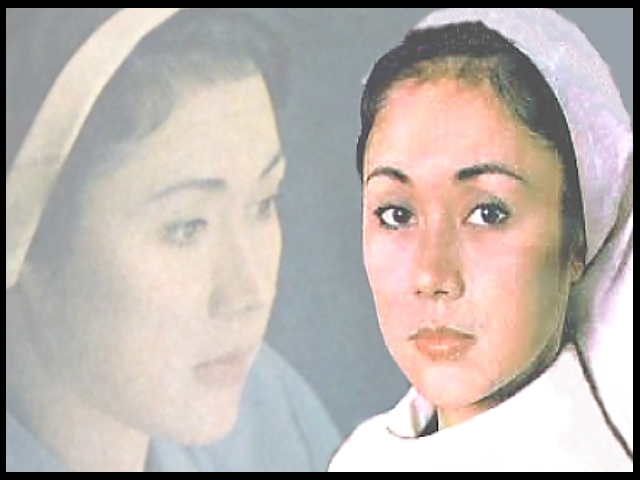
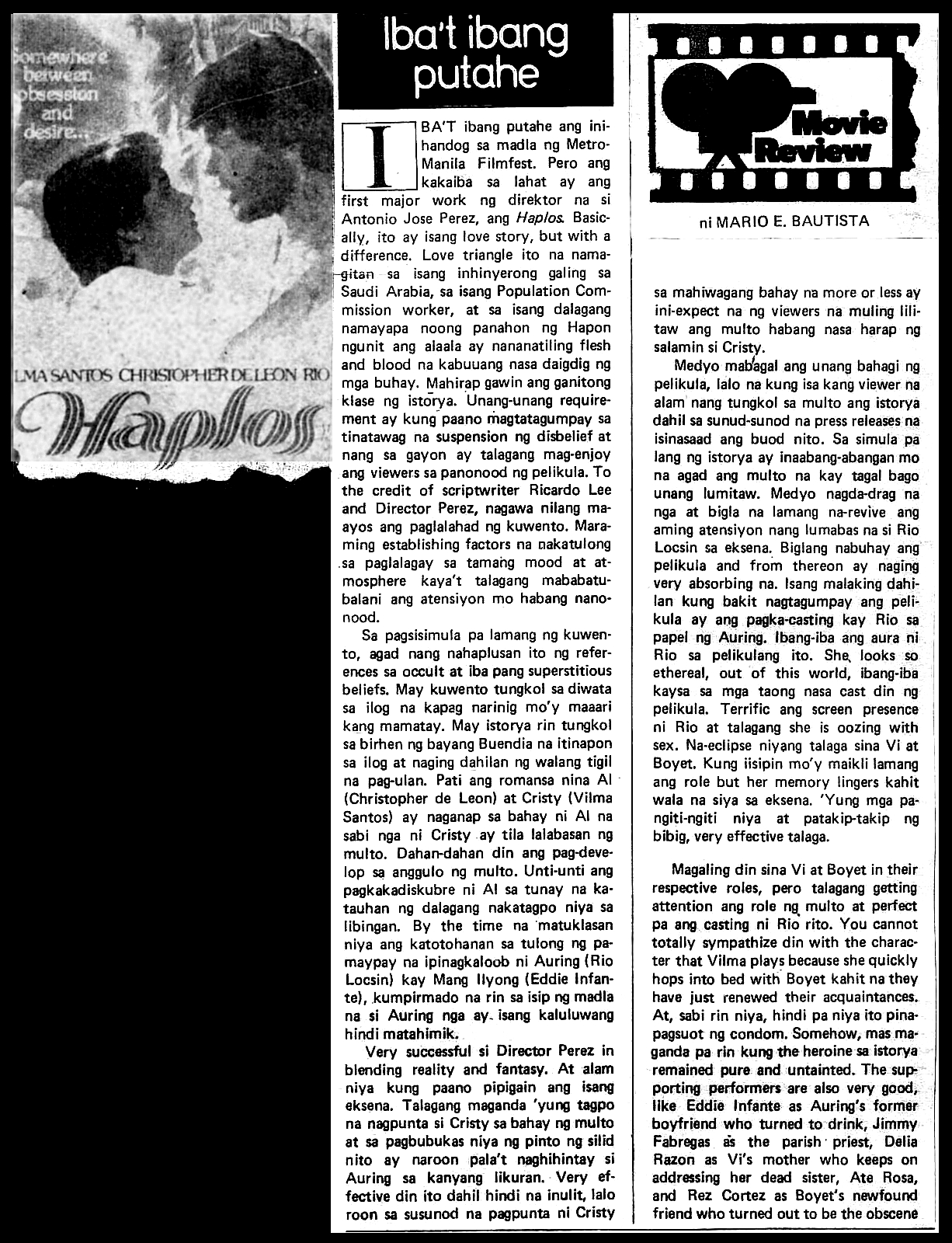


 Even with the very annoying number of voice-over scenes, scenes that you will hear the two main characters talks but you will see them not opening their mouth, the film has so many good qualities that you will forgive these flaws. We probably attributed these flaws to the style of many films in the 60s and 70s. Ricardo David’s cinematography was excellent particularly the many scenes on the streets. You can see many spontaneous shots of people that were gawking at Christopher Deleon running like a maniac. David’s very intricate camera work inside the car, dinner table and at the living room while Nanette’s mother was playing piano adds to the intense mood of the film, this is despite some shot where you can see the shadow of the camera particularly when Christopher left the house because he can’t stand to see Nanette being slap repeatedly by her angry father. The film was fast paced, thanks to Augusto Salvador’s editing. There are many scenes where the background music matches the mood like the choir/choral-like music at the very end of the film but Ernani Cuenco used so many canned music that sometimes it was very distracting. Like the voice over style used by Castillo, the musical score used in this film was typical of the 60s and 70s. Even the excellent Lino Brocka film, “Tinimbang Ka Ngunit Kulang” used this kind of style. Overall, Tag-ulan sa Tag-araw was a superb film that highlighted the potential on screen chemistry and talents of the screen team of Christopher Deleon and Vilma Santos. For their fans, I would recommend to have a copy of this classic film. – RV (
 “…The problem of love in Tag-ulan sa Tag-araw stems not from the lovers per se but from their ill fate as cousins. The factors are both socially dictated and morally stringent, situations that they cannot change no matter what they do. Even if they go on living together, they will still be hounded by the truth. Wherever they go, that truth cannot be proven false. Fate did two unpardonable things to them: bring them together and break them up. It is inevitable to question if it was their fault—or if their love was a fault at all, or if it was the society’s fault, for imposing the way things should be. The film makes a point of raising doubts on our moral attitudes and obligations, without telling us what is right or wrong but simply showing what happens when the doors of people’s minds are closed forever—when refusal to understand ruins happy couples’s lives. All desperation peaks in the end. The heartbreaking ten-minute chase stands as a powerful statement on what love can do in the harshest of circumstances. It is a perfectly executed sequence, that aside from showing the extent of possibilities that they are willing to get themselves into just to be together, it also delivers the horror of the couple’s misery, of the inability of their love to win –of losing each other forever.
 “…Ad Castillo’s Tag-Ulan sa Tag-Araw (Monsoon Rain in Summer, 1975) is about a young man (Christopher de Leon) who dorms with his uncle and aunt and falls in love with his cousin (played by a waiflike Vilma Santos). Ad Castillo tackles the sensational subject of incest by framing the two lovers’ relationship as a kind of innocent affair, taking place in a countryside Eden. It’s the kind of hackneyed concept that really shouldn’t work; the result ought to be less like D.H. Lawrence and more like Emmanuelle. But Ad Castillo happens to have one of the most prodigiously talented eye in all of Philippine cinema, and the heedlessly lyrical manner in which he shot Tag-Ulan transforms softcore porn into something like art. Every rainfall, every shaft of light, every leafy shadow caught by his largely handheld camera makes you catch your breath; there is lovemaking without nudity, yet Ad Castillo shoots with such throbbing intensity you are nevertheless aroused…” – Noel Vera, Critique After Dark, 06 December 2012 (


 Star For All Seasons
You must be logged in to post a comment.