



 Note: With so many format errors, we decided to reprint and repost this article as a tribute to the Kid. “Fair disclosure” in in effect here, infringement is not intended and no commercial profit gained in republishing this piece. Celso Ad Castillo was born on September 12, 1943, he died November 26, 2012 on apparent heart attack. During that time, he was reportedly working on his autobiography, which was released last year and promoted by his son, Christopher Castillo.
“As a child, he had the second-run theater circuit in downtown Manila as playground; his first “playmates” were King Kong, Suzie Wong and Gene Kelly. “I could barely understand American slang, but I was mesmerized by the light and shadows, the framing, the composition, the rhythm, the editing,” recalls acclaimed filmmaker Celso Ad. Castillo. Before young Celso even started school, his father Dominador had taken him to watch Hollywood movies “from MGM musicals to Elia Kazan” dramas.
“He was a film buff,” recounts Direk Celso, known as The Kid of Philippine Movies. “My aunt and uncles were also crazy about movies.” Dominador, who was also a lawyer, komiks novelist and producer for Larry Santiago Productions, was hesitant to allow young Celso to join show business. Teenaged Celso protested that he was merely following in his father’s footsteps. Dominador had created the classic komiks heroine “Cofradia,” immortalized by Gloria Romero in the Sampaguita film version in 1953 and Gina Alajar in the 1970s.
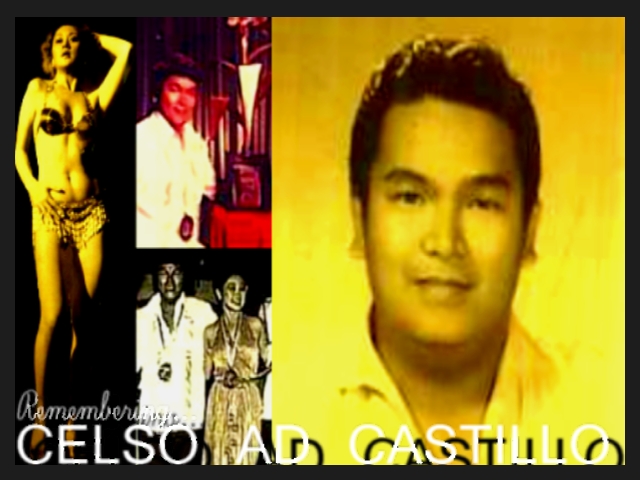 Like father… – “I started out as a komiks illustrator,” Celso relates. “I’m also fond of drawing.” He eventually wrote the komiks novels “Tartaro,” “Vampira” and “Palalong Kuba.” After all, he notes, stories about dragons, mermaids and vampires were “part of my childhood memories.” He acknowledges that his komiks sojourn primed him for filmmaking: “It taught me how to visualize the frame.” Yes, komiks panels were the first storyboards for this English Literature graduate. “Komiks also taught me how to choose commercially viable projects.”
From there, Celso, at the tender age of 18, crossed over to the movies as scriptwriter. “I started by doing spoofs of James Bond films. For Chiquito, I wrote “James Bandong, Secret Agent 02-10.” For Dolphy, “Dr. Yes.” VM Cinematic Films took notice because these movies had done very well at the tills. “VM gave me my first break, “Misyong Mapanganib” in 1965. It starred Tito Galla, Ruby Regala, and Helen Gamboa in her first starring role,” Celso says. “Local movies” whiz kid was also a law student at the time. “My father allowed me to direct only because I promised to continue my law studies.”
Potboilers – He churned out six potboilers, one after the other, among them “Zebra Jungle Girl” with Ruby Regala and “Mansanas sa Paraiso” with Stella Suarez. He admits that, inevitably, both his legal and film endeavors suffered. “I was flunking in school and my first seven movies were half-baked. I had to make a choice.” Celso’s gambit yielded his first critical success, “Nympha,” a black-and-white bomba film starring Rizza. “I wanted to prove that sex films could be artistic if they didn’t offend the sensibilities and intelligence of moviegoers,” he explains. The cache brought about by “Nympha” allowed him to make “The Virgin,” again with Rizza. “[It was] my first avant-garde movie,” he remembers fondly. “Eighty percent of the film had no dialogue. The story was told through ballads.”
Alas, “The Virgin” wasn’t as profitable as “Nympha.” With candor, he says, “It was a big flop. It was ahead of its time. Moviegoers were stumped “they couldn’t understand why no one was talking!” The indie maverick then surprised the industry by plunging head first into the mainstream. After megging “Ang Gangster at ang Birhen” (with Dante Rivero and Hilda Koronel) for Lea Productions, Celso caught the eye of Fernando Poe Jr.
Da King’s Direk – “At 26, I was directing the King of Philippine movies,” he reminisces with pride. “Asedillo,” his first outing with Da King, was not just a box-office smash; it also won a Famas Best Actor trophy for FPJ in 1972. “That movie started our collaboration. In a span of two years, we made three more movies: “Santo Domingo,” “Ang Alamat” and “Esteban.” Working with Da King, Celso felt obliged to prove his worth because, “You had to earn his respect.”
After those four action movies, Celso was itching for another change of pace. “I wanted to go freelance to do my kind of movies, innovative and experimental films that are commercial at the same time.” His next gambit, “Ang Mahiwagang Daigdig ni Pedro Penduko,” starring Ramon Zamora, hit the jackpot as well. “I never wanted to be boxed in one genre. So I followed up the fantasy movie “Penduko” with a kung-fu flick, “Return of the Dragon,” also with Ramon. I also made a zombie film with Alona Alegre entitled “Kung Bakit Dugo ang Kulay ng Gabi.”
In 1974, he crafted the horror hit “Patayin Mo sa Sindak si Barbara,” for FPJ’s wife, Susan Roces. They followed it up with “Maligno,” for which Susan won Famas Best Actress in 1978. Celso says, “When it was first shown, people didn’t know what to make of “Maligno.” But I recently caught it on cable. I almost cried at the end. It was surreal and grotesque.” By then, Celso had become the master of the unexpected. After casting sweet Sampaguita star Susan in gothic tales, he re-imagined Miss Universe Gloria Diaz into “Ang Pinakamagandang Hayop sa Balat ng Lupa,” in 1975.
Wet Look – Celso wistfully describes “Hayop” as “the killer” because it started the “wet look trend and single-handedly demolished the predominantly macho star system.” He remembers that, before “Hayop,” female stars were mere “adornment” in local movies. “Pang-display. “Hayop” [changed that].” He continued to give prominence to women in his films, most notably “Burlesk Queen,” an entry in the 1977 Metro Manila Film Festival. “That movie created a furor at the film fest,” he says. “Furor” is really an understatement.
“Burlesk” swept the awards in that year’s MMFF, resulting in a controversy that led to the wholesale return of trophies. In spite of the scandal, “Burlesk” is still regarded by critics as the “quintessential” Filipino film. “Hinamon ni Brocka si Tinio ng suntukan (Lino Brocka dared Rolando Tinio to a fight),” Celso remembers. “Tinio, who was the head of the jury, heralded “Burlesk” as the most beautiful Filipino film past, present and future.”
 Vi’s Turnaround – Adding fuel to the fire, “Burlesk” had stunned moviegoers because it unveiled a new Vilma Santos?from ingénue to wanton woman. Vilma says of “Burlesk marked a transition in my career. Working with Celso Kid is a privilege. He’s a genius.” With good humor, Vilma recalls a “quarrel” on the set of “Pagputi ng Uwak, Pag-itim ng Tagak,” which she produced in 1978. “It took so long to finish. I lost money on that. But we’re still friends. “Burlesk” and “Pagputi” brought a lot of honor to me.”
Gloria Diaz agrees: “Not too many people [would appreciate] his style [of filmmaking]. He’s a no-nonsense guy kasi. I consider myself lucky that I got to work with the best.” In “Burlesk” and “Pinakamagandang Hayop,” as in all his films, Celso challenged his stars to improvise, “not to stick to the script [and] say the lines… from the hearts.”
Love Letter – In the case of “Burlesk,” that’s because it was, for him, a love letter to his youth. “That was about my adolescence. I was a regular in Clover, Inday Theater, Grand Opera House. I watched Canuplin and Bayani Casimiro. I witnessed both the peak and the decline of bodabil,” he remarks. If there’s a common thread in his 61 movies, he points out, it’s that each one seeks to capture on film “a time of transition.”
He expounds: “Burlesk” was about the end of the bodabil era; “Pagputi,” the Huk movement; “Ang Alamat ni Julian Makabayan,” the Philippine revolution. Coincidentally “Julian Makabayan” signaled Celso’s own personal transformation. “In 1983, I attended the Asean Film Festival in Malaysia, where “Julian” was an entry. In my brief stay there, I discovered Islam. Six years later, I returned to Malaysia, to convert.”
Islam, he says, allowed him to “mellow and discover myself. Islam is a tough religion. Perfect for the hard-headed.” The serenity that he thus found can be gleaned from his subsequent choice of address: Siniloan, Laguna, location for his major works. He waxes poetic here: “Siniloan was where I was born. That place has everything, ricefields, mountains, rivers.” Nowadays, he spends most of his time in his chestnut farm there. At the time of this conversation (just before the recent holidays) he is ready to harvest. “I’m always busy with something,” he insists.
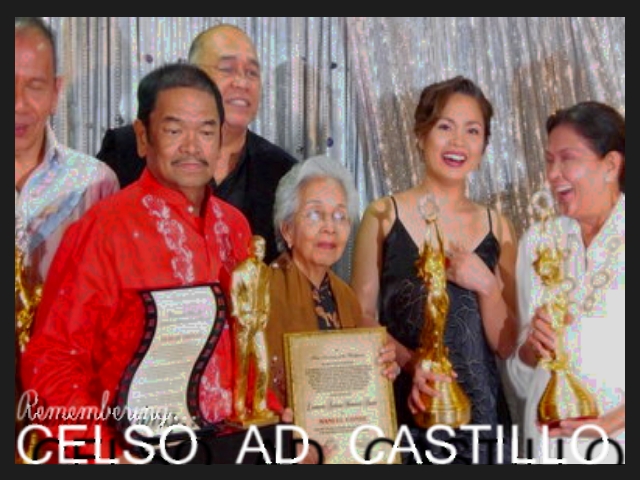 Lifetime Achievement – Being the recipient of two Lifetime Achievement honors in 2007 (from the Famas and the Film Academy of the Philippines), Celso thought it was also apropos to pick up a long-shelved project: His biography, “Celso Kid of the Philippine Movies” by independent filmmaker Ron Bryant. “Ron was my student in the Celso Ad. Castillo Filmmaking Institute in 1999,” he says. Celso played the role of Epy Quizon’s paralytic father in Ron’s award-winning Cinemalaya film, “Rotonda,” in 2006. “He’s a very professional actor,” Ron says of his mentor. “He never meddled in my directing and remained focus on his acting.”
Ron, however, points out that the Celso book project has evolved into a “documentary.” “The scope is too wide, especially in the context of 1970s Filipino cinema,” Ron explains. He hails Celso as a true vanguard of “the indie spirit.” “He made inventive films on a shoestring budget.” Coming full circle, Celso is now tinkering with digital technology, with two indie movies in the works “Sanib 2” and “OFW.”/p>
The technology is new, but trust Celso to rely on the same “improvisational” tricks with his actors. “OFW” actor Coco Martin says he finds The Kid’s method exciting. “On the set, we keep improving the dialogue. It’s a different experience. Direk Celso is so cool!” Proof that Direk Celso is hip and happening still can very well rest in the fact that his old films are continuously being remade on both the big and small screens.
After “Pedro Penduko,” his “Patayin sa Sindak si Barbara” and “Maligno” have been turned into teleseryes by ABS-CBN 2. His “Pinakamagandang Hayop” has also been snapped up by GMA 7. If you ask him, reviving his old movies is the ultimate tribute. As bonus, his 1984 film “Snake Sisters” has been picked up by British firm Mondo Macabro for DVD distribution abroad.
 Dream Project – Says critic Pete Tombs of Mondo Macabro: “I think he’s one of the most visually gifted filmmakers to come out of the Philippines. A true original.” Celso is positive, “I’m far from slowing down. I’m more aggressive now. My goal is to make an international movie soon!”
That dream project would be “Where Willows Grow,” which is set in the Land Down Under and tells the story of a Filipino mail-order bride who becomes the prime suspect in the murder of her Australian husband. “My wish,” he concludes, “is for my films to transcend their ethnic origin and merge with different cultures of the world.” – Bayani San Diego Jr., Philippine Daily Inquirer, 29 January 2008 (READ MORE)


The “Queen” – “…This movie was in tribute of the staff and crew behind the movies produced by Sampaguita Pictures. They were played by Dolphy, Panchito, Chichay and other actors and actresses of the said film outfit. The title was about a popularity contest in the studio where some of the said staff and crew were the candidates. Here, the King of Comedy played a janitor named “Julio Antukin” who became involved in most of the hilarious situations in the movie studio premises like throwing the pin of the grenade instead of the grenade, when he replaced a bit player, at the site where a movie director, played by Ading Fernando, was standing giving instructions about a scene. Another one was when he was assigned in the sound room where his clumsiness in the operation of its equipment caused the switching of the male and the female voices of its contract stars, played by Jose Mari Gonzales and Liberty Ilagan, in a musical number scene. In the end, he redeemed himself, when he was able to help the studio from being robbed by a gang of criminals which made him the “King” while Chichay was the “Queen”. Vilma Santos appeared in this movie as Dolphy’s younger kid sister…” – Melcore’s CinePlex Blog (READ MORE)
Pamosong Komedyante – “…Samantala sa entablado naman ng mga eskuwelahan at sa mga syudad, ipinalabas din ang dulang New Yorker in Tondo, isang komedya tungkol sa isang balikbayan na mas Amerikano pa kaysa Amerikano pero kayumanggi naman. Nauso rin sa radyo ang komedya tulad ng Sebya Mahal Kita na pinalabasan nina Sylvia Guerrero at Eddie San Jose. Ang iba pang pamosong mga komedyante ay sina Oscar Obligacion, Chichay at Aruray atbp…Sa larangan ng pelikula, si Ai-Ai pa rin ang bida sa mga komedya, na marahil ay namana ang kanyang pagiging komedyante sa mga “greats” tulad ni Chichay at Aruray na sumikat noong mga 50′s at hanggang 60′s. Bandang 70′s o 80′s ginawang katatawanan ang isang artista na sobra ang dunong daw…” – Wilhelmina S. Orozco (READ MORE)
Patsy vs Chichay – “…Her best episode in Wanted: Boarders in the old ABS-CBN Channel 4 was when Chichay guested in the show. Chichay had a daughter, singer Geraldine, and Patsy could never pronounce the girl’s name correctly (she kept saying Gungadine). From the start, there was already animosity between Patsy and Chichay. It turned out that Chichay was the ex-girlfriend of Patsy’s husband, Pugo, and it was a riot in the show. That episode was a landmark on Philippine TV because there supposedly was a feud between Chichay and Patsy off-screen. Nobody ever knew if this was true or just a joke between them and no one knew the exact reason why they were feuding in the first place. The public waited for the answer when Patsy was featured as guest in the Joy Virata-Robert Jaworski talk show Celebrity in 1978 on Channel 4 (then already a government studio). Unfortunately, when Ms. Virata asked that question, Patsy evaded it by merely answering: “It’s a military secret.” The year after, Patsy died and buried along with her mortal remains was the mystery about her supposed feud with Chichay. But at the funeral, there was only one celebrity who went, Chichay….” – Butch Francisco, The greatest comedians of all time (Third of a series), Philstar, Aug 19 2006 (READ MORE)
Toothless Miss – “…During her absence, something “that I couldn’t figure out till now” occurred. When she returned, a new Chichay was born: the toothless Miss. By conservative estimate, Chichay has to date 120 photoplays to her credit, the most decisive and memorable of which is Buhay Pilipino, a movie she made with Pancho Magalona and Tita Duran in 1951 because it gave birth to the masungit and tsismosa aunt-image that Chichay is now well-known for. She has a CAT Award (for Best TV Actress of 1967) to attest to her acting ability. Chichay the person is a far cry from Chichay the jester. whenever she is free from commitments (which is very seldom), she stays at home and reads her favorite fun magazines: 1001 Jokes, Mad and Taurus. She is fond of cats. She has not seen any movie for the past five years, even her own films. Her favorite comedienne is Lucille Ball. Fifty years old last January 21, Chichay professes she has a deep-seated devotion to show business: “I want to laugh away the rest of my life…” – Ricardo F. Lo, Sunday Times Variety, April 27 1969 (READ MORE)
Chichay (born Amparo R. Custodio; January 21, 1918 – May 31, 1993) was a Filipino comedienne. Her short and stocky stature, scratchy voice and prematurely aged appearance allowed her to portray grandmothers while only in her thirties. She was born in Tondo, Manila, the daughter of a ship steward, Jose Pacifico Custodio and Maria Robles of Bulacan. In 1945, she married Hercules Saenz Moya of Iloilo. She entered showbusiness as a teen, joining the “Samahang Antonieta” as a singer with her sister Iluminada. She also appeared as a chorus line dancer at the bodabil shows of Katy de la Cruz. Soon a regular at the bodabil circuit, she received her stage name “Chichay” from Atang de la Rama. The name was a corruption of the Japanese word “Chiisai”, meaning “short”, in reference to Chichay’s own short height and she got famous for her toothless appearance but in reality she still got 2 molars left…Chichay remained a contract star with Sampaguita Pictures for almost two decades. After her stint with Sampaguita, she remained in demand as a character actress, often in comic roles. In 1972, she was nominated for a FAMAS Best Supporting Actress award for her role in Bilanguang Puso. She was active in film until her death in 1993. Among her last roles was as Lola Basyang in the 1986 Regal Films fantasy movie, Mga Kuwento ni Lola Basyang. – Wikipedia (READ MORE)
Chichay and Vilma Santos
Related Reading:


The year was 1971, when ate Vi celebrated her debut. Ang tagal na pala. Parang kailan lang when I cut these photos sa isang newspaper. I was still in grade school then, at wala pang pambili ng mga magazines. So, I content myself sa newspaper naming sa bahay. As far as I can remember, isang bonggang birthday celebration iyon. Nagkaroon ng isang asalto on the eve of her birthday. Meron din fans party na ginanap sa Mehan garden, pero ang talagang coming-out party niya ay ginanap sa The Plaza restaurant. Wala na itong restaurant na ito ngayon, but it was very popular ng mga panahon na iyon. The restaurant, which was, located sa Makati, ay siya ring naging venue ng reception ng wedding nina FPJ at Susan Roces. Ang asalto, fans party sa Mehan garden at ang debut party ay added attraction sa movie nina ate Vi at Edgar na “Eternally.” Ang gown ni ate Vi was made by Ben Farrales. Sa isang write-up interview kay Danilo Franco, na siyang gumawa ng wedding gown ni ate Vi, nabanggit nito that he was working for Mang Ben during that time.
The white gown bore hand-painted pink roses, which were made by Danilo Franco. Star-studded ang party ni ate Vi. Halos lahat ng young stars of the era ay dumating. Ang mga kasamahan niya sa TV show na The Sensations ang siyang mga kasali sa cotillion. Dumalo rin ang big stars of the era like sina Rosemarie at Ricky Belmonte, at doon nila inannounce na magpapakasal sila the following month. Special guest din si Mr. Manda Elizalde of Panamin, na tinulungan noon nina ate Vi at Edgar para ikampanya para sa Senado. Dumalo rin ang super big action star noon na si Tony Ferrer kasama ang kanyang misis na si Mutya Ng Pilipinas winner, Alice Crisostomo. Naroon rin ang mga producers ni Ate Vi at ang mga press people. It’s now 2005, 34 years na ang nakakaraan, pero andito pa rin si Ate Vi at siyang nangungunang Reyna ng pelikulang Pilipino. Nawala na ang mga kasabayan niya at maging ang mga sumunod sa kanya, pero nanatiling nag-iisa ang tunay na Reyna ng Pelikulang Pilipino sa lahat ng panahon. – Eric Nadurata (READ MORE)


November 3, 1984, it was red letter day for Vilma Santos. She was turning 31 years old. “Gurang na, ano?” she laughingly told us earlier. “Di bale, hindi naman halata, di ba? O, i-deny mo, i-deny mo.” At nagtawa siya ng malakas of the press got an invitation for her birthday celebration. It says “you’re invited! VIP – Special Birthday Edition, November 3, Saturday, A Birthday Celebration, Televised Live at the Celebrity Sports Plaza, VIP Time – 8P.M.” The whole place was jampacked as early as 4:30PM. The televised program started on time, with a taped production number showing Vilma singing Irene Cara’s Out Here on MY Own. She was pensively looking at the serene Taalk Lake and Volcano, which she used as background for her song. In between, she inserted some instrospective musing about her past life and career. It was indeed a very fruitful one. Vi had several costumed changes during the show. She was very regal in a silk calf-length gown, so at ease in snazzy pantsuit, so with-it in a simple blouse and slacks which she wore after the show proper. But the guests stayed on long after the show. Among those who rendered special numbers for Vi were Christopher de Leon, Phillip Salvador, Ace Vergel, Maricel Soriano, Roderick “Charot” Paulate, Kristina Paner with mom Daisy Romualdez, Tina Revilla with hubby Serge Valencia, “Sister Stell L.” director Mike de Leon and producer Lily Monteverde (who had to rush back to Valencia for the preview of Virgin Forest), Rico J. Puno, Tirso Cruz III, the entire cast of Bagets 2 and a host of other luminaries. Vi was looking radiant as she posed in front of her giant birthday cake specially baked for the occassion. She was really happy and vibrant taht evening, with husband Edu Manzano by her side and everything looking all’s well with the world. A few days later, she would be sporting another face. Alas, such is the twist of fate in our lives. Papa Santos passed away and we see another face of Vilma, this time, in grief. – Tony Tantay, Jr., Movie Flash Magazine, 22 November 1984 (READ MORE)


 Star For All Seasons
You must be logged in to post a comment.