THE STAR FOR MANY MORE REASONS


Last month, we discussed leading female stars’ “career arcs” with some show biz colleagues and most of us agreed that Vilma Santos has had the most interesting and instructive career to date — and her future prospects could be even more remarkable! We have other outstanding female stars who’ve won all sorts of awards, essayed a great variety of roles with distinction, and enjoyed a nationwide influence beyond their show biz context.

Major Crises – But, Vilma has done more, gone further and weathered major crises besides, so she’s in a category all her own. See if you agree: Vilma started her career as a child star, and this made her grow up in a hurry. Unlike many other child talents who stop getting offers at the onset of adolescence, Vilma kept right on working in front of the TV-movie cameras, all the way to pang-kilig teenybopper roles, her precocious love team with Edgar Mortiz, and young-adult roles. Financial reverses pulled her down momentarily, but Vilma fought back and paid her debts, eliciting the admiration of entertainment industry leaders, who were surprised and gratified to see that the “cute” star had true grit going for her, as well. Then came another challenge that threatened her career’s continuing upward trajectory: Vilma had been acting her heart out in her starrers, but she always seemed to end up second-best to Nora Aunor when it came to awards. As a result, Vilma took a hard look at her options, and decided to concentrate on relatively daring roles that Nora felt incapable of doing full justice to.

Challenging Roles – This meant that Vilma would go for challenging roles like the tragic stripper in “Burlesk Queen,” the demented lead in “Dama de Noche,” and the modern, conflicted wife in “Relasyon!” Happily, Vilma’s daring gamble worked: Viewers didn’t feel that she had “cheapened” herself. Many awards came her way, and the industry finally saw Nora and Vilma as co-equal queens, not only of the box office, but also of movie awards competitions. Later, Vilma’s thespic stock went up even further when she played an activist nun in “Sister Stella L.” Not only did the difficult role stretch Vilma’s limits, but it also made her “relevant” in terms of social issues, as “Minsa’y Isang Gamu-Gamo” had earlier done for Nora. This new sensitivity to extra-show biz concerns peaked when Vilma married rising politician, Ralph Recto. Soon, she herself ran for office, and served Lipa City well as its mayor for nine formative and affirmative years. Her constituents’ approval of her tenure invited her to dream bigger in political terms, and she ended up in a hard-fought campaign that made her the governor of Batangas province. Sure, Vilma’s focus on politics for the past decades has limited her show biz involvement, but her colleagues have supported her in her new endeavor, because she has proven that some stars can do more than entertain.

Female TV-movie Luminary – Yes, male stars like Fernando Poe Jr. and Joseph Estrada have done the same, but it’s gratifying to see that a female TV-movie luminary like Vilma can also serve the nation. To date, Vilma’s political posts have been local and provincial in nature, but her recent triumph at the polls has made some “queenmakers” dream of next pointing her toward running for a national position — as senator, or even higher! At the moment, this sounds like a fantasy, but stranger things have been known to happen in this country, where show biz and politics are — very comfortable bedfellows!

Tandem – It’s interesting to note that, some years ago, we saw the Ralph-Vilma tandem eventually contesting the top post in the land with Kiko-Sharon, Mar-Korina, or other, yet-unheralded politics-and-show biz pairings. — And now? Will it be Vilma-Ralph, instead? In any case, Vilma has been scrupulously learning her political lessons, so she could decide to take the “big step” without waiting for another decade to elapse. Adding to her confidence is the fact that, although she’s rarely seen on the big and small screen these days, she remains a popular star and her movies have continued to hit it big at the box office — evincing a popularity that she can make full use of in a national election. So, will she, or won’t she? Whatever the future holds, Vilma is our leading female TV-movie luminary to date — and the Star for All Seasons is now also the Star for Many More Reasons! – Inquirer, 08/18/2007

THE TEN BEST FILMS OF VILMA SANTOS


Sa history ng pelikulang lokal, sadyang namumukod-tangi si VILMA SANTOS dahil hindi lang sa larangan ng pag-arte siya nagtagumpay kundi pati na rin sa pulitika. Pagkatapos ng siyam na taong paglilingkod bilang mayor ng Lipa City, tinanghal naman siyang governor ng buong lalawigan ng Batangas. Nagsimula si Ate Vi bilang child actress noong 1963 sa pelikulang Tudis Liit ng Sampaguita Pictures nang siya ay siyam na taong gulang lamang. Nakipagtagisan siya ng talino sa dalawang batikang aktres nang panahong iyon, sina Gloria Romero at Lolita Rodriguez. Naging positibo ang reception ng publiko kay Ate Vi kaya naman nagkasunod-sunod ang movies niya as a child actress. Sa kanyang makumpletong filmography, makikita ninyong walang patlang ang paggawa ni Ate Vi ng pelikula. Hindi siya nagaya sa ibang child stars na sa transition from childhood to adolescence ay nawala sa eksena at tuluyang nagretiro, o kaya’y bumalik na lang noong teenager na sila. Noong naging 16 years old si Ate Vi in 1970, she became a teen idol and made a staggering total of 27 movies for one year alone. Malayung-malayo nga sa mga artista ngayon na isa o dalawang pelikula lang ang nagagawa taun-taon. She was truly in demand then! And to think may regular TV show pa siya at that time sa ABS CBN, ang D’ Senations na later on ay isinapelikula rin.

HINDI MADALING GAWIN – Ang assignment namin dito ay itala ang ten best films na nagawa ni Ate Vi at, sa totoo lang, hindi madaling gawin ito dahil nga napakarami niyang nagawang magagandang pelikula through the years. As a child star, pinakagusto namin ang kanyang Ging sa Premiere Productions. Street urchin siya ritong anak ng lumpong si Olivia Cenizal na natuklasan sa movies at sumikat bilang child star. Sa teenage phase ng kanyang career, ang most memorable movies niya for us ay ang Renee Rose (gumanap siya bilang isang sikat na artistang may mahigpit na stage mother, played by Lilia Dizon, at dahil dito ay nalaktawan niya ang kanyang kabataan and she often behaves like a child), Inspiration (directed by the late Ishmael Bernal, this is a well-written teen romance at ang nakatambal niya ay ang yumaong Jay Ilagan), Takbo, Vilma, Dali (this is and effective suspense-thriller directed by the late Joey Gosiengfaiao and Vilma played a witness to a crime na hinahabol ng killer), Dama de Noche (dito niya napanalunan ang first Famas best actress award niya and she is totally convincing in a dual role bilang magkapatid na kambal na ang isa ay mabait at ang isa ay baliw), Lipad, Darna, Lipad (this is her first Darna movie, a trilogy na naging blockbuster hit and established her as a top box office actress), Nakakahiya? (this is about a scandalous May-December romance na ang kapareha niya ay ang nasirang Eddie Rodriguez na pwede na niyang maging ama, naging big hit ito kaya nagkaroon pa ng sequel na Hindi Nakakahiya), at Tag-ulan Sa Tag-araw (directed by Celso Ad Castillo, ang first movie nila ni Christopher de Leon tungkol sa magpinsang-buo na umibig sa isa’t isa).

Natitiyak naming kayo ay may sariling paborito sa mga pelikulang ginawa ni Ate Vi. Tiyak na marami ring may gusto sa Pagputi Ng Uwak, Pag-itim Ng Tagak (a love story about a rebel, Bembol Roco, and a violinist, Ate Vi, na siya mismo ang nag-produce sa kanyang VS Films at dinirek ni Celso Ad Castillo), Rubia Servios (dito siya unang dinirek ni Lino Brocka and she played a rape victim who later gets to kill her rapist, Philipp Salvador), Tagos Ng Dugo (isa siyang serial killer dito, directed by Maryo J. de los Reyes), Kapag Langit Ang Humatol (a well-told komiks melodrama directed by Laurice Guillen), Anak (she played an OFW na may gap sa anak niyang si Claudine Barretto, directed by Rory Quintos), Bata-Bata Paano Ka Ginawa? (adapted from Lualhati Bautista’s award-winning novel, she played a liberal single mother who asserts herself, directed by Chito Roño) and Dekada ’70 (again adapted from a Lualhati Bautista novel and directed by Chito Roño, tungkol ito sa isang ina noong panahon ng martial lwa).

OUR PERSONAL CHOICES – Para sa amin, ang aming personal choices are the following:

article pic 0031. SISTER STELLA L (1984) Mula kay Mother Lily Monteverde ng Regal Films, ito ang most socially relevant film na ginawa ni Ate Vi, masterfully directed by Mike de Leon, written by Ricky Lee. Hinakot nito ang karamihan sa tropeo ng Urian Awards for that year, including best picture, best actress for Ate Vi, best actor for Jay Ilagan, best supporting actress for Laurice Guillen, and best supporting actor for Tony Santos, Sr. Si Vilma ang gumaganap bilang title-roler, isang apolitical nun na ang dating boyfirend ay naging isang journalist (Jay) na tumutulong sa mga inaaping manggagawa sa pangunguna ng labor leader na si Ka Dencio (Tony). Ang kapwa niya madreng si Sister Stella B. (Laurice) ang nagpakita sa kanya kung paano sila magiging mas makabuluhan by serving the people’s struggle for social justice. Ipinakita ritong dapat tayong makisangkot sa mga suliranin ng lipunan para magkaroon ng mabuting pagbabago sa sistema. Hindi pwedeng neutral ka lang na ayaw ma-involve. Kahit na nga member ka ng religious community, dapat ding makisangkot ka sa socio-political affairs. Ang talumpati ni Ate Vi nang maging militanteng madre na siya pagkatapos mapatay si Ka Dencio (“Kung ‘di tayo kikilos, sino’ngkikilos? Kung ‘di ngayon, kailan pa?”) ay talaga namang nakakaantig ng damdamin.

2. IKAW AY AKIN (1978)Member kami ng Urian Awards nung ’78 at ang pelikulang ito, produced by Tagalog Ilang-Ilang Productions, ang siyang ipinaglaban namin para manalo ng best picture. Hindi ito sinang-ayunan ng karamihan sa mga kapwa namin Manunuri dahil mas pinili nila ang Pagputi ng Uwak, Pag-itim Ng Tagak, dahil may elemento raw ng kaapihan ng magsasaka at ng reporma sa lupa. (Ang tanging consolation ng Ikaw Ay Akin ay nanalo si Christopher de Leon ng kanyang first Urian best actor award.) Years later, some of the Manunuri members who voted for Pagputi told us they regretted the decision dahil obvious namang Ikaw Ay Akin ang pelikula na talagang withstood the test of time, written by Jose Carreon and directed by Ishmael Bernal. Wala itong pretensiyon na nagpapa-socially relevant but it deals so effectively on the matter of how human beings and relantionships can at once be simple and complex. Malayo nga ito sa usual love triangle flicks na puno ng melodramang iyakan, although Christopher as Rex is also turn between Vilma Santos as Sandra, a kooky and neurotic artist designer, and Nora Aunor as Tere, an orchid expert. Ang mga salimuot ng menage-a-trois na ito ay sensitively laid out para makita ng viewer ang sakit at ligaya , at dusa at saya na dinaraanan ng bawa’t tauhan. Sa ending, nothing is really resolved. Basta nagtitinginan lang sina Nora at Vilma sa isa’t isa nang walang dialogue for five minutes. This is a very daring move, lalo na’t ang local viewers ay yung tipong gustong matiyak kung kanino ba talaga napunta si Boyet, kay Vi o kay Guy? Pero si Bernal ay walang pakialam with fulfilling viewer expectations. Basta ang gusto niya ay mailarawan niya ang mensahe ng movie.: that no one can totally, absolutely, fully own another human being. The best thing is to understand ang pangangailangan ng isang tao at mahalin mo ito according to his limitations. Sabi nga ni Boyet kay Guy: “Kailangan ako ni Sandra hindi lang sa pisikal kundi sa emosyonal din, tulad ng pangangailangan ko sa ‘yo. Sa kanya, nagkakaroon ako ng gamit. Kailangan ko kayong dalawa para mabuo ako.” Sabi naman niya kay Vi: “Si Tere, tinanggap nang hindi niya ako maaangkin nang buong-buo. Kung sasabihin mong nakuha mo ako ng buong buo ang isang bagay, kulang pa rin.” Grabe rin ang galing ng acting dito ni Vi sa tagpong inilantad niya ang kanyang sarili as an insecure woman: “Sabi nila, liberated ako, front lang. Kalong daw, front din. Alam mo namang kulang-kulang ako. ‘Pag wala ka, magkakalat ako. Para akong manok, takbo nang takbo, wala namang ulo!”

3. DALAWANG PUGAD, ISANG IBON (1977) A commercial and artistic success written and directed by Ishmael Bernal, love triangle movie rin ito that banked on the real life romance then of its lead stars, Vilma and Romeo Vasquez. Si Vilma ay si Terry, na iniwanan ng kanyang immature boyfriend (Mat Ranillo III at sumama sa isang lalaking may asawa (Romeo) sa kabila ng pagtutol ng mga magulang niya. Pwede itong naging mediocre romantic melodrama pero nagtagumpay si Bernal na i-elevate ito to art by giving us mature, sensitive characters who, like most of us, are looking for meaningful personal relationships. Tinalakay sa movie (in a very sutle manner) ang legal and moral implications ng adultery o pakikiapid ng isang dalaga sa isang married man, lalo na nga’t society shuns such sinful relationships. Ang relasyon nina Vilma at Romeo ay reflected sa relasyon ng iba pang mga tauhan sa movie, tulad ng sa mother ni Vilma (Anita Linda) at ng ama niyang nagtataksil din (Fred Montilla), sa lola ni Vi (Mary Walter),sa first boyfriend niya (Mat) at sa babaeng may gusto rito (Ann Villegas) at kapatid nitong pokpok (Laila Dee), at sa misis ni Romeo (Anna Gonzales) na ayaw siyang pakawalan kahit hindi naman sila magkasundo. Kung may pelikula si Ate Vi na nasasabik kaming panoorin uli, ito ‘yon. Kaya lang, wala na yatang existing copy ito at nakasama sa movies produced by Lea Productions na nasunog o nasira sa baha. What a big waste. Sayang talaga.

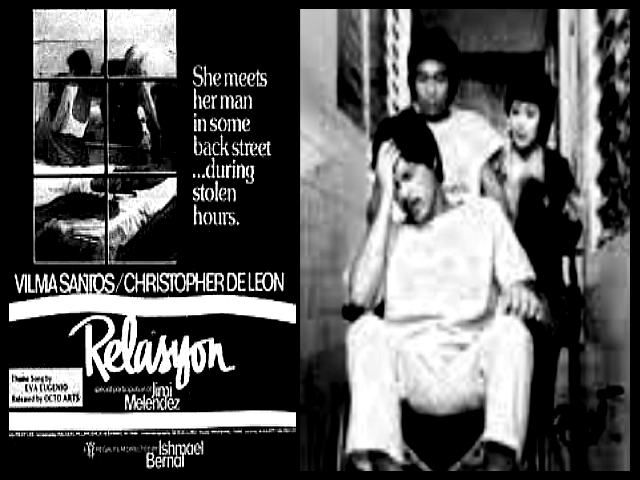
relasyon4. RELASYON (1982) Ito ay isa pang pelikula ni Ishmael Bernal sa Regal Films na tumatalakay sa subject ng adultery from the point of view of the other woman, si Marilou (Vilma), ang mistress ni Christopher de Leon na pinaglilingkuran siya ng buong puso: pinaglalaba siya, binibigyan ng beer at inaalagan pa ang anak niya mula sa legal wife niya. Ipinakita rin sa feministic movie na aito ang pagka-chauvinist ng mga lalaking Pinoy. Gusto’y sila lagi ang masusunod at ni ayaw makakausap ng ibang lalaki ang babae nila, tulad ng aversion ni Christopher kay Jimi Melendez sa kuwento, at pati na rin sa kaibigang bading ni Ate Vi na si Manny Castañeda. Tinalakay rin sa movie ang subject ng kawalan ng divorce sa Pilipinas, dahil kung may diborsiyo raw ditom sana ay pinakasalan na ni Boyet si Vi. Narito sa pelikulang ito, which scored for Ate Vi her first grand slam as best actress, ang famous death scene ni Boyet na namimilipit sa sakit habang inirereklamo ang masakit niyang ulo at tarantang-taranta naman si Ate Vi na hindi malaman ang gagawin. Tuhog ang kuha sa mahabang eksenang ito and the acting is really great kaya dito pa lang ay sulit na ang panonood ninyo.

5. BROKEN MARRIAGE (1983)Nagwagi rin ng Urian best actress award si Ate Vi para sa acting niya sa pelikulang ito na muli ay produced ng Regal Films. As the title implies, tungkol ito sa isang nasirang marriage. Si Vi ay si Ellen, isang TV production executive, at si Boyet ay si Rene, isang newspaper reporter. Pagkatapos ng sampung taong pagsasama, kinakalawang na ang relasyon nila bilang mag-asawa. Dahil lagi na lang silang nag-aaway, umalis si Rene mula sa tahanan nila at si Ellen ay naging single parent sa dalawa nilang anak. Nang manakawang ang bahay nila, lumipat si Ellen at mga anak nila sa bahay ng nanay niya. Nang mabugbog si Rene ng mga tauhan ng isang politiko dahil sa expose niya, napilitan siyang muling pumisan kina Ellen at dito rin muling nabuo ang pagsasama nila bilang mag-asawa, resulting into a reconciliation. May dalawang mahabang arias dito si Ate Vi na talagang lutang na lutang ang kahusayan niya. Una’y ang monologue niya sa piling ng mga kaibigan na pinagtatapatan niyang bagot a bagot na siya sa buhay. Susunod ay sa eksena niya with Boyet na sinasabi niyang hindi sila magkakabalikan nang dahil lang sa mga bata. Hindi rin malilimutan ang unang confrontation scene nila sa movie na natural na natural ang away nila bilang mag-asawang na-alienate na ang loob sa isa’t isa.

6. SAAN NAGTATAGO ANG PAG-IBIG (1987)Sa aming talaang ito, ito lamang ang pelikula ni Ate Vi na hinango sa isang nobelang komiks. This was shown in the same year as Tagos ng Dugo (na siayang nagpanalo sa kanya ng isa pang Famas best actress award), pero hindi namin naibigan ang performance niya rito as it was so palpably engineered, pati ang ibang movements niya na ang nakikita mo sa likuran niya ay ang instructions na bigay ng direktor kung ano ang gagawin niya. That year, ang choice namin for best actress ay si Lorna Tolentino sa anti-heroin role niya in Maging Akin Ka Laman ni Lino Brocka. But we will alwyas love Saan Nagtatago Ang Pag-ibig, na dinerek ni Eddie Garcia, dahil may kakaibang tama ito sa puso. Sa kuwrnto, si Vilma ay nabuntis ni Ricky Davao pero hindi siay mapakasalan nito dahil sa mamanahin mula sa kanilang dominanteng lola, the late Alicia Vergel, na inaapi-api pati ang ina ni Ricky, si Gloria Romero, who gives a great performance. Ang ginawa ni Ricky a kinumbinsi si Vilma na pakasal sa kanyang kapatid na retarded, si Val, played by Tonton Gutierrez, para aito ang magbigay ng pangalan sa magiging supling niya. Pumayag si Ate Vi at doon na nga siya natira sa malaking bahay ng pamilya nina Ricky at Tonton. Dahil doon, mababago ang takbo nga buhay ng pamilyang ito dahil si Vilma ang magsisilbing agent of change who will defy the matriach taht is Alicia Vergel. Mabubunyag din kung pano nagkaroon ng pinsala si Tontion sa utak. Maraming madamdaming eksena sa pelikula na talagang titimo sa inyong puso. Sa ending, there is justice dahil nagkamit ng karampatang parusa ang mga nagkasala.

pahiram7. PAHIRAM NG ISANG UMAGA (1989) Namatay si Ate Vi sa pelikulang ito sa papel niya bilang Juliet, isang advertising executive na dinapuan ng cancer, but the film, produced by Regal Films, written by Jose Javier Reyes and directed by Ishmael Bernal, is really more a celebration of life. Pagkatapos malaman ni Juliet na may taning na ang buhay niya, ginugol niya ang mga natitira niyang araw para ilagay sa ayos ang kanyang buhay. Nakipagkasundo siya sa kanyang estranged husband (Gabby Concepcion) na may iba nang asawa (Zsa Zsa Padilla) at inihabilin dito ang anak nila (Billy Joe Crawford). Maraming simbolo and motifs ng buhay at kamatayang ginamit din ang expressionist painter na si Ariel (Eric Quizon) ina an impressive performance) para ipakita ang parallelisms between life and art. In one scene, tinalakay pati ang origins ng art when prehistoric men made drawings on caves na kahit primitive ay they continue to exist until this day. people may die, but art will live on. Ironically, si Ariel ay isang tormented soul who wants to kill himself. Pero iniligtas siya ni Juliet, a dying woman na hindi na maililigtas ang sarili niyang buhay. The grand death scene of Juliet on the beach habang nakasuot siya ng puting night gown haang nagbubukang-liwayway, sa ‘di kalayuan ay isa sa mga ‘di-malilimutang paglalarawan ng buhay at kamatayan na maing napanood sa pinilakang tabing.

8. HAHAMAKIN ANG LAHAT (1990) Produced by Regal Films, dinirek ito ni Lino Brocka and we honestly believe na very much underrated ito. Ang tanging award na pinanalunan nito ay best supporting actress award for Snooky Serna (na very deserving). Nirepaso nga namin ang aming listahang ito at napansin naming ito lang ang movie ni Ate Vi na dinirek ni Brocka which is included in our list. Mas marami kaming isinaling pelikula ni Ate Vi na dinirek ni Bernal. Actually, may iba pang ginawang movies si Ate Vi with the legendary director, tulad ng nabanggit na rin naming Rubia Servios (kunsaan tinalo siya ni Ate Guy as best actress for Atsay in the 1978 Metro Manila Film Festival) at ang Adultery: Aida Macaraeg with Philipp Salvador and the late Mario Montenegro. Pero para sa amin, this is Ate Vi’s best Brocka movie and one of her best and most demanding roles sa mga nagampanan na niya. Vilma plays an anti-heroin, si Sylvia, isang bida-kontabida. Asawa siya ng isang gahamang mayor (Eric Quizon), na piangtataksilan siya. Nang muli niyang makatagpo ang una niyang pag-ibig, si Rene (Gabby Concepcion) ay pinagsikapan niyang makuhang muli ang pagtingin nito kahit kasal na rin ito sa ibang babae (Snooky). Sa kanya nga patungkol ang titulo ng movie dahil hahamakin niya ang lahat maagaw lang muli ang dati niyang pag-ibig. Dati, akala niya, magiging maligaya siya sa mga materyal na bagay at pati ang mahirap niyang ina (Perla Bautista) ay nagawa niyang itakwil. Nguni’t natanto niyang wala sa pera o sa kapangyarihan ang tunay na kaligayahan kundi nasa tunay na pag-ibig. Ang hindi niya alam, paghahangad niyang maibalik ang nakaraan ay hahantong lamang sa isang malagim na trahedya. Sadyang mapanghamon ang role ni Ate Vi rito na tuso, matapang, sinungaling at manggagamit ng kapwa tao. Mapupuri mo nga siya dahil hindi siya natatakot kumuha ng ganitong klase ng roles (gaya rin ng role niya sa Sinasamba Kita) na pwedeng maka-alienate sa kanyang fans. She’s definitely more adventurous as an actress. Kaso ang nakalaban niya that year ay si Nora Aunor who played a more sympathetic role bilang inang nagpakasakait alang-alang sa ikabubuti ng anak sa Andrea, Paano Ba Ang Maging Isang Ina? kaya mahuhulaan na ninyo kung sino ang nagwagi ng best actress awards for the year.

9. BURLESK QUEEN (1977) Humakot ng lahat ng tropeo sa 1977 Metro Manila Film Festival, tribute ito sa stage shows noong ’50s. Sinulat ni Mauro Gia Samonte at dinirek ni Celso Ad Castillo, dito unang nagpa-sexy si Ate Vi at talagang big blockbuster ito. Kuwento ito ng isang batambatang burlesque dancer noong 1950s, played by Ate Vi. Nagsimula siya bilang alalay ng isang reigning burlesque queen, si Rosemarie Gil, na kabit ang maton na si roldan Aquino. Nang iwana ni Roldan si Rosemarie, naglasing ito at ayaw nang sumayaw kaya si Vilma ang isinalang bilang kapalit niya sa entablado. Maiinit ang naging pagtanggap ng mga lalaking manonood kay Vilma, pero ang maprinsipyong ama niyang lumpo (Leopoldo Salcedo) ay tutol sa ginagawa niya. Dahil naghihirap sila, nasunod din ang gusto ni Vilma na maging burlesk dancer. Nagpatiwakal ang ama niya dahil dito. Umibig naman si Vilma sa isang iresponsableng lalaki na nakipag-live in dito, si Rollie Quizon, na isa palang mama’s boy at hindi sanay sa hirap kaya nilayasan din siya. Ang climax ng movie ay ang may sampung minutong pagsasayaw ni Vilma sa entablado hanggang duguin siya. Buntis pala siya at gusto niya talagang malaglag ang dinadala niya. Maganda ang maraming elemento sa movie, malian sa production design na 1950s ang setting pero hindi maingat kaya maraming detalye na pang-19702 ang kasama rito. Very memorable din dito si Jonee Gamboa sa papel ng stage impresario an siyang nagsasatining ng mga opinyon ng writer at direktot na pinupuna ang hypocrisy ng mga moralista, tulad ng pagtatanong niya kung anong uri ng show ang dapat ibigay sa masang Pinoy na hindi kayang magbayad ng pang-mayaman at kulturadong shows tulad ng operang Merry Widow. Sayang at wala na rin daw existing copy ng pelikulang ito.

10. DOLZURA CORTEZ STORY: DAHIL MAHAL KITA (1993) Ito ang unang pelikulang lokal na nagsiwalat tungkol sa sakit na AIDS at filmbio ito ng kuna-unahang Pilipino na umaming may AIDS siya, si olzura Cortez, na ang kuwento ay nalathala sa dyaryo. Sinulat ni Ricky Lee, dinirek ni Laurice Guillen at produced ng Octo Arts Films, bida-kontrabida rin ang papel ni Ate Vi rito in the title role. Hindi siya yung usual heroine na walang bahid-dungis at inaapi. Dito, isa siyang makasalanang babae na nagbili ng katawan, nagkaroon ng affairs sa maraming lalaki, hanggang sa dapuan nga siya ng dreaded sickness called AIDS. Muli ngang naka-grand slam si Ate Vi sa role niya sa pelikulang ito. The same year, meron ding nagawang movie si Ate Guy, ang Inay na dinirek ng yumaong Artemio Marquez, pero hindi man lang siya naging nominee para sa pagkakaganap niya roon. That year, dalawang movies ang nagawa ni Ate Vi. Ang isa pa ang ang action-dramang Ikaw Lang ni Chito Roño, na in fairness ay mahusay rin siya sa papel ng battered wife ng baliw na si Cesar Montano an naging bank robber kasama si Ronnie Ricketts. Pero sa Dolzura Cortez nga pinarangalan si Ate Vi dahil talaga namang very convincing ang pagkakaganap niya bilang isang babaeng lumaban sa buhay alang-alang sa kanyang pamilya, nguni’t sa kasamaang-palad ay iginupo ng isang sakit na walang lunas. Malusog na malusog si Ate Vi nang gawin niya ang pelikulang ito, pero very convincing siya sa paglalarawan ng isang babaeng may malubhang sakit at malapit nang bawian ng buhay. Dahil nga sa pelikulang ito, nagkaroon ng higit na kamulatan ang publiko ungkol sa sakit na AIDS.

BEST MOVIE IS YET TO COME – Kung magdagdag kami ng isa pang Ate Vi movie sa aming listahan, it will be another work of Laurice Guillen, ang Ipagpatawad Mo, where Ate Vi played the mother of an autistic boy na ipinaglaban ang anak niya kahit may kapansanan ito. At dahil aktibo pa rin si Ate Vi at may bagong movie na nakatakdang gawin sa Star Cinema, hindi pa tapos ang pagsulat sa history niya bilang isang actress. Kahait gobernadora na siya ang Batangas, lalabas pa rin daw siya sa movies every now and then. Who knows? Baka he really, really best movie is yet to come habang mas nagmamature siya, like fine wine, bilang isang actress for all seasons. – Mario Bautista, Hi! Magazine Dec 2007

PROUDLY FILIPINA (Videos)


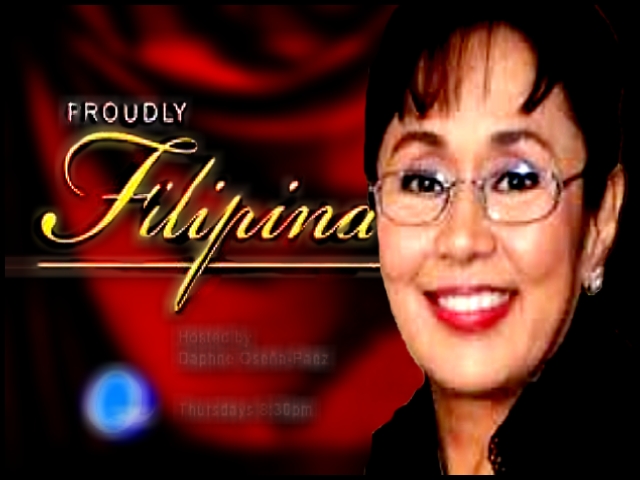
Proudly Filipina is a magazine show on QTV-11 focused on women achievers. Originally hosted by Daphne Oseña-Paez in 2006 but was replaced by beauty title holder/actress, Charlene Gonzales in 2008. The show was cancelled in 2009.

Charlene Mae Gonzales Bonnin Muhlach is a television and film personality and former beauty queen from the Philippines. Gonzalez won the Binibining Pilipinas-Universe 1994 title and represented her country at the Miss Universe 1994 pageant held in Manila, where she won the Best National Costume award and was one of the top 6 finalists. Born to actor Bernard Bonnin and model Elvira Gonzales, on 1 May 1974, she has a brother, actor Richard Bonnin. She married Filipino actor Aga Muhlach on May 24, 2001, and they have twin children born in 2001 named Andrés and Atasha. She is also a talk show host and a commercial model (Wikepedia).

RELATED READING:
Charlene Gonzalez joins QTV-11 to host “Proudly Filipina”
Charlene Gonzalez is the new face of “Proudly Filipina”
Charlene is Proudly Filipina
Daphne Oseña-Paez sets motherhood as priority over “Proudly Filipina”
Official Web-site: Daphne Oseña-Paez

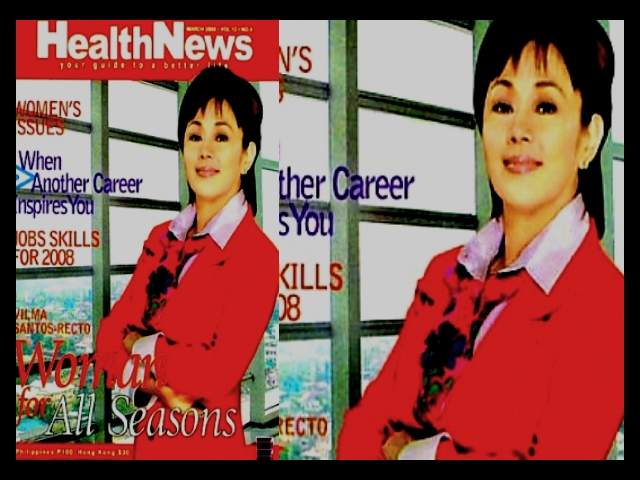
Woman for all seasons


Relasyon is part of the legendary collaboration between the late National Artist for Film Ishmael Bernal and movie queen Vilma Santos.

The film, which is the first of the so-called Bernal-Santos trilogy (that includes Broken Marriage and Pahiram ng Isang Umaga), earned Santos all the Best Actress trophies in 1982 — FAMAS; Gawad Urian; Film Academy of the Philippines; Catholic Mass Media Awardsthe very first grand slam feat for this category in Philippine entertainment history.

She defeated Nora Aunor’s high-wattage performance as Elsa, in another Bernal opus, in the heavily favored film production of Himala.

In Relasyon, Santos was both amusing and amazing as the contemporary incarnation of the beloved one, the querida. Critics and audiences, to this day, cannot seem to forget the very realistic death scene of Christopher de Leon as Emil that clocked more than one minute, taken in one continuous shot (no cuts), wherein Vilma’s Marilou was hysterically superlative.

Others (including this writer) found Santos’s exceptional acting evident in three memorable instances. The first is when she informs Emil of her pregnancy. Vilma’s face is almost pure, beaming at her lover affectionately, as she sends him off to work. Secondly, at Christmas Eve with girlfriends, she seems to be losing it, crying and laughing at the same time, enumerating how mistresses don’t celebrate special occasions, and prior to the credits, Marilou gives her love nest one more lingering gaze, eyes filled with acceptance and resignation on the fate of her affair.

Since the grand slam victory, spin masters gave her the tag “Star for All Seasons,” a creative counterpart to Aunor’s “Superstar” label.

She had other grand slam winnings after Relasyon, as Dolzura Cortez in The Dolzura Cortez Story, the AIDS-stricken sex worker; as Lea, the modern-day mother of two kids from different fathers, and as Amanda Bartolome, in Dekada ‘70, the mother coping with the turbulent 1970s and the harsh realities that growing children face.

The world of Philippine showbiz remains colorful and exciting as long as Vilma Santos’s supremacy continues.

Of late, she has been in the news again. With Aunor’s much-hyped TV comeback, Noranians are proclaiming hosannas for the superstar and, as expected, the “rivalry” between the two is brewing anew.

“That rivalry that I have with her, matagal na ‘yun,” says Santos. “I think, especially in the world of Philippine entertainment, universally accepted na yung if there is a Vilma, then Nora is immediately part of the equation. However, that so-called competition, matagal na ‘yun. Those were the days when we were still 37,” she laughs. “What’s important is that we are both working, we have very exciting projects and that the public, especially our fans, continue to support us.”

Always an actress – “Acting will always be in my blood,” articulates the actress. “I consider myself fortunate because I have already achieved all the things that an artist would want to achieve in his or her career.”

Ate Vi elaborates: “When I was younger, I had done my dream roles — gumanap na ako bilang Darna at Dyesebel. These are the roles that young stars dream of now. Kahit papaano, napagdaanan ko na ‘yan. I was able to make good and relevant films like Sister Stella L, ‘yung mga ginawa ko with direk Ishma (Ishmael Bernal), ‘yung Relasyon, Broken Marriage. Na-experience ko rin to become a box-office queen once in my life.”

Fans are looking forward to her latest movie project. “This October, my movie with Kim Chiu begins; shooting na kami,” Santos happily reports. “Since once in two years lang ako gumagawa ng pelikula, pinipili ko na kung ano ‘yung gusto ko at may maibibigay akong bago.”

With Chito Roño as its director, The Healing (tentative title) is a film about the lives of people who believe in the power of alternative medicines and witchcraft.

What drives her passions? Queen Vi smiles. “It’s because I am inspired. I have my family with me, giving me all the inspiration and the adrenaline to work harder and be inspired. I am now the mother of the province of Batangas, and so far, so good. I’ve been serving Batangas for 14 years now. But the most important thing at this point in time is that I want my family to be healthy. Kayamanan na ‘yun.”

Always a public servant – Aside from the project with Kim, the Star for All Seasons is at the forefront of the Bear Brand Powdered Milk’s Laki Sa Gatas Nutrition Education Advocacy.

The Laki Sa Gatas Advocacy is now on its fifth year. The company behind the brand visits 5,000 public schools nationwide yearly, providing school children with milk so that they acquire the habit of milk drinking. It reaches out to more than 2.5 million mothers and children via interactive information campaign.

“I believe that health is number one,” she pronounces. “That’s why my priority programs are geared toward health. Before, education used to be my top priority, but I soon realized, how can our students learn if they are not healthy? How can they become competitive if they do not get the proper nutrition?

“That is why in Batangas, I am initiating programs for the rehabilitation of hospitals, for the promotion of health cards and various nutrition programs,” Santos adds.

Always a mom – Any conversation with Santos will not be complete without talking about her eldest son, Luis Manzano. The young Manzano has announced his interest to run for the Lipa City mayor’s seat.

“I can’t stop him from the doing what he wants,” Ate Vi says. “I told him it’s not easy to be a public servant, it’s not easy to sacrifice all the things he has right now. I told him that if he’s really serious in entering, he must really have the heart for it, and that his life would not be the same.

“I would like to believe that I have set a good example,” she muses. “He grew up seeing how I work. When he was young I used to bring him with me on important occasions. I think that was an eye-opener for him, so in case he’s going to try politics he already has the foundation. If that is what he really wants, I’ll support him.”

With regard to his son’s love life, Santos quips, “As a mother, I’ll just be here to support him. I am here not to meddle or not to impose on anything when it comes to his love life.”

Vilma Santos-Recto clearly knows what is important to her — a blissful family, an exhilarating acting career, a progressive province. She is a queen in many ways and a woman in every way. – Alwin M. Ignacio

FILM REVIEW: IKAW AY AKIN

This slideshow requires JavaScript.

The Plot: “Botanist, Tere’s (Nora Aunor) long stable relationship with business executive Rex (Christopher Deleon) was shaken when Sandra (Vilma Santos) came into their lives. A pill popping liberal career minded, Sandra made Rex’s monotonous life colourful and exciting. He later realized that both women complete his existence.” – RV (READ MORE)

“An unusual story of three people caught in the unexplainable intricacies of love and need. The five year old relationship of Rex and Tere is put to a test as Sandra, the kooky, talented and aggressive designer rocks the picture perfect and peaceful relationship. The solid and unruffled engagement cracks as Rex is immediately smitten by Sandra’s dynamic persona. The film features the superstar team-up of award winning artists Nora Aunor and Vilma Santos and the drama king, Christopher de Leon.” – Database of Philippine Movies (READ MORE)

“Ang ‘Ikaw ang Akin’ ay tungkol sa isang paboritong paKsa sa ating puting-tabing: ang trianggulo ng pag-ibig. Si Rex (Christopher de Leon) ay batambatang tagapamahala ng isang pagawaan ng dyipni. Limang taon na silang magkatipan ni Tere (Nora Aunor), isang dalubhasa sa paghahalaman. Mapayapa at maayos ang kanilang pagsasama hanggang makilala ni Rex si Sandra (Vilma Santos), isang designer. Nagsimulang magkaroon ng sigalot ang pagsasama nina Rex at Tere. Hindi makapagpasiya si Rex kung sino ang pipilijn sa dalawa na kapwa naging matimbang sa kanya. Sa huli, nataios ni Rex na ang pag-ibig at pag-aangkin sa isang nilalang ay isang masalimuot na damdaming hindi nararapat sarilinin ng isang tao lamang.” – Manunuri (READ MORE)

The Reviews: “…After 37 years, Ikaw Ay Akin becomes a materialist indictment of the patriarchal deceit cisgender passion must contend with, opening up the queerness that emerges from feminine confidence as zone of alternative feelings. And, of course, Nora still punctures the assault with an imperturbable will to punctuate the sentence, despite the adages of her time failing to utter competitive affection, convincing Vilma that the encounter isn’t just about female rivalry, but also masculine decadence…” – J. Pilapil Jacobo, Young Critics Circle Film Desk, 21 November 2015 (READ MORE)

“…Bernal, testing the tensions of triangular love (for geometry books, one of his characters wittily says) for some time now, plunges deeper into character analysis and metaphorizing. In Lumayo, Lumapit ang Umaga, the triangle was unevenly explored: the first love was sketchily drawn. Dalawang Pugad, Isang become a choice for a more stable relationship. Walang Katapusang Tag-araw was a strange reverse of characters for two women and an unusual development of love into hatred and hatred into love, where therefore the triangle was essentially illusions. Ikaw ay Akin finally sets an interlocked triangle on its bases and looks at it (from all 3 angles) squarely in the face. Except for some scenes with overdrawn energy, the viewing is intelligent entertainment. However, after an interesting beginning and development one feels the resolution is too simplified…and too calculated. Charing (Nora) is the confident, authoritative, ultra-responsible mother-figure who fits very nicely with Rex’s (Boyet) tentative character: orphan-psyched, retreating… an incomplete figure. Sandra (Vilma) outs a very colorful character: agressive, creative, lively – but underneath it all, essentially a clinging vine. They are such convincing characters, and all their needing and suffering come accross very easily from the celluloids. With just a few scenes they are rounded out. Charing and her orchids – a reflection of her care for Rex and her discerment between experiment and commitment; Rex and his parachute – a give-away of his secret longing to get away from all the givens of his life (the inherited business, cons of orphan’s loneliness even his 5-year relationship with Charing!) Sandra and her designs – creating is at once product of her character and a need (initiating a realtionship with Rex is expression of need more than any romantic feeling). When Rex, balancing the triangle, verbalizes all these into a very basic “She needs me; I need her needing me plus your caring for me,” clearly sided heavily on Sandra’s side, it is unbelievable that it should all boil down to plain need, that decisions on love could be made this easily. Questions: While one is at verbalizations, why not mention the giving side of love, appraise or even applaud it a little instead of leaving it implicit in Charing’s character – which could be, come to think of it, the key out of tanglejails of possession? Ofcourse Bernal might have been considering less subtlety in a bid for a more popular style. Granting that, one may still appreciate the five selections of environmental details that areally delineate characters and character development – a fine effort to bring setting characters and action into a unified direction – but are triangles the curret favorite in the moviemarket? If this means it is a main concern in many lives today, then…what a hell!…” – Petronila Cleto, Pelikula, Atbp (READ MORE)

“…Unlike other superstar team-ups that fail to exploit the golden opportunity of pulling in sure audiences to watch a serious work, Bernal’s greatest achievement lies not so much in putting his three big stars together but in making use of them to lure their fans and followers intos eeing a mature, sensible film. And his cast serves Bernal very well. In the hands of a capable director, Christopher de Leon proves that his forgettable appearance in such odious films as “Topo-Topo Barega” and “Disco Fever” are mere lapses in judgment that do not entirely discredit his craft. He also shows enough gallantry by not getting into the way of his leading ladies, whose roles are undoubtedly more demanding than his. As the uptight Sandra, Vilma Santos has the script’s choicest, wittiest lines. She makes the most of them and succeeds in giving a fairly accurate portrait of an emotionally insecure young woman. And when she tells Rex: “sabi nila liberated ako, front lang. Kalog daw, front din. Alam mo namang kulang-kulang ako. Pag wala ka, magkakalat ako. Para akong manok, takbo ng takbo wala namang ulo.” She likewise handles her final breakdown exceedingly well. Nora has less lines but she nevertheless manages to conveys her emotions very effectively. In that family reunion-party which is so engrossed in gossip and banter, she remains so detached, speaking nary a word — a triumph for both Bernal and her. The hurt in her eyes continues to build up until that disrupted dinner scene where she rushes to her room and, unable to contain herself, finally cries. The most stable of the three, you could really believe her when she tells Rex: “Galit ako sa ‘king sarili, dahil sinasaktan mo na ako nang todo-todo pero lalo ka namang napapamahal sa akin.” The film is greatly enhanced by Jose Carreon’s vibrant script, Mel Chionglo’s superb production design, the Vanishing Tribe’s fine musical score, and Augusto Salvador’s brisk editing (few scenes last longer than a couple of minutes). But the lion’s share of credit goes to Bernal. I particularly like his splendid use of meaningful pauses and oppressive silences, as in Sandra and Tere’s accidental first meeting at Rex’s house, Sandra’s soundless dinner with her father that leads to her breakdown, and the long, quiet ending scene where Sandra and Tere never say a word and yet succeed in finally communicating with each other. Our viewers are discomfited by this exhausting process, what with the underdeveloped tastes of our mass audience perpetuated by irresponsible irectors. But one fervently hopes for Bernal, who apparently believes he owes the audience his best even if they are more likely to love his third best more, that they would get the film’s message and, perhaps, even accept and like it.” – Mario E. Bautista, Philippine Daily Express, 1978 (READ MORE)

“…Mas challenging ang role ni Ate Vi rito kumpara kay nora…mas magaganda ang mga dialogues ni Ate Vi na nakakatuwa at magaling ang pagkakadeliver niya ng mga linya. Sexy siya ha at magaganda ang mga damit na ginamit niya rito. Maigsi ang buhok na medyo curly. Bagay na bagay sa kanya. Komento ko lang ay medyo matinis pa ang boses ni Ate Vi rito…Vilma-Nora Scenes: a) sa sine parang sa tingin ko ay di sabay ito kinunan sa tingin ko lang ay di sila magkaeksena rito bagamat pareho silang nasa sinehan. b) bahay scene – ang ikli ng pagsasama nilang dalawa rito na parang pinasabik ang mga manonood kung may iringan ba or acting sa acting ang magaganap, pero walang naganap na ganun! c) No Dialogue Scene – Grabe!! Ang galing ng eksenang ito. First time kong makanood ng ganitong ending…walang salitaan, sagutan, walang murahan, walang away, wala as in wala except labanan ng facial expression, eye acting ika nga. Kainis lang ang director na ito kasi pinaglaruan lamang ang imahinasyon ng mga manonood at ng mga Vilmanians-Noranians!…” – Dream Forest, V Magazine Issue No. 7 Literary Issue 2006 (READ MORE)

“…Makikita sa Ikaw Ay Akin ang dalawang magkaibang estilo ng pagganap na ipinamalas nina Nora at Vilma at kapwa akmang-akma ito sa buong katauhan ng mga karakter na kanilang ginampanan. Sino ang mas mahusay sa kanilang dalawa? Kani-kaniyang opinyon, depende sa mga nakapanood ng pelikula. Maraming nagsabing mas pinaboran daw ni Bernal si Vilma sa dahilang mas maramin itong mabibigat na eksena kaysa kay Nora, ngunit paano makakalimutan ang huling tagpo sa Ikaw Ay Akin kung saan mahabang katahimikan ang naging daan upang higit na magkaintindihan sina Tere at Sandra tungkol sa kanilang pag-ibig kay Rex. Kung totoong mas pinaboran ng direktor si Vilma ay nakabawi naman ito ng husto kay Nora pagdating sa nabanggit na eksena. Kakaiba din ang husay na ipinamalas ni Christopher de Leon, maaring alam niyang ang Ikaw Ay Akin ay pelikula ng dalawang malalaking aktres kung kaya tama lamang ang bigat ng pagganap na ipinamalas ng aktor sa papel ni Rex. Napagwagihan ni Christopher ang Pinakamahusay Na Pangunahing aktor mula sa Manunuri Ng Pelikulang Pilipino nang sumunod na taon samantalang kapwa nakatanggap ng nominasyon bilang Pinakamahusay Na Pangunahing Aktres sina Nora at Vilma sa Ikaw Ay Akin ngunit kapawa sila natalo ni Beth Bautista para sa kanyang mahusay na pagganap sa Hindi Sa Iyo Ang Mundo, Baby Porcuna. Hindi matatawaran ang tagumpay ng mga manlilikhang bumuo sa Ikaw Ay Akin na nagtaas ng kalidad ng dramatikong pelikulang Pilipino, nagturong umintindi ng husto sa damadamin ng mga taong tunay na nagmamahalan.” – Jojo Devera, Sari-saring Sineng Pinoy (READ MORE)

“…While the previous year was less productive in terms of quantity, Vilma Santos came back with a big bang the following year with twelve films. Most of these films were adult dramas. Three notable films were the critically acclaimed “Pagputi ng Uwak, Pag-itim ng Tagak” directed by Celso Ad Castillo and produced by Vilma herself. The local film festival entry, “Rubia Servios” directed by the late Lino Brocka. And lastly, “Ikaw ay Akin” directed by Bernal. “Ikaw ay Akin” reunited Vilma with rival, Nora Aunor. The film also featured Christopher De Leon, who won the local critics’ best actor and best actress nominations for Aunor and Santos as well as best director nomination for Bernal. Aside from Ikaw, Bernal also did two other films, both starring Alma Moreno, “Lagi na lamang ba akong babae?” and “Isang gabi sa iyo Isang gabi sa akin” with Elizabeth Oropeza…” – RV (READ MORE)

“…“Ikaw Ay Akin,” 1978, Ishmael Bernal. A refreshing change of role for the superstar, cast here as a smart and sophisticated horticulturist at odds with best friend and real-life rival Vilma Santos. Notable for its experimental and long closing shot of the two friends’ reunion, with only their eyes talking…” – Mario A. Hernando, Philippine Daily Inquirer, 01 October 2011 (READ MORE)

FILM REVIEW: SSL (Updated)

This slideshow requires JavaScript.

If we do not act, who will act? If not now, when?

The Plot: Sister Stella L. is the award-winning masterpiece by Mike De Leon. It’s about a nun, Sister Stella Legaspi, who becomes involved in labor strikes after learning about the government’s neglect of the poor and the working class. Her sworn duty to fight for the poor and the oppressed turns personal when her journalist friend Nick Fajardo is tortured and the union leader Dencio is kidnapped and killed. What follows is her eye-opening and the tear-jerking battle against cruelty and injustice. The film broke censorship barriers back in 1984, during the final years of the US-backed Marcos dictatorship, for its realistic portrayal of labor struggles, and extrajudicial killings, hauntingly mirroring the reality of Philippine society today under Gloria Macapagal-Arroyo. – Filipinas for the Rights and Empowerment

The Reviews: Hindi kami nakakilos sa aming inuupuan matapos panoorin ang “Sister Stella L”. Para kaming sinampal, tinamaan ng kidlat right between the eyes. Masyado kaming naapektuhan. Gusto naming sumigaw. Talagang gagalitin ka ng pelikula. Kay raming eksena ang talagang titiim ang bagang mo. Manggigigil ka, magngingitngit ka. At pahahangain ka. Gusto mong sigawan ng bravo, yakapin at suubin ng papuri ang mga gumawa nito. Si Mike de Leon na siyang direktor. Si Lily Monteverde na naglakas-loob na i-produce ito. Ang scripwriters, ang mga artista, at lahat na ng kaugnay sa pelikula. Alam mong itinataya nila ang kanilang kaligtasan sa paggawa ng ganitong uri ng pelikula. At bilang manunulat, naroon ang hangarin mo upang tulungan ang pelikulang ito na mapanood ng lalong nakararaming mga pilipino. ..nang walang putol!

Ang “Sister Stella L” ay kasaysayan ng isang madre, ng isang Pilipino, at ang pagkakamulat ng kanyang mga mata sa mga kaapihang sosyal na nagaganap sa kanyang paligid. Sa pagsisimula ng istorya as siyam na taon nang naglilingkod sa kumbento ng Caritas si Sister Stella Legaspi (Vilma Santos). Guidance counselor siya sa mga taong may problema na tulad ni Gigi (Gina Alajar), isang unwed mother. Minsa’y dinalaw siya ni Nick Fajardo (Jay Ilagan), isang peryodistang dati niyang katipan. May sinusulat itong artikulo tungkol sa mga aktibistang pari at madre. Agad inamin ni Stella na siya’y “walang masyadong alam sa socio-political involvement ng mga madre at pari.” Siya ang ginawang ehemplo ni Nick sa artikulo nito ng mga madreng kulang sa kamulatan. Nag-react dito si Stella at sinabi sa kanya: “ Hindi ba involvement din ang trabaho ko rito sa Caritas?” Madalas ma-depress si Gigi at kay Stella ito sumasandal. Nang minsang sabihin sa kanya ni Stella na kaya niyang dalhin ang kanyang mga problema ay sinumbatan siya nito: “Madaling magsalita. Hindi naman ikaw ang nahihirapan. Paano mo alam, hindi ka naman dumaan sa hirap? Nagbuntis ka na ba? Laging masakit ang suso mo. Nahihirapan kang tumae.” At nang patuloy pa ring malamig si Stella ay sinabi nito: “Bakit hindi ka gumaya sa ‘kin? Nagagalit, nagmumura, nagpapabuntis?”

May kaibigang madre si Stella, si Sister Stella Bautista (Laurice Guillen). Involved ito sa social action work at kasalukuyang tumutulong sa Barrio Agoho, isang factory town, na kung saan ang mga manggagawa sa Republic Cooking Oil ay nagbabantang mag-aklas. Naakit si Stella L. na tingnan ang uri ng trabaho roon ni Stella B. Sa araw ng kanyang pagdalaw sa Agoho ay tiyempo namang pagsisimula ng welga roon. Tuwang-tuwa si Stella B. Sumasama raw siya sa picket line dahil “pag may mga madre at pari sa picket line, nahihiyang pumasok ang mga eskirol.” Sa paglapit niya sa picket ay naabutan si Stella L. ng placard at siya man ay napabilang na rin sa welga. Puno pa siya ng mga katanungan: “Ano ba ‘tong napasukan ko? Anong gagawin ko?” Sabi naman ni Stella B.: “Basta gawin mo lang ang gagawin ko.” Sa paglipas ng oras ay nakausap niya ang mga manggagawang nagwewelga, nakitulong siya sa pagsandok ng kanin, sa paghugas ng plato. Nakilala niya ang lider ng mga welgista na si Dencio (Tony Santos) at ang asawa nitong si Auring (Anita Linda). Nang makita ni Nick ang mga larawang kuha sa welga at kabilang doon si Stella, nasabi nito sa kanyang editor (Liza Lorena): “Kilala ko si Stella. Madali siyang maimpluwensiyahan. Baka kung ano na ang napulot noon sa tokayo niyang radikal.” Nagsimula namang kuwestiyunin ni Stella ang trabaho niya sa Caritas. Binalaan siya ng kanyang superyorang si Juaning (Adul de Leon): “Hindi social action ang linya natin. At tandaan mo ang sabi ng Papa: huwag tayong humalo sa politika.” Sa kanyang mga alinlangan kung tama ang pasiya niyang maglingkod sa Agoho, ito ang payo ni Stella B.: “Paano mo malalaman kung hindi mo susubukan? Hindi ang mga tao ang dapat makinig sa ‘yo, ikaw ang dapat makinig sa kanila.” Dahil sa kanyang karanasan sa Agoho, nasabi ni Stella kay Gigi: “Ang kahirapang nababasa’t naririnig ko lamang ay naging buhay na sa akin. Ako pala’y nangangapa ring tulad mo.” Namulat ang mata niya sa “pang-aabuso sa mga naaapi” at na-touch siya ng “pag-aasikaso ng mga ito.” Aniya: “Sila na ang nangangailangan ay kami pa ang kanilang iniintindi.”

Duda pa rin si Nick sa involvement niya sa welga. Pasulpot-sulpot lang daw siya roon, patulong-tulong. “Kapag nagsawa ka,” anito, “uuwi ka rin sa komportableng kumbento.” Si Stella B. ay kinailangan namang magpunta sa Davao upang tumulong sa isa pa nilang kasamahan doon, lalong nangamba si Stella L. na iiwanan siya nito sa Agoho. “Baka hindi ko kaya,” aniya. Sabi naman ni Stella B. “Puro ka baka, e, kailan mo pa malalaman?” Pinatawag uli si Stella ni Juaning. Sabi nito: “Hindi payag ang kongregasyon sa trabaho mo sa Barrio Agoho.” Sa pagbabalik niya sa Caritas, nagpatiwakal naman si Gigi. Lalong naguluhan si Stella. “Parang bumaliktad ang mundo ko,” aniya. “Marami akong tinatanong. Bakit nga ba ako nag madre?” Sabi naman ni Stella B.: “Madreng lansangan ka pa rin hanggang mamatay ka.” Natuloy ang pag-alis nito, na ang akala’y pinoproblema niya na baka may pagtingin pa rin siya kay Nick. Bilin pa nito: “Kung mahal mo siya, sundin mong feeling mo. Marami namang paraan ngpaglilingkod sa Diyos.” Si Nick ay nagkaroon din ng problema sa trabaho niya. Isang artikulo niya tungkol sa karanasan ni Stella B. sa Isabela na pinamagatan niyang “A Nun’s Story: Military Atrocities” ang hindi pinalathala ng kanilang publisher. “I-rewrite mo,” sabi ng editor niya. “Bawasan mo’ng tapang.” “Ano?” balik niya. “Gawin kong love story?” “Sabi ko, i-rewrite mo, hindi babuyin,” anang editor. Pero sa bandang huli ay nag-give up na rin ito. Tanggapin na raw lamang ang kanilang mga limitasyon. “Hindi lahat ng legal ay makatarungan.” Nagbitiw si Nick sa trabaho niya sa Tribune at lumipat ng pagsusulat sa Malaya.

Nagbalik si Stella L. sa Agoho at naging mas aktibo na siya sa picket line. Nang minsang lalabas ang trak ng mga produkto mula sa pabrika ay siya pa ang nag wika: “Mga kasama, magkapit-bisig tayo.” Samantala’y nagsimula ang pangha-harass kay Dencio at sa pamilya nito. Una’y ginulpi ang anak niyang si Roger, pagkatapos ay binaril ang bahay nila. Ang huli’y kinidnap si Dencio. Nang papaalis na sina Stella at Nick upang humingi ng tulong, sila man ay kinidnap din. Nakita nila ang pagpapahirap kay Dencio. Sila man ay sinaktan din at si Stella ay binastos pa ng mga sanggano. Pinakawalan din sila. Di naglaon, ibinalik si Dencio. Patay na. Sa harap ng mga manggagawa, ipinahayag ng asawa nitong si Auring na tuloy ang welga. Nagsalita rin si Stella at sinabi niya: “Ilang beses akong pinaalalahanan na ako’y isang madre lamang. Pero una sa lahat, ako’y isang tao, ako’y isang Kristiyano.” At isinigaw niya: “Katarungan para kay Ka Dencio. Mabuhay ang uring manggagawa.” Sa last scene ng pelikula’y nagsasalita ng diretso si Stella L. sa mga manonood: “Marami pa akong hindi alam at dapat malaman tungkol sa kasalukuyang kalagayan ng ating sistema ng lipunan. Kailangan pa ‘kong patuloy na mag-aral at matuto. Pero ang mahalaga’y narito na ako ngayon, hindi na nanonood lamang. Nakikiisa sa pagdurusa ng mga di makaimik, tumutulong sa abot ng aking makakaya. Kung hindi tayo ang kikilos, sino ang kikilos? Kung hindi ngayon, kailan pa?”

More than anything else, ipinakita ni Mike de Leon bilang isang socially committed at responsible na director ang iba pang posibilidad ng pelikula bilang art at bilang medium of communication. ‘Yung mga laging pumipintas sa pelikulang lokal at nagsasabing walang kuwenta’t saysay ang mga ito, panoorin ninyo and “Sister Stella L” for it is Filipino moviemaking at its best: aware, concerned, and with a universally relevant message. It also shows that an artistic film can be entertaining and as a matter of fact, is necessarily intellectually entertaining (but an entertaining film is not necessarily an artistic one).

The movie succeeds in delivering its message because all the elements that went into its completion are excellently executed. It is that rare kind of movie which has no false moves. The screenplay is brilliantly developed and constructed by Pete Lacaba, Jose Almojuela (who is also the assistant director), and Mike de Leon himself. The cinematography of Rody Lacap deserves nothing but superlatives and the musical score by Ding Achacoso is served in a silver platter (napakagaganda ng mga awiting “Sangandaan” at “Aling Pag-ibig Pa” na nilikha niya para sa pelikula). The editing by Jess Navarro and the production design by Cesar Hernando also deserve the highest commendation. We cannot help but gush dahil lahat ng aspeto ng produksiyong ito ay maganda.

The movie is sure to elicit all sorts of reactions from various quarters. The bigoted and the narrow-minded will no doubt readily brand it as the work of communists and subversives. The involved will merely find it interesting. But the enlightened will declare it as a socially committed work of art. No doubt that some concerned quarters will be offended. Some of the speeches are so frank and fearless. Dencio says in a May 1st rally: “Ang mga manggagawa ang lumilikha ng yaman ng bansa. Panahon na para ipakita ang lakas ng ating pagkakaisa, na makamtan ng bayan ang tunay na kalayaan. Ang manggagawa ang nagpapaandar ng makina, nagpapalago ng puhunan.” Pero ano ang nangyayari? Tayo ang namamatay sa gutom, ang naghihikahos. Hindi magbabago ang ating lipunan kung uupo lang tayo sa isang sulok at maghihimutok. kundi tayo ngayon kikilos, kailan pa?” Nang mamatay siya, sabi naman ng asawa niyang si Auring: “Noon, ang paniwala ko talaga, gano’n ang buhay, may nasa itaas, may nasa ibaba. May nag-uutos at may nagsisilbi. Pero kung tatahimik ka na lang lagi, ang konting meron ka, aagawin pa sa ‘yo. Patay na nga si Dencio pero tuloy ang welga.” Sabi naman ng anak niyang si Roger: “Kung kikilos tayo, dapat ngayon na. Ngayon pa lang, pinapatay na kami. Kaya mas mabuti pang mamatay ng lumalaban kaysa habang buhay kang nagtitiis.”

To make a film like this comes under the heading “they said it couldn’t be done.” Mike de Leon does it, splendidly. In these days when local film faces such problems as exorbitant production cost, commercialism, lack of an intelligent and responsive audience, and censorship, it is heartening to note that movies like this are still being made. Matthew Arnold said that art and society shape each other so artists should deal with serious subjects of moral and social value. This is exactly what Stella L. accomplished, for it allows the viewer to meditate on life and help him gain some insights. Surely no film is an island entire of itself because each movie is made by several men, but the distinguishable personality of an exceptional director is almost always imprinted on his film. We have never really liked the works of Mike de Leon that much and his movies (like “Itim”, “Kung Mangarap Ka’t Magising”, and “Kisapmata”) seemed nothing more to us as exercises in self-indulgence. Starting with “Kakaba-kaba Ka Ba?” though, he demonstrated a newfound cause in making movies, which is further reinforced by “Batch ‘81”. Now, Stella L., offers the pleasure of watching a director as he is hitting full stride, his craft and competence marching in step with history. His deft hand is quickly evident in the cinematography. There is no imposed prettiness in the photography, no straining for arty effects, but the texture is rich and palpable to validate reality, with the effective use of color-acting on the viewer to reinforce the temper and tenor of the story.

De Leon handles his intimate and delicate material powerfully, persuasively and penetratingly. He not only executes the technical aspects marvelously but also knows how to work with his actors, both individually and in the here all-important ensembles. The crowd scenes are a delight, with some sequences presented with the veristic quality of a documentary, and each scene is played for maximum impact, immaculately crafted and made with care and conscience, with dedication and devotion. If we now sound so much like an avid de Leon fan, it is because Stella L. is the kind of work that makes a reviewer long for new adjectives of praise. One knows very well that de Leon works for reasons other than money. This makes the strength, sensitivity and symetry of his direction deserve the highest praise and the sweet of music of thunderous applause for it is just better than perfect. Local cinema gives us very few occasions to rejoice and this is one of them.

In the large and uniformly excellent supporting cast, Laurice Guillen stands out as Sister Stella B. She is one film director and actress who is really ablaze with talent. As the instrument to Stella L.’s involvement in a much more worthy cause, she imbuesher role with just the right mixture of intensity and charm. Equally memorable are Tony Santos as the beleaguered labor leader, Anita Linda as his courageous wife, and Liza Lorena as the sympathetic magazine editor who is willing to compromise. Gina Alajar is very effective in a very short role as the unwed mother. In the male lead role, Jay Ilagan proves once more that he is indeed one of our most competent young actors available.

And now, Vilma Santos. Playing the title role, Vilma tries a part that is totally different from her past roles and proves that she has indeed become a highly skilled professional. Her role is somewhat reminiscent of Audrey Hepburn’s in Fred Zinnermann’s “The Nun’s Story”, where a young nun discovers in a hospital at the Congo that she is first a nurse and only second a religious. But Stella’s awakening is much more vital and revolutionary than that of Sister Luke in the Hepburn movie. Vilma’s transformation from an innocent bystander to that of an active participant who is audacious enough to be in the thick of battle is truly quite awesome to behold. We could almost see and feel the internal changes in her. In a sense, the role is somewhat tailor made for her because her beauty is appropriate to the part of Stella L., but she also succeeds in transcending her established personality, delivering her lines and gestures with vigorous conviction and playing it to perfection that one can safely predict that she will again be running in the best actress derby come next year. And so, to Vi, Mike and Mother Lily, our heartfelt gratitude for giving us a film that has the power to cause insomnia. – Mario E. Bautista (READ MORE)

Must the ability to entertain the audience be the constant guiding criteria in the film and in the performing arts? While certainly, one does not minimize the importance of the entertainment function of the arts, the film Sister Stella L shows that it is not much the ability to entertain that is crucial as the ability to stir and maintain interest. For, as in this film, one cannot really say that the audience is entertained, regaled with spectacular sights, provided a pleasant diversion or titillated by teasing or amusing scenes, but the audience is invited, through the skills of the performers and director, to engage in immediate issues which concern us today. This film thus poses a challenge to our usual notions and expectations of Philippine cinema, as it is not a romantic or domestic drama, a comedy or an action film. The fact that such a film as this appears at this point implies a belief in the development and maturity of the local audience who can, at least from the responses of previewers so far, be receptive to harder stuff.

Sister Stella L deals with the contemporary social issues through the experience of various characters, among them Sister Stella L (Vilma Santos) and Nick, her former boyfriend now a journalist (Jay Ilagan), Sister Stella B (Laurice Guillen), the union leader Ka Dencio (Tony Santos) and his wife (Anita Linda). Again, the film differs from most productions nowadays in its immersion in contemporary social reality. The characters, too, possess a strong active aspect of people engaged in a meaningful cause, the people’s struggle for social justice. The nun that Sister Stella B portrays typifies in her strength and honesty the person who has gone beyond purely personal and selfish concerns to embrace the larger role of service to the people. No doubt, it is a refreshing and exhilarating experience to see characters who realize themselves fully as human beings by transcending petty selfish interest and giving of themselves to people in need of support and protection. Because of this, the spirit of the film is highly optimistic and reassuring because it makes us strongly aware of the forces in our midst working for change and of the fact that history is moving forward with these forces assuming the active role.

The central issue of the film has to do with the involvement of religious like Sister Stella L and her senior, Sister Stella B, in socio-political affairs. We know, for instance, that one point of view will have priests and religious secluded behind convent walls where their activity is restricted to praying. They are to have nothing to do with life around them as social and political concerns are thought to corrupt their purity and bring in wordly moral dangers and temptations. Or that priests and religious should remain apolitical, not taking sides in socio-political issues, but as men of God, considering all men as brothers who will, in the end, become docile and receptive to preachings of love and unity. The other point of view believes that it is not as simplistic as all that. In fact, it believes that the adoption of a neutral attitude can only serve to dull one’s moral sensibilities and because one shirks from making moral choices, one also renouces one’s responsibility as a human being. In truth, it is of utmost importance, perhaps particularly so for religious, to have a fine and acute sense of moral discernment as applied to social relations, in which the idea of truth and justice operate. The religious who makes grand sermons on love and unity may not himself understand the meaning of truth and justice, because love and unity do not exist in the abstract but are social ideals possible of attainment – only and only when exploitative relationships are destroyed. Otherwise, one contents oneself with hypocrisies. What for instance, would be the love of the rich factory owner intent on profits for the worker, and vise versa. Workers’ wages are only to keep workers alive and in a measure of health for him to have enough strength to operate the machines of work in the fields. Is it enough for factory owner and worker to meet in church and perhaps occupy the same pew – or will religious feel sufficiently edified at the sight? But priests and nuns are citizens of this country as much as any of us and are thus part of the body politic in which they have the right to take active part. Likewise, they are as human as anyone else, and as human beings, they have the drive toward concreteness and totality realized only in social interaction. The Church, too, cannot afford to take a position of alienation and withdrawal, because by doing so it will only continually lose its influence in a time of urgent and pressing realities; otherwise, it will only end up as an outmoded medieval institution. The Church is continually called upon to make moral decisions, and it is through these that the people will know whether it truly supports their cause or whether it only acts as a liaison for exploitative interests.

In the film, for instance, there is a conflict between Sister Stella L and her superior who wants her to stay in the convent to act as guidance counsellor and not to engage in labor activities in Barrio Agoho where a strike in an oil factory is taking place. For a while, she obeys her superior to be spiritual adviser to an unwed mother, portrayed by Gina Alajar, who, however, throws her back the question of what does she know at all, as a nun, of human suffering. The task of counselling this individual soul lost in her private hell is fruitless and Gina eventually commits suicide, which serves to show the nun the narrow limitation of such a task. Sister Stella L henceforth knows that she must make the choice of the larger and more challenging field of the workers in struggle. It is also important to note that Sister Stella B tells her fellow nun that although her immediate superior may not approve of her social participation, it is possible that higher superiors will – thus showing that such is still possible within the fold of the congregation. Also, at one time, there arises the question of whether Sister Stella L will stick it out as a religious or continue her activities outside the convent. Upon consultation with her friend, Sister Stella B, she decides to carry on the struggle as a nun, and by so doing, show the importance of such a function for her fellow religious, as well as its validity as a position within the religious orders.

The central event in the film is the strike of workers in an oil factory in Barrio Agoho where nuns show their support for the workers by participating in the picket, thereby lending valuable protection. The factory owner (Ruben Rustia) sends goons to harass the picket line, and makes use of the military, which readily lends itself to protect the minority interests of wealthy property owners against the majority interests of the workers. When the strike continues despite inclement weather and hunger, the factory owner resorts to kidnapping the union leader, Sister Stella L, and her journalist friend. All are maltreated and tortured, but the old union leader is finally “salvaged” and thrown into a dump. In the confrontation between the factory owner and Sister Stella L, the former shows himself to be hostile to the workers and to the participation of the nuns: “Kung pati ang mga madre ay nagpapagamit sa mga Komunista, mabuti pang magbago na lang ako ng relihiyon.” To which the nun answers: “Mabuti na ngang magbago kayo ng relihiyon upang hindi parehong Diyos ang sambahin natin.” The murder of the union leader, Ka Dencio, only lends more fuel to the workers’ resolve to continue the strike, which is now led by his wife, with the militant participation of Sister Stella L. The latter’s exhortation to the workers – and by extension to the audience – to engage in the struggle ends the film.

A secondary theme is the issue of press freedom, which is explored, in the first-hand experience of Nick, the young journalist. He writes a series on the politicization of the religious and their active participation in mass actions. In the beginning, his motivations are somewhat confused – and this his editor points out clearly to him – because he may be using this as an excuse to follow and communicate with Sister Stella L, who used to be his girlfriend. The journalist, however, understands the futility of the religious confining themselves within convent walls and poses the challenge for involvement. Sister Stella L takes up the challenge – in fact, the journalist’s articles contribute to her politicization. When she gets more and more involved, he becomes protective and anxious for her safety. His articles on the subject barely squeeze through censorship and he experiences increasing difficulty in getting published. Sister Stella L and he are kidnapped by goons and they are physically assaulted even as they witness the torture of the union leader. Instead of intimidating them, the experience completes their politicization and in the end Sister Stella, militant and committed, finds her true social role.

Because this movie deals with issues, it has more than the usual amount of dialogue compared with other films. This, however, does not work against it. Since what is talked about is drawn from the very stuff of social reality and thus concerns a large number, it is able to sustain interest. Too much dialogue would be a defect if it dwelt on banalities or inanities or if it narrated incidents rather than portrayed them. In this case, dialogue is necessary for the exploration of issues, as well as for the portrayal of how the characters reckon with ideas and develop in their social consciousness. The audience is not bored provided the things talked about in the film have a bearing on their lives. Filipinos, after all, are a talky lot (think of the large amounts of time spent in coffee shops over coffee or beer). Moreover, these are talky times, because the larger public is rapidly developing critical awareness, and there is now a greater need for interaction and exchange in the interest of survival. There are references in the film which may, at first, seem extraneous, such as Sister Stella B’s mission to Davao where she joins a fact-finding group. However, such references serve to extend the “area of responsibility,” if we may borrow the expression, from Manila to the far-flung provinces. Thus, the unity of the film is not only in the events that engage the characters in Manila but also in a larger over-all spirit of solidarity in which vibrations of sympathy throughout the islands give strength and comfort to those of a common cause. For a heart-warming film, the entire cast deserves congratulations, particularly Vilma Santos who reveals another aspect of her multi-faceted talent. From her usual soft and sweet romantic roles, she can be transformed into a strong and militant woman without losing any of her charm and beauty. Jay Ilagan, Tony Santos, Anita Linda and Liza Lorena are also in their best form. Mike de Leon as director, Jose F. Lacaba as scriptwriter are likewise to be congratulated for making a truly human film and for contributing to the cause of workers for justice and of the religious for the recognition of their social role. Not to be overlooked is the producer Lily Monteverde of Regal Films who has this time shifted from puerile erotic dramas to make a courageous film for which she will always be well remembered. – Alice G. Guillermo, Who Magazine May 30, 1984 (READ MORE)

THERE WOULD HAVE BEEN two important Filipino films in this year’s prestigious Cannes Film Festival: Sister Stella L., directed by Mike de Leon and Kapit sa Patalim, directed by Lino Brocka. Both smuggled out to France and both vitally political in thrust, the two films were reportedly disowned by the Philippine embassy in France. Supposedly under instructions from the Philippine goverment, the embassy sent the following disclaimer to the festival directorate: “There are no Filipino films in the Cannes Film Festival.” The two films nevertheless made it to the festival site, though only one was screened as scheduled. Brocka’s film was in the category “In Competition,” and was tested against the works of such eminent directors as Werner Herzog, Wim Wenders, and Satyajit Ray. Early on, Kapit sa Patalim (which acquired a second title, Bayan Ko, in deference to another film project which had been approved before Brocka’s project) was rumored to be a strong contender for the Best Film award. Critic Bertrand Tavernier was quoted as saying, “It’s a toss-up between Wim Wenders’ Paris Texas and Brockas’s Bayan Ko.” De Leon’s film was to have had special screenings, on the unanimous request of the Cannes’ board of critics. Sister Stella L., however, suffered from the rush of subtitling work that descended upon Cannes’ select group of translators and De Leon opted not to show the film without subtitles. He nevertheless had the distinct honor of holding a retrospective under the sponsorship of the French Cinematheque right after the festival. The film eventually competed at the Venice Film Festival. Under its original title Sangandaan (Crossroads), Sister Stella L. was invited to the Venice Film Festival in 1984, the second Filipino film (after Genghis Khan in 1951) to be honored with such recognition. – – Agustin L. Sotto and Pet Cleto, Philippine Panorama Dec 02 1984 (READ MORE)

“…Sister Stella L is undeniably, an angry film. It reeks of the pungency of a dictatorial regime and immersed in the canker of political and social repression. It is Jose F. “Pete” Lacaba’s film more than it is Mike de Leon’s. It is ideologically furious and liberalistic that you might surmise the film as left-leaning rather than simply a hard nudge at the Marcos government. Interesting to note of Lacaba’s background in the underground movement after the imposition of Martial Law in 1972, which, as most of the intellectually enlightened ended being rounded up by the military, thus his exclamation is compellingly evident in Sister Stella L…in the film’s first minutes, we witness a kind of relevancy we could not deny exists nowadays: the separation of the Church and the state, particularly on affairs that have a lasting effect on the people. “Hindi ang mga tao ang dapat makinig sa yo, ikaw ang dapat makinig sa kanila” (“The people should not be the ones listening to you, instead, you should be the one listening to them”), Sister Stella Bautista quietly ripostes, summarizing the supposedly inherent role of the laity in its profession of faith and service. A reversal of such an adage practically prevails in the Church’s current social rearings, despite the invisible boundary. But is activism a justification for the intrusion? Probably dependent on the circumstances. The motivation is noble and not of selfish traditionalism, that the film likewise bestows the necessity of religious congregations to act as a force to mobilize. Maybe the film is too radical in its approach, and frankly, Mike de Leon would possibly agree to that. Like most people would notice, Sister Stella L. is undoubtedly, not a Mike de Leon film. He has a hand in its production, but it is certainly not his. It has all the footprints of Pete Lacaba firmly planted in, from its conception to structure, similarly like what he did with Lino Brocka’s hard-line Bayan Ko…Kapit sa Patalim (1985) and Orapronobis (1989).” – Etchie (READ MORE)

“…In Mike de Leon’s “Sister Stella L,” Vilma Santos plays Catholic nun Sister Stella Legaspi. Searching for meaning behind the words in the Bible that teach people to serve the poorest of the poor, she is led to the picket line of striking workers. Gradually, she begins to see her role as a Christian to be amongst the poor and the oppressed in society. Eventually, the management (and military?) try to break the strike through terror and torture, something that is happening to this day. Different strategies of the strike are debated as well as the “sides” between the workers and capitalists. Although there is a simplistic framing of the “evil capitalist,” the issues raised by the union leaders ring very true today, especially in this economic crisis. No Filipino movie could be complete without a love story, or at least the background of one which thankfully doesn’t dominate this movie. Vilma Santos shines as the unsure but strong-willed nun in the beginning to a militant defender of the people by the end. It is a similar role she plays 18 years later in “Dekada ’70.” The movie ends in an almost-cheesy PSA but the message is clear and bold coming out after the Ninoy Aquino assassination. “If we do not act, who will act? If not now, when?…” – Identity & Consciousness (READ MORE)

“…Nearly a day after watching Philippine President Gloria Macapagal-Arroyo’s deliverance of the State of the Nation Address (SONA) in Manila, Filipinos in New York, unconvinced by Arroyo’s speech, gathered for a in-door forum to discuss “the REAL State of the Nation Address” (SONA) at the BAYANIHAN Filipino Community Center followed by an outdoor march along Roosevelt Avenue in Woodside, Queens. Amongst the special guest speakers at the forum was none other than the real-life inspiration for the 1984 Filipino film “Sister Stella L” featuring actress Vilma Santos, Mother Mary John Mananzan…Aside from serving as the Chairperson for the Association of Major Religious Superiors of the Philippines (AMRSP), Mananzan has the distinguished title of Chairperson Emeritus of GABRIELA Philippines, the largest federation of women’s organizations in the country working for fundamental economic and social reforms. While in New York, Mananzan was happy to be joined by fellow members of Filipinas for Rights and Empowerment (FiRE), one of only a handful of Filipino women’s organizations in the US that are also members of GABRIELA-USA….” – Anakbayan New York-New Jersey (READ MORE)

“…When “Sister Stella L.” starring Vilma Santos was shown in 1984 by Regal Films, it was up against Viva’s new Sharon Cuneta komiks mo-vie, “Bukas Luluhod ang mga Tala,” which clobbered it at the box office. Although it didn’t succeed at the box office, “Sister Stella L,” the story of a sheltered nun who becomes an activist, withstood the test of time. It won many awards and has been constantly praised through the years for being an excellent example of socially relevant filmmaking. Last Friday, the UP Film Institute (the haven of pornographic gay films) did something right and paid tribute to “Sister Stella L” on its 25th anniversary. Ate Vi, now Gov. Vi of Batangas, was candid enough during the open forum that at the time she did the movie when she was about 28 years old, the political issues that were delineated in the film (made at the time that the protest rallies against the Marcos regime was raging after the murder of Ninoy Aquino) were not really that clear to her. “Hindi ko pa talaga ganap na naiintindihan ang mga sitwasyon noon,” she says. “Basta ginawa ko lang ang pinaaarte sa akin ng director naming si Mike de Leon. But now, I’m more aware of the conditions shown there. Talaga ngang relevant pa rin up to now ang “Sister Stella L.” dahil ang mga sitwasyon na pinakikita roon, lalo na ang labis ng kahirapan ng mga manggagagawa, nangyayari pa rin hanggang ngayon sa ating paligid. It was only when I ran for mayor in Lipa City that I came to understand what “Sister Stella L.” was all about. Kaya proud akong kahit hindi maganda ang naging resulta nito sa takilya, heto’t patuloy pa rin siyang pinupuri at pinararangalan ng future generations. Hindi gaya ng ibang movies na nakalimutan na. I’m really proud na sa career at buhay ko, nagkaroon ako ng chance na gampanan si “Sister Stella L.”. Hanggang ngayon, gaya ng tauhan doong si Ka Dencio, marami pa rin tayong kababayan na naghahanap ng katarungan. Sabi nga sa movie, “kung hindi tayo ang kikilos, sino ang kikilos? Kundi ngayon, kailan pa?” In the panel discussion that preceded the showing of the film, the resource persons aside from Gov. Vi were Mother Lily Monteverde (the film’s producer), Pete Lacaba (the film’s scriptwriter), Laurice Guillen (who won best supporting actress for her role as the other Sister Stella in the film), production designer Cesar Hernando, and critics Mario Hernando and Roland Tolentino, with Prof. Ed Piano as moderator who cited Gov. Vi’s numerous accomplishments…” – Mario Bautista, People’s Journal March 25 2009 (READ MORE)


FILM REVIEW: PAKAWALAN MO AKO

This slideshow requires JavaScript.

The Plot: Namatay ang tatay ni Ana (Vilma Santos) at dahil rito’y naghirap sila. Napilitan siyang magtinda ng sabon at tumigil sa pag-aaral. Sa kabila nito hindi siya humingi ng tulong sa katipan na si Freddie Villasenor (Christopher DeLeon). Dahil sa hirap ay napilitang pumasok si Ana sa isang escort service sa tulong ng kanyang kaibigang si Bernadette Santos (Deborah Sun). Nakilala ni Ana si Bernard San Diego (Antony Castelo) sa kanyang trabaho bilang escort girl. Sa gabing iyon nakita siya ng kapatid na babae ni Freddy. Nang yayain ni Freddy si Ana para magpakasal pumayag na ito at pumunta siya sa bahay ni Freddy para makilala ang pamilya ni Freddy. Hindi nila alam ay inimbitahan ng kapatid ni Freddy si Bernard San Diego. At sa hapag ng kainan ay binisto nito ang tunay na trabaho ni Ana. Umalis nang umiiyak si Ana at nagkagalit sila ni Freddy. Pinuntahan ni Bernard si Ana para humingi ng paunmanhin ngunit naabutan sila ni Freddy at nag-away sila ni Bernard. Inakala ni Freddy na talagang may relasyon si Bernard at Ana kung kaya iniwanan niya ito. Nagbalik si Ana sa kanyang trabaho. Nagkaroon ng secret admirer ito. Yung pala ito ay si Bernard. Nalaman rin ni Ana na buntis siya at ang ama ng dinadala niya ay si Freddy. Inalok ni Bernard si Ana ng kasal at pumayag naman ito sa kabila ng pagtutol ng kanyang mayamang ama. Lumaki ang bata at apat na taon na ito nang magdesisyon ang ama ni Bernard na tigilan na ang pagsasama ng dalawa. Inalok si Ana ng malaking halaga ngunit tumutol ito. Nang umalis ang ama ni Bernard ay pinaiwan nito ang isa sa kanyang mga tauhan para gahasain si Ana. Dumating si Bernard at nagaway sila ng tauhan ng kanyang ama. Sa kaguluhan ay nabaril ng tauhan ng kanyang ama si Bernard mismo. Sinet-up ng ama ni Bernard si Ana. Pinakulong at kinuhang abogado si Freddy. Sa hukuman ay nakuhang magduda ni Freddy sa dating katipan. Nagpunta ito sa bahay ng ina ni Ana upang kausapin ang batang anak ni Ana. Natuklasan ni Freddy ang tutuong nangyari at ang testigo ay ang anak ni Ana. Sa closing ng kaso ay inihayag ni Freddy na walang kasalanan si Ana at ang pumatay kay Bernard ay ang tauhan ng sarili nitong ama. Napawalang sala si Ana at nalaman ni Freddy na ang bata’y ang sarili niyang anak.

The Reviews: Prinudyus ng Sampaguita Pictures, ang “Pakawalan Mo Ako” ay isa sa mga pruweba na nasa ikataas na puwesto si Vilma Santos nang bagong dekada otsenta. Mula umpisa hanggang sa huli’y umiikot ang istorya sa karakter ni Vilma bilang si Ana, isang escort girl. Markado ang papel ni Vilma at makikita ito sa mga eksena sa kulungan at hukuman. Ang Pakawalan Mo Ako ay mula sa panulat ni Pete Lacaba at iskrinplay nina Pete Lacaba, Mao Gia Samonte at Isko Lopez. Kung ikukumpara sa mga ibang pelikula ni Elwood Perez mas pulido at makatotohanan ang mga eksena’t dialouge ng pelikula. Tulad ng konprontahin nga ma ni Bernard si Ana sinabi nito na: “Puta, Puta! Puta! Hindi lang naman kayo ang unang nagparatang sa akin ng ganyan! Puta! Puta! Putang Ina n’yong lahat…” At nang unang dalhin ni Bernard si Ana sa bahay nito at pagtangkaang gahasain, pumiglas si Ana at sabay kuha sa pera at sabay sabing: “kukunin ko ang bayad sa halik may sukli ka pa!” At siyempre ang eksena sa hukom kung saan paulit ulit niyang sinasabi ang salitang: “Sinungaling!…” Ang musika ni Lutgardo Labad ay minsan nakakaabala sa tunay na eksena ngunit angkop na angkop ang theme song ng pelikula, ang “Dati” na kinanta mismo ni Antony Castelo. Merong mahahabang linya si Christopher DeLeon sa bandang huli at nakuha naman niyang bigyan ng buhay ang papel niya bilang abogado ng taga-usig kahit na parang pilit ang pagpapalit niya ng panig para sa tagapagtanggol sa bandang huli, sa kanyang closing remarks. Alam niya marahil na talagang pelikula ito ni Ate Vi. Mahusay rin ang pagganap ni Antony Castelo bilang isang matigas na ulong anak ng isang mayaman. Sa papel na ina ni Ana, nakaka-distract ang hindi tunay na boses ni Mila Ocampo. Bilang ama ni Bernard San Diego, very one-dimensional ang papel ni Subas Herrero. Ang pinakanakakatuwang papel ay ang papel na kaibigan ni Ana na ginampanan ni Deborah Sun. Meron siyan eksena sa hukuman kung saan tumistigo siya at natural na natural ang pagkababaeng bakla niya. Mabilis ang pacing ng pelikula at walang mahusay ang pagkakaedit nito. Hindi ako nagtaka kung bakit nanalo si Ate Vi para sa pelikulang ito mula sa Famas. Ito rin ang bale hudyat ng pagsibol ng bagong Vilma Santos pagpasok ng dekada otsenta dahil sa sumunod na taon ay nagkasunod sunod na ang parangal sa pagarte ni Ate Vi mula sa iba’t ibang award giving bodies. – RV (READ MORE)

“Dalawangpu’t Anim na taon na ang nakakalipas nang una nating napanood ang pelikulang Pakawalan Mo Ako (Now on 2012, PMA is 31 years old!) . Tumabo ito sa takilya at nagbunga ng pagkapanalo ni Ate Vi ng Best Actress mula sa Famas para sa taong ito. Prinudyus ng Sampaguita Pictures, ang “Pakawalan Mo Ako” ay isa sa mga pruweba na nasa ikataas na puwesto si Vilma Santos nang bagong dekada otsenta. Mula umpisa hanggang sa huli’y umiikot ang istorya sa karakter ni Vilma bilang si Ana, isang escort girl. Markado ang papel ni Vilma at makikita ito sa mga eksena sa kulungan at hukuman. Ang Pakawalan Mo Ako ay mula sa panulat ni Pete Lacaba at iskrinplay nina Pete Lacaba, Mao Gia Samonte at Isko Lopez. Kung ikukumpara sa mga ibang pelikula ni Elwood Perez mas pulido at makatotohanan ang mga eksena’t dialouge ng pelikula. Tulad ng konprontahin nga ma ni Bernard si Ana sinabi nito na: “Puta, Puta! Puta! Hindi lang naman kayo ang unang nagparatang sa akin ng ganyan! Puta! Puta! Putang Ina n’yong lahat…” At nang unang dalhin ni Bernard si Ana sa bahay nito at pagtangkaang gahasain, pumiglas si Ana at sabay kuha sa pera at sabay sabing: “kukunin ko ang bayad sa halik may sukli ka pa!” At siyempre ang eksena sa hukom kung saan paulit ulit niyang sinasabi ang salitang: “Sinungaling!…” Ang musika ni Lutgardo Labad ay minsan nakakaabala sa tunay na eksena ngunit angkop na angkop ang theme song ng pelikula, ang “Dati” na kinanta mismo ni Antony Castelo. Merong mahahabang linya si Christopher DeLeon sa bandang huli at nakuha naman niyang bigyan ng buhay ang papel niya bilang abogado ng taga-usig kahit na parang pilit ang pagpapalit niya ng panig para sa tagapagtanggol sa bandang huli, sa kanyang closing remarks. Alam niya marahil na talagang pelikula ito ni Ate Vi. Mahusay rin ang pagganap ni Antony Castelo bilang isang matigas na ulong anak ng isang mayaman. Sa papel na ina ni Ana, nakaka-distract ang hindi tunay na boses ni Mila Ocampo. Bilang ama ni Bernard San Diego, very one-dimensional ang papel ni Subas Herrero. Ang pinakanakakatuwang papel ay ang papel na kaibigan ni Ana na ginampanan ni Deborah Sun. Meron siyan eksena sa hukuman kung saan tumistigo siya at natural na natural ang pagkababaeng bakla niya. Mabilis ang pacing ng pelikula at walang mahusay ang pagkakaedit nito. Hindi ako nagtaka kung bakit nanalo si Ate Vi para sa pelikulang ito mula sa Famas. Ito rin ang bale hudyat ng pagsibol ng bagong Vilma Santos pagpasok ng dekada otsenta dahil sa sumunod na taon ay nagkasunod sunod na ang parangal sa pagarte ni Ate Vi mula sa iba’t ibang award giving bodies.” – RV (READ MORE)

“…Elwood Perez and Vilma Santos collaborated in seven films. The first one was the trilogy that he co-directed with two other director, Borlaza and Gosiengfiao (these three are the most underrated and under appreciated directors in the Philippines), the remake of Mars Ravelo comic super hero, Darna in Lipad Darna Lipad. The film was a record-breaking hit Box-office Film. They follow this up with a more mature projects as Vilma started to switched her image from sweet to a mature/versatile actress, pairing her with Christopher DeLeon in five films starting with Masarap Masakit Ang Umibig in 1977. The Perez-Santos-DeLeon team produced several blockbuster hits and also gave Vilma two FAMAS best actress awards.  Both wins contributed to her elevation to the FAMAS’ highest honour, the “Hall of Fame” award she received in 1989.  The wins were for Pakawalan Mo Ako (1979) and Ibulong Mo Sa Diyos (1988)…” – RV (READ MORE)

“…The second memorable film experience for me was during early 80s where I saw the free sneak preview of “Pakawalan Mo Ako” at Gotesco Theatre near University of the East. I was one of the lucky ones who managed to get in. My college mates weren’t. They got stocked in the pandemonium outside. I was worried sick as I took the long escalator and saw them being crashed by the crowd. The security guards have to closed the gate of the lobby. Fans became so restless and broke the glass windows (where they displayed posters and still photos) . Inside, It was crowded, hot and wild. We were seeing a more mature Vilma Santos.  The moviegoers reacts to every scenes from the very beginning up to the very end (the courtroom scene where Vilma cried and swear, “Liars!  Liars! You’re all Lying!”)…” – RV (READ MORE)

“…Natatangi ang pelikulang Pakawalan Mo Ako (MVP Pictures, 1981) dahil sa matagumpay nitong pagtatangkang ilahad ang proseso tungkol sa pag-ibig at pagbabahagi ng sarili nang buo ang pagkatao. Nilinaw ng pelikula ang mga personal at pang-ekonomiyang salik na naghatid sa pangunahing tauhan tungo sa pagpuputa at inilalantad ang bunga nito gaya ng madamdaming pagsasadula ni Vilma Santos. Nang muli silang magkita ng kasintahan, ibang babae na ang kanyang nakatagpo, mas may tiwala sa sarili at mulat na sa kalakaran ng mundo. Nakakaantig ang transpormasyon ng kanyang karakter mula biktima ng nasawing pag-ibig at di-makalingang propesyon tungo sa pagbabago at paninindigan ng kanyang pagiging babae. Mapangumbinsi rin ang pagganap ni Christopher de Leon dahil sa kanyang sensitibong pagpasok sa katauhan ng isang abogadong makiling sa sistema ng batas. Sa unang tingin, tila makababae ang punto de bista ng Pakawalan Mo Ako dahil sa paglalahad ng babae bilang biktima pa rin ng ispontanyong reaksiyon ni Bernard, ang lalaking nagnanasa sa kanyang katawan. Subalit madulas ang daloy ng iskrip nina Pete Lacaba, Mao Gia Samonte at Iskho Lopez, konsistent ang disenyong biswal at sinematograpiya. Malinis ang editing at akmang-akma ang musika. Ngunit habang hinihimay ang naratibo, unti-unting natuklasan ang melodramatikong proposisyong ipinapakain ng pelikula. Isang proposisyong taliwas sa pagnanasang patuloy na makibaka, magmahal at mabuhay…” – Jojo Devera, Sari-saring Sineng Pinoy (READ MORE)