Vilma Santos-Recto is a popular multi-awarded actress and politician in the Republic of the Philippines. *** She is known as "Queen of Philippine Movies," "Queenstar," "Grand Slam Queen," "Box Office Queen," and "Star for All Seasons." *** This website is mostly about her iconic film career.
Basic Information: Directed: Marilou Diaz Abaya; Story: Carlo J Caparas; Screenplay: Racquel Villavicencio; Cast: Vilma Santos, Christopher De Leon, Eddie Garcia; Executive producer: Vic Del Rosario; Original Music: George Canseco; Cinematography: Manolo Abaya; Film Editing: Mark Tarnate; Theme Songs: “Minsan Pa Nating Hagkan Ang Nakaraan” performed by Basil Valdez
Plot Description: A heart rendering drama of love – resisted and revived. Rod leaves Helen for his career and she falls in love with another. Rod becomes successful and goes back to Helen who obviously still feels strongly for him. An illicit affair ensues. And the resulting conflict revolving around three of the Philippines’ most awarded stars makes this movie one of the most remembered love stories. From the powerful pen of Racquel Villavicencio and the dynamic direction of Marilou Diaz-Abaya. – Pelikula.net (READ MORE)
Helen (Vilma Santos) looks like a woman who has everything, a beautiful home, a loving husband and a baby on the way. But this serenity is only superficial, as the baby’s father is not her husband Cenon (Eddie Garcia) but her lover Rod (Christopher de Leon). Helen and Rod used to be lovers but Helen’s pride could not take Rod’s ambitions so she married Cenon thinking this is the life she wanted. But Rod comes back and refuses to give her up. He worms his way into Helen’s family by offering his services as the architect of their new house. Soon, Rod wants her to leave Cenon and make a new life with him and the baby. But Helen is torn by her loyalty to Cenon and the need to secure her baby’s future. Who will Helen chose? Or will fate choose for her? Award-winning filmmaker Marilou Diaz-Abaya directed this melodrama based from a story by Carlo J. Caparas. Written by Racquel Villavicencio, Minsan Pa Nating Hagkan Ang Nakaraan was produced by Viva Films. – Jojo DeVera
Past lovers, Helen (Vilma Santos) and Rod (Christopher De Leon) revived their affair, complication is, the woman, Helen is now married to a rich old man, Cenon (Eddie Garcia). – RV
Film Review: A heart rendering drama of love – resisted and revived. Rod leaves Helen for his career and she falls in love with another. Rod becomes successful and goes back to Helen who obviously still feels strongly for him. An illicit affair ensues. And the resulting conflict revolving around three of the Philippines’ most awarded stars makes this movie one of the most remembered love stories. From the powerful pen of Racquel Villavicencio and the dynamic direction of Marilou Diaz-Abaya. – Pelikulang Pinoy (READ MORE)
“…Isa pa rin ito sa mga mahalagang pelikulang nagawa ni Ate Vi na nagbigay sa kanya ng karangalan bilang mahusay na aktres sa URIAN and of course kay Boyet bilang mahusay na aktor. Sa Viva Films sila nakagawa ng maraming pelikulang pinagtambalan dahil na rin sa isinasaad ng kani-kanilang mga kontrata. Kaya naman sa pagtatapos ng taong 1983, ginawa nila ni Boyet ang “Minsan Pa Natin Hagkan Ang Nakaraan”, the only movie na namatay silang magkasama kung saan asawa siya ni Eddie Garcia sa pamamahala ni direk Marilou Diaz Abaya…” – Willie Ferrnandez (READ MORE)
“…Sa 1983, ang mga mapagpipilian lamang ay Broken Marriage…On a lower randk would be…Minsan Pa Nating Hagkan ang Nakaraan…Now that we have discussed this year’s better films and the directors who made them, tunghayan natin ang listahan ng best screen performances…ang pinagtaksilang aswang labis ang pagmamahal sa kanyang kabiyaksa Minsan Pa Nating Hagkan ang Nakaraan, ibang uri ng akting ang ipinamalas ni Eddie (Garcia) rito at talaga namang namumukod-tangi ang kanyang pagkakaganap… ” – Movie Flash Magazine, January 5, 1984 (READ MORE)
“…Marilou Diaz-Abaya’s Minsan Pa Nating Hagkan Ang Nakaraan (Viva Films) lingers on the sparks of an emotional connection. As the events turns into something more, the film captures a truth most others only imply. To love someone is an opportunity to rethink who you are, an invitation to shape and refine the self you wish to be….As the film unfolds, split-second decisions carry enormous weight, small gestures mean the world. Character-driven dramas are not supposed to make show of backstory, much of Minsan is devoted to defining these characters or rather to watching how they define themselves in streams of free-flowing but perfectly calibrated talk and in a few candid, tender scenes. A gifted director with an ear for naturalistic dialogue and a shrewd sense of structure, Abaya embeds several discoveries along the way, most crucially, the catch that defines the film’s time frame immediately lending its meandering conversations a heightened urgency. But it’s a testament to Abaya’s skill and maturity that Minsan dosen’t hinge on simple plot points, on will-they-won’t-they suspense on a twist that reveals an unexpected connection between the protagonists. What truly matters here is the vivid sense of individuals going about thoroughly ordinary lives, neither fully satisfied nor exactly depressed engaged in the day-to-day drama of figuring out who they are, in public and in private. While Abaya never turns his characters into mouthpieces, Rod and Helen’s husband, Cenon (Eddie Garcia) to an extent, embody conflicting impulses and Minsan shows that each have their attractions and that both exert a toll. If a film as unassuming as Minsan can feel profound, even downright revelatory, that maybe because the romance genre has never really had the chance to mature. For better and worse, most screen romances have always reflected the gender and sexual attitudes of their times. Minsan Pa Nating Hagkan Ang Nakaraan is a wise, lovely, enormously moving film that’s both timeless and specific. A story about falling in love that is also a tale of identity and self-definition…” – Jojo Devera, Sari-saring Sineng Pinoy (READ MORE)
Romantic Obsession – “…Two of Bernal’s successful domestic dramas, Relasyon/Relationship (1982) and Broken Marriage (1983), would have been in Abaya’s mind when she signed on with major production company Viva for her next project, also a domestic drama, Minsan Pa Nating Hagkan ang Nakaraan/Yesterday’s Kiss… Tomorrow’s Love (1983). Both of Bernal’s films had top-billed two of the country’s most enduring superstars, Vilma Santos and Christopher de Leon, and Abaya’s own project would feature the same actors. That it shared so many common elements as the great master’s works would have been both cause for excitement and trepidation for Abaya. For the script, she hired a young writer, Raquel Villavicencio, who had co-written Relasyon with Bernal and Lee. Based on a story by popular komiks writer Carlo Caparas, the film follows the obsessive relationship between Rod (de Leon) and Helen (Santos) that broke up when Rod left to study in the United States and that reignited as soon as he came back. The only problem is that Helen is now happily married to a much older man, Cenon (Eddie Garcia). At first, Helen resists Rod’s renewed pursuit but her barriers eventually break down and she starts to meet him in guilty trysts. As Helen refuses to leave her husband, Rod insinuates himself into Cenon’s good graces and gets himself hired as architect for a house that Cenon is building for Helen. She tries to break their affair once and for all, but Rod can’t be easily shaken off, especially after Helen gets pregnant and Rod is convinced that the baby is his. This dance of obsession, temptation, and guilt leads the lovers to tragedy. Abaya displayed style and maturity in her handling of a story which in most hands would be an occasion for melodramatic excess. As with the majority of Abaya’s works, the attention to production design, cinematography (by Manolo) and pacing is evident. The film did not reach the sublime elegance and wit of Bernal’s best domestic dramas like Relasyon. But it was a cut above the majority of domestic dramas of the day and need not find an excuse for its unpretentious, modest study of romantic obsession…” – Asian Cine Vision (READ MORE)
“Ang hirap dito sa relasyon natin, puro ikaw ang nasusunod, kung saan tayo pupunta, kung anong oras tayo aalis, kung anong kakainin natin, kung anong isusuot ko sa lahat ng oras, ako naman sunod ng sunod parang torpeng tango ng tango yes master yes master!” – Maria Lourdes Castaneda
“Ano ba ako rito istatwa? Eh dinadaan daanan mo na lang ako ah, hindi mo na ako kinakausap hindi mo na ako binabati hindi mo na ako hinahalikan ah…namputsang buhay ‘to. Ako ba may nagawa akong kasalanan hah? Dahil ang alam ko sa relationship, give and take. Pero etong atin, iba eh! Ako give ng give ikaw take ng take! Ilang taon na ba tayong nagsasama? Oo, binigyan mo nga ako ng singsing nuong umpisa natin, pero pagkatapos nuon ano? Wala na! Ni-siopao hindi mo ako binigyan eh dumating ka sa bahay na ito ni butong pakwan hindi mo ako napasalubungan sa akin eh kaya kung tiisin lahat pero sobra na eh…hindi naman malaki hinihingi ko sayo eh konti lang… alam ko kerida lang ako…pero pahingi naman ng konting pagmamahal…kung ayaw mo ng pagmamahal, atleast konsiderasyon man lang. Kung di mo kayang mahalin bilang isang tunay na asawa, de mahalin mo ako bilang isang kaibigan, Kung ayaw mo pa rin nun bigyan mo na lang ako ng respeto bilang isang tao hindi yung dadaan daanan mo lang sa harapan na para kang walang nakikita!” – Maria Lourdes Castaneda
This slideshow requires JavaScript.
Basic Information: Directed: Ishmael Bernal; Story: Ricardo Lee; Screenplay: Ricardo Lee, Raquel Villavicencion, Ishmael Bernal; Cast: Vilma Santos, Christopher De Leon, Jimi Melendez, Ernie Zarate, Lucy Quinto, Manny Castañeda, Beth Mondragon, Bing Fabregas, Olive Madridejos, Augusto Victa, Dante Castro, Tony Angeles, Thaemar Achacoso; Executive producer: Lily Monteverde; Original Music: Winston Raval; Cinematography: Sergio Lobo; Film Editing: Augusto Salvador; Production Design: Benjie De Guzman; Art Direction: Dennis Cid; Sound: Vic Macamay; Theme Songs: “Relasyon” performed by Eva Eugenio
Plot Description: A young woman falls in love with a married man, and they eventually try to live together — may be tame for Western audiences, but director Ishmael Bernal made this film for the Philippines, where divorce is forbidden at this time. Marilou (Vilma Sanders works as a guide in a Planetarium and has an on-going affair with Emil (Christopher de Leon) that neither her family nor friends can condone — Emil is married and has two sons. But when his wife leaves him, Emil and Marilou move in together, and that is when the problems start. She tries to make everything work out perfectly, and Emil, in turn, shows an arrogance that was quite hidden before. Given society’s disapproval of their arrangement in the bargain, their future together hardly seems bright. Ishmael Bernal was one of the most prolific directors in Philippine film history, he died in 1996 after making more than 50 films. – Eleanor Mannikka, All Movie Guide web-site
Emil, a young executive, and his mistress Marilou, a planetarium guide, decide to be live-in partners. In the process, they discover each other’s failing, which result in the strain in their relationship, bringing about their temporary separation. When they finally decide to resume their relationship, under a set-up wherein the man devides his time between his family and mistress, he dies frpm an attack of cerebral aneurysm. The woman decides to start a new life abroad, finding strength in the Jove of her departed lover. – Manunuri web-site
He sees nothing wrong in having a wife and a mistress. She would do anything to make him happy, including putting up with his idiosyncrasies, babysitting his child, and finding loopholes in the law so she could be with him. The characters are so familiar and so realistic that you might see yourself. Vilma Santos and Christopher de Leon star in this very touching story about two people who truly love each other but are trapped by the circumstances. Relasyon is another fine motion picture from director Ishmael Bernal. – Regal Films web-site
“…The story of an adulterous affair, and its implications for the families involved…” – British Film Institute (READ MORE)
Film Achievement: 1982 FAMAS Best Actress – Vilma Santos; 1982 Gawad URIAN Best Actress – Vilma Santos; 1982 Film Academy of the Philipiines Best Actress – Vilma Santos; 1982 Catholic Mass Media Awards Best Actress – Vilma Santos; 1982 The very first “Grand Slam” for Best Actress in Philippine Entertainment history; 1982 RPN Channer 9’s Let’s Talk Movies Awards Best Actress for body of Works – Vilma Santos for Relasyon, Sinasamba Kita, T-Bird At Ako, Never Ever Say Goodbye, Gaano Kadalas Ang Minsan? and Haplos; 1982 FAMAS Nomination Best Actor – Christopher De Leon; 1982 Gawad Urian Nomination Best Direction – Ishmael Bernal; 1982 Gawad Urian Nomination Best Picture; 1982 Gawad Urian Nomination Best Screenplay – Ricardo Lee, Raquel Villavicencio, Ishmael Bernal
Official Selection – 1983 Manila International Film Festival: Restrospective Festival “Focus on the Philippines”; 25 Filipino films shown at Lincoln Center – “In celebration of the 100th year of Philippine Independence, the Film Society of Lincoln Center, in partnership with the Philippine Centennial Commission, the Cultural Center of the Philippines, IFFCOM, the Philippine Information Agency, the Consulate General of the Philippines in New York and the Philippine Centennial Coordinating Council – Northeast USA, presented a series of Filipino films at the Walter Reade Theater of the Lincoln Center. Slated July 31 through August 20, and with a line-up of about 25 films, the series was the most extensive Filipino film retrospective ever to take place in the United States. All prints are subtitled in English. By including old classics as well as contemporary films, the three-week festival brought the country’s centennial commemoration into sharper historical focus. It also featured some of the best works by acclaimed director Lino Brocka, and concluded with the award-winning short films and videos of young, upcoming Filipino and Filipino-American filmmakers. The members of the film selection committee were Richard Peña (Program Director of the Film Society of Lincoln Center), Domingo Hornilla, Jr., Vincent “Ting” Nebrida, and Agustin “Hammy” Sotto. Some of the titles shown in the festival were: In the Classics Category…two films by Mike De Leon: Sister Stella L. starring Vilma Santos and Batch ’81 starring Mark Gil; and three works by Ishmael Bernal namely Nunal sa Tubig (A Speck in the Water) starring Daria Ramirez, Aliw starring Suzette Ranillo and Relasyon starring Vilma Santos…Among Brocka’s films being spotlighted were Maynila sa Mga Kuko ng Liwanag, Insiang, Tinimbang Ka Nguni’t Kulang (You Were Weighed But Was Found Wanting) and Ina, Kapatid, Anak (Mother, Sister, Daughter)…” – Seapavaa Bulletin (READ MORE)
Film Reviews: “…The notion of the martir resurfaces in Relasyon (1982), a stellar example of a mistress movie with genuine depth. It portrays Marilou (Vilma Santos) as not just a mistress, but also a servant for the chauvinistic Emil (Christopher De Leon). There is a poignant scene in the aforementioned: in spite of catering to her lover’s every need, she is still left alone in the house on Christmas Eve, because he really isn’t hers to begin with. Santos’ brilliant, appropriately emotive acting in the movie gave the star her big break. Filipino Department faculty member Jayson Jacobo, PhD expounds on Santos’ role in Philippine media. “[Her] middle period presents us a social sphere of material conditions which articulate the context of amorous situations that persuade a woman to enter and exit a relasyon.” Jacobo finds that more recent mistress films are devoid of the dramatic sophistication that these older films presented. He points out their key faults, saying, “These films of late are too concerned with the calisthenics of sexual encounter, the scandalous confrontation, the fashionable hysteria, the publicity of neurosis and the contrivance of normative resolution…” – Rissa A. Coronel, Katipunan The Guidon Magazine, 30 January 2013 (READ MORE)
Finally in Ishmael Bernal’s Relasyon, we have a film made explicitly for adults. There is no explicit sex sequence (adults don’t really go for that sort of thing, only adolescent boys do). But the psychological problems faced by the film are comprehensible only to adults, those who know what it means to live with someone one loves (or, at least, used to love). This film is, thus, not entertaining in the usual prurient sense, but in a deeper, psychological, intellectual sense.
There are basically two themes that this film tackles: sex roles and divorce. – Vilma Santos represents womanhood in the film: Christopher de Leon represents manhood. The Filipina woman is commonly thought of as a martir or long-suffering masochist. Santos portrays a mistress who is an out-and-out martir. She serves De Leon hand and foot, ministering to his every need, including fetching beer for him, washing his clothes, serving as his shoulder to cry on, even baby-sitting his child. In return, all she gets from De Leon is chauvinistic love, void of tenderness, full of immature aggressiveness.
De Leon represents chauvinist maleness. He portrays a character who is totally insensitive to his woman’s needs. He wants the house done exactly to his own taste. He expects his woman to be there when he needs her, but does not even think that he should be there when she wants him. He finds nothing wrong with having a wife and a mistress at the same time. On the other hand, he sees everything wrong with Santos entertaining suitor Jimi Melendez in the house. He’s even jealous of Manny Castaneda, Santos’ gay acquaintance. In short, he is selfishness personified.
The trouble with sex roles in our society, the film argues, is that they are widely accepted without question. Men are suposed to have mistresses, and women are supposed to be faithful. Men are supposed to make the decisions (about where to live, what job to get, when to dine out), and women are supposed merely to follow. The Philippines may justifiably boast that, in politics, women are almost as powerful as men, but it is undeniable that in every other field including the home, it is the men who are the masters and the women who are the slaves.
The other theme tackled by the film is that of divorce. Again and again, the characters discuss the lack of divorce in the Philippines. If De Leon could only annul his marriage, if he could only divorce his wife, if he could only get to Las Vegas and marry Santos there… Such possibilities remain mere possibilities, because Philippine law, unfortunately, still does not allow for divorce. In the film, it is made clear that the marriage of De Leon and his wife is totally beyond repair. With De Leon, being the male chauvinist pig that he is, and with his wife, being the non-entity that she is, there is no hope for the loveless couple. On the other hand, Santos and De Leon clearly love each other, clearly deserve chance to be man and wife, clearly should be helped (not damned) by society. It is an implicit case for divorce, made even more convincing by the fact that the characters are so familiar, so realistic.
Technically, the film does not rank high in Ishmael Bernal’s canon of films. The production design, presumably middle class, raises questions (especially about the fact that Santos can withdraw a thousand pesos from a bank at a moment’s notice:lower middle class persons do not have that kind of instant money.) The music is undistinguished, and the cinematography sometimes places the actors in shadows. There is one technical achievement worth watching for: De Leon’s death scene, covering more than one minute, is taken with one continuous shot (no cuts). Otherwise, the editing is spotty, especially with one sequence completely out of its proper place (before Santos says in one sequence that they have been together only for eight months, a sequence is shown in which she asks De Leon how many years they have been together, even allowing for hyperbole, that is too much of an exaggeration). Santos’ acting is adequate and extraordinary. De Leon gives another of his solid performances, though he could have worked harder to show how inconsiderate his character is. The supporting cast do not stand out; since two of them are supposed to be mistresses themselves, and the third loses much of her credibility when she starts lecturing on man’s selfishness. – Isagani Cruz, Parade magazine, July 21, 1982
Thee film has unblushingly spoken for the Filipino urban society and its increasing acceptance of adultery as a social habit. It could have been a repetitious tale of a man with two women. But the writers have interestingly conducted the story through the precarious steps of a young, single, beautiful and supposedly decent girl. Marilou (Vilma Santos) has fallen helplessly in love with Emil (Christopher de Leon), a married man. When Emil’s wife decides to leave for Mindanao because she couldn’t stand him anymore, Marilou then decides for them to live together. Overjoyed with the prospect, she presses on to keep their relationship thrilling, warmer and stronger. But her efforts over the months only depresses her as she sees Emil gradually locking himself into a door she couldn’t enter. The mutual delights she had previously imbibed had soured into irritating silence and alienation. Her mounting disillusion flares up into throwing a couple of dishes. She opts for a separation only to yearn for him again. They go back to each other. She becomes pregnant. Suddenly, Emil suffers an attack and dies in her arms. Marilou whirls in grief for a time but bounces back to being “single”, attractive but perhaps no longer “decent”.
The writers have fed significance into the conversations by filling them with popular ideas on marriage and relationships, engaging the viewers to respond with their own beliefs. There is irony though in the confessions of Emil and Marilou – in happier times – that each had been a better person upon being loved by the other. But their life together contradicted that statement. Her selfishness is revealed. “Ikaw lang ang iniintindi mo” he says and it uncovered his insensitivity. “Ako rin, may ego”, She replies. Vilma Santos confidently showed she felt the character she was portraying. Her depiction of feelings and emotions easily involve the viewers to share in her conflicts and joys. In this film, she has peeled-off apprehensions in her acting. Christopher de Leon has also been supportive in emphasizing the characterization of Marilou. He suitably complements Vilma’s acting. The director, Ishmael Bernal, displays his flair for taking scenes of Vilma putting on make-up. Unwittingly, he has suggested that whatever make-up is put on over adultery, it is still adultery. – Lawrence delos Trinos, Star Monthly Magazine, July 1982
Isang mayamang karanasan ang panonood ng pelikula ni Ishmael Bernal. Kahit ikaw ay isang masugid na estudyante ng sining ng pelikula o isang karaniwang tagahanga lamang. Sinasabing ang pelikula ay salamin ng tunay na buhay. Ang mga pelikula ni Bernal ay malilinaw na salamin. Buhay na buhay ang mga tauhan, ang istorya ay pamilyar sa atin at ang leksiyong itinuturo ay simple lang pero hindi direktang isinisermon sa manonood. Ang mga pelikula ni Bernal ay realistikong drama ng buhay. Tulad nitong “Relasyon” na ang mga bida ay sina Vilma Santos, Christopher de Leon at Jimi Melendez. Ito’y mula sa istorya at dulang pampelikula nina Ricky Lee, Ishamel Bernal at Raquel Villavicencio. Pang araw-araw ang drama ng “Relasyon”. Marahil mas komersiyal na titulo nito ang Kerida o kaya’y No. 2. Pero sa aming palagay ay mas makabuluhan ang pamagat na Relasyon dahil higit na malalim ang sinasakop nitong kahulugan. Simple lang ang istorya nito. Dalaga si Marilou (Vilma Santos). Liberated ang orientasyon. Nagtratrabaho sa Planetarium. May-asawa si Emil (Christopher de Leon). May isang anak na lalaki. Nagtratrabaho hanggang hapon, nagtuturo sa gabi. (Hindi tiniyak sa pelikula kung ano ang trabaho ni Christopher at kung ano ang kanyang itinuturo sa gabi.)
Hindi maayos ang takbo ng buhay nilang mag-asawa. Kaya nga bumaling si Emil kay Marilou na pinili ang may-asawa kaysa sa biyudong si Jun-jun (Jimi Melendez) na wala namang matatag na hanapbuhay. Sa simula’y patagpu-tagpo lang sa mga hotel sina Marilou at Emil pero higit na naging kumplikado ang kanilang buhay nang ipasiya nilang kumuha ng isang permanenteng bahay. Dito nagsimula ang kanilang tunay na relasyon. Sa umpisa’y para silang mga bagong kasal pero nang tumagal na, dahil kailangang magtrabaho nag husto si Emil upang masuportahan ang dalawang pamilya, ay naging parang mag-asawa na sila. Nang maging parang “misis” na siya ay doon nagkaproblema si Marilou. Sa paningin ni Emil ay naging mapaghanap ang babae at tinatangkang baguhin siya. Hindi nakatagal si Marilou sa isang relasyong “taken for granted” na siya. Naghiwalay ang dalawa. Bumalik ang asawa ni Emil. Pero dahil tunay na minamahal ni Marilou si Emil ay ipinasya na niyang maging kerida kaysa ganap na mawala ito sa kanyang buhay. Pero hindi lumigayang habang buhay si Marilou. Namatay si Emil at ang kanyang bangkay ay inangkin ng tunay niyang misis. Ipinasiya ni Marilou na humanap ng bagong buhay sa Amerika.
Makatotohanan ang akting sa pelikulang ito. Hindi sila caricature. Sila’y mga karakter na marahil ay mga kapitbahay natin. Muli na namang ipinamalas ni Bernal ang kanyang kakayahan sa pagpapagalaw ng mga artista. Hindi lang akting ang mapapanood mo. Ang nakikita mo ay ang tunay na takbo ng buhay. Nananatili si Christopher bilang isa sa iilan nating mahuhusay na kabataang actor. Makakalimutan mo na siya si Cris at ikaw ay ganap na mabibihag ng karakter na kanyang binubuhay sa aninong gumagalaw. Marahil, higit pa nating mauunawaan sana ang karakter na ginagampanan ni Chris kung nalaman natin kung ano ang kanyang propesyon at nagkaroon pa tayo ng ilang background ng kanyang buhay. Hindi tulad ni Vi na medyo kumpleto ang background. Kaisa-isa siyang anak. Edukada at masasabing liberated o mayroong malayang kaisipan. Sa pamamagitan ng konserbatibong ama ni Vi ay masusuri natin ang kanyang pamilya at kung paano niya haharapin ang mga situwasyon sa buhay. Sinasabi ng mga drumbeater ni Vi na ang kanyang role sa pelikulang ito ay pang-award, pang-FAMAS, pang-URIAN o pang-Film Academy Award kung matutuloy ito. Hindi kami tumututol sa kanilang palagay laluna’t napanood namin ang pelikulang ito. Masuwerte si Vi at sa ganitong maselang role ay dinirek siya ng isang katulad ni Bernal. Tulad nang binigyang diin namin sa unang bahagi, ang mga pelikula ni Bernal, ang “Pagdating sa Dulo”, “Nunal sa Tubig”, “Mister mo, Lover Boy ko” at “City after Dark” ay mga malinaw at makatotohang salamin ng buhay. Kaya sa “Relasyon” ay natural lamang na makakita tayo ng mga sitwasyong tila aktuwal na kinuha sa tunay na buhay at inilipat nang buong-buo sa puting tabing : Ang eksena sa kainan ng mga lovers na sina Vi at Cris; ang pagtratrabaho sa bahay ni Vi; ang usapan ni Vi at ng kanyang mga barkada; ang pagkabagot ni Vi samantalang gusto ng matulog ni Chris at iba pang eksena na karaniwan na sa tunay na mag-asawa.
Napakadramatiko ang pagkompronta ni Vi kay Chris sa direksyon ng kanilang relasyon. Higit sa lahat, sa pamamagitan ng huling eksena, ang pagsasara ni Vi sa pinto ng kanilang bahay, ang pugad ng kanilang “relasyon”, inihayag ni Bernal na ang ganitong relasyon ay may hindi maiiwasang magwakas tulad ng sa tunay na buhay. Maaaring kamatayan o isang panibagong relasyon. Kung ang isang lalaki ay may-asawa, at mayroon na siyang relasyon o nagbabalak pa lang magkaroon ng relasyon sa ibang babae, dapat niya itong panoorin ng dalawang beses. Una, kasama ang kanyang misis at ikalawa, kasama angkanyang no. 2 o magiging ka-relasyon. Sa mga babaing katulad ni Vi sa pelikulang ito, mabuting panoorin ninyo nang nag-iisa ang pelikulang ito upang higit na maunawaan ninyo ang inyong relasyon o magiging relasyon. – Mando Plaridel, Star Monthly Magazine July 10, 1982
Dalawang magagandang pelikula ang sabay na itinatanghal ngayon. Ito’y ang “Relasyon” ni Ishmael Bernal at “Hubad na Gubat” ng baguhang si Lito Tiongson. Sa taong ito, tatlo pa lamang ang talagang namumukod tangi para sa amin. Ang “Ito Ba Ang Ating Mga Anak” ni Bernal, “In This Corner” ni Brocka at ngayon nga’y ang “Relasyon” ni Bernal na naman. Napakahusay ni Vilma Santos sa papel ng pangunahing tauhan, isang dalagang umibig sa isang may asawa. It’s one hell of a role and a heaven of a performance. Kasama si Vilma sa lahat ng eksena sa pelikula at talagang ito na ang pinakamabigat na papel na napaatang sa mga balikat ng isang local actress mula ng gampanan ni Gina Alajar and lead role sa “Salome”. This time, sigurado nang mano-nominate si Vilma sa Urian (ito lamang ang award na hindi niya napapagwagihan) at malamang na ang maging pinakamahigpit niyang kalaban dito ay si Nora Aunor na very demanding din ang role sa “Himala” (na si Bernal din ang direktor). Ito’y kung matatapos ang ECP project na ito sa taong ito na sa palagay nami’y hindi kahit gusto ng ECP na isali ito sa filmfest sa Disyembre. Dinalirot ng “Relasyon” ang lahat ng mga anggulong maaaring suutan ng isang babaing nagiging kerida. Maraming madamdaming tagpo sa pelikula, lalo na ang death scene ni Christopher de Leon na tuhog ang pagkakakuha. Bagay na bagay kay Jimi Melendez ang papel niya bilang torpeng talisuyo ni Vilma. Hit na hit siya sa audience.
Hanggang ngayon ay patuloy na dumarag sa dito sa amin ang mga sulat na pumupuri sa acting ni Vilma Santos sa “Relasyon”. Sabi ni Nelda Santiago ng Arellano St., Marikina : “Napakagaling ni Vilma at kahit hindi pa ako nagiging kerida, para bang na identify ako sa kanya.” Sabi naman ni Hector Cruz ng 14 Malaya St., Q.C. : “Maraming nasasabi ang mga mata ni Vilma lalo sa mga eksenang wala siyang dialogue. Pati pilikmata niya ay umaarte. Dapat lang na magka award siya rito. Magaling din sina Jimi Melendez at Beth Mondragon.” Ayon naman kay H. Santillan III ng UP Village : Hindi kami fan ni Vilma pero kung ganito ng ganito ang performances niya, dapat siguro’y maging fan na nga niya kami. Tour de force ang acting niya at dapat ilagay sa textbook on acting. Hindi mapapantayan ang rapport nila ni Christopher de Leon.” May iba pang mga sulat pero hindi na namin masisipi sa kakulangan ng espasyo. – Mario E. Bautista, People’s Journal, July 1982
“…Sa kabuuan, mahusay ang pagsasalarawan ni Vilma Santos ng kanyang papel bilang Marilou ngunit hindi ito maihahanay sa ibang pelikula kung saan kinakitaan ang aktres ng kaibahan sa kanyang pagganap tulad ng ating nasaksihan sa Dalawang Pugad, Isang Ibon (1977) at Broken Marriage (1983). Samantalang ibayong talino naman ang ipinamalas ni Christopher de Leon bilang Emil. Naipahiwating lang sana ng maayos ang motibo ni Emil sa pakikisama nito kay Marilou. Hindi maitutulad ang aspetong teknikal ng Relasyon sa ibang obra ni Bernal. Ang disenyong pamproduksiyon ni Benjie de Guzman ay hindi kapani-paniwala. Ipinakitang mababa ang estado ng kabuhayan ni Marilou ngunit madalian siyang nakakuha ng isang libong piso sa bangko. Ang mga tulad nito ay karaniwang walang natatagong ganoong kalaking halaga. Halos hindi marining ang musika ni Winston Raval habang ang sinematograpiya ni Sergio Lobo ay kadalasang nababalot ng dilim. Makikita din ang pagkakamali ng editing ni Augusto Salvador. Sa isang tagpo ay ipinakitang walong buwan nang nagsasama sina Marilou at Emil at nang sumunod na mga eksena, tinanong nito si Emil kung ilang taon na silang magkasama. Ngunit sa kabila ng mga pagkukulang na ito, naging matagumpay pa rin si direktor Ishmael Bernal sa kanyang paglalahad ng isang pelikulang sumubok sa ating mga kaalaman at paniniwala.” – Jojo Devera, Sari-saring Sineng Pinoy (READ MORE)
“…For us, sinuman ang manalo kina Vilma Santos o Lorna Tolentino ay okey lang. Both Gina and Nora have won the Urian best actress awards twice. Gina for Brutal and Salome, Nora for Tatlong Taong Walang Diyos and Bona. Napakagaling ni Gina in portraying the role of the trying hard Kathy in Moral. Hindi biru-biro ang ganoong character na gagawin mong sympathetic dahil mas malamang na lumabas itong ridiculous lang kaysa nakakakuha ng simpatiya. But Gina succeeded in making her Kathy both ridiculous and sympathetic. As Elsa, Nora’s case is that of star and role merging into one, fitting into each other perfectly dahil alam nating ang karisma ni Guy sa kanyang fans ay siya ring karisma ni Elsa sa kanyang naging followers. Pero palagay namin, kung hindi magta-tie sina Lorna at Vilma, mananalo ng solo si Vilma Santos. Vi has never won the Urian. She should have gotten it in 1977 for Burlesk Queen but the trophy went to Daria Ramirez in Sinong Kasiping. Maraming acting highlights ang paper ni Vi bilang Marilou sa Relasyon. Sa confrontation scenes nila ni Boyet, superb siya roon sa tagpong sinusumbatan niya ito dahil ginagawa na lamang siyang tau-tauhan. Ang acting niya sa death scene ni Boyet na hindi malaman ang gagawin sa katarantahan is also awesome to behold…” – Mario E. Bautista, Movie Flash Magazine, 1983 (READ MORE)
“…On Relasyon. “I won my first grand slam with this movie. I shot this two months after I gave birth to Lucky. I was besieged with enormous financial problems. I owed the BIR, the banks. Thank you to Manay Ichu and Atty. Esperidion Laxa who guided me through this difficult phase in my life. My loans were re-structured. I produced five films which lost a lot of money. One was Pagputi ng Uwak, Pag-itim ng Tagak which we did in three years. Life was miserable. Hinarap ko lahat ang problema ko. Everything that I earned went straight to the banks to pay off my debts. And I paid all of them. Thank God. So when I was doing Relasyon, I was drawing a lot of emotions from the troubles, the pain I was experiencing. Yes, I will not also forget that tuhog scene I did with Boyet and his death scene. Ishmael Bernal our director was great. And Luis is really lucky…” – Boy Abunda, The Philippine Star, July 31, 2009 (READ MORE)
“…In the documentary, Santos admitted that working with Bernal brought out the best in her as an actress. “She made me do this scene in ‘Relasyon’ that was really tough as it was unpredictable. I think Bernal was the first director to risk putting the character of The Mistress as The Heroine. In the past, the roles of mistresses were mere punching bags of The Wives in many confrontation scenes in Filipino movies,” she added…” – Pablo A. Tariman, VERA Files (READ MORE)
“…On a final note, it’s rather unfair that when it comes to actors, Brocka always gets the authority to be called the actor’s director. Not to discredit Brocka of course but Bernal always exceeds Brocka in terms of directing comedies. And humor is only as hard as drama can get; and oftentimes even harder. Ilagan, Andolong, Ranillo, and Locsin may not be the best to portray their roles but their characters don’t need the best—they need believability more, and their youth exudes that, more than their acting chops. They grip on their dialogues so much that watching them is such a delight. There’s this anecdote told by Vilma Santos when she won her grandslam for Relasyon that she walked into Bernal’s shoot a little unmotivated and still high after her big win. She couldn’t get her acting right. And then Bernal said to her, “O, bakit parang lutang ka diyan? Porke’t naka-grand slam ka, feeling mo, magaling ka na?” That’s one-big-“OH”. And to think that Ate Vi was already a big star that time, and getting bigger and bigger thanks to her roles, it does not only give an impression of “katarayan” on Bernal’s part, but more of brilliance. Salawahan is one of the many proofs…” – Richard Bolisay, Lilok Pelikula (READ MORE)
Musical Scorer – “…The final set briefly harkened back to Raval’s work in the Philippines. When he wasn’t performing at clubs and on the concert stage in the 1970’s and 80’s, Raval composed film scores, most notably for the great filmmaker Ishmael Bernal. He gave his audience on Sunday a taste of that when he played the theme from “Relasyon,” the 1982 film by Bernal that starred Vilma Santos and Christopher de Leon and for which Santos won one of her many best actress awards. Adding an amusing touch to the numbers on Sunday were Raval’s stories of how they came to be and how he came up with the titles. But one song that gave Raval a hard time finding a name for was the first number in the final set—and that’s how he ended up calling it “What’s Your Name,” he said, to the guests’ amusement. “Just Another Standard” and “Rolling Hills, Layered Lives” (“I don’t know what that means,” Raval said cheekily of the song) rounded out the program…” – Lorenzo Paran III, Pinoy in America, Nov 24 2012 (READ MORE)
Querida – “…Patrocinio and Bernal’s own mother, Elena, could very well have been Ishmael’s inspiration for several classics of Philippine movies. In Relasyon, Vilma Santos played the querida who lived up to her name as the beloved, a lady of intellect and fine sensibility; the virtually separated Emil truly loved and preferred her to his legal wife. In Dalawang Pugad, Isang Ibon (Two Nest, One Bird), Bernal explored the male’s polygamous nature, and pitted him against gritty female characters. In these films, Bernal recast the querida different from the stereotype of a family wrecker toward a clear-headed case-by-case realist delineation of the common-law wife. In Relasyon, Bernal can arguably be shown as a champion of the querida as a Filipino director, in depicting Marilou as a principled martyr in a society that wrongfully extols man’s false claim to moral ascendancy. As would be evident in the film, Ishmael saw the injustice done to women in male-dominated society, as he also saw and questioned the morality and rationality of institutionalized but falsely monogamist families…” – Bayani Santos Jr., Manuel L. Quezon University, Bernal as Auteur: Primary Biographical Notes, 2012 (READ MORE)
Hypocritical Religious Piety – “…In Relasyon [The Affair], for example, Marilou, the querida (“common-law wife”) was the conceptual opposite of the stereotype in Philippin movies. She was a home-builder rather than a wrecker, a victim and not a victimizer. Such characterization may be subversive to the Catholicized society outside Bernal’s home, but most family members had always shared those views anyway, and what was queer to them was that “others”failed to see the issues as the family had seen them. Again, in many if his films, Bernal had comically depicted hypocritical religious piety…In Relasyon, Vilma Santos played the querida who lived up to her name as the beloved, a lady of intellect and fine sensibility; the virtually separated Emil truly loved and preferred her to his legal wife. In Dalawang Pugad, Isang Ibon [Two Nests, One Bird], Bernal explored the male’s polygamous nature, and pitted him against gritty female characters. In these films, Bernal recast the querida different from the stereotype of a family wrecker toward a clear-headed case-by-case realist delineation of the common-law wife. In Relasyon, Bernal can arguably be shown as a champion of the querida as a Filipino director, in depicting Marilou as a principled martyr in a society that wrongfully extols man’s false claim to moral ascendancy. As would be evident in the film, Ishmael saw the injustice done to women in male-dominated society, as he also saw and questioned the morality and rationality of institutionalized but falsely monogamist families…” – Bayani Santos, Jr., Kritika Kultura (READ MORE)
“…After years of this unfair competition, Vilma decided to stop playing the also-ran, and opted to essay the roles that Nora preferred not to do, -the other woman, rape victim, burlesque dancer, etc. Vilma’s sexy movies were more suggestive than anything else, but they gave her a new screen persona that made her a distinct movie entity from Nora. Fact is, Nora could also have played sensual characters, but she felt awkward doing so, and Vilma benefited from her reticence. In time, Vilma was also winning acting awards and starring in big hits, so the competition between her and Nora peaked…” – Nestor U. Torre, Philippine Daily Inquirer, 2002 (READ MORE)
“…In my Tuesday column, I listed the names of some of the past Best Actor winners in the Gawad Urian. Below are the Manunuri’s Best Actress winners in the last 25 years:…Nora Aunor is clearly a Manunuri favorite. Most industry members (including Vilma Santos) are aware a lot of Manunuri members are “Noranians.” The Manunuri members, of course, do not necessarily operate on fan mentality. In the acting categories, they choose the ones who really deliver the outstanding performances of the year. In this sense, we can also call Gina Alajar a Manunuri favorite…Vilma Santos, unlike Nora, Gina, Jaclyn and even Chanda Romero (during the Manunuri’s early years), was never known to be a Manunuri favorite. Ironically, she is the one with the most number of Urian acting trophies, seven in all (as of 2013, she has 8). In the ’70s, Vilma a perennial Urian nominee; but also a perennial loser. In 1982, however, she won her first Urian (for Relasyon) and there was no stopping her after that. On record, she is the only actress who has won three Urian acting trophies in a row. After Relasyon she won successively for Broken Marriage and Sister Stella L. Later, she won four more for the following films: Pahiram ng Isang Umaga (1989), Ipagpatawad Mo (1991), Dahil Mahal Kita, The Dolzura Cortez Story (1993) and Bata, Bata, Paano Ka Ginawa? (1998). Like rival, Nora Aunor, Vilma Santos was also declared Best Actress of the decade in the ’80s and ’90s…” – Butch Francisco, May 09, 2002 (READ MORE)
“…Wenn Deramas (Director; Ang Tanging Ina, Praybeyt Benjamin): “Si Vilma Santos ang buong pelikula, maaaring istorya or a day in the life lamang ito ng isang kabit, pero sa sobrang husay ng ibinigay ni Vilma, lumaki ang buong pelikula…” – SCL, “Greatest Pinoy Films Poll,” 07 May 2013, Pinoy films through Pinoy lenses, (READ MORE)
“… Reportedly Ms. Santos, buoyed by the many acting awards earned by the previous film, was so eager to do well in the new production that Bernal got irritated, locked her in a bathroom, and delivered to her an ultimatum: she was not coming out till she got over her ‘hysteria.’ One sees what made the latter so successful, the same time watching this one sees why Bernal didn’t want to simply duplicate that success. Relasyon was a lean and elegantly told melodrama that took a sidelong glance at the institution of Filipino marriage; in Broken Marriage Bernal wanted to examine the institution directly, without the oblique glances. He didn’t want to film some doomed struggle to keep love alive but something less dramatic, far more difficult to capture: the aftermath of a protracted war, where the ultimate casualty is married love. He in effect didn’t want Ms. Santos at her perkiest and most energetic–he wanted her exhausted, looking for a way out, and to her credit Ms. Santos delivers exactly this with her performance…” – Noel Vera, Critique After Dark, 08 April 2012 (READ MORE)
“…Relasyon remains in the Philippines, on the ground of facts. But the film does not end with social criticism. Behind the well-meaning film problem hiding an everyday epic of real existing love, so how and if it is to have in the wrong world. Sometimes this gets epic train of the film with its stated educational content in conflict. Marilou suggests that the advice of the well-informed uncle in the wind, of course, is unreasonable. But it is just their stubborn irrationality adverse circumstances over which so occupies us for it. Therein also lies the quiet, growing with each minute of film Would this really banal figure. At some point, it is sufficient Vilma Santos watch when make-ups – and the heart wants to rip one…” – Nicholas Perneczky, Critic.de, 10 Sep 2014 (READ THE TRANSLATION)
“…In Filipino melodramas, the heroines often lean on against a hostile environment. Some no less combative women have created a permanent place in the film industry of the country…Lino Brocka and Ishmael Bernal devoted themselves repeatedly with a strong social and political consciousness of the popular form of melodrama. More than Brocka himself Bernal frequently focused on strong female characters that need to manage their lives under unfavorable circumstances. In his films female stars in the spotlight, without the problems of everyday life would go by the board. With Vilma Santos in 1982 he turned Relasyon, wherein the main character wants to escape from a stifling marriage and not only emotionally, but also legally reaches its limits (a year later with Santos Bernal turned the thematically similar mounted Broken Marriage). Was produced Relasyon of Lily Monteverde , who plays an influential role in the Philippine film industry today. Already at the beginning of the 20th century there were in the studios and production companies in the country powerful women who ruled with a firm hand and were addressed by their subordinates even as mothers. “Mother Lily” made his mark as a hard nosed business woman, often more economic than artistic interests followed, understandably, not just friends. The young director Raya Martin let her in his short film Long Live Philippine Cinema! (2009) even to death to save the Philippine cinema…” – Michael Kienzl, Critic.de, 10 Sep 2014 (READ THE TRANSLATION)
“Ganuon naman pala eh, de alam mo na may asawa na ako…bitiwan mo ako…alright wise guy, gypsy pala ako nun hah…sinabi mo rin mahilig ako sa music, dancing, siguro may favourite song ako, huwag nang yung napakalayong kahapon, baka hindi mo mabasa eh, yun na lang natapos na kahapon, twenty, twenty five years ago…ano kayang favourite song ko?” – Sarah
This slideshow requires JavaScript.
Basic Information: Directed, screenplay: Danny Zialcita; Story: Sylvia Barreto; Cast: Vilma Santos, Ronaldo Valdez, Tommy Abuel, Chanda Romero, Christopher Deleon (guest appearance), Marianne Delariva, Dante Rivero, Aurora Salve, Suzanne Gonzales, Martha Sevilla, Odette Khan, Virginia Montes, Bella Flores, Etang Ditcher, Vic Silayan, Fred Montilla, Renato Robles, Ruel Vernal, Augusto Victa, Butch Aquino; Executive producer: Ernesto C. Rojas; Original Music: Gilbert Gregorio; Cinematography: Felizardo Baillen; Film Editing: Enrique Jarlego Sr.; Theme Songs: “Minsan Sa Isang Panahon” performed by Kuh Ledesma, “Its now or never”
Plot Description: “On the eve of Sara’s (Vilma Santos) wedding, Eric (Ronaldo Valdez) mistakes her for a prostiture and forces himself on her. By a strok of conincidence, their paths cross again at a time when their respective marriages are in disarray. Valuing the sanctity of virginity, Sara’s now husbant Alfredo (Tommy Abuel) has made life a living hell for her when he found out about the rape inicident while Eric’s estranged wife Cristy (Chanda Romero) has decided to cool things off by taking a break abroad. Sara and Eric’s meeting strikes both as deja vu and they discover through a psychic that they are the reincarnations of Guada and Enrico, two illicit lovers who were tragically killed by Guada’s husband, Limbo, in a fit of jealousy. Now Sara and Eric seem destined to follow the same path. But in whose spouse does teh spririt of Limbo rest?” – KTX.ph
Sarah (Vilma Santos) is forced to defer her wedding when she scheduled to flight was delayed. At a hotel where she is staying, Sarah encounters Eric (Ronaldo Valdez), a regular guest who forces himself on her. The incident leaves a stigma not just on Sarah but more so on her fiancé, Alfredo (Tommy Abuel) whose dream of marrying a “virgin” is dashed. Strangely, Sarah and Eric’s paths cross again at a time when their respective marriages are in disarray. Their meeting strikes both as “déjà vu.” Could it be that they have met each other in the past? Their suspicious are confirmed after Eric consults a psychic. As it turns out, Sarah and Eric are the reincarnation of Guada and Enrico, two lovers who had an illicit affair sixty years ago. When Guada’s husband, Limbo (Ruel Vernal), learned of her affair, he went on a murderous rampage. Now Sarah and Eric seem destined to follow the same path. But in whose spouse does the spirit of Limbo rest? Is it the disabled Alfredo? Or Eric’s estranged wife Cristy (Chanda Romero)? – Viva Films
Sarah (Vilma Santos) is forced to defer her wedding when her scheduled flight is delayed. At a hotel where she is staying, she encounters Eric (Ronaldo Valez), a regular guest, who forces himself on her. The incident leaves a stigma not just on Sarah but more so on her fiance, Alfredo (Tommy Abuel)whose dream of marrying a virgin is dashed. – Telebisyon.net (READ MORE)
Film Achievement: Digitally remastered through ABS-CBN Film Restoration’s Sagip Pelikula
1981 FAMAS Best Supporting Actor – Tommy Abuel; 1981 FAMAS Best Supporting Actress – Chanda Romero; 1981 Metro Manila Film Festival Best Actress – Vilma Santos; 1981 Cebu City Film Festival Best Actress – Vilma Santos
Film Review: “Totoong maraming magagandang pelikulang tagalog ang ginawa mula nung araw na nagsimula ito hanggang sa kasalukuyan. maraming mapagpipilian. Pero para masabing maganda ang isang pelikula at pagkalooban ito ng “Best Picture Award” ng mga award-giving ceremonies, ang inakala n’yang tatanghaling “Best Picture” ay hindi nananalo? Of course, kanya-kanyang taste, kanya-kanyang standard ang board of jurors, that’s why kung minsan, hindi tumatama ang prediction ng isang tao sa piniling “Best Picture” ng mga judges. Recently, sa ginawang review ng isang kritiko sa pelikulang “Batch ’81,” all praises ang naturang kritiko sa kagandahan ng pelikual. The best picture of all time raw. According naman sa isang veteran writer, ang pelikulang ito raw ang the best local movie ever produced in 25 years. Agree? Disagree? As we said earlier, maraming magagandang local films na mapapipilian. So, we decided, why not make sure on the Ten Best Local Films ever produced? This time, hindi namin isinali ang mga kritiko na nagri-review ng local films para mamili ng Test Best Pictures para sa kanila…Hermie Francisco (editor, his choices)…6. Karma, paano nagawa ni Danny Zialcita ang pagtagpi-tagpiin ang maraming bagay na hiwa-hiwalay sa istorya? Kung may “Somewhere in Time” sa Amerika, may “Karma” naman tayon. A little of fantasy pero, very entertaining talaga. Masarap umpisahan sa una at patuloy na panooring…” – Rowena Agilada, Zoom Magazine, 20 Decembe 1982, Posted by James DR, Pelikula Atbp, 10 February 2021 (READ MORE)
“…Maituturing na head of his time ang mahusay at napaka-innovative na direktor na si Danny Zialcita. Lahat nang nanood ng 1981 movie na tinatampukan nina Vilma Santos, Ronaldo Valdez at Chanda Romero, na ipinalabas ang restored version courtesy of the ABS-CBN Film Restoration last Friday sa Trinoma, ay sumang-ayon na very now pa ang tema ng pelikula. At very now pa rin ang approach niya sa pagsasa-pelikula nito. Bukod sa pagdidirek ng Karma, si direk Danny din ang sumulat ng story at script nito. Fresh from his performance bilang ama sa apat na ‘di magkasundong magkakapatid, hangga’t nalaman ng mga ito na malapit na siyang bawian ng buhay, sa blockbuster Star Cinema movie na Seven Sundays, Ronaldo already proved he was an actor to reckon with, yes, that early, sa pelikulang Karma. At kung looks ang pag-uusapan, sorry Janno Gibbs dahil mas guwapong ‘di hamak ang iyong ama. At the time na ginawa ni Ronaldo ang Karma, kaedad din niya si Janno. Of Ate Vi, dapat mapanood ng kanyang mga anak na sina Luis Manzano at Ryan Christian-Recto ang Karma. Pagkaganda-ganda ni Ate Vi sa said movie. Kasama rin sa pelikula si Tommy Abuel na isang lawyer sa tunay na buhay. Magaling siya sa kanyang role bilang mister ni Ate Vi, na hindi nito napatawad dahil sa hindi nito ipinagtapat bago sila ikinasal na hindi na siya virgin. Si Tommy ay napapanood pa rin paminsan-minsan sa mga teleserye at may nagsabing regular member ito ng Cinema Evaluation Board (CEB). As to Ronaldo, he was at the screening of Karma. At gumawa talaga siya ng oras para bumati sa lahat ng audience bago sinimulan ang screening. Of direk Danny, he died in 2013…” – Baby E, Pang-Masa, 29 October 2017 (READ MORE)
The technical preview of “Karma” the other night was delayed for about an hour but I did not mind waiting because I was quite certain that I’d be seeing a fine film. To while away the time, “Firecracker,” co-starring American actors with local talents like Chanda Romero, Vic Diaz, and Rey Malonzo was shown. Chanda and Vic delivered their lines themselves but surprisingly Rey didn’t. Before one whole reel could roll, the prints of “Karma” arrived. “Don’t stop it yet, a bed scene is coming,” Mario Bautista protested. Happily, “Karma” turned out to be as good as I expected. It’s performers are first-rate – Vilma Santos, Ronaldo Valdez, Tommy Abuel, Chanda Romero – so their award-winning acting didn’t surprise me at all. The script was outstanding but even that was expected, coming from director Danny Zialcita. What impressed me was that minor parts were played by name actors. The housekeeper who appeared in one short sequence could have been played by any elderly woman but those who made the movie wanted nothing less than Etang Discher. The psychiatrist could have been played by any decent-looking man but they didn’t settle for anybody less than Vic Silayan. The male lover at the start of the story had to be acted out by Dante Rivero, that at the end by Christopher de Leon. The movie boasted of several bold scenes. Those involving Vilma weren’t much as we know for a fact that Vilma could show only so much. One scene showing Chanda was a different story. It showed her with absolutely nothing on, yet it didn’t offend anybody as it was executed in style, shot with great care. There was just one thing, which looked unnatural to me – the way in which one of the main characters killed himself. “That’s all right,” Danny assured me. “Before we shot it, we double-checked its possibility.” Reincarnation and transference are undoubtedly mind-boggling subjects but, to his utmost credit, Danny managed to present them simply, bringing them down for everybody to understand. “Bala lang yan. Katawan lang ito. Babalik at babalik kami sa mundong ito,” Dante vowed. Come back they did as they promised building the foundation of the story. – Bob Castillo, People’s Journal Dec. 12, 1981
Sa pagbabago ng estado ni Vilma Santos, tila nagbabago na rin ang kanyang approach sa kanyang career. Dahil hindi na career ang unang priority niya sa buhay, lalong nagiging professional ang kanyang tingin sa trabaho. Dahil hindi na twenty-four hours a day ang kanyang buhay artista, alam na niyang I-apportion ang bawat minuto na walang aksaya. Sa set ng Relasyon ni Ishmael Bernal, hangang-hanga ang director sa bagong pang-unawa ni Vilma sa trabaho. Dumarating sa oras, kabisado ang linya (memorizing lines for Vilma, of course, was never a problem even the days she was shooting five pictures simultaneously), full attention sa sinasabi ng direktor, walang problema. Kung pagbabasehan sa naging resulta ng Karma, lalong maganda ngayon si Vilma, mas mariin ang kanyang pagganap, mas mature ang kanyang approach at understanding sa kaniyang papel. Swerteng-swerte ang pagkapanalo niya ng best actress sa nakaraang Film fest. Sayang at wala siya upang tanggapin mismo ang tropeo. Pero lalong naging makabuluhan para sa kanya ang sinabi ng kapwa niya artista sa Karma nang sabihin ni Chanda Romero na “napakaganda naman ng karma ni Vilma. Mayroon na siyang Edu, mayroon siyang Lucky, ngayon ay mayroon pa siya nito (ang ibig sabihin ay ang best actress trophy),” sabay tilian ng mga fans sa loob ng Cultural Center, walang makapigil, walang makasaway. Pero, gaya ng dati, hindi naging madali kay Vilma ang pananalo. Nagpatas ang botohan ng dalawang beses – triple tie sila ni Gina Alajar at Charo Santos, hanggang ma-break ang deadlock at nakaungos ng isang boto si Vilma sa dalawa pa niyang kalaban. Tinawagan si Vilma ni Cirio Santiago, pinasundo sa isang limousine, pero nagdahilan ang Vilma. Ayaw niya sigurong umasa dahil minsan, sa isang awards night din, sinigurong siya ang mananalo pero hindi ganun ang nangyari. (I understand that Vilma really won but the verdict was changed afterwards through the representations and machinations of some influential press sectors.) Kunsabagay, wala rin si Charito Solis noong awards dahil sabi sa akin ni Chato, talagang hindi niya inaasahang manalo ang maliit na papel na iyon sa Kisapmata. Noon pa mang preview pa lamang, maugong na ang balitang baka si Charito ang manalo bilang supporting actress pero hindi niya yun pinansin dahil tiyak na tiyak siya na si Vic Silayan ang mananalo. Sinabi pa niya sa interview niya kay Armida Siguion-Reyna sa Let’s Talk Movies na napakagaling ni Vic. Sa set pa lamang daw, natitiyak na niya halos na si Vic ay mananalo sa Kisapmata. Sa naturan ding programa, sinabi ni Armida sa pagre-review niya ng Karma na talagang magaling ang pagkakaganap ni Vilma sa Karma na parang nakuha nitong punuan ang ilang mahalagang kakulangan ng pelikula. – Oscar Miranda
“…During the MMFF when Ate Vi won in Karma. It was a triple tie between Ate Vi, Gina Alajar and Charo Santos. JQ as one of board of jurors defended why Ate Vi should win. On the second deliberation JQ convinced one of the jurors and Ate Vi won by 1 point. JQ lambasted on his TV program the jurors in the MMFF when Ate Vi was not even nominated for her performance in Langis At Tubig. The nominees are Nora Aunor for “Bona” and “Kung Akoy IIwan Mo” and Amy Austria for Brutal. Its good that Amy won. JQ said that Ate Vi is good in langis compared to Nora in “Kung Akoy IIwan.” Obiously that was manipulated by Dean Lukresia Kasilag who was the Board Chairman that time and a certified Noranian. Kawawa talaga si Ate Vi basta involved si Kasilag lagi syang nabibiktima. Remember Rubia Serbios and Atsay. JQ always regarded Ate Vi as the real Queen of Philippine movies and a certified box Office Queen…” – V Magazine (READ MORE)
“…Nang minsang makapanayam namin si Vi sa set ng Karma, sabi niya, “Masaya ako ngayon. Sa darating na Filmfest kasi, maganda ang panlaban kong pelikula. Kung nagustuhan ng mga manonood ang Langit at Tubig last year, mas magugustuhan nila ang Karma. Hindi kiyeme-kiyeme ang sinasabi ko. Nakita ko na kasi ang mga rushes, “I consider Danny as one of the best among our movie directors. Pulido siyang magtrabaho. Pari iyong mga bold scenes namin, talagang artistically done. All praises ako sa kanya. Nakasama ko na rin siya before and because of that, may inter-action kaming dalawa. Vibes na vibes kami. Sure ako, hindi ako mapapahiya sa filmfest entry ko. “Karma will be my Christmas gift to all my fans who, until now, have not stopped loving me. Ang pagtingin ko sa kanila ay extra special kaya naman, extra-special ang regalo ko…” – Manny A. Valera, Jingle Extra Hot Magazine, December 28, 1981 (READ MORE)
“One of the most misundertood occult concepts. The nearest equivalent in European thought is contained in the idea of fate, though the oriental term indicates that fate is not a haphazard sequence of events of experiences, but is dependent on actions of previous lives or spiritual conditions. The idea is that a spirit undertakes to live in an earthy body for a given period of time, usually in order to learn in a disembodied state, and has to accept rewards and punishments for good and bad deeds committed in previous incarnations. In order that understanding may grow, any evil committed against another persons will have to be experienced by the perpetrator. The working out of Karma is not done consciously by ordinary people. The real reasons and relatinships may be understood only when the nature of their Karma is grasped -which is tantamount to saying that it is virtually impossible to understand or judge another person when seen in the context of one material lifetime only. Vilma Santos fits the role to a T. For the past years that she has suffered a string of misfortunes and setbacks in real and reel life, she has honed herself as promise, a common objective: to gove the viewing public what it wants – entertainment with a capital E. For Danny Zialcita, aside from having a good screenplay, good direction and brilliant actors and actresses, the movie should have artistic values…” – Bong de Leon, Jingle Extra Hot Magazine, November 2, 1981 (READ MORE)
“…Sarah (Vilma Santos) is forced to defer her wedding when her scheduled flight is delayed. At a hotel where she is staying Sarah encounters Eric (Ronaldo Valdez) a regular guest who forces himself on her. The incident leaves a stigma not just on Sarah but more so on her fiance Alfredo (Tommy Abuel) whose dream of marrying a virgin is dashed. Strangely Sarah and Eric’s paths crossed again at a time when their respective marriages are in disarray. Their meeting strikes both as deja vu. Could it be that they have met each other in the past? Their suspicions are confirmed after Eric consults a psychic. As it turns out Sarah and Eric are the reincarnation of Guada and Enrico twol lovers who had an illicit affair 60 years ago. When Guada’s husband Limbo (Ruel Vernal) learned of her arffair he went on a murderous rampage. Now Sarah and Eric seem destined to follow the same path. But in whose spouse does the spirit of Limbo rest? Is it the disabled Alfredo? Or Enrico’s estranged wife Cristy?…” – Mav Shack (READ MORE)
“For godsake, Nora! Magkaroon ka nga ng sarili mong identity!” – Divina Ferrer
“Imposible namang lumaki ang tingin ko sa taong tinutulungan ko lang!..kungsabagay magkaiba tayo ng ina…bakit kaya pinatulan ni papa ang iyong inay?…hindi ko siya iniinsulto sinasabi ko lang sayo ang totoo…magkaiba tayong dalawa…hindi mo ako matutularan at hindi kita tutularan. Nora, ang hindi mo maabot huwag mong pagplitan abutin, wala ka pang pakpak kaya huwag ka pang lumipad ng ubod ng taas!” – Divina Ferrer
This slideshow requires JavaScript.
Basic Information: Directed: Eddie Garcia; Story: Gilda Olvidado; Screenplay: Orlando Nadres; Cast: Vilma Santos, Christopher Deleon, Lorna Tolentino, Philip Salvador, Ramil Rodriguez, Irene Celebre, Loleta Abesamis, Norma Blancaflor, Danny De Cordova, Moody Diaz, Luz Fernandez, Larry Leviste, Kristina Paner, Fanny Serrano, Yvonne; Executive producer: Vic del Rosario Jr.; Sinasamba Kita Theme Song Arrange by Armando Triviño, Sung by: Sharon Cuneta; Sinasamba Kita Theme Song Arrange by Danny Favis, Sung by Rey Valera; Words and Music: George Canseco; Cinematography: Romeo Vitug; Production Design: Manny Morfe; Art Direction: Donnie Gonzales, Arthur Santamaria; Sound: Rolly Ruta; Original story serialized in Tagalog Klasiks comics published Atlas Publication.
Plot Description: Strong-willed and sophisticated, Divina (Vilma Santos) takes over the business of her late father Don Ferrer (Eddie Garcia) who had requested Divina to ensure that his daughter Nora (Lorna Tolentino) with his mistress is cared for. But Nora wins the love of Jerry (Christopher De Leon), the only man who has captivated Divina’s discriminating heart. From the start. Jerry is attracted to Nora whose steadfast suitor Oscar (Phillip Salvador) respects and honors her chastity, only to find out that she has fallen in love and has given herself to Jerry. But Will Divina ever give up fighting for Jerry’s love? – TFC Now (READ MORE)
Film Achievements: 1982 FAMAS Best Director – Eddie Garcia; 1982 FAMAS Nomination Best Picture; 1982 FAP Best Cinematography – Romeo Vitug; 1982 FAP Best Original Song – George Canseco; 1982 FAP Best Story Adaptation – Orlando Nadres; 1982 Top Box Office Record Breaker; The original film became a TV movie in 2007 by GMA Network, directed by Joel Lamangan, starring Sheryl Cruz as Divina and Valerie Concepcion as Nora.
Napanood namin ang “Sinasamba Kita” at hindi nga pala kayang iarte ni Lampel Luis ang role na napunta kay Lorna Tolentino. Parang komiks talaga ang istorya ng pelikulang hanggo nga sa nobelang komiks. Melodramatiko at kung minsan ay mahirap paniwalaan ang mga sitwasyon. Pero mapupuri na rin ang iskrip ni Orlando Nadres dahil nagawa niyang credible ang mga tauhan sa istorya. At talagang mahuhusay ang acting ng mga artista. Napakagaling ni Vilma Santos sa papel ng mataray na business executive. Para talagang alam niya ang bawat kilos at hakbang na ginagawa niya. Very sympathetic namang tunay si Lorna sa kanyang role bilang inaaping kapatid. At for once, hindi nasapawan si Christopher de Leon ng kanyang co-star. Kontroladong-kontrolado ang acting niya rito. Si Phillip Salvador nga ang nagmukhang dehado, iba pati ang hitsura niya sa pelikula. Mukha siyang tumandang hindi mawari. Maganda rin ang theme song ng pelikula. At dito kami naniwalang totoo ang kasabihang it’s the singer not the song. – Mario E Bautista, Puna at Puri, 1982 (READ MORE)
“Muli na namang ipinakita ni Vilma Santos ang kanyang husay sa pagganap sa pelikulang “Sinasamba Kita”. Consistent ang characterization ni Vilma sa naturang pelikula, at nagmukhang supporting na lahat ang kasama niyang may malalaki din namang pangalan.” – Arthur Quinto
“Sobra pala ang lakas ng “Sinasamba Kita.” Tuwang tuwa sina Vic at Mina del Rosario. They started with 38 theatres, by the weekend, 41 theatres na ang nagpapalabas ng pelikula. After 6 days, kumita na ito ng P5,207,416.00. After a week’s time, almost P6 million na ito.” – Billy Balbastro
“1982 was a banner year for Vilma Santos. Aside from the acting gem, “Relasyon,” she also established her bankable status, thanks to Viva film’s “Sinasamba Kita”. This film grossed 6.2 million in just 6 days, a box office record! Directed by Eddie Garcia, the film featured Vilma as the “bitchy-rich” anti-heroine executive, Lorna Tolentino, Christopher DeLeon and Philip Salvador. The intertwined love quadrangle between the four characters enhanced by crisp dialogue, glossy production design and catchy theme song made this movie effective and very commercial. Two scenes stands out, both involved Vi and Lorna. (By the way, Lorna’s name in this film was Nora and Vilma was Divina, which made us wonder if this is supposed to be a Nora-Vilma film.) In one scene, Vilma was waiting for her younger sibling Lorna, when she finally arrived, she accused the younger sister of wearing her perfume, the accusation made Lorna defensive and replied: “…bumili ako para sa sarili ko nagustuhan ko kasi ang amoy!” In which Vilma countered: “…for godsake, Nora, bakit hindi ka magkaroon ng sarili mong identity!..Hindi kita anino!” Another scene, Vilma caught Lorna wearing the same designer clothes: Vilma: “Iniinsulto mo ba ako? Anong gusto mong palabasin bakit ginagaya mo ang damit ko?” Lorna: “Ate naman ano naman ang masama kung gayahin kita?” Vilma: “Alamin mo muna ang iyong limitasyon…baka nakakalimutan mo kung saan kita pinulot…kinikilala kitang kapatid pero hindi tayo magkapantay!” Lorna: “Napakaliit naman pala ng pagtingin mo sa akin…” Vilma: “Imposible naman lumaki ang pagtingin ko sa taong tinutulungan ko lang?…kung sabagay magkaiba tayo ng ina…bakit kaya pinatulan ng papa ang iyong ina?” Lorna: “huwag mo naming insultuhin ang inay, patay na siya…” Vilma: “Hindi ko siya iniinsulto sinasabi ko lang sayo ang totoo! Magkaiba tayong dalawa, hindi mo ako matutularan at hindi kita tutularan! Nora, ang hindi mo maabot huwag mog pagpilitang abutin, wala kang pang pakpak k’ya huwag lumipad ng pagkataas-taas!” – RV (READ MORE)
“…The movie showed Garcia’s strengths as a director—able to motivate his actors, frame sequences and scenes, and efficiently tell a story. Those qualities would be very evident in the 1980’s when Eddie Garcia directed the biggest blockbusters of Viva Films…But his best movies were domestic dramas that gripped audiences for their complex take on relationships and their tendencies toward tortured, twisted operations. Hallmarks of this genre were “Sinasamba Kita” in 1982 (Vilma Santos cruelly treating her half-sister), “Paano Ba ang Mangarap?” in 1983 (cruel mom-in-law seizing her grandkid from his mom, played by Santos), and “Magdusa Ka” in 1986 (an illegitimate daughter claims her birthright but finds life in her rich dad’s mansion a cruel torture). His last most significant movie as a director was obviously “Abakada Ina” (2001). In telling the story of an illiterate mother struggling for her children’s attention against her mother-in-law who’s a schoolteacher, Garcia seemed to go back to the standard traits of his best domestic dramas, with their take on the meanness and cruelty that seem to underlie filial relationships…” – Lito B. Zulueta (READ MORE)
“…Lorna the illegitimate daughter of a business tycoon was left in the care of her half-sister Vilma upon the death of their father. Though she took care of all her material needs she refused to show the girl any kind of affection. In contrast Lorna absolutely adored her and wanted to be like her older sister in every way. She was hoping that someday Vilma would learn to love her too like a real sister. What Lorna did not know was that it was now become very difficult for Vilma to do so because the man she loved was in love with Lorna and the older sister was determined to win him at all costs…” – Mav Shack (READ MORE)
“…Al! Natatako ako, umalis na tayo rito!…Kapag sumama ka sa kanya mamatay ka…” – Cristy
This slideshow requires JavaScript.
Basic Information: Directed: Antonio Jose Perez; Story, screenplay: Ricardo Lee; Cast: Vilma Santos, Christopher De Leon, Rio Locsin, Delia Razon, Eddie Infante, Rez Cortez, Juan Rodrigo, Jaime Fabregas; Original Music: Jun Latonio; Cinematography: Romeo Vitug; Film Editing: Edgardo Jarlego, George Jarlego, Ike Jarlego Jr.; Production Design: Laida Lim-Perez; Sound: Rolly Ruta; Theme Song: “Haplos” performed by Eva Eugenio
Plot Description: Al (Christopher De Leon) is a balikbayan who returns to his former hometown where his mother is buried. There he meets his childhood friend Cristy (Vilma Santos) who works as a counselor for family planning. Eventually they develop a romantic relationship and end up as a couple. However, a mysterious lady appears one day while Al tends to his mother’s grave. Al falls in love with the stranger and is now torn between her and Cristy. Haplos is another cinematic masterpiece by famed screenwriter Ricardo Lee. It is the official entry to the 1982 Metro Manila Film Festival. With Vilma Santos and Christopher De Leon in the lead roles and supported by Rio Locsin, Haplos is a brilliant movie with a mind-boggling twist in the story. It’s a must-see for all Pinoy film buffs. – neTVision
Film Achievement: 1982 Metro Manila Film Festival 3rd Best Picture; 1982 FAMAS Nomination Best Supporting Actress – Rio Locsin
Film Review: “…The movie’s first major flaw is the relationship between Cristy and Al. Virginal Cristy has her first taste at the hands of Al. In one scene, Cristy says that she views the event as isolated, but in another scene, she says she has fallen in love with Al. Between the two scenes, however, she never sees Al. Does perception change with time? In general, yes but only if there is cause to change. Al, for all intents and purposes has disappeared from Cristy’s life after the isolated bed scene. The second major flaw involves the time frame of Auring, the ghost. She was supposed to have been raped and killed during the Japanese occupation. She reappears to select men, in this case Al, in order to seduce them. That was the only logical explanation for the fact that she allows herself to be kissed so quickly. Since she is dead, she should not die again. When the house burns down in the end, therefore, her house should reappear as it does and Auring should reappear but she doesn’t. Where’s the logic?…Because the director does not know how to direct his actors, they end up delivering uninspired performances. Rio Locsin is the best of the leads, with Christopher de Leon a poor second. Vilma Santos apparently cannot decide how to approach her role. Haplos, simply put is a bad horror film.” – Jojo Devera, Sari-saring Sineng Pinoy (READ MORE)
“…Medyo mabagal ang unand bahagi ng pelikula, lalo na kung isa kang viewer na alam nang tungkol sa multo ang istorya dahil sa sunod-sunod na press releases na isinasaad ng buod nito. Sa simula pa lang ng istorya ay inaabang-abangan mo na agad ang multo na kay tagal bago unang lumitaw. Medyo nagda-drag na nga at bigla na lamang na-revive ang aming atensiyon nang lumabas na si Rio Locsin sa eksena. Biglang nabuhay ang pelikula and from thereon ay naging absorbing na. Isang malaking dahilan kung bakit nagtagumpay ang pelikula ay ang pagka-casting kay Rio sa papel na Auring. Ibang-iba ang aura ni Rio sa pelikulang ito. She looks so ethereal, out of this world, ibang-iba kaysa sa mga taong cast din ng pelikula. Terrific ang screen presence ni Rio at talagang she is oozing with sex. Na-eclipse niyang talaga si Vi at Boyet. Kung iisipin mo’y maikli lamang ang role but her memory lingers kahit wala na siya sa eksena. ‘Yung mga pangiti-ngiti niya at patakip-takip ng bibig, very effective talaga. Magaling din sina Vi at Boyet in their respective roles, pero talagang getting attention ang role ng multo at perfect pa ang casting ni Rio rito…Somebody from the ECP script’s screening committee told us na mas maganda raw ang orihinal na script ni Ricardo Lee sa naisapelikula. Isang istudyanteng nagbabakasyon sa lalawigan si Cristy at naging takilyera sa isang sinehan. Pero ipinabago raw ito ni Vilma kaya’t nagmukhang propaganda para sa family planning ang papel niya. Ang orihinal na Cristy ay mahilig mag-fashion model kaya’t hindi katakataka nang isuot niya ang damit ni Auring na nakita niya sa kama nito. May nag-aakalang sa ending ng pelikula ay na-possess si Cristy ng kaluluwa ni Auring but the writer never intended it to be like this…” – Mario E. Bautista, Jingle Extra Hot Magazine, 1982 (READ MORE)
“…Halloween may not be that big of a deal on our tropical shores, but Philippine cinema has had its wealth of scary features in the last 50 years or so. Sure, we have our unique superstitions, supernatural mythology and homegrown ghost stories; yet it is safe to presume that local moviegoers go for cinematic chills due to this universal fact: horror/suspense movies are downright entertaining, if in often perverse ways. The alphabetical list below gathers just 10 of the more memorable Filipino films that are scary in varying degrees — some straight-up gory, others disturbing or creepy; some tacky, others funny; all generally reflecting a sense of moviemaking adventurism that has been lacking in Pinoy filmdom of the last decade or so…Likewise an MMFF entry in its year of release, this Ricky Lee-scripted, Antonio Jose Perez-helmed drama is topbilled by Vilma Santos and Christopher de Leon, a tandem whose prolific body of work together is, in the view of former Philippine Free Press contributing editor-writer Ricky Torre, “akin to the wealth of collaborations between Miles Davis and John Coltrane. The Vi-Boyet oeuvre ably tackled the nuances of human relationships.” Haplos’ key players essentially form a love triangle (Rio Locsin plays the 3rd wheel) but, in the story’s traversing between its present time and the era of the Japanese occupation, it is also, as Torre muses, “a far-out take on the time-space continuum.” The horror element in Haplos is also its twist, one best realized by the uninitiated by scoring it on video CD…” – Bert B. Sulat Jr., Rappler, 10 Oct 2012 (READ MORE)
“Nasa ikatlong araw na ngayon (Monday, Dec 27) ang 1982 Metro Manila Film Festival na nagsimula noong Dec 25, Saturday, at ngayon pa lamang ay nadarama na ng mga producer ang kanilang kapalaran sa takilya. Nakangiti na ‘yong mga nangunguna at lulugo-lugo naman ‘yong kulelat. Subalit hindi pa tapos ang festival. Ngayong gabi, Dec. 27, Monday, ay ang Gabi ng Parangal sa Cultural Center (Main Theater) at dito’y tiyak na lalabas na naman ang dalawang mukha na simbolo ng show business. Isang nakatawa at isang umiiyak. Makikita ngayong gabi ang simbulong ito sa paggagawad ng karangalan sapagkat tiyak na ang mga magwawagi ng mga pangunahing karangalan ay nangakangiti at ‘yong mamalasan ay tutunganga na lang. Sa gabing ito ibabatay ang tunay na kalalabasan ng festival sa susunod pang pitong araw. Dikasi ang magaganap ngayong gabi ang siyang magdudulot ng pagbabago sa takbo ng labanan sa takilya….Sa sampung pelikulang naglalaban-laban, di lang sa takilya kundi sa karangalan, ang unang paboritong magta-top gross ay ang Santa Claus is Coming to Town ng Regal, Panday Ikatlong Yugto ng FPJ, Himala ng ECP, Moral ng Seven Star Films at Haplos ng Mirick Films. Ang mga paborito namang magwawagi ng awards: sa Best Actor, mahigpit ang labanan nina Robert Arevalo sa Santa Claus at Christopher de Leon sa Haplos. Sa Best Actress, labanang umaatikabo rin sina Vilma Santos sa Haplos, Lorna Tolentino sa Moral at Nora Aunor sa Himala…” – Movie Flash Magazine, 1982 (READ MORE)
Basic Information: Directed: Jose Javier Reyes; Story: Jose Javier Reyes; Screenplay: Jose Javier Reyes; Cast: Vilma Santos, Christopher De Leon, Aga Muhlach, Cherrie Pie Picache, Amy Perez, Jao Mapa, Orestes Ojeda, Cita Astls, Maine Villanueva, Noni Buencamino, Susan Africa, Gina Leviste, Ogie Diaz; Executive producer: Lily Y. Monteverde; Original Music: Nonong Buencamino; Cinematography: Ely Cruz; Film Editing: George Jarlego; Production Design: Benjie De Guzman; Art Direction: Arnold, De Jesus, Sonny Maculada; Theme Songs: “Nag-iisang Bituin” Music, Lyrics and Performed by Rannie Raymundo
Plot Description: Miggy is not an ordinary boy. He grows up as a learning-disabled person. He becomes the center of his brother’s life. A psychiatrist gives her time and attention to help Miggy. Together they face the odds and joys of bringing up Miggy in his different world. – Kabayan Central (READ MORE)
Film Achievement: 1994 FAMAS Best Screenplay – Jose Javier Reyes; 1994 Nominations Gawad Urian Best Screenplay – Jose Javier Reyes; 1994 Nominations Star Awards Best Actress – Vilma Santos; 1994 Nominations FAMAS Best Director – Jose Javier Reyes; 1994 Nominations FAMAS Best Best Picture
Film Review: “…Mula 1994 hanggang 2003 ay hindi na nagkatunggali sa Best Actress award sina Nora at Vilma. Early 1994 nang huling magkasabay as contenders for the acting plum sina Nora (Inay) at Vilma (Dahil Mahal Kita). For the whole year, Nora didn’t topbill any movie. She hosted Modern Romance sa Telebisyon on GMA 7 and the monthly special Superstar Beyond Time on RPN 9, and appeared on several telesines and a successful two-night concert at the Mandarin Hotel Ballroom. Naulit ang pangyayari noong 1992 na walang pelikula si Nora (she only appeared in her second stage play, DH, na nag-world-tour in 1993) and this will be repeated 10 years later, when she did the ABS-CBN 2 drama series Bituin that aired from September 2002 to May 2003 and several concerts. Vilma notched two films: Regal’s Nag-iisang Bituin (by Joey Reyes) and Golden Lions’ Lipa Massacre (by Carlo J. Caparas), which won as Best Picture sa FAMAS…” – William Reyes (READ MORE)
Basic Information: Directed: Laurice Guillen; Story: Olivia M. Lamasan; Screenplay: Olivia M. Lamasan; Cast: Vilma Santos, Christopher De Leon, Charito Solis, Bing Loyzaga, Amy Perez, Delia Razon, Ruby Rodriguez, Joonee Gamboa, Johnny Wilson, Vivian Foz, Jinky Oda, Terence Baylon, Bennette Ignacio, Eddie Albert Ramos, Lorli Villanueva; Executive producer: Vic del Rosario Jr.; Cinematography: Eduardo Jacinto; Film Editing: Efren Jarlego; Production Design: Edgar Martin Littaua; Sound: Gaudencio Barredo
Plot Description: A married couple who try to make their marriage work despite the fact that both of them are career-oriented and that there are tensions created by the prescence of their first-born child, Mike Jr., who turns out to be autistic. – RV
Atty. Mike Esquivel (Christopher De Leon) is a very successful lawyer who feels he has everything and the world is at his feet for the asking. He doesn’t know failure and how to deal with it. Mike is married to Celina (Vilma Santos), an equally successful T.V. personality. When Celina gives birth to their firstborn, Mike becomes ecstatic for he is now complete. But as their son grows, the doctor finds he is autistic. Mike is indignant. He cannot accept a feeble minded son as he worries about his reputation like his parents who suggest an institution. The situation is breaking up their ideal marriage for only Celina can understand and love her autistic son unconditionally. – TFC Now (READ MORE)
Film Achievemetns:1991 FAMAS: Best Actor – Christopher De Leon; Best Child Actor – Terence Baylon; Best Director Nomination – Laurice Guillen; Best Picture; 1991 FAP: Best Actor – Christopher De Leon; Best Child Actor – Terence Baylon; Best Editing – Efren Jarlego; Best Picture; Best Actress Nomination – Vilma Santos; 1991 Gawad Urian: Best Actress – Vilma Santos; Best Picture; Best Screenplay – Olivia M. Lamasan; Best Actor Nomination – Christopher De Leon; Best Cinematography Nomination – Eduardo Jacinto; Best Direction Nomination – Laurice Guillen; Best Editing Nomination – Efren Jarlego; Best Production Design Nomination – Edgar Martin Littaua; Best Supporting Actor Nomination – Terence Baylon
Film Reviews: Christopher de Leon and Vilma Santos, the box-office love team of more than a dozen dramas, including “Pakawalan Mo Ako,” “Paano Ba ang Mangarap,” “Relasyon,” “Broken Marriage” and “Imortal” are reunited in this Laurice Guillen drama written by Olive M. Lamasan. They portray a married couple who try to make their marriage work despite the fact that both of them are career-oriented and that there are tensions created by the pres¬ence of their first-born child, Mike Jr., who turns out to he autistic.
At first, their marriage is close to being one made in heaven. Mike Esquivel (Christopher) is a successful lawyer, while Celina (Vilma) is a popular talkshow hostess. Celina gives up her career to devote fall time as mother to Junjun, the autistic child, played well by both Bennett Ignacio (when Junjun is three years old) and Terence Baylon (when the boy is seven years old). The husband, however, is totally unsympathetic and even considers the child a disgrace. With the wife spending practically all her waking hours to attend to her “special” child, the marriage expectedly begins to crumble. They only give themselves a second chance when Celina finds out that she is again pregnant. The second child – to father Mike’s relief – turns out to be a normal, healthy boy. But with Mike still unable to accept the first child, the marriage is on the rocks once more.
The situation worsens when Mike -driven by the abnormal conditions at home and his own self-centeredness – starts an extramarital affair with a balikbayan named Monique (Bing Loyzaga). Finally, a near tragic incident gives Mike another chance to prove himself a worthy husband to Celina and even worthier father to his kids, especially the autistic one. The movie is poignant, nevermushy. It isnotthe run-of-the-mill tearjerker that relies on maudlin theatrics and melodramatic devices to touch the hearts of moviegoers. Surprisingly, despite the frustrating problem facing the movie couple, moviegoers did not seem to be depressed by the movie.
Attempts to “commercialize” the film may be seen in the comic relief provided by the protracted spats between the two kids’ yayas (Ruby Rodriguez and Jinky Oda). But the heavy subject and the conditions in the local film industry allow us to accept the filmmakers’ decision to inject such crowd-pleasing elements. Though the late Lino Brocka has made a posthumous telemovie on the same subject autism — with a similar dramatic situation in the still-unreleased “Lampang Kerubin,” this is the first time in recent memory that a Filipino movie tackles the subject with seriousness and compassion. Beyond the subject of having an autistic child, the movie also deals with the intri¬cacies of family relationships, as indicated by the ties between Celina and her mother (Charito Solis) and a wayward sister (Vivian Foz), and between these folks and Mike’s parents (Delia Razon and Johnny Wilson). “Ipagpatawad Mo” is a major film event of the year, with quiet and restrained per-formances by the cast that erupts in emo¬tional outbursts only periodically and judiciously. – Butch Francisco, The Philippine Star (READ MORE)
“…The 1990s saw Charito Solis graduate to mother and grandmother roles, which she had done with frequency in the 1980s. In another nod to her age, she finally allowed herself to be billed above Vilma Santos, then acknowledged as the Longest-Reigning Box Office Queen of Philippine Movies, albeit above-the-title in films such as Ipagpatawad Mo (1992) and Dahil Mahal Kita: The Dolzura Cortez Story (1993)…” – Gypsy Baldovino and Yolly Tiangco (READ MORE)
“…Christopher redeems himself from his bad performance in the movie Huwag Mong Salingin ang Sugat ko, shown last week. He is in top form here, and portrays a gamut of emotions, as a father who could not accept that his son is autistic; as comfused husband who turns to another woman for comfort; as a desperate man who implores his wife to give him another chance; and as a transformed father who finally accepts his son is autistic. Vilma is exceptional, as usual. The two stars look good together. (I cannot imagine Christopher and Nora Aunor together). Although, they looke visibly – dare I say it? – old. Not even the soft-focus lens could disguise the bags under their eyes and the lines on their cheeks. Good thing Ipagpatawad Mo is a movie which deals with a more sophisticated subject, other than a man who meets a woman and they fall in love, or a married man falls-in-love with another woman and vice versa. In the future, I would like to see less cellular phones and more mature movies like this, please.” – Elvira Mata, Manila Standard, Oct 23 1991 (READ MORE)
“…Ninety percent of these autistic children are very good-looking and are good in numbers but they have a world of their own. If you teach them something, yon kung ang alam nila, no other world exists. Autism is like virus and it is not hereditary. Hindi malalaman na autistic ang isang bata until they are about three or four years old. But doctors know, when a baby is born that he or she is autistic, only they don’t dare tell the parents about it. This movie should be an eye opener for such doctors and parents.” – Nena Z. Villanueva, Manila Standard, Oct 28 1991 (READ MORE)
“…The wife was a popular talk show host. The husband was a top executive in the field of advertising. They were the ideal couple and the envy of all their friends. They seemed to lead the perfect life more so when the birth of their baby boy completed the picture of a domestic paradise. But time brought a realization that their son was not like the other normal children. He was diagnosed as autistic. The wife gave up her career to give her son every possible chance to lead a normal life but the husband could not accept his child. He thought that it was a massive blow on his masculinity. How they came to terms with the presence of this autistic child in their lives is the gist of this wonderfully crafted film…” – Mav Shack (READ MORE)
Basic Information: Directed: Eddie Garcia; Story: Orlando Nadres; Cast: Vilma Santos, Christopher De Leon, Tommy Abuel, Ricky Davao, Gelli De Belen, Cherie Gil, Jacklyn Jose, Liza Lorena, Richard Reynoso, Roi Vinzon; Executive producer: Vic del Rosario Jr.; Original Music: George Canseco; Cinematography: Joe Batac Jr.; Film Editing: Ike Jarlego Jr.; Production Design: Elmer Manapur; Theme Songs: “Imortal” performed by Basil Valdez
Plot Description: The first time they laid eyes on each other, they knew from that very moment that they were destined to be together. But their love was not meant to be consummated instantly-they had to wait. But their waiting spanned not just year but lifetimes. The time comes that they meet again. But now, they must break the walls that have for so long kept them apart. They must fight for their love because now is their last chance. – Viva Films
Film Achievement: 1989 FAMAS Best Director – Eddie Garcia; 1989 FAMAS Best Story – Orlando Nadres; 1989 FAMAS Nomination Best Actor – Christopher De Leon; 1989 FAMAS Nomination Best Picture; 1989 Gawad Urian Nomination Best Actor – Christopher De Leon; 1989 Metro Manila Film Festival Best Actress – Vilma Santos; 1989 Metro Manila Film Festival Best Film
Film Reviews: We saw the movie “Imortal” starring Vilma Santos and Christopher de Leon, and directed by Eddie Garcia, which won most of the awards in the last Metro-Manila Festival. It was awful. People who make such movies, and those who hand out awards to them, thoroughly deserve each other. In its asinine plot, “Imortal” tells of the immortal love between two siblings with a common father — a doctor Christopher de Leon and Vilma Santos who becomes a nun, wife of an impotent husband, adulteress and a whore. They never make it because movie censor Manoling Morato would have gotten mad, but in the next generation, the daughter of the whore with foreigner (without AIDS, we hope) — also played by a younger Vilma Santos — marries the son of the doctor, played by a young Christopher de Leon, in a psychedelic wedding in the year 2016 AD. In the year 2016, youngsters Vilma (with brown skin and blue eyes) and Boyet are singing Happy Birthday to the father Old Christopher, a senile old man in a wheel chair. “Happy Birthday, Papa,” says Vilma as she kisses him on the cheek; he does not respond so she panics: “Papa… Papa… PAPA!” He does not answer because he is dead. According to the movie script, the father Christopher was born in 1954, which makes him in 2016 only 62 years of age — much younger than Director Eddie Garcia or even Dolphy, hardly an age to be senile and dying.
There are other laughable scenes. Vilma says, “My husband is (music rises ominously) — my husband is (music again) IMPOTENT (music rises to a climax)!” You’d think the husband just contracted the AIDS virus or got castrated by Sparrow units! Shucks, I know several husbands who just can’t do it anymore, and I hear no heavy music when their wives complain. As a matter of fact, wives prefer their husbands to be impotent, rather than be sexually active with other women. Another terrible scene. The car ridden by Christopher and wife Cherie Gil falls off a cliff. Cherie who is pregnant is mortally wounded and dies. And Christopher looks at his dead wife, and holds aloft a new born baby complete with umbilical cord. This is absurd without a caesarian operation by a doctor. The worst scene is when Christopher digs up the corpse of Vilma at the cemetery, amidst thunder, lightning, wind and rain, and embraces her passionately, while she exhibits no rigor mortis, and apparently no smell of formalin. You don’t find this kind of idiocy in a television commercial. Most of my grandchildren, including Angeli who is only four months of age, enjoy commercials more than dramas.
Some TV commercials can tell the story vividly, memorably, with impact in 30 seconds, better than two hours of unmitigated nincompoopery in filmed dramas. A simple love story is telescoped into a heartwarming half a minute of the Lizl Lebron commercial for San Miguel — boy meets girl against the parents’ wishes, in the tennis court, Fort Santiago in the rain, in the balcony — and ends as he gives her a engagement ring. Actresses with a roomful of acting awards can never match the birth of love and passion in the virginal innocence of this young girl. The same love story is retold in the Ligaw ad of Jollibee chronicling the Filipino traditional courtship — the chaperoned visit, permission to take the girl out for a snack, “Sigurado ka bang sa Jollibee?” the first tentative holding of hands, and the sudden appearance of papa — a slice of true life experience every young person can identify with, more than the bizarre events of “Imortal.” Movies are a director’s medium, the stage is an actor’s medium, a TV commercial is the medium of the advertiser who pays for the ad. The advertiser conducts enough studies to justify the expenditure in a logical way: product and consumer research to determine the most compelling reason to buy the product; careful attention to story boards, makeup, hair style, with no waste, irrelevances or digressions — long before shooting even starts.
A commercial of 30 seconds takes from P800,000 to P2 million to produce or as much as P67,000 per second. A movie of two hours or 9,600 seconds may take P5 million to produce, or P520 per second. A commercial costs as 128 times as much as a movie. Del Monte’s Spaghetti Sauce’s Godfather ad, mechado sauce’s Candida ad, and ketchup’s Family Dinner ad; the San Miguel series with Fernando Poe Jr., Tawa Marcelo and Freddie Aguilar; Jollibee’s Lola ad; and the Sarsi ad — are technical and artistic masterpieces. The Hope cigarette ads are colonial, sexist and insulting to the intelligence, as are those of Vos Brandy, White Castle Whisky and Old Captain Rum. But even the worst TV ad is better than “Imortal.” – Hilarion M. Henares Jr., January 14, 1990, Philippine Daily Inquirer (READ MORE)
“…Jacklyn is cast with Vilma Santos and Christopher De Leon in Viva’s “Immortal.” This is Vilma and Christopher’s first film together after several years of making movies separately. Although Jacklyn is cast in a supporting role, she is excited in doing the dramatic opus since it is a Vilma starrer. Jacklyn is vocal to admit that she is an avid fan of Vilma. This is the second time she co-stars with her favorite idol. The first one was on a TV dramatic special “Lamat sa Kristal,” which was produced by Vilma herself. Besides, Jacklyn is also happy to note that she will be directed by one of her favorite directors, Eddie Garcia…” – Eddie O. Liboon (READ MORE)
“Dahil Father’s Day ngayon, nais nating bigyan ng magandang tribute ang nakilala nang ama ng maraming artista ng iba’t ibang henerasyon na si Eddie Garcia. Hindi lang mahusay na bida at kontrabida si Eddie kundi mahusay rin siya bilang isang film director. Taong 1961 nang idirek ni Eddie ang kanyang unang pelikula titled “Karugtong Ng Kahapon” kunsaan bida sina Mario Montenegro, Rita Gomez, Ric Rodrigo at Marlene Dauden. Higit na 36 movies pa ang dinirek ni Eddie na iba-iba ang tema…Imortal (1989), Ito ang pinakamalaking cast na dinirek ni Eddie at pinagbidahan ito nina Vilma Santos at Christopher de Leon. Kasama rin sina Ricky Davao, Cherie Gil, Jaclyn Jose, Tommy Abuel, Liza Lorena at marami pang iba.
Kuwento ito ng walang kamatayan na pag-iibigan nila Nic at Sandra na nabuhay at namatay sa iba’t ibang katauhan sa mga nagdaang taon. Hanggang sa nagkasama na rin sila at mag-isang dibdib. Isa ito sa official entries sa 1989 Metro Manila Film Festival at napanalunan nito ang 11 awards including Best Picture, Best Director, Best Actress, Best Actor at Best Supporting Actress for Cherie Gil. Nanalo rin si Eddie bilang Best Director sa FAMAS…” – Ruel Mendoza, Abante, 15 June 2019 (READ MORE)
“Hindi ako naniniwala…Putang…anong karapatan mong sabihin sa akin yan?! Diyos ka ba?! Ikaw ba na nagbigay ng buhay sa akin?! Sino ka ba?…Akala mo alam n’yo nang lahat ayoko nito! Akala mo alam n’yong lahat hah..Ayoko nito…ayoko nito..ayoko pang mamatay!…anong mangyayari sa mga anak ko…mga putang ina n’yo…ayoko nito!” – Dolzura Cortez
Basic Information: Directed: Laurice Guillen; Story: Dolzura Cortez; Screenplay: Ricardo Lee; Cast: Vilma Santos, Christopher De Leon, Charito Solis, Jackie Aquino, Christine Bersola, Noni Buencamino, Maila Gumila, Mia Gutierrez, Gigette Reyes, Gilleth Sandico, Eula Valdez, Mikee Villanueva, Nonie Buecamino, Jaime Blanch, John Caddi, Tess Dumpit, Chris Michelena, Sharme Centenera, Ernie Zarate, Pocholo Montes, Gil Portes; Executive producer: Orly Ilacad; Original Music: Nonong Buencamino; Cinematography: Eduardo Jacinto; Film Editing: Efren Jarlego; Production Design: Edgar Martin Littaua; Sound: Monching Reyes; Theme Songs: “Dahil Mahal Kita” sung by Ogie Alcasid
Plot Description: Based on Ma. Ceres P. Doyo’s award-winning series in the Philippine Daily Inquirer, this film chronicles the life of Dolzura Cortez, the first Filipina to bravely come out in public and admit she was afflicted with AIDS; thus finally giving a face to an AIDS patient. – Philippine Movies Data base, Geocities web site
This Philippine drama chronicles the colorful life of Dolzura Cortez, the first publicly recognized AIDS patient in the Philippines. The film begins with a brief examination of Cortez’s pre-AIDS life. Initially she lived in a small village with her cruel husband and three kids. The spunky woman leaves them and moves to the big city where she engages in several affairs. Her second marriage to a rich foreigner does not last long. To support her children, Dolly begins an all woman “contract worker” agency. This also serves to facilitate her love of night-life. Tragedy comes to Dolzura after she collapses on a dance floor one night and learns that she has full-blown AIDS. At a Manila hospital she meets ex-lover Paulo, an AIDS researcher who encourages to tell her story publicly. The courageous woman does and she becomes instrumental in spreading AIDS awareness to the islands. – Sandra Brennan, All Movie Guide, The New York Times web site
Ma. Dolzura Cortez (d. 1992) is the first Filipino AIDS victim who came out in the open to tell about her life and how she acquired the AIDS virus. Her life story was made into the 1993 Filipino film Dahil Mahal Kita (English “Because I Love You: The Dolzura Cortez Story”), directed by Laurice Guillen and starring Vilma Santos as Cortez. – Wikepedia web-site
“…Life story of the Philippine’s first publicly acknowledged AIDS patient, a woman who leaves her husband in her home village for the big city. Here she indulges in love-affairs that end her second marriage with a wealthy foreigner…” – British Film Institute (READ MORE)
Film Achievements: 1993 Film Academy of the Philippines Best Actress – Vilma Santos; 1993 URIAN Best Actress – Vilma Santos; 1993 URIAN Best Music – Nonong Buencamino; 1993 STAR Best Actress – Vilma Santos; 1993 Manila Film Festival Best Actres – Vilma Santos; 1993 Movie Magazine Best Actress – Vilma Santos; 1993 Intrigue Magazine Reader’s Choice Best Actress – Vilma Santos; 1993 New Fame Magazine Reader’s Choice Best Actress – Vilma Santos; 1993 FAMAS Circle of Excellence -Vilma Santos; 1993 URIAN Best Director nomination – Laurice Guillen; 1993 URIAN Best Picture nomination – Octo Arts; Special screening – the 1994 San Francisco Asian-American International Film Festival; Special screening – the 1994 Amsterdam Film Festival.
Film Reviews: “…If eroticism and sadomasochistic reverberations were ignited in Midnight Passion, Guillen’s The Dolzura Cortez Story (Dahil Mahal Kita, 1993) broke new ground in another direction. It was not only one of the first films to tackle AIDS as a reality by giving it a real human face, but also a rare revelation for its protagonist’s confession that the absence of sexual intimacy as a diseased outsider created a profound ache. This connection of alienation to desire startlingly brings out the humane aspects of the AIDS tragedy. Like her other films, Dolzura Cortez was a strong woman who never allowed herself to be viewed as a victim…” – Vinita Ramani, Big O Magazine (READ MORE)
This Philippine drama chronicles the colorful life of Dolzura Cortez, the first publicly recognized AIDS patient in the Philippines. The film begins with a brief examination of Cortez’s pre-AIDS life. Initially she lived in a small village with her cruel husband and three kids. The spunky woman leaves them and moves to the big city where she engages in several affairs. Her second marriage to a rich foreigner does not last long. To support her children, Dolly begins an all woman “contract worker” agency. This also serves to facilitate her love of night-life. Tragedy comes to Dolzura after she collapses on a dance floor one night and learns that she has full-blown AIDS. At a Manila hospital she meets ex-lover Paulo, an AIDS researcher who encourages to tell her story publicly. The courageous woman does and she becomes instrumental in spreading AIDS awareness to the islands. It was the first movie on AIDS in the Philippines that provided ‘a name and a face’ among the 50 recorded lives that were lost to AIDS in 1992. This movie was utilized as a focus of discussion by some health care personnel to express their thoughts, opinions and recommendations regarding the use of cinema as a powerful tool for AIDS information dissemination. – You and Aids web-site
The “Dolzura Cortez Story” was the Philippines’ first movie on AIDS that provided ‘a name and a face’ among the 50 recorded lives that were lost to AIDS in 1992. This movie was utilized as a focus of discussion by some health care personnel to express their thoughts, opinions and recommendations regarding the use of cinema as a powerful tool for AIDS information dissemination. Responding to a newspaper advertisement looking for a person with AIDS, Ms. Dolzura Cortez agreed to have her life story serialized in print and later developed into a movie. The “Dolzura Cortez Story” was subsequently produced as the Philippines’ first movie on AIDS which documented the real experiences of a person living with AIDS in the country. The author reports findings from a study conducted to determine the social impact of the movie as perceived by some health care personnel. Specifically, it aimed to identify the messages that health care providers derived from watching the movie and to make recommendations on how this and subsequent films could serve as an effective tool for AIDS education. 134 health care personnel representing 13 regional hospitals from all over the country watched the film, then answered a questionnaire.
The sample was of mean age 35.6 years, 84.3% female, and with mean experience of 10.1 years. 20.1% were doctors, 21.6% nurses, 32.4% social workers, and 25.4% other health personnel. 22.9% had direct experience caring for persons with AIDS and 32.8% knew someone with AIDS. Although these participants perceived some simple and subtle messages from the movie, they also noted its shortcomings. The movie lacked realism; overemphasized the dangers of having multiple sex partners at the expense of warning about other risk factors for HIV transmission; the counsellor pressured the patient and failed to provide enough information on infection control; the psychosocial, economic, and spiritual concerns of people with AIDS were not addressed; and there were some misinterpretations and twisted truths about AIDS facts and the story itself. The respondents suggested that health care providers and people directly involved in AIDS education and counseling be involved in the production of such movies. Moreover, documentary pictures and testimonial footage of the woman would have added realism, while additional basic information about AIDS could have been mentioned in either the movie or a trailer. – NCBI web site
‘Dolzura Cortez Story’ is an artistic and brilliant film from Manila’s finest director. The movie’s leading actress, Ms. Santos, played her part so powerfully, and is very convincing as Dolzura, the first Filipino HIV/AIDS patient to come- out to the public. The movie is a thought- provoking film, ready to challenge the Filipino idea of what is right and what is wrong. – “A thought- provoking, honest film from Philippine’s finest director” by Jonard, IBDB web site, March 11, 2000
“…The 1990s saw Charito Solis graduate to mother and grandmother roles, which she had done with frequency in the 1980s. In another nod to her age, she finally allowed herself to be billed above Vilma Santos, then acknowledged as the Longest-Reigning Box Office Queen of Philippine Movies, albeit above-the-title in films such as Ipagpatawad Mo (1992) and Dahil Mahal Kita: The Dolzura Cortez Story (1993)…” – Gypsy Baldovino and Yolly Tiangco (READ MORE)
Defining Moments – “…Other scoops are spectacular in terms of their instant impact or how they led to defining moments in Philippine history. An example of a high-impact scoop was the Dolzura Cortez story by Ceres Doyo in 1992. On the other hand, a February 2001 story on the last days of the Estrada administration, as reported by then Executive Secretary Edgardo Angara, was an example of a scoop that changed the course of our history. Cortez was the first Filipino with full-blown Acquired Immune Deficiency Syndrome (AIDS) to come out and tell her story. Past interviews with Filipinos afflicted with AIDS had been on condition that no names were mentioned and no photographs were taken. Cortez not only allowed the publication of her name but also her photograph. She also gave the Inquirer a photograph of herself before she got AIDS. Her before-and-after-AIDS pictures were revealing?they showed the readers how ravaging the disease could be. Cortez’s story serialized from Aug. 31 to Sept, 3, 1992, gave AIDS a “name and face.” It got tremendous response from readers and helped raise awareness of the disease. Doyo also won a number of awards and a full-length movie was produced on Cortez’s life….” – Lawrence de Guzman, Minerva Generalao, Philippine Daily Inquirer, 29 Nov 2010 (READ MORE)
“…Previously, HIV/AIDS “victims” were seen either as homosexual men, or women who worked in the sex industry. The former stereotype was even turned into a mainstream 1993 Hollywood movie Philadelphia that won a best actor Academy Award for Tom Hanks. The latter, on the other hand, was the subject of a 1993 Filipino film The Dolzura Cortez Story starring Vilma Santos. As a disease, AIDS was highly misunderstood two decades ago. Religious fanatics considered it “a punishment from God” for the sexual excesses of its victims. While a complete falsehood, there was some truth to the other mistaken belief about AIDS—that it would lead to certain death for whoever had the disease, which had no known cure. Fast forward to 2013 and Filipinos still generally remain in the dark about HIV/AIDS…” – Beting Laygo Dolor, Manila Times, 14 August 2013 (READ MORE)
Basic Information: Direction: Ike Jarlego Jr.; Cast: Christopher De Leon, Charito Solis, Pilar Pilapil, Timmy Cruz, Ruby Moreno, Antoinette Taus, Melissa Mumay Santiago, Bing Loyzaga, Matthew Mendoza; Theme Songs: “Hanggang Ngayo’y Mahal” performed by Jaya
Plot Description: The wife feels that the two have grown apart and before they will start to hate each other, she decides on a trial separation from her husband. – Pelikula.net (READ MORE)
“…Restaurant owner Margot (Vilma Santos) often reproaches her dentist husband Leo (Christopher De Leon) for his irresponsible and disorganized ways, reaching a point where Margot finds no reason for them to stay together. Margot wants out of their marriage and their temporary separation becomes difficult for their two kids Patricia (Antoinette Taus) and Pauline (Melisse “Mumay” Santiago) but a delight to Mrs. Perez (Charito Solis), Margot’s meddling mother in-law who never liked her. Their estrangement eventually ends in annulment, a trying process for Margot who has to derogate Leo’s character in court to win her case. But after all, Leo still loves Margot despite her hurtful testimonies…” – TFC Now (READ MORE)
Film Achievement: 1998 Nominated FAMAS Award Best Child Actress Antoinette Taus; 1998 Nominated Star Awards for Movies Actress of the Year Vilma Santos
Film Review: “…You know, it’s amazing because we’ve never been linked to each other and yet the public loves seeing our movies together. Siguro it’s because we have this unbelievable chemistry. We know each other so well that tinginan lang on screen, we already know what to do to make a take very good…” – Mario E. Bautista (READ MORE)
“…She loves her husband despite his irresponsible ways. She continues to stand by him despite his flaws. But one day she tells herself that she can no longer live with his dereliction. So she suggests that they separate. He loves her still but he has to agree with her decision. So they go on separate ways: he takes a new girlfriend while she starts to date other men. Things are smooth between them, but the separation takes its toll on their children. The eldest daughter begins to rebel while her younger child starts making up stories…” – Mav Shack (READ MORE)


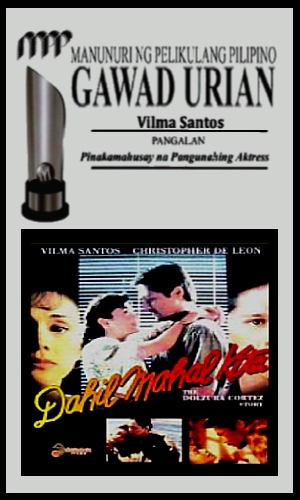
 Star For All Seasons
You must be logged in to post a comment.