Vilma Santos-Recto is a popular multi-awarded actress and politician in the Republic of the Philippines. *** She is known as "Queen of Philippine Movies," "Queenstar," "Grand Slam Queen," "Box Office Queen," and "Star for All Seasons." *** This website is mostly about her iconic film career.
Basic Information: Directed: Jose Javier Reyes; Story: Jose Javier Reyes; Screenplay: Jose Javier Reyes; Cast: Vilma Santos, Christopher De Leon, Aga Muhlach, Cherrie Pie Picache, Amy Perez, Jao Mapa, Orestes Ojeda, Cita Astls, Maine Villanueva, Noni Buencamino, Susan Africa, Gina Leviste, Ogie Diaz; Executive producer: Lily Y. Monteverde; Original Music: Nonong Buencamino; Cinematography: Ely Cruz; Film Editing: George Jarlego; Production Design: Benjie De Guzman; Art Direction: Arnold, De Jesus, Sonny Maculada; Theme Songs: “Nag-iisang Bituin” Music, Lyrics and Performed by Rannie Raymundo
Plot Description: Miggy is not an ordinary boy. He grows up as a learning-disabled person. He becomes the center of his brother’s life. A psychiatrist gives her time and attention to help Miggy. Together they face the odds and joys of bringing up Miggy in his different world. – Kabayan Central (READ MORE)
Film Achievement: 1994 FAMAS Best Screenplay – Jose Javier Reyes; 1994 Nominations Gawad Urian Best Screenplay – Jose Javier Reyes; 1994 Nominations Star Awards Best Actress – Vilma Santos; 1994 Nominations FAMAS Best Director – Jose Javier Reyes; 1994 Nominations FAMAS Best Best Picture
Film Review: “…Mula 1994 hanggang 2003 ay hindi na nagkatunggali sa Best Actress award sina Nora at Vilma. Early 1994 nang huling magkasabay as contenders for the acting plum sina Nora (Inay) at Vilma (Dahil Mahal Kita). For the whole year, Nora didn’t topbill any movie. She hosted Modern Romance sa Telebisyon on GMA 7 and the monthly special Superstar Beyond Time on RPN 9, and appeared on several telesines and a successful two-night concert at the Mandarin Hotel Ballroom. Naulit ang pangyayari noong 1992 na walang pelikula si Nora (she only appeared in her second stage play, DH, na nag-world-tour in 1993) and this will be repeated 10 years later, when she did the ABS-CBN 2 drama series Bituin that aired from September 2002 to May 2003 and several concerts. Vilma notched two films: Regal’s Nag-iisang Bituin (by Joey Reyes) and Golden Lions’ Lipa Massacre (by Carlo J. Caparas), which won as Best Picture sa FAMAS…” – William Reyes (READ MORE)
Basic Information: Directed: Laurice Guillen; Story: Olivia M. Lamasan; Screenplay: Olivia M. Lamasan; Cast: Vilma Santos, Christopher De Leon, Charito Solis, Bing Loyzaga, Amy Perez, Delia Razon, Ruby Rodriguez, Joonee Gamboa, Johnny Wilson, Vivian Foz, Jinky Oda, Terence Baylon, Bennette Ignacio, Eddie Albert Ramos, Lorli Villanueva; Executive producer: Vic del Rosario Jr.; Cinematography: Eduardo Jacinto; Film Editing: Efren Jarlego; Production Design: Edgar Martin Littaua; Sound: Gaudencio Barredo
Plot Description: A married couple who try to make their marriage work despite the fact that both of them are career-oriented and that there are tensions created by the prescence of their first-born child, Mike Jr., who turns out to be autistic. – RV
Atty. Mike Esquivel (Christopher De Leon) is a very successful lawyer who feels he has everything and the world is at his feet for the asking. He doesn’t know failure and how to deal with it. Mike is married to Celina (Vilma Santos), an equally successful T.V. personality. When Celina gives birth to their firstborn, Mike becomes ecstatic for he is now complete. But as their son grows, the doctor finds he is autistic. Mike is indignant. He cannot accept a feeble minded son as he worries about his reputation like his parents who suggest an institution. The situation is breaking up their ideal marriage for only Celina can understand and love her autistic son unconditionally. – TFC Now (READ MORE)
Film Achievemetns:1991 FAMAS: Best Actor – Christopher De Leon; Best Child Actor – Terence Baylon; Best Director Nomination – Laurice Guillen; Best Picture; 1991 FAP: Best Actor – Christopher De Leon; Best Child Actor – Terence Baylon; Best Editing – Efren Jarlego; Best Picture; Best Actress Nomination – Vilma Santos; 1991 Gawad Urian: Best Actress – Vilma Santos; Best Picture; Best Screenplay – Olivia M. Lamasan; Best Actor Nomination – Christopher De Leon; Best Cinematography Nomination – Eduardo Jacinto; Best Direction Nomination – Laurice Guillen; Best Editing Nomination – Efren Jarlego; Best Production Design Nomination – Edgar Martin Littaua; Best Supporting Actor Nomination – Terence Baylon
Film Reviews: Christopher de Leon and Vilma Santos, the box-office love team of more than a dozen dramas, including “Pakawalan Mo Ako,” “Paano Ba ang Mangarap,” “Relasyon,” “Broken Marriage” and “Imortal” are reunited in this Laurice Guillen drama written by Olive M. Lamasan. They portray a married couple who try to make their marriage work despite the fact that both of them are career-oriented and that there are tensions created by the pres¬ence of their first-born child, Mike Jr., who turns out to he autistic.
At first, their marriage is close to being one made in heaven. Mike Esquivel (Christopher) is a successful lawyer, while Celina (Vilma) is a popular talkshow hostess. Celina gives up her career to devote fall time as mother to Junjun, the autistic child, played well by both Bennett Ignacio (when Junjun is three years old) and Terence Baylon (when the boy is seven years old). The husband, however, is totally unsympathetic and even considers the child a disgrace. With the wife spending practically all her waking hours to attend to her “special” child, the marriage expectedly begins to crumble. They only give themselves a second chance when Celina finds out that she is again pregnant. The second child – to father Mike’s relief – turns out to be a normal, healthy boy. But with Mike still unable to accept the first child, the marriage is on the rocks once more.
The situation worsens when Mike -driven by the abnormal conditions at home and his own self-centeredness – starts an extramarital affair with a balikbayan named Monique (Bing Loyzaga). Finally, a near tragic incident gives Mike another chance to prove himself a worthy husband to Celina and even worthier father to his kids, especially the autistic one. The movie is poignant, nevermushy. It isnotthe run-of-the-mill tearjerker that relies on maudlin theatrics and melodramatic devices to touch the hearts of moviegoers. Surprisingly, despite the frustrating problem facing the movie couple, moviegoers did not seem to be depressed by the movie.
Attempts to “commercialize” the film may be seen in the comic relief provided by the protracted spats between the two kids’ yayas (Ruby Rodriguez and Jinky Oda). But the heavy subject and the conditions in the local film industry allow us to accept the filmmakers’ decision to inject such crowd-pleasing elements. Though the late Lino Brocka has made a posthumous telemovie on the same subject autism — with a similar dramatic situation in the still-unreleased “Lampang Kerubin,” this is the first time in recent memory that a Filipino movie tackles the subject with seriousness and compassion. Beyond the subject of having an autistic child, the movie also deals with the intri¬cacies of family relationships, as indicated by the ties between Celina and her mother (Charito Solis) and a wayward sister (Vivian Foz), and between these folks and Mike’s parents (Delia Razon and Johnny Wilson). “Ipagpatawad Mo” is a major film event of the year, with quiet and restrained per-formances by the cast that erupts in emo¬tional outbursts only periodically and judiciously. – Butch Francisco, The Philippine Star (READ MORE)
“…The 1990s saw Charito Solis graduate to mother and grandmother roles, which she had done with frequency in the 1980s. In another nod to her age, she finally allowed herself to be billed above Vilma Santos, then acknowledged as the Longest-Reigning Box Office Queen of Philippine Movies, albeit above-the-title in films such as Ipagpatawad Mo (1992) and Dahil Mahal Kita: The Dolzura Cortez Story (1993)…” – Gypsy Baldovino and Yolly Tiangco (READ MORE)
“…Christopher redeems himself from his bad performance in the movie Huwag Mong Salingin ang Sugat ko, shown last week. He is in top form here, and portrays a gamut of emotions, as a father who could not accept that his son is autistic; as comfused husband who turns to another woman for comfort; as a desperate man who implores his wife to give him another chance; and as a transformed father who finally accepts his son is autistic. Vilma is exceptional, as usual. The two stars look good together. (I cannot imagine Christopher and Nora Aunor together). Although, they looke visibly – dare I say it? – old. Not even the soft-focus lens could disguise the bags under their eyes and the lines on their cheeks. Good thing Ipagpatawad Mo is a movie which deals with a more sophisticated subject, other than a man who meets a woman and they fall in love, or a married man falls-in-love with another woman and vice versa. In the future, I would like to see less cellular phones and more mature movies like this, please.” – Elvira Mata, Manila Standard, Oct 23 1991 (READ MORE)
“…Ninety percent of these autistic children are very good-looking and are good in numbers but they have a world of their own. If you teach them something, yon kung ang alam nila, no other world exists. Autism is like virus and it is not hereditary. Hindi malalaman na autistic ang isang bata until they are about three or four years old. But doctors know, when a baby is born that he or she is autistic, only they don’t dare tell the parents about it. This movie should be an eye opener for such doctors and parents.” – Nena Z. Villanueva, Manila Standard, Oct 28 1991 (READ MORE)
“…The wife was a popular talk show host. The husband was a top executive in the field of advertising. They were the ideal couple and the envy of all their friends. They seemed to lead the perfect life more so when the birth of their baby boy completed the picture of a domestic paradise. But time brought a realization that their son was not like the other normal children. He was diagnosed as autistic. The wife gave up her career to give her son every possible chance to lead a normal life but the husband could not accept his child. He thought that it was a massive blow on his masculinity. How they came to terms with the presence of this autistic child in their lives is the gist of this wonderfully crafted film…” – Mav Shack (READ MORE)
Basic Information: Directed, story, screenplay: Carlo J. Caparas; Cast: Vilma Santos, Joel Torre, John Regala, Charina Scott, Angelica Panganiban, Robert Arevalo, Perla Bautista, Phillip Gamboa, Liezel Martinez, Ronnie Lazaro, Mia Gutierrez, Tony Mabesa; Executive producer: Carlo J. Caparas, Vic del Rosario Jr., Donna Villa; Cinematography: Boy Dominguez; Film Editing: Abelardo Hulleza
Plot Description: Story of Ronald Arandia who came back home after working overseas and found out his family was murdered, based on a true to life story of a massacre in Lipa City, Batangas. – Jagger Kieth (READ MORE)
A family of an overseas Filipino worker is murdered in their own home in Lipa City. While boarding a plane bound for the Philippines, Mr. Arandia is shocked to see his family in the front page of a newspaper. – ABS-CBN (READ MORE)
Film Achievement: 1994 FAMAS: Best Director – Carlo J. Caparas; Best Actor nomination – Joel Torre; Best Child Actress nomination – Charina Scott
Film Review: Vilma Santos portrayed the role of Mrs. Helen Arandia, wife of an Overseas Filipino Worker in Saudi Arabia. The Star for All Seasons starred with John Regala, Joel Torre, and then-child actors Charina Scott and Angelica Panganiban in this 1994 movie. While boarding a plane back to the Philippines, Mr. Ronald Arandia (played by Joel Torre) was shocked when he saw his murdered family on a newspaper’s front page. The killer (John Regala) visited Mrs. Arandia at their home in Lipa City, Batangas, and brutally murdered her and her two daughters, aged 8 and 6. The film directed by Carlo Caparas won Best Picture and Best Director at the 43rd Famas Awards (1994). Jagger Kieth (READ MORE)
“…Mula 1994 hanggang 2003 ay hindi na nagkatunggali sa Best Actress award sina Nora at Vilma. Early 1994 nang huling magkasabay as contenders for the acting plum sina Nora (Inay) at Vilma (Dahil Mahal Kita). For the whole year, Nora didn’t topbill any movie. She hosted Modern Romance sa Telebisyon on GMA 7 and the monthly special Superstar Beyond Time on RPN 9, and appeared on several telesines and a successful two-night concert at the Mandarin Hotel Ballroom. Naulit ang pangyayari noong 1992 na walang pelikula si Nora (she only appeared in her second stage play, DH, na nag-world-tour in 1993) and this will be repeated 10 years later, when she did the ABS-CBN 2 drama series Bituin that aired from September 2002 to May 2003 and several concerts. Vilma notched two films: Regal’s Nag-iisang Bituin (by Joey Reyes) and Golden Lions’ Lipa Massacre (by Carlo J. Caparas), which won as Best Picture sa FAMAS…” – William Reyes (READ MORE)
“Vilma Santos finally gets her wish to star in a massacre movie under director Carlo Caparas with her role as Helen Arandia in the Lipa Massacre. The film is about the Arandia family tragedy (a mother and her two daughters were killed by a neighbor while Mr. Arandia was abroad). Congressman Ralph Recto plays himself in the movie. Vilma had to forego a trip abroad to shoot another film just to help promote this massacre movie. Producer Donna Villa is all praises for Vi’s professionalism and her concern for this movie. Playing Mr Arandia is Joel Torre, who has become a favorite of the Golden Lions couple after he worked with them in the Antipolo Massacre. The Lipa Massacre movie will have a playdate on November 9. Donna and Carlo are now ready with their new movie…” – Norma Japitana, Manila Standard, Nov 2 1994 (READ MORE)
“…nababaliw ka na noh…puro kabaliwan yang nasa isip mo…hindi Jason, meron iba tayong dapat nating sundin…meron iba! Gamitin natin ang sinasabi ng isip natin, ang ipinararamdam ng kaluluwa natin, yun! Dahil madalas yun ang nagsasabi ng tama, yun ang nagsasabi ng nararapat nating gawin hindi ang puso…hindi ang puso Jason, hindi ang sinungaling mong puso…huwag kang padadala, ililgaw ka niyan…ililigaw ka dahil marunong manglinlang ang puso dahil alam ko ang tama huwag kang magpapadala…huwag kang magpapadala, hindi mababago ang katotohanang mali ang ginagawa natin, mali…” – Clara
“hayup! Hayup!…Baboy! Mamatay kang kasama ng mga baboy mo!” – Clara
This slideshow requires JavaScript.
Basic Information: Directed: Maryo J. De Los Reyes; Story: Jose Javier D. Reyes, Jake Tordesillas; Screenplay: Jose Javier D. Reyes, Jake Tordesillas; Cast: Vilma Santos, Gabby Concepcion, Alice Dixon, Aga Muhlach, Aiko Melendez, Ricardo Cepeda, Dennis Baltazar, Charlie Davao, Philip Gamboa, Melinda Mendez, Mila Ocampo, Luz Valdez, Orestes Ojeda, Michelle Bautista, Lora Luna, Aris Bautista, Daniel Roa, Dax Rivera, Allan Laceda, Aida Carmona, Estrella Antonio, Alex Toledo, Nonoy Gates, Tato Malay, Lemuel Sales, Francis Ignacio, Chynthia Carriedo, Marvin Bellosillo, Veronica Medel, Jeff Long; Executive producer: Lily Monteverde; Original Music: Lutgardo Labad; Cinematography: Charlie Peralta, Jun Pereira, Caloy Jacinto; Film Editing: George Jarlego; Production Design: Ronaldo “DO” Cadapan; Sound: Joe Climaco, Rodel Capule; Theme Songs: “Sinungaling Mong Puso” sung by Basil Valdez, composed by Willy Cruz
Plot Description: An endearing romantic drama that tells of a very curious affair between an older woman (Vilma Santos) and a young unhappily married boy (Aga Muhlach). In between them are Vilma’s husband, Gabby Concepcion and Aiko Melendez as Aga’s wife. All told, the movie proves once again that love does not only happen in the most unexpected times and places. It also makes people do the strangest things. – Regal Films DVD description
Film Achievement: 1992 FAMAS Best Actor – Aga Muhlach; 1992 FAMAS Best Supporting Actor – Gabby Concepcion; 1992 URIAN Best Actress nomination – Vilma Santos; 1992 URIAN Best Director – Maryo J. De los Reyes; URIAN Best Supporting Actor – Gabby Concepcion
Film Reviews: Nagsimula ang movie with Clara (Vilma) had a visitor in a jail, ito ay ang ex-wife ng asawa niya. Kasabay nito’y nag-flashback na ang pelikula. Bakit nakulong si Clara? Unang nagkakilala sa isang disco sina Jason at Clara. Inalok ng batang-batang si Jason si Clara ng sayaw ngunit inignore lang nito ang istudyante. Makikita agad na parehong hindi masaya sa buhay may asawa si Clara (Vilma Santos) at Jason (Aga Muhlach). Si Clara ay asawa ng isang malupit at babaerong negosyate, si Roman (Gaby Concepcion). Samantalay si Jason naman ay laging nina-nag ng kasing edad niyang asawa na si Aiko Melendez at pati ang kani-kanilang mga magulang ay nadadaway at madalas na nase-sermunan si Jason dahil rito. Kasabay na pinakita ang problema sa pagaasawa’y ipinakita rin ang mga taong nasasangkot sa pag-iibigan ni Clara at Jason. Ang asawa ni Clara na si Roman ay ubod ng lupit, minsan ay may nahuli ang mga tauhan nito na nagnanakaw sa kanilang bahay ay binaril nito ang magnanakaw. Bukod sa kalupitan ay marami ring naanakan siya at ang laging solusyon nito ay perahan ang mga babae para manahimik ang mga ito.
Nang bumalik sa Pilipinas ang kanyang ex wife na si Leda (Alice Dixon), muling gustong makipagrelasyon ito. Dahil sa mga pambabae ni Roman ay gusto rin sanang makaganti ito sa asawa at maraming mga lalaki na gustong makipagrelasyon sa kanya ngunit napipigilan pa rin nito ang sarili ngunit nang makilala niya minsan ang batang-batang si Jason (Aga) ay hindi na nito napigilan ang sarili. Muling pinagtagpo si Clara at Jason nang masiraan itong una sa kalye at nagkataon na naruon si Jason at tinulungan siya na humantong sa isang dinner date. Nagkaroon sila ng relasyon at nagkikita sa isang apartment na pagaari ng kaibigan ni Clara. Sa kabila ng agwat ng kanilang edad at estado’y natutong mahalin ng dalawa ang kanilang isa’t isa hanggang sa matuklasan ng asawa ni Jason ang relasyon at mag-iskandalo pa ito sa harap ng mga tao’t sa apartment na tagpuan ng dalawa. Bukod sa iskandalo ay nagsumbong pa ito sa asawa ni Clara. Ang naging resulta ng pagsusumbong na ito’y ang pagkakabugbog ni Jason sa malupit na kamay ni Roman. Sinadista nito ang kaawa-awang si Jason. Nang malaman ni Clara ay hindi niya napigilan ang nangyari sa katipan at nang mapuntahan niya’y natuklasan niya ang sinapit ni Jason. Binaril niya ang asawa at pinatay. Dito siya nakulong.
Maayos na nailahad ni Maryo Delosreyes ang istorya nang pag-iibigan ni Clara at Jason. Ito marahil ang dahilan kung bakit tinangihan ni Vilma ang pelikulang Naglalayag na halos kapareho ng istorya, ang pag-ibigan ng isang batang lalaki sa nakakatandang babae. Merong mga eksena rito na hindi kapanipaniwala katulad ng bakit nabuhay pa si Aga Muhlach sa bandang huli dahil nakakapagtaka na sa kabila na sobrang torture na natanggap niya mula sa sadistang si Roman ay nabuhay pa ito. Hindi rin na-isplika ng pelikula kung bakit gustong balikan ni Roman ang ex-wife niyang si Leda (Alice Dixon). Mahusay ang cast ng pelikula, magagalit ka talaga sa kalupitan ni Gabby Concepcion at makikita mo rin na believable siya bilang isang babaerong negosyante. Bilang ex-wife ni Roman, parang tuod si Alice Dixon wala siyang kabuhay buhay na magdeliver ng mga lines. Samantala, litaw na litaw naman ang role ni Aiko Melendez bilang Ana, ang asawa ni Jason. Halos lahat ng eksena niya ay mahusay niyang nagampanan maliban sa bandang huli yung reconciliation scene niya kay Vilma kung saan hindi bagay ang lines niya na: ”pareho natin siyang minahal… blah blah blah…”
Magaling sina Aga Muhlach at Vilma Santos bilang nagtatagong magkasintahan. Lutang na lutang ang pag-arte ng dalawa at nakakatuwa sila sa kanilang mga eksena na nagtatagpo ng palihim tulad ng mag-kita sila sa department store. Dumating si Vilma at hinahanap niya si Aga, hindi nya makita ito hanggang sa mamataan niya ang binata na nakaupo sa may display area. Kinindatan ni Jason si Clara at napatawa na lang ang babae. Mararamdaman mo ang excitement ng mga pagkikitang ito. Nang mahuli ni Ana ang asawa at mag-iskandalo ito, nang umalis na ang asawa at balikan ni Jason si Clara sa loob ng apartment, makikita sa mukha ni Vilma ang pagtatapos ng kanilang affair. Ang sabi niya: “ Hinintay lang kita, gusto kong maghiwalay tayo ng maayos…” Bukod sa maraming eksena na lutang na lutang ang pag-arte ni Vilma marahil ang pinaka-memorable ay ang eksena kung saan binaril ni Vilma si Gabby at sabihin niya ang line na: “mamatay kang kasama ng mga baboy mo…” ito ang pagpapatunay na talagang napakahusay niyang artista. – RV
“…Strange Coincidence – There are funny coincidences going on in the lives of some of our more durable and interesting showbiz personalities. For instance, in the lives of Vilma Santos and Nora Aunor. So far it’s proving to be Vilma’s year (that’s why she comes first sa billing). First she plunged into politics and helped win for long time beau Ralph Recto a seat in Congress. Now she’s starring in Regal’s anniversary offering, Sinungaling Mong Puso, with loverboy Aga Muhlach. Next, she’s marching down the aisle to marry Ralph, a Recto no less, in what promises to be the social event of the year, bar none. It’s interesting how, the older Ate Vi gets (she’s in her late thirties now), the younger and more sosyal her men get (Ralph is ten years her junior, Aga more). It reflects awesome self-confidence, is all I can say. And she’s not alone. Ate Guy’s career may be on hold these days but, apparently, not her lovelife. This is where she and Ate Vi match points. Guy’s new beau is John Rendez, a rapper composer who’s all of 21 years old. Wala akong masabi except, wow, what a trip…”…” – Angela Stuart Santiago, Manila Standard, Aug 24 1992 (READ MORE)
“Vilma Santos did not expect that her first experience at the Lower House could be so pleasant. “They were very nice. I was expecting that they’ll just tolerate me kasi artista ako, but they even posed with me,” she shared. Gina de Venecia, wife of the Speaker, asked her to join the Congressional Ladies Group. Ate Vi said that as soon as “Things settle down after the December 11 wedding to be held at the Lipa Cathedral, she will organize a foundation for street children. First, in Lipa and later here in Metro Manila. Vi said that her latest movie, Sinungaling Mong Puso, slated to open today, is inspired by her tele-movie, Once There Was A Love which also starred Aga Muhlach. I really wanted Aga to be my leading man in this movie since we started our tele-movie.” The movie also reminded her of the time when she and Ralph met for the first time. He was then only 21, or 11 years her junior. Vi does not plan to stop making movies, “I’ll be bored with just being a housewife,” she averred. “Sinungaling…, she said, “is teh story of three women and how they relate to the men in their lives. This is more intense compared to Ipagpatawad Mo. She is set to do two more movies this year – – one for Moviestars with Cesar Montano and Ronnie Rickets to be directed by Chito Rono; and another for OctoArts with perennial screen partner, Christopher de Leon with Mike de Leon as director…” – Nena Villanueva, Manila Standard, Aug 27 1992 (READ MORE)
“Scale of 1 to 10, I give it a 9.9!” – Oskee Salazar, Manila Standard, Aug 27 1992 (READ MORE)
“It is well acted, with special mention going to Vilma Santos, Aga Muhlach, and Gabby Concepcion.” – Ricky Calderon, Manila Standard, Aug 27 1992 (READ MORE)
“I realized I have lesser problem in life.” – Alfie Lorenzo, Manila Standard, Aug 27 1992 (READ MORE)
“Best actress talaga si Vilma. Aga Muhlach is the best actor of his generation.” – Mario Dumawal, Manila Standard, Aug 27 1992 (READ MORE)
“Acting superb. Plot realistic. It can happen to the best of families. Aga’s talent comes to the fore — award-winning. I like all his scenes…Pacing last. I’d like to see it again.” – Nena Villanueva, Manila Standard, Aug 27 1992 (READ MORE)
“…The stellar achievement in politics, motion picture and television industries of Star for All Seasons and acknowledged Longest-Reigning Box-Office Queen Vilma Santos has necessitated the creation of yet another FAMAS special award: the Exemplary Achievement Award, an award given only to previous Lifetime Achievement Award recipients who have shown continued blossoming and achievement in the movie industry, as well as in other fields. The actress, who is also the incumbent governor of Batangas province, was not able to make it to the Gabi ng Parangal due to short notice, but she was able to send a video message acknowledging her award. It can be remembered that the FAMAS created a special award for Vilma Santos’ portrayal in Sinungaling Mong Puso in 1992. By technicality as a Hall of Famer, she cannot receive a regular FAMAS Award, so she was awarded an accolade higher than the Hall of Fame: the Circle of Excellence. This year, that instance is again repeated, a testament to the Star for All Seasons’ durability and penchant for excellence and achievement. Santos is also the recipient of yet another special award this awards season, the Ulirang Artista (Lifetime Achievement Award) of the Star Awards for Movies…” – Nicolo Magundayao, The Filipino Academy of Movie Arts and Sciences (READ MORE)
“The film scene is not unlike the current weather – drab, gloomy, mostly uneventful. But the cinematic sky finally clears up and giving us reason to be hopeful once again. We are talking here of a pretty well-made Pinoy movie that comes like a benediction from above especially at a time when every producer in town has plunged deeper into the abyss of profitability. And what irony it is – the movie has come straight out of Mother Lily’s dump-site where every piece of film product is beyond recylability. The film is called Sinungaling Mong Puso which, discard its abominable title, is a darling attempt on the part of its makers to raise the genre of marital melodrama into a decent and mature form of filmmaking. The film concerns a May-December affair between Vilma Santos and Aga Muhlach with one major hitch. They both happen to be married – she to Gabby Concepcion and he to Aiko Melendez – and the problems arising from such relationship are apparent from the start. They are quite unhappy in their status, have problems relating to their partners, and now want a way out from the heckling, bullying and, especially in Santos’ case, insulting that characterize their married lives.
Santos’ problem is clearly more complicated than Muhlach’s. She is married to a man who’s been married before (to Alice Dixon, from whom he is separated on legal grounds that are not made clear) and who literally abuses her in bed. Worse, he thinks it’s perfectly normal for a man to engage in extra-marital affairs. Muhlach’s wife is a nagger and whom he was forced to marry at a young age after he impregnated her. Their affair is nothing extraordinary – they meet by accident, she phones him, they began to date and finally go to bed. What makes the story extraordinary is the reactions of their respective spouses to their problem. Melendez becomes hysterical and Concepcion is naturally violent. He orders his bodyguards to beat up Muhlach and leaves him badly battered. Santos comes to the scene and shoots her husband dead, right in the company of the swine that he raises and she calls him whenever he forces her to make love. At the end, she is sent to jail where a tearful reunion between the lovers takes place, with another plea for absolution from their past sins. What makes the film in a way absorbing is the firm, secure hand of its director, Maryo delos Reyes.
He has a nice way of working with the camera (three cinematographers are credited) and even more effective way of working with his actors. Though he occassionally lapses into using visibly commercial devices (such as the effects of slow-mo, freeze frame, and fragmentation shots), he manages on the most part to motivate his actors into giving their best. Ms. Santos is at her usual inspired level (But hasn’t she done this part in countless other movies?) though I often got distracted with her outfits, make-up and their age difference (Muhlach is 21 but we never find out Santos’ age, presumably 15 years older). Muhlach is a revelation, a natural in his acting even he indulges in pure histrionics. Concepcion has improved considerably and is now at home playing parts like this. Melendez is likewise adequate but a bigger surprise is Dixon’s portrayal of a career woman torn between her friendship and love. She has finally blossomed in time even if I do not completely trust the voice on the soundtrack (must be the dubber’s). The script is by two people – Jake Tordesillas and Jose Javier Reyes – and it is best with problems, structually mostly. The film is told as a flashback but the device is used only at the opening and closing of the film while Santos is in jail visited by Dixon. But the narrative is not told from her point of view nor anybody else’s. This is, however, a monor quibble compared to the merit of the film, not the least of which is its uncompromising view of the problems confronting married people, and the anachronistic standards that Philippine society uses in judging those who violate the sanctity of marriage…” – Justino Dormiendo, Manila Standard, Sep 6, 1992 (READ MORE)
“…Even now, the Sirkian influence could still be seen in many Tagalog movies. The framing makes sense, it adds drama, makes the scene visually beautiful. But, I only wish that the younger filmmakers eradicate the lugubriousness of Sirk’s orchestration of melodrama to solicit emotional response from the audience. But, sad to say, the Philippine movie industry seemed to have got stuck and has been suffering from a fixation known as the “heavy drama obsession.” ”Sinungaling Mong Puso” is just one example of Sirk’s influence. But what made this film even more horrific is that all the actors in this film, except Vilma Santos, were a hopeless case of “acting running amuck”. It was definitely patterned from Douglas Sirk’s smash hit films that many starred Rock Hudson: Magnificent Obsession (1954); All That Heaven Allows (1955); There’s Always Tomorrow (1956); Written on the Wind (1956); A Time to Love and A Time to Die (1958); Imitation of Life (1959); to name a few…” – Jose Mari Lee, Pinoy Comics TV Movies (READ MORE)
“…Dahil sa tagumpay sa box-office ng pelikulang “Just A Stranger” nina Anne Curtis at Marco Gumabao, muling nauuso ang mga May-December affair film. Sa Urban Dictionary, ang meaning ng “May-December affair” is a relationship between two people where one partner is in the “winter” of their life (old) and the other partner in the relationship is in the “spring” of their life (young). May/December relationships can either be superficial or serious – so the term doesn’t itself say anything about the status of the relationship…Kung tutuusin ay noon pa uso ang May-December affair films at ang iba rito ay naging award-winning pa…Heto nga ang mga pelikulang nagpakilala sa landian, lambingan, harutan ng mga babae/lalaki na may edad sa mga mas batang-batang nilalang…Sinungaling Mong Puso (1992) – Kuwento ito ni Clara (Vilma Santos) na hindi na masaya sa pagsasama nila ng malupit at babaero niyang mister na si Roman (Gabby Concepcion). Nagkataon na nakilala niya ang young father na si Jason (Aga Muhlach) na hindi rin masaya sa nagging wife niyang si Anna (Aiko Melendez). Nabuo ang isang sikretong relasyon na nauwi sa isang madugong trahedya. Mula sa direksyon ni Maryo J. Delos Reyes, nanalo rito si Aga bilang FAMAS Best Actor…” – Anonymous, Abante, 07 Sep 2019
“Sister nain-love ka na ba? Hindi yong Love kay Kristo ha, yong love na may sex!” – Leah
This slideshow requires JavaScript.
Basic Information: Directed: Chito S. Roño; Story: Lualhati Bautista; Screenplay: Lualhati Bautista, Chito S. Roño; Cast: Vilma Santos, Albert Martinez, Carlo Aquino, Serena Dalrymple, Angel Aquino, Cherry Pie Picache, Raymond Bagatsing, Ariel Rivera, Rosemarie Gil, Andrea Del Rosario, Dexter Doria, Cita Astals, Ronalissa Cheng, Carmen Serafin; Executive producer: Charo Santos-Concio, Malou N. Santos; Original Music: Jessie Lasaten; Cinematography: Charlie Peralta; Film Editing: Jaime Davila; Production Design: Manny Morfe; Sound: Albert Michael Idioma; Theme Songs: “Kumusta Ka” performed by Nonoy Zuniga
Plot Description: Lualhati Bautista’s award-winning novel was adapted to the big-screen with brilliant results: the casting (specially Mayor Vilma Santos as the strong-willed Leah Bustamante) is perfect; Bautista’s script is filled with comic and dramatic undertones. 8 year-old Serena Dalrymple provided most of the laughs as the innocent child who serves as Leah’s mirror of her personality. Everything in the film is a labor of love and art, and it deserves to be a classic. – IMDB
A fiercely independent and unflinchingly candid woman connected with a women’s crisis and survival center has to raise her two kids with different fathers. Her first husband has left her when their career options failed to converge. She is now stuck in an extramarital arrangement with another man who cannot bring himself to respect and commit to their quite unorthodox relationship. – Database of Philippine Movies
The movie is about Lea, a mother of two kids with different fathers. Lea, works in an NGO (non-government organization), which deals with human rights violation committed against women. Ogie and Maya are Lea’s children. Ogie’s father, Raffy, leaves them when he had to work in the province of Surigao. Lea together with his son Ogie, did not join Raffy for Lea has a job in Manila which she did not want to leave. Maya, whose father is Ding lives with them, together with Ogie. Things start to get worse when Raffy arrives in Manila. Raffy, meets with Lea for him to see his son, Ogie. As days went on, Ogie regularly sees his father and sometimes spends some time in his house together with his new wife who is pregnant with there first child. Raffy, realizes that he has a lot of shortcomings as a father to Ogie. Raffy tells Lea that he will take Ogie with him to the United States after his wife gives birth. Lea doesn’t know what to do. – Skynet
Film Achievement: 1999 Brussels International Festival of Independent Films Best Actress – Vilma Santos; 1999 International Festival of Independent Films Best Director – Chito S. Roño; 1999 Asia-Pacific Film Festival Special Jury Award – Chito S. Roño; 1998 FAMAS Best Child Actor – Carlo Aquino; 1998 FAMAS Best Child Actress – Serena Dalrymple; 1998 FAMAS Best Story – Lualhati Bautista; 1998 FAP Best Actress – Vilma Santos; 1998 FAP Best Picture – Star Cinema; 1998 FAP Best Supporting Actor – Carlo Aquino; 1998 FAP Best Supporting Actress – Serena Dalrymple; 1998 Urian Best Actress – Vilma Santos; 1998 Urian Best Picture – Star Cinema; 1998 Urian Best Best Screenplay – Lualhati Bautista; 1998 Urian Best Supporting Actress – Serena Dalrymple; 1998 Star Awards Actress of the Year – Vilma Santos; 1998 Star Awards Child Performer of the Year – Carlo Aquino; 1998 Star Awards New Movie Actress of the Year – Serena Dalrymple; 1998 Young Critics Circle Best Film – Star Cinema; 1998 Young Critics Circle Best Performer – Vilma Santos; 1998 Young Critics Circle Best Screenplay – Lualhati Bautista; 1998 PASADO Best Picture – Star Cinema; 1998 PASADO Best Screenplay – Lualhati Bautista; 1998 PASADO Best Actress – Vilma Santos
Other Film Achievements 1998 FAP Best Cinematography nomination – Charlie Peralta; 1998 FAP Best Director nomination – Chito S. Roño; 1998 FAP Best Editing nomination – Jaime Davila; 1998 FAP Best Production Design nomination – Manny Morfe; 1998 FAP Best Screenplay nomination – Lualhati Bautista; 1998 FAP Best Supporting Actor nomination – Albert Martinez; 1998 Urian Best Best Director nomination – Chito S. Roño; 1998 Urian Best Best Editing nomination – Jaime Davila; 1998 Urian Best Music nomination – Jessie Lasaten; 1998 Urian Best Sound nomination – Albert Michael Idioma; 1998 Urian Best Supporting Actor nomination – Carlo Aquino; 1998 Urian Best Supporting Actor nomination – Raymond Bagatsing; Bata Bata Paano Ka Ginawa? Became a stage play in 1999
Film Reviews: Motherhood. Womanhood. It has long been believed that the former is the be-all and end-all of the latter. Our culture dictates this. Our society has its own standard boxes of what constitutes a good woman and of what necessitates a good mother. If you don’t fit this box, then you suffer the consequences. Lea Bustamante (Vilma Santos), a mother of two and a woman who chooses to live differently, is learning how to deal with these consequences. Her eldest is OJIE (Carlo Aquino), an outspoken boy on his peak of puberty. Her youngest is Maya (Serena Dalrymple), a precocious and equally outspoken six-year old. Both have different fathers. Neither is married to Lea. Lea was once married to Ojie’s father, Raffy (Ariel Rivera). But he had to leave for his job and she had to stay for hers. Hence, they separated. Now, Lea lives with Maya’s father, Ding (Albert Martinez), a mama’s boy who is constantly at the beck and call of his mother. This infuriates Lea because it reminds her that Ding is not married to her and they are not his priority. Nevertheless, Lea is sure she can handle herself and her children without anyone’s help.
Her world gets shaken however when Raffy goes back to the Philippines. She knows she still loves him but that there is no chance for a reconciliation. Raffy came back with a new wife on the family way. Ojie begins to see his father during weekends. Lea sees how father and son thirst for the bond they should have started forming a long time ago. She also sees how much Maya misses her brother so much whenever he spends his time with his father. Matters get worse when Raffy voices his desire to take Ojie with him and his new wife to America. With a fearful heart and a great respect for her son, Lea leaves the decision to Ojie. Before he even makes a decision, he and Maya suffer an accident. The mother gets blamed. Her job gets blamed. Lea works in a survival center for women in crisis and is continually exposed to the adverse effects of how society can become a victim of its own ideology. Lea considers herself emancipated from these labels. She has her own sense of motherhood, of womanhood, of what is true and good and beautiful. But now, she is being accused by both fathers of not being a good mother, and of being a woman of twisted priorities. In this susceptible state, Lea finds solace in the company of Johnny (Raymond Bagatsing), a colleague and a friend from the center. As if her life wasn’t complicated enough, she receives yet another bomb. Ding breaks up with her after a long absence, apparently after getting married to a girl he got pregnant. Ding wants to take Maya too. With a broken spirit, a confused heart and great reverence for Maya as with Ojie, Lea lets her children decide about their life. In these moments of vulnerability, Lea confronts her worth and the needs of her soul which the men in her life never really fulfilled – her being a woman and a mother. Is living the life she wants worth losing the children she loves? With a broken spirit, a confused heart and great reverence for Maya as with Ojie, Lea lets her children decide about their life. In these moments of vulnerability, Lea confronts her worth and the needs of her soul which the men in her life never really fulfilled – her being a woman and a mother. Is living the life she wants worth losing the children she loves? – Star Cinema
“A women’s rights activist and mother of two, Lea has been abandoned by the fathers of her children. Her daughter and son are at crucial transitional ages and she struggles to provide for them while maintaining her hectic job at a woman’s crisis center. Soon though, the job and her budding romance with co-worker Johnny threaten Lea’s role as mother when her children’s fathers return to accuse her of neglect.” – Baseline Studio Systems (READ MORE)
“In one of the most remarkable performances in Filipino film history, Vilma Santos plays Lea, a woman who defiantly rejects social convention to experience life on her own terms. A woman’s rights activist and mother of two, Lea has been abandoned by the fathers of her children. Her daughter and son are at crucial, transitional ages and she struggles to provide for them while maintaining her hectic job at a women’s crisis center. Soon, however, the job and her budding romance with co-worker Johnny threaten Lea’s role as mother. When the children’s fathers turn up to accuse her of neglect, she must ask herself whether her independence is worth the possibility of losing her children? What role–motherhood or lover–will best satisfy the deepest needs of her soul?” – The 35th Chicago International Film Festival (READ MORE)
“…Lea’s Story, based on Lualhati Bautista’s award-winning novel “Bata, bata paano ka ginawa,” tells the story of Lea, a strong and independent woman who defiantly rejects social conventions to live life on her own terms. Lea, a woman’s rights activist and single mother of two, struggles desperately to provide for her children by working at a woman’s crisis center. Soon her job and romance with a co-worker are threatened when her estranged husband comes back into Lea’s life, accusing her of neglect and abuse. Last year, Lea’s Story swept the Filipino Academy Awards by winning Best Picture, Best Actress, Best Screenplay and Best Director. It stars the Philippines’ top actress and actor, Vilma Santos and Raymond Bagatsing respectively…” – Asian American Film News (READ MORE)
“Sa tingin ko, sa Bata, Bata… pinakamagaling si Vilma Santos. Sa dami ng kanyang award, may ibubuga pa pala siya. Iba ang akting niya rito…Halatang feel na feel ni Vilma Santos ang kanyang papel dahil, gaya ng karakter ni Lea Bustamante, dalawa ang anak ni Vilma sa magkaibang lalake.” – Marra Pl. Lanot, Diario Uno, Sept. 1998 (READ MORE)
“…Ang international fame, bilang Best Actress, ay nakamit ni Vilma in 1999, when her Star Cinema headliner Bata … Bata … Paano Ka Ginawa? – directed by Chito Rono – was entered as competition entry sa Brussels Film Festival. Released in 1998, Bata won for Vilma the Best Actress honors at the Star Awards, FAP and Gawad Urian, as well as the Best Performance award from the YCC-Film Desk. Dahil nahalal na alkalde ng Lipa City sa Batangas si Vilma Santos-Recto (she married then Batangas Congressman, now Senator Rafael ‘Ralph” Recto in December 1992), naging mas madalang ang paggawa niya ng pelikula. Pero hindi pa rin magmimintis si Vilma na manalo ng acting trophy, kapag din lang may panlabang pelikula, as in 2000 when she did Star Cineman’s Anak by Rory Quintos. Nanalo siyang Best Actress sa Star Awards…” – William Reyes (READ MORE)
“…And Vilma Santosis more than up to the challenge. Gone are the hysterically flapping hands, the melodramatic emoting, all the trademark acting tics. In their place is a heartfelt performance that distills Lea’s essence to an exquisite point-no movements are wasted, no gestures are overwrought. …Vilma rolls them on her tongue like the finest wine; when Lea is on the verge of breaking down, Vilma remains true to the spirit of her character… If the Lipa City mayor decides never to do another movie again, she can retire assured that her last performance-in a career already studded with formidable portrayals-may conceivably have been her best…” – Andrew E. Pardes, Manila Times, Sept 1998 (READ MORE)
“…To best understand how Filipino women have changed in the course of time, let us quote Lea’s final words: “OO, natuklasan ko ang mga bagay na hindi ko siguro natuklasan kung pinahawakan ko lang sa iba ang pagkatao ko. Hindi ako nagpakulong, sinikap kong lumaya. At mula sa paglaya ko sa makitid na papel ng isang babae, natiyak ko na ang kalayaan nga pala, sa higit na pangmalawakang kahulugan nito, ay hindi nahihingi kundi ipinakikipaglaban. Hindi lahat ng hinuhuli’y kriminal, at hindi lahat ng diyos ay may dangal! Hindi ako natatako. Babae ako at malakas ako. Ako ang tagapagsilang ng tao, pambuhay ng sanggol ang dibdib ko. Hindi porke ina na ‘ko’y tumigil na ‘ko sa paglaki. Hindi porke babae ako’y maiiwan ako sa labanan. Para sa kaligtasan ng lipunan at kinabukasan ng mga anak ko sa digmaan ng mga uri’t prinsipyo, sa mapayapa man o madugong pagbabago, magtiwala kayo…sasama ako!” We need more Josies adn Leas in our society tody, The time is ripe for Filipino women to rise above the society’s traditional views and coventions. Although ultimate freedom and due recognition of gender equlity remain a struggle and a serious concern, Filipino women are slowly gaining a strong foothold. In a book dedication written by Bautista to this writer, she wroteL “Ang mga kamay na nag-uugoy ng duyan ay kaya ring magtumba ng alon sa dagat.” And we belive that a freer woman is better mother. And every Filipino family needs her. Every family must have her. We remember what Vilma said in our interview with her during the last shooting day of her film “Bata, Bata…” “I would like to be remembered as a mother who would give her life to her children anytime…” She’s an accomplished actress, and many will remember her for that. But Vilma would rather be a mother in her films, in her life…” – Veron Dionisio, Philippine Daily Inquirer, Jul 29, 2000 (READ MORE)
“…Nora’s performance in ‘Sidhi” is touted to be the answer to Vilma Santos’ hysterical outing in “Bata, Bata, Pa’no Ka Ginawa?’ If only ‘Sidhi’ came out during last year’s cut-off period, then Nora would definitely give Vilma another tough fight in the awards derby this year. “Let’s stop it,” Ate Guy shakes her head as she shows her lack of interest in the rivalry. “As far as we’re concerned, things like that, you know, that phase is over. Let’s not talk about those things anymore.” Nora knows her rivalry with Vilma would linger for a long time. But personally, she thinks they have developed a different level of friendship through the years. “Movie projects offered to Vilma are different from those I accept. So you really can’t accept films just to compete with her. If I don’t want something, I won’t do it,” Nora further explains…” – Wikipedia (READ MORE)
Basic Information: Directed: Lino Brocka; Story, screenplay: Ricardo Lee; Cast: Vilma Santos, Snooky Serna, Gabby Concepcion, Eric Quizon, Dennis Roldan, Perla Bautista, Ruben Rustia, Maritoni Fernandez, Gina Perez, Pocholo Montes, Archie Adamos; Executive producer: Lily Y. Monteverde; Original Music: Jaime Fabregas; Cinematography: Pedro Manding Jr.; Film Editing: George Jarlego; Production Design: Benjie De Guzman; Sound: Joe Climaco, Ramon Reyes
Plot Description: Lucinda (Vilma Santos), a hard-nosed scheming power hungry woman is married to a young politico, Gerard (Eric Quizon). Theyère the ideal and perfect partners in life and in crime. Their lives take a new shape with the re-entry of Renato (Gabby Concepcion), Lucindaès first love and now married to cousin Teresa (Snooky Serna). What follows is another colorful drama – swapping partners to satisfy their burning passion. But the moment of truth arrives – Lucinda and Gerard outwits each other to assure power and reach the top to the extend of plotting their lover’s murder. – Regal Films (DVD box description)
An oppressed housemaid has transformed herself into a wealthy and powerful business mogul through sheer dint of talent, ambition and driving need to avenge herself on her tormentors. She comes back to the scene of her most abject debasement with the sole intent of humiliating the family who once made her life such a living hell. Unknowingly, she gets to exact revenge on the very person who turns out to be her own daughter by the son of her former mistress. – Databases of Philippine Movies (READ MORE)
Vilma Santos plays a devious and power-mad wife of an equally contemptuous mayor (Eric Quizon). While riding high on the crest of power, Vilma tries to ruin the lives of a married couple, Snooky Serna and Gabby Concepcion. Snooky is Vilma’s distant cousin while Gabby is her former flame. While making it appear that she’s sincere in helping bail Gabby out of his financial troubles, she also tries to lure her ex-boyfriend back into her arms. At first, she is successful at snaring back Gabby— but only for one brief sexual encounter. The more serious complications set in only when Vilma’s resident lover, Dennis Roldan, attempts to blackmail her about their love affair. Trying to get herself out of that fix, she sets a ploy that would permanently eliminate Dennis. As partof her plan, she sends Dennis to molest Snooky hoping that the poor woman would defend herself by shooting Dennis with the gun Vilma gave her earlier. However, this does not work out exactly as planned since it is Gabby who gets to kill Dennis. Instead of making Gabby turn himself in, Vilma encourages him to hide from the police in the hope that he agree to run off with her to some faraway place. But eventually Vilma realizes that he cares not for her but for Snooky. To show her repentance, she arranges for his peaceful surrender to the police. An unfortunate twist takes place when Gabby is shot dead by an assassin hired by Eric. He wants to punish his wife for her indiscretions. Vilma gets even with him by having him convicted. – Lino Brocka: The Artist and His Times, Posted by Video48 (READ MORE)
Film Achievement: 1990 Star Awards for Movies Best Supporting Actress – Snooky Serna; 1990 FAMAS Nomination Best Supporting Actress – Snooky Serna; 1990 FAP Nomination Best Actress – Vilma Santos; 1990 Gawad Urian Nomination Best Best Actor – Gabby Concepcion
Film Reviews: “…Can the specificities of a film genre dictate the nature of roles available to actors according to their sexual differentiation? In the instance of a specific local genre, melodrama, it appears that not only the nature of the roles but the advantage of the performer is predetermined in a manner opposed to the original foreign norm. Two of the better releases in 1990 by the country’s top competitors for studio supremacy prove this point indirectly, by applying for us one outstanding performance each – both by female actors essaying distinctively female roles…Regal Films’ Hahamakin Lahat has the reliable Vilma Santos in a successful (in popular terms) modification of her other-woman persona, placing her work here on the order of Tagos ng Dugo and Pahiram ng Isang Umaga. Both films can be roughly classified as melodramas of the Filipino variety, specifically by their emphasis on moral issues, complicated plots, and strong female roles – characteristics that serve the thesis that local melodramas are, for want of a better term, prejudiced in favor of women, complaints from feminists notwithstanding…while that of Vilma Santos resolves not to fall emotionally for her flavor of the moment; in the end, when Mr. Seemingly Right happens along, all their notions of self-sufficiency get discarded like so much excess baggage, as off they go after the walking incarnation of the True Meaning of Life…
Compared with the director-writer team-up’s previous effort, Gumapang Ka sa Lusak, Hahamakin manages to go deeper into the psyche of the female oppressor (a secondary character in the earlier film, which concentrated on the victim instead). On the other hand, several crucial establishing details in the latter work had to be relegated to lines of exchanges, and a demonstration of how social cancer spreads through the body politic is never pulled off, precisely because the filmmakers had to confine themselves to the major characters. Nevertheless both recent films, plus Gumapang Ka, represent our state-of-the-craft when it comes to melodrama movie making, and I can think of no higher compliment than posing a challenge for the future: since every conceivable female lead role has been explored, with varying degrees of success, in local melodrama, and since action films have long allowed for strong women characters even in lead capacity, how about refashioning the former genre to suit non-female leads? The clash between gender and genre might yet result in certain long-overdue insights into love and anarchy as only a truly confused culture can make it…’ – Joel David, National Midweek, 17 October 1990 (READ MORE)
Brocka did Hahamakin Lahat for Regal Films. This would be his third team-up with Vilma Santos. The role called for Vilma to be dark, daring, and innovative—something that totally deviated from characters usually portrayed by the sweet-faced actress . It showed a heroine entering into a marriage of convenience with a ruthless, scheming mayor—a character Brocka created to expose the hypocrisy and corruption of society. – Mario Hernando
“…In his book, Don Jose & The Early Philippine Cinema, Joe Quirino credits jose Nepomuceno pioneer in producing movies that not only entertained but also informed. Wrote Quirino: “His screen adaptation of Noli Me Tangere, Jose Rizal’s novel exposing the social cancer that festered during the Spanish occupation of the Philippines, captured the sardonic and satirical contents of the imflammatory noel.” Satire was a popular device through which producer aired their views on social issues. In 1929, a satirical movie called Patria Amore caught the ire of the local Spanish community who went to court to stop its exhibition. A counterpart incident took place in 1965 when the Liberal Party tried to stop the showing of Iginuhit ng Tadhana, the propagandistic movie of the life of Ferdinand Marcos. The same motion picture propelled Marcos to the presidency. Movies of social significance often face this dillemma on their way to the big screen. Because of their strong public statement, they invite uproar from concerned sectors, an experience that became almost a daily ordeal for the late director, Lino Brocka. In recent years and until his death in 1991, Brocka had been the prime mover of Tagalog movies of social significance. Some of his works that easily fall under this category are, in no particular orderL Orapronobis (about vigilantes and rebels in the countryside), Bayan Ko (on labor unrest), Gumapang Ka sa Lusak and Hahamakin Lahat (on political corruption), Maynila: Sa Mga Kuko ng Liwanag (on moral degradation and exploitation)…” – Nestor Cuartero, Panorama, dated June 13, 1993 (READ MORE)
Snooky Also Shines – “…Do you know who has improved a lot in her acting especially in her last movie? It’s Snooky. In “Hahamakin Lahat,” she was almost at par with the star for all seasons, Vilma S. kung acting ang paguusapan, says an ardent admirer. Nag-underacting siya but there were moments na akala mo siya ang bida sa pelikula. I remember a hysterical Snooky in highlights scenes of her movies. I think it’s only Lino Brocka who directed her in her first movie, “Wanted, Perfect Mother,” when she was only four or five years old, who can control her acting as he did in “Hahamakin.” Snooky has gained more character and a certain maturity in her acting. I’m sure she’ll garner several nominations for this movie come awards time next year…” – Nena z. Villanueva, Manila Standard, 05 Sep 1990 p16 (READ MORE)
“Hindi ako naniniwala…Putang…anong karapatan mong sabihin sa akin yan?! Diyos ka ba?! Ikaw ba na nagbigay ng buhay sa akin?! Sino ka ba?…Akala mo alam n’yo nang lahat ayoko nito! Akala mo alam n’yong lahat hah..Ayoko nito…ayoko nito..ayoko pang mamatay!…anong mangyayari sa mga anak ko…mga putang ina n’yo…ayoko nito!” – Dolzura Cortez
Basic Information: Directed: Laurice Guillen; Story: Dolzura Cortez; Screenplay: Ricardo Lee; Cast: Vilma Santos, Christopher De Leon, Charito Solis, Jackie Aquino, Christine Bersola, Noni Buencamino, Maila Gumila, Mia Gutierrez, Gigette Reyes, Gilleth Sandico, Eula Valdez, Mikee Villanueva, Nonie Buecamino, Jaime Blanch, John Caddi, Tess Dumpit, Chris Michelena, Sharme Centenera, Ernie Zarate, Pocholo Montes, Gil Portes; Executive producer: Orly Ilacad; Original Music: Nonong Buencamino; Cinematography: Eduardo Jacinto; Film Editing: Efren Jarlego; Production Design: Edgar Martin Littaua; Sound: Monching Reyes; Theme Songs: “Dahil Mahal Kita” sung by Ogie Alcasid
Plot Description: Based on Ma. Ceres P. Doyo’s award-winning series in the Philippine Daily Inquirer, this film chronicles the life of Dolzura Cortez, the first Filipina to bravely come out in public and admit she was afflicted with AIDS; thus finally giving a face to an AIDS patient. – Philippine Movies Data base, Geocities web site
This Philippine drama chronicles the colorful life of Dolzura Cortez, the first publicly recognized AIDS patient in the Philippines. The film begins with a brief examination of Cortez’s pre-AIDS life. Initially she lived in a small village with her cruel husband and three kids. The spunky woman leaves them and moves to the big city where she engages in several affairs. Her second marriage to a rich foreigner does not last long. To support her children, Dolly begins an all woman “contract worker” agency. This also serves to facilitate her love of night-life. Tragedy comes to Dolzura after she collapses on a dance floor one night and learns that she has full-blown AIDS. At a Manila hospital she meets ex-lover Paulo, an AIDS researcher who encourages to tell her story publicly. The courageous woman does and she becomes instrumental in spreading AIDS awareness to the islands. – Sandra Brennan, All Movie Guide, The New York Times web site
Ma. Dolzura Cortez (d. 1992) is the first Filipino AIDS victim who came out in the open to tell about her life and how she acquired the AIDS virus. Her life story was made into the 1993 Filipino film Dahil Mahal Kita (English “Because I Love You: The Dolzura Cortez Story”), directed by Laurice Guillen and starring Vilma Santos as Cortez. – Wikepedia web-site
“…Life story of the Philippine’s first publicly acknowledged AIDS patient, a woman who leaves her husband in her home village for the big city. Here she indulges in love-affairs that end her second marriage with a wealthy foreigner…” – British Film Institute (READ MORE)
Film Achievements: 1993 Film Academy of the Philippines Best Actress – Vilma Santos; 1993 URIAN Best Actress – Vilma Santos; 1993 URIAN Best Music – Nonong Buencamino; 1993 STAR Best Actress – Vilma Santos; 1993 Manila Film Festival Best Actres – Vilma Santos; 1993 Movie Magazine Best Actress – Vilma Santos; 1993 Intrigue Magazine Reader’s Choice Best Actress – Vilma Santos; 1993 New Fame Magazine Reader’s Choice Best Actress – Vilma Santos; 1993 FAMAS Circle of Excellence -Vilma Santos; 1993 URIAN Best Director nomination – Laurice Guillen; 1993 URIAN Best Picture nomination – Octo Arts; Special screening – the 1994 San Francisco Asian-American International Film Festival; Special screening – the 1994 Amsterdam Film Festival.
Film Reviews: “…If eroticism and sadomasochistic reverberations were ignited in Midnight Passion, Guillen’s The Dolzura Cortez Story (Dahil Mahal Kita, 1993) broke new ground in another direction. It was not only one of the first films to tackle AIDS as a reality by giving it a real human face, but also a rare revelation for its protagonist’s confession that the absence of sexual intimacy as a diseased outsider created a profound ache. This connection of alienation to desire startlingly brings out the humane aspects of the AIDS tragedy. Like her other films, Dolzura Cortez was a strong woman who never allowed herself to be viewed as a victim…” – Vinita Ramani, Big O Magazine (READ MORE)
This Philippine drama chronicles the colorful life of Dolzura Cortez, the first publicly recognized AIDS patient in the Philippines. The film begins with a brief examination of Cortez’s pre-AIDS life. Initially she lived in a small village with her cruel husband and three kids. The spunky woman leaves them and moves to the big city where she engages in several affairs. Her second marriage to a rich foreigner does not last long. To support her children, Dolly begins an all woman “contract worker” agency. This also serves to facilitate her love of night-life. Tragedy comes to Dolzura after she collapses on a dance floor one night and learns that she has full-blown AIDS. At a Manila hospital she meets ex-lover Paulo, an AIDS researcher who encourages to tell her story publicly. The courageous woman does and she becomes instrumental in spreading AIDS awareness to the islands. It was the first movie on AIDS in the Philippines that provided ‘a name and a face’ among the 50 recorded lives that were lost to AIDS in 1992. This movie was utilized as a focus of discussion by some health care personnel to express their thoughts, opinions and recommendations regarding the use of cinema as a powerful tool for AIDS information dissemination. – You and Aids web-site
The “Dolzura Cortez Story” was the Philippines’ first movie on AIDS that provided ‘a name and a face’ among the 50 recorded lives that were lost to AIDS in 1992. This movie was utilized as a focus of discussion by some health care personnel to express their thoughts, opinions and recommendations regarding the use of cinema as a powerful tool for AIDS information dissemination. Responding to a newspaper advertisement looking for a person with AIDS, Ms. Dolzura Cortez agreed to have her life story serialized in print and later developed into a movie. The “Dolzura Cortez Story” was subsequently produced as the Philippines’ first movie on AIDS which documented the real experiences of a person living with AIDS in the country. The author reports findings from a study conducted to determine the social impact of the movie as perceived by some health care personnel. Specifically, it aimed to identify the messages that health care providers derived from watching the movie and to make recommendations on how this and subsequent films could serve as an effective tool for AIDS education. 134 health care personnel representing 13 regional hospitals from all over the country watched the film, then answered a questionnaire.
The sample was of mean age 35.6 years, 84.3% female, and with mean experience of 10.1 years. 20.1% were doctors, 21.6% nurses, 32.4% social workers, and 25.4% other health personnel. 22.9% had direct experience caring for persons with AIDS and 32.8% knew someone with AIDS. Although these participants perceived some simple and subtle messages from the movie, they also noted its shortcomings. The movie lacked realism; overemphasized the dangers of having multiple sex partners at the expense of warning about other risk factors for HIV transmission; the counsellor pressured the patient and failed to provide enough information on infection control; the psychosocial, economic, and spiritual concerns of people with AIDS were not addressed; and there were some misinterpretations and twisted truths about AIDS facts and the story itself. The respondents suggested that health care providers and people directly involved in AIDS education and counseling be involved in the production of such movies. Moreover, documentary pictures and testimonial footage of the woman would have added realism, while additional basic information about AIDS could have been mentioned in either the movie or a trailer. – NCBI web site
‘Dolzura Cortez Story’ is an artistic and brilliant film from Manila’s finest director. The movie’s leading actress, Ms. Santos, played her part so powerfully, and is very convincing as Dolzura, the first Filipino HIV/AIDS patient to come- out to the public. The movie is a thought- provoking film, ready to challenge the Filipino idea of what is right and what is wrong. – “A thought- provoking, honest film from Philippine’s finest director” by Jonard, IBDB web site, March 11, 2000
“…The 1990s saw Charito Solis graduate to mother and grandmother roles, which she had done with frequency in the 1980s. In another nod to her age, she finally allowed herself to be billed above Vilma Santos, then acknowledged as the Longest-Reigning Box Office Queen of Philippine Movies, albeit above-the-title in films such as Ipagpatawad Mo (1992) and Dahil Mahal Kita: The Dolzura Cortez Story (1993)…” – Gypsy Baldovino and Yolly Tiangco (READ MORE)
Defining Moments – “…Other scoops are spectacular in terms of their instant impact or how they led to defining moments in Philippine history. An example of a high-impact scoop was the Dolzura Cortez story by Ceres Doyo in 1992. On the other hand, a February 2001 story on the last days of the Estrada administration, as reported by then Executive Secretary Edgardo Angara, was an example of a scoop that changed the course of our history. Cortez was the first Filipino with full-blown Acquired Immune Deficiency Syndrome (AIDS) to come out and tell her story. Past interviews with Filipinos afflicted with AIDS had been on condition that no names were mentioned and no photographs were taken. Cortez not only allowed the publication of her name but also her photograph. She also gave the Inquirer a photograph of herself before she got AIDS. Her before-and-after-AIDS pictures were revealing?they showed the readers how ravaging the disease could be. Cortez’s story serialized from Aug. 31 to Sept, 3, 1992, gave AIDS a “name and face.” It got tremendous response from readers and helped raise awareness of the disease. Doyo also won a number of awards and a full-length movie was produced on Cortez’s life….” – Lawrence de Guzman, Minerva Generalao, Philippine Daily Inquirer, 29 Nov 2010 (READ MORE)
“…Previously, HIV/AIDS “victims” were seen either as homosexual men, or women who worked in the sex industry. The former stereotype was even turned into a mainstream 1993 Hollywood movie Philadelphia that won a best actor Academy Award for Tom Hanks. The latter, on the other hand, was the subject of a 1993 Filipino film The Dolzura Cortez Story starring Vilma Santos. As a disease, AIDS was highly misunderstood two decades ago. Religious fanatics considered it “a punishment from God” for the sexual excesses of its victims. While a complete falsehood, there was some truth to the other mistaken belief about AIDS—that it would lead to certain death for whoever had the disease, which had no known cure. Fast forward to 2013 and Filipinos still generally remain in the dark about HIV/AIDS…” – Beting Laygo Dolor, Manila Times, 14 August 2013 (READ MORE)
Basic Information: Directed: Danilo Cabreira; Cast: Vilma Santos, Ramon ‘Bong’ Revilla Jr., Anthony Alonzo, Vic Vargas, Archie Adamos, Telly Babasa, Perla Bautista, Manjo del Mundo, King Gutierrez, Subas Herrero, Edgar Mande, Ros Olgado, Tom Olivar, Oliver Osorio, Mat Ranillo III, Edwin Reyes, Ruby Rodriguez, Vic Varrion, Jane Zaleta; Executive producer: Charo Santos-Concio
Plot Description: Lt. Daniel Santiago (Ramon ‘Bong’ Revilla, Jr.) is a police officer who captures the infamous Warlito Gan (Anthony Alonzo), leader of a notorious crime syndicate. Wanting to take revenge on Lt. Santiago, Warlito Gan moves his group of corrupt police officers to pin a murder to Santiago. And despite efforts of defending himself, Santiago loses his fight to the staunch lawyer Vera Villaverde (Vilma Santos). Having no hope of finding justice in court, Lt. Santiago desperately escapes prison and takes Vera as hostage. Luckily, Vera learns of Daniel’s situation and decides to help him clear his name. But going back won’t be simple, for Vera and Daniel will have to survive the horde of assassins Warlito Gan unleashed after them. – ABS-CBN (READ MORE)
Film Achievement: “…Revilla followed his father’s footsteps when he entered the showbiz industry with the movie “Dugong Buhay.” He has done various films and won a couple of acting awards. Revilla was conferred Best Actor by the Filipino Academy of Movie Arts and Sciences (FAMAS) Awards for the movie “Relaks Ka Lang Sagot Kita” in 1994…” – Gerome Vedeja (READ MORE)
Basic Information: Direction: Ike Jarlego Jr.; Cast: Christopher De Leon, Charito Solis, Pilar Pilapil, Timmy Cruz, Ruby Moreno, Antoinette Taus, Melissa Mumay Santiago, Bing Loyzaga, Matthew Mendoza; Theme Songs: “Hanggang Ngayo’y Mahal” performed by Jaya
Plot Description: The wife feels that the two have grown apart and before they will start to hate each other, she decides on a trial separation from her husband. – Pelikula.net (READ MORE)
“…Restaurant owner Margot (Vilma Santos) often reproaches her dentist husband Leo (Christopher De Leon) for his irresponsible and disorganized ways, reaching a point where Margot finds no reason for them to stay together. Margot wants out of their marriage and their temporary separation becomes difficult for their two kids Patricia (Antoinette Taus) and Pauline (Melisse “Mumay” Santiago) but a delight to Mrs. Perez (Charito Solis), Margot’s meddling mother in-law who never liked her. Their estrangement eventually ends in annulment, a trying process for Margot who has to derogate Leo’s character in court to win her case. But after all, Leo still loves Margot despite her hurtful testimonies…” – TFC Now (READ MORE)
Film Achievement: 1998 Nominated FAMAS Award Best Child Actress Antoinette Taus; 1998 Nominated Star Awards for Movies Actress of the Year Vilma Santos
Film Review: “…You know, it’s amazing because we’ve never been linked to each other and yet the public loves seeing our movies together. Siguro it’s because we have this unbelievable chemistry. We know each other so well that tinginan lang on screen, we already know what to do to make a take very good…” – Mario E. Bautista (READ MORE)
“…She loves her husband despite his irresponsible ways. She continues to stand by him despite his flaws. But one day she tells herself that she can no longer live with his dereliction. So she suggests that they separate. He loves her still but he has to agree with her decision. So they go on separate ways: he takes a new girlfriend while she starts to date other men. Things are smooth between them, but the separation takes its toll on their children. The eldest daughter begins to rebel while her younger child starts making up stories…” – Mav Shack (READ MORE)
“Aalis ka rin ba, Judith? Naiintindihan mo ba kung para saan yung ginawa nila?…sanay akong tinatalikuran at iniiwanan. Alam mo bang yan ang istorya ng buhay ko.” – Lilia Chiong Yang
“Pinuntahan n’yo ba ako rito para awayin?…silang dalawa,,,mahal ko silang dalawa, bago ko pa man naging boyfriend si Michael, naging asawa si Paul, magkakasama na kami, kaya mahal ko silang dalawa, mahirap bang intindihin ‘yon?…walang batas na nagsasabing bawal magmahal ng dalawa….” – Lilia Chiong Yang
This slideshow requires JavaScript.
Basic Information: Directed: Joel Lamangan; Story: Lily Monteverde, Roselle Monteverde-Teo, Roy Iglesias, Joel Lamangan; Screenplay: Roy C. Iglesias; Cast: Vilma Santos, Christopher De Leon, Jay Manalo, Boots Anson-Roa, Carlo Aquino, Amy Austria, Sheryl Cruz, Eddie Garcia, Jean Garcia, Patrick Garcia, Karylle, Angel Locsin, Angelica Panganiban, Allan Paule, Cherry Pie Picache, John Prats, Dennis Trillo, Gardo Versoza; Executive producer: Charo Santos-Concio, Malou N. Santos; Original Music: Jesse Lucas; Cinematography: Rolly Manuel; Film Editing: Tara Heinberger; Production Design: Rodell Cruz; Sound: Albert Michael Idioma; Theme Songs: “Pagbigyan Ang Puso Ko” composed by Ito Rapadas, sung by Karylle and Jerome John Hughes and produced by Bella Tan’s Universal Records, music video was directed by Jeffrey Tan
Plot Description: Anti-crime crusader Lilia Chiong Yang (MISS VILMA SANTOS) seems to have everything a woman could want and need: a husband (JAY MANALO) who pampers her; children (PATRICK GARCIA, KARYLLE, ANGEL LOCSIN) whom any parent would be proud of; and the respect & admiration of the most powerful people in the land. But just as Lilia prepares for her 25th wedding anniversary celebration, a chance encounter in Thailand with her first love Michael (CHRISTOPHER DE LEON) throws Lilia’s life into chaos. So begins the resumption of a relationship that threatens to unravel the delicate threads connecting Lilia to the other people in her life. “Mano Po 3” is a heartfelt tearjerker which was declared Best Picture at the 2004 Metro Manila Film Festival Philippines. Vilma Santos and Christopher de Leon also won well-deserved awards for Best Actress and Best Actor, respectively, in this moving film about the choices we must make for the sake of those we love. Also starring: Karylle, Angel Locsin, Patrick Garcia, Angelica Panganiban, Carlo Aquino, John Prats & Dennis Trillo – Regal Films
Film Achievement: 2004 Metro Manila Film Festival Best Picture – Mac Productions; 2004 Metro Manila Film Festival Best Actress – Vilma Santos; 2004 Metro Manila Film Festival Best Actor – Christopher de Leon; 2004 Metro Manila Film Festival Best Story – Lily Monteverde, Roselle Monteverde-Teo, Roy Iglesias, Joel Lamangan; 2004 Metro Manila Film Festival Best Production Design – Rodell Cruz; 2004 Metro Manila Film Festival Best Original Theme Song – Ito Rapadas; 2004 Metro Manila Film Festival Best Festival Parade Float – Mac Productions; 2004 STAR Best Actress – Vilma Santos; 2004 STAR Best Supporting Actor – Jay Manalo; 2004 STAR Best Theme Song – Ito Rapadas; 2004 FAMAS Best Musical Score – Jesse Lucas; 2004 Philippine Official Entry – 2005 8th Shanghai International Film Festival; 2004 Gawad Suri Best Picture – MAQ Productions; 2004 Gawad Suri Best Actress – Vilma Santos; 2004 Gawad Suri Best Director – Joel Lamangan
Other Film Achievements: 2004 Metro Manila Film Festival, Male Star of the Night – Christopher de Leon; 2004 Metro Manila Film Festival, Female Star of the Night – Vilma Santos; 2004 FAP Best Actor nomination – Christopher De Leon; 2004 FAP Best Actress nomination – Vilma Santos; 2004 FAP Best Screenplay nomination – Roy C. Iglesias; 2004 FAP Best Supporting Actor nomination – Eddie Garcia; 2004 URIAN Best Actress nomination – Vilma Santos; 2004
Film Reviews: They say if you strike the third time, you’re out. Thank goodness, it’s not a strike the third time, instead, it’s a homerun hit for the third sequel of this franchise. “Mano Po 3: My Love” was as grand as the first two but with simple well-written story line. The film managed to iron out the past and present events through flashbacks and thanks to the editor (Tara Heinberger), the continuity of each scene were smooth. Mano Po 3: My Love is a life story of Chinese-Filipino anti-crime crusade, Lilia Chiong Yang. A Chinese couple who left Fujian, China in 1959, brought her here. Her mother beg this couple to bring her with them because she’s going to be put into the orphanage just because she is a girl and having so many baby girl, the Chinese government will not support them financially. Living now in the Philippines and now a young adult (Angelica Panganiban), Lilia met and fell in love with Michael (Cogie Domingo), her classmate and fellow activist. Together with Paul (Patrick Garcia), their classmate, they engaged into activism during the martial law. One night, during the curfew hours, they got into trouble and were hunted down by the military. Michael sacrificed himself and was caught. Lilia was pregnant with Michael’s child but he already left the country and so, Lilia fell to the hands of Paul.
Now, a mature Lilia (Vilma Santos), her quiet life was rattled when Michael (Christopher DeLeon) came back. They accidentally met in Thailand; Michael decided to win her back. Both were surprised to learn that Paul (Jay Manalo) deceived them by not giving all of Michael’s letters to Lilia when he left the country. With Lilia being a popular media personality, people have started talking, gossiping about Lilia’s secret affair with another man particularly in the Chinese community. It also added stress to her family and eventually they turned their back to their own mother. Finally, it all comes down to Lilia making decision on which man to choose. She finally decided to stay with her husband despite her undying love for Michael. Then the tragic end. Lilia’s anti-crime activism created her enemies. One of them tragically killed Paul. Again, her family blamed her. The end part of the film was a typical Regal tradition – that of reconciliations. Lilia’s family accepted her again and all wounds got heal. And what happened to Lilia and Michael? They remained friends as Lilia realized they are not really meant for each other.
People are saying that her scene in the car where Paul (Jay Manalo) was shot was reminiscent of her death scene in “Relasyon.” Yes, there was a touch of it but the scene in MP3 was more intense because it’s shorter and the pacing was faster. Christopher as Michael deserves his best actor award during the film festival. Finally, Lamangan managed to control Christopher’s dialogue mannerism. Christopher has the tendency to starts his line with “well….” Probably because the MP3’s script was tighter and requires him to follow strictly each lines because each lines most of the time have other meanings. For example, when the three of them finally met, Christopher said: “Isa sa mga natutunan ko nuon sa kilusan is Honesty.” Which he is actually saying to Paul that he is dishonest and deceitful; particularly for not giving to Lilia, all of his letters when he left the country during the martial law years. As Paul, Jay Manalo, despite his young look managed to convinced us with his restraint performance. I wonder if Philip Salvador would give as strong performance as Jay Manalo in this role. Jay showed us that he’s indeed one of our great actors today. Sheryl Cruz didn’t do much as Bernadette. Her performance was one dimensional, a trap for villain roles. And all can be blamed to the three writers – Roy Iglesias, Lily Monteverde and Joel Lamangan. Maybe because they concentrated their efforts to established the three main characters and so they neglected the others. Eddie Garcia and Boots Anson Roa played the usual supporting roles but Boots gave us the most memorable lines in all of the movies showed in 2004: “hindi ka puedeng magmahal sa dalawa lalake…” of course, with her Chinese accent.
Vilma also will not be far behind with her lines: “hindi ka ba sasama sa kanila Judith? Alam mo ba kung para saan ang kanilang ginawa?… sanay na akong tinatalikuran at iniiwanan yang ang storya ng buhay ko…” Vilma’s performance here was an example of how she matured and became an A1 actress. From the start to the end, she transformed herself to be the character. She became Lilia Chiong Yang. Here are the highlights…
Her scene in Tagaytay Highland.
Her breakfast scene with her family, where all except for one, left her.
The scene where she and Paul finally met Michael in a restaurant was full of irony and sarcasm.
The scene where Bernadette and three other relatives one of them was Boots Anson Roa confronted Lilia. Like a true fighter and speaking in Mandarin, she told them, she’ll be back in five minutes and if they’re all still in her office they will see the worst of her.
The scene where Lilia and Paul were in a middle of an argument and suddenly they calmed themselves down because their dressmakers arrived (to measure their sizes for the clothes their going to wear on their wedding anniversary) was poignant and funny at the same time.
Then Paul’s death scene that followed the hospital scene.
All in all, a controlled, restraint, riveting performance. How can someone not noticed? If I will evaluate “Mano Po 3: My Love”, I will give the film an A for its excellent production and magnificent performances.
Vilma versus Nora – In seeing both films, Vilma gave a far more superior performance than Nora Aunor’s “Naglalayag.” Again, how can anyone not noticed? I mean, it could probably be blamed to their directors. Lamangan able to come up with a far more superior script and direction than De Los Reyes. Vilma’s role composed of so many highlights that are so hard to pick which one is the best compare to one from Nora’s film. Funny both Vilma and Nora’s film has some similarities. Both have a scene were they both accepted an award and they have to do speeches in front of adoring audiences. Another similarities, the two characters have to dealt with the gossiping and the bad publicity that their personal lives creates affecting their respective communities. Although in Naglalayag, Nora’s character wasn’t fully established as how’s her overall standing/status in the community. Now the difference, Vilma’s crisped delivery of lines came as natural, even when she talks in Tagalog, English or Cantonese/ Mandarin but Nora’s delivery of lines were as awkward as a kid trying to learn how to speak English for the first time. Her tendency to make “SSSS” sound in every English word she has on her lines were very distracting to audience and at times laughable. Her clothes are dated too, for a rich judge, one may wonder if she’s just a thrifty judge or just don’t know how to dress up, the opposite can be said with Vilma, her pink/orangey gown on the death scene was elegant. Admittedly, both Vilma and Nora have no fear of showing their age. There was a scene in both movies where they didn’t wear any make up and their faces showed their real ages. Overall, Nora’s performance lacks control and finesse while Vilma’s performance excels in restraints and effectiveness. Nora’s not credible as Dorinda, the judge while Vilma became Lilia Chiong Yang, the anti-crime crusade activist and businesswoman. – RV
Other Reviews: The performances of Christopher De Leon and Vilma Santos are great. It’s a great movie, the director made a good job. The flow of events and the pace of the story are nicely plotted. You won’t feel unease when Michael Lim (Christopher) come back to Lilia Chiong (Vilma) and interfered with her “happy” married life. Compare to the passed 2 Mano Po movies, Mano Po 3 doesn’t have enough Chinese tales, it can stand alone as a pure love story movie without involvement of Chinese culture. In my personal opinion, if Christopher De Leon character was a pure Filipino, and if the reason why he was separated from Vilma was due to rejection from Vilma’s Chinese parents, and Vilma was arranged-marriage “kai-siaw” to Paul (Jay Manalo), then this would be a better Chinese foundation as the background for Christopher and Vilma to met after 25 years. It might not be a happy ending, but it was a rational ending given the circumstances of the events. This movie will definitely make you cry in the end. – IMDB
Some people were pointing out that there was nothing new shown in this movie that was not already shown in previous films. However since this is the first Mano Po movie I have watched I actually found the screenplay satisfactory. Nothing great but nonetheless it was ample. One thing that I found refreshing was the fact that this film was less of a mellow dramatic soap opera type of drama, which is prevalent in Philippine movies. Yes there are no shouting and slapping matches in this one. There were some sub-plots, which seemed unnecessary such as the story of the children of Lilia. In terms of performances, I thought that the lead actors did a splendid job in acting out their roles. Vilma Santos did a great job and really deserved her best actress honour at the MMFF. Certainly her efforts overshadowed those of here co-stars, Christopher De Leon and Jay Manalo. It’s a shame really that her duties in Lipa are keeping her from other movies. Eddie Garcia, I thought could have done a better job in delivering his lines. I realize that he is playing a character that was not that fluent in Filipino but some of his words were just garbled and found it hard to understand. My only gripe maybe in the casting of Jay Manalo as the husband of Lilia. In the story Manalo is portrayed as the same age as De Leon and Santos which frankly I find hard to believe since Manalo looks many years younger. In terms of production, I thought Regal Films did a good job in setting an overall atmosphere by bringing in good costumes and props. It was also nice to see them speaking in Chinese so as to make the situations more authentic and believable. – IMDB
It is indeed a sad day in Philippine cinema when this movie, mano po 3 (which is an installment in a series of stories, totally unconnected with each other, about filipino-Chinese in the Philippines), won in the Metro Manila Film Festival. It is as if the film festival has turned into an award giving that celebrates mediocrity. What ever happened to the high standards that the film fest clung to in the past? Indeed, it is sad to see GERIATRIC actors Vilma Santos and Christopher de Leon portray roles that they have exceptionally portrayed before in their lustrous 40 years in Philippine show business. To even think of casting these superb actors in roles that are at least 15 years their junior, that defies their age, is indeed insulting to the intelligence of the Filipino viewers. But hey! Nobody’s complaining! Right? In fact, they both won the Best Actors awards in the said film fest! Sad, sad, sad… (Trivia: It seems that Vilma Santos cannot appear in any movie without clinging to a white hankie, see for yourself!) Question: Is there a dearth of good Filipino actors? Why can’t the director, Joel Lamangan, cast actors that befit the role… I used to admire Mr. Lamangan but after seeing this movie, I don’t know anymore…And the movie is just a futile exercise in method acting, and is just full of empty rhetorics. I’m sure the Chinese community in the Philippines were scandalized by this shallow portrayal of their values, of their identity and of their personalities! I mourn for Philippine cinema! I’m sure Lino Brocka must be turning in his grave now for the sad state of the movies in the Philippines. – IMDB – Matthew Ashley from Sturgeon Bay, Wisconsin
“Mano Po 3: My Love” is far better off than the previous Mano Po movies. If the other to MP movies talked about family and home, this 3rd franchise talks about the most universal language of all: Love. This is about Lilia Chiong-Yang (Vilma Santos) a Chinese-Filipino woman. She was torn from her first and only love, and ended up marrying the person she didn’t want (Jay Manalo). One faithful day, she met up with her old love Michael (Christopher De Leon) and things began to get rocky then. He wanted her to choose between her family and the only man she truly loved. The good thing about this movie is she made a decision in the end. For me, this third and last installment was the best among the rest. The movie made me laugh, cry, angry, sad and everything else. That’s really rare the Philippines’ movie industry now. Vilma Santos did a wondrous job in portraying her role. After her 2-year absence in the movie industry, she still had the touch. The only thing i didn’t like about the movie was Jay Manalo. He really was too young to be Vilma’s husband in the movie. They were supposed to be the same age though, but remarkably he did a very good job playing his role as well. How can we not forget Boyet? He was marvelous! Without him, this movie wouldn’t be the best one yet. People say this is such an ordinary love story, but in my eyes, this is the best Filipino movie ever made in my time. Teenagers like me and adults could easily understand the plot. I’m not surprised why when I tried to watch the movie, it was sold out. It’s THAT good. – IMDB
The measure of a good movie is if it can transport you to another world or another time and make you forget na hindi pala totoo ang nakikita mo on screen. Dahil sa magagaling at pinagkaka-gastusan na pelikula abroad, we have higher standards each year, even for our own Metro Manila Film Festival. Mano Po III, My Love is one of the entries of Regal Entertainment. Regal’s matriarch Lily Monteverde says the film outfit really spent for this movie kasi last na ito sa Mano Po series.
It is a love story that spans generations. Lilia Chiong (Vilma Santos) is born in China to a poor family. Ipinanganak siya sa isang family na marami ng anak na babae, something that was considered a curse in China at that time. Her mother gave her away to spare her life, and she ended up with a couple who brought her and raised her in the Philippines. The young Lilia (played by Angelica Panganiban) has a childhood sweetheart Michael Lim (the young one is played by Carlo Aquino). The two are inseperable and vow eternal love against the wishes of their loved ones. Their best friend Paul Yang (John Prats) helps them through troubled times. During Martial Law, the three friends are in danger of being caught by the military and Michael sacrifices himself for his friends. Michael leaves the country and is never heard from again. Since Lilia is carrying his child, Paul marries her and cares for their eldest (Patrick Garcia) as his own.
In present-day Philippines, Lilia is a prominent anti-crime advocate. Her life in endangered when she pinpoints police officers involved in crime. Meanwhile, on a business trip in Thailand, Lilia meets up with Michael after many years. In their reminiscing they discover that Michael had been writing Lilia for a long time but Paul (older version played by Jay Manalo), out of love for Lilia, hid his letters from her. Since Paul’s wife had since died, Lilia is now struggling about whether she should leave her faithful (yet deceptive) husband of 25 years. In the meantime, she is losing her family with the rumors going around about her and Michael. The best part about this film is the decision Lilia makes in the end so I will not spoil that for you.
The film is shot in the Philippines, China and Thailand and all its sets are remarkably authentic. The bluish hue in the shots in old-time China give it a sad feeling of poverty and hardship. The bright colors and amazing scenery of Thailand give the sense of excitement and anticipation. Parts of the film were also taken in tagaytay Highlands, a perfect site for Michael to profess his love for Lilia. Also notable are the shots of traditional Chinese theater performances and festivities like the dragon dance. Karylle, who plays Lilia’s daughter, does a song and dance number with traditional Chinese dress.
Authentically Chinese –I noted that there were some Filipino-Chinese members of the audience who were delighted at some phrases used in their language. I was amazed at how convincingly the cast spoke although I’m no expert. What is truly portrayed is the Chinese love for family and respect for tradition. The role of Eddie Garcia, who plays Lilia’s devoted adoptive father, is one of the most touching in the film. Though not her biological father, the Chiong patriarch is loving, faithful and understanding of his daughter to the very end.
Undying love – Mano Po III is definitely a showcase for Philippine cinema. It is basically a love story, but without any melodrama. Kudos for Joel Lamangan who brings out much emotion without ranting and violent tears that other filmmakers find so necessary to tell a story. Christopher de Leon and Vilma Santos are both subdued but effective in their portrayal of restrained lovers. One particular scene with Christopher, Vilma and Jay is a highlight of the film. It is a scene where the three are having a seemingly innocent conversation about business but with underlying dialogues about love and betrayal. The screenplay written by Roy Iglesias is exceptional, witty and effective. The credible acting would not be possible without such a script. In all, Mano Po is a must-see this filmfest. It was sold out the first time I tried to see it, but it was worth the wait. – ABS-CBN
“For the purported final entry in an envisioned trilogy. Regal matriarch Lily Monteverde has pulled out all the stops. The story is centered squarely on Mayor Vi and Boyet, whose cozy chemistry still crackles with a romantic thrill even after 24 movies together.” – Andrew Paredes, Manila Standard
“As a love story, it is romantic as romantic can be – passionate even. And you really have to give it to the durable love team of Vilma Santos and Christopher de Leon to be able to pull off a material like Mano Po 3 and give the kilig effect of expected by most viewers and fans of love stories. It is handsomely-mounted, glossy and very entertaining. Its production values are far more superior compared to other local movies.” – Butch Francisco, Philippine Star
“Kahanga-hanga ang ipankitang pagpapahalaga ng pelikula sa pamilya at pagaasawa.” – CINEMA (Catholic Initiative for Enlightened Movie Appreciation)
MAQ Productions’ “Mano Po 3: My Love,” starring the legendary screen pairing of Mayor Vilma Santos and Christopher de Leon, began principal photography last week. The energy of the cast and crew was electric, everyone knows that there is something unique and special about the project. Directed by Joel Lamangan from a screenplay by Roy Iglesias, “MP3” will be the last in executive producer Lily Yu Monteverde’s anthology of dramatic, culturally-enriching films about the experiences of Chinese-Filipinos of Chinoys in the Philippines. “Mano Po 3” also stars the most popular artists of film and television, including Boots Anson-Roa, Sheryl Cruz, Jay Manalo, Carlo Aquino, John Prats, Angelica Panganiban, Angel Locsin, Dennis Trillo, Karylle, Patrick Garcia, and Eddie Garcia.
The main cast members recently returned from an exhausting but creatively rewarding pictorial in Beijing, China to shoot publicity stills and scenes to be used in the movie. The photogenic actors were filmed in distinctly Chinese environs such as Wangfujiang Street, the Summer Palace, Ming�s Tomb and the Great Wall of China. MAQ is proud to share these exclusive photographs with this publication. The beautiful photos were taken by award-winning lensman Raymond Isaac under the creative supervision of Jun Poblador. Ace photographers Richard Chen and Jay Alonzo shot second unit stills. The general public will also have a chance to see the best photographs from the film in the special “Mano Po 3” exhibit which will coincide with the film’s release this Christmas.
Currently, the inspired cast & crew are working non-stop to bring Mother Lily’s unique vision to the screen in time for the Metro Manila Film Festival, and she’s sparing no expense to bring her most personal project to the screen. In between shooting, the stars are learning how to speak Fookien and Mandarin Chinese from linguist Jubilee Ong. In terms of the sets, an authentic Chinese village is being erected at a cost of over three million pesos. Conceived and executed by award-winning production designer Rodell Cruz, the expensive set will be seen in the film’s opening scenes. “I’m going all out with “Mano Po 3,” declares Mother Lily. “The moviegoers deserve the best movie we can give them, and if that means spending more money, so be it.” The script for “Mano Po 3: My Love” was ranked first among all scripts submitted to the Metro Manila Film Festival Philippines (MMFFP) Committee. – “MP3: A vision becoming a reality”- Manila Bulletin
“Mother (Lily) and I haven’t even discussed money matters yet!” That, according to Lipa City Mayor Vilma Santos, is the truth (and nothing but?) about her and the Regal Matriarch. You see, a minor issue cropped up about Vilma’s talent fee for Mano Po 3, intended by Regal Films for the Metro Manila Filmfest in December. Was Vilma really asking for P7 million (later reduced to P4 million)? That was the ticklish P7-million question. “As I was saying,” Vilma said during a phone chat with Funfare (she was in Lipa City busy with the preparations for the celebration of the city’s 57th foundation this week), “ang usapan namin ni Mother ay hindi pa umaabot sa talent fee ko. So far, we’ve been discussing only the script.” But Vilma admitted that she “got hurt” when the matter about her talent fee leaked to the press. “What I know is that I gave a copy of my Star Cinema contract to Regal so more or less they’d know,” said Vilma. “Everything was supposed to be confidential. I don’t know kung paano nakarating sa press.” Vilma added that she was touched when Mother Lily called her up to say she felt sorry for the incident. “How nice of her,” said Vilma. All’s well that ends well.
“The project goes on,” assured Vilma who will play the matriarch (similar to those played by Boots Anson-Roa and Susan Roces in Mano Po parts 1 and 2 respectively) of a Chinese clan, with Judy Ann Santos as one of her children. “May konting inaayos na lang sa script. I have to do the movie because it’s my commitment to Mother. Si Mother pa!” Cameras are expected to, hopefully, start grinding for Mano Po 3 first week of September and principal photography will, hopefully, be finished in time for the Metro Filmfest. “We’re again going to shoot some scenes in Shanghai,” said Mother Lily, “just like we did for Mano Po 1 and 2. Ate Vi will be in those scenes.” Last seen in Star Cinema’s Dekada ’70 (shown at the 2001 Metro Filmfest), Vilma has been begging off from doing movies because of her pressing obligations as Lipa City mayor. But Mano Po 3 is too good a project to let pass. “Besides,” said Vilma, “commitment ko kay Mother, e!” – Ricardo F. Lo, Philippine Star, August 10, 2004
Joel Lamangan’s Mano Po, My Love dominated the Metro Manila Film Festival awards Wedenesday evening when it won all the top awards – Best Picture, Best Actor (Christopher de Leon), Best Actress (Vilma Santos) and Best Director (Lamangan). In the Philippine movie industry, the term Best Picture actually means the least bad movie of the crop. By that measure, Mano Po 3 perhaps does deserve the award. At least Mano Po 3 is slickly and tastefully produced. It boasts of a prestigious cast and tries to address a few pressing issues that affect the Chinese community in the Philippines. All the looks good on paper and the movie does look good most of the time but the resulting movie, like its two predecessors, falls short on expectations….Without the Chinese trappings, Mano Po 3: My Love is a typical Vilma Santos movie designed to highlight all the wonderful elements that make her a star for all seasons. Again, she sobs, laughs and acts pensive in that distinctive fashion Santos is famous for in one sudsy scene after another. Yet even as an emblematic Vilma Santos movie, Mano Po 3 is below par. The Star was better in other films that had better material. In this movie, screenwriter Roy Iglesias and director Joel Lamangan shamelessly force the star to imitate Meryl Streep in a scene stolen from Clint Eastwood’s Bridges of Madison County (1995). And like the two first installments, Mano Po 3 features some strange casting. Jay Manalo is supposed to be a contemporary of de Leon and Santos but when you see them together, Manalo looks more like their son than a classmate. Lamangan’s storytelling is fluid and deliberate but being deliberate can be deadly when almost every scene is all talk. Talk is fine if the words are inspiring but when the lines are pallid and of the telenovela variety, we’s just rather stick to the Korean soap they show on TV. While actors deliver modulated performances, this writer feels that Christopher de Leon’s role is too small to warrant a best actor nomination and award. I think he should have listed in the supporting category but I’m opening a can of worms here. Let’s just be thankful that this is the last Mano Po movie to be ever made. (Star rating: one star 1/2 out of four) – Dennis Ladaw, The Manila Times, Feb 28, 2005 (READ MORE)
“…Lamangan seems to be fond of this. In Mano Po 3, the teary scene in the car where Vilma Santos must eventually make her choice between Jay Manalo and Christopher de Leon, is an unabashed copying of a similar scene in The Bridges of Madison Country, where Meryl Streep must also make her choice between her husband and Clint Eastwood. Needless to say, Eastwood’s film has more resonance…” – Ian Rosales Casocot, Eating The Sun, blog, Nov 2005 (READ MORE)

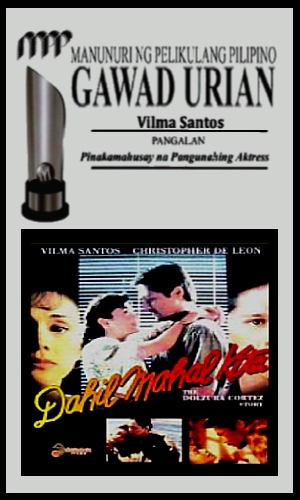
 Star For All Seasons
You must be logged in to post a comment.