Vilma Santos-Recto is a popular multi-awarded actress and politician in the Republic of the Philippines. *** She is known as "Queen of Philippine Movies," "Queenstar," "Grand Slam Queen," "Box Office Queen," and "Star for All Seasons." *** This website is mostly about her iconic film career.
Despite the negative propaganda which almost made her give up, the Governor remains on her seat. Here’s what happened on Gov. Vilma Santos-Recto’s first flag ceremony at the Batangas Capitol after her proclamation.
In an emotional speech last May 17, 2010 during her first flag ceremony after being proclaimed as winner in her re-election bid, Gov. Vilma Santos Recto thanked all those who kept their faith in her administration and supported her and Sen. Ralph Recto during the heated campaign period.
“Serving Batangas again for the next three years is no joke, as it will require a lot of sacrifice,” the first lady governor of Batangas avowed. “But I will do my best not to fail my fellow Batangueños.”
Santos Recto admitted that she felt like giving up at times during the 45-day campaign period as the political rollercoaster ride had her mentally, emotionally, physically and even spiritually drained. It was only the support of her family, particularly husband, Sen. Recto, and her children Luis and Ryan, and the continuous faith of those who believed in her capacity as a leader that cheered her on.
Being an emotional person who is always open and direct to people she deals with, she said she was shocked with all the negative propaganda launched against her. She emphasized that, despite her 12 years in government service, she is still learning a lot, particularly in terms of political relationships. The Batangas Liberal Party chairperson related that the very people who heaped praises on her and fervently tried, until the Certificate of Candidacy-filing deadline in November last year, to make her run for the country’s vice presidency, were the same individuals who attacked her with all the misinformation and lies, when she decided instead to continue her crusade for the province.
“The last campaign was my fifth since I first ran as Lipa mayor, but it was, by far, the most difficult,” Santos Recto surmised. “Maraming salamat sa lahat ng sumuporta.”
She also thanked all the employees who held on to their belief in her, and to all those who did not, she lightheartedly added: “May God bless all of you.” Knowing that she cannot please everybody, Gov. Vi assured those who did not vote for her that: “hindi ko kayo aawayin…I respect all of you. But you have to respect me back.”
With another three years of public service in the horizon, Gov. Vi challenged all provincial employees to work together as a family for the continuous growth of Batangas.
Santos Recto won the May 10 gubernatorial derby as she earned almost 60% of votes casted in the country’s first automated elections. Sen. Recto has also been proclaimed as among the victorious senatorial candidates, while Vice Gov. Mark Leviste and all re-electionist Board Members prevailed over their respective rivals (Wow Batangas).
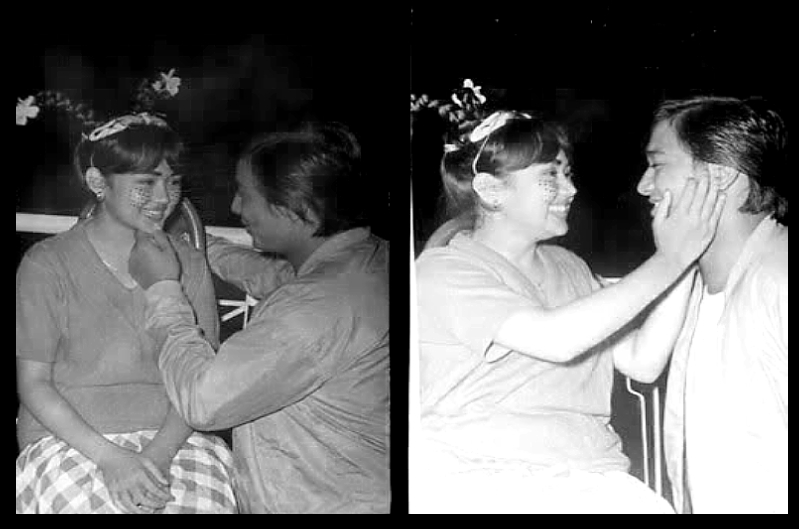
The Vilma Santos-Christopher de Leon love team is the most enduring tandem in local cinema. They were first paired in 1975 in Celso Ad. Castillo’s Tag-ulan sa Taga-araw, as first cousins who fall in love with each other. This was followed by Masarap Masakit ang Umibig, Nakawin Natin ang Bawat Sandali, Ikaw ay Akin (with Nora Aunor, megged by the late Ishmael Bernal), Pinay American Style (shot in the US), Disco Fever, Magkaribal, Gusto Kita, Mahal Mo Siya (with Romeo Vasquez), Pakawalan Mo Ako, Karma, Sinasamba Kita, Relasyon, Haplos, Broken Marriage, Paano Ba ang Mangarap, Minsan Pa Nating Hagkan ang Nakaraan, Imortal, Ipagpatawad Mo, Dahil Mahal Kita, Dolzura Cortez Story, Nag-iisang Bituin (with Aga Muhlach), Hanggang Ngayon Ika’y Minamahal, and Dekada 70.
Mano Po 3, My Love is Vilma’s 23rd film with Boyet and her 190th major movie in her filmography. She also did guest appearances for friendship’s sake in films like Roderick Paulate’s Charot, German Moreno’s Payaso and Jinggoy Estrada’s Erpat Kong Astig. What is the secret of her successful team up with Boyet?
“You know, it’s amazing because we’ve never been linked to each other and yet the public loves seeing our movies together. Siguro it’s because we have this unbelievable chemistry. We know each other so well that tinginan lang on screen, we already know what to do to make a take very good.”
Ate Vi turned 51 on Nov. 3 and it’s to her credit that she can manage to look half her age. What is her secret?
“I exercise everyday. If I don’t, I’d get sick. When I feel down or I’m angry about something, I exercise and it makes me feel better. As a mayor, I get invited to a lot of dinners and they’d feel slighted if I don’t honor their invitation. So can you imagine what would happen to me kung kain ako nang kain and I don’t exercise? Also, I never abuse myself. Wala naman akong vices like drugs or alcohol. Clean living. I also have a positive attitude in life. I don’t dwell on negative things as it’s not healthy.”
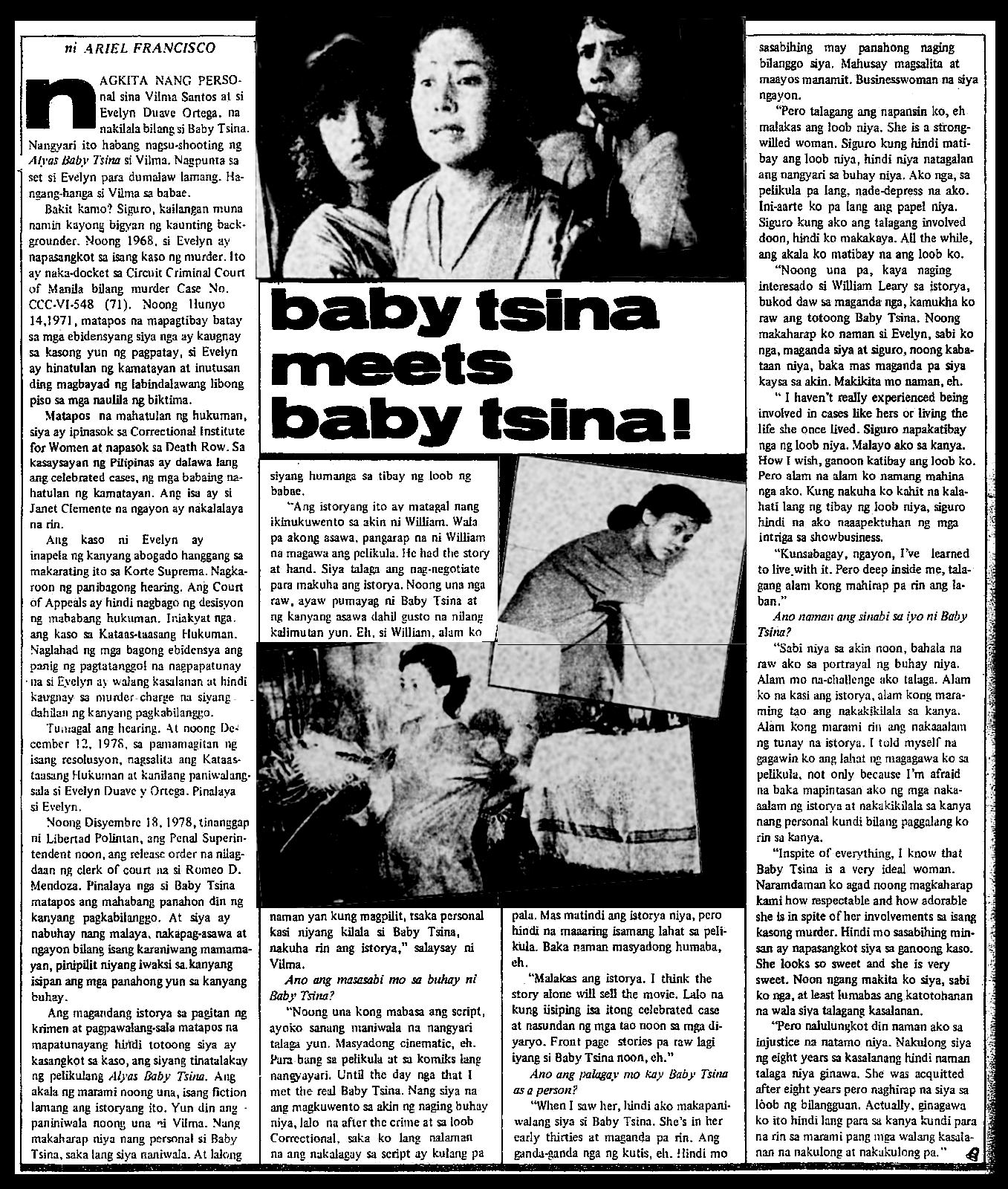
Did she have a hard time playing the role of a Chinese woman in Mano Po 3? “You know, I did a movie before, Baby Tsina, but I wasn’t really Chinese there. In Mano Po 3, I play Lilia Chong-Yang, a socially conscious anti-crime crusader and I get to know more about Chinese culture. We were even taught how to speak Fookien Chinese by a private tutor. Sa dubbing, the coach was there to make sure we’re perfect with our pronunciation of all our Chinese lines.”
Why did she choose Mano Po 3 to be her comeback film after a three-year hiatus? “You know, I’ve done some of my best award-winning films with Regal, like Relasyon, Broken Marriage, Sister Stella and Pahiram ng Isang Umaga, so when Mother Lily offered this project to me, which was originally Soong Sisters pero hindi natuloy, I accepted it. I’ve seen the first Mano Po, also directed by Joel Lamangan, and I liked it, so sabi ko, why not do the last installment in the series? Also, here, I get to play a glamorous woman once again. In my last films like Anak, Bata, Bata and Dekada, I play a plain housewife kaya most of the time naka-duster lang ako. For a change, sabi ko, I want to play the role of a well-dressed executive once again. Then there’s the prospect of working with direk Joel Lamangan for the first time.”
How is it being directed by Lamangan, who got more identified with Nora Aunor after such award-winning films as Flor Contemplacion Story and Bakit May Kahapon Pa?
“We got along well, kahit alam kong malapit siya kay kumareng Guy. We never felt awkward on the set since he’s very understanding, considering that my schedule allows me to shoot only on weekends. After doing a dramatic scene, he’d even kiss me on the forehead to express his approval. Mano Po 3 is one film I can be proud of. One thing that surprised me is he’s such a fast worker. With other directors, we shoot only one or two sequences a day. With him, we shoot eight to nine sequences a day. And you should be prepared with all your lines and your costume and makeup when you get to the set as he does only one rehearsal and take na kaagad. For this movie, iba ang pinagawa niyang atake namin ni Boyet compared to our past films before. I’m sure the audience will appreciate because it’s really something different.”
She’s working with many young stars in the film. How did she get along with them? “With Carlo Aquino and Angelica Panganiban, no problem as they played my kids in Bata, Bata, Paano Ka Ginawa and Lipa Massacre. Pero sina Karylle, Angel Locsin, Patrick Garcia, John Prats, Dennis Trillo, and even Jay Manalo, ngayon ko lang nakatrabaho. When we all went to Beijing, I noticed parang nahihiya sila sa akin so I took the initiative of talking and embracing all of them. By the time we started shooting, they were relaxed and comfortable with me na. It’s fun working with them as they’re all professional and responsible.”
How does she feel about the sudden demise of Fernando Poe Jr.? “I really felt very sad as he’s one of the kindest men I ever met. We’ve done three films together. The first one was when I was only 19-years-old, Batya’t Palo-Palo, a big hit. He was the one who taught me how to swim while we were shooting that movie. Before that, I did Dyesebel where I played a mermaid but I didn’t even know how to swim. This was followed by Bato sa Buhangin. Our last film together was Ikaw ang Mahal Ko, which I did after I gave birth to Ryan Christian. Kuya Ronnie is a gentleman in the strictest sense of the word. Talagang maasikaso siya sa lahat ng kasama niya sa shooting and he feeds everyone with great food all the time. He’s fun to work with kasi palabiro siya at masaya talaga kasama. The whole industry will miss him.”
We saw Christopher de Leon at the wake of Fernando Poe Jr. at Sto. Domingo with his wife Sandy Andolong and he, too, feels sad about Da King’s passing away. He has worked with FPJ only once, in Agila (1980), where they played father and son.
“But I used to be part of his FPJ all star basketball team that played in various parts of the county,” he says. “FPJ is a very caring person. He acts like an adviser when it comes to one’s career. He’d tell me, I saw the trailer of your movie, dapat ganito ang ginawa mo. All his comments are constructive. You know he wants to be of help to you.”
Boyet didn’t have a single movie this year except for Mano Po 3. His last one was Mano Po 2 in last year’s filmfest. “I got busy with TV work. I did the soap Hanggang Kailan and the sitcom All Together Now on GMA 7. Now, I’m also busy as juror in Starstruck.”
How different is his role in Mano Po 3 from Mano Po 2? “There’s a big difference. In Mano Po 2, I was the family patriarch with three wives. Here, I’m a lover boy. Vilma Santos and I were sweethearts during our college days. My whole family was deported abroad by the Marcos regime so we got separated without me knowing she’s already pregnant. Several years later, we meet again while we’re both attending a conference in Thailand and our love for each other blooms once more. This starts the conflict in the film because she’s already married to Jay Manalo. Ako naman, widower na. Making this film brought me to Beijing and the beautiful ancient city of Ayutthaya in Thailand which is one and a half hours away from Bangkok.”
Why does he think his partnership with Vilma continues to thrive even after 30 years? “I just love working with Vi because she is such a giving co-actor. Hindi siya nang-aagaw ng eksena. If the scene is yours, susuportahan ka niya nang husto for you to shine. You can’t help but get carried away kapag siya ang kaeksena mo dahil sa husay niya.”
Boyet has just taped a real-life episode with wife Sandy for Magpakailanman. “We play Claro and Carmelita. They’re not celebrities pero maganda ang story nila. I play the role of a blind man. This is my first time in Magpakailanman and I’m glad I’m doing it with Sandy with whom I haven’t worked for a long time.”
Next year, he’s going to the US to visit his son, Miguel, 18, who is studying computer graphics in New Jersey. “There’s also an offer for me to do a show with Nora Aunor while I’m there.”
We ask Vi and Boyet if they expect their film to win come filmfest awards night.
“It’s nice to win but I don’t want to expect anything,” says Boyet. “I’m just happy with the thought that we are able to do this kind of movie and we gave our best to our respective roles to please the viewers.”
“More than the awards, I want the film to make money at the box office and be appreciated by people from all walks of life,” says Vilma. “At the core of the film is a beautiful love story and a woman’s love for her family. I’m sure a lot of couples will be able to identify with it.”
Source: Written by Mario E. Bautista, The Star, December 24, 2004 NEWSFLASH
Is it “Mission Impossible” Madam Anna? The End of “100 Days to Heaven: A Heavenly Finale”
ABS-CBN’s top-rating Primetime Bida drama series “100 Days to Heaven” was once again the talk of the town as it recently trended worldwide on Twitter with the non-stop intense scenes and revelations on its last week dubbed as “100 Days to Heaven: A Heavenly Finale.” Aside from following the happenings in the lives of Madam Anna Manalastas (Coney Reyes/Xyriel Manabat) and daughter Sophia (Jodi Sta. Maria), loyal viewers are hooked in the finale week to watch out for the guest appearance of some of the biggest Kapamilya stars which recently included Jake Cuenca as the young ‘Tagasundo,’ Coco Martin as the young ‘Tagabantay,’ and Governor Vilma Santos as ‘Tagabantay.’
When asked about her guesting, Santos said nothing but praises for the show. She said, “We all know that many people are watching the show that’s why I consider it a great honor to be a part of it, plus the fact that I got to work with my good friend, Coney Reyes.”
The Star for All Seasons also shared that like all the loyal viewers of “100 Days to Heaven,” she was also deeply touched with Madam Anna’s journey. “I salute the program for all the good values it presents. It has taught viewers the importance of being good to others and that it is never too late to change for the better and ask for forgiveness from those we have offended,” Santos said. Meanwhile, the whole cast and production team of “100 Days to Heaven” are thankful for the public’s full support to show which aired for six months. On her Twitter account, Reyes constantly expresses her gratitude to the show’s followers. She tweeted, “We hope that everyone will be a part of our journey from the beginning to end. Thank you very much for all the support!” After all her efforts, is it really ‘mission accomplished’ for Anna? Was she really able to correct all that she had done wrong? Will the gates of heaven open for her or will she be brought into the clutches of hell? Don’t dare miss the final judgment on “100 Days to Heaven: A Heavenly Finale,” weeknights after “TV Patrol” on ABS-CBN. For more info, visit: official web-site, Twitter, Facebook. Source: Starmometer, Nov 16, 2011, ABS-CBN READ MORE
“Buong buhay ko yan na lang lagi ang sinasabi nila sa akin…wala kang magagawa eto ang gusto ng asawa mo…wala kang magagawa eto ang kapalaran mo…wala kang magagaw dahil dapat…putris naman, dapat hindi ganuo…tapos sasabihin ng daddy n’yo hindi lang ang anak ko ang pinatay hindi lang ang anak ko ang dinukot…lalo akong nanggigigil, lalo akong nagagalit dahil kung nanay ka talaga, hindi ka lang dapat nanganganak kundi naiapaglaban mo rin ang anak mo dapat kaya mong pumatay para sa anak mo…gusto ko lang malaman bakit nila pinatay ang anak ko…hindi masamang tao ang anak ko, kahit sa oras na ito humarap ako sa diyos kahit sa dimonyo hindi masamang tao ang anak ko…hindi masamang tao ang anak ko!” – Amanda Bartolome
“You could stop being proud of me! Nagsawa na ako sa ganuon, gusto ko naman ngayon ako mismo just for a change, maging proud sa sarili ko!” – Amanda Bartolome
The Plot
Dekada 70 is a story of a family caught in the midst of a tumultuous time in Philippine history – the martial law years. Amanda (Vilma Santos) and Julian (Christopher Deleon) is a picture of a middle class couple with conservative ideologies, who must deal with raising their children, five boys – Jules (Piolo Pascual), Isagani (Carlos Agassi), Emmanuel (Marvin Agustin), Jason (Danilo Barrios) and Bingo (John Sace) in an era marked by passion, fear, unrest and social chaos. As siblings struggle to accept the differences of their ideologies, as a father faces the painful dissent of his children, a mother’s love will prove to be the most resonant in the unfolding of this family’s tale, will awaken to the needs of her own self, as she embarks on a journey of discovery to realize who she is as a wife, amother, a woman and a Filipino. – Star Cinema
Dekada ’70 (English: 70s Decade) is a 2002 Filipino drama film released based on a book called Dekada ’70 written by Filipino author, Lualhati Bautista. The film tells the story of the life of a middle-class Filipino family who, over the space of a decade, become aware of the political policies that have ultimately led to repression and a state of Martial law in the Philippines. Filipina actress Vilma Santos stars as Amanda, who realizes the implications of living within a dictatorship after sorting out the contradictory reactions of her husband and five sons. Her husband (Julian), played by Filipino actor, Christopher de Leon, supports his eldest son’s (Jules), played by Filipino actor, Piolo Pascual; efforts to rail against the government while refusing to follow Amanda’s wish to find a job. Her second son (Gani), played by Filipino actor, Carlos Agassi, is in the United States Navy. Her third son (Eman), played by Filipino actor, Marvin Augustin, writes illegal political exposes. The fourth son (Jason), played by Filipino actor, Danilo Barrios fell victim to a corrupt police department, and her youngest son named (Bingo), played by Filipino actor, John W. Sace, is still a boy. – Wikepedia (READ MORE).
The Reviews
“…At the center of the film and the family is Amanda (Filipino cinematic diva Vilma Santos) who vicariously experiences living under a dictatorship through her husband and five sons’ different reactions before coming into her own as a person. Her husband, Julian (Christopher De Leon), seems a walking contradiction: He offers rationalizations for the government while supporting his eldest son’s revolutionary activities, but has a fit when his wife wants to get a job. As for the sons, firstborn son (Piolo Pascual) joins the guerillas in the mountains. The second son (Carlos Agassi), forced into a shotgun wedding, defiantly works for the American Navy. The third son (Marvin Augustin) writes journalistic exposes he can’t publish, while the fourth son (Danilo Barrios) is a mystery to his family until his brutal, motiveless murder (probably by police) reveals a lost girlfriend. The fifth son (John W. Sace) is still a boy. Santos’ Amanda effortlessly and movingly chronicles the changed consciousness of the family and the country, with understatement her most reliable tool. Pic begins and ends with images of Santos at the forefront of a political demonstration, and nothing, from first image to last, for 128 minutes, is allowed to spontaneously or slyly deviate from the logic of her consciousness-raising.” – Ronnie Scheib, Variety Magazine (READ MORE)
“Last seen in ANAK (SFIAAFF ‘01), Vilma Santos delivers an understated, profoundly moving performance as the matriarch whose awakening redefines the traditional mother and wife role she donned for years. This is the story of an incredible character that survived an unforgettable decade.” – Michael Magnaye, The 22nd San Fransisco Asian-American Film Festival, 2004 (READ MORE)
“…Rono and Bautista, who writes her own adaptation, have obviously worked very closely in fleshing out the novel on screen. The result is an effective and even subtle tableau of scenes to present the Bartolome family’s struggles from the late ‘60s to ‘70s that not only set the domestic drama, but also prefigure the wider social and historical saga unfolding before the nation. No scene is wasted, no useless pandering to the viewer’s sense of spectacle or penchant for soap opera is even attempted. The competent production design, the agile editing, the stark photography (which impresses even the Paris-based Filipino-Spanish painter Sanso who calls it comparative to the best in Europe) ensures a panoply of images that is immediate, recognizable, and keen. Like Regal Films, Star Cinema has been compelled to throw in its stable of stars so that the Bartolome siblings look distractingly too much like a boy band. But because they play well-thought-out characters, their damage is put to a minimum. In some cases, like Piolo Pascual as Jules, the young communist rebel, the effect is heart-wrenching. Pascual plays, along with Vilma Santos as Amanda, one of the centers of gravity of the movie; the other center consists of Santos and Christopher de Leon. As arguably the first unabashedly feminist Filipino novel, “Dekada” shows a woman’s awakening to her nature and gender through the men of her life-her husband and her first born. Their age, generation and preoccupation divide both men, and Amanda serves as their bridge and transition. In the process, Amanda herself is transformed. She becomes herself. The most moving scenes of the movie are of Jules and Amanda meeting on the sly and forced to carry on mother-and-son endearments hurriedly because of the threat of arrest. But the most poignant scene is Julian and Amanda confronted with the terrible loneliness of their advanced years, left by their children, he turning away from her to hide his tears, and she asking him to face her and not to be ashamed. It helps that the scene is played by Santos and De Leon, truly one of Filipino cinema’s most effective screen couples. As Amanda, Vilma Santos shows again why Brocka, before he died, had likened her to water. “She can register anything,” he said. In “Dekada”, its the same Santos of vigor and transparency. The only difference is the depth, the resonance, and the greater confidence. Can she ever go wrong?” – Lito B. Zulueta, Philippine Daily Inquirer, 30 December 2002 (READ MORE)
“…Ang Dekada ’70 ay isang mahusay na adaptasyon sa pelikula ng nobela nitong may parehong titulo. Napanatili ang kaluluwa ng nobela sa pelikula sa kabila ng limitasyon ng pelikula bilang isang audio-visual na medium. Marahil, nakatulong ng malaki ang pagkakaroon ng iisang manunulat lamang. Naging maayos ang takbo ng pelikula na tulad sa nobela nitong nahati sa mga taon ng dekada ’70. Mahusay ang pagkakaganap ng mga pangunahing tauhan (maliban kay Carlos Agassi) na nakapagbigay hininga sa mga tauhang noo’y nababasa lamang. Naibalik ng pelikula ang larawan ng dekada ’70 sa mga eksena nitong nagpapakita ng mga demonstrasyon, protesta at rallies na tunay na nangyari noong panahon na iyon. Ang musika at tunog ay madalas na akma at nagpapaigting sa emosyong nais ipahatid ng pelikula. Naging mahina lamang ang disenyong pamproduksiyon ng pelikula na hindi naging masusi sa make-up, at kasuotan ng mga tauhan sa pawang hindi parating umaangkop sa panahon…” – Catholic Initiative for Enlightened Movie Association (READ MORE)
“…Dekada 70 journeys with the central character Amanda Bartolome (Vilma Santos), the reticent wife of an alpha-male husband, and the worrying mother of a boisterous all-male brood. Thoroughly relegated to domesticity in a world slathered in testosterone, Amanda begins to undergo a transformation when her family becomes imbricated in the sociopolitical realities brought about by the Marcos dictatorship. The declaration of Martial Law, the lifting of the writ of habeas corpus, the curfews and police searches, all these could have easily floated past Amanda’s head had her sons not found themselves caught in the crossfire between the government and the pro-democracy movements. As one son after another faces the oppressive forces of the dictatorship, Amanda gradually realizes that the personal is political. While chanting slogans for sociopolitical change, she finds her own voice and comes to terms with the fullness of her own person…There are touches of seventies style Filipino humor that foreign audiences might miss; they effectively establish that this is a real, average Filipino family trying to navigate through the eye of the political storm. The acting is generally impressive, most especially that of lead actress Santos, who gives a luminous, sensitive performance. Santos essays the transformation of Amanda so effectively that we do see clearly at the end of the film that there has been a fundamental change in her character. If there is something to be faulted about the film, it is Roňo’s failure to keep melodramatic moments in check. The funeral sequence of one of Amanda’s sons, for instance, becomes an over-extended session of copious tears. The rich story material of Dekada 70 could do away with such “in your face” paroxysms, which only work to dull the film’s cutting edge political trajectory. Nonetheless, it cannot be denied that Roňo had created a noteworthy, epic-scale Filipino film, and on a Third World budget at that. It also cannot be denied that Roňo had not forgotten the sentence of history on his home country…” – Antonio D. Sison, Insititute for Pastoral Initiatives University of Dayton (READ MORE)
“…about Vilma’s performance in “Dekada ‘70”: Some jurors, viewers and reviewers have expressed dissappointment over it because they regard it as too passive, low-key, unemotional, too much taken up with observation, and reflection instead of action. Thus, it doesn’t deserve the best actress award. We disagree. We think that, precisely because Vilma’s portrayal was so restrained for the most part, it was more difficult to achieve. It’s far easier to rant and rave, to “feel” bigtime, to run the gamut of emotions from A to Z- but, if Vilma did that, she would have gone against her character’s nature, as written…during the first half of the film, Vilma’s character occasionally felt unhappy, taken for granted or unappreciated as a person, but she held her emotions in check to keep the peace in the family. It was only later, when the national trauma of martial law rule affected her sons in various tragic ways, that she found the voice and rediscovered the heart to assert herself as a person and to give her emotions full play. We submit that Vilma’s portrayal is excellent precisely because she vivified he character as the wife and mother was in the ‘70s. Her thematic and emotional high points towards the end of the film rivetting, but it was her quieter, more controlled moments that showcased Vilma’s true gift as an actress. During those moments, Vilma didn’t just observe what was going on, she was constantly conflicted only, she had been programmed not to speak out because it wasn’t her “place”. Thus, when she finally changes and expresses herself in the end, the contrast makes her transformation all the more stunning. In the movie’s first half, Vilma is such a good actress that, although she may not be the active element in her family (her husband is), she is quietly involved in each and every scene, and every new development is seen from her point of view. Even better, despite her relative lack of dialogue at this point, we can “read” her thoughts on her face as clearly as though she were speaking. And we see her slowly changing before our very eyes, gradually overcoming her reticence, discovering her true worth, and finally finding and expressing her true self. This is very difficult to do, as any true thespian will affirm. Which is why, unlike some people who dismiss Vilma’s portrayal as passive and weak, we think it ranks among her best, right up there with her performances in and fully deserving of the filmfest’s coveted best actress trophy.” – Nestor Torre, Philippine Daily Inquirer (READ MORE)
“…The reason “Sister Stella L” will probably end up better appreciated is that the movie was shown during the martial law era. The movie was relevant to the times and Vilma was portraying an activist nun, a role not usually associated with the Star for all Seasons… As the mother, Vilma does justice to her character, holding back her strong emotions until the end, when she finally confronts Christopher de Leon and wants to break up with him. Despite the many tragic events that befall her character, Vilma chooses to underplay her role except at key points towards the end of the movie. Boyet is his usual competent self as the chauvinistic husband of Vilma who is forced to change when his wife breaks out of her shell. Piolo Pascual also deserves mention for his realistic portrayal of the activist turned NPA rebel…” – Edmund L. Sicam, Philippine Daily Inquirer (READ MORE)
“…Unlike Vilma Santos’ Sister Stella L. character, who becomes politicized practically overnight, her Amanda role in “Dekada ‘70” takes longer to mature politically (almost the whole decade). And she goes through a very painful process because she experiences the abuses of the marcos regime by seeing her own children suffer. With Vilma hurting inside and suffering almost in silence, we have here in “Dekada ‘70” some very moving dramatic scenes that are mostly devoid of hysterics but are still very effective nonetheless. Actually, we see yet another facet of Vilma Santos’ acting talent in this film. In the story, she goes through guilt (with the fate of one of her sons), pain, anguish and anxiety (particularly with the eldest, Piolo)-plus discontent as a plain housewife who wants to do something more with her life other than to keep house for her husband and kids. The great actress that she is, Vilma is able to manifest clearly the different layers of her character in a very quiet manner, which-you have to admit-is quite difficult to achieve. But Vilma-after all these decades -can do no wrong anymore in the field of acting. Although it’s not the greatest performance of her career (it’s still Sister Stella L), her portrayal of Amanda in “Dekada ‘70” is no doubt one of her finest. More importantly, her role (and her approach to it) is different from the hundreds of other roles she has done in the past…” – Butch Francisco, The Philippine Star (READ MORE)
“…Santos’ performance is so vivid and insightful that we can see her changing in front of our very eyes… We were enthralled…we were moved. And we valued the film’s important contribution to the very urgent task of reminding everyone of the trauma in our collective lives that was the martial law period of the ’70s,” noted Nestor Torre of Inquirer News Service. Chito Rono’s Dekada ‘70 made its world premier at the Asian American International Film Festival in June of 2003. The film has also won numerous domestic awards. The Young Critics Circle voted Dekada ‘70 Best Film of the Year (2002), Best Screenplay, Best Sound and Best Performance in a tie between actress Vilma Santos (Amanda) and Piolo Pascual (Amanda’s eldest son). The Best Film of the Year award is reserved for the director, such that no separate prize for direction is needed. The Best Performance award is the most coveted as it is conferred on the performer whether male or female, adult or child, individual or ensemble in leading or supporting role. Vilma Santos also received an award for Best Actress from Star Awards for Movies, Film Academy of The Philippines, and Gawad Urian Awards. Piolo Pascual also received an award for Best Supporting Actor from the Young Critics Film Circle, Metro Manila Film Festival, Star Awards for Movies, Film Academy of the Philippines, FAMAS Awards, and Gawad Urian Awards. The Gawad Urian Awards also presented Dekada ’70 with the award for Best Screenplay…” – Sara Stokoe, Asia Pacific Arts (READ MORE)
“…In Chito S. Roño’s superb “Dekada ’70,” a family in the Marcos-era Philippines has a domineering father and five sons, but it is the mother (Vilma Santos) who provides the mental stamina. She fights for her family in ways the father can’t even dream of. “To give birth to these children isn’t enough,” she says. “You have to defend them, protect them.” That’s the ’70s. In 30 years, that kind of woman will deal with difficult questions of divorce and motherhood, one in which women want freedom, yet must be willing to share blame when something goes wrong. The young woman who leaves her husband and thinks about aborting her pregnancy in South Korean filmmaker Gina Kim’s “Invisible Light” is an experimental example. Moon’s great performance in “A Good Lawyer’s Wife” almost makes you believe wrong is right, and, taken with her much-lauded portrayal of a girl with cerebral palsy in “Oasis,” reveals her as one of the world’s best actresses. Hollywood, take note. – No stereotypes of Asians here…” – G. Allen Johnson, Festival Celebrates Real Women, San Francisco Chronicle March 4, 2004 (READ MORE)
“…The young actors that were cast in Dekada ’70 were all guilty of doing too much “acting”. I don’t think actors should be acting-out, or (in this case) over-acting, unless they were filming a farce, or a comedic parody. Inexcusable mediocre performances plagued every scene. Instead of ensuring the characters were having a real conversation (real interaction), it seemed as though they were merely spitting out lines which they had memorized word-for-word, the delivery, inflections, and pauses unnatural. People don’t talk to each other like this in real life now, do they? Of course not. It is sometimes possible for a younger actor to deliver a satisfactory performance though the guiding hand of an experienced veteran. This of course is quite rare, as it calls for a unique, uncalculated, natural chemistry that can never be faked. Award winning greats like Vilma Santos and Christopher De Leon should never be subjected to work with a group of inexperienced pretty faces who are incapable of displaying a sense of depth and sophistication. Proof that casting makes for a vital element that determines the success of a film…” – Edwin Manalo(READ MORE)
“…The characters of brothers Jules (Piolo Pascual) and Eman (Marvin Augustin) share similar anti-Marcos perspectives in the movie. A movie that attempts to add a more familiar and human touch to a real event isn’t without its melodrama. The overt use of music to drive emotion home and unnecessarily lengthy shots distract a bit from what otherwise could have been short and sweet takes of awesome performances. The pace of the film seems to slow down mid-way through the film. Yet these faults are minute enough that they probably didn’t even deserve a mention…This movie makes for a satisfying introduction to this decade in Philippine history. I shouldn’t forget to mention how faithful the movie remains to the styles of dress, the models of cars, and the music of the time to strongly present the age and era the movie takes place. Most importantly Dekada ’70 presents to us the emotional aspect, an aspect you cannot obtain through school textbooks, snapshots, and soundbites of Martial Law under Marcos. This is communicated successfully through its collection of talents seen through the eye of a veteran director…” – Pinoy Movie Reviews(READ MORE)
“…Dekada ’70 tells of how under hate, greed and corruption, one normal person transcends beyond right and wrong: instead learns that it is freedom that entails survival. Set in the 70′s, urban Metro Manila, Amanda Bartolome is a middle-class mother of five young men. Amanda acts as a supposed symbolism of detachment. First of all, she was a mother, a housewife; such were not considered integral parts of society during those times. She was not the breadwinner; she did not experience the foremost effects of the decline of the Philippines economy back then. She was a member of the middle class; her family did not take money, like the rich, nor did her family suffer the worst of the financial crises, like the poor. The lives of Amanda’s children each went in different directions in the story, and each varied. Her eldest son was Jules. Jules grew up normally, similar to every other ideal family. His upbringing was that of what ideally conformed to normal standards and circumstances. Being the eldest, however, Jules lived, and more importantly, matured through the shock caused by the declaration of President Marcos’ martial law. Thus, Jules lived his adolescence exposed to rebellious reading material, and inevitably molded his mind into that of guerilla. Jules grew up to become a member of the communist New People’s Army, and his evolution came full circle…” – Dekada 70, A Book Review (READ MORE)
“…For ten consecutive years from 1995 to 2004, the Philippines submitted films for consideration for the Best Foreign Language Film category of the Oscar Awards. But up to this point of film history, we remain in the list of countries who has never won nor nominated for this award…The next year 2003, the country’s entry was Dekada ’70, directed by Chito S. Rono based on the novel Dekada ’70 of Lualhati Bautista. It tells the story of a middle-class Filipino couple (Christopher de Leon and Vilma Santos) and their five sons during a tumultuous decade of the martial law regime. The sons were played by Piolo Pascual, Carlos Agassi, Marvin Agustin, Daniel Barrios and John Wayne Sace…” – FAP (READ MORE)
Fernando Poe Jr.’s “Lawin” (hawk) failed to soar high at the box office after Ramon “Bong” Revilla Jr.’s “Agimat” (amulet) proved to be more powerful. Working wonders at the tills, “Agimat ni lolo,” Revilla’s action-fantasy-adventure movie was the top grossing film on the first day of the festival last Wednesday, edging out Poe’s “Alamat ng Lawin,” from top slot. Caloocan Mayor Rey Malonzo, chair of the MMFF executive committee, refused to divulge the box-office figures because “that was the request of the other producers.” An MMFF insider, however, disclosed that “Agimat” earned P14 million gross on the day it opened. Imus Productions bankrolled “Agimat.” As early as yesterday noon, Revilla said he was told that “Agimat” was already leading in the box office race. A number of theaters opened as early as 9 a.m.yesterday, making it easy to determine the results after only the first screening. Revilla outshone even comedy king Dolphy’s “Home Along da Riles,” which ranked only third. Regal Entertainment’s “Mano Po,” which boasts a powerhouse cast and Joel Lamangan at the helm, came in fourth. Star Cinema’s period opus, “Dekada ’70,” directed by Chito Rono and top billed by drama royalty Vilma Santos and Christopher de Leon, was fifth. The epic tale of Filipino hero “Lapu-Lapu,” with Pampanga Governor Lito Lapid in the lead, took the sixth place, and Reflection Films’ “Hula Mo, Huli Ko,” starring Rudy Fernandez and Rufa Mae Quinto, came in seventh in the box-office race. But the box-office tallies might still change after tonight’s “Gabi ng Parangal,” when the MMFF hands out the awards to this festival’s best films. Two more entries – OctoArts Films’ “Lastikman” starring Vic Sotto and Regal Film”s “Spirit Warriors 2: Short-cut” -will be shown starting Jan 1. The filmfest will run until Jan 10. – Leah Salterio Philippine Daily Inquirer, Dec 27 2002 (READ MORE)
This year’s Metro Manila Film Festival (MMFF) sports a new name, but its trademark controversial image and reputation remain the same. The 28th MMFF has included a “P” in its official name. The “P” which stands for Philippines, means the entries in the festival can now be seen nationwide. The cast of “Dekada ’70” staged a walkout. A special effects awardee returned his trophy. A film that failed to make it to the filmfest’s top seven won thrid best picture. These and other inconsistencies were the “highlights” of this year’s “Gabi ng Parangal” awards ceremony last Friday. Piolo was “Dekada ’70’s” biggest winner as best supporting actor for his compelling portrayal of a tortured rebel leader in Chito Rono’s period drama. John Wayne Sace, who plays Pascual’s brother Bingo, bagged the best supporting child actor award. “Dekada ’70” also bagged the second best child actor award. “Dekada ’70” also bagged the second best picture award. Regal Films’ “Mano Po” romped off with the most number of awards, including the best actress plum that went to Ara Mina, who best-ed the veteran “Dekada ’70” star Vilma Santos. Eddie Garcia was adjudged best festival actor, while Joel Lamangan was named this year’s best director. Kris Aquino won best supporting actress also for “Mano Po.” Regal Films matriarch Lily Monteverde thanked the filmfest committee in Aquino’s behalf. Mother Lily has two more reasons to say “Chi chien” after “Mano Po” won best picture and best original story for writer Roy Iglesias. Iglesias also won the best screenplay citations for “Mano Po.” Resty Garchitorena and Tara Limberger took home the best cinematography and best film editor awards, again for “Mano Po.” The cross-cultural drama, which even partly filmed in Beijing, China, bagged a toral of 12 awards that night. Bong de Guzman snatched the best musical score trophy from such veteran composers as Louie Ocampo, Nonong Buencamino, Jimmy Fabregas and Elmer Sayson.
Best festival production design trophy was awarded to Tatus Aldana for his spectacular work on “Mano Po.” The biggest surprise came when Chito Rono’s “Spirit Warriors 2: Shortcut.” won third best picture. The award came as a surprise even to its director Chito Rono, who upon hearing the news, commented that “the award only proved how good the movie is.” “Spirit Warrior 2” snatched the festival’s two most important technical awards – best make-up for Warren Munar and best visual effects for Dodge Ledesma and Road Runner Productions. Unlike “Alamat” and “Lastikman” which didn’t get any award, Reflectin Films’ “Hula Mo, Huli Ko” and RVQ Productions’ “Home Alone da Riles” each won an award. RVQ Productions’ “Nasaan Ka” was heralded as this year’s best theme song, while Caloy de Leon won the best sound recording plum for his work on “Hula Mo.” De Leon, however, returned the award later that night. “I want the jurors to explain to me how can a film dubbed in mono like “Hula Mo” win over other films dubbed in Dolby digital,” he said. Imus Productions’ spectacular “Agimat” float took home P75,000 after bagging the best festival float award. Noticeably absent during the awards night were “Alamat ng Lawin” lead star Fernando Poe Jr., his leading lady Ina Raymundo, and the entire cast of “Lastikman,” led by comedian-producer Vic Sotto. Poe’s long-time aide, Amay Bisaya, said the action king chose not to attend the ceremony to “avoid intrigues and politicking.” – Marinel R. Cruz Philippine Daily Ingquirer, Dec 29 2002 (READ MORE)
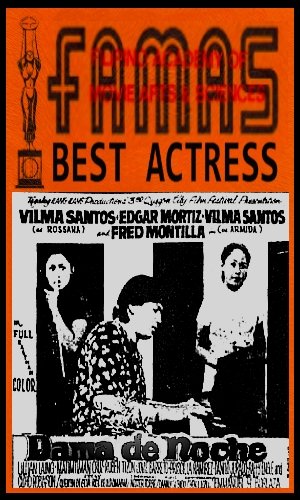
Leading Roles – The year was 1972, FAMAS was still considered the only credible award giving body in the Philippines. The musical still rampant but slowly but surely the young rivalry of Nora Aunor and Vilma Santos is forming another path. The race for who is the better actress started with both teen stars venturing to dramatic film roles. With Nora’s And God Smiled At Me and Vilma’s Dama De Noche, the fight went from box office queens, miss Philippines movies into a more serious title of best actress. The hype started with both entering their films to 1972 Quezon City Film Festival. Nora won the best actress despite a heated protest from Vilma’s camp. Indeed, Nora’s machine of supporters were on top of things. She will venture into several film projects under her own film outfit NV productions and she is well positioned to emerge on top come the yearly acting race. Come, 1973, the 21st FAMAS was indeed a fight between the young stars. Nora wasn’t nominated for And God Smile At Me, instead she was nominated for A Gift of Love, the best actress went into a tie. Considered a veteran, Boots Anson Roa, winner for her comedic performance opposite the very young and still leading actor of this time, Joseph Estrada in Tatay Na Si Erap. Roa shared the honor with Vilma Santos for her portrayal of opposite character twin sister in Dama De Noche. The very first best actress award for Vilma, it was a sweet revenge from the very first battle at the QFF and there will be more to come, not only from FAMAS but the other award giving bodies that will follow. A small note, Nick Romano won best supporting actor for another Vilma Santos film, Tatlong Mukha ni Rosa Vilma (READ MORE).
This is it folks! Nora Aunor vs. Vilma Santos, And God Smiled at Me vs. Dama de Noche. Which one will the FAMAS bless? The awards of the Filipino Academy of Movie Arts and Sciences are still far away though. But not the Quezon City filmfest awards which will be known tonight at the Nation Cinerama theater. One persistent prediction in showbiz is that Vilma will make it, hands down. However, Nora watchers are just as insistent that her ‘inspired’ performance in And God Smiled at Me is simply ‘super’ and worth no less than a best actress award. Dama de Noche is showing in three theaters– Remar, Delta and Sampaguita. It is, Vilma was quoted as saying, her dream role fulfilled. The very professional Vilma has come out with the resolution than henceforth she will demand to see the script and also see that the script is demanding— or she’ll say nix. Well, Dama de Noche is exactly just that: demanding. In it she delineates the twin-sister roles of sweet Armida and deranged Rosanna. Vilma sobs and screams, giggles, and crazy-dances, claws and clowns, sobs again and screams some more. But she does more than all these things. She acts. In the Filipino movieworld where crying is synonymous with acting, that certainly is being ahead of one’s kind. Vilma as Armida is drab and dry, almost a movie prop. It is in the portrayal of Rosanna that Vilma would tear one’s heart away. The many close-ups so effectively used throughout the movie show the unglamorous Vilma: her frowns, her lip-twitching, her uninhibited and stifled sobs.
But Vilma is less successful with the shifty look that is the distinctive trait of the deranged. She compensates for this in the ‘betrayal’ scene when Rosanna suspects that Leo, Armida and the psychiatrist (Fred Montilla) all conspired to imprison her in the hospital. Another outstanding feat is the subdued scene where Rosanna learns that Leo has gone to the Lerma villa to meet Armida.
The vivacious Rosanna is just as winsomely pathetic. Watching her is just like seeing a bosom friend trying to pretend she’s happy when both of you know she’s not only in this case, Rosanna is truly happy. Her non-knowledge of her plight is what is particularly heart-curling. Dama de Noche is Tagalog Ilang-Ilang Production’s entry in the QC filmfest which started on Oct.15. It is a very simple story, almost run-of-the-mill, but Nestor Torre, Jr. who wrote the screenplay saved it with his meaningful and amusing lines. However, the movie is occasionally dragging with the Filipino moviemania for spoonfed sequences. Will the memorable Rosanna win for Vilma the most coveted award tonight? Or will Nora the Superstar make it? The die is cast and tonight is the NIGHT. New Frontier Cinema in Cubao was never before so loaded that the fire exits had to be opened to let in air. It was so badly jampacked, one swore it couldn’t be worse. But it was, a ‘stand-mate’ (there were no seats) quipped, ‘Noong first day, mas grabe.’ And so through a snail-pacing 20-yard pila and after exactly one hour, one got inside the theater, at last!
On the screen: La Aunor doing her thing– praying. A few steps away from the chapel, in their home in Davao, her mother (Naty Santiago) lies dying. Damian (Luis Gonzales) sits by the sickbed, comforting his wife, assuring her she is the only woman he has ever truly loved. The good woman dies and Celina (Nora) is bitter. She had prayed so hard, had run so fast from the chapel home, only to find the elder women reciting the litany of the dead. Here, the first sobs from a woman stand-mate as Celina pounds clenched fists on the door. After the burial, father tells daughter the well-kept secret of her being illegitimate. Celina shows bitterness again, but the good daughter that she is, she soon gets over from the shock and decides to live with it. Damian brings Celina to Manila as his ‘inaanak.’ They’ll wait for the perfect timing, he says and then he’ll tell his wife Olga (Lucita Soriano) everything. The perfect timing never comes. One morning, Celina just can’t help calling him ‘Itay,’ telling him she loves him very much and that he must come home at once, please. The tender moments take too long, and everybody in the theater knows Damian is ‘tsk, tsk, tsk, mamamatay.’ Everybody is right. At the hospital, the secret lets loose as Celina jerks in agony. ‘Itay, Itay,’ she sobs, in the presence of Damian’s wife and two adopted daughters. Here, Nora’s bid for a best actress award really begins.
The three witches (oh, how the fans hated them) now maltreat Celina all the more, slapping her, pulling her hair, kicking her right in the tummy. All through these, Celina’s only consolation is her love for Carding (Tirso Cruz III), the laundry-woman’s (Nenita Jana) son. He is blind. He is desperate. He loves Celina very much but ‘wala akong karapatang umibig.’ And so he contemplates suicide, sneaking out one night, begging between yells of ‘Gusto ko nang mamamatay,’ for a vehicle to run over him. An irked driver shouts at him: ‘Ano ka ba, bulag?’ A woman fan shouted too: ‘wag kayong tumawa, serious yan.’ And then, what do you know, another death: not the blind leading man (that would’ve been a blunder) but his mother, who had followed him. After so much unbearable beating and tearful moments between the lovers, Celina delivers her ultimate prayer — she can’t take it anymore. AND GOD SMILES AT HER. God grants her a golden voice (for a while one thought that was only the beginning of the movie, after no less than two-and-a-half hours) and she sings all her heart at the foot of the altar. And this is not the end of it. Nora Aunor won the Quezon City Film Festival Best Actress award and her movie, “And God Smiled at Me” also took home seven more including the Best Picture and Best Actor awards. In reaction to the article above and the filmfest award results, a reader sent an open letter to the QC Filmfest Judges. Read the text in full and be the judge yourself. However, in 1973, Vilma Santos received the FAMAS Best Actress award (in a tie with Boots Anson-Roa in “Tatay na si Erap”) in the movie “Dama de Noche,” thus avenging her loss to perennial rival, Nora Aunor in the Quezon City Film Festival (READ MORE).
“…I didn’t expect to win, although marami ang nagsasabi sa akin na malaki ang pag-asa ko. Ako naman, I don’t believe anything unless talagang nangyayari. Kasi noon, I expected to win, sa film festival din sa Quezon City, but somebody else did. I was very disappointed. Noong awards night nga, I wasn’t convinced I would win hanggang hindi ko pa hawak ‘yong trophy…” – Ricardo F. Lo, Expressweek Magazine January 19, 1978 (READ MORE)











 Star For All Seasons
You must be logged in to post a comment.