FAMAS’ Circle of Excellence

This slideshow requires JavaScript.

After Hall of Fame – “…Relegated to hall of famer status, both Nora and Vilma were not allowed to compete for the acting awards in the coming years, a problem for FAMAS. Both actress were still active in making movies that deserve acting accolades. Two years after Vilma was acclaimed to the hall of fame status, she came up with performances that deserve praises, Kapag Langit Ang Humatol in 1990 and Ipagpatawad Mo in 1991. FAMAS can’t resist giving citation to Vilma anymore so they created a special award with a status higher than the Hall of Fame, hence the Circle of Excellence was born in 1993…”

“…The 41st FAMAS Awards honoring films made in 1992 was held again at the Fiesta Pavillion of the Manila Hotel on May 8, 1993. Vilma, now 40 years old earned her first of two Circle of Excellence awards. She was cited for Regal films’ Sinungaling Mong Puso. Sinungaling earned acting honours for Aga Muhlach, lead actor, Gabby Concepcion, supporting actor and best story for Jose Javier Reyes. It also earned nominations for its director, Maryo J. de los Reyes, best picture for Regal, supporting actress for Aiko Melendez. The next year, FAMAS deservingly gave Vilma her second Circle of Excellence award citing her performance in her social relevant film about HIV/AIDS, Dahil Mahal Kita: The Dolzura Cortez Story. Dahil Mahal Kita was nominated for best picture and best director for Laurice Guillen. …” – RV (READ MORE)

Sinungaling Mong Puso (1992)

“…Vilma Santos did not expect that her first experience at the Lower House could be so pleasant. “They were very nice. I was expecting that they’ll just tolerate me kasi artista ako, but they even posed with me,” she shared. Gina de Venecia, wife of the Speaker, asked her to join the Congressional Ladies Group. Ate Vi said that as soon as “Things settle down after the December 11 wedding to be held at the Lipa Cathedral, she will organize a foundation for street children. First, in Lipa and later here in Metro Manila. Vi said that her latest movie, Sinungaling Mong Puso, slated to open today, is inspired by her tele-movie, Once There Was A Love which also starred Aga Muhlach. I really wanted Aga to be my leading man in this movie since we started our tele-movie.” The movie also reminded her of the time when she and Ralph met for the first time. He was then only 21, or 11 years her junior. Vi does not plan to stop making movies, “I’ll be bored with just being a housewife,” she averred. “Sinungaling…, she said, “is teh story of three women and how they relate to the men in their lives. This is more intense compared to Ipagpatawad Mo. She is set to do two more movies this year – – one for Moviestars with Cesar Montano and Ronnie Rickets to be directed by Chito Rono; and another for OctoArts with perennial screen partner, Christopher de Leon with Mike de Leon as director…” – Nena Villanueva, Manila Standard, Aug 27 1992 (READ MORE)

Dahil Mahal Kita: The Dolzura Cortez Story (1993)

“…The 1990s saw Charito Solis graduate to mother and grandmother roles, which she had done with frequency in the 1980s. In another nod to her age, she finally allowed herself to be billed above Vilma Santos, then acknowledged as the Longest-Reigning Box Office Queen of Philippine Movies, albeit above-the-title in films such as Ipagpatawad Mo (1992) and Dahil Mahal Kita: The Dolzura Cortez Story (1993)…” – Gypsy Baldovino and Yolly Tiangco (READ MORE)

FAMAS’ Circle of Excellence Awarded Films of Vilma Santos

  • 1993 Dahil Mahal Kita: The Dolzura Cortez Story – Directed by Laurice Guillen; written by Ricardo Lee; produced by Orly Ilacad; musically scored by Nonong Buencamino; photographed by Eduardo Jacinto; and edited by Efren Jarlego; featured Vilma Santos, Christopher De Leon, Charito Solis, Jackie Aquino, Christine Bersola, Noni Buencamino, Maila Gumila, Mia Gutierrez, Gigette Reyes, Gilleth Sandico, Eula Valdez, Mikee Villanueva, Nonie Buecamino, Jaime Blanch, John Caddi, Tess Dumpit, Chris Michelena, Sharme Centenera, Ernie Zarate, Pocholo Montes and Gil Portes. (READ MORE)
  • 1992 Sinungaling Mong Puso – Directed by Maryo J. De Los Reyes; written by Jose Javier D. Reyes, Jake Tordesillas; produced by Lily Monteverde; musically scored by Lutgardo Labad; photographed by Charlie Peralta, Jun Pereira, Caloy Jacinto; edited by George Jarlego; featured Vilma Santos, Gabby Concepcion, Alice Dixon, Aga Muhlach, Aiko Melendez, Ricardo Cepeda, Dennis Baltazar, Charlie Davao, Philip Gamboa, Melinda Mendez, Mila Ocampo, Luz Valdez, Orestes Ojeda, Michelle Bautista, Lora Luna, Aris Bautista, Daniel Roa, Dax Rivera, Allan Laceda, Aida Carmona, Estrella Antonio, Alex Toledo, Nonoy Gates, Tato Malay, Lemuel Sales, Francis Ignacio, Chynthia Carriedo, Marvin Bellosillo, Veronica Medel, and Jeff Long. (READ MORE)

The Filipino Academy of Movie Arts and Sciences bestows the Circle of Excellence Award to Hall of Fame inductees who have used their skills and craftsmanship to the best of their abilities for the development and creation of a Filipino motion picture. The Circle of Excellence Award is the highest award the FAMAS can bestow on an individual. The Circle of Excellence was the brain child of then FAMAS member Jimmy Tiu to honor Hall of Fame inductees whose work deserves the recognition of the Academy. Since Hall of Fame inductees cannot be given another competitive FAMAS Award for the same category, the award was born.

The Circle of Excellence Award was modeled from great screen legend and FAMAS Award-winner Rosa Rosal by master sculptor Manuel Barreiro. The varnished gold-painted wood statuette boasts of a Balintawak-clad woman whose raised hands holds a four-spoke film reel. She stands on a circular pedestal, which is encircled with a thin sheet of gold that bears the initials and full name of FAMAS, the awards ceremony in which it was won, the words “Circle of Excellence” name and the name of the winner. The first Circle of Excellence Award was given out in the 41st FAMAS Awards (1992) in 1993 to honor Best Actress Hall of Fame inductee Vilma Santos for her performance in Sinungaling Mong Puso. At that time, the Circle of Excellence Award was a glass plaque. The current statuette was given the next year, also to Ms. Santos, at the 42nd FAMAS Awards (1993).

Circle of Excellence Recipients:  Vilma Santos – 1992, 1993; Nora Aunor – 1995; Christopher de Leon – 2004  (READ MORE)

Related Reading: * 1972 Best Actress  * FAMAS Recognitions * Who cares about movie awards? * FAMAS Hall of Fame Best Actress

Remembering Eddie Peregrina 2/2 (Videos)

This slideshow requires JavaScript.

Eddie Villavicencio Peregrina (11 November 1944 – 30 April 1977), better known as Eddie Peregrina, was a singer and leading matinee idol of the 1970s. Dubbed as “the Original Jukebox King,” he was most famous for hit songs such as What Am I Living For, Together Again, Two Lovely Flowers and Mardy, among others. He died at the age of 32 after a freak car accident in EDSA…eregrina’s popularity was high, particularly among masses. Jukebox, the coin-operated machine which plays selected music, was said to have attained much popularity as well because of continuous requests of Peregrina’s songs. His fame surge even more among the Filipino masses when he became movie star, cast with the leading ladies of the 1970s, including Esperanza Fabon and Nora Aunor, with whom he had a TV show entitled The Eddie-Nora Show on Channel 9 in the 1960s. Among his movies included Mardy, Memories of Our Dreams with Esperanza Fabon. He co-starred with his wife Lyn Salazarin in Batul of Mactan in 1974. He was also the leading man in Dito sa Aking Puso (1970) with Nora Aunor and with Vilma Santos in Mardy. Most of his films were produced by JBC Productions, which invariably paired him with Vilma Santos, Edgar Mortiz, Esperanza Fabon, and directed by Bebong Osorio. When not busy attending show business commitments, he managed his own business, including Edviper Records and the Pervil Photo Studio…Eddie’s Mustang car collided with a trailer truck in EDSA Shaw underpass in 1977. He died a month and a week later (April 30, 1977) at the age of 32 at Polymedic Hospital due to internal hemorrhage. His early and tragic death shocked his millions of fans nationwide. – Wikipedia (READ MORE)

Related Reading:

Remembering Eddie Peregrina 1/2

This slideshow requires JavaScript.

Coin-operated Machine – “…During the early 60’s, a singer’s popularity was practically determined by the jukebox, a coin-operated machine that can play specially selected songs from self-contained media. It was a period when fans dropped 20 centavos in a jukebox to listen to Timi Yuro’s “Crazy” or Matt Monro’s “Walk Away” and “Before You Go.” Of course, Eddie’s songs like “Together Again,” “Two Lovely Flowers,” “Mardy” and “I Do Love You” were such national anthems and outdid their foreign counterparts not only in the jukebox market but also on the airwaves, in restaurants and well…the local cabarets…” – Gypsy Baldovino (READ MORE)

Car Accident – “…Eddie Peregrina was another OPM (Original Pilipino Music) legend. While he sang with The Blinkers in Japan, he also became the first jukebox king in his homeland where Filipinos thronged around the coin-operated machines to drop 20 centavos to listen to their favorite singing idol. With the band, Eddie Peregrina gave us memorable hits like Blue Eyes and Together Again. During his prime, Eddie Pergrina was also doing TV (like the popular The Eddie-Nora Show) and acted in movies with leading ladies (like Vilma Santos, Espie Fabon, Nora Aunor). Eddie died from a car accident at the age of 32 in 1977. He was survived by his wife, Lyn, and two daughters, Edlyn and Michelle. He left a legacy of evergreen songs like Alaala ay ikaw and Nabubuhay ako dahil sa’yo…” – Questing Bandstand (READ MORE)

True Connoisseur of “Bakya” – “…If you don’t even get one answer right, you are, if not a foreigner, either a hopeless bourgeois or an incurable egghead. But if you guess that (a) “Mardy” is an Eddie Peregrina top tune and the title of one of his movies; (b) Orasyon na naman is the standard opening line of Johnny de Leon’s afternoon radio program, Lundagin Mo, Baby; (c) Nora Cabaltera Villamayor is the real name of Nora Aunor; (d) Pilyo, nguni’t clean fun is the slogan of Pogi; Ricky Na, Tirso Pa is the movie that brings together for the first time those real-life first cousins, Ricky Belmonte and Tirso Cruz III, congratulations: you are true connoisseur of bakya…” – Pete Lacaba (READ MORE)

Eddie Peregrina and Vilma Santos’ Films

  • May hangganan ang pag-ibig (1970) – Directed by Fely Crisostomo, written by Joey Luna and Eddie Perigrina co-starred with Vilma Santos, Romy Mallari, and Millie Mercado (READ MORE)
  • Mother Song (1970) – Directed by Jose De Villa, written by Ernesto ‘Baby’ Nauda, Eddie Peregrina co-starred with Vilma Santos, Rosa Mia, Patria Plata, and Joseph de Cordova. (READ MORE)
  • Songs and Lovers (1970) – Directed: A. Gregorio; Story: Felipe Baron, Henry Cuino; Screenplay: Felipe Baron, Henry Cuino; Cast: Eddie Perigrina, Alona Alegre, Vilma Santos, Edgar Mortiz, Esperanza Fabon, Fred Panopio, Thelma Kennedy, Romy Mallari, The Blinkers, and Pauline Sevilla. (READ MORE)
  • I Do Love You (1970) – Directed and written by Consuelo P. Rosario, Eddie Perigrina co-starred with Vilma Santos, Esperanza Fabon, Bebong Osorio, Perla Adea, Rebecca Rocha, Ben David, Mary Walter, Betty Mendez, Tommy Angeles, Jose Padilla Jr., Joey Alvarez, Dolly Favorito, Nick Aladdin, Armando De Guzman, Edgar Orda, Romy Mallari, and the Bunkers. (READ MORE)
  • My Darling Eddie (1969) – Directed and written by Consuelo P. Osorio, Eddie Peregrina co-starred with Vilma Santos, Edgar Mortiz, Esperanza Fabon, Bebong Osorio, Mildred Ortega, Joe Alvarez, Dolly Favorito, Nick Aladdin, Mary Walter, Ben David, Patria Plata, and Priscilla Ramirez. (READ MORE)
  • Mardy (1969) – Directed and written by Consuelo P. Osorio, Eddie Peregrina co-starred with Vilma Santos, Esperanza Fabon, Bebong Osorio, Perla Adea, Joe Alvarez, Dolly Favorito, Nick Aladdin, Ben David, Betty Mendez, Tommy Angeles, Danilo Jurado, Danny Boy (READ MORE)
  • The Jukebox King (1969) – Directed and written by Consuelo P. Osorio, Eddie Peregrina co-starred with Vilma Santos, Edgar Mortiz, Esperanza Fabon, Bebong Osorio, Mildred Ortega, Joe Alvarez, Nick Aladdin, Dolly Favorito, Ben David, Tommy Angeles, Metring David, Dely Villanueva, Perla Adea, Armando De Guzman Jr., and Eduardo Padilla. (READ MORE)

Eddie Villavicencio Peregrina (11 November 1944 – 30 April 1977), better known as Eddie Peregrina, was a singer and leading matinee idol of the 1970s. Dubbed as “the Original Jukebox King,” he was most famous for hit songs such as What Am I Living For, Together Again, Two Lovely Flowers and Mardy, among others. He died at the age of 32 after a freak car accident in EDSA…eregrina’s popularity was high, particularly among masses. Jukebox, the coin-operated machine which plays selected music, was said to have attained much popularity as well because of continuous requests of Peregrina’s songs. His fame surge even more among the Filipino masses when he became movie star, cast with the leading ladies of the 1970s, including Esperanza Fabon and Nora Aunor, with whom he had a TV show entitled The Eddie-Nora Show on Channel 9 in the 1960s. Among his movies included Mardy, Memories of Our Dreams with Esperanza Fabon. He co-starred with his wife Lyn Salazarin in Batul of Mactan in 1974. He was also the leading man in Dito sa Aking Puso (1970) with Nora Aunor and with Vilma Santos in Mardy. Most of his films were produced by JBC Productions, which invariably paired him with Vilma Santos, Edgar Mortiz, Esperanza Fabon, and directed by Bebong Osorio. When not busy attending show business commitments, he managed his own business, including Edviper Records and the Pervil Photo Studio…Eddie’s Mustang car collided with a trailer truck in EDSA Shaw underpass in 1977. He died a month and a week later (April 30, 1977) at the age of 32 at Polymedic Hospital due to internal hemorrhage. His early and tragic death shocked his millions of fans nationwide. – Wikipedia (READ MORE)

Related Reading:

The Making of Happy Days Are Here Again

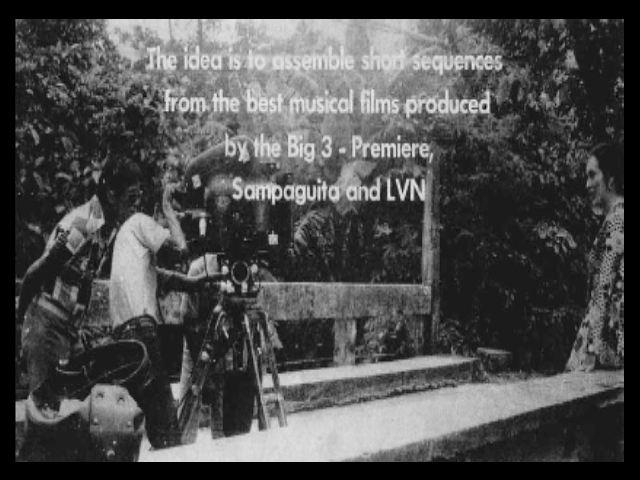
“…The idea is to assemble short sequences from the best muscal films produced by the Big 3 – Premiere, Sampaguita and LVN. It’s Digna Santiago on the phone giving it straight to tme like an IBM machine: “Sampaguita, LVN and Premiere are reproducing a full-lenght movie for the first time. It’s going to be a collection of film clips from their best movies since the 40s. The two studios hired their own researchers already. Can you research for us? Your associate will be Bernardo C. Bernardo.” Will I? Deal, I said with a school-boy enthusiasm. Cirio told us that the idea was to assemble a sizeable collection of short sequences from the three studios’ biggest hits. Bernie and I would work in the film library of Premiere. The co-production vernture was actually Cirio’s baby. His enthusiasm was so infectious that he was able to convince Mike de Leon of LVN and Bobby Vera Perez of Sampaguita to finance this unique production with him. The original plan was to produce, firstly, a straight documentary on the film trends in the local cinema from the 40’s up to the present and the superstars who glittered and captivated the audience for more than three decades. This was to be titled Remember When. It would be followed immediately by Happy Days Are Here Again!, which will showcase a compilation of the musical comedies produced by the three studios.

Cirio said that he had already contacted Lamberto Avellana to direct the movie. We were mesmerized by the imposing personality of Avellana whose anecdotes and witticism thrilled us like starry-eyed schoolchildren. Avellana said that documentary films are too stiff and not appealing enought to lure theater-goers. “We can’t spend more than two hundred fifty thousands grand for this film!” he emphasized. The hazy vision on the crystal ball finally became clear. The producer were making the movie on a shoe-string budget! During the pre-production talks, they couldn’t decide whether to cut the original budget – or splurge the four hundred fifty thousand bucks that Avellana wanted for the movie. They were frankly shocked by the “staggering” cost of the movie. Avellana wanted it spectacular in size. The producers were nervous. Meanwhile, the researchers began working at LVN. Socrates Jose and Eman Lacaba started reviewing old films inside the studio projection room and so did the Sampaguita group of Medy Tarnate and Joel Apuyan. Bernie and I were deep in research work at the studio editing room. To our dismay, the films we wanted were not available either because they were lost or the negatives had been destroyed. For instance, when Bernie and I wanted a copy of Bakya Mo Neneng which starred Rosa del Rosario, we were informed by the studio property master Ben Llenado that they didn’t have the negatives of the film anymore.

Not even Cirio’s repeated orders of “Find it!” could help locate the film. The LVN researchers wre on the same boat with us. Three of their musical comedy classics – Ikaw Kasi, Bahala Na (the first local film photographed in cinemascope type of lens called “MagnaScope”) and Tingnan Natin had been lost foreever. The studio didn’t have the copies of these three films! The same thing with Sampaguita’s Madaling Araw and Paru-Parong Bukid. Only the Big Broadcast had survived. While Cirio was preparing for abroad, Medy and Tiny worked on the second script. The verdict of Mike and Bobby was the same as on the first: Weak! When the third script was okayed, for the first time in more than a month of constant changes and editing, we were jubilant for a change, until Rosa Rosal, the leading character on the revised and okayed script dropped the bomb: She wanted P15,000 for three days of shooting! “Too much!” the producers’ blood temperatures rose, and we saw the third script slide down to oblivion. Earlier, they were even considering Dolphy for the musical finale of the movie – sort of a take-off from his El Pinoy Matador entry from Premiere. “Just imagine Dolphy with 50 toreadorabelles all in red,” enthused Avellana. But when they learned that the comedian’s asking price now is P300,000 per picture we said goodbye to Dolphy and his 50 dancing toreadorabelles all in red!

We were back again to zero. We were getting nervous as we sensed that the producers were contemplating on giving up their joint venture. In fact, Mike was all for abandoning the project. He was preparing for his trip to Germany to purchase new color processing equipments. Even the researchers were quarelling. When Peping Tarnate, our film editor, submitted his report on the running time of the film clips of each studio we found out that Sampaguita has 18 minutes, Premiere, 22 and LVN, 48 minutes! When the producers asked for the complete and final presentation of a new screen treatment for Happy Days Are Here Again!, we knew taht it was an ultimatum to produce something – or else! Suddenly, the dreaded specter oozed its frightening apparition before us. The bouncing baby had become an uncontrollable muti-headed monster! Bernie and I started arguing. One time we scandalized the LVN canteen with our “shoutings” and Soc joined in, banging the chair on the table that an outsider rushed inside our office. “What’s happening here?” he asked worried. “Nothing. Just discussing the script.” we answered like innocent school boys. The “Five Fingers,” too were on each other’s nerves. I couldn’t stant it anymore. Finally, we agreed to be clear headed about it. The project was in danger of collapsing, we couldn’t afford to be petty with our feelings anymore.

Avellana gave us encouragement. “Fight, boys, fight!” he enthused again like a cheer leader. With that, we worked on our individual scripts. It was Lina Santiago (who was representing Premiere on behalf of Cirio and her husband, Danilo) who read the script first. “Its much better this time and so many ideas to choose from,” Mike read the scripts in his office. Bobby was down with the flue but sent word that he’d go along with the decision of Lina and Mike regarding their final choice of the script. Premiere wanted to start the production rolling and offered to buy LVN’s share on the venture. But Mike refused. He knew that without the LVN films clips, the entire film would collapse like a pile of tarot cards! And besides, Mike himself was aware of the fact that LVN had the best entries. And he was right! Amidst the producer’s vaccilation and the production’s somnalent state, I gave the whole affair a shrug. I have other responsibilities to attend to. Two weeks later, a call from Premiere office asked me to be present at the HDAHA staff meeting. News was Ciriio just arrived and he was re-organizing the project – or what was left of it. I was glad to come. After two weeks, I’d see my friend again. In the movie, despite internal dissent, affection prevails. This I found out. The sight of Soc, Bernie, Tiny, Medy and Eman restored that warm glow of enthusiasm and concern I had for the project.

The next day, we wre once again in a panting flurry of actions. Once in his orbit, Cirio’s powerful motivating force seems to pull us in dizzying spins. Also, his volatile temper sent us coming and going like comfused rabbits! He asked the researchers of LVN, Sampaguita and Premiere to add more entries to the previewed and edited later. he gave his basic story line for Medy and Tiny to work on. What do you know – it was the original idea we had before! Talk about going in circles! “What happened to our best musicales? Hawaiian Boy? Basta Pinoy? I didn’t like our Eddie Mesa entry. Too simple. We have plenty of Eddie Mesas. Rolling Rockers, Singing Idols…” Cirio rattled on. The next morning, I sent a report on our research work the whole day to Cirio: Hawaiian Boy and Basta Pinoy are beyond salvage. Also, no prints or copies are available at the studio, Eddie Mesa’s big scene in Singing Idol is what you want it to be: Spectacular. But sorry, we can’t find the sound reel. We await your instructions. When our energetic “general” scheduled our first shooting day at the Sampaguita studiio, we were excited and bewildered. One question nagged us: What happened to Avellana? We asked Cirio if he had already informed him of the changes in the project including the script and that he (Avellana) was no longer to direct the HDAHA movie for the Big three.

“I tried twice, in fact. But I didn’t have the nerve to tell him that he’s out of project,” Cirio said. (Avellana ended up as consultant of the movie.) First shooting day dawned on the HDAHa company at the Sampaguita studio, Gloria Romero and Leopoldo Salcedo were scheduled to shoot that day for their brief narrations. The other stars like Nida Blanca, Jaime de la Rosa, Ike Lozada, German Moreno, Eddie Gutierrez, Pugo, Tirso Cruz III and Susan Roces were to shoot their scene within the week. There was a slight confusion and excitement when we found out that we had not submitted our script to the Board of Censors for their approval – before we could shoot or start shooting the film! Medy and Tiny immediately worked double time to type the censor’s copy. Bernie did the required sypnosis. “What do you think? Will we make it at the box office with our movie?” Cirio kept repeating, asking everyone, while pacing nervously all over the set. When he alerted us – “O, ready na, Gloria (Romero) is here!” – I was convinced that finally and most definitely the much delayed, plagued and battered project would see realization at last and this time no more hassles! – Cris D. Almario (READ MORE)

Karugtong Ng Kahapon

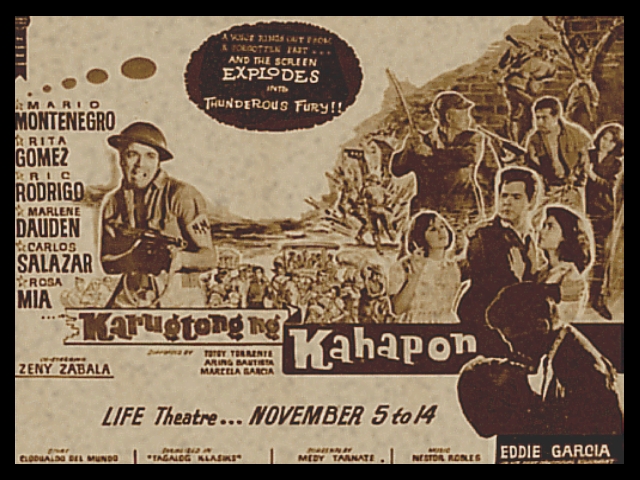
Originally released in 1961, Karugtong ng Kahapon was re-used as the title of the Vilma Santos 1975 film. Literally translated as the “continuation of yesterday,” the original film casted the major stars of this period, Rita Gomez, Mario Montenegro, Marlene Dauden and even its director, Eddie Garcia will all have films with Vilma. It was written by Clodualdo Del Mundo for Tagalog Klasiks, a comics magazine. Meanwhile, the 1975 film starring Vilma Santos was also written for comics magazine by Nerissa Cabral and Eddie Garcia was also involved, this time not the director but part of the ensemble cast that includes major stars like Gloria Romero and Celia Rodriguez.

Karugtong ng Kahapon (1961) – Directed by Eddie Garcia; Original story: Clodualdo Del Mundo; Screenplay: Medy Tarnate; Cast: Mario Montenegro, Rita Gomez, Ric Rodrigo, Marlene Dauden, Carlos Salazar, Rosa Mia, Zeny Zabala, Totoy Torrente, Aring Bautista, Marcela Garcia; Music: Nestor Robles; Production Co: Sampaguita Pictures

The Director – “…The same breadth and variety in his performances characterize Eddie Garcia’s other career in the movies as a director. Either acting or directing, he seems to have the same temper and outlook; one characterized by a nearly total lack of self-consciousness and self-absorption. But the artistry and innovation are unmistakable. It would appear in fact that Eddie Garcia used acting as a vehicle in order to become a filmmaker. He told the Manunuri that when he joined the movies in 1949, he made a promise to himself, “In 15 years, I will be director.” He made it as director in just 12 years when he was given an assignment in 1961 by “Doc” Jose Perez, studio boss of Sampaguita, the dramatic movie, “Karugtong ng Kahapon,” starring Rita Gomez, Ric Rodrigo and Marlene Dauden. Before that, he was assistant director to Mai’ Torrres, Octavio Silos and other Sampaguita directors…” – Lito Zulueta (READ MORE)

“…The 1961 movie, “Karugtong ng Kahapon” is almost forgotten. Even Eddie Garcia, in most of his interviews never mention or cite this movie which played a big part in his illustrious career. This is Eddie’s first directorial assignment, and not “Historia de un Amor” (1963) as previously reported in other articles. Eddie is a Famas Hall of Fame awardee for Best Director, Best Actor and Best Supporting Actor. What a feat!…” – Simon Santos (READ MORE)

Karugtong ng Kahapon (1975) – Directed by: Fely Crisostomo; Story: Nerissa Cabral; Screenplay: Mike Relon Makiling; Cast: Vilma Santos, Edgar Mortiz, Gloria Romero, Celia Rodriguez, Eddie Garcia, Jay Ilagan, Romy Mallari, Joseph Sytangco, Patria Plata, Ronald Ruiz; Original Music: Danny Subido; Cinematography: Ricardo Herrera; Editing: Gervacio Santos; Production Co.: Roma Films; An Entry to the 1975 Metro Manila Film Festival.

Festival Entry – “…Nora Aunor’s entry, NV Productions’ Batu-Bato sa Langit (directed by Luciano B. Carlos), was a hit and won as 3rd Best Picture. Vilma Santos, on the other hand, gave a notable performance in Roma Films’ Karugtong ang Kahapon. That time, Nora and Vilma were in their peak, their career and the movies they made were being followed closely, compared, watched, praised, scrutinized both by fans and critics. Their storied and fierce rivalry dominated our movie industry for years. In fact, one could argue that even to this day, a Filipino movie fan is either a Noranian or a Vilmanian…” – Wikipedia (READ MORE)

“…Starring Vilma, daughter of a “happy” couple Eddie Garcia and Gloria Romero. Throw in the other woman of Eddie, Celia Rodriguez and as expected, another morality play was born. Shown at the first Metro Manila Film Festival…” – Mario O. Garces (READ MORE)

Buhay Artista

This slideshow requires JavaScript.

Post-War – “…Ayon kay Mona Lisa, kasama siya sa tropa nina Fernando Poe, na siyang pangunahing aktor at direktor sa panahon ng giyera. Kasama nila sina Willie Chavez, Jaime dela Rosa at iba pa, nagpalipat-lipat sila sa Lyric, Capitol at Avenue Theaters. Ang artistang nakilala sa mga pelikulang, Ang Pagbabalik, Kolehiyala, Dilim at Liwanag, Bago Lumubog Ang Araw, Bahay Kubo at Magmamani ay napilitang kumanta, sumayaw at sumali sa mga iskit sa tanghalan. Bago pa lamang nagdadalaga si Virginia Montes sa gulang na katorse nang una niyang subukan ang stage shows sa mga huling taon ng WWII. Namatay sa giyera ang kaniyang ama at siya ang inaasahang tumulong sa kaniyang ina para sa buhayin silang magkakapatid. Kasama naman siya sa tropa ng mga nagsisipagtanghal sa Orient Theatre sa pamamahala ni Papang Salvador (Lou Salvador, Sr.) at ng kabiyak nitong si Aling Cora (ina nina Mina Aragon, Philip at Ramon Salvador). Sumasayaw sa stage si Virgie. Naalaala pa niya nang bago siya lumalabas ay naiiyak siya tuwing magsusuot siya ng maigsi. Pero wala naman siyang magawa, kasi iyon ang costume nila. Ang kanilang choreographer ay si Chuchi, sa supervision ni Don Jose Zarah na pagkatapos naman ng digmaan ay siyang namahala sa Clover Theatre. Kabilang sa mga artistang lumalabas sa mga stage shows noon sina Teroy de Guzman, Golay (kilala ngayon bilang Dolphy), Panchito Alba, Etang Discher, Rene Pangan, Chiquito, Balot, Metring David, Gregorio Ticman, Patsy, Lopito, Bayani Casimiro, Nieves at Ester Chavez…” – Irene Diaz-Castillo, Charlie V. Lozo and Liza Endaya, Ang Showbiz Ngayon, September 11, 1989 (READ MORE)

Television Show – “…The legendary comic duo of Dolphy and Panchito headlined Buhay Artista, one the top-rating TV shows in the 60s. A Sunday evening treat for the whole family telecast over Channel 3, from 7:30 t0 8:30 p.m….” – Simon Santos (READ MORE)

“…He is best remembered for the long-running TV show “Buhay Artista” (with Panchito) and “John en Marsha” with Nida Blanca as his with in an inspiring story about a poor yet happy family. The TV show was made into movies, just like “Home Along da Riles,” the show that followed it…” – Ricky Lo, The Philippine Star, July 11, 2012 (READ MORE)

Susan and Dolphy in Buhay Artista (1967) – Susan played a movie fan who became a movie star, opposite Dolphy. The have done several films prior to Buhay Artista, some are: Lab na Lab Kita (1962); Pepe En Pilar (1966); Susanang Daldal (1962) and Sa Lingo ang Bola (1961).

“…”Malaki ang agwat ng edad namin ni Dolphy. Ang kabarkada ko talaga [noon], yung kapatid niya, si Georgie [Quizon],” banggit din ni Susan sa younger brother ni Dolphy na namatay sa isang aksidente [hit-and-run], ilang taon na ang nakakaraan. “Pero very supportive si Dolphy sa amin ni Georgie. “Pagka merong extra’ng trabaho, binibigyan niya kami, sa mga radio shows niya. Du’n naman ako na-train sa voice acting. “Marami din kaming pinagsamahan na radio programs, nung panahon na ‘yon, sa dzRH,” wika rin ni Susan na naging tampok sa Mga Reyna ng Vicks (1958), pelikulang base sa radio program na ang sponsor ay Vicks Vaporub. Ito rin ang pinagbasehan ng kuwento ng Sapagka’t Kami’y Mga Misis Lamang [1977], tampok pa rin si Susan, Nora Aunor, Celia Rodriguez at Chichay. “Nu’ng nag-produce na siya [Dolphy], pagkatapos ng kontrata niya sa Sampaguita Pictures, at nung ako naman ay freelancer na rin, muli kaming nagkasama sa marami ring proyekto ng RVQ Productions. “Kaming Mga Taga-Ilog [1968], Pepe En Pilar [1966]… hindi ko na halos mabilang,” ang sabi ni Susan…”Mabait si Dolphy. Although malayo ang agwat namin sa edad, hindi namin siya tinatawag na ‘Kuya’ o ‘Tito,’ dahil alam namin na hindi siya magiging masaya na tawagin namin siya nang gano’n. “Pero alam niya na iginagalang namin siya. Kagalang-galang na, katulad nga ng maraming sinabi, yung mga na-interview, sabi nila, ‘Pag nakikita mo si Dolphy, kakaiba siya. “Iilan lang sa mga public personalities natin na pagpasok nila [sa isang pagtitipon] parang mapapatigil ka sa kanya, [dahil sa] respeto. “Sa personal, hindi naman siya pala-kuwento. Ah, mas madalas tahimik siya at nakikinig siya sa mga kuwento. “Gusto niya, meron siyang nakaka-kuwentuhan, pero i-e-encourage ka niyang ikaw ang magkuwento. “Ang bonding moments namin [noon], siyempre… pagkain!” nangiti si Susan pagkabanggit nito. Then, she recalled, “Paborito niya yung huling pinaluto ko para sa kanya. “That was a few months ago, na nasa bahay lang siya at ang sabi ng doktor, kailangan kumain siya nang kumain… kare-kare, adobo. Yun ang mga gusto niya…” – William R. Reyes (READ MORE)

Vilma and Dolphy in Buhay Artista (1979) – Dolphy and Vilma Santos did four films together. The first one was in her first year in show biz and in a Dolphy-Chichay film. After six years, the two reunited in one of early films of Nida Blanca and Dolphy. The film was sort of about family planning and birth control. Vi was in minor role and one of the child actors featured in the film. They followed this up with minor roles in the Cirio Santiago’s all-star-cast film. By later part of 1970s, both Dolphy and Vilma became a regular staples in award shows receiving several trophies as box office king and queen. Finally, after almost a decade from their last outings and no longer his film daughter, Dolphy and Vilma did their last film (to this day), this time, Vilma played the leading lady, in a film, ironically, about show business. Also, that year, Doply became the only male actor who portrayed Darna, the female comic-super-heroine in Darna Kuno. Not to be undone, Vilma will reprise the role the following year in her fourth and final film as Darna in Darna at Ding. At present time, both superstars made headlines as contenders for Philippines’ National Artists honors. Vilma respectfully and publicly asked for Dolphy to confer the title ahead of her.

“…Nakapanayam ng PEP.ph (Philippine Entertainment Portal) at ilang entertainment press sina Vilma at Lani, at kanilang ikinuwento sa amin ang mga hindi nila malilimutang sandali kasama ang Comedy King. Malungkot si Star for All Seasons Vilma Santos-Recto sa pagpanaw ni Dolphy, at sa opinyon niya’y “napilay” ang industriya ng pelikula at telebisyon sa ating bansa. Gayunman, hindi niya kailanman malilimutan ang Hari ng Komedya dahil “legacy na siya ng movie industry.” Dagdag pa niya, “So, katawan lang ‘yan, pero ‘yong legacy na iniwan ni Tito Dolphs would, ah, will definitely stay in the movie industry. “Hindi mabubuo ang movie industry kung wala si Dolphy.” Nagkasama sina Vilma at Dolphy sa pelikulang Buhay Artista Ngayon (1979), at nang mapanood niya raw ulit ito’y naalala niya ang tawanan nila sa set noong ginagawa ang pelikula. Kuwento niya, “Grabe, na-miss ko si Tito Dolphy. Ang galing namin sumayaw! “‘Yong dance sequence namin nakaka-miss talaga. “Pero wala, kanya-kanyang kontribusyon ‘yon, and at the end of the day, what’s important is the legacy na iiwan mo sa mga taong nagmahal sa ’yo. “For sixty years nagsilbi si Tito Dolphs, so talagang he’s one of the pillars ng pelikulang Pilipino.” At kung ang National Artist Award naman ang pag-uusapan, ito lamang ang opinyon ni Ate Vi: “Deserving si Tito Dolphy. “Deserving sa contribution, sa ginawa niya, lahat, lahat ng ginagawa niya noon—deserving si Tito Dolphs…” – Joyce Jimenez (READ MORE)