Remembering Rudy Fernandez

This slideshow requires JavaScript.

The Superstardom – “…Kapwa nagsimula sina Rudy at Lito sa pa-extra-extra. Wika nga, they both started from scratch. Kahit na may mga kamag-anak silang nauna sa kanila sa movies, they began from the bottom and struggled their way up to the ranks of superstardom. Matagal na nagtiyaga si Rudy sa pagiging extra at bit player. Naging second lead siya ni Nora Aunor sa Wanted Dead or Alive at naging rapist pa nga ni Lorna Tolentino sa Leap Year Ngayon, Lagot ka, Pipikutin kita na kung saan si Christopher de Leon ang leading man ni Lorna. Nabigyan si Rudy ng kanyang pinakamalaking break sa pelikulang Bitayin si Baby Ama na pinagtambalan nila ng babaing naging ina ni Mark Anthony, si Alma Moreno. Nagkasunod-sunod na ang mga pelikula ni Rudy pagkatapos nito….Marami rin namang pelikulang ginawa si Rudy na hindi malilimutan noong panahong iyon, halimbawa’y ang Salonga (ang ikalawang pelikulang batay sa buhay ng Tondo kingpin na si Asiong Salonga), Maynila 1970, Panganib Araw at Gabi, at Anak sa Una, Kasal sa Ina. Nang magkahiwalay sila ni Alma at mapaugnay siya Kay Lorna Tolentino, sinasabing muling nagkaroon ng sigla, ng panibagong ningning ang career ni Rudy. Naging nominado siya sa Urian at Famas best actor awards para sa Pepeng Shotgun. nagkasunod-sunod ang kanyang box office hits gaya ng Kahit Ako’y Lupa, Nueve de Pebrero, Kumander Kris, Boy Condenado, Kumander Elpidio Paclibar at Get My Son, Dead or Alive…” – Mario E. Bautista, Movie Flash Magazine, March 24, 1983 (READ MORE)

Bankable Star – “…Then came Rudy Fernandez, the current heart throb of many lonely hearts. His coming was not much of a bang. In fact, naghintay muna siya ng kaunting panahong pinamulaklakan ng pagtitiyaga, pagpapakasakit at paghihirap. But in the end, Rudy came out the victor. Now he’s one of the few-in-demand, most sought-after action stars of the country. It was in MBM Pictures’ “Bitayin Si Baby Ama” where Rudy made people recognize his potential as an actor of the first order. Hindi lamang bilang aktor kundi bilang isang box office drawer na matatawag ngayong one of the bankable stars of Philippine movies. Na ang ibig sabihin nito, basta pelikula ni Rudy Fernandez ay puwede nang iutang sa bangko. Dahil sa maaasahan nga ito sa takilya. Lalong tumingkad ang pangalang Rudy Fernandez nang ito’y nai-link sa isa pang maluningning na pangalan sa pelikulang lokal na si Alma Moreno. Naging maganda ang kanilang team hindi lamang sa pelikula kundi maging sa tunay na buhay. Ang totoo nga ay nagkaroon din ng ugnayan ang dalawa at nagkaroon pa nga sila ng isang anak na si Mark Anthony. Ngayon, split na muna ang dalawa at si Rudy ay nag-iisa ngayon sa kanyang magarang bahay sa White Plains, Quezon City. Meanwhile, Rudy’s movie career is continuously riding high and as the years go by ay lalong naging established actor itong poging anak ng nasirang direktor na si Yoyong Fernandez. Kunsabagay, hindi dapat pagtakhan ito. Nasa kanyang dugo ang dugo ng mga Padilla, isa sa mga pangunahing angkan sa pelikulang Pilipino. At nasa dugo pa rin niya ang dugo ng mga Fernandez na tulad ng mga Padilla ay may talino’t kakayahan ding taglay. Hindi yata basta direktor ang kanyang ama….At that, Rudy Fernandez can well be the star, nay, as the actor to contend with. In fact, he almost romped away with the FAMAS Best Actor Award for his brilliant portrayal of the title role in “Star?” of Agrix Films but lost out by a mere point to Mat Ranillo III in 1978. And again, the following year, 1979, Rudy was once more a strong contender for the same category but lost out eventually to Fernando Poe, Jr. by a few votes…” – Ross F. Celino, Jr., Jingle Extra Hot Movie Entertainment Magazine, April 20, 1981 (READ MORE)

Peace-Loving Nature – “…One time, we missed him by a few minutes when he went to the National Press Club to settle a spat with another movie star through the intercession of our friend, then NPC president Marcelo Lagmay and former FAMAS president Rudy Salandanan. The misunderstanding between the movie actors was resolved, all right. Which reflected to peace-loving nature of Daboy — he went out of his way to settle a row. He had a soft heart for the small people, too. Consider: In one of those times when I dropped by the Press Club, I was thanked by some of the NPC employees for supposed Christmas gifts to them. When I asked them about it, they pointed to the sacks of rice which they said came from Rudy Fernandez, thinking that it was us. Actually, I used to contribute cash gifts for the NPC employees during Christmas but not in kind. I told them that the sacks of rice did not come from us. When the NPC staff rechecked the gift’s accompanying letter, they noted that it was the movie actor and his lovely wife Lorna who sent the rice….” – Rudy A. Fernandez (READ MORE)

Rodolfo “Rudy” Valentino Padilla Fernandez, screen name Rudy Fernandez (March 3, 1952 – June 7, 2008), also known as “Daboy”, was a multi-awarded Filipino actor and producer. He came to prominence as an action star in the Philippine cinema during the 1980s up to the early 1990s. – Wikipedia (READ MORE)

Rudy Fernandez and Vilma Santos

Payaso (1986) – “…The 1986 Metro Manila Film Festival was considered the worst in the 12-year history of the annual 10-day festival of local movies. For the first time, it did not give out the traditional first and second best picture awards. Two other categories— best story and best screenplay were not also given. “No one of the seven entries deserved these awards,” according to Tingting Cojuangco, one of the jurors…” – J C Nigado (READ MORE)

Makahiya at Talahib (1977) – “…Ang pangalawang taon ng MMFF (1976) ay ginawa ng Disyembre (itinapat sa araw ng Pasko) para daw mas marami ang makapanood lalo na ang mga bata ng mga pelikulang Tagalog. Ang pelikulang “Makahiya At Talahib” ang panlaban nina Vilma Santos at Rudy Fernandez samantalang ang kay Nora ay ang pelikulang “Minsa’y Isang Gamu-Gamo.” Dito sa pelikulang Makahiya At Talahib ay binayaran daw si Vilma ng Php 100,000 kahit hindi siya ang nag-dub ng pelikula kundi si Laura Hermosa….” – Alfonso Valencia (READ MORE)

Mga Reynang Walang Trono (1976) – “…To recall, the senior and junior movie queens appeared in these movies: Bulaklak at Paru-paro (1970), Mga Reynang Walang Trono(1976) and Asawa Ko, Huwag Mong Agawin (1986). Amalia directed Vilma’s episode in Mga Reyna and agreed to second billing to Vilma in Asawa Ko. No doubt about it, Amalia Muhlach Sumilang Fuentes, is a Vilmanian. To seal their sisterhood and camaraderie, Vilma is Ninang to Liezl Martinez and to the latter’s son Alfonso. Why, Liezl even sang a song ’’Wind Beneath My Wings’ to her surprised mother that night which drove the strong-willed and still beautiful Amalia to tears. A Kodak moment, indeed. Priceless! While interviewing the three Muhlach generations, Fuentes, Liezl and young daughter Aliyanna, Amalia revealed to Vilma that she is protective of her ’unica hija’ Liezl. ”Ay naku, I think I also have become like my Mom, I’m also very protective of my children,” Liezl remarks…” – Mario O. Garces (READ MORE)

Bertang Kerengkeng (1976) – “…Isa sa mga minimithi noon ni Atty. Esperidion Laxa bago siya magretiro bilang prodyuser ay mapagtambal niya sina Vi at Rudy Fernandez. Subali’t paano pa niya ito magagawa samantalang wala na si Rudy. Eniwey si Vi at Rudy ay nagkasama naman sa mga pelikulang Vilma & The Beep Beep Minica (1974), Ibong Lukaret (1975), Mga Reynang Walang Trono (1976), Bertang Kerengkeng(1976) at Makahiya at Talahib (1976). Nagkasabay silang maging FAMAS best actress at best actor noong 1987, si Vi sa pelikulang Tagos Ng Dugo….si Rudy naman ay sa pelikulang Victor Corpus. Sa 1998 FAP awards ay magkasabay din silang pinarangalan bilang best actress at best actor…..si Vi sa pelikulang Bata, Bata Paano Ka Ginawa?…..si Rudy sa pelikulang Birador…” – Alfonso Valencia (READ MORE)

Dugo at pag-ibig sa kapirasong lupa (1975) – “…A Must for the Filipino History Students and for everyone who wants to awaken the innate nationalism in them. These series of stories depicting the fight of the Filipinos against colonialism of Spain, Japan and even their fellow Filipinos abusing the power in the government. A seemingly serious film but spiced with the star-studded cast like Fernando Poe Jr., Ramon Revilla, Joseph Estrada, Nora Aunor, Dante Rivero, Eddie Garcia, Vic Vargas, Goerge Estregan and the other all time favorite artists. This movie even highlighted the comparison between the love of country and the other kind of love we offer to our family and to our beloved as the story featured love stories in the midst of tragic and bloody war happening in our society…” – Kabayan Central (READ MORE)

Ibong lukaret (1975) – “…1975 was another productive year for Vilma Santos as she did nine films mostly title roles like Vilma Viente Nueve, Darna Vs the Planet Women, and Ibong Lukaret. It was the “prep” stage for the years to come as she was given more mature roles like the local festival entry, “Karugtong ang Kahapon” and Celso Ad Castillo’s “Tag-ulan sa Tag-araw.” Tagulan was the first film of Vilma and Christopher De Leon. While Vilma was testing the water for more serious mature projects, Ishmael Bernal decided to return to his original forte, drama, after years of doing light comedies and television work. He came up with “Mister Mo, Lover boy Ko” and “Lumapit, Lumayo Ang Umaga.” Both films featured sexy star, Elizabeth Oropeza…” – RV (READ MORE)

Dugo at pag-ibig sa kapirasong lupa (1975) – “…A Must for the Filipino History Students and for everyone who wants to awaken the innate nationalism in them. These series of stories depicting the fight of the Filipinos against colonialism of Spain, Japan and even their fellow Filipinos abusing the power in the government. A seemingly serious film but spiced with the star-studded cast like Fernando Poe Jr., Ramon Revilla, Joseph Estrada, Nora Aunor, Dante Rivero, Eddie Garcia, Vic Vargas, Goerge Estregan and the other all time favorite artists. This movie even highlighted the comparison between the love of country and the other kind of love we offer to our family and to our beloved as the story featured love stories in the midst of tragic and bloody war happening in our society…” – Kabayan Central (READ MORE)

Vilma and the Beep Beep Minica (1974) – “…She was also a hit in “Dyesebel” and the thrillers “Takbo, Vilma, Dali” and “Hatinggabi Na, Vilma.” She also did other fantasy films like “Phantom Lady,” “Vivian Volta,” “Wonder Vi,” and “Vilma and the Beep Beep Minica…” – Mario Bautista (READ MORE)

Related Reading:
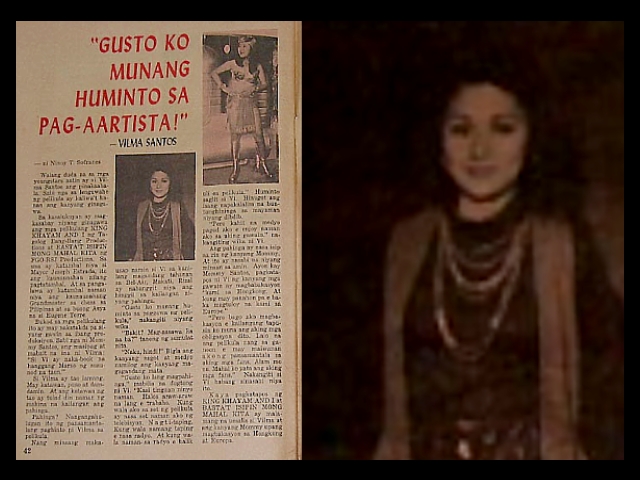
Gusto Ko Munang Huminto sa Pag-aartista!

Walang duda na sa mga youngstars natin ay si Vilma Santos ang pinakaabala. Sabi nga sa lenguwahe ng pelikula ay kaliwa’t kanan ang kanyang ginagawa. Sa kasalukuyan ay magkasabay niyang ginagawa ang mga pelikulang King Khayam And I ng Tagalog Ilang-Ilang Production at Basta’t Isipin Mong Mahal Kita ng FGORSJ Productions. Sa una ay katambal niya si Mayor Joseph Estrada, ito ang kauna-unahang nilang pagtatambal. At sa pangalawa ay katambal naman niya ang kauna-unahang Grandmaster sa chess sa Pilipinas at sa buong Asya na si Eugene Torre. Bukod sa mga pelikulang ito ay may nakatakda pa siyang gawin sa ibang produksiyon. Sabi nga ni Mommy Santos, ang masipag at mabait na ina ni Vilma: “Si Vi ay naka-book na hanggang Marso ng susunod na taon.” Si Vilma ay tao lamang. May katawan, puso at damdamin. At ang katawan ng tao ay tulad din naman ng makina na kailangan ang pahinga. Pahinga? Nangangahulugan ito ng pansamantalang paghinto ni Vilma sa pelikula. Nang minsang makausap namin si Vi sa kanilang magandang tahanan sa Bel-Air, Makati, Rizal ay nabanggit niya ang hangad na kailangan niyang pahinga. “Gusto ko munang huminto sa paggawa ng pelikula,” nakangiti niyang wika.

“Bakit? Mag-aasawa ka na ba?” tanong ng sumusulat nito. “Naku, hindi!” Bigla ang kanyang sagot at medyo namilog ang kanyang magagandang mata. “Gusto ko lang magpahinga.” mabilis na dugtong ni Vi. “Kasi tingnan ninyo naman. Halos araw-araw na lang e trabaho. Kung wala ako sa set ng pelikula ay nasa set naman ako ng telebisyon. Nagti-taping. Kung wala namang taping e nasa radyo. At kung wala namang radyo eh balik uli sa pelikula.” Huminto saglit si Vi. Hinugot ang isang napakalalim na buntong hininga sa mayaman niyang dibdib. “Pero kahit na medyo pagod ako e enjoy naman ako sa aking gawain.” nakangiting wika ni Vi. Ang pahinga ay nasa isip na rin ng kanyang Mommy. At ito ay nasabi na niyang minsan sa amin. Ayon kay Mommy Santos, pagkatapos ni Vi ng kanyang mga gawain ay magbabakasyon “kami sa Hongkong. At kung may panahon pa eh baka magtuloy na kami sa Europe.” “Pero bago ako magbakasyon e kailangan tapusin ko muna ang aking mga obligasyon dito. Lalo na ang aking pelikula nang sa ganoon e may maiwanan akong pansamantala sa aking mga fans. Alam mo na. Mahal ko yata ang aking mga fans.” Nakangiti si Vi habang sinasabi niya ito. Kaya pagkatapos ng King Khayam And I at Basta’t Isipin Mong Mahal Kita ay malamang na umalis si Vilma at ang kanyang Mommy upang magbakasyon sa Hongkong at Europa. – Nonoy T. Sofranes, Love Story Illustrated Weekly Magazine, No. 162, 01 Nov 1973

Maryo De Los Reyes’ Vilma Santos Films

This slideshow requires JavaScript.

204 films, 70 directors, 5 decades, Vilma Santos, one of the original Philippine movie queens, rose up to become the versatile actress that has been given the fitting title of “Star for All Seasons” because of her capacity to adapt to the changing mores and values of the Filipino woman, giving a face to their plight and struggles, albeit in success both critically and box-office wise in some of Philippine cinema’s classics such as Trudis Liit (1963), Lipad, Darna, Lipad (1973), Burlesk Queen (1977), Relasyon (1982), Sister Stella L. (1984), Alyas Baby Tsina (1984), Pahiram ng Isang Umaga (1989), Dahil Mahal Kita: The Dolzura Cortez Story (1993), Anak (2000) and Dekada ’70 (2002). This are top ten directors who contributed to her success. – RV (READ MORE)

In 1987, Maryo De Los Reyes directed Vilma Santos that critics considered one of the most shocking film that year, “Tagos Ng Dugo.”  The film was hailed as feminist as seldom a Filipino woman was seen on screen as a murderous serial killer.  It earned Vilma Santos her fourth FAMAS Best Actress.  Ironically, the conservative Catholic church’s award giving body, Catholic Mass Media Awards, agreed with the FAMAS.  They gave Vi their Best Actress award while the critics’ group, Gawad Urian refused to hand-out their yearly award citing there were no deserving films that year.  Reyes last directed Vilma in another memorable off-beat role, the 1992 drama, “Sinungaling Mong Puso.” – RV (READ MORE)

Tagos ng Dugo (1987) – “…A breakthrough for Philippine psychological movies? Probably. Let me explore a few other angles on this seeming cross between Francois Truffaut’s The Bride Wore Black and Luis Buñuel’s Belle du Jour — I don’t know if screenwriter Jake Tordesillas or De los Reyes himself should be congratulated for the cohesion of multi-resultants in this work. Part of this multi-readings would be the movie as a feminist take on womankind’s monthly pains as a form of excuse for female monthly insanities, insanities our machos regard as regular terrorism on the whole of mankind (men or society as a whole). It is with that reading that the ending apologies, by Vilma Santos in the lead role, might be understood as a plea for understanding of how all of woman’s monthly Eve-behavior should not be seen as a Biblical sin but as an equal (to, say, men’s beastly) naturalness. . . . Another feminist reading, more radical perhaps, would treat the film as a view of how Philippine society (the men in it, primarily) approaches provincial innocence, educational weakness, and “females’ weaker sanity” as stimuli for abuse… There is, however, the possibly more general reading of the film as an apologia for insanity qua itself, how it should be treated as a disease instead of as a monster to be eliminated….” – Vicente-Ignacio S. de Veyra (READ MORE)

Sinungaling Mong Puso (1992) – “…Magaling sina Aga Muhlach at Vilma Santos bilang nagtatagong magkasintahan. Lutang na lutang ang pag-arte ng dalawa at nakakatuwa sila sa kanilang mga eksena na nagtatagpo ng palihim tulad ng mag-kita sila sa department store. Dumating si Vilma at hinahanap niya si Aga, hindi nya makita ito hanggang sa mamataan niya ang binata na nakaupo sa may display area. Kinindatan ni Jason si Clara at napatawa na lang ang babae. Mararamdaman mo ang excitement ng mga pagkikitang ito. Nang mahuli ni Ana ang asawa at mag-iskandalo ito, nang umalis na ang asawa at balikan ni Jason si Clara sa loob ng apartment, makikita sa mukha ni Vilma ang pagtatapos ng kanilang affair. Ang sabi niya: “ Hinintay lang kita, gusto kong maghiwalay tayo ng maayos…” Bukod sa maraming eksena na lutang na lutang ang pag-arte ni Vilma marahil ang pinaka-memorable ay ang eksena kung saan binaril ni Vilma si Gabby at sabihin niya ang line na: “mamatay kang kasama ng mga baboy mo…” ito ang pagpapatunay na talagang napakahusay niyang artista.” – RV (READ MORE)

Maryo J. de los Reyes is a film and television director from the Philippines. He began his career in the 1970s. – Wikipedia (READ MORE)

Related Reading

A Very Long Rivalry – 1984

This slideshow requires JavaScript.

Pre-1984 – After winning all the best actress trophies in 1983 for the previous year, 1982 and the award giving season ends, 1983 seems to be another business as usual for Vilma Santos. She released three more films after the dissapointment of “Ayaw Kong Maging Kerida” in earlier part of 1983, then on June 9th, Viva Films released “Paano Ba ang Mangarap?” that turned out to be another box office hit. Few months afterwards Regal films released Bernal’s “Broken Marriage,” the follow-up film after the successful grand slam film, “Relasyon.” The film was a critical and commercial success. Then finally, four days after Vi’s birthday, Viva Films released Marilou Diaz-Abaya’s drama, “Minsan pa Natin Hagkan Ang Nakaraan,” another box office hit. This film plus the two films mentioned earlier solidified her bankable status. Not to be outshine, Nora’s “Himala” continued its relentless fight for recognition, winning the bronze prize at the 1983 Chicago International Film Festival on November of 1983. Despite this, 1983 seems to be not her year, aside from losing in all the award derbies, she only released two films, “Bad Bananas sa Puting Tabing” and the forgettable, “Minsan May Isang Ina.”

Golden Year – “…In 1984, Nora and Vilma each had three “pang-award” movies. Nora starred in ‘Merika by Gil Portes, Condemned and Bulaklak ng City Jail by Mario O’Hara. The latter was entry in the MMFF, winning Best Picture and Direction at nanalo ring Best Actress si Guy. Si Vilma was in Brocka’s Adultery: Aida Macaraeg, Mike de Leon’s Sister Stella L. and Marilou Diaz-Abaya’s Alyas Baby Tsina. Noong 1985 unang nagbigay ng Star Awards ang Philippine Movie Press Club (PMPC). Para sa taong 1984 ang mga parangal na ipapamahagi, at sina Nora at Vilma lang ang nominated for Best Actress: Guy for all her three starrers, Vilma for Aida Macaraeg and Sister Stella L. Mainitan umano ang nagging deliberation para sa kategoryang Best Actress, which earlier that year was bagged by Vilma (for Sister Stella L. sa Gawad Urian; her third straight win!) and by Nora (for Bulaklak ng City Jail sa CMMA). Sa 1st Star Awards for Movies, it was Nora Aunor who won for ‘Merika. The late movie scribe Frank Mallo, a self-confessed Noranian, fought hard for Aunor to clinch the Best Actress plum, especially for ‘Merika. He even wrote a letter (published in Constantino’s Highspeed column) disputing the Manunuri’s earlier choice of Vilma Santos as Urian Best Actress. Sa taong ito rin ng Gawad Urian nagtamo ng double nomination si Nora – for ‘Merika and Bulaklak ng City Jail. Sa pagtatapos ng award-giving season, si Nora uli ang Best Actress sa FAMAS (her third win) for Bulaklak ng City Jail. Dito niya unang naka-tie si Sharon Cuneta (for Borlaza’s Dapat Ka Bang Mahalin?). Pero hanggang ngayon, nakahihinayang na walang napanalunang award si Nora for Condemned, kung saan she was cited by Tempo entertainment editor Nestor Cuartero for that single scene in which she acted out a “cry of sorrow like no other” upon the death of actor Dan Alvaro who played her brother in that film which was rated “A” by the Film Ratings Board…” – William Reyes (READ MORE)

Nora Aunor’s Films (3): (‘Merika; Bulaklak sa City Jail; Condemned) – Nora did three solid award-worthy films, two from Mario O’Harra and one from Gil Portes.

Vilma Santos’ Films (4): (Adultery; Alyas Baby Tsina; Charot; Sister Stella L.) – Vilma did four films, a guest role to her television co-host film, Roderick Paulate’s “Charot” and three award-worthy films from A-1 directors, Lino Brocka for “Aida Macaraeg: Adultery,” Marilou Diaz-Abaya’s “Alyas Baby Tsina,” and Mike de Leon’s “Sister Stella L.”

Nora Aunor’s 1984 acting recognition (5) – Best Actress from Star Awards for “‘Merika;” Best Actress from Metro Manila Film Festival and CMMA for “Bulaklak ng City Jail;” and two nominations from URIAN for “‘Merika” and “Bulaklak sa City Jail.”

Vilma Santos’ 1984 acting recognition (6) – Best Actress from URIAN and nominations from FAMAS; FAP; CMMA; Star Awards all for “Sister Stella L.;”and another nomination from Star Awards for “Alyas Baby Tsina.”

Human courage and Determination – “…We see a fairly representative sector of Filipinos living in America through the eyes of Milagros Cruz (Nora Aunor), a nurse working in a New York City hospital. It is her fifth year on the job and life for her has become a predictable routine of quick meals, subway rides, Caucasian patients and late night TV. To augment her income, she holds a second job at a nursing home. Although her two jobs keep her well-off, Mila harbors a secret wish to come home to the Philippines. And while her wish is not an impossible one, the decision involved is a difficult one to make. For Mila, her decision to come home or to stay is largely shaped by a circle of Filipino friends and acquaintances, all of whom have changed in outlook and attitude towards their native land and their adopted country. For the most part, knowledge of events back home has become speculative while knowledge of the new land has become increasingly material and resentful. An aging Filipino whom Mila befriends at the nursing home becomes her surrogate father. The old man is angry at the manner in which his generation was received by the Americans in the years before the war. Mila’s younger friends, on the other hand, are luckier in terms of present-day opportunities. While some have remained honest, others have become callous, even rotten, in adopting the American way of life. All have moments of pride in terms of achievement but no one cares to admit the degradation one goes through to earn that better life, Mila’s final decision comes with much pain but it’s one deed that’s a tribute to human courage and determination. What is clearly admirable about “‘Merika,” is its affecting portrait of loneliness, so thoughtfully realized by Nora Aunor’s touching performance, Gil Portes’s direction and Doy del Mundo and Gil Quito’s homely screenplay. The film does not emphasize a single, urgent cause for Mila’s wanting to go home precisely because such loneliness cannot be quantified. For the migrant Filipino, this kind of loneliness exists in mind and heart but it can never be completely expressed. It’s a feeling so deep seated, it couldn’t be relieved entirely, even by a long-distance call. The film utilizes many images to describe this sad feeling, from chilly scenes of winter to bare trees, disabled senior citizens, to the never-ending pictures on television. It all adds up to a very, very cold account of a life of sacrifice in a country of great expectations. …” – Emmanuel A. Reyes, Tempo, 1984 (READ MORE)

Major-league Filmmaking – “…So far the only pitfall he has stumbled into in “Bulaklak sa City Jail” appears to be the pursuit of a more grandiose design (the city as confirmation of the city-jail metaphor) at the expense of already established premises. For the excursion of Angela into big-city intrigues forces the film into a linear storytelling mode as the characterization of city-jail types is abandoned for plot twists; here the absurdities acceptable for enrichment of character begin to be called to account, and are transformed, in the context of conventionalized approaches, into glaring lapses of logic. Foremost among these is the total absence of support for any of the inmates. While this real-life improbability becomes necessary for the organization of the dramatic lines of force among the inmates, the artifice gets exposed once the Angela character is made to abandon the city-jail schema and the audience consequently realizes that the last jail victim she fought for before deciding to escape had connections powerful enough to influence court decisions—a consideration that makes their failure in releasing the victim-to-be-too obvious to be ascribed to sheer negligence….Although “Bulaklak sa City Jail” would ordinarily have been doomed by such compromises, the project does not appear to be as easily dismissible, saved as it is by a surface perfection never before seen in any Mario O’Hara, specifically in the combination of his willingness to handle big themes (which has always been his strong point) with the confidence of a veteran film craftsman. Particularly noteworthy is his ability to recreate dramatic texture through the interrelation of character progressions (in the city-jail portion) and the use of ironic juxtapositions. Although these are virtues that should be first credited to the screenwriter, it may do observers well to keep in mind that O’Hara has written some of his own films’ scripts and has done even better ones for other directors. A continuing consciousness on his part of dramatic essentials will help distinguish him from the Johnnys-come-lately of so-called serious filmmaking, who in their less sober moments strive for flash without regard for illuminative sources. With “Bulaklak sa City Jail,” Mario O’Hara has begun his bid for major-league filmmaking….” – Joel David, Tinig ng Plaridel, 1985 (READ MORE)

Tragic Heroine – “…The film is not only Filipino film but a fine one in practically every respect, starting with the gripping screenplay which comes to life under the adroit direction of Mario O’ Hara. It is a flawed jewel but a finely polished one nonetheless. It is a refreshing departure from the predictable and the prosaic elements that one encounters in many, if not most, Filipino films. For the most part, it veers away from the cloying melodramatic acting coaxed from our Filipino actors. As the tragic heroine, Nora Aunor turns in a sensitive and restrained portrayal of touching vulnerability — her deep love for her psychotic killer-brother played convincingly by Dan Alvaro, her helplessness in the face of adversity or her quiet rage as she daringly confronts the arch villainess played with surprising flair by Gloria Romero. The closeness between the brother and sister plays up an unusual sister-brother relationship which is central to the plot but which is a theme rarely fully developed in Filipino films. One wonders if there is more to the relationship than actually meets the eye. Though Dan Alvaro has appeared in numerous action films and died in most of them, he makes his mark in “Condemned” with his striking screen presence. A majority of the previewers considered both Nora and Dan as perfectly cast, with the supporting cast providing creditable performances…” – Film Ratings Board, 1984 (READ MORE)

Societal and Religious Norms – “…Aida (Vilma Santos giving a very mature performance) is the sole breadwinner for her family, consisting of a bedridden father, a nagging mother, a good-for-nothing brother, his unemployed wife and baby. Unable to bear the hardships of living with her family, she takes the offer of her boyfriend Carding (Phillip Salvador) to simply live together, resisting his invitation to marry him despite the possible scandal that might arise out of their living arrangement. Carding gets caught peddling prohibited drugs and gets imprisoned, leaving Aida all alone to fend for herself. Years later, Carding gets released from prison and finds Aida, now a mistress of a wealthy executive (Mario Montenegro) and mother to a child that is not his. Aida is then sued for adultery by Carding, which if she is proven guilty would separate her from her son. There’s one sequence in the film which clearly shows Brocka’s mastery. Aida visits Carding in prison, telling him of her pregnancy. Carding again offers to marry her, fearing that their child would be a bastard child. Supposedly out of pity, Aida agrees. The marriage is solemnized then and there. The prison chaplain officiates the ceremony where Aida is draped in an ordinary dress while Carding wears the orange colored uniform. Around are the witnesses of their marriage, felons all donning the same orange outfit Carding is wearing. Of course, these are mere background details, emphasizing the sullenness of the event that is ordinarily jovial and lively. Brocka concentrates on Aida. He closes up on her face, worried about the uncertainty of her future: she is after all pregnant and now married to a convict with absolutely no source of income. It is Aida’s point of no return and Brocka understands it as such, thus he presents it with understated elegance; no dialogue, just Lutgardo Labad’s swelling music and Brocka’s emphatic close-up of Vilma Santos’ apprehensive face. The film attempts to criticize marriage, which is depicted not in its traditional sense (as the key to life’s bliss) but as a harrowing cage where women are left with no choices. It seems to advocate infidelity, especially when the requirements of life overtakes the facile concerns of societal and religious norms. Interestingly, Brocka does not antagonize any of his characters. Aida is a hardworking woman who we first see as the selfless sufferer who is charged with her family’s survival, a mere victim of fate and circumstance. Also, one cannot doubt Carding’s affection for Aida. His decisions in life may have been off, leading to his incarceration and Aida’s continuing suffering, but it cannot be denied that his love for his wife is indubitable. The blame does not go to any person but to the social institution of marriage, its sometimes shallow roots and the unbendable veneration the law and society gives to it to the detriment of the unique needs of individuals…” – Oggs Cruz (READ MORE)

Front-page Baby Tsina – “…Ang istoryang ito ay matagal nang ikinukuwento sa akin ni William. Wala pa akong asawa, pangarap na ni William na magawa ang pelikula. He had the story at hand. Siya talaga ang nag-negotiate para makuha ang istorya. Noong una nga raw, ayaw pumayag ni Baby Tsina at ng kanyang asawa dahil gusto na nilang kalimutan yun. Eh, si William alam ko yan kung magpilit, tsaka personal kasi niyang kilala si Baby Tsina, nakuha rin ang istorya,” salaysay ni Vilma…”Noong una kong mabasa ang script, ayoko sanang maniwala na nangyari talaga yun. Masyadong cinematic, eh. Para bang sa pelikula at sa komiks lang nangyayari. Until the day nga that I met the real Baby Tsina. Nang siya na ang makuwento sa akin ng naging buhay niya, lalo na after the crime at sa loob Correctional, saka ko lang nalaman na ang nakalagay sa script ay kulang pa pala. Mas matindi ang istorya niya, pero hindi na maaring isamang lahat sa pelikula. Baka namang masyadong humaba eh. Malakas ang istorya. I think the story alone will sell the movie. Lalo na kung iisiping isa itong celebrated case at nasundan ng mga tao noon sa mga diyaryo. Front page stories pa raw lagi iyang si Baby Tsina noon eh…” – Ariel Francisco, Jingle Extra Hot Magazine, October 12, 1984 (READ MORE)

The Power to cause Insomnia – “…De Leon handles his intimate and delicate material powerfully, persuasively and penetratingly. He not only executes the technical aspects marvelously but also knows how to work with his actors, both individually and in the here all-important ensembles. The crowd scenes are a delight, with some sequences presented with the veristic quality of a documentary, and each scene is played for maximum impact, immaculately crafted and made with care and conscience, with dedication and devotion. If we now sound so much like an avid de Leon fan, it is because Stella L. is the kind of work that makes a reviewer long for new adjectives of praise. One knows very well that de Leon works for reasons other than money. This makes the strength, sensitivity and symetry of his direction deserve the highest praise and the sweet of music of thunderous applause for it is just better than perfect. Local cinema gives us very few occasions to rejoice and this is one of them. In the large and uniformly excellent supporting cast, Laurice Guillen stands out as Sister Stella B. She is one film director and actress who is really ablaze with talent. As the instrument to Stella L.’s involvement in a much more worthy cause, she imbuesher role with just the right mixture of intensity and charm. Equally memorable are Tony Santos as the beleaguered labor leader, Anita Linda as his courageous wife, and Liza Lorena as the sympathetic magazine editor who is willing to compromise. Gina Alajar is very effective in a very short role as the unwed mother. In the male lead role, Jay Ilagan proves once more that he is indeed one of our most competent young actors available. And now, Vilma Santos. Playing the title role, Vilma tries a part that is totally different from her past roles and proves that she has indeed become a highly skilled professional. Her role is somewhat reminiscent of Audrey Hepburn’s in Fred Zinnermann’s “The Nun’s Story”, where a young nun discovers in a hospital at the Congo that she is first a nurse and only second a religious. But Stella’s awakening is much more vital and revolutionary than that of Sister Luke in the Hepburn movie. Vilma’s transformation from an innocent bystander to that of an active participant who is audacious enough to be in the thick of battle is truly quite awesome to behold. We could almost see and feel the internal changes in her. In a sense, the role is somewhat tailor made for her because her beauty is appropriate to the part of Stella L., but she also succeeds in transcending her established personality, delivering her lines and gestures with vigorous conviction and playing it to perfection that one can safely predict that she will again be running in the best actress derby come next year. And so, to Vi, Mike and Mother Lily, our heartfelt gratitude for giving us a film that has the power to cause insomnia…” – Mario E. Bautista (READ MORE)

Post-1984 – As both Vilma and Nora reaped recognitions from a year full of award-worthy films that some considered, “Golden Year” for both, the next year would be a test of who can sustain their popularity. Vilma seems to be on a decline as she only release two films, the flop, “Doctor, Doctor, We Are Sick” and the smash hit, “Muling Buksan ang Puso.” Meanwhile, Nora Aunor’s career were on upswing. She released five films, mostly dramas, “Beloved” with Hilda Koronel; “I Can’t Stop Loving You” and “Till We Meet Again” with Tirso Cruz III; “Mga Kwento ni Lola Basyang” in a special guest role; “Tinik Sa Dibdib” with Phillip Salvador and Dina Bonnevie. Then in 1986, both Vilma and Nora did four films each. Critics seems to noticed the decline of both actress as their films seem to be the same melodramas, despite this, both earned nominations. Nora’s acting in “I Love You Mama, I Love You Papa” got her a FAMAS nomination while Vilma’s hit film “Palimos ng Pag-ibig” earned her nominations from Star Awards and FAMAS. Then in 1987, a slight change of pace, Vilma is now concentrating more on television. She moved her show, VIP to GMA 7 and eventually changed its named to simply, “Vilma!” While maintaining her high rating on small screen, she managed to complete four films, she guested on Nora’s produced film “Takot ako, eh!” and featured in three dramas, “Ibigay Mo Sa Akin Ang Bukas,” “Saan Nagtatago Ang Pag-ibig?” and “Tagos ng Dugo.” The last two earned her some trophies, including her fourth FAMAS. Meanwhile, Nora released only three films, she also guested in “Takot Ako Eh,” and featured in “My Bugoy Goes to Congress” and the melodrama, “Tatlong Ina, Isang Anak.” Finally, a year before their final showdown in this decade, 1988, both Vilma and Nora’s focus were on their television shows and only managed to do three films, Nora did the forgettable,”Balut Penoy” and “Sana Mahalin Mo Ako” while Vilma’s only film was “Ibulong Mo Sa Diyos,” a surprised winner in FAMAS and that allowed her to be elevated to their Hall of Fame pedestal. The last year of the decade seems to be the same for both Vilma and Nora, they only produced four films, one for Nora “Bilangin Ang Bituin sa Langit” and three for Vilma, “Imortal,” a festival entry; “Pahiram Ng Isang Umaga,” her last film with Ishmael Bernal and a special guest role in “Rizal Alih, Zamboanga Massacre.” 1989 ends brighter for Vilma, her TV show maintained its high ratings and her filmfest entry, “Imortal” earned several acting trophies including a best actress for her. Come, 1990 Nora and Vilma found themselves fighting it again mano a mano in the acting derby, Nora for “Bilangin” and Vilma for “Pahiram.”

Related Reading:

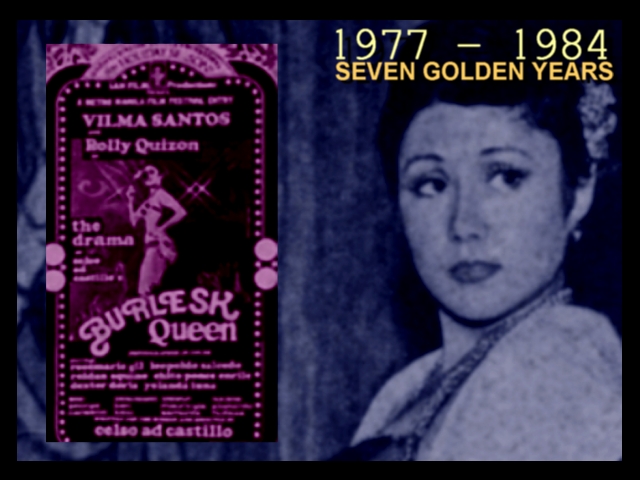
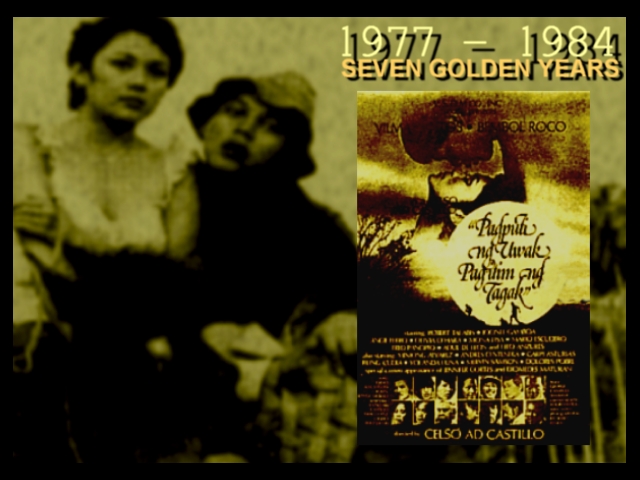
Vilma Santos Seven Golden Years 1977 – 1984

This slideshow requires JavaScript.

From 1977 to 1984, Vilma Santos made 55 films, a very productive seven years full of commercial success and several critical accolades.

13 Acting trophies– 11 Best Actress, 2 Best Picture (Film Producer)

11 Acting Nominations

1977– six films, highlights: Burlesk Queen and Dalawang Pugad, Isang Ibon signalled her image transformation.

  • 1977 Burlesk Queen – “…an official Entry to the 1978 Festival del film Locarno (Switzerland) …swept the awards in that year’s MMFF, resulting in a controversy that led to the wholesale return of trophies. In spite of the scandal, “Burlesk” is still regarded by critics as the “quintessential” Filipino film. “Hinamon ni Brocka si Tinio ng suntukan (Lino Brocka dared Rolando Tinio to a fight),” Celso remembers. “Tinio, who was the head of the jury, heralded “Burlesk as the most beautiful Filipino film” past, present and future.” Vi’s turnaround: Adding fuel to the fire, ?Burlesk? had stunned moviegoers because it unveiled a new Vilma Santos?from ingénue to wanton woman. Vilma says of “Burlesk?” – “It marked a transition in my career. Working with Celso Kid is a privilege. He’s a genius.” With good humor, Vilma recalls a “quarrel” on the set of “Pagputi ng Uwak, Pag-itim ng Tagak,” which she produced in 1978. “It took so long to finish. I lost money on that. But we’re still friends.” Burlesk and Pagputi brought a lot of honor to me…” (READ MORE)
  • 1977 Dalawang Pugad, Isang Ibon – “…Bernal recieved his first Gawad Urian best director award…Anita Linda and Mary Walter played mother and grandmother to Vilma…” (READ MORE)
  • 1977 Masarap, Masakit ang Umibig – “…an entry to the 1981 ASEAN Film Festival in Sydney Austarlia and Asia-Pacific Film Festival in Taipei Taiwan…the film earned Mat Ranillo III the 1978 FAMAS best supporting actor award…” (READ MORE)
  • 1977 Pulot-gata, Pwede Kaya? – “…Directed by and casted Vi with Romeo Vasquez, Suzanne Gonzalez, Rodolfo Boy Garcia, Tange, Ruel Vernal, Tita De Villa, Paraluman…” (READ MORE)
  • 1977 Susan Kelly, Edad 20 – “…Directed by Maria Saret and casted Vi with Dante Rivero and Anthony Alonzo…” (READ MORE)
  • 1977 Apoy sa Ibabaw Apoy sa Ilalim (cameo role) – “…Produced by VS Films, no information available except that the Vilma Santos’ birthday celebration was added as bonus feature of the film….” (READ MORE)

1978– fourteen films, highlights: Lino Brocka’s Rubia Servios and Celso castedillo’s Pagputi ng Uwak, Pag-itim ng Tagak; atleast one film per month; films with Nora Aunor, Ikaw ay Akin, Pinagbuklod ng Pag-ibig and Huwag Hamakin Hostess (Vi in came role).

  • 1978 Huwag Hamakin Hostess (cameo role)
  • 1978 Mga mata ni Angelita (came role) – “…Julie Vega was only 10 years old when she was launched to full stardom in the 1978 movie, “Mga mata ni Angelita.” …She appeared in previous movie outings as Darling Postigo. The young Vega was ably supported by an all super star casted headed by the King of Philippine Movies, Fernando Poe, Jr. (in the role of Conrado, the ex-convict) and Comedy King Dolphy (as Tacio, the taho vendor). Also appearing in cameo roles…Vilma Santos ( as a worried wife)…” (READ MORE)
  • 1978 Amorseko: Kumakabit, Kumakapit – “…Directed by Maria Saret and casted Vi with George Estregan, Ernie Garcia, Rez Cortez, and Beth Bautista…” (READ MORE)
  • 1978 Bakit Kailangan Kita? – “…Directed by Emmanuel H. Borlaza and casted Vi with Romeo Vasquez, Vilma Santos, Maan Hontiveros, Laurice Guillen, Romeo Enriquiz, Mary Walter…Leah Navarro’s “Kailangan Kita” was used as the film’s theme song ..” (READ MORE)
  • 1978 Kampus – “…Directed by Emmanuel H. Borlaza and casted Vi with Bembol Roco, Mat Ranillo III, Allan Valenzuela, Liza Lorena, Anita Linda, Lito Lapid…” (READ MORE)
  • 1978 Disco Fever – “…Directed by Al Quinn and casted Vi with Christopher De Leon, Victor Laurel, Rio Locsin…” (READ MORE)
  • 1978 Ikaw ay Akin – “…Nora and Vilma were nominated for their roles in the 1978 Gawad Urian but lost, their leading man Christopher de Leon won the best actor…” (READ MORE)
  • 1978 Nakawin Natin ang Bawat Sandali – “…Directed by Elwood Perez and casted Vi with Christopher De Leon, Baby Delgado, Roel Vergel de Dios…” (READ MORE)
  • 1978 Pag-ibig ko sa iyo lang Ibibigay – “…Directed by Nilo Saez and casted Vi with Romeo Vasquez, Perla Bautista, Romy Diaz…Flippers’ “Pag-ibig ko sayo ko lang ibibigay” was used as the film’s theme song…” (READ MORE)
  • 1978 Pagputi ng Uwak, Pag-itim ng Tagak – “…Vilma’s own VS films won both the 1978 FAMAS and Gawad Urian best picture awards…” (READ MORE)
  • 1978 Pinagbuklod ng Pag-ibig – “…Directed by Leonardo L Garcia and casted Vi with Romeo Vasquez, Nora Aunor, Tirso Cruz III, Romnick Sarmenta…” (READ MORE)
  • 1978 Promo Girl – “…Directed by Joey Gosiengfiao and casted Vi with Ricky Belmonte, Roel Vergel de Dios, Bembol Rocco, Eddie Gutierrez…” (READ MORE)
  • 1978 Rubia Servios – “…it may not win her the 1978 Metro Manila Film Festival: Best Performer award but Rubia Servios end up as a record breaking earner of the festival…” (READ MORE)
  • 1978 Simula ng Walang Katapusan – “…Directed by Luis Enriquez and casted Vi with Eddie Rodriguez, Carmen Soriano, Lito Anzures, Rio Locsin, Ruben Rustria…” (READ MORE)

1979– eight films, highlights: movies with fim giants: Dolphy in Buhay Artista, Ngayon; Charito Solis in Modelong Tanso.

  • 1979 Buhay Artista, Ngayon – “…Directed by Frank Gray Jr. and casted Vi with Dolphy, Panchito, Babalu, Cachupoy, Bayani Casimiro, Georgie Quizon, Ellen Esguerra, Moody Diaz, Odette Khan, German Moreno, Ike Lozada, Florante, Joe Quirino…” (READ MORE)
  • 1979 Coed – “…Directed by Emmanuel H. Borlaza and casted Vi with Jay Ilagan, Celia Rodriguez, Allan Valenzuela, Jun Soler, Angge…” (READ MORE)
  • 1979 Halik sa Kamay, Halik sa Paa – “…Directed by Luis Enriquez and casted Vi with Ronald Corveau, Eddie Rodriguez, Rosemarie Gil, Roderick Paulate, Angie Ferro, Aurora Salve…produced by Vilma Santos’ VS Films…” (READ MORE)
  • 1979 Magkaribal – “…Directed by Elwood Perez and casted Vi with Christopher De Leon, Alma Moreno …” (READ MORE)
  • 1979 Modelong Tanso – “…Directed by Cirio H. Santiago and casted Vi with Charito Solis, Winnie Santos…” (READ MORE)
  • 1979 Pinay, American Style – “…Directed by Elwood Perez and casted Vi with Christopher De Leon, Bembol Roco, Cocoy Laurel, Rosa Mia…Theme Song, “Pinay” performed by Florante…” (READ MORE)
  • 1979 Rock, Baby, Rock – “…Directed by Oscar Miranda and casted Vi with Junior, Rolly Quizon, Leah Navarro, Tito Sotto, Vic Sotto, Joey de Leon…” (READ MORE)
  • 1979 Swing it, Baby – “…Directed by Al Quinn and casted Vi with Romeo Vasquez, Tito Sotto, Vic Sotto, Joey de Leon, Amy Austria, V.S.T. & Company, Mike Monserrat, Walter Navarro…Theme Songs, “I-swing mo ako” performed by Sharon Cuneta…” (READ MORE)

1980– nine films, highlights: ressurected her Darna role for the last time; bolder stripper roles in Mrs Jones and Miss X.

  • 1980 Ang Galing-galing Mo, Mrs. Jones – “…Directed by Cirio H. Santiago and casted Vi with Al Tantay, Mark Gil, Vic Salayan, Anita Linda ..” (READ MORE)
  • 1980 Darna at Ding – “…Directed by J. Erastheo Navoa and Cloyd Robinson and casted Vi with Niño Muhlach, Celia Rodriguez, Marissa Delgado, Veronica Jones, Rez Cortez, Ike Lozada, German Moreno, Al Tantay, Donna Villa…” (READ MORE)
  • 1980 Good Morning, Sunshine – “…Directed by Ishmael Bernal and casted Vi with Junior, Lloyd Samartino, Sheryl Cruz, Debraliz, Anita Linda, Liza Lorena…” (READ MORE)
  • 1980 Gusto Ko Siya, Mahal Kita – “…Directed by Emmanuel H. Borlaza and casted Vi with Romeo Vasquez, Christopher De Leon, Maila Gumila…” (READ MORE)
  • 1980 Langis at Tubig – “…Directed by Danny Zialcita and casted Vi with Dindo Fernando, Ronaldo Valdez, Amy Austria, Vic Silayan…theme song, “Langis At Tubig” performed by Sharon Cuneta…” (READ MORE)
  • 1980 Miss X – “…Directed by Gil Portes and casted Vi with Mark Gil…theme song, “Dito Ba?” performed by Kuh Ledesma…film shot in the red district of Amsterdam…” (READ MORE)
  • 1980 Romansa – “…Romansa (1980) was the first film of two tha Edu Manzano and Vilma Santos films did together (the other one was Palimos ng Pag-ibig (1986)…” (READ MORE)
  • 1980 Yakapin Mo Ako, Lalaking Matapang – “…Directed by Emmanuel H. Borlaza and casted Vi with Lito Lapid, Chichay, Angie Ferro, Lucita Soriano, Rez Cortez, German Moreno…theme song performed by Lirio Vital…” (READ MORE)
  • 1980 Candy Vilma Santos in a cameo role.

1981– four films, highlights: box office hits – Karma and Pakawalan Mo Ako; Karma, an entry to the 1981 Metro Manila Film Festival earned Vilma the festival’s best actress award.

  • 1981 Pakawalan Mo Ako – “…Vilma Santos won the 1981 FAMAS Best Actress…” (READ MORE)
  • 1981 Hiwalay – “…Directed by Romy Suzara and casted Vi with Dindo Fernando, Eddie Rodriguez, Celia Rodriguez, Anita Linda …” (READ MORE)
  • 1981 Karma – “…Vilma Santos won the 1981 Metro Manila Film Festival Best Actress…” (READ MORE)
  • 1981 Ex-Wife – “…Directed by Eddie Rodriguez and casted Vi with Beth Bautista, Raul Aragon, Michael de Mesa, Eddie Garcia, Liz Alindogan, Wendy villarica, Rosemarie Gil…” (READ MORE)

1982– six films, highlights: Record-breaking hits: Gaano Kadalas ang Minsan? and Sinasamba Kita. Earned rave reviews for her performance in Relasyon; last year’s Pakawalan Mo Ako earned Vilma her second FAMAS best actress (after Dama De Noche in 1972).

  • 1982 Gaano Kadalas ang Minsan? – “…Gaano kadalas ang Minsan grossed 7.3 Million in its few days run in Metro Manila in 1982 outgrossing “Sinasamba Kita” for Philippine movies’ all-time box office tally. With inflation and currency rate in consideration that will be around 95 million. But that’s not the only exciting thing about these film. It was the only film that Vilma Santos and Hilda Koronel did while atleast when Hilda was still at her peak…” (READ MORE)
  • 1982 Haplos – “…Directed by Antonio Jose Perez and casted Vi with Christopher De Leon, Rio Locsin, Delia Razon, Eddie Infante…theme song, “Haplos” performed by Eva Eugenio…” (READ MORE)
  • 1982 Never Ever Say Goodbye – “…Directed by Gil M. Portes and casted Vi with Nonoy Zuniga, Ian Veneracion…theme song, “Never Ever Say Goodbye” performed by Nonoy Zuniga…” (READ MORE)
  • 1982 Relasyon – “…The very first “Grand Slam” for Best Actress in Philippine Entertainment history…” (READ MORE)
  • 1982 Sinasamba Kita – “…They started with 38 theatres, by the weekend (they added more) and became 41 theatres…After 6 days, the film earned P5,207,416.00. After a week’s time, almost P6 million…” (READ MORE)
  • 1982 T-Bird at Ako – “…Directed by Danny Zialcita and casted Vi with Nora Aunor, Dindo Fernando, Tommy Abuel, Anita Linda, Liza Lorena, Rustica Carpio…theme song, “Hiwaga ng Pag-ibig” performed by Nora Aunor…” (READ MORE)

1983 – four films, highlights: box office hits – Minsan Pa Nating Hagkan Ang Nakaraan and Paano Ba Ang Mangarap; received grandslam best actress from previous year’s Relasyon (Winning four best actress from FAMAS, Gawad Urian, CMMA and FAP).

  • 1983 Ayaw Kong Maging Kerida – “…Directed by Leonardo L. Garcia and casted Vi with Romeo Vasquez, Carmi Martin, Norma Blancaflor…” (READ MORE)
  • 1983 Broken Marriage – “…Vilma Santos won the 1983 Gawad Urian best actress, her second consecutive awards from the local critics…” (READ MORE)
  • 1983 Minsan pa Natin Hagkan Ang Nakaraan – “…Directed by Marilou Diaz Abaya and casted Vi with Christopher De Leon, Eddie Garcia…theme song, “Minsan Pa Nating Hagkan Ang Nakaraan” performed by Basil Valdez…” (READ MORE)
  • 1983 Paano Ba ang Mangarap? – “…Directed by Eddie Garcia and casted Vi with Christopher Deleon, Amy Austria, Jay Ilagan, Peral Bautista, Armida Siguion Reyna, Vic Silayan…theme song, “Paano Ba Ang Mangarap?” performed by Basil Valdez…” (READ MORE)

1984– four films, highlights: films with Brocka, Diaz-Abaya, de Leon in one year; received second consecutive Gawad Urian for last year’s Broken Marriage.

  • 1984 Adultery – “…Directed by Lino Brocka and casted Vi with Phillip Salvador, Tita De Villa, Alvin Enriquez, Anita Linda, Mario Montenegro, Deborah Sun…” (READ MORE)
  • 1984 Alyas Baby Tsina – “…Directed by Marilou Diaz-Abaya and casted Vi with Phillip Salvador, Dindo Fernando, Cecille Castillo, Chanda Romero, Johnny Delgado, Caridad Sanchez, Maria Isabel Lopez, Dexter Doria, Mary Walter, Vangie Labalan, Harlene Bautista…” (READ MORE)
  • 1984 Sister Stella L. – “…Vilma Santos won the 1984 Gawad Urian:best actress…the Philippines’ entry to 1985 Venice International Film Festival…Sister Stella L. was one of 25 Filipino films shown in New York from July 31 to August 1999, organized by the Film Society of Lincoln Center…” (READ MORE)
  • 1984 Charot – “…Vilma Santos in cameo role…” (READ MORE)

OPM Jukebox Hits – Original Artists

Songs – Artists

  • 01 Rain – Boy Mondragon
  • 02 Bakit Ako Mahihiya – Didith Reyes
  • 03 Mr. Lonely – Victor Woods
  • 04 My Pledge of Love – Edgar Mortiz
  • 05 Sixteen – Vilma Santos
  • 06 Mardy – Eddie Peregrina
  • 07 Forbidden – Norma Ledesma
  • 08 I Am A Soldier – Lew Soratorio
  • 09 You Don’t Own Me – Jeanne Young
  • 10 Dearest One – Lord Soriano
  • 11 Mother Of Mine – Florence Aguilar
  • 12 Faithful Love (Instrumental) – Cezar Manalili on Guitar
  • 13 Baleleng – Max Surban
  • 14 I’m Sorry – Neddie Decena
  • 15 Love Me Now And Forever – Romeo Miranda
  • 16 Pangako – Flippers
  • 17 Kawawang , Cowboy – Fred Panopio
  • 18 Butsekik – Yoyoy Villame (Amazon)

Wilear’s Top Company in Philippine Awards – The third annual presentation of the Awit Awards was held at the Manila Hotel with Senator Doy Laurel of the Philippine Congress as guest of honor and principal speaker. The sponsoring group was the Philippine Academy of Recording Arts and Sciences (PARAS). The event criticized in the local circle because of its unpopular results and deglamourized presentation, gave posthumous awards of merit to Frankie Martin, a juror last year, and Santiago Suarez, one of Filipino musical stalwarts. The founder of the Awit Awards, Billboard correspondent Oskar Salazar, was also honored. Wilear’s Records scored heavily in the awards this year. The foreign division was permanently scrapped. Two major companies, Villar Records and Dyna Products, Inc. did not submit nominations this year. The 1970 winners are: Female Singer (English) – Nora Aunor (Alpha); Male Singer (English) – Eddie Mesa (Grandeur); Female Singer (Vernacular) – Amapola (Lapulapu); Male Singer (Vernacular) – Armando Ramos (Wilear’s). Most Promising Female Singer – Eva Vivar (Alpha); Most Promising Male Singer (tie) – Boy Mondragon (Vicor) and Jonathan Potenciano (D’Swan); Record Company of the Year – Wilear’s Records; Song of the Year – “Forever Loving You” by Bert Dominic (Billboard); Best Single – “Sixteen” by Vilma Santos (Wilear’s); Vocal Group (Vernacular) – D’Big 3 Sullivans (Vicor); Vocal Group (English) – Reycard Duet (Alpha); Instrumental Recording – “Philippine Rondalla” by the Philippine Rondalla (Wilear’s); Original Movie Music Theme – Soundtrack of “Wanted: Perfect Mother” by Danny Subido (Neon); Special Recording – “Philippine Rondalla” (Wilear’s); Instrumental – Eric Dimson (Vicor); Instrumental Group – Pandacan Original Brass Band (Wilear’s); Musical Arranger – Doming Amarillo; Lyricist (Vernacular) – Philip Maninang; Lyricist (English) – Danny Subido; Composer (English) – Robert Dominic; Album Liner Notes (LP & Mini) – “Baby Vi” (Wilear’s); Album Cover (LP) – “I’m Sorry My Love” (Vicor); Mini-Album – “Something Stupid” by Vilma Santos and Edgar Mortiz (Wilear’s); Album – “Phenomenal Nora Aunor” by Nora Aunor (Alpha). Other Awardees (receiving plaques): Best Recording Studio – Cinema-Audio, Inc.; Best Recording Engineers – Ric Santos (Cinema-Audio, Inc.) and Best Pressing Plant – Home Industries Dev. Corp. Given citations for their support were Tower Productions, stations DZTM and DZTR and Gloria Sevilla, a film producer. – Billboard Magazine, International News Reports, 14 August 1971 (READ MORE)

Eddie Garcia’s Vilma Santos Films

This slideshow requires JavaScript.

204 films, 70 directors, 5 decades, Vilma Santos, one of the original Philippine movie queens, rose up to become the versatile actress that has been given the fitting title of “Star for All Seasons” because of her capacity to adapt to the changing mores and values of the Filipino woman, giving a face to their plight and struggles, albeit in success both critically and box-office wise in some of Philippine cinema’s classics such as Trudis Liit (1963), Lipad, Darna, Lipad (1973), Burlesk Queen (1977), Relasyon (1982), Sister Stella L. (1984), Alyas Baby Tsina (1984), Pahiram ng Isang Umaga (1989), Dahil Mahal Kita: The Dolzura Cortez Story (1993), Anak (2000) and Dekada ’70 (2002). This are top ten directors who contributed to her success. – RV (READ MORE)

Eddie Garcia first directed Vilma in the Marcos film, “Pinagbuklod Ng Langit.”  She reprised the role of Imee Marcos and again co-starred with movie queen, Gloria Romero and dramatic actor, Luis Gonzales after “Iginuhit ng Tadhana.”  Garcia directed Vilma again in 1982′s record breaker, “Sinasamba Kita.”  Overall, the two collaborated in five more films after “Sinasamba,” giving us two of the most memorable Filipino movie lines – confronting the mistress Dina Bonevie, Vi said: “Para Kang Karinderyang bukas sa lahat ng gustong kumain (translated literally into “You are like food restaurant! Open to all who wanted to eat!”) from the movie “Palimos Ng Pag-ibig” and then confronting the rich snotty old Alicia Vergel, Vi said: “Si Val, si Val, si Val na walang malay! (literally translated to “Its Val! its Val!, Its always Val, The one who is innocent!”). – RV (READ MORE)

Pinagbuklod ng langit (1969) – “…Pero higit na tumatak si Luis nang gampanan niya ng dalawang beses si Pangulong Ferdinand Marcos. Ito’y sa kontrobersyal na pelikulang “Iginuhit ng Tadhana” bago tumakbo si Marcos bilang presidente noong 1965. Sinundan ito ng “Pinagbuklod ng Langit” noong 1969. Si Imee Marcos, na ginampanan noon ni Vilma Santos, naalala ang galing ni Luis na mahirap na daw tapatan ngayon. “His acting was understated. A great actor and a good friend. He played a big role in our lives. Halos naniniwala na ako na tatay ko siya dahil sa boses. Mahal na mahal namin si Luis Gonzales,” sabi ni Imee. Ayon sa kanyang kabiyak, huling hiling ni Luis na ipa-cremate ang kanyang labi…” – Mario Dumaual (READ MORE)

Sinasamba Kita (1982) – “…Sobra pala ang lakas ng “Sinasamba Kita.” Tuwang tuwa sina Vic at Mina del Rosario. They started with 38 theatres, by the weekend, 41 theatres na ang nagpapalabas ng pelikula. After 6 days, kumita na ito ng P5,207,416.00. After a week’s time, almost P6 million na ito….” – Billy Balbastro (READ MORE)

Paano Ba ang Mangarap? (1983) – “…A true blooded Vilmanian will not forget the time when a teaser (a very brief movie trailer – around 20 seconds) was shown to the theatres in the summer of 1983. It was Viva films’ “Paano Ba Ang Mangarap?” Another box office hit from Vilma Santos and Christopher DeLeon. The teaser (almost worth the whole movie ticket) was the scene where Lisa, played by Vilma discovered that her son (to Eric’s brother, Jay Ilagan) was gone courtesy of her evil rich mother-in-law (Armida Sigueon Reyna). Here’s the lines and the explosive acting of the Queen. The scene: After running around looking for the baby in all the rooms in second floor of of this huge mansion, Lisa confronted Eric who were stunned to find Lisa’s hysterics. Lisa: “Dinaya n’yo ako! Saan n’yo dinala ang anak ko?!!!” Eric: “Hindi ko alam!” Lisa: “Hindi mo alam…Sinungaling!” Eric: “Lisa, makinig ka muna…” Lisa: “Kasabwat ka ng ina mo! Alam ko matagal n’yo nang plano ito!” Eric: “Ano bang pinagsasabi mo?” Lisa: “Dinaya n’yo ako! Mga Traydor Kayo! Traydor kayong lahat!” Eric: “Lisa, huminahon ka baka mapaano ang bata!” Lisa: “Wala akong pakialam! Ibalik mo sa akin si Jun Jun! Ibalik mo sa akin ang anak ko! Ibalik mo sa akin si Jun Jun! Ibalik mo sa akin….AHHHH” (mahuhulog sa hagdanan). Just this scene alone, Vilma should be rewarded that year’s best actress award! Bravo!…” – RV (READ MORE)

Palimos Ng Pag-ibig (1986) – “…The year was 1986. Palimos Ng Pag-ibig directed by Eddie Garcia was a smashed hit. Vilma co-starred with her soon to be ex husband Edu Manzano and Dina Bonnevie. Despite the mixed reviews from the critics, the film gave us, arguably, one of the most memorable lines in Philippine movie history. The scene was, Vilma, playing Fina was about to leave the house when Ditas, (Edu’s mistress and baby maker) knocked on the door, with her was her husband’s child. She forced herself in. Confronting Ditas, Fina: “Ilang gabi kang binili ni Rodel?” Ditas (Dina): “Isang Gabi lang, malakas ang kanyang punla at nangangailangan lang ng matabang lupa!” Fina: “Okey! So you’re fertile and I’m barren…pero sa mga pangyayari, para kang karinderyang bukas sa lahat ng gustong kumain! Paano mong mapapatunayang ang asawa ko nga ang ama ng batang iyan at wala siyang kasosyong iba?…” – RV (READ MORE)

Saan Nagtatago Ang Pag-ibig? (1987) – “…Tulad ng “Paano Ba Ang Mangarap,” merong ‘dream sequence” ang pelikula kung saan kunwari’y hinuhusgahan si Val na isang baliw. Kung puputulin ang eksenang ito’y hindi magiging sagabal sa paglalahad ng buong istorya ni Gilda Olvidado. Mula sa lumang bahay hanggang sa eksena sa libingan ay mahusay ang sinematograpiya ni Romy Vitug at disenyong pangproduksiyon ni Manny Morpe. Mahusay ang mga katulong na artista mula kay Cherrie Gil, Alicia Alonzo at Alicia Vergel. Mahusay rin si Ricky Davao bilang Rick at Gloria Romero bilang ina ni Rick at Val. Ngunit ang pelikulang ito’y tungkol kay Val at bilang si Val ay nabigyan ng mahusay na pagganap ni Tonton Gutierrez ang papel na sinto sinto mula sa pagsasalita na utal utal haggang sa pisikal na mukha at pa-ika-ikang paglalakad. Tulad ng inaasahan, mahusay si Vilma bilang si Stella. At tulad ng maraming pelikulang ginawa niya sa ilalim ng Viva at sa direksiyon ni Eddie Garcia ay merong linya o dayalogo siya na hindi malilimutan, ito ay nang bigkasin niya ang linyang, “…si Val, si val na wala naman malay…” na magpahanggang ngayon ay natanim sa mga Pilipino na mahihilig sa pelikulang tagalog.” – RV (READ MORE)

Imortal (1989) – “…There are other laughable scenes. Vilma says, “My husband is (music rises ominously) — my husband is (music again) Impotent (music rises to a climax)!” You’d think the husband just contracted the AIDS virus or got castrated by Sparrow units! Shucks, I know several husbands who just can’t do it anymore, and I hear no heavy music when their wives complain. As a matter of fact, wives prefer their husbands to be impotent, rather than be sexually active with other women. Another terrible scene. The car ridden by Christopher and wife Cherie Gil falls off a cliff. Cherie who is pregnant is mortally wounded and dies. And Christopher looks at his dead wife, and holds aloft a new born baby complete with umbilical cord. This is absurd without a caesarian operation by a doctor. The worst scene is when Christopher digs up the corpse of Vilma at the cemetery, amidst thunder, lightning, wind and rain, and embraces her passionately, while she exhibits no rigor mortis, and apparently no smell of formalin. You don’t find this kind of idiocy in a television commercial. Most of my grandchildren, including Angeli who is only four months of age, enjoy commercials more than dramas….” – Hilarion M. Henares Jr. (READ MORE)

Eddie Garcia (born Eduardo Verchez García on May 20, 1929 in Sorsogon, Philippines) popularly known as Manoy is a Filipino film actor and film director…He is the most awarded and nominated person in the long history of the Filipino Academy of Movie Arts and Sciences (FAMAS) Awards. He garnered a total of 34 nominations (13 for Best Supporting Actor, 10 for Best Actor and 11 for Best Director). Out of these, he got 6 Best Supporting Actor wins, 5 Best Actor wins and 5 Best Director wins, 3 Hall of Fame Awards, 1 Lifetime Achievement Award and the Fernando Poe, Jr. Memorial Award. He was awarded his first FAMAS Award in 1957 and his last FAMAS, a Hall of Fame for Best Actor, in 2003. The first actor to be inducted in the FAMAS Best Supporting Actor Hall of Fame of the Filipino Academy of Movie Arts and Sciences in 1974. – Wikipedia (READ MORE)

Related Reading

Higit Ngayon Ang Responsibilities ni Vi

Ngayong masasabing kay Vi lahat nakatutok ang mga mata ng mga taong nagbabasa sa local showbiz world. At marahil gayon din ang mga nasa labas nito…ang kanyang hindi mabilang na fans at ang mga movie public. Pagka’t bukod sa pagiging isang aktress, isa na ring movie producer si Vi. Nakikiramdam ang mga naturan kung mahusay niyang magampanan ang dalawang papel na ito ngayon. Bilang aktres, ang paglabas ni Vi sa Mga Rosas Sa Putikan, na isang movie production ng kanyang kompanya ay isa ring puntos ng interes para sa mga naturan. Pagka’t dito’y maiiba sa dating uring role ang ginagampanan ni Vi. Magsisilbing tunay na hamon sa career niya. Dito kasi’y gagawa si Vi ng mga eksenang hindi niya ginagawa-gawa sa pelikula. Sa Mga Rosas mababatid kong maiibigan ng movie public at ng mga fans niya in particular ang gagawin niya o hindi. Kung ipagpapatuloy niya ito o hindi, kaya ang mahalagang katanungang malikha tungkol dito ay “tanggapin kaya ang pagbabago” (na marami ring nagsasabing pagpapaunlad sa kanyang career na panahon na niyang gawin( ng kanyang image?” Ang isa pang interesadong malaman ng publiko’y ang tungkol sa unang movie production niya, ang Mga Rosas Sa Putikan nga.

Hindi kaila kasi sa mga ito na maraming pumapasok sa movie making business na sa unang produksiyon pa lang ay bagsak na agad. Hindi kasi kumuwela ito. Bagama’t nakakahigit mang malaki ang nagsasabing ki-click ang Mga Rosas, kahit paano’y naroon pa rin ang katanungang, “Mag-click kaya ang first movie productions nina Vi!” Ngunit ang katanungang ganito’y pangkaraniwan sa showbiz. People in and out of the showbiz world will always wonder if a movie will be a hit or not in the box office. Kaya’t higit ngayong marahil ang responsibilities ni Vi hindi lang sa kanyang sarili kungdi sa kanya ring fans, the movie public, sa mga mahal niya sa buhay, sa mga kaibigan, at sa local showbiz industry. Wala nang hangarin si Vi sa pagiging aktres n’ya. She has more than proven herself in this. Ngunit, masasabing mayroon din naman. Pagka’t sa pagpasok niya sa movie productions, hindi niya dapat payagang mabawasan ang ningning ng kanyang nakakasilaw na katayuan bilang isang artista. She owes this much to her countless followers. At bilang aktres ay nararapat niya ring ibuhos ang kanyang lahat sa unang produksiyon niya kung saan siya rin ang pangunahing bituin. – Cleo Cruz, Darna, No. 304, 30 Aug 1974

Cleo Cruz was Vilma Santos’ publicist in the early part of her movie career. Vi normally calls her, “Mommy” or Mommy Cleo. Now retired from entertainment journalism, Cleo Cruz is reportedly living in the United States. She referred Vi’s followers in many of her columns and articles as “Luvs.” – RV

Laurice Guillen’s Vilma Santos Films

This slideshow requires JavaScript.

204 films, 70 directors, 5 decades, Vilma Santos, one of the original Philippine movie queens, rose up to become the versatile actress that has been given the fitting title of “Star for All Seasons” because of her capacity to adapt to the changing mores and values of the Filipino woman, giving a face to their plight and struggles, albeit in success both critically and box-office wise in some of Philippine cinema’s classics such as Trudis Liit (1963), Lipad, Darna, Lipad (1973), Burlesk Queen (1977), Relasyon (1982), Sister Stella L. (1984), Alyas Baby Tsina (1984), Pahiram ng Isang Umaga (1989), Dahil Mahal Kita: The Dolzura Cortez Story (1993), Anak (2000) and Dekada ’70 (2002). This are top ten directors who contributed to her success. – RV (READ MORE)

Guillen gave Vilma her fifth and sixth Gawad Urian Best Actress awards for 1991′s Ipagpatawad Mo and 1993′s Dolzura Cortez. The later also gave Vilma her second grand slam, winning all the best actress awards from local award giving bodies. – RV (READ MORE)

Kapag Langit Ang Humatol (1990) – “…Fortunately, director Laurice Guillen has more faith in her material, more respect. For she has not only come up with a beautifully-photographed, well-edited and generally superbly-acted melodrama. She has also held up to us a mirror of the dreams and aspirations, the frustrations, suffer¬ing and uncomplicated lifestyle of the so-called masa. Moments of the heroine’s unmitigated oppres¬sion in the hands of her evil mistress is age-old reality in Philippine life and, quite logically, litera¬ture. Her soul nearly scarred by her excruciating, degrading experience, she somehow manages not only to survive but also to rise from her humble, bleak origins, when she leaves the hellhole and finds hope and rewards in the city. In true melodramatic fashion, she plots out her revenge, but alas, even in carrying it out, she must pay dearly, nearly tragically. Feminist observers may easily notice that in this picture – as in, they would say, Philippine society -it is the women who run things. They domineer and dominate, manipulating the men, even the men they love. True enough, from the very beginning, it is the mistress and her poor servant who move things, decide, and tell men what to do. It is they who plot out schemes and plan their destiny. The same is true even with the minor characters, those played by Kristine Garcia (who virtually drags the farm stud into a stormy affair and pushes him to run away with her), Eula Valdez (who pulls the trigger that ends a chapter in the drama), Charo Santos (the single mother and self-made tycoon) and Carmina Villarroel (the young woman who tries to extricate herself from the mess which her quarreling mother and grandmother have created). For their part, the men are pushed around, fooled and overtaken by events: the weakling lover (Gomez), the perpetually horny stablehand (Wil¬liam Lorenzo) and the young and rich heir (Jeffrey Santos). All in all, it is a glossy and well-crafted movie, with marvelous performances by Ms. Santos and Ms. Romero.” – Mario A. Hernando (READ MORE)

Ipagpatawad Mo (1991) – “…The movie is poignant, nevermushy. It isnotthe run-of-the-mill tearjerker that relies on maudlin theatrics and melodramatic devices to touch the hearts of moviegoers. Surprisingly, despite the frustrating problem facing the movie couple, moviegoers did not seem to be depressed by the movie. Attempts to “commercialize” the film may be seen in the comic relief provided by the protracted spats between the two kids’ yayas (Ruby Rodriguez and Jinky Oda). But the heavy subject and the conditions in the local film industry allow us to accept the filmmakers’ decision to inject such crowd-pleasing elements. Though the late Lino Brocka has made a posthumous telemovie on the same subject autism — with a similar dramatic situation in the still-unreleased “Lampang Kerubin,” this is the first time in recent memory that a Filipino movie tackles the subject with seriousness and compassion…” – Butch Francisco (READ MORE)

Dahil Mahal Kita: The Dolzura Cortez Story (1993) – “…Taong 1993, nang gawin naman nila ang award winning movie na “Dahil Mahal Kita, Dolzura Cortez” sa ilalim ng OctoArts films at sa pamamahala ni direk Laurice Guillen na nagbigay kay Ate Vi ng ikalawang Grand Slam Best Actress award…” – Willie Ferrnandez (READ MORE)

Laurice Guillen is a Filipino actress and director. A protege of Lino Brocka, Guillen began her first major work as a director with Init sa Magdamag. In 1984 she directed Salome, which was shown at the Toronto International Film Festival and described as “the kind of cinematic discovery that single-handedly justifies the festival’s existence”. Ipagpatawad Mo was also directed by Guillen, as was Dahil Mahal Kita: The Dolzura Cortez Story in 1993, before her retirement from filmmaking. Dedicating herself to the Marian movement, Guillen made pilgrimages to churches and cathedrals throughout the Philippines with her husband, believing that Mary had called on her to experience a spiritual renewal. By 1998 she was thinking about returning to filmmaking, and following a good reception of Ipagpatawad Mo by a group of priests, who encouraged her to back into filmmaking, along with an appearance on Kris Aquino’s talk show, she did so. – Wikipedia (READ MORE)

Related Reading
FAP: Laurice Guillen’s Filmography
Women of Power, Women of Substance
Laurice Guillen recalls her fondest memory of late husband Johnny Delgado
Laurice Guillen stars in Tanghalang Ateneo’s “The Glass Menagerie”
Clips – Dahil Mahal Kita: The Dolzura Cortez Story – Vilma Santos
Clips – Ipagpatawad Mo (Video)
Top 10 Film Directors (Video)

Aktres: Pelikula at Lipunan 2006

This slideshow requires JavaScript.

Aktres – “…Movie buffs have until March 19 to catch up with the ongoing “Aktres: Pelikula at Lipunan” which is being held at the Cineplex in Gateway Mall at the Araneta Center. The film event, which is in celebration of the country’s top women in cinema, and which kicked off last Feb. 22, is being held in an effort to save the vanishing Filipino film heritage. Films starring the country’s top movie queens are being screened in order to raise funds to set up an industry film archive where films can be stored and preserved, according to festival director Nick Deocampo. Deocampo has taken up the task of creating public consciousness on the issue of film loss through the annual “Pelikula at Lipunan.” He said this month-long film event aims to raise funds to save what little is left of the country’s film patrimony. Just recently, the long presumed lost film “Zamboanga” which Deocampo recovered in the US during his studies there, was shown recently on ABC 5. The film, starring Fernando Poe, Sr. and Rosa del Rosario opened the filmfest. This time, Deocampo brought home the long-lost classics “Darna,” “Dyesebel” and “Ang Banga ni Zimadar” from where he discovered them in a film archive in Bangkok. The films starred Rosa del Rosario, Edna Luna and Mila del Sol, respectively.  Aside from these films, also shown at “Pelikula at Lipunan 2006” are other films starring the country’s top movie queens: “Gumising Ka, Maruja” starring Ms. Susan Roces; “Aguilar,” starring Amalia Fuentes; Gloria Romero’s “Dalagang Ilokana;” Nora Aunor’s “Nakaw na Pag-ibig;” Vilma Santos’ “Relasyon,” “Nida Blanca’s “Waray-Waray;” Mona Lisa and Hilda Koronel’s “Insiang;” Anita Linda’s “Sisa;” Lilia Dizon’s “Sanda Wong;” Jaclyn Jose’s “Private Show;” Sharon Cuneta’s “Bituing Walang Ningning;” Maricel Soriano’s “Hinugot sa Langit’ and Gina Alajar’s “Orapronobis,” among others. Aside from the film screenings, there is also a film exhibit tracing the history of women in Philippine cinema over the past 100 years; symposia on the theme of women and society; and a regional tour to salute the movie queens in their respective native cities like Susan Roces in Bacolod City; Gloria Romero in Pangasinan; Nora Aunor in Naga, and Vilma Santos as adopted daughter of Lipa, Batangas…” – The Manila Bulletin, March 17, 2006 (READ MORE)

Grim State – “…”In this festival, we decided to highlight the image of movie actresses in view of the recently concluded centennial of feminism in the Philippines,” said festival director Nick Deocampo. The tribute however went beyond the female leads. In her speech, Susan Roces extended the accolade to the film producers of her time, “While we pay tribute to the actresses, we shouldn’t also forget that the leading producers of our period are also women, Dona Dolores Vera of Sampaguita Pictures, Dona Sisang de Leon of LVN, and Dona Adela Santiago of Premiere Productions.” The other highlight of the festival is the crusade to save the Filipino films from oblivion. In fact, the proceeds of the festival will go to help build an industry film archive at the Mowelfund Film Institute, for storage and preservation of the rapidly decomposing Filipino films.  Film preservation in the Philippines is in a grim state. Just consider the facts: Movies such as Ang Daigdig ng Mga Api by the well-regarded Gerry de Leon, Dolphy’s El Pinoy Matador, Chiquito’s Arizona Kid, Dalagang Bukid, Wanted Perfect Mother, and Juan Tamad Goes to Congress are lost, not temporarily but forever. All the filmprints of Nora Aunor hits Ina Ka Ng Anak Mo and Annie Batungbakal are also lost. Salome, and Bakya Mo Neneng are damaged films with parts missing, while Vilma Santos’ Burlesk Queen and Dyesebel have their film prints abroad. Pelikula at Lipunan 2006 serves as a platform for Deocampo to dramatize the efforts of Mowelfund Film Institute to save Filipino films from rot. …” – Gypsy Baldovino, The Manila Bulletin, February 27, 2006, (READ MORE)

Nick Deocampo – Nick Deocampo (born 1959 in Mina, Iloilo) is a multi-awarded Filipino filmmaker, writer, and educator. He is the current director of the Center for New Cinema. Deocampo completed his basic education at West Visayas State University and finished salutatorian at Iloilo High School in 1976. He graduated cum laude with a bachelor’s degree in Theater Arts at the University of the Philippines (UP) in 1981. Under a a Fulbright Scholarship Grant, Deocampo earned his Master of Arts degree in Cinema Studies at the New York University in 1989. He was also a French government scholar for eight years and received his Certificate in Film at the Atelier du Formacion Au Cinema in 1989. He received another Fulbright grant as an international senior research fellow at the U.S. Library of Congress in Washington, D.C. in 2001…Deocampo has made a number of films, including a trilogy documenting Filipino lives during the regime of Ferdinand Marcos. It was awarded the grand prize in Brussels in 1987. – Wikipilipinas (READ MORE)

Related Reading: