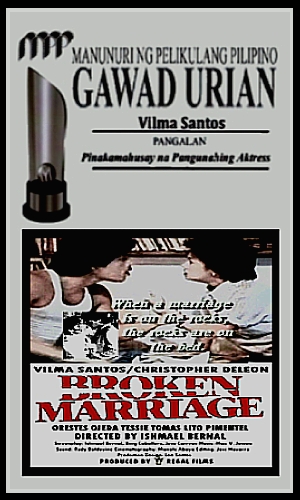
FILM REVIEW: BROKEN MARRIAGE


The Plot: After ten years and two children, Rene and Ellen find their marriage on the brink of breaking up. They seem to have fallen out of love and life has become a series of verbal hussies and conflicts. They decide that the only way out is a temporary separation. Rene, a police reporter, and Ellen, who is a television production assistant, begin to live apart from each other. Rene moves into his friend’s apartment while Ellen has to cope with running a household by herself. But they soon begin to feel the effects of their separation. A series of events that follow drastically change their lives. Rene is mauled for his expose of a gambling casino owned by a high ranking government official. He is forced to stay temporarily in the house of Ellen’s mother. As he recuperates from his injuries, both he and Ellen attempt to rebuild their shattered relationship. – Manunuri (READ MORE)

Demanding careers and two children have left Ellen (Vilma Santos) and Rene (Christopher De Leon) with a rocky marriage. A trial separation follows, and soon enough, the consideration of divorce — a serious taboo in Filipino culture in 1983. Orestes Ojeda co-stars as a new flame who lights up Ellen’s life. Prolific director Ishmael Bernal directs a heart-tugging script that he co-wrote with Bing Caballero and Jose Carreon. – Netflix (READ MORE)

The Reviews: Broken Marriage comes as a second wave to the noisy ripple created by Vilma Santos’s award-winning performance in Relasyon. The Regal people have banged their bongos so much harder this time that viewers will expect that Ms. Santos’ cards for this year’s awards derby will be more than secure. The hint is that Broken Marriage is a Vilma Santos movie. Lest the moviegoer expect too much from this year’s quadruple winning best actress, he should be forewarned that the movie is about, well, a broken marriage.

After more than 10 years of marriage, two young persons find each other repugnant. Ellen is a television floor director who hops from one set to the other shooting sitcoms and soaps. Her husband, Rene, complements her rapid lifestyle in investigative reporting. The movie commences with Ellen coming home in the morning from overtime with a crew party on the side. Rene greets her with an ugly nag. The house turns topsy-turvy as they proceed to hurl invectives against each other.

The exchange is extremely exhilarating; and just as the viewer breathes a sigh of relief, another quarrel starts and ensues as if it were the final assault.

Eventually, they decide to separate at the cost of their boy’s understanding nod and their little girl’s distaste. Rene moves to a house populated with such absurd characters as an artist who carves sexy sculptures, a friendly bit-part actor, and a gay art director who cuddles the upstart. Ellen, meanwhile, has to see to it that the children are not left out in their school activities – even standing as an athletic parent during one of her boy’s scouting engagements. She also has to check the advances of her bodyache-complaining producer, to whom she later gives in anyway.

Gradually, the two people realize the great loss that comes with division. Ellen, with the two children, is forced to move to her mother’s place after her house is burglarized, thus realizing the difficulty of an unmanned house. Rene substitutes a whore in the absence of his wife’s caresses. It is when Rene gets beaten up by a city mayor’s goons for nearly publishing a detrimental article and is constrained to recuperate in his mother-in-law’s house that the couple starts patching up the seams of the rent relationship. The ending is of course happy: reconciliation, what else?

Comparisons dawn inexorably: how does Broken Marriage fare as a follow-up to the bravura of Relasyon? This is tough inquiry. If intentions were to be the starting point, then the new movie is a better achievement. Relasyon, judging from its title, was supposed to be about a man and other woman relationship; but the feminist tendencies of our cinema had pinned the movie to a fateful drift: the travails of the modern mistress. Broken Marriage never swerves from its goal; from start to finish it is a portrait of two persons and the bond which they discover smothering and smoldering.

But the ordinary moviegoer does not assess by artist’s intentions – he does not even care about the artist (I mean here the one behind the work. On one hand, the film in front of him is the present; and on the other hand, it is the past. Broken Marriage is made to appear to him as a sequel to Relasyon. The process of integrating the past and the present is a challenge for him. For him are opened two avenues: to start with past and proceed with present; or start with present and proceed with past. If he chose the former, the condemnation for Broken Marriage would clang like a wild cymbal. If he chose the latter, the outcome is a laudatory comment).

Nonetheless, one has to prove that the new movie can stand on its own feet. What Relasyon sadly lacked (albeit not too sadly) was humor. Broken Marriage has tons of it – the caustic swaps, the funny characterizations, the clever plottings – so that the audience’s conditioned response for a supposedly serious movie shifts irrevocably to playful irreverence. Vintage Ishmael Bernal.

It is a masterly stroke – the proverbial Bernal sleight-of-hand at work, this time with more gusto and style. If the Inquisition were still around, he would be branded and burned seven times as a heretic for turning a marriage gone sour into an off-beat frolic suddenly turned sweet – at least, to the viewer’s mirth-hungry belly.

But none may claim that Bernal’s treatment loses its mark of delineating the disadvantages of separation. The humor chisels the message so that it comes to us shining and double-edged, while doing its duty of alleviating an otherwise gloomy impression which accompanies every disillusioning subject matter.

Not only does it come through humorously but also simply. Nowhere is the strain which anyone expects from grave subjects present here. It is as if the dreary topic had been borne on the Lord’s shoulders so that the yoke – and audiences love to be martyrs of maudlin tears – becomes, this rare time, light and easy. The scene where Rene visits his family and finds Ellen and the children agitated by the swift burglary of the house, and the producer wrily comments “Mahirap talaga ang walang lalaki sa bahay”(It’s difficult to have no man in the house) is casual but very biting so that the urgency of the hero returning to his gamily throbs mercilessly like a set clock.

In the same way, Bernal shows Ellen’s retrospective mood minus the conventional flashback: her younger sister is engaged to be married, and Ellen watches the two lovebirds running like children, with a bright but painful smile, even with jealousy, knowing that after the ceremonies, the two will lose the innocence which tradition stifles. This is a repetition of the technique Bernal used in Relasyon – the mistress attending the wedding of her cousin – with just the same effect, namely, sympathy.

The screenplay plunges right into the boiling point, the issues hurled to the foreground like machine-gun fire, the familiar scenes of hatred and division treated like aimless confetti so that the audience neither breathes nor is excused. It jolts us at the outset and after the terrible whipping, when the squabbles lessen and finally ebb into peace, we realize that these two handsome people must have had only one tragic flaw: they did not keep mum for a while.

Manolo Abaya’s cinematography dances with the jetstyle rhythm of the two protagonists. From the clever blocking of the morningjumble scenes to the hurried bustle of the television studio, Abaya’s camera sweeps avidly and flawlessly. In his hands, the incessant quarrels of Rene and Ellen seem like a vengeful lovemaking. The long shots, conventions of a Bernal, are more developed here. Above all, Abaya’s camera has humor and pathos.

The production design never digresses from its limited scope but manages to make poetry out of cluttered rooms and artificial television set-ups. The claustrophobia one feels at the outset of the movie with the couple’s disorderly room easily renders the hopelessness of the two people’s situation. The music filters the emotions of the characters with a detached but effective air. Jesus Navarro’s splendid editing is a breathless canvass of cosmopolitan animation.

The supporting actors are remarkable. Spanky Manikan as a loony reporter getting loonier everyday must not be denied mention; so with the actors who play the sculptor and the gay art director. Lito Pimentel as the gay’s idol is a relaxed performer with a talent for effortlessness.

Christopher de Leon endows the character of Rene with the right sense of machismo and basic weakness. When Rene is compelled to act maturely, De Leon unflinchingly turns him even more childish with useless tantrums; and when Rene finally learns his lesson, De Leon adds a boyish smile as if the lesson were amusing. We watch De Leon, elated and entertained: he is never so old as to appear too distant nor is he too young as to seem undocile. Broken Marriage is a gift to this actor. He is not propelled here to be more manly; since his character is made to contribute to a lot of oversights, De Leon’s doesn’t have to put a mask of strength: he just has to be himself and act with ease.

Vilma Santos is not about to be a letdown, not this time when the most important female roles are coming her way. A new intelligence she infuses in the character Ellen. Like De Leon, she turns Ellen into a woman-child, but the stress is less on her part as she has done similar roles before. Her beautiful face is flush receptive: the quiet moments of just observing the people around her are moments of perfect acting. Her body moves with an agility that is both funny and dramatic. Her two monologues – the first with her friends in the cafe when she informs them that she is bored, and the second with Rene when she tells him that they are not children anymore – are her best scenes: the camera lingers upon her countenance and she enunciates in return with ironic ease. She should watch out for next year’s awards race – there is simply no stopping her at the moment. – Joselito Zulueta, Sine Manila – 1983 (READ MORE)

Mahigit sampung taong nagsasama bilang mag-asawa sina Ellen (Vilma Santos), floor director sa isang programang pantelebisyon at Rene (Christopher de Leon), isang investigative reporter. Sa simula pa lamang ng Broken Marriage (Regal Films, 1983) mapapansing pag-uwi pa lamang ni Ellen mula sa trabaho, pakikipagtalo agad ang isinasalubong ni Rene dito. Ipinakita ng pelikula ang tumitinding alitan sa pagitan ng mag-asawa hanggang sa mapagdesisyunan nilang pansamantalang maghiwalay. Pilit na ipinaintindi ng mga ito ang di pagkakaunawaan sa kanilang dalawang anak. Nanirahan si Rene sa isang bahay na pinamumugaran ng isang grupo ng mga absurd characters na matatagpuan sa pelikula. May iskultor, isang bit player at ang kinakasama nitong baklang art director. Di naglaon, napilitang makisama ni Ellen at ng mga anak sa poder ng kanyang ina sa dahilang pinagnakawan ang kanilang bahay dala ng kawalan ng lalaking magtataguyod dito. Nang mapag-alamang ilalathala ni Rene ang isang artikulong maglalantad sa katiwalian ng isang opisyal ng lokal na pamahalaan ay agad itongipinagulpi upang mapigilan ang pag-publisa ng artikulo. Pansamantalang tumigil si Rene kasama ng asawa’t anak sa bahay ng kanyang biyenan upang magpagaling at dito naayos ng dalawa ang kanilang pagsasama. Ang pagtatapos? Muling nabuo ang kanilang pamilya.

Paano malalampasan ng Broken Marriage ang Relasyon? Kung pagbabasehan ang intensiyon ng direktor, higit itong nakaaangat sa Relasyon. Mula simula hanggang sa pagtatapos nito, hindi lumihis ang Broken Marriage sa mensaheng nais nitong ipahatid. Mahusay ang pagsasalarawan ni Ishmael Bernal sa domestikong suliranin ng mag-asawa bagama’t sumasang-ayon sa patriyarkal na gahum habang pinagbibigyan nito ang di inaasahang pagkamulat ng lalaking protagonista ay nagpakita ding ganap sa semiotikong detalye ng kompleksidad ng resolusyon sa pansariling loob. Ang sensitibong paglikha ni Vilma Santos kay Ellen ay isang marubdob at personal na layon kung ihahambing sa kanyang pagsasakarakter ng papel ni Marilou bilang kerida sa Relasyon. Hinamon ni Ellen ang kumbensiyonal na depinisyon ng pagiging asawa at pagkaina sa paghahanap ng mga alternatibo sa gitna ng makainang pagpapalaki sa mga anak. Ginawan niya si Ellen ng sariling silid kung saan nakahanap ito ng solitaryong kanlungan nang hindi pinuputol ang pakikipag-ugnayan sa asawa. Iniugnay ni Ellen ang ang kanyang pribadong hapdi sa spectrum ng kanyang relasyon. Samantala, nakatutok ang tunggalian sa Broken Marriage hindi lamang kay Vilma Santos kundi kay Christopher de Leon. Nasa asawang lalaki ang bulto ng suliranin kaya sa kanya umiikot ang kuwento, ang relasyon ni Rene kay Ellen at ang relasyon ni Rene sa kanyang mga anak. Ang maalam na pagpasok ni de Leon sa katauhan ni Rene ang lumiligalig sa mga kontradiksiyong talamak sa sistemang patriarkal. Kaakibat ng Broken Marriage ang manipestasyon ni Bernal sa pagbibigay ng representasyon sa reyalidad at partikular na pagsasaayos ng iba’t-ibang elementong kaagapay sa masining na pagbuo ng pelikula. – Jojo DeVera, Sari-saring Sineng Pinoy (READ MORE)

Ishmael Bernal: “…O, bakit parang lutang ka diyan? Porke’t naka-grand slam ka, feeling mo, magaling ka na?…” Bernal scolded Vi when she reported to the set of Broken Marriage, still high after her grand slam wins for Relasyon and a little unmotivated. – Richard Bolisay, Lilok Pelikula, 15 May 2010 (READ MORE)

“… Reportedly Ms. Santos, buoyed by the many acting awards earned by the previous film, was so eager to do well in the new production that Bernal got irritated, locked her in a bathroom, and delivered to her an ultimatum: she was not coming out till she got over her ‘hysteria.’ One sees what made the latter so successful, the same time watching this one sees why Bernal didn’t want to simply duplicate that success. Relasyon was a lean and elegantly told melodrama that took a sidelong glance at the institution of Filipino marriage; in Broken Marriage Bernal wanted to examine the institution directly, without the oblique glances. He didn’t want to film some doomed struggle to keep love alive but something less dramatic, far more difficult to capture: the aftermath of a protracted war, where the ultimate casualty is married love. He in effect didn’t want Ms. Santos at her perkiest and most energetic–he wanted her exhausted, looking for a way out, and to her credit Ms. Santos delivers exactly this with her performance…” – Noel Vera, Critique After Dark, 08 April 2012 (READ MORE)

“…In Filipino melodramas, the heroines often lean on against a hostile environment. Some no less combative women have created a permanent place in the film industry of the country…Lino Brocka and Ishmael Bernal devoted themselves repeatedly with a strong social and political consciousness of the popular form of melodrama. More than Brocka himself Bernal frequently focused on strong female characters that need to manage their lives under unfavorable circumstances. In his films female stars in the spotlight, without the problems of everyday life would go by the board. With Vilma Santos in 1982 he turned Relasyon, wherein the main character wants to escape from a stifling marriage and not only emotionally, but also legally reaches its limits (a year later with Santos Bernal turned the thematically similar mounted Broken Marriage). Was produced Relasyon of Lily Monteverde , who plays an influential role in the Philippine film industry today. Already at the beginning of the 20th century there were in the studios and production companies in the country powerful women who ruled with a firm hand and were addressed by their subordinates even as mothers. “Mother Lily” made his mark as a hard nosed business woman, often more economic than artistic interests followed, understandably, not just friends. The young director Raya Martin let her in his short film Long Live Philippine Cinema! (2009) even to death to save the Philippine cinema…” – Michael Kienzl, Critic.de, 10 Sep 2014 (READ THE TRANSLATION)

“Reportedly Ms. Santos, buoyed by the many acting awards earned by Relasyon, was so eager to do well in the new production that Bernal got irritated, locked her in a bathroom, and delivered to her an ultimatum: she was not coming out till she got over her ‘hysteria.’ One sees what made the latter so successful, the same time watching this one sees why Bernal didn’t want to simply duplicate that success. Relasyon was a lean and elegantly told melodrama that took a sidelong look at the institution of Filipino marriage; in Broken Marriage Bernal wanted to focus on the institution sans oblique glances. He didn’t want to film some doomed struggle to keep love alive but something less dramatic, far more difficult to capture: the aftermath of a protracted war, where the ultimate casualty is married love. He in effect didn’t want Ms. Santos at her perkiest and most energetic–he wanted her exhausted, looking for a way out, and to her credit Ms. Santos delivers.” – Noel Vera, Critic After Dark, 13 September 2014 (READ MORE)
RELATED READING:
Wikipedia: Ishmael Bernal
Ishmael Bernal (1938-1996)
The Films of Ishmael Bernal Circa 1971-79, Part One
The Films of Ishmael Bernal Circa 1980-94, Part Two
Tribute to Ishmael Bernal
The new ‘Working Girls’ front and center
Ishmael Bernal (1938-1996)
The Films of Ishmael Bernal Circa1980-96, Part Two
Remember The Face: Bernal Film Director
The Bernal-Santos Collaborations
Promising “Inspiration”
Inspiration (1972)
Now and Forever (1973)
Dalawang Pugad Isang Ibon
Ikaw ay Akin
Good Morning Sunshine
Relasyon
Broken Marriage
Pahiram ng Isang Umaga

A woman of simplicity and contentment (Repost)


Vilma Santos will share who she is and what she went through in ABS-CBN’s Vilma: A Woman for All Seasons premiering tomorrow, Aug. 1 I have never been shy about my being a rabid fan of superstar Nora Aunor but neither am I coy about my being a great admirer of Vilma Santos, the Star for All Seasons. In my career as a TV talk show host, Vilma belongs to my Top 5 Best Interviewees. She is engaging, spirited, honest, intuitive, generous, vulnerable and powerful. She talks to you and the TV cameras seamlessly. Not many people understand this dynamics. You talk to her for hours and the sparkle doesn’t diminish a bit. And you realize humbly that you are in the presence of royalty. And what a privilege it is always to do a conversation with the queen. (I have no quarrel about the title, Star for all Seasons but with the cataclysmic global warming phenomenon, she deserves a more definitive title).

I will attempt to paraphrase some of her most interesting declarations and revelations from the conversation I had with her the other day at ABS-CBN. Read on.

On childhood. “As a child, I already loved to perform. When there were visitors in the house, mama and papa would make me sing and dance.”

On Darna and Dyesebel. “Darna (she did four Darna movies) and Dyesebel were very difficult to do. I wore body stockings underneath the Darna costumes. Just before I was presented to the press in my Darna costume, Douglas Quijano, Alfie Lorenzo and William Leary convinced me that the body stockings didn’t look good and there was nothing to be afraid of because, I had good skin. I took off the stockings and since then I wore the Darna costume without them. Dyesebel was harrowing. It took 10 people to help me into the costume and out of it. If I needed to go to the toilet, they created a hole on the costume to make my life bearable. When I did these movies, we weren’t as wired as we are today. In Darna, I was tied and lifted to simulate flying. It was physically punishing.”

On recording and dancing. “I recorded a couple of albums that spawned hits — one is the iconic Sweet Sixteen which I would still sing in private. My fans would still play my songs in the provincial capitol. I miss dancing.”

On Burlesk Queen. “Yes, I will never forget that seven-minute dance in the movie. I postponed the shoot of the scene five times. I was so afraid. I performed the dance in front of a real burlesk show audience.

I remember the controversy about the Metro Manila Film Festival Awards and the squabble between Rolando Tinio and Lino Brocka. They wanted us to return the trophies. I didn’t return mine. I deserved it. I worked hard for that trophy.”

On Relasyon. “I won my first grand slam with this movie. I shot this two months after I gave birth to Lucky. I was besieged with enormous financial problems. I owed the BIR, the banks. Thank you to Manay Ichu and Atty. Esperidion Laxa who guided me through this difficult phase in my life. My loans were re-structured. I produced five films which lost a lot of money. One was Pagputi ng Uwak, Pag-itim ng Tagak which we did in three years. Life was miserable. Hinarap ko lahat ang problema ko. Everything that I earned went straight to the banks to pay off my debts. And I paid all of them. Thank God. “So when I was doing Relasyon, I was drawing a lot of emotions from the troubles, the pain I was experiencing. Yes, I will not also forget that tuhog scene I did with Boyet and his death scene. Ishmael Bernal our director was great. And Luis is really lucky.”

On Sister Stella L. “It will always be an important film. When I was doing this movie, I didn’t realize what it meant to me and the Filipino people. I only started to understand it when I became Mayor of Lipa and if you listen to one of the lines of the movie, you will realize that it is still relevant today. ‘Kung hindi tayo kikilos, sino? Kung hindi ngayon, kailan?’”

On Nora Aunor. “Kami ni Nora ang unang mga artistang binayaran ng milyon. If we only knew how to manage our money we would have owned subdivisions. Before when we would talk, I would ask her, are you stable? Do you have a dollar account? But you know what? In spite of all these that we hear about her, I know she will survive because she is a fighter.”

On politics. “It was not written in the wall that I would get into politics. As a movie star, everything is given to you. In politics baliktad. You give everything. But it’s the fulfillment that you are able to make a difference. My focus is on Batangas. No, I am not entertaining thoughts about the Vice Presidency.”

On the men in her life.Bobot Mortiz. “Young love. I knew he was going to be a director. He was very creative. He was also conservative.”

Edu Manzano. “He brought me to places I haven’t been to before like a pizza parlor.”

Boyet de Leon. “We never got into anything serious. Kasi lagi mali ang timing.”

Ralph. “He is the most secure man I have known. I want to grow old with him.”

Luis. “Who he is today, he worked hard for. I am proud of him.”

Ryan Christian. “He is very passionate. One time he told me he wanted to get into politics and showbiz. And I told him, ‘It’s hard anak’ and he shot back ‘Bakit ikaw mommy?”

On motherhood. “It’s true that you truly appreciate your mother when you become a mother yourself. Mama is 83. I will do anything to make her comfortable, to make her happy.”

On the hanky. “Oh yes, it’s a trademark. I use it for many things. Wipe my sweat, wave it when I’m happy. Madalas mahingi ng tao. So when people ask what we can give the governor, on her birthday… simple lang po akong tao pajamas, hankie or pagkain.”

On Vilma: A Woman for All Seasons. “This is a TV special that will air in ABS-CBN starting tomorrow, Aug. 1 and all the Saturdays of August. It’s sharing who I am, what I went through, how I got here, what I have become, the excitement of what lies ahead.

Kwentuhan with the public that has given me so much. Pasasalamat to Him up there who has blessed me with a wonderful life.”

I brought out my imaginary mirror and asked her to describe what she saw, she quipped, “A woman who is content, a woman who has remained simple.”

Long Live the Queen! Source: Written by Boy Abunda, The Philippine Star, July 31, 2009 Philstar

Vilma Santos recalls highlights of her career for Inside the Cinema (Repost)

On its 15th year of airing on cable television, Cinema One celebrates with the Star for All Seasons, Ms. Vilma Santos. Hosted by Boy Abunda, this special two-hour episode of Inside the Cinema (September 15).

The multi-awarded and four time Grand Slam Best Actress is one of the iconic women of Philippine pop culture, and a successful politician and family woman whose charisma never waned until this day. Maria Rosa Vilma T. Santos was born in Tarlac in September 1953. She instantly catapulted to fame when she displayed arresting talent in the ’60s dramatic film Trudis Liit, allowing her to bag her first Best FAMAS Award as Child Actress.

After starring in over 300 movies, with most of them box-office hits and winning awards abroad, Inside the Cinema interviews the Star for All Seasons to allow her to share her thoughts about the evolution of her career from being an actress to public servant. Vilma points out: “Mahirap i-balanse noong una. In the long run napaghiwalay ko din kung ano iyong imahen ko bilang artista at ano naman bilang public servant lalo na when I’m with my constituents.”

Ever aware of the undying rivalry between her and Superstar Nora Aunor, she answers why theirs is a rivalry that transcended their decade and at one point even became subjects of discussions between cinema aesthetes to bickering fans as to who is the better actress. “Pareho kami ng kumare ko na hindi naapektuhan nun.”

But she becomes more animated when she describes the various leading men she shared the screen with. From Christopher de Leon to Edgar Mortiz, Matt Ranillo III to reel and one real-life partner Edu Manzano then to Albert Martinez and Ariel Rivera.

But when asked what her experiences were with the various directors who honed her acting skills, the Star for All Seasons becomes both serious and playful since here’s where she makes them distinct in her words and with their directing style. From Rory Quintos to Chito Roño. Danny Zialcita to Eddie Garcia. Laurice Guillen to Olivia Lamasan who directs her in her latest and highly anticipated movie In My Life where she acts opposite for the first time with son Luis Manzano and multi-awarded actor John Lloyd Cruz. – PEP (Telebisyon.net)

The Seasons in Vilma’s life (Repost)


Vilma Santos (with husband Ralph Recto and son Ryan Christian, left) shares her life as a mother, performer and public servant in Vilma: A Woman for all Seasons

The camp of Gov. Vilma Santos credits movie journalist JC Nigado for giving the actress-turned-politician the tag Star for All Seasons. For the longest time — since the early ’70s, rival Nora Aunor was called Superstar. In 1986, Sharon Cuneta was built up as the Megastar and yet Vilma remained untitled.

In 1988, when Vilma marked her 25th year in show business in a PICC extravaganza put up by GMA 7 with the help of Chit Guerrero for her weekly variety show, Vilma!, Nigado wrote a series of articles where he called her Star for All Seasons. Other titles were coined for other stars after that, but only a few managed to maintain those titles and Vilma is undeniably one of them.

Tonight, after Charo Santos’ Maalaala Mo Kaya, ABS-CBN will start airing a five-part special called Vilma: A Woman for All Seasons, which will trace the various facets of her life and career as an actress (the only one with four grand-slam wins), as a TV host and dancer (her Vilma! show on GMA 7 that ran for nine years was the best-produced — without question), as a wife and mother (the first time she is showing her new home in Alabang — a must-see on Aug. 15) and as a public servant (her image as Lipa mayor first and now Batangas governor is untainted). For the final episode on Aug. 29, son Luis Manzano will show viewers some of the behind-the-scenes in the making of their movie All My Life, which will be shown by Star Cinema in September.

I had a reunion with Vilma recently and we both agreed that the title Woman/Star for All Seasons is so apt for her because she had been through all the seasons of life round and round. Together, we sat down to trace the various seasons of her life.

Happiest seasons

“When I gave birth to my son Luis/Lucky — lucky talaga siya.”

“When I evolved as an actress and, modesty aside, started getting those grand-slam awards.”

“When I was given a second chance at marriage. Imagine, si Ralph (her husband, NEDA chief Recto), binata and he inherited an instant family.”

“When I gave birth to my other son, Ryan and he grew up to be a healthy boy,” she still sighs with relief now. “That was a difficult pregnancy that made me stay in bed for months.” The truth is, practically the whole nation prayed for her successful delivery and we are all happy that Ryan has turned into a bright and intelligent teenager.

Saddest seasons

“When I discovered in the late ‘70s that financially I was negative P16-M.” This was due to failed investments and mismanagement, particularly of her movie production outfit, VS Films. “The interest of the bank loans I made, I didn’t realize I had already accumulated — from P2-M, it swelled to P7-M. When I woke up one day, wala na akong ari-arian. All my assets were frozen because I also had problems with the BIR.” To her credit, she slaved it out to be able to recover and pay her bank debts. She did films left and right, but she never enjoyed her talent fees from those blockbusters because all these went straight to the bank and to the BIR. For her upkeep (she had to eat, too, of course and maintain a staff), she accepted the offer to do the BBC-2 variety show V.I.P. (Vilma in Person) that aired live Sundays. Looking back, that contributed to the failure of her first marriage (to Edu Manzano) because she had to sacrifice her Sundays, which was supposed to be family day.

“Also sad was the passing away of my father in 1986.” Even local showbiz mourned the death of Amado Santos because he was a good man and was missed by all.

Frustrating seasons

“When my first marriage failed. But God is good. He gave me another chance — and may bonus pa na another son.”

“When my career went down in the late ‘70s and for that I only blame myself because those were the years I was being unprofessional. For example, there was this Christmas presentation I was supposed to do and I fled to Baguio. I did not show up on the set.” Now, I really salute her because it takes a big person to admit that mistake when she could have passed on the blame on other people and even the system. But that’s Vilma Santos.

Rebellious seasons

“When I put my personal life and happiness over my career. Height ng katigasan ng ulo ko ‘yun. I was doing five to six movies a year and maybe na-burn out din ako. I was looking for independence. I wanted my freedom.” She says that her rebellious years happened when she was between 24 to 27 years old. Actually, if you ask me, she started rebelling late. She must have really been up to here to rebel at that point of her life.

Scariest seasons

“If you want me to panic and get scared, tell me that one of my family members is ill. If one of my children is sick, I don’t work — I don’t even sleep. I stay beside my child all the time.” I witnessed that myself when Luis got sick (was it dengue?) before he reached his teens. Nothing and nobody could make Vilma get out of the hospital room (maybe not even an earthquake) because she wanted to stay with her first-born all throughout the ordeal. No tapings, no shoots. If only for that, she should have been awarded best mother of the year. “Even with Ryan now, kaunting lagnat lang, I take his temperature every hour — until he gets annoyed with me na. Ha! Ha! Ha!”

Most romantic seasons

“All seasons,” she says, letting out a hearty laughter. People have extolled Vilma Santos as a great performer and politician. But has anyone cited her for being witty, too? Source: Written by Butch Francisco, The Philippine Star, August 01, 2009 Philstar.

FILM REVIEW: Kampanerang Kuba’s religious rituals and miracles

Kampanerang Kuba started with Andang (Vilma Santos), a hunch back bell-ringer running away from the people in the market. She was accuse of stealing. When she got back from the church (where she lives and work), she was confronted and physically assaulted by Tateng (Celia Rodriguez) for no justifiable reason. Thankfully, Father Damian, the old sick priest intervened. He has long been her protector. Andang felt sad when she found out that Father Damian is leaving. On his absence, a young priest, Father Agaton (Edgar Mortiz) will take over. Aside from ringing the bell, Andang clean and feed the piglets (owned by Ellen and Tateng, they are the church’s caretakers). She normally eats with her bare hands while talking to her patron saint, Saint Martin. She talks and treats the idol along side the church’s bell towers like they are humans. Meanwhile, Tateng, the daughter of the head caretaker, Ellen (Patria Plata), is a sex maniac who loves to abuse Andang. She also seduce men in exchange of material things like jewelry.

One time Andang caught Tateng having sex with Crispin (Dindo Fernando) inside the church, when Tateng found out that she was around, she physically abuse her. Then the following day, while feeding the piglets, Tateng verbally abuse her. Andang retaliate and the two had mud-wrestling inside pig pen. Tateng’s mother Ellen was about to join the fight when Father Agaton arrived and intervened. The next day, a group of women arrived and accused Tateng of accepting gifts from their husband that they own. When Tateng overheard the loud complaints, she quickly went to Andang and pretended she wanted to make amends and gave her a necklace. When the group of women finally faced Tateng, she lied and told them to look for the jewelry at Andang.

The women then went to Andang and accused her of stealing. Afraid of her safety, Andang went to the church’s roof telling them that if they will not stop, she will jump. Tateng convinced Andang not to jump and that she is her friend. The trusting Andang came back and was welcome by the women with physical assaults. They tied her down with a long rope and dragged her on the ground until Crispin, who riding the horse (where Andang was tied down) reached the town’s mountain hill where he threw Andang’s lifeless body. When Andang miraculously regained consciousness, she was seen talking to her patron saint, Saint Martin. He blessed her and was able to bring her back to the church. There, she was blessed by the Virgin Mary. A holy miracle happened, flower petals falls down from the sky and holy lights beams Andang. She slowly changed from the ugly hunch back girl into a beautiful woman. As turned out she became Sandra Belmonte. A woman long gone and who were once the topic of town gossips. Sandra’s two sister found her into the church the next day. Surprised and very thankful, they brought her back to their big home. Andang now assumed the identity of Sandra. Sandra as it turned out has suitor, Roel (Ernie Garcia) who she didn’t like. She also discovered that she missed her life as Andang and now sure that she is in love with Father Agaton.

Can’t control her feelings anymore, she went to the church for the Catholic ritual of confession. And with Father Agaton, she confess her love for him. Tateng overheard this, and coerced the priest to have sex with her in exchange for her silence but failed. In retaliation, she spread this information to the town’s people. Headed by Tateng’s admirer, Max Alvarado, the priest was confronted by the angry people. The priest denied the affair. The town’s people decided to tied the priest into a post and burn him. This is because the priest doesn’t want leave the church. When Sandra who was with Roel, discovered what was happening, she luckily escape madness and went inside the church to pray to Saint Martin. Her pray were answered by the sudden ringing of the church’s bells followed by a loud thunder. It started to rain killing the fire and saving the poor priest. It was a miracle. Tateng’s sinful mind cleared and she ask Father Agaton’s forgiveness, who gladly obliged. Father Agaton then search for Sandra when her suitor Roel appeared. They both went to the church tower and saw Andang instead. The end.

Kampanerang Kuba’s convoluted long story maybe attributed to the original comics material written by Pablo Gomez. A good director should iron out all the unbelievable plots specially all the one-dimensional characters. For example, Celia Rodriguez character, Tateng. She is so masochistic that viewer might wonder why she is so mean. Also, with her tower-nesque beauty, why she decided to remained in a town where everything seems to be so trivial and everyone seems loves to gossip, even the men. Nilo Saez (with Jose Flores Sibal wrote the script) failed miserably in this regard. Shot in Nagcarlan Laguna, Kampanerang Kuba showcased the old Filipino beliefs in patron saints, religious rituals and miracles. It also demonstrates that people can be so cruel, can passed judgement, and can asked for forgiveness that quick when confronted with truth. All will be forgiving without taking into account all the harm that they have done. In the real world, these people will be punished. Celia Rodriguez seems to be wooden in so many scenes but equally infuriating when she started to do her verbal and physical abuse of Andang. With limited dialogue, a young Dindo Fernando portrayed Tateng’s lover convincingly. All the other supporting roles including Perla Bautista, Ernie Garcia and others gave forgettable performances. About the two main lead, Edgar Mortiz and Vilma Santos, both did what they can to portrayed their respective roles. Edgar Mortiz seems to be trying very hard to be effective as the priest but acting is clearly not his forte. Would this be different if Jay Ilagan did this role? Vilma Santos succeed more with her solo scenes, talking to the patron saints and the bell tower, eating with her bare hands and trying to beautify her ugly face. She appeared to be gearing up for more versatile roles that requires her not to sing but to act. – RV

RELATED READING:
Kampanerang Kuba (1974)
Pinoy Classics Review: Kampanerang Kuba (1973)

Vilma Santos: The Best Darna Ever (Videos)


RELATED READING:
Official Mars Ravelo’s Darna Web-site
IMDB: Lipad, Darna, lipad! (1973)
Darna and The Giants (1973)
Fly Darna Fly! (1973) movie series
Vilma Santos: The Best Darna Ever
Celia Rodriguez and Gina Pareno: Memories of Darna
The five Darnas we love!
International Hero: Mars Ravelo’s Darna
Eric Cueto’s Interview with VILMA (Repost)
1st shooting day ng Darna and the Giants
Darna at Ding Philippines 1980
Filmography: Lipad Darna Lipa! (1973)
Filmography: Darna and the Giants (1973)
Filmography: Darna vs. the Planet Women (1975)
Filmography: Darna at Ding (1980)
CLIPS – Eva Linda in Wish Ko Lang (Video)

Discography: Sing Vilma Sing (1972)

This slideshow requires JavaScript.

COVERS - 1970S Wakas 1971Sing Vilma Sing (1972)
Side A

1. Da Doo Ron Ron – arranged by Orly Ilacad
2. Aba Daba Honeymoon – arranged by Orly Ilacad
3. Tweedlee Dee – arranged by Orly Ilacad
4. A Kookie Little Paradise – arranged by Orly Ilacad
5. Bobby Bobby Bobby – arranged by Orly Ilacad
6. The Ricky -Tick Song – arranged by Orly Ilacad

Side B
1. It’s Been A Long Long Time – arranged by Orly Ilacad
2. Breaking Up Is Hard to Do – arranged by The Music Machine
3. You Made Me Love you – arranged by Orly Ilacad
4. The Birds And The bees – arranged by The Music Machine
5. He’s so Near ( Yet So Far Away) – arranged by The Music Machine

**********************

Vocal Supervision: Bobby Guzman, Ernie De La Pena
Creative Director: Oscar Salazar
Photography: Vicor Studio
Cover Design: Nick B. Fertierra
Back Cover Notes: Baby A. Gil
Sound Engineer: Ric A. Santos, Jun Orenza, Jess Payumo
Recording Studio: Cinema Audio Inc.
Produced by: Vicor Music Corporation

Back cover LP text: – It is common knowledge that a few years ago, Vilma Santos was regarded solely as an up and coming young actress. Without a doubt, a most talented one, for by that time,she was already holding several acting honors under her belt. Not one to be typed, however she turned to recording. Vilma Santos recordrd “Sixteen” and in the process made recording history. “Sixteen” was that year’s biggest hit and resulting acclaim that came along made a singing star out of the actress. Today Vilma Santos is one of the most fabulous figures in show business. Just a hit short of being legendary. Nearly countless is the number of Vilma’s films which made a magnificent killing at the box office. Now a Famas Best Actress Awardee, Vilma is well on her way to becoming the country’s undisputed movie queen.

As a recording artist, she has her credit several hit albums. A Golden Record Award for the song “Palong Palo Ako” and another possible Golden Record Award for “Tweedlee Dee” – which is one of the songs included in this album. This is how for this young actress has come in the recording field. When Vilma decided to try her hand in recording, she wasn’t by a long shot merely trying to prove her versatility. The truth is the girl-Vilma-loves to sing and she wasn’t about to pass up the chance of waxing some of the songs she loves. In every recording session, there emerges in Vilma the inherent desire of every artist to do her work to the hilt. Vilma is a professional who can’t help but give her best. This comes accross with every movie role, with every performance and in this case with every song. It comes accross distinctly with this L.P. Here, Vilma glistens with a different, dazzling kind of brillance, further intensified by the sparkling beauty of the twelve songs contained in this album.

In “He’s so near (Yet So Far Away)” and “It’s been a long, long time, ” Vilma is wishful, in love. In “Abadaba Honeymoon” and “The Ricky-Tick Song,” she is wacky, a kook, impish, even irrepressible. She is all these in “Sing Vilma Sing.” Vilma Santos is indeed so many things to so many people. Superstar, Award-winning actress. A-one recording artist. She is all these and more. And to think that she’s great as any of them! How many Vilma’s are there? Which is the greater one? Well it really depends on who you’re looking for. Here we present Vilma, the singer. Listen to her to your hearts’ delight. So “Sing Vilma Sing” and make this a brighter, lovelier world to live in.

What Ate Vi gave me on her birthday holiday


I was excited to see a good friend of mine in Malaysia to celebrate her birthday with her family, and to celebrate Ate Aida’s birthday, too.  The only time I have been to Malaysia was on a cruise via Star Cruises, passing through Penang. So finally a trip to see Kuala Lumpur and Genting became a reality.  Even if I was spending only two nights with the Vilma Santos, I welcomed the chance, and the break from the stress of Manila.

Vilma, Ralph, and Ryan planned to celebrate her birthday to be outside the country this time, instead of the usual dinner in her house.  Of course, Ate Emily, Ate Aida, and Sonny (Vi’s brother), plus an entourage of family and friends, were in tow. I wanted to be in Phuket with them for their first stop, but work in Manila prevented me from joining them; I caught up with them in Malaysia.  I missed out on the adventures in Phuket where, I was told, the group rode elephants through the jungle and, on another day, the boys went on a fishing expedition, while the girls had their retail therapy. On the eve of Vilma’s birthday, they had a formal dinner where Ralph surprised her with diamond necklace and earrings. When I ask how much the jewelry cost, all I got was the answer, “You can never put a price tag on love.”  After a week in Phuket, the group flew to Malaysia. Genting is a mountain resort an hour away from Kuala Lumpur, and the highest peak of the mountain resort boasts a complex under the wing of Resorts World. You got it, casino galore!

But Vilma and the crew opted for a more quiet vacation, so they stayed at the mid-levels of the mountain at Awana Golf Resort. I was unfortunate to have the only available room left in the First Hotel. Little did I know I was arriving at the peak of a holiday in Malaysia, and I was greeted by hordes and hordes of tourists in the reception, making me claustrophobic. That’s how crowded Genting Highlands was that day.  Vilma and the girls picked me up after I waited two hours for my room. They were excited to give me a tour of the complex, which was literally a maze within a maze. Each hotel—I know of at least four—are connected in a labyrinth of pathways to food malls, shopping areas, casinos, a theme park, and theaters.  They toured me around, and showed me a hawker’s plaza aptly called “Food for the Seasons”; we all joked that it was named after Vilma Santos herself.  The day ended in a Chinese restaurant Ralph chose. I must say the senator knows his food; I just loved the food there. A nightcap in a sports bar gave us the chance to behave like kids and dance to a few songs before we called it a night.

Retail therapy in KL – The next day Ralph rented two vans to bring us to Kuala Lumpur for a day tour.  First stop was the Petronas Tower, where we all had our souvenir photo. We entered via the Suria Mall, which the girls fondly called, “divi-SURIA.” As girls will be girls, the tour turned into another retail therapy session.  Vilma, who thought that she was not known in KL, walked without care in the world, exploring the shops, only to discover Filipinos working and shopping in the same area.  Initially only a few recognized her and had their photos taken with her. When we sat down in a coffee shop, however, we realized that the number of fans and oglers was growing. The meal became a photo-op, and her anonymity was gone. I joined the fray, and we all made new friends in the end.

Nothing seemed to bother Vi, as she was on vacation mode. She obviously knew how it is to be a celebrity, but still, I was impressed with how patient she was in dealing with different people. She would even ask people who worked there how they were, and if life was good in Kuala Lumpur. She genuinely cared.  As usual, we lost track of time and were a little late for the shuttle back to Genting. We all arrived famished and just ate at Awana.  It was getting late, and I had to pack for my flight the next day. I had to travel three more mountains to my hotel, so I said my goodbyes.  As I was about to leave, Ate Vi offered to take me back to my hotel via the cable car. And that was where the real adventure began.  We got stuck 9,000 feet above the ground, in the cable lines. I videotaped this, and will show it in my podcast, Adventures Behind My Lens, available in iTunes, too. I suggest you wait to see how we survived. I watched the video for the fifth time today, and I still die of laughter every time.

After two nights I had to fly back to Manila, yet already missing the group. Those two days with them left me a valuable lesson. Vilma has been a public figure all her life. Going to the mall, sitting on the sidewalk, eating in a carinderia, even buying street food are things we take for granted. But for Vi, these things are precious moments.  Some say that loss of privacy is a small price to pay for fame and fortune, but let me tell you that her life has not been all fame and fortune. It’s more of work, integrity, and sacrifice. Some people would trade places with her in an instant, but if you knew how she got to where she is now, you would wonder how she ever endured such a life.  She has had really low points in her life. Life is hard enough but it becomes even harder when one is always under microscopic scrutiny. Seeing her enjoy the simple things makes me appreciate the things I take for granted.  Funny that when I flew to Malaysia, I was wondering the birthday gift I could give someone who has everything—only to realize that it was she who gave me something instead: The gift of insight.

Source: Written by Raymund Isaac, Philippine Daily Inquirer, Nov 19, 2011 Telebisyon.net.

Vilma Santos Film Actress (Repost)

In the fickle and uncertain world of showbusiness, there is one name that has remained consistently on top fro the past two decades: Vilma Santos. Hers is an altogether exceptional case as her movie career has brought Santos both popular and critical acclaim. Even more amazing is her star continues to shine more brightly.

In 1963, a chubby, gangling nine-year-old girl was to do a film with Lolita Rodriguez and Luis Gonzales, in Anak ng Iyong Ina. An unexpected turn of events, however, found her auditioning for the lead part of Trudis Liit instead. The movie mogul, Dr. Jose Perez, of Sampaguita Pictures, who was then conducting the audition noticed the girl and thereupon commanded her to act. When she did, the producer was pleased with his find, wasting no time to cast her in the title role. That girl went on to become the first best child actress of the Filipino Academy of Movie Arts and Sciences (FAMAS).

Having hurdled her fist test, the child Santos found herself being cast in the part of the young daughter of the film’s leading adult characters, as in the controversial Iginuhit ng Tadhana, where she portrayed the Marcoses’ eldest daughter, Imee.  At the onset of the popular teenage love teams, who dominated the late sixties and the early seventies, Santos found a loyal screen partner in Edgar Mortiz with whom she would coo and cuddle her way through the fans’ hearts and into the box office. The pair found a worthy match in the Nora Aunor-Tirso Cruz III romantic tandem, which could enviably pave the way for a long-time Santos-Aunor rivalry.

In 1977, Santos found herself gambling with her sweet and virginal image built up by studio machinery by doing the highly controversial Burlesk Queen. With maverick director Celso Ad Castillo at the helm, she essayed the role of a teen-age burlesque dancer in the fifties, who, driven by economic and personal depression, danced her way to the film’s grand finale – an abortion scene. That gamble certainly paid off, for soon after the film’s release, Santos felt that people became increasingly interested in her and more particularly in what she could do, not as a star but as an actress worth her salt, her fans, on the other hand, could only concur in her decision to become a serious thespian.

Her later movies would prove her right. In ht. In Rubia Servios (1978), directed by the top-caliber Lino Brocka, she made people take notice of her acting mettle as she effectively portrayed the harrowing experience of a rape victim. Then, she did Pagputi ng Uwak, Pag-itim ng Tagak (1978), under her own VS film outfit, in the role of a tragic heroine caught in the midst of seething social unrest. Then came the films with director Ishmael Bernal: Ikaw ay Akin (1978), Relasyon (1982) and Broken Marriage (1983). The last two films earned for Santos two consecutive best actress awards from the critics’ body. This was followed by yet another award-winning performance Sister Stella L. (1984) where she did justice to the part of crusading nun who eventually involves herself with the workers’ cause.

Graduating into mature and radically complex roles – away from the mold of which she was typecast – Santos adamantly refused to do the same predictable roles, believing that she would be better off with the then emerging roles of liberated woman and independent minded wife, as the temper of the times so dictated. Her continued popularity in these seemingly novel roles proved that the transition was smooth, and the fans were well-prepared for it.  “If I am still here,” Santos says, “it must be because I am not afraid to take risks in my profession. I also owe it partly to careful planning and getting the right projects. And when I decide to take a chance, and it turns out well, then that would be great. If not, I just have to stand up again.”

Today, the actress is seemingly content with the way her career – and life – has turned out. She continues to get good meaty roles as evidenced by recent pictures such as Baby Tsina, Tagos ng Dugo, Ibulong Mo Sa Diyos, and Pahiram ng Isang Umaga, all of which have earned her both nominations and awards from various award-giving bodies. She continues to strike a happy balance by doing films that would please the critics and her audience of ardent admirers as well.  Now the mother of eight-year old Lucky, her son by estranged actor-husband Edu Manzano, Santos has found newer challenges to keep her weekly musical show, Vilma, which has been accorded recognition by both Star Awards and the Catholic Mass Media Awards. On top of these, she produces occasional drama specials on television, directed by name directors and scriptwriters.  “My career has brought me fame, fortune, and most important of all, professional fulfillment. From the mistakes I have committed in the past, I have emerged a much stronger person,” she says. If she were to live life all over again, Vilma Santos would have no qualms about becoming a movie star all over again.

Source: Written by Justino M. Dormiendo and Photographed by Calixto N. Rodriguez Filipino Heritage

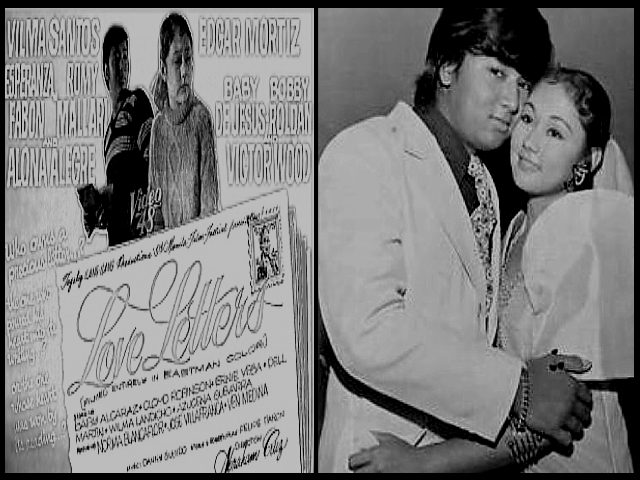
FILM REVIEW: LOVE LETTERS


The Plot: Film-Am Edgar falls in love with Vilma. The two had a set back that ended with Edgar returning all Vilma’s love letters that he regreted and wanted it back. He went to Vilma’s house to retrieve it but was caught and accused of stealing. The whole misunderstanding ended up in court but was settled eventually. Edgar left the country but returned for Alona Alegre’s wedding to Victor Wood. He also reunited Vilma. – RV (READ MORE)

The Reviews: Love Letters started with Vilma entering a living room and Baby De Jesus started playing the piano.  Suddenly, Vilma started singing and after finishing her song, she left the room, while a very young Alona Alegre sitting beside her appeared to be in her own world, as if she heared, nothing.  There were no interaction between the three, no dialouge, making this opening scene quite irritating.  The next scene, we found out that Edgar, played by Edgar Mortiz is a Filipino-American. We assumed that he is vacationing and taking some course. Next scene, Victor Wood is singing on the telephone while Alona Alegre is listening on the other line. Then it Edgar turn to sing.  This time, in the men’s dormitory followed by Baby De Jesus.  Her limited dialouge: she wanted to sing  “to entertain Vilma.”  Then Edgar and Vilma are set to meet in a park but because Vilma was so late, Edgar decided to leave. When she arrived and found no Edgar, she started to cry and ofcourse, she sings!  Not to be outdone, its Romy Mallari’s turn to sing!  Then its Edgar turn to sing again.  Edgar got so mad with Vilma and decided to return all of Vilma’s love letters.  In protest, Vilma returned his gift, a ring and bracelet.

Afterwards she sings the theme song, “Love Letter.” She followed this up with her day dreaming scenes, remeniscing the time when the two of them are singing in the park. She then fell asleep but was awaken by an intruder! Presto! It was Edgar! Stealing their love letters! He escaped when Vilma’s parent caught them talking. The next scenes was a courtscenes. Vilma and Edgar plus Vilma’s parent testified in front of a judge. A phone call from the mayor who is connected to Edgar postponed the judge’s decision.  As turned out, Vilma’s parent also owned some love letters which made them understand what their daughter is now going through. At the breakfast table the next day, Vilma all of the sudden proclaimed that she doesn’t care about Edgar anymore. Then they discovered that Edgar and his friends decided to have a picket line in their house (ala-“Occupy Wall Street”???).  They decided to remained in the picketline over night with more singing.  Sleeping outside, the girls headed by Alona Alegre, decided to join the picketline. Vilma’s parent confronted them and Victor Wood all of the sudden declared that he wanted to marry Alona Alegre! And to add to the drama, Edgar decided to leave the country. The next scenes was Vilma receiving love letters over time. Then finally the promised wedding of Victor Wood and Alona Alegre, Edgar then seranade Alona and Victor.  When Vilma heard and saw Edgar, she run to the church’s balcony.  They reunited with a duet!  The End.

Love Letters is a musical films specially made for the fans of “teeny-bopper” stars – Vi and Bot.  The film was probably shot with improvisations, which means, without a written script.  This was noticeably clear as the film’s main characters and the actual names of the actors were not change at all.  The film’s main plot was the the stealing of love letters that ended in court,  followed by picket line (ala-“Occupy” Wall Street) that was hard to believe.  And also the one-after the other testimonies of Edgar, Vilma and both parents that were irritatingly funny. Although we are used to Vilma’s tolereable singing, we’re more surprise to see a singing Alona Alegre!  She looked more like Eugene Domingo (clearly before her sexy films/image).  One more thing, Alona’s wedding gown was worth a second look, its not like your ordinary wedding gown.  The head piece was a beaded hood that covers her hair and neck.  With so much singing, Baby De Jesus’s voice stands out among the girls but her piano playing acting was over the top. Victor Wood’s duet with Edgar Mortiz, “Beautiful Dreamers” is worth downloading. Danny Subido was responsible for inserting all the musical numbers that was quite a tasks particularly without a well written musical screenplay.  The film was shot in Baguio City and cinematographer, Avelino Peralta’s did a wonderful job showcasing the city on Vilma’s day dreaming except for the akward courtscenes.  Love Letters was produced by Tagalog Ilang-Ilang Production and directed by Abraham Cruz, a forgettable film that only a die hard Vi and Bot fans (and those who loves film nostalgia) can only appreciate. – RV

RELATED READING:
IMDB: Love Letters (1970)
IMDB: Abraham Cruz
IMDB: Edgar Mortiz
IMDB: Esperanza Fabon
IMDB: Romy Mallari
Vilma Santos From Wikipedia
Edgar Mortiz From Wikipedia
Vilma and Edgar Duet (Video)
Clips – Love Letters (Video)
Vilma Santos-Edgar Mortiz Love Team Circa 1970

FILM REVIEW: INSPIRATION


The Plot: Single parents Tony Benetez (Carlos Salazar) and Sylvia Motolla (Merle Tuazon) fell in love and married without their spoiled and protective teen ager kids, Gina (Vilma Santos) and Danny (Jay Ilagnan). They decided to live in one roof with Sylvia getting pregnant and the two kids developing a special relationship. – RV (READ MORE)

The Reviews: Ishmael Bernal’s first film with Vilma Santos was 1972’s “Inspiration,” an unusual teeny-bopper team-up film of Vilma and the late Jay Ilagan. The film established its main characters as both very much protective of their parents. Although its not explained why both Tony Benetez (Carlos Salazar) and Sylvia Mottola (Merle Tuazon) are still single, they ended up dating and  eventually marrying each other. Gina Benetez (Vilma Santos) and Danny Motolla’s (Jay’ Ilagan) parents first met in a polo tournament attended by both families. They were introduced by the socialite grandmother of Danny, Lola Jane (Lilian Laing). Later that same day both single parent met again in a night club. It was clear then that both are attracted to each other but are afraid that their kids will not approved it.  They then continued to  secretly date until one day both kids discovered when all four of them accidentally met in a restaurant.  The complication ended when Lola Jane intervened.  With the help of Gina’s household maid, Choleng, the two planned an intervention.  The meeting ended up with both kids leaving the Lola Jane’s house while the parents eloped.

Without the kids aproval, the newly married couple returned and forced their kids to live in one roof.   Sylvia then got pregnant while Gina and Danny developed a secret affair. Another complication and here come Lola Jane to the rescue, in the hospital after Slyvia delivered her baby, it was understood that Lola Jane has informed Sylvia and Tony about their kids special relationship. The next scene was Gina and Danny having a motorcycle ride that ended up in a park.  Under the tree the two had an innocent chat about their relationship.  The End.

In a musical era of 1970s, “Inspiration” was quite an experimental film, with no musical numbers but with better screenplay and well-written characters. Nestor and Bernal works well in establishing the character of Jay and Vilma. Their dialouges are not “corny” and very realistic. There is no over the top dramatic scenes inserted between musical numbers here. The parent played wonderfully by Merle Tuazon and Carlos Salazar were convincing. Although both Vilma and Jay played their roles effectively, Lilian Laing steals the film as Lola Jane. She was bubly and funny, a sex-starved, karate black belter, polo game afficionado, who loves life, considering she is playing the old grandma who is also the solution to all the complication in the lives of our four main characters.

Bernal was on his element here, a good story teller, pre-“Dalawang Pugad Isang Ibon, Pahiram Ng Isang Umaga and Relasyon.” Although he is directing a light comedy, written by Nestor Torre Jr., he managed to established all the characters without relying on corny dialouges and musical numbers common in this musical era.

RELATED READING: