Vilma Santos-Recto is a popular multi-awarded actress and politician in the Republic of the Philippines. *** She is known as "Queen of Philippine Movies," "Queenstar," "Grand Slam Queen," "Box Office Queen," and "Star for All Seasons." *** This website is mostly about her iconic film career.
“Okay you’re fertile and I’m barren…pero sa mga pangyayari…para kang karinderyang bukas sa lahat ng gustong kumain!” – Fina
The Plot: On the outside, it looks like a marriage made in heaven. But inside the thick walls of what they call home, theirs is a relationship waiting to crumble. They have been wanting a child for so long, but the wife does not have the capacity to bear a child. And when her husband cannot take it any longer, he decides to end his misery once and for all. – IMDB
The story is about an infertile couple who never had a child of their own. The husband, frustrated by his wife’s infertility, hired somebody who was willing to carry his child. The hired woman got pregnant but she fell in love with the child’s father. The husband falsely adopted the child, hiding the fact from his wife that the child was his own. All the attention the husband gave to the child drove his wife to jealousy. To complicate things, the husband eventually had a secret affair with the child’s mother, and this affair produced another baby. The mistress left the newborn baby at the footsteps of the husband’s house. The wife then took care of the baby, and the children grew without their adoptive mother knowing that the two kids were fruits of her husband’s secret love affair. – Wikipilipinas
The Reviews: “…Eddie Garcia first directed Vilma in the Marcos film, Pinagbuklod Ng Langit. She reprised the role of eldest of the Marcos children, Imee and again co-starred with movie queen, Gloria Romero and dramatic actor, Luis Gonzales. Garcia directed Vilma again in 1982′s box Office Record Breaker, Sinasamba Kita. Three more hit films follows that gave us memorable movie lines like “Para Kang Karinderyang bukas sa lahat ng gustong kumain” in Palimos Ng Pag-ibig and “Si Val, si Val, si Val na walang malay!…” – (READ MORE)
“…Hit novels serialized in Aliwan Komiks were also adapted into movies:“Blusang Itim” by Elena M. Patron and Joey Celerio;“Pardina” by Jim Fernandez and Sonny Trinidad;“The Family Tree” by Pablo S. Gomez and Louie Celerio;“Palimos ng Pag-ibig” by Nerissa G. Cabral and Ernie H. Santiago;“Anak ni Zuma” by Jim Fernandez and Ben Maniclang;“Kamay ni Hilda” by Pablo S. Gomez and Louie Celerio…” – Wikipilipinas (READ MORE)
“…Palimos ng Pag-ibig (Filipino: “Begging for Love”) was a movie in 1985 and turned into a TV series in 2007 for the first installment of Sineserye Presents. This was from the original story by Nerissa Cabral. This movie was home of the famous tagline: “Para kang karenderiang bukas sa lahat ng gustong kumain!” (You’re like a restaurant that’s open to anyone who wants to eat!), In context of prostitution reference…” – Wikipedia (READ MORE)
“…Ang surrogacy or womb for hire, eh isang katotohanan na napagtanto nating lahat. Tinalakay ito in all its melodrama splendor sa Palimos ng Pag-Ibig, ang pelikula nina Vilma Santos, Edu Manzano at Dina Bonnevie. Sa movie, si Fina Alcaraz (Ate Vi) ay may infertile uterus. Desirous ang kanyang husband na si Rodel (Doods) to have a biological child so he hired Ditas (Miss D) na isang baby maker for a fee. Walang pros and cons ang surrogacy issue sa movie lalo na’t galing ang material sa komiks. Ang pinakamemorable sa movie eh ang linya ni Vilma na, “Para kang karinderyang bukas sa lahat ng gustong kumain.” Sosyalera si Ate Vi sa movie pero she can say lines like these…” – Alwin Ignacio, Abante Tonite, 22 March 2015 (READ MORE)
ABS-CBN proudly presents a grand five-part TV special for the one and only Star For All Seasons entitled ‘Vilma: A Woman for all Seasons’ airing on all Saturdays of August. Known as the Star for All Seasons, Vilma Santos is no stranger to the entertainment industry. Having been part of show business from the age of nine, Vilma won her very first acting trophy as Best Child Performer from FAMAS for the film Trudis Liit (Little Trudis). Since then, the respected actress has been in over a two hundred films and various TV programs over the years and has pleased the most prestigious award-giving bodies for movies and television such as FAMAS, Gawad Urian, PMPC and Catholic Mass Media awards among others. She was also honored with the Lifetime Achievement Awards by Cinemanila and FAP among others as well as UP Gawad Plaridel Award for her achievements as an actress and a public servant. Aside from bringing entertainment to Filipinos for several decades through her passion for acting, Vilma also has a heart for public service. She is currently in politics as the first woman Governor of Batangas who is appreciated by her constituents for being hands on and was also the first woman Mayor of Lipa City for three fruitful terms. She is also a doting mother to two wonderful sons and a loving wife to fellow public servant Ralph Recto. Presented in a documentary-magazine and reality TV format, fans and viewers alike will be in for a real treat as the revered multi-faceted woman tells all about her life in this five weekend special that will tackle everything on the esteemed actress-turned-Governor , from the start of her career to her term as the first woman Governor of Batangas as well as sneak peeks in her highly awaited and much talked about movie ‘In My Life’ with son Luis Manzano and blockbuster film actor John Lloyd Cruz. – TFC now (READ MORE)
The Kapamilya Network proudly presents the much awaited five-part TV special for the one and only Star For All Seasons aptly entitled ‘Vilma: A Woman for all Seasons’ available on TFCnow’s Premium Edition, starting the first Saturday of August. Presented in a documentary-magazine and reality TV format, fans and viewers alike will be in for a real treat as the respected and veteran actress tells all in this once in a lifetime event. This five episode special will tackle everything on the esteemed actress-turned-Governor – from the start of her career, to her term as a public servant as well as sneak peeks into her highly awaited and much talked about movie ‘In My Life’ with son Luis Manzano and blockbuster film actor John Lloyd Cruz. The first episode (available starting August 1), hosted by Claudine Barretto who has worked with Vilma in the drama film ‘Anak,’ showcases Vilma as an actress/ artist, being the four-time grand slam Best Actress in various award-giving bodies as well as receiving Lifetime Achievement Awards from Cinemanila and FAP among others. This also highlights a special acting workshop by Vilma herself in collaboration with respected director Laurice Guillen for hand-picked Star Magic talents who will imitate scenes from her unforgettable movies.
This exclusive workshop is undeniably a must-see and is participated by the likes of Primetime Princess Kim Chiu (who acted out the scene in the film “Dolzura Cortez” where PDA scholar Bugoy bravely faced Kim’s slapping hand), indie King turned mainstream actor Coco Martin, host and singer Nikki Gil, breakthrough kontravida beauty Megan Young, some of the favorite PDA and Pinoy Fear Factor stars as well as the rest of the Star Magic family. On the following week (available starting August 8), viewers will see Vilma as a TV host, dancer and performer. With funny man Vhong Navarro adding laughter with his comical antics and wacky remarks as the host, the Star for all Seasons shares some of her insights and experiences during tapings and shootings – from unavoidable health concerns and even to romantic problems with her good-looking leading men. We will relive the days of “VIP” show where she used to do her special numbers in her most colorful costume and danced the most complicated dance routines by no less than Maribeth Bichara. Joining the prized actress in the dance workshop are young stars Shaina Magdayao, Angelica Panganiban, Iya Villania, Empress Shuck, Nina Dolino, Princess Ryan and Dianne Medina. Definitely something to look forward to is the much-awaited dance number of Vilma with the said stars!
Next episode (available starting August 15), fans and supporters will have an exclusive preview of Vilma’s private world as one of the young actresses closest to her heart, teleserye Princess Angel Locsin hosts this very personal chapter. Vilma welcomes viewers into her home in Alabang which is the very first time her private quarters will be shown on Philippine television. Featuring the prized actress as a wife, mother, sister and friend, we will see how she spends her free time at home and what a ‘normal’ family day is in the life of Governor Vi. On the fourth installment (available starting August 22), Vilma is shown as an empowered Filipina leader being the hands-on and the first woman Governor of Batangas and a UP Gawad Plaridel Awardee for her achievements as an actress and a public servant. Capping off this five-episode special (available starting August 29) is your very own VIP pass into the making of Vilma’s movie, ‘In My Life’ with eldest son Luis and John Lloyd who will also serve as the hosts. Be the first to peer into some of the movie scenes and events shot at the colorful city of New York, listen in on some selected interviews with the cast and crew as well as trivia on the much-anticipated film and get an exclusive sneak peek into the never before seen behind-the-scenes shots. – TFC now (READ MORE)
How is Vilma as a wife and mother? – The Aug. 15 episode has the answer: For the first time, the actress allows a TV crew to shoot inside her new house in Alabang. The episode will also display the musical talents of hubby Ralph Recto and second son, Ryan Christian. The fourth episode focuses on Vilma as a public servant. And, for the final episode, she will be seen during the shooting of her forthcoming movie with her son, Luis, and John Lloyd Cruz. Parenthetically, she told us that she doesn’t aspire for the country’s vice presidency because all her plans are exclusively for Batangas. – Remy M. Umerez, Philippine Daily Inquirer Aug 07 2009 (READ MORE)
“Buong buhay ko yan na lang lagi ang sinasabi nila sa akin…wala kang magagawa eto ang gusto ng asawa mo…wala kang magagawa eto ang kapalaran mo…wala kang magagaw dahil dapat…putris naman, dapat hindi ganuo…tapos sasabihin ng daddy n’yo hindi lang ang anak ko ang pinatay hindi lang ang anak ko ang dinukot…lalo akong nanggigigil, lalo akong nagagalit dahil kung nanay ka talaga, hindi ka lang dapat nanganganak kundi naiapaglaban mo rin ang anak mo dapat kaya mong pumatay para sa anak mo…gusto ko lang malaman bakit nila pinatay ang anak ko…hindi masamang tao ang anak ko, kahit sa oras na ito humarap ako sa diyos kahit sa dimonyo hindi masamang tao ang anak ko…hindi masamang tao ang anak ko!” – Amanda Bartolome
“You could stop being proud of me! Nagsawa na ako sa ganuon, gusto ko naman ngayon ako mismo just for a change, maging proud sa sarili ko!” – Amanda Bartolome
The Plot
Dekada 70 is a story of a family caught in the midst of a tumultuous time in Philippine history – the martial law years. Amanda (Vilma Santos) and Julian (Christopher Deleon) is a picture of a middle class couple with conservative ideologies, who must deal with raising their children, five boys – Jules (Piolo Pascual), Isagani (Carlos Agassi), Emmanuel (Marvin Agustin), Jason (Danilo Barrios) and Bingo (John Sace) in an era marked by passion, fear, unrest and social chaos. As siblings struggle to accept the differences of their ideologies, as a father faces the painful dissent of his children, a mother’s love will prove to be the most resonant in the unfolding of this family’s tale, will awaken to the needs of her own self, as she embarks on a journey of discovery to realize who she is as a wife, amother, a woman and a Filipino. – Star Cinema
Dekada ’70 (English: 70s Decade) is a 2002 Filipino drama film released based on a book called Dekada ’70 written by Filipino author, Lualhati Bautista. The film tells the story of the life of a middle-class Filipino family who, over the space of a decade, become aware of the political policies that have ultimately led to repression and a state of Martial law in the Philippines. Filipina actress Vilma Santos stars as Amanda, who realizes the implications of living within a dictatorship after sorting out the contradictory reactions of her husband and five sons. Her husband (Julian), played by Filipino actor, Christopher de Leon, supports his eldest son’s (Jules), played by Filipino actor, Piolo Pascual; efforts to rail against the government while refusing to follow Amanda’s wish to find a job. Her second son (Gani), played by Filipino actor, Carlos Agassi, is in the United States Navy. Her third son (Eman), played by Filipino actor, Marvin Augustin, writes illegal political exposes. The fourth son (Jason), played by Filipino actor, Danilo Barrios fell victim to a corrupt police department, and her youngest son named (Bingo), played by Filipino actor, John W. Sace, is still a boy. – Wikepedia (READ MORE).
The Reviews
“…At the center of the film and the family is Amanda (Filipino cinematic diva Vilma Santos) who vicariously experiences living under a dictatorship through her husband and five sons’ different reactions before coming into her own as a person. Her husband, Julian (Christopher De Leon), seems a walking contradiction: He offers rationalizations for the government while supporting his eldest son’s revolutionary activities, but has a fit when his wife wants to get a job. As for the sons, firstborn son (Piolo Pascual) joins the guerillas in the mountains. The second son (Carlos Agassi), forced into a shotgun wedding, defiantly works for the American Navy. The third son (Marvin Augustin) writes journalistic exposes he can’t publish, while the fourth son (Danilo Barrios) is a mystery to his family until his brutal, motiveless murder (probably by police) reveals a lost girlfriend. The fifth son (John W. Sace) is still a boy. Santos’ Amanda effortlessly and movingly chronicles the changed consciousness of the family and the country, with understatement her most reliable tool. Pic begins and ends with images of Santos at the forefront of a political demonstration, and nothing, from first image to last, for 128 minutes, is allowed to spontaneously or slyly deviate from the logic of her consciousness-raising.” – Ronnie Scheib, Variety Magazine (READ MORE)
“Last seen in ANAK (SFIAAFF ‘01), Vilma Santos delivers an understated, profoundly moving performance as the matriarch whose awakening redefines the traditional mother and wife role she donned for years. This is the story of an incredible character that survived an unforgettable decade.” – Michael Magnaye, The 22nd San Fransisco Asian-American Film Festival, 2004 (READ MORE)
“…Rono and Bautista, who writes her own adaptation, have obviously worked very closely in fleshing out the novel on screen. The result is an effective and even subtle tableau of scenes to present the Bartolome family’s struggles from the late ‘60s to ‘70s that not only set the domestic drama, but also prefigure the wider social and historical saga unfolding before the nation. No scene is wasted, no useless pandering to the viewer’s sense of spectacle or penchant for soap opera is even attempted. The competent production design, the agile editing, the stark photography (which impresses even the Paris-based Filipino-Spanish painter Sanso who calls it comparative to the best in Europe) ensures a panoply of images that is immediate, recognizable, and keen. Like Regal Films, Star Cinema has been compelled to throw in its stable of stars so that the Bartolome siblings look distractingly too much like a boy band. But because they play well-thought-out characters, their damage is put to a minimum. In some cases, like Piolo Pascual as Jules, the young communist rebel, the effect is heart-wrenching. Pascual plays, along with Vilma Santos as Amanda, one of the centers of gravity of the movie; the other center consists of Santos and Christopher de Leon. As arguably the first unabashedly feminist Filipino novel, “Dekada” shows a woman’s awakening to her nature and gender through the men of her life-her husband and her first born. Their age, generation and preoccupation divide both men, and Amanda serves as their bridge and transition. In the process, Amanda herself is transformed. She becomes herself. The most moving scenes of the movie are of Jules and Amanda meeting on the sly and forced to carry on mother-and-son endearments hurriedly because of the threat of arrest. But the most poignant scene is Julian and Amanda confronted with the terrible loneliness of their advanced years, left by their children, he turning away from her to hide his tears, and she asking him to face her and not to be ashamed. It helps that the scene is played by Santos and De Leon, truly one of Filipino cinema’s most effective screen couples. As Amanda, Vilma Santos shows again why Brocka, before he died, had likened her to water. “She can register anything,” he said. In “Dekada”, its the same Santos of vigor and transparency. The only difference is the depth, the resonance, and the greater confidence. Can she ever go wrong?” – Lito B. Zulueta, Philippine Daily Inquirer, 30 December 2002 (READ MORE)
“…Ang Dekada ’70 ay isang mahusay na adaptasyon sa pelikula ng nobela nitong may parehong titulo. Napanatili ang kaluluwa ng nobela sa pelikula sa kabila ng limitasyon ng pelikula bilang isang audio-visual na medium. Marahil, nakatulong ng malaki ang pagkakaroon ng iisang manunulat lamang. Naging maayos ang takbo ng pelikula na tulad sa nobela nitong nahati sa mga taon ng dekada ’70. Mahusay ang pagkakaganap ng mga pangunahing tauhan (maliban kay Carlos Agassi) na nakapagbigay hininga sa mga tauhang noo’y nababasa lamang. Naibalik ng pelikula ang larawan ng dekada ’70 sa mga eksena nitong nagpapakita ng mga demonstrasyon, protesta at rallies na tunay na nangyari noong panahon na iyon. Ang musika at tunog ay madalas na akma at nagpapaigting sa emosyong nais ipahatid ng pelikula. Naging mahina lamang ang disenyong pamproduksiyon ng pelikula na hindi naging masusi sa make-up, at kasuotan ng mga tauhan sa pawang hindi parating umaangkop sa panahon…” – Catholic Initiative for Enlightened Movie Association (READ MORE)
“…Dekada 70 journeys with the central character Amanda Bartolome (Vilma Santos), the reticent wife of an alpha-male husband, and the worrying mother of a boisterous all-male brood. Thoroughly relegated to domesticity in a world slathered in testosterone, Amanda begins to undergo a transformation when her family becomes imbricated in the sociopolitical realities brought about by the Marcos dictatorship. The declaration of Martial Law, the lifting of the writ of habeas corpus, the curfews and police searches, all these could have easily floated past Amanda’s head had her sons not found themselves caught in the crossfire between the government and the pro-democracy movements. As one son after another faces the oppressive forces of the dictatorship, Amanda gradually realizes that the personal is political. While chanting slogans for sociopolitical change, she finds her own voice and comes to terms with the fullness of her own person…There are touches of seventies style Filipino humor that foreign audiences might miss; they effectively establish that this is a real, average Filipino family trying to navigate through the eye of the political storm. The acting is generally impressive, most especially that of lead actress Santos, who gives a luminous, sensitive performance. Santos essays the transformation of Amanda so effectively that we do see clearly at the end of the film that there has been a fundamental change in her character. If there is something to be faulted about the film, it is Roňo’s failure to keep melodramatic moments in check. The funeral sequence of one of Amanda’s sons, for instance, becomes an over-extended session of copious tears. The rich story material of Dekada 70 could do away with such “in your face” paroxysms, which only work to dull the film’s cutting edge political trajectory. Nonetheless, it cannot be denied that Roňo had created a noteworthy, epic-scale Filipino film, and on a Third World budget at that. It also cannot be denied that Roňo had not forgotten the sentence of history on his home country…” – Antonio D. Sison, Insititute for Pastoral Initiatives University of Dayton (READ MORE)
“…about Vilma’s performance in “Dekada ‘70”: Some jurors, viewers and reviewers have expressed dissappointment over it because they regard it as too passive, low-key, unemotional, too much taken up with observation, and reflection instead of action. Thus, it doesn’t deserve the best actress award. We disagree. We think that, precisely because Vilma’s portrayal was so restrained for the most part, it was more difficult to achieve. It’s far easier to rant and rave, to “feel” bigtime, to run the gamut of emotions from A to Z- but, if Vilma did that, she would have gone against her character’s nature, as written…during the first half of the film, Vilma’s character occasionally felt unhappy, taken for granted or unappreciated as a person, but she held her emotions in check to keep the peace in the family. It was only later, when the national trauma of martial law rule affected her sons in various tragic ways, that she found the voice and rediscovered the heart to assert herself as a person and to give her emotions full play. We submit that Vilma’s portrayal is excellent precisely because she vivified he character as the wife and mother was in the ‘70s. Her thematic and emotional high points towards the end of the film rivetting, but it was her quieter, more controlled moments that showcased Vilma’s true gift as an actress. During those moments, Vilma didn’t just observe what was going on, she was constantly conflicted only, she had been programmed not to speak out because it wasn’t her “place”. Thus, when she finally changes and expresses herself in the end, the contrast makes her transformation all the more stunning. In the movie’s first half, Vilma is such a good actress that, although she may not be the active element in her family (her husband is), she is quietly involved in each and every scene, and every new development is seen from her point of view. Even better, despite her relative lack of dialogue at this point, we can “read” her thoughts on her face as clearly as though she were speaking. And we see her slowly changing before our very eyes, gradually overcoming her reticence, discovering her true worth, and finally finding and expressing her true self. This is very difficult to do, as any true thespian will affirm. Which is why, unlike some people who dismiss Vilma’s portrayal as passive and weak, we think it ranks among her best, right up there with her performances in and fully deserving of the filmfest’s coveted best actress trophy.” – Nestor Torre, Philippine Daily Inquirer (READ MORE)
“…The reason “Sister Stella L” will probably end up better appreciated is that the movie was shown during the martial law era. The movie was relevant to the times and Vilma was portraying an activist nun, a role not usually associated with the Star for all Seasons… As the mother, Vilma does justice to her character, holding back her strong emotions until the end, when she finally confronts Christopher de Leon and wants to break up with him. Despite the many tragic events that befall her character, Vilma chooses to underplay her role except at key points towards the end of the movie. Boyet is his usual competent self as the chauvinistic husband of Vilma who is forced to change when his wife breaks out of her shell. Piolo Pascual also deserves mention for his realistic portrayal of the activist turned NPA rebel…” – Edmund L. Sicam, Philippine Daily Inquirer (READ MORE)
“…Unlike Vilma Santos’ Sister Stella L. character, who becomes politicized practically overnight, her Amanda role in “Dekada ‘70” takes longer to mature politically (almost the whole decade). And she goes through a very painful process because she experiences the abuses of the marcos regime by seeing her own children suffer. With Vilma hurting inside and suffering almost in silence, we have here in “Dekada ‘70” some very moving dramatic scenes that are mostly devoid of hysterics but are still very effective nonetheless. Actually, we see yet another facet of Vilma Santos’ acting talent in this film. In the story, she goes through guilt (with the fate of one of her sons), pain, anguish and anxiety (particularly with the eldest, Piolo)-plus discontent as a plain housewife who wants to do something more with her life other than to keep house for her husband and kids. The great actress that she is, Vilma is able to manifest clearly the different layers of her character in a very quiet manner, which-you have to admit-is quite difficult to achieve. But Vilma-after all these decades -can do no wrong anymore in the field of acting. Although it’s not the greatest performance of her career (it’s still Sister Stella L), her portrayal of Amanda in “Dekada ‘70” is no doubt one of her finest. More importantly, her role (and her approach to it) is different from the hundreds of other roles she has done in the past…” – Butch Francisco, The Philippine Star (READ MORE)
“…Santos’ performance is so vivid and insightful that we can see her changing in front of our very eyes… We were enthralled…we were moved. And we valued the film’s important contribution to the very urgent task of reminding everyone of the trauma in our collective lives that was the martial law period of the ’70s,” noted Nestor Torre of Inquirer News Service. Chito Rono’s Dekada ‘70 made its world premier at the Asian American International Film Festival in June of 2003. The film has also won numerous domestic awards. The Young Critics Circle voted Dekada ‘70 Best Film of the Year (2002), Best Screenplay, Best Sound and Best Performance in a tie between actress Vilma Santos (Amanda) and Piolo Pascual (Amanda’s eldest son). The Best Film of the Year award is reserved for the director, such that no separate prize for direction is needed. The Best Performance award is the most coveted as it is conferred on the performer whether male or female, adult or child, individual or ensemble in leading or supporting role. Vilma Santos also received an award for Best Actress from Star Awards for Movies, Film Academy of The Philippines, and Gawad Urian Awards. Piolo Pascual also received an award for Best Supporting Actor from the Young Critics Film Circle, Metro Manila Film Festival, Star Awards for Movies, Film Academy of the Philippines, FAMAS Awards, and Gawad Urian Awards. The Gawad Urian Awards also presented Dekada ’70 with the award for Best Screenplay…” – Sara Stokoe, Asia Pacific Arts (READ MORE)
“…In Chito S. Roño’s superb “Dekada ’70,” a family in the Marcos-era Philippines has a domineering father and five sons, but it is the mother (Vilma Santos) who provides the mental stamina. She fights for her family in ways the father can’t even dream of. “To give birth to these children isn’t enough,” she says. “You have to defend them, protect them.” That’s the ’70s. In 30 years, that kind of woman will deal with difficult questions of divorce and motherhood, one in which women want freedom, yet must be willing to share blame when something goes wrong. The young woman who leaves her husband and thinks about aborting her pregnancy in South Korean filmmaker Gina Kim’s “Invisible Light” is an experimental example. Moon’s great performance in “A Good Lawyer’s Wife” almost makes you believe wrong is right, and, taken with her much-lauded portrayal of a girl with cerebral palsy in “Oasis,” reveals her as one of the world’s best actresses. Hollywood, take note. – No stereotypes of Asians here…” – G. Allen Johnson, Festival Celebrates Real Women, San Francisco Chronicle March 4, 2004 (READ MORE)
“…The young actors that were cast in Dekada ’70 were all guilty of doing too much “acting”. I don’t think actors should be acting-out, or (in this case) over-acting, unless they were filming a farce, or a comedic parody. Inexcusable mediocre performances plagued every scene. Instead of ensuring the characters were having a real conversation (real interaction), it seemed as though they were merely spitting out lines which they had memorized word-for-word, the delivery, inflections, and pauses unnatural. People don’t talk to each other like this in real life now, do they? Of course not. It is sometimes possible for a younger actor to deliver a satisfactory performance though the guiding hand of an experienced veteran. This of course is quite rare, as it calls for a unique, uncalculated, natural chemistry that can never be faked. Award winning greats like Vilma Santos and Christopher De Leon should never be subjected to work with a group of inexperienced pretty faces who are incapable of displaying a sense of depth and sophistication. Proof that casting makes for a vital element that determines the success of a film…” – Edwin Manalo(READ MORE)
“…The characters of brothers Jules (Piolo Pascual) and Eman (Marvin Augustin) share similar anti-Marcos perspectives in the movie. A movie that attempts to add a more familiar and human touch to a real event isn’t without its melodrama. The overt use of music to drive emotion home and unnecessarily lengthy shots distract a bit from what otherwise could have been short and sweet takes of awesome performances. The pace of the film seems to slow down mid-way through the film. Yet these faults are minute enough that they probably didn’t even deserve a mention…This movie makes for a satisfying introduction to this decade in Philippine history. I shouldn’t forget to mention how faithful the movie remains to the styles of dress, the models of cars, and the music of the time to strongly present the age and era the movie takes place. Most importantly Dekada ’70 presents to us the emotional aspect, an aspect you cannot obtain through school textbooks, snapshots, and soundbites of Martial Law under Marcos. This is communicated successfully through its collection of talents seen through the eye of a veteran director…” – Pinoy Movie Reviews(READ MORE)
“…Dekada ’70 tells of how under hate, greed and corruption, one normal person transcends beyond right and wrong: instead learns that it is freedom that entails survival. Set in the 70′s, urban Metro Manila, Amanda Bartolome is a middle-class mother of five young men. Amanda acts as a supposed symbolism of detachment. First of all, she was a mother, a housewife; such were not considered integral parts of society during those times. She was not the breadwinner; she did not experience the foremost effects of the decline of the Philippines economy back then. She was a member of the middle class; her family did not take money, like the rich, nor did her family suffer the worst of the financial crises, like the poor. The lives of Amanda’s children each went in different directions in the story, and each varied. Her eldest son was Jules. Jules grew up normally, similar to every other ideal family. His upbringing was that of what ideally conformed to normal standards and circumstances. Being the eldest, however, Jules lived, and more importantly, matured through the shock caused by the declaration of President Marcos’ martial law. Thus, Jules lived his adolescence exposed to rebellious reading material, and inevitably molded his mind into that of guerilla. Jules grew up to become a member of the communist New People’s Army, and his evolution came full circle…” – Dekada 70, A Book Review (READ MORE)
“…For ten consecutive years from 1995 to 2004, the Philippines submitted films for consideration for the Best Foreign Language Film category of the Oscar Awards. But up to this point of film history, we remain in the list of countries who has never won nor nominated for this award…The next year 2003, the country’s entry was Dekada ’70, directed by Chito S. Rono based on the novel Dekada ’70 of Lualhati Bautista. It tells the story of a middle-class Filipino couple (Christopher de Leon and Vilma Santos) and their five sons during a tumultuous decade of the martial law regime. The sons were played by Piolo Pascual, Carlos Agassi, Marvin Agustin, Daniel Barrios and John Wayne Sace…” – FAP (READ MORE)
Fernando Poe Jr.’s “Lawin” (hawk) failed to soar high at the box office after Ramon “Bong” Revilla Jr.’s “Agimat” (amulet) proved to be more powerful. Working wonders at the tills, “Agimat ni lolo,” Revilla’s action-fantasy-adventure movie was the top grossing film on the first day of the festival last Wednesday, edging out Poe’s “Alamat ng Lawin,” from top slot. Caloocan Mayor Rey Malonzo, chair of the MMFF executive committee, refused to divulge the box-office figures because “that was the request of the other producers.” An MMFF insider, however, disclosed that “Agimat” earned P14 million gross on the day it opened. Imus Productions bankrolled “Agimat.” As early as yesterday noon, Revilla said he was told that “Agimat” was already leading in the box office race. A number of theaters opened as early as 9 a.m.yesterday, making it easy to determine the results after only the first screening. Revilla outshone even comedy king Dolphy’s “Home Along da Riles,” which ranked only third. Regal Entertainment’s “Mano Po,” which boasts a powerhouse cast and Joel Lamangan at the helm, came in fourth. Star Cinema’s period opus, “Dekada ’70,” directed by Chito Rono and top billed by drama royalty Vilma Santos and Christopher de Leon, was fifth. The epic tale of Filipino hero “Lapu-Lapu,” with Pampanga Governor Lito Lapid in the lead, took the sixth place, and Reflection Films’ “Hula Mo, Huli Ko,” starring Rudy Fernandez and Rufa Mae Quinto, came in seventh in the box-office race. But the box-office tallies might still change after tonight’s “Gabi ng Parangal,” when the MMFF hands out the awards to this festival’s best films. Two more entries – OctoArts Films’ “Lastikman” starring Vic Sotto and Regal Film”s “Spirit Warriors 2: Short-cut” -will be shown starting Jan 1. The filmfest will run until Jan 10. – Leah Salterio Philippine Daily Inquirer, Dec 27 2002 (READ MORE)
This year’s Metro Manila Film Festival (MMFF) sports a new name, but its trademark controversial image and reputation remain the same. The 28th MMFF has included a “P” in its official name. The “P” which stands for Philippines, means the entries in the festival can now be seen nationwide. The cast of “Dekada ’70” staged a walkout. A special effects awardee returned his trophy. A film that failed to make it to the filmfest’s top seven won thrid best picture. These and other inconsistencies were the “highlights” of this year’s “Gabi ng Parangal” awards ceremony last Friday. Piolo was “Dekada ’70’s” biggest winner as best supporting actor for his compelling portrayal of a tortured rebel leader in Chito Rono’s period drama. John Wayne Sace, who plays Pascual’s brother Bingo, bagged the best supporting child actor award. “Dekada ’70” also bagged the second best child actor award. “Dekada ’70” also bagged the second best picture award. Regal Films’ “Mano Po” romped off with the most number of awards, including the best actress plum that went to Ara Mina, who best-ed the veteran “Dekada ’70” star Vilma Santos. Eddie Garcia was adjudged best festival actor, while Joel Lamangan was named this year’s best director. Kris Aquino won best supporting actress also for “Mano Po.” Regal Films matriarch Lily Monteverde thanked the filmfest committee in Aquino’s behalf. Mother Lily has two more reasons to say “Chi chien” after “Mano Po” won best picture and best original story for writer Roy Iglesias. Iglesias also won the best screenplay citations for “Mano Po.” Resty Garchitorena and Tara Limberger took home the best cinematography and best film editor awards, again for “Mano Po.” The cross-cultural drama, which even partly filmed in Beijing, China, bagged a toral of 12 awards that night. Bong de Guzman snatched the best musical score trophy from such veteran composers as Louie Ocampo, Nonong Buencamino, Jimmy Fabregas and Elmer Sayson.
Best festival production design trophy was awarded to Tatus Aldana for his spectacular work on “Mano Po.” The biggest surprise came when Chito Rono’s “Spirit Warriors 2: Shortcut.” won third best picture. The award came as a surprise even to its director Chito Rono, who upon hearing the news, commented that “the award only proved how good the movie is.” “Spirit Warrior 2” snatched the festival’s two most important technical awards – best make-up for Warren Munar and best visual effects for Dodge Ledesma and Road Runner Productions. Unlike “Alamat” and “Lastikman” which didn’t get any award, Reflectin Films’ “Hula Mo, Huli Ko” and RVQ Productions’ “Home Alone da Riles” each won an award. RVQ Productions’ “Nasaan Ka” was heralded as this year’s best theme song, while Caloy de Leon won the best sound recording plum for his work on “Hula Mo.” De Leon, however, returned the award later that night. “I want the jurors to explain to me how can a film dubbed in mono like “Hula Mo” win over other films dubbed in Dolby digital,” he said. Imus Productions’ spectacular “Agimat” float took home P75,000 after bagging the best festival float award. Noticeably absent during the awards night were “Alamat ng Lawin” lead star Fernando Poe Jr., his leading lady Ina Raymundo, and the entire cast of “Lastikman,” led by comedian-producer Vic Sotto. Poe’s long-time aide, Amay Bisaya, said the action king chose not to attend the ceremony to “avoid intrigues and politicking.” – Marinel R. Cruz Philippine Daily Ingquirer, Dec 29 2002 (READ MORE)
Spanning five decades with 197 films credits and almost two hundred awards, Vilma Santos’ filmography is a kaleidoscope picture of changes in times. Different genres, from teen musicals, folksy fantasies, campy horrors, animated actions to mature adult dramas, her films demonstrated her inner acting talents honed by directors, maneuvered by film producers/benefactors (who some are no longer with us) and supported by her ever loyal fanatics. The results were a long list of film titles that covered several social relevance that capture each decades. A long list of record-breaking box office returns that gave her the title, “the longest reigning box office queen of all time.” A long list of films that sustained her career to different transformation, ensuring her longevity no other Filipino movie queen ever enjoyed. We have painstakingly choose the best of the best. Basing our selection with three criteria. First, the financial success of the film. Cliche it maybe, financial success sustained her bankability and longevity. Second is the critical recognitions the film received. Third, is the other factors that contribute to the overall success of the film, namely, relevance, entertainment value, and the question of, is this film a career milestone or is this film contributed to her popularity. Here are Vilma Santos’ top 100 films.
Total score consists of (A) 10 points for box office records, (B) 10 points for critics recognitions, (C) 10 relevance/longevity, (D) “other factors” that contribute to overall success, gives us total score of 30 points.
60. Mga Mata Ni Angelita 1978
SCORE: 6(A) + 10(B) + 5(C) + 0.08(D) = 21.08(T)
Directed by Lauro Pacheco, starring: Julie Vega, Gloria Sevilla, Boots Anson-Roa, Alma Moreno, Rosanna Ortiz, Nora Aunor, Trixia Gomez, Marissa Delgado, Etang DischerMat Ranillo III, Roldan Rodrigo, Christopher De Leon, German Moreno, Rez Cortez, Eddie Rodriguez, Dolphy, Fernando Poe Jr. Vilma’s segments made this film in our list of memorable non-lead role. – MORE INFO
59. Rock, Baby, Rock 1979
SCORE: 6(A) + 10(B) + 5(C) + 0.09(D) = 21.09(T)
Directed by Oscar Miranda, starring: Leah Navarro, Lorli Villanueva, Geleen EugenioJunior, Rolly Quizon, Tito Sotto, Vic Sotto, Joey de Leon, Val Sotto, VST & Company – MORE INFO
58. Hiwalay 1981
SCORE: 7(A) + 8(B) + 6(C) + 0.1(D) = 21.1(T)
Directed by Romy Susara, starring: Dindo Fernando, Eddie Rodriguez – MORE INFO (no available video)
57. Susan Kelly, Edad 20 1977
SCORE: 6(A) + 10(B) + 5(C) + 0.2(D) = 21.2(T)
Directed by Maria Saret, starring: Laila Dee, Dante Rivero, Anthony Alonzo, Romeo Enriquez, Chito Ponce Enrile, Cloyd Robinson, Sandy Garcia, Laila Dee, Ramon Zamora – MORE INFO (no available video)
56. Hindi Nahahati ang Langit 1966
SCORE: 7(A) + 8(B) + 6(C) + 0.3(D) = 21.3(T)
Directed by Lauro Pacheco, starring: Lolita Rodriguez, Marlene Dauden, Eddie Rodriguez – MORE INFO (no available video)
55. Masarap, Masakit ang Umibig 1977
SCORE: 7(A) + 8(B) + 6(C) + 0.4(D) = 21.4(T)
Directed by Elwood Perez, co-starring: Christopher De Leon, Mat Ranillo III with Anita Linda, Ma-An Hontiveros, Lillian Laing, Laila Dee, Amado Cortez, Sandy Garcia, Cloyd Robinson. Official Philippines’ entry to the 1981 ASEAN Film Festival and Sydney Film Festival. Official entry to 1978 Asia-Pacific Film Festival in Taipei. – MORE INFO
54. Minsan pa Natin Hagkan Ang Nakaraan 1983
SCORE: 7(A) + 7(B) + 7(C) + 0.5(D) = 21.5(T)
Directed by Marilou Diaz-Abaya, co-starring: Christopher De Leon, Eddie Garcia. – MORE INFO
53. Halik sa Kamay, Halik sa Paa 1979
SCORE: 7(A) + 7(B) + 7(C) + 0.6(D) = 21.6(T)
Directed by Luis Enriquez, co-starring: Rosemarie Gil, Ester Chavez, Angie Ferro, Angge, Virginia Montez, Aurora SalveRonald Corveau, Eddie Rodriguez, Jose Vergara, Roderick Paulate. Vilma recieved a best actress nominationf from 1979 FAMAS. – MORE INFO
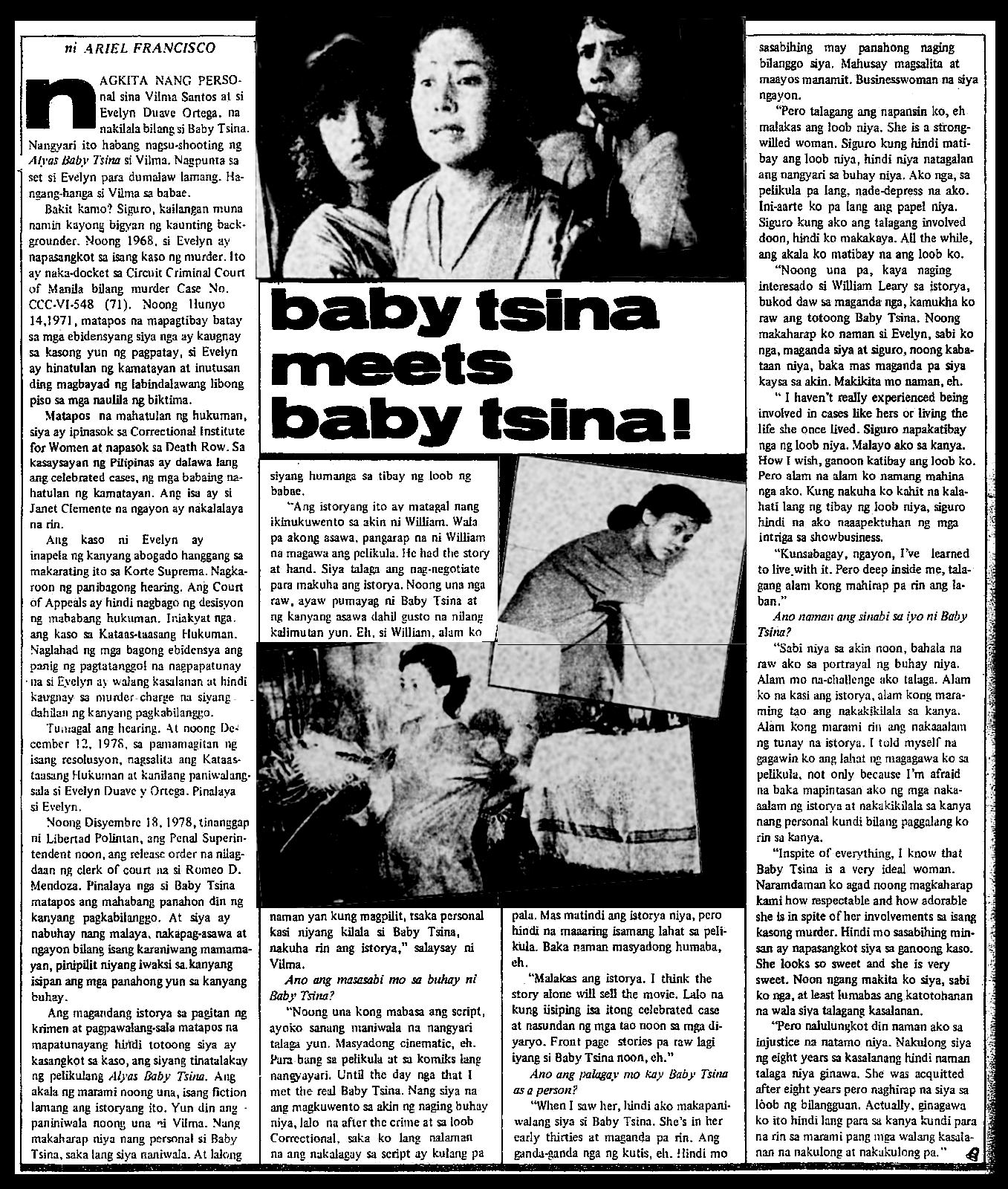
52. Alyas Baby Tsina 1984
SCORE: 7(A) + 7(B) + 7(C) + 0.7(D) = 21.7(T)
Directed by Marilou Diaz-Abaya, co-starring: Phillip Salvador, Dindo Fernando withZeny Zabala, Cecille Castillo, Chanda Romero, Raquel Villavicencio, Caridad Sanchez, Maria Isabel Lopez, Dexter Doria, Mary Walter, Vangie Labalan, Harlene Bautista, Rez Cortez, Rolando Tinio, Len Santos, Johnny Delgado – MORE INFO (no available video)
51. T-Bird at Ako 1982
SCORE: 7(A) + 7(B) + 7(C) + 0.8(D) = 21.8(T)
Directed by Danny Zialcita, co-starring: Nora Aunor, Baby Delgado, Rosemarie Gil, Suzanne Gonzales, Odette Khan, Anita Linda, Liza Lorena, Adul de Leon, Rustica Carpio, Anita LindaDindo Fernando, Tommy Abuel, Tony Carreon, Alvin Enriquez. Written by Portia Ilagan. – MORE INFO
RECAP:
60. Mga Mata Ni Angelita 1978
59. Rock, Baby, Rock 1979
58. Hiwalay 1981
57. Susan Kelly, Edad 20 1977
56. Hindi Nahahati ang Langit 1966
55. Masarap, Masakit ang Umibig 1977
54. Minsan pa Natin Hagkan Ang Nakaraan 1983
53. Halik sa Kamay, Halik sa Paa 1979
52. Alyas Baby Tsina 1984
51. T-Bird at Ako 1982
Spanning five decades with 197 films credits and almost two hundred awards, Vilma Santos’ filmography is a kaleidoscope picture of changes in times. Different genres, from teen musicals, folksy fantasies, campy horrors, animated actions to mature adult dramas, her films demonstrated her inner acting talents honed by directors, maneuvered by film producers/benefactors (who some are no longer with us) and supported by her ever loyal fanatics. The results were a long list of film titles that covered several social relevance that capture each decades. A long list of record-breaking box office returns that gave her the title, “the longest reigning box office queen of all time.” A long list of films that sustained her career to different transformation, ensuring her longevity no other Filipino movie queen ever enjoyed. We have painstakingly choose the best of the best. Basing our selection with three criteria. First, the financial success of the film. Cliche it maybe, financial success sustained her bankability and longevity. Second is the critical recognitions the film received. Third, is the other factors that contribute to the overall success of the film, namely, relevance, entertainment value, and the question of, is this film a career milestone or is this film contributed to her popularity. Here are Vilma Santos’ top 100 films.
Total score consists of (A) 10 points for box office records, (B) 10 points for critics recognitions, (C) 10 relevance/longevity, (D) “other factors” that contribute to overall success, gives us total score of 30 points.
20. Tag-ulan sa Tag-araw 1975
SCORE: 8(A) + 10(B) + 7(C) + 0.4(D) = 25.4(T)
Directed by Celso Ad. Castillo, co-starring: Christopher De Leon, Eddie Garcia, Joseph Sytangco, Lorli Villanueva, Odette Khan, Alma Moreno, Eva Darren, Edna Diaz, Nympha Bonifacio, Joonee Gamboa, Rez Cortez, Soxy Topacio. The first film of Christopher Deleon and Vilma Santos, as of 2008, total 23 films. – MORE INFO
19. Sinasamba Kita 1982
SCORE: 7(A) + 10(B) + 8(C) + 0.5(D) = 25.5(T)
Directed by Eddie Garcia, co-starring: Christopher Deleon, Philip Salvador, Lorna Tolentino, Irene Celebre, Loleta Abesamis, Norma Blancaflor, Moody Diaz, Luz Fernandez, Kristina Paner, Yvonne, Ramil Rodriguez, Danny De Cordova, Larry Leviste, Fanny Serrano. Written by Gilda Olvidado. 1982 Top Box Office Record Breaker. The original film became a TV movie in 2007 by GMA Network, directed by Joel Lamangan, starring Sheryl Cruz as Divina and Valerie Concepcion as Nora. – MORE INFO
18. Paano Ba ang Mangarap? 1983
SCORE: 7(A) + 10(B) + 8(C) + 0.6(D) = 25.6(T)
Directed by Eddie Garcia, co-starring: Christopher Deleon, Jay Ilagan, Amy Austria, Perla Bautista, Armida Siguion Reyna, Vic Silayan. Written by Nerissa Cabral. Broke box office record of 1983 – MORE INFO
17. Gaano Kadalas ang Minsan? 1982
SCORE: 8(A) + 10(B) + 7(C) + 0.7(D) = 25.7(T)
Directed by Danny Zialcita, co-starring: Dindo Fernando, Hilda Koronel, Chanda Romero, Suzanne Gonsales, Tommy Abuel, Mark Joseph Enriquez. Broke box office record of 1982, Earned P7.3 million during its first day of showing in Metro Manila – MORE INFO
16. Trudis Liit 1963
SCORE: 7(A) + 10(B) + 8(C) + 0.8(D) = 25.8(T)
Directed by Jose De Villa, co-starring: Luis Gonzales, Lolita Rodriguez, Connie Angeles, Bella Flores, Charlie Davao, Ramon D’Salva. Written by Mars Ravelo. This film is immortalized in small screen in 2010 by GMA 7 . A remake was filmed in the 1990s. Vilma Sanots won a FAMAS Best Child Actress. – MORE INFO (no available video)
15. Pagputi ng Uwak, Pag-itim ng Tagak 1978
SCORE: 10(A) + 5(B) + 10(C) + 0.9(D) = 25.9(T)
Directed by Celso Ad. Castillo, co-starring: Bembol Roco, Angie Ferro, Olivia O’Hara, Mona Lisa, Robert Talabis, Joonee Gamboa, Mario Escudero. As the film producer, Vilma received the highest recognition for best film of the year FAMAS and Gawad URIAN. She also received a nomination for best actress from FAMAS. – MORE INFO
14. Adultery: Aida Macaraeg 1984
SCORE: 10(A) + 8(B) + 8(C) + 0.6(D) = 26.6(T)
Directed by Lino Brocka, co-starring: Phillip Salvador, Anita Linda, Deborah Sun, Alvin Enriquez, Mario Montenegro. Vilma received best actress nomination from PMPC Star Awards. – READ MORE
13. Tagos ng Dugo 1987
SCORE: 8(A) + 10(B) + 8(C) + 0.7(D) = 26.7(T)
Directed by Maryo J. De los Reyes, co-starring: Caridad Sanchez, Lucita Soriano, Alicia Alonzo, Mia Gutierrez, Raquel VillavicencioMichael De Mesa, Miguel Rodriguez, Francis Arnaiz, Richard Gomez, Mark Joseph, Lito Pimentel, Joey Hipolito, Joey Marquez, Tony Santos Sr. Vilma Santos won the 1987 FAMAS and CMMA Best Actress awards. She also received nomination from FAP. – MORE INFO
12. Anak 2000
SCORE: 8(A) + 10(B) + 8(C) + 0.8(D) = 26.8(T)
Directed by Rory B. Quintos, co-starring: Claudine Barretto, Amy Austria, Cherry Pie Picache, Sheila Mae Alvero, Tess Dumpit, Jodi Sta. Maria Joel Torre, Baron Geisler, Leandro Muñoz, Gino Paul Guzman, Cris Michelena. Philippines’ official entry to 73rd best foreign language OSCAR. Philippines’ official entries to 2001 international film festivals including Fukuoka, San Francisco. Vilma received the 2000 PMPC STAR award for best actress as well as the 2000 PASADO and nomination from FAP. She was also crowned the 2000 GMMSF Box Office Queen. – MORE INFO
11. Imortal 1989
SCORE: 8(A) + 10(B) + 8(C) + 0.9(D) = 26.9(T)
Directed by Eddie Garcia, co-starring: Christopher De Leon, Tommy Abuel, Ricky Davao, Gelli De Belen, Cherie Gil, Jacklyn Jose, Liza Lorena Richard Reynoso, Roi Vinzon. Written by Orlando Nadres. Vilma won the 1989 Metro Manila Film Festival Best Actress. – MORE INFO
RECAP:
20. Tag-ulan sa Tag-araw 1975
19. Sinasamba Kita 1982
18. Paano Ba ang Mangarap? 1983
17. Gaano Kadalas ang Minsan? 1982
16. Trudis Liit 1963
15. Pagputi ng Uwak, Pag-itim ng Tagak 1978
14. Adultery: Aida Macaraeg 1984
13. Tagos ng Dugo 1987
12. Anak 2000
11. Imortal 1989
1. Christopher de Leon – Christopher De Leon (October 31, 1956 in Manila ) is a Filipino film actor who has 11 award wins and 23 award nominations, he has also become involved in politics. In the 1980s he appeared on the gag show Going Bananas and has appeared in over 120 films since the early 1970s. On July 1, 2010, he was sworn into office as the board member of the 2nd district of Batangas (Wikipedia). One of Philippine movies enduring love team, Vilma Santos and Christopher De Leon successfully transformed their film career from commercial success into critically acclaimed tandem. Both gave memorable performance in their 22 films mostly directed by acclaimed directors. The most notable commercial success are Elwood Perez’ Pakawalan Mo Ako and critically praised Relasyon.
Total Number of films with Vilma Santos – 23 (Tag-ulan sa Tag-araw, Masarap Masakit ang Umibig, Ikaw ay Akin, Disco Fever, Nakawin Natin ang Bawa’t Sandali, Magkaribal, Pinay American Style, Gusto Kita Mahal ko Siya, Pakawalan Mo Ako, Relasyon, Sinasamba Kita, Haplos, Paano ba ang Mangarap?, Broken Marriage, Minsan Pa Nating Hagkan ang Nakaraan, Imortal, Ipagpatawad Mo, Dahil Mahal Kita: The Dolzura Cortez Story, Nagiisang Bituin, Hanggang Ngayon Ika’y Minamahal, Dekada ’70, Mano Po 3: My Love, Karma)
2. Edgar Mortiz – Edgar “Bobot” Mortiz is a Filipino movie/TV actor and actor. Born Edgardo Mortiz on August 30, 1954. He was the champion for 13 weeks on the network’s talent search, “Tawag ng Tanghalan,” hosted by Pugo and Patsy (both deceased). He was the Original and unbeatable partner of Vilma Santos (Wikipedia). The loveteam of Edgar Mortiz and Vilma Santos endured a stiff competition from teeny bopper love team of Nora Aunor and Tirso Cruz III and came up with equal success with string of hit films during the musical era of the 70s. Together they did forgettable but commercial hits and also some hints of the years to come to Vilma Santos’ long career. The most notable one: Dama De Noche.
Total Number of films with Vilma Santos – 25 (Young Love, Teenage Jamboree, Songs and Lovers, Renee Rose, My Pledge of Love, Mga Batang Bangketa, Love Is for the Two of Us, I Love You Honey, From the Bottom of My Heart, Baby Vi, Love Letters, The Wonderful World of Music, The Sensations, The Young Idols, Sweethearts, Sixteen, Leron-Leron Sinta, Edgar Love Vilma, Don’t Ever Say Goodbye, Dama de Noche, Anak ng Aswang, Because You Are Mine, Kampanerang Kuba, Kasalanan Kaya, Karugtong ang Kahapon
3. Romeo Vasques – A best actor awardee in the Asian Film Festival for his portrayal in Ako ang Maysala, He also starred in Lydia, Siete Amores, Wedding Bells, Isinakdal Ko Ang Aking Ama, Ginang Hukom, and Ako’y Iyong-Iyo which was all produced by Sampaguita Pictures Inc. His other movies included Ibulong Mo Sa Hangin, Hani-Hanimun, Sa Muling Pagkikita, Sa Digmaan at Pag-ibig, Ikaw ang Gabi at Ang Awit, Sa Pagsikat Ng Araw, Hanggang sa Kurtinang Bakal, Mariveles, Walang Wakas sa Matatapang, Pwede Ako… Puwede Ka Pa Ba?, Sa Aming Muling Pagkikita and Reputasyon. He co-starred witn Susan Roces in Bandana, Prinsesang Gusgusin and Maruja. His daughter with Amalia Fuentes, Liezel Sumilang, became the wife of Albert Martinez. His real name is Ricardo Sumilang from Lucban, Quezon (FAP).
Total Number of films with Vilma Santos – 11 (Nagaapoy na Damdamin, Pulot-Gata Puwede Kaya?, Dalawang Pugad Isang Ibon, Pinagbuklod ng Pag-ibig, Bakit Kailangan Kita, Pag-ibig Ko Sa Iyo Lang Ibibigay, Swing it Baby, Gusto Kita Mahal Ko Siya, Ayaw Kong Maging Querida, Dugo At Pag-ibig Sa Kapirasong Lupa, Happy Days Are Here Again)
4. Jay Ilagan – Born Julius Abad Ilagan on January 20, 1953 in Manila. Son of Sampaguita Pictures leading lady Corazon Noble and director Angel Esmeralda, he started as a child actor in the Philippine cinema. A matinée idol, he hosted “Stop, Look and Listen” and starred in My Son, My Son and Goin’ Bananas. He died from motorcycle accident in February, 1992 (Wikipilipinas). Jay Ilagan and Vilma Santos did twelve films with commercial success except for one, their most critically acclaimed film, Sister Stella L.
Total Number of films with Vilma Santos – 12 (Inspiration, Ang Konduktora, Tsismosang Tindera, Tatlong Mukha ni Rosa Vilma, Ang Hiwaga ni Mariang Cinderella, Paano Ba Ang Mangarap, Sister Stella L, Coed, Leron Leron Sinta, Ito Ang Pilipino, Remembrance, Karugtong Ng Kahapon)
5. Dindo Fernando – Born Jose Tacorda Chua Surban on Nov 19, 1940, Dindo Fernando became one of the most popular dramatic actor in the Philippines. He was famous as the father of famous TV soup character, Flor De Luna played by Janice De Belen in the 80s. He started at Sampaguita Pictures opposite Nida Blanca in 60s and later branched out into commercial drama actor in the 70s and 80s. His famous movie with Vilma was Gaano Kadalas Ang Minsan and Langis At Tubig.
Total Number of films with Vilma Santos – 7 (Langis at Tubig, Gaano Kadalas ang Minsan, Baby Tsina, Kampanerang Kuba, Langis At Tubig, Hiwalay, T-Bird At Ako)
6. Eddie Rodriguez – One of the greatest dramatic actors of Philippine cinema, he starred in such classics directed by Gregorio Fernandez as Kundiman ng Lahi, Luksang Tagumpay and Malvarosa with Charito Solis, Rebecca del Rio and Vic Silayan for LVN Pictures, Inc…His real name was Luis Enriquez from Zamboanga City (FAP). Eddie Rodriguez who was once played father to Vilma Santos in Vilma’s child star years later became her leading man in smash hits Nakakahiya and the sequel Hindi Nakakahiya.
Total Number of films with Vilma Santos – 10 (Nakakahiya, Hindi Nakakahiya, Simula ng Walang Katapusan, Halik sa Paa Halik sa Kamay, Hiwalay, Mga Mata ni Angelita, Kay Tagal ng Umaga, Hindi Nahahati ang Langit, Kasalanan Kaya?, Sino ang may Karapatan?)
7. Mat Ranillo – Matias Archibald S Ranillo III is son to veteran actress Gloria Sevilla and Mat Ranillo Jr. and brother to actress, Suzette Ranillo. He is now more popular as the dad of starlet, Krista Ranillo. Mat did four films with Vilma, the most memorable was Rubia Servios, directed by the late Lino Brocka.
Total Number of films with Vilma Santos, (as the film’s leading man) – 6 (Dalawang Pugad Isang Ibon, Kampus, Masarap Masakit ang Umibig, Rubia Servios, Relaks Ka Lang Sagot Kita, Mga Mata ni Angelita)
8. Bembol Rocco – Rafael Roco, Jr. (born November 20, 1953) is an award-winning Filipino actor whose work ranges from films to television. He is famous for his critically acclaimed role as Julio Madiaga in Maynila: Sa mga Kuko ng Liwanag. Though he acts in his country’s films, he also had a small role in the 1982 Australian-U.S. film The Year of Living Dangerously(wikipedia). Bembol Rocco did three films with Vilma Santos, two of which were box office hit and one was critically acclaimed, Pagputi ng Uwak Pag-itim ng Tagak.
Total Number of films with Vilma Santos – 4 (Pagputi ng Uwak, Pag-itm ng Tagak, Coed, Kampus, Pinay American Style)
9. Philip Salvador -Phillip “Ipe” Salvador (born Phillip Mikael Reyes on Salvador August 21, 1953) is a three-time FAMAS award-winning Filipino actor. (Wikipedia)Vilma and Philip did three films, all directed by critically acclaimed directors, Marilou Diaz Abaya and the late, Lino Brocka. All these films were critically acclaimed and box office hits. He is also included in another VSR hit film, Sinasamba Kita.
Total Number of films with Vilma Santos – 5 (Adultery, Baby Tsina, Rubia Servios, Batya’t Palu-palo, Bato Sa Buhangin)
10. Fernando Poe Jr. – Ronald Allan Kelley Poe (August 20, 1939 – December 14, 2004), better known as Fernándo Poe, Jr. and colloquially known as FPJ and Da King, was a Filipino actor and cultural icon. (wikiedia)Two of the three films FPJ and VSR did was a record breaking box office hits. FPJ received the Philippine National Artist Award in 2006.
Total Number of films with Vilma Santos – 5 (Batya’t Palu-Palo, Bato sa Buhangin, Ikaw ang Mahal Ko, Dugo At Pag-ibig sa Kapirasong Lupa, Mga Mata ni Angelita)
Basic Information: Directed: Armando Garces; Story: Mars Ravelo; Screenplay: Armando Garces; Cast: Vilma Santos, Rosanna Ortiz, Zandro Zamora, Bentot Jr., Eva Linda, Lita Vasquez, Liza Zobel, Diana Villa; Executive producer: Espiridion Laxa; Original Music: Carding Cruz; Cinematography: Amado De Guzman
Plot Description: She is just a simple woman- a lady gifted with disability that she cannot leave her crutch. Narda/Darna (Vilma Santos) is very much contented with her life – having the company of her little brother and their grandmother not to mention her someone special who already accepts and love her for who she is. She has a greatest dream of helping and touching the lives of many but buried that in her heart given the situation that she has. Who would imagine that she will be chosen as the saviour of the Mother Earth against the dangerous attempt of the aliens from other planet? She was chosen to be strong and powerful “Darna”, a local superhero whose role is to depend the people and stop the plan of invasion from women in another planet. They want to use the earth as the extension of their planet by killing its people especially the experts in all areas such as metal, nuclear, moral and others. Darna has to act and who knows how much she is going to sacrifice with the given MISSION… – Kabayan Central (READ MORE)
Film Achievement: Vilma Santos’ third successful film as Darna.
Film Review: In this 1975 film (the 3rd in a 4 Darna film franchise), the story of Darna is rebooted as this new installment is NOT a continuation of the 1st and 2nd films. In this revamped version, Narda (Vilma Santos) is a cripple who dreams of accomplishing great things for the betterment of humankind despite her physical limitations. One day, she discovers her suitor (Zandro Zamora) paralyzed after having been attacked by a UFO. Together with her brother Ding (Bentot Jr.), she prays for help and offers to sacrifice herself for the sake of her suitor’s survival. A voice from beyond answers and sends her an enchanted amulet of power. The power of Darna contained within the magic pebble. With her newfound powers, she battles The Planet Women- Alien Amazons who are trying to transport the Earth to their own star system. – Eric Cueto, Mars Ravelo’s Darna (READ MORE)
“Due to the Internet, one day soon I’m sure information on all of the cinematic obscurities of the world will be available to us, but at the moment it’s still wonderful to uncover a country’s hidden pop culture hitherto unnoticed by the rest of the planet. Take Video48, a mind-shattering trip into the uncharted realms of Filipino cinema, featuring a menagerie of stills, posters and articles from films I never even dared to dream existed! I stumbled across home-grown super-heroes such as Mars Revelo’s Darna a few years back, and Eric Cueto’s fansite provided a wealth of information on her cinematic adventures, (whilst also revealing tantalising glimpses of her on-screen contemporaries), but I certainly hadn’t realised the extent to which comic book characters pervaded the Philippine big-screen. Chances are the country was second only to Turkey when it came to cinematic Super-heroes – Darna herself has starred in 14 films and two TV series, which certainly puts Wonder Woman to shame…Sadly most of these fantasy films are unlikely to have survived – the condition of the Vilma Santos’ early Darna movies is supposedly so wretched that a DVD release has been permanently canned, and ancient VHS copies of Darna & the Giants and Darna & the Planet Women are jealously guarded by the few collectors who salvaged them from rental shops. Just as in Turkey, these films were probably considered to be as disposable as the comic books on which they were based – but I for one would go ga-ga for a double bill of this years The Dark Knight with 1973’s Fight Batman Fight (fair enough, my brain might melt out of my ears afterwards, but what a way to go…” – Poptique (READ MORE)
Vilma Santos returns as the Pinoy Wonder Woman in the third of her four Darna films. This time around Narda is a plucky, somewhat disabled village girl who prays for justice and mercy in a world beset by pointless brutality, represented here by a gang of fairly unambitious local bullies. When her boyfriend Ramon (Zandro Zamora) is frozen by a mysterious ray from a UFO her prayers are answered in the form of a magic pebble which enables her to transform into Amazonian superbeauty Darna. She rescues her boyfriend, who is being used by a gang of female aliens, the titular (heh) Planet Women, as a source of information on all the world’s leading authorities on nuclear power, metallurgy, and, er, morality (all of whom live within comfortable abducting distance of Darna’s village in the arse-end of nowhere) so that they, the Planet Women, can kidnap these elite thinkers and use their knowledge to steal the planet Earth and take it to their overpopulated solar system of Arko Eris. – MyDuckIsDead.com (READ MORE)
“…Darna may be easily dismissed by many as a cheap Pinoy knockoff of Superman or Wonder Woman, but there’s much more to her. Since her first appearance in the burgeoning komik industry in 1947, she captured the imagination of the komik-reading underclasses: Narda is an innocent country lass who has superpowers thrust upon her transforming her into the costumed Darna to protect the world, the Philippines, her village, her family, and most of all, her younger brother Ding. It’s wish fulfilment for girls, pure cheesecake for boys, and after sixty years – her first film appearance was in 1950, the last TV series three years ago – Darna is still a much-revered staple of Philippines pop culture. Vilma took over the role in 1973 in a crazed, Mad Magazine style satiric reimagining called Lipad, Darna, Lipad, and over four appearances in the next seven years, would arguably become the actress most associated with the role. Darna vs The Planet Women from 1975 is the most fun and certainly most colourful of Vilma’s stint, thought strangely enough it’s as if the previous Darna adventures had never occurred, or had slipped into a Black Hole where most of the Philippines’ lost cinema must also exist. Instead we are reintroduced to Narda, unremarkable country lass with a heart of gold and serious limp. Her two great loves, it seems, are chubby little brother Ding, and her awkward beau Ramon. An altercation with the local goons ends with a flying saucer suddenly appearing over a field, and Ramon is beamed aboard. It’s a ship piloted by Elektra (Rosanna Ortiz), blue leader of a pack of painted space floozies clad in primary colour wigs, shower caps and AM radios strapped to them. Narda feels bad about losing her guy to a space sorority, but a kindly voice tells her to stop worrying, and plonks a magic stone in her lap. On the cry of “Darna!”, Narda transforms from unglamorous barrio girl – unassuming, with very little makeup – into gaudy statue of pure womanhood. No wonder poor Ding’s eyeballs are almost dropping to the ground like marbles. The Planet Women, it seems, are here to study human behaviour- whether they like it or not – and are intent on kidnapping the world’s leading scientists. Not so, says Darna, who flies into their space ship to play the jealous girlfriend bit. She gets back Ramon, but it won’t be the last time the Planet Women gain control over the weak-willed boob. It’s a real battle of minds: desperate kung-fu kicking Star Slappers against the self-righteous Darna in an escalating series of face-offs and showdowns for the ultimate prize – the fate of the Universe itself…” – Andrew Leavold (READ MORE)
“…Darna Vs. The Planet Women is the third film in the franchise where Santos was the superhero. The first two were Lipad! Darna! Lipad! and Darna And The Giants. Currently, I have three of the four Santos as Darna films, which includes the Darna At Ding film minus the Lipad! Darna! Lipad! movie. And the funny thing about this is that I am not even a Darna fan. Maybe I just enjoy the nostalgia and novelty behind it. Though I reasonably enjoy the acting in the seventies. Fairly slow and predictable but can still be digested without the help of any liquid. With the seventies having the bombardment of local films, a movie like this can tell that this was actually immortalized and currently sold to the public meaning a few or a lot of people could’ve clamored for such film, though this point greatly contradicts to my earlier statement, my apologies. But I am sticking to my own disagreement. It would’ve been nice if this film garnered cult status. You can really see the similarities of the villains of this film versus the villains in Zsazsa Zaturnnah. It feels that the creator of Zaturnnah took something from this fantasy film and eventually understands that he or she could’ve paid homage to this movie. Such film is a definite for the Darna fan and anyone who adores screaming drag queen outfits and such…” – Pinoy Film Zealot (READ MORE)
Most Popular Darna “…Ding, ang bato!” yells Narda, the adolescent country lass, to her younger brother. Ding obligingly hands over a shiny pebble which Narda swallows to turn herself into the vivacious super-vixen, Darna. Mars Ravelo’s superheroine, clad in crimson bikinis and knee-high stiletto boots, may perhaps be the most famous local fantasy character given life on the silver screen. Though not actually considered a career-defining role, portraying Darna is, nonetheless, highly-coveted. Darna has been portrayed by no less than nine actress in 12 feature films. Rosa del Rosario first wore the scarlet two piece in May 1951. She reprised the role after three months. Liza Moreno, Eva Montes and Gina Pareno followed her. The inter-galactic pebble found its way to Vilma Santos’ throat in 1973 via the flick “Lipad, Darna, Lipad!” Santos, now a two-term mayor of Lipa City in Batangas, is probably the most popular Darna, with a total of four movies in a span of seven years. Some of these were made known to younger generations through afternoon airings on television in the late ’80s. Maybe RPN 9 should do that again so that even younger generations can marvel at Darna’s greatness, albeit antiquated, in such movies as “Darna and the Giants” and “Darna vs. the Planet Women…” – Armin Adina, Philippine Daily Inquirer, June 06, 2003 (READ MORE)
Darna is Not a ‘Rip-off” of Wonder Woman – “…Because of the character’s immense popularity, several other studios would license the character and produce more Darna movies throughout the next several decades. After Rosa Del Rosario, Vilma Santos (who first played Darna in 1973’s “Lipad, Darna, Lipad”) would be the most well known and the most in demand to play the character. She starred in a total of 4 Darna movies. Her 4th and final one being in 1980. For years after that, no more Darna movies were produced…” – Raffy Arcega, Comic Book Movie (READ MORE)
Intergalactic Warrior – “…There were comic-inspired franchises that never travelled beyond their own borders, such as the Darna series from the Philippines in the 1970s – she was an intergalactic warrior disguised as an earthling – and which helped actress Vilma Santos turn the fame she achieved into a political career that still sees her serving as governor of Batangas province…” – Matt Scott, South China Morning Post, 20 April, 2014 (READ MORE)

 RELATED READING:
















 Star For All Seasons
You must be logged in to post a comment.