FILM REVIEW: LIPAD DARNA LIPAD


The Plot: After a long period of absence, Vilma Santos resurrected Filipino version of Wonder Woman, Darna, in a fantastic trilogy. Despite the lack of height familiar with previous Darnas, Vilma Santos’ bubbly youthful portrayal as Darna and the alter ego character Narda radiated the screen against Philippine cinema’s senior screen queens, Gloria Romero as the “Babaing Impakta (Vampire Woman),” Celia Rodriguez as “Babaing Ahas (Snake Woman),” and Liza Lorena as “Babaing Lawin (Hawk Woman).” The film was release on March 23, 1973 to a massive crowd in Metro Manila. Tagalog Ilang Ilang Production who produced the film reportedly distributed Darna dolls and Coca-cola drinks to the moviegoers. The film was a trilogy that focuses on the fights scenes between the Darna and her nemesis with great effect and with the help of Darna’s equally perky young brother, Ding portrayed by child star, Angelito. The special effect that’s way ahead of its time in were in full bloom in this film and the make-up goriness particularly Gloria Romero’s was a proof that Filipinos are creative and talented way ahead of Hollywood or even Bollywood. – RV (READ MORE)

The Reviews: In the Silver Age era of Darna, the movie “Lipad, Darna, Lipad!” (“Fly, Darna, Fly!” 1973), played by the lovely Vilma Santos, made a new version of the story. In this time, Narda was a teenager in her late teens. She discovered the magic stone after the event of a falling star landed near her home one night. She discovered that the magic pebble gave her superpowers that made her Darna. She and her brother were the only ones who knew the secret and their grandmother was not aware of it in this version. Narda herself becomes Darna and were not two different characters. She was also not from Planet Marte but was just a champion warrior of the forces of light. Every time Darna turns back to her mortal self, the magic stone reappears in her mouth and she takes it out and hides it until she needs it again. Every time the need arises, she has to swallow the pebble again and say Darna to transform. – Supersexyheroines.com (READ MORE)

In 1951, 2 Darna movies were made starring Rosa Del Rosario, followed by another two starring Liza Moreno in the early 60’s, one by Eva Montes and one by Gina Pareno in 1969. But it was not until 1973’s “Lipad, Darna, Lipad” starring Vilma Santos when “Darna mania” would be rekindled and made this version the highest grossing Darna movie of them all. A feat that has not been equalled to this day. In these 1970s films, Darna’s origin was slightly tweaked with a new twist yet remained faithful to Mars Ravelo’s vision. No longer a little girl, Narda was now in her late teens. Also, she herself becomes Darna, unlike the original where she just “channels” her. Only Ding knows her secret in this version unlike the original where both Ding and their Grandmother knew the secret. Also, the stone comes out of Narda’s mouth every time she changes back from being Darna; she has to swallow it every time she wants to transform (This became standard for following versions). Darna is not specified as coming from Marte, just as a “warrior of Light”. This version of Darna became most people’s idea of the character for about 3 decades. A famous catch phrase by Narda popularized by the movies and NOT the comics version is “Ding, Ang Bato !” (“Ding, the Stone!) – Nostalgia Manila (READ MORE)

The quintessential action-fantasy Pinoy flick that appeals to all ages, from generation to generation. This movie is a major milestone for Vilma because it proved that she could really carry a solo movie and bring in the dough (up to now of course!). Vilma’s Darna franchise is the most memorable and successful of all Pinoy fantasy-action genres. Imitated but never equalled, Vilma’s Darna lives on. Unforgettable. Memorable. It grows on you. No Pinoy kid ever grows up without being a part of the Darna magic. The enormous success of Lipad, Darna, and Lipad led to three more Darna movies with Vilma Santos. As a result, the star for all seasons became the star for all Darnas—Santos played her four times, more than any other actress in the super heroine’s history. Lipad, Darna, Lipad! were thus divided into three separate segments, directed by three different directors. In Darna’s case, the three directors were Maning Borlaza, Joey Goesiengfao, and Elwood Perez—three names that promised an adventure that could do Andy Warhol proud.

First episode: “Ang Impakta” (Vampire Woman) – Starring Gloria Romero as Miss Luna, Narda’s school teacher who has a dark secret. She is actually a flying blood sucking creature at night. In this thrilling episode she knows the secret identity of Narda. The most memorable part was when Ms. Luna asked Narda to help her with some paper works. Little that she know, while she was busy checking the papers Ms. Luna excused herself, she then went to the next room and transformed into a scary vampire. Ding found out that Ms. Luna is the vampire and Narda forgot to bring the magical stone , he rushed to her sister who then was being strugled by the monster. As soon as he got there, he threw the stone to her much terrified sister and she immediately changed to Darna. Followed was the famous aerial fight scene. Nanette Medved and Bing Loyzaga tried to copy the infamous fight scene in 1990 Viva films Darna. Episode one was directed by Maning Borlaza.

Second episode: “Valentina” (Snake Woman) – Vilma also had to battle with Celia Rodriguez, who played a campy Valentina, a supermodel by day and a snake priestess by night. One scene has the actress naked in bed being caressed by a dozen snakes. Indeed, with the likes of Gosiengfao, Perez, and Borlaza at the helm, Darna is sure to get stuck in grotesque situations reminiscent of the Rocky Horror Movie. Their take on Darna is sometimes too risqué and violent for little children; but as a camp fest, the movie works. In this episode Valentina, tried to steal Narda’s magical stone. Also, there was a scene where Valentina dressed up as Darna. I love the exciting part where Darna and Valentina battled on top of a high rise building. Darna, was almost a no match to her mortal enemy. Dangerously armed with lazer beams coming out from Valentina’s eyes, Darna was helpless and knocked down several times. Until, she stumbled upon into a piece of broken mirror and used it as a shield againts Valentina’s deadly lazer beams. Darna quickly made her looked in the mirror. Her lazer beams bounced back and she turned into a stone. From the roof, Valentina fell hard on the ground and broked into shattered pieces. Anjanette Abayarri and Cherrie Gil almost did the same scene in ” Darna, Ang Pagbabalik ! ” Second Episode was directed by Elwood Perez. Vilma Santos with co stars Ernie Garcia and Celia Rodriguez as Dr. Valentina Vrandakapoor, Phd in reptilian zoology from the University of new Delhi. Not to be overlooked is Darna’s arch-rival Valentina. Celia Rodriguez breathed new life to the term antagonist with her classy portrayal of the serpent-haired villainess. Rodriguez set a new standard by which evil women are to be judged.

Third episode: “Babaing Lawin” (Hawk Woman) – Starring Liza Lorena as Babaing Lawin. I barely remember this one, there was this scene where Narda and Ding got caught and almost drowned in a quick sand. In Hawk Woman’s cave there’s this stream, that can make her wings disappear by walking across to it. There was also this character named Agila, a bird man played by Rod Dasco, he’s like the Hawk Woman’s mate. There was some fight scenes in the cave between Hawk Woman and and Darna. At the end of the story Darna and Hawk Woman, mend their ways. – Eric Cueto, Mars Ravelo Darna (READ MORE)

“…In the 1960’s, Gloria Romero portrayed Imelda Marcos in “Iginuhit ng Tadhana” and “Pinagbuklod ng Langit.” In the 1970’s she starred in two memorable movies: Behn Cervantes’s vanished movie, “Sakada” (1976), and earlier, 1973’s “Lipad, Darna, Lipad,” the biggest movie of its time in which she played a “manananggal” to Vilma Santos’s super heroine. Up to now, she considers the last as one of her most unforgettable…” – MPP (READ MORE)

“…Vilma, now 20, still looking virginal and sweet kicked 70’s phenomenal superstar Nora’s butt at the boxoffice and earned her box-office wings via this monumental hit. The Emancipation of Baby Vi. Mariah Carey could not agree more. There was no turning back since then. The Fantasy Queen was born. Fortythree year old Tita Gloria gamely and bravely accepted the role of Ms. Luna, teacher by day and Manananggal by night. Movie Queen Gloria was deglamorized and became the evil incarnate as a vampire. Amalia Fuentes was the original movie queen who bravely accepted a daring role such as a vampire that won her a FAMAS statuette in Gerry De Leon’s Ibulong Mo Sa Hangin, and changed her goody-two-shoe image forever. Was she the original queen of reinvention that gave Vilma an idea to do the same via the landmark movie Burlesk Queen? Hmmm… For the first time, La Santos was billed above La Romero. Times have changed. The tables were turned. Vilma Santos is the New Box-Office Champ and Tita Glo and Co. could only “bow” to the Reel/Real Queen: Ms. Rita Gomez, Helen Gamboa, Boots Anson-Roa, Barbara Perez and others did not have second thoughts to do a movie with the resurgent Vilma. Who wouldn’t want to be famous again and have fun working with the most hardworking and versatile actress? In my book, the aerial Good versus Evil fight of Vilma and Gloria as Darna and Impakta was one of the most thrilling and unforgettable scenes of my movie-going life. How I wish the movie resurfaces from Indonesia or from Timbuktu and my Vilma collection will be complete. That will be heaven! Where, oh, where is that classic movie? The Manananggal episode of Lipad, Darna, Lipad was so good that the two have to followed up their success via Anak Ng Aswang…” – Mario Garces (READ MORE)

“1972 – Lipad, Darna, Lipad…di ko na nakuhang mag-supper and hurriedly went to Coronet 2 bagama’t the film had already started eh uber sa dami ang mga fans sa loob at labas ng sinehan. nakapwesto ako sa dilantera ng sinehan para malapitan kong matanaw sa pagdaan si Ate Vi dahil premier night ng pelikulang Lipad Darna. Nagsalubong ang kilay ko in exasperation nang lapitan ako ng mayordoma ni Johnny Wilson na kalapit-bahay namin sa Paco. May mga kasama sya at tinanong kung Vilmanian din daw ako. Sabi ko’y napadaan lang ako at paalis na nga. tiempong gumagawi ako sa may likuran nang biglang nagkagulo ang mga tao sa pagdating ni Vilma. Ang ganda nya! naka-costume pero naka-kapa para di gaanong malantad ang katawan nya. tuwang-tuwa pa naman ako nang muntik na akong masagasaan. Nasa gitna na pala ako ng E. Rodriguez at namura pa ako ng driver. Potah! Gumawi tuloy ako sa kabilang kalye at kahit malayo ako’y masaya pa rin ako. Sa pakiramdam ko’y ako ang kinakawayan nya. mangilan-ngilan kami sa kabilang kalye na kakaway-kaway rin sa kanya. i went home happy but bone-weary and hungry. kaya lang, nasinturon ako ng tatay ko. Di tuloy ako nakakakain. This sucks! But i will tell nothing of the story of Lipad, Darna, Lipad. Alam kong napanood na yon ng sambayanan. I just have to say kudos to Ate Vilma, she’s so awesome as Darna. There were Gloria, Celia and Liza…all of the evil creatures you need to see in order to make them truly appear as the antagonists of Darna. The story itself is too rich and wonderful, just enough of humor, just enough of banter. The box-office result made history. Almost everyone joined the jubilant partying that is Vilma. She worked hard for it…and effectively captured our national psyche…on her way on top. Some actresses also dared Darna roles, unfortunately, they lacked originality and creativity that we might just view them as a form of flattery. Iba pa rin ang Vilma! Inevitably, it was time for Vilma to take the helm, talagang panahon na nya at wala ng makakaawat pa sa kanyang pagsikat… She was set to eclipse her contemporaries, including the brown girl from Iriga City.” – Bobby Lopez (READ MORE)

“…Maturing as a scriptwriter and film director, in 1973, commercially successful Lipad, Darna Lipad! was released. Award-winning actress Celia Rodriguez essayed the role of Medusa-like villainess, Valentina, nubile Vilma Santos played the Filipino supergirl (a role that launched her in a series of Darna flicks). To Filipino film industry insiders, Perez is known as the most sought-after movie director of his generation…” – Nickie Wang (READ MORE)

“…Elwood Perez and Vilma Santos colloborated in seven films (Ibulong Mo Sa Diyos 1988, Lipad Darna Lipad 1973, Magkaribal 1979, Masarap Masakit ang Umibig 1977, Nakawin Natin ang Bawat Sandali 1978, Pakawalan Mo Ako 1981, Pinay American Style 1979). The first one was the trilogy that he co-directed with two other director, Borlaza and Gosiengfiao (these three are the most underrated and under appreciated directors in the Philippines), the remake of Mars Ravelo comic super hero, Darna in Lipad Darna Lipad. The film was a record-breaking hit Box-office Film. They follow this up with a more mature projects as Vilma started to switched her image from sweet to a mature versatile actress, pairing her with Christopher DeLeon in five films starting with Masarap Masakit Ang Umibig in 1977. The Perez-Santos-DeLeon team produced seven blockbuster hits that gave Vilma two FAMAS best actress awards that secured her elevation to FAMAS highest honour, the FAMAS Hall of Fame award. She won in 1979 for Pakawalan Mo Ako and 1988 for Ibulong Mo Sa Diyos…” – RV (READ MORE)

Sa paggawa ng pelikula, kung maringgan man ng pagdaing si Vilma Santos ay bihirang-bihira. Nangyayari lang ito kung ipagpalagay nating siya’y may dinaramdam, hapong-hapo at talagang hindi na makakaya ng katawang humarap sa kamera kahit ibigin niya. Gayon man, kung nagkataong napakahalaga ng eksena at kinakailangang gawin niya, khait anong sama ng pakiramdam niya’y humaharap siay sa kamera. At sa pagtungo niya sa set o location, lagi siyang nasa oras. Kung maatraso ma’y saglit lang. Ganyan ka-professinal si Vilma Santos. Ngunit sa Lipad, Darna, Lipad ay dumaraing siya. Hindi sa hindi niya enjoy gawin ito. Ang totoo’y sa pelikulang ito lang siya na-involved. Ibig na niyang matapos na ito’t makita ang pinagpaguran niya. Talaga palang mahirap gumawa ng costumes picture. Lalo pa’t kung tulad nito! Una ang naging suliranin namin ay ang Darna costumes ko. Kasi kinakailangan maging maliksi ang kilos ko bilang Darna, kaya kailangang alisin na ang padding. Kaso nga lilitaw naman ang malaking bahagi ng aking katawan. Mabuti na lang at sumang-ayon ang aking fans. “Pangalawa, nag-aalala ako sa mga eksenang bakbakan namin nina Gloria Romero, Celia Rodriguez at Liza Lorena. Kasi baka masaktan ko sila nang di sinasadya. Ang pangatlo ay ang likas ng pagkatakot ko…sa mga ahas. Kasi may bahagi roong tungkol sa Babaing Ahas, si Valentina. Dito, laging kailangan ang ahas sa mga eksena. Mga sari-saring ahas. Maliliit at malalaki. At makamandag! Ang pinakamahirap sa lahat ay ang pag-su-shooting. Kailangan naming tapusin ito anuman ang mangyari. Kaya nasasagap ko ang lamig ng gabi at init ng araw. At ang suot ko nga’y labas ang malaking bahagi ng katawan! At alam n’yo namang kailang lang ay naospital ako dahil sa respiratory defects!” Ito ang daing ni Vilma Santos sa pinakamahirap niyang pelikula, ang Lipad, Darna, Lipad. Ngunit mahihinuha naman ninyo na ang pagdaing niya’y parang paglalambing lang. Dinaraan pa nga niyang lahat sa biro. Pagka’t ang tutoo, mahal na mahal niya ang pelikulang ito. Dahil ito nga ang pinakamahirap. At sa isang artista, kung alin ang pinakamahirap ay siya namang pinakamasarap! – Cleo Cruz, Love Story Magazine, 1973

RELATED READING:

FILM REVIEW: IPAGPATAWAD MO


The Plot: A married couple who try to make their marriage work despite the fact that both of them are career-oriented and that there are tensions created by the prescence of their first-born child, Mike Jr., who turns out to be autistic. – RV (READ MORE)

The Reviews: “…At first, their marriage is close to being one made in heaven. Mike Esquivel (Christopher) is a successful lawyer, while Celina (Vilma) is a popular talkshow hostess. Celina gives up her career to devote fall time as mother to Junjun, the autistic child, played well by both Bennett Ignacio (when Junjun is three years old) and Terence Baylon (when the boy is seven years old). The husband, however, is totally unsympathetic and even considers the child a disgrace. With the wife spending practically all her waking hours to attend to her “special” child, the marriage expectedly begins to crumble. They only give themselves a second chance when Celina finds out that she is again pregnant. The second child – to father Mike’s relief – turns out to be a normal, healthy boy. But with Mike still unable to accept the first child, the marriage is on the rocks once more. The situation worsens when Mike -driven by the abnormal conditions at home and his own self-centeredness – starts an extramarital affair with a balikbayan named Monique (Bing Loyzaga). Finally, a near tragic incident gives Mike another chance to prove himself a worthy husband to Celina and even worthier father to his kids, especially the autistic one. The movie is poignant, nevermushy. It isnotthe run-of-the-mill tearjerker that relies on maudlin theatrics and melodramatic devices to touch the hearts of moviegoers. Surprisingly, despite the frustrating problem facing the movie couple, moviegoers did not seem to be depressed by the movie…” – Butch Francisco (READ MORE)

“What?s the critics said: Payak, makabuluhan ngunit kakaibang pelikula ang ?Ipagpatawad Mo? ng Viva Films. Sapat ngang ipakipaglaban ng Vilma Santos at Christopher de Leon tandem ang paghahanap ng ibang klaseng script na lalo pang mapatingkad sa status nila bilang mga aktor sa makatuturang kahulugan nito. Mapalad sila sa panulat ni Olivia lamasan ng isang story na tumatalakay sa reaksiyon ng isang pamilya sa pagkakaroon ng abnormal na anak. Hinugot ni Ms. Lamasan ang autism syndrome na first time na inilantad sa Pilipino screen, bagamat tinangka na rin itong ipaliwanag sa ?Rain Man? ni Dustin Hoffman sa Hollywood. Sa story, sina Vilma at Christopher ay intelihente (TV broadcaster at lawyer respectively) at matagumpay na indibidwal. Maykaya sila sa buhay ngunit nagkaanak ng autistic. (Ang autism, ayon sa mga modren psychologists na sina Bernard Rimiand at lauretta bender, ay isang uri ng infantile psychosis na kung saan ang sinasapian ay nagwi-withdraw sa reyalidad ng buhay. Nananatili sila sa sariling daigdig na nilikha ng isip at pantasya.) dahil sa autistic child (Edward Carlos Garcia) unti-unting nawasak ang pamilya nina Vilma. Vilma vowed to protect and care for the child because she felt this is the only way a mother can assure herself that everything can be given to the son. (Pinatunayan nga ng pelikula na mas apt ang title na Paano Ba Ang Maging Ina rito kaysa roon sa ginawa ni Nora Aunor). On the other hand, nire-reject ni Chris at ng kanyang family (Delia Razon, et al) ang bata dahil nakababawas ito sa dignidad ng family stature nila. The conflict progresses to give us the different views on how to accept the frailties of people within our family. Para bang kung paano tatanggapin ng magulang na may anak siyang may butas sa puso or worst bakla. The father and mother image were deliberately explored at sa tuwing mag-aaaway sina Vi at Boyet, parang nakikita natin ang ating mga magulang na nagtatalo. the scenes were too real for comfort.

Nadale ng Viva ang kiliti ng masa. Hindi mo nga kailangang bigyan ng heavy stuff ang tao para masabing matino ang pelikula. Tama na nga sa mga politicized films or pa-social relevance. Bugbog na bugbog na ang ganitong tema sa mga diyaryo at sensayunalismo ng TV Patrol ng Channe 2. Mas kinagugusto ng balana ang mga pelikulang nakasentro sa mga karaniwang problema ng tao, lalo na?t may kinalalaman sa ordinaryong relasyong pantao. Napapanahon ang story ng ?Ipagpatawad?. Simple. Natural na pinakilos ng mga tauhan ng dula na halos parang hindi mo namamalayang pelikula lang pala ito. Aakalain mo ngang nakikinood ka lang sa isang scenario sa buhay ng kapitbahay mo. Ganito katindi ang tama ng pelikula sa manonood. This is indeed a very special movie for Boyet and Vi. Santos is again in the running for Best Actress. She was able to sink her teeth to the role of a disturbed mother torn in the love and responsibilities for her husband and the abnormal child. Except for some restless gesticulation of the hands, damang-dama mong buong katawan niya ay nilukuban ng kaakuhan ng role. All her scenes can be considered highlights, because she was consistently good in them. Her duro scene with Boyet was satisfactorily blocked and orchestrated. So far here, Vilma has an edge over Ruffa Gutierrez, Mona Liza, Janice de Belen and Lorna Tolentino in the acting derby next year. De leon was able to regain his acting brilliance in this movie. hindi puwersado. Cool, less facial contortion which became evident in some recent films he made. I like him better here than in ?Salingin? and ?Makiusap sa Diyos?. Nakababagbag-damdamin ?yung paghingi niya ng tawad sa anak. The monologue, which started sa pasakalye to reconcile ended in pained catharsis, that even a man with a heart of stone whould melt in depression. As a team, gamay na gamay na nina Vi at Boyet ang isa?t isa. Actually. sa tender moments nila, you don?t see them as the stars. You are made to believe they were really husbadn and wife.They were too relaxed. Their movements were free and natural. This is really what we call team acting. Walang sapawan.

The movie added more luster with the convincing portrayal of the kids. (Edward Garcia, Bennet Ignacio at Terence Baylon) who played Vi?s children. Special mention dito si Garcia na gumanap na 3-year old Junjun. Ang nuances niya ng ritualistic hand movements and echolalic sppech (symptom ng autism) ay talagang believable. He is not even conscious of the camera. Not to be outdone ay ang great support nina Charito Solis, as the choleric mother of Vi: Joonee gamboa, as the phlegmatic father; Ruby Rodriguez, as the yaya na talagang agaw-eksena, lalo na sa carnival scene; Bing Loyzaga, na mas improved and better version ni Gretchen Barretto sa movie; at Vivian Foz, as the wronged confused sister of Vi. Exceptional din ang cinematography and lighting works ng movie. As usual, expected sa Viva melodrama ang glossy, fabulous setting na nag-capitalized sa affluent house interior. kaya lang, parang di tugma ang theme song ni Janno Gibbs sa story. But more than this, laudable ang script ni Ms. Lamasan. Veritable na may research work ang writer. Dahil na-inform niya nag madla tungkol sa autism na dominant sa mga batang lalaki ngayon. Naipabatid niya na autism is detectable at the first two years, when the child is suffering from hearing and speech impairment In-insinuate din niya na the birth delivery (as specified in the opening scene) can cause oxygen deprivation that may affect the brain development of the child, thus creating immaturity in vasomotor coordination such as hearing, speech and hand movement. nilinaw rin niya na ang emotional refrigeration (yaong rejection nina Chris, Delia at Vivian) can cause the intensification of the disease. However, na-establish din niya ang love and care ng parents (ni Vilma) at sibling (ng kapatid na normal) will be more than enough to push the child to develop little by little. This time Laurice Guillen has hit the pot. The movie turned out to be artistically made and yet the commercial value of it did not suffer. Bumalik na ang aesthetic eye ni Direktora Guillen. Thank God, a film like this comes once in a while to give us enter-educational (learning with pleasure) millieu.” – Ces Ysobel Orsal (READ MORE)

“…The 1990s saw Charito Solis graduate to mother and grandmother roles, which she had done with frequency in the 1980s. In another nod to her age, she finally allowed herself to be billed above Vilma Santos, then acknowledged as the Longest-Reigning Box Office Queen of Philippine Movies, albeit above-the-title in films such as Ipagpatawad Mo (1992) and Dahil Mahal Kita: The Dolzura Cortez Story (1993)…” – Gypsy Baldovino and Yolly Tiangco (READ MORE)

“So much has been said and written about Enter-Educate (Entertainment for Education) but does anyone really know what it all means? As their ad says people in the entertainment industry who ascribe to Enter Education use their appeal to inculcate positive values. Quickly applying this in the movies, It’s the difference between Ipagpatawad MO (Viva Films) and Disgrasyada (Regal Films) both showing at your favorite theaters. Ipagpatawad Mo is a movie about how a family copes with autisitc children. Value: The Family. I haven’t seen Disgrasyada, but given Regal’s track record for gadawful movies, this movie will probably have Ruffa Gutierrez rompling around (wet, most likely) in Mother Lily’s famous kamison. Value: Magic Kamison. I am not saying that Viva makes better movies than Regal. Viva is the same company which brought you Humanap ka ng Panget and Andrew Ford Medina. But it is making an effort to entertain and educate. Which is more than I could say for other movie companies. Ipagpatawad Mo (Direction: Laurice Guillen) is like a training film for parents of autistic children, with lots of drama and fine acting from two name stars. Before anything else, this is the first time I’ve seen a cellular phone (not cordless) in a Filipino movie. (Puh-leeze, I can’t stand people who use cellular phones in their cars, in restaurants, in movie houses, even in church. I hereby propose cellular phone-free zones). This is observation has nothing to do with the rest of this review. In the movie, Vilma Santos plays a successful TV journalist (Must everyone play Loren Legarda in the movies?) while Christopher is a successful lawyer. Everything is perfect until their son Junjun turns three (Are the two children who played Junjun, age 3 and age 8, autistic in real life, or are they actors?) They find out from Lorli Villanueva, who plays a psychiatrist, not a laudrywoman that their son is autistic. Christopher wants to put Junjun in an institution (ala-Rainman).

Instead Vilma takes Junjun to her parent’s house. She gives up her job, stops playing attentive wife to Christopher, and dutifully takes Junjun to a special school. Christopher complaints that Vilma doesn’t pay enough attention to him anymore. Vilma complains that Christopher has forsaken his duties as a father. They breakup, almost. But they reconcile because Vilma is pregnant. She has given birth to Paolo, a normal child. Understandably, Christopher is proud of Paolo and ashamed of Junjun. He doesn’t want his friends to know he has a “defective” son. One day, Junjun humiliates his father in a party. Christopher scolds him, but Junjun doesn’t understand. Instead, he starts to draw his father with a tail and horns. Christopher has an affair with Bing Loyzaga, who tries very hard to do a Nanette Medved, but ends up looking like Gloria Estefan in that Pepsi commercial. Vilma discovers the affair and moves out of the house. Christopher doesn’t want to lose his family so he breaks up with Bing. He begs Vilma to come back and promises to make an effort to accept Junjun. They take a vacation and finally Christopher comes to terms with his feeling for his autistic son. In a touching scene, Christopher and Junjun sit together, but apart in the living room. He tells his son how excited he was when he was born. How he had such great hopes for him. How dissapointed he was when he found out he was autistic. And that he really doesn’t know what to do with him. But he loves him very much. Christopher cries, Vilma, who has eavesdropped, cries too. Junjun who has been toying with a ball, stands up and leaves the room. I guess this sums up the whole situation of what it’s like to be a parent of an autistic child.

Christopher redeems himself from his bad performance in the movie Huwag Mong Salingin ang Sugat ko, shown last week. He is in top form here, and portrays a gamut of emotions, as a father who could not accept that his son is autistic; as comfused husband who turns to another woman for comfort; as a desperate man who implores his wife to give him another chance; and as a transformed father who finally accepts his son is autistic. Vilma is exceptional, as usual. The two stars look good together. (I cannot imagine Christopher and Nora Aunor together). Although, they looke visibly – dare I say it? – old. Not even the soft-focus lens could disguise the bags under their eyes and the lines on their cheeks. Good thing Ipagpatawad Mo is a movie which deals with a more sophisticated subject, other than a man who meets a woman and they fall in love, or a married man falls-in-love with another woman and vice versa. In the future, I would like to see less cellular phones and more mature movies like this, please.” – Elvira Mata, Manila Standard, Oct 23 1991 (READ MORE)

“Countless subjects have been written about this star for all seasons – a fascinating character to her fans. Her calm composure even in the midst of brickbats thrown her way by some members of the press, her acting talents attested by the 16 best actress trophies and her screen image are reasons enough why she has gained a strong foothold in the hearts of the moviegoers. “Being popular in one’s profession or let’s say being successful, is not a shield against the wounds of life. On the contrary, principles come more often and go deeper if one is successful and popular,” she told us when we chanced to talk toher on the set of her latest movie, Ipagpatawad Mo with Christopher de Leon. Moviegoers have always accepted the team-up of Vi and Boyet, acting and box office wise. This is their 16th partnership. Their first was in Tagulan sa Tagaraw.

So what else is new? “There was a time na parang sawa na kami sa subject ng movie namin. Relasyon, Pakawalan Mo Ako, Imortal, Nakawin Natin ang Bawat Sandali, Masarap Masakit ang Umibig, etc. are just some of them. So when we read the script, we said na sana bago naman ang story, not just a love triangle, or legal separation and such subjects. This is the first time in out picture togethertaht involved our child who is autistic. Not many people or only a few of our parents know what an autistic child is. Akala nila mentally retarded na ang mga yon. Which is definitely not true. Autistic children can be taught, can be improved but it takes a lot of patience and determination to make them so. In this movie, Boyet could not believe that he has such a child and he rejects him. But I could not, and that is the bane of our everyday quarrel. I fiercely defend out son here saying to all and sundry that he is not mentally retarded. How did you tackle the subject of autism? “Boyet and I read books about it, saw a movie with its theme, visited a special school for such children in Forbes Park, and spoke to parents of these children.

Ninety percent of these autistic children are very good-looking and are good in numbers but they have a world of their own. If you teach them something, yon kung ang alam nila, no other world exists. Autism is like virus and it is not hereditary. Hindi malalaman na autistic ang isang bata until they are about three or four years old. But doctors know, when a baby is born that he or she is autistic, only they don’t dare tell the parents about it. This movie should be an eye opener for such doctors and parents.” How is it that you and Boyet are so compatible with each other as a love team? To our knowledge, no other team-up has endured such long partnership. “Maybe it’s because we’re comfortable with each other. And one thing more, the moviegoers accepted our team because there’s no personal involvement between us. It’s not necessary that there’s love angle between us. Ang sa amin platonic lang. Not only that, we’re the best of friends. Do you know that Boyet was the first leading man to whom I confided that I’m going to marry Edu? He was also the first to whom I broke the news that I’m pregnant with Lucky. That’s how firm our friendship is.”

In all the years that you’ve been together in the movies, did Boyet ever court you? I heard before that wen you we’re filming a movie with Eddie Rodriguez, he sent you three red roses. “Naku ha! That’s just his way of affirming our friendship. Walang malisya youn.” If in real life, you’re really husband and wife, do you think your marriage will also endure up to the present? ” I just can’t tell, ha. But Boyet and I are both Scorpions. We have the same strong personalities. Siguro magka-clash kami. But in our scenes in the movies, It’s wonderful if Boyet is my partner, because kung intense at high ang feelings ko, kaya ni Boyet na saugtin kung ano ang sinasabi ko with the same intense feeling.” And with the others? “No comment.” In Ipagpatawad Mo, Vi portrays a mother’s love for her child. “I know the feeling because I am a mother. I’ll fight tooth and nail for the care and well-fare of my son, Lucky.” Vi is going full ahead of her movie schedules next year. After this movie, she’ll be shooting Sinungaling na Puso (temporary title), for Regal’s tehn one with Armida’s Reyna Films (The Heiress), and another one schedule for Vision Films.” – Nena Z. Villanueva, Manila Standard, Oct 28 1991 (READ MORE)

FILM REVIEW: MASARAP MASAKIT ANG UMIBIG

Plot Description: A wealthy couple’s sacrificing adopted son, Alonso (Christopher de Leon) and wayward biological son, Alvaro (Mat Ranillo III) vie for the love of the same woman, Estella (Vilma Santos).

Film Reviews: “…Walang ipinagkaiba ang pelikula sa ibang mga sineng tinalakay ang mga suliranin ng pag-ibig at pamilya. Makikitang pinagtuunan ng pansin ni direktor Elwood Perez ang disenyo ng pelikula ngunit hindi naging epektibo ang paggamit nito upang maiusad ang kuwento. Kahit sa pagganap ng mga pangunahing tauhan, animo sila’y nasa entablado. Nanlilisik ang mga mata, walang katapusang pagsisigawan, pagtutulakan at pagbubugbugan. Sa pelikulang ito, unang ipinamalas ang senswalidad ni Vilma Santos. Maraming eksenang sekswal ang aktres at maaari talaga siyang makipagsabayan sa mga tulad nina Alma Moreno at Trixia Gomez. Karamihan ng mga sitwasyong ibinigay sa kanyang karakter ay hindi kapani-paniwala. Nariyang gawin siyang modelo, sa ilang piling tagpo ipinakita din ang pagiging estudyante ni Estella ngunit hindi naman tinahak ang mga ito sa kabuuan ng pelikula. Hindi rin maikakaila ang husay ni Christopher de Leon bilang aktor ngunit sa pelikulang ito ay nasayang lamang ang kanyang pagganap. Hindi nabigyan ng tamang direksyon ang aktor kung kaya’t lumabas na sabog ang kanyang karakterisasyon. Si Mat Ranillo III naman ay tila hindi na natutong umarte. Kadalasa’y pinaghuhubad siya ng direktor sa mga eksena upang mabigyang pansin. Masyadong mahaba ang pelikula dahil na rin siguro sa panghihinayang ni direk Elwood na masayang ang magagandang eksenang kanyang nakunan ngunit hindi naman nakaapekto ang mga ito sa takbo ng istorya. Kadalasa’y nakababad lamang ang kamera at nakatanghod sa susunod na gagawin ng mga artista. Hindi ito nakatulong upang mapabilis ang takbo ng pelikula, nakakainip panoorin ang ganitong mga eksena. Ang Masarap, Masakit Ang Umibig ay basurang nababalot sa kinang ng makintab na sinematograpiya, disenyo at musika na nagbabalatkayong masining na pelikula.” Jojo Devera, Sari-saring Sineng Pinoy (READ MORE)

“…Her metamorphosis began in late 1976 when she agreed to be kissed by Rudy Fernandez in Makahiya at Talahib. It was a “feeler” of sort and when the public clacked its tongue in obvious approval, Vilma shelved her lollipops-and-roses image and proved that she, too, could be a woman – a wise move indeed because at that time her career was on a downswing and her movies were not making money. Then she did Mga Rosas sa Putikan for her own VS Films where she played a country girl forced into prostitution in the big city. The movie did fairly well at the tills. Good sign. And came her romance with Romeo Vasquez, boosting both their stocks at the box office (thier two starrers, Nag-aapoy na Damdamin and Pulot-Gata where Vilma did her own wet style, were big moneymakers). The tandem, although it did help Vilma, actually helped Vasquez more in re-establishing himself at the box office (without Vilma, his movies with other leading ladies hardly create any ripple). In Susan Kelly, Edad 20, Vilma played a notorious-woman role that required her to wear skimpy bikini briefs in some scenes, following it up with two giant sizzlers (Dalawang Pugad, Isang Ibon and Masarap, Masakit ang Umibig) that catapulted her as the newest Bold Queen. Then came Burlesk Queen…” – Ricardo F. Lo, Expressweek Magazine January 19, 1978 (READ MORE)

“…Elwood Perez and Vilma Santos colloborated in seven films (Ibulong Mo Sa Diyos 1988, Lipad Darna Lipad 1973, Magkaribal 1979, Masarap Masakit ang Umibig 1977, Nakawin Natin ang Bawat Sandali 1978, Pakawalan Mo Ako 1981, Pinay American Style 1979). The first one was the trilogy that he co-directed with two other director, Borlaza and Gosiengfiao (these three are the most underrated and under appreciated directors in the Philippines), the remake of Mars Ravelo comic super hero, Darna in Lipad Darna Lipad. The film was a record-breaking hit Box-office Film. They follow this up with a more mature projects as Vilma started to switched her image from sweet to a mature versatile actress, pairing her with Christopher DeLeon in five films starting with Masarap Masakit Ang Umibig in 1977. The Perez-Santos-DeLeon team produced seven blockbuster hits that gave Vilma two FAMAS best actress awards that secured her elevation to FAMAS highest honour, the FAMAS Hall of Fame award. She won in 1979 for Pakawalan Mo Ako and 1988 for Ibulong Mo Sa Diyos…” – RV (READ MORE)

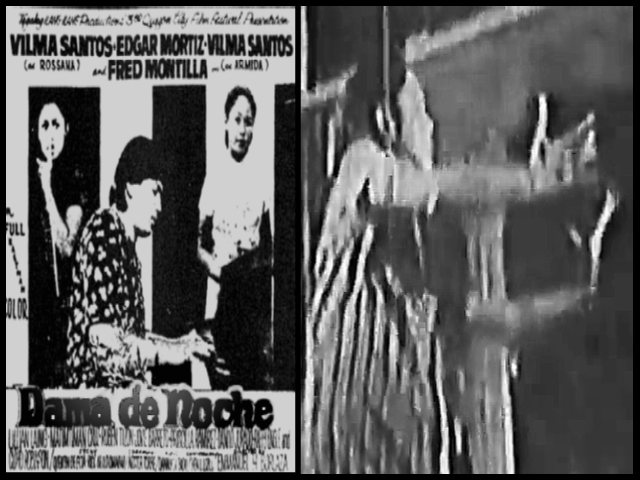
FILM REVIEW: DAMA DE NOCHE


The Plot: A dual role – demented lead. She plays the role of twin sisters, one of whom is a lunatic.

The Reviews: “…Dama de Noche is showing in three theaters– Remar, Delta and Sampaguita. It is, Vilma was quoted as saying, her dream role fulfilled. The very professional Vilma has come out with the resolution than henceforth she will demand to see the script and also see that the script is demanding— or she’ll say nix. Well, Dama de Noche is exactly just that: demanding. In it she delineates the twin-sister roles of sweet Armida and deranged Rosanna. Vilma sobs and screams, giggles, and crazy-dances, claws and clowns, sobs again and screams some more. But she does more than all these things. She acts. In the Filipino movieworld where crying is synonymous with acting, that certainly is being ahead of one’s kind. Vilma as Armida is drab and dry, almost a movie prop. It is in the portrayal of Rosanna that Vilma would tear one’s heart away. The many close-ups so effectively used throughout the movie show the unglamorous Vilma: her frowns, her lip-twitching, her uninhibited and stifled sobs. But Vilma is less successful with the shifty look that is the distinctive trait of the deranged. She compensates for this in the ‘betrayal’ scene when Rosanna suspects that Leo, Armida and the psychiatrist (Fred Montilla) all conspired to imprison her in the hospital. Another outstanding feat is the subdued scene where Rosanna learns that Leo has gone to the Lerma villa to meet Armida. The vivacious Rosanna is just as winsomely pathetic. Watching her is just like seeing a bosom friend trying to pretend she’s happy when both of you know she’s not only in this case, Rosanna is truly happy. Her non-knowledge of her plight is what is particularly heart-curling. Dama de Noche is Tagalog Ilang-Ilang Production’s entry in the QC filmfest which started on Oct.15. It is a very simple story, almost run-of-the-mill, but Nestor Torre, Jr. who wrote the screenplay saved it with his meaningful and amusing lines. However, the movie is occasionally dragging with the Filipino moviemania for spoonfed sequences. Will the memorable Rosanna win for Vilma the most coveted award tonight? Or will Nora the Superstar make it? The die is cast and tonight is the NIGHT. New Frontier Cinema in Cubao was never before so loaded that the fire exits had to be opened to let in air. It was so badly jampacked, one swore it couldn’t be worse. But it was, a ‘stand-mate’ (there were no seats) quipped, ‘Noong first day, mas grabe.’ And so through a snail-pacing 20-yard pila and after exactly one hour, one got inside the theater, at last!…” – The Times Journal (READ MORE)

“…A very young Vilma Santos plays twins—a goody-two shoes and a manic meanie. They fall for the same guy—if I’m not mistaken, a slim Edgar Mortiz. The good twin sings pretty songs, looks morose most of the time, and is often helpless; the bad twin is active, take-charge, and flashes her eyes at the camera a lot. In the end she burns the house down; unfortunately she traps herself in it. Good Vi and Bot escape, and watch the house go down in flames while holding on to each other beside a dama de noche shrub (or at least I assume it’s one). And yes, there is a theme song that goes, “Daaaama de noche… daaaaaaaaamaaaaa de nocheeeeee…” – Joel McVie (READ MORE)

“…We wrote quite a number of scripts for Vilma, including the screenplay for “Dama de Noche,” which turned out to be the first film that gave her an acting award. “This was a big deal for Vi because she was very frustrated at the time due to the fact that she was always losing to Nora in acting derbies in the ’70s. Thus, when she won her Famas trophy, she felt vindicated. It was when “Dama de Noche” was being shot that we had an instructive experience with Vilma. She played a mentally disturbed girl in the story, and there was one scene in which she was supposed to dance her way through a forest. Somebody had interpreted this to mean that the dance would be choreographed number, so a ballet-like dance costume had been made for Vilma! When we got to the movie set that day, Vilma showed us her dance costume, and we were shocked. We explained that the “dance” was supposed to be spontaneous, thus unchoreographed and uncostumed! After our explanation, Vilma returned the costume to the production people, and simply “danced” the scene at her mentally challenged character would, spontaneously. This experience told us that, despite her young age then, Vilma was determined to do her job well, and once she understood how a scene should be done she would insist on doing it the right way, no matter if she ruffled the feelings of some people in the production…” – Nestor U. Torre, Philippine Daily Inquirer, June 6, 2003 (READ MORE)

FILM REVIEW: IGINUHIT NG TADHANA


The Plot: Iginuhit ng Tadhana (Carved by Destiny) is a movie based on the life of Ferdinand Marcos prior to his ascendancy as President of the Philippines. The movie was chronological in setting, featuring Marcos as a young boy in his hometown, as a brilliant student, and up to the time that he was unjustly imprisoned as a suspect in the murder of the political rival of his father. The movie then moves up to his acquittal, his career as a young congressman and senator, and up to the time that he married Imelda Marcos. The movie was shown in Manila as additional campaign material for Marcos’ candidacy for the Presidential race, which he eventually won. The movie portrayed Marcos as a person who is more than just a politician. – Wikipilipinas

The Film: “…Marcos knew the power of the medium of film. Earlier on, Marcos produced a film biography using the most popular stars for his first presidential campaign. He ran against Macapagal who also came up with a film biography to boost his reelection bid. Marcos would also use another film Iginuhit ng Tadhana (Written by Destiny, 1965) to campaign for a second term. The two Marcos film bios would be the only successful political films—commercial and election wise—as other film biographies in the post-Marcos period by senatorial and presidential aspirants would prove dismal, unhelpful for election bids. The post-Marcos period liberalized the political and economic scene. It conventionalized and intensified the election of movie and sports stars, and even television news hosts to national politics. Television stations were sequestered by the government, the largest of which, however, was returned to its pre-martial law owners. ABS-CBN would become the leading television station until after 2000, allowing two of its news anchors to become senators…” – Rolando Tino (READ MORE)

“…In 1965, the Board of Censors suspended the movie exhibition of Iginuhit ng Tadhana (a movie biography of Presidential candidate Ferdinand Marcos). Many believed and suspected that Malacanang had a hand in the board’s decision and such action was a wrong political maneuver and ploy that proved disastrous to the reelection bid of incumbent President Diosadado Macapagal. It practically ensured the Presidential electoral victory of Marcos…The suspension of the showing of a movie on the life of Senate President Ferdinand E. Marcos stirred yesterday a political storm and precipitated the resignation of the chairman of the Board of Censors for Motion Pictures. Officials of the board said that the board voted to suspend the exhibition of the movie, “Iginuhit ng Tadhana” (Destined by Fate) because its producer failed to submit it for preview by the board en banc or by the entire board. The film had been approved for showing by a subcommittee of four headed by Mrs. Rosalina I. Castro last August 24. The board said it interpreted the refusal of the movie company, the 777 Film Productions, to comply with its order as defiance of the Board. The order of the board also suspends the showing of the movie in eight provinces and cities— Camarines Norte, Batangas, Marawi City, Pampanga, Cotabato, Aklan, Masbate, and Sulu. The film has been showing in theaters in these places since Aug. 24, the date of the approval of the picture by the subcommittee of four. In the wake of the suspension of the showing of the film, columnist Jose L. Guevarra, chairman of the board of censors, tendered his resignation. Guevarra did not state his reason for resigning in his letter to President Macapagal, but sources close to him said that the resolution of suspension, which was adopted in his absence, had something to do with it…” – Isagani Yambot, Sept. 3, 1965 (READ MORE)

“…Isa sa paborito ko ay ang Iginuhit ng Tadhana,” ayon pa kay Conrado, “because that film helped President Marcos win the elections in 1965. If you remember, that film was banned by the Macapagal administration and the people naturally became curious. The movie was a big hit.” Iginuhit ng Tadhana was divided into three parts: Marcos as student, Marcos after school and Marcos in his early years in politics. Conrado directed the portion with the President as a young man, during the Nalundasan case, a crucial part in the President’s life. Before he began shooting, according to Conrado, he made his own research and first visited Batac where they shot an important scene…” – Conrado CondeJingle Extra Hot Movie Entertainment Magazine, April 27 1981 (READ MORE)

“This rarely seen, authorized biography of former President Ferdinand Marcos stars Luis Gonzalez, Gloria Romero, Vilma Santos, and Ferdinand “Bongbong” Marcos Jr. as himself. (The film starts with a flash of lighting as he is born on 9/11 in 1917.) ” – Vincent Nebrida (READ MORE)

“…In the 1960’s, Gloria Romero portrayed Imelda Marcos in “Iginuhit ng Tadhana” and “Pinagbuklod ng Langit.” In the 1970’s she starred in two memorable movies: Behn Cervantes’s vanished movie, “Sakada” (1976), and earlier, 1973’s “Lipad, Darna, Lipad,” the biggest movie of its time in which she played a “manananggal” to Vilma Santos’s super heroine. Up to now, she considers the last as one of her most unforgettable…” – Lito Zulueta (READ MORE)

“…And what many people probably didn’t know is that Bongbong played himself in Iginuhit ng Tadhana, produced by Sampaguita Pictures as a campaign pitch for Ferdinand when he first run for president in 1965, with Gloria Romero as Imelda, Luis Gonzales as Ferdinand, (now reelectionist Batangas Gov.) Vilma Santos as Imee and Gina Alajar as Irene (now Mrs. Greggy Araneta). A few years later, a sequel, titled Pinagbuklod ng Langit, was produced also by Sampaguita, directed by Eddie Garcia, with Gloria, Luis, Vilma and Gina reprising their roles and Jose “Jonjie” Aranda (first husband of Bongbong’s fellow Nacionalista, reelectionist Sen. Loren Legarda; their marriage was annulled in 1986) playing Bongbong….” – Ricardo F. Lo (READ MORE)

“…In hid book, Don Jose & The Early Philippine Cinema, Joe Quirino credits jose Nepomuceno pioneer in producing movies that not only entertained but also informed. Wrote Quirino: “His screen adaptation of Noli Me Tangere, Jose Rizal’s novel exposing the social cancer that festered during the Spanish occupation of the Philippines, captured the sardonic and satirical contents of the imflammatory noel.” Satire was a popular device through which producer aired their views on social issues. In 1929, a satirical movie called Patria Amore caught the ire of the local Spanish community who went to court to stop its exhibition. A counterpart incident took place in 1965 when the Liberal Party tried to stop the showing of Iginuhit ng Tadhana, the propagandistic movie of the life of Ferdinand Marcos. The same motion picture propelled Marcos to the presidency. Movies of social significance often face this dillemma on their way to the big screen. Because of their strong public statement, they invite uproar from concerned sectors, an experience that became almost a daily ordeal for the late director, Lino Brocka. In recent years and until his death in 1991, Brocka had been the prime mover of Tagalog movies of social significance. Some of his works that easily fall under this category are, in no particular orderL Orapronobis (about vigilantes and rebels in the countryside), Bayan Ko (on labor unrest), Gumapang Ka sa Lusak and Hahamakin Lahat (on political corruption), Maynila: Sa Mga Kuko ng Liwanag (on moral degradation and exploitation)…” – Nestor Cuartero, Panorama, dated June 13, 1993 (READ MORE)

“…The First Manila Film Festival was held for the first time in 1966. Reserved solely for Hollywood and foreign movies, first-run downtown theaters like Ideal, Odeon, State, Ever, Galaxy, Capitol, Lyric, among others were opened for exhibition to locally-produced or Tagalog movies. The filmfest was the brainchild of then Manila Mayor Antonio Villegas. The 10-day festival which coincided on the city’s foundation day (June 24) was a huge success participated in by big names in the industry…A total of 18 movies (14 new, 4 reissues) were exhibited during the 10-day festival. Iginuhit ng Tadhana, Portrait of the Artist as Filipino and Daigdig ng mga Api, all released in 1965, and Zamboanga, shown a month earlier, were allowed to participate…” – VIdeo48 (READ MORE)

RELATED READING:

FILM REVIEW: RUBIA SERVIOS

This slideshow requires JavaScript.

The Plot: Sa umpisa ng pelikula, makikitang nag-aaral pa lamang si Rubia (Vilma Santos), Norman Ignacio (Mat Ranillo III) at Willie Trizon (Philip Salvador). Masugid na manliligaw ni Rubia si Willie kahit na alam na nito na may nobyo na siya’t pakakasal na sila sa pagkatapos ng taon. Nang malaman ni Willie na pakakasal na si Rubia ay naging desperado ito’t plinano na kidnapin si Rubia. Isang araw habang naghihintay ito ng taxi sa kalye ay hinablot siya nga pat na lalaki na tauhan ni Willie. Dinalo siya ni Willie sa isang cottage sa Cavite. Nagtangka si Rubia na tumakas at tumakbo sa labas. Duon siya ginahasa ni Willie sa tabing dagat. Matapos gahasain ay nagtangkang magpakalunod si Rubia ngunit pinigil siya ni Willie at binalik sa cottage. Pinag-isipan ni Rubia kung paano niya mapipilit si Willie na pawalan siya. Tinanong niya si Willie kung anong gusto nitong mangyari. Sinabi nitong gusto niyang pakasalan siya. Pumayag si Rubia na magpakasal ngunit kailangan nitong ipaalam sa kanyang mga magulang ang nangyari sa kanya. Natagpuan naman ng pamilya ni Rubia siya sa ospital at duon nito nagpasya na maghabla. Matapos ang hearing sa korte sa kabila ng pagmamakaawa ng pamilya ni Willie ay nasentensiyahan siya ng anim na taon sa bilanguan at magbayad ng 70,000 pesos. Samantala nanatiling nakakulong sa kuwarto si Rubia matapos ang kaso. Pinilit ni Norman na kausapin ang katipan at dito nalaman niya na ang dahilan ng pagkukulong sa kuwarto ni Rubia’y buntis ito. Pinasya ni Norman na bigyan ng pangalan ang pinabuntis ni Rubia at nagpakasal ang dalawa.

Nanatiling tahimik ang buhay ng dalawa’t nagkaroon pa sila ng isa pang anak. Nang 3 years old na ang batang naging anak niya kay Willie’y nag-umpisang mangulo na naman ito. Si Willie’y nakalabas ng kulungan pagkatapos ng tatlong taon lamang. Nung una’y pinagkaila ni Rubia sa asawa ang mga tawag ni Willie. Ngunit napuna na rin ito ni Norman nang mapuna niyang madalas ang asawa na umuuwi ng maaga sa bahay at nag-umpisang uminom ng valium at naging magugulatin ito. Pinagtapat na rin ni Rubia sa asawa ang panggugulo ni Willie at pumayag ito na payagan si Rubia na makipagkita kay Willie. Nang malaman ni Rubia kung saan sila magkikita’y si Norman ang pumunta sa usapan. Ang resulta’y nabugbog ito ng mga tauhan ni Willie. Dahil rito’y naging maliwanag na hindi sila titigilan ni Willie lalo pa’t minsa’y takutin si Rubia nang wala si Norman sa bahay at pumunta si Willie’t pinatay ang aso nila. Wala naman magawa ang mga polis dahil wala silang hard evidence na si Willie nga’y nanggugulo sa buhay nila. Pinasya ni Norman at Rubia na umalis na nang bansa at bumalik sa Canada kung saan sila ilang taon ring nag-aral bago naging doctor. Pinasya rin nila na ibigay sa kanyang mga magulang ang dalawang bata para sa kanilang safety.

Sa kasamaang palad, kinidnap ni Willie ang anak nila ni Rubia na si Vivian. Nagpunta sila sa mga pulis ngunit wala pa ring magawa ang mga ito dahil wala silang ebidensiya. Kinontak ni Willie si Vivian at gusto nitong makipagkita siya rito. Pumayag si Norman ngunit sumonod rin ito sa usapan. Kasama ng kanyang mga alagad iniwanan ni Willie ang magasawa at binantaan na sa susunod magsisisi sila sa kanilang ginawa dahil nga ang usapan ay si Rubia lamang ang gusto niyang makita. Tinakot pa ni Willie si Rubia’t kumuha ito ng bankay na bata at isinuot ang damit ng anak ni Rubia. Nalathala ito sa mga diyaryo at pinuntahan ni Rubia ang bankay laking pasasalamat nito’t hindi ang anak ang bangkay. Dahil rito’y nagpasya na si Rubia na kitain si Willie na hindi alam ni Norman. Kinita nga ni Rubia si Willie ngunit nasundan rin pala si Rubia ni Norman. Sa tulong ng mga alagad ni Willie ay itinali ng mga ito sa puno si Norman at muling ginahasa nito si Rubia sa harap ni Norman. Nagsisigaw ito ngunit walang siyang nagawa. Kahit ayaw ni Rubia ay napapayag rin siya dahil papatayin ni Willie ang kanyang asawa. Pagkatapos nito’y binugbog ng mga tauhan ni Willie si Norman at sinama si Rubia papunta sa kanilang anak. Sa dagat papunta sa isla kung saan naruon si Vivian ay kinausap ni Willie ang dino-dios niyang si Rubia. Pinangako nito na matututunan rin niyang mahalin siya. Hindi napansin ni Willie na nakahawak si Rubia sa sagwan ng bangka at ilang ulit nitong pinalo sa ulo ang nabiglang si Willie habang sinasabi ang salitang “hayup!” Hinanap nito ang baril at pinagbabaril rin niya ang nahulog sa dagat na si Willie. Narating ni Rubia ang isla at duon nito nakita ang kanyang anak na buhay na buhay at tinatawag ang kanyang pangalan. The End. – RV

The Reviews: “The second rape scene in “Rubia Servios” which stars Vilma Santos, is reminiscent of the rape scene in “Santiago”, shown in 1970. Instead of Caridad Sanchez as the wife who is assaulted in full view of husband Mario O’Hara, it has Vilma Santos and Mat Ranillo III. This coincidence is not surprising since Brocka also directed Santiago, and O’Hara, who has since graduated from supporting roles, is the scriptwriter for “Rubia Servios”. Vilma does not expose much skin and Philip Salvador (as the attacker) has his pants on, but the scene could well be one of the most realistic rape scenes on screen in a long, long time. The anguish in Vilma’s face and the lust in philip’s eyes blended so well the effect was dramatic rather than sensual. The real climax of the film, however, is the killing of Philip by Vilma with a paddle aboard a motorboat at sea. Lino Brocka, who directs Vilma for the first time, succeeded in muffling her sobs even in the most hysterical moments. To our mind, “Rubia Servios” is geared towards mature audiences. It is engrossing despite the lack of fancy camera shots and an almost chronological presentation.” – Ricky Lo (READ MORE)

Kung uri ang paguusapan, de-kalidad ang Rubia Servios. Kaya lamang, may sabit. Maraming butas ang iskrip ni mario O’Hara. Ang istorya ng Rubia Servios ay batay sa mga legal story ni Aida Sevilla Mendoza, at ito’y pumapaksa sa babaeng ginahasa ng kanyang masugid na manliligaw. Si Rubia (Vilma Santos) ay isang medical student na may kasintahang kaeskuweala, si Norman (Mat Ranillo III). Balak nilang magpakasal pagkatapos ng kanilang pag-aaral. Karibal ni Norman si Willie (Philip Salvador) na ayaw tumanggap ng kabiguan sa pag-ibig. Anak siya ng mayaman at maipluwensiyang pamilya sa Kabite. Kaya nang tapatin siya ng dalaga na wala siyang maaasahan, kinidnap niya si Rubia sa isang bahay-bakasyunan at ginahasa ito. Nang magkaroon ng pagkakataon ang babae, tumakas ito at isinuplong si Willie. Idinemanda ang lalaki at nahatulang mabilanggo ng anim na taon. Paglabas ng lalaki sa bilangguan, ginulo na naman niya ang buhay ng babae na ngayo’y asawa na ni Norman at may dalawang anak (ang una’y anak niya kay Willie). Dahil sa pananakot ng hui, nakipagtagpo si Rubia, at muli na namang ginahasa sa sementeryo sa harapan pa naman ng asawa. Kinidnap ni Willie ang anak niya para gawing pain sa pagtatagpo nila ni Rubia at para sumama na tio sa kanya. Ngunit nagkakaroon na naman ng pagkakaton ang babae na lumaban at sa bangka, hinampas niya si Willie ng sagwan, at pagkatapos ay binaril ang lalaki hanggang sa ito’y tuluyan nang malunod.

Simplistiko ang materyal at lalong simplistiko ang pamamaraan ni O’Hara sa karakterisasyon. Nagmumukha tanga ang mga tauhan (si Rubia at si Norman) samantalang medical students at naturingang doktor pa naman sial. Tinatakot na sila’y hindi pa sila humingi ng proteksiyon sa pulis. Ginahasa na si Rubia ay nakipagtagpo pa sa sementeryong madilim nang nag-iisa at nagpaganda pa mandin siya nang husto. At ang asawa niya’y wala ring utak. Biro mong sinundan ang asawa sa sementeryo nang nag-iisa! Dapat nga palang magkaganito sila kung napakakitid ng kanilang utak. Sa direksiyon ni Brocka, lumitaw ang galing ni Vilma Santos, at nakontrol ang labis na pagpapagalaw ng kanyang labi. Mahusay din ang eksena ng gahasa. Si Philip Salvador naman ay tulad sa isang masunuring estudyante na sinusunod lahat ang direksiyon ng guro. Kitang-kita mo sa kanyang pagganap ang bawat tagubiling pinaghihirapan niyang masunod: kilos ng mata, buntong-hininga, galaw ng daliri, kislot ng kilay. Limitado ang kanyang kakayahan at makikia ito sa kanyang mukha (na limitado rin). Walang-wala rtio si Mat Ranillo III, na parang pinabayaan para lalong lumitaw ang papel at pag-arte ni Salvador. Samantala, ang kamera ni Conrado Salvador ay hindi gaanong nakalikha ng tension at suspense, bukod sa napakaliwanang ng disenyo ng produksiyon ang pagbabago ng mga tauhan sa loob ng pitong taon batay sa estilo ng damit at buhok. – Justino M. Dormiendo, Surian: Si Nora At Vilma sa Gitna ng Basura, Sagisag, Feb 1979 (READ MORE)

Para sa akin naging matagumpay si Vilma sa kanyang pagganap bilang si Rubia Servios. Isang tour de force. Nuong una ko itong napanood sa Avenida ay namangha ako sa kanyang galing. Ngayon pagkatapos ng dalawanput siyam na taon pinanood ko muli ito’y hindi nababawasan ang aking pagkamangha sa galing niya. Paano mo ba isasalarawan ang babae na nagahasa? Paano mo ba isasalarawan ang babaeng nakidnapan ng anak at muling nagahasa sa harap pa mismo ng asawa mo? Isang mahirap na papel. At naisalarawan ito ni Vilma nang makatotohanan. Walang mga pagpopokos ng kamera para mag-emote. Makatotohanang pagganap. Special mention sina Mat Ranillo III at Philip Salvador. Dapat ay napahalagahan sila sa pamamagitan ng nomination subalit naging maramot ang organisasyon ng pestibal at isang acting awards lamang ang binigay nila. Panalo sana si Philip Salvador ng best actor award rito dahil damang dama mo ang kanyang karakter. Makikita rin kung gaano kaganda ng kanyang katawan. Meron eksena siya na nakaswimming trunks lang at talagang alaga pa niya ang kanyang katawan nuon. Si Mat naman ay sana nanominate bilang best supporting actor. Mahusay rin siya lalo na sa eksena kung saan nakatali siya sa puno at wala siyang nagawa ng pagsamantalahan muli si Rubia sa harapan niya ni Philip. Technically, nang panoorin ko itong pelikulang ito ay maganda ang resulta ngunit nang panoorin ko muli ng ilang beses ngayon ay makikita ang ilang flaws. Una na ang cinematography ni Conrado Baltazar. Maraming eksena ay hindi nasa tamang angulo. Merong eksena na nagsasalita si Ate Vi pero ang nakikita lamang ay ang kanyang nuo. Ang musical score ni Freddie Aguilar ay parang hindi bagay sa tema ng pelikula. Pati ang theme song na “Pagsubok” parang pang-politika at very “folksy” ang dating. Merong isang butas ang screenplay ni Mario O Harra. Nang umalis si Philip para iwanan si Vivian, ang anak niyang kinidnap, nang umalis ito’y sumakay ito ng kotse, pagkatapos nang dalhin niya si Rubia sa banding huli’y sumakay naman sila ng boat. Medyo nakaligtaan nila ang isang detalye na ito. Mabilis ang pacing na pelikula at maraming mga eksena talaga si Vilma na makikita mo ang pagaalaga ni Lino. Sayang nga lamang at hindi ito nakita ng mga hurado ng pestibal at maging ang mga manunuri ng taong iyon. – RV (READ MORE)

“…Perhaps, the most in “your face” reality-based role was Rubia Servios. Another transformation. An acting vehicle that even Madonna can’t accomplished, yes even with Evita! I considered Rubia as her most daring and demanding role surpassing Chato’’s BQ. Not only the role required her to be physical but also she has to show the emotion of being battered and abused, inside and outside. The pain in her face was visible while crawling in the beach. The rage in her face showed when she smacked the rapist, Philip Salvador using the boat paddle near the end. I can still feel it, the revenge. I remember I swore a number of times while watching her lift that paddle in the air and aimed at her rapist (Sige pa! Pataying mo ang hayup na iyan! I told to myself.) But the most poignant connection about this film and her role now as politician was her awareness of the abuse Filipina women has become accustomed to. There are a lot of Rubias who doesn’t have the courage to face their assailant. There are so many of them who will have no chance to avenge their fate. Most people will even think that they have provoked the rapist to rape them and they are partly to blame. Vilma as Rubia has made her emphatized the victims and be tough on crime like this. Rape, Crime & Justice, three issues that Vilma have to faced every single day as a mayor…” – RV (READ MORE)

“Rubia Servios,” on the other hand, does not dilute the message. Willy (Phillip Salvador), the son of a powerful and wealthy figure, is portrayed as totally evil, devoid of any redeeming quality. To screenwriter Mario O’Hara and director Lino Brocka, the province is the same as the city. Rubia Servios (Vilma Santos) is raped both in the city and in the country. Rubia kills Willy in the country. Violence unites all places. It is the “unity” of conception, scripting, design, and direction, in fact, that “Rubia Servios” is superior to “Atsay.” Lino Brocka does not waste shots in is attempt to create a Filipino classical tragedy. He subordinates everything to the building up of one emotion in the viewer, that of hatred of Willy. So despicable does Willy become at the end that, when he is murdered by Rubia, no viewer can say that Rubia is at fault. And yet, morally speaking, no one is allowed to take the law into his own hands. The law, in fact, put Willy in prison for the first rape. There is no reason to think that the law will not put Willy to death for the second rape. By conditioning the reader to condone Rubia’s revenge, Brocka succeeds in questioning one of our deeply-rooted moral beliefs.

“…Mula sa isang real life legal story ang Rubia Servios, namumuhunan ito sa ideya na ang masasaksihan ng mga manonood sa iskrin ay hindi likhang-isip lamang kundi talagang nangyari sa tunay na buhay. Hinimok ni Lino Brocka sa kanyang pelikula na pagmasdan ang babae sa konteksto ng ating lipunan. Bakit ganito ang nangyayari sa kababaihan? Dahil tinatanggap nating maging ganoon ang kanilang kundisyon sa lipunan. Kung pagkakasala ang pabayaang maghari ang mayayamang may kapangyarihan, nararapat lamang na ituwid ang pagkakasalang ito. Sa mga nakakaalam ng mga pelikula ni Brocka, pamilyar ang paggamit sa estratehiya ng melodrama. Sa ganitong paraan, ang focus ay ang paghihirap na pinagdaraanan ng pangunahing tauhang babae at ito ang nakababagbag sa damdamin ng manonood. Ngunit sa pagpuntirya ng emosyon, hindi matamaan ang paglinaw sa tunay na isyu. Si Vilma Santos bilang Rubia Servios ay hindi lamang mahusay na gumanap sa buhay ni Rubia kundi naging isa ring makapangyarihang talinghaga na nakapagpalusog sa teksto ng pelikula. Sa kabuuan, inaangkin ng pelikulang Rubia Servios ang kapangyarihan nitong lumikha ng katotohanan mula sa masalimuot na materyal ng reyalidad. Sa ganitong proseso, nailalantad ang isang piraso ng reyalidad upang mapanood, masuri at mabigyang-kahulugan. Sa kabilang banda, hindi rin makakatakas ang pelikula sa mga diskursong kumakanlong sa mismong puinupuna at tinutuligsa nito…” – Jojo Devera, Sari-saring Sineng Pinoy (READ MORE)

“…Rubia Servios, on the other hand, does not dilute the message. Willy (Phillip Salvador), the son of a powerful and wealthy figure, is portrayed as totally evil, devoid of any redeeming quality. To screenwriter Mario O’Hara and director Lino Brocka, the province is the same as the city. Rubia Servios (Vilma Santos) is raped both in the city and in the country. Rubia kills Willy in the country. Violence unites all places. It is the “unity” of conception, scripting, design, and direction, in fact, that Rubia Servios is superior to Atsay. Lino Brocka does not waste shots in his attempt to create a Filipino classical tragedy. He subordinates everything to the building up of one emotion in the viewer, that of hatred of Willy. So despicable does Willy become at the end that, when he is murdered by Rubia, no viewer can say that Rubia is at fault. And yet, morally speaking, no one is allowed to take the law into his own hands. The law, in fact, put Willy in prison for the first rape. There is no reason to think that the law will not put Willy to death for the second rape. By conditioning the reader to condone Rubia’s revenge, Brocka succeeds in questioning one of our deeply rooted moral beliefs. The unity that characterizes Rubia Servios contrasts sharply with the tendency of Eddie Garcia in Atsay to exploit Vitug’s versatility even at the expense of tightness. There are shots in Atsay, for example, which could easily be cut without hurting the film’s integrity. Even the train sequence, one of the best sequences in Atsay, is far too long. Rubia Servios is Lino Brocka’s film; Atsay is Romeo Vitug’s. Nora does an excellent acting job; but so does Vilma Santos, and Rubia is a much more demanding and difficult role. Edgardo M. Reyes is an established literary figure, but Mario O’Hara is much better screenwriter. Overall, Atsay may be much more impressive than Rubia Servios. In terms of challenging our moral and legal convictions, however, Rubia Servios is much more significant.” – Isagani Cruz, TV Times 1979 (READ MORE)

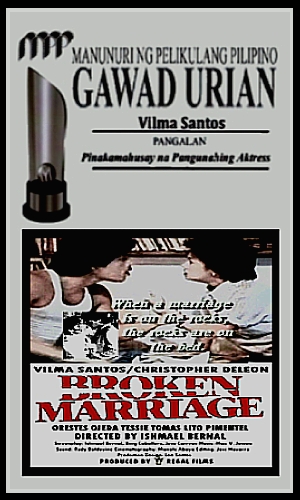
FILM REVIEW: BROKEN MARRIAGE


The Plot: After ten years and two children, Rene and Ellen find their marriage on the brink of breaking up. They seem to have fallen out of love and life has become a series of verbal hussies and conflicts. They decide that the only way out is a temporary separation. Rene, a police reporter, and Ellen, who is a television production assistant, begin to live apart from each other. Rene moves into his friend’s apartment while Ellen has to cope with running a household by herself. But they soon begin to feel the effects of their separation. A series of events that follow drastically change their lives. Rene is mauled for his expose of a gambling casino owned by a high ranking government official. He is forced to stay temporarily in the house of Ellen’s mother. As he recuperates from his injuries, both he and Ellen attempt to rebuild their shattered relationship. – Manunuri (READ MORE)

Demanding careers and two children have left Ellen (Vilma Santos) and Rene (Christopher De Leon) with a rocky marriage. A trial separation follows, and soon enough, the consideration of divorce — a serious taboo in Filipino culture in 1983. Orestes Ojeda co-stars as a new flame who lights up Ellen’s life. Prolific director Ishmael Bernal directs a heart-tugging script that he co-wrote with Bing Caballero and Jose Carreon. – Netflix (READ MORE)

The Reviews: Broken Marriage comes as a second wave to the noisy ripple created by Vilma Santos’s award-winning performance in Relasyon. The Regal people have banged their bongos so much harder this time that viewers will expect that Ms. Santos’ cards for this year’s awards derby will be more than secure. The hint is that Broken Marriage is a Vilma Santos movie. Lest the moviegoer expect too much from this year’s quadruple winning best actress, he should be forewarned that the movie is about, well, a broken marriage.

After more than 10 years of marriage, two young persons find each other repugnant. Ellen is a television floor director who hops from one set to the other shooting sitcoms and soaps. Her husband, Rene, complements her rapid lifestyle in investigative reporting. The movie commences with Ellen coming home in the morning from overtime with a crew party on the side. Rene greets her with an ugly nag. The house turns topsy-turvy as they proceed to hurl invectives against each other.

The exchange is extremely exhilarating; and just as the viewer breathes a sigh of relief, another quarrel starts and ensues as if it were the final assault.

Eventually, they decide to separate at the cost of their boy’s understanding nod and their little girl’s distaste. Rene moves to a house populated with such absurd characters as an artist who carves sexy sculptures, a friendly bit-part actor, and a gay art director who cuddles the upstart. Ellen, meanwhile, has to see to it that the children are not left out in their school activities – even standing as an athletic parent during one of her boy’s scouting engagements. She also has to check the advances of her bodyache-complaining producer, to whom she later gives in anyway.

Gradually, the two people realize the great loss that comes with division. Ellen, with the two children, is forced to move to her mother’s place after her house is burglarized, thus realizing the difficulty of an unmanned house. Rene substitutes a whore in the absence of his wife’s caresses. It is when Rene gets beaten up by a city mayor’s goons for nearly publishing a detrimental article and is constrained to recuperate in his mother-in-law’s house that the couple starts patching up the seams of the rent relationship. The ending is of course happy: reconciliation, what else?

Comparisons dawn inexorably: how does Broken Marriage fare as a follow-up to the bravura of Relasyon? This is tough inquiry. If intentions were to be the starting point, then the new movie is a better achievement. Relasyon, judging from its title, was supposed to be about a man and other woman relationship; but the feminist tendencies of our cinema had pinned the movie to a fateful drift: the travails of the modern mistress. Broken Marriage never swerves from its goal; from start to finish it is a portrait of two persons and the bond which they discover smothering and smoldering.

But the ordinary moviegoer does not assess by artist’s intentions – he does not even care about the artist (I mean here the one behind the work. On one hand, the film in front of him is the present; and on the other hand, it is the past. Broken Marriage is made to appear to him as a sequel to Relasyon. The process of integrating the past and the present is a challenge for him. For him are opened two avenues: to start with past and proceed with present; or start with present and proceed with past. If he chose the former, the condemnation for Broken Marriage would clang like a wild cymbal. If he chose the latter, the outcome is a laudatory comment).

Nonetheless, one has to prove that the new movie can stand on its own feet. What Relasyon sadly lacked (albeit not too sadly) was humor. Broken Marriage has tons of it – the caustic swaps, the funny characterizations, the clever plottings – so that the audience’s conditioned response for a supposedly serious movie shifts irrevocably to playful irreverence. Vintage Ishmael Bernal.

It is a masterly stroke – the proverbial Bernal sleight-of-hand at work, this time with more gusto and style. If the Inquisition were still around, he would be branded and burned seven times as a heretic for turning a marriage gone sour into an off-beat frolic suddenly turned sweet – at least, to the viewer’s mirth-hungry belly.

But none may claim that Bernal’s treatment loses its mark of delineating the disadvantages of separation. The humor chisels the message so that it comes to us shining and double-edged, while doing its duty of alleviating an otherwise gloomy impression which accompanies every disillusioning subject matter.

Not only does it come through humorously but also simply. Nowhere is the strain which anyone expects from grave subjects present here. It is as if the dreary topic had been borne on the Lord’s shoulders so that the yoke – and audiences love to be martyrs of maudlin tears – becomes, this rare time, light and easy. The scene where Rene visits his family and finds Ellen and the children agitated by the swift burglary of the house, and the producer wrily comments “Mahirap talaga ang walang lalaki sa bahay”(It’s difficult to have no man in the house) is casual but very biting so that the urgency of the hero returning to his gamily throbs mercilessly like a set clock.

In the same way, Bernal shows Ellen’s retrospective mood minus the conventional flashback: her younger sister is engaged to be married, and Ellen watches the two lovebirds running like children, with a bright but painful smile, even with jealousy, knowing that after the ceremonies, the two will lose the innocence which tradition stifles. This is a repetition of the technique Bernal used in Relasyon – the mistress attending the wedding of her cousin – with just the same effect, namely, sympathy.

The screenplay plunges right into the boiling point, the issues hurled to the foreground like machine-gun fire, the familiar scenes of hatred and division treated like aimless confetti so that the audience neither breathes nor is excused. It jolts us at the outset and after the terrible whipping, when the squabbles lessen and finally ebb into peace, we realize that these two handsome people must have had only one tragic flaw: they did not keep mum for a while.

Manolo Abaya’s cinematography dances with the jetstyle rhythm of the two protagonists. From the clever blocking of the morningjumble scenes to the hurried bustle of the television studio, Abaya’s camera sweeps avidly and flawlessly. In his hands, the incessant quarrels of Rene and Ellen seem like a vengeful lovemaking. The long shots, conventions of a Bernal, are more developed here. Above all, Abaya’s camera has humor and pathos.

The production design never digresses from its limited scope but manages to make poetry out of cluttered rooms and artificial television set-ups. The claustrophobia one feels at the outset of the movie with the couple’s disorderly room easily renders the hopelessness of the two people’s situation. The music filters the emotions of the characters with a detached but effective air. Jesus Navarro’s splendid editing is a breathless canvass of cosmopolitan animation.

The supporting actors are remarkable. Spanky Manikan as a loony reporter getting loonier everyday must not be denied mention; so with the actors who play the sculptor and the gay art director. Lito Pimentel as the gay’s idol is a relaxed performer with a talent for effortlessness.

Christopher de Leon endows the character of Rene with the right sense of machismo and basic weakness. When Rene is compelled to act maturely, De Leon unflinchingly turns him even more childish with useless tantrums; and when Rene finally learns his lesson, De Leon adds a boyish smile as if the lesson were amusing. We watch De Leon, elated and entertained: he is never so old as to appear too distant nor is he too young as to seem undocile. Broken Marriage is a gift to this actor. He is not propelled here to be more manly; since his character is made to contribute to a lot of oversights, De Leon’s doesn’t have to put a mask of strength: he just has to be himself and act with ease.

Vilma Santos is not about to be a letdown, not this time when the most important female roles are coming her way. A new intelligence she infuses in the character Ellen. Like De Leon, she turns Ellen into a woman-child, but the stress is less on her part as she has done similar roles before. Her beautiful face is flush receptive: the quiet moments of just observing the people around her are moments of perfect acting. Her body moves with an agility that is both funny and dramatic. Her two monologues – the first with her friends in the cafe when she informs them that she is bored, and the second with Rene when she tells him that they are not children anymore – are her best scenes: the camera lingers upon her countenance and she enunciates in return with ironic ease. She should watch out for next year’s awards race – there is simply no stopping her at the moment. – Joselito Zulueta, Sine Manila – 1983 (READ MORE)

Mahigit sampung taong nagsasama bilang mag-asawa sina Ellen (Vilma Santos), floor director sa isang programang pantelebisyon at Rene (Christopher de Leon), isang investigative reporter. Sa simula pa lamang ng Broken Marriage (Regal Films, 1983) mapapansing pag-uwi pa lamang ni Ellen mula sa trabaho, pakikipagtalo agad ang isinasalubong ni Rene dito. Ipinakita ng pelikula ang tumitinding alitan sa pagitan ng mag-asawa hanggang sa mapagdesisyunan nilang pansamantalang maghiwalay. Pilit na ipinaintindi ng mga ito ang di pagkakaunawaan sa kanilang dalawang anak. Nanirahan si Rene sa isang bahay na pinamumugaran ng isang grupo ng mga absurd characters na matatagpuan sa pelikula. May iskultor, isang bit player at ang kinakasama nitong baklang art director. Di naglaon, napilitang makisama ni Ellen at ng mga anak sa poder ng kanyang ina sa dahilang pinagnakawan ang kanilang bahay dala ng kawalan ng lalaking magtataguyod dito. Nang mapag-alamang ilalathala ni Rene ang isang artikulong maglalantad sa katiwalian ng isang opisyal ng lokal na pamahalaan ay agad itongipinagulpi upang mapigilan ang pag-publisa ng artikulo. Pansamantalang tumigil si Rene kasama ng asawa’t anak sa bahay ng kanyang biyenan upang magpagaling at dito naayos ng dalawa ang kanilang pagsasama. Ang pagtatapos? Muling nabuo ang kanilang pamilya.

Paano malalampasan ng Broken Marriage ang Relasyon? Kung pagbabasehan ang intensiyon ng direktor, higit itong nakaaangat sa Relasyon. Mula simula hanggang sa pagtatapos nito, hindi lumihis ang Broken Marriage sa mensaheng nais nitong ipahatid. Mahusay ang pagsasalarawan ni Ishmael Bernal sa domestikong suliranin ng mag-asawa bagama’t sumasang-ayon sa patriyarkal na gahum habang pinagbibigyan nito ang di inaasahang pagkamulat ng lalaking protagonista ay nagpakita ding ganap sa semiotikong detalye ng kompleksidad ng resolusyon sa pansariling loob. Ang sensitibong paglikha ni Vilma Santos kay Ellen ay isang marubdob at personal na layon kung ihahambing sa kanyang pagsasakarakter ng papel ni Marilou bilang kerida sa Relasyon. Hinamon ni Ellen ang kumbensiyonal na depinisyon ng pagiging asawa at pagkaina sa paghahanap ng mga alternatibo sa gitna ng makainang pagpapalaki sa mga anak. Ginawan niya si Ellen ng sariling silid kung saan nakahanap ito ng solitaryong kanlungan nang hindi pinuputol ang pakikipag-ugnayan sa asawa. Iniugnay ni Ellen ang ang kanyang pribadong hapdi sa spectrum ng kanyang relasyon. Samantala, nakatutok ang tunggalian sa Broken Marriage hindi lamang kay Vilma Santos kundi kay Christopher de Leon. Nasa asawang lalaki ang bulto ng suliranin kaya sa kanya umiikot ang kuwento, ang relasyon ni Rene kay Ellen at ang relasyon ni Rene sa kanyang mga anak. Ang maalam na pagpasok ni de Leon sa katauhan ni Rene ang lumiligalig sa mga kontradiksiyong talamak sa sistemang patriarkal. Kaakibat ng Broken Marriage ang manipestasyon ni Bernal sa pagbibigay ng representasyon sa reyalidad at partikular na pagsasaayos ng iba’t-ibang elementong kaagapay sa masining na pagbuo ng pelikula. – Jojo DeVera, Sari-saring Sineng Pinoy (READ MORE)

Ishmael Bernal: “…O, bakit parang lutang ka diyan? Porke’t naka-grand slam ka, feeling mo, magaling ka na?…” Bernal scolded Vi when she reported to the set of Broken Marriage, still high after her grand slam wins for Relasyon and a little unmotivated. – Richard Bolisay, Lilok Pelikula, 15 May 2010 (READ MORE)

“… Reportedly Ms. Santos, buoyed by the many acting awards earned by the previous film, was so eager to do well in the new production that Bernal got irritated, locked her in a bathroom, and delivered to her an ultimatum: she was not coming out till she got over her ‘hysteria.’ One sees what made the latter so successful, the same time watching this one sees why Bernal didn’t want to simply duplicate that success. Relasyon was a lean and elegantly told melodrama that took a sidelong glance at the institution of Filipino marriage; in Broken Marriage Bernal wanted to examine the institution directly, without the oblique glances. He didn’t want to film some doomed struggle to keep love alive but something less dramatic, far more difficult to capture: the aftermath of a protracted war, where the ultimate casualty is married love. He in effect didn’t want Ms. Santos at her perkiest and most energetic–he wanted her exhausted, looking for a way out, and to her credit Ms. Santos delivers exactly this with her performance…” – Noel Vera, Critique After Dark, 08 April 2012 (READ MORE)

“…In Filipino melodramas, the heroines often lean on against a hostile environment. Some no less combative women have created a permanent place in the film industry of the country…Lino Brocka and Ishmael Bernal devoted themselves repeatedly with a strong social and political consciousness of the popular form of melodrama. More than Brocka himself Bernal frequently focused on strong female characters that need to manage their lives under unfavorable circumstances. In his films female stars in the spotlight, without the problems of everyday life would go by the board. With Vilma Santos in 1982 he turned Relasyon, wherein the main character wants to escape from a stifling marriage and not only emotionally, but also legally reaches its limits (a year later with Santos Bernal turned the thematically similar mounted Broken Marriage). Was produced Relasyon of Lily Monteverde , who plays an influential role in the Philippine film industry today. Already at the beginning of the 20th century there were in the studios and production companies in the country powerful women who ruled with a firm hand and were addressed by their subordinates even as mothers. “Mother Lily” made his mark as a hard nosed business woman, often more economic than artistic interests followed, understandably, not just friends. The young director Raya Martin let her in his short film Long Live Philippine Cinema! (2009) even to death to save the Philippine cinema…” – Michael Kienzl, Critic.de, 10 Sep 2014 (READ THE TRANSLATION)

“Reportedly Ms. Santos, buoyed by the many acting awards earned by Relasyon, was so eager to do well in the new production that Bernal got irritated, locked her in a bathroom, and delivered to her an ultimatum: she was not coming out till she got over her ‘hysteria.’ One sees what made the latter so successful, the same time watching this one sees why Bernal didn’t want to simply duplicate that success. Relasyon was a lean and elegantly told melodrama that took a sidelong look at the institution of Filipino marriage; in Broken Marriage Bernal wanted to focus on the institution sans oblique glances. He didn’t want to film some doomed struggle to keep love alive but something less dramatic, far more difficult to capture: the aftermath of a protracted war, where the ultimate casualty is married love. He in effect didn’t want Ms. Santos at her perkiest and most energetic–he wanted her exhausted, looking for a way out, and to her credit Ms. Santos delivers.” – Noel Vera, Critic After Dark, 13 September 2014 (READ MORE)

RELATED READING:
Wikipedia: Ishmael Bernal
Ishmael Bernal (1938-1996)
The Films of Ishmael Bernal Circa 1971-79, Part One
The Films of Ishmael Bernal Circa 1980-94, Part Two
Tribute to Ishmael Bernal
The new ‘Working Girls’ front and center
Ishmael Bernal (1938-1996)
The Films of Ishmael Bernal Circa1980-96, Part Two
Remember The Face: Bernal Film Director
The Bernal-Santos Collaborations
Promising “Inspiration”
Inspiration (1972)
Now and Forever (1973)
Dalawang Pugad Isang Ibon
Ikaw ay Akin
Good Morning Sunshine
Relasyon
Broken Marriage
Pahiram ng Isang Umaga

FILM REVIEW: INSPIRATION


The Plot: Single parents Tony Benetez (Carlos Salazar) and Sylvia Motolla (Merle Tuazon) fell in love and married without their spoiled and protective teen ager kids, Gina (Vilma Santos) and Danny (Jay Ilagnan). They decided to live in one roof with Sylvia getting pregnant and the two kids developing a special relationship. – RV (READ MORE)

The Reviews: Ishmael Bernal’s first film with Vilma Santos was 1972’s “Inspiration,” an unusual teeny-bopper team-up film of Vilma and the late Jay Ilagan. The film established its main characters as both very much protective of their parents. Although its not explained why both Tony Benetez (Carlos Salazar) and Sylvia Mottola (Merle Tuazon) are still single, they ended up dating and  eventually marrying each other. Gina Benetez (Vilma Santos) and Danny Motolla’s (Jay’ Ilagan) parents first met in a polo tournament attended by both families. They were introduced by the socialite grandmother of Danny, Lola Jane (Lilian Laing). Later that same day both single parent met again in a night club. It was clear then that both are attracted to each other but are afraid that their kids will not approved it.  They then continued to  secretly date until one day both kids discovered when all four of them accidentally met in a restaurant.  The complication ended when Lola Jane intervened.  With the help of Gina’s household maid, Choleng, the two planned an intervention.  The meeting ended up with both kids leaving the Lola Jane’s house while the parents eloped.

Without the kids aproval, the newly married couple returned and forced their kids to live in one roof.   Sylvia then got pregnant while Gina and Danny developed a secret affair. Another complication and here come Lola Jane to the rescue, in the hospital after Slyvia delivered her baby, it was understood that Lola Jane has informed Sylvia and Tony about their kids special relationship. The next scene was Gina and Danny having a motorcycle ride that ended up in a park.  Under the tree the two had an innocent chat about their relationship.  The End.

In a musical era of 1970s, “Inspiration” was quite an experimental film, with no musical numbers but with better screenplay and well-written characters. Nestor and Bernal works well in establishing the character of Jay and Vilma. Their dialouges are not “corny” and very realistic. There is no over the top dramatic scenes inserted between musical numbers here. The parent played wonderfully by Merle Tuazon and Carlos Salazar were convincing. Although both Vilma and Jay played their roles effectively, Lilian Laing steals the film as Lola Jane. She was bubly and funny, a sex-starved, karate black belter, polo game afficionado, who loves life, considering she is playing the old grandma who is also the solution to all the complication in the lives of our four main characters.

Bernal was on his element here, a good story teller, pre-“Dalawang Pugad Isang Ibon, Pahiram Ng Isang Umaga and Relasyon.” Although he is directing a light comedy, written by Nestor Torre Jr., he managed to established all the characters without relying on corny dialouges and musical numbers common in this musical era.

RELATED READING:

FILM REVIEW: DEKADA ’70 1/2

This slideshow requires JavaScript.

For Film Review: Dekada ’70 2/2 CLICK HERE

“Buong buhay ko yan na lang lagi ang sinasabi nila sa akin…wala kang magagawa eto ang gusto ng asawa mo…wala kang magagawa eto ang kapalaran mo…wala kang magagaw dahil dapat…putris naman, dapat hindi ganuo…tapos sasabihin ng daddy n’yo hindi lang ang anak ko ang pinatay hindi lang ang anak ko ang dinukot…lalo akong nanggigigil, lalo akong nagagalit dahil kung nanay ka talaga, hindi ka lang dapat nanganganak kundi naiapaglaban mo rin ang anak mo dapat kaya mong pumatay para sa anak mo…gusto ko lang malaman bakit nila pinatay ang anak ko…hindi masamang tao ang anak ko, kahit sa oras na ito humarap ako sa diyos kahit sa dimonyo hindi masamang tao ang anak ko…hindi masamang tao ang anak ko!” – Amanda Bartolome

“You could stop being proud of me! Nagsawa na ako sa ganuon, gusto ko naman ngayon ako mismo just for a change, maging proud sa sarili ko!” – Amanda Bartolome

The Plot

Dekada 70 is a story of a family caught in the midst of a tumultuous time in Philippine history – the martial law years. Amanda (Vilma Santos) and Julian (Christopher Deleon) is a picture of a middle class couple with conservative ideologies, who must deal with raising their children, five boys – Jules (Piolo Pascual), Isagani (Carlos Agassi), Emmanuel (Marvin Agustin), Jason (Danilo Barrios) and Bingo (John Sace) in an era marked by passion, fear, unrest and social chaos. As siblings struggle to accept the differences of their ideologies, as a father faces the painful dissent of his children, a mother’s love will prove to be the most resonant in the unfolding of this family’s tale, will awaken to the needs of her own self, as she embarks on a journey of discovery to realize who she is as a wife, amother, a woman and a Filipino. – Star Cinema

Dekada ’70 (English: 70s Decade) is a 2002 Filipino drama film released based on a book called Dekada ’70 written by Filipino author, Lualhati Bautista. The film tells the story of the life of a middle-class Filipino family who, over the space of a decade, become aware of the political policies that have ultimately led to repression and a state of Martial law in the Philippines. Filipina actress Vilma Santos stars as Amanda, who realizes the implications of living within a dictatorship after sorting out the contradictory reactions of her husband and five sons. Her husband (Julian), played by Filipino actor, Christopher de Leon, supports his eldest son’s (Jules), played by Filipino actor, Piolo Pascual; efforts to rail against the government while refusing to follow Amanda’s wish to find a job. Her second son (Gani), played by Filipino actor, Carlos Agassi, is in the United States Navy. Her third son (Eman), played by Filipino actor, Marvin Augustin, writes illegal political exposes. The fourth son (Jason), played by Filipino actor, Danilo Barrios fell victim to a corrupt police department, and her youngest son named (Bingo), played by Filipino actor, John W. Sace, is still a boy. – Wikepedia (READ MORE).

The Reviews

“…At the center of the film and the family is Amanda (Filipino cinematic diva Vilma Santos) who vicariously experiences living under a dictatorship through her husband and five sons’ different reactions before coming into her own as a person. Her husband, Julian (Christopher De Leon), seems a walking contradiction: He offers rationalizations for the government while supporting his eldest son’s revolutionary activities, but has a fit when his wife wants to get a job. As for the sons, firstborn son (Piolo Pascual) joins the guerillas in the mountains. The second son (Carlos Agassi), forced into a shotgun wedding, defiantly works for the American Navy. The third son (Marvin Augustin) writes journalistic exposes he can’t publish, while the fourth son (Danilo Barrios) is a mystery to his family until his brutal, motiveless murder (probably by police) reveals a lost girlfriend. The fifth son (John W. Sace) is still a boy. Santos’ Amanda effortlessly and movingly chronicles the changed consciousness of the family and the country, with understatement her most reliable tool. Pic begins and ends with images of Santos at the forefront of a political demonstration, and nothing, from first image to last, for 128 minutes, is allowed to spontaneously or slyly deviate from the logic of her consciousness-raising.” – Ronnie Scheib, Variety Magazine (READ MORE)

“Last seen in ANAK (SFIAAFF ‘01), Vilma Santos delivers an understated, profoundly moving performance as the matriarch whose awakening redefines the traditional mother and wife role she donned for years. This is the story of an incredible character that survived an unforgettable decade.” – Michael Magnaye, The 22nd San Fransisco Asian-American Film Festival, 2004 (READ MORE)

“…Rono and Bautista, who writes her own adaptation, have obviously worked very closely in fleshing out the novel on screen. The result is an effective and even subtle tableau of scenes to present the Bartolome family’s struggles from the late ‘60s to ‘70s that not only set the domestic drama, but also prefigure the wider social and historical saga unfolding before the nation. No scene is wasted, no useless pandering to the viewer’s sense of spectacle or penchant for soap opera is even attempted. The competent production design, the agile editing, the stark photography (which impresses even the Paris-based Filipino-Spanish painter Sanso who calls it comparative to the best in Europe) ensures a panoply of images that is immediate, recognizable, and keen. Like Regal Films, Star Cinema has been compelled to throw in its stable of stars so that the Bartolome siblings look distractingly too much like a boy band. But because they play well-thought-out characters, their damage is put to a minimum. In some cases, like Piolo Pascual as Jules, the young communist rebel, the effect is heart-wrenching. Pascual plays, along with Vilma Santos as Amanda, one of the centers of gravity of the movie; the other center consists of Santos and Christopher de Leon. As arguably the first unabashedly feminist Filipino novel, “Dekada” shows a woman’s awakening to her nature and gender through the men of her life-her husband and her first born. Their age, generation and preoccupation divide both men, and Amanda serves as their bridge and transition. In the process, Amanda herself is transformed. She becomes herself. The most moving scenes of the movie are of Jules and Amanda meeting on the sly and forced to carry on mother-and-son endearments hurriedly because of the threat of arrest. But the most poignant scene is Julian and Amanda confronted with the terrible loneliness of their advanced years, left by their children, he turning away from her to hide his tears, and she asking him to face her and not to be ashamed. It helps that the scene is played by Santos and De Leon, truly one of Filipino cinema’s most effective screen couples. As Amanda, Vilma Santos shows again why Brocka, before he died, had likened her to water. “She can register anything,” he said. In “Dekada”, its the same Santos of vigor and transparency. The only difference is the depth, the resonance, and the greater confidence. Can she ever go wrong?” – Lito B. Zulueta, Philippine Daily Inquirer, 30 December 2002 (READ MORE)

“…Ang Dekada ’70 ay isang mahusay na adaptasyon sa pelikula ng nobela nitong may parehong titulo. Napanatili ang kaluluwa ng nobela sa pelikula sa kabila ng limitasyon ng pelikula bilang isang audio-visual na medium. Marahil, nakatulong ng malaki ang pagkakaroon ng iisang manunulat lamang. Naging maayos ang takbo ng pelikula na tulad sa nobela nitong nahati sa mga taon ng dekada ’70. Mahusay ang pagkakaganap ng mga pangunahing tauhan (maliban kay Carlos Agassi) na nakapagbigay hininga sa mga tauhang noo’y nababasa lamang. Naibalik ng pelikula ang larawan ng dekada ’70 sa mga eksena nitong nagpapakita ng mga demonstrasyon, protesta at rallies na tunay na nangyari noong panahon na iyon. Ang musika at tunog ay madalas na akma at nagpapaigting sa emosyong nais ipahatid ng pelikula. Naging mahina lamang ang disenyong pamproduksiyon ng pelikula na hindi naging masusi sa make-up, at kasuotan ng mga tauhan sa pawang hindi parating umaangkop sa panahon…” – Catholic Initiative for Enlightened Movie Association (READ MORE)

“…Dekada 70 journeys with the central character Amanda Bartolome (Vilma Santos), the reticent wife of an alpha-male husband, and the worrying mother of a boisterous all-male brood. Thoroughly relegated to domesticity in a world slathered in testosterone, Amanda begins to undergo a transformation when her family becomes imbricated in the sociopolitical realities brought about by the Marcos dictatorship. The declaration of Martial Law, the lifting of the writ of habeas corpus, the curfews and police searches, all these could have easily floated past Amanda’s head had her sons not found themselves caught in the crossfire between the government and the pro-democracy movements. As one son after another faces the oppressive forces of the dictatorship, Amanda gradually realizes that the personal is political. While chanting slogans for sociopolitical change, she finds her own voice and comes to terms with the fullness of her own person…There are touches of seventies style Filipino humor that foreign audiences might miss; they effectively establish that this is a real, average Filipino family trying to navigate through the eye of the political storm. The acting is generally impressive, most especially that of lead actress Santos, who gives a luminous, sensitive performance. Santos essays the transformation of Amanda so effectively that we do see clearly at the end of the film that there has been a fundamental change in her character. If there is something to be faulted about the film, it is Roňo’s failure to keep melodramatic moments in check. The funeral sequence of one of Amanda’s sons, for instance, becomes an over-extended session of copious tears. The rich story material of Dekada 70 could do away with such “in your face” paroxysms, which only work to dull the film’s cutting edge political trajectory. Nonetheless, it cannot be denied that Roňo had created a noteworthy, epic-scale Filipino film, and on a Third World budget at that. It also cannot be denied that Roňo had not forgotten the sentence of history on his home country…” – Antonio D. Sison, Insititute for Pastoral Initiatives University of Dayton (READ MORE)

“…about Vilma’s performance in “Dekada ‘70”: Some jurors, viewers and reviewers have expressed dissappointment over it because they regard it as too passive, low-key, unemotional, too much taken up with observation, and reflection instead of action. Thus, it doesn’t deserve the best actress award. We disagree. We think that, precisely because Vilma’s portrayal was so restrained for the most part, it was more difficult to achieve. It’s far easier to rant and rave, to “feel” bigtime, to run the gamut of emotions from A to Z- but, if Vilma did that, she would have gone against her character’s nature, as written…during the first half of the film, Vilma’s character occasionally felt unhappy, taken for granted or unappreciated as a person, but she held her emotions in check to keep the peace in the family. It was only later, when the national trauma of martial law rule affected her sons in various tragic ways, that she found the voice and rediscovered the heart to assert herself as a person and to give her emotions full play. We submit that Vilma’s portrayal is excellent precisely because she vivified he character as the wife and mother was in the ‘70s. Her thematic and emotional high points towards the end of the film rivetting, but it was her quieter, more controlled moments that showcased Vilma’s true gift as an actress. During those moments, Vilma didn’t just observe what was going on, she was constantly conflicted only, she had been programmed not to speak out because it wasn’t her “place”. Thus, when she finally changes and expresses herself in the end, the contrast makes her transformation all the more stunning. In the movie’s first half, Vilma is such a good actress that, although she may not be the active element in her family (her husband is), she is quietly involved in each and every scene, and every new development is seen from her point of view. Even better, despite her relative lack of dialogue at this point, we can “read” her thoughts on her face as clearly as though she were speaking. And we see her slowly changing before our very eyes, gradually overcoming her reticence, discovering her true worth, and finally finding and expressing her true self. This is very difficult to do, as any true thespian will affirm. Which is why, unlike some people who dismiss Vilma’s portrayal as passive and weak, we think it ranks among her best, right up there with her performances in and fully deserving of the filmfest’s coveted best actress trophy.” – Nestor Torre, Philippine Daily Inquirer (READ MORE)

“…The reason “Sister Stella L” will probably end up better appreciated is that the movie was shown during the martial law era. The movie was relevant to the times and Vilma was portraying an activist nun, a role not usually associated with the Star for all Seasons… As the mother, Vilma does justice to her character, holding back her strong emotions until the end, when she finally confronts Christopher de Leon and wants to break up with him. Despite the many tragic events that befall her character, Vilma chooses to underplay her role except at key points towards the end of the movie. Boyet is his usual competent self as the chauvinistic husband of Vilma who is forced to change when his wife breaks out of her shell. Piolo Pascual also deserves mention for his realistic portrayal of the activist turned NPA rebel…” – Edmund L. Sicam, Philippine Daily Inquirer (READ MORE)

“…Unlike Vilma Santos’ Sister Stella L. character, who becomes politicized practically overnight, her Amanda role in “Dekada ‘70” takes longer to mature politically (almost the whole decade). And she goes through a very painful process because she experiences the abuses of the marcos regime by seeing her own children suffer. With Vilma hurting inside and suffering almost in silence, we have here in “Dekada ‘70” some very moving dramatic scenes that are mostly devoid of hysterics but are still very effective nonetheless. Actually, we see yet another facet of Vilma Santos’ acting talent in this film. In the story, she goes through guilt (with the fate of one of her sons), pain, anguish and anxiety (particularly with the eldest, Piolo)-plus discontent as a plain housewife who wants to do something more with her life other than to keep house for her husband and kids. The great actress that she is, Vilma is able to manifest clearly the different layers of her character in a very quiet manner, which-you have to admit-is quite difficult to achieve. But Vilma-after all these decades -can do no wrong anymore in the field of acting. Although it’s not the greatest performance of her career (it’s still Sister Stella L), her portrayal of Amanda in “Dekada ‘70” is no doubt one of her finest. More importantly, her role (and her approach to it) is different from the hundreds of other roles she has done in the past…” – Butch Francisco, The Philippine Star (READ MORE)

“…Santos’ performance is so vivid and insightful that we can see her changing in front of our very eyes… We were enthralled…we were moved. And we valued the film’s important contribution to the very urgent task of reminding everyone of the trauma in our collective lives that was the martial law period of the ’70s,” noted Nestor Torre of Inquirer News Service. Chito Rono’s Dekada ‘70 made its world premier at the Asian American International Film Festival in June of 2003. The film has also won numerous domestic awards. The Young Critics Circle voted Dekada ‘70 Best Film of the Year (2002), Best Screenplay, Best Sound and Best Performance in a tie between actress Vilma Santos (Amanda) and Piolo Pascual (Amanda’s eldest son). The Best Film of the Year award is reserved for the director, such that no separate prize for direction is needed. The Best Performance award is the most coveted as it is conferred on the performer whether male or female, adult or child, individual or ensemble in leading or supporting role. Vilma Santos also received an award for Best Actress from Star Awards for Movies, Film Academy of The Philippines, and Gawad Urian Awards. Piolo Pascual also received an award for Best Supporting Actor from the Young Critics Film Circle, Metro Manila Film Festival, Star Awards for Movies, Film Academy of the Philippines, FAMAS Awards, and Gawad Urian Awards. The Gawad Urian Awards also presented Dekada ’70 with the award for Best Screenplay…” – Sara Stokoe, Asia Pacific Arts (READ MORE)

“…In Chito S. Roño’s superb “Dekada ’70,” a family in the Marcos-era Philippines has a domineering father and five sons, but it is the mother (Vilma Santos) who provides the mental stamina. She fights for her family in ways the father can’t even dream of. “To give birth to these children isn’t enough,” she says. “You have to defend them, protect them.” That’s the ’70s. In 30 years, that kind of woman will deal with difficult questions of divorce and motherhood, one in which women want freedom, yet must be willing to share blame when something goes wrong. The young woman who leaves her husband and thinks about aborting her pregnancy in South Korean filmmaker Gina Kim’s “Invisible Light” is an experimental example. Moon’s great performance in “A Good Lawyer’s Wife” almost makes you believe wrong is right, and, taken with her much-lauded portrayal of a girl with cerebral palsy in “Oasis,” reveals her as one of the world’s best actresses. Hollywood, take note. – No stereotypes of Asians here…” – G. Allen Johnson, Festival Celebrates Real Women, San Francisco Chronicle March 4, 2004 (READ MORE)

“…The young actors that were cast in Dekada ’70 were all guilty of doing too much “acting”. I don’t think actors should be acting-out, or (in this case) over-acting, unless they were filming a farce, or a comedic parody. Inexcusable mediocre performances plagued every scene. Instead of ensuring the characters were having a real conversation (real interaction), it seemed as though they were merely spitting out lines which they had memorized word-for-word, the delivery, inflections, and pauses unnatural. People don’t talk to each other like this in real life now, do they? Of course not. It is sometimes possible for a younger actor to deliver a satisfactory performance though the guiding hand of an experienced veteran. This of course is quite rare, as it calls for a unique, uncalculated, natural chemistry that can never be faked. Award winning greats like Vilma Santos and Christopher De Leon should never be subjected to work with a group of inexperienced pretty faces who are incapable of displaying a sense of depth and sophistication. Proof that casting makes for a vital element that determines the success of a film…” – Edwin Manalo (READ MORE)

“…The characters of brothers Jules (Piolo Pascual) and Eman (Marvin Augustin) share similar anti-Marcos perspectives in the movie. A movie that attempts to add a more familiar and human touch to a real event isn’t without its melodrama. The overt use of music to drive emotion home and unnecessarily lengthy shots distract a bit from what otherwise could have been short and sweet takes of awesome performances. The pace of the film seems to slow down mid-way through the film. Yet these faults are minute enough that they probably didn’t even deserve a mention…This movie makes for a satisfying introduction to this decade in Philippine history. I shouldn’t forget to mention how faithful the movie remains to the styles of dress, the models of cars, and the music of the time to strongly present the age and era the movie takes place. Most importantly Dekada ’70 presents to us the emotional aspect, an aspect you cannot obtain through school textbooks, snapshots, and soundbites of Martial Law under Marcos. This is communicated successfully through its collection of talents seen through the eye of a veteran director…” – Pinoy Movie Reviews (READ MORE)

“…Dekada ’70 tells of how under hate, greed and corruption, one normal person transcends beyond right and wrong: instead learns that it is freedom that entails survival. Set in the 70′s, urban Metro Manila, Amanda Bartolome is a middle-class mother of five young men. Amanda acts as a supposed symbolism of detachment. First of all, she was a mother, a housewife; such were not considered integral parts of society during those times. She was not the breadwinner; she did not experience the foremost effects of the decline of the Philippines economy back then. She was a member of the middle class; her family did not take money, like the rich, nor did her family suffer the worst of the financial crises, like the poor. The lives of Amanda’s children each went in different directions in the story, and each varied. Her eldest son was Jules. Jules grew up normally, similar to every other ideal family. His upbringing was that of what ideally conformed to normal standards and circumstances. Being the eldest, however, Jules lived, and more importantly, matured through the shock caused by the declaration of President Marcos’ martial law. Thus, Jules lived his adolescence exposed to rebellious reading material, and inevitably molded his mind into that of guerilla. Jules grew up to become a member of the communist New People’s Army, and his evolution came full circle…” – Dekada 70, A Book Review (READ MORE)

“…For ten consecutive years from 1995 to 2004, the Philippines submitted films for consideration for the Best Foreign Language Film category of the Oscar Awards. But up to this point of film history, we remain in the list of countries who has never won nor nominated for this award…The next year 2003, the country’s entry was Dekada ’70, directed by Chito S. Rono based on the novel Dekada ’70 of Lualhati Bautista. It tells the story of a middle-class Filipino couple (Christopher de Leon and Vilma Santos) and their five sons during a tumultuous decade of the martial law regime. The sons were played by Piolo Pascual, Carlos Agassi, Marvin Agustin, Daniel Barrios and John Wayne Sace…” – FAP (READ MORE)

Fernando Poe Jr.’s “Lawin” (hawk) failed to soar high at the box office after Ramon “Bong” Revilla Jr.’s “Agimat” (amulet) proved to be more powerful. Working wonders at the tills, “Agimat ni lolo,” Revilla’s action-fantasy-adventure movie was the top grossing film on the first day of the festival last Wednesday, edging out Poe’s “Alamat ng Lawin,” from top slot. Caloocan Mayor Rey Malonzo, chair of the MMFF executive committee, refused to divulge the box-office figures because “that was the request of the other producers.” An MMFF insider, however, disclosed that “Agimat” earned P14 million gross on the day it opened. Imus Productions bankrolled “Agimat.” As early as yesterday noon, Revilla said he was told that “Agimat” was already leading in the box office race. A number of theaters opened as early as 9 a.m.yesterday, making it easy to determine the results after only the first screening. Revilla outshone even comedy king Dolphy’s “Home Along da Riles,” which ranked only third. Regal Entertainment’s “Mano Po,” which boasts a powerhouse cast and Joel Lamangan at the helm, came in fourth. Star Cinema’s period opus, “Dekada ’70,” directed by Chito Rono and top billed by drama royalty Vilma Santos and Christopher de Leon, was fifth. The epic tale of Filipino hero “Lapu-Lapu,” with Pampanga Governor Lito Lapid in the lead, took the sixth place, and Reflection Films’ “Hula Mo, Huli Ko,” starring Rudy Fernandez and Rufa Mae Quinto, came in seventh in the box-office race. But the box-office tallies might still change after tonight’s “Gabi ng Parangal,” when the MMFF hands out the awards to this festival’s best films. Two more entries – OctoArts Films’ “Lastikman” starring Vic Sotto and Regal Film”s “Spirit Warriors 2: Short-cut” -will be shown starting Jan 1. The filmfest will run until Jan 10. – Leah Salterio Philippine Daily Inquirer, Dec 27 2002 (READ MORE)

This year’s Metro Manila Film Festival (MMFF) sports a new name, but its trademark controversial image and reputation remain the same. The 28th MMFF has included a “P” in its official name. The “P” which stands for Philippines, means the entries in the festival can now be seen nationwide. The cast of “Dekada ’70” staged a walkout. A special effects awardee returned his trophy. A film that failed to make it to the filmfest’s top seven won thrid best picture. These and other inconsistencies were the “highlights” of this year’s “Gabi ng Parangal” awards ceremony last Friday. Piolo was “Dekada ’70’s” biggest winner as best supporting actor for his compelling portrayal of a tortured rebel leader in Chito Rono’s period drama. John Wayne Sace, who plays Pascual’s brother Bingo, bagged the best supporting child actor award. “Dekada ’70” also bagged the second best child actor award. “Dekada ’70” also bagged the second best picture award. Regal Films’ “Mano Po” romped off with the most number of awards, including the best actress plum that went to Ara Mina, who best-ed the veteran “Dekada ’70” star Vilma Santos. Eddie Garcia was adjudged best festival actor, while Joel Lamangan was named this year’s best director. Kris Aquino won best supporting actress also for “Mano Po.” Regal Films matriarch Lily Monteverde thanked the filmfest committee in Aquino’s behalf. Mother Lily has two more reasons to say “Chi chien” after “Mano Po” won best picture and best original story for writer Roy Iglesias. Iglesias also won the best screenplay citations for “Mano Po.” Resty Garchitorena and Tara Limberger took home the best cinematography and best film editor awards, again for “Mano Po.” The cross-cultural drama, which even partly filmed in Beijing, China, bagged a toral of 12 awards that night. Bong de Guzman snatched the best musical score trophy from such veteran composers as Louie Ocampo, Nonong Buencamino, Jimmy Fabregas and Elmer Sayson.

Best festival production design trophy was awarded to Tatus Aldana for his spectacular work on “Mano Po.” The biggest surprise came when Chito Rono’s “Spirit Warriors 2: Shortcut.” won third best picture. The award came as a surprise even to its director Chito Rono, who upon hearing the news, commented that “the award only proved how good the movie is.” “Spirit Warrior 2” snatched the festival’s two most important technical awards – best make-up for Warren Munar and best visual effects for Dodge Ledesma and Road Runner Productions. Unlike “Alamat” and “Lastikman” which didn’t get any award, Reflectin Films’ “Hula Mo, Huli Ko” and RVQ Productions’ “Home Alone da Riles” each won an award. RVQ Productions’ “Nasaan Ka” was heralded as this year’s best theme song, while Caloy de Leon won the best sound recording plum for his work on “Hula Mo.” De Leon, however, returned the award later that night. “I want the jurors to explain to me how can a film dubbed in mono like “Hula Mo” win over other films dubbed in Dolby digital,” he said. Imus Productions’ spectacular “Agimat” float took home P75,000 after bagging the best festival float award. Noticeably absent during the awards night were “Alamat ng Lawin” lead star Fernando Poe Jr., his leading lady Ina Raymundo, and the entire cast of “Lastikman,” led by comedian-producer Vic Sotto. Poe’s long-time aide, Amay Bisaya, said the action king chose not to attend the ceremony to “avoid intrigues and politicking.” – Marinel R. Cruz Philippine Daily Ingquirer, Dec 29 2002 (READ MORE)

RELATED READING:

Film Review: LANGIS AT TUBIG


The Plot: Bobby (Dindo Fernando) is a man secretly in love with his neighbour and friend Cory (Vilma Santos) but who is living-in with her partner Charlie (Ronaldo Valdez). However, Cory decides to leave Charlie upon discovering his deepest secret that he is a married man. This gives Bobby the chance to show his true feelings for Cory and marries her even adopting the child Charlie has left in her womb. Bobby lives the life of a perfect husband with Cory and accepts a job assignment in Albay shuttling to and from Manila to support his new family. In the province, he meets Pilar (Amy Austria) a lovely town girl. His friendship with Pilar blossoms and they find themselves falling for each other, with Bobby concealing his real marital status. Soon the two learn that she is pregnant and the family forces them into marriage. Consequently, the women discover that Bobby is living a lie and is married to two women. He is forced to make a crucial decision, which of his marriages must be honour? Or will he faced the prospect of getting charged with bigamy? – Philippine Movies (READ MORE)

The Reviews: Nang magkaroon ng chance si Bobby (Dindo Fernando) ay sinamantala niya ang sitwasyon ng matagal na niyang nililigawang si Cory (Vilma Santos). Hiniwalayan ng kapitbahay niya ang ka-live in nitong si Charlie (Ronaldo Valdez) dahil sa panloloko nito. Natuklasan ni Cory na may asawa na ito at kinakuwartahan lang pala siya. Buntis si Cory at para maiwasan ang kahihiyan ay pumayag itong pakasal sa manliligaw na si Bobby. Nagpakasal nga ang dalawa at sa kabila ng mga tsismisan ay natutunan rin ni Cory na mahalin si Bobby. Sa kabila ng kanilang matiwasay na pagsasama ay hindi pa rin magkaanak si Cory kay Bobby hanggang sa madestino si Bobby sa Bicol kung saan nabuntis niya si Pilar (Amy Austria). Napilitang pakasalan ni Bobby si Pilar dahil sa pananakot ng pamilya nito. Nang malaman ng masugid na manliligaw ni Pilar (George Estregan) na may asawa na pala ang pinakasalan ng kanyang nililigawan ay sinabi niya agad rito’t lumuwas si Pilar upang alamin kung tutoo nga ang balitang ito. Rito niya nalamang dalawa nga silang pinakasalan ni Bobby at nagsampa ito ng demandang “bigamy.” Nang malaman ni Cory ang nangyari, una’y nasaktan ito ngunit inintindi niya ang asawa at handa itong magparaya para lang hindi ito makulong. Nagkasundo si Cory at Pilar at iuurong na ni Pilar ang demanda ngunit nagdesisyon si Bobby at hinarap ang pagkakasala nito. Sa harap ng husgado ay sinabi niyang siya ay “guilty” at nakulong siya.

“…In 1980, tatlong pelikula ni Nora Aunor ang maituturing na panlaban: two by Brocka (Nakaw na Pag-ibig and Bona) and the other by Laurice Guillen, Lea Productions’ Kung Ako’y Iiwan Mo. She won the Gawad Urian for Bona. Ang panlaban ni Vilma was Zialcita’s Langis at Tubig. Hindi taon ni Vilma ang 1980, which saw the emergence of other young and talented actresses like Gina Alajar (Brutal), naka-tie ni Nora sa Urian, and Amy Austria, na tumalo kay Aunor sa Metro Manila Film Festival. In the 1980 MMFF, Amy won with a lone entry – Brutal – while Nora got nominated for Bona and Kung Ako’y Iiwan Mo. (A case of split votes.) Sa 1980 Gawad Urian, nominated sina Nora, Gina (eventual winners) at Amy, samantalang si Vilma was “snubbed by the critics.” In 1981, nanalong MMFF Best Actress si Vilma for Zialcita’s Karma, besting Nora’s multi-character portrayal in Maryo J. delos Reyes’ musical-drama Rock ‘N Roll. Vi, however, failed to win any other nomination for that starrer, while Nora went on to win a trophy (Catholic Mass Media Awards) and Best Actress nomination (Gawad Urian) for Mario O’Hara’s Bakit Bughaw ang Langit?…” – William Reyes (READ MORE)

Sa direksiyon ni Danny Zialcita, ang Langis At Tubig ay isang pelikulang mabilis at nakakaaliw sa kabila ng pangkaraniwang istorya nito. Tinalakay ng pelikula ang tungkol sa bigami at inilahad ang mensahe na kahit na ano pa ang sitwasyong kinakaharap ng mga tauhan ng pelikula’y hindi maikakaila talaga na may kasalanan ang karakter na ginampanan ni Dindo Fernando. Sa bandang huli’y hayagan sinabi ng husgado na sa mata ng batas walang nangingibawbaw na kahit na sino, ang maysala ay dapat parushan. Isang lagda na ng director Zialcita ang nakakaaliw ng mga diyalogo at ang Langis ay hindi na naiiiba sa mga nagawa na niyang pelikula tulad ng “Gaano Kadalas Ang Minsan” at “T-Bird At Ako.” Ang huling pelikulang ginawa ni Zialcita ay nuong 1986 pa, sana ay magbalik pelikula na siya. Napakahusay ng cinematography ni Felizardo Bailen at ang mabilis ng editing ni Ike Jarlego Sr. Bagama’t maganda ang themesong na ginawa ni George Canseco ay nakaka-distract naman sa ilang eksena na bigla na lang pumapasok ang kanta ni Sharon na dapat sanay tahimik na lang. Kung ang pag-uusapan naman ay ang pagganap, mahusay si Amy Austria bilang Pilar. Makikitang pinaghandaan niya ang kanyang pagganap. Muli, binigyan ng magagandang linya si Vilma Santos mula sa umpisa kung saan kinompronta niya ang manloloko niyang ka-live in at sinabing: “namputsa naman nahuli ka na ayaw mo pang aminin” at sa bandang huli nang intindihin niya ang asawa at handing magparaya, sinabi niya “…handa akong magparaya, kung gusto niya isang lingo sa kanya, isang lingo sa akin…” Pero halatang ang pelikulang ito ay pelikula ni Dindo Fernando. Deserving si Dindo sa kanyang pagkapanalo sa Famas bilang pinakamahusay na actor bagamat nang taong ito’y mahusay rin si Christopher Deleon sa Aguila at Taga ng Panahon at Jay Ilagan sa Brutal. Tahimik lang ang pag-arte niya’t makikita ang kanyang intensity sa kanyang eksena kung saan nagtapat na siya sa asawang si Cory tungkol sa kanyang kaso. Mahusay rin siya nang hinarap niya si Pilar at sabihin niyang, “mahal ko kayong dalawa.” Maganda ang location ng pelikula. Makikita ang mga ordinaryong tanawin ng Albay sa Bicol at ang mga ordinaryong manggagawa rito mula sa mga nagtatanim ng palay hanggang sa mga nagtitinda ng mga paninda sa palengke ng bayan. Sa kabila ng ordinaryong istorya ng Langis At Tubig, ang mahusay na direksyon at mahusay na pagkakaganap ng mga artista rito’y nangibabaw ang tunay na karapatan nitong panoorin muli ng mga mahihilig sa pelikulang Pilipino. Sayang nga lang at hindi na gumagawa ng pelikula ang ang gumawa ng obrang ito. – RV (READ MORE)

Zialcita’s first movie with Vilma was the 1980 festival entry, a drama about bigamy, Langis at Tubig. The following year, Zialcita and Santos joined forces again in antoher festival entry, Karma. The film earned Vilma her second Metro Manila Film Festival Best Actress. The following year, Ziacita’s Gaano Kadalas Ang Minsan broke box office record, Earned P7.3 million during its first day of showing in Metro Manila and assured Vilma Santos the box office queen of 1982. The total number of Vilma Santos and Danny Zialcita colloborations were four (Gaano Kadalas ang Minsan? 1982, Karma 1981, Langis at Tubig 1980, T-Bird at Ako). – RV (READ MORE)