kilometric lines and crispy diallogues


Natakot ako at natatakot pa sa maaari nilang gagawin, Pero kung padadala tayo sa takot… Kung susuko tayo ngayon, ay parang isinuko na rin natin ang ating karapatang mabuhay ng marangal at parang isinuko na rin natin ang ating kinabukasan. Ilang beses akong sinabihan at pinaalalahanan, na ako’y isang madre lamang. Isang madre na hindi dapat makialam sa mga bagay na wala siyang nalalaman. Pero una sa lahat, ako’y isang tao. Ako’y isang Kristyano.  At bilang isang Kristyano, alam ko at alam nating lahat na tayo ay nasa tama, na tama ang ating pinaglalaban at kung naririto lamang si Kristo, natitiyak kong kasama natin siya sa pakikibakang ito. Katarungan para kay Ka Dencio! – Sister Stella L

The title Queen of kilometric lines would definitely be fitted for no other than Miss Vilma Santos, and why not, she can memorize and deliver a long dialogue with no sweat. If my memory serves it right, the longest one was from Pagputi ng Uwak, Pagitim ng Tagak and it goes like this: “Madalas kong maisip, mula noong magkalayo tayo, lahat ng sinabi mo sa akin nang bumalik ako galing sa Maynila…” etc. etc. Hindi ko kayang sabayan yon, only Ate Vi can do that and nobody can beat her. I remember that Leroy Salvador was so impressed with our Queenstar during the showing of Sister Stella L “Iyang si Vilma, kayang-kayang magkabisa ng mahabang linya at sabayan ito sa dubbing ng walang sablay, that’s a talent”.

Trivia no 1: Do you know that Vilma became Stella in the movie twice? First was in “Batya’t Palupalo” as a rich young student who fell in love with Delfin (FPJ), second is in Sister Stella L as an activist nun. There’s a lot of ingredients on how to make a big hit movie from the stars to storyline to directing up to small details including promotion, script and line deliveries.

Crispy dialogue is Ate Vi’s forte, TATAK VILMA as they say. “Si Val, si Val na walang malay”, “Para kang karenderyang bukas sa lahat ng gustong kumain” and the all-time favorite “Ibalik mo sa akin si Jun-jun”, these famous lines helped it’s marketing vehicle for it’s box-office success.  Parang libreng promotion na nga dahil ginagaya ng lahat ng tao, sa school, sa palengke, sa bahay, sa trabaho at pati sa mga sing-along bar. I remember a classmate of mine in college named Lorenzo, he was disappearing in the class all the time, for some reasons he left the room for hours and my professor always looked for him. “Nawawala si Jun-jun” he joked. The whole class would laugh and spoof Ate Vi by saying “Jun-jun, Jun-jun.” From there on his name was not Lorenzo anymore because everybody called him Jun-jun until we graduated college.

Trivia Question no 2: Ano-anong pelikula naging anak ni Ate Vi si Jun-jun? Answer: Gusto kita, Mahal ko siya, Pakawalan mo ako, Ipagpatawad Mo, Paano ba ang mangarap?, Never Ever Say Goodbye. Crispy dialougues and a little bit of sampalan is one of Vilma Santos trademarks that Viva/Regal Films continues to follow as the main formula for their movies.

Confrontation scene is the most important part of the film injected by crispy dialogues. Eto yung nakakagigil habang lumalaban ng sagutan si Ate Vi at nakikipagbatuhan ng linya sa kontrabida o sa kapwa bida. In Magkaribal, Alma Moreno tried hard to insist that Boyet loves her more than Vilma, at kayang-kayang sabayan ni Eric Cueto ang sagot ni Ate Vi na…”Mababa ka pa rin sa akin Cristy, ako pa rin ang asawa, ikaw pa rin ang kerida.” There’s another back to back tarayan that Allan Trambulo had mastered, Ate Vi told Maricel “Anak ka lang, ako ang asawa, karugtong ng buhay, kasiping sa kama” then Maricel replied “Eto naman ang alam ko, ako ang anak, dugo ng kanyang dugo. Ang anak hindi napapalitan, ang asawa nahihiwalayan.” Ate Vi ended the conversation with “Tingnan natin.”

People would react “Laban ka?” And of course, I have my own favorite confrontation scene from the blockbuster movie Anak. When Claudine refused to let her boyfriend drive for Vilma. Claudine goes like “Hindi mo siya driver, boyfriend ko siya,” then Vilma was like “Kaya nga gusto ko siyang makilala dahil kung makakasama mo siya habang buhay, dapat lang na makilala ko ang pagkatao niya.” Claudine was so irate and answered back “Hindi habang buhay ko siyang makakasama” pero syempre makakalusot ba siya kay Ate Vi by saying “Kung ganoon hindi mo siya dapat inuwi dito…” Pause, eye to eye contact tahimik pareho then Ate Vi ulit “Nagkakaintindihan ba tayo?” the audience went crazy and applaused “ganyan nga Josie, ganyan nga.”

But let’s not forget that Filipino audience are always waiting for a good moral lesson in every conversation in the movie. Ate Vi’s character give us some advices in it’s own way, mga salitang nagmamarka sa isip at tumatatak sa puso, tulad ni Leah Bustamante sa Bata, bata paano ka ginawa? “Di ba dapat nasa eskwelahan ka, kelan ka pa natutong magbulakbol? Alam mo ba na pag naloko ka sa sugal, hanggang sa paglaki mo maloloko ka dyan. Hanggang sa magkaasawa ka na, hanggang magka-anak ka na. Mapapabayaan mo ang buhay mo, maloloko ang buhay mo.” This is perfect, as Jojo Lim quips patama sa Mare nya.

Before I end my article let me leave you my favorite dialogue of all time, here it is…. Claudine: “Hindi mo ko naiintindihan. Hindi ko hiningi ang lahat lahat ng ibinigay nyo sa amin. Kayo ang may gusto noon hindi ako.” Vilma: “Dahil mahal ko kayo, mahal ko kayo. Ngayon, sabihin mo sa akin. Ako ba inintindi mo? Sarili mo lang ang iniisip mo. Sana tuwing umiinom ka ng alak, habang humihitit ka ng sigarilyo. Habang nilulustay mo perang padala ko ay naisip mo, sana kung ilang pagkain ang tiniis kong hindi kainin para may maipadala lang sa inyo. Sana habang natutulog ka sa kutsong hinihigaan mo ay naisip mo kung ilang taon ang tiniis kong matulog mag-isa habang nasasabik ako sa yakap ng mga mahal ko sa buhay. Alam mo ba kung gaano kasakit ang magalaga ng mga batang hindi ko naman kaano-ano samantalang kayo na mga anak ko ay di ko man lang maalagaan. Alam mo ba kung gaano kasakit yon bilang ina? Kung di mo ako maituring bilang ina, respetuhin mo naman ako bilang tao. Yun lang Carla, yun man lang.” – Franco Gabriel, V magazine 2007 (READ MORE)

The Vilma Santos-Ralph Recto Romance

How else to explain why so many are joining beauty contests and, win or lose, more often than not, marrying a rich guy?  A penniless, pretty lass with bountiful physical assets in, say, showbiz, has more chances than others of attracting and bagging a representative, a senator, a businessman, a somebody with huge financial assets.  The Vilma Santos-Ralph Recto romance  is like a Cinderella story except that by the time Vilma married Ralph, she was no longer a pauper. She wasn’t looking for a prince or a moneyed papa, for, after all, she was the multi-awarded actor Vilma Santos, the Star for All Seasons. In other words, he was rich, and she, too, was rich. The difference is that he was born rich, and she was not to the wealthy born.

The love story began 20 years ago, in July 1985. For the first time after a one-and-a-half years of being separated from then husband, actor Edu Manzano, Vilma came out of seclusion. Although Vilma and Edu were living separate lives, residing in different houses, Vilma remained constant, maintaining a semblance of fidelity, because, she reasoned out, she was still legally his wife. She didn’t want to give people an opportunity to wag their tongue, to misunderstand or judge her, she avoided getting stoned by negative opinions of her. But when she found out Edu was dating other women, she decided it was time for her to have fun herself, to spread her wings, and to find a life. “Ba’t ako magpapaka-martir?” Vi pouted.

Finally heeding friends who had been advising her to go out and enjoy herself, she dressed up and accepted an invitation to King Kong disco bar, which was owned by director Marilou Diaz-Abaya. So, there she was chatting and laughing with friends Marilou Diaz-Abaya, Maryo J. delos Reyes, Charito Solis, Charlie Peralta, and Greg de Guzman, swaying and stomping under the strobe lights, and feeling free. Then, a tall, mestizo guy approached Vilma and introduced himself: “Excuse me, my name is Ralph Recto. May I have this dance with you?” Vilma snubbed him; no, she did not want to dance with that boy. Was it because she didn’t know him or was it because she was still hurting from a failed marriage? The guy was persistent and patiently waited until he asked her again. Charito Solis nudged Vilma: “Four am na, pagbigyan mo na, isayaw mo na.”  And so, the reluctant Vilma danced with Ralph.

While dancing, reports Vilma, Ralph asked her: “Do you know my father?” “No,” Vilma answered. “Do you know Assemblyman Raffy Recto?” Ralph continued. “No,” Vilma replied. “Are you interested in politics?” Ralph ventured. “No,” Vilma shrugged.  After the dance, he asked Vilma: “Are you coming back here next Saturday?”  Vilma: “Maybe.” Then, he got her phone number and brought his partner back to her table.  “At my first glimpse of her, I found her attractive,” say Ralph, “I didn’t know that she was the Star for All Seasons, so to speak.” It was only when he went back to his table that he found out who that attractive young woman was.  His barkada from Greenhills told him that the person he was dancing with was Vilma Santos the actor.

All he knew was she was named “Vilma” and that she was “A joyful person.” The funny thing is he had only recently seen the Vilma starrer Sister Stella L. Vilma surmises that maybe he did not recognize her because she was wearing an off-shoulder attire, which was, of course, very different from a nun’s habit.  Ralph called up Vilma the following day, and “she obliged me to meet with her again the following week in the same place, the same disco.” “Why? Well, Vilma’s first impression of Ralph was that he was “Very intelligent, down-to-earth, tisoy (mahilig ako sa tisoy).”  And so, they did see each other again a week later.

Another week after, recalls Ralph, “we had a private dinner.  I felt we would have a meaningful relationship.  ”That private dinner was with his parents in Greenhills.  Vilma was at once nervous and excited.  They knew her background, she didn’t hide from Ralph who or what she really was – that she was 32, that she was married, had one child, had been grist for gossip columnists, had not had higher education, etc. By this time, Vilma knew he was only 21, single, a graduating student at the De La Salle University taking up Economics, and a member of an illustrious Spanish-speaking family. Edu Manzano, meanwhile, drifted further away from Vilma.

Being an American citizen, Edu had married Vilma in Las Vegas, and then divorced her in Guam. Three to four months after their first encounter, Vilma and Ralph went MU, or mutual understanding, which is the first stage of today’s couples’ relationship. Mutual understanding meant that they could see each other as often as they liked, but neither one was committed to the other.  In other words, in principle, both could go out on a date with other persons, but they might show a special devotion, a special friendship, love and understanding —that is, the two on MU—for one another.  Those happy, carefree days would see Ralph attending the shooting of Tagos ng Dugo by Maryo J.  He would come from school, stay in his car, wait for her, and then bring her home to Magallanes.

In Magallanes, Vilma recounts: “Magkukuwentuhan kami ni Ralph tungkol sa lahat ng bagay, about everything under the sun.  Inaabot kami hanggang sa pagdating ng diyaryo ng 6:30 am.  Hindi naming namamalayan na maliwanag na pala, na umaga na.”  Vilma sizes Ralph up: “Matalino, maraming alam, pero hindi mayabang. Inisip ko na marami akong matututunan dito.”  They enjoyed each other’s company while going places, eating pizza, and having “gimmicks” and so on. Vilma analyses his appeal to her: “Baka nadala niya ako sa kabataan niya, kasi di ko naranasan iyon noong bata ako.”  She concentrated on her work as a child, and has done almost nothing but work ever since.

Vilma and Ralph lived in for seven years. She was not prepared to get married then because she had to attend to her career and her small child by Edu, Lucky. Ralph, on the other hand, wanted to be more stable in his profession and his finances. Then, after seven years of living in, Ralph ran for Congress and asked Vilma to campaign for him in Batangas. Vilma accompanied him all over the province. She experienced the hardship of going from city to city, from barrio to barrio. She had a taste of politics. If she was willing to make that sacrifice for him, Vilma thought, “siguro mahal ko itong taong ito.”  Ralph told Vilma, “Win or lose, let’s get married.”

“You know,” Vilma warned him, “hindi ako madaling maging asawa. Mahihirapan ka, kilala ako sa Pilipinas.” It would be quite difficult for him to do any hanky-panky because he would easily be found out since Vilma is so popular that almost everything and anything the nosey press would sniff would immediately be reported in the media. The brave Ralph was not intimidated, and at 2 pm of December 11, 1992, they officially tied the knot in a splendid wedding ceremony in Lipa, Batangas.

Some 500-700 guests from politics and showbiz witnessed the exchange of vows. It must have been a relatively blissful union since they already had a chance to get to know each other up close when they were living in. Relates Ralph: “For me, the most trying period in our relationship was the first seven years.” The proverbial sevenyear-itch happened to both Vilma and Ralph before their wedding. Ralph lived in his condo in Greenhills, but he telephoned Lucky almost every day, pretending or so it seemed, that his concern was only Lucky and not Vilma.

Lucky missed his Tito Ralph, and after two weeks, thanks to Lucky, Ralph returned. Vilma, the mother and wife, observes that “the whole time of marriage is a period of adjustment. Habang tumatanda ka, nag-iiba ang priorities mo sa buhay, so mga every five years, kailangang pag-isipan mo ang priorities mo.” “There are times you have to listen to your children. They should retain an old sense of values, like respect for elders, how to properly treat people. You must talk openly with your spouse and your children, you must trust your children, you communicate with them, you text them. You must also know how to let go.”

Like other typical couples, they undergo moments of discord. Sometimes, even when they’re in a bad mood, they still greet each other good morning and good night with a kiss, but a quick, cold one, like they’re merely fulfilling an obligation, a task, so that they can attend to other “more important” matters of the day. However, no problem is unsolvable. Sometimes, they let a month go by in ill humor until things cool off a bit. At the end of 30 days of silence, they would go” “Can we talk?” They find dialogue most effective. No vitriolic physical or verbal barbs, just civilized talk.

Both believe that support for each other is very important in a relationship. “It’s important to support each other’s ambitions, dreams, goals in life. Walang inggitan,” Vilma advises couples. “A career woman has to adjust to a relationship, work on it, get off her pedestal. I learned to say ‘I’m Sorry.” In their political life, Ralph seeks Vilma’s opinion on some of his speeches. Vilma tells him, for example, “to stress this point or ito, heavy, mabigat or ‘yan, tanggalin mo ‘yan…” Also, Vilma confides that she doesn’t compete with Ralph. “In fact, as mayor, I receive guidance from him in making decisions. ”

Vilma claims they are both broadminded. How long has Vilma been mayor of Lipa? “This is my last term. I’ve been mayor for three terms na, three years per term, so a total of nine years. I have been serving Lipa for almost eight years now.” This celebrity couple also lives ordinary lives.  For example, Ralph treats Vilma like any other ordinary person, and not like a VIP. Vilma reveals: “Hindi porke Vilma Santos ako and I’m earning a lot, e, wala na siyang ibibigay na allowance sa akin. He takes care of the maintenance of the house.  He’s the provider.”

In the last five or six years, Vilma and Ralph have tried to spend more time with each other in spite of their busy schedule. They have been traveling alone, just the two of them, and sometimes with their children Lucky or Luis, now 24 years old, and Ryan, aged 9. Together, they go swimming, bowling, boating, meditating, playing golf, watching television, etc.  Right after Ate Vi, aka Mayor Vi, was given the Gawad Plaridel last July 4, 2005, which is sponsored by the University of the Philippines College of Mass Communications, at the Film Institute’s Cine Adarna, husband and wife took a grand vacation. They spent 14 days in Europe, came back to the Philippines for a while, and hied off to Los Angeles, USA, for five days, and to New York and New Jersey for four days.

In New Jersey, Vilma cut the ribbon at the opening of the four-year old Philippine Fiesta Exposition Center. “She’s an excellent mother,” gushes Ralph. “ She takes good care of me and her children.  She’s a loving person. Sometimes, she’s hardheaded. But I can live with that. I’ve learned to live with it. And sometimes, I could be hardheaded, too. (Smiles) I’ve no complaints. She is what she is and I love her for what she is. She’s now more concerned about social and political issues.” How does Ralph for his part keep their relationship going? “We count our blessings.

Both of us have been blessed.” Although Vilma doesn’t cook, she sees to it that the cook, upon her culinary guidance, serves Ralph his favorite dish such as baked pasta, which contains corned beef, cream of mushroom, parmesan cheese, and sweet corn. Says Vilma: “My immediate family comes first. I do my part as a mother and as a woman. I don’t plan my life. It’s enough that I live comfortably, my family is fine.”   Their terms of endearment for each other are “Papa” and “Mommy.” Has the tag ‘Mr. Vilma Santos’ ever, ever affected Ralph at any point in his life? “No, it has not affected me in a negative way,” explains Ralph, “It has helped me tremendously.

Being Mr. Vilma Santos made it easier for me to identify with the masses. As a kid, my professors in school would tag me as the grandson of the great Claro M. Recto. So I was used to it. I’ve always thought of it positively. There’s nothing in their relationship that he wants to forget. “The relationship is incomplete if I will forget even just a tiny bit of it. There’s nothing I would want to forget or change. I have no complaints about our relationship. I’ve been blessed by this relationship. I’m the luckiest man alive. I hope she feels the same way, too. With a wife like Vi, children like Lucky and Ryan, how can I complain? Why would I want to forget any part of this wonderful and blessed relationship?”

In fact, Ralph will always happily remember “achieving milestones in our life together—getting married, having children, watching them grow up, participating in school activities, helping each other make our community better. Of course, traveling together. I suppose our happiest times are yet to come—which is, growing old together.” The Vilma Santos-Ralph Recto romance, despite all the zigging and zagging, sounds almost like a fairy tale. Yes, perhaps, politics and showbiz do go together. – “The Vilma Santos-Ralph Recto Romance” written by Ms. Mara P. Lanot, Mr. & Ms. Magazine, Nov 2005

Age Difference – “…Their first meeting -and first dance- would lead to much more time spent together, until Recto one day asked for her hand in marriage. “I was prepared to settle down and I wanted to have a kid as well, so I asked her. I was a congressman then, and I asked her already, if she wanted to get married,” he said. It wasn’t an enthused “yes” he had gotten from Santos then, Recto recalled. Even her colleagues from the industry had some reservations about their union. “Medyo nagdalawang isip din siya,” Recto said, referring to Santos. “I think in the beginning, many of her friends and colleagues didn’t want us to get married.” “Of course they would think that I’m 10 years younger, I suppose,” Recto said. “Hindi naman kasi conventional ‘yung ganoong laki ng deperensya sa edad, ‘di ba?” Looking past their age difference, Recto and Santos would eventually exchange vows in December 1992…” – ABS-CBN News (READ MORE)

DEKADA 60: Si Ate Vi, Si GING

All Vilmanians and even those who just love watching old Tagalog movies must have been glued to their TV screens last Thursday afternoon when Channel 9’s “Premiere Pilipino Klasiks” aired “Ging”, Vilma Santos’ follow-up movie after she was introduced in Sampaguita Pictures’ “Trudis Liit”. Produced by Premiere Productions when Vilma was only 10 (circa 1963), “Ging” casts the now-Star for All Seasons (and Lipa City Mayor, too! (now Governor of Batangas-FRV)) as a street child who is in charge of taking care of her invalid mother, played by Olivia Cenizal.

In flashback fashion, we find out that Ms. Cenizal was once a big movie star who fell in love and married a young rich man (portrayed in the film by Jose Padilla, Jr.) Padilla’s aristocratic mother (Etang Discher), unfortunately, breaks up the union and the two lovers go their separate ways. Vilma, as Ging, was born shortly after. While begging for food scraps from customers at the restaurant of the Chinese Ponga (I doubt if today’s generation have any idea who he is or how he looks like), she is spotted by Ramon D’Salva and his wife, Carol Varga. The couple immediately express their wish to adopt her. Vilma was hesitant at first at the idea – until she was promised by D’Salva that she would be sent to school, and her mother, to the hospital for medical treatment. Once she is in the D’Salva home, the couple show their true colors. They exploit her by making her perform in vaudeville presentations.

Although she is a hit and a top money maker, she is still badly treated by Varga. For one, she is not given proper nutrition to stunt her growth (child stars are supposed to be cute and small). Little Vilma rebels when she finds out that D’Salva does not fulfill his promise of sending her mother to the hospital for treatment. She runs away and in the process bumps into people related to her biological father.  Padilla and Cenizal are reunited and the little heroine lives happily ever after with her parents. “Ging” was directed by Cirio Santiago and Teodorico Santos.  Although it was made in the old-fashioned way of making films (the flashback scenes in particular), the material used here is timeless – especially since there are more street children in our midst now more than ever.

As far as the showbiz scene is concerned, there are still a lot of heartless impresarios today exploiting young talents in the business. But what really made “Ging” a delight to watch was the performance of the very young Vilma Santos. Even at the early age, it was clear that she was already brimming with talent. Vilma, apparently, was born into this world to perform, entertain and make people happy. She was utterly convincing in the dramatic scenes and thoroughly graceful in her musical numbers. Listang-lista – as we’d say in the vernacular. Even then, she was already living up to her showbiz title of “Star for All Seasons” because her performance in “Ging” is not only brilliant, but timeless as well. – The Reviewer, Butch Francisco People’s Journal 04 March 1999 Article and Pictures submitted by Eric Nadurata for V magazine

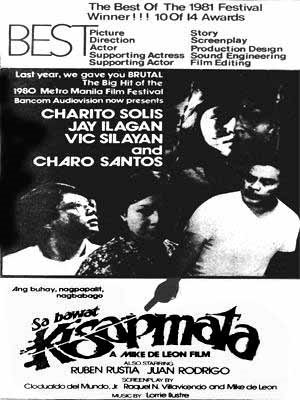
Kisapmata Wins Nine Awards

Kisapmata, a movie about a deranged retired policeman, got nine of the 13 awards, including best picture, in the 1981 Metro Manila film festival awards ceremonies held at the Cultural Center of the Philippines last night.

The movie, earlier banned from being shown until the hearing on a suit involving it starts on Jan. 4, also won for Mike de Leon the best director award, De Leon, together with Clodualdo del Mundo and Raquel Villavicencio, also won the best screenplay award. Vic Silayan, the lead actor in Kisapmata, won the best actor award, Jay Ilagan and Charito Solis were adjudged best supporting actor and actress, respectively. Kisapmata, produced by Bancom Audiovision, also got the best production design, best sound, and best editing awards.

This year’s best actress is Vilma Santos, who appeared in Sining Silangan’s Karma. Other awards went to Pagbabalik ng Panday, for best cinematography and best child performer (Bentot Jr.); Kamlon, best musical scoring; Kapitan Kidlat, also for best child performer (Dranreb). Press photographers walked out shortly after the evening show started. A man who was directing people on the stage shooed the photographers away, saying they were not allowed near the stage. – The Times journal December 28, 1981,  Source: Video 48 (READ MORE)

The Mysterious Hanky


In 1963, a nine-year-old girl from Trozo, Manila, went to Sampaguita Studios for a movie assignment that her cameraman uncle got her. She was supposed to star in a movie with then big-name actresses Gloria Romero and Rita Gomez. But along the way to the set, she and her mother stopped by an ongoing audition for kid actresses for a new movie. Star-maker and Sampaguita Studios owner Dr. Jose “Doc” Perez saw her and asked her to join the audition. Hesitant at first because she had already committed herself to another movie, she later gave in to Doc Perez’s request. He was the movie company’s owner, after all.

When her turn to act with veteran character actress Bella Flores came, everyone was impressed, including Doc Perez himself. She did not only pass the audition, she also got the lead role.

The movie was titled Trudis Liit (the first of her 196 movies), and the little girl who got the lead role and later got an acting award (the first of her 75 awards) for her performance was Vilma Santos.

Fittingly dubbed as “The Star for All Seasons,” she has maintained her luster despite the years and changes in show business; despite the challenges brought about by the coming of younger stars; despite the intrigues, challenges and personal problems that threatened to rid her of her throne as a queen in Philippine movies.

Vilma Santos maintained her status as a bankable movie star and as a critically-acclaimed actress over the four decades (and still counting) that she has been in show business. Vilma won not only numerous top acting awards, but also the love and loyalty of movie fans who call themselves “Vilmanians.”

This five-foot-flat Scorpio-born also gave a new meaning to the term “versatility.” Adding to her roster of abilities and talents—acting, singing, dancing, producing and hosting—she entered politics and governed first, Lipa City, and eventually the whole province of Batangas, famous for its machismo or “pagiging barako.”

Victorious Vi transformed from an award-winning box-office actress to a well-loved, highly respected public servant—Batangas Governor Vilma Santos-Recto.

URBAN LEGEND: THE “MYSTERIOUS HANKY.” But a legendary star like her is not without naughty rumors, tall tales, or urban legends. Vilma had her share of stories bordering on exaggeration and fallacy.

One such story is the urban legend of Vilma Santos’s “mysterious hanky.”

One tale has it that she always carries a hanky to hide the bulging veins on her left hand. Mischievous rumormongers have another version that says Vilma has very sweaty hands, that’s why she always has this handy hanky—to wipe her hands first before shaking a person’s hand or touching another person.

THE HANKY EXPLAINED. PEP (Philippine Entertainment Portal) sought the help of no other than Jojo Lim, the president of Vilma Santos Solid International, Inc. (VSSI, Inc.), to shed light on this urban legend.

Jojo Lim a Vilmanian since 1978, gave PEP what he knows about the “mysterious hanky” of Ate Vi.

“Ang alam ko, simula pa ‘yan nung bata pa siya. Si Papa [Amado] Santos, lagi siyang pinagbabaon ng lampin para pamunas ng pawis niya,” Jojo narrated.

Jojo continued that Vilma later gave up the “lampin” for soft, signature hankies that matched the color of her clothes in the ‘80s. Clothes that were made by popular designers Danilo Franco, Chiqui Hollman, Steve de Leon, Danny Acuna and Rajo Laurel.

“Since trademark na noon ni Vi yung panyo, kaya yung mga designers niya, kapag iginagawa siya ng damit, lagi nang may katerno yung panyo,” Jojo added.

VSSI auditor Al Valencia, a Vilmanian who fell in love with the Star for All Seasons the moment he first watched her in Lipad Darna Lipad, gave PEP another story about the hanky.

“Nung ‘80s, barkada kasi ni Vi si Coney Reyes. Siya yung nag-suggest kay Vi na lagi na lang magdala ng panyo sa kamay,” began the Vilmanian “Trivia Guy.”

“Si Vi kasi noon, kapag pinupunasan niya ang pawis niya, tissue ang ginagamit. Nag-iiwan tuloy ng himulmol o piraso ng tissue sa mukha niya. So, sinabihan nga siya ni Coney na panyo na lang. So, from then on, lagi nang may dalang panyo si Vilma.”

But the most legit explanation to the “hanky mystery” comes directly from Governor Vilma Santos-Recto herself, when PEP caught up with her in a presscon sponsored by Bear Brand, the milk brand she endorses.

PEP asked her for the story behind her now trademark hanky-on-hand.

“Protection,” the legendary star answered simply. “Protection ko sa pawis, sa alikabok, sa dumi.”

Gov. Vi said she started to always carry a hanky on her left hand during her Vilma! (Vilma on Seven or V.O.S.) days. She now needs to carry it more often than before, now that she’s always on the move, visiting barangays in Batangas in the sun’s heat and the blowing dust to see what the Batangueños need and what she can do to meet their needs. – Rommel R. Llanes, PEP, Sep 9, 2008

FILM REVIEW: IN MY LIFE


The Plot: “…In My Life offers you a different Vilma Santos, a different John Lloyd Cruz and a different Luis Manzano,” said the film’s director, Olivia Lamasan, the woman behind the blockbusters Milan, Sana Maulit Muli, Got 2 Believe and Madrasta. “You have to see the genuine chemistry among these three actors who are together for the first time in a movie. This is also a unique film because it presents a mother in her 50s, thinking that she’s been through all and seen it all, when in actuality, a new chapter in her life is just beginning.” Santos plays Shirley, a public school librarian who wants to be in control of everything. Her unwarranted intervention in the lives of her children and their families leads to their emotional detachment from each other. Feeling she has lost her command over her children, she flies to New York to reunite with his estranged son, Mark (Manzano) only to find out that her son is gay and she has to live with him and his lover, illegal immigrant Noel (Cruz). As Shirley struggles to deal with the situation and with living in the Big Apple, she discovers that being gay is not the only huge secret that Mark is keeping. Discovering what this is will change Shirley’s life forever…” – Manny the Movie Guy (READ MORE)

The Reviews: “…The woman who plays the mother tries hard to be young, which might be the pattern of her recent films. It is not a bad path after all, for one has to graduate from doing the same things for a long time. She has comedic timing, and she has dramatic prowess. When she complains, “Ginagawa niya akong turista! Ikaw ang pinunta ko rito, hindi ‘yung tour!” we laugh because she is witty. When she throws a tantrum after getting lost in the subway, we hate her. Apart from knowing that it was her fault, we can’t stand the charming partner being blamed despite his niceness by an ingrate. It crossed my mind to call her character one of the weakest roles ever written for her, but that’s just because Shirley Templo isn’t too likable. She is repulsive most of the time. Reflecting, the actor has portrayed “unlikable” characters before, even taboo roles for that matter, yet we still like her. But in In My Life, her role tends to go beyond understanding; you just need to be her to understand her. Yet the actor delivers; she deceives us. But the blood of the film flows from the actor who plays the son’s partner. Amid the histrionics and uneven noise of the film in general, he shows his restraint without fuss. Apparently the writers intend to make his character subdued. He exists in the periphery without losing his grip. When he cries at his partner’s back as he hugs him on the bridge, he is the equivalent of sacrifice. Never show the pain, never show the loneliness. That’s us, on the screen. The brief exposure of his family’s life is enough for us to connect with him. Contrary to the emphasis given to the mother’s family, we would like to know him more, know if the lump in his mother’s breast is just a false alarm, know if he’s just fine after crying overnight. We learn about his troubles in staying in the States, how he juggles work and hobby, how he struggles to earn for his marriage. God forbid, we don’t want him to fall into the arms of Pamela. His issues are more interesting, yet what makes him special is that like most people around us, we only get to know him up to a certain extent. He comes and goes. We miss him. We want to see if he’s fine. His distance unsettles us, in a good way…” – Richard Bolisay, Lilok Pelikula (READ MORE)

“…For its exceptional casting alone, In My Life is amazing. Vilma aside, my heart goes out to John Lloyd, that rare dramatic actor who can make you cry just by seeing his eyes well up with tears. He portrays a lover quietly suffering Shirley’s tantrums with restraint and grace, but at the same time, he makes it heartfelt and sincere. I was surprised by John Lloyd and Luis’ screen dynamic as a gay couple. They call each other as Babe, display very romantic photos in their apartment and as the movie ends, they share a tender kiss on Brooklyn Bridge. Onscreen, their love is sweet, hushed and terribly romantic; even more effective and memorable than most hetero screen pairings. As for JLC and Luis being typecast in gay roles or catching social stigma, I have serious doubts about that, for onscreen, they are still as masculine and virile. As for Vilma, she portrayed a multi-dimensional mother who learns to get off her high horse and deal with displaced motherly pride. Later in the movie, Shirley realizes that that even if she’s done everything for her children, she failed to know them as persons. Unlike other mother roles she has done in the past, the Star for All Seasons depicts a flawed mother who eventually finds peace with herself and her past mistakes. Not to be missed is Shirley and Noel’s confrontation wherein the traditional sampalan was reinvented and Noel throws in the lines: “Anak mo lang siya, hindi mo siya pag-aari. Kung ano ang naging siya, dahil ‘yon sa mga taong pumaligid sa kanya, at isa ka lang doon…” – Czeriza Valencia (READ MORE)

“…In “Direk Olive’s ‘In My Life’ is bold and fresh,” by Walden Sadiri (Manila Bulletin, 2009), its director Olive Lamasan is quoted as saying that she helped Santos “rehearse how a librarian walks and looks ‘losyang.’” If this were an article for a scholarly journal, I suppose some questions that could be asked are: Is there such a thing as a “librarian walk”? Are all librarians losyang (Tagalog slang for unglamorous)? But it probably isn’t fair to ask such questions of an article that only seeks to promote the release of a soon-to-be shown film. I think it’s important to remember that Lamasan is talking about a specific character in a particular film. And that it would be a mistake to focus only on this one phrase in the 20-paragraph article or judge the entire movie based on how the librarian is portrayed. I don’t think there was any intention to characterize ALL librarians as losyang. But we also cannot deny that this stereotypical librarian exists. I look at the photo above and remember that more than a few librarians I’ve met dress exactly that way. Should the director perhaps have made sure that all kinds of librarians were represented in her film? It’s not her responsibility to do so and that’s not really how movies are made….” – Filipino Librarian (READ MORE)

“…John Lloyd Cruz as Noel is the archetypal leading man of Star Cinema: a man who loves unconditionally, who suffers for his love, who also happens to be devoted to his parents. He’s predictably given moments to bare his heart out. But Manzano as Mark is the more interesting creation. He’d rather go to the gym than spend time with his Mom, and he makes that strange proposal to her (I won’t give away the surprise), tapping into a son who’s both practical and caring, tough and sweet. Plus, with all that missing sex in the movie, Manzano manages to hint at someone who’s comfortable with it, next to Cruz’s somewhat frozen take on man-to-man touching. But what little gay moments that are permitted to slip through are strong. In one scene, Shirley (Santos) complains that her son never even “came out” to her. In defense, Mark points out the double standard: If his straight siblings were never obligated to declare their straightness, why should he announce his gayness? Lamasan’s co-writers, Raymond Lee and Senedy Que, are minds behind two of the most progressive queer films of our time. (Lee produced Ang Pagdadalaga Ni Maximo Oliveros; Que wrote and directed Dose.) Like those films, In My Life belies a fierce intelligence, wisdom that comes from a place of experience, at least whenever it’s allowed. The film’s most special move is that it roots Mark’s anxiety — He’s never good enough for Mom — to that moment in adolescence when he felt his homosexuality was a disappointment. Like that scene, the best moments in the film are those which meld specific personal experience to the anyone-can-relate universal — which is really the aim of the genre of melodrama. Santos may be a mother to a gay son, but she’s really just any parent who wants to say sorry for her mistakes. Dimples Romana, in a great supporting performance, is any daughter (or son) who felt like a failure. But the makers don’t know when to ease up on the melodramatic conventions, which stall the movie here and there. Shirley’s journey is marked with obvious, rigid plotpoints. She spends the first part whining about America with a capital A, then finds mini-success as a career woman, complete with feel-good montage. There’s an old-fashioned, weary mannerism to Lamasan’s approach, not helped by her visual team. New York is a flat, gray city in the eyes of cinematographer Charlie Peralta, and lifeless and generic according to production designer Elfren Vibar…” – Franc, The Bakla Review (READ MORE)

“…So in the movie, Vilma is “Shirley Templo” (methinks the joke in the character name will be wasted on many of the audience), a separated lady being convinced to sell an old house officially bequeathed to her by her late father-in-law. Knowing this, she buys herself a plane ticket (on a librarian’s salary) to see her gay son in New York, and forces herself upon his life. The writers do their hardest to show that Luis, who plays Vilma’s son, Mark is the busiest man on their side of the planet. But for the most part, Mark (a.k.a. “Lucky”) just succeeds in looking constipated most of the time. Speaking of constipated, Vilma Santos seems to have over-acted in this movie… there’s grit and nails all over the scene whenever she’s there. Even if grit and nails aren’t necessary for the supposed scene. The forced comedy of some parts were obviously…forced…” – Jasper Greek Lao Golangco (READ MORE)

“…We really wanted “In My Life” to be one of the few films that we will always look back on and cherish as a film that brings a glimmer in our eyes. Unfortunately, that dream won’t happen. So what made “In My Life” bad? First, it was definitely not the acting. We all have praises for the three main protagonists. Vilma was just at her best here and John Lloyd showed how much drama he can show out. Luis needs more improvement but he actually performed well being a homosexual so still, props to him. Second, it also wasn’t the lack of drama thereof. There were oodles upon oodles of scenes where tears will fall and we also liked the occasional break from all the heaviness with light comedic scenes scattered all over the film. Unfortunately, even with all the topnotch acting and drama, the simple truth is that “In My Life” left out one big aspect in a film and that is the story/plot. The story of “In My Life” was just too much for us too digest as there are a lot of unnecessary subplots happening all over the place (especially by the end of the film). As a viewer, we just wanted it to end but the film just gave more, more and more. We think the writers just forced it to have lots of dramatic avenues just for the sake that people will cry. As the saying goes, too much of anything is bad and this holds true here as they do not mesh well. Cry you will but you will might also wonder why. Even though it had unusual twists, it will make you think if it was really necessary to have them happen that way as an effective means to move the story forward. For us, they were not…” – Jed and Vit (READ MORE)

“…A mainstream Filipino film “In My Life” that stars the Philippines’ multi-awarded veteran actress Vilma Santos will premiere on September 27 at the Fox Theater in Redwood City at 2pm. The film also stars Santos’ real life son Luis Manzano and Manila’s matinee idol John Lloyd Cruz. The gay-themed movie was filmed both in Manila and in New York City. The setting, which has the backdrop of the Big Apple and the outskirts of Manila revolves around a doting mother and her gay son, who is not out to her yet. She visits the gay son and finds out he lives with a “Best Friend.” The mother cloys and clings with the son until finally the son gives in with a blow of his ailment. A powerful scene between the mother and her son’s partner will surely wrench the viewers’ hearts when they see the movie…” – Marconi Calindas (READ MORE)

“…Vilma Santos has become the poster girl for these cinematic suffering mothers, having played the progressive mother of children from different fathers in Chito Roño’s Bata Bata Paano Ka Ginawa? (Lea’s Story, 1998), the maltreated maid from Hong Kong who returns to Manila to ungrateful children in Anak, and the indefatigable mother in Roño’s 2003 adaptation of Lualhati Bautista’s famous novel Dekada ’70, where a middle class family wades through the turbulent decade and evolves from convenient apathy to activism and awareness. In Olivia Lamasan’s In My Life, she plays Shirley Templo, an effective yet stubborn mother to openly gay Mark (Luis Manzano, Santos’ son in real life). Shirley Templo is the culmination of all the mothers that Santos has played: assured because she can pinpoint every little comfort and pleasure that she dutifully has given up for her children and because of that, feels entitled to her children’s undivided loyalty and attention. Thus, when Shirley decides to move to New York City with Mark after learning that her daughter (Dimples Romana, who does wonders in the little role she has; that scene where she laments of her dissolved dream of becoming a doctor is precious) has decided to migrate elsewhere, Noel (John Lloyd Cruz), Mark’s overly loyal boyfriend who is staying illegally in the United States, suddenly becomes the third wheel in Shirley’s belated attempt to reconnect with her son. There is no denying that Santos is a terrific actress. Recently however, she has limited herself to roles that are quite unvaried, to the point of Santos becoming a predictable if not mechanical performer. Her Shirley Templo, while an always entertaining presence because of her amusing quirks (Santos has exquisite comedic timing) and the skill and experience that Santos gives her during the many emotional highlights in the film, feels more like a derivative of everything the actress has done in the last decade. Fortunately, Cruz, who has graduated from playing charming yet soulless boys next door in the many romantic comedies he starred in, gives formidable support to Santos. The methodical manner Cruz gives life to Noel (the extra split seconds that he has his mouth open after every word that is shouted with subtle inflection; the slight gestures that hint of the femininity underneath the masculine exterior) is complemented by the sensitivity and charisma that the actor naturally exudes. Manzano, although largely inconsistent, does quite well, even alongside more talented and more experienced actors like Santos and Cruz…” – Oggs Cruz (READ MORE)

“…Hindi ko rin talaga alam ito sa pagkakaalam ko kasi magsi-celebrate lang ako ng simple lang. Monday kasi is a working day nagkataon lang na exact date ito ng mismong birthday ko ang dami pala nilang preparation na ginawa. So I’m very, very thankful mga Mayors na andito, department heads at halos lahat ng mga empelyado ay narito at nakiisa sa akin,” masayang panimula iyon ni Ate Vi habang pawisan dahil noong mga sandaling kausapin namin siya ay abala ito sa paglilibot sa mga mesa na kung saan naroon ang kanyang mga kaibigan at kasama sa pulitika. “Now that I’m turning 38 I’m so happy,” biro pa ni Ate Vi. Ayon kay Ate Vi walang pagsidlan ang kanyang kaligayahan dahil hindi daw niya talaga alam na bibigyan siya nang bonggang party ng mga taong nagmamahal sa kanya. At dahil dito ay ipinangako niya na kung paano siyang minamahal ng mga taga Batangas ay higit pa run ang pagmamahal at pagsiserbisyong ibibigay niya sa kanyang mga kababayan. “Nakakahiya naman siguro kung alam mong mahal ka ng mga tao at sinusuportahan tapos wala kang gagawin sa kanila, ‘ay hindi naman siguro puwede ang ganun., Bilang Gobernadora ng bayang ito nais kong ipakita sa kanila at ipadama na rin na ako ay karapat-dapat sa pagtitiwalang ibinigay nila sa akin kung kayat marami pa rin akong magagandang plano sa Batangas, At hindi ko ito basta magagawang mag-isa kung hindi nila ako tutulungan.” Maraming wish si Ate Vi pero hindi para sa pansarili kundi para sa bayan at isa dito ay ang kasaganahan at katahimikan hindi lang ng buong lalawigan ng Batangas kundi nang buong bansa…” – Morly Alinio (READ MORE)

“…This begs the question: should we expect this kind of progressive view on homosexuality from the mainstream in general and In My Life in particular? Perhaps not. In an industry dominated by conservative values—rooted in the ideal economic feasibility of a G-rated film—In My Life’s gay publicity is simply a ruse, the film’s bid to package itself as daring and sensitive, as is fitting for the Star of All Seasons. Vilma Santos’s comeback cannot be centered on anything but her. The film must project Vilma as a daring actress (and liberal-minded politician) willing to tackle controversial roles, while maintaining her palatable sensitivity as the ordinary matriarch of Anak and Dekada ’70 fame. In My Life, then, is ultimately a film about mothers. Though packaged as a queer film, it is actually a family movie, the much-publicized homosexual angle between Cruz and Manzano just one of the many issues mothers like Shirley have to deal with in these times…” – Edgar Allan Paule, Viewer Discretion, 14 Oct 2009 (READ MORE)

LUNA RECOGNITION

This slideshow requires JavaScript.

Vilma Santos’ Film Academy of the Philippines (Luna Awards) Recognitions
(13 nominations, 4 wins, one lifetime achievement)

From Wikipedia: In 1981, President Ferdinand Marcos passed Executive Order 640-A, which established the Film Academy of the Philippines, the Philippines’ official counterpart of the United States’ Academy of Motion Picture Arts and Sciences.

The very first Film Academy of the Philippines’ best actress winner was Vilma Santos in 1982, for Relasyon. Also, two Vilma Santos movies, Sinasamba Kita and Gaano Kadalas Ang Minsan won technical awards for sound, original score, cinematography, and adapted screenplay.

Paano Ba ang Mangarap, a Vilma Santos movie won best cinematography for Romy Vitug the following year.

The third FAP confirmed the arrival of Sharon Cuneta, as she was adjudged by the guilds, their best actress in 1984 beating Vilma and Nora for Sa Hirap At Ginhawa. Vilma’s Sister Stella L director, Mike De Leon won the best director. Vilma’s other film, Alyas Baby Tsina won best in musical score and production design.

Nida Blanca won best actress for Miguelito and Lino Brocka best director for Kapit sa Patalim in 1985.

Vilma’s Saan Nagtatago Ang Pag-ibig won best director for Eddie Garcia and best cinematography for Romy Vitug in 1987. Lorna Tolentino won the best actress for Maging Akin Ka Lamang. Tagos Ng Dugo, Vilma’s winning film at the FAMAS won, best musical score. Veteran actress, Mary Walter received the lifetime achievement award.

Amy Austria and Philip Salvador was the big winner in 1988, for surprisingly for forgettable films, Boy Negro and Celestina Sanchez aka Bubbles respectively.

As both Vilma and Nora shared the best actress at the URIAN, FAP gave the best actress solely to Nora Aunor in 1989. Her film Bilangin Mo Ang Bituin Sa Langit, won best actor, best director as well. Vilma’s film, Pahiram ng Isang Umaga won two, best production design and best sound. Director Lamberto Avellana received the posthumous recognition award and veteran actors, Leopoldo Salcedo and Bella Flores, the lifetime achievement awards. Leopoldo did the memorable film Burlesk Queen with Vilma while Bella Flores was Vilma’s torturer in her very first film as a child actress in Trudis Liit.

As Vilma Santos won three times in rival award giving bodies, URIAN, Nora Aunor did the same with her three consecutive best actress in 89, 90, and 91. Both Vilma and Nora have four Lunas.

Vilma’s Kapag Langit ang Humatol won best story and cinematography and Joseph Estrada received the lifetime achievement award in 1990. Also, this year, the Lamberto Avellana Memorial Award was given to Lino Brocka.

Vilma’s Ipagpatawad Mo won best child performer for Terence Baylon and best Editing while the lifetime achievement award went to Fernando Poe Jr in 1991.

Nora’s three-year feat ends when Lorna Tolentino won the best actress in 1992 for Narito ang Puso Ko.

Vilma won her second best actress after seven nominations in 1993 for Dolzura Cortez Story. The film also won best adaptation story and musical score. Lifetime achievement awards went to Espiridion Laxa and Nora Aunor. Laxa was Vilma’s film producer of so many memorable films like, Dama De Noche and Lipad Darna Lipad.

Nora won her fourth best actress in 1995 for The Flor Contemplacion Story and Sharon Cuneta in 1996 for Madrasta. The 1996 lifetime achievement award went to Anita Linda.

Maricel Soriano’s turn to receive the best actress happened in 1997. She won for Nasaan ang Puso. Also, this year, Vilma Santos received the lifetime achievement award and the posthumous recognition award to Charito Solis.

Vilma Santos won her third best actress in 1998 for Bata, Bata, Paano Ka Ginawa, her co-stars, child actors, Carlo Aquino and Serena Dalrymple won the supporting acting trophies. The film also won best in production design. Vilma’s director in box office hits like Sinasamba Kita and Imortal, Eddie Garcia, received the lifetime achievement award.

Bulaklak ng Maynila win big in 1999, best director (Joel Lamangan), best actor (Christopher de Leon) and best actress (Elizabeth Oropesa). Vilma’s blockbuster movie, Anak won two trophies in 2000: best supporting actress for Amy Austria and best screenplay for Ricardo Lee. Gloria Romero won the best actress for Tanging Yaman. Vilma’s director and co-star in memorable films Nakakahiya and sequeal, Hindi Nakakahiya, Eddie Rodriguez received the lifetime achievement award.

Lorna Tolentino reclaimed her spot in FAP history when she won the following year her second best actress for Abakada Ina.

Vilma won her fourth best actress in 2002 via Chito Rono’s Dekada ’70. Her co-star, Piolo Pascual won the best supporting and the film also won best production design.

Maricel Soriano won again in 2003 for Filipinas while Susan Roces received the lifetime achievement award. The next year, Claudine Barretto won her very first academy award for her film, Milan. The following year, Vilma received her 13th best actress nomination for Mano Po III: My Love.

In 2005, the FAP award became, the “Luna Awards.”

In 2006, Nida Blanca and George Canseco received the posthumous recognition award. Nida Blanca co-starred with Vilma in 1988’s Ibulong Mo Sa Diyos. George Canseco created so many memorable songs for films starring Vilma Santos. In 2007, the special posthumous award was given to Armando Garces and Fernando Poe Jr.

STAR RECOGNITION

This slideshow requires JavaScript.

Vilma Santos STAR awards for Movies Recognitions

 18 nominations with six wins, one lifetime achievement award, one darling of the press award

Highlights:   In 1985, the Philippine Movie Press Club initiated the Star Awards for Movies and Television, which is currently the Philippines’ Golden Globes’ counterpart. The very first recipient of Star best actress was Nora Aunor for Merika while Vilma’s movie Sister Stella L. received the movie of the year award.   Vilma Santos was nominated for Palimos Ng Pag-ibig in 1986 but failed to win the best actress. Unfaithful Wife was judged the STAR best picture of this year.  The next year, Vilma’s film, Saan nagtatago ang pag-ibig was proclaimed the movie of the year. Vilma received a best actress nomination for her FAMAS winning film, Tagos Ng Dugo.  The fifth year, Vilma was nominated again, this time for Ibulong Mo Sa Diyos. 

PMPC finally gave the trophy to Vilma in 1989 Star Awards. Vilma’s Pahiram Ng Isang Umaga four major awards: actress of the year for Vilma, supporting actor for Eric Quizon, director of the year for Ishmael Bernal, and Movie of the year for Regal films. Pahiram also won technical awards for cinematography, musical score, and production design.  The following year, Snooky Serna won the supporting actress for Vilma’s “Hahamakin Ang Lahat.”  Vilma was nominated for Hahamakin but the Star went to Nora Aunor for Andrea paano ba ang maging isang ina.  Despite the lost, Vilma received a very special award from the PMPC, the “Darling of the Press” award. The next year, 1991, Nora Aunor again received the Star Award Actress of the Year for Ang totoong buhay ni Pacita M. Vilma was nominated for Ipagpatawad Mo. In 1992, Vilma was nominated again, for Sinungaling Mong Puso that Lorna Tolentino won for Narito ang puso ko.  After winning her first Star Award in 1989 and nominated three consecutive years, Vilma finally win her second Star in 1993 for Dahil mahal kita: Dolzura Cortez Story. The next year, Vilma was nominated for Nagiisang Bituin but Dawn Zulueta took home the trophy for Buhay ng buhay ko.

In 1995, Nora Aunor was the big winner again with her film, Flor Contemplacion Story.  1996 was Sharon‘s grand slam year. She won the Star for Madrasta with co-star, Christopher De Leon taking the actor of the year.   In 1997, Zsa Zsa Padilla defeated Nora, Vilma, Marecel and Sharon for actress of the year for Batang PX. Vilma was nominated for Hanggang Ngayon Ika’y Minamahal.  Vilma was the big winner in ’98 for her film, Bata bata paano ka ginawa. She won actress of the year while co-star Serena Dalrymple won the supporting actress. Elizabeth Oropesa followed Vilma’s win the following year via Bulaklak ng Maynila.   The new millennium brings another Star to Vilma as she claimed her fifth actress of the year for her film, Anak. The next year the Tuhog was the top film while Snooky Serna won the actress of the year for Habang kapiling ka.   Vilma won her sixth actress of the year from Star in 2002 for the film, Dekada ’70. She will win her seventh Star again in 2004 for Mano po III: My love in 2004.   The next three years, Judy Ann Santos (Kasal, kasali, kasalo – 2006); Ai-Ai de las Alas (Ang cute ng ina mo! – 2007) and Sharon Cuneta (Caregiver – 2008) received the Star actress of the year.   Vilma Santos received the lifetime achievement award in the 2008 Star Awards while Nora Aunor’s film Himala was given a special citation award.  By 2010, Vilma received her 18th best actress nominations and won for her 2009 film, In My Life. – RV

Vilma Santos’ STAR for TV RecognitionIn the 1980’s, Nora Aunor’s Superstar show was losing viewership and her box-office appeal was also in question. Suddenly, the 70’s superstar was being eclipsed by a non-singer but an excellent dancer and versatile actress Vilma Santos. She has just scored her first of four grand slams for the movie Relasyon and continued to reign as the Longest Box-office Queen of Philippine Cinema. And slowly but surely, her VIP (Vilma In Person) TV show was gaining patronage/high ratings too from the precious class ABC households nationwide, TV advertisers’ prime target audience for their products.   There was no stopping Vilma Santos. She was about to conquer the TV musical-variety genre where Nora Aunor ruled for years. Early on, Vilma Santos had rough sailings with her musical variety show. VIP was being broadcast from Channel 2 which had a bad reception among TV homes nationwide, and was no match to the more modern RPN Channel 9 where Nora’s Superstar show was simultaneously shown from Luzon to Mindanao in vivid, crisp color. When VIP moved to GMA Channel 7, it was the best move that Vilma’s think tank ever did. With better satellites, shrewd marketing, state of the art facilities, and more ambitious production numbers and with the Dancing Queen Vilma at the center of it all, and with the genius of Maribeth Bichara’s choreography and musical concepts written all over the show – “Vilma!” became the most watched and the most awarded (SEE LIST BELOW) TV show in the musical/variety category.. (READ MORE).

  • 1987 – Best Musical Variety Show Host
  • 1988 – Best Musical Variety Show Host
  • 1988 – Best Musical Variety Show
  • 1989 – Best Musical Variety Show
  • 1990 – Best Musical Variety Show
  • 1991 – Best Musical Variety Show
  • 1992 – Best Musical Variety Show
  • 1994 – Best Musical Variety Show
  • 1998 – Ading Fernando Lifetime Achievement Award
  • 2006 – Best Actress in a Single TV Performance – MMK: Regalo

Related Readings:
26th PMPC Star Awards (2010) Winners: John Lloyd Cruz, Vilma Santos etc
Gov. Vilma Santos-Recto to receive Ulirang Artista award from PMPC
ighlights and sidelights of 25th Star Awards for Movies
Governor Vilma Santos inducts new officers of PMPC
PMPC Star Awards for TV 2006 Winners
STAR for TV RECOGNITIONS (and other TV awards)

STAR for TV RECOGNITIONS (and other TV awards)

Vilma Santos’ STAR for TV RECOGNITIONS

  • 1987 STAR Award Best Musical Variety Show Host – Vilma!
  • 1988 STAR Award Best Musical Variety Show Host – Vilma!
  • 1988 STAR Award Best Musical Variety Show – Vilma!
  • 1989 STAR Award Best Musical Variety Show – Vilma!
  • 1990 STAR Award Best Musical Variety Show – Vilma!
  • 1991 STAR Award Best Musical Variety Show – Vilma!
  • 1992 STAR Award Best Musical Variety Show – Vilma!
  • 1994 STAR Award Best Musical Variety Show – Vilma!
  • 1998 STAR Award Ading Fernando Lifetime Achievement Award
  • 2006 STAR Award Best Actress in a Single TV Performance – MMK: Regalo 

 Catholic Mass Media Awards

  • 1987 CMMA Best Musical Variety Show
  • 1988 CMMA Best Musical Variety Show
  • 1989 CMMA Best Musical Variety Show
  • 1990 CMMA Hall of Fame in Musical Variety Show

Other Recognitions

  • 1972 EMEE Most Effective TV Actress
  • 1990 New York International Awards for TV Finalist
  • 1991 Dove Awards Best Musical Variety Show

Related Readings:
26th PMPC Star Awards (2010) Winners: John Lloyd Cruz, Vilma Santos etc
Gov. Vilma Santos-Recto to receive Ulirang Artista award from PMPC
ighlights and sidelights of 25th Star Awards for Movies
Governor Vilma Santos inducts new officers of PMPC
PMPC Star Awards for TV 2006 Winners
STAR Recognition

Two Doctorate Degrees In Humanities

Honorary Doctorate Degree in Humanities by the Lipa City Public College

Mayor Vilma Santos-Recto (she is now, the Governor of Batangas) was given an honorary degree of Doctor in Humanities by the Lipa City Public College (LCPC) last November 10, 2005.  The Doctorate degree was given after resolution no. 01-05 of the Academic Council was passed. The head of the Academic Council, Dr. Armando Badillo and the Board of Trustees, including City Adminstrator Mr. Pedrito Martin M. Dijan, approved the resolution. The Commission on Higher Education (CHED) also approved the resolution on May 11, 2005. The resolution states that they acknowledge the leadership and talent of Mayor Vi not only in the art of Film, but also her sincerity and effective management as a Mayor and for being a good role model for a new Filipina, beautiful inside and out. It is further stressed in the resolution that the life of Mayor Vi as a public servant and as a multi-awarded actress clearly mirrors her deep understanding of how she can serve the public, her respect for human dignity and her genuine belief in the goodness of men to serve and help one another. Dr. Cristeto Pamplona, Schools division superintendent of DepEd Lipa; Atty. Joel Montealto, City Legal Officer; Lipa City Councilor Romy Macasaet and Ronaldo de Castro, City Personnel Officer completes the LCPC Academic Council. – Eric Nadurata, V magazine Vol 2 No 6 The Valentine’s Day Issue 2005