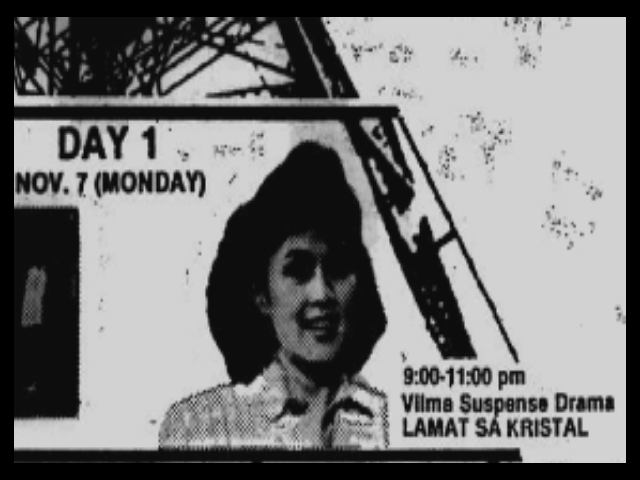
Lamat Sa Kristal (1988) tele-movie

This slideshow requires JavaScript.

Basic Information: Direction: Maryon de los Reyes; Screenplay: Raquel Villavicencio (Based on the stage play, Extremities); Cast: Vilma Santos, Richard Gomez, Jacklyn Jose, Mia Gutierrez. Broadcasted November 7 1988 by GMA Channel 7

Plot Description: Based on the play Extremities, a photographer (Vilma Santos) avenged her sufferings by torturing back the rapist (Richard Gomerz) who abused her.

Film Accomplishment: Part of GMA Seven’s special one week event entitled: “Seven Nights To Remember in November” in connection to their newly installed high voltage power grid broadcasting tower in 1988.

Film Review: “…Jacklyn is cast with Vilma Santos and Christopher De Leon in Viva’s “Immortal.” This is Vilma and Christopher’s first film together after several years of making movies separately. Although Jacklyn is cast in a supporting role, she is excited in doing the dramatic opus since it is a Vilma starrer. Jacklyn is vocal to admit that she is an avid fan of Vilma. This is the second time she co-stars with her favorite idol. The first one was on a TV dramatic special “Lamat sa Kristal,” which was produced by Vilma herself. Besides, Jacklyn is also happy to note that she will be directed by one of her favorite directors, Eddie Garcia…” – Eddie O. Liboon (READ MORE)

The highlight of GMA 7’s day one of its “Seven Days to Remember in November” las Monday, was the showing of Vilma Santos, Inc.’s first drama special for television titled Lamat sa Kristal, based on the play Extrimities. Coincidentally, the said tele-movie was shot during the rage of killer typhoon Unsang and was aired at the height of another weather disturbance name Yoning. The suspense drama starred Santos, Jacklyn Jose and Mia Gutierrez as the three friends, all professinals in their respective fields, who went out in vacation at a resthouse in Tagaytay. Santos, as the quiet photographer about to hold her one-woman show, was nursing a broken heart from a failed relationship. Jose was the happy-go-lucky type while Gutierrez was the usual reliable supportive friend. The tension started when Jose and Gutierrez left Santos in the resthouse all by herself. The lonely photographer calmly did her chores till she came across a stranger (portrayed by Richard Gomez) who turned out to be a psychopath and rapist. The following scenes showed how the woman was attacked, abused, tortured, molested and almost raped and she tried to put a fight and survive the ordeal.

Santos’ remarkable transformation from a hapless victim to a raging avenger trying to get even is one fo the most moving delineations we’ve seen in years. As it turned out, Jose was herself a rape victim and the harrowing experience of her friend suddenly confronted her with her traumatic past. She was convincing with her role and Gutierrez was likewise effective. What really surprised us was Gomez, we never thought that the good looking acotr could really act – we almost wanted to actually slash his neck in anger. As for Maryo de los Reyes’ direction, we doubt it very much if he had a hard time with this one, since he had some of our most gifted thespians and the typhoon which had provided the needed atmosphere. Of course, there were some loopholes. In the script of Raquel Villavicencio. For a tele-movie, Lamat sa Kristal was well-crafted and it surely deserves a follow up soon. As usual, the commercials were too many and they seemed too long. At any rate, Lamat sa Kristal was far better than most of the movies being shown lately. We never realised that the combination of Santos and the two typhoons would be that explosive. – Manila Standard, Nov 12, 1988 (READ MORE)

Seven Star-Studded Days Kick Off Tonight – “GMA-7 takes primetime television by storm as it unleash a prowerful entertainment package of internationally acclaimed bestsellers, world-class blockbusters and certified local chartsbusters starting today, November 7, Day one of its “Seven Days To Remember In November” special programming. Towering power, A Musical Dedication kicks off the spectacular showcase by gathering the GMA Family of Stars and some of the biggest, brightest names in the entertainment world in a two-hour musical extravaganza starting at 7 p.m. GMA’s prized star Vilma Santos maintain the momentum with a two-hour suspense drama, Lamat sa Kristal, her first TV-movie ever, with Richard Gomez as co-star and ace megman Maryo de los Reyes as director at 9 p.m…The celebrated musical variety show Vilma throws a grand birthday presentation-celebrations on Day Five starting at 7 p.m. live at the Araneta Coliseum…” – Manila Standard, November 7, 1988 (READ MORE)

“…Vilma Santos went through with the taping of her first drama special, Lamat sa Kristal, during the rage of killer typhoon Unsang. While it wrought havoc in the entire nation and claimed numerous lives and destroyed properties, the whole production made good use of the terribly bad weather to set the mood for the top actress’ tele-movie. Indeed, there’s nothing like Mother Nature providing the real atmosphere, as teh stars and crew braced the strong winds and heavy rains. To the said stars and crew the showbiz rule “the show must go on” still holds true, no matter what the weather is…” – Meg mendoza (READ MORE)

“Again, it was a bad year for the movies in 1988, the industry reached a critical low – a total output of 132 films to 150 of the previous year. Certainly, the situation, has become worse, a foreboding that may prove irreversible unless appropriate measures are instituted…On the other hand, Vilma Santos, although she starred in only one movie, Ibulong Mo sa Diyos, lorded it over in television with the top rated Vilma and a top-rating drama special (Lamat sa Kristal) she herself produced…….” – Mike Feria, Manila Standard, Jan 5 1989 (READ MORE)

“…Jacklyn Jose still talks about her rare experience of appearing in a special tele-movie (Lamat sa Kristal) with her favorite actress Vilma Santos. Jose was vocal in telling her friends that she is an avid fan of the top actress. In one scene, she was supposed to drive the care where she, Santos and Mia Gutierrez were supposed to be riding in. She got excited not because she did not know how to drive but because she was for the first time with her movie idol…” – Eddie O. Libo-on, Manila Standard, Jan 9, 1989 (READ MORE)
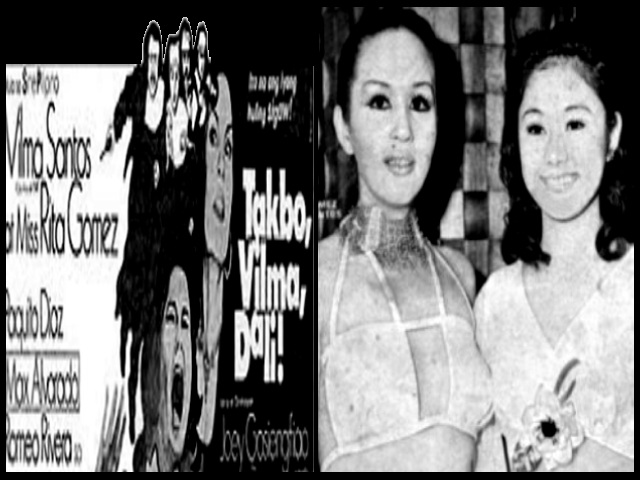
Ronnie Henares and Vilma Santos

This slideshow requires JavaScript.

Teen Heartthrobs – “…The ‘Two of Us’ story started when Jojit and Ronnie were invited to spend a weekend at the Laurel beach house in Matabungkay, Batangas. They sang on the beach with their acoustic guitars just hanging out with Suzie, Lynnie, and Cocoy Laurel, Vicky Lopez, and other friends who came to party. They were astonished by Jojit and Ronnie’s phenomenal vocal blending. The ‘‘two of them’’ were surprised by the clamor. By the sands of Matabungkay Beach, the ‘Two of Us’ was born. Shortly, they became widely popular among college and university campuses around Manila that they could not cope with invitations. In the early days their invitations were mostly from exclusive private schools. Later on they transcended socio-economic barriers and found themselves invited to school campuses public or private all over Metro Manila. They were spreading their fame by connecting rich and poor with the universal language of music. Their popularity exploded from school campus on to radio, print, and television. After their first appearance on “ABS Musical Extravaganza,” a noontime TV show, the phone board was jammed with calls. The next show they were back by popular demand. Their meteoric rise in Philippine showbusiness was phenomenal. Soon the ‘Two of Us’ had gigs on prime time TV doing musical specials, live shows, road tours, concerts, radio shows, and numerous personal appearances. Lem Balagot, Ronnie’s classmate at the Ateneo, introduced them to Tower Productions where they composed “Tina” for Tina Revilla and their first movie theme “Funny Girl.” Famous DJ celebrity Ike Lozada introduced them to Tony Santos, director of the highest- rated primetime TV show, ABS-CBN Ch. 3’s “D’Sensations” with Vilma Santos. They were offered “permanent cast” status on the spot by Director Tony Santos when the studio audience broke into a screaming frenzy at their first song. For a couple of years, every Sunday evening the ‘Two of Us’ serenaded audiences all over Luzon, Visayas, and Mindanao in a prime time TV show that transformed them from teen heartthrobs to Philippine Idols…” – Live from Los Angeles (READ MORE)

After The Two of Us – “…That time, The Two of Us (as managed by Ronnie’s younger brother Atom Henares) was more popular than the APO since the duo was more visible on TV than the APO (although both groups made a killing doing campus tours). I actually was more familiar with Jojit because his dad was the classmate of my parents in law school. The older Paredes, from Abra I was told, was a very good-looking man — as my parents pointed out in their school annual…After The Two of Us, Jojit eventually disappeared from the scene (he is now in L.A. married to an American and works as an assistant administrator in a hospital), while Ronnie’s popularity lingered, especially when he and Vilma Santos began dating. Ronnie also joined Penthouse 7 as executive producer/dancer and also part of the group was Ida Ramos, who many years later would become his wife. (Ida Henares now heads GMA Artist Center.) In between, he also hosted his own variety shows on TV, primarily in the Broadcast City stations…” – Butch Francisco (READ MORE)

The Proposal – “…But it was Ronnie Henares, Jojit’s partner in Two of Us, who became Vilma’s next boyfriend after Edgar Mortiz,” Jojo told PEP. “Ayon sa mga balita noon, niyaya niya si Vi na magpakasal noon, kaya lamang ay hindi pa handa si Vi na lumagay sa tahimik noong panahong iyon. After ng breakup nila ni Vi, he married Merce Henares [na lumabas bilang anak nina Rosa Rosal at Ronald Remy sa TV show na ‘Yan ang Misis Ko].” Single again, a slew of suitors once again tried their luck with Vi. “Kabilang pa sa mga nanligaw kay Vi sina Richard La Torre na pamangkin ni Sylvia La Torre, si Joey Sonora na only brother nina Susan Roces at Rosemarie Sonora, yung mga basketball players na sina Dave Brodeth at Atoy Co, ‘tapos U.S. Air Force lieutenant pa na si Les McCoy at yung Fil-Am na si Nelson Anderson from San Francisco,” narrated Jojo…” – Rommel R. Llanes (READ MORE)

Ronnie Henares – Before becoming the manager of Regine Velasquez, Henares is famous member of a duo, Two of Us. He was also a television personality during the 70s with TV show, Penthouse at Seven.

Ronnie Henares and Vilma Santos

Let’s Do the Salsa (1976) – “…Ate Vi thus became the chief opponent of Nora Aunor as the movie queen of the 1970s. Her edge is that she also became the queen of hit disco movies filled with singing and dancing, like “Swing It, Baby,” “Disco Fever,” “Rock Baby Rock,” “Let’s Do the Salsa,” and the movie she did with Latin idol Junior, “Good Morning Sunshine…” – Mario Bautista (READ MORE)

Darna vs. the Planet Women (1975) – “…In this 1975 film (the 3rd in a 4 Darna film franchise), the story of Darna is rebooted as this new installment is NOT a continuation of the 1st and 2nd films. In this revamped version, Narda (Vilma Santos) is a cripple who dreams of accomplishing great things for the betterment of humankind despite her physical limitations. One day, she discovers her suitor (Zandro Zamora) paralyzed after having been attacked by a UFO. Together with her brother Ding (Bentot Jr.), she prays for help and offers to sacrifice herself for the sake of her suitor’s survival. A voice from beyond answers and sends her an enchanted amulet of power. The power of Darna contained within the magic pebble. With her newfound powers, she battles The Planet Women- Alien Amazons who are trying to transport the Earth to their own star system…” – Eric Cueto, Mars Ravelo’s Darna (READ MORE)

Related Reading:

Acting Moments in Philippine Movies

ARTICLES - Acting Moments in Philippine Movies

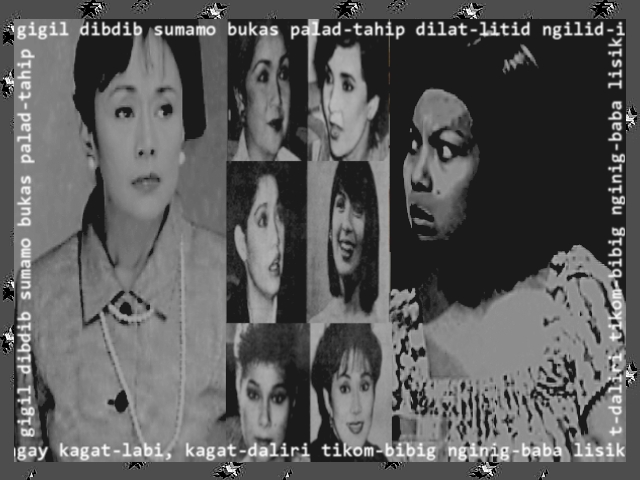
Scanning television programming last Holy Week lead me to watch Lino Brocka’s “Tatlo, Dalawa, Isa” (1974). In the second and third episode, I was struck by the acting styles of three of Philippine cinema’s most competent actresses: Anita Linda and Hilda Koronel in “Hello Soldier” and Lolita Rodriguez in “Bukas, Madilim, Bukas.” Watching them act brings to mind my fascination with schools of acting in Philippine cinema. For a while it is fruitless to talk about who the best actress is among the lot, it is quite interesting to map the traditions of acting which our better actresses descend. Since much of the acting of our actresses is intuitive and is not schooled in, let us say the realist Stanislavski tradition and its expression in the Method, or the Brechtian philosophy of social gesture, the best category of analysis to probe is not style, but the body and how it articulates emotion. Here lie particular problems and possibilities. Inasmuch as it is the body that coordinates performance, the expression is derived from a certain authenticity of emotion which is either of the moment or processed in the history of feeling the actress as social person has gone through. But because, by the same token, it is the body that is the main instrument of acting, the quality of the body and susceptibility to stereotyping limit the range of portrayals. There are also, of course, other factors to consider like the irresistible habits of Spanish and American colonial theater, the market demands of Hollywood, and the imperatives imposed by other mass media forms like radio and television. Still, the body and the process of embodiment of emotion are key to the appreciation of certain tendencies in acting. We now list random schools of thought in Philippine acting, with body parts as locus of action and source of idiosyncratic flair.

01. The “gigil” school which demands high energy, intensity and stamina in gesticulation as gleaned in the heavygoing styles of Vilma Santos, Charito Solis, Coney Reyes, and Maricel Soriano.

02. The “dibdib” school which plumbs the depths of repression to flesh out violation of the darkest kind as exemplified by Nora Aunor, Gina Alajar, and Nida Blanca.

03. The “sumamo” school which forces the actress to almost grovel in supplication as if on the verge of breakdown as rendered with subtle nuances and gross oversimplifications by Dawn Zulueta, Aiko Melendez, Julie Vega, and Judy Ann Santos.

04. The “bukas palad-tahip” school which allows the actress to compensate lack of facial acting with the repetitive up-and-down movement of arms as if in winnowing motion as best typified by Dina Bonnevie, Gretchen Barretto, and Sharon Cuneta.

05. The “dilat-litid” school which is the stark opposite of the previous in that it rarely uses body parts other than the eyes, which glower, and the mouth, which exerts the most dramatic vocal pressure, as executed with grace and precision (but sometimes with paranoia) by Lolita Rodriguez, Hilda Koronel, Vivian Foz, and Snooky Serna.

06. The “ngilid-ismid” school which contrues dramatic acting in terms of the ability of the performer to stifle sobs, make the eyes appear teary, and arrest the fall of tears (which are only made to well around the lids); the actress finishes of the act with a signature sarcastic grin as if to feign control over obviously collapsing faculties. Exemplars include Lorna Tolentino and Alice Dixson.

07. The “taas-noo-taas-kilay” school which exudes an air of sophistication marked by a mannered delivery of English one-liners and catty retort, complete with rolling r’s, as honed to perfection and cult status Rita Gomez, Celia Rodriguez, and Pilar Pilapil.

08. The “tulala-titig” school which shows the actress, seized in catatonia and resignation, staring out into a clearing as practiced with varying success by Rosa Rosal, Susan Roces, Helen Gamboa, and Charo Santos-Concio.

09. The “tiklop-bisig-sabay-irap” school which stresses a point by asking the actress to fold her arms and place them close to the chest as she holds her head high and lets out a sneer, with pout and high-pitched admonition attending, as perfected by the likes of Gloria Diaz and Raquel Villavicencio.

10. The “nguya-halakhak” school which is actually the bold-star type of depicting street-smartness on the outside and profound anguish within as embodied by Jaclyn Jose, Sarsi Emmanuel, and Rosanna Roces, who chew gum as astutely as they chew on their troubles.

11. The “buntong-hininga” school which manifests exasperation and impatience by making the actress take a deep breath and then expel air in the most hyperbolic fashion, as noticed in the petulant but sometimes poignant temper of Sheryl Cruz, Janice de Belen, and Liza Lorena.

12. The “tirik-pungay” school which tries to simulate dementia by urging the actress to roll her eyes in almost pathological manner and engage in imbecilic talk as represented by Anita Linda and Armida Siguion-Reyna.

13. The “kagat-labi, kagat-daliri” school which essays the confused and panic-stricken look by asking the performer to bite her lips and, if all else fails, one of her fingers as manifested in the body of work of Barbara Perez, Delia Razon, and Leni Santos.

14. The “tikom-bibig” school which rules against the actress opening her mouth, the better for her to mumble like mantra a litany of “sama ng loob” against the world as ably demonstrated by Amy Austria and Gina Pareño.

15. The “nginig-baba” school which puts premium on the quiver around the mouth to denote tension, as lovingly cultivated into an art form by Zsa Zsa Padilla, Kris Aquino, and Vivian Foz.

16. The “lisik” school which is the standard “kontrabida” demeanor as codified in iconography of Carol Varga, Bella Flores, Zeny Zabala, Princess Punzalan, and Gladys Reyes.

These schools of thought in Philippine acting inevitably degenerate into mannerisms, convenient stylizations and affectations, and finally self-parody. In the absence of a serious consideration of acting as an art and profession, our actress simply resort to what they know best, what their hearts tell them, what their bodies are bent to express. Sometimes, they are betrayed by their knowledge, their emotion, and their own flesh and blood. But with a little education and distance from an almost natural reflex, our actresses can heighten their sensibilities and become one of the best in the world. It is not seldom we hear of international film festival directors remarking that Philippine actresses are able to save the films they are in by virtue of their heartfelt performances. Surely, as the Filipino word for performance (“pagganap”) indicates, acting is an enabling means of making and doing; it signifies the process of working toward a certain fullness or “kaganapan,” a labor and conception, the fulfillment of role. And if one is a good actress of the Philippine cinema, one must be true to the doubt that something is wrong with the world to which one is born and is committed to do something about it. We await the day when our actresses are finally able to do something about the art that expresses both their suspicion and struggle, a tradition of both acting out social condition and acting agent of its possible transformation. – Patrick Flores, Hot Seat Manila Standard, 2001 (READ MORE)

FAIR USE NOTICE: This site contains copyrighted materials the use of which has not always been specifically authorized by the copyright owner. We are making such material available in our efforts to preserve the film legacies of actress, Vilma Santos, and to make her career information available to future generations. We believe this is NOT an infringement of any such copyrighted materials as in accordance to the fair dealing clauses of both the Canadian and U.S. Copyright legislation, both of which allows users to engage in certain activities relating to non commercial/not for profit research, private study, criticism, review, or news reporting. We are making an exerted effort to mention the source of the material, along with the name of the author, performer, maker, or broadcaster for the dealing to be fair, again in accordance with the allowable clauses. – Wikipedia (www.en.wikipedia.org/wiki/Fair_dealing)

Darna at Ding (Videos)


Plot Description: Narda (Vilma Santos) and her young brother Ding (Niño Muhlach) find a glowing stone that has fallen from that sky and when swallowed by Narda turns her into a superwoman. From then on, the tandem of Narda and Ding embark into adventures of saving the world from evil. Together they fight the avenging German woman scientist (Marissa Delgado) who turns healthy people into zombies by injecting them with microbes that is transmittable through their saliva. Then Narda and Ding stay with their aunt in Chinatown, Manila where a Chinese witch is kidnapping children. But Ding is made ill by the witch’s sorcery. Will Darna’s power be effective to save her brother against black magic? – TFC Now (READ MORE)

RELATED READING:

All about awards

AWARDS 4

First of all, I would like to welcome you all to our first e-groups newsletter. This project is dedicated to our one and only idol, Ms. Vilma Santos Recto and to all Vilmanians around the globe. Our maiden issue is about “Awards.” it is very timely since its still award season in our country. We are very hopeful that ate Vi will reaped more awards due to her impressive performance in MP3.

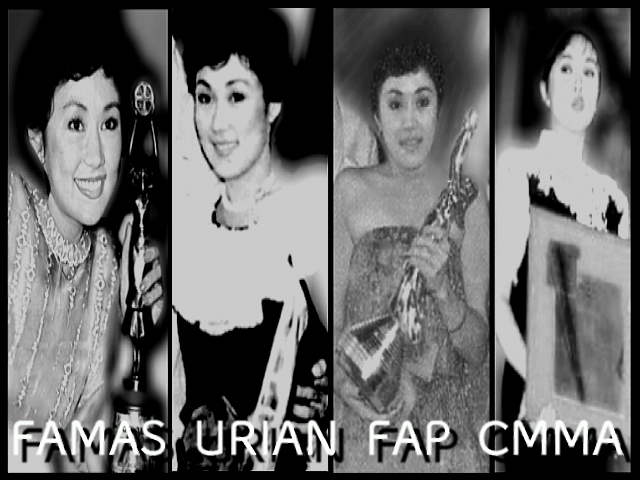
The ultimate win – For all Vilmanians, who can forget 1983? It’s the ultimate win for our idol. 1982 ended with Nora Aunor winning the December film festival for Himala. Everyone are predicting about her winning all the awards for that year. But Vilma is Nora’s true tormentor because as the award season in 1983 begins (remember they honoring the films from the previous year), all award giving bodies lined up and unanimously gave the best actress awards to Vilma! Bernal may have been a true actor’s director but without ate Vi’s maturing talent, no one can perform as effective as Malou in Relasyon! And FAMAS, CMMA, URIAN & FAP, all agreed resulting a true Grand Slam! Impressive indeed. This is a vindication of all the heartaches she suffered in the 70s.

AWARDS - Grand Slam 2

The Milestone Move – No longer a sweet teenager, Vilma’s milestone, career move was through Burlesk Queen. By 1977, Vilma’s reinvention of her image began with her feminist look at her personal life. She no longer care about the gossip and bad publicity that her relationship with Romeo Vasquez has created. Concentrating with her movies, Vilma accepted daring roles like “Dalawang Pugad, Isang Ibon,” “Nag-aapoy Na Damdamin,” “Tagulan sa Tag-araw.” And also as producer, she created some of the best films of that decade, like “Mga Rosas Sa Putikan,” “Halik sa Paa, Halik sa Kamay,” and the ultimate, “Pagputi Ng Uwak, PagItim ng Tagak” (an almost grand slam winner for best picture). She is one of the very first independent producer in the country. But the most daring of them all was Burlesk Queen. Ian films bet all of its money to this project and it paid off because not only it is the top grosser of the film festival it also reaped almost all of the festival’s awards! Sourgraping, the Nora Aunor camp complained but to no avail, All awards were never returned as what the news said few days after it was given. Burlesk Queen established Vilma Santos name as the number one actress in the Philippines. She was featured in Times Magazine in its coverage of the news around the globe.

The hurtful Lost – Ironically, the following year Ian films went to the other camp and produced one of the most stereotypical film of all times, Atsay. Directed by Eddie Garcia, Nora Aunor gave her most over rated performance of all time. Avoiding the scandal of the previous years and aim at vindicating Nora Aunor, the festival judges gave her the Best Performer award over Vilma Santos’ impressive performance in Rubia Servios. Isagani Cruz, a well respected critics during that time emphasized the hardship and delicate direction of Lino Brocka that is being the total craftsmanship of the Rubia was far more superior than Atsay. Cruz even pointed out that although Nora and Vilma both gave splendid performances, Vilma’s role was far more demanding and difficult. And everyone agreed including all Noranians. And so, as history will tell, it was the sweetest victory of Nora and Noranians over us. It was also hurtful because as the victory spread around the archipelago, the news about Ate Vi committing suicide came out. True it was a big disappointment and Marichu Vera Perez attested, she and Vilma cried all night after the awards night but the suicide rumor was just a myth. Vilma will learned from this lost and as we all remember, a lesson learned, she will never expect to win. She’ll do her job and let them decide if she is deserving of their accolades. The 80’s will proves to be more fruitful, kind and respectful of her effort to give her fans and movie aficionados every cent of their movie ticket.

AWARDS 3

From fantasy to reality – As the 70’s box office queen, Vilma reinvent herself so many times. She was the disco queen, the action hero (darna, vivian volta, wonder vi), physically disabled bell ringer (kampanerang kuba), a mermaid (dyesebel) to name a few. But in order to transform herself into a maturing actor and get notice for her acting talent, Vilma accepted daring roles which gave her so many awards (almost 70 to this date!) but the most revealing thing about this reinventions was the intrinsic value of all this important roles. The feminism, activism and social issues tackled and explored in these films are the most important contribution to the real world and the real human condition in our country. From the ill fated dancer in Burlesk Queen, to the liberal minded, suicidal designer in Ikaw Ay Akin to a desperate lover to Tag-ulan sa Tag Araw to a more rebellious wife in Broken Marriage, Vilma gave us a true to life picture of what are the most common sufferings of Filipinos. What are the real conditions that most of us cant voice out. True to its form, her films current as we still continue to experience all this social issues. Poverty and helplessness among the common Filipino problems. She also affected us with her tour de force portrayal of a modern mistress in Relasyon, an activist nun in SSL, a dying cancer stricken career woman in Pahiram, a mother of autistic child in Ipagpatawad, an AIDS patient in Dolzura, an awaken mother to an activist rebel in Dekada and just recently a modern crime crusader torn between two lovers in Mano Po 3! From fantasy to reality, her filmography deserve the most important awards in Philippine movie history – the National Artist honor.

AWARDS 8

The Future – As we all know Vilma has surpassed all of her contemporaries, including Nora Aunor. The future for our idol has become more exciting than ever. Vilma admittedly said that she wanted to stay in show business for as long as she still enjoys it, just like her idol, Gloria Romero, playing grandmother roles. But that’s not gonna happen right now, Vilma still commands the leading roles. She can still carry a film and portray roles that’s younger than her real age (Thanks to her youthful looks and clean lifestyles). Projects are still pouring in. And again, unlike her contemporaries, she remained choosy and committed, to do “never been done” projects, a well known secret of her longevity. Indeed, her future remained bright and truly exciting! – RV, V Magazine, April – May 2005 (READ MORE)

TV RECOGNITIONS (Repost)

PMPC STAR for TV RECOGNITIONS

  • 1987 STAR Award Best Musical Variety Show Host
  • 1988 STAR Award Best Musical Variety Show Host
  • 1988 STAR Award Best Musical Variety Show
  • 1989 STAR Award Best Musical Variety Show
  • 1990 STAR Award Best Musical Variety Show
  • 1991 STAR Award Best Musical Variety Show
  • 1992 STAR Award Best Musical Variety Show
  • 1994 STAR Award Best Musical Variety Show
  • 1998 STAR Award Ading Fernando Lifetime Achievement Award
  • 2006 STAR Award Best Actress in a Single TV Performance – MMK: Regalo

Catholic Mass Media Awards

  • 1987 CMMA Best Musical Variety Show
  • 1988 CMMA Best Musical Variety Show
  • 1989 CMMA Best Musical Variety Show
  • 1990 CMMA Hall of Fame in Musical Variety Show

Other Recognitions

  • 1972 EMEE Most Effective TV Actress
  • 1990 New York International Awards for TV Finalist
  • 1991 Dove Awards Best Musical Variety Show

RELATED READING:

Vilma Santos, Ang Ulirang Ina

ARTICLES - Mother Vilma 2

Whether in reel or real life, Vilma Santos is an epitome of an ideal mother. This is my tribute to Vilma Santos, ang Ulirang Ina.  She has had faults or wrong choices in life. Like her, we all make mistakes. As the years go by, we learn from those missteps, wisen up and change for the better.  I could write a book about Vilma, and perhaps one of the most poignant chapters will be about her as a mother. Oh yeah, we’ve had ‘mother’ role figures in showbiz via the late Ms. Rita Gomez, the original bad girl, or her ‘arch rival’ Ms. Celia Rodriguez.  Then there’s Mother Lily, the matriarch of Regal studios.  There is the protective Amalia Fuentes, who at daughter Liezl’s prime, was the best known mother/actress of the Philippines.  At one time, Nora Aunor was a picture of a happy family with real son Ian De Leon and a battalion of adopted children who appeared on movies together with either Christopher De Leon or Tirso Cruz as father figures.  In films, some of Nora’s most memorable characters are mothers: Bulaklak sa City Jail, Andrea, and Pacita Madrigal.

But no one is as beloved a Mother Figure than the QueenStar, Ms. Vilma Santos.  Remember the “I love you Lucky!” days when, after a grueling VIP/Vilma live show, mother Vi would say those endearing words to her son waiting at home?  Those were the most famous greetings that were heard every Friday, from Luzon to Mindanao, year after year.  “I love you, Lucky!” The words say it all, from a loving, doting, responsible mother. At the height of her TV (top rating Vilma!) and movie career (prime movie roles and box-office triumphs in the 90’s), Vilma mad a tough choice: to give new husband Sen. Ralph Recto a child.  In her farewell Vilma! show, she tearfully said goodbye to fame and fortune, and her fans, to give way to family/motherhood. Why even megastar Sharon Cuneta was all praises to the Real Queen for the tough but wise decision she ever made.  No success in life can ever replace a failed family. Even then, Ms. Vilma Santos was admirable for her brave, smart decisions.  Risking her career, even her life, she went through a most delicate pregnancy the Philippines had been a voyeur to.  She had to be literally carried to the bathroom in order not to bleed and lose the baby.  What a sacrifice from a mother and wife.  And how God blessed her with a new son, Ryan Christopher Recto.  And oh how avid fan Sharon Cuneta followed in her idol’s footsteps. Two great mothers.  Two great superstars.  When they appear in a film 2gether?

As to films, no other actress has essayed a gamut of credible mother roles, than Vilma Santos.

  • “Broken Marriage” – failure as a wife, but Never as a mother.
  • “Aida Macaraeg” – her poignant moments with her son, unforgettable. Lino Brocka could not have found a better Macaraeg.
  • “Dolzura Cortez” – on her deathbed, dying from AIDS, she tells her mother Charito Solis (SLN) – “ang mga anak ko, huwag ninyong pababayaan ang mga anak ko.” Urian was won over. Bow! Award, oh! Grand slam number two, oh!
  • “Saan Nagtatago ang Pag-Ibig?” – as a ‘surrogate’ mother to Val (Tonton Gutierrez). Remember the lines, “si Val, si Val!?” Best picture!
  • “Ipagpatawad Mo” – “si Jun-Jun!”. Ugrian jurors made the right choice. Best actress of ’91.
  • As Lea in “Bata Bata Paano Ka Ginawa” – son screams “hindi totoo ‘yan. ‘hindi totoo ‘yan!” Mother and son scenes. Mother and daughter scenes. Mother and children scenes. Unforgettable. Grand slam nga, eh! Number three!
  • As Josie in “Anak” – wa na ko say. BOW! WOW! POW! PMPC Star, PASADO and CMMA did the right thing. Awards! Oscar foreign language film entry.
  • Amanda Bartolome in “Dekada ’70” – Mother Courage, Nestor Torre describes Vilma of her character and brilliant performance. Grand slam number four. Second trip to the Oscar foreign language film category as an entry.
  • Lilia “Mano Po 3” – “Pati ba ikaw iiwan mo ako? Sabagay, sanay na ako ng iniiwan?” A well written role for Vilma (si Nestor Torre ulit, oh!) as mother, wife, abandoned girlfriend, anti-crime crusader.

The envelope, please! Kayo, may maidadagdag pa ba kayo? Vilma Santos has done it all. Been there, done that. Next stop, the MMK role as mother to a child with cerebral palsy. And the mother of three gay sons in Flores de Mara. Kapanapanabik! As for me, Vilma’s best mother role is that of being mother to sons Lucky and Ryan, and to her constituents in Lipa city who voted her, in a landslide, three times, for being an excellent, incomparable Ina Ng Lipa. Bow! Happy Mother’s Day, Mayor Vilma Santos-Recto! – Mar Garces, V Magazine, April – May 2005 (READ MORE)

ARTICLES - Mother Vilma 1

Hotdog: Unang Kagat (1975)

This slideshow requires JavaScript.

Basic Information: Direction: Raul T. Silos; Story: Bert R. Mendoza; Cast: Dennis Garcia, Connie Angeles, Greg Lozano, Ella del Rosario, Jess Garcia, Edward Campos; Special appearances: FPJ, Joseph ‘Erap’ Estrada, Nora Aunor, Vilma Santos, Boots Anson-Roa; Original Music: Hotdog; Cinematography: Fortunato Bernardo; Release Date: 30 May 1975 (Philippines); Production Co: Crown Seven Film Productions

Plot Description: No Available Data

Film Achievement: No Available Data

Film Review: “…Formed by brothers Dennis and Rene Garcia in 1974, Hotdog crashed the music and concert circuit at a time when fans’ musical taste and preference were heavily influenced by imported acts playing trite disco and funk tunes, as Pinoy groups — though highly-talented were relegated to doing covers and cheap imitations of foreign hits to remain relevant. Hotdog became an instant sensation when it launched its distinctive sound that came to be known as Manila Sound, an original Pilipino music distinguished for exuberant songs that featured catchy, captivating lyrics in Tagalog and Taglish that directly appealed to the ordinary Filipino listeners’ everyday moods and sentiments. Through Manila Sound, Hotdog succeeded in revolutionizing the formal and stilted music scene that led to the establishment of a new and lasting identity for mainstream Filipino music and blazed the trail for OPM to take root and flourish from the late ‘80s onward. Its rise to musical stardom has been phenomenal. Its songs, all written by Dennis and Rene Garcia — became smash hits, topping the local charts from the mid-’70s to the mid-’80s and remaining at the forefront of the most recognized and acclaimed tunes in popular Filipino music. Hotdog has released more than three dozen hit singles that eventually attained gold and platinum status. One of its big hits, Bongga Ka, Day (1974), reaped greater success when it spawned a motion picture of the same title featuring the band, together with a stellar cast composed of Fernando Poe Jr., Joseph Estrada, Nora Aunor, Vilma Santos and Boots Anson-Roa in cameo roles. Another hit that was turned into a successful movie starring Nora Aunor was Annie Batungbakal, which was about the story of a disco-loving saleslady. Another popular song, Manila, a tribute to the capital city, has become an anthem of millions of Filipinos working overseas who continue to long for their native land…” – Peter Osias, The Philippine Star Nov 21 2011 (READ MORE)

“…Last Thursday, we joined 70s fans at “Hotdog: The Reunion” at PICC tent which suffered from the awful sound system where half of what Rene Garcia was saying couldn’t be understood. Most of the group was new, although Maso Diez was there, but the crowd expected Ella del Rosario to sing her big hit “O Lumapit Ka” even if a new girl did quite well. Top favorites at the show were still “Manila,” plus “Bongga ka Day” and “Annie Batungbakal,” which movies of the same title had been produced by Guy’s NV Productions, directed by Maryo J. de los Reyes, starring Guy and favorite leading man of the season Lloyd Samartino (now in TV5’s “PS I Love you ” teleserye). Even earlier, in 1974, the first Hotdog album “Unang Kagat” resulted in a movie with the band in 1975 with cameos of FPJ, Erap, Guy, Ate Vi, and Boots Anson Roa. The 4th reunion concert showed the band headed by the unassuming genius of Dennis Garcia as still the leader of the Manila Sound genre that fused Tagalog with Taglish. In the show they paid tribute to contemporaries VST & Company, Boyfriends, and Hagibis. The disco group VST with Vic Sotto, Val Sotto, Joey de Leon, Homer Flores, and Spanky Rigor had made famous the songs “Awitin Mo isasayaw Ko” and “Disco Fever” while the audience rose to their feet when Hotdog interpreted VST’s “Rock Baby Rock.” The Boyfriends’ pop and disco hit “Bakit Labis Kitang Mahal” covered by both Lea Salonga and Dingdong Avanzado in their albums was Hotdog’s next tribute. Then, of course, came the Hagibis with their campy imitations of the Village People in “Katawan,” which to this day is a favorite in dance parties…” – Bibsy Carballo, Journal, Dec 04 2011 (READ MORE)

Related Reading: