Vilma Santos-Recto is a popular multi-awarded actress and politician in the Republic of the Philippines. *** She is known as "Queen of Philippine Movies," "Queenstar," "Grand Slam Queen," "Box Office Queen," and "Star for All Seasons." *** This website is mostly about her iconic film career.
Basic Information: Directed: Ishmael Bernal; Story: Ricardo Lee; Screenplay: Ricardo Lee, Raquel Villavicencion, Ishmael Bernal; Cast: Vilma Santos, Christopher De Leon, Jimi Melendez, Ernie Zarate, Lucy Quinto, Manny Castañeda, Beth Mondragon, Bing Fabregas, Olive Madridejos, Augusto Victa, Dante Castro, Tony Angeles, Thaemar Achacoso; Executive producer: Lily Monteverde; Original Music: Winston Raval; Cinematography: Sergio Lobo; Film Editing: Augusto Salvador; Production Design: Benjie De Guzman; Art Direction: Dennis Cid; Sound: Vic Macamay; Theme Songs: “Relasyon” performed by Eva Eugenio
Plot Description: He sees nothing wrong in having a wife and a mistress. She would do anything to make him happy, including putting up with his idiosyncrasies, babysitting his child, and finding loopholes in the law so she could be with him. The characters are so familiar and so realistic that you might see yourself. Vilma Santos and Christopher de Leon star in this very touching story about two people who truly love each other but are trapped by the circumstances. Relasyon is another fine motion picture from director Ishmael Bernal. – Regal Films
Before 1982, the word grandslam were only used in sports. The term grandslam according to Wikipedia in terms of tennis is a singles player or doubles team that wins all four major tournaments (Australian, French, Wimbledon, US) in the same calendar year, is said to have achieved the “Grand Slam” or a “Calendar Year Grand Slam,” just like what Steffi Graf, the retired German tennis superstar did in 1988. Meanwhile the American Heritage dictionary described the term “grand slam” as follows: first, the winning of all the tricks during the play of one hand in bridge and other whist-derived card games. Second, the winning of all the major or specified events, especially on a professional circuit. And third, in baseball, a home run hit when three runners are on base. From this set of definitions comes the term “grand slam best actress” which basically winning all the best actress awards from all major award giving bodies. And in 1983, the four majors were FAMAS, Gawad Urian, CMMA, and the FAP (or Luna now).
The Beginning – The Marcos administration created the Film Academy of the Philippines in 1981 under the guidance of first lady Imelda Marcos and Imee Marcos as Experimental Cinema of the Philippines’ director-general. ECP started to ambitiously produced films to showcase local talents for its inaugural Manila International Film Festival. The organization produced two memorable films, Peque Gallaga’s period film, “Oro, Plata, Mata” and Ishmael Bernal’s French influenced film, “Himala.” Come Gawad Urian night, both films received it’s stiff competitions from three other films, Mike Deleon’s “Batch ’81,” Lino Brocka’s “Cain at Abel” and Marilou Diaz Abaya’s “Moral.” For the Manunuri, the previous year produced only two stand out films, Mike De Leon’s Kisap Mata and Laurice Guillen’s Salome. A big contradiction this year, as not only they have the tasks of sorting out the best in each categories from these five films mentioned above but also other worthy films. Famous with their long heated debates, the local critics added the following fims in their list of best films: Nora Aunor’s “Mga Uod at Rosas,” Vilma Santos’ “Relasyon” and Hilda Koronel’s “PX.” The three were cited not ony for the overall production but also for the performances of the film’s lead actresses. Also cited were, ECP’s delicate horror film, “Haplos” directed by Jose Perez and two Lino Brocka films, the comedy “Palipat-lipat, Papalit-palit” and the drama “In this Corner.”
For Vilma Santos, The previous year, Pakawalan Mo Ako was a huge summer hit that earned Vilma a surprised best actress in FAMAS. That year also released Ex-Wife and Hiwalay, about marital problems. Art immitating life, as there were reports that Vilma and now, ex-husband, Edu Manzano were having some marital problems. But Vilma as trooper as she is, any personal troubles were not publicly noticeable as she goes on with her work, business as usual. Also, Vilma gave birth to her eldest son Luis “Lucky” Manzano.
By December of 1981, her film festival entry, Karma earned her another surprise best actress trophy after the FAMAS gave her the nod for Pakawalan Mo Ako. In an unrelated news, the entertainment industry were shocked to found that matinee idol, Alfie Anido died on Dec 31st. Like the death of Julie Vega and Rico Yan, it is still unknown the reason behind Anido’s death.
She’s determined to make 1982 another successful year. She released a total of six films, out of six, two were certified record breakers, “Sinasamba Kita (I Idolized You)” released in August and “Gaano Kadalas ang Minsan? (How Many Times is Onced),” released in November, both produced by Viva Films. The other four films (Relasyon, T-Bird at Ako, Never Ever Say Goodbye, Haplos) were mild hits. All of her hard work paid off because as early as January of the 1983 she was already poised to reap major awards.
Meanwhile for Nora Aunor, 1982 were a mixed bag of mild hits and failed opportunities. “Mga Uod at Rosas,” her collaboration with Lorna Tolentino and director Romy Zusara produced a mixed reviews from the critics. Her excellent performance did not help as the film were just mild hit with the audience. Her follow up films, “Annie Sabungera” and “Palenke Queen” both comedies also didn’t do well at the box office making the expectation from her next film higher, as she teamed-up with the hottest star of 1982, her closest rival, Vilma Santos in Danny Zialcita’s fast paced film, “T-bird at Ako.” T-bird’s high expectation wasn’t realized as the film earned just a modest income.
By December, all eyes were focused again on Nora and her most ambitious project to date, Ishmael Bernal’s “Himala,” produced by the Imee Marcos’ Experimental Cinema of the Philippines. The film was an entry to the Metro Manila film festival. Nora Aunor was again proclaimed the “queen of local festival” as she won her third Metro Manila Film Festival best actress. Nora’s momentum was rising and she was conditioned to make some serious dent in the following year’s award giving seasons. Critics were all going “gagah” with Aunor’s gigantic performance as Elsa. They said, Himala was very effective in communicating its film’s message, it has moving moments and raw power.
Communicated It Really Well – “…Nestor Torre…he finds Batch ’81 the best movie made in 1982. “The movie had something very important to say and it communicated it very well…As for the best actress, it’s Nora Aunor in Himala. “It was a good role, and she communicated it very well. At least, Nora wasn’t api here for a change, It was quite a complicated role, but she handled it very well….Other choices were Gina Alajar and Lorna Tolentino in Moral…Vilma Santos, Nestor notes, is admittedly a “very hard worker but her physical structure really makes it difficult for her to be really effective—hindi malalim—and her voice is not that expressive.” Nestor adds, though, that, once in a while, Vilma “transcends her physical limitations, as in Rubia Servios…” – Nestor Torre Jr. (film critic), Parade Magazine, January 19, 1983 (READ MORE)
Moving Moments – “…Best Films: (in the order of preference) 1. Oro, Plata, Mata and Batch ’81; 2. Relasyon and Himala; 3. Moral. Best Directors: (in no particular order) 1. Ishmael Bernal for Relasyon and Himala; 2. Peque Gallaga for Oro Plata Mata; 3. Mike de Leon for Batch ’81. Actresses: 1. Vilma Santos for Relasyon; 2. Nora Aunor for Himala and Uod at Rosas; 3. Sandy Andolong for Moral and Oro Plata Mata; 4. Gina Alajar for Moral. Actors: 1. Mark Gil for Batch ’81 and Palipat-lipat, Papalit-palit; 2. Joel Torre for Oro Plata Mata; 3. Christopher de Leon for Relasyon. Most movies are usually flawed, and those in my list are no exception. However, apart from the standard criteria I am applying to them (the classic from and content balance), I am giving much weight on impact and emotional power. So, my top two are Oro and Batch. Himala is an ambitious film and much flawed, but it has visual beauty and emotional wallop. Relasyon is more modest in scope, but I think is more successful on its own terms. Moral has many good things going for it, from direction and writing, to performances, but it does not match the four other films in impact (though it has some moving moments) and originality…” – Mario Hernando (film critic), Parade Magazine, January 19, 1983 (READ MORE)
Raw Power – “…Ding Nolledo…confesses to liking Himala “very much” but mentions that he hasn’t seen Oro Plata Mata…because the film exudes “raw power,” not to mention the excellent acting and the direction, which was like early Fellini, especially the middle part…Ding doesn’t agree with Moral’s rave reviews because “I’ve seen Moral in about 369 other films.” It’s not that original, he implies. As for best actress, it’ll have to be Nora in Himala. “She reminds me of the young Anna Magnani. Besides, the script fitted her to a T. The role practically coincides with what she is in real life…” – Wilfrido Nolledo (novelist, screenwriter, film critic), Parade Magazine, January 19, 1983 (READ MORE)
Himala won nine out of eleven local festival awards. A sort of repeat of what Vilma’s “Burlesk Queen” achieved in 1977 but without the complaints or sourgrapes.
The success of Himala in the December festival has been overshadowed by the commercial success of Vilma Santos’ body of work. In fact, on Dec 14, 1982, Channel 9’s talk show, Let’s Talk Movies recognized Vilma Santos as their best actress for her body on work. Nora Aunor was nominated for her films excluding her epic movie Himala which was not qualified due to the show’s fiscal year requirements which covers December 1981 to November 1982 (More about this below).
On January 20, 1983, Vilma was crowned the Box Office Queen by the Metro Manila Theaters Association in their very first The 1st Cinehan Awards. Reporter Meg Mendoza wrote in an article for Prime Magazine, “…Vilma gave Viva Films its first biggest hit in Sinasamba Kita earning over P7M in Metro Manila alone. Then came T-Bird at Ako (a mild hit), Never Ever Say Goodbye (a sorry miss), Gaano Kadalas ang Minsan? (her biggest hit for that year) and Haplos. As early as January 20, 1983, Vilma began to reap several victories when she was awarded by the Metro Manila Theaters Association on their first Cinehan Awards together with Fernando Poe, Jr. held at the Philippine Plaza. National Artist Nick Joaquin, in an article that came out in the Bulletin Today on February 11, 1983 wrote: “By emerging as box-office queen, Vilma Santos proved herself to be the Philippine Cinema’s Superstar – a title, it’s to be realized now, that can be bestowed only by the Cinehan.” So, on Cinehan Awards Night, Vilma was the very picture of the conquering heroine, drawing all eyes as she glowed and glittered, a rapture of radiance in her strapless white gown with lilac sash – and in white gloves yet! In her triumph joined both cinema and cinehan. Her pictures were all well done – and they also did very well at the box-office. In the same awards night, Ambassador Jaime Zobel de Ayala, another recipient of the Cinehan, upon receiving his award from Dean Lucresia Kasilag said: “I’m only a little bit sorry that Vilma didn’t give me the award. But it’s all right, I’ll try again next year. You’re my favorite star, you’re my muse! I’ll suffer in silence…”
Ironically, few weeks after her crowning as box office queen, Vilma released Ayaw Kong Maging Kerida, the results was average, proving the Romeo Vasquez and Vilma Santos screen charisma has subsided immensely.
Not to be outdone with Vilma’s latest feat, Nora’s “Himala” competed in the 1983 Berlin International Film Festival the following month. The film was the Philippines’ sole entry. The rave reviews were solid, Aunor’s performance was recognized by a nomination but unfortunately, according to Bernal, she lost the race by a mere vote. Would a similar fate awaits Aunor as the local award giving seasons begins?
First Major – By late February, the award-giving season in the country started. In their website, the Catholic Mass Media Awards recalled, “…The Archdiocese of Manila, through His Eminence Archbishop Jaime L. Cardinal Sin, organized the Catholic Mass Media Awards (CMMA) in 1978, in observance of the International Social Communication Day (established by the Universal Church to stress the importance of mass media and to instill a sense of responsibility in communicators). An outstanding way, in radio, print, advertising, television, and film. It was first given out in 1978; since then the CMMA was held every year onwards. In 1980, His Holiness Pope John Paul II graced the awarding ceremonies. Handing out personally the trophies to the winners, the Pontiff illustrated the significant place of mass media in today’s society, and its pervasive influence in the lives of the people…”
Just the previous year, the CMMA praised Nora Aunor’s acting in the late Mario O’harra film, “Bakit Bughaw ang Langit?” and she was adjudged their best actress. There is a great chance that Nora would repeat the feat, as many expected the church would favor a well-crafted film with religious theme.
On February 29, 1983, the fight between Nora Aunor’s “goliath” type of performance in “Himala (Miracle)” versus the “davidian” type of performance in Vilma Santos’ “Relasyon (the affair)” begins. The media were patly right, CMMA gave their best picture, screenplay, supporting actor/actress to Himala. But despite its, taboo story of a mistress, the Catholic Church’s award giving body favoured Vilma’s sympathetic performance.
Vilma won the first bout. Nora left empty-handed. The first blood has been drawn and Noranians, Nora Aunor’s fanatic fans were furious. The fight didn’t stop at the Catholic Mass Media Awards. The next one was a big one.
Second Major – Noranians expected a third Urian best actress considering the magnitude of Aunor’s performance in Himala and the positive reviews it received. Positive reviews that were written by the Manunuri critics themselves. Noranians dismissed Vilma’s win at the CMMA and expected that metal sculted trophy was in the bag already. By the way, who are these critics anyway?
Practicing Film Critics – Writer, Billy R. Balbastro described the Manunuris, “…The Manunuri ng Pelikulang Filipino, on the other hand, is an organization of practicing film critics established in 1976. Most came from the Academe then with Nestor U. Torre becoming its first president. The Manunuri had its Gawad Urian in simple one hour-long rites at the CCP then. Dr. Bienvenido Lumbera Jr. became its second president. Other presidents include: Mario Hernando, Butch Francisco, Agustin “Hammy” Sotto, Gigi Javier Alfonso of UP. Each critic-member is expected to write regularly film reviews or film criticism which must be published in national publications. Each year too they give out awards for achievements in the movie industry, thus joining the FAMAS, the Film academy of the Philippines and the Philippine Movie Press Club’s Star Awards in this aspect of endeavor. During their first decade (1976 to 1985), they also came up with their Stars of the Decade: Nora Aunor, Vilma Santos, Vic Silayan and Phillip Salvador. The members of the Manunuri are: Mario Hernando (editor of Sunday Malaya), Bienvenido Lumbera Jr.(1993 Ramon Magsaysay awardee for journalism, literature and creative communication), Nicanor Tiongson (former artistic director of the Cultural Center of the Philippines, and former MTRCB chair), Butch Francisco (TV personality), Agustin “Hammy” Sotto (founding president of the Society of Film Archivists), Paul Daza (columnist), Gigi Javier Alfonso (dean of the UP-Diliman Open University and professor at the UP College of Mass Communication –UP-CMC), Ellen Paglinauan (dean of UP-CMC), Bro. Miguel Rapatan (DLSU), and Lito Zulueta (Inquirer sub-editor and faculty member of the UST Faculty of Arts and Letters)…”
On April 15, 1983, the Gawad Urian was set to give out their hardware. It was known by many, that the critics or the Manunuris were pro-Nora Aunor. They gave Aunor their very first best actress award in 1976 for her excellent performance in “Tatlong Taong Walang Diyos (three years without God)”. They also gave Aunor a second nod in 1980 in her wonderful performance in “Bona” with Gina Alajar as co-winner.
Speaking of co-winner or “tie,” writer Rolfie Velasco pointed out in his article, “…FAMAS was the sole award-giving body for film in the Philippines from 1952 until 1976, when the Manunuri ng Pelikulang Pilipino (MPP) formed the Gawad URIAN (FAMAS was also contested by the Manila Film Festival, established in the 1960s, but a film festival cannot be considered as a major award-giving body). From 1952 to 1976, FAMAS alone has awarded the most foremost performers and craftsmen of Filipino films, from screen legend Rosa Rosal to master director Gerardo de Leon. Winning a FAMAS Award became the target obsession for many film craftsmen, for it was, after all, the Philippines’ counterpart of the Oscars. The awards itself, then held mostly in the Manila Hotel, was the biggest annual event in the Philippine movie industry…In 1973, the FAMAS was rocked by a terrible scandal. It awarded the first tie in the lead categories in the history of Philippine cinema. Before this, the only recorded tie was in 1968, when Tito Arevalo and Tony Maiquez shared the Best Musical Score honors and also the tie in the best actress category, with both Boots Anson-Roa and Vilma Santos sharing the honors. Because a tie in the lead categories was unheard of, the public dissented the vote. Therefore, for the next years, the FAMAS invited film critics to be members of its nominating and awarding committee. These critics left the FAMAS in 1976 to form MPP and subsequently, the Gawad Urian (Urian Award), named after the Tagalog word for gold standard…”
When the winner was read, even Vilma was surprised. After so many years of snubs, she finally received the recognition she truly deserved. The critics finally came to their senses and recognized Vilma’s explosive and giant killer performance.
By winning the Gawad Urian, Vilma defeated not only Nora but also Lorna Tolentino and Gina Alajar both equally gave a felt performance in the feminist film, “Moral.”
Adding chery to an already sumptous plate, at the same night, on April 15, 1983, Vilma have to rush to another ceremony, she was crowned by the Guillermo Mendoza Memorial Foundation as the 1982 – 83 Box Office Queen of Philippine Movies at the Celebrity Sports Plaza with Fernando Poe Jr as the Box Office King, her second crown/title after January’s Cinehan Awards.
This was Vilma’s second major best actress wins in the same calendar year. She was half way there. People are now starts talking about the possibility of Vilma winning all the best actress awards.
Not to be outdone, Noranians regained from their dissapointments as Nora Aunor received an award from a socio-political group, the TOWNS on April 23, 1983. Nora Aunor received (The Outstanding Women in the Nation’s Service) or simply TOWNS award from no less than the then tirst lady, Mrs. Imelda Romualdez Marcos, at the Plenary Hall of the Philippine Convention Center. With the first lady handing out the TOWNS to Nora, people are started to insinuate that Nora Aunor’s defeat in two previous majors are polically motivated.
Third Major – The next race was the very first Luna Awards, back then, simply called the Film Academy Awards, Philippines’ counterpart of OSCAR.
On April 27, 1983 the First Film Academy of the Philippines Awards were held at the Manila Film Center. The FAP official web-site provided some basic information about The Luna Awards, “…Established in 1981 as mandated by Executive Order No. 640-A, the Academy has been able to forge an alliance among the various guilds of the movie industry. Serving as the umbrella organization, the Film Academy oversees the welfare of the guilds thru an assortment of subsidies, projects and opportunities that would bring about the upgrading of the knowledge and expertise of the guild members. The principal function of the Academy is to give awards in recognition of the artistic and technical excellence of the performances and to accentuate the value of quality works of the people behind the outstanding films shown during the year. The Annual Luna Awards is intended to provide the necessary motivation in enhancing the craftmanship of movie industry workers that will eventually uplift the quality of local films. The Academy also assists in the staging and managing of the annual Metro Manila Film Festival from which proceeds the Film Academy gets a share. Delegates to foreign film festivals are primarily sent thru the intercession of the Academy. The Academy also spearheads the collaboration of the movie industry with government agencies in order to gain opportunities for the guilds and its members…”
Academy insider, Jose N. Carreon wrote: “…At seven o’clock on a Wednesday evening on April 27, 1983, the Film Academy of the Philippines held its first ever awards night for distinguished works and performances in films exhibited in 1982. The venue was the Manila Film Center, one of the cultural edifices that were constructed under the auspices of then First Lady, Madame Imelda Romualdez-Marcos…The first ever Academy award winner was the late Rodolfo ‘Boy’ Garcia who was adjudged the best supporting actor for his role in Ito Ba ang Ating mga Anak?…Liza Lorena was best supporting actress for her role in Oro, Plata, Mata…The late Vic Macamay won the best sound award for Gaano Kadalas ang Minsan?…The best cinematography award was won by Romy Vitug for Sinasamba Kita…Sinasamba Kita by the late George Canseco was voted the best original song…The late Orlando Nadres won the best screenplay adaptation for Sinasamba Kita…Romy Suzara won as best director for Uod at Rosas…Manay Ichu’s MVP Pictures’ Batch ’81 was voted the first best picture of the academy awards…With the stage overflowing with showbiz people, the best actor and best actress awards were announced. Philip Salvador (for Cain at Abel) was declared best actor over Robert Arevalo (Santa Claus is Coming to Town), Mark Gil (Batch ’81), Christopher de Leon (Relasyon) and Joel Torre (Oro, Plata, Mata). The last winner of the night turned out to be Vilma Santos who was best actress for her performance in Relasyon. The other aspirants were Gina Alajar (Moral), Nora Aunor (Himala), Coney Reyes-Mumar (Pedring Taruc) and Lorna Tolention (Moral). Then everything was history. After 25 years, we remember and we celebrate and we recommit ourselves for another quarter of a century. The Film Academy of the Philippines and its Luna Awards live on…”
Vilma Santos faces again a stiff resistance from Nora Aunor. In the end, Vilma received her fourth majors from non other than the first lady Imelda Romouldez Marcos. Like Nora in TOWNS, the first lady, Imelda Marcos handed out the very first Academy award best actress to Vilma.
Vilma won her third major best actress.in the same calendar year. One short of a complete overhaul.
Fourth Major – The award season of 1983 ended with the handing out of the FAMAS. The Manila Film Center was jam packed with not only celebrities but also a boisterous group of Noranians and Vilmanians. Unfortunately, Nora Aunor wasn’t nominated for her gigantic role of Elsa in “Himala” instead, she was nominated for her portrayal of an underdog lover of the late Johnny Delgado in Romy Zusara’s “Mga Uod at Rosas (the worms and roses)”. The competition didn’t stop with Vilma’s “Relasyon,” Noranians were worried about the other nominees too. Hilda Koronel was cited for her solo starrer, “PX” and Alma Moreno was nominated for her daring role as Cristina Gaston in the “Diary of Cristina Gaston.” The list of Nominees were completed with the inclusion of two veterans: Mona Lisa for her supposed to be supporting role in “Cain at Abel” and Liza Lorena for her surprising role in “Santa Claus is Coming to Town.” With this list comes a lesser expectation from Noranians, as Nora wasn’t nominated for her more intense role as Elsa. But this didn’t bother them as they raided the Manila Film Centre with so much fan fare.
The unofficial FAMAS website declared the winners, “…The 31st FAMAS Awards was held at the Manila Film Center on May 28, 1983. The Best Picture went to Cine Suerte’s Cain at Abel defeating Gaano Kadalas Ang Minsan [Viva Films], Himala [Experimental Cinema of the Philippines], Ang Panday: Ikatlong Yugto [FPJ Productions] and Sinasamba Kita [Viva Films]. The Best Actor went to Anthony Alonzo for Bambang defeating Christopher de Leon for Relasyon, Dolphy for My Heart Belongs to Daddy, George Estregan for Lalaki Ako, Dindo Fernando for Gaano Kadalas Ang Minsan, Fernando Poe, Jr. for Ang Panday: Ikatlong Yugto, and Philip Salvador for Cain at Abel. The best supporting Actor went to Tommy Abuel for Gaano Kadalas Ang Minsan while the best supporting Actress went to Sandy Andolong for Moral. Eddie Garcia won the best director Sinasamba Kita defeating Marilou Diaz-Abaya for Moral, Ishmael Bernal for Himala, Lino Brocka for Cain at Abel, Fernando Poe, Jr. for Ang Panday: Ikatlong Yugto and Danny Zialcita for Gaano Kadalas Ang Minsan. Gaano Kadalas Ang Minsan also won the best story for Tom Adrales; best screenplay for Tom Adrales and Danny Zialcita; best editing for Ike Jarlego, Jr.; best musical score and theme song for George Canseco and best sound for Vic Macamay. Joseph Estrada received the Hall of Famer Award for winnign five times as producer. The most anticipated award was for best actress which went to Vilma Santos for Relasyon defeating Nora Aunor for Mga Uod at Rosas, Hilda Koronel for PX, Mona Lisa for Cain at Abel, Liza Lorena for Santa Claus is Coming to Town, Alma Moreno for The Diary of Cristina Gaston ..”
Unfortunately, for Noranians, their idol went empty handed again for the last time. Vilma claimed her fourth major best actress in one calendar year. The night for Vilmanians didn’t stop from Vilma’s win. Eddie Garcia won the best director award for a Vilma Santos’ blockbuster film, “Sinasamba Kita.”
Noranians were all mad as hell. Writer Bum D. Tenorio Jr., in his article for Philippine Star, described how the feisty Noranians reacted on Vilma’s win on their home turf, the Gawad Urian, “…Talk about Himala, it was because of this movie that two ladies in my neighborhood got into a nasty hair-pulling fight. Nora could have won the grand-slam for Best Actress in all the award-giving bodies for this movie in 1982 except that her archrival and now Batangas Gov. Vilma Santos won for the movie “Relasyon” in the Gawad Urian. The feisty Noranians in the neighborhood could not accept this, while the Vilmanians gloated. This irreconcilable difference unfortunately turned ugly. In those days, fans were fiercely loyal. When Vilmanians talked about “Wonder V,” expect Noranians to come up with “Super G.” When Vilmanians mentioned how they got scared in “Phantom Lady,” expect a multitude of Noranians to thwart their claim by discussing “Fe, Esperanza, Caridad,” Nora’s suspense thriller. Even when Nora and Vilma starred together in a movie, say “Pinagbuklod ng Pag-Ibig” or the legendary “T-Bird at Ako,” competition between fans of both camps still raged. But in my community, the Noranians always prevailed!…”
Paranoia seeped in their brain as they hypothesized the reasons why Nora failed to win any awards. Sabotage according to them was the only reason. The political repercussion of the film being made under the Marcos administration resulted Nora Aunor being ignored by all award-giving bodies! Never mind that Vilma Santos deserved all the wins. Vilma Santos swept the entire best actress in four major award-giving bodies in one calendar year. The tag line “grand slam” was born.
In addition to the above majors, talk show, “Lets talk movies” came up with their own film awards on its anniversary presentation at the end of 1982. The hosts, Behn Cervantes (filmmaker, film critic), Armida Siguion Reyna (film actress, producer) and Mario Bautista (movie reporter, critic, columnist) were quoted as who they think deserve the year’s accolade.
Behn Cervantes: “…Behn’s choice for best movie of 1982 comes easy, with one qualification (he has not seen Oro, Plata, Mata). “It’s Batch ’81 because it was innovative and more daring…As for the choice of best actress, “mahirap iyan,” Behn admits spontaneously. “It’s a difficult choice between Gina Alajar in Moral and Nora Aunor in Himala. Gina was beautifully flamboyant and effective as the funky character in Moral, while Nora was very cinematic in Himala. Nora is one actress who knows how to use her medium…Vilma is also good. She knows her craft, but somehow, at the moment of truth, physically she doesn’t quite hit me. There’s something very cutesified about it…”
Armida Siguion Reyna: “…Armida has said it in her TV show Let’s Talk Movies and she’s saying it again: her choice for best movie not only for the filmfest but for the entire 1982 is Moral. “It’s very ‘today,’ NOW. You really get to identify with the characters in the movie…After Moral, Armida chooses Oro, Plata, Mata and Cain at Abel, respectively, as among 1982’s best…Armida chooses Vilma Santos as best actress for her performance in Relasyon. “I can’t explain my choice in the beautiful language of the Manunuri but I go by gut and alam kong maganda.” She is also more inclined toward Vilma because the actress made a number of good movies last year…”
Mario E. Bautista: “…For us, sinuman ang manalo kina Vilma Santos o Lorna Tolentino ay okey lang. Both Gina and Nora have won the Urian best actress awards twice. Gina for Brutal and Salome, Nora for Tatlong Taong Walang Diyos and Bona. Napakagaling ni Gina in portraying the role of the trying hard Kathy in Moral. Hindi biru-biro ang ganoong character na gagawin mong sympathetic dahil mas malamang na lumabas itong ridiculous lang kaysa nakakakuha ng simpatiya. But Gina succeeded in making her Kathy both ridiculous and sympathetic. As Elsa, Nora’s case is that of star and role merging into one, fitting into each other perfectly dahil alam nating ang karisma ni Guy sa kanyang fans ay siya ring karisma ni Elsa sa kanyang naging followers. Pero palagay namin, kung hindi magta-tie sina Lorna at Vilma, mananalo ng solo si Vilma Santos. Vi has never won the Urian. She should have gotten it in 1977 for Burlesk Queen but the trophy went to Daria Ramirez in Sinong Kasiping. Maraming acting highlights ang paper ni Vi bilang Marilou sa Relasyon. Sa confrontation scenes nila ni Boyet, superb siya roon sa tagpong sinusumbatan niya ito dahil ginagawa na lamang siyang tau-tauhan. Ang acting niya sa death scene ni Boyet na hindi malaman ang gagawin sa katarantahan is also awesome to behold…”
Unfortunately, despite their highly praises of Nora Aunor, the talk show hosts gave their nod to Vilma Santos due to their technical rules. An article from Movie Flash explained: “…In celebration of its first anniversary, Channel 9’s Let’s Talk Movies will have a special presentation on December 14 from 9:30 to 11:30 pm. The talk show hosted by Armida Siguion-Reyna, Behn Cervantes and Mario E. Bautista will distribute seven major awards to deserving artists who excelled in local pictures shown from Dec, 1981 to November, 1982. The Let’s Talk Movies awards differ from those of other award-giving bodies in that they honor a director or performer not for just a single work or performance in one movie but for a body of outstanding works or performances shown during the said fiscal year. This is in line with the show’s aim to help uplift local movies. To qualify, a nominee should have atleast two significant contributions. Nominees for…best actress…are Gina Alajar (Init o Lamig, Pusong Uhaw), Nora Aunor (Uod at Rosad, T-bird, Rock ‘n Roll, Palengke Queen), Amy Austria (Katas ng Langis, Waywaya, Pusong Uhaw), Vilma Santos (Karma, Relasyon, T-bird, Sinasamba Kita, Never Ever Say Goodbye) and Maricel Soriano (Galawgaw, Mother Dear, Schoolgirls)…An award for best producer will be given to the company which has produced the most number of outstanding films during the year. Special citations will be given to movie personnel who made worthy contributions to the industry during the year…” (READ MORE)
While Vilmanians celebrated their idol’s historical win, Nora Aunor redeemed their broken ego by lining up to the 1983 Manila International Film Festival on June 24th, Himala was choosen as the opening gala film together with Hollywood film, Gandhi as the closing.
After the awards season of 1983, Vilma Santos released three more films after the dissapointment, Ayaw Kong Maging Kerida.
On June 9th, Viva Films released Paano Ba ang Mangarap? that turned out to be another box office hit. Few months afterwards Regal films released Bernal’s Broken Marriage, the follow-up film after the successful grand slam film, Relasyon.
Finally, four days after Vi’s birthday, Viva Films released Marilou Diaz-Abaya’s drama, Minsan pa Natin Hagkan Ang Nakaraan, another box office hit. This film plus the two films mentioned above confirmed her bankable status. Not to be outshine again, “Himala” continued its relentless fight for recognition, winning the bronze prize at the 1983 Chicago International Film Festival on November of 1983 (Nov 4-18 1983).
Vilma Santos made history. The first grand slam win of Vilma Santos was repeatedly analyzed over and over again. Mostly to give credit to the loser, Nora Aunor.
Joel David, in his article titled “Performances of the Age” wrote: “…the outstanding performance of the period belongs to that of Nora Aunor in Himala, which was honoured only by the MMFF….In Himala the director and writer seemed to have agreed to a mutual stand-off, thus amplifying the theatrical potential of an expansive locale with a protracted takes; stage-trained talents ensured the competent execution of histrionic stylizations, with the climax set on an open-air platform before a hysterical audience. It was a truly great actress’ opportunity of a lifetime, and Nora Aunor seized it and made it not just her role, but her film as well. Not since Anita Linda in Gerardo de Leon’s Sisa (circa the first Golden Age) had there been such a felicitous exploitation by a performer of ideal filmmaking conditions – and in this instance, Himala has the decided advantage of being major-league and universal….”
Arnel Resma Ramos’ article titled “Himala Revisited” praised Nora’s complex role: “…we believe that Nora Aunor should have swept all the best actress awards for that particular year…Aunor had the more complex role and only an actress of her calibre can pull off the part with much persuasion. It calls for a restrained, self-effacing acting style. And Aunor, the consummate actress that she was…strikes not a false note in her performance. It is, in one word, mesmerizing. And Himala is without a scintilla of a doubt the pinnacle of her cinematic achievements.”
In recent years, Himala was recognized in many film exhibitions around the world. Even international television network fell on the prey and held an international internet poll, raising Himala to its highest glory, proclaiming the film as one of Asia’s best film. They hail, finally, Aunor were given the citations its truly deserved!
Again, never mind that Vilma Santos gave the most effective performance in the history of local movie screen. The fact is, no matter what they do or say they can’t change history. Vilma Santos was the very first “grand slam” best actress winner.
In 1981, President Ferdinand Marcos passed Executive Order 640-A, which established the Film Academy of the Philippines, the Philippines’ official counterpart of the United States’ Academy of Motion Picture Arts and Sciences (Wikipedia).
The very first Film Academy of the Philippines’ best actress winner was Vilma Santos in 1982, for Relasyon. Also, two Vilma Santos movies, Sinasamba Kita and Gaano Kadalas Ang Minsan won technical awards for sound, original score, cinematography, and adapted screenplay.
Paano Ba ang Mangarap, a Vilma Santos movie won best cinematography for Romy Vitug the following year.
The third FAP confirmed the arrival of Sharon Cuneta, as she was adjudged by the guilds, their best actress in 1984 beating Vilma and Nora for Sa Hirap At Ginhawa. Vilma’s Sister Stella L director, Mike De Leon won the best director. Vilma’s other film, Alyas Baby Tsina won best in musical score and production design.
Nida Blanca won best actress for Miguelito and Lino Brocka best director for Kapit sa Patalim in 1985.
Vilma’s Saan Nagtatago Ang Pag-ibig won best director for Eddie Garcia and best cinematography for Romy Vitug in 1987. Lorna Tolentino won the best actress for Maging Akin Ka Lamang. Tagos Ng Dugo, Vilma’s winning film at the FAMAS won, best musical score. Veteran actress, Mary Walter received the lifetime achievement award.
Amy Austria and Philip Salvador was the big winner in 1988, for surprisingly for forgettable films, Boy Negro and Celestina Sanchez aka Bubbles respectively.
As both Vilma and Nora shared the best actress at the URIAN, FAP gave the best actress solely to Nora Aunor in 1989. Her film Bilangin Mo Ang Bituin Sa Langit, won best actor, best director as well. Vilma’s film, Pahiram ng Isang Umaga won two, best production design and best sound. Director Lamberto Avellana received the posthumous recognition award and veteran actors, Leopoldo Salcedo and Bella Flores, the lifetime achievement awards. Leopoldo did the memorable film Burlesk Queen with Vilma while Bella Flores was Vilma’s torturer in her very first film as a child actress in Trudis Liit.
As Vilma Santos won three times in rival award giving bodies, URIAN, Nora Aunor did the same with her three consecutive best actress in 89, 90, and 91. Both Vilma and Nora have four Lunas.
Vilma’s Kapag Langit ang Humatol won best story and cinematography and Joseph Estrada received the lifetime achievement award in 1990. Also, this year, the Lamberto Avellana Memorial Award was given to Lino Brocka.
Vilma’s Ipagpatawad Mo won best child performer for Terence Baylon and best Editing while the lifetime achievement award went to Fernando Poe Jr in 1991.
Nora’s three-year feat ends when Lorna Tolentino won the best actress in 1992 for Narito ang Puso Ko.
Vilma won her second best actress after seven nominations in 1993 for Dolzura Cortez Story. The film also won best adaptation story and musical score. Lifetime achievement awards went to Espiridion Laxa and Nora Aunor. Laxa was Vilma’s film producer of so many memorable films like, Dama De Noche and Lipad Darna Lipad.
Nora won her fourth best actress in 1995 for The Flor Contemplacion Story and Sharon Cuneta in 1996 for Madrasta. The 1996 lifetime achievement award went to Anita Linda.
Maricel Soriano’s turn to receive the best actress happened in 1997. She won for Nasaan ang Puso. Also, this year, Vilma Santos received the lifetime achievement award and the posthumous recognition award to Charito Solis.
Vilma Santos won her third best actress in 1998 for Bata, Bata, Paano Ka Ginawa, her co-stars, child actors, Carlo Aquino and Serena Dalrymple won the supporting acting trophies. The film also won best in production design. Vilma’s director in box office hits like Sinasamba Kita and Imortal, Eddie Garcia, received the lifetime achievement award.
Bulaklak ng Maynila win big in 1999, best director (Joel Lamangan), best actor (Christopher de Leon) and best actress (Elizabeth Oropesa). Vilma’s blockbuster movie, Anak won two trophies in 2000: best supporting actress for Amy Austria and best screenplay for Ricardo Lee. Gloria Romero won the best actress for Tanging Yaman. Vilma’s director and co-star in memorable films Nakakahiya and sequeal, Hindi Nakakahiya, Eddie Rodriguez received the lifetime achievement award.
Lorna Tolentino reclaimed her spot in FAP history when she won the following year her second best actress for Abakada Ina.
Vilma won her fourth best actress in 2002 via Chito Rono’s Dekada ’70. Her co-star, Piolo Pascual won the best supporting and the film also won best production design.
Maricel Soriano won again in 2003 for Filipinas while Susan Roces received the lifetime achievement award. The next year, Claudine Barretto won her very first academy award for her film, Milan.
In 2005, the FAP award became, the “Luna Awards.”
In 2006, Nida Blanca and George Canseco received the posthumous recognition award. Nida Blanca co-starred with Vilma in 1988’s Ibulong Mo Sa Diyos. George Canseco created so many memorable songs for films starring Vilma Santos. In 2007, the special posthumous award was given to Armando Garces and Fernando Poe Jr. – RV (READ MORE)
Aside from Gawad Urian, Star Awards, Film Academy Awards and FAMAS, the annual local festival, called MMFF or Metro Manila Film Festival has become a part of Vilma Santos’ film career. From the 70s to the new millennium, Vilma Santos was able to entered memorable films that earned her awards, record-breaking ticket revenues, career breakthrough performances and even some memorable heartache. Spanning four decades, the MMFF earned Vilma 7 acting nominations with four wins.
The Martial Law established the amalgamation of the surrounding cities in Manila. Prior to 1975, three local film festivals showcase Filipino films, Quezon City and Manila each has their own festivities and another one in Southern part of the country, Bacolod City. The local festivals started the acting competition between rival, Vilma Santos and Nora Aunor. In 1970 Manila Film Festival, Nora’s Nora in Wonderland and Young Heart compete with Vilma’s sole entry, Love Letters. Two years afterwards, the acting race will heat up in Quezon City Film Festival when the two collided with Nora’s And God Smiled at Me and Vilma’s Dama De Noche. After the Martial Law, cities were amalgamated with Manila. And the Quezon City Film Festival and the Manila Film Festival ends creating the December festival in 1975. Occasionally, Manila will have their own festival every summer in connection to city’s “Araw Ng Manila” celebration. Tthe last time Vilma entered a film at MFF was in 1993 via Dahil Mahal Kita: The Dolzura Cortez Story where she won the best actress. Meanwhile, Nora Aunor’s last venture to MFF was in 2004’s Naglalayag where like Vilma, she won the best actress too.
The Metropolitan Manila Film Festival, now simply called, MMFF, (the “politan” was dropped eventually) or Metro Manila Film Festival exhibits only local films in all its theatres from Christmas Eve to the first week of the following New Year. The festival has its street parade at the eve of Christmas Day and each films contesting for best float. The festival has its awards night at the third or fourth nights.
Not surprisingly, both Nora and Vilma have competed in the first MMFF. Nora’s entry was her self-produced film directed by Luciano B. Carlos, Batu-Bato sa Langit and Vilma’s entry was the melodrama, Karugtong ang Kahapon. The big winner was the pre-presidential, Joseph Estrada. Directed by Augosto Bunaventura, Estrada’s Diligin Mo ng Hamog ang Uhaw na Lupa won the major awards: Best Picture, Best Director, and Best Actor. Best Actress went to Charito Solis for Araw-Araw, Gabi-Gabi.
The second year, the festival was noticeably the precursor to the awards race. It was a showcase of who’s who in the local film industry. Lino Brocka, Eddie Romero, Lupita Concio were among the big name directors competing. Romero’s Ganito Kami Noon, Paano Kayo Ngayon dominated the awards night winning the best director and Christopher de Leon the best actor. Hilda Koronel was proclaimed the best actress for her impressive performance in Insiang. Concio’s Minsa’y Isang Gamo-gamo, Brocka’s Insiang and Romero’s Ganito will be the top films competing for the first Gawad Urian.
The third MMFF, brought controversy to Vilma Santos. Now starting to accept offbeat roles and learning to adopt versatility to her arsenal, she bravely entered the festival with Celso Ad Castillo’s Burlesk Queen. The gamble paid off as the film became the top grosser and won eight awards out of ten. Burlesk won best picture and best in direction, lead actor, actress, screenplay, supporting actress/actor and cinematography.
Burlesk defeated Lino Brocka’s Inay, Mario O’Hara and Romy Suzara’s Mga Bilanggong Birhen, Mike de Leon’s Kung Mangarap Ka’t Magising, Eddie Romero’s Banta ng Kahapon, Ishmael Bernal’s Walang Katapusang Tag-araw, Joey Gosiengfiao’s Babae, Ngayon at Kailanman, Gil Portes’ Sa Piling ng mga Sugapa. A very impressive list, no wonder some critics loudly complained about the awards results. And according to Armida Sigueon Reyna, in her newspaper column, Brocka walked out the awards night in protest and even cursed the juror on the way out ot the auditorium. It was also reported that the organizer asked the winners to return their medals (they hand out medals that year) but no such things happened, Vilma still has her medal in her fully loaded cabinet of hardwares.
The success of Burlesk Queen commercially and critically brought down some senses to some Nora Aunor followers. Clearly, Vilma Santos’ willingness to accept mature and offbeat roles became a threat to Nora Aunor’s standing as the number one actress. Vilma Santos’ entry was Lino Brocka’s true to life film about rape victim, Rubia Servios. Critics and media have predicted Vilma was dead lock for the best actress. Come awards night, the juries’ award Nora’s film about a maid abused by her employer, Atsay won the major awards including best picture and best director for Eddie Garcia. The top acting award was changed to best performer that Nora Aunor won. A vindication from last year’s result? Wait, there wasn’t even an Aunor film last year. For some consolation, Rubia won two technical awards, one for editing and screenplay for Mario O’Harra. The film also became the top grosser of the festival even with the lost to Aunor. According to Isagani Cruz on his TV Times article in 1979: “…Nora does an excellent acting job; but so does Vilma Santos, and Rubia is a much more demanding and difficult role….Overall, Atsay may be much more impressive than Rubia Servios. In terms of challenging our moral and legal convictions, however, Rubia Servios is much more significant.”
1979 brought the tandem of Charito Solis & Vilma Santos versus Lolita Rodrigues and Nora Aunor. The clear winner was the latter team. Although Solis and Santos film did much better at the box office. Ina Ka Ng Anak Mo, a much better film, directed by Lino Brocka won the major awards, best picture, director and acting awards for Raul Aragon and Nora Aunor. For film aficionado, the scene where Solis slapped Santos in Modelong Tanso was memorable. Many reprised that scene, Vilma did it in Anak (with Claudine) and recently Sharon Cuneta with Heart Evangelist in the recent Mano Po.
By 1980, Nora Aunor kept on pushing for festival supremacy and like last year, she entered two films. This time, with Lino Brocka’s Bona and Laurice Guillen’s Kung Ako’y Iiwan Mo. Vilma’s lone entry was Danny Zialcita’s Langis at Tubig. Nora came up short, as both of her film missed the major awards. The big winner was Christopher De Leon and Bembol Roco’s film Taga Sa Panahon. Taga won the top awards while Marilou Diaz Abaya’s film Brutal won directing and best actress for Amy Austria. Langis At Tubig won best actor Dindo Fernando.
After winning in 1977 and a big loss in 1978, Vilma’s enthusiasm in winning at the MMFF subsided significantly. Her film entries were now focused on entertainment value aimed at getting commercial success instead of awards. 1980 and 1981 was a big example. Danny Zialcita’s Langis At Tubig did very well at the box office in ’80 and her entry the following year was a glossy production, Karma. Karma was a big hit and earned nominations but one film dominated all the 1981’s MMFF, Kisap Mata, directed by Mike De Leon won eight out of ten awards except for best actress, that award went to Vilma Santos. Vilma didn’t attend the ceremony, her co-star, Chanda Romero, accepted the award.
Nora’s absence in 1981 add motivation to her camp, she entered the festival with the epic film, directed by Ishmael Bernal, Himala, now considered by many as one of the best Filipino film of all time. Himala won seven major awards including best picture, director, screenplay and actress. Vilma’s entry Haplos was a distant third, with a win for lead actor, Christopher De Leon. The following year, Himala harvested nominations from four award-giving bodies particularly the best actress nominations for Nora but failed to win any, all the trophies went to Vilma, earning her first grand slam best actress. The next six years, no film by Vilma Santos in the festival. The big winners during these years are: 1983 – Karnal, 1984 – Bulaklak ng City Jail, 1985 – Paradise Inn, 1986 – Halimaw sa Banga, 1987 – Olongapo, 1988 – Patrolman.
The 1989 MMFF brought back the team of Vilma Santos and Christopher De Leon. Viva film’s Immortal directed by Eddie Garcia won major awards including best picture, director and the acting for Christopher and Vilma. Not to be undone, Nora Aunor entered the race the following year via Elwood Perez’ Andrea Paano ba ang Maging Isang Ina. The film won best picture, director and actress for Nora. Best actor went to Dolphy for Espadang Patpat. Then 1991 was a repeat for Nora as her film, again directed by Perez, Ang Totoong Buhay ni Pacita M. won major awards.
The next twelve years seems to be non-existent for Vilma followers as there were no entries from Vilma Santos in these years. There were no films that stands out compare to the high caliber films entered during the peak of the Vilma-Nora rivalry. There are six films that were praised by the critics though, Chito Rono‘s films Nasaan ang Puso (1997) and Bagong Buwan (2001), Marilou Diaz-Abaya’s Jose Rizal (1998) and Muro-ami (1999) and Laurice Guillen’s Tanging Yaman (2000). In the acting category, only Elizabeth Oropesa win in 1999 for Bulaklak ng Maynila and Gloria Romero’s win in 2000 for Tanging Yaman stands out.
By 2002, it was déjà vu all over again, Vilma Santos convinced by many as a sure bet for the best actress lost again for her festival entry, Dekada 70. The award was given to Ara Mina for her supposed to be supporting role in the very first Mano Po. Dekada will dominate the awards race the following year, Vilma will win several best actress awards. Vilma’s co-star, Piolo Pascual will win all the best supporting actor making him a grand slam winner. The next year, Crying Ladies, starring Sharon Cuneta, Hilda Koronel and Angel Aquino won the best picture, best actor for Eric Quizon, best supporting actress for Hilda while Maricel Soriano snatched the best actress for Filipinas. The next year, Vilma came back again with Regal’s third installment to the Mano Po series. Titled, Mano Po 3: My Love and directed by Joel Lamangan, the film won best picture and the lead acting for Vilma and Christopher De Leon. Cesar Montano’s self-produced and directed film, Panaghoy sa Suba won best actor.
No Vilma Santos or Nora Aunor films the next five years. Vilma visibly concentrated with her political career and Nora retired in the United States. The film festival continued its annual fan fare with some memorable films. Zsazsa Padilla and Cherry Pie Picache continued the Mano Po series with a comedy, Ako Legal Wife, Mano Po 4 won the female acting awards in 2005. Judy Ann Santos comedy film, directed Joey Reyes, Kasal, Kasali, Kasalo top the 2006 festival. Maricel Soriano received another best actress the following year for Bahay Kubo, The Pinoy Mano Po. Anne Curtis arrived in the big league as she wins best actress for Baler in 2008 and then this year, Bong Revilla won best actor for Ang Panday and Sharon Cuneta best actor for Mano Po 6: A Mother’s Love, both first time winner.
For some, Vilma Santos MMFF recognitions in terms of awards wasn’t as significant compare to lets say, her number of URIAN or FAMAS awards but all the shortcomings were forgotten when you think about the successful recorded revenue of her festival entries. From Burlesk Queen, Rubia Servios, Karma, Langis at Tubig and to her last one, Mano Po 3, all did very well. At the end of the day, producers would still prefer a little profit than trophies. – RV
superwoMOM “…Watching all the tributes and reading all the superlative articles about you leaves me in awe. But even without all those accolades, I have always known what an exceptional woman you are. I call you superwoMOM and there will never be any runners-up, no matter how sincerely they try to play second mom to Ricky, Clara and me. When people ask me if I am going to continue what you started, I am dumbfounded. Nobody, not even me whom you have always called your extension, is qualified to be the next Inday Badiday. The least I could do to honor you is to add up the bits and pieces of our wonderful, colorful life together and keep on living and loving the way you taught me how…” – Dolly Ann Carvajal, Philippine Daily Inquirer, Oct 16, 2003 (READ MORE)
The Queen is dead. Inday Badiday, real name Lourdes Jimenez Carvajal, in her lifetime was known as the Queen of Intrigues. No one is ready to wear that crown. Many have learned from her, but no one can yet make superstars and play godmother to a mudfish at the same time without losing the public’s respect. No one has yet mastered her knack for asking the right probing questions at the right time, for probing and then pulling back without really hurting. Her show biz talk shows are memorable like her laughter and her closing line, “Saranghameda,” but it is best to remember Inday in her own words. In an interview with Inquirer Entertainment in 2002, Inday was asked which she loved to do most, TV, radio, print. She said: “Radio and print are more freewheeling. You can choose the topics you like. Mas nailalabas mo ang innermost feeling mo, mas open ka. Unlike sa TV mas limitado and oras at and emotions.”
Why did shoe biz reporting today jolt her? “Minsan kasi parang, tama na! Haggang diyan ka na lang. Wala nang limit kasi. Ang nangyayari, the more na bulgar, more probing, more vicious, the more na gusto nila.”
When did she stop smoking? “1996. The bypass operation did it. Talagang ayoko na talaga. sabi ko nga kay (brother-in-law Dr. Carlitos Magsanoc), ” (sister and Inquirer edition in chief) letty (Jimenez-Magsanoc) smokes, I smoke. Seh drinks, I drink. I sleep late, mas lalo kung magpuyat si Letty. Mapag-isip ako, mas lalo si Letty. Pareho lang kami ng ginagawa. Pero bakit ako nagkakasakit, si Letty hindi? Letty still smokes. Grabe!”
What’s a good talk show to her? “No script. Freewheeling. Yung ang mga saopt ng mga artista hindi mag-uumpisa sa “Well…” or “Actually…”
Did she think she would regain her crown as queen of intrigues and talk show? “I’m not trying to regain anything. What crown are you talking about? Sila lang naman ang nag-name sa kin ng Queen of Intrigues. I don’t pretend to have a title. I’m just me. I don’t want to compete with any of them. I’m just here to join the parade, not to lead the parade.”
What first things did she do as a host? “Ang dami-dami. Lahat ng kababalaghan! Nung namatay ang dalag, nakiburol kami. Diyos ko! para akong luka-loka! May mga bulaklak pa kami. Ang tawag ko sa ganyan, “Aliw Awards.” Kagaya nung bumubuhay ng patay, yung ngasasayaw na Sto. Nino. Lahat ng ipinalihi sa kung saan. You name it, I did it.” In her Christmas Day “Face to Face” column in 1999, Iday Listed the “little and big monuments and milestones in my life.” Among them were Nora Aunor and public service. “Whether I like it or not,” she wrote, “the superstar’s name shall forever be a part of my life in show business. Seh has been the star to whom i hitched my wagon.” Of public servie, she wrote: “There was a time when public service weren’t watchable. But “Eye to Eye” changed that. It makes me happy to say this show helped institutionalize the Filipino’s innate gift of generosity. I’ve always been amazed by how the number of people needing help is always matched by the people willing to give it.”
What was she most proud of as a talk show host? “Before, show biz reporters were taboo on the air, Ipinaglaban ko ‘yun. My point was, they are the people who know what questions to ask the stars, who know what’s happening. “Many people did not like that idea, putting show biz reporters on the air. At least ngayon tanggap na tanggap na sila.” Indeed, entertainment columnist Butch Francisco wrote in July 2000: “Before Inday Badiday, entertainment writers were mere by-lines in fan magazines and the movie pages of newspapers. But through the trailblazing efforts of this woman with a vision, some movie journalists have become personalities themselves, hosting their own show biz talk show on TV.” Francisco proceeded to enumerate Inday’s “creations” – Cristy Fermin, Aster Amoyo, Lolit Solis, Nap Gutierrez, and Francisco himself. What was she like as a mother? “Normal.” Writer Anselle Beluso, one of her closest friends: “Depende kung sinong anak.” Inday: Gaga! Should other hosts be afraid of her comeback? “Why should they be? ‘There’s no reason to be afraid of me. I’m just one of them.” No more “Saranghameda?” “It will just come. That was the time I met Bo (Gene Palomo), so saranghameda. The word is Korean for I love you. Malay mo, baka may makilala ako sa show ko, e ‘di iba naman (laughs).” – Louie C. Camino, Philippine Daily Inquirer, Sep 28, 2003 (READ MORE)
Irreplaceable. “…its impossible to find somebody like Inday Badiday,” said Ansel Beluso, head writer of the show biz talk show “Inday: Heart to Heart” on GMA 7 last Sunday at Inday’s wake at the Santuario de San Antonio in Forbes Park, Makati City. He said that whoever would replace Inday should be someone who’s as credible and as highly respected in show biz as the Queen of Intrigues herself. “Whoever will take over the show would only have to be who he or she really is,” Beluso added. “The new host would have to be someone who’s motherly, like Inday,” said Bibeth Orteza, who’s also a head writer of “Heart to Heart” and one of Inday’s long-time friends. Inday, Lourdes Jimenez Carvajar in real life, pioneered show biz talk shows in the Phlippines, hosting TV shows like “See True,” which ran for seven years, “The Truth and Nothing But,” four years, and “Eye to Eye,” 10 years. She died on Sept. 27 of a lingering illness at the St. Luke’s Medical Center in Quezon City after being confined in the hospital’s intensive care unit since Aug. 18…At Inday’s wake last Sunday, show biz writer Ronald Carballo shared: For years, Inday had paid the bill of his birthday parties. “This happened when Inday was at the peak of her career in the ’80s,” said Carballo, “She would call me a week before my birthday, ask me how much I would need for the party and, on the day of the celebratin, send a check with an amount double than waht I told her.” Carballo said he was present during Inday’s Aug .7 birthday celebration at the Trader’s Hotel in Pasay City. “She hugged me and said, “Salamat, Ronald, Nawala na silang lahat, ikaw na alng ang naiwan (Thank you for being here, They are all gone, and you are the only one who has remained)…” – Marinel R. Cruz and Jocelyn Valle, Inquirer, Sep 30, 2003 (READ MORE)
Funny Lady “…She recalled how Inday once “tutored” her about how to act like a lady during a visit to South Korea in the ’80s, when Inday’s late father, Nicanor Jimenez, had been the Philippines ambassador to that country. “She lectured me about my behavior and warned me that I must not embarrass her dad,” Solis said. “But duiring a Mass which we attended, she fell asleep because she had too much wine to drink earlier. The following day, she couldn’t face her dad!” Expect the unexpected with Inday, Solis said. “Like how she would always find something to laugh about even if she was talking to the grimmest person on earth.” she added…” – Nini Valera, Philippine Daily Inquirer, Sep 29, 2003 (READ MORE)
Truth and Frienship When Aiko Melendez guested on “Eye to Eye” before going to her debut, Ate Luds presented to her a heart wrenching interview with her dad Jimi Melendez, who was dying in remote seashore village in Batangas. But Ate Luds was averse to inventing news. While others resorted to manufacturing lies which they then asked the movie stars converned to react to – an exercise that they passed on as news reporting – Ate Luds always chose to dig. “There is no need to invent news,” she always said. “You just have to dig deeper, and there’s always a gem out there waiting to be found.” I remember Ate Luds being very happy about a reaction that was attributed to Fernando Poe jr. when “Eye to Eye” went off the air. The king of Philippine Movies said, “Without Inday, we will never know what the truth is about show biz news.” “Be aware always about the fine line that divides friendship and show biz truth, and always choose to be on the side of friendship, because show biz truth is all a matter of perception.” I saw it happen: When her friends went through rough times, Ate Luds always chose to be by their side, even at the expense of her own credibility as a a broadcaster. Because of this, when bigger issues happened, her friends always honored her with the first shot at the truth. “Truth in show biz is different from truth in politics,” Ate Luds once explaine to me. “In show biz, when a movie star tells a lie, it is entertaining. In politics, when a politician tells a lie, no matter how small, it can ruin the nation.”
Affection for People “Beware of people you don’t know – but even more, of people you do know.” Ate Luds’ people skills were incredible. If she were fish, people were her water. And she could swim both in fresh and tropical waters. She had genuine love and affection for people. This was the key to her success. She knew what made people tick. She knew what turned them on or off. She also knew about the exquisite joy of loyalty, as well as the bitter taste of betrayal. “Friendship in show biz does not exist. So you have to make it for yourself. Friendship in show bix is an act of will.” Ate Lud was known by all, but she once admitted to me that she only had very few friends in show biz. A lot of her friends were not from the entertainment world. They were “ordinary” people who derived nothing from her except the joy of simple friendship. “In show biz, when you see someone who can be a friend, hold on to that person and protect your realtionship with everything you’ve got. Friendship is measured not by what you can get from it, but by what you are willing to give up for it – so choose wisely. A good friendship can enrich you, but a bad one can bankrupt you.” Ate luds gave up a lot for frienship. Of course, it was very sad that a few of these friendships proved to be wrong choice. “Show biz is serious business. But never take yourself seriously. Laugh hard – and laugh hardes at yourself.” Ate Luds’ self deprecating humor was legendary. “Hoy! Anak ako ng ambassador, no!,” She’d holler at anyone who pointed out some gaffe or breach in protocol she had committed. “Ako pa?,’ she’d self-mockingly proclaim each time a folly or foible was attributed to her, and you couldn’t help but laugh at her little idiosyncracies. Goodbye, Ate Luds. – Ansel Beluso, Philippine Daily Inquirer, Oct 11, 2003 (READ MORE)
Constant Reminder “…Inday Badiday (a.k.a. Ate Luds) doesn’t remember now who gave her the tableau containing that little prayer (“Ewan ko kung kaaway ko o kaibigan ko”) but that’s beside the point. The tableau stands on her headboard and it’s the first thing Inday sees when she wakes up every morning. Sa totoo lang, Inday has been trying, during the past many years, to observe that prayer — to no avail. “Para akong si Mother Lily,” says Inday, “pag hindi ko binuksan ang bibig ko, magugutom ako, hindi ako kikita. Aray ko!…Remember when Nora Aunor, displeased by a news report which she deemed favored Vilma Santos at her expense, asked her secretary to get back (that same evening!) a P5,000 check she had gifted Inday with a week earlier during the blessing of Inday’s house in Meycauayan, Bulacan?….Inday’s constant reminder to her children is this: “Don’t come to me crying!” That is also what the Ambassador would often tell his children: “Don’t ever come to me crying.” “Military man kasi ‘yon, e.” Inday hasn’t run back to Daddy crying ever since. “Alam mo,” she admits, “people can accuse me of not having been a good wife. Pero walang makapagsasabing hindi ako naging mabuting ina.” And that, would you believe, is the truth and nothing but…” – Ricky Lo, Weekend magazine, March 10 1985 (READ MORE)
Investigative Journalism – “…I follow up on events and I always add that dash of scoop by getting at the real story behind the news item.” Inday Badiday’s brand of gossip, therefore, is more akin to investigative journalism. Never mind the fact that her investigations always end up in the same way. For nobody can quite ransack a “ropero” as thoroughly as Inday can. Inday Badiday or Ludy Jimenez Carvajal also admits to having”sources” who relay precious information to her but she sifts these carefully and only follows up on the “more interesting” bits. “The hotel guest registry is not my cup of tea, I leave it to others to do that type of reporting. If I get a lead about so-and-so cheking in at this hotel, I sometimes pass on the information to another reporter and leave it up to him to follow the story if he cares to.” Inday’s chitchat being more issue-oriented has landed her into more controversies than she’s ready to bargain for. “In the Amalia-Romeo-Vilma affair, for instances, I was only a bystander. They were the ones who did all the talking, most especially Bobby. But it was my program which took the brunt of it all. Sabi ko nga, para bang nag-away ang mga bisita mo sa bahay mo. Anong magagawa mo?” Inday confesses that her job is not exactly a bed of roses. “Anong gagawin mo pag sinabi sa iyo ng artista, “Ate Luds, ito ang tunay na nangyari pero huwag mong sasabihin. Ito na lang ang sabihin mo, Sasakit ang ulo mo talaga.” The constant ringing of the phone, the centenarian who came to visit Inday that day, the unending parade of people streaming in and out of Inday’s tiny office-all these attest to the queen’s popularity. “My sister (Letty Jiminez-Magsanoc of Panorama) tells me that I’m but a mere spectator of this circus.” What LJM meant was perhaps that Inday’s life is the anti-thesis of the sordid world of her occupation. Inday after all started out as a ballet teacher at Joji Felix’s dance studio (would you believe?) where perhaps the most awkward event of any given day was a ballerina’s lazy arabesque. Now that her world has changed from ballet to bod stars, she remains even more certain of her ground. “The point of interest being facets of the stars’ private lives,” says Inday, “and this means I cannot write or talk about how many times they go to church. I cannot imagine why some peole would like us to turn plastic, too, by writing plastic things about their plastic selves. Ang sabi nga kung naiinitan ka sa apoy ng nagluluto, di umalis ka sa kusina.” It is the movies where one worries most when the gossip stops. Very few attain that sought-after state of virtual imperviousness. Should anything truly sensational happen in their lives, who do you think will merit bigger headlines today, Vilma Santos or Tita Duran? What worries certain movie scribes, Giovanni Calvo included…” – TV Times, 27 April – May 3 1980
Incredible Legacy “…Speaking of lessons I’ve learned in the talk show circuit, my mom’s (“the mother of all talk shows.” as she’s been dubbed) countless tips remained unparalleled in my book. You’ll be privy to all this when you catch our one-on-one interview in “CelebrityDAtCom’s” first episode. Due to time constraints, our interview was cut short just when it was getting juicy. But there will be a part 2 of that dream interview. Truth to tell, my mom has politely declined many invitations to be interviewed on other talk shows. As she says, “I’m beyond show biz.” That’s why I’m so grateful that she agreed to appear on my new show with TJ and Angelo. It;s not that she was obliged to just because I have to be her daughter. I know she wanted to be around to show me her support. Her presence was the only adrenaline shot I needed to perk me up for the initial telecast. I know that even when she was the one who asked me to take over the hosting chores on “Movie Magazine” many years ago, deep inside her she wished that I had pursued my dreams to become an interpreter in the United Nations. That dream may or may not be fullfilled but it doesn’t bother me much. Foregoin one dream to be able to continue my mom’s incredible legacy in show biz is more than enough compensations. It’s the least I can do to give something back to all the people whose live she has not only touched but changed for the better…” – Dolly Ann Carvajal, Philippine Daily Inquirer, May 13, 2003 (READ MORE)
The Bukas Palad Awardee – Inday Badiday Recipient (1998) – “…The Bukas Palad Award (Open-Armed Award) was awarded by the Filipino Academy of Movie Arts and Sciences in the 47th FAMAS Awards (1998) in 1999 to honor the generosity and indelible contributions of the Philippines’ original Queen of Talk, gossip columnist and TV host Inday Badiday, to the Philippine motion picture industry. Inday Badiday, who is Lourdes Carvajal in real life, not only boosted star’s careers through her gossip shows but had been also known to help various stars in their times of need. In addition, she had been known to help various local charities that promoted various social causes…” – FAMAS (READ MORE)
Lourdes Jimenez Carvajal (August 6, 1944 – September 26, 2003), better known as Inday Badiday, was a Filipino host and journalist who was known as Philippine television’s “queen of showbiz talk shows” and “queen of intrigues”. Referred to by many in the entertainment industry as “Ate Luds”, Inday began her broadcasting career as a radio host who talked about show business. Her commentary and knowledge about the industry eventually brought her fame. One of her first shows was Nothing but the Truth and later See-True and Eye to Eye, which served as Philippine television’s template for showbiz talk shows. These shows were all produced by GMA News and Public Affairs and her production company, LoCa Productions (LoCa is the combination of the first two letters of her names, Lourdes Carvajal). She made her television comeback in GMA Network in 2002 with the show Inday, Heart to Heart. Inday Badiday died on September 26, 2003, from multiple organ failure due to two strokes at 59 years old, at St. Luke’s Medical Center, Quezon City. She had three children, Dolly Anne and Ricky from a previous marriage, and Clara (Klang-klang) by her beloved Gene “Bo” Palomo, the man Inday referred to in her famous parting shot, “Saranghamnida, Bo” (Korean for “I love you, Bo”) in her program Eye to Eye. She was also the grandmother of Juicy co-host IC Mendoza. – Wikipedia (READ MORE)
Magmula pa nang magsimula si Vilma Santos sa pag-arte, sa munting edad na siyam, ipinakita na niya na nasa puso niya ang pag-ganap. Sa “Trudis Liit” makikita ang kusang pag-patak ng luha at tamang pagbibigay ng emosyon. Ito ay likhang talento na hindi makikita sa ibang mga batang artista ngunit hindi rin ito sapat upang sa paglaki mo’y manatili ang talento nakagisnan mo nang kabataan. Mangilan-ngilan lamang ang namulat sa katotohanang hindi hanggang sa pagtanda ay mananatili kang magaling sa pagganap. Hindi nga ba’t hindi naging isang mahusay na artista si Nino Muhlach nang itoy maging isang binata na. Si Snooky Serna na kailangan ng mahusay na direktor upang mapalabas ang tunay na tinatagong galing. Nasaan na si Connie Angeles, si liezl (na anak ni Amalia), si Bentot Jr at marami pang hindi malilimutang mga batang aktor na nagpakitang gilas. Ang katotohanan ay kailangang patuloy ang pag-aaral sa pag-ganap. Ang katotohanan ay ang paghahanda sa pagbabago ng imahen at pagtanggap ng mga naiibang papel. Upang patuloy ang paghasa ng talentong kinagisnan mula pa nuong kabataan. Iyan ang sikreto ni Vilma Santos. Mula pa nang Trudis Liit, umikot ang mundo ni Rosa Vilma. Sinagupa niya ang labanan sa pag-arte ng buong tapang. Ito ang tunay na marka ng mahusay na aktor. Walang papel na maliit, walang papel na hindi puedeng kakaiba ang pagganap. Ilang pelikula ang nagmarka sa lipunan. Nagbigay ito ng kahulugan sa mga pakay ng ordinaryong buhay ng mga pilipino.
Pumaimbulog ang kakaibang pagarte niya sa Dama De Noche. Maalala ng lahat ang pagsusuot niya ng “two-piece bikini” sa Nakakahiya ngunit ang pagganap niya bilang “spoiled brat” na umiibig sa mas matandang lalaki ang dapat bigyan ng pansin. Matapang na unang pag-iiba ng imahen. Senyales ng Masagana’t markadong mga papel na darating. Bago pa man nauso ang mga pelikulang “horror-scream fest” ay naging tatak na ito ni Rosa Vilma. Mula sa mga patok sa takilya na “takbo Vilma Dali”, “Hatinggabi na Vilma” at “Anak ng Aswang.” Sinundan pa ito ng mga pelikulang pang-aksiyon at pantasya na nagbigay ng kayamanan sa Tagalog Ilang Ilang Production. Katulad ng “Wonder Vi”, “Dyesebel”, “Phantom Lady,” “Kampanerang Kuba” at ang pinakamatagumpay ng Darna na hindi na mapapantayan pa, “Lipad Darna Lipad”. Hindi maitatago ang tagumpay ng mga pelikula niya magmula pa ng tumigil na ang mga pelikulang “musikal”. Ito ang naging hugyat ng pagbaba ng kasikatan ng mga kakontemporaryo niya. Nang dumating ang huling parte ng dekad 70 kung saan ang mga pelikulang musikal ay hindi na kumikita, ang mga pelikulang komersiyal na tinatampukan ni Vilma Santos ang nanguna at masasabing naging sulosyon sa papahinang kita ng mga pelikula nuon. Kasabay pa nito ang pagrami ng mga pelikulang banyaga.
Ang pagdating na dekada 80 ay naging isang patunay na ang sinasabing “Superstar” na kalaban ay hindi na kapantay ng sinasabi nilang “poor second.” Mabibilang lamang sa kamay ang mga pelikualang ginawa niya na hindi naging matagumpay sa takilya. Magmula ng huling parte ng dekada 70 at sa pagpapatuloy ng mga pelikula niya sa dekada 80, ang mga markadong papel na ginampanan ni Vilma ay naging isang pagpapatunay ng kanyang patuloy na paghuhudyat ng kanyang galing sa pag-arte. Ng patuloy niyang paghuhubog sa kanyang sining. Ng patuloy na pag-aaral hanggang sa marating niya ang halos perpektong pagganap. Hanggang sa marating niya ang malalim na kahulugan ng bawat papel. Si Chato, Rubia, Marilou…Baby Tsina, Fina, Aida…si Stella, Dolzura, Leah, Amanda…hanggang kay Josie at kay Lilian…makikita mo ang iba’t ibang lalim ng pagganap na kung ang isang ordinaryong artista lamang ang gaganap ay hindi makikita ang epektibo, hindi mo makikita ang tunay na katauhan. Ang mga pelikulang ginampanan niya, makikita mo ang mga katauhan, hindi mo makikita si Vilma Santos kundi ang mga babae kanyang buong tapang na isinalarawan sa puting telon. Kapag pagarte ang pag-uusapan, ano ba ang kaibahan ng isang Vilma Santos. Ang sagot: siya ay isang orihinal. Hindi siya isang kahawig lamang ng ibang artista. Makikita sa kanyang buongbugong pagganap. Magmula sa kanyang likuran, tuktok, paa, kamay, mukha, luha at mga salita, ang makikitang gumaganap ay ang kanyang buong katauhan. Sa ilang dekadang ibinigay niya sa ating mga tagasubaybay, eto ang ilang markang Vilma Santos na hindi makikita sa iba o kung Makita man ay pilit na tinutularan.
Kamay sa mukha habang umiiyak – Ilang beses nang pinagbawalan ng mga direktor ang habituwal na kamay ni Vilma na madalas makita sa kanyang mukha habang umiiyak. Magmula kay Lino Brokha, pilit nilang inaalis ang markang Vilma Santos na ito. Pero ang katotohanan, kapag umiiyak ang isang ordinaryong tao, mapapansin na ang ating mga kamay ay laging napupun a sa ating mukha upang magkaroon ng kaunting kontrol sa anumang pinagdadalamhati natin. Natural na habitwal ng isang ordinaryong tao. Ito marahil ay pagpapatunay lamang na kuhang kuha ni Vilma ang tunay na gawi at kilos ng isang ordinaryong tao na umiiyak. Magmula kay Julia Roberts hanggang kay Natali Portman ang markang kamay ni Vilma sa pagiyak ay makikita sa mga banyagang pelikula. Sa ating lokal na pelikula, magmula kay Sharon Cuneta hanggang kay Claudine Barreto o Judy Ann Santos, makikita na mayroong kahawig sa kanilang pagiyak sa mga pelikula kung saan ang kanilang mga kamay ay makikitang humahaplos sa kanilang mga mukha?t mata habang dumadaloy ang mga luha. Maling mali ang mga kritiko nuong panahon nila Broka at Bernal kung ganoon. Ang markang kamay sa mukha habang umiiyak ni Vilma ay hindi distraksyon sa pagganap kundi isang patunay ng tunay na gawi ng isang ordinaryong tao habang umiiyak. Makikita sa pagarte ni Nora Aunor sa “Ina Ka Ng Anak Mo” kung saan nakapokos ang kamera sa kanyang mukha (sa kanyang mga mata) habang nag-e-emote nang mahuli nito ang pagtataksil ng kanyang asawa at ng kanyang ina. Makikitang umiiyak ito sa harap ng kamera. Ito ay isang arte na hindi makatotohanan. Kung nangyari ito sa tutoong buhay marahil ang mga sandaling pageemote ay makikitang sinasabunutan nito ang inang walang kahihiyan at malaking away ang magaganap. Sa halip iniksployt ni Brokha ang mga mata ni Nora dahil nga ang usapan nuon ay magaling ang mata ni Nora, yun lang at tama na. Ang naging bunga naman nitoy hindi makatototohan at hindi hango sa tunay na buhay na paglalarawan ng isang babaeng pinagtaksilan. Kung pag-aaralan nating buong buo, makikitang ang mga kamay sa mukha habang umiiyak ni Vilma ay mas epektibong paglalarawan ng tunay ng nagdadalamhating ordinaryong tao kaysa sa ipinopokus na mga mata ni Nora. Ito marahil ang dahilan kung bakit hanggang ngayon ay makikita sa mga pelikula, lokal o banyaga ang markang Vilma na ito at wala kang makikitang pelikulang lokal man o banyaga na nagpopokus lamang sa mga mata habang umiiyak dahil itoy hindi epektibong at hindi makatotohanang pagganap.
Mga kilo-kilometrong linya at tono – Kung hindi man magaling kumanta si Vilma, binawi niya ito sa kanyang orihinal na talento sa pagbibitaw ng kilo-kilometong linya at sa iba’t ibang tono ng pagbibitaw at pagbibigkas ng mag linyang ito. Bago pa man nauso ang mahahabang linya sa mga pelikulang The English Patient at Magkapatid, pina-uso na ito ni Vilma. Magmula sa eksena ni Chato sa Burlesk Queen kung saan kinakausap niya ang patay niyang tatay sa ospital hanggang sa konprontasyon ni Josie sa suwail na anak na ginampanan ni Claudine Baretto, milya milyang linya ang binitawan ni Vilma. Kung pagdudugtungin lahat ng mga linya niya parang lubid, marahil aabot ito sa buong mundo papunta at pabalik. At hindi lamang basta bastang linya kundi mga linyang tumatanim sa iyong utak. Magmula sa linyang “Ding ang Bato Dali!” hanggang sa “para kang karinderyang bukas sa lahat ng gustong kumain”…at sa “Katarungan para kay Ka Dencio”…at sa “kung hindi mo kayang respetohin ako bilang isang ina…respetohin mo ako bilang isang tao!” Maalala mo itong mga linyang ito kapag narinig mo ang pangalang Vilma Santos. At hindi mo ito basta basta makakalimutan dahil sa bawat salita nito’y may katumbas na kakaibang tunog, diin at lalim ng kahulugan. Hindi nga ba’t hindi natin malilimutan ang halos pabulong niyang mga linya sa may tabing dagat sa “Pahiram ng Isang Umaga” kung saan binitawan niya ang mga linyang…”ang sarap mabuhay…” o ang matalim na pagtatanong niya sa ospital sa Dulzura ng mga linyang “…Bakit diyos ka ba? Sino Ka ba? Ikaw ba ang nagbigay buhay sa akin? Sino ka ba?!” Kung kaya ang bawat magsasabi ng mga linyang ito, ay pumapailalim sa kakaibang karakter. Kung ibang artista lamang ang bumigkas o nagbitiw ng mga linyang ito, marahil ay hindi magiging epektibo at hindi matatanim sa mga ordinaryong tao. Hindi nga ba’t ilang dekada na ang dumaan ngunit nanatili pa rin sa ating mga alaala ang mga linyang binitiwan ni Vilma sa mga pelikulang Sister Stella L, Pahiram ng Isang Umaga, Gaano Kadalas Ang Minsan, Sinasamba Kita, Muling Buksan Ang Puso, Anak at marami pang iba na kung ililista natin ay kulang pa ang isang pahina? Tatak Vilma Santos, ang pagbibitaw ng kilo-kilometrong linya na may lalim at galling, may puso at tapang.
Mataray na Karakter – Nag-umpisa marahil sa pag-iiba ng karakter bilang hindi laging martir sa pagganap si Carmen Rosales ngunit ang nagpauso nito sa mga hindi makakalimutang komersiyal na pelikulang lokal ay walang iba kundi si Vilma Santos. Siya ang nagpa-uso o nagpasikat ng mga bida/kontrabidang papel. Bago pa man ginawa ni Demi More sa “Disclosure” o nitong huli si Meryl Streep sa “The Devil Wears Prada” ginawa na niya ito sa mga pelikulang “Sinasamba Kita,” “Hahamakin Lahat” at sa iba pang pelikula kung saan ang bida ay hindi pa-martir habang inaapi ng mga kontrabidang walang ginawa kundi magsisigaw o manakit. Kung iisipin marahil kung sinuman ang sumulat ng pelikula ni Meryl Streep (the Devil wears Prada) ay isang Vilmanian o napanood ang pelikula ni Ate Vi na Sinasamba Kita. Ang karakter ni Meryl sa pelikula ay isang “cold-low-tone-bitch” ganitong ganito kung magsalita at umarte si Vilma sa Sinasamba Kita. Kung tinaray tarayan ni Meryl si Anne Hathaway sa kanyang pananamit, ganuon rin si Vilma sa pa nanamit ni Lorna. Sa tono ng pagsasalita ni Meryl na monotone at talangang mararamdaman mo ang bichy attitude nito, ganito rin ang mararamdaman mo sa pelikula ni Vilma. Kung iisipin ang pagganap ni Vilma sa maraming pelikulang naglalarawan sa iba’t ibang klase ng babae sa lipunan ay nagpabago sa kaisipan ng marami. Naunawaan natin ang kalagayan ng mga kabit lang na babae sa mga pelikula ni Vilma. Naunawaan natin na hindi perpekto ang buhay ng mga mayayamang babae. Ginampanan ni Vilma ang mga papel na matataray, mayaman, sosyal na mga babae pero sa likod nito’y pareho lamang ang nais nila tulad ng mga ordinaryong mahirap na mga babae. Ito ay ang mainitindihan sila’t mahalin. Kung iisipin sa ilang dekadang ibinigay sa atin ni Vilma hindi natin masasabing iisang papel or karakter lamang ang binigay niya sa mga pelikula niya. Kung ang kakontemporaryo niya, masasabing halos lahat ng pelikula’y naging pa-martir at laging api, si Vilma’y kasalungat o higit pa rito ang nagampanan. Iba’t ibang putahe ngunit hindi api-apihan kundi ang karakter ng isang taong lumalaban sa buhay, isang mataray, isang bida/contrabida, markang Vilma. Kung ang kamay sa mukha habang umiiyak, kilo-kilometrong linya at mataray na karakter ay mga tunay na markang Vilmang-Vilma, marami pang maidadagdag natin sa mga unang nabanggit ko. Sa loob ng apat na dekada patuloy ngayon sa bagong milenyo, pumapaindayog pa rin ang orihinal at kakaibang uri ng pag-arte ng isang Vilma Santos.
Gripo – Sinabi ni Binibining Boots Anson Roa sa isang artikulo na kakaiba ang isang Vilma Santos dahil kakayahan niyang magkaroon ng iba’t ibang klase ng luha. Sinabi ng beteranang aktress na kapag umiyak si Vilma’y mayroong pumapatak lang ang luha, mayroong tuloytuloy ng pagpatak ng luha at mayroong parang gripo. Ito ay kusang nagagawa ni Vilma dahil sa kanyang malalim na talento sa pagganap. Matatandaan na magmula pa sa murang edad na siyam ay taglay na ni Vilma ang kakayahan sa pag-iyak ngunit paano niya ito nanantili ay ang tanong. Marahil sa mga malulungkot niyang karanasan hinihigop niya ang mga eksenang nangangailangan ng iba’t ibang klase ng pag-iyak. Kung sinasabi nila na laging kontrolado ang pag-arte ng mahigpit niyang kalaban dahil sa mga mata nito’y ang sagot naman ng mga taga-subaybay ni Vilma’y ang kontroladong kakayahan nito sa iba’t ibang klase ng pag-iyak. Kung ikukumpara mo ang pag-iyak ni Nora sa Naglalayag at ang mga eksena ni Vilma sa Mano Po 3, makikita ang katotohanang ang pag-iyak ni Nora na pawang ngumangawa’t naglulupasay ay taliwas sa iwinawagayway na argumento ng kanyang mga tagasubaybay na ang pagarte nito’y laging kontrolado. Samantala sa maraming eksena ni Vilma na umiiyak sa Mano Po 3, makikita ang iba’t ibang klaseng pag-iyak. Nariyan ang untiunting tumutulo ang luha sa eksena sa ospital kung saan namatay si Jay Manalo, ang eksena sa simbahan kung saan ang luha ni Vilma’y kusang umaagos habang dinarasal nito na tulungan siya sa kanyang magiging desisyon. Ang halos bumagsak na luha habang sinasabi niya sa kanyang anak na babae nang lisanin siya sa hapag kainan: “aalis ka rin ba katulad nila?…iyan ang storya ng buhay ko…” Hanggang sa eksenang nagmamakaawa siya dahil sa pagkabaril ni Jay, umaagos ang luha niya, parang gripo ngunit may kontrol at alam mo na may katapusan ang pag-iyak. Marahil iisipin ng marami ng kaya rin ng mga kalaban ni Vilma sa pagganap ang iba’t ibang klaseng pag-iyak na ito. Ngunit mananatiling kulang pa rin ito sa mga sangkap na kaya lang ibigay ng isang Vilma Santos. Ang iba’t ibang klase ng pag-iyak kasabay ng epektibong pagbibigay ng malalim na bigkas sa mga kilokilometrong linya kasabay ng pisikal na galaw at pag-aaral ng papel (mataray, pa-martir o palaban), ito ang mga tatak o markang Vilma na hindi kailanman matutumbasan ng kahit na sinong artista, kasama na riyan ang mahigpit niyang karibal, si Nora Aunor.
Istilo sa pananamit – Sinasabi nila na ang tamang damit o kustom ng mga papel na ginagampanan ng isang artista ay nakakatulong sa epektibong pagganap. Ito marahil ang isa sa mga dahilan kung bakit ilang beses ko na sinabi na hindi epektibo ang pagganap ni Nora Aunor sa Naglalayag dahil sa ang isang mayamang hukom ay dapat lamang na magsuot ng mga tamang damit, ang isang eksena kung saan ito ay dapat nakasuot ng damit pampaligo sa sariling “swimming pool” ngunit nakasuot lang ito ng t-shirt. Ang kustom ni Nora sa Super Gee marahil ang dahilan kung bakit sumemplang ito sa takilya samantalang ang mga kustom ni Vilma sa Darna, Wonder Vi at maging sa Dyesebel at Kampanerang Kuba ay nakatulong lahat upang magampanan ni Vilma ang mga komersyal na papel na ito na epektibo’t naging patok sa takilya. Kung ang pagbabatayan ay ang mga damit na suot ng mga artista’y maraming mga pelikula kung saan nakatulong ang tamang istilo sa mga matatagumpay na pelikula ni Vilma. Sa mga papel na ito binigyan ni Vilma ang kanyang manonood ng iba’t ibang klase ng istilo sa pananamit. Sa Burlesk Queen hindi lamang ang makikinang na seksing damit ng isang mananayaw kundi ibang klaseng istilo kung saan makikita sa maraming eksena na naka-“short-sleeve-polo-shirt” siya na halatang panglalaki at nakatupi ang laylayan ng sleeve. Isang senyales ng pagka-peminista ng papel na ito. Kasabay pa nito ang maikling buhok ni Vilma na may mahabang patilya. Sinadya ba ito o talagang ito ay isang hudyat ng liberasyon ni Vilma bilang isang modernong pilipina na patapos na ang dekada 70? Istilong Vilma, epektibong panglahok sa epektibong pagganap. Sa dekada 70 pa rin binigyan niya tayo ng magagandang istilo sa pananamit na makikita sa mga papel niyang ginampanan tulad ng mga damit niya sa Rubia Servious, Nag-aapoy na Damdamin, Ikaw Ay Akin at marami pang iba. Natatandaan n’yo ba ang damit ni Vilma nang gabi ng parangal, nuong Rubia bersus Atsay? Napakaganda ni Vilma. Makikita ang kakaibang pananamit na nagsasabing “to hell to all of you”, malaya akong gagawin ang sa tingin ko’y nabubuti sa akin. Malaya sa pag-iisip at ito ay makikita sa mga aksesorya niya tulad ng mga perlas na hikaw at mahahabang kwintas. Ang pagpasok ng dekada 80 ay naghudyat na panibagong Vilma Santos. Ginamit niya ang makabagong pananamit sa maraming makukulay, matitingkad na komersiyal ng pelikula niya sa Viva at Regal. Kung konserbatibo ang mga damit niya sa “Gaano Kadalas Ang Minsan,” kabaligtaran naman ang mga damit niya sa “Sinasamba Kita.” Sa dekada ring ito’y naghudyat ang maraming papel na nangangailangan ng ibang klaseng istilo sa pananamit. Katulad ng mga damit niya sa Baby Tsina. Mahusay na isinuot niya ang maraming “mini skirt” bilang patunay na ito ang uso ng panahong iyon. Samantala’y narumihan ang puting damit niyang sinuot habang nakikibaka sa pelikulang Sister Stella L. Sinong makakalimot sa puting “night gown” niya sa tabing dagat sa eksenang kasama si Eric Quizon sa Pahiram Ng Isang Umaga. Hindi rin natin malilimutan ang mga “power suit”, mga pasosyal niyang damit at mga high heels niya sa “Sinungaling Mong Puso.” Hindi lang naman puro mga magagandang damit ang ibigay niya sa atin. Makikita rin siya sa ordinaryong “daster” na pambahay sa Relasyon o nitong huli bilang katulong na nagtratrabaho sa Hongkong sa pelikulang Anak. At isa rin sa mga dahilan kung bakit ko pina-ulitulit na sabihing ang pagganap ni Vilma sa Mano Po 3 ay mas epektibo dahil sa mga pananamit pa lamang makikita natin na ang napapanood natin sa telon ay hindi si Vilma kundi si Lilian Cheong Yang. Ito’y makikita sa tamang pananamit at istilo na ankop na pinag-aralan at hindi basta basta ipinagpaliban lamang. Ang isang Vilma Santos ay nagiisip ng tamang istilo ng pananamit upang maging epektibo ang paglalarawan ng mga papel sa telon. Ito ay isa sa tatak Vilma na hindi matu tularan ng iba.
Klase ng pag-arte – Merong iba’t ibang klase ng pag-arte. Nuong dekada 70, pinagbasihan ang mga klaseng kontroladong pagarte bersus pisikal na pagarte. Sinabi nila na si Nora Aunor at Lolita Rodriguez ang magkahawig dahil sa kanilang kontroladong pag-arte samantala si Vilma Santos at Charito Solis ang magkasama dahil sa kanilang pisikal na pagarte. Alin sa dalawang uri ng pagarte ang makakatotohanan at hango sa tunay na buhay? Depende kung sino ang tatanungin mo. Unang-una, kung ang pagbabasihan ay ang “longevity” at tagumpay sa kani-kanilang karir. Masasabing pawang mahina or tuluyang nawala na ang kinang ng karir ni Nora at Lolita. Samantala’y aktibo pa rin si Charito bago pa man ito sumakabilang buhay at tatanungin pa ba natin ang lagay ng karir ng isang Vilma Santos? Hanggang ngayon siya lamang ang nag-iisang nakatayong reyna na nanggaling sa dekada 70. Balikan natin ang ating tanong, alin sa dalawang uri ng pagarte ang mas epektibo? Nuong panahon nila Lino Brocka, madalas nilang sabihin na ang tahimik at kontroladong pag-arte ay mas epektibo ngunit hindi n’yo ba napupuna na hanggang sa bandang huli halimbawa sa huling pelikula ni Nora Aunor sa Naglalayag ay taliwas ang ginawang pagarte nito? Ang ibig kong sabihin naiba ang klase ng pagarte niya’t parang ginaya niya ang pagka-pisikal na pagarte. Sino ang hindi mababaliw sa parang may epelepsi niyang pag-iika-ika, pag-ngingisay-ngisay at pagbubunganga sa sinasabi nilang eksena sa burolan sa Naglalayag. Minsan pang iniksployt ng direktor ang sinasabi nilang galing ni Nora Aunor ngunit sa ganang akin, ang naging resulta ay maliwanag na “uma-arte” si Nora at walang makikitang kahit isang katiting na natural na pag-arte. Ang pisikal na pag-arte ni Vilma ay kakaiba. Hindi ito lutong-luto kung baga sa pagkain. Halimbawa, nang malaman niyang pinatay ang anak niya sa Dekada 70. Hindi siya nagngangawa at nagsalita ng kung ano-anong pagmumura o anumang salita sa halip hinimatay siya. Sa iba isang kakulangan ito. Sasabihing anong klaseng pag-arte ito? Pero sa tutoong buhay, ito ang talagang mas epektibong paglalarawang kung paano mo makakayanang malamang ang sarili mong anak ay pinaslang.
Isa pang halimbawa ng pisikal na pag-arte ni Vilma na epektibo ay ang eksenang nagbabati siya ng itlog siya sa Pahiram ng Isang umaga, kaka-alam lang niya na may sakit siyang kanser at unti-unting pumapasok sa kanyang kaisipan na mayroong posibilidad na mamatay siya ng maaga. Ipinapakita sa eksenang ang bigat ng kanyang dinadala. Hindi lamang ang mga huling pelikula ni Vilma ipinakita niya ang kakaibang pisikal na pag-arte na hindi lutong-luto kundi tamang-tama lang ang timpla. Halimbawa, habang gumagapang siya sa lupa pagkatapos pagsamantalahan ni Philip Salvador sa Rubia Servious. Paano mo ipapakita ang sakit ng katawang inabot niya sa sadistang si Philip? Makikita sa kanyang mukha ang hapdi hindi lang na inabot niya sa katawan kundi ang bangis ng ruming ibinigay ni Philip sa kanyang isip at puso. Hindi na siya malinis at kitang kita sa kanyang mga mata. Sa bandang huli makikita ang puot sa kanyang mukha habang pinapalo niya ng sagwan ang manggagahasang si Philip. Pagpupunyagi ang madarama mo, “sige patayin mo ang hayup na iyan!” ang paulit-ulit kong binibigkas sa eksenang ito. Kung ibinansag ng mga grupo na ang klase ng pag-arte ni Vilma’s pisikal, aking sinasabing hindi ito tutoo. Ang katotohanan ay ang pagarte ni Vilma’y kumbinasyon ng dalawang klase. At ito ang dahilan kung bakit naiiba ang markang Vilmang klase ng pag-arte. Halimbawa, sa Dekada 70, maraming eksena ang tahimik lamang at kontrolado ang pag-arte niya. Nang makita niya ang anak niya sa detensyon na puro pasa at iika-ika dahil sa “torture” na sinapit nito, makikitang tumayo lamang ito sa kinaka-upuan at yinakap ang anak habang umiiyak ito. Ang eksena sa kuwarto habang yakap yakap nito ang damit ng namatay na anak. Ngunit nang mamulat na siya sa konsepto na kailangang kumilos siya upang maging makabuluhan ang kanyang lagay bilang tao sa lipunan, nagsimula na siyang magsalita, magbigay ng opinyon sa mundo ng mga lalaki. Unti-unting nakikita ang pisikal niyang pag-arte. Pisikal na tamang-tama lang. Hindi niya kailangang mag-ngingisay-ngisay at magwala katulad ni Nora sa Naglalayag upang masabing umaarte siya. Hindi mo na kailangang maging isang kritiko Santos. Ito ay kumbinasyon na maraming klase na natutunan niya sa iba’t ibang direktor. Makikita mo na hindi mawawala ang pagka-pisikal niyang pag-arte at makikita mo rin ang mga tahimik na eksena.
Anong bago – Sa hinaba-haba ng mga pelikulang ibinigay niya sa kanyang mga taga-subaybay, ang laging tanong ng mga manunulat ay “Anong bago sa pelikulang ito?” Iyan marahil ang isa sa mga unang katanungan kung paano tinatanggap ni Vilma ang kanyang mga proyekto. Kung susumahin, naranasan ni Vilma ang gumawa ng sampu samperang pelikula nuong dekada 70. Nariyang kumanta siya’t sumayaw makipagsabayan sa kanyang mahigpit na kalaban at ito marahil ay ang naging daan kung bakit nalagpasan niya ang lahat ng mga kasabay niyang artista. Ang isa pang sangkap ng tagumpay ni Vilma ay ang pagyakap niya sa mga pagbabago. Nang hindi na uso ang mga musikal na mga pelikula naging matapang ito sa pagtanggap ng iba’t ibang klaseng pelikula. Nariyan ang mga pelikulang kakatakutan, mga pantasya’t kakatawanan. Nariyang maging serena siya, tinderang tsismosa, anak ng aswang o maging isang malditang anak. Buong tapang niyang ginampanan ang iba’t ibang klaseng papel na sumasagot sa katanungan, anong kakaibang aliw ang maibibigay ko sa aking mga taga-subaybay. Sa mga kasabay niya’t karibal, otsenta porsiyento na ang mga naging pelikula’y halos pare-pareho. Katulad ng mga pelikula ni Nora Aunor. Naging sagabal sa kanyang pag-unlad ang hindi nito pagtanggap ng matatapang na papel. Laging pa-martir at api-apihan ang mga papel na ginampanan nito. Walang pagbabago kasabay ng hindi nito pagtanggap ng katotohanang ang pag-arte ay patuloy na pag-aaral. At hindi palaging sa bawat pelikula’y kailangang ifokos ang “over-rated” niyang mga mata. Ang isang markang Vilma na hindi maitatanggi maging ng kanyang mga kalaban ay ang laging sariwang pananaw nito sa mga proyektong kanyang ginagawa. Kung kaya naman halos lahat ng pelikulang ginawa niya ay naging matagumpay sa takilya. Dahil sa laging mayroong bagong makikita ang mga manonood. Dahil ibang “aliw” ang kanilang malalasap. Ang mga markang Vilmang-Vilma: kamay sa mukha habang umiiyak, kilo-kilometrong linya, mga makukulay na karakter sa pagganap, Iba’t ibang klase ng pag-iyak, iba’t ibang istilo ng pananamit, Iba’t ibang kumbinasyon ng klase ng pag-arte at ang maaasahang bagong sangkap ng pelikula. Eto ang mga dahilan kung bakit orihinal sa pag-arte ang taglay ni Vilma Santos. Sa buong tapang niyang sinagupa ang mga kalaban, sa halos maglilimang dekada niya sa larangan ng pagganap, nag-iisa lamang siyang natitirang nakatayo sa itaas. Nag-iisang pagpupugay sa lahat ng mga taong sumubaybay sa kanyang kasikatan mula sa Trudis Liit hanggang sa Regalo. Buong pagpapakumbaba niyang pinahahalagahan ang mga taong tumulong sa kanya upang hubugin ang kakayahan niya sa pagganap. Kung bibigyan laman ako ng kapangyarihan upang magdagdag ng salita sa diksyunaryo, aking isasama ang salitang “Vilma.” Ang salitang Vilma na ibig sabihin ito ay “orihinal sa pag-arte,” natatanging katauhan ng isang mahusay na alagad ng sining. Katulad ng ginawa nila kay Imelda Marcos (ang salita “Imeldific”). Tunay, ka, ang isang Vilma Santos ay nag-iisa. Isang orihinal na kayamanan na hindi matutumbasan ng kahit na sinong artista nuon at ngayon. – RV, V Magazine Issue Nos 10 (READ MORE)
Siyam na taong gulang si Vilma Santos nang gawin niya ang kauna-unahang pelikula niya ang “Trudis Liit” ng VP Pictures na itinanghal noong Pebrero 21 – Marso 2, 1963. Naging abala siya pagkatapos sa linguhang taping ng TV series na “Larawan ng Pag-ibig” sa ABS (ang dating KBS sa Roxas Blvd. Noon) kung saan nakasama niya sina Zeny Zabala at Willie Sotelo. Noon pa man, kapuna-puna na madaling kumuha ng direksiyon si Vi, bukod pa sa mabilis itong magmemoya ng linya. Lubha rin siyang maingat sa kanyang pangkalahatang kaanyuhan bago humarap sa kamera. Kapag ang eksena ay sa loob ng tahanan, medyo guguluhin niya ang buhok, titiyakin na may kalumaan ang suot na simpleng damit, pati na ang tsinelas. Kapag sa labas naman ang eksena, pipili siya ng angkop na kasuotan, na para sa kanya ay komportable at simple. Dito sila madalas nagkakaiba ng panlasa ng kanyang ina. Pati na sa ayos ng buhok. Ang kay Vi, ang pananatili pa rin ng dating gawi. Ang sa kanyang mama, artista at kinakailangan nga naman ng kauting pagbabago sa panlabas na kaanyuan. Siyempre, ang kadalasang resulta, ang Mama niya ang nasusunod. After all, mother knows best, hindi ba? Bagay na hanggang nagdalaga si Vi ay muli at muli niyang napatunayan. Anyway, noon pa man, natural lang na mamalas kay Mama Santos ang understandeble pride sa anak, lalo pa’t madalas sabihin nina Zeny at Willie, “Artista talaga! Madali niyang masakyan ang prepesyong ito!” na matinding intriga at kontrobersiya.
Ipinanganak nga marahil si Ma. Rosa Vilma Tuazon Santos sa show business dahil sa pagitan ng taping ng “Larawan..” ay nagkasunod-sunod na ang kanyang mga pelikula: ”Anak, Ang Iyong Ina” ng Sampaguita Pictures (Abril 5 – 13, 1963), “King ang Queen For A Day” (Hulyo 4 – 13, 1963), “Duelo Sa Sapang Bato” ng Larry Santiago Productions (Hulyo 13 – 22, 1963), “Aninong Bakal” ng Vitri Films (Oktubre 9 – 28, 1963), “Ging” ng People’s Pictures (Enero 20 – 29, 1964), “Larawan Ng Pag-ibig” ng Vitri (base sa TV series, Pebrero 19 – 28, 1964), “Naligaw Na Anghel” ng LSP (Agosto 8 – 17, 1964), “Sa Bawa’t Pintig Ng Puso” ng LSP (Nobyemre 16 – 25, 1964), “Sa Baril Magtuos” ng Medallion Films (Abril 12 – 20, 1965), “Maria Cecilia” ng LSP (Mayo 15 – 24, 1965), “Morena Martir” ng VP (Hulyo 20 – Agosto 9, 1965), “Kay Tagal Ng Umaga” ng LSP (Agosto 23 – Setyembre 1, 1965), “Iginuhit Ng Tadhana” ng 777 Films (Setyembre 7 – 15, 1965), “Hindi Nahahati Ang Langit” ng LSP (Enero 9 – 18, 1966), “Hampaslupang Maton” ng JBC (Mayo 5 – 12, 1966), “Ito Ang Dahilan” ng LSP (Agosto 1 – 8, 1966), “Batang Iwahig” ng LSP (Oktubre 21 – 28, 1966), “Ito Ang Pilipino” ng EMAR (Disyembre 30, 1966 – Enero 9, 1967), “The Longest Hundred Miles” ng VIP (Hunyo 18 – 27, 1967), “De Colores” ng Arco-Iris (Marso 30 – April 10, 1968), “Kasalanan Kaya” ng Virgo Films (Hunyo 16 – 28, 1968), “Sino Ang May Karapatan” ng Virgo (Nobyembre 16 – 25, 1968), “Pinagbukold Ng Langit” ng UBP (Agosto 7 – 28, 1969), “Pag-ibig, Masdan Ang Ginawa Mo” ng RVQ Films (Setyembre 7 – 13, 1969), “My Darling Eddie” ng JBC (Disyembre 16 – 23, 1969, “Mardy” ng JBC (Disyembre 31 – Enero 6, 1969) hanggang “Young Love” ng VP Enero 1 – 21, 1970) ng lumikha ng rekord sa takilya.
Ang tutoo niyan, ang pag-aartista ni Vi ay nag-ugat sa isang family reunion na usung-uso sa mga Santoses. Sa isa sa mga ganyang okasyon, nabanggit ng tiyuhin ni Vi, si G. Amaury Agra, (noo’y cameraman ng Sampaguita Pictures) na bakit hindi nito subukin ang pag-aartista. Katuwiran ng amain, lista naman ang pamangkin at napakalimit pa nitong mapasali sa school plays, siyempre, ayaw ng ina ang dating Milagros Tuazon na tubong Cabanatuan, Nueva Ecija. Pag-aaral muna, bago ano pa aman. Iba naman ang reaksiyon ng ama, si Amado Santos ng Bamban, Tarlac. Amused ito at siyempre, nandoon ang parental pride dahil batid niyang maganda, matalino at lista ang anak. Iba pa rin ang reaksiyon ng mag kapatid ni Vi, sina Ma. Michaela (Emelyn) at Ma. Theresa (Maritess). Tuwang-tuwa sila. Masarap nga namang pakinggan iyong may “artista” sa pamilya. Ang dalawang bunso, sina Ma. Norwena (Winnie) at Joel (Sonny Boy) ay mga paslit pa lamang upang maunawaan ang pinag=uusapan. Natapos ang family reunion. Nakalimutan ang suhestiyon.
Makalipas ang mga tatlong buwan, nakatanggap ng maikling sulat si Mama Santos muka lay G. Agra. Naghahanap ang Sampaguita Picutures ng batang babae na gaganap ng mahalagang papel sa “Anak, Ang Iyong Ina!” at isinali ng amain ang pangalan ni Vi. Hindi puwedeng lumiban si Papa Santos sa pinpasukang government office, at ayaw naman nilang mapahiya ang kamag-anak, kaya napilitan si Mama Santos na humingi ng day=off sa opisina (Aguinaldo’s). Pagdating sa studio, wala si G. Agra at nasa location shooting, ngunit totoong naroroon ang pangalan ni Vi, kaya’t pinapasok sila sa tanggapan. Napadaan sa harapan ni Mama Santos si Bella Flores na dala ang script ng “Trudis Liit.” Nagulumihanan si Mama Santos. Binasa niyang muli ang liham ni G. Agra. Mali yata ang napuntahan nila! Akma niyang tatawagin si Vi na noon ay nkikipaglaro sa iba pang mga bata upang yayain na itong umuwi, nang pumasok sina Mommy Vera, Dr. at Mrs. Perez, at Eddie Garcia. At doon nagsimula ang movie career ni Vi na magpahanggang ngayon ay batbat pa rin ng iba’t ibang panunuri, opinyon at konklusiyon.
Pagkatapos ni Vi ng “Young Love,” nagsimula naman ang napakalaking pagbabago sa buhay niya at career life. Ang trend noon ay musicals, kung kaya’t sa kauna-unahang pagkakataon, umawit siya sa pelikula. Sa “My Darling Eddie” ng JBC, inawit niya ang “Devoted To You” ka-dweto si Edgar Mortiz. At dahil kararaos lamang ni Vi ng kanyang 16th birthday, sinulat ni Danny Subido ang awiting “Sixteen” na siyang naging unang plaka ni Vi sa Wilear’s Recording na ang likod ay “Wonderful To Be In Love.” Ang nasabing plaka ay agad naging number one sa loob lamang ng limang araw at tumagal ito sa gayong puwesto nang mahigit sa isang buwan. Noon, malaking rekord na ang gayon.
1970 rin nang magsimula ang professional rivalry nila ni Nora Aunor na lalong lumaganap at tumagal sa tulong ng mga publisidad, mga tagahanga at mga tao sa kani-kanilang paligid. Iisa ang pinagpatahian nila ng damit, ang Torino’s, halos iisa rin ang mga TV programs na dinadaluhan nial, gayon din ang mga movie companies na kanilang pinaglilingkuran, ngunit sa mata ng publiko, lalo na ng kanikanilang mga tagahanga, magkaiba sina Vilma at Nora. Iisa lamang ang dapat nakaupo sa trono ng katanyagan, iisa lamang ang dapat may hawak ng setro ng popularidad, iisa lamang ang puputungan ng korona ng superstardom.
1970 rin nang magsimulang i-ugnay si Vi kay Edgar, na siyang naging kauna-unahang nobyo niya sa tunay na buhay. Sunod-sunod ang kanilang pagtatambal: “Songs and Lovers” ng Tagalog Ilang Ilang Productions, “My Pledge Of Love” ng TIIP, “Love Is For the Two Of Us” ng AM, “From The Bottom of My Heart” ng TIIP at “Sixteen” ng Sampaguita, Ang naging mahigpit na “kalaban” ng kanilang tambalan ay ang love team nina Guy at Pip (Tirso Cruz III).
Dahil sa sunod-sunod na siyuting, hindi lang natigil sa pag-oopisina si Mama Santos, kung hindi nanganib din na matigil sa pag-aaral si Vi na nasa fourth year high school na. Minabuti nilang kumuha ng private tutor, na pinayagan naman ng pamunuan ng St. Mary’s Academy sa Trozo, Tondo, Maynila. Sa kanyang graduation, halata na mahal ng mga madre, guro at kamag-aral si Vi. Nagbalak siyang magpatuloy sa college, kahit na hindi kumpletong units bawa’t semester, ngunit iba pala ang balak ni Atty. Laxa ng TIIP.
1970 pa rin nang unang manibang bansa si Vi. Ginawa nila ni Edgar doon ang “Aloha, My Love” at “Never Say Goodbye.” Pagbalik niya rito, ginawa naman niya ang “Dingdong” ng Sampaguita ng siyang unang pinagtambalan nila ni Pip. Balik-tambalan sila ni Edgar sa “Sweethearts” at “Love Letters” bago niya sinimulan ang una nilang pagtatambal ni Jay Ilagan, ang “Inspirasyon” ng TIIP sa direksiyon ni Ishmael Bernal. Nasundan ito ng pagkakapanalo niya sa FAMAS (“Dama De Noche” ng TIIP) at nagpatuloy na niyang makasama ang iba pang mga batikan sa mga pelikulang tulad ng “Karugtong Ng Kahapon” (Eddie Rodriguez), “Mga Tigre Sa Sirra Cruz” (Charito Solis, direktor Augusto “Totoy” Buenaventura) at “Batya’t Palu-Palo” (Fernando Poe Jr.).
Anupa’t walang naging ibang daigdig ni Vi, mula 1963 kung hindi ang show business. Sabi ng niya sa isang interview: “…ibang-iba talaga. Para bang di man lamang ako dumaan sa pagkabata…heto akong naka-lollipop, and then bigla, ni wala man lamang transition, tumanda na akao, kayod na ako nang kayod, daig ko pa ang isang padre de familia. Noon, hindi ko pa na realiza na parang abnormal pala ang growing-up years ko. Paano, bising-bisi ako lagi sa trabaho. Besides, I was too young to understand about such things then, I ondly got to realiza about the things I’ve missed in life when I saw my younger sisters growing up. Ang saya-saya nila, they’re completely free to do anything they please, ang dami-dami nilang experiences na di mo man lamang naranasan. Somehow, in a way, inggit ako sa kanila. Pero all the same, ang mga nangyari’y nangyari na. Kahit ano pa ba ang gawin mo, di na na babalik ‘yung mga nakalipas na. And then, I’ve also learned it isn’t right to blame other people for what you’ve become. Kasi, ano e, talagang di tama. After all, if you don’t really want to do something, wala namang makakapilit sa’yo a. It’s not right for me to blame my Mama or my Papa dahil they never pushed me into becoming a movie personality. Ang aking pag-aartista’y kagustuhan ko. Lahat naman tayo, we all have to do what we feel we have to do. Everything in this world naman is dedicated by necessity. And yet, at the same time, di naman siguro ako masisisi for feeling cheated about some good things in life that somehow I feel I’ve missed…”
At nagpatuloy ang paggawa niya ng pelikula. Siya’y naging si “Dyesebel,” si “Darna,” si “Wonder Vi,” at ‘Bertang Kerengken” at ang “Kampanerang Kuba.” Nagpatuloy din ang pagsubaybay sa kanya ng publiko, bagama’t ibang aspeto sa buhay ni Vi ang nais laging malaman, ang kanyang love life. Naghiwalay sila ng landas ni Edgar at naging paboritong paksa ng hulaan ay kung sino ang susunod na aangkin sa pag-ibig ni Vi. Lahat halos nang nakatambal niya ay nasali sa “hulaan,” Jojit Paredes, Ronnie Henares, Dave Brodett, Jay Ilagan, Tirso Cruz III, Christopher De Leon, Mat Ranillo III, Bembol Roco, ABM Junior, Romeo Vasquez, Mark Gil at Lito Lapid. Maging sina Fernando Poe Jr., Dolphy at Eddie Rodriguez ay hindi nakaligtas. Ang hindi lamang yata nadawit kay ay sina Mayor Joseph Estrada (“The Sultan and I”), Victor Laurel (“Ophelia at Paris”), Jun Aristorenas (“Mahilig Ang Mister Ko”), Rudy Fernandez (“Makahiya’t Talahib”), Philip Salvador (“Rubia Servios”), Angelo Castro Jr at Ramil Rodriguez (“Modelong Tanso”) at Al Tantay (“Ang Galing Galign Mo Mrs Jones”). Wala isa mang nakakula na si Ronnie Henares ang naging mapalad na pangalawang kasintahan ni Vi.
1975 nang magsimulang magbago ng image si Vi. Pumayag siyang gumanap ng nagdadalang-tao sa “Mahilig…” at makipaghalikan ng lips to lips sa “Tag-ulan sa Tag-araw.” 1976 ay lalong napagtibay ang bold image ni Vi. Nag-prodyus siya at gumanap sa “Mga Rosa Sa Putikan” na sa pamagat lamang ay mahuhulaan kung anong uri ng karakter ang kanyang ginampanan. Ngunit sa kabila ng mga iyan, naroroon pa rin ang “hulaan” sa love life ng dalaga. Lalo pa nga at noong Marso 22, 1976 ay naging panauhin siya ng TV show ni Edgar na “People,” kapalit nung pagtungo nito sa TV show ni Vi, ang “Ayan Eh!” Natural, iisa ang konklusiyon ng karamihan. Magkakabalikan ang dating magkasintahan ng tatlong taon.
Nang sumunod ng taon, 1977, nakilala niya at nakatambal si Romeo Vasquez sa “Nagaapoy Na Damdamin.” Nang mga panahong iyon, nagpasiya na si Vi na bumukod ng tirahan. Ang tanging hangarin niya noon: matutong mamuhay nang mag-isa, magpasiya nang siya lamang ang mananagot sa anumang kahihinatnan, at matikman ang inaakala niyang kalayaan na ganap lamang niyang mapagsasawaan kung siya’y nakahiwalay sa mga magulang at kapatid. Naganap nga ang kanyang kagustuhan, ngunit hungkag pa rin ang kanyang buhay. Walang direksiyon. Ang naging publisidad nang hakbang na ito ni vi ay ang diumano’y pagsasabi niya na “I want to be liberated.” Marami ang nagtaas ng kilay. At lalo nang hindi nila maibaba ito nang mapabalita na si Bobby ay kasintahan na ni Vi. Lalong gumulo na ang iba’t ibang nasulat tungkol sa dalawa. Hanggang sa tuluyan nang maghiwalay sila ng landas.
Muli, pelikula na naman ang nagpaliit ng daigdig ni Vi. Bagama’t ang 1978 ay tinaguriang taon ng mga rosas para kay Vi (panay ang padala ng mga rosas nina Bobby, Christopher, Mar Ranillo, Rolly Quizon at isang nagngangalang Ricky), iyon din ang taong ng “Rubia Servios.” Sa awards night na ginanap noong Enero 3, 1979 sa CCP, marami ang humula na mananalo si Vi. Ngunit si Guy ang nanalo sa “Atsay.”
Ilang araw matapos ang awards night, nabalita na nagtangkang magpakamatay si Vi dahil sa sama ng loob. Paano at saan nagsimula ang balita? Mahirap tukuyin. Ang madali ay ang katotohanan. Pagkagaling sa CCP, nagkita-kita sina Vi at ang kanyang pamilya, Manay Ichu (Marichu Vera Perez), mga kapatid nitong sina Lilibeth at Chona, Cleo Cruz at ang manunulat na ito sa Palamigan Express. Pagkagaling doon, naganyaya si Vi sa kanyang tinutuluyan, sa Tuscanny sa Makati. Hindi sumama si Cleo. Pagdating doon nagpaalam na rin ang mga magulang at kapatid ni Vi. Naiwan ang mga Vera-Perezes, ang alalay noon ni Vi si Viring at ang ang inyong lindkod. Tahasang inamin ni Vi: “Hinangad ko ang manalo, dahil alam kong mahusay ang pagkakaganap ko sa tulong ni direk (Lino Brocka), Ipe (Philip) at Archie (Mat) at iba pang mga kasama. Pero hindi ako umasa. I hoped I’d win, but I did not expect naman. Of course, disappointed ako, masakit, pero kailangang tanggapin…” at iniba na ni Many Ichu ang usapan. Naglabas si Vi ng alak, naging topic ang mga off-the-record na love life at ilang personal na suliranin ni Vi at bago namin namalayan umaga na pala.
Duon, sa Tuscanny, muli naming napatunayan ang isa pang aspeto ng personalidad ni Vi. Ang kanyang pagiging masinop at pagiging systematic. Kung sabagay, noon pa mang nagsisimula pa lamang si Vi, agad mapapansin sa kanya ang breeding, sincerity at pagiging very gracious. Ang ganyang kaugalian ay nadala niya magpahanggang ngayon. Maging nang dumating ang panahon na nagkasabit-sabit ang kanyang mga schedule na naging dahilan nang pagiging unprofessional niya at times. Hindi pa rin nagbago ang kanyang basic and inherit traits.
Ngayon, nahaharap si Vi sa panibagong chapter in her life, ang pagiging isang ina. At sa halip na unawain siya ng iba, ngayon pa lamang hinuhusgahan na siya. May nanghihinayang. May kumukondena. Ngunit sa pagkakatanda namin, noon, ang tanong ay: ano ang pumipigil sa pag-aasawa ni Vi? Tipong inaapura nila ito noon at ngayong magpasiya ang aktres at bigyan daan ang sariling kaligayahan, iba naman ang naging reaksiyon.
The Cover: Anu’t-anuman, sa paglingon ni Vi, taas-noo niyang masasabi na naibahagi niya sa kanyang publiko at tapat na mahabang pagbibigay-kasiyahan sa pamamagitan ng kanyang mga pelikula, plaka, TV shows at personal appearances. Altogether, she gave the best years of her life to her adoring public and it is but her right for her to now give herself the chance to live her life the way she wants it. – Ched P. Gonzales, Vilma Santos: Noon At Ngayon, Modern Romances True Confessions Magazine, December 15, 1980 (READ MORE)
Gawad Plaridel – The University of the Philippines (UP) College of Mass Communica-tion (CMC) is pleased to announce the recipient of the 2012 UP Gawad Plaridel in the person of Florence Danon Gayda, better known as Rosa Rosal. Rosal was chosen for her outstanding contributions to the broadcasting industry, particularly in the field of television. An accomplished film and television actress whose career spans six decades. Rosal is best known for her tireless work with the Philippine Red Cross serving as a volunteer-member for its blood program in the 1950s and later elected to its Board of Governors in 1965. She has been in the board up to the present. Her committed philanthropic work led to her receiving the 1999 Ramon Magsaysay Award for Public Service. The UP CMC is honoring Rosal with the 2012 Gawad Plaridel for her contribution to the Philippine television industry, particularly in affecting media for public service. Rosal utilized her popularity and successfully employed television to benefit the less fortunate without fanfare and sensationalism. Her public service program has set the standard for genuine public service in the television industry. Ms. Rosal’s unquestionable integrity, unceasing and genuine volunteerism, and tireless humanitarian work and advocacy epitomize the value that other public persons have forgotten or taken for granted.
The Gawad Plaridel award comes with a trophy specially designed by National Artist, Dean Napoleon Abueva, which will be awarded to Ms. Rosal by UP president Alfredo Pascual and UP Diliman chancellor Caesar Saloma in ceremonies on July 31 at 2 p.m. at the UP Film Institute Film Center’s Cine Adarna. Ms. Rosal will deliver a lecture on using television for public service and humanitarian work during the ceremonies. Established by the UP CMC, the annual UP Gawad Plaridel recognizes Filipino media practitioners who have excelled in any of the media (print, radio, film, and television) and have performed with the highest level of professional integrity in the interest of public service. Its roster of honorees include Eugenia Duran-Apostol (2004), Vilma Santos (2005), Fidela “Tiya Dely” Magpayo (2006), Cecilia “Cheche” Lazaro (2007), Pachico Seares (2008), Kidlat Tahimik (2009) and Eloisa “Lola Sela” Canlas (2011). – Tribune, June 22 2012 (READ MORE)
“…In an interview with ABS-CBN News, Rosal said she is truly grateful to be given the award because all she really wanted was to be of help to other people. “Noon ang gusto ko lang makakuha ng maraming dugo at pera para sa Red Cross. Iyan ang aking pangarap sa buhay. I hope the government would have a steady income for the blood donors,” she said. “Hindi ko na kailangan ng title. Ang importante sa akin, anong maitutulong natin sa bayan kagaya ng blood donation,” she added. Rosal also said she is hoping her legacy will live on even when she passes away. “The Lord can take me home anytime… sana kahit mamatay na ako, may mga magpapatuloy nitong legacy na iniwanan ko. I have no regrets in my life. I have so much blessings. Sana may mga kabataan na artista na susunod sa yapak ko,” she said. During the awarding ceremony held in UP, Rosal received her trophy, which was designed by National Artist Napoleon V. Abueva. It was awarded to her by UP president Alfredo E. Pascual and UP Diliman chancellor Caesar A. Saloma. Last year, the award was given to Eloisa C. Canlas (a.k.a. Lola Sela) for her outstanding contributions in the field of radio…” – ABS-CBN News, Jul 31 2012 (READ MORE)
Red Cross – “…She now wears braces to hold her body (I’m afraid that she’s getting frailer and frailer) and her knees got all worn out from soliciting contributions for the Red Cross. Do you think she is charging any government agency to reimburse her for her medical bills? That is after giving all her life to charity — and after being there in the middle of a calamity (typhoons, earthquakes, name it) or even those EDSA revolutions. That was the only headache she gave her late mother, who had always feared for Rosa Rosal’s safety during these emergency cases and crises. Her mother and then, later, daughter Toni Rose Gayda, would always want her to just stay put at home when there was danger outside, but she would find a way to escape and her loved ones would just see her on TV riding an amphibian tank – like that time during the great flood that hit Central Luzon in 1972…” – Butch Francisco (READ MORE)
The Roles – “…Two memorable scenes in Filipino movies. Rosa Rosal, as the proverbial prostitute with a golden heart in Bert Avellana’s “Anak Dalita,” being confronted by a jealous Tony Santos. Avellana’s camera seamlessly tracking Tony Santos as he demands where Rosal had been and the near-frozen close-up of that pair of grief-stricken, haunting eyes of arguably the finest dramatic actress that has ever graced the local screen. In sharp contrast is the practically static camera work of Behn Cervantes as Rosal stands behind Roberto Arevalo, her hands on his shoulders as they both contemplate the inexorable unfolding of the doomed sugar plantation workers’ uprising in “Sakada.” Those heart-wrenching eyes again, seeing in the morrow a repetition in the son of the tragedy that has befallen the father…” – Sol Jose Vanzi (READ MORE)
Remarkable Legacy “…Rosa Rosal She may have made it to the top on a stack of villainess roles making life miserable for the leading lady but she made so many films for LVN Pictures and became extremely popular that no less than a fan magazine declared her the year’s top movie queen so early in her career. And today, Rosa Rosal will be the one member of entertainment who will leave a most remarkable legacy, not only as a performer, but as a humanitarian as well (after all, she is a Ramon Magsaysay awardee and recently voted Reader’s Digest’s Most Trusted). There is no greater way to be remembered than the option she took and this was to do charity work…” – Butch Francisco (READ MORE)
Five Days Bride – “…I was married for five days only,” she says bravely, with none of the sadness, much less bitterness, she has every right to still feel. “He looked like Clark Gable, this American-Polish man who was a very good pilot. His name was Walter Gayda. We met in Hong Kong. I had long black hair and a 22-inch waistline. After three months of courtship, we got married. I was 28, he was 15 years older.” If the name of the church was a portent of things to come, then the union was doomed from the start. They wed at the church of Our Lady of Sorrows. No invites were sent out, only phone calls were made. But Rosa Rosal was already a big star then and her celebrity ensured that the church was packed to the brim. She remembers a statue falling because of the crowd that had gathered. “It was a bad omen,” she says, shaking her head. When Walter Gayda saw the crowd, he turned to his very new bride and told her, “I will take you to Hawaii.” They honeymooned at the Bayview Hotel and flew out after one day. As the plane hovered over the landing strip in Hawaii they looked out their plane window, wondering why there were photographers waiting. For whom, the newlyweds wondered. As it turned out, the press people were looking out for her. This displeased Walter Gayda all over again, although his new bride had yet to find out just how much. As we talk, Tita Rose gives more random details of her very brief marriage. “The straw that broke the camel’s back was a TV guesting while we were there. I remember going back to the hotel after appearing on the show and he was very, very cold. I could not understand where that coldness was coming from. The next day, I woke up early. I looked for Walter because we were going to have breakfast together, or so I thought. His friend went up to me and said, “Rose, pack your bags. Don’t call him anymore, he has left you…” – Lucy Gomez (READ MORE)
On Vilma Santos – “…Si Vilma ang isa sa madalas magpadala ng tulong kapag may mga pangangailangan o project kami sa Red Cross at Damayan. Iilan lang ang katulad niya na kusang tumutulong na hindi na kailangan pang ipaalam sa publiko…” – Global Vilmanians (READ MORE)
Trivia
Aside from sharing the name “Rosa,” Gawad Plaridel Awardees, Rosa Rosal (2012) and Vilma Santos (2005) are Kapangpangans.
Both Rosa Rosal and Vilma Santos co-starred with the late Tony Santos Sr and earned critical success. Rosal for Biyaya ng Lupa and Santos for Sister Stella L.
In 2010, a survey proclaimed Rosa Rosal as the most trusted woman in the Philippines, not too far behind is Vilma Santos at number 17.
Even with her long years of public services, Vilma Santos admitted she’s still not as deserving as Dolphy and Rosa Rosal for the National Artist honors and suggested this honor be given to the two ahead of her.
Public servants, Rosa Rosal and Vilma Santos received a doctorate Degrees of Humanities honoris causa, Rosal from Far Eastern University (2005) and Santos from the University of Northeastern Philippines (2009) and the Lipa City Public College (2005).
Rosa Rosal is the mother of TV host Toni Rose Gayda while Vilma Santos is the mother of TV host Luis Manzano.
In 1993 Rosa Rosal appeared in TV drama series, Maala-ala Mo Kaya, entitled “Baby Picture.” Thirteen years after, Vilma Santos appeared in the same drama series. The episode was titled, “Regalo.”
In 1947, Rosa Rosal was cast opposite Leopoldo Salcedo in Kamagong (1947), her first film. In 1977, Vilma Santos was cast together with Leopoldo Salcedo in Burlesk Queen, her milestone career transformation.
Rosa Rosal recieved the FAMAS Best Actress in 1955 for Sonny Boy, while Vilma Santos received her first FAMAS Best Actress in 1972 for Dama de Noche.
In 1976, Rosa Rosal did Behn Cervantes’s Sakada, a socio-political film which was banned by the martial law government of President Ferdinand Marcos (It was shown finally in 2005). In 1984, Vilma Santos did Mike de Leon’s Sister Stella L, a socio-political film shot post-martial law and the ending era of the Marcos administration. Both Sakada and Sister Stella L are about labour unrest.
Rosa Rosal did “Balintataw,” a drama series on ABC-5 (now TV5) in the 1960’s and “Iyan ang Misis Ko,” a family-oriented sitcom with Ronald Remy in 1970’s. Also in the 70’s, Vilma Santos did “Dulambuhay ni Rosa Vilma” on ABS-CBN 2 and a several musical variety shows. Both artists, received Ading Fernando Lifetime Achievement Award for television body of work, Rosal in 2008 and Santos in 1998.
Florence Danon Gayda (born October 16, 1931), better known as Rosa Rosal, is a FAMAS award-winning Filipino film actress dubbed as the “original femme fatale of Philippine cinema”.[1][2] She is also known for her work with the Philippine National Red Cross. For her humanitarian activities, she received the 1999 Ramon Magsaysay Award for Public Service,[3] an award widely considered as Asia’s Nobel Prize.[4][5][6] She is the mother of TV host Toni Rose Gayda. – Wikipedia (READ MORE)
The Plot: A dual role – demented lead. She plays the role of twin sisters, one of whom is a lunatic.
The Reviews: “…Dama de Noche is showing in three theaters– Remar, Delta and Sampaguita. It is, Vilma was quoted as saying, her dream role fulfilled. The very professional Vilma has come out with the resolution than henceforth she will demand to see the script and also see that the script is demanding— or she’ll say nix. Well, Dama de Noche is exactly just that: demanding. In it she delineates the twin-sister roles of sweet Armida and deranged Rosanna. Vilma sobs and screams, giggles, and crazy-dances, claws and clowns, sobs again and screams some more. But she does more than all these things. She acts. In the Filipino movieworld where crying is synonymous with acting, that certainly is being ahead of one’s kind. Vilma as Armida is drab and dry, almost a movie prop. It is in the portrayal of Rosanna that Vilma would tear one’s heart away. The many close-ups so effectively used throughout the movie show the unglamorous Vilma: her frowns, her lip-twitching, her uninhibited and stifled sobs. But Vilma is less successful with the shifty look that is the distinctive trait of the deranged. She compensates for this in the ‘betrayal’ scene when Rosanna suspects that Leo, Armida and the psychiatrist (Fred Montilla) all conspired to imprison her in the hospital. Another outstanding feat is the subdued scene where Rosanna learns that Leo has gone to the Lerma villa to meet Armida. The vivacious Rosanna is just as winsomely pathetic. Watching her is just like seeing a bosom friend trying to pretend she’s happy when both of you know she’s not only in this case, Rosanna is truly happy. Her non-knowledge of her plight is what is particularly heart-curling. Dama de Noche is Tagalog Ilang-Ilang Production’s entry in the QC filmfest which started on Oct.15. It is a very simple story, almost run-of-the-mill, but Nestor Torre, Jr. who wrote the screenplay saved it with his meaningful and amusing lines. However, the movie is occasionally dragging with the Filipino moviemania for spoonfed sequences. Will the memorable Rosanna win for Vilma the most coveted award tonight? Or will Nora the Superstar make it? The die is cast and tonight is the NIGHT. New Frontier Cinema in Cubao was never before so loaded that the fire exits had to be opened to let in air. It was so badly jampacked, one swore it couldn’t be worse. But it was, a ‘stand-mate’ (there were no seats) quipped, ‘Noong first day, mas grabe.’ And so through a snail-pacing 20-yard pila and after exactly one hour, one got inside the theater, at last!…” – The Times Journal (READ MORE)
“…A very young Vilma Santos plays twins—a goody-two shoes and a manic meanie. They fall for the same guy—if I’m not mistaken, a slim Edgar Mortiz. The good twin sings pretty songs, looks morose most of the time, and is often helpless; the bad twin is active, take-charge, and flashes her eyes at the camera a lot. In the end she burns the house down; unfortunately she traps herself in it. Good Vi and Bot escape, and watch the house go down in flames while holding on to each other beside a dama de noche shrub (or at least I assume it’s one). And yes, there is a theme song that goes, “Daaaama de noche… daaaaaaaaamaaaaa de nocheeeeee…” – Joel McVie (READ MORE)
“…We wrote quite a number of scripts for Vilma, including the screenplay for “Dama de Noche,” which turned out to be the first film that gave her an acting award. “This was a big deal for Vi because she was very frustrated at the time due to the fact that she was always losing to Nora in acting derbies in the ’70s. Thus, when she won her Famas trophy, she felt vindicated. It was when “Dama de Noche” was being shot that we had an instructive experience with Vilma. She played a mentally disturbed girl in the story, and there was one scene in which she was supposed to dance her way through a forest. Somebody had interpreted this to mean that the dance would be choreographed number, so a ballet-like dance costume had been made for Vilma! When we got to the movie set that day, Vilma showed us her dance costume, and we were shocked. We explained that the “dance” was supposed to be spontaneous, thus unchoreographed and uncostumed! After our explanation, Vilma returned the costume to the production people, and simply “danced” the scene at her mentally challenged character would, spontaneously. This experience told us that, despite her young age then, Vilma was determined to do her job well, and once she understood how a scene should be done she would insist on doing it the right way, no matter if she ruffled the feelings of some people in the production…” – Nestor U. Torre, Philippine Daily Inquirer, June 6, 2003 (READ MORE)


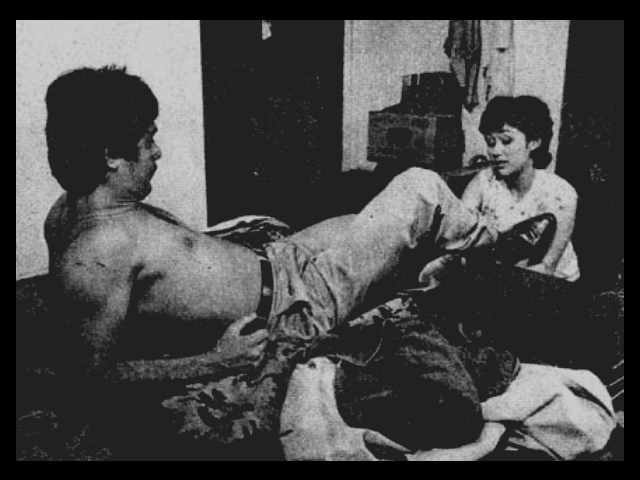 RELATED READING:


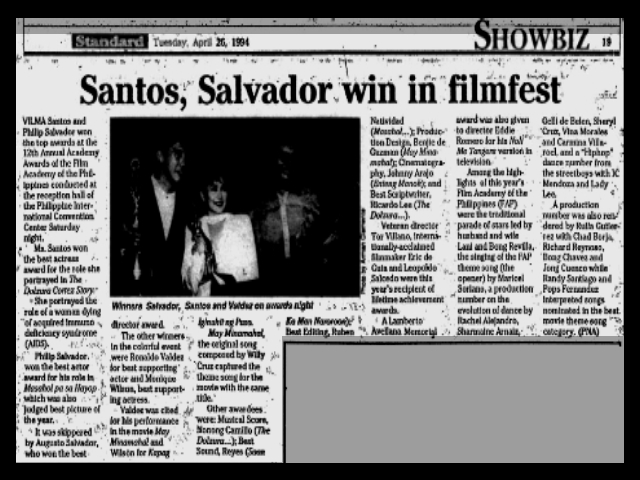

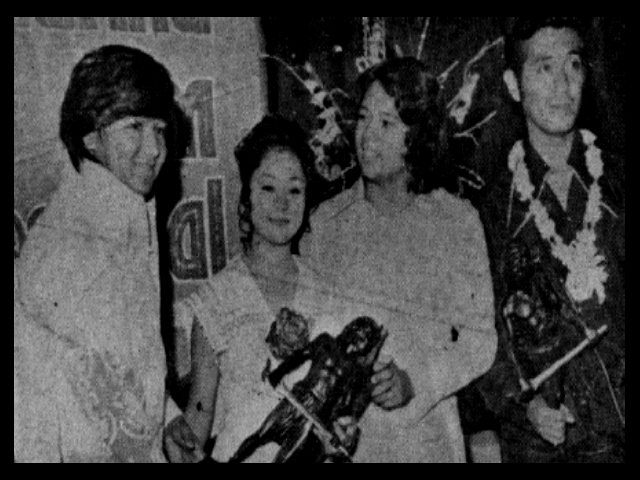
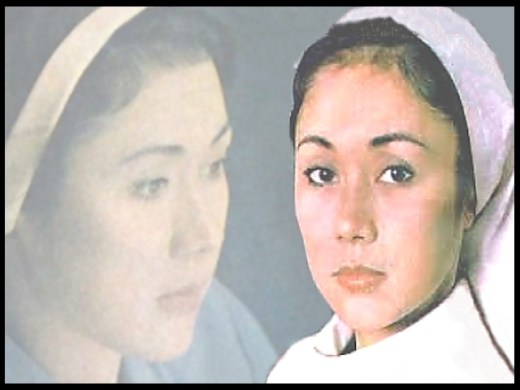


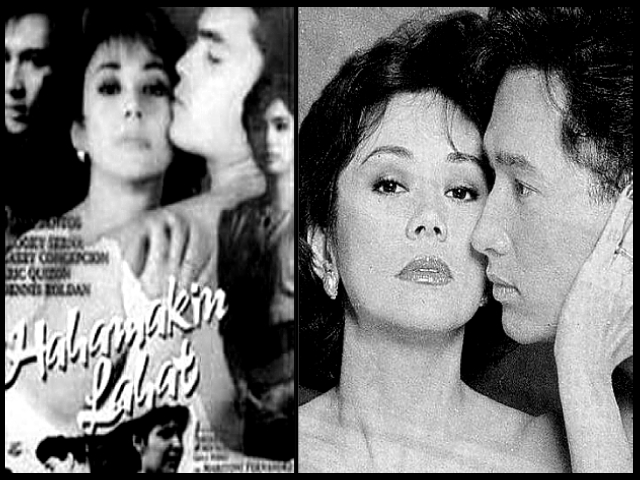
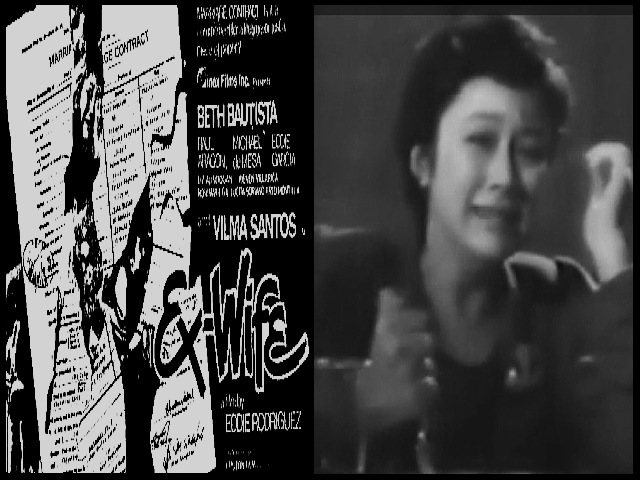

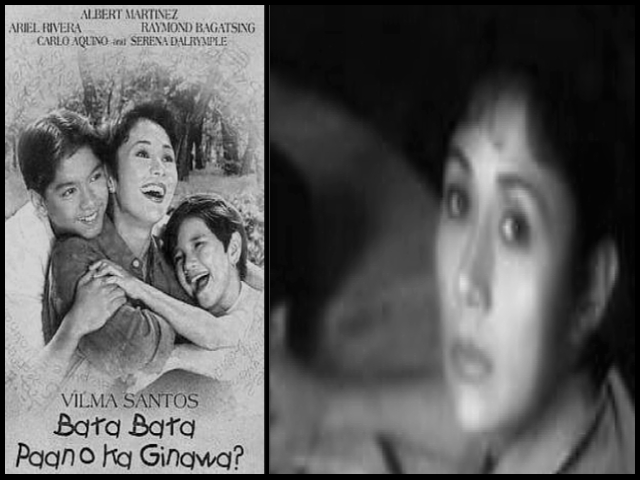

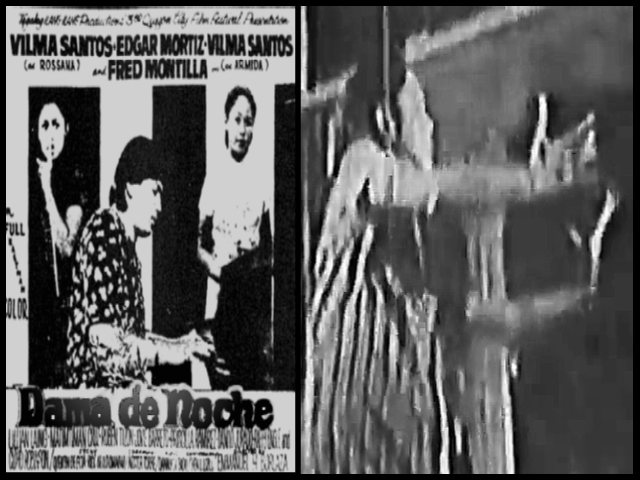
 Star For All Seasons
You must be logged in to post a comment.