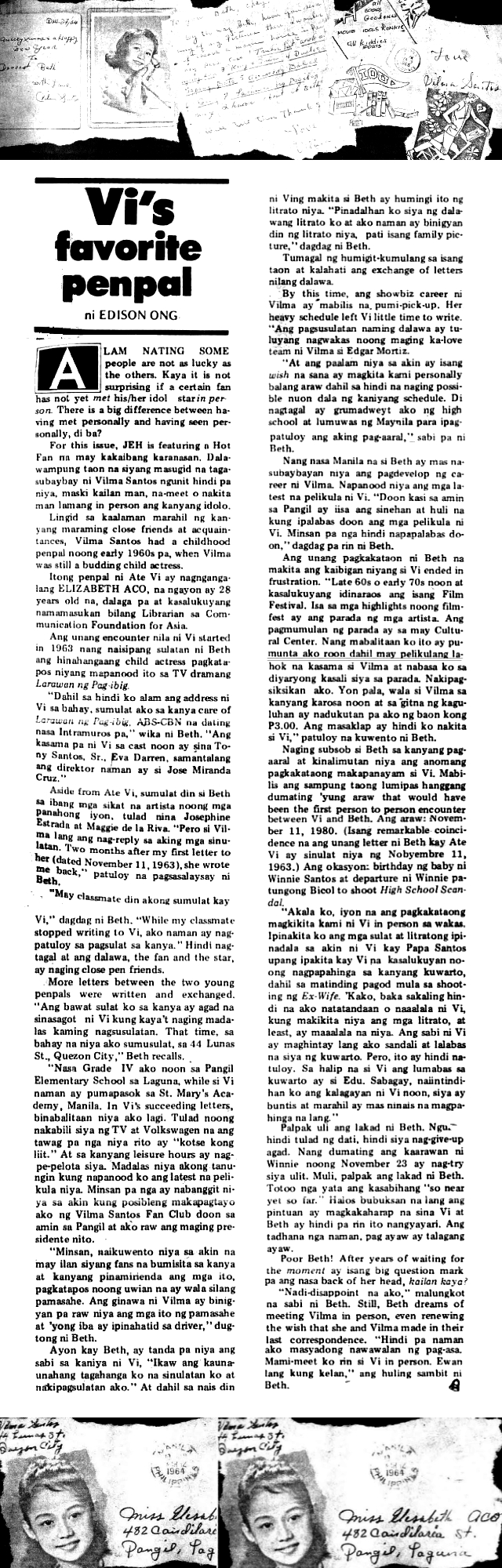
Source: Pelikula, ATBP – VI’S FAVORITE PENPAL (Jingle Extra Hot Magazine, June 22, 1981)



Figure 1: Best Actress from FAMAS, Gawad Urian, Film Academy of the Philippines, and CMMA
The oldest award giving body in the Philippines was the Filipino Academy of Movie Arts and Sciences simply called FAMAS. It was launch two years after the Maria Clara awards folded in 1951. FAMAS shared the same name with the American film academy; AMPAS until the later complained and the Filipino organization have to change theirs into the current acronym. FAMAS created a history of controversies throughout their more than sixty years in award-giving business mostly due to their questionable selection of winners. In 2006, FAMAS experienced another setback when two groups divided the organization due to a controversial election of its officers. As the legal battle settled, the battling groups decided to just hand out their own awards, one used the name FAMAS and the other the Maria Clara Awards. Like its infancy, the Maria Clara Awards did not reach its maturity and died the second time. This is not the first time FAMAS experience disgruntled “break-away” members forming their own award. Prior to 1976, FAMAS retained their status as the most prestigious recognition a Filipino actor could have. Charito Solis, who won best actress at the Asian Film Festival in 1967 used to proudly bring her FAMAS trophies on the film set to intimidate starlets and to instigate professionalism. The breakaway group of critics wish to distinguish themselves from FAMAS by successfully branded their award as not for actors who overtly act in films, they catered to the ones who are restrained and controlled. Hence, the term “Pang-FAMAS na acting” was born, which means over-acting.
The new group of practicing critics handed out their first award in 1976 and called themselves as the Manunuri ng Pelikulang Pilipino (The Filipino Film Critics) and their awards as Gawad Urian. The critics created a name for its credible choices of winners throughout the years. This untainted reputation made the Gawad Urian, the most sought after award in the Philippines.
Two years after the critics handed out their Gawad Urian, the Catholic Church joined the derby by handing out their own version of movie awards. The Catholic Mass Media Awards came to fruition in 1978 with the late Cardinal Jaime Sin in charge of the ceremony. CMMA honour not only films but also television, print, radio, and recently advertisement.
Five years afterwards, came the establishment of the Philippines’ counterpart of OSCAR. Consists of different guilds, the very first academy awards, now called Luna Awards, handed out in 1983. After 25 years, the Luna Awards cemented a reputation as “the popularity contest awards,” which means each guild votes for their favourites and not necessarily about merits. They tried very hard to adopt a new set of voting rules including different nominating group that represented each guild to resolve this issues but like the OSCAR, the results are sometimes questionable. The common consensus was that the Luna Awards remained far behind Gawad Urian. Two years after the creation of Film Academy of the Philippines’ Luna awards, another group joined the award giving business.
The Philippines Movie Press Club or the PMPC handed out their first Star awards in 1985. The Star awards were considered the Philippines’ counterpart of the Golden Globes. And like the Golden Globes, the Star also honours television. The only difference is that the Star Awards hands out their film and televisions ceremonies separately. Consists of publicists and entertainment writers, who are member of PMPC (Philippine Movie Press Club) the Star Awards followed the footsteps of Gawad Urian with very credible choices of winners but just like FAMAS, the Star Awards experienced the same fate with a disgruntled members formed their own version of the same awards. The Entertainment Press Society was born with their Golden Screen Awards in 2004.
Today, in addition to the Gawad Urian, FAMAS, Luna, CMMA, Star Awards, and Golden Screen, we also have the PASADO awards from an organization of academics; the YCC, Young Critics Circle Awards from a group of film students; the Gawad Tanglaw from an organization of film and arts’ instructors. Lately, the OMG Awards by the internet company, Yahoo Philippines, and the MTRC Awards by the board of censors joined the now, overcrowded award giving bodies.
Before 1982, the word grandslam were only used in sports. The term grandslam according to Wikipedia in terms of tennis is a singles player or doubles team that wins all four major tournaments (Australian, French, Wimbledon, US) in the same calendar year, is said to have achieved the “Grand Slam” or a “Calendar Year Grand Slam,” just like what Steffi Graf, the retired German tennis superstar did in 1988. Meanwhile the American Heritage dictionary described the term “grand slam” as follows: first, the winning of all the tricks during the play of one hand in bridge and other whist-derived card games. Second, the winning of all the major or specified events, especially on a professional circuit. And third, in baseball, a home run hit when three runners are on base. From this set of definitions comes the term “grand slam best actress” which basically winning all the best actresses awards from all major award giving bodies. And in 1983, the four majors were FAMAS, Gawad Urian, CMMA, and the FAP (or Luna now).
The Beginning – The Marcos administration created the Film Academy of the Philippines in 1981 under the guidance of first lady Imelda Marcos and Imee Marcos as Experimental Cinema of the Philippines’ director-general. ECP started to ambitiously produced films to showcase local talents for its inaugural Manila International Film Festival. The organization produced two memorable films, Peque Gallaga’s period film, “Oro, Plata, Mata” and Ishmael Bernal’s French influenced film, “Himala.” Come Gawad Urian night, both films received its stiff competitions from three other films, Mike Deleon’s “Batch ’81,” Lino Brocka’s “Cain at Abel” and Marilou Diaz Abaya’s “Moral.” For the Manunuri, the previous year produced only two stand out films, Mike De Leon’s Kisap Mata and Laurice Guillen’s Salome. A big contradiction this year, as not only they have the tasks of sorting out the best in each categories from these five films mentioned above but also other worthy films. Famous with their long heated debates, the local critics added the following films in their list of best films: Nora Aunor’s “Mga Uod at Rosas,” Vilma Santos’ “Relasyon” and Hilda Koronel’s “PX.” The three were cited not only for the overall production but also for the performances of the film’s lead actresses. Also cited were, ECP’s delicate horror film, “Haplos” directed by Jose Perez and two Lino Brocka films, the comedy “Palipat-lipat, Papalit-palit” and the drama “In this Corner.”
For Vilma Santos, The previous year, Pakawalan Mo Ako was a huge summer hit that earned Vilma a surprised best actress in FAMAS. That year also released Ex-Wife and Hiwalay, about marital problems. Art imitating life, as there were reports that Vilma and now, ex-husband, Edu Manzano were having some marital problems. But Vilma as trooper as she is, any personal troubles were not publicly noticeable as she goes on with her work, business as usual. Also, Vilma gave birth to her eldest son Luis “Lucky” Manzano.
By December of 1981, her film festival entry, Karma earned her another surprise best actress trophy after the FAMAS gave her the nod for Pakawalan Mo Ako. In an unrelated news, the entertainment industry were shocked to found that matinee idol, Alfie Anido died on Dec 31st. Like the death of Julie Vega and Rico Yan, it is still unknown the reason behind Anido’s death.
She is determined to make 1982 another successful year. She released a total of six films, out of six; two were certified record breakers, “Sinasamba Kita (I Idolized You)” released in August and “Gaano Kadalas ang Minsan? (How Many Times is Once),” released in November, both produced by Viva Films. The other four films (Relasyon, T-Bird at Ako, Never Ever Say Goodbye, Haplos) were mild hits. All of her hard work paid off because as early as January of the 1983 she was already poised to reap major awards.
Meanwhile for Nora Aunor, 1982 were a mixed bag of mild hits and failed opportunities. “Mga Uod at Rosas,” her collaboration with Lorna Tolentino and director Romy Zusara produced a mixed reviews from the critics. Her excellent performance did not help as the film were just mild hit with the audience. Her follow up films, “Annie Sabungera” and “Palenke Queen” both comedies also did not do well at the box office making the expectation from her next film higher, as she teamed-up with the hottest star of 1982, her closest rival, Vilma Santos in Danny Zialcita’s fast paced film, “T-bird at Ako.” T-bird’s high expectation wasn’t realized as the film earned just a modest income.
By December, all eyes were focused again on Nora and her most ambitious project to date, Ishmael Bernal’s “Himala,” produced by the Imee Marcos’ Experimental Cinema of the Philippines. The film was an entry to the Metro Manila film festival. Nora Aunor was again proclaimed the “queen of local festival” as she won her third Metro Manila Film Festival best actress. Nora’s momentum was rising and she was conditioned to make some serious dent in the following year’s award giving seasons. Critics were all going “gaga” with Aunor’s gigantic performance as Elsa. They said Himala was very effective in communicating its film’s message; it has moving moments and raw power.
Communicated It Really Well – “…Nestor Torre…he finds Batch ’81 the best movie made in 1982. “The movie had something very important to say and it communicated it very well…As for the best actress, it’s Nora Aunor in Himala. “It was a good role, and she communicated it very well. At least, Nora wasn’t api here for a change, It was quite a complicated role, but she handled it very well….Other choices were Gina Alajar and Lorna Tolentino in Moral…Vilma Santos, Nestor notes, is admittedly a “very hard worker but her physical structure really makes it difficult for her to be really effective—hindi malalim—and her voice is not that expressive.” Nestor adds, though, once in a while, Vilma “transcends her physical limitations, as in Rubia Servios…” – Nestor Torre Jr. (film critic), Parade Magazine, January 19, 1983
Moving Moments – “…Best Films: (in the order of preference) 1. Oro, Plata, Mata and Batch ’81; 2. Relasyon and Himala; 3. Moral. Best Directors: (in no particular order) 1. Ishmael Bernal for Relasyon and Himala; 2. Peque Gallaga for Oro Plata Mata; 3. Mike de Leon for Batch ’81. Actresses: 1. Vilma Santos for Relasyon; 2. Nora Aunor for Himala and Uod at Rosas; 3. Sandy Andolong for Moral and Oro Plata Mata; 4. Gina Alajar for Moral. Actors: 1. Mark Gil for Batch ’81 and Palipat-lipat, Papalit-palit; 2. Joel Torre for Oro Plata Mata; 3. Christopher de Leon for Relasyon. Most movies are usually flawed, and those in my list are no exception. However, apart from the standard criteria I am applying to them (the classic from and content balance), I am giving much weight on impact and emotional power. So, my top two are Oro and Batch. Himala is an ambitious film and much flawed, but it has visual beauty and emotional wallop.
Relasyon is more modest in scope, but I think is more successful on its own terms. Moral has many good things going for it, from direction and writing, to performances, but it does not match the four other films in impact (though it has some moving moments) and originality…” – Mario Hernando (film critic), Parade Magazine, January 19, 1983
Raw Power – “…Ding Nolledo…confesses to liking Himala “very much” but mentions that he hasn’t seen Oro Plata Mata…because the film exudes “raw power,” not to mention the excellent acting and the direction, which was like early Fellini, especially the middle part…Ding doesn’t agree with Moral’s rave reviews because “I’ve seen Moral in about 369 other films.” It’s not that original, he implies. As for best actress, it’ll have to be Nora in Himala. “She reminds me of the young Anna Magnani. Besides, the script fitted her to a T. The role practically coincides with what she is in real life…” – Wilfrido Nolledo (novelist, screenwriter, film critic), Parade Magazine, January 19, 1983
Himala won nine out of eleven local festival awards. A sort of repeat of what Vilma’s “Burlesk Queen” achieved in 1977 but without the complaints or sour grapes.
Body of Work – The success of Himala in the December festival has been overshadowed by the commercial success of Vilma Santos’ body of work. In fact, on Dec 14, 1982, Channel 9’s talk show, Let’s Talk Movies recognized Vilma Santos as their best actress for her body of work. Nora Aunor was nominated for her films excluding her epic movie Himala which was not qualified due to the show’s fiscal year requirements which covers December 1981 to November 1982 (More about this below).
On January 20, 1983, Vilma was crowned the Box Office Queen by the Metro Manila Theaters Association in their very first The 1st Cinehan Awards. Reporter Meg Mendoza wrote in an article for Prime Magazine, “…Vilma gave Viva Films its first biggest hit in Sinasamba Kita earning over P7M in Metro Manila alone. Then came T-Bird at Ako (a mild hit), Never Ever Say Goodbye (a sorry miss), Gaano Kadalas ang Minsan? (her biggest hit for that year) and Haplos. As early as January 20, 1983, Vilma began to reap several victories when she was awarded by the Metro Manila Theaters Association on their first Cinehan Awards together with Fernando Poe, Jr. held at the Philippine Plaza.
National Artist Nick Joaquin, in an article that came out in the Bulletin Today on February 11, 1983 wrote: “By emerging as box-office queen, Vilma Santos proved herself to be the Philippine Cinema’s Superstar – a title, it’s to be realized now, that can be bestowed only by the Cinehan.” So, on Cinehan Awards Night, Vilma was the very picture of the conquering heroine, drawing all eyes as she glowed and glittered, a rapture of radiance in her strapless white gown with lilac sash – and in white gloves yet! In her triumph joined both cinema and cinehan. Her pictures were all well done – and they also did very well at the box-office. In the same awards night, Ambassador Jaime Zobel de Ayala, another recipient of the Cinehan, upon receiving his award from Dean Lucresia Kasilag said: “I’m only a little bit sorry that Vilma didn’t give me the award. But it’s all right, I’ll try again next year. You’re my favorite star, you’re my muse! I’ll suffer in silence…”
Ironically, few weeks after her crowning as box office queen, Vilma released Ayaw Kong Maging Kerida, the result was average, proving the Romeo Vasquez and Vilma Santos screen charisma has subsided immensely.
Not to be outdone with Vilma’s latest feat, Nora’s “Himala” competed in the 1983 Berlin International Film Festival the following month. The film was the Philippines’ sole entry. The rave reviews were solid, Aunor’s performance was recognized by a nomination but unfortunately, according to Bernal, she lost the race by a mere vote. Would a similar fate awaits Aunor as the local award giving seasons begins?
First Major – By late February, the award-giving season in the country started. In their website, the Catholic Mass Media Awards recalled, “…The Archdiocese of Manila, through His Eminence Archbishop Jaime L. Cardinal Sin, organized the Catholic Mass Media Awards (CMMA) in 1978, in observance of the International Social Communication Day (established by the Universal Church to stress the importance of mass media and to instill a sense of responsibility in communicators). An outstanding way, in radio, print, advertising, television, and film. It was first given out in 1978; since then the CMMA was held every year onwards. In 1980, His Holiness Pope John Paul II graced the awarding ceremonies. Handing out personally the trophies to the winners, the Pontiff illustrated the significant place of mass media in today’s society, and its pervasive influence in the lives of the people…”
Just the previous year, the CMMA praised Nora Aunor’s acting in the late Mario O’harra film, “Bakit Bughaw ang Langit?” and she was adjudged their best actress. There is a great chance that Nora would repeat the feat, as many expected the church would favor a well-crafted film with religious theme.
On February 29, 1983, the fight between Nora Aunor’s “goliath” type of performance in “Himala (Miracle)” versus the “davidian” type of performance in Vilma Santos’ “Relasyon (the affair)” begins. The media were partly right, CMMA gave their best picture, screenplay, supporting actor/actress to Himala. But despite its, taboo story of a mistress, the Catholic Church’s award giving body favoured Vilma’s sympathetic performance.
Vilma won the first bout. Nora left empty-handed. The first blood has been drawn and Noranians, Nora Aunor’s fanatic fans were furious. The fight didn’t stop at the Catholic Mass Media Awards. The next one was a big one.
Second Major – Noranians expected a third Urian best actress considering the magnitude of Aunor’s performance in Himala and the positive reviews it received. Positive reviews that were written by the Manunuri critics themselves. Noranians dismissed Vilma’s win at the CMMA and expected that metal sculpted trophy was in the bag already. By the way, who are these critics anyway?
Practicing Film Critics – Movie writer, Billy R. Balbastro described the Manunuris: “…The Manunuri ng Pelikulang Filipino…is an organization of practicing film critics established in 1976. Most came from the Academe then with Nestor U. Torre becoming its first president. The Manunuri had its Gawad Urian in simple one hour-long rites at the CCP then. Dr. Bienvenido Lumbera Jr. became its second president. Other presidents include: Mario Hernando, Butch Francisco, Agustin “Hammy” Sotto, Gigi Javier Alfonso of UP. Each critic-member is expected to write regularly film reviews or film criticism which must be published in national publications. Each year too they give out awards for achievements in the movie industry, thus joining the FAMAS, the Film academy of the Philippines and the Philippine Movie Press Club’s Star Awards in this aspect of endeavor. During their first decade (1976 to 1985), they also came up with their Stars of the Decade: Nora Aunor, Vilma Santos, Vic Silayan and Phillip Salvador. The members of the Manunuri are: Mario Hernando (editor of Sunday Malaya), Bienvenido Lumbera Jr.(1993 Ramon Magsaysay awardee for journalism, literature and creative communication), Nicanor Tiongson (former artistic director of the Cultural Center of the Philippines, and former MTRCB chair), Butch Francisco (TV personality), Agustin “Hammy” Sotto (founding president of the Society of Film Archivists), Paul Daza (columnist), Gigi Javier Alfonso (dean of the UP-Diliman Open University and professor at the UP College of Mass Communication –UP-CMC), Ellen Paglinauan (dean of UP-CMC), Bro. Miguel Rapatan (DLSU), and Lito Zulueta (Inquirer sub-editor and faculty member of the UST Faculty of Arts and Letters)…”
The 1973 Scandal – Speaking of co-winner or “tie,” writer Rolfie Velasco pointed out in his article, “…FAMAS was the sole award-giving body for film in the Philippines from 1952 until 1976, when the Manunuri ng Pelikulang Pilipino (MPP) formed the Gawad URIAN (FAMAS was also contested by the Manila Film Festival, established in the 1960s, but a film festival cannot be considered as a major award-giving body). From 1952 to 1976, FAMAS alone has awarded the most foremost performers and craftsmen of Filipino films, from screen legend Rosa Rosal to master director Gerardo de Leon. Winning a FAMAS Award became the target obsession for many film craftsmen, for it was, after all, the Philippines’ counterpart of the Oscars. The awards itself, then held mostly in the Manila Hotel, was the biggest annual event in the Philippine movie industry…In 1973, the FAMAS was rocked by a terrible scandal. It awarded the first tie in the lead categories in the history of Philippine cinema. Before this, the only recorded tie was in 1968, when Tito Arevalo and Tony Maiquez shared the Best Musical Score honors. Because of the popular nominees with their loyal supporters, the tie in the 1973 best actress category became a hot topic with both Boots Anson-Roa (Tatay Na Si Erap) and Vilma Santos (Dama De Noche) sharing the honors. Because a tie in the lead categories was unheard of, the public dissented the vote. Therefore, for the next years, the FAMAS invited film critics to be members of its nominating and awarding committee. These critics left the FAMAS in 1976 to form MPP and subsequently, the Gawad Urian (Urian Award), named after the Tagalog word for gold standard…”
On April 15, 1983, the Gawad Urian was set to give out their hardware. It was known by many, that the critics or the Manunuris were pro-Nora Aunor. They gave Aunor their very first best actress award in 1976 for her excellent performance in “Tatlong Taong Walang Diyos (three years without God)”. They also gave Aunor a second nod in 1980 in her wonderful performance in “Bona” with Gina Alajar as co-winner.
When the winner was read, even Vilma was surprised. After so many years of snubs, she finally received the recognition she truly deserved. The critics finally came to their senses and recognized Vilma’s explosive and giant killer performance.
By winning the Gawad Urian, Vilma defeated not only Nora but also Lorna Tolentino and Gina Alajar both equally gave a felt performance in the feminist film, “Moral.”
Adding cherry to an already sumptuous plate, at the same night, on April 15, 1983, Vilma have to rush to another ceremony, she was crowned by the Guillermo Mendoza Memorial Foundation as the 1982 – 83 Box Office Queen of Philippine Movies at the Celebrity Sports Plaza with Fernando Poe Jr as the Box Office King, her second crown/title after January’s Cinehan Awards.
This was Vilma’s second major best actress wins in the same calendar year. She was half way there. People are now starts talking about the possibility of Vilma winning all the best actress awards.
Not to be outdone, Noranians regained from their disappointments as Nora Aunor received an award from a socio-political group, the TOWNS on April 23, 1983. Nora Aunor received (The Outstanding Women in the Nation’s Service) or simply TOWNS award from the former first lady, Madame Imelda Romualdez Marcos, at the Plenary Hall of the Philippine Convention Center. With the first lady handing out the TOWNS to Nora, people are started to insinuate that Nora Aunor’s defeat in two previous majors are politically motivated.
Third Major – The next race was the very first Luna Awards, back then, simply called the Film Academy Awards, Philippines’ counterpart of OSCAR.
On April 27, 1983 the First Film Academy of the Philippines Awards were held at the Manila Film Center. The FAP official web site provided some basic information about The Luna Awards, “…Established in 1981 as mandated by Executive Order No. 640-A, the Academy has been able to forge an alliance among the various guilds of the movie industry. Serving as the umbrella organization, the Film Academy oversees the welfare of the guilds thru an assortment of subsidies, projects and opportunities that would bring about the upgrading of the knowledge and expertise of the guild members. The principal function of the Academy is to give awards in recognition of the artistic and technical excellence of the performances and to accentuate the value of quality works of the people behind the outstanding films shown during the year. The Annual Luna Awards is intended to provide the necessary motivation in enhancing the craftsmanship of movie industry workers that will eventually uplift the quality of local films. The Academy also assists in the staging and managing of the annual Metro Manila Film Festival from which proceeds the Film Academy gets a share. Delegates to foreign film festivals are primarily sent thru the intercession of the Academy. The Academy also spearheads the collaboration of the movie industry with government agencies in order to gain opportunities for the guilds and its members…”
Academy insider, Jose N. Carreon wrote: “…At seven o’clock on a Wednesday evening on April 27, 1983, the Film Academy of the Philippines held its first ever awards night for distinguished works and performances in films exhibited in 1982. The venue was the Manila Film Center, one of the cultural edifices that were constructed under the auspices of former First Lady, Madame Imelda Romualdez-Marcos…The first ever Academy award winner was the late Rodolfo ‘Boy’ Garcia who was adjudged the best supporting actor for his role in Ito Ba ang Ating mga Anak?…Liza Lorena was best supporting actress for her role in Oro, Plata, Mata…The late Vic Macamay won the best sound award for Gaano Kadalas ang Minsan?…The best cinematography award was won by Romy Vitug for Sinasamba Kita…Sinasamba Kita by the late George Canseco was voted the best original song…The late Orlando Nadres won the best screenplay adaptation for Sinasamba Kita…Romy Suzara won as best director for Uod at Rosas…Manay Ichu’s MVP Pictures’ Batch ’81 was voted the first best picture of the academy awards…With the stage overflowing with showbiz people, the best actor and best actress awards were announced. Philip Salvador (for Cain at Abel) was declared best actor over Robert Arevalo (Santa Claus is Coming to Town), Mark Gil (Batch ’81), Christopher de Leon (Relasyon) and Joel Torre (Oro, Plata, Mata). The last winner of the night turned out to be Vilma Santos who was best actress for her performance in Relasyon. The other aspirants were Gina Alajar (Moral), Nora Aunor (Himala), Coney Reyes-Mumar (Pedring Taruc) and Lorna Tolentino (Moral). Then everything was history. After 25 years, we remember and we celebrate and we recommit ourselves for another quarter of a century. The Film Academy of the Philippines and its Luna Awards live on…”
Vilma Santos faces again a stiff resistance from Nora Aunor. In the end, Vilma received her fourth best actress award. And like when Nora received her TOWNS award, the former first lady, Imelda Marcos handed out the very first Academy award best actress to Vilma.
Vilma won her third major best actress in the same calendar year. One short of a complete overhaul.
Fourth Major – The award season of 1983 ended with the handing out of the FAMAS. The Manila Film Center was jam packed with not only celebrities but also a boisterous group of Noranians and Vilmanians. Unfortunately, Nora Aunor wasn’t nominated for her gigantic role of Elsa in “Himala” instead, she was nominated for her portrayal of an underdog lover of the late Johnny Delgado in Romy Zusara’s “Mga Uod at Rosas (The Worms and Roses)”. The competition didn’t stop with Vilma’s “Relasyon,” Noranians were worried about the other nominees too. Hilda Koronel was cited for her solo starrer, “PX” and Alma Moreno was nominated for her daring role as Cristina Gaston in the “Diary of Cristina Gaston.” The list of Nominees were completed with the inclusion of two veterans: Mona Lisa for her supposed to be supporting role in “Cain at Abel” and Liza Lorena for her surprising role in “Santa Claus is Coming to Town.” With this list comes a lesser expectation from Noranians, as Nora wasn’t nominated for her more intense role as Elsa. But this didn’t bother them as they raided the Manila Film Centre with so much fanfare.
The unofficial FAMAS website declared the winners, “…The 31st FAMAS Awards was held at the Manila Film Center on May 28, 1983. The Best Picture went to Cine Suerte’s Cain at Abel defeating Gaano Kadalas Ang Minsan [Viva Films], Himala [Experimental Cinema of the Philippines], Ang Panday: Ikatlong Yugto [FPJ Productions] and Sinasamba Kita [Viva Films]. The Best Actor went to Anthony Alonzo for Bambang defeating Christopher de Leon for Relasyon, Dolphy for My Heart Belongs to Daddy, George Estregan for Lalaki Ako, Dindo Fernando for Gaano Kadalas Ang Minsan, Fernando Poe, Jr. for Ang Panday: Ikatlong Yugto, and Philip Salvador for Cain at Abel. The best supporting Actor went to Tommy Abuel for Gaano Kadalas Ang Minsan while the best supporting Actress went to Sandy Andolong for Moral. Eddie Garcia won the best director Sinasamba Kita defeating Marilou Diaz-Abaya for Moral, Ishmael Bernal for Himala, Lino Brocka for Cain at Abel, Fernando Poe, Jr. for Ang Panday: Ikatlong Yugto and Danny Zialcita for Gaano Kadalas Ang Minsan. Gaano Kadalas Ang Minsan also won the best story for Tom Adrales; best screenplay for Tom Adrales and Danny Zialcita; best editing for Ike Jarlego, Jr.; best musical score and theme song for George Canseco and best sound for Vic Macamay. Joseph Estrada received the Hall of Famer Award for winning five times as producer. The most anticipated award was for best actress which went to Vilma Santos for Relasyon defeating Nora Aunor for Mga Uod at Rosas, Hilda Koronel for PX, Mona Lisa for Cain at Abel, Liza Lorena for Santa Claus is Coming to Town, Alma Moreno for The Diary of Cristina Gaston ..”
Unfortunately, for Noranians, their idol went empty handed again for the last time. Vilma claimed her fourth major best actress in one calendar year. The night for Vilmanians didn’t stop from Vilma’s win. Eddie Garcia won the best director award for a Vilma Santos’ blockbuster film, “Sinasamba Kita.”
Noranians were all mad as hell. Writer Bum D. Tenorio Jr., in his article for Philippine Star, described how the feisty Noranians reacted on Vilma’s win on their home turf, the Gawad Urian, “…Talk about Himala, it was because of this movie that two ladies in my neighborhood got into a nasty hair-pulling fight. Nora could have won the grand slam for Best Actress in all the award-giving bodies for this movie in 1982 except that her archrival and now Batangas Gov. Vilma Santos won for the movie “Relasyon” in the Gawad Urian. The feisty Noranians in the neighborhood could not accept this, while the Vilmanians gloated. This irreconcilable difference unfortunately turned ugly. In those days, fans were fiercely loyal. When Vilmanians talked about “Wonder V,” expect Noranians to come up with “Super G.” When Vilmanians mentioned how they got scared in “Phantom Lady,” expect a multitude of Noranians to thwart their claim by discussing “Fe, Esperanza, Caridad,” Nora’s suspense thriller. Even when Nora and Vilma starred together in a movie, say “Pinagbuklod ng Pag-Ibig” or the legendary “T-Bird at Ako,” competition between fans of both camps still raged. But in my community, the Noranians always prevailed!…”
Paranoia seeped in their brain as they hypothesized the reasons why Nora failed to win any awards. Sabotage according to them was the only reason. The political repercussion of the film being made under the Marcos administration resulted Nora Aunor being ignored by all award-giving bodies! Never mind that Vilma Santos deserved all the wins. Vilma Santos swept the entire best actress in four major award-giving bodies in one calendar year. The tag line “grand slam” was born.
In addition to the above majors, talk show, “Let’s talk movies” came up with their own film awards on its anniversary presentation at the end of 1982. The hosts, Behn Cervantes (filmmaker, film critic), Armida Siguion Reyna (film actress, producer) and Mario Bautista (movie reporter, critic, columnist) were quoted as who they think deserve the year’s accolade.
Behn Cervantes: “…Behn’s choice for best movie of 1982 comes easy, with one qualification (he has not seen Oro, Plata, Mata). “It’s Batch ’81 because it was innovative and more daring…As for the choice of best actress, “mahirap iyan,” Behn admits spontaneously. “It’s a difficult choice between Gina Alajar in Moral and Nora Aunor in Himala. Gina was beautifully flamboyant and effective as the funky character in Moral, while Nora was very cinematic in Himala. Nora is one actress who knows how to use her medium…Vilma is also good. She knows her craft, but somehow, at the moment of truth, physically she doesn’t quite hit me. There’s something very cutesified about it…”
Armida Siguion Reyna: “…Armida has said it in her TV show Let’s Talk Movies and she’s saying it again: her choice for best movie not only for the film fest but for the entire 1982 is Moral. “It’s very ‘today,’ NOW. You really get to identify with the characters in the movie…After Moral, Armida chooses Oro, Plata, Mata and Cain at Abel, respectively, as among 1982’s best…Armida chooses Vilma Santos as best actress for her performance in Relasyon. “I can’t explain my choice in the beautiful language of the Manunuri but I go by gut and alam kong maganda.” She is also more inclined toward Vilma because the actress made a number of good movies last year…”
Mario E. Bautista: “…For us, sinuman ang manalo kina Vilma Santos o Lorna Tolentino ay okey lang. Both Gina and Nora have won the Urian best actress awards twice. Gina for Brutal and Salome, Nora for Tatlong Taong Walang Diyos and Bona. Napakagaling ni Gina in portraying the role of the trying hard Kathy in Moral. Hindi biru-biro ang ganoong character na gagawin mong sympathetic dahil mas malamang na lumabas itong ridiculous lang kaysa nakakakuha ng simpatiya. But Gina succeeded in making her Kathy both ridiculous and sympathetic. As Elsa, Nora’s case is that of star and role merging into one, fitting into each other perfectly dahil alam nating ang karisma ni Guy sa kanyang fans ay siya ring karisma ni Elsa sa kanyang naging followers. Pero palagay namin, kung hindi magta-tie sina Lorna at Vilma, mananalo ng solo si Vilma Santos. Vi has never won the Urian. She should have gotten it in 1977 for Burlesk Queen but the trophy went to Daria Ramirez in Sinong Kasiping. Maraming acting highlights ang papel ni Vi bilang Marilou sa Relasyon. Sa confrontation scenes nila ni Boyet, superb siya roon sa tagpong sinusumbatan niya ito dahil ginagawa na lamang siyang tau-tauhan. Ang acting niya sa death scene ni Boyet na hindi malaman ang gagawin sa katarantahan is also awesome to behold…”
Unfortunately, despite their highly praises of Nora Aunor, the talk show hosts gave their nod to Vilma Santos due to their technical rules. An article from Movie Flash explained: “…In celebration of its first anniversary, Channel 9’s Let’s Talk Movies will have a special presentation on December 14 from 9:30 to 11:30 pm. The talk show hosted by Armida Siguion-Reyna, Behn Cervantes and Mario E. Bautista will distribute seven major awards to deserving artists who excelled in local pictures shown from Dec, 1981 to November, 1982. The Let’s Talk Movies awards differ from those of other award-giving bodies in that they honor a director or performer not for just a single work or performance in one movie but for a body of outstanding works or performances shown during the said fiscal year. This is in line with the show’s aim to help uplift local movies. To qualify, a nominee should have at least two significant contributions. Nominees for…best actress…are Gina Alajar (Init o Lamig, Pusong Uhaw), Nora Aunor (Uod at Rosa, T-bird, Rock ‘n Roll, Palengke Queen), Amy Austria (Katas ng Langis, Waywaya, Pusong Uhaw), Vilma Santos (Karma, Relasyon, T-bird, Sinasamba Kita, Never Ever Say Goodbye) and Maricel Soriano (Galawgaw, Mother Dear, Schoolgirls)…An award for best producer will be given to the company which has produced the most number of outstanding films during the year. Special citations will be given to movie personnel who made worthy contributions to the industry during the year…”
While Vilmanians celebrated their idol’s historical win, Nora Aunor redeemed their broken ego by lining up to the 1983 Manila International Film Festival on June 24th, Himala was chosen as the opening gala film together with Hollywood film, Gandhi as the closing.
After the awards season of 1983, Vilma Santos released three more films after the disappointment, Ayaw Kong Maging Kerida.
On June 9th, Viva Films released Paano Ba ang Mangarap? that turned out to be another box office hit. Few months afterwards, Regal films released Bernal’s Broken Marriage, the follow-up film after the successful grand slam film, Relasyon.
Finally, four days after Vi’s birthday, Viva Films released Marilou Diaz-Abaya’s drama, Minsan pa Natin Hagkan Ang Nakaraan, another box office hit. This film plus the two films mentioned above confirmed her bankable status. Not to be outshine again, “Himala” continued its relentless fight for recognition, winning the bronze prize at the 1983 Chicago International Film Festival on November of 1983 (Nov 4-18 1983).
Vilma Santos made history. The first grand slam win of Vilma Santos was repeatedly analyzed over and over again. Mostly to give accolade to Nora Aunor.
Joel David, in his article titled “Performances of the Age” wrote: “…the outstanding performance of the period belongs to that of Nora Aunor in Himala, which was honoured only by the MMFF….In Himala the director and writer seemed to have agreed to a mutual stand-off, thus amplifying the theatrical potential of an expansive locale with a protracted takes; stage-trained talents ensured the competent execution of histrionic stylizations, with the climax set on an open-air platform before a hysterical audience. It was a truly great actress’ opportunity of a lifetime, and Nora Aunor seized it and made it not just her role, but her film as well. Not since Anita Linda in Gerardo de Leon’s Sisa (circa the first Golden Age) had there been such a felicitous exploitation by a performer of ideal filmmaking conditions – and in this instance, Himala has the decided advantage of being major-league and universal….”
Arnel Resma Ramos’ article titled “Himala Revisited” praised Nora’s complex role: “…we believe that Nora Aunor should have swept all the best actress awards for that particular year…Aunor had the more complex role and only an actress of her calibre can pull off the part with much persuasion. It calls for a restrained, self-effacing acting style. And Aunor, the consummate actress that she was…strikes not a false note in her performance. It is, in one word, mesmerizing. And Himala is without a scintilla of a doubt the pinnacle of her cinematic achievements.”
In recent years, Himala was recognized in many film exhibitions around the world. Even international television network fell on the prey and held an international internet poll, raising Himala to its highest glory, proclaiming the film as one of Asia’s best film. They hail, finally, Aunor were given the citations its truly deserved!
Again, never mind that Vilma Santos gave the most effective performance in the history of local movie screen. The fact is, no matter what they do or say they can’t change history. Vilma Santos was the very first “grand slam” best actress winner.
The history continues – Three years after Vilma Santos registered the very first grand slam win, Philip Salvador replicated the honours by winning all the best actor in 1985 via Lino Brocka’s political drama, ‘Bayan Ko kapit sa Patalim.’ Salvador won five majors as Star Awards were added to the four. The next year, 1986, Nida Blanca followed suit with a best supporting actress grand slam for her outstanding performance in the film, “Magdusa Ka.” Then four years after Blanca’s came the most awaited turn for Vilma’s rival.
Noranians were ecstatic as their idol claimed all the best actress hardwares of 1990 for “Andrea Paano Ba Ang Maging Isang Ina.” A deserving consolation as the film bombed at the box office. Nora’s stiffest competition came from Vilma’s two films, Lino Brocka’s “Hahamakin Lahat,” and Laurice Guillen’s “Kapag Langit ang Humatol.” But the table was turned and Nora claimed almost all of the major awards except from CMMA where she was declared runner up to Gina Alajar.
By 1990, CMMA was relegated into the minor league of award giving bodies replaced by much more popular Star Awards. Two years after Nora Aunor claimed the honour as grand slam winner, Lorna Tolentino took the crown for her effective performance in 1992′s “Narito Ang Puso Ko.”
Then back to Vilma again. – In 1993, Vilma Santos successfully relived the life of the first PWA in Laurence Guillen’s “Dahil Mahal Kita: Dolzura Cortez Story.” Not only the film recorded the second grand slam win for Vilma as best actress of 1993, the film was also a smashed hit. The two years intervals prove to be a normal pattern as Vilma’s closest rival took all the trophies again in 1995.
Nora Aunor hit the jackpot via true to life film, the “Flor Contemplacion Story.” And not only did she won the grand slams, she added an international recognition winning the best actress at Cairo International Film Festival. In addition to the majors, Aunor also received the best performer from YCC and the box office queen title from the Guillermo Mendoza Memorial Scholarship Foundation, Inc. (GMMSFI).
The next years, two actresses claimed the grand slam honours. Sharon Cuneta as best actress for her effective performance in “Madrasta (the Stepmother)” and the best supporting actress awards for Gina Alajar in “Mulanay, Sa Pusod Ng Paraiso.”
Then back to Vilma Santos again after two years for the third time. Vilma Santos won all the best actress awards for 1998′s “Bata Bata Paano Ka Ginawa (Lea’s Story)”. Then like Aunor in 1995, she added an international recognition with her grand slam win. Vilma was cited as the best actress at the Brussels International Film Festival. And also received the YCC-Film Desk’s best performer award.
By 1999, the grand slams wins were alive and kicking. Elizabeth Oropeza won all the best actress hardwares for her very intense performance as a prostitute in 1998′s “Bulaklak Ng Maynila.” The same year, an unknown actress Glydel Mercado, surprised everyone as she won all the best supporting actress awards coincidentally from a Nora Aunor comeback vehicle, “Sidhi.”
Then in 2002, Vilma Santos for the fourth time claimed the grand slam title by winning all the best actress awards for her superb performance in the film, “Dekada 70 (the seventies).” At the same time, Vilma’s co-star, Piolo Pascual declared his arrival to the big league of fine acting by winning all the best supporting actor awards. The film also gave Vilma her second international recognition winning the best actress from Cinemanila International Film Festival. In addition, she also received hardwares from PASADO (Pampelikulang Samahan ng mga Dalubguro) and YCC-Film Desk in its annual Circle Citations.
In Conclusion – For Noranians, Nora Aunor should be given the honour as the very first grand slam win in 1976 as they argued Aunor won the best actress from FAMAS and Gawad Urian, the only major award giving bodies back then. Unfortunately, this wins didn’t create the tag line, grand slam. Also, Vilma Santos, as film producer won all the best picture award in 1978 for Pagputi ng Uwak Pagitim ng Tagak from FAMAS and Gawad Urian, still the only major award giving bodies. Unfortunately, no one said this is a grand slam win.
It was only when Vilma Santos won four majors in 1983 did the tag line “grand slam” came to its birth at least in Philippine award giving film history. And so, history will record Vilma’s achievements as the very first actress who claimed all four major best actresses in one calendar year based on the true meaning of the word “grand slam.” She is also the current record holder of the most grand slam wins, four [Relasyon (1982); Dahil Mahal Kita – The Dulzora Cortez Story (1993); Bata, Bata, Paano Ka Ginawa? (1998); and “Dekada 70” (2002)]. – Florencio “Rendt” Viray, V Magazine 2007, (READ MORE)
Related Reading:
#FirstGrandSlamBestActressPhilippines, #VilmaSantos, #GrandSlam, #BestActress, #Philippines, #Relasyon, #Himala, #FAMAS, #GawadUrian, #FAP, #LunaAwards, #CMMA
Vilma Santos’ Film Academy of the Philippines (Luna Awards) Recognitions
(13 nominations, 4 wins, one lifetime achievement)
From Wikipedia: In 1981, President Ferdinand Marcos passed Executive Order 640-A, which established the Film Academy of the Philippines, the Philippines’ official counterpart of the United States’ Academy of Motion Picture Arts and Sciences.
The very first Film Academy of the Philippines’ best actress winner was Vilma Santos in 1982, for Relasyon. Also, two Vilma Santos movies, Sinasamba Kita and Gaano Kadalas Ang Minsan won technical awards for sound, original score, cinematography, and adapted screenplay.
Paano Ba ang Mangarap, a Vilma Santos movie won best cinematography for Romy Vitug the following year.
The third FAP confirmed the arrival of Sharon Cuneta, as she was adjudged by the guilds, their best actress in 1984 beating Vilma and Nora for Sa Hirap At Ginhawa. Vilma’s Sister Stella L director, Mike De Leon won the best director. Vilma’s other film, Alyas Baby Tsina won best in musical score and production design.
Nida Blanca won best actress for Miguelito and Lino Brocka best director for Kapit sa Patalim in 1985.
Vilma’s Saan Nagtatago Ang Pag-ibig won best director for Eddie Garcia and best cinematography for Romy Vitug in 1987. Lorna Tolentino won the best actress for Maging Akin Ka Lamang. Tagos Ng Dugo, Vilma’s winning film at the FAMAS won, best musical score. Veteran actress, Mary Walter received the lifetime achievement award.
Amy Austria and Philip Salvador was the big winner in 1988, for surprisingly for forgettable films, Boy Negro and Celestina Sanchez aka Bubbles respectively.
As both Vilma and Nora shared the best actress at the URIAN, FAP gave the best actress solely to Nora Aunor in 1989. Her film Bilangin Mo Ang Bituin Sa Langit, won best actor, best director as well. Vilma’s film, Pahiram ng Isang Umaga won two, best production design and best sound. Director Lamberto Avellana received the posthumous recognition award and veteran actors, Leopoldo Salcedo and Bella Flores, the lifetime achievement awards. Leopoldo did the memorable film Burlesk Queen with Vilma while Bella Flores was Vilma’s torturer in her very first film as a child actress in Trudis Liit.
As Vilma Santos won three times in rival award giving bodies, URIAN, Nora Aunor did the same with her three consecutive best actress in 89, 90, and 91. Both Vilma and Nora have four Lunas.
Vilma’s Kapag Langit ang Humatol won best story and cinematography and Joseph Estrada received the lifetime achievement award in 1990. Also, this year, the Lamberto Avellana Memorial Award was given to Lino Brocka.
Vilma’s Ipagpatawad Mo won best child performer for Terence Baylon and best Editing while the lifetime achievement award went to Fernando Poe Jr in 1991.
Nora’s three-year feat ends when Lorna Tolentino won the best actress in 1992 for Narito ang Puso Ko.
Vilma won her second best actress after seven nominations in 1993 for Dolzura Cortez Story. The film also won best adaptation story and musical score. Lifetime achievement awards went to Espiridion Laxa and Nora Aunor. Laxa was Vilma’s film producer of so many memorable films like, Dama De Noche and Lipad Darna Lipad.
Nora won her fourth best actress in 1995 for The Flor Contemplacion Story and Sharon Cuneta in 1996 for Madrasta. The 1996 lifetime achievement award went to Anita Linda.
Maricel Soriano’s turn to receive the best actress happened in 1997. She won for Nasaan ang Puso. Also, this year, Vilma Santos received the lifetime achievement award and the posthumous recognition award to Charito Solis.
Vilma Santos won her third best actress in 1998 for Bata, Bata, Paano Ka Ginawa, her co-stars, child actors, Carlo Aquino and Serena Dalrymple won the supporting acting trophies. The film also won best in production design. Vilma’s director in box office hits like Sinasamba Kita and Imortal, Eddie Garcia, received the lifetime achievement award.
Bulaklak ng Maynila win big in 1999, best director (Joel Lamangan), best actor (Christopher de Leon) and best actress (Elizabeth Oropesa). Vilma’s blockbuster movie, Anak won two trophies in 2000: best supporting actress for Amy Austria and best screenplay for Ricardo Lee. Gloria Romero won the best actress for Tanging Yaman. Vilma’s director and co-star in memorable films Nakakahiya and sequeal, Hindi Nakakahiya, Eddie Rodriguez received the lifetime achievement award.
Lorna Tolentino reclaimed her spot in FAP history when she won the following year her second best actress for Abakada Ina.
Vilma won her fourth best actress in 2002 via Chito Rono’s Dekada ’70. Her co-star, Piolo Pascual won the best supporting and the film also won best production design.
Maricel Soriano won again in 2003 for Filipinas while Susan Roces received the lifetime achievement award. The next year, Claudine Barretto won her very first academy award for her film, Milan. The following year, Vilma received her 13th best actress nomination for Mano Po III: My Love.
In 2005, the FAP award became, the “Luna Awards.”
In 2006, Nida Blanca and George Canseco received the posthumous recognition award. Nida Blanca co-starred with Vilma in 1988’s Ibulong Mo Sa Diyos. George Canseco created so many memorable songs for films starring Vilma Santos. In 2007, the special posthumous award was given to Armando Garces and Fernando Poe Jr.
Vilma Santos STAR awards for Movies Recognitions
18 nominations with six wins, one lifetime achievement award, one darling of the press award
Highlights: In 1985, the Philippine Movie Press Club initiated the Star Awards for Movies and Television, which is currently the Philippines’ Golden Globes’ counterpart. The very first recipient of Star best actress was Nora Aunor for Merika while Vilma’s movie Sister Stella L. received the movie of the year award. Vilma Santos was nominated for Palimos Ng Pag-ibig in 1986 but failed to win the best actress. Unfaithful Wife was judged the STAR best picture of this year. The next year, Vilma’s film, Saan nagtatago ang pag-ibig was proclaimed the movie of the year. Vilma received a best actress nomination for her FAMAS winning film, Tagos Ng Dugo. The fifth year, Vilma was nominated again, this time for Ibulong Mo Sa Diyos.
PMPC finally gave the trophy to Vilma in 1989 Star Awards. Vilma’s Pahiram Ng Isang Umaga four major awards: actress of the year for Vilma, supporting actor for Eric Quizon, director of the year for Ishmael Bernal, and Movie of the year for Regal films. Pahiram also won technical awards for cinematography, musical score, and production design. The following year, Snooky Serna won the supporting actress for Vilma’s “Hahamakin Ang Lahat.” Vilma was nominated for Hahamakin but the Star went to Nora Aunor for Andrea paano ba ang maging isang ina. Despite the lost, Vilma received a very special award from the PMPC, the “Darling of the Press” award. The next year, 1991, Nora Aunor again received the Star Award Actress of the Year for Ang totoong buhay ni Pacita M. Vilma was nominated for Ipagpatawad Mo. In 1992, Vilma was nominated again, for Sinungaling Mong Puso that Lorna Tolentino won for Narito ang puso ko. After winning her first Star Award in 1989 and nominated three consecutive years, Vilma finally win her second Star in 1993 for Dahil mahal kita: Dolzura Cortez Story. The next year, Vilma was nominated for Nagiisang Bituin but Dawn Zulueta took home the trophy for Buhay ng buhay ko.
In 1995, Nora Aunor was the big winner again with her film, Flor Contemplacion Story. 1996 was Sharon‘s grand slam year. She won the Star for Madrasta with co-star, Christopher De Leon taking the actor of the year. In 1997, Zsa Zsa Padilla defeated Nora, Vilma, Marecel and Sharon for actress of the year for Batang PX. Vilma was nominated for Hanggang Ngayon Ika’y Minamahal. Vilma was the big winner in ’98 for her film, Bata bata paano ka ginawa. She won actress of the year while co-star Serena Dalrymple won the supporting actress. Elizabeth Oropesa followed Vilma’s win the following year via Bulaklak ng Maynila. The new millennium brings another Star to Vilma as she claimed her fifth actress of the year for her film, Anak. The next year the Tuhog was the top film while Snooky Serna won the actress of the year for Habang kapiling ka. Vilma won her sixth actress of the year from Star in 2002 for the film, Dekada ’70. She will win her seventh Star again in 2004 for Mano po III: My love in 2004. The next three years, Judy Ann Santos (Kasal, kasali, kasalo – 2006); Ai-Ai de las Alas (Ang cute ng ina mo! – 2007) and Sharon Cuneta (Caregiver – 2008) received the Star actress of the year. Vilma Santos received the lifetime achievement award in the 2008 Star Awards while Nora Aunor’s film Himala was given a special citation award. By 2010, Vilma received her 18th best actress nominations and won for her 2009 film, In My Life. – RV
Vilma Santos’ STAR for TV Recognition – In the 1980’s, Nora Aunor’s Superstar show was losing viewership and her box-office appeal was also in question. Suddenly, the 70’s superstar was being eclipsed by a non-singer but an excellent dancer and versatile actress Vilma Santos. She has just scored her first of four grand slams for the movie Relasyon and continued to reign as the Longest Box-office Queen of Philippine Cinema. And slowly but surely, her VIP (Vilma In Person) TV show was gaining patronage/high ratings too from the precious class ABC households nationwide, TV advertisers’ prime target audience for their products. There was no stopping Vilma Santos. She was about to conquer the TV musical-variety genre where Nora Aunor ruled for years. Early on, Vilma Santos had rough sailings with her musical variety show. VIP was being broadcast from Channel 2 which had a bad reception among TV homes nationwide, and was no match to the more modern RPN Channel 9 where Nora’s Superstar show was simultaneously shown from Luzon to Mindanao in vivid, crisp color. When VIP moved to GMA Channel 7, it was the best move that Vilma’s think tank ever did. With better satellites, shrewd marketing, state of the art facilities, and more ambitious production numbers and with the Dancing Queen Vilma at the center of it all, and with the genius of Maribeth Bichara’s choreography and musical concepts written all over the show – “Vilma!” became the most watched and the most awarded (SEE LIST BELOW) TV show in the musical/variety category.. (READ MORE).
Related Readings:
26th PMPC Star Awards (2010) Winners: John Lloyd Cruz, Vilma Santos etc
Gov. Vilma Santos-Recto to receive Ulirang Artista award from PMPC
ighlights and sidelights of 25th Star Awards for Movies
Governor Vilma Santos inducts new officers of PMPC
PMPC Star Awards for TV 2006 Winners
STAR for TV RECOGNITIONS (and other TV awards)

Vilma Santos’ STAR for TV RECOGNITIONS
Catholic Mass Media Awards
Other Recognitions

Related Readings:
26th PMPC Star Awards (2010) Winners: John Lloyd Cruz, Vilma Santos etc
Gov. Vilma Santos-Recto to receive Ulirang Artista award from PMPC
ighlights and sidelights of 25th Star Awards for Movies
Governor Vilma Santos inducts new officers of PMPC
PMPC Star Awards for TV 2006 Winners
STAR Recognition

Honorary Doctorate Degree in Humanities by the Lipa City Public College
Mayor Vilma Santos-Recto (she is now, the Governor of Batangas) was given an honorary degree of Doctor in Humanities by the Lipa City Public College (LCPC) last November 10, 2005. The Doctorate degree was given after resolution no. 01-05 of the Academic Council was passed. The head of the Academic Council, Dr. Armando Badillo and the Board of Trustees, including City Adminstrator Mr. Pedrito Martin M. Dijan, approved the resolution. The Commission on Higher Education (CHED) also approved the resolution on May 11, 2005. The resolution states that they acknowledge the leadership and talent of Mayor Vi not only in the art of Film, but also her sincerity and effective management as a Mayor and for being a good role model for a new Filipina, beautiful inside and out. It is further stressed in the resolution that the life of Mayor Vi as a public servant and as a multi-awarded actress clearly mirrors her deep understanding of how she can serve the public, her respect for human dignity and her genuine belief in the goodness of men to serve and help one another. Dr. Cristeto Pamplona, Schools division superintendent of DepEd Lipa; Atty. Joel Montealto, City Legal Officer; Lipa City Councilor Romy Macasaet and Ronaldo de Castro, City Personnel Officer completes the LCPC Academic Council. – Eric Nadurata, V magazine Vol 2 No 6 The Valentine’s Day Issue 2005

2000 Box Office Queen – “…The Guillermo Mendoza Memorial Scholarship Foundation, Inc. is staging the 31st annual Box Office King and Queen of Philippine Movies coronation night on April 4 at the UP Theater. Telecast date is on April 21 on RPN-9. This private foundation is headed by civic leader Corazon M. Samaniego, daughter of the late Guillermo Mendoza who was once a noted politician and philanthropist in Bulacan. Middle of this week, the members of the board of judges of this award-giving body (with Necy Marco Llarena as chairperson) sat down to deliberate on the winners of this yearly popularity contest. Lipa City Mayor Vilma Santos was voted Box Office Queen because of the strong showing at the tills of her film Anak last summer. Produced by Star Cinema and directed by Rory Quintos, Anak was one of the top-grossing films of the year 2000. Robin Padilla, on the other hand, was voted Box Office King of Philippine Movies. Padilla’s two movies last year were big winners at the box office: Kailangan Ko’y Ikaw with Viva Films and Tunay na Tunay — Gets Mo, Gets Ko, released under Star Cinema…Veteran performers Dolphy and Gloria Romero are also being honored as All-Time Favorite Actor and Actress. Dolphy may have lost in the Best Actor race in last December’s Metro Manila Film Festival, but he still made quite a splash in Gil Portes’ Markova: Comfort Gay. And Gloria? After so many decades, she’s once more the toast of the town – thanks to Tanging Yaman…Maribeth Bicharra should also be very happy with the list of winners in this year’s Guillermo Mendoza Memorial Scholarship Foundation awards rites. Her VIP was voted almost unanimously as the Most Popular Dance Group. In the television category, Rudy Fernandez’s Kasangga on Channel 7 was picked as the Most Popular TV Program…” – Butch Francisco, The Star, Feb. 25, 2001, Reposted by: Sol Jose Vanzi (READ MORE)


Naging perya ang mga sinehan ng Kamaynilaan sa nakaraang 1978 Metropolitan Manila Film Festival. Bumalik sa dating sistema ng palabunutan ang tambiyolo ng kapalaran, sa halip na magkaroon ng pamimili sa mga produktong may uri at karapat-dapat ipalabas tulad ng nangyari noong nakaraang pista. Dinagdagan ang singil ng singkuwenta sentimos (para daw sa Mowelfund ni Joseph Estrada na muling nahirang na pangulo ng PMPPA, ang samahan ng mga malalaking prodyuser) at nagkaroon ng bolahan, at may mga nakalaang premyo tulad ng kotse at mga appliances para sa masusuwerteng ticket holders. Sige na, matuloy lang ang perya.
Dahil sa mula’t mula pa’y hindi agad masiguro kung tuloy o hindi ang pestibal (dahil rin sa ayaw makipagtulungan ng mga may-ari ng sinehan), ang karamihan sa mga pelikulang lahok ay yaong mga yari na, o di kaya’y nilagare para humabol sa pestibal, at galing sa mga prodyuser na nagkasuwerteng makabunot ng sinehan. Nang magmatigas ang mga may-ari ng teatro sa pamumuno ni Johnny Litton, sumugod ang mga taga-PMMPA sa Malacanang para kausapin si Gng. Imelda Marcos. Nang mabigyan sila ng opisyal na pahintulot, walang nagawa ang mga theatre owners kundi sundin ang direktiba.
Tuloy ang pista, ang parada, ang bolahan nitong kapaskuhan. Tulad ng nakaraang taon, siyam din ang kalahok (bagama’t noon ay idinaan sa mahigit na pamimili ng mga hurado). Kung nagkaroon ng screening, dalawa lamang siguro ang makakapasa. Ang pito ay dapat sanang pinalabas sa Mahal na Araw bilang penitensiya sa mga manonood (ngunit tinapat din sa Pasko, kung kailan pa naman naghahanap ang mga manonood ng mapaglilibangan hindi ng kalbaryo). Sa katunayan, may isang pangkat na nagpetisyon sa pangulo tungkol sa karahasan ng mga pelikula, sa tema at paksa, ngunit madali silang sinagot ni Meyor Estrada. Kulang daw talaga sa panahon at preparasyon, at aprobado daw ng sensor ang mga ito, giit niya. At saka mas mabuti na raw ang local garbage kaysa sa imported garbage. Maitatanong tuloy: Kung basura ang mga pelikula, bakit hindi ipahakot sa Metro Manila Aide sa halip na ipakita sa mga tao? Kung basura’y bakit binabayaran ng kuwatro pesos?
Tunay ngang mababa ang uri ng mga pelikula. Magsimula tayo sa ibaba. Nangunguna na sa grupong ito ang Salonga, na ibinatay raw sa tunay na buhay ni Nicasio “Asiong” Salonga, kilalang lider ng isang gang sa Maynila nang mga huling taon ng 1940. Sa direksiyon ni Romy Suzara, naging malabo ang kuwento. Hindi mo maintindihan kung bakit naging hoodlum si Salonga, kung bakit gusto ng mga taong magbigay ng tong sa kanya, kung bakit siya naging pinuno ng kanyang gang, at kung bakit siya naging public enemy no 1. Walang direksiyon ang iskrip ni Humilde Roxas, maliban sa pagpapakita ng kaunting aksiyon, kaunting romansa, kaunting drama, at kaunting pakuwela. Ni wala kang makitang insight sa mga tauhan at sa kapaligirang nagluwal ng ganitong klaseng karahasan. Bilang action picture, amateurish ang pagkakadirehe ng mga bakbakan (malayong-malayo sa Boy Pana ni Suzara). At bilang artista, si Rudy Fernandez ay may all-purpose look sa kanyang baby face na una na nating nasialayan sa Baby Ama. Sa pangkalahatan, ang pelikula ay dapat tinaguriang “Asiong Aksaya.”
Isa pang aksaya ng pera at panahon ang Jai Alai King. Kuwento naman ito ni Drigo Garrote (Christopher de Leon) na isang amateur pelotari na may ambisyon maging propesyonal. Sa tulong ng kanyang sidekick na bata (Dranreb) ay malapit nang matupad ang kanyang pangarap. Ngunit may malaking problema: maraming naiingit sa kanya ang mga kapwa-pelotari, na pinamumunuan ni Juan Delgado (Johnny Delgado). Naroong ipabugbog siya. Naroong patamaan siya ng bola. Naroong agawin ang kanyang babae. Sa madaling salita, madali pormuang ginamit: may pag-ibig (tatlong babae ang may gusto kay De Leon), may drama (nagtampo ang batang sidekick), may aksiyon (maraming alalay si Delgado na wala namang ginawa sa pelikula), at maraming pakwela si Boyet at Dranreb na dito’y walang-iniwan sa matandang dalaga. Biro mong siya ang manedyer, kahero, tagapayo, at numero unong tagahanga ni Garrote.
Nagka-routine ng direksiyon ni Manuel Cinco (kung matatawag itong direksiyon). Napakaraming butas ng istorya (ni hindi ipinaliwanag kung bakit nakatira ang Jai-Alai player sa guhong bahay). Malabo rin ang mga kuha ng kamera kaya sasakit ang mga mata mo. At maraming kuha sa jai-alai na hindi magkasabay na ipinapakita ang mga manlalaro at ang mga tao. Nakapanghihinayang na wala rito ang mga bagay-bagay na inaasahan mong makita: ang intriga, ang pagbebenta ng laro, ang manipulasyon ng mga kapitalista, ang adiksiyon ng masa sa sugal na ito, ang tunay na daigdig ng jai-alai.
Wala ring sinabi at sinasabi ang The Jess Lapid Story, isang pagtatangkang buhayin ang pangalan ng kilalang stuntman na sumikat sa pelikula noong mga taong sisenta, nang mauso ang aksiyon. Sa halip, binibigyan tayo ng mga de-kahong sitwasyong nagpapakita ng 1) kanyang buhay 2) pag-ibig 3) pakikipagsapalaran sa daigdig ng pelikula. Ipinakita ang kanyang kahirapan sa probinsiya, ang pagpapalit-palit niya ng trabaho, ang pagsisimula niya bilang boksingero, utility man, stuntman, at hanggang maging action king siya sa kama at telon. Ngunit sino talaga si Jess Lapid, at bakit siya kinainggitan ng ilang tao at pa-traydor pang binaril? Itanong mo na lang sa mga sumulat ng iskrip, sina Diego Cagahastan at Tony Mortel, at kay Cesar Gallardo, direktor ng pelikula, na patuloy ang pagbulusok sa kawalang-sinabi. Lahat ng mga pelikulang hawakan ni Gallardo ngayon ay paurong nang paurong mula sa kalidad ng Kadenang Putik noong 1950.
Magaling bilang stuntman si Lito Lapid (pamangkin ni Jess sa tunay na buhay). Ngunit bilang aktor, marami siyang dapat matutunan. Una na rito, ang kanyang pananalog. Halatang Pampanggo ang dila niya, at napaka-conscious niya sa kamera. Malimit siyang naka-pose bago magpakita ng stunts, na kalimita’y lundag at lipad. (‘The Flying Lapid’, puna ng isang kaibigan ko). Nasayang lang si Beth Bautista rito bilang martir na asawa ni Jess, samantalang sina Tina Monasterio at Trixia Gomez, mga naging kabit ni Jess sa pelikula, ay talagang wala nang pag-asa. Ipinapayo kong magpalit na lang sila ng trabaho at huwag na tayong idamay sa kanilang walang talino o galing.
May maganda sanang materyal ang pelikula ng isang stuntman, Ang Huling Lalaki ng Baluarte. Mayaman sa alegorya at simbolismo ang kuwento nito tungkol sa isang lugar na nililigalig ng isang ganit na pinuno at kinikidnap ang kalalakihan para sapilitang pagtrabahuhin sa minahan ng ginto. Isang lalaki na lang ang natitira sa lugar, na siyang tanging pag-asa ng mga kababaihan, hinanap ni Isaac (Malonzo) at ng ilang babaeng kanyang tinuruang makipalaban, ang nawawalang mga lalaki ng Baluarte. Sa wakas, siyempre, natagpuan din nila ang minahan, napatay lahat ang masasamang-loob, at naipakita rin ni Malonzo ang kanyang husay sa martial arts. Beterano siya kung ihahambing kay Lapid, at puwede rin sa drama.
Ngunit sayang. Sa kamay ng isang direktor na may malawak na imahinasyon, naiangat sana ang materyal nito para maging makabuluhan sa karanasan ng mga Pilipino, at sa mga tungaliang nagaganap sa ating paligid. Kung di nga nauwi sa bakbakan, barilan at bidahan. Sa kamay ni Artemio Marquez, ang kuwentong pangkomiks ni Carlo Caparas ay naging behikulo para ipakita ang huling gimik ni Malonzo sa karate, sa judo at sa baril.
Kung nauwi sa aksiyong nakasasawa ang Baluarte, naging malapot na drama naman ang Katawang Alabok ni Emmanuel Borlaza, na sa pamamaraan at pananaw ay dapat tanghaling Huling Direkto sa Pilipinas. Hindi na uubra ang kanyang mga obra. Mga diskurso sa Eva Fonda. Mga bodabil sa Dodong Diamond. Mga pa-bold-bold sa Mga Bulaklak ng Teatro Manila. Bawat tauhan ni Borlaza ay kinakailangang mag-drama. At dramang pag-Gala. Magandang halimbawa ang Katawang Alabok.
Sa kanyang sinasayawang teatro natipuhan si Lorna Tolentino ng mayamang matanda (Vic Silayan), na may baliw na asawa (Lucita Soriano) at may anak na direktor (Robert Arevalo). Gustong pag-artistahin ni Arevalo ang dalagita kaya naiinggit ang iba niyang artista sina Orestes Ojeda at Janet Bordon at ang doktora ng pamiya na si Daisy Romualdez. Kaya lumayas si Lorna at nakilala niya ang isang bulag (Manny Luna), na anak ng masungit na trabahadora (Anita Linda) na… Magulo ano? Hindi. Masalimuoot. Tipikal na produkto ng panulat ni Pablo Gomez na lalo pang nagkalikaw-likaw sa iskrip ni Allan Jayme Rabaya.
Sa dami ng artista, hindi mo malaman kung uuwi ang Katawang Alabok sa alabok na pinagmulan. Isa lamang ang namumukod dito: si Robert Arevalo. Sa tabi niya, nagmistulang katawan lamang ang mga tulad ni Orestes Ojeda (hindi marunong magsalita), Daisy Romualdez (hindi marunong mag-ayos), Lucita Soriano (hindi marunong magloka-lokahan), Manny Luna (hindi marunong magbulag-bulagan), Lorna Tolentino (hindi marunong mag-bold), at Vic Silayan (hindi marunong pumili ng pelikula). Hindi ko alam kung bakit ang katulad ni Borlaza ay patuloy na kinakandili ng makabagong istudyo na tulad ng Agrix. Siguro, kung sa Gala, maari pang umangat ang katawan ni Borlaza sa Alabok.
Pang-stage show rin ang Jack and jill of the Third Kind, lalo na ang mga pakulo nina Dolphy at Nora Aunor. Pangatlong daan na siguro itong papel ni Dolphy na talyadang kinahumalingan ng isang mayamang hindi marunong kumilatis kung talyada o tandang ang kaharap. May pagkakatulad sina Panchito at Rolly Quizon: kailangan nila ng larga bista para malaman kung babae o lalaki ang tsuper nitong si Nora, at kung si Dolphy ay tunay na babae o manlalabas sa perya sa San Andres. Maging ang mga pagpapatawa ni Dolphy ay gasgas na gasgas na: matutumba sa swimming pool, nakabestida ng satin at kakanta sa hardin, maglalagay ng itlog ng manok sa dibdib na mapipisa at tutulo sa binti, hahawahan ng pagka-talyada ang matong nagtuturo sa kanyang lalaki, ad nauseum. Nalipasan na nga ng panahon ang pagkatalyada ni Dolphy, tulad din ng Jack and Jill ni Mars Ravelo, na hinalukay pa sa antigong baul ni Orlando Nadres.
Kung uri ang paguusapan, de-kalidad ang Rubia Servios. Kaya lamang, may sabit. Maraming butas ang iskrip ni mario O’Hara.

1978
Ang istorya ng Rubia Servios ay batay sa mga legal story ni Aida Sevilla Mendoza, at ito’y pumapaksa sa babaeng ginahasa ng kanyang masugid na manliligaw. Si Rubia (Vilma Santos) ay isang medical student na may kasintahang kaeskuweala, si Norman (Mat Ranillo III). Balak nilang magpakasal pagkatapos ng kanilang pag-aaral. Karibal ni Norman si Willie (Philip Salvador) na ayaw tumanggap ng kabiguan sa pag-ibig. Anak siya ng mayaman at maipluwensiyang pamilya sa Kabite. Kaya nang tapatin siya ng dalaga na wala siyang maaasahan, kinidnap niya si Rubia sa isang bahay-bakasyunan at ginahasa ito. Nang magkaroon ng pagkakataon ang babae, tumakas ito at isinuplong si Willie. Idinemanda ang lalaki at nahatulang mabilanggo ng anim na taon. Paglabas ng lalaki sa bilangguan, ginulo na naman niya ang buhay ng babae na ngayo’y asawa na ni Norman at may dalawang anak (ang una’y anak niya kay Willie). Dahil sa pananakot ng hui, nakipagtagpo si Rubia, at muli na namang ginahasa sa sementeryo sa harapan pa naman ng asawa. Kinidnap ni Willie ang anak niya para gawing pain sa pagtatagpo nila ni Rubia at para sumama na tio sa kanya. Ngunit nagkakaroon na naman ng pagkakaton ang babae na lumaban at sa bangka, hinampas niya si Willie ng sagwan, at pagkatapos ay binaril ang lalaki hanggang sa ito’y tuluyan nang malunod.
Simplistiko ang materyal at lalong simplistiko ang pamamaraan ni O’Hara sa karakterisasyon. Nagmumukha tanga ang mga tauhan (si Rubia at si Norman) samantalang medical students at naturingang doktor pa naman sial. Tinatakot na sila’y hindi pa sila humingi ng proteksiyon sa pulis. Ginahasa na si Rubia ay nakipagtagpo pa sa sementeryong madilim nang nag-iisa at nagpaganda pa mandin siya nang husto. At ang asawa niya’y wala ring utak. Biro mong sinundan ang asawa sa sementeryo nang nag-iisa! Dapat nga palang magkaganito sila kung napakakitid ng kanilang utak.
Sa direksiyon ni Brocka, lumitaw ang galing ni Vilma Santos, at nakontrol ang labis na pagpapagalaw ng kanyang labi. Mahusay din ang eksena ng gahasa. Si Philip Salvador naman ay tulad sa isang masunuring estudyante na sinusunod lahat ang direksiyon ng guro. Kitang-kita mo sa kanyang pagganap ang bawat tagubiling pinaghihirapan niyang masunod: kilos ng mata, buntong-hininga, galaw ng daliri, kislot ng kilay. Limitado ang kanyang kakayahan at makikia ito sa kanyang mukha (na limitado rin). Walang-wala rtio si Mat Ranillo III, na parang pinabayaan para lalong lumitaw ang papel at pag-arte ni Salvador. Samantala, ang kamera ni Conrado Salvador ay hindi gaanong nakalikha ng tension at suspense, bukod sa napakaliwanang ng disenyo ng produksiyon ang pagbabago ng mga tauhan sa loob ng pitong taon batay sa estilo ng damit at buhok.
Namumukod ang Atsay sa sampung pelikula sa pestibal. Kung ako ang tatanungin, isa ito sa tatlong pinakamahusay na pelikula ng taon (kasama na ang Ikaw ay Akin ni Ishmael Bernal). Bagama’t melo-dramatiko at epi-episodyo ang iskrip ni Edgardo Reyes, sinematiko naman ang pamamaraan ni Romy Vitug, malinis at makinis ang direksiyon ni Eddie Garcia. Ang unang mapupuna mo sa Atsay ay ang husay ng craftmanship (resulta ng matagal at maingat na paghahanda, mabusising direksiyon, matinong materyal). Bagay na bagay si Nora Aunor, at tunay na kapani-paniwala siya sa papel niya rito (hindi sa minamaliit ko siya).
Nagsimula ang pelikula nang ilibing ang tatay ni Nelia (Nora). Para mabuhay, natuto silang magtrabaho ng kanyang ina at mga kapatid. Isang araw, dumating si Bella Flores na nanghahakot ng babae para dalhin sa Maynila. Para sa pabrika raw, iyon pala’y gagawin atsay o mananayaw sa beerhouse. Natagpuan na lang ni Nelia ang sarili bilang atsay sa bahay ni Anggie Ferro na masungit na’y sadistiko pa. Nag-layas ang babae. Sa bawat lipat niya ay sinusundan siya ng isang matandang pipi na lumayas din sa bahay ni Bella. Inirekomenda ni Nelia ng kaibigang atsay, sa bahay ni Armida Siguion-Reyna, na may malamig na relasyon sa asawang si Renato Robles. Naakit ang lalaki sa katulong. At nang malaman ng asawa na buntis ang kanyang katulong, binugbog ang babae hanggang makunan. Tinulungan siya ng pipi ngunit binaril ni Armida ang inaakalang magnanakaw. Na-ospital si Nelia at sa kanyang paggaling ay nagpasiyang umuwi. Naglakad siya patungo sa istasyon at dito siya hinimatay. May nagmagadang-loob sa kanya (Mona Lisa) na may ampong anak na lalaki (Ronald Corveau). Sa simula, galit ang binata ngunit nang alagaan siya ni Nelia pagkatapos niyang maaksidente, ay nagkalapit ang kanilang damdamin. Kailangan nang umuwi ni Nelia, pinigilang siya ng lalaki. Pasakay na si Nelia ng tren, nang makita siya nang binata at… Kung ihahambing ang Atsay sa ibang pelikula ng pestibal, malayung-malayo ang uri nito. Isa itong magandang halimbawa ng produksiyong pinaghirapan at pinag-ingatan para ipalabas sa pestibal. Limang buwan itong inihanda. Tanging Atsay ang nagbigay-dangal sa sampung araw ng bolahan ng kung tawagin ay Metropolitan Manila Film Festival, at isa sa kakarampot na pelikulang nagbigay ng buhay at kulay sa buong taon ng 1978. – Justino M. Dormiendo, Sagisag, February 1979 (READ MORE)
RELATED READING:
IMDB: Rubia Servios (1978)
IMDB: Lino Brocka (1939–1991)
IMDB: Phillip Salvador
IMDB: Mat Ranillo III
Vilma Santos: Akress
1978 MMFF
Battle of Superstars
1978 Metro Manila Film Festival
Vilma Santos’ Top 10 Film Directors (part four)
Brocka and Bernal: A study in contrast
Aida Sevilla Mendoza, writer of Rubia Servios (Photo)

Aside from Gawad Urian, Star Awards, Film Academy Awards and FAMAS, the annual local festival, called MMFF or Metro Manila Film Festival has become a part of Vilma Santos’ film career. From the 70s to the new millennium, Vilma Santos was able to entered memorable films that earned her awards, record-breaking ticket revenues, career breakthrough performances and even some memorable heartache. Spanning four decades, the MMFF earned Vilma 7 acting nominations with four wins.
Here are the highlights: The Martial Law established the amalgamation of the surrounding cities in Manila. Prior to 1975, three local film festivals showcase Filipino films, Quezon City and Manila each has their own festivities and another one in Southern part of the country, Bacolod City. The local festivals started the acting competition between rival, Vilma Santos and Nora Aunor. In 1970 Manila Film Festival, Nora’s Nora in Wonderland and Young Heart compete with Vilma’s sole entry, Love Letters. Two years afterwards, the acting race will heat up in Quezon City Film Festival when the two collided with Nora’s And God Smiled at Me and Vilma’s Dama De Noche. After the Martial Law, cities were amalgamated with Manila. And the Quezon City Film Festival and the Manila Film Festival ends creating the December festival in 1975. Occasionally, Manila will have their own festival every summer in connection to city’s “Araw Ng Manila” celebration. Tthe last time Vilma entered a film at MFF was in 1993 via Dahil Mahal Kita: The Dolzura Cortez Story where she won the best actress. Meanwhile, Nora Aunor’s last venture to MFF was in 2004’s Naglalayag where like Vilma, she won the best actress too.
The Metropolitan Manila Film Festival, now simply called, MMFF, (the “politan” was dropped eventually) or Metro Manila Film Festival exhibits only local films in all its theatres from Christmas Eve to the first week of the following New Year. The festival has its street parade at the eve of Christmas Day and each films contesting for best float. The festival has its awards night at the third or fourth nights.
Not surprisingly, both Nora and Vilma have competed in the first MMFF. Nora’s entry was her self-produced film directed by Luciano B. Carlos, Batu-Bato sa Langit and Vilma’s entry was the melodrama, Karugtong ang Kahapon. The big winner was the pre-presidential, Joseph Estrada. Directed by Augosto Bunaventura, Estrada’s Diligin Mo ng Hamog ang Uhaw na Lupa won the major awards: Best Picture, Best Director, and Best Actor. Best Actress went to Charito Solis for Araw-Araw, Gabi-Gabi.
The second year, the festival was noticeably the precursor to the awards race. It was a showcase of who’s who in the local film industry. Lino Brocka, Eddie Romero, Lupita Concio were among the big name directors competing. Romero’s Ganito Kami Noon, Paano Kayo Ngayon dominated the awards night winning the best director and Christopher de Leon the best actor. Hilda Koronel was proclaimed the best actress for her impressive performance in Insiang. Concio’s Minsa’y Isang Gamo-gamo, Brocka’s Insiang and Romero’s Ganito will be the top films competing for the first Gawad Urian.
The third MMFF, brought controversy to Vilma Santos. Now starting to accept offbeat roles and learning to adopt versatility to her arsenal, she bravely entered the festival with Celso Ad Castillo’s Burlesk Queen. The gamble paid off as the film became the top grosser and won eight awards out of ten. Burlesk won best picture and best in direction, lead actor, actress, screenplay, supporting actress/actor and cinematography.
Burlesk defeated Lino Brocka’s Inay, Mario O’Hara and Romy Suzara’s Mga Bilanggong Birhen, Mike de Leon’s Kung Mangarap Ka’t Magising, Eddie Romero’s Banta ng Kahapon, Ishmael Bernal’s Walang Katapusang Tag-araw, Joey Gosiengfiao’s Babae, Ngayon at Kailanman, Gil Portes’ Sa Piling ng mga Sugapa. A very impressive list, no wonder some critics loudly complained about the awards results. And according to Armida Sigueon Reyna, in her newspaper column, Brocka walked out the awards night in protest and even cursed the juror on the way out ot the auditorium. It was also reported that the organizer asked the winners to return their medals (they hand out medals that year) but no such things happened, Vilma still has her medal in her fully loaded cabinet of hardwares.
The success of Burlesk Queen commercially and critically brought down some senses to some Nora Aunor followers. Clearly, Vilma Santos’ willingness to accept mature and offbeat roles became a threat to Nora Aunor’s standing as the number one actress. Vilma Santos’ entry was Lino Brocka’s true to life film about rape victim, Rubia Servios. Critics and media have predicted Vilma was dead lock for the best actress. Come awards night, the juries’ award Nora’s film about a maid abused by her employer, Atsay won the major awards including best picture and best director for Eddie Garcia. The top acting award was changed to best performer that Nora Aunor won. A vindication from last year’s result? Wait, there wasn’t even an Aunor film last year. For some consolation, Rubia won two technical awards, one for editing and screenplay for Mario O’Harra. The film also became the top grosser of the festival even with the lost to Aunor. According to Isagani Cruz on his TV Times article in 1979: “…Nora does an excellent acting job; but so does Vilma Santos, and Rubia is a much more demanding and difficult role….Overall, Atsay may be much more impressive than Rubia Servios. In terms of challenging our moral and legal convictions, however, Rubia Servios is much more significant.”
1979 brought the tandem of Charito Solis & Vilma Santos versus Lolita Rodrigues and Nora Aunor. The clear winner was the latter team. Although Solis and Santos film did much better at the box office. Ina Ka Ng Anak Mo, a much better film, directed by Lino Brocka won the major awards, best picture, director and acting awards for Raul Aragon and Nora Aunor. For film aficionado, the scene where Solis slapped Santos in Modelong Tanso was memorable. Many reprised that scene, Vilma did it in Anak (with Claudine) and recently Sharon Cuneta with Heart Evangelist in the recent Mano Po.
By 1980, Nora Aunor kept on pushing for festival supremacy and like last year, she entered two films. This time, with Lino Brocka’s Bona and Laurice Guillen’s Kung Ako’y Iiwan Mo. Vilma’s lone entry was Danny Zialcita’s Langis at Tubig. Nora came up short, as both of her film missed the major awards. The big winner was Christopher De Leon and Bembol Roco’s film Taga Sa Panahon. Taga won the top awards while Marilou Diaz Abaya’s film Brutal won directing and best actress for Amy Austria. Langis At Tubig won best actor Dindo Fernando.
After winning in 1977 and a big loss in 1978, Vilma’s enthusiasm in winning at the MMFF subsided significantly. Her film entries were now focused on entertainment value aimed at getting commercial success instead of awards. 1980 and 1981 was a big example. Danny Zialcita’s Langis At Tubig did very well at the box office in ’80 and her entry the following year was a glossy production, Karma. Karma was a big hit and earned nominations but one film dominated all the 1981’s MMFF, Kisap Mata, directed by Mike De Leon won eight out of ten awards except for best actress, that award went to Vilma Santos. Vilma didn’t attend the ceremony, her co-star, Chanda Romero, accepted the award.
Nora’s absence in 1981 add motivation to her camp, she entered the festival with the epic film, directed by Ishmael Bernal, Himala, now considered by many as one of the best Filipino film of all time. Himala won seven major awards including best picture, director, screenplay and actress. Vilma’s entry Haplos was a distant third, with a win for lead actor, Christopher De Leon. The following year, Himala harvested nominations from four award-giving bodies particularly the best actress nominations for Nora but failed to win any, all the trophies went to Vilma, earning her first grand slam best actress. The next six years, no film by Vilma Santos in the festival. The big winners during these years are: 1983 – Karnal, 1984 – Bulaklak ng City Jail, 1985 – Paradise Inn, 1986 – Halimaw sa Banga, 1987 – Olongapo, 1988 – Patrolman.
The 1989 MMFF brought back the team of Vilma Santos and Christopher De Leon. Viva film’s Immortal directed by Eddie Garcia won major awards including best picture, director and the acting for Christopher and Vilma. Not to be undone, Nora Aunor entered the race the following year via Elwood Perez’ Andrea Paano ba ang Maging Isang Ina. The film won best picture, director and actress for Nora. Best actor went to Dolphy for Espadang Patpat. Then 1991 was a repeat for Nora as her film, again directed by Perez, Ang Totoong Buhay ni Pacita M. won major awards.
The next twelve years seems to be non-existent for Vilma followers as there were no entries from Vilma Santos in these years. There were no films that stands out compare to the high caliber films entered during the peak of the Vilma-Nora rivalry. There are six films that were praised by the critics though, Chito Rono‘s films Nasaan ang Puso (1997) and Bagong Buwan (2001), Marilou Diaz-Abaya’s Jose Rizal (1998) and Muro-ami (1999) and Laurice Guillen’s Tanging Yaman (2000). In the acting category, only Elizabeth Oropesa win in 1999 for Bulaklak ng Maynila and Gloria Romero’s win in 2000 for Tanging Yaman stands out.
By 2002, it was déjà vu all over again, Vilma Santos convinced by many as a sure bet for the best actress lost again for her festival entry, Dekada 70. The award was given to Ara Mina for her supposed to be supporting role in the very first Mano Po. Dekada will dominate the awards race the following year, Vilma will win several best actress awards. Vilma’s co-star, Piolo Pascual will win all the best supporting actor making him a grand slam winner. The next year, Crying Ladies, starring Sharon Cuneta, Hilda Koronel and Angel Aquino won the best picture, best actor for Eric Quizon, best supporting actress for Hilda while Maricel Soriano snatched the best actress for Filipinas. The next year, Vilma came back again with Regal’s third installment to the Mano Po series. Titled, Mano Po 3: My Love and directed by Joel Lamangan, the film won best picture and the lead acting for Vilma and Christopher De Leon. Cesar Montano’s self-produced and directed film, Panaghoy sa Suba won best actor.
No Vilma Santos or Nora Aunor films the next five years. Vilma visibly concentrated with her political career and Nora retired in the United States. The film festival continued its annual fan fare with some memorable films. Zsazsa Padilla and Cherry Pie Picache continued the Mano Po series with a comedy, Ako Legal Wife, Mano Po 4 won the female acting awards in 2005. Judy Ann Santos comedy film, directed Joey Reyes, Kasal, Kasali, Kasalo top the 2006 festival. Maricel Soriano received another best actress the following year for Bahay Kubo, The Pinoy Mano Po. Anne Curtis arrived in the big league as she wins best actress for Baler in 2008 and then this year, Bong Revilla won best actor for Ang Panday and Sharon Cuneta best actor for Mano Po 6: A Mother’s Love, both first time winner.
Vilma Santos’ Manila Film Festival and Metro Manila Film Festival Entries and Recognitions
(2 nominations, 5 wins)
For some, Vilma Santos MMFF recognitions in terms of awards wasn’t as significant compare to lets say, her number of URIAN or FAMAS awards but all the shortcomings were forgotten when you think about the successful revenue of her film entries recorded. From Burlesk Queen, Rubia Servios, Karma, Langis at Tubig to her last one, Mano Po 3, all of her films did very well. At the end of the day, producers would still prefer a little profit than trophies that will just eat dusts in the attic. – RV
On May 1, 1976, ten Filipino critics agreed to discuss the annual award-giving situation in the local industry. All in agreement that there must be an alternative to FAMAS, the only award giving body in the Philippines. The ten critics, mostly academics, were Pio de Castro, Behn Cervantes, Pete Daroy, Mario Hernando, Bien Lumbera, Doy del Mundo, Manny Pichel, Nick Tiongson, Gino Dormiendo, and Nestor Torre. Most of them were part of FAMAS roster of judges. Most, questioned the recent years winners. According to the website, Wikepedia: “The 1972 Best Actress tie that materialized between major star Boots Anson-Roa and then-rising star Vilma Santos” was a good example of the disillusionments experience by the academics. “…the tie was unheard of at that time, which resulted in accusations of lessening prestige on the part of FAMAS.” Ironically, Gawad will have numerous ‘tie” winners in their future set of winners, including a string of ‘tie” involving their early favorite, Nora Aunor. Headed by Nestor Torre, the nine critics agreed to review films and release quarterly citations of best films with the final nominations and winners announce at the end of the year.
Over the years, the Manunuri Ng Pelikulang Pilipino (Filipino Film Critics) considered the equivalent of the United States’ New York Film Critics Circle, established themselves as the most credible award giving bodies in the Philippines. They are known for having a long discussion for each of their award categories resulting sometimes in heated debate and unfortunately the unavoidable “tie” between nominees. Since 1976, the group has eluded controversies that rival groups endured. The oldest award, FAMAS has experienced two renegade or break away groups resulting in costly legal battles and low television ratings. Another group, the Philippine Movie Press Club is considered second to Gawad Urian, Star Awards had experience a similar fate, they also had a break away group, creating their own awards, the Golden Screen Awards. With the advent of new awards, now ten, and still counting. Gawad Urian remained strong and the most sought after. Currently, the Manunuri are consists of: Rolando B. Tolentino, Grace Javier Alfonso, Butch Francisco, Mario A. Hernando, Bienvenido Lumbera, Miguel Q. Rapatan, Benilda S. Santos, Dr. Nicanor G. Tiongson, Tito Genova Valiente and Lito B. Zulueta
Vilma Santos has become a big part of Gawad Urian. Although she wasn’t considered their early favourite, they developed a long fondness to the actress, many considered as the Meryl Streep of the Philippines cinema. Fourteen best actress nominations spanning three decades and eight wins: 1982’s Relasyon, 1983’s Broken Marriage, 1984’s – Sister Stella L; 1989’s – Pahiram Ng Isang Umaga; 1991’s Ipagpatawad Mo; 1993’s Dahil Mahal Kita: The Dolzura Cortez Story; 1998’s – Bata Bata Paano Ka Ginawa; and 2002’s Dekada 70. Most of these films were cited when Vilma received the University of the Philippines’ highest honours, the Gawad Plaridel in 2005. Vilma also won two Gawad Urian special awards as the Actress of the Decade, for her body of work and Gawad Urian wins for the 1980s and 1990s. She also recieved a Gawad Urian best picture award in 1978, as film producer for the film, Pagputi Ng Uwak Pagitim Ng Tagak.
Vilma Santos did ten films in 1976, mostly for commercial release. The only serious contenders for award derby were the dramedy directed by Eddie Rodriguez, Hindi Nakakahiya, and Emmanuel Borlaza’s drama, Mga Rosas sa Putikan. Clearly, Vilma Santos wasn’t ready for the big league drama competition. Ganito Kami Noon…Paano Kayo Ngayon dominated the very first URIAN awards with nominations for several major categories and winning best picture, best director (Eddie Romero) and best screenplay (Eddie Romero and Roy Iglesias). Romero defeated a worthy bunch of directors, Bernal for Nunal Sa Tubig, Brocka for Insiang, Mike De Leon for Itim and lupita Concio for Minsa’y Isang Gamogamo. The acting awards went to Vic Silayan for Ligaw na Bulaklak and Nora Aunor for Tatlong Taong Walang Diyos. Vic Silayan’s stiff competition was from the very young Christopher De Leon in Ganito Kami while Nora’s four other competitors were Charo Santos (Itim), Daria Ramirez (Nunal sa Tubig), Hilda Koronel (Insiang), Lolita Rodriguez (Lunes, Martes …), and Mona Lisa (Insiang). Supporting actor went to Ruel Vernal for Insiang while Maya Valdez (Lunes, Martes …) and Yvonne (Ligaw na Bulaklak) were tie for supporting actress.
The next year, Vilma Santos were more equipped with three films: Castillo’s festival entry, Burlesk Queen; Bernal’s Dalawang Pugad Isang Ibon and Elwood Perez’ Masarap Masakit ang Umibig. The Manunuri took noticed and cited the three films in several categories, including best actress. Hubad Na Bayani was acclaimed as the best picture of 1977. Compensated for the noticeable absence on their very first award ceremony, Vilma Santos’ films Burlesk Queen and Dalawang pugad…Isang Ibon gave Hubad na Bayani a stiff competitions. Ishmael Bernal, the director of Dalawang Pugad snatched the best director award from remarkable nominees, Lino Brocka for Tahan na Empoy Tahan, Celso Ad. Castillo for Burlesk Queen, Mike De Leon for Kung Mangarap Ka’t Magising, Eddie Romero for Banta ng Kahapon, and Hubad Na Bayani’s director, Robert Ylagan. The acting went toBembol Roco for Sa Piling ng Mga Sugapa (he was using the screen name, Rafael Roco Jr. back then) and Daria Ramirez for Sino’ng Kapiling, Sino’ng Kasiping. Aunor wasn’t even nominated, Vilma was nominated for her breakthrough film, Burlesk Queen and Hilda Koronel for the slick and glossy film, Kung Mangarap Ka’t Magising. For the supporting categories, Vilma’s co-stars, Mat Ranillo III (Dalawang pugad… Isang Ibon) and Rolly Quizon (Burlesk Queen) were nominated for best supporting actor that went to Lito Legaspi for Sino’ng Kapiling, Sino’ng Kasiping. The best supporting actress went to Armida Siguion-Reyna for Tahan na Empoy, Tahan. Rosemarie Gil was nominated for Burlesk Queen.
Then in 1978, the Manunuri cited only three films for their top awards. Hindi Sa Iyo Ang Mundo Baby Porcuna, Ikaw ay akin and Pagputi ng Uwak Pagitim ng Tagak duke it out with Vilma Santos self produced Film winning. Pagputi won four awards including best director for Celso Ad Castillo; best screenplay for Castillo, Ishko Lopez, Lando Perez Jacob and Ruben Arthur Nicdao; best supporting actor for Joone Gamboa; and best sound for Gaudencio Barredo. Castillo’s main competitor for the best director award were Ishmael Bernal for Ikaw ay akin, a Vilma Santos-Nora Aunor starrer, Lino Brocka for Mananayaw, Eddie Garcia for the controversial local festival entry, Atsay and Danny Zialcita for Baby Porcuna. For acting categories, Christopher De Leon received her very first URIAN for Ikaw ay akin, defeating Dolphy in Ang Tatay Kong Nanay and Bembol Roco for Boy Pana. Vilma Santos wasn’t nominated for Pagputi or for her Brocka film, Rubia Servious instead she was cited together with he co-star Nora Aunor in Bernal’s Ikaw Ay Akin. Both lost to Beth Bautista for Hindi Sa Iyo Ang Mundo, Baby Porcuna. The supporting actor nod went to Joone Gamboa for Pagputi and Chanda Romero for Boy Pana.
Like the previous year, URIAN nominated only three films for their best picture award, Berbal’s Aliw, Zialcita’s Ikaw at ang Gabi and Brocka’s Jaguar fight it out with Jaguar claiming victory. The three directors also fought for the best director together with Maryo J. De Los Reyes who were nominated for High School Circa ’65. Jaguar also won the writing category for Jose Lacaba and Ricardo Lee. From last year’s big win as film producer and nomination for Ikaw Ay Akin, Vilma wasn’t even nominated for any of her films in 1979, particularly, Halik sa Kamay Halik sa Paa or Pinay, American Style. The female lead role award went to Charito Solis for Ina, Kapatid, Anak. Her stiff competition were Lolita Rodriguez and Nora Aunor both for Ina Ka ng Anak Mo. While Jaguar dominated the supporting acting categories, won by Menggie Cobarrubias and Amy Austria, the film’s lead, Philip Salvador failed to grab the best actor. The award went to Dindo Fernando for Ikaw…at ang Gabi.
1980 produced five high quality films. Eddie Romero’s Aguila; Brocka’s Bona; Abaya’s Brutal; Bernal’s City After Dark, Kakabakaba ka ba got the best picture nominations with Bernal’s film taking the top prize. All of these directors were nominated for best director together with Laurice Guillen for Kasal with Mike De Leon edging them out. Kakabakaba kaba will also win the best supporting actor for Johnny Delgado. In addition to the top prize, City After Dark received the best screenplay for Ishmael Bernal and the best actor for Bernardo Bernardo, a surprise winner against Dindo Fernando (Langis at Tubig) and Phillip Salvador (Bona). For the best supporting actress, Daria Ramirez won her second URIAN for Aguila. Like the previous year, Vilma was not nominated for any of her efforts, Langis at Tubig or Miss X. The best actress were a tie. Gina Alajar (Brutal) and Nora Aunor (Bona) were declared the co winners.
For their 6th year, the 1981 Gawad Urian cited four films for their best picture category: Romy Suzara’s Pepeng Shotgun, Mel Chionglo’s Playgirl, Mike de Leon’s Kisap Mata and Laurice Guillen’s Salome. Salome was the winner. The four directors were also nominated for best director together with Ishmael Bernal for Pabling. Guillen was also the winner for Salome. In addition to picture and director awards, Salome also won the best screenplay for Ricardo Lee and the best actress award for Gina Alajar. Alajar’s strong competitors were Charito Solis for Playgirl and Nora Aunor for the forgettable Bakit Bughaw ang Langit. Vilma Santos were again got the cold shoulder from the Manunuri as she wasn’t even cited for any of her films: Pakawalan Mo Ako (where she won a FAMAS), Hiwalay, Karma (where she won the best actress from Metro Manila Film Festival) or Ex-Wife. For male acting categories, Vic Silayan received his second best actor defeating the late Johny Delgado, nominated for Salome. Charito Solis received her second URIAN, this time for the supporting role.
1982 harvested a string of high quality films: Batch ’81, Himala, Moral, Oro Plata Mata and Relasyon, all vying for the best pictures Urian. Oro Plata Mata edged out the other four. It also won the best director honour for Peque Gallaga. Gallaga defeated Marilou Diaz-Abaya (Moral), Ishmael Bernal (Himala and Relasyon), Lino Brocka (Cain at Abel) and Mike de Leon (Batch ’81). The writing category went to Clodualdo del Mundo, Raquel Villavecencio at Mike de Leon for Batch ’81.
Noticeably ignored many times by the Manunuri, Vilma Santos was nominated for her sympathetic mistress role in Relasyon. She is up against Nora Aunor’s epical role for Himala, Gina Alajar and Lorna Tolentino’s feminist film Moral. The Manunuri surprised everyone by declaring Vilma Santos as their 7th best actress winner. The other award giving bodies (FAMAS, Film Academy of the Philippines, CMMA) also declared Vilma Santos as their best actress and the term “grand slam” were born in local entertainment industry. As for the other acting categories, Philip Salvador won the lead actor and Baby Delgado, supporting actress both for Cain At Abel, and Mark Gil won the supporting actor for Palipat-lipat, Papalit-palit. The Manunuri gave the Natatanging Gawad Urian to veteran actress, Anita Linda, who is still very active today. She starred in this year’s Venice Film Festival entry, Lola.
The following year, the Manunuri nominated only two films for their best picture, a quick turn around from a very promising 1982. Regal Films’ Broken Marriage joined Cine Suerte’s Karnal in a two way run for each categories. Broken Marriage won the top award for Mother Lily Monteverde of Regal and best director for Ishmael Bernal. Bernal defeated four worthy competitor: Maryo J. De Los Reyes for Saan Darating ang Umaga, Lino Brocka for Hot Property; Marilou Diaz-Abaya for Karnal and Laurice Guillen for Init sa Magdamag. In addition to best picture and director, Broken Marriage also win best screenplay for Jose Carreon, Bing Caballero and Bernal; Best Editing for Jesus Navarro; Best Sound for Rudy Baldovino as well Vilma Santos’ second best actress award. Proving that her win for Relasyon from last year wasn’t just a fluke, Vilma handedly won the trophy without much competition, literally. She won only up against one competitor, Cecille Castillo for Karnal. The best actor went to Phillip Salvador for Karnal, which just like the best actress category was up against one competitor, Vilma’s co-star, Christopher De Leon. The supporting categories were much more competitive, veteran Actor Vic Silayan won her third URIAN for Karnal (he already won for best actor for Ligaw Na Bulaklak and supporting for Kisap Mata). He defeated Joel Torre (Karnal), Len Santos (Broken Marriage), Rey Ventura (Broken Marriage). Notice the four actors were from the two films, Broken and Karnal. Just like Vic Silayan, Charito Solis received her third URIAN, also for Karnal besting out co-star, Grace Amilbangsa and a surprise nominee, Liza Lorena for the melodrama, Don’t Cry For Me Papa.
Vilma Santos dominated the URIAN for the past two years, with the initial grand slam feat in 1982 for Relasyon and the dominance of Broken Marriage the following year. Her string of hits, like Gaano Gadalas Ang Minsan, Sinasamba Kita, and Paano Ba Ang Mangarap established her as the most bankable stars of the 80s. In the mixed of these glossy, commercial projects were quality films like Relasyon and Broken Marriage. Both films fared well at the box office and award. Would three in row be possible? Vilma’s 1984 film projects consists of: Lino Brocka’s Adultery, Marilou Diaz Abaya’s Alyas Baby Tsina and Mke De Leon’s Sister Stella L. The first two, managed to do well at the box office, but the last wasn’t lucky enough. It did poorly against Sharon Cuneta’s film, Bukas Luluhod Ang Mga Tala. Vilma’s dominance in the last two years revamped the interest for her rival, Nora Aunor to come up with more serious projects. And this year proved to be a good match, mano a mano. Nora came up also with three films: Gil Portes’ ‘Merika; Mario O’Hara’s Bulaklak sa City Jail and Condemned.
Come URIAN, Vilma and Nora received the attention their fans has been craving for since the mid 70s. The arrival of Sharon Cuneta as a threat to Vilma Santos’ supremacy at the box office and the impossibility that the Manunuri will give Vilma a third consecutive best actress put high hope to many Nora Aunor fans. They are all in high spirits as two Nora Aunor films were nominated for the best picture Bulaklak sa City Jail and ‘Merika against only one for Vilma, the box office flop, Sister Stella L. Another Regal Film, Sinner or Saint, completed the four nominated best picture films. Sadly, the Manunuri can’t ignore the quality of Mike De Leon’s film. Sister Stella L won best picture, director, screenplay (Jose F. Lacaba, Jose Almojuela and Mike de Leon), actor (Jay Ilagan), supporting actor (Tony Santos, Sr.), supporting actress (Laurice Guillen), editing (Jesus Navarro), music (Ding Achacoso), sound (Ramon Reyes) and the best actress to Vilma Santos! Vilma won three consecutive best actress, a feat at that time. She defeated Claudia Zobel for Sinner or Saint, Gina Pareño for Working Girls, Sarsi Emmanuelle for Boatman and two nominations for rival, Nora Aunor, ‘Merika and Bulaklak sa City Jail.
Meanwhile, De Leon defeated a bunch of good directors, Marilou Diaz-Abaya for Vilma’s Baby Tsina, Tikoy Aguiluz for Boatman, Pio de Castro III for Soltero, Mel Chionglo for Sinner or Saint and the two Aunor films, Mario O’Hara for Bulaklak sa City Jail and Gil Portes for ‘Merika. In the lead actor, Jay Ilagan who is also nominated in his other film, Soltero defeated, Tommy Abuel for Bukas May Pangarap, Ronnie Lazaro for Boatman and Phillip Salvador for Baby Tsina. In the supporting actor, Tony Santos Sr, Ka Dencio in SSL, defeated unknown actors Alfredo Salanga for Boatman and Cesar Aliparo for ‘Merika and two actor for Baby Tsina, Len Santos and the late Dindo Fernando. And in the supporting actress, Laurice Guillen defeated co-stars in SSL, Gina Alajar and Liza Lorena and for Bulaklak sa City Jail, Celia Rodriguez Perla Bautista.
Vilma Santos did two films in 1985, the comedy Doctor Doctor We Are Sick and the melodrama, Muling Buksan ang Puso both were deservingly ignored by the Manunuri. The critics refocused their attention to the comeback works of their favorite directors Bernal, Brocka, Castillo and Gallaga. The five best picture bets were Bernal’s Hinugot sa Langit, Brocka’s Kapit sa Patalim and Miguelito Ang Batang Rebelde, Peque Gallaga’s Virgin Forest and Celso Ad. Castillo’s Paradise Inn. Brocka’s Bayan Ko won the top award but the best director went to his rival, Ishmael Bernal for Hinugot sa Langit. Kapit also won writing for Jose Lacaba, and lead actor for Phillip Salvador. The lead actress went to a tie between, Gina Alajar for Kapit sa Patalim and the late, Nida Blanca for Miguelito, Ang Batang Rebelde. And the supporting acting categories went to Lito Anzures for Paradise Inn and Liza Lorena for Miguelito.
The start of mid 80s wasn’t as promising for the film critics, as happened in late 70s only three films were cited for the top award, Bagong Hari, Takaw Tukso and Unfaithful Wife. Takaw Tukso won. Takaw’s director, William Pascual won the best director and its lead role, Jacklyn Jose won the best actress, co-sharing the honour with Pilar Pilapil for Napakasakit Kuya Eddie. In another tie, Anita Linda for Takaw Tukso and Nida Blanca for Magdusa Ka were declared co-winners in supporting actress as well. The best actor went to Unfaithful Wife’s Michael de Mesa and supporting actor went to Napakasakit Kuya Eddie’s Aga Muhlach. As for Vilma, she did three box office hits in 1986, Asawa ko Huwag Mong Agawin, Palimos Ng Pag-ibig and Yesterday Today & Tomorrow. All three were commercial success but was ignored by the Manunuri. The following year, 1987, the Manunuri decided not to hand out any awards.
For the 1988 awards, the Manunuri rewarded four films with best picture nominations: Anak ng Cabron, Itanong Mo Sa Buwan, Kapag Napagod ang Puso, and Misis mo Misis Ko. Itanong Mo Sa Buwan, a Chito Rono film won the top honours as well as best director for himself. The acting categories went to Ace Vergel (Anak ng Cabron) and Jaclyn Jose (Itanong Mo Sa Buwan) for leading roles. The supporting went to Lito Pimentel (Kapag Napagod ang Puso) and Perla Bautista (Anak ng Cabron). Vilma did one film this year, Elwood Perez’ Ibulong Mo Sa Diyos that the Manunuri ignored.
By the end of 80s, Vilma Santos has curved her mark in the URIAN history. Three remarkable wins (1982, 83, 84), Could 1989 be added to the three year feat? The shortage of quality films were noticeable in the later part of the 80s. 1989 was an exemption. The Manunuri generously nominated five films: Willie Milan’s Ang Pumatay ng Dahil Sayo, Elwood Perez’ Bilangin ang Bituin Sa Langit, Augusto Salvador’s Joe Pring, Brocka’s Macho Dancer, Bernal’s Pahiram Ng Isang Umaga. Ishmael Bernal’s film about life and death, Pahiram ng Isang Umaga won him the best director award, best picture for Regal, best screenplay for Jose Javier Reyes, and best cinematography for Manolo Abaya, Eduardo Jacinto at Nonong Rasca. For the acting categories: Christopher De Leon for another Vilma Santos starrer Imortal and Gabby Concepcion for Pahiram were nominated for lead actor but both failed to win as Daniel Fernando claimed his very first URIAN for Macho Dancer. As Vilma’s best friend who took care of her finances in Pahiram Ng Isang Umaga, Vicky Suba was cited in the supporting actress but it wasn’t enough to dethrone Jaclyn Jose. Jose won the best supporting actress award, also for Macho Dancer. In the supporting actor, Eric Quizon, claimed his first URIAN as the volatile painter in Pahiram. Then the best actress, went to: IT’S A TIE! Again! Beating Helen Gamboa for Kailan Mahuhugasan Ang Kasalanan and a very strong performance from post child actress, Janice de Belen for Rosenda, Nora Aunor (Bilangin ang Bituin Sa Langit) and Vilma Santos (Pahiram Ng Isang Umaga) were declared co winners!
The new decade brought two worthy films from Vilma Santos: Laurice Guillen’s Kapag Langit Ang Humatol and Lino Brocka’s Hahamakin Lahat. The Manunuri took noticed and rewarded the films with nominations. Brocka did the Vilma starrer, Hahamakin Lahat for Regal and Gumapang Ka Sa Lusak for Viva Films, a Dina Bonevie drama. Gumapang proved to be the better of the two as it won the best picture and best director nominations. But Hahamakin earned best actor nomination for Gabby Concepcion. Meanwhile Guillen’s Kapag Langit earned the best picture nomination together with Andrea Paano Ba Ang Maging Isang Ina, My Other Woman and Gumapang. Surprisingly, Guillen won the best director defeating Lino Brocka, Maryo J. De Los Reyes (My Other Woman) and Chito Roño (Kasalanan Bang Sambahin Ka). Kapag Langit also earned nominations for writing, Emmanuel Borlaza and Salvador Royales; actress, Vilma Santos; supporting actress, Carmina Villaroel and Kristine Garcia; production design, Edgar Martin Littaua. It won two technical awards in addition to Guillen’s best director: cinematography for Romeo Vitug and editing for Efren Jarlego. The leading actor went to Christopher De Leon for My Other Woman and leading actress, to Nora Aunor for Andrea Paano Ba Ang Maging Isang Ina. The supporting awards went to Michael de Mesa (Ikasa Mo, Ipuputok Ko) and Gina Alajar (Biktima). Despite losing the best actress award, Vilma did not went home empty handed, she received the highest award as one of three top actress of the past decade (1980s). the other actress were Nora Aunor and Gina Alajar. Philip Salvador received the male category.
Vilma Santos did only one film in 1991. In comparison to two the previous year. Guillen’s follow-up film from last year’s Kapag Langit ang Humatol was Ipagpatawad Mo, a family drama about an autistic child. Laurice’s second film with Vilma as director proves to be a memorable one for Viva Films, known for their slick, glossy films. Guillen secured the best picture award for Viva defeating Lino Brocka’s Sa Kabila ng Lahat and a strong film from Carlos Siguion-Reyna’s Hihintayin Kita sa Langit. Last year’s best director Guillen missed this time. The best director went to Siguion-Reyna. Over all, Ipagpatawad mo earned nominations for best director for Laurice Guillen; best actor for Christopher De Leon; best supporting actor for Terence Baylon; best production design for Edgar Martin Littaua; best cinematography for Eduardo Jacinto; and best editing for Efren Jarlego. And won best picture for Viva films, best screenplay for Olive M. Lamasan and best actress for Vilma Santos. She defeated four of the most in-demand actress of the early 1990s: Dawn Zulueta for Hihintayin Kita sa Langit; Dina Bonnevie for Sa Kabila ng Lahat; Lorna Tolentino for Kislap sa Dilim and Nora Aunor for Ang Totong Buhay ni Pacita M. The other acting trophies went to: Richard Gomez, best actor for Hihintayin Kita sa Langit; Gabby Concepcion best supporting for Makiusap Ka sa Diyos; and Nanette Medved, best supporting actress for Sa Kabila ng Lahat.
Like the previous year, Vilma did one film, Maryo De Los Reyes’s Sinungaling Mong Puso. Although not nominated for best picture, Sinungaling won nominations for acting and other categories in 1992’s Gawad Urian. The Manunuri gave two films: Ikaw ang Lahat sa Akin of Regal Films and a co production of Regal and Reyna Films, Ikaw Pa Lang ang Minahal their best picture nominations. Ikaw Pa lang won the best picture together with best director for Carlos Siguion-Reyna. Sinungaling Mong Puso was nominated for best director, Maryo J. De Los Reyes; best supporting actor, Gabby Concepcion and best actress for Vilma. Three of the acting awards went to Narito Ang Puso Ko: lead actors to Gaby Concepcion and Lorna Tolentino; and supporting to Amy Austria while the supporting actor went to Tirso Cruz III for Kahit Buhay Ko. The Natatanging Gawad Urian was given to Mary Walter, the veteran actress who co-starred with Vilma in memorable films like Baby Tsina (1984), Dalawang pugad, isang ibon (1977), Lipad, Darna, lipad! (1973) and Edgar Loves Vilma (1972).
The following year, Vilma did two films, Guillen’s Dahil Mahal Kita The Dolzura Cortez Story and Chito Rono’s Ikaw Lang. Both did well at the box office and earned nominations from the Manunuri. Dahil Mahal Kita was cited for best picture and best director but lost to Jose Javier Reyes film, Makati Ave. Office Girls produced by Regal films. For acting categories: Saan Ka Man Naroroon won best actor for Richard Gomezand best supporting actress for Sharmaine Arnaiz. The best supporting actor went to Ronaldo Valdez for May Minamahal. Finally, the best actress went to Vilma Santos for Dolzura.
Vilma Santos did three films in 1994, all were commercial success: Nag-iisang Bituin, Relaks ka Lang Sagot Kita and Lipa: Arandia Massacre. The last two won awards at FAMAS including best picture for Lipa. However, the Manunuri deservingly ignored these films. Their top films were Regal films’ The Fatima Buen Story and The Secrets of Sarah Jane Salazar and Maq’s Wating. Fatima Buen, Kris Aquino’s first attempt to big league acting was the big winner with its director, Mario O’Hara defeating notable directors, Ishmael Bernal for Wating, Maryo J. De Los Reyes for Sarah Jane, Laurice Guillen for Bakit Ngayon Ka Lang. For the acting categories: Richard Gomez won best Actor for Wating, John Regala won supporting actor for The Fatima Buen Story and Chin-Chin Gutierrez won supporting actress for Maalaala Mo Kaya. For the best actress, the Manunuri decided to give their best actress to Gelli de Belen for The Secrets of Sarah Jane Salazar instead of Carmina Villaroel for Wating or Kris Aquino for Fatima. The only notable citation that was related to Vilma Santos was the best screenplay nomination Jose Javier Reyes earned for Nag-iisang Bituin. Lastly, the Natatanging Gawad Urian went to Leopoldo Salcedo, the character actor who co-starred with Vilma Santos in her breakthrough film Burlesk Queen in 1977. Also, Happy Days Are Here Again (1975), Darna and the Giants (1974), Biktima (1974), Anak ng aswang (1973), De colores (1968).
No Vilma Santos film in 1995. The big winner in URIAN was Star Cinema’s Sana Maulit Muli. The film won best picture defeating The Flor Contemplacion Story, a Nora Aunor starrer. Despite the failure of Flor to win the top award, the film won best director for Joel Lamangan and best actress to Nora. Nora shared the award with co-winner, Helen Gamboa for Bagong Bayani. Best Actor went to Aga Muhlach for Sana Maulit Muli. Supportings went to Ricky Davao for Ipaglaban Mo, The Movie and Jaclyn Jose for Flor. The next year, Vilma Santos did Ikaw Ang Mahal Ko, with the late Fernando Poe Jr. The forgettable film did poorly at the box office and was automatically ignored by the Manunuri. Six citations were given to six films this year, noticeably plentiful for the top honour in URIAN’s standard. Bakit May Kahapon Pa?, Istokwa, Madrasta, Mulanay, Radio Romance, and Segurista were all nominated with the last declared the winner. The film’s director, Tikoy Aguiluz also won the best director. For the best actress, Nora Aunor, again share the honour with another actress. She won for Bakit May Kahapon Pa, with Sharon Cuneta for Madrasta. Sharon will record a grand slam this year, winning the best actress in the other award giving bodies. The following year, 1997, Vilma Santos’ only film was with Christopher De Leon. This was their 20th film. Hanggang Ngayon Ika’y Minamahal, directed by Ike Jarlego Jr was a commercial success but was ignored by the Manunuri. Just like last year, six films were cited for the top honour, Batang PX, Damong Ligaw, Ligaya ang Itawag Mo sa Akin, Milagros, Minsan Lamang Magmamahal and Nang Iniwan Mo Ako. Marilou Diaz-Abaya’s Milagros won best picture and best director for herself. Best actress went to Zsa Zsa Padilla for Batang PX.
Vilma Santos did another breakthrough performance in 1998. Her performance earned her several Best actress trophies locally. Star Cinema won top honours from the URIAN in their 22nd ceremony for Chito Roño’s Bata, Bata, Paano Ka Ginawa defeating Marilou Diaz Abaya’s two important films, Jose Rizal and Sa Pusod ng Dagat both produced by rival company GMA films. The other competitions were both from Good Harvest films, Jeffrey Jeturian’s Sana Pag-ibig Na and Lav Diaz’s Serafin Geronimo, Kriminal ng Baryo Concepcion. All the above directors were nominated for best director that Abaya won for Jose Rizal. Bata Bata nominations for best editing for Jaime Davila; best music for Jesse Lasaten; best sound for Michael Albert Idioma and best supporting for Raymond Bagatsing. Despite losing in supporting category, Jaime Fabregas was declared the winner for Jose Rizal, Bagatsing won in the male lead role for Kriminal ng Baryo Concepcion. In addition to nominations and best picture win, Bata Bata won three more: best screenplay for Lualhati Bautista, best supporting actress for child star, Serena Dalrymple and best actress for Vilma Santos. The Natatanging Gawad Urian was given to comedian, Dolphy. Vilma and Dolphy did one film together, 1979’s Buhay Artista Ngayon. There is no Vilma Santos film in 1999. Despite this, Bata Bata Paano Ka Ginawa, now re-titled Lea’s Story continued its winning streak. Touring the festival circuit, the film earned Vilma, her first international best actress at a festival in Brussels. The film was also exhibited in different cities in Canada and the USA. The Manunuri awarded their top honours of 1999, Bayaning 3rd World including best director to Mike De Leon. Best Actress went to Elizabeth Oropesa for Bulaklak ng Maynila defeatingNora Aunor for her comeback film, Sidhi.
For the first year of the new millennium, Vilma Santos did one film. Rory Quintos’ Anak. The film was a commercial succes and earned two citations from the Manunuri: best actress nomination for Vilma and best supporting actor nomination for Baron Geisler. The Manunuri gave the best picture to Regal’s Tuhog while Tanging Yaman received the other top honours for best director for Laurice Guillen and best actress for Gloria Romero. Another veteran, Eddie Garcia won best Actor for Deathrow. The Natatanging Gawad Urian was given to the late Nida Blanca. Vilma and Nida worked together in Elwood Perez’ Ibulong mo sa Diyos. The Manunuri also handed out their Actress of the Decade award. Vilma Santos shared the actress category with rival, Nora Aunor and Richard Gomez received the actor.
No Vilma Santos film the following year, 2001. The Manunuri, rewarded Lav Diaz the best director and JmCN Productions the best picture for Batang West Side respectively. Then on 2002, Vilma Santos did another memorable performance in another Lualhati Bautista novel, Dekada 70. Dekada earned nominations in several categories at the 26th Gawad Urian. It shared top honours with Mga Munting Tinig, both proclaimed as 2002’s best picture. Best Director went to Munting Tinig’s Gil Portes while the writing went to Lualhati Bautista for Dekada. Other nominations for dekada went to Manny Morfe for production design and Albert Michael Idioma for sound. Christopher De Leon earned nomination for best actor for Dekada but lost to Jay Manalo, the winner for Prosti. The other awards won by Dekada were for acting. Best Actress went to Vilma Santos and best supporting actor to Piolo Pascual. The supporting actress went to Elizabeth Oropesa for Laman. The Manunuri gave their Natatanging Gawad Urian to film legend, Fernando Poe Jr. FPJ and Vilma did three films together, Batya’t Palu-palo, Bato Sa Buhangin and Ikaw Ang Mahal Ko.
As expected, there’s no Vilma film in 2003. The Manunuri bestowed their accolades to Star Cinema’s Magnifico. Its director Maryo J. De Los Reyes, previously ignored by the Manunuri finally got the best director award. Three acting awards went to Magnifico: best actor to child star, Jiro Manio; best supporting actor to Albert Martinez and best supporting actress to Gloria Romero. The best actress went to Cherrie Pie Picache for Bridal Shower. For the Natatanging Gawad Urian, Ricardo Lee joined the prestigious lists that includes Manuel Conde, Lamberto Avellana and Gerardo De Leon. Some of the Vilma Santos films that Ricardo Lee wrote were: Anak (2000), Dahil mahal kita: The Dolzura Cortez Story (1993), Hahamakin lahat (1990), Baby Tsina (1984), Haplos (1982), Relasyon (1982), and Miss X (1980).
The next year, 2004, Regal films asked Vilma to do the third installment to the Mano Po franchise. A Metro Manila Film Festival entry, MP3: My Love was a big hit and won awards. Despite a strong competition from Ebolusyong ng Isang Pamilyang Pilipino, Milan and Sabel, Cesar Montano’s self-produced film, Panaghoy sa Suba dominated the 28th Gawad Urian. The film won three major awards for Cesar Montano: best picture, director, and actor. Sabel won two acting awards: Wendell Ramos won best supporting and lead star, Judy Ann Santos defeated contemporary, Claudine Barreto for Milan and the two veterans, Nora Aunor for Naglalayag and Vilma Santos for Mano Po 3: My Love. The Manunuri gave the Natatanging Gawad Urian to veteran actress, Gloria Romero. Vilma Santos and Gloria worked together in films like: Saan nagtatago ang pag-ibig? (1987), Makahiya at Talahib (1976), Karugtong ang kahapon (1975), Lipad, Darna, lipad! (1973), Anak ng aswang (1973), Pinagbuklod ng langit (1969), Iginuhit ng Tadhana (1965).
The next two years, she did guest appearance as herself in 2006’s D’Lucky Ones and some TV guest appearances. Meanwhile the Manunuri rewarded Ang Pagdadalaga ni Maximo Oliveros as their top film for 2005 and its film director, Mes de Guzman the best director. Robin Padilla won best actor for La Visa Loca and Jaclyn Jose won best actress for Sarung Banggi. The next year, 2006, Kubrador won best picture and Jeff Jeturian the best director. For the top acting awards, Gina Pareno won best actress again for Jeturian’s Kubrador. And another Padilla won the best actor, this time Robin’s brother, Rustom won the best actor for his role as gay super hero, ZsaZsa Zaturnah. Eddie Garcia received the Natatanging Gawad Urian. Eddie Garcia’s most notable works with Vilma as an co-stars were: Mano Po III: My love (2004), Ibulong mo sa Diyos (1988), Yesterday, Today & Tomorrow (1986), Minsan pa nating hagkan ang nakaraan (1984) and Karugtong ng kahapon (1971). He also worked with Vilma as director in memorable films like: Imortal (1989), Palimos ng pag-ibig (1985); Sinasamba kita(1982); and Pinagbuklod ng langit (1969).
For the 31st Gawad Urian, Tirador was acclaimed as 2007 best film, and the film’s director, Brilliante Mendoza, pre-Cannes fame, won best director. Mendoza’s other film Foster Child gave Cherry Pie Picache the best actress. The Natatanging Gawad Urian went to Marichu Vera Perez Maceda, she produced several Vilma Santos starrer, most notably, Nakawin natin ang bawat sandali (1978), Pakawalan Mo Ako (1981) and Rubia Servios (1978).
Vilma Santos Gawad Urian Recognitions:
Written by: RV, Dec 2009; Additional Source info: Manunuri, Wikepedia
 Star For All Seasons
You must be logged in to post a comment.