Vilma Santos-Recto is a popular multi-awarded actress and politician in the Republic of the Philippines. *** She is known as "Queen of Philippine Movies," "Queenstar," "Grand Slam Queen," "Box Office Queen," and "Star for All Seasons." *** This website is mostly about her iconic film career.
Basic Information: Directed: Luis Enriquez; Story: Louise De Mesa; Screenplay: Rene Fornier; Cast: Eddie Rodriguez, Vilma Santos, Gloria Romero, Barbara Perez, Vivian Avila, Ricky Santiago, Marilou Esteban, Nanette Lizares, Mila Montemayor; Original Music: Rudy Arevalo; Cinematography: Hermo U. Santos
Plot Description: No Available Data
Film Achievement: 1975 Bacolod City Film Festival Best Actress
One of Vilma Santos and Gloria Romero 13 films – (Anak ang Iyong Ina, Iginuhit ng Tadhana, De Colores, Pinagbuklod ng Langit, Anak ng Aswang, Lipad Darna Lipad, Happy Days are Here Again, Karugtong ang Kahapon, Nakakahiya?, Hindi Nakakahiya, Makahiya at Talahib, Saan Nagtatago Ang Pag-ibig?, Kapag Langit Ang Humatol) – RV (READ MORE)
One of film projects Rodriguez and Santos collaborated. (Ex-Wife 1981 (director), Halik sa Kamay Halik sa Paa 1979, Hindi Nakakahiya 1976 (director), Ikaw Lamang 1971, Kasalanan Kaya? 1968, Nakakahiya? 1975 (director), Simula ng Walang Katapusan (director) 1978) – RV (READ MORE)
Film Review: “…Starring Eddie Rodriguez who was married to Barbara Perez who was the best friend of Gloria Romero whose daughter (again!) Vilma Santos fell in love with Mr. Rodriguez, Vilma’s first of May-December flicks. Oh, what a shame and a scandal in the family. A Morality play? You betcha. It’s the 70’s and the times they were changin’. Nakakahiya? Vilma donned a bikini for the first time and the public did not mind. Vilma and Eddie were so good that they triumphed at the Bacolod City Film Festival. Best Picture. Best Director. Best Actress. Best Actor. Beating the likes of Nora Aunor and Gerry De Leon. Ms. Romero and Ms. Perez did not mind second billings. It’s the role that mattered most….” – Mario Garces (READ MORE)
Hit na hit sa takilya at Patok ang Mr. and Miss R.P. Movies na sina Eddie Rodriguez at Vilma Santos, ang nagkamit ng award bilang “Pinakamahusay na actor at actress sa Bacolod Film Festival para sa pelikulang “Nakakahiya.” At hindi lamang iyan. Nakamit din ng pelikulang ito ang mga sumusunod: Best Picture, best screenplay, best director, best sound, at best film editing awards. Isang bagay lamang ang ikinalulungkot ng mga taga-Bacolod. Hindi nakarating sina Eddie at Vilma upang tanggapin ang kanilang awards. At ang pinakahuling karangalang tinanggap ng dalawang sikat na tambalang ito ay ang pagkakapili sa kanilang dalawa bilang Mr. and Miss R. P. Movies ng taong ito. Isang karangalan ang mapiling Mr. and Miss R. P. Movies. Iisa lamang ang kahulugan nito ang mataas na pagpapahalaga sa kanilang dalawa ng pelikulang Tagalog bilang mga pangunahing alagad ng sining. At hindi naman alangan ang pagkakahirang kina Eddie at Vilma sapagkat kapwa sila dedicated sa kanilang propesyon. Si Eddie, bukod sa isang mahusay na actor, director at prodyuser ay isa pa ring mahusay na scriptwriter. At hindi lamang sa pelikula nagdi-direct si Eddie Rodriguez. Maging sa kanyang weekly tv show, ang “Sanyugto” ay siya rin ang director. – Ely L. Jovez (READ MORE)
Luis Enriquez aka Eddie Rodriguez first directed a young Vilma Santos in 1968 Kasalanan Kaya, another love triangle genre starring the dramatic trio of Marlene Dauden, Eddie Rodriguez and Lolita Rodriguez. Vilma received an early acting recognitions from this film by receiving a FAMAS Nomination for Best Supporting Actress. When Enriquez directed Vilma again, it was a calculated risk that allowed a still young Vilma into a bikini-clad lead role opposite his director himself, Eddie Rodriguez. The film, Nakakahiya, a may-december affair between an older man and a young woman was an entry to 1975 Bacolod City Film Festival. Aside from making the the film a smash hit, Vilma received the festival’s Best Actress. Enriquez will direct Vilma in five more films, the last one was ExWife in 1981 where surprisingly Luis used in film credits his screen name, Eddie Rodriguez. Theri total number of colloborations were seven (Ex-Wife 1981, Halik sa Kamay Halik sa Paa 1979, Hindi Nakakahiya 1976, Ikaw Lamang 1971, Kasalanan Kaya? 1968, Nakakahiya? 1975, Simula ng Walang Katapusan) – RV (READ MORE)
Basic Information: Directed: Luciano B. Carlos; Story, screenplay: Bert R. Mendoza; Cast: Chiquito, Vilma Santos, Walter Navarro, Caridad Sanchez, Lorlie Villanueva, Roderick Paulate, Tony Carrion, Robert Miller, Jesse O’Neil, James O’Neil, Raquel Montesa, Nympha Bonifacio, Joe Garcia, SOS Daredevils; Executive producer: Emilia Blass; Original Emie Munji; Cinematography: Ricardo Periodica
Plot Description: Teribol Dobol is a classic comedy movie. Maritess (Vilma Santos) asked for help from Frankie (Chiquito) a private investigator to investigate her father, who’s foolishly in love with a young lady. This lady & her family only wanted the wealth and fortune of her father. They will plan to poison Don Cosme (father of Maritess) and accuse Maritess for the caused of his death. Will they succeed to bring Maritess to jail? – Kabayan Central (READ MORE)
Film Achievement: No Available Data
Film Review: “If one is not enough, two can’t be too much!…..” Teribol Dobol (June 27, 1975) ng Lea Productions na pinangunahan nina Vi, Chiquito, Walter Navarro, Caridad Sanchez, Lorli Villanueva, Roderick Paulate, Tony Carrion, Robert Miller, Racquel Montesa at Nympha Bonifacio sa panulat at iskrip ni Bert R. Mendoza at sa direksiyon ni Luciano B. Carlos. – Alfonso Valencia (READ MORE)
“Lights…camera…action…yan ang sigaw ng mga film director kapag nagsushooting ng pelikula. Masasabing ang film director ang tumatayong “captain of the ship” dahil sila ang responsable sa camera angles, lens effects, lighting at set design. Sila din ang nagsisilbing story teller. Malaki din ang role ng film director sa post-production ng pelikula. Ngayong buwan ng Agosto…..sa ating ALAM NYO BA? Part 74 ay bigyang daan naman natin ang mga naging director ng Star for All Seasons na si Ms. Vilma Santos sa kanyang mga naging pelikula. Sa mahigit sa apat na dekadang pamamalagi sa larangan ng pelikula…..humigit kumulang sa dalawang daang pelikula din ang nagawa ni Vi sa mahigit na pitumpong direktor na nagdirek sa kanya…Nakagawa din si Vi ng pelikula na si Luciano B. Carlos ang direktor at ito ay sa mga pelikulang Pag-ibig Masdan Ang Ginawa Mo (1969), Teribol Dobol (1975) at Let’s Do The Salsa (1976)…” – Alfonso Valencia (READ MORE)
Basic Information: Directed: Fely Crisostomo; Story: Nerissa Cabral; Screenplay: Mike Relon Makiling; Cast: Vilma Santos, Edgar Mortiz, Gloria Romero, Celia Rodriguez, Eddie Garcia, Jay Ilagan, Romy Mallari, Joseph Sytangco, Patria Plata, Ronald Ruiz; Original Music: Danny Subido; Cinematography: Ricardo Herrera; Film Editing: Gervacio Santos
Plot Description: “…When the happy, well-adjusted daughter of a middle-class couple discovers her father’s infidelity to her mother, her hysterical and overblown response to the discovery leads one to wonder how well-adjusted she could have been..” – Clarke Fountain, Rovi, Blockbuster (READ MORE)
Film Review: “…May pagsisikap ang Karugtong Ang Kahapon na lumikha ng naiibang larawan ng babae. Sekretarya lamang ni Rafael si Norma ngunit tila wala siyang pakialam sa tradisyunal na huwarang pambabae na dapat lamang makipag-seks sa ilalim ng institusyon ng kasal. Nagdedesisyon siya ayon sa pinaniniwalaan niyang tama. Kahit may pananagutan na si Rafael, malaya niyang sinunod ang nais ng kanyang isip at katawan. Pero kailangan pa rin niyang itago ang katotohanan sa harap ni Raquel nang bigla siyang komprontahin nito ukol sa pakikipagrelasyon ng kanyang ama kay Beatrice. Sa kabila ng liberal na asta at asal na ipinakita sa pelikula, nakakapagtaka na pinairal pa rin ang anakronista at makalumang pagtuturing sa babae bilang martir. Mapapansin ito sa papel na ginampanan ni Gloria Romero. Ipinakita ni Beatrice ang hindi pasibong pagtanggap nito sa suliraning kinasasangkutan ng asawa, na tumututol naman siya kahit paano, hindi rin naman ipinakita na gumagawa siya ng hakbang na tumutungo, kahit bahagya, sa isang progresibong pagkamulat sa kanyang kalagayan. Ayon sa pagkakaganap, isinabalikat ni Vilma Santos sa papel ni Raquel ang buong bigat ng pasaning nakapaloob sa pelikula sa pamamagitan ng isang uri ng pagganap na kumikilos, nag-iisip at malalim na umuunawa sa karanasan. Sinubok ng Karugtong Ang Kahapon na hatakin ang manonood sa landas tungo sa matalinong pagsasalarawan at pag-unawa sa kababaihan. Sa maraming pagkakataon, pinilit nitong kumawala sa etiketang kinakabit sa babae pero naroon pa rin ang etiketang nakabatay sa patriyarkal na ayos ng mga bagay…” – Jojo Devera, Sari-saring Sineng Pinoy (READ MORE)
“…Starring Vilma, daughter of a “happy” couple Eddie Garcia and Gloria Romero. Throw in the other woman of Eddie, Celia Rodriguez and as expected, another morality play was born. Shown at the first MMFF…” – Mario O. Garces (READ MORE)
“…Nora Aunor’s entry, NV Productions’ Batu-Bato sa Langit (directed by Luciano B. Carlos), was a hit and won as 3rd Best Picture. Vilma Santos, on the other hand, gave a notable performance in Roma Films’ Karugtong ang Kahapon. That time, Nora and Vilma were in their peak, their career and the movies they made were being followed closely, compared, watched, praised, scrutinized both by fans and critics. Their storied and fierce rivalry dominated our movie industry for years. In fact, one could argue that even to this day, a Filipino movie fan is either a Noranian or a Vilmanian…” – Wikipedia (READ MORE)
“Dahil Father’s Day ngayon, nais nating bigyan ng magandang tribute ang nakilala nang ama ng maraming artista ng iba’t ibang henerasyon na si Eddie Garcia. Hindi lang mahusay na bida at kontrabida si Eddie kundi mahusay rin siya bilang isang film director. Taong 1961 nang idirek ni Eddie ang kanyang unang pelikula titled “Karugtong Ng Kahapon” kunsaan bida sina Mario Montenegro, Rita Gomez, Ric Rodrigo at Marlene Dauden. Higit na 36 movies pa ang dinirek ni Eddie na iba-iba ang tema…” – Ruel Mendoza, Abante, 15 June 2019 (READ MORE)
“Kuya Rod…ayokong magsisi ka…nasasaktan ako…basta’t mahal kita, mahal na mahal kita, basta’t mahal mo ako, hindi tayo dapat magsisi, hindi tayo dapat mahiya!” – Nanette
This slideshow requires JavaScript.
Basic Information: Directed, story: Celso Ad. Castillo; Screenplay: Mauro Gia Samonte; Cast: Vilma Santos, Christopher De Leon, Eddie Garcia, Lorli Villanueva, Joseph Sytangco, Joonee Gamboa, Odette Khan, Pedro Faustino, Alma Moreno, Rez Cortez, Soxy Topacio, Eva Darren, Edna Diaz, Nympha Bonifacio; Executive producer: Lourdes S. Sevilla; Original Music: Ernani Cuenco; Cinematography: Ricardo M. David; Film Editing: Augusto Salvador; Production Design: Baby Alvarez; Sound: Manuel Daves; Released date: 24 October 1975
Plot Description: First cousins, Rod (Christopher Deleon) and Nanette (Vilma Santos) fell in love. The result was an unwanted pregnancy and a scandal that their family have to endured and ended into a trip to the abortion clinic. RV
A young co-ed (Vilma Santos) falls in love with her first-degree cousin (Christopher De Leon), who stays with her family while studying in Manila. Their forbidden affair, which they keep secret from their family, is revealed when she becomes pregnant. For the scandalized family, abortion is the only solution left, which the two lovers resist. – ABS-CBN (READ MORE)
Film Achievement: The very first film of Christopher Deleon and Vilma Santos, considered as one of the most successful love team Philippine cinema ever produced. As of 2008, Deleon and Santos has twenty-three films under their belt.
Film Review: The film “Tag-ulan sa Tag-araw” directed by Celso Ad Castillo started with Nanette (Vilma Santos) meeting Rod (Christopher Deleon) while vacationing in their rest house along the beach. It was clear to both that it was love at first sight but this instant chemistry ended when they discovered they are first cousins. Faith continued to play an important role to their initial attraction as Rod joined Nanette along with her parent to Manila where Rod was permitted by his parent to continue his study. Rod and Nanette at first decided to resist their feeling for each other by dating other people but their love for each other are more intense than what their mind dictates. The two started to have a secret affair culminating to a hot sex when they came back to the rest house when another summer arrives.
As expected Nanette gets pregnant and the problem to expose, their taboo affair is ticking. Worst, Nanette’s morning sickness was noticeable to her suspicious mother played wonderfully by Lorli Villanueva. When finally Nanette’s family found out her condition, she was beaten by her angry father but she remained tight lipped to tell who impregnated her. As Rod tried to remained his calm, Nanette’s family locked her to her room until she’s ready to talk. Rod climbed to the balcony to speak to her and that’s when Nanette’s family discovered who is the father. As Rod came down to the balcony, he was cursed by both parents and was beaten by them as Nanette beg for mercy. Rod was hospitalized as his parent came from the province and beg for forgiveness to the angry Julio (Eddie Garcia), Nanette’s father. Julio was fuming and throws the couple out the house. He also mentioned that they are planning to abort Nanette’s baby.
When Rod found out from his parents the planned abortion, he left the hospital and went back to his uncle’s house. Very timely, Rod arrives as Nanette together with her family was headed to the abortion clinic. With the help of two security guards, Rod was controlled as his uncle’s car passed him and Nanette cried for intervention. Rod followed the car and was almost successful as the car stopped for the traffic lights. But his attempt failed as the car continued its destination. The end.
The Catholic Church prohibits marriage between first cousins and it is considered a sin. Tag-ulan sa Tag-araw successfully tackles this topic with convincing scenarios and believable characters. Celso Ad Castillo’s style remained true to many films in the 60s with canned music and repetitive voice over by its two main characters. One scene you will hear Christopher narrates his feelings and the next scene it was Vilma’s turn to speak. Most of this narration or voice over while they are playing in the rain on the streets or on beach.
This is the first film by Vilma Santos and Christopher Deleon and it was clear that the two have that chemistry on screen. The film ensemble was quite impressive starting with Eddie Garcia and Lorli Villanueva as Nanette’s parents. As Julio, Eddie Garcia was animated at times but his character balances out the mother role of Lorli Villanueva. Joseph Sytanco’s role as Nanette brother was minimal and he doesn’t have enough lines but his quiet scenes were effective. Johnee Gamboa and Odette Khan’s performance as Rod’s parents were excellent. The agony on Odette’s voice as Johnee, her husband begs for forgiveness on behalf of their son was very believable.
The two main characters, Christopher Deleon and Vilma Santos obviously carried the film with surprising maturity. Considering this was their first team-up and both were very young. In 1975, both were still in transitions, from teenybopper stars of the musical era to serious actors. Christopher Deleon’s performance was quite impressive as the apologetic Rod, except for some scenes where you can see his nostril moves, he gave a very affecting performance. Vilma Santos equally balance the equation with a touching show of emotions that we seldom see in her early films that are mostly musicals, fantasy or comedies.
Three scenes stand out. First was in the bus where she confronted her “Kuya Rod” to not to give-up on their relationship. Second when her parents caught them in the balcony. She begs them to stop beating up her “Kuya Rod.” And then finally, the driving to the abortion clinic scene, she cried her heart out begging them to stop and cried for help to her “Kuya Rod,” who was running behind and trying very hard to stop the car. Celso Ad Castillo successfully gave us a very moving film. Even with the very annoying number of voice-over scenes, scenes that you will hear the two main characters talks but you will see them not opening their mouth, the film has so many good qualities that you will forgive these flaws. We probably attributed these flaws to the style of many films in the 60s and 70s.
Ricardo David’s cinematography was excellent particularly the many scenes on the streets. You can see many spontaneous shots of people that were gawking at Christopher Deleon running like a maniac. David’s very intricate camera work inside the car, dinner table and at the living room while Nanette’s mother was playing piano adds to the intense mood of the film, this is despite some shot where you can see the shadow of the camera particularly when Christopher left the house because he can’t stand to see Nanette being slap repeatedly by her angry father.
The film was fast paced, thanks to Augusto Salvador’s editing. There are many scenes where the background music matches the mood like the choir/choral-like music at the very end of the film but Ernani Cuenco used so many canned music that sometimes it was very distracting. Like the voice over style used by Castillo, the musical score used in this film was typical of the 60s and 70s. Even the excellent Lino Brocka film, “Tinimbang Ka Ngunit Kulang” used this kind of style. Overall, Tag-ulan sa Tag-araw was a superb film that highlighted the potential on screen chemistry and talents of the screen team of Christopher Deleon and Vilma Santos. For their fans, I would recommend to have a copy of this classic film. Special thanks to Liam Tayag for downloading this film via Youtube. RV
Celso Ad Castillo: I see the movie in my mind even before I start shooting. I’m meticulous. I control everything on the set, even during post-production — from editing and music to sound. My audience knows my style. It’s like painting: You discover your style, then you do it. I caught “Tag-ulan sa Tag-araw” with Vilma Santos and Boyet de Leon on Cinema One the other day, and I clearly saw my own style, in terms of sensitivity, shots and drama. – Ronald Mangubat, Inquirer, 06/09/2007
Tag-ulan sa Tag-araw is the first screen team-up of Vilma Santos and Christopher de Leon. That fact alone gives the film a unique importance. This partnership paved the way for a string of memorable films together. They played notable roles, shared celebrated scenes, delivered unforgettable dialogues, and reaped acclaim for their performances. Theirs is the ripest love team in Philippine cinema, transcending cheap romance in exchange of maturity, often appearing as a couple in the hardest of circumstances. In Tag-ulan sa Tag-araw, they play cousins who fall in love with each other, and knowing it is socially unacceptable, they try to fall out of it. It seems awkward for a first team-up, considering its taboo subject, but seeing young Vilma and Boyet weep as they fight for their impossible love story, it only shows that they only get better the harder their roles are.
It is already clear in the beginning that their romance is doomed. Rod and Nanette meet in a beach house owned by her parents, who bring Rod along to stay in their place in Manila to study. It is love at first sight—Rod sees her playing along with her friends in the beach and as she runs to get her dog, they exchange names, glances, and affection. Right that very moment, they are in love. They walk around the place, holding hands, sharing their surprise on how comfortable they already are with each other. There is nothing really malicious about it. We all know that their affection is sincere. They have longed for it—and it came. – Richard Bolisay, Lilok Pelikula (Read More)
Noel insisted that I watch Tag-Ulan Sa Tag-Araw, a Vilma Santos-Christopher de Leon movie from the 70s. Hadn’t realized it was written and directed by Celso Ad. Castillo, the demented genius of Philippine cinema. I used to see the movie on TV ages ago, and I’ve never forgotten the final scene in which Vilma’s parents are taking her away, Christopher is chasing the car on foot, and at every stoplight he hurls himself at the car, smashing the windows and bouncing off the hood. It was intense and oddly, not laughable. Nenet (Santos) and Rod (De Leon) are cousins who fall in love at first sight before they learn that they are first cousins. Rod has come to Manila to attend university; he lives in the house of Nenet’s parents. The parents are played by Eddie Garcia and Lorli Villanueva, and their hamminess fits the movie perfectly. They’re not the villains: there is no villain, the culprit is passion. Rod does the decent thing: he avoids Nenet and tries to move out of the house. But this is first love of the hysterical kind, the passion that drives the young insane, and the actors are so committed to their roles that you believe every cheesy line they utter. Their love overrides all rational thought. In one scene Nenet confronts Rod on the bus—she always calls him “Kuya Rod”, reminding everyone of the incest—and in front of all the passengers, declares that she doesn’t care if they’re cousins, she loves him. Instead of eliciting giggles, the scene is genuinely disturbing. These young lovers are beyond silliness: they are in a delirium. Celso Ad. Castillo is a master at creating and drawing out emotional tension—as Noel pointed out, it’s almost like watching a horror movie. The lovers can’t abide parental counsel; what they need is an exorcist because they are possessed. There’s even a balcony scene, a demented reference to Romeo and Juliet. The copy is gray and brown with age, unrestored, lacks opening and closing credits, and don’t even mention subtitles or special features. We’re just glad it still exists. Tag-Ulan Sa Tag-Araw is available at video stores; Raymond found his copy on sale for 100 pesos. – Jessica Zafra (READ MORE)
“…Ad Castillo’s Tag-Ulan sa Tag-Araw (Monsoon Rain in Summer, 1975) is about a young man (Christopher de Leon) who dorms with his uncle and aunt and falls in love with his cousin (played by a waiflike Vilma Santos). Ad Castillo tackles the sensational subject of incest by framing the two lovers’ relationship as a kind of innocent affair, taking place in a countryside Eden. It’s the kind of hackneyed concept that really shouldn’t work; the result ought to be less like D.H. Lawrence and more like Emmanuelle. But Ad Castillo happens to have one of the most prodigiously talented eye in all of Philippine cinema, and the heedlessly lyrical manner in which he shot Tag-Ulan transforms softcore porn into something like art. Every rainfall, every shaft of light, every leafy shadow caught by his largely handheld camera makes you catch your breath; there is lovemaking without nudity, yet Ad Castillo shoots with such throbbing intensity you are nevertheless aroused…” – – Noel Vera, Critique After Dark, 06 December 2012 (READ MORE)
Forest of the Heart – “…The best way to learn how to write is to keep on reading and writing. That was the advice I got from the late Vicente Rivera Jr., Literary Editor of the Weekly Graphic Magazine in 1965. Evidently concerned that I might be getting discouraged by the avalanche of rejections of my contributions to his section, Vic would write me such notes and attach them to the manuscripts that he sent back. Finally out of school, having permanently aborted my engineering studies, I was then working as a stay-in janitor-messenger in a travel agency in Binondo. That stay-in status gave me whole nights of pounding the typewriter for churning out short story manuscripts so endlessly it must seem that a friend of the agency owner who was doing PR for a brewery company would taunt me with ridicule: “The only good thing you are doing is you are helping the paper industry.” I would gape at the remark, quite baffled. And he would blurt out in harsh laughter, saying, “Imagine the tons of bond paper that you consume with what you are doing.” “Just you wait, Jimmy Boy. Just you wait.” At this point, I am constrained to flash forward. The time was 1970. That guy Jimmy had been waiting at the editorial offices of the Makabayan Publishing Corporation, publisher of the Weekly Nation, one of three leading magazines during the period. He did take time to wait, three, four hours maybe, so as to get an appointment for Luis Nepomuceno, producer of the Nepomuceno Productions of which he was the PRO, with the entertainment editor of the Weekly Nation — named Mauro Gia Samonte. Vic Rivera’s advice had borne fruit. I had kept reading and writing until, at long last, in 1965 I had my first-ever short story published in the Weekly Graphic, “Forest of the Heart.” That story would, a decade later, form the core of the screenplay of “Tag-Ulan Sa Tag-Araw,” the Vilma Santos-Christopher de Leon blockbuster film that I would write for direction by Celso Ad. Castillo. And the performance of the movie would tee me off in a career, both in screenwriting and in film direction, successful enough for Tatay to say he had not waited in vain. He got the pleasure of being included together with Nanay in one of the movies I directed. But didn’t I say, “If I were a fish”? I did, indeed. And as a fish, I was gasping for breath when Henry Sy suddenly dealt the Philippine film industry a death blow by banning adult movies in SM theaters, which comprise 80 percent of movie exhibition outlets; and adult movies were what the Philippine cinema was mainly about…” – Mauro Gia Samonte, Manila Times, 11 October 2016 (READ MORE)
Basic Information: Directed: Romy Susara; Story: Nestor Torre Jr.; Screenplay: Nestor Torre Jr.; Cast: Vilma Santos, Manny De Leon, Yoyoy Villame, Chanda Romero, Virginia Montes, Patria Plata, Ven Medina, Tito Arevalo, Ruth Farinas, Romeo Miranda, Elizabeth Vaughen, Doming Viray, Romy Luartes, Pons De Guzman, The Bordon Sisters, Greg Lozano, Beth Manlongat, Angelito; Original Music: Tito Arevalo; Cinematography: Benjamin Lobo
Plot Description: No Available Data
Film Achievement: Second Vilma Santos-Manny De Leon film.
Film Review: “…Besides teaming up with Edgar Mortiz during her teen years, Vilma Santos also starred and appeared in many movies opposite other leading men…” – Simon Santos (READ MORE)
“…He became the leading man of Nora Aunor after Tirso Cruz III. Theirs was also a popular tandem. Decades later, when I finally got to talk to Nora during an interview, she revealed that their working relationship wasn’t really all that pleasant. Manny disappeared from the scene when Nora moved on to become a more serious actress. Whatever happened to Manny de Leon? When last heard from — many, many years ago — it was full of speculations and, sadly, those bits of information about him were unpleasant…” – Butch Francisco (READ MORE)
“…Romy Suzara comes back with Tinik. The film, which stars Raymond Bagatsing and Hayden Kho, tells the story of a middle-aged couturier who faces the many problems of being gay, and in the midst of all his struggles, tries to hold on to his own dignity. Romy rose to fame in the early ’70s with movies like Tatlong Mukha ni Rosa Vilma and Cariñosa, both starring Vilma Santos…” – The Philippine Star), 06 September 2013 (READ MORE)
Basic Information: Directed, screenplay: Celia Diaz Laurel; Story: Mars Ravelo; Cast: Victor Laurel, Vilma Santos, Marissa Delgado, German Moreno, Rodolfo Boy Garcia, Mary Walter, Subas Herrero, Jose Villafranca, Joonee Gamboa, Andres Centenera, SOS Daredevils, Celia Diaz Laurel, Ronald Remy; Executive producer: Victor Laurel; Original Music: Ryan Cayabyab
Plot Description: No Available Data
Film Achievement: The first movie of Vilma Santos and Cocoy Laurel, the other films are: Disco Fever and Pinay American Style.
Film Review: “…As an actor, he has an enviable filmography. Among his films are “Pinay, American Style” (1979), “Disco Fever” (1978), “Waikiki: Sa Lupa Ng Ating Mga Pangarap” (1980), “Bawal: Asawa Mo, Asawa Ko” (1974), “Ophelia at Paris” with Vilma Santos, “Oh, Margie, Oh” with Margie Moran, “Impossible Dream,” “Till Death Do Us Part” and his last movie, Huwad Na Mananayaw…” – Gypsy Baldovino (READ MORE)
“…Mars Ravelo’s Ophelia at Paris: Prinsipe Paris Walang Kaparis (December 10, 1973) ay handog ng VL Productions na tinampukan nina Vi, Victor Laurel, Marissa Delgado, German Moreno, Rodolfo Boy Garcia, Mary Walter, Subas Herrero, Joonee Gamboa, Celia Diaz Laurel at Ronald Remy sa direksiyon ni Celia Diaz Laurel…” – Alfonso Valencia (READ MORE)
Basic Information: Directed: Emmanuel H. Borlaza, Elwood Perez, Joey Gosiengfiao; Story: Mars Ravelo; Screenplay: Joey Gosiengfiao; Cast: Vilma Santos, Gloria Romero, Celia Rodriguez, Liza Lorena, Eddie Garcia, Marissa Delgado, Ernie Garcia, Dick Israel, Ruel Vernal, Angie Ferro, Angelito, Nanette Lizares, Rod Dasco, Cloyd Robinson, Mary Walter, Adul de Leon, Bobby Roldan, Edgar Oira, Karlo Vero, Francisco Cruz, Chanda Romero, Gilda Gomez, Ellen Esguerra, Oskar Peralta, Urduja, Louie Acosta; Executive Producer: Victor Gosiengfiao; Original Music: Jonas Sebastian, Demetrio Velasquez; Cinematography: Rodolfo Diño
Plot Description: After a long period of absence, Vilma Santos resurrected the Filipino version of Wonder Woman, Darna, in a fantastic trilogy. Despite the lack of height familiar with previous Darnas, Vilma Santos’ bubbly youthful portrayal as Darna and the alter ego character Narda radiated the screen against Philippine cinema’s senior screen queens, Gloria Romero as the “Babaing Impakta (Vampire Woman),” Celia Rodriguez as “Babaing Ahas (Snake Woman),” and Liza Lorena as “Babaing Lawin (Hawk Woman).” The film was release on March 23, 1973 to a massive crowd in Metro Manila. Tagalog Ilang Ilang Production who produced the film reportedly distributed Darna dolls and Coca-cola drinks to the moviegoers. The film was a trilogy that focuses on the fights scenes between Darna and her nemesis with great effect and with the help of Darna’s equally perky young brother, Ding portrayed by child star, Angelito. The special effect that was considered way ahead of its time were in full displayed in this film. The goriness make-up, particularly Gloria Romero’s was a proof that Filipinos were creative and talented, way ahead of Hollywood or even Bollywood. – RV
Film Achievement: Top Record-Breaking Box-office Film of 1973; The first of four Darna films starring Vilma Santos; One of Vilma Santos and Gloria Romero 13 films – (Anak ang Iyong Ina, Iginuhit ng Tadhana, De Colores, Pinagbuklod ng Langit, Anak ng Aswang, Lipad Darna Lipad, Happy Days are Here Again, Karugtong ang Kahapon, Nakakahiya?, Hindi Nakakahiya, Makahiya at Talahib, Saan Nagtatago Ang Pag-ibig?, Kapag Langit Ang Humatol) – RV (READ MORE)
Film Review: In the Silver Age era of Darna, the movie “Lipad, Darna, Lipad!” (“Fly, Darna, Fly!” 1973), played by the lovely Vilma Santos, made a new version of the story. In this time, Narda was a teenager in her late teens. She discovered the magic stone after the event of a falling star landed near her home one night. She discovered that the magic pebble gave her superpowers that made her Darna. She and her brother were the only ones who knew the secret and their grandmother was not aware of it in this version. Narda herself becomes Darna and were not two different characters. She was also not from Planet Marte but was just a champion warrior of the forces of light. Every time Darna turns back to her mortal self, the magic stone reappears in her mouth and she takes it out and hides it until she needs it again. Every time the need arises, she has to swallow the pebble again and say Darna to transform. – Silver Age Darna, Supersexyheroines website
In 1951, 2 Darna movies were made starring Rosa Del Rosario, followed by another two starring Liza Moreno in the early 60’s, one by Eva Montes and one by Gina Pareno in 1969. But it was not until 1973’s “Lipad, Darna, Lipad” starring Vilma Santos when “Darna mania” would be rekindled and made this version the highest grossing Darna movie of them all. A feat that has not been equalled to this day. In these 1970s films, Darna’s origin was slightly tweaked with a new twist yet remained faithful to Mars Ravelo’s vision. No longer a little girl, Narda was now in her late teens. Also, she herself becomes Darna, unlike the original where she just “channels” her. Only Ding knows her secret in this version unlike the original where both Ding and their Grandmother knew the secret. Also, the stone comes out of Narda’s mouth every time she changes back from being Darna; she has to swallow it every time she wants to transform (This became standard for following versions). Darna is not specified as coming from Marte, just as a “warrior of Light”. This version of Darna became most people’s idea of the character for about 3 decades. A famous catch phrase by Narda popularized by the movies and NOT the comics version is “Ding, Ang Bato!” (“Ding, the Stone!) – Nostalgia Manila blog site
LIPAD, DARNA, LIPAD (1973) – The quintessential action-fantasy Pinoy flick that appeals to all ages, from generation to generation. This movie is a major milestone for Vilma because it proved that she could really carry a solo movie and bring in the dough (up to now of course!). Vilma’s Darna franchise is the most memorable and successful of all Pinoy fantasy-action genres. Imitated but never equalled, Vilma’s Darna lives on. Unforgettable. Memorable. It grows on you. No Pinoy kid ever grows up without being a part of the Darna magic. The enormous success of Lipad, Darna, and Lipad led to three more Darna movies with Vilma Santos. As a result, the star for all seasons became the star for all Darnas—Santos played her four times, more than any other actress in the super heroine’s history.
Lipad, Darna, Lipad! were thus divided into three separate segments, directed by three different directors. In Darna’s case, the three directors were Maning Borlaza, Joey Goesiengfao, and Elwood Perez—three names that promised an adventure that could do Andy Warhol proud.
First episode: “Ang Impakta” Starring Gloria Romero as Miss Luna, Narda’s school teacher who has a dark secret. She is actually a flying blood sucking creature at night. In this thrilling episode she knows the secret identity of Narda. The most memorable part was when Ms. Luna asked Narda to help her with some paper works. Little that she know, while she was busy checking the papers Ms. Luna excused herself, she then went to the next room and transformed into a scary vampire.
Ding found out that Ms. Luna is the vampire and Narda forgot to bring the magical stone , he rushed to her sister who then was being strugled by the monster. As soon as he got there, he threw the stone to her much terrified sister and she immediately changed to Darna. Followed was the famous aerial fight scene. Nanette Medved and Bing Loyzaga tried to copy the infamous fight scene in 1990 Viva films Darna. Episode one was directed by Maning Borlaza.
Second episode: Vilma also had to battle with Celia Rodriguez, who played a campy Valentina, a supermodel by day and a snake priestess by night. One scene has the actress naked in bed being caressed by a dozen snakes. Indeed, with the likes of Gosiengfao, Perez, and Borlaza at the helm, Darna is sure to get stuck in grotesque situations reminiscent of the Rocky Horror Movie. Their take on Darna is sometimes too risqué and violent for little children; but as a camp fest, the movie works.
In this episode Valentina, tried to steal Narda’s magical stone. Also, there was a scene where Valentina dressed up as Darna. I love the exciting part where Darna and Valentina battled on top of a high rise building. Darna, was almost a no match to her mortal enemy. Dangerously armed with lazer beams coming out from Valentina’s eyes, Darna was helpless and knocked down several times. Until, she stumbled upon into a piece of broken mirror and used it as a shield againts Valentina’s deadly lazer beams. Darna quickly made her looked in the mirror. Her lazer beams bounced back and she turned into a stone. From the roof, Valentina fell hard on the ground and broked into shattered pieces. Anjanette Abayarri and Cherrie Gil almost did the same scene in ” Darna, Ang Pagbabalik! ” Second Episode was directed by Elwood Perez.
Vilma Santos with co stars Ernie Garcia and Celia Rodriguez as Dr. Valentina Vrandakapoor, Phd in reptilian zoology from the University of new Delhi. Not to be overlooked is Darna’s arch-rival Valentina. Celia Rodriguez breathed new life to the term antagonist with her classy portrayal of the serpent-haired villainess. Rodriguez set a new standard by which evil women are to be judged.
Third episode: The final& episode was “Babaing Lawin” ( Hawk Woman), starring Liza Lorena as Babaing Lawin. I barely remember this one, there was this scene where Narda and Ding got caught and almost drowned in a quick sand. In Hawk Woman’s cave there’s this stream, that can make her wings disappear by walking across to it. There was also this character named Agila, a bird man played by Rod Dasco, he’s like the Hawk Woman’s mate. There was some fight scenes in the cave between Hawk Woman and and Darna. At the end of the story Darna and Hawk Woman, mend their ways. – Eric Cueto (READ MORE)
“Due to the Internet, one day soon I’m sure information on all of the cinematic obscurities of the world will be available to us, but at the moment it’s still wonderful to uncover a country’s hidden pop culture hitherto unnoticed by the rest of the planet. Take Video48, a mind-shattering trip into the uncharted realms of Filipino cinema, featuring a menagerie of stills, posters and articles from films I never even dared to dream existed! I stumbled across home-grown super-heroes such as Mars Revelo’s Darna a few years back, and Eric Cueto’s fansite provided a wealth of information on her cinematic adventures, (whilst also revealing tantalising glimpses of her on-screen contemporaries), but I certainly hadn’t realised the extent to which comic book characters pervaded the Philippine big-screen. Chances are the country was second only to Turkey when it came to cinematic Super-heroes – Darna herself has starred in 14 films and two TV series, which certainly puts Wonder Woman to shame…Sadly most of these fantasy films are unlikely to have survived – the condition of the Vilma Santos’ early Darna movies is supposedly so wretched that a DVD release has been permanently canned, and ancient VHS copies of Darna & the Giants and Darna & the Planet Women are jealously guarded by the few collectors who salvaged them from rental shops. Just as in Turkey, these films were probably considered to be as disposable as the comic books on which they were based – but I for one would go ga-ga for a double bill of this years The Dark Knight with 1973’s Fight Batman Fight (fair enough, my brain might melt out of my ears afterwards, but what a way to go…” – Poptique (READ MORE)
“…Vilma, now 20, still looking virginal and sweet kicked 70’s phenomenal superstar Nora’s butt at the boxoffice and earned her box-office wings via this monumental hit. The Emancipation of Baby Vi. Mariah Carey could not agree more. There was no turning back since then. The Fantasy Queen was born. Forty-three year old Tita Gloria gamely and bravely accepted the role of Ms. Luna, teacher by day and Manananggal by night. Movie Queen Gloria was deglamorized and became the evil incarnate as a vampire. Amalia Fuentes was the original movie queen who bravely accepted a daring role such as a vampire that won her a FAMAS statuette in Gerry De Leon’s Ibulong Mo Sa Hangin, and changed her goody-two-shoe image forever. Was she the original queen of reinvention that gave Vilma an idea to do the same via the landmark movie Burlesk Queen? Hmmm…for the first time, La Santos was billed above La Romero. Times have changed. The tables were turned. Vilma Santos is the New Box-Office Champ and Tita Glo and Company could only “bow” to the Reel/Real Queen: Ms. Rita Gomez, Helen Gamboa, Boots Anson-Roa, Barbara Perez and others did not have second thoughts to do a movie with the resurgent Vilma. Who wouldn’t want to be famous again and have fun working with the most hardworking and versatile actress? In my book, the aerial Good versus Evil fight of Vilma and Gloria as Darna and Impakta was one of the most thrilling and unforgettable scenes of my movie-going life. How I wish the movie resurfaces from Indonesia or from Timbuktu and my Vilma collection will be complete. That will be heaven! Where, oh, where is that classic movie? The Manananggal episode of Lipad, Darna, Lipad was so good that the two have to followed up their success via Anak Ng Aswang…” – Mario O. Garces (READ MORE)
“…This four-time FAMAS-winning actress is best remembered for her role as the slithering Dr. Valentina Vrandakapoor in the 1973 film Lipad, Darna, Lipad. In the iconic movie, she donned the reptile headdress for the Medusa-inspired character and gave Darna (Vilma Santos) hell. Although she’s been appearing in less villainous roles, Celia Rodriguez is still active in both movie and television these days. She played a supporting character in Darna’s latest TV incarnation, with Marian Rivera as the superheroine…” – Spot.ph (READ MORE)
Most Popular Darna “…Ding, ang bato!” yells Narda, the adolescent country lass, to her younger brother. Ding obligingly hands over a shiny pebble which Narda swallows to turn herself into the vivacious super-vixen, Darna. Mars Ravelo’s superheroine, clad in crimson bikinis and knee-high stiletto boots, may perhaps be the most famous local fantasy character given life on the silver screen. Though not actually considered a career-defining role, portraying Darna is, nonetheless, highly-coveted. Darna has been portrayed by no less than nine actress in 12 feature films. Rosa del Rosario first wore the scarlet two piece in May 1951. She reprised the role after three months. Liza Moreno, Eva Montes and Gina Pareno followed her. The inter-galactic pebble found its way to Vilma Santos’ throat in 1973 via the flick “Lipad, Darna, Lipad!” Santos, now a two-term mayor of Lipa City in Batangas, is probably the most popular Darna, with a total of four movies in a span of seven years. Some of these were made known to younger generations through afternoon airings on television in the late ’80s. Maybe RPN 9 should do that again so that even younger generations can marvel at Darna’s greatness, albeit antiquated, in such movies as “Darna and the Giants” and “Darna vs. the Planet Women…” – Armin Adina, Philippine Daily Inquirer, June 06, 2003 (READ MORE)
“…And so, yielding to the theory that “misery loves company,” the two failures teamed up. They picked up from where they had left off. Backed up by some enterprising businessmen who firmly believed the duo would make good next time (they were joined by Joey’s brother, Victor, and movie scribe Douglas Quijano and others), they formed Sine Pilipino and turned out the three-episode “Lipad, Darna, Lipad.” Joey and Elwood directed two of the episodes. In an interview, the two directors intimated that, depending on public reaction, it could have been their last stint in the movies. Miracles of miracles, Lipad, Darna,,,broke existing box office records at that time! But alas, despite the movie success, Sine Pilipino closed shop due to “mismanagement.” Undaunted, Elwood and Joey formed another company, this time the Juan de la Cruz Productions. Just the same, the budding outfit folded up because it had a rough time with the Board of Censors. By then, the drive against bomba movies and smut publications were massive and sustained, and the guidelines were different to those of today…” – Manny B. Fernandez, Expressweek, July 12, 1979 (READ MORE)
Darna is Not a ‘Rip-off” of Wonder Woman – “…Because of the character’s immense popularity, several other studios would license the character and produce more Darna movies throughout the next several decades. After Rosa Del Rosario, Vilma Santos (who first played Darna in 1973’s “Lipad, Darna, Lipad”) would be the most well known and the most in demand to play the character. She starred in a total of 4 Darna movies. Her 4th and final one being in 1980. For years after that, no more Darna movies were produced…” – Raffy Arcega, Comic Book Movie (READ MORE)
Gina Pareño – “…Maraming naging Darna sa kani-kanilang panahon pero ang unang inabot naming lumabas na Darna ay si Gina Pareño. Aba, kung nakita ninyo si Gina noong panahong iyon, ang ganda talaga niya at hanep ang katawan. ’Tapos ang maraming Darna movies na napanood namin, ang star ay si Vilma Santos, na nagsimula sa Lipad, Darna, Lipad. Iniba ang title dahil ang sinundang pelikula na Takbo, Vilma, Dali ay naging isang napakalaking hit din noong panahong iyon. Aba, isipin ninyo, noong panahong iyon ay nakakagawa ng isang pelikulang black and white sa halagang P120,000 lamang. Eh kinse pesos lang ang sine noon. Ang Darna ni Vilma kumita ng tatlung daang libong piso sa Metro Manila pa lamang at kakaunti pa ang sinehan noon ha. At kung titingnan naman ninyo si Vilma nung nag-uumpisa — maganda, sexy, at maputi. Kung negra ka, ano ang hitsura mo kung magsusuot ka ng costume ni Darna? Baka mapagkamalan ka pang lumilipad na tuko? Pagkatapos ni Vilma, marami ring naging ibang Darna, pero honestly ni hindi na namin napanood ang mga pelikula. Hindi dahil nagsawa kami sa Darna movies ha. In fact, hanggang ngayon mahilig pa rin kami sa super heroes. Nanonood nga kami ng anime eh. Pero hindi namin nagustuhan ang iba…” – Ed de Leon, Pang-Masa, 08 Oct 2013 (READ MORE)
Valentina – “…Iba talaga si Direk Maryo J. dahil he brings out the best in his actors,” says Katrina, whose daughter Katrence turned one year old last Wednesday. “Dito sa ‘Magkano Ba ang Pag-ibig’, tatlo kaming aktres na nag-Valentina ang nagkasama-sama. Una si Tita Celia Rodriguez na nag-Valentina kay Gov. Vilma Santos sa ‘Lipad Darna Lipad’ in 1973. Then si Alessandra de Rossi na nag-Valentina on TV to Angel Locsin’s Darna noong 2005, at ako na nag-Valentina kay Marian Rivera sa 2009 version ng ‘Darna…” – Mario Bautista, Journal, 23 September 2013 (READ MORE)
Intergalactic Warrior – “…There were comic-inspired franchises that never travelled beyond their own borders, such as the Darna series from the Philippines in the 1970s – she was an intergalactic warrior disguised as an earthling – and which helped actress Vilma Santos turn the fame she achieved into a political career that still sees her serving as governor of Batangas province…” – Matt Scott, South China Morning Post, 20 April, 2014 (READ MORE)
Sa paggawa ng pelikula, kung maringgan man ng pagdaing si Vilma Santos ay bihirang-bihira. Nangyayari lang ito kung ipagpalagay nating siya’y may dinaramdam, hapong-hapo at talagang hindi na makakaya ng katawang humarap sa kamera kahit ibigin niya. Gayon man, kung nagkataong napakahalaga ng eksena at kinakailangang gawin niya, khait anong sama ng pakiramdam niya’y humaharap siay sa kamera. At sa pagtungo niya sa set o location, lagi siyang nasa oras. Kung maatraso ma’y saglit lang. Ganyan ka-professinal si Vilma Santos. Ngunit sa Lipad, Darna, Lipad ay dumaraing siya. Hindi sa hindi niya enjoy gawin ito. Ang totoo’y sa pelikulang ito lang siya na-involved. Ibig na niyang matapos na ito’t makita ang pinagpaguran niya. Talaga palang mahirap gumawa ng costumes picture. Lalo pa’t kung tulad nito! Una ang naging suliranin namin ay ang Darna costumes ko. Kasi kinakailangan maging maliksi ang kilos ko bilang Darna, kaya kailangang alisin na ang padding. Kaso nga lilitaw naman ang malaking bahagi ng aking katawan. Mabuti na lang at sumang-ayon ang aking fans. “Pangalawa, nag-aalala ako sa mga eksenang bakbakan namin nina Gloria Romero, Celia Rodriguez at Liza Lorena. Kasi baka masaktan ko sila nang di sinasadya. Ang pangatlo ay ang likas ng pagkatakot ko…sa mga ahas. Kasi may bahagi roong tungkol sa Babaing Ahas, si Valentina. Dito, laging kailangan ang ahas sa mga eksena. Mga sari-saring ahas. Maliliit at malalaki. At makamandag! Ang pinakamahirap sa lahat ay ang pag-su-shooting. Kailangan naming tapusin ito anuman ang mangyari. Kaya nasasagap ko ang lamig ng gabi at init ng araw. At ang suot ko nga’y labas ang malaking bahagi ng katawan! At alam n’yo namang kailang lang ay naospital ako dahil sa respiratory defects!” Ito ang daing ni Vilma Santos sa pinakamahirap niyang pelikula, ang Lipad, Darna, Lipad. Ngunit mahihinuha naman ninyo na ang pagdaing niya’y parang paglalambing lang. Dinaraan pa nga niyang lahat sa biro. Pagka’t ang tutoo, mahal na mahal niya ang pelikulang ito. Dahil ito nga ang pinakamahirap. At sa isang artista, kung alin ang pinakamahirap ay siya namang pinakamasarap! – Cleo Cruz, Love Story Magazine, 1973
Plot Description: Action hero ala-Tarzan, Wonder Vi fights goons in Wonde4r Vi!
Film Achievement: Box Office Hit of 1973!
Film Review: “…There was a time in the 70s, particularly in 1973 and 1974, when a spate of Pinoy fantasy films featuring Pinoy superheroes graced our big screens. I think it was Vilma Santos’ Lipad Darna Lipad that started it all. It ushered in this wave of so-called trend in fantasy movies. Besides Darna, Vilma came up with Wonder Vi (1973), Phantom Lady (1974) and Vivian Volta (1974); Nora Aunor had Super Gee (1973) based on a popular komik serial; Superman and Batman had their local counterparts in Zoom, Zoom Superman (1973) with Ariel Ureta and Fight Batman Fight with Victor Wood. Vilma came out with another sequel of Darna titled Darna and the Giants, also in 1973; Dolphy had his own version of Captain Barbell in Captain Barbell Boom (1973). It was the movie, Supergirl (1973) which starred Pinky, that made a major impact among the moviegoers that time. It was a surprise hit that year. It was reshown several times due to insistent public demand…” – Simon Santos (READ MORE)
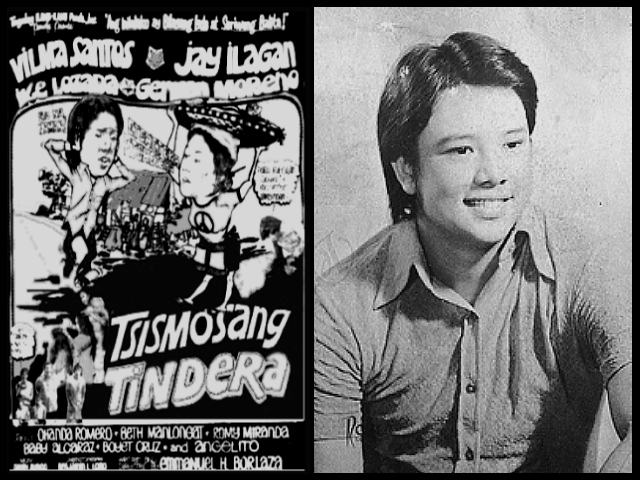
Basic Information: Directed: Emmanuel H. Borlaza; Cast: Vilma Santos, Jay Ilagan, Ike Lozada, German Moreno, Chanda Romero, Beth Manlongat, Romeo Miranda, Baby Alcaraz, Boyet Cruz, Angelito; Executive Producer: Espiridion Laxa; Original Music: Danny Subido; Cinematography: Benjamin Lobo
Plot Description: Gossipy street vendor Vilma found love (trouble!) Jay in this comedy directed by Borlaza!
Film Achievement: “…Borlaza gave Vilma Santos her very first best actress, winning the 1972 FAMAS for via Dama De Noche. He is also credited in narrowing the popularity gap between her and the musical era’s darling of the 70s, Nora Aunor. Total Number of Films in our list of VSR’s Top 50 films = 4 (#10 Lipad Darna Lipad 1973, #32 Dyesebel at ang Mahiwagang Kabibe 1973, #48 Darna and the Giants 1973, #49 Dama De Noche 1972)…” – RV (READ MORE)
“…Jay Ilagan and Vilma Santos did twelve films with commercial success except for one, their most critically acclaimed film, Sister Stella L. Total Number of films: 12 (Inspiration, Ang Konduktora, Tsismosang Tindera, Ang Hiwaga ni Mariang Cinderella, Paano Ba Ang Mangarap, Sister Stella L, Coed, Leron Leron Sinta, Ito Ang Pilipino, Remembrance, Karugtong Ng Kahapon)…” – RV (READ MORE)
Film Review: “…Besides teaming up with Edgar Mortiz during her teen years, Vilma Santos also starred and appeared in many movies opposite other leading men…Jay Ilagan — Inspiration (1972), Ang Konduktora (1972), Tatlong Mukha ni Rosa Vilma (1972), Tsismosang Tindera (1973), Ang Hiwaga ni Maria Cinderella (1973)…” – Simon Santos (READ MORE)
“…His films lack the arthouse style and social relevance that critics loves most in a Brocka or Bernal films but who cares about the critics when the paying public loves them. And the producers demand his service, from Doc Perez of Sampaguita Pictures, Atty. Esperidion Laxa of Tagalog Ilang Ilang Productions and later on, Vic Del Rosario of Viva Films and Lily Monteverde of Regal Films. Clearly, his films exists with one purpose, to entertain the masses not to depress or remind them with the country’s sad fate of economy or the below poverty line lives of many. The success of the Vilma-Borlaza films gave Vilma Santos versatility and preparation to a more serious acting career. It also narrowed the popularity gap between her and the musical era’s darling of the 70s, Nora Aunor. These are perhaps, the most significant contributions of Emmanuel Borlaza to Vilma’s career. Vilma who was considered only second to Nora couldn’t matched her singing talent and so, Borlaza countered this lack of singing with films that showcased Vilma’s acting versatility…” – RV (READ MORE)
Basic Information: Directed: Ishmael Bernal; Cast: Vilma Santos, Edgar Mortiz, Tommy Abuel, Mercy Pantamaria, Lorli Villanueva, Ernie Zarate, Buth Josue, Jaime Asensio, Ed Villapol, Tony Carrion, Carmen Jiongco, Chito Guerero, Chanda Romero, Elizabeth Vaughn, Randy Robledo; Executive producer: Espiridion Laxa; Cinematography: Benjamin Lobo
Plot Description: No Available Data
Film Achievement: Total Number of Bernal directed films = 8 (Broken Marriage, Dalawang Pugad Isang Ibon, Good Morning Sunshine, Ikaw ay Akin, Inspiration, Now and Forever, Pahiram ng Isang Umaga, Relasyon)
Film Review: “…By late 1969, movie producers had been tapping a Vilma Santos-Edgar Mortiz love team. Edgar was a Tawag ng Tanghalan winner. They started to be together in the movies, My Darling Eddie (1969) and The Jukebox King (1969)…In 1970, the love team of Vilma Santos and Edgar “Bobot” Mortiz was officially launched in the movie Young Love, together with the another popular love team during that time, Nora Aunor and Tirso Cruz III. The Vi and Bot love team went on to do 14 more movies in 1970—The Young Idols, Songs and Lovers, Sweethearts, Sixteen, Love Letters, Love is for the Two of Us, Mga Batang Bangketa, My Pledge of Love, Renee Rose, Baby Vi, Because You Are Mine, Edgar Loves Vilma, From the Bottom of My Heart, and I Love You Honey. All did well at the box-office…” – Rommel R. Llanes (READ MORE)
“…Noong Dekada ’70, ang mga young stars ay kailangang marunong kumanta dahil yun ang uso kaya naman nagtayo ng sariling recording company ang nasirang manager ni Vi na si William Leary dahil ayaw niyang pahuhuli sa uso ang kanyang alaga. Ilan sa mga naging recording artists ng WILEARS RECORDS bukod kay Vi ay sina Edgar Mortiz, Ed Finlan, Sahlee Quizon, Hilda Koronel at Esperanza Fabon. According to Vi, kapag nagrerecord siya ng kanta ay nakatalikod siya sa dingding ng recording company at si Bobot ang umaalalay sa kanya. Ang SIXTEEN, na sinulat ni Danny Subido ang unang recording na ginawa ni Vi at ito ay flipsided by It’s So Wonderful To Be In Love. Ang SIXTEEN ay agad naging gold record at dahil dito ay gumawa ng pelikula ang Tagalog Ilang Ilang Productions, ang home studio ni Vi at ito ay ginawa nilang pamagat katambal si Edgar Mortiz. Hindi nyo naitatanong, muntik nang manalo si Vi bilang most promising singer sa AWIT AWARDS noong early ’70s…” – Alfons. Valencia (READ MORE)
“…The loveteam of Edgar Mortiz and Vilma Santos endured a stiff competition from teeny bopper love team of Nora Aunor and Tirso Cruz III and came up with equal success with string of hit films during the musical era of the 70s. Together they did forgettable but commercial hits and also some hints of the years to come to Vilma Santos’ long career. The most notable one: Dama De Noche. Total Number of films with Vilma Santos – 25 (Young Love, Teenage Jamboree, Songs and Lovers, Renee Rose, My Pledge of Love, Mga Batang Bangketa, Love Is for the Two of Us, I Love You Honey, From the Bottom of My Heart, Baby Vi, Love Letters, The Wonderful World of Music, The Sensations, The Young Idols, Sweethearts, Sixteen, Leron-Leron Sinta, Edgar Love Vilma, Don’t Ever Say Goodbye, Dama de Noche, Anak ng Aswang, Because You Are Mine, Kampanerang Kuba, Kasalanan Kaya, Karugtong ang Kahapon…” – RV (READ MORE)
“…The following year, Santos made fourteen films, mostly forgettable musicals. It was also a year where her benefactor started to positioned her as more of a film actress than a singing film star. The results was successful experiments that showcased her comedic ability (Ang Kundoktora), screaming action stunts (Takbo Vilma Dali) and dramatic capability (Dama De Noche). Her followers was delighted when she earned her first acting recognition the next year receiving the FAMAS best actress via Dama De Noche. Most of her films in 1972 were directed by Emmanuel Borlaza however, she was able to do one film with Ishmael Bernal, “Inspiration” with the late Jay Ilagan, one of her regular film partner. According to Bernal, the film wasn’t as successful as what he expected, as the film flopped. Aside from Inspiration, Bernal did two other films, El Vibora (starring Vic Vargas and Boots Anson Roa) and Till Death Do Us Part (starring the young Hilda Koronel and Victor Laurel). 1973 turned out to be a banner year for Vilma Santos as she emerged on top with box office hits one film after another. Nine films altogether that featured her in different genres (comedy – “Tsismosang Tindera;” fantasy – “Maria Cinderella,” “Dyesebel at ang Mahiwagang Kabibe” and ”Ophelia at Paris;” action/fantasy – “Wonder Vi,” “Lipad, Darna, Lipad,” and “Darna and the Giants;” horror – “Anak ng Aswang” and teenybopper – “Carinosa” and “Now and Forever”). While Vilma was productive Bernal, like the past two years did only two films, one was the comedy fantasy starring television host and comedian Ariel Ureta in a spin off of Superman, “Zoom, Zoom, Superman!” and “Now and Forever” the film that reunited him with Jay Ilagan and Vilma…” – RV (READ MORE)



 Star For All Seasons
You must be logged in to post a comment.