Vilma Santos-Recto is a popular multi-awarded actress and politician in the Republic of the Philippines. *** She is known as "Queen of Philippine Movies," "Queenstar," "Grand Slam Queen," "Box Office Queen," and "Star for All Seasons." *** This website is mostly about her iconic film career.
Basic Information: Directed: Emmanuel H. Borlaza; Story, screenplay: Allan Jayme Rabaya; Cast: Vilma Santos, Jay Ilagan, Celia Rodriguez, Allan Valenzuela, Romeo Enriquez, Romeo Rivera, Jun Soler, Angge, Jojo Santiago, Cora Tanada, Larry Leviste, Marilyn Villarruz, Rosemarie Sarita; Original Music: George Canseco; Cinematography: Mike Accion; Film Editing: Abelardo Hulleza
Plot Description: No Available Data
Film Achievement: Borlaza gave Vilma Santos her very first best actress, winning the 1972 FAMAS for via Dama De Noche. He is also credited in narrowing the popularity gap between her and the musical era’s darling of the 70s, Nora Aunor.
Film Review: “…Sabi ni Mama Santos, ako daw ang “pumatay” sa kanilang Pagputi…eto ang parusa ko, bigyan ko daw sila ng isang Kampus? so I’m making for them Coed. You see, when I was working on Kampus? at UP Los Banos, I realized their problems and lifestyle can be a source of even 10 movie materials. At kapag ang student force pala ang nag-patronize sa Tagalog movie, ang laki ng audience!” Borlaza revealed…I’m very meticulous about is: the audience were to identify itself with my main character, will it be happy with the poetic justice I execute? Will they find it correct and realistic? In Kampus? for instance, students who were pleased with the movie told me they liked the ending very much. They agreed with it. Vilma was bedded first by Mat Ranillo III, but ended up with Bembol who was the right choice after all. They say in real life, the man you walk down the aisle with is not necessarily the first man you had sex with. Also they say the dialouges were very in – like the way actual students would speak them. Siguro, once they sit in the theater, they are not bothered by such questions as ‘Why” or “how come?” Is the star value the main thing in selling movies? “In the case of Kampus?, yes, because Vilma Santos was my main star and she’s the current box office queen…” – Manny B. Fernandez, Expressweek, November 9, 1978 (READ MORE)
“…Borlaza’s films lack the arthouse style and social relevance that critics loves most in a Brocka or Bernal films but who cares about the critics when the paying public loves them. And the producers demand his service, from Doc Perez of Sampaguita Pictures, Atty. Esperidion Laxa of Tagalog Ilang Ilang Productions and later on, Vic Del Rosario of Viva Films and Lily Monteverde of Regal Films. Clearly, his films exists with one purpose, to entertain the masses not to depress or remind them with the country’s sad fate of economy or the below poverty line lives of many. The success of the Vilma-Borlaza films gave Vilma Santos versatility and preparation to a more serious acting career. It also narrowed the popularity gap between her and the musical era’s darling of the 70s, Nora Aunor. These are perhaps, the most significant contributions of Emmanuel Borlaza to Vilma’s career. Vilma who was considered only second to Nora couldn’t matched her singing talent and so, Borlaza countered this lack of singing with films that showcased Vilma’s acting versatility…” – RV (READ MORE)
Jay Ilagan (March 6, 1953 – February 3, 1992) is a Filipino actor. He hosted Stop, Look and Listen and starred in My Son, My Son and Going Bananas. He was married and separated with another popular movie personality Hilda Koronel and a common-law husband of Amy Austria at the time of his death. He died in a motorcycle accident in 1992. He was 39. – Wikipedia (READ MORE)
“I’m PX, short for Paula Xavier, I’m a Filipina…kyontiii…I can understand Tagalog but I’m having a hard time speaking it…actually, I’m not hungry…but on the second thought, why not?” – PX
“one-fourth Japanese, one-fourth Chinese, one-fourth Indonisian, one-fourth Filipino but I was born in Hongkong…you see my mom was a tourist in Hongkong when she met my Japanese father, my Chinese father, my Indonisian father and my Filipino father!” – PX
This slideshow requires JavaScript.
Basic Information: Directed: Elwood Perez; Story, screenplay: Toto Belano; Cast: Vilma Santos, Christopher De Leon, Bembol Roco, Cocoy Laurel, Rosa Mia, Alexandra Dulaney, Nova Villa, Bella Flores, Angge, Filipino Lou, Gloria Gaynor; Executive producer: Lily Monteverde; Original Music: Demetrio Velasquez; Cinematography: Felipe Sacdalan, Johnny Araojo; Editing: Rogelio Salvador; Sound: Luis Reyes, Ramon Reyes; Theme Songs: “Pinay” performed by Florante
Plot Description: PX, short for Paula Xavier (Vilma Santos) was an illegal alien in New York City. She’s broke and waiting for fiancé, Cocoy laurel to fulfill his promise of marriage despite the fact that Cocoy has already married an American to secure a green card. Hiding from the authorities, PX met two men who are willing to take care of her but conflicts arise as the two wanted to maintain a serious relationship with her. Played wonderfully by Christopher Deleon and Bembol Roco, the film resolved the love quadrangle between ex-fiancé, Cocoy Laurel and the two brothers when the jealous Cocoy reported Vilma to the immigration authorities. PX was deported back to the Philippines. But the films didn’t end in a sour note, PX found herself reunited with Christopher Deleon when the later followed her in the Philippines. – RV
Film Achievement: One of eight box office hit films Vilma Santos did in 1979
Film Reviews: Shot in New York City and directed by Elwood Perez, this film seems to be a precursor to Miss X (1980) ’Merika (1984) starring Nora Aunor and Milan (2004), even Anak (2000) and Dubai (2005). Talaga bang masarap ang buhay sa ibang bansa? Bakit nagpapakamatay sa green card ang mga Pinoy? PX, mahal na mahal kita, PX, I love you walang iba. Paula Xavier or PX (Vilma Santos) is a TNT like boyfriend Victor Laurel (what an effective undersated performance) who leaves her as his live-in to be engaged to an American to get a green card who promises Vilma to divorce the White girl and to marry PX so they could live happily forever after. Not. Vilma is pissed that Laurel dropped her for good and he left her with unpaid rent and a broken heart. Enter Boyet De Leon, as Vilma’s next boyfriend who has two jobs who has been around long enough to know what he wants in life – women and the American Dream. Enter Bembol Roco, in a great performance as Boyet’s Kuya who is a bagito green card holder in America. He was in the opening scene of the movie where he owns his business and lives comfortably even have someone to make him coffee. Rosa Mia are Roco and De Leon’s battered mother who suffers from the physically abusive second husband (a geriatric Irishman), and verbalized regrets for leaving the Philippines. She has the best lines in the movie and summarized the movie’s theme: “Kung uuwi ako sa Pilipinas ay kung patay na ako. Ayokong umuwi ng buhay at malaman nila na ang hirap ng buhay dito – kayod ka talaga to survive, at di pinupulot ang dolyar, ubas at mansanas sa daan. Ang dami kong dinaanang hirap para lang magka green card.”
Vilma Santos as PX is most effective in her scenes as a dumped/bitter girlfriend of Laurel, as a conflicted girlfriend of De Leon, and as a grateful soul who thank Roco for saving her from paying her overdue rent to her white landlord. Her PX is a toned down Sandra of Ikaw Ay Akin. She says to Roco: “Dati, sa konting pagkain, I offer myself to be laid. Napakabait mo.” Roco answers back: “Hindi ganoon kababa ang tingin ko sa sarili ko.” You see, Roco falls for the beautiful PX too and was upset to learn that PX is already making it with his brother, which drove him to drink and was depressed for a while. Panoorin na lang ninyo ang movie. The movie’s hopeful view of America begins with Perry Como singing White Christmas as Roco, in a dream scene, cavorts in the snow in slow motion. In his dying scene in the arms of his brother De Leon, Roco whispers “ni hindi ko man lang nakita ang snow”, and the above Winter Wonderland scene was replayed, while Boyet’s cry for help fell on deaf American ears. Vilma was deported after Laurel clandestinely reported her to the INS which arrested her at her birthday party. Her farewell scene with De Leon, handcuffed and all in a train station was one of the best scenes in the movie. The movie has a happy ending, with De Leon finding Santos, a flower picker amidst a field of white daisies with Benguet/Baguio as a backdrop. In a typical Elwood Perez slow mo fashion, amidst the daisy flower plantation, the box office love team of all time hugged and lived happily ever after. As credits rolled, Florante’s song Pinay played on. Pinay, American Style. Ang ganda! Vilma Santos yata iyan! – Mario O. Garces, V Magazine Issue No. 6 2006 (READ MORE)
Vilma was obviously under utilized as PX in these Elwood Perez experiment. Despite this predicament, Vilma was able to give us a splash of her abilities. While Nora was in full bloom as Mila in these quiet Portes film. She gave us a convincing portrayal of lonely woman who realized that she was being used by a man she truly loves. The contrast of style was the main point why I matched these two roles. As PX, Vilma was talkative, hiding her insecurity and vulnerability with her fragile disguise pretending to be a rich New Yorker with almost caricature gestures.
Regal films’ Pinay American Style was as commercial as one can imagine. Regal films producer, Lily Monteverde hired three leading men to support the most bankable actress of 1979, Christopher DeLeon, Bembol Rocco and Victor Cocoy Laurel. It was a period in Vilma’s career where she is doing one commercial films after the other. Two dance/musical hits Swing it Baby and Rock Baby Rock and a string of sexy films like Rubia Servious the previous year, Coed and Magkaribal mostly targeting the mature adult audience established her status as the number one box office superstar of 1978-79. Vilma in 1979 was a picture of self-assured bankable star. She did two movies with Elwood Perez, Magkaribal and Pinay American Style both were box office hits. She also produced an Eddie Rodrigues starrer Halik sa Paa Halik sa Kamay, and teamed-up with comedy king, Dolphy in Buhay Artista. As the year 1979 ends, she battled the drama queen Charito Solis in the local festival entry, Modelong Tanso. The end of the decade marked her stronghold as the box office queen. Clearly, Vilma Santos’ versatility as an actress was the secret weapon of her box office success. And this weapon was in full display in Pinay American Style.
Pinay American Style was the story of PX, an illegal alien or TNT – “tago ng tago.” Her boyfriend played by Victor Laurel abandoned her for a rich American girl mainly to secure a green card. PX met an Americanized Filipino, Christopher DeLeon but found him not serious of having her as a steady girlfriend. It just so happened that PX also met Christopher’s brother, Bembol Rocco, a new immigrant. PX and Bembol fell for each other. And a love triangle surfaced the screen. Adding to the drama was Victor Laurel’s enraged, jealous appearances. Laurel eventually tipped the police ending PX stays in New York. As Bembol Rocco realized that America doesn’t fit his lifestyle, he reconciled with his brother and advised him to follow PX in the Philippines. Christopher and Vilma reconciled in a farm field in the Philippines. The end.
The film was so forgettable that the critics didn’t even bother to write any reviews. The lack of enthusiasm on the part of the critics was compensated with the box office success of the film. Vilma fits the role as the illegal alien, PX. Her attempt to speak fluent English and pretend that she’s rich when she met the boyish looking Christopher was funny and poignant. She was given enough scenes to shine. One was when she was harassed by her landlady, she promised her the rent money the next day and when she’s gone, she opened her refrigerator and found a staled piece of bread. She took bottled water and ate the staled bread, went to the bedroom and found her mom’s letter. Lying down in bed, she started to break down. A quiet scene without dialogue. A contrast from the earlier scenes where she was talkative as she tried to impress Christopher and telling him she’s rich and from a well-known family. It was obvious in 1979, Elwood Perez wasn’t the kind of director you will expect to produce a serious output. He wasn’t a Bernal or Brocka. He’s a commercial director. It was a better effort though, compared to a much more convoluted Magkaribal or their past successful projects like Nakawin natin ang bawat sandali and masakit masarap ang umibig. In Pinay, Toto Belano’s script wasn’t efficient in ironing out the “love quadrangle” plot twists and establishing the characters of four actors. So the blame can’t be put to solely to Perez’ shoulder. There was a scene were Vilma Santos and Christopher were watching a concert which was obviously not part of the script. – RV
“…Pinay, American Style carries such attributes. Shot entirely in America, it depicts the plight of some Filipinos living there – Filipinos who are obsessed with amassing fortunres and landing high-paying jobs and enjoying the dolce vita in the muchballyhooed “land of the brave and home of the free” and the “land of the mighty dollar.” Compared to foreign movies with explicit sex scenes, Pinay… would not even deserve the “For Adults Only” tag or an “X-rated” classification, according to Elwood. Basically, the movie is a relfection of the typical plight of Filipinos living abroad. It is a plight that runs counter to the optimism and false hopes entertained by potential Filipino immigrants. Arriving in the U.S. as tourists, some Filipinos would choose to stay behind in their search for “greener pastures.” Having done so, they have to play hide-and-seek with immigration authorities, accept odd jobs to survive in the asphalt jungle, get married to ward off deportation, and similar evasive maneuvers. These same incidents are what the cast – Vilma Santos, Christopher de Leon, Bembol Roco and Victor “Cocoy” Laurel – portray in Pinay. Pinay is Elwood’s second movie shot abroad after Lollipops…” – Manny B. Fernandez, Expressweek, July 12, 1979 (READ MORE)
Basic Information: Directed: Elwood Perez; Story, screenplay: Toto Belano; Cast: Vilma Santos, Christopher De Leon, Alma Moreno; Executive producer: Lily Y. Monteverde; Original Music: Ernani Cuenco; Cinematography: Johnny Araojo; Film Editing: Rogelio Salvador
Plot Description: A story of a woman whose closest friend became her worst rival. They were once very close to each other-almost like sisters. She even confides all her troubles and heartaches to this friend. Later, she sensed some changes in her friend’s attitude towards her which became obvious when this friend of hers tried to outshine her in everything. She tried not to mind this but worse came to worst when she discovered that the other woman in her love one’s life is the very same friend thus a never-ending conflict arised. It stars: Vilma Santos, Christopher de Leon, Alma Moreno. – Trigon Video
A story of a woman whose closest friend became her worst rival. They were once very close to each other, almost like sisters. She even confides all her troubles and heartaches to this friend. Later, she sensed some changes in her friend’s attitude towards her which became obvious when this friend of hers tried to outshine her in everything. Philippines Filipino Tagalog movie. – Amazon (READ MORE)
Film Achievement: Box Office Hit of 1979, The title “Magkaribal” was used into TV series that was not related to this film in 2010 by ABS-CBN.
Film Review: “…Christopher de Leon embodies the physicality and psyche of a sexy beast whose complexity is at par with that of a De Niro or Pacino. De Leon, here in his prime epitomizes the dramatic range and animal magnetism akin to Marlon Brando’s Stanley Kowalski. Alma Moreno’s portrayal of a woman who desires a new life in the face of a very uncertain future is competent. The acting method employed here is able to twist the logic of cliché and reconstitutes the drama of yearning with passion and grace. Vilma Santos shows that the strength of women need not come from the repudiation of “feminine” traits and roles. Neither should they come from brute, shrewish adamance as exemplified by the stereotype, nor from machismo as embodied by her husband. Santos demonstrates that the concept of the beautiful, dainty, feminine and strong are not necessarily mutually exclusive. Rather, these form a character that is finally textured, complex and potentially oppositionist. Magkaribal is commendable for staging clever and well-thought out situations partaking of actual tension and punctuated by defamiliarizing comical scenarios and melodramatic circumventions. A certain style of filmmaking based on genre or other considerations is taken as any distinct mode of creating form in film and is made possible only against a background of options that makes a particular choice significant, meaningful and therefore recognizable stylistically. Film artists work within these possibilities in the process of making art, but are never limited to custom and habit…” – Jojo Devera, Sari-saring Sineng Pinoy (READ MORE)
“…Elwood Perez and Vilma Santos colloborated in seven films (Ibulong Mo Sa Diyos 1988, Lipad Darna Lipad 1973, Magkaribal 1979, Masarap Masakit ang Umibig 1977, Nakawin Natin ang Bawat Sandali 1978, Pakawalan Mo Ako 1981, Pinay American Style 1979). The first one was the trilogy that he co-directed with two other director, Borlaza and Gosiengfiao (these three are the most underrated and under appreciated directors in the Philippines), the remake of Mars Ravelo comic super hero, Darna in Lipad Darna Lipad. The film was a record-breaking hit Box-office Film. They follow this up with a more mature projects as Vilma started to switched her image from sweet to a mature versatile actress, pairing her with Christopher DeLeon in five films starting with Masarap Masakit Ang Umibig in 1977. The Perez-Santos-DeLeon team produced seven blockbuster hits that gave Vilma two FAMAS best actress awards that secured her elevation to FAMAS highest honour, the FAMAS Hall of Fame award. She won in 1979 for Pakawalan Mo Ako and 1988 for Ibulong Mo Sa Diyos…” – RV (READ MORE)
“…Back in the late ’70s, “Magkaribal” was the title of a dream project, casting together for the first time the two reigning box office queens at the time, Vilma Santos and Alma Moreno. Cast as opposing women, they fought for the love of one man, played by Christopher de Leon. TV’s “Magkaribal” is not based on the landmark Regal film directed by Elwood Perez and produced by Lily Monteverde. The title was not part of a film package bought by ABS-CBN from Regal Films a few years ago, explains business unit head Deo Endrinal. At best, “Magkaribal,” the teleserye, can be considered an allusion, if not a homage, to the film version, a big box office hit in its time. By the way, the original “Magkaribal” is available on video, capturing the quite young Vilma, Boyet and Alma in their sexiest best…” – Nestor Cuartero, Manila Bulletin, 20 June 2010 (READ MORE)
Basic Information: Directed: Cirio H. Santiago; Story: Nerissa G. Cabral; Screenplay: Jose Mari Avellana; Executive Producer: Cirio H. Santiago; Cast: Vilma Santos, Charito Solis, Winnie Santos; Original Music: Nonong Buencamino; Cinematography: Manuel Bulotano
Plot Description: Directed by Cirio H Santiago. Serialized from comics story of Nerissa Cabral. Film with Charito Solis.
Film Achievement: Entry to 1979 Metro Manila Film Festival; One of six Solis and Santos’ collaborations (Happy Days are Here Again, Mga Tigre ng Sierra Cruz, Modelong Tanso, Ipagpatawad Mo, Dahil Mahal Kita The Dolzura Cortez Story, Hanggang Ngayon Ika’y Minamahal). – RV (READ MORE)
Film Review: “…The multi-awarded actress even related her personal experience about feeling inadequate when she did the 1979 movie Modelong Tanso with the late Charito Solis who played her mom in the story. “Ako ang naintimidate noon. Naranasan ko yun noong araw kay Ms. Charito Solis na ngayon parang yun naman ang nangyayari sa akin [with the young stars.] So tinuro ko sa kanila na kahit may ka-eksena kayo na senior stars, kapag sinabi ng direktor ni’yo na kailangan niyong sampalin/sigawan sila, wala kayong choice. Gawin ni’yo yun, kahit sabihin niyong senior or respected star man yun, hindi kayo pwedeng magpa-intimidate. Kasi lahat sila kinakabahan lalo na nung pinapasampal ako kay Megan…” – Rachelle Siazon (READ MORE)
“…Sa 1979 FAMAS, Nora bested Lolita, who, with her performance in Brocka’s Tinimbang Ka Ngunit Kulang, beat Aunor in 1974. Ang “katapat” ng Nora-Lolita duo ay ang acting tandem nina Vilma Santos at Charito Solis in Bancom Audiovision’s Modelong Tanso, directed by Cirio Santiago. Sa 1979 Gawad Urian, it was neither Nora nor Lolita as Best Actress; the award instead went to Charito Solis for Brocka’s Ina, Kapatid, Anak…” – William Reyes (READ MORE)
“…the film that defined her 1970s career was not an adult film, but a dramatic film, her specialty. Pitted with the “other dramatic empress” Lolita Rodriguez, she contrasted her usual acting style with Rodriguez’ restrained, quiet style in Ina, Kapatid, Anak (1979). At that time already acknowledged as Philippine Cinema’s Hall of Famer for Best Actress, Charito Solis showed her acting prowess in a way that did not swallow Rodriguez nor did not allow to be shadowed by Rodriguez’ subtle style. Come FAMAS time, she had another Best Actress nod but lost to Nora Aunor for Ina Ka ng Anak Mo, but the “other” awards, the Gawad Urian, granted her its Gawad para sa Pinakamahusay na Pangunahing Aktres (Best Actress). Interesting enough, her penchant for top-billing persisted: the usual tool for billing two actresses demanding top billing was employed (see left). She also appeared with Vilma Santos in Modelong Tanso, a pale competitor to Rodriguez’ and Nora Aunor’s Ina Ka ng Anak Mo. Because Vilma Santos was another actress known for her penchant with billing, the same tool was used…The 1990s saw Charito Solis graduate to mother and grandmother roles, which she had done with frequency in the 1980s. In another nod to her age, she finally allowed herself to be billed above Vilma Santos, then acknowledged as the Longest-Reigning Box Office Queen of Philippine Movies, albeit above-the-title in films such as Ipagpatawad Mo (1992) and Dahil Mahal Kita: The Dolzura Cortez Story (1993)…Charito Solis’ “antics” were the toast of the tabloids when she was younger, from the admirable to the ridiculous. Her volatile outbursts on sets when professionalism was not observed was a common story written in the movie magazines. Ever a stickler for promptness and professionalism, she was said not to allow any one to make a noise during her performances because it detracts from her concentration. She would even go to the lengths of bringing her acting trophies on movie sets so that she can show the younger stars that they were dealing with a competent and award-winning actress that they have to respect in terms of promptness and performance. Both Vilma Santos and Nora Aunor, future FAMAS Hall of Famers, were said to have experienced this…” – FAMAS (READ MORE)
“…Another “good” movie is “Modelong Tanso” directed by Cirio Santiago. It is based on a novel by Nerissa Cabral. This movie has one hell of a different plot: that of an obsessed woman who would get wealth and power against odds. The woman (ably portrayed by Charito Solis), forsakes husband, morals, children, for the sake of the over-riding ambition. The driving force is rooted in an impoverished childhood. She had to beg for food. She would get out of her squalid surroundings by any means. Only trouble was, she was still at it, long after she had left the barung-barong. Ang bigat ng paper ni Solis dito. At believeable siya. The conflict in this film comes off naturally. No issue is forced each incident is the result of a logical buildup in the plot. Vilma Santos, who marries a filthy rich fag in this movie, sees that she is starting to take up to her mother’s ways and stops, in this time, Solis, however, remains “unreconstructed” up to the very last. As teh movie ends, she has assumed command of an even bigger business empires. Nagustuhan ko ang pelikulang ito dahil may sinasabi. It should have won some awards. The fact that it didn’t again speak of the “consistency” of the judges…” – Ros H. Matienzo, JEH Jan 21 1980 (READ MORE)
“…what the non-winning dramatic films (Modelong Tanso, Alabok na Ginto, and Julian Makabayan) have in common are disappointments. Cirio H. Santiago’s Modelong Tanso is another of those Electra-complex explorations which lately have become so strangely fashionable in local cinema: in fact one of the festival winners, Ina Ka, falls in the same category. Modelong Tanso is about the conflict between a materialistic mother and an idealistic daughter, each of whom gets what she wants and pays the proper price for it. Santiago also pays a price: stereotypical acting, carelessly executed multiple roles, and embarrassing approximations of social sophistication. As in the other entries, Modelong Tanso attempts at significance through developmentalisms (i.e., favorable references to the barangay and the Bagong Lipunan Sites and Services program); as in the other entries, the attempts deservedly fail. Antonio C. Martinez’s Alabok na Ginto may have been the festival’s dark horse, a love triangle consistent in many ways, mostly technical. Thematically, it falls short of realizing the ambitious statements it makes about fairness (or the lack of it) in love and war. As its title suggests, the movie glitters, but it certainly isn’t gold. As least it is better than the uneven alloy Modelong Tanso turned out to be…” – Joel David, WHO, 19 January 1980 (READ MORE)
Basic Information: Directed: Luis Enriquez; Story: Beybs Pizarro Gulfin; Screenplay: Luis Enriquez, Beybs Pizarro Gulfin; Cast: Vilma Santos, Ronald Corveau, Eddie Rodriguez, Rosemarie Gil, Jose Vergara, Roderick Paulate, Ester Chavez, Angie Ferro, Angge, Virginia Montez, Aurora Salve; Executive producer: Vilma Santos; Original Music: E Veron; Cinematography: Loreto Isleta; Film Editing: Abellardo Hulleza
Plot Description: No Available Data
Film Achievement: 1979 FAMAS Nomination Best Actress – Vilma Santos
Film Review: Luis Enriquez aka Eddie Rodriguez first directed a young Vilma Santos in 1968 Kasalanan Kaya, another love triangle genre starring the dramatic trio of Marlene Dauden, Eddie Rodriguez and Lolita Rodriguez. Vilma received an early acting recognitions from this film by receiving a FAMAS Nomination for Best Supporting Actress. When Enriquez directed Vilma again, it was a calculated risk that allowed a still young Vilma into a bikini-clad lead role opposite his director himself, Eddie Rodriguez. The film, Nakakahiya, a may-december affair between an older man and a young woman was an entry to 1975 Bacolod City Film Festival. Aside from making the the film a smash hit, Vilma received the festival’s Best Actress. Enriquez will direct Vilma in five more films, the last one was ExWife in 1981 where surprisingly Luis used in film credits his screen name, Eddie Rodriguez. Theri total number of colloborations were seven (Ex-Wife 1981, Halik sa Kamay Halik sa Paa 1979, Hindi Nakakahiya 1976, Ikaw Lamang 1971, Kasalanan Kaya? 1968, Nakakahiya? 1975, Simula ng Walang Katapusan) – RV (READ MORE)
Basic Information: Directed: Al Quinn; Story, screenplay: Oscar Miranda; Cast: Romeo Vasquez, Vilma Santos, Tito Sotto, Vic Sotto, Joey de Leon, Amy Austria, V.S.T. & Company, Mike Monserrat, Sandy Garcia, Geleen Eugenio, Bing Davao, Walter Navarro, Nena Perez Rubio, Lirio Vital, Coritha, Ritchie D’Horsie, Val Sotto, Ernie Zarate; Executive producer: Emilia Blas; Original Music: Vicor Music Corporation; Cinematography: Joe Batac; Film Editing: Nonoy Santillan; Production Design: Orlando Tolentino; Art Direction: Francisco Faustino; Sound: Luis Reyes, Ramon Reyes; Theme Songs: “I-swing mo ako” performed by Sharon Cuneta
Plot Description: Love is like dancing. No matter how many times you have been out of tuned, you will always go back to hitting the right one. Learning it may not be easy at first but if you find the right partner for you, then you can sway together… forever. Let’s dance along with Marilen (Vilma Santos) and Ben (Romeo Vasquez) as they discover more about love and friendship. – TV Star Cinema (READ MORE)
Film Achievement: No Available Data
Film Review: “Sometime in the mid 70s, matinee idol Romeo Vasquez returned to the movie scene after a long absence, his movie career in limbo after his failed marriage with popular actress Amalia Fuentes. His teamup with Vilma Santos somehow rekindled and revived his career. Their first movie together, Nag-aapoy na Damdamin in 1976 turned out to be a big hit. Despite their age gap, reel and real life sweetheart, Romeo, 34 and Vilma, 23, soon became the hottest love team, doing one hit movies after another…” – Video 48 (READ MORE)
“…Romeo Vasquez is an oddity in Vilma’s life. Hindi akalain ng lahat na ang isang notorious playboy and balikbayan actor would capture the heart of the then elusive Ate Vi. Nagkaroon sila ng affair which lasted for more than a year. Kilala si Bobby sa pagiging bohemyo kaya naman walang kakilala si Ate Vi na bumoto sa aktor. Ate Vi was love struck at talagang na head-over heels in love. Nagsimula ang kanilang affair sa set ng kanilang pelikulang “Nag-aapoy na Damdamin”. True to this title, nagliyab silang dalawa at tunay ngang nag-apoy ang kanilang damdamin. May plano pa nga sila ni Bobby na magpakasal sa Europe. Talagang Ate Vi was ready to give up her life as an actress and would settle with the actor abroad. And with herb relationship with Bobby, nag-surface ang bagong Vilma Santos. Ate Vi realized that she cann’t sacrifice everything for love. Nagising siya sa katotohanan at nagkamali kung kaya nagdesisyon siyang kumalas sa bohemyong aktor…” – Willie Fernandez (READ MORE)
“…But it was with handsome actor Romeo Vasquez that Vilma Santos had her most controversial relationship. Romeo was the former husband of Philippine movie queen Amalia Fuentes. He and Vilma first paired in the movie Nag-aapoy na Damdamin (1976). It was also during this year that they became a couple. They made several movies together, all of which did well at the box-office. Vi and Bobby (Romeo’s nickname) became the most-talked about reel and real love team at the time. The relationship was always on the pages of showbiz magazines and tabloid entertainment section pages because of the intrigues and the personalities who got involved with them…” – Rommel R. Llanes (READ MORE)
Basic Information: Directed: Gil M. Portes; Story, screenplay: Jose Javier Reyes; Cast: Vilma Santos, Nonoy Zuniga, Jenny Ramirez, Ting Jocson, Allan Bautista, Ian Veneracion; Executive producer: Wilson Theng; Original Music: Willy Cruz; Cinematography: Ely Cruz; Film Editing: Edgardo Vinarao; Theme Songs: “Never Ever Say Goodbye” performed by Nonoy Zuniga
Plot Description: No Available Data
Film Achievement: 1982 Aliw Awards for Record of the Year – Never Ever Say Goodbye; FAP – Best movie theme song nomination.
Film Review: “…After these two awards, Nonoy Zuñiga, Pops Fernandez and Ivy Violan performed a medley of the five nominated theme songs. Sinasamba Kita by the late George Canseco was voted the best original song, winning over Willy Cruz’ Never Ever Say Goodbye, Marita A. Manuel’s Puppy Love, Rey Ramos’ Paalam (from Get My Son, Dead or Alive) and Pablo Vergara’s Katumbas ay Buhay (from Vendetta). The late Ernani Cuenco won the best musical score award for Pedring Taruc. The other nominees were Ryan Cayabyab (Kamakalawa), Willy Cruz (Never Ever Say Goodbye), Lorrie Ilustre (Batch ’81) and Marita A. Manuel (Puppy Love)…” – Jose N. Carreon (READ MORE)
Heart Out Trance – “…(He lost a leg during the 1980 explosion at a hotel where he and his band were performing regularly; and how he tucked up a degree in Medicine from UST even while doing shows (plus a movie, Never Say Goodbye, inspired by his hit song) and recordings)…Many know me as a balladeer but not the fact that I can also sing folk songs and pop-rock and play the guitar. I actually started as a folk singer, then got into a showband, and then went solo with romantic songs. So, I want to share and bare more of myself…(here are the five songs: Ako Ay Ikaw Rin; Doon Lang; Kumusta Ka; Never, Ever Say Goodbye; and Love Without Time, that mean so much to Nonoy)…about “Never, Ever Say Goodbye,” Willy told me that he had an unfinished song based on his experience with a girlfriend whom he loved so much when he was abroad but they had to part ways because of his pressing commitments in Manila. He asked me if I could relate to the song because I was still young then. All I could say was, ‘Yeah, a little.’ So, during the recording, I put myself in a trance and sang my heart out. By the way, Willy said that he dreamed of the prelude and melody. As soon as he woke up, he wrote the lyrics and taped the melody before he forgot about it…” – Nonoy Zuñiga, reported by Ricky Lo, The Philippine Star, 12 March 2019
“May mga anak ako, Nagtratrabaho ako, Nag-aaral ako tapos lagi pa kaming nag-aaway na mag-asawa. So tense, Minsan gusto ko ng tumalon sa bintana.” – Ellen
“Bakit nababawasan din naman ang pagkatao ko kapag sinisigawan mo ako!” – Ellen
“Ang marriage trinatrabaho yan…twenty four hours…” – Ellen
This slideshow requires JavaScript.
Basic Information: Directed: Ishmael Bernal; Story: Bing Caballero, Jose Carreon; Screenplay: Ishmael Bernal, Bing Caballero, Jose Carreon; Cast:Vilma Santos, Christopher De Leon, Orestes Ojeda, Lito Pimentel, Tessie Tomas, Richard Arellano, Cesar Montano, Len Santos, Ray Ventura, Harlene Bautista; Executive producer: Lily Monteverde; Original Music: Max V. Jocson; Cinematography: Manolo Abaya; Film Editing: Jess Navarro; Production Design: Len Santos; Sound: Rudy Baldovino; Production Co: Regal Films; Release Date: 2 September 1983 (Philippines) – IMDB
Plot Description: Trapped in a world of hectic schedules, pressure and little time for each other, Ellen (Vilma Santos) and Rene (Christopher de Leon) decided to have a temporary separation. One of the things that is against traditional Filipino culture is a marriage break-up. And that is what they went through as their maariage reaches one of its lowes points. Saddled by their two children, Ellen tried her best to live a normal life as possible, eventually finding a prospective lover (Orestes Ojeda). But something is missing from her life that not even a new flame could fill. A self-discovery both for Ellen and Rene, one great film that will surely make you realize the value of marriage. – Regal Films (READ MORE)
After ten years and two children, Rene and Ellen find their marriage on the brink of breaking up. They seem to have fallen out of love and life has become a series of verbal hussies and conflicts. They decide that the only way out is a temporary separation. Rene, a police reporter, and Ellen, who is a television production assistant, begin to live apart from each other. Rene moves into his friend’s apartment while Ellen has to cope with running a household by herself. But they soon begin to feel the effects of their separation. A series of events that follow drastically change their lives. Rene is mauled for his expose of a gambling casino owned by a high ranking government official. He is forced to stay temporarily in the house of Ellen’s mother. As he recuperates from his injuries, both he and Ellen attempt to rebuild their shattered relationship. – Manunuri
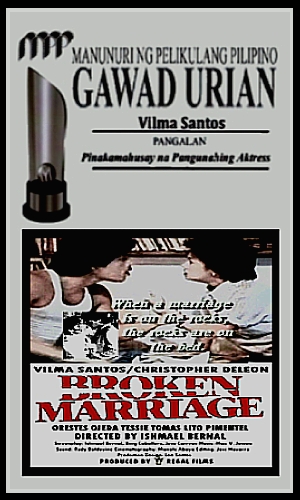
Rene (Christopher de Leon) is a police reporter for a daily newspaper married to Ellen (Vilma Santos) who works as TV production assistant. Both are full of enthusiasm, career-conscious individuals who have no time for each other or for their two children, until they are forced to try to live separately. Broken Marriage won awards from the 1983 Urian for best picture, (Ishmael Bernal), best actss (Vilma Santos), best screenplay (Jose N. Carreon), best editing (Jess Navarro), as well as several nominations from the Film Academy Awards and FAMAS. Music by Max Jocson and Cinematography by Manolo Abaya. Also stars Orestes Ojeda and Spanky Manikan. From Regal Films. – Trigon Video
Film Achievement: 1983 Gawad Urian: Best Picture – Regal Films; Best Actress – Vilma Santos; Best Director – Ishmael Bernal; Best Editing – Jess Navarro; Best Screenplay – Jose Carreon, Bing Caballero, Bernal; Best Sound – Rudy Baldovino; Best Actor Nomination – Christopher De Leon; Best Cinematography Nomination – Manolo Abaya; Best Music Nomination – Max V. Jocson; Best Production Nomination – Len Santos; Best Supporting Actor Nomination – Len Santos; Best Supporting Actor Nomination – Ray Ventura; 1983 FAMAS: Best Actor Nomination – Christopher De Leon; Best Actress Nomination – Vilma Santos; 1983 Best Child Actress Nomination – Harlene Bautista; Official Selection: 1984Moscow Film Festival; Prague Film Festival; Vienna Film Festival
Film Reviews: “…Comparisons dawn inexorably: how does Broken Marriage fare as a follow-up to the bravura of Relasyon? This is tough inquiry. If intentions were to be the starting point, then the new movie is a better achievement. Relasyon, judging from its title, was supposed to be about a man and other woman relationship; but the feminist tendencies of our cinema had pinned the movie to a fateful drift: the travails of the modern mistress. Broken Marriage never swerves from its goal; from start to finish it is a portrait of two persons and the bond which they discover smothering and smoldering. But the ordinary moviegoer does not assess by artist’s intentions – he does not even care about the artist (I mean here the one behind the work. On one hand, the film in front of him is the present; and on the other hand, it is the past. Broken Marriage is made to appear to him as a sequel to Relasyon. The process of integrating the past and the present is a challenge for him. For him are opened two avenues: to start with past and proceed with present; or start with present and proceed with past. If he chose the former, the condemnation for Broken Marriage would clang like a wild cymbal. If he chose the latter, the outcome is a laudatory comment). Nonetheless, one has to prove that the new movie can stand on its own feet. What Relasyon sadly lacked (albeit not too sadly) was humor. Broken Marriage has tons of it – the caustic swaps, the funny characterizations, the clever plottings – so that the audience’s conditioned response for a supposedly serious movie shifts irrevocably to playful irreverence. Vintage Ishmael Bernal. It is a masterly stroke – the proverbial Bernal sleight-of-hand at work, this time with more gusto and style. If the Inquisition were still around, he would be branded and burned seven times as a heretic for turning a marriage gone sour into an off-beat frolic suddenly turned sweet – at least, to the viewer’s mirth-hungry belly.
But none may claim that Bernal’s treatment loses its mark of delineating the disadvantages of separation. The humor chisels the message so that it comes to us shining and double-edged, while doing its duty of alleviating an otherwise gloomy impression which accompanies every disillusioning subject matter. Not only does it come through humorously but also simply. Nowhere is the strain which anyone expects from grave subjects present here. It is as if the dreary topic had been borne on the Lord’s shoulders so that the yoke – and audiences love to be martyrs of maudlin tears – becomes, this rare time, light and easy…De Leon adds a boyish smile as if the lesson were amusing. We watch De Leon, elated and entertained: he is never so old as to appear too distant nor is he too young as to seem undocile. Broken Marriage is a gift to this actor. He is not propelled here to be more manly; since his character is made to contribute to a lot of oversights, De Leon’s doesn’t have to put a mask of strength: he just has to be himself and act with ease. Vilma Santos is not about to be a letdown, not this time when the most important female roles are coming her way. A new intelligence she infuses in the character Ellen. Like De Leon, she turns Ellen into a woman-child, but the stress is less on her part as she has done similar roles before. Her beautiful face is flush receptive: the quiet moments of just observing the people around her are moments of perfect acting. Her body moves with an agility that is both funny and dramatic. Her two monologues – the first with her friends in the cafe when she informs them that she is bored, and the second with Rene when she tells him that they are not children anymore – are her best scenes: the camera lingers upon her countenance and she enunciates in return with ironic ease. She should watch out for next year’s awards race – there is simply no stopping her at the moment…” – Joselito Zulueta, Sine Manila – 1983 (READ MORE)
“…Ang sensitibong paglikha ni Vilma Santos kay Ellen ay isang marubdob at personal na layon kung ihahambing sa kanyang pagsasakarakter ng papel ni Marilou bilang kerida sa Relasyon. Hinamon ni Ellen ang kumbensiyonal na depinisyon ng pagiging asawa at pagkaina sa paghahanap ng mga alternatibo sa gitna ng makainang pagpapalaki sa mga anak. Ginawan niya si Ellen ng sariling silid kung saan nakahanap ito ng solitaryong kanlungan nang hindi pinuputol ang pakikipag-ugnayan sa asawa. Iniugnay ni Ellen ang ang kanyang pribadong hapdi sa spectrum ng kanyang relasyon. Samantala, nakatutok ang tunggalian sa Broken Marriage hindi lamang kay Vilma Santos kundi kay Christopher de Leon. Nasa asawang lalaki ang bulto ng suliranin kaya sa kanya umiikot ang kuwento, ang relasyon ni Rene kay Ellen at ang relasyon ni Rene sa kanyang mga anak. Ang maalam na pagpasok ni de Leon sa katauhan ni Rene ang lumiligalig sa mga kontradiksiyong talamak sa sistemang patriarkal. Kaakibat ng Broken Marriage ang manipestasyon ni Bernal sa pagbibigay ng representasyon sa reyalidad at partikular na pagsasaayos ng iba’t-ibang elementong kaagapay sa masining na pagbuo ng pelikula.” – Jojo Devera, Saring Sineng Pinoy (READ MORE)
“…Sa 1983, ang mga mapagpipilian lamang ay Broken Marriage…On a lower rank would be…Minsan Pa Nating Hagkan ang Nakaraan…Ang Broken Marriage ni Ishmael Bernal ay isang masusing pagsusuri sa lumabnaw na pagtitinginan ng isang young married couple; ang problema ng mag-asawa sa kani-kanilang trabaho, ang mga suliranin ng isang working mother, ang iba’t ibang uri ng relationship between spouses and friends, at ang unti-unti’y muling pagkakalapit ng naghiwalay na mag-asawa. Maraming nagrereklamo sa happy ending ng pelikula na para bang masama ang loob nila’t lumigayang muli ang mag-asawa. Pero sa amin, talagang napaghandaan ang masayang eksena sa beach ng buong pamilya dahil sa simula pa lamang ay inuungot na ng mga anak ang pagpunta roon. So, sa wakas, nakapunta rin sila sa beach and it’s a fitting end indeed……Now that we have discussed this year’s better films and the directors who made them, tunghayan natin ang listahan ng best screen performances…Susunod sa aming listahan ay sina Christopher de Leon, ang batambatang amang may problema sa kanyang pamilya sa Broken Marriage…Then there’s Vilma Santos as the working mother who does a tough balancing act in her dedication to her career and to her family in Broken Marriage… ” – Movie Flash Magazine, January 5, 1984 (READ MORE)
“…Though in the last cited awards, Karnal did not make it as best films, it nevertheless gave Broken Marriage a tough fight for the honor, in fact winning more nominations than Berna’s films. It evetually won prizes for performances, cinematography, music and editing…A product of film schools, Marilou earned her M.A. in Film and Television from Loyola Marrymount College in Los Angeles and received a diploma in film from the London Film School. In May, she will be flying to Moscow to attend the Philippine Film Week, where Karnal, Broken Marriage and Soltero will be exhibited. Then it will be Prague and Vienna for both Karnal and Broken Marriage. Her earlier work, Brutal has also been invited to Tokyo’s Pia Film Festival, which is sponsored by critics and journalist to showcase the works of young directors from 10 countries. International may have come her way, but at the moment, Marilou is earnestly preoccupied with starting her latest project, Baby Tsina, which will star two-time Urian best actress Vilma Santos, and written by Marilou’s signature scenarist Ricky Lee. In a few days, the camera are set to start grinding for the director’s new film…” – Justino Dormiendo, Movie Flash Magazine, April 26, 1984 (READ MORE)
“…On a final note, it’s rather unfair that when it comes to actors, Brocka always gets the authority to be called the actor’s director. Not to discredit Brocka of course but Bernal always exceeds Brocka in terms of directing comedies. And humor is only as hard as drama can get; and oftentimes even harder. Ilagan, Andolong, Ranillo, and Locsin may not be the best to portray their roles but their characters don’t need the best—they need believability more, and their youth exudes that, more than their acting chops. They grip on their dialogues so much that watching them is such a delight. There’s this anecdote told by Vilma Santos when she won her grandslam for Relasyon that she walked into Bernal’s shoot a little unmotivated and still high after her big win. She couldn’t get her acting right. And then Bernal said to her, “O, bakit parang lutang ka diyan? Porke’t naka-grand slam ka, feeling mo, magaling ka na?” That’s one-big-“OH”. And to think that Ate Vi was already a big star that time, and getting bigger and bigger thanks to her roles, it does not only give an impression of “katarayan” on Bernal’s part, but more of brilliance…” – Richard Bolisay (READ MORE)
“… Reportedly Ms. Santos, buoyed by the many acting awards earned by the previous film, was so eager to do well in the new production that Bernal got irritated, locked her in a bathroom, and delivered to her an ultimatum: she was not coming out till she got over her ‘hysteria.’ One sees what made the latter so successful, the same time watching this one sees why Bernal didn’t want to simply duplicate that success. Relasyon was a lean and elegantly told melodrama that took a sidelong glance at the institution of Filipino marriage; in Broken Marriage Bernal wanted to examine the institution directly, without the oblique glances. He didn’t want to film some doomed struggle to keep love alive but something less dramatic, far more difficult to capture: the aftermath of a protracted war, where the ultimate casualty is married love. He in effect didn’t want Ms. Santos at her perkiest and most energetic–he wanted her exhausted, looking for a way out, and to her credit Ms. Santos delivers exactly this with her performance…” – Noel Vera, Critique After Dark, 08 April 2012 (READ MORE)
“…In Filipino melodramas, the heroines often lean on against a hostile environment. Some no less combative women have created a permanent place in the film industry of the country…Lino Brocka and Ishmael Bernal devoted themselves repeatedly with a strong social and political consciousness of the popular form of melodrama. More than Brocka himself Bernal frequently focused on strong female characters that need to manage their lives under unfavorable circumstances. In his films female stars in the spotlight, without the problems of everyday life would go by the board. With Vilma Santos in 1982 he turned Relasyon, wherein the main character wants to escape from a stifling marriage and not only emotionally, but also legally reaches its limits (a year later with Santos Bernal turned the thematically similar mounted Broken Marriage). Was produced Relasyon of Lily Monteverde , who plays an influential role in the Philippine film industry today. Already at the beginning of the 20th century there were in the studios and production companies in the country powerful women who ruled with a firm hand and were addressed by their subordinates even as mothers. “Mother Lily” made his mark as a hard nosed business woman, often more economic than artistic interests followed, understandably, not just friends. The young director Raya Martin let her in his short film Long Live Philippine Cinema! (2009) even to death to save the Philippine cinema…” – Michael Kienzl, Critic.de, 10 Sep 2014 (READ THE TRANSLATION)
“Reportedly Ms. Santos, buoyed by the many acting awards earned by Relasyon, was so eager to do well in the new production that Bernal got irritated, locked her in a bathroom, and delivered to her an ultimatum: she was not coming out till she got over her ‘hysteria.’ One sees what made the latter so successful, the same time watching this one sees why Bernal didn’t want to simply duplicate that success. Relasyon was a lean and elegantly told melodrama that took a sidelong look at the institution of Filipino marriage; in Broken Marriage Bernal wanted to focus on the institution sans oblique glances. He didn’t want to film some doomed struggle to keep love alive but something less dramatic, far more difficult to capture: the aftermath of a protracted war, where the ultimate casualty is married love. He in effect didn’t want Ms. Santos at her perkiest and most energetic–he wanted her exhausted, looking for a way out, and to her credit Ms. Santos delivers.” – Noel Vera, Critic After Dark, 13 September 2014 (READ MORE)
Basic Information: Directed: Leroy Salvador; Story: Nerissa Cabral; Screenplay: Orlando Nadres; Cast: Vilma Santos, Dindo Fernando, Lorna Tolentino, Sandy Andolong, Rowell Santiago, Jimi Melendez, Coney Reyes; Executive producer: Vic Del Rosario Jr.; Original Music: George Canseco; Cinematography: Rody Lacap; Film Editing: Ike Jarlego Jr.; Production Design: Manny Morpe; Theme Songs: “Muling Buksan Ang Puso” performed by Basil Valdez
Plot Description: Cristy’s persistence and Jim’s longing for a child leads to an illicit relationship. But too much love suffocates and covetousness can breed hate. – Pelikula.net (READ MORE)
Jim (Dindo Fernando) is a doctor and Cristy (Vilma Santos) is his nurse. Good looking and successful Jim finds himself an ardent admirer in Cristy. But Cristy is not an ordinary lady – she’s daring and defiant. She’ll do whatever it takes to win him even if he’s very much married. Cristy’s persistence and Jim’s longing for a child leads to an illicit relationship. But too much love suffocates and covetousness can breed hate. – Mavshack (READ MORE)
Film Achievement: 1985 FAMAS Nomination Best Actor – Dindo Fernando; 1985 FAMAS Nomination Best Actress – Vilma Santos
Film Review: “…She has four rated A movies (Haplos, Broken Marriage, Adultery and SSL) to her name but SSL earned the least at the box-office. But the movie was invited and screened at the prestigious Venice Film Festival. It was also invited at the Cannes Film Festival, but the film didn’t arrive in time for its screening because of some problems with the censors. And so, Vilma and her producers are back to square one churning out comics rehash and light melodramas to regain lost grounds. Her first movie for this year, Muling Buksan ang Puso was again a hit and it proved once more that it’s the kind of movie the public wants to patronize. How sad…” – Meg Mendoza, Prime Magazine, Nov 14, 1985 (READ MORE)
Basic Information: Directed, story, screenplay: Mike Relon Makiling; Cast: Vilma Santos, Tito Sotto, Vic Sotto, Joey de Leon, Rowell Santiago, Jobelle Salvador, Francis Magalona; Executive producer: Vic del Rosario Jr.; Original Music: Tito Sotto; Cinematography: Benjamin L. Lobo; Film Editing: Ike Jarlego Jr.; Production Design: Arthur Santamaria
Plot Description: Rose (Vilma Santos) and her three cousins (Tito, Vic, & Joey) are Hospital Attendants who find themselves in various comic situations, together with their Supervisor (Paquito Diaz) and resident Physician Dr. Roland (Rowell Santiago), until they get entangled in a terrible fix. Bitoy (Ricky Rivero) survives a gun shot after witnessing a murder that involves a very influential person. Bogart (Jimmy Santos) is commissioned to kill Bitoy and poses as a patient in the hospital to finish the job. – Pelikula.net (READ MORE)
In a rare comic appearance, Vilma Santos plays the role of Rose, a hospital attendant hopelessly in love with Roland (Rowell Santiago), a resident doctor who gets the support of her wacky cousins Lucky, KC and Ian (Tito, Vic & Joey) in this comedy from writer-director Mike Relon Makiling. With Paquito Diaz, Jobelle Salvador and Francis Magalona lending support. Doctor, Doctor, We Are Sick was produced by Viva Films. – Jojo DeVera
Film Achievement: No Available Data
Film Review: “…Expect the unexpected when dramatic actress Vilma Santos tried her hand at comedy and joined the wacky trio of Tito Vic & Joey in this hilarious hospital romp. The foursome played bumbling orderlies whose work method was enough to send patients out of the hospital or to undeserved calamity although they were in truth caring and kind-hearted and were only trying to do good…” – Mav Shack (READ MORE)



 Star For All Seasons
You must be logged in to post a comment.