Remembering Lino Brocka

This slideshow requires JavaScript.

America’s Euphoria I was a little irritated with my students. Why did they seem distracted and not excited about What I saying? I was, after all, talking about Lino Brocka’s eminent role in the advance of Philippine cinema and nationalism in the arts. I was leading into his participation in people’s struggles before Edsa I. I was also going to point out his contribution to the Philippine Constitutiion, when as a member of the 1987 Constitution Convention he included “freedom of expression” as a right of every Filipino citizen. This has forever insured artistic freedom in this country. Why then did lino seem alien to them? Simple arithmetic made me realize that Lino passed away 12 years ago. If my student were 19 or 20 years old now, they were not even teenagers when Lino epitomized to the general public what a concerned artist should be. On the other hand, I met Lino when he was still Catalino. This was many years before he became better known as Lino Brocka, the Filipino director who impressed international critics in film festivals by the British Film Institute as one of the world’s best directors. It was 1956 when we enrolled at UP as freshman. Life was seemingly easy for teenagers in those days. We empahized with America’s euphoria after the end of the Pacific War. Technicolor film spectacles, Balara, La Mesa Dam, Bucolic Baguio, barn dances, Matorco symbolized the easy and inexpensive good times of that period. We closely identified with Hollywood role models like Parley Granger and Ann Blyth, whose movie roles focused on their search for “the meaning of life.” The more daring ones aped reckless Elvis Presley and oh-so-naughty Marilyn Monroe. The intellectuals read Camus and other existential philisophers. Why, some even advocated socialist concepts and were rumored to be aheists! They discussed usch topics with great fervor at the UP Liberal Arts Basement. The place was thick with cigarette smoke and the combination of constant laughter, fiery arguments, green jokes and simple gossip.

Wilfredo Ma. Guerrero – Those were happy times despite our self-inflicted angst. Nevertheless, Redemptorist priest threatened fire and brimstone during annual retreats. A number of us green freshman had the gall to join older university students who answered the “Audition” call of the UP Dramatic Club, the very prestigious association of thespians at the University of the Philippines, then under the tutelage of the renowned playwright Wilfredo Ma. Guerrero, Freddie to UP-DC and distuinguished alumni. That roster included Celia Diaz Laurel, Joe Viterbo, Mitos Sison, Doy Laurel, Angelita Collas, Joy Gamboa Virata, Marce and Kit Viduya, Jose “Jun” Roy, Tito Gupit and Cherry Santos. Phil Cabanos was designing his sets engineering student Sonny Osmena handled his lights. Could we join that illustrious list of thespians? What an honor to work with such an accomplished director-playwright, we thought. No wonder freshman like Jose Ma. Sison, Pinky Rigor Parolan, Carolina “Bobby” Malay Ocampo, George Moran Sison, Heidi de Peralta, Donnie Montelibano and myself auditioned for the Guerrero production of Thorton Wilder’s “A Happy Journey From Trenton to Camden.” After strenous public auditions, a select few were cast in the play. Also, included was one Catalino Brocka from San Jose, Nueva Ecija. Ishmael Bernal, a year or two ahead of us, was among those who would work backstage later on. Since most of the new members were graduates of “exclusive” schools life Ateneo, La Salle, Assumption, Maryknoll, Holly Ghost, and UP High or UP Prep, we spoke (American) English well. We were therefore excused from doing the tongue-twisting “She sells see shells by the seashore” and “Peter Piper” exercises. Alas, Catalino had to go through them. The Eliot play would be twin-billed with Sartre’s “No Exit,” an existentialist play that had reaped critical praise during its summer run.

Theater “sessions” – The cast of “No Exit” was headed by Jun Roy, Rita Kalaw Ledesma, Phil Cabanos and Kit Viduya. Marita Adolfo Viduya, or Kit ot all her friends at UP, was a spellbinding Estelle. I think “No Exit” was the dramatic turning point in our salad years because, soon after, Lino, Joonee Gamboa, Adul de Leon, and I became a gang of serious theater and movie buffs. We sat attentive and critical, at any and all theater productions in Manila. We even observed theater “sessions” wher more mature actors like Tita Munoz, Nick Agudo and Butch Josue went through Actor’s Studio techniques under a visiting American stage actor. Bert Avellana’s “My Name is Legion” was another awesome productions, along with Daisy Avellana as the sleepwalking lady in “Macbeth In Black.” When we could afford it, we would see the plays of the Manila Theater Guild at the exclusive Army-Navy Club, where expats enjoyed what were then the most polished stage productions in the city. Since we were inveterate moviegoers, we would also regularly see films together and, over ma Mon Luk’s pansit’ siopao, compare insights on productin, acting, directing and scripting. Simone Signoret’s quiet but sething intensity in “Room At The Top” was akin to Kit’s performance in “No Exit,” we thought. She remains one of my favorite stage actress to this day. Lino was her great fan and friend, too. In fact, Lino often slept over in their little bungalow near the LVN compound in San Juan. – Behn Cervantes, Philippine Daily Inquirer, May 31, 2003 (READ MORE)

Von Brocka – Lino quit the UP Dramatic Club production of the Wilder play because during our first rehearsal, he screamed a line that got the whole cast and crew in stitches. He yelled, “Awe, Mudder, Mudder luk ut dat gel weering a batting chute!” (Translated in properfly pronounced English that would be: Oh Mother, Mother, look at that girl wearing a bathing suit.) I didn’t know till much later that he was terribly humiliated by our spontaneous and mindless laughter. He opted to quit the play and kept away from our (to his mind) snobbish company. Instead, he worked backstage. He swept the stage, cleaned the dressing room area and threw away our pee collected in small bottles bockstage after the performances. he also drew and dropped the curtain, and promted the cast when needed. Sometime later, he confided to me that his family name originally Von Brocka but they dropped the royal indicator out of embarrassment. Instead, Catalino erstwhile Von Brocka became Lino to the UP Dramatic Club members. Only Adul insited on calling him Catalino. At some point, Joonee and I “adopted” Lino as our friend and protege. We helped him with his English pronunciation and, when he wasn’t getting cast in UP productions, we transferred to the Arena Theater at Philippine Normal College under Dr. Severino Montano on Taft ave. Joonee and his brother Arthur were alread Arena actors and Montano proteges. We appeared in Montano and Tony Bayot plays. Naty Crame Rogers was another PNC stalwart. In 1957, I resigned from the UP Dramatic Club in protest over its constant use of alumni, while resident UP Dramatic Club members like Lino were not given the chance to act. He was finally cast in “Second Shepherd’s Play,” a medieval morality play with the gorgeous Dee Marquez portraying Mary. She became the first musical star of Philippine television, hosting “The Pacosta Hour” that was later renamed “The Dee Marquez Show.” For years, Lino would describe a woman of great beauty, femininity and grace as “ala-Dee Marquez.”

The Glass Booth – When there was no mony for tuition, Lino would drop out of school. Adul, who had dropped out earlier, helped him land jobs. The first was as a jockey for Muzak, then run by psychiatrist Dr. Paul Hodel. Adul had the day shift while LIno took care of the graveyard hours. They play soothing music for Manil Hotel patrons in a glass-enclosed studio located on the ground floor of the historic hotel. Often, I would keep Lino company during thelonely early morning hours. I would arrive after the last full show at Ideal or Avenue theaters on Rizal ave. From inside the glass booth, Lino and I would gawk at Manila’s 400 going to the Fiesta Pavillion for the Kahirup’s grand balls, or those very elitist fashion shows of yore. Pedigreed beauties like Deana Jean Lopez, Norma Serafica, Bambi Lammoglia, Baby Jereza along with society matrons Chona Kasten, Elvira Manahan, Chito Madrigal and young debutantes Conchita Sevilla and Josie Padilla walked the ramps and executed their dramatic turns fro charity. During those long, lonely hours, we talked of everything under the sun. A few years later, Adul worked for PR Bill Kane. He represented Hollywood productions that then shot films in cheap, sun-rich and English-speaking Philippines, a country that also offered well-trained technical crews. Adul got Lino involved in those productions. The first was “Walls of Hell” or “Intramuros” for the domestic run. It starred Jock Mahoney, a former Tarzan, and the young Fernando Poe Jr, Eddie Romero, who directed the movie, told me later that Lino worked in other co-productions. Lino would often ask me to visit him on the set. He was busy, indeed. I failed to see how much of a turning point that would be in his life. Little did anyone on those sets realize that the 90-pound, 5’3 fellow would become a titan of Philippie cinema! – Behn Cervantes, Philippine Daily Inquirer, June 06, 2003 (READ MORE)

Missionary Work – Lino was converted to the Mormon religion sometime in 1962. How did it happen? One rainy evening, I arrived in our Pasay home to find a couple of Mormon missionaries vainly trying to talk my Protestant parents into accepting the merits of their Utah-based religiion. I made an appointment to see them at some other time. I phone Lino to accompany me to the scheduled religious session. After their lengthy spiels, Lino and I agreed it was a rather amusing experience. But Lino continued to see them for proselytizing sessions – until one day he found himself waist – deep in a big pool! He was baptized by beaming missionaries as one of their first Filipino converts to theChurch of Latter Day Saints! In 1965, he was sent to Honolulu for missionary work. Lino had a mind of his own, so it was not surprising that he soon encountered problems with the superiors of his strict church. As a result of his willfulness, he was “exiled” to far-off Molokai. Albeit that stint, he was sent to San Francisco, where he did more missionary work. While there he befriended a yound actor appearing in the stage play “The Subject Was Roses.” He later became better known as Martin Sheen. Lino came home for a sabbatical and I made him join Peta. It was during that time that we had a falling out. I cast him in “Apollo of Bellac” for a Grey November Wednesday show. Ishmael Bernal wisely used that slow mid-week day for a “happening” to draw the crowd to his cafe. Lino came late for the performance so we had a mini-spat that developed further when I questioned his appointment as the director of a Nestor Torre play for a major Peta production. We didn’t speak to each other for 14 years! In years in between, I had joined the parliament of the street. He had become an acclaimed film director with “Wanted: Perfect Mother.” As they say the rest is history. It was only in May 1983, when we worked together in the Free The Artists, Free The Media Movement, that we started to speak to each other again.

Bulaklak ng City Jail – After the assassination of Aquino in Aug. 21, 1983 we became active in Jaja (Justice for Aquino, Justice for All) and many other organizations. Lino and I were detained in a well-publicized arrest during a transport strike in January 1985. We spent ample time together in the Quezon City Jail and Camp Bonifacio, where we reminisced about our salad years, recalled old friends and reminded ourselves of our spats. All that was now water under the bridge. We had become not only friends but comrades, although some silly fellow referred to us as the “Bulaklak ng City Jail,” a take-off from a movie that starred Nora Aunor. We now centered our efforts on the Concerned Artists of the Philippines and its aims. The essense of theCAP statement was clear: We recognized the fact that we were Filipinos first and foremost. We happened to be artist but we had to concern ourselves with our nation’s needs since these affected our lives as artist. We could and did not separate one from the other. We shared a vision of the work and challenges that confronted dedicated and concerned artsts in a troubled country. We had to confront many national problems. We hope to eliminate some of them through out artistic endeavours. All future work would have to be seen from the point of view of the underprivileged Filipino. The task confronting us was formidable. Lino died 12 years ago. There is still so much to be done! New generations should admire what he stood for, emulate his dedication to truth and integrity; and understand his positin in the struggle for true national liberation. he was not just a great filmmaker but a great Filipino artists, as well. – Behn Cervantes, Philippine Daily Inquirer, June 14, 2003 (READ MORE)

Unforgettable Scenes “…There were three unforgettable scenes in the film: Hilda Koronel’s painful monologue when she and Bembol Roco were in a motel room; Tommy Abuel’s extinguishing a cigarette butt in his palm when he trying to escape from her Chinese employer, and the dramatic final scene when people chased Roco when they saw him kill Koronel’s Chinese boss. And then I remember reading the name of the movie director in the credits – Lino Brocka. I became an instant fan…I remember them all: Gina Alajar’s questioning look in the final scene of “Bayan Ko: Kapit sa Patalim,” a subdued Lolita Rodriguez and a hysterical Charito Solis in the confrontation scene in “Ina, Kapatid, Anak,” Philip Salvador’s lament and hubris when he carried his dead son in “Orapronobis,” Vilma Santos’ rape scene in “Rubia Serbios,” etc. In “Nakaw na Pag-ibig,” (Brocka’s 29th film, loosely based on Theodore Dreiser’s “An American Tragedy,”) in the scene where Philip Salvador was about to push his lover (Nora Aunor) off a cliff, the audience clapped and whistled in admiration when Aunor’s face was shown close up on screen, full of terror, confusion and anger. To this day, I consider that scene as one of Aunor’s best dramatic acting moments. Only a Brocka could make her act like that…” – Ronald G. Mangubat, Philippine Daily Inquirer – May 24, 2003 (READ MORE)

Excessive Sex in Cinema “…Doing a Brocka requires much more than just outsiders and victims, shot in Lino’s signatures squatter locations, with characters mouthing seethingly witty diatribes against the rich and hypocritical, showing up politicians and social climbers for the vainglorious fakes they really are. today’s ersatz Brocka may be able to approximate these key elements, but when they put them together, the finished creation beats with a cold, utilitarian heart. You simply can’t fudge passin, genuine involvement and the readiness to do anything and even give up everything in order to come up with a film that will force viewers to face the worst and the best about themselves. Those, and not the “signature” squatter locales, are what truly distinguish Brocka’s works from other filmmakers’, and they can’t be imitated. Another point: with Brocka, life and film were one – which is why his movies throbbed with his view of life, nobody else’s. That, again, can’t be approxinated with conviction, especially not by many of today’s filmmakers, who have become far too comfortable with compromise. Take this currently “hot” issue of excessive sex in cinema. Brocka made some sexy movies, but none of them ended up as bomba movies even in the ’70s, when super-sexy films were “allowed.” He knew when to stop after he had made his erotic point, and when enough was enough – unlike some directors today, whose “enough” is far too much! So, if there are new filmmakers out ther who want to become “another Lino Brocka,” our best advise is: don’t even try, because you’re sure to fail – and look trying – hard in theprocess, because Lino is a tough act to follow. Brocka became Brocka because he was Brocka, with all of his unique attributes, goals and drives, so it’s futile for the picayune non-Brockas out there to try to approximate his depth and stature…” – Nestor U Torre, Philippine Daily Inquirer, May 11, 2001 (READ MORE)

Santiago – “…Right after “Wanted…,” Lino was contracted to direct other movies one after the other, in the hope that they would also turn out to be winners. The biggest of these productions, by far, was “Santiago,” because it starred no less than the Filipino industry’s “King of Action Films,” Fernando Poe Jr. Never mind that Lino wasn’t an action director, he was given the “honor” of directing King FPJ. He took on that gargantuan task even if it wasn’t really within his ken of interest because, if it clicked it would make him an even more bankable director. With that kind of box office clout, producer would then premit him to direct the much more daring, committed and “dangerous” films he really wanted to make. Well, the inevitable happened: Lino and FPJ clashed. It really couldn’t be avoided because they came from two different cinematic worlds, and never the twain di meet, except with a lot of anger and trauma. Lino was quite unnerved by the experience. He tried to keep his cool as best he could and went on to finish the movie, but the stress told on him in a manner that he couldn’t control: it left a psychological emblem, a white spot on his cheek, for the young director to rememeber his mis-encounter with FPJ by. Years late, Lino would point to that white spot on his cheek and call it his FPJ beauty spot. Truth to tell, however, the experience was far from beautiful. Still, “Santiago” emerged as a must see film, and FPJ did better in it than in most of his other starrers, so both he and Lino were able to prove their thespic points. For his part, however, Lino was criticized for the overly stagy way with which he mounted some scenes in the film, with the townspeople acting like a Greek chorus, in full theatrical froth. But we will always remember “Santiago” for the great way with which it showcased the very young and beautiful Hilda Koronel, in her “introducing” screen appearance: After a fire, a house has been gutted to its foundations, and everything is covered with ash, soot and a few embers. Then, in the midst of all the bleakness, a hand reaches out from beneath the ashes/ There;s a survivor! As the figure crawls out, it turns out to be the lovely Hilda, her beautiful face “blooming” like a brave lily in that landscape of death and destruction. What a great first shot for a new actress! And only LIno Brocka could have thought it up for the luminous young talent who would later become his artistic “daughter” in cinema.” – Nestor U. Torre, Philippine Daily Inquirer, Jul 21, 2001 (READ MORE)

Lino Brocka and Vilma Santos

Brocka gave Vilma one of the most controversial film after Burlesk Queen, her milestone role as a rape victim in 1978′s Rubia Servios. The film failed to secure Vilma the local festival’s best performer award but broke record in terms of revenue.

Rubia Servios (1978) – “…Sa direksiyon ni Brocka, lumitaw ang galing ni Vilma Santos, at nakontrol ang labis na pagpapagalaw ng kanyang labi. Mahusay din ang eksena ng gahasa. Si Philip Salvador naman ay tulad sa isang masunuring estudyante na sinusunod lahat ang direksiyon ng guro. Kitang-kita mo sa kanyang pagganap ang bawat tagubiling pinaghihirapan niyang masunod: kilos ng mata, buntong-hininga, galaw ng daliri, kislot ng kilay. Limitado ang kanyang kakayahan at makikia ito sa kanyang mukha (na limitado rin)…” – Justino M. Dormiendo, Sagisag, February 1979 (READ MORE)

Adultery: Aida Macaraeg (1984) – “…The movie also offers another view of prison life. Sa mga pelikulang lokal na tungkol sa piitan, karaniwan nang nalalagyan ng tattoo ang bida, ginagahasa ng kapwa bilanggo at ginugulpi ng husto. Dito, maayos ang naging kalagayan ni Carding habang nasa bilangguan at wala siyang naenkwentrong mga problema na gaya ng usual na napapanood natin sa prison movies. Maganda talaga ang Aida Macaraeg…” – Mario E. Bautista, Movie Flash May 31, 1983 (READ MORE)

Hahamakin Lahat (1990) – “…Brocka did Hahamakin Lahat for Regal Films. This would be his third team-up with Vilma Santos. The role called for Vilma to be dark, daring, and innovative—something that totally deviated from characters usually portrayed by the sweet-faced actress . It showed a heroine entering into a marriage of convenience with a ruthless, scheming mayor—a character Brocka created to expose the hypocrisy and corruption of society…” – Mario Hernando (READ MORE)

Talent was welling out like spring water – “…So I assumed that, as an actress, she was really just second to Nora. But Vilma takes good care of herself not only physically – there’s always this aura about her – but intellectually too: so she grows and develops tremendously. The second time I worked with her, in Adultery, I realized she had become as good as Nora, or better. And by the time of Hahamakin Lahat there was the complete sensibility already – a difference in the way she expressed pain and hurt. Talent was welling out like spring water, and flowing from her most naturally, no longer courtesy of Vicks or whatever…Possibly her coming of age as a woman. She had become more sure of herself. And this self-confidence grew as her private life became calmer, as she found herself with fewer problems, both financially and emotionally. How a director would feel about her at the moment is that he can do anything with her now. She has become so supple that his tendency would be to challenge her still further, make her come up still higher, open up more doors. She can give you so much more now.” Brocka snorts at the complaint Vilma is currently making: that so utterly has she done all the roles she can do there’s no new role left for her to do. ‘She can do the same role over and over again as long as, with the right direction, she does it always a bit more profoundly than the last time and makes it a bit more complex than the last time. She should have no problem at all with roles. In fact, I would advise her now to play roles that are not glamorous. Yes, she’s too associated with glamour to do that. But maybe in another year or two she can afford to take off her make up and act her age. Then she’ll really be on par with Nora, whose chief concern is seldom her looks. With Nora, it’s not her face that’s on sale. The problem with Vilma is that she feels she has to live up to her image as The Glamour Girl. I’m waiting for the day when glamour will have no truck -walang pakialam! – with the acting…” – Quijano De Manila (Nick Joaquin), Philippine Graphic Magazine 05 November 1990 (READ MORE)

Catalino Ortiz Brocka (April 3, 1939–May 21, 1991), director for film and broadcast arts, espoused the term “freedom of expression” in the Philippine Constitution. Brocka took his social activist spirit to the screen leaving behind 66 films which breathed life and hope for the marginalized sectors of society — slumdwellers, prostitute, construction workers, etc. He also directed for theater with equal zeal and served in organizations that offer alternative visions, like the Philippine Educational Theater Association (PETA) and the Concerned Artists of the Philippines (CAP). At the same time, he garnered awards and recognition from institutions like the CCP, FAMAS, TOYM, and Cannes Film Festival. Brocka has left behind his masterpieces, bequeathing to our country a heritage of cinematic harvest; a bounty of stunning images, memorable conversations that speak volumes on love,betrayal and redemption, pestilence and plenty all pointing towards the recovery and rediscovery of our nation. To name a few, Brocka’s films include the following: “Santiago” (1970), “Wanted: Perfect Mother” (1970), “Tubog sa Ginto” (1971), “Stardoom” (1971), “Tinimbang Ka Ngunit Kulang” (1974), “Maynila: Sa Kuko ng Liwanag” (1975), “Insiang” (1976), “Jaguar” (1979), “Bona” (1980), “Macho Dancer” (1989), “Orapronobis” (1989), “Makiusap Ka sa Diyos” (1991) (NCCA.gov.ph). On May 21, 1991 Brocka met an untimely death in a car accident in Quezon City, Metro Manila. In 1997 he was given the posthumous distinction of National Artist for Film.- Wikipedia (READ MORE)

Related Reading:

Charmed Life of Maria Rosa Vilma (Repost)

This slideshow requires JavaScript.

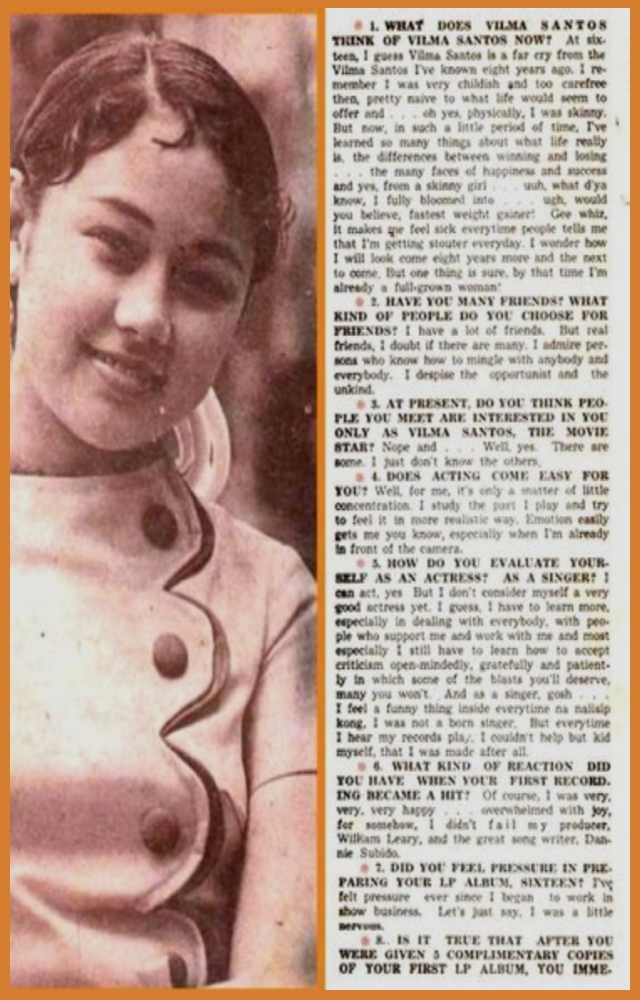
Isang Martes ng umaga, ika-3 ng Nobyembre, 1953, sa Trozo, Magdalena, Tondo, Maynila ay may isinilang na isang cute bouncing baby girl sa Galang’s Maternity Clinic. Ang batang ito ay ipinaglihi sa kesong puti at labis labis na pagmamahal. Ang ina ay nagsilang na din ng isang batang babae two years earlier pero dito sa pangalawang batang ito ay walang pagsidlan sa kaligayahan ang kanyang nadarama. May “premonition” siya na ang batang ito ay lalaking “somebody special” and that she will lead a “charmed life.” Pinangalanan ng mag-asawang Amado Santos at Milagros Tuazon Santos ang kanilang baby ng Maria Rosa Vilma.

Ang ama, Amado Santos, na isang tubong Bamban, Tarlac ay dating isang bit player sa Premiere, LVN at Larry Santiago Productions. Lumabas siya kasama ang mga big stars ng mga nasabing produksiyon at ang pinsan niyang si direktor Felicing Constantino ang nagkumbinse sa kanya para subukan ang pelikula.

Ang ina, Milagros Tuazon Santos, na isang tubong San Isidro, Nueva Ecija ay isang pharmacist by profession at eksperto sa sayaw nang kanyang kabataan. Sa MCU, kung saan siya nagtapos ng kanyang “degree” ay palaging may libreng costume para lang maipakita ang kanyang “terpsichorean talent” sa mga importanteng school programs. Sa pagkakataong ito, saan pa ba magmamana si Vi ng kanyang galing sa pagsasayaw?

Ang Santos family ay nakatira sa ground floor ng isang maliit na apartment at sa itaas naman ay ang isang close relative. Isang araw habang nasa kusina si Papa Amado ay bigla siyang nakarinig ng ingay na parang kalabog ng isang nahulog sa hagdanan. Dali dali siyang tumakbo papunta sa hagdanan at nagulantang siya nang makita niya na si Vilma pala ang nahulog sa hagdanan. Agad nila itong isinugod sa ospital, pina-xray at salamat sa Diyos dahil sinabi ng attending physician na very slight fracture lang ang nangyari sa bata.

When Rosa Vilma was already of age, ipinasok siya sa St. Mary’s Academy at noong nasa kindergarten pa siya ay dito na umarangkada ang kanyang pagiging artista dahil palagi siyang kinukuha sa mga school play. Gustong-gusto niya yung ilang oras na nasa stage, behind gleaming footlights, in fancy costume and make-up. At pagkatapos ng “play” ay ang malakas na palakpakan at pagbati sa kanya ng publiko. Nakalimutan na niya ang title ng play at kung anong okasyon ng eskwelahan ito ipinalabas subali’t tandang-tanda pa niya na ang role niya dito ay isang madre na pagkaraan pala ng tatlong dekada ay lalabas din siya sa role ng isang nun-turned-radical film Sister Stella L na dinirehe ni Mike de Leon.

Noong anim na taong gulang pa lamang si Rosa Vilma ay sinabi niya sa kanyang magulang na magiging “painter” siya someday. Gusto daw niyang kunin ay “Fine Arts” sa University of Sto. Tomas, maging isang matagumpay na artist at maging mayaman. Mahilig siyang mag-drowing – crayon sketches of birds, flowers, trees, houses at kahit saan ay nagdodrowing siya pati na sa dingding ng kanilang bahay. Dahil dito, si Papa Amado ay palaging nag-a-apply ng coat ng pintura sa kanilang sala tuwing ikalawang linggo at hindi lang yun dahil binabantayan din niya ang batang si Rosa Vilma na baka mahulog sa baso ng gatas ang mga krayola niyang ginagamit. Si Mama Milagros naman ay nagtrabaho sa isang garment department ng Aguinaldo’s kasama ang hindi pa kilalang manlililip na si Rene Salud.

Bukod sa pagkanta at pagsayaw sa mga school plays, ang batang si Rosa Vilma ay nagpakita din ng kanyang galing sa pag-iyak dahil sa pakikinig niya ng mga soap operas sa radyo. Mahilig siyang makinig ng mga drama sa radyo at doon ay tutulo na lamang ang kanyang luha. May mga okasyon pa nga na bigla na lang papasok sa kuwarto niya sina Papa Amado at Mama Milagros at nakikita nila na nasa salamin ang batang si Rosa Vilma at nagda-drama.

Noong later part ng 1962, nagkaroon sila ng family reunion sa nilipatan nilang apartment sa La Loma at ang isa sa mga naging bisita nila ay si Amaury Agra na isang cameraman sa Sampaguita Pictures. Si Amaury ay isang malayong tiyuhin ni Rosa Vilma, na ang asawa ay pinsan ni Papa Amado. Noong makita ni Amaury si Rosa Vilma ay agad niya itong tinanong kung gusto niyang mag-artista dahil ang Sampaguita Pictures ay naghahanap ng isang batang lalabas sa kanilang susunod na pelikula, ang Trudis Liit na sinulat ni Mars Ravelo at natutunghayan sa Liwayway Magazine.

Noong una ay ayaw ng mag-asawang Amado at Milagros na pumasok sa pag-aartista ang batang si Rosa Vilma dahil pareho silang abala sa trabaho, bukod pa sa gusto nila na pag-aaral muna ang asikasuhin ng batang si Rosa Vilma, subali’t isang araw ay nakatanggap sila ng sulat mula kay Amaury at sinabing ipinalista niya ang pangalan ni Rosa Vilma para mag-audition sa Sampaguita Pictures kung saan si Dr. Jose R. Perez ang isa sa mga screening committees.

Dahil hindi nila mapahindian si Amaury kaya’t nag-day off muna si Mama Milagros sa Aguinaldo’s para samahan si Rosa Vilma sa Sampaguita studio. “Diyos ko po,” ang nasambit ni Mama Milagros dahil mahigit yata sa tatlong daan ang mga batang nag-a-apply, lima lamang ang magiging finalists at sa limang finalists ay dalawa lamang ang kukunin, isang batang babae at isang batang lalaki na gaganap na kapatid ni Trudis Liit.

Ang suwerte naman, dahil ni-reveal ni Dr. Perez na bago pa sila nagpa-audition nang araw na yun ay meron na silang napiling limang finalists noong previous screening at inisip ni Mama Milagros na lahat ng nag-audition nang araw na yun ay wala ng pag-asa pero sinabi ni Amaury na gusto lang niyang mag-try out si Rosa Vilma para sa susunod nilang pelikulang pang-mahal na araw ng 1963 na pinamagatang Anak Ang Iyong Ina.

Si Amaury ay nasa location shooting noong araw na yun. Samantala, nang si Rosa Vilma na ang nag-audition, sa harap ni Dr. Perez at ni Direktor Jose de Villa at nang ipinagyugyugan na si Rosa Vilma ni Bella Flores ay parang gripong tumutulo ang kanyang mga luha. Nakita ni Mama Milagros sina Dr. Perez at Direktor de Villa na nagtitinginan at pagkatapos ng screening ay sinamahan ni Direk De Villa ang mag-ina sa opisina ni Dr. Perez na nag-extend ng congratulations kay Rosa Vilma na siyang gaganap na Trudis Liit at yung limang finalists ay gagawin na lang supporting sa mga forthcoming na pelikula ng Sampaguita Pictures.

Suot ng isang magarang damit, pumunta na ang mag-ina para sa isang screen test subali’t ang magandang damit ay pinalitan ng gula-gulanit, parang basahan. Inumpisahan nang lagyan ng make-up ni Jesse Lopez, ang make-up artist ng studio sapol pa noong era nina Carmen Rosales hanggang sa era ni Amalia Fuentes si Rosa Vilma. Nagtanong pa ang batang si Rosa Vilma kung bakit pa siya kailangang lagyan ng make-up at ang gusto lang daw niya ay huwag masyadong makapal at kung pwede ay pulbos lang.

Gumiling ang camera…..sumigaw ang direktor ng” Action!” Nag-umpisang mandilat ang mata ni Bella at cry to death naman ang Rosa Vilma. “CUT!” sabi ng direktor. “Very good!”. Si Bella ay niyakap ang batang si Rosa Vilma at sinabing…. .Aba, first take lang nakuha mo kaagad. Ang galing. Congratulations, Trudis Liit. The whole set was no screen test, but an actual take. Si Maria Rosa Vilma Tuazon Santos ay isa ng ganap na bituin sa edad na siyam na taon.

May mga tanong noon kung ano ang itatawag nila kay Rosa Vilma onscreen. Ang mag-asawang Amado at Milagros ay gustong i-retain na lang ang pangalang Rosa Vilma subali’t si Dr. Perez ay nag-object dahil marami na daw Rosa sa pelikulang Tagalog, merong Rosa Mia, Rosa Rosal, Rosa Aguirre. Nag-suggest na lang si Dr. Perez na alisin ang Rosa at tawagin na lang na VILMA SANTOS. Sa Trudis Liit, ang batang si Vilma ay binayaran ng Php 1,000 sa isang kondisyon na sa susunod na pelikula ay lalabas ulit siya at ito nga ay yung Anak Ang Iyong Ina. Dito sa Anak Ang Iyong Ina ay Php 700 ang kanyang take-home pay.

Bukod kay Bella Flores, kasama rin ni Vilma sina Lolita Rodriguez, Luis Gonzales at Connie Angeles sa Trudis Liit, “The Motion Picture That Will Tear Your Heart To Pieces” (as proclaimed by the film’s ad). Ito ay sa screenpaly ni Chito Tapawan. Nagkamit ng FAMAS Best Child Actress si Vilma dito sa Trudis Liit.

Impressed na impressed si Direk De Villa sa batang si Vilma dahil sa isang explanation lang eh nakukuha na kaagad nito ang mga instructions. Sabi ng mga co-workers ni Vilma, si Vilma ay merong fantastic memory and can easily dish out even a kilometric dialogue.

Pagkatapos ng Trudis Liit at Anak Ang Iyong Ina, sunod sunod na ang ginawa niyang pelikula katulad ng King and Queen For A Day, Aninong Bakal, Morena Martir, Iginuhit Ng Tadhana at Pinagbuklod Ng Langit.

Samantala, gumawa rin ang batang si Vilma ng isang weekly tv series sa ABS (the former KBS in Roxas Boulevard) sa direksiyon ni Jose Miranda Cruz na may pamagat na Larawan Ng Pag-ibig kasama sina Willie Sotelo at Zeny Zabala at tumagal ito ng dalawang taon sa ere. In between tapings of Larawan Ng Pag-ibig and schoolwork, siya ay gumawa rin ng mga pelikula sa iba’t ibang outfits katulad ng Ging, Naligaw Na Anghel at Sa Bawa’t Pintig Ng Puso. Later on, ginawa ring pelikula ang Larawan Ng Pag-ibig.

Gumawa rin siya sa Larry Santiago Productions ng mga pelikulang Maria Cecilia, Kay Tagal Ng Umaga at Hindi Nahahati Ang Langit. Sa mga sumunod na taon ay ginawa rin niya ang mga pelikulang Ito Ang Dahilan, De Colores, Kasalanan Kaya?, Sino Ang May Karapatan? at Sa Baril Magtuos. Dito sa Sa Baril Magtuos ay kasama niya sina Ronald Remy at Romeo Vasquez.

Noong 1967 ay ginawa ni Vilma ang The Longest Hundred Miles, isang war movie for international release sa pangunguna ng Hollywood actor na si Ricardo Montalban, Doug McLure at Katherine Ross.

Noong nagsisimula pa lang si Vilma sa Sampaguita Pictures, isa sa mga pelikulang pinanood niya kasama ang buong pamilya ay ang award-winning na The Miracle Worker. Ang role ni Patty Duke as the young Helen Keller ang kanyang pinakapaborito at ninais niya hanggang sa ngayon na makagawa siya ng pelikulang katulad nito.

Sabi ni Papa Amado, si Vilma ay hindi “spoiled” dahil kahit artista na siya, pinapalo pa rin daw niya ito kung sa palagay niya ay may nagawang kasalanan. Sabi naman ni Mama Milagros si Vilma pag may isang bagay ng gustong gawin, ito ay kanyang itinutuloy. Sabi naman ng movie scribe na si Ched Gonzales, si Vilma daw ay katulad din ng isang ordinaryong tao na mahilig sa manggang hilaw na may bagoong at sa sitsirya katulad ng popcorn, pretzel, chicharon at butong pakwan. Gustong gusto daw nito na may kinukukut-kukut.

Noong 1968, si Vilma ay nominado ng FAMAS para sa best supporting actress category, kasama sina Lolita Rodriguez at Eddie Rodriguez sa pelikulang Kasalanan Kaya? Siya ang pinakabatang aktres an nominado sa kategoryang ito. Hindi man siya pinalad na manalo sa FAMAS subali’t ang San Beda College ay binigyan siya ng Best Supporting Actress award.

Sa pagsasara ng dekada 60, si Vilma ay naging popular sa mga television shows kagaya ng Tinno Lapus’ Eskwelahang Munti sa Channel 7. Dito ay itinambal siya sa undefeated Tawag Ng Tanghalan champion for twelve weeks na si Edgar Mortiz. Ang unang pelikulang pinagtambalan ni Vilma at Edgar ay ang JBC Productions’ My Darling Eddie topbilled by the late Eddie Peregrina.

Noong 1970, ginawa in Vilma at Edgar ang pelikulang Love Is For The Two Of Us kasama sina Helen Gamboa at Ricky Belmonte. Sa telebisyon, si Vilma at Edgar ay may regular shows na Oh My Love at The Sensations sa Channel 2. Ang kanilang tambalan ay tinawag na “subok na matibay, subok na matatag.”

Noong Enero 1, 1970, ipinalabas ang superhit na pelikula ng VP Pictures na Young Love kasama ang loveteam nina Nora Aunor at Tirso Cruz III. Dito na nagsimula ang rivalry ng Vilma-Edgar loveteam at Nora-Tirso loveteam.

Noong 1971, ang tv show na The Sensations ay ginawa ring pelikula ng Tagalog Ilang Ilang Productions sa direksiyon ni Tony Santos, Sr. Noong Nobyembre 1971, ang popular lovebirds ay pumunta ng Hawaii at Estados Unidos para gawin ang mga pelikulang Aloha My Love at Don’t Ever Say Goodbye.

Marami pa ding mga pelikulang ginawa sina Vilma at Edgar at kabilang na dito ay ang mga pelikulang I Do Love You, From The Bottom of My Heart, Because You’re Mine, Eternally, Edgar Loves Vilma, Vilma My Darling, My Love At First Sight, The Wonderful World of Music, Remembrance, Renee Rose, Angelica, I Love You Honey, Our Love Affair, Mga Batang Bangketa, Baby Vi, Dulce Corazon, Anak Ng Aswang at ang inilahok sa 1972 Quezon City Film Festival na Dama de Noche kung saan hindi man siya ang naging best actress dito subali’t sa FAMAS nang sumunod na taon ay siya ang naging Best Actress ka-tie si Boots Anson Roa.

Samantala, Abril 28, 1974 nang maghiwalay ng landas sina Vilma at Edgar. Maraming Vilma-Edgar Fans ang nalungkot at inisip nila na magkakabalikan din ang dalawa subali’t hindi na ito nangyari hanggang sa si Vilma ay itinambal sa iba’t ibang leading men. Pero bago pa sila naghiwalay ay itinambal na din si Vilma kina Paolo Romero sa pelikula ng Virgo Productions na Ikaw Lamang kung saan nagkamit ito ng Best Picture sa 1973 Quezon City Film Festival, Manny de Leon sa mga pelikulang Teen-age Señorita at Cariñosa, Walter Navarro sa Sweet Sweet Love at Dalagang Nayon, Jay Ilagan sa Tsismosang Tindera, Ang Konduktora at Inspirasyon, Tirso Cruz III sa Dingdong, Nobody’s Child at Give Me Your Love, Victor Wood sa My Little Darling, Victor Laurel sa Ophelia At Paris, Prinsipe Paris Walang Kaparis, Jojit Paredes sa Tok Tok Palatok, Ronnie Henares sa Let’s Do The Salsa at nitong huli ay kay Christopher de Leon sa Tag-ulan sa Tag-araw.

Talagang poor second lang noon si Vilma kay Nora Aunor, subali’t nang gawin niya ang trilogy film ng Sine Pilipino na Lipad Darna Lipad ay talagang lumipad ng husto ang kanyang box office appeal. Sinundan pa ito ng mga pelikulang Takbo Vilma Dali at Hatinggabi Na Vilma.

Anupa’t itinambal din si Vilma sa mga matured leading man na katulad nina Eddie Rodriguez sa mga pelikulang Nakakahiya, Hindi Nakakahiya Part 2 kung saan nagkamit siya ng Best Actress Award sa 1st Bacolod City Film Festival at Simula Ng Walang Katapusan, Dante Rivero sa Susan Kelly Edad 20, Chiquito sa Teribol Dobol, Dolphy sa Buhay Artista Ngayon, Joseph Estrada sa King Khayan & I, Fernando Poe Jr. sa Batya’t Palu Palo at Bato Sa Buhangin, Jun Aristorenas sa Mapagbigay Ang Mister Ko, Dindo Fernando sa Langis at Tubig at Muling Buksan Ang Puso at Romeo Vasquez sa Nag-aapoy Na Damdamin, Dalawang Pugad Isang Ibon, Pulot Gata Pwede Kaya at Pag-ibig Ko Sa ‘Yo Lang Ibibigay.

Nagkasunod sunod na ang kanyang box office hit movie, hanggang sa inoperan siya ng Ian Films ng pelikulang Burlesk Queen kasama si Rollie Quizon kung saan hinakot nito ang halos lahat ng award including the Best Actress Award sa 1977 Metro Manila Film Festival. Hindi lang awards ang nakopo ng pelikulang ito dahil ang Burlesk Queen pa rin ang itinanghal na Top Grosser sa nasabing pestibal. Gumawa rin siya ng mga pelikulang siya mismo ang prodyuser katulad ng 1978 FAMAS and Urian Best Picture na Pagputi ng Uwak Pag-itim ng Tagak katambal si Bembol Roco, Halik Sa Paa Halik Sa Kamay kasama si Ronald Corveau at Eddie Rodriguez, Coed kasama si Jay Ilagan at iba pa.

Noong taong 1978, ginawa ni Vilma ang isang pelikula kung saan lumabas siyang isang rape victim kasama sina Philip Salvador at Matt Ranillo III ng Sampaguita VP Pictures na pinamagatang Rubia Servios. Hindi siya pinalad na maging Best Actress sa pelikulang ito, si Nora Aunor ang nanalo sa pelikulang Atsay, bagama’t marami ang humuhula na siya ang tatanghaling Best Actress dahil kahit ang direktor ng pelikulang Atsay na si Eddie Garcia ay si Vilma ang hinalikan at binati subali’t kinabukasan ay lalong lumakas sa takilya ang Rubia Servios at tinalo nito ang Atsay. Talagang iniyakan ni Vilma ang kanyang pagkatalo.

Taong 1978 din nang lumabas ang betamax issue sa kanila ni Romeo Vasquez subali’t sa halip na kumulimlim ang kanyang pagkabituin ay lalo pa siyang pumaimbulog paitaas at sa bandang huli ay hindi naman napatunayan ang balitang ito.

Noong July 19, 1980 ay nagpakasal si Vilma kay Edu Manzano sa Las Vegas, Nevada habang ginagawa nila ang pelikulang Romansa at April 21, 1981 nang isilang ni Vilma si Luis Manzano. Gusto ni Edu na maging plain housewife lang si Vilma subali’t hindi ito nangyari dahil sa natuklasan ni Vilma na baon na pala siya sa utang kaya gumawa siya ng mga pelikula.

Talagang puro good karma ang dumating sa buhay ni Vilma dahil after niyang makapanganak ay gumawa siya ng sunod-sunod na mga box-office hit na pelikula katulad ng Ex-Wife, Hiwalay, Sinasamba Kita, Gaano Kadalas Ang Minsan?, Paano Ba Ang Mangarap?, Relasyon, Tagos Ng Dugo, Saan Nagtatago Ang Pag-ibig? Yesterday Today & Tomorrow at iba pa.

Sunod-sunod rin ang kanyang Best Actress award katulad ng kanyang grand slam sa mga pelikulang Relasyon, Dahil Mahal Kita: Dolzura Cortez Story, Bata Bata Paano Ka Ginawa? at Dekada ’70. Naging best actress din siya sa mga pelikulang Broken Marriage, Mano Po 3: My Love, Sister Stella L, Tagos Ng Dugo, Pakawalan Mo Ako, Ibulong Mo Sa Diyos, Pahiram Ng Isang Umaga, Sinungaling Mong Puso at Anak. Sunod-sunod rin naman ang kanyang Box Office Queen award. Hindi lang best actress at box office queen award ana kanyang natanggap kundi nagwagi din siya ng 2005 Gawad Plaridel.

Samantala, sa pagsasara ng ABS CBN dahil sa martial law, ay nagsara din ang tv show ni Vilma na The Sensations datapwa’t may mga humalili din dito katulad ng Santos, Mortiz & Associates, Ayan Eh, Vilma Santos Very Special at Vilma In Person (VIP) sa BBC 2. Ang VIP ay lumipat sa GMA 7 at ito ay ginawa nilang VILMA. Ang VILMA ay nagtagal ng labinglimang taon at sa loob ng mga taong ito ay consistent top rater ito kaya naman siya ang highest paid tv star nang panahong iyon.

Noong December 12, 1992 ay ikinasal naman si Vilma sa noo’y congressman ng 2nd District ng Batangas na si Ralph Recto. Bumaha ang taong dumalo at nanood ng kanilang kasal sa San Sebastian Church sa Lungsod ng Lipa at noong March 29, 1996 ay ipinanganak si Ryan Christian Recto.

Noong 1998, hinikayat siya ng iba’t ibang sektor ng lipunan para kumandidatong punong-bayan ng Lungsod na Lipa at matapos niyang gawin ang pelikulang Bata Bata Paano Ka Ginawa? ay miniting niya ang mga Vilmanians at sinabing humihingi lang siya ng isang “sign” para matuloy siyang kamandidatong mayor ng Lipa at ito ay nangyari.

Naging punong-lungsod siya ng Lipa at sa loob ng siyam na taong panunungkulan ay masasabing ang Lungsod ng Lipa ang isa sa mga pinakaprogresibong lungsod sa Pilipinas. Noong May 14, 2007, siya ay nahilingan naman na kumandidato bilang gobernador ng Batangas at dahil sa kanyang magandang nagawa sa Lungsod ng Lipa, siya ay pinalad na manalo sa posisyong ito. Katatapos lang iselebreyt ni Governor Vi ang kanyang 100 araw na panunungkulan bilang gobernador ng lalawigan ng Batangas at nagkaroon siya ng State of Provincial Address nitong nakaraang October 8, 2007.

Sabi nga ni Governor Vi, sa nagayon ay prioridad niya ang kanyang pamilya, pangalawa ay ang pagiging gobernador ng Batangas at pangatlo na lamang ay ang kanyang pagiging artista. Maraming movie offers ang kanyang natatanggap katulad ng pagsasamahan nila ni John Lloyd Cruz, meron pang digital film na La Independencia ni Raya Martin na automatic na ilalahok sa Cannes Film Festival kung magagawa niya (sana lang!). Meron ding offer na stage play (pero malabo na ito dahil maraming oras ang kakainin nito lalo na sa rehearsals). Meron ding mga commercials at marami pang iba.

Ano pa kaya ang naghihintay sa isang VILMA SANTOS-RECTO? Marami pa, marami pa, di ba Governor Vi? Happy 54th Birthday Governor VI! – Alfonso Valencia, Alam Nyo Ba? Part 41, V Mag 2006 (READ MORE)

Related Reading:

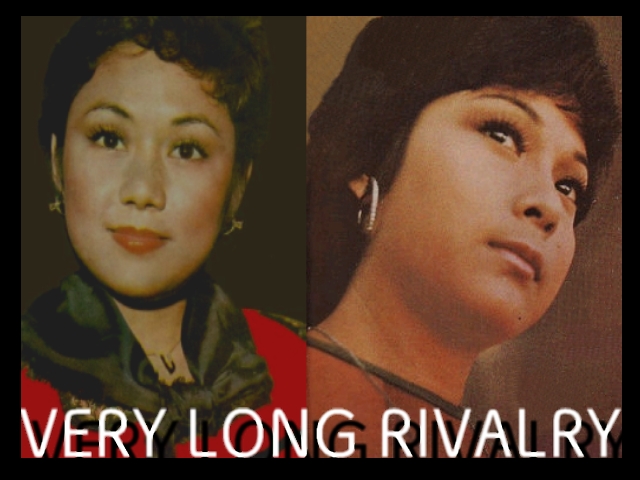
A Very Long Rivalry – 1976

This slideshow requires JavaScript.

Pre-1976 – Although Vilma Santos showed great promise the previous year, all with her dramatic projects like “Nakakahiya?” with Eddie Rodriguez; “Karugtong ng Kahapon” with Eddie Garcia and Gloria Romero and “Tag-ulan sa Tag-araw with Christopher de Leon, it was Nora Aunor who owns 1976, at least in terms of notable films.

Landmark Performance – “…Nagkakalaban pa rin sina Nora at Vilma sa FAMAS, pero kapwa sila talunan. Especially Vilma, who didn’t win another FAMAS Best Actress trophy until 1982 (with Elwood Perez’s 1981 meager Pakawalan Mo Ako). In 1976, Nora Aunor’s “landmark performance ” in Mario O’Hara’s Tatlong Taong Walang Diyos won nods from the FAMAS voters as well as from the Gawad Urian critic-jurors bilang Best Actress. Hindi si Vilma ang naging mahigpit na kalaban ni Nora, kundi si Hilda Koronel (for Lino Brocka’s Insiang). Sa MMFF in December 1976, si Hilda ang Best Actress, but Nora’s performance in Lupita Kashiwahara’s Minsa’y Isang Gamugamo was equally acclaimed by the critics. (Minsa’y…won as FAMAS Best Picture in 1977.) It was the first year of the Gawad Urian (organized by film critics collectively known as the Manunuri ng Pelikulang Pilipino), at si Nora ang nag-buena-mano as Best Actress. Henceforth, hindi na lamang ang FAMAS ang kinilalang tagapagbigay-parangal sa industriya ng pelikulang lokal. Sa mga sumunod na taon, dumami ang award-giving body sa movie industry. Bukod dito, ang mga filmfest sa iba’t ibang siyudad outside Metro Manila; like in Davao City, where Nora Aunor once won as Best Actress for Tito Sanchez’s Ibilanggo si Neneng Magtanggol…” – William Reyes (READ MORE)

Nora Aunor’s 1976 Films (9): (Ang Bulag, ang Pipi at ang Bingi; Big Ike’s Happening; Kaming Matatapang ang Apog; Magandang Gabi sa Inyong Lahat; Minsa’y Isang Gamu-gamo; Relaks Lang Mama, Sagot Kita; Sapagka’t Kami’y Mga Misis Lamang; Tatlong Taong Walang Diyos; Wanted: Deb or Alayb Agad-agad) – After “Banaue” of previous year, Nora Aunor produced another memorable film, “Tatlong Taong Walang Diyos,” directed by Mario O’Harra where she won all the best actress, from the only two award giving bodies during this time. Aside from this remarkable feat, she also did an equally notable film under Premiere Productions, “Minsa’y Isang Gamo-gamo.”

Vilma Santos’ Films (10): (Bato sa Buhangin; Bertang Kerengkeng; Big Ike’s Happening; Hindi Nakakahiya; Let’s Do the Salsa; Makahiya at Talahib; Mapagbigay ang Mister Ko; Mga Reynang Walang Trono; Mga Rosas sa Putikan; Nag-aapoy na Damdamin) – In terms of notable projects, there was no award deserving films that Vilma did this year but she remained bankable with commercial success of “Bato sa Buhangin,” film with FPJ, Hindi Nakakahiya,” film with Eddie Rodriguez; “Makahiya at Talahib,” film with Rudy Fernandez and “Nag-aapoy na Damdamin,” film with Romeo Vasquez.

Nora Aunor’s 1976 acting recognition (2) – Best Actress from FAMAS; URIAN for “Tatlong Taong Walang Diyos.”

Vilma Santos’ 1976 acting recognition (0) – none

Means Business – “…People who used to smile and wink when they talk of Nora Aunor as an actress should see this film, because the lady is determined to show everybody that she means business both as an actress and as a producer. In this film she is successful as both…In the end, Mario O’Hara symbolizes man’s fate as helpless creature buffeted by the winds of adversity but still turning to God by a blind man who lights a candle as a procession enters the church to mark the return of normalcy. The tragic fate of Rosario, Crispin and Masugi goes against the grain if traditional “cine Pilipino” which insists on a happy ending. And for this we must thank conscientious craftsmen like Mario O’Hara and Nora Aunor for their concerted effort. “Tatlong Taong Walang Diyos” is without doubt one of the best films of 1976…” – Pio de Castro III, The Times Journal 1976 (READ MORE)

Good Sign – “…Then she did Mga Rosas Sa Putikan for her own VS Films where she played a country girl forced into prostitution in the big city. The movie did fairly well at the tills. Good sign…” – Ricardo F. Lo, Expressweek, Jan 19 1978 (READ MORE)

Post-1976 – After Nora’s triumph in both FAMAS and Gawad Urian, Vilma seems to be reawakened the following year by the success of “Burlesk Queen.”  The film earned her nominations from Famas and Gawad Urian but failed to secure her the trophies. Despite this, 1977 seems to favor Vilma more than Nora in terms of quality output.  Aside from Burlesk Queen, she did “Dalawang Pugad Isang Ibon” directed by Bernal, “Masarap Masakit Ang Umibig” directed by Elwood Perez, “Pulot-gata, Pwede Kaya?” with Romeo Vasquez and “Susan Kelly, Edad 20” with Dante Rivero, these films were smash hits. Meanwhile, Nora did twelve films, her only award worthy film was “Ibilanggo si Neneng Magtanggol” where she won the best actress in Davao Film Festival and a nomination from the Metro Manila Film Festival for “Bakya Mo Neneng.”  Like Vilma in her past year, Nora had a similar run, “high on output and commercial success but low on quality, worthy of acting awards” (“Little Christmas Tree” wirh FPJ and “Bakya Mo Neneng” with Joseph Estrada were both mediocre films).  With Vi and Guy’s careers on fire in term of box office success, the next year would be a test on who will sustain popularity, as more worthy project will come their way.

Related Reading:

TRIVIA

I will venture into my friend Al’s territory for this issue of V Mag.  Mag-trivia muna tayo para pag may nagtanong sa atin tungkol kay ate Vi ay hindi tayo mapaupo sa last row, sa tabi ng garbage can.

  • Ate Vi was born on a Tuesday, 03 November of 1953 at Galang Hospital in Blumentritt Street, Manila.
  • She weighed 6.5 lbs.
  • Si Mama Milagros Tuazon-Santos ay taga Cabanatuan City, Nueva Ecija, samantalang taga Bamban, Tarlac naman si Papa Amado Constantino Santos.
  • Pinaglihi si ate Vi sa kesong puti.
  • Pangalawa si ate Vi sa limang magkakapatid. Panganay si at Emelyn, sumunod kay ate Vi si Maritess, na sinundan nina Winnie at Sonny.
  • Nag-aral si ate Vi sa St. Mary’s Academy sa Trozo st., Bambang, Manila mula Kinder hanggang High School. Samantala kumuha siya ng special course on Local Governance sa University of the Philippines – Diliman.
  • Takot si ate Vi sa ipis at ayaw niyang nakakarinig ng daing ng babae.
  • Nagtitinda si ate Vi ng minatamis na sampaloc noong nag-aaral pa siya.
  • Marami na ring bahay na natirhan si ate Vi. Una silang tumira sa Trozo St., Bambang. Manila at tumagal sila doon hanggang naging 12 years old siya. Sa la Loma, QC naman sila lumipat hanggang sa mag 17 years old siya. 1970 ng lumipat sila sa Cinnacle Drive, Proj. 6, QC. Mula rito ay lumipat naman sila sa Morado St., Dasmarinas Village, Makati. Sumundo ay tumira naman sila sa Amapola St., Bel Air Village, Makati. Matagal din silang tumira sa Margarita St., Magallanes Village, Makati. 1990 ng lumipat naman sila sa Swallow Drive, GreenMeadows Subd., QC. 2007 ng lumipat sila sa Ayala Alabang Village in Taguig City.  Bukod ditto may bahay pa rin sila sa LPL Compound in Lipa City, Batangas. May rest house rin siya sa Tagaytay. May bahay pa rin siya sa West Covina, CA. Nagkaroon din siya ng bahay sa Monterey Hills, Marikina.
  • Nagkasakit si ate Vi ng pneumonia noong siya ay limang taong gulang. Na-confine siya sa Galang Hospital.
  • Hindi marunong magluto si ate Vi pero may specialty siya. Ito ay ang Meal-in-One na may spaghetti, corned beef, sweet corn at mushroom.
  • Opel record na kulay Silver Blue ang unang kotse niya.
  • Unang bansa na narrating niya ay HongKong.
  • Five feet and half inch ang height niya.
  • May malaking nunal si ate Vi sa likod.
  • Una siyang gumanap sa stage bilang isang madre sa tanghalan ng St. Mary’s noong siyaý nasa Kindergarten. Gumanap rin siya bilang Veronica sa Dulang pam-Mahal na Araw sa Culural Center of the Phils. noong 1971.
  • Tatlong beses niya nakasama si Amalia Fuentes sa pelikula: Bulaklak at Paru-paro (1970), Mga Reynang Walang Trono (1976) at Asawa ko, Huwag Mong Agawin (1986). Samantala, ang karibal ni Amalia na si Susan Roces ay hindi pa niya nakasama sa pelikula.
  • Si Dona Josefa Edralin-Marcos ang nagputong ng kanyang korona bilang Miss Philippine Movies of 1971 at Box Office Queen of Phil. Movies 1978.
  • Magaling mag-drawing si ate Vi, kaya nga binalak niyang kumuha ng Fine Arts kundi lang siya lubhang naging abala sa mga showbiz commitments niya.
  • Special added attraction ang film coverage ng Debut niya sa pelikulang Eternally na ipinalabas noong 1971.
  • Unang pelikula niyang ginawa sa abroad ang Aloha, My Love (1972), sinundan ng mga Don’t Ever Say Goodbye (1972), Pinay, American Style (1979), Miss X (1980), Gusto Kita, Mahal Ko Siya (1980), at Romansa (1980). Samantala may ilang eksenang kinunan sa HongKong ang Anak (2000) at sa Bangkok ang Mano Po 3, My Love (2004).
  • Idinaos ang kanyang debut noong Nov. 3, 1971 sa The Plaza Restaurant sa Makati. Isang sosyal at sikat na restaurant noong panahong iyong ang naturang resto. Dito rin idinaos ang reception ng lasal nina FPJ at Susan Roces noong 1968. Si Ben Farrales ang nagdesenyo at tumahi ng kanyang gown. Si Danilo Franco ang nagburda ng kanyang gown, baguhan pa lamang noon si Danilo at nagtratrabaho kay Mang Ben.
  • Si Auggie Cordero ang gumawa ng wedding gown ni Ate Vi na ginamit sa kanyang Lux Commercial. Samantalang ang National Artist for Film na si Gerry de Leon ang nagdirect ng naturang commercial. Nagkaroon ng Lux and Vi TV special na dinaluhan ng mga nagdaang Lux beauties gaya nina Amalia Fuentes, Susan Roces, Helen Gamboa, Gina Pareno at Hilda Koronel.
  • Jul. 25, 1970 ang initial telecast ng The Sensations sa ABS CBN 3. naging top rate rang nasabing program na nakasama nina Vilma at Edgar ang mga young stars na sina Perla Adea, Romy Mallari, Rhodora Silva, Darius Razon, Baby de Jesus at Tony Santos, Jr. Ginawa pa itong pelikula ng TIIP dahil sa kasikatan nito. Nanatili ito sa ere hanggang ideklara ang Martial law noong Sept 1972.
  • Tumayong maid of Honor si ate Vi sa kasal nina Tony Ferrer at Alice Crisostomo noong 1970 at kian Aurora Salve at Romy Ongpauco noong 1974.
  • Si Ben Farrales rin ang gumawa ng terno ni ate Vi bilang Miss Asian Basketball Confederation of 1973.
  • May magazine na puro Vilma ang news at articles. Ito ay ang Movie Queen magazine.
  • Oleg Casini ang brand ng bikini na suot ni ate Vi sa beach scene ng pelikulang Susan Kelly, Edad 20. Kinunan ang naturang beach scene sa Villamar Beach resort sa Cavite.
  • Hango sa pelikulang The Exorcist ni Linda Blair ang initial telecast ng Dulambuhay ni Rosa Vilma sa BBC2. naging top rater ang naturang programa at nagbigay kay ate Vi ng nomination sa PATAS awards bilang Best TV Actress of 1974.
  • May gagawin sanang pelikula si ate Vi with Lolita Rodriguez (Tigang na Lupa) at Rita Gomez (Mother and Daughter) sa TIIP noong 1974, ngunit parehong hindi niya nagawa. Ang Mother and Daughter ay isinapelikula rin ngunit iba na ang casting. Sina Paraluman at Elizabeth Oropesa na ang gumanap rito.
  • 1974 ng nailathala ang mga nobelang isinulat umano ni ate Vi. Ito ay ang Saksi Ko Ang Diyos, Akoý Birhen (Movie Specials) at Paper Dolls (Kislap). Siya rin ang may akda ng istorya ng pelikulang Biktima na kanyang entry sa 1974 Manila Film Festival.
  • Sinagot ni ate Vi si Edgar Mortiz noong Apr 7, 1971 at nag break sila noong Apr 28, 1974. Si Edgar ang una niyang boyfriend.
  • Nakapag-produce ang VS Films ng limang pelikula. Ito ay ang mgs ss.: Mga Rosas sa Putikan; Pagputi ng Uwak, Pag-itim ng Tagak; Halik sa Paa, Halik sa Kamay, Apoy sa Ilalim, Apoy sa Ibabaw at Coed.
  • Naging judge si Ate Vi sa Miss RP 1976, kung saan nanalo ang nag-artista rin na si Suzanne Gonzales at runner up ang naging super model Anna Bayle. Naging judge rin siya sa Bb. Pilipinas noong 1987.
  • Nagkaroon ng concert si ate Vi sa Folk Arts Theatre noong 1977. Nakasama niya sina Rico J. Puno, Nino Muhlach, Didith Reyes and the late Yolly Samson.
  • Naging official entry ang Masarap, Masakit, ang Umibig (My Brother’s Wife) sa 23rd Asian Film Festival sa Bangkok, Thailand noong 1977.
  • Sa Long Beach Resort, sa Nalinac, La Union nag-celebrate si ate Vi ng kanyang ika 24th birthday. Samantalang sa Paris, France naman nung kanyng ika 26th birthday.
  • Sia te Vi ay ang 1978 Miss Presto at 1980 Miss Crispa sa PBA.
  • Napanalunan lahat ng Burlesk Queen ang mga awards sa 1977 Metro Manila Film Festival maliban sa dalawa (Best Cinematography and Best Production design). Ito rin ang Top Grosser.
  • Super lakas ng pelikulang Miss X. It grossed more than P600,000.00 in its first day of showing just 27 theatres, when normally a P100,000.00 first day gross in the 1980s is already considered a blockbuster. Ito ang unang pelikulang pinagsamahan nina ate Vi at director Gil Portes. The movie was filmed in Amsterdam.

I hope you enjoyed reading this trivia. Addition lang to the info mentioned, November 1962 ng unang mag shooting si ate Vi for Trudis Liit, kaya it’s her 45th Showbiz anniversary. – Eric Nadurata,  December  2007,  V magazine (READ MORE)

  • The only actress who won three consecutive years as best actress in the Urian awards (the country’s film critics) for her movies, Relasyon (1982), Broken Marriage (1983), and Sister Stella L. (1984).
  • She has never won a single best actress award from her movies directed by an ace director, the late Lino Brocka.
  • The first actress in Philippine movies to score a grand slam in 1983 as best actress for her performance in Relasyon (1982) from Catholic Mass Media, Urian, Film Academy and FAMAS award giving bodies.
  • Her mother is Mila Tuazon Santos.
  • Mother of Luis Manzano.
  • Currently serving as mayor of Lipa City in the Philippines. Her husband, Ralph Recto, is an incumbent Philippine Senator.
  • Children (Edu Manzano) and Ryan Christian (with Ralph Recto).
  • Siblings: Emelyn and Sonny.
  • Her Girl Friday Aida Fandialan is girlfriend of her brother Sonny.
  • She is the winner of the most Gawad URIANs (from the country’s top film critics), tallying 8 wins, 5 additional nominations (all for Best Actress) and 2 special awards for being the best actress of the ’80s and the ’90s.
  • She is also currently the most awarded actress in the Filipino Academy of Movie Arts and Sciences Awards (FAMAS Awards) with 6 wins (5 Best Actress, 1 Child Actress), a Hall of Fame Award, two Circles of Excellence awards (the highest award of the FAMAS), a Lifetime Achievement Award and 9 other nominations (1 Best Supporting Actress, 8 Best Actress). She also holds the record of having the longest string of consecutive FAMAS nominations for performers; she had 12 consecutive nominations from 1977-1989.
  • She is also the most awarded actress in the Film Academy Awards (along with Nora Aunor) with 4 wins for Best Actress, 8 other nominations and 1 Lifetime Achievement Award.
  • The other half of the very controversial FAMAS Best Actress tie in 1972. She shared the Best Actress honors with Boots Anson-Roa. It is the first tie in Philippine movie awards history.
  • The only actress in the history of the Filipino Academy of Movie Arts and Sciences to have won back-to-back acting awards twice (1981 and 1982, 1987 and 1988).
  • The only actress to have scored 4 grand slams in Philippine movie history (Caveat: a Grand Slam means that the actor/actress has won the Philippines’ FAMAS Awards, Gawad URIAN, Film Academy Awards and Star Awards). She scored grand slams in Relasyon (1982), Dahil mahal kita (1993), Bata bata paano ka ginawa? (1998) and Dekada ’70 (2002).
  • An advocate-endorser of a nationwide milk education campaign called “Laki Sa Gatas,” in partnership with Bear Brand, the Philippines’ leading milk brand by sales. The campaign aims to promote, primarily among mothers, the nutritional importance of milk in light of declining milk consumption in the Philippines.
  • Elder sister of Winnie Santos.
  • At the Cinema One Originals Film Festival 2009, she received the Cinema One Legend Award. – telebisyon.net (READ MORE)

Related Readings:

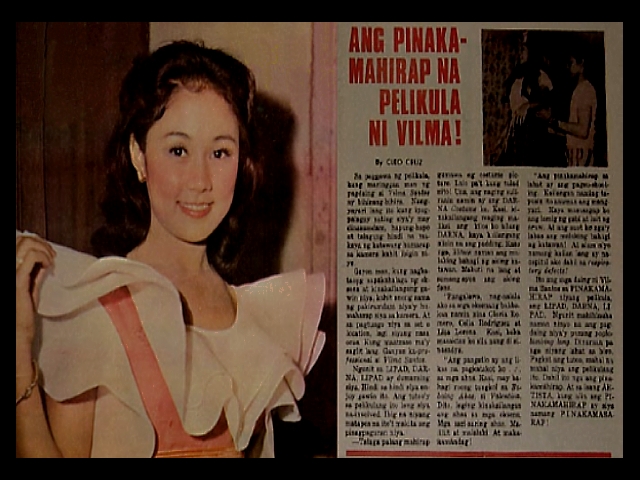
Ang Pinakamahirap na Pelikula ni Vilma!

Sa paggawa ng pelikula, kung maringgan man ng pagdaing si Vilma Santos ay bihirang-bihira. Nangyayari lang ito kung ipagpalagay nating siya’y may dinaramdam, hapong-hapo at talagang hindi na makaya ng katawang humarap sa kamera kahit ibigin niya. Gayon man, kung nagkataong napakahalaga ng eksena at kinakailangang gawin niya, kahit anong sama ng pakiramdam niya’y humaharap siya sa kamera. At sa pagtungo niya sa set o location, lagi siyang nasa oras. Kung maatraso ma’y saglit lang. Ganyan ka-professional si Vilma Santos. Ngunit sa Lipad, Darna, Lipad ay dumaraing siya. Hindi sa hindi siya enjoy gawin ito. Ang tutoo’y sa pelikulang ito lang siya na-involved. Ibig na niyang matapos na ito’t makita ang pinagpaguran niya. Talaga palang mahirap gumawa ng costume picture. Lalo pa’t kung tulad nito! Una, ang naging suliranin namin ay ang Darna Costume ko. Kasi, kinakailangang maging maliksi ang kilos ko bilang Darna, kaya kailangang alisin na ang padding. Kaso nga, lilitaw naman ang malaking bahagi ng aking katawan. Mabuti na lang at sumang-ayon ang aking fans.

“Pangalawa, nag-aalala ako sa mga eksenang bakbakan namin nina Gloria Romero, Celia Rodriguez, Liza Lorena. Kasi, baka masaktan ko sila nang di sinasadya. “Ang pangatlo ay ang likas na pagkatakot ko…sa mga ahas. Kasi, may bahagi roong tungkol sa Babaing Ahas, si Valentina. Dito, laging kinakailangan ang ahas sa mga eksena. Mga sari-saring ahas. Maliliit at malalaki. At makamandag! “Ang pinakamahirap sa lahat ay ang pagsu-shooting. Kailangan naming tapusin ito anuman ang mangyari. Kaya nasasagap ko ang lamig ng gabi at init ng araw. At ang suot ko nga’y labas ang malaking bahagi ng katawa! At alam n’yo namang kailan lang ay na-ospital ako dahil sa respiratory defects! Ito ang mga daing ni Vilma Santos sa pinakamahirap niyang pelikula, ang Lipad, Darna, Lipad. Ngunit mahihinuha naman ninyo na ang pagdaing niya’y parang palalambing lang. Dinaraan pa nga niyang lahat sa biro. Pagka’t ang tutoo, mahal na mahal niya ang pelikulang ito. Dahil ito nga ang pinaka-mahirap. At sa isang artista, kung alin ang pinakamahirap ay siya namang pinakamasarap! – Cleo Cruz, Love Story Illustrated Weekly Magazine, No. 78, 23 Mar 1973

Cleo Cruz was Vilma Santos’ publicist in the early part of her movie career. Vi normally calls her, “Mommy” or Mommy Cleo. Now retired from entertainment journalism, Cleo Cruz is reportedly now living in the United States. She referred Vi’s followers in many of her columns and articles as “Luvs.” – RV

2004 Stars Awards

This slideshow requires JavaScript.

Trouble in the Stars – “Former Philippine Movie Press Club (PMPC) President Ernie Pecho is convinced that the media group’s incumbent head, Joe Barameda, was “not aware” of the alleged vote-buying during the recent 21st Star Awards ceremony. The very first Star Awards for movies were given out during Pecho’s term. “I know Joebar (Barrameda’s nickname). He’s a good person,” Pecho told Inquirer Entertainment in a phone interview on Wednesday. “Had he known, I’m sure he would have done something about it. He’s not like some of our colleagues na matindi ang pangangailangan (who are desperate). He would never accept money and ruin his image.” Quoting reports in the tabloids Pecho said 13 PMPC members, all part of the 24-man voting committee, received P5,000 each from “a woman from ABS-CBN.” This waa to ensure that the Best Actor award would go to Piolo Pascual (for “Milan”) and the Best Actress award to Kris Aquino (for “Feng Shui”). “They claimed Joebar was behind the “switching” of the awards,”said Pecho. The payoff might have happened, in fact, he said, but he reiterated his comfidence in Barrameda. Star Cinema, movie arm of ABS-CBN, produced both “Milan” and “Feng Shui.” “One story even said writer Allan Diones has admitted receiving money from the woman,” Pecho noted. Rumors that Kris and Piolo would win the top acting awards has started circulating days before the awards rites last Saturday.

Several people who turned up for the program at the Cinema 5 of the Gateway Mall in Cubao, Quezon City and sported the two nominees commented: “They probably know that they would win. Why else would they be here?” But it was, Vilma Santos who took the Best Actres trophy for “Mano Po 3: My Love,” and Dennis Trillo was named Best Actor and Best New Movie Actor for “Aishite Imasu 1941.” Inquirer Entertainement called Barrameda also on Wednesday, but he would not pick up. Instead, he sent this text message: “The PMPC will issue an official statement hopefully tomorrow.” Several write-ups identified the “woman” as Star Magic PR head Rikka Dylim, who denied the accusation. In a statement sent to Inquirer, Dylim said she had “nothing to do with the alleged vote-buying for (ABS-CBN Star Magic) contract artist Mr. Piolo Pascual.” Dylim added: “The network accepts the fact that another actor won the Best Actor award. We never question or protest the decision of the club.” Pecho said there could be several reasons that Kris and Piolo did not win, “despite all the efforts experted by ABS-CBN.” “Some members could have taken the money but felt guilty and voted for other nominees,” Pecho said. “Or maybe these members got somethng bigger from someone else.” Of the controversy, he could only say: “This is really humiliating. The PMPC used to pride itself in its integrity and unquestioned choices. It used to be the most credible awards-giving body.

Now, can we say the same?” In October 2003, Pecho and two other former PMPC presidents questioned the process of selecting the winners for the 17th Star Awards for Television, citing “glaring disparities.” Pecho said some artists who won could “hardly carry a tune,” and shows that bagged the trophies in spite of “consistently poor production quality.” Billy Balbastro, 1984 PMPC president, complained about the alleged of winners during that awards show. He said he received text messages the day before, saying ABS-CBN would win by a lanslide. Of the same ceremony, Veronica Samio, PMPC president from 1991 to 1993, said she heard talk that certain individuals had paid several club offiicials to win certain awards. Pecho, PMPC president from 1985 to 1987, saidl all past PMPC presidents should meet to discuss the situation. “I think there should be a “general cleaning” within the PMPC.” Saturday’s ceremony was well attended by both celebrities and fans. This could explain why the 700 seater venue looked so chaotic. Before entering the theater, Inquirer Entertainement encountered a throng of fans screamign to catch their idols attntion. A group of ushers refused to let in guests – not even those with invitations – who were not in formal attire. Inside, people kept walking around even as the cameras rolled. These people included cameramen and guests in blue jeans and casual shirts.

In one corner, performers Sandara Park, Hero Angeles and the Speed Dancers rehearsed their dance steps while the program was ongoing and presenters like Ciara Sotto, Anna Larucea and Baron Geisler took last-minute instructions from the stage manager. Vilmanians and Noranians, as well as fans of young stars Sandara, Hero, Jennylyn Mercado and Mark Herras, screamed at every mention of their idols’ name and movies. What supposed to be a “formal” ceremony instead looked and sounded like any noontime program, with spectator’s hollering, “Laban!” or “Bawi!” at the top of their lungs. Kris arrived at about the same time as Sen. Jinggoy Estrada, who accepted the Lifetime Achievement Award for his father, former president Joseph Estrada. A swarm of photographers jostled for the best shots. Kris is the daughter of another former president, Corazon Aquino. Only SVP for Drama Production and Star Cinema Malou Santos was around to accept the Best Picture award for “Milan.” One member of the audience noted that Charo Santos-Concio, ABS-CBN’s EVP for Entertainment, was conspicuosly absent, fuelling rumors that she had quit working for the network on account of differences with its chair, Gabby Lopez. Pops Fernandez shared hosting chores with Vilma, and Martin Nievera was anchor man. The Golden Screen Awards show on March 5 had only two production numbers; Star Awards had four. Pops and The CompanY did the opening number. Star Circle questors Sandara and Hero performed in a “dance showdowns” with Starstruck ultimate survivors Jennylyn and Mark Young performers Mark Bautista, Erik Santos and Rachelle Ann Go did a medley of Filipino songs hafway into the program. Karylle, Keempe de Leon, Jamie Rivera and Franco Laurel sang Broadway tunes in the latter part. The Speed Dancers worked the hardest, performing in all the production numbers.” – Marinel R. Cruz, Philippine Daily Inquirer, Mar 18, 2005 (READ MORE)

Star Awards to be probed – “Officers of the Philippine Movie Press Club will form a committee to investigate the alleged vote-buying during the recent 21st Star Awards, according to Veronica Samio, head of the club’s grievance committee. “A deceitful act like this should not go unpunished,” said Samio, who was president of the PMPC from 1991 to 1993. “Its not right to cheat. We will see to it that PMPC members involved in this will be expelled. Post-show reports alleged that 13 PMPC members, all part of the 24-man voting committee, received money from ABS-CBN Star Magic PR head Rikka Dylim several days before the ceremony. This was to ensure that Piolo Pascual would be named Best Actor for “Milan” and the Best Actress award would go to Kris Aquino for “Feng Shui.” The accused members included writer Allan Diones, who admitted to received P5,000 from Dyllim, Samio also identified former PMPC president Julie Bonifacio-Gaspar, incumbent vice president Jimi Escala and member Ador Saluta as among thosed involved. Star Cinema, movie arm of ABS-CBN, produced both “Milan” and “Feng Shui.” But Vilma Santos (“Mano Po 3: My Love”) took home the Best Actress trophy and Dennis Trillo (“Aishite Imasu 1941”) was named Best Actress and Best New Movie Actor. Samio said Diones confessed to the vote-buying on the day the committee members were to cast their vote. “The first reaction of our president (Joe Barrameda) was to strike Piolo’s name from the list of nominees.

But we dissuaded him because it would not be fair to Piolo, who actually did well in “Milan,” Samio told Inquirer Entertainment last Friday. “Piolo probably didn’t even know what these people did for him.” According to Samio, writer-TV host Cristy Fermin was also seen reportedly handing out P3,000 to 12 PMPC members a few days before the PMPC was to announce the winners at the Cinema 5 of the Gateway Mall in Quezon City last March 12. Fermin had been campaigning for Piolo and Kris – praising them in her columns in the tabloids Bandera, Pilipino Star Ngayon and Bulgar, and on her radio program on dzMM. But Samio said only eight members actually voted for Piolo. “I know, because I’ve seen the summary of votes that the PMPC submitted to the show’s producer, Airtime Marketing,” she pointed out. “This means some of the members who accepted the bribe did not vote for Piolo.” PMPC chair Fernand de Guzman, Barrameda and two accountants signed the summary of votes handed to Airtime Marketing, said Samio. “You see, walang dayaaan sa PMPC,” she declared. “People tried to cheat but they did not succeed.” Asked for her reaction, Fermin said: “I do not wish to comment to anyone about the issue because what I think and feel about it are all written in my colums.”

In her “Most Wanted” column in Bulgar last Friday, Fermin referred to the controversy as “Isang bangungot para sa ilan at masamang panaginip para sa iba, hindi naman lahat ng panaginip ay maganda (a nightmare to some and a bad dream to others – not all dreams are good).” ABS-CBN’s Dylim also denied having anything to do with the alleged vote-buying. In a statement sent to Inquirer Entertainment Wednesday Dylim said: “The network accepts the fact that another actor won the Best Actor Award. We never question or protest the decision of the club.” In anotehr statement, ABS-CBN Broadcasting Corporation said it was “saddened” by the alleged “vote-buying scam” and annouced that it “has not tolerated and will not tolerate such practice.” The statement added: “The network has always espoused the principles of professinalism and integrity and this extends to playing fair in any industry-related activity, including the PMPC’s Star Awards. “It is unfortunate that such allegation routinely surfaces after every awards ceremony regardless of parties, to the detriment of the industry.” PMPC officials and some members met last Thursday to discuss the controversy, said Samio. “It was during the meeting that we decided to expel members who would be proven guilty of accepting bribes,” added the former PMPC president. “How can the PMPC cleanse itself if it does not get rid of these people?” Incumbent president Barrameda said the PMPC “stands by the veracity of all of its winners” and “fins no errors in its tabulations.” – Marinel R. Cruz, Philippine Daily Inquirer, Mar 20, 2005 (READ MORE)

Vilma! Show (Videos) 2/3

MEMORABILIA - Vilma! TV 1984

Vilma! is a Friday Primetime musical variety show formerly aired by GMA Network from 1986 to 1995 hosted by Vilma Santos. Formerly known as Vilma In Person, Vilma! (also known as Vilma on Seven) was debuted on August 8, 1986, the pilot episode is shown from the Metropolitan Theater as a temporary studio where Vilma Santos and the VIP Dancers are performed there. Until 1987, the Friday Primetime musical variety show moved to Broadway Studios as a new location and it is shown on the first StereoVision format which features dance and love song performances. Vilma! was competed by two other variety shows Loveli-Ness and Dance-2-Nite of ABS-CBN (originally debuted in 1987) as rivals, but the variety show maintained its ratings. Vilma! received four nominations in the PMPC Star Awards for TV from 1988 to 1990, 1992 and 1994, as well as Best Female Musical Variety Show Host from 1987 to 1988, they also produced anniversary and birthday specials from 1987 to 1994 as well. After nine years, Vilma! produced the 479th and the last episode on September 29, 1995, brought many fans and supporters bade farewell to the Star for all seasons, and made as the longest-running Musical Variety Show. Truly, Vilma! was ended on September 29, 1995 and it was replaced by Bubble Gang. – Wikipedia (READ MORE)

ARTICLES - 8 PMPC Star Awards for TVRelated Reading:

Vilma! Show (Videos) 1/3

Vilma! is a Friday Primetime musical variety show formerly aired by GMA Network from 1986 to 1995 hosted by Vilma Santos. Formerly known as Vilma In Person, Vilma! (also known as Vilma on Seven) was debuted on August 8, 1986, the pilot episode is shown from the Metropolitan Theater as a temporary studio where Vilma Santos and the VIP Dancers are performed there. Until 1987, the Friday Primetime musical variety show moved to Broadway Studios as a new location and it is shown on the first StereoVision format which features dance and love song performances. Vilma! was competed by two other variety shows Loveli-Ness and Dance-2-Nite of ABS-CBN (originally debuted in 1987) as rivals, but the variety show maintained its ratings. Vilma! received four nominations in the PMPC Star Awards for TV from 1988 to 1990, 1992 and 1994, as well as Best Female Musical Variety Show Host from 1987 to 1988, they also produced anniversary and birthday specials from 1987 to 1994 as well. After nine years, Vilma! produced the 479th and the last episode on September 29, 1995, brought many fans and supporters bade farewell to the Star for all seasons, and made as the longest-running Musical Variety Show. Truly, Vilma! was ended on September 29, 1995 and it was replaced by Bubble Gang. – Wikipedia (READ MORE)

ARTICLES - 8 PMPC Star Awards for TVRelated Reading:

Remembering Leopoldo Salcedo

This slideshow requires JavaScript.

Made Ordinary People Happy – “…In the 1970s, he was still appearing in local movies and I made sure I cast him in my scripts in TV dramas. He was indeed a fantastic actor, he came on time, ready, all the dialogues memorized (just like Rosa Rosal). While the younger actors were all fumbling during the rehearsal before the take, Pol and Rose were patiently trying their best to understand the shortcomings of younger actors (except Gina Alajar, of course, who would also come to the set well-prepared, and whose caliber was A1). One conversation I had with Pol that really stuck in my mind was when we were outside the studio of Broadcast City one taping day of the show Alindog. While waiting for all the cast to arrive, we both leaned on the railings on the top landing of the stairs leading to the studio, overlooking the vastness of the network compound – the same raillings where the child Romnick Sarmenta would wait before taping starts. The same raillings where, after seeing me arrive, the child would hurry to meet me, and would jump right at me where I would raise him above my head, up and down, three to four times, while he was laughing hysterically. So, while Pol and I looked out to the vastness of the compound of the biggest network in RP in those days, he suddenly said: “Joey, I’m celebrating my 66th birthday this weekend. Do you have time to come to my house?” “Of course, I will find the time, just for you, Pol. I’m sure all your friends in showbiz are coming as well?” “Oh. God, no. Many of them are gone now. The ones I worked with like Rose (Rosa Rosal) are much younger than I am. It’s really sad when you grow old. You wake up one day, realizing that your closest friends are not around anymore because they have passed on. It makes you feel so all alone. In my youth, every time I would celebrate my birthday, it was always a big event. Producers, directors, movie stars, movie scribes, and even my fans would be there. It was wonderful. Life was beautiful…

“…Now, they’re all gone. Sometimes, some people I used to know would even ignore me when they see me.” I choked, and it took me a few minutes before I gathered myself together. “Pol,” I said, “you may be old now, some people may ignore you now, but always remember that you are Leopoldo Salcedo who made many ordinary people happy. They went to see your movies and for two hours, at least you’ve lightened their load. You made them forget their problems at least for a few moments, and they’ve gone home refreshed, inspired, even thankful for being alive – because there was someone like you who made their daily toil bearable, thus lessening their miseries. You are one of the Philippines’ finest actors, and your name will never be forgotten for a long, long time. I will admit to you that when I write a character in my script, and I know that it will be you who would play that role, I feel so happy because I know that, that particular role will be in good hands. You are a great actor and thank God for giving you to us.” He said: “Thank you for all the kind words. You are a good kid. And each time I see you, I am reminded of my children. I wish I had been a better father for them.” I turned to look at him. He was looking away at the distance. There was a profound sadness on his face. We both remained quiet. After a long beat, I told him: “Pol, nobody’s perfect. We are all infallible. There is no such thing as “slam dunk” formula for being a perfect parent. We all have shortcomings. The only thing we can do is to try to do our best. You’re not a bad father. I know you’ve tried your best.” “I could have tried my very best,” he said. “But my career had always gotten in the way. I seldom saw them because I was always busy. I could have made them my first priority” “Sometimes, we are trapped by life. We have to make choices for our loved ones…”

“…Some parents are always at home with their children, yet they can’t afford to give them the bare necessities of life. You have chosen what you thought was the best for your loved ones and that was a wonderful thing. Don’t worry about the past. You’ve done okay as a father.“ I extended my hand to give him a handshake. “Happy 66th birthday in advance.” I said. And we smiled at each other…” – The Cool Canadian (READ MORE)

The Great Profile – “…Veteran actor Leopoldo Salcedo, known as “The Great Profile” of Philippine movies, died Thursday morning of heart failure after being bedridden for one year. Death came while he was in his residence in Pasig. He was 86. Born in San Roque, Cavite, on March 12, 1912, he was married five times, the latest to actress Merle Tuazon. He had 14 children. Nicknamed Pol, he waned to become a priest and entered the San Vicente de Paul seminary, but quit after a year. At 17, he joined the bodabil troupe of Borromeo Lou. He made more than 200 movies. His big leading role debut was in Jose Nepomuceno’s “Sawing Palad in 1934. During the Japanese occupation of Manila, he continued to perform at the Avenue Theatre with the Philippine Artists’ League of Lamberto Avellana. Leopoldo’s most memorable role was in the title role of the “Moises Padilla Story” which won for him the Famas Best Actor Award in 1961. In 1976, at 64, he won the Best Supporting Actor trophy for his performance in the classic “Ganito Kami Noon, Paano Kayo Ngayon?” In 1989, he received a Lifetime Achievement award from the Film Academy of the Philippines…” – Sol Jose Vanzi (READ MORE)

Most Sought After Actor – “…His popularity prompted the Japanese to cast him in “The Dawn of Freedom,” their first propaganda feature designed to spread the goodwill of the invaders and expose the treachery of the Americans. In the film, Salcedo is betrayed by his American superiors and is shot by them while trying to save the lives of Filipino soldiers. After the war, Leopoldo SAlcedo was the personification of the down-at-heels guerilla who found problems in re-entering the quotidian. In “Lupang Pangako,” he pawns a clutch of medals so that he could order lunch for his ex-guerilla friends and himself. In “Kamagong,” he is a senator’s son and former guerilla who steals from pardoned but unrepentant collaborators to help the downtrodden. His roles are a stirring commentary on the hard realities of post-war reconstruction and the ennui after the euphoria of liberation….

…This led to the social slant found in many of his later films. In “Bisig ng Manggagawa,” he focused on labor problems, in “Tyug (Ang Bayang Api)” and “Batong Buhay (sa Central Luzon),” on the burgeoning peasant revolt, and in Moises Padilla Story,” on political martyrdom exacted by rotten governance. Also, after the war, Salcedo was one of the most sought after of actors and one of the first to go to freelance. His contention was, “If you are a good actor, why would you be afraid to be a freelancer.” He was already receiving a princely sum of three hundred pesos a month from the studios which he thought he could further up but not being tied to a contract. At the height of his popularity, he was shooting as many films at the same time and a number of them were playing simultaneously in Tagalog language moviehouses…” – Augustin Sotto (READ MORE)

Leopoldo Salcedo and Vilma Santos

Burlesk Queen (1977) – The last film of Vilma and Leopoldo. He played the crippled father who is against his dauther working as a burlesque dancer. Writer, Ricardo Lee interviewed director Celso Ad Castillo about the directing Salcedo and Santos: “…Tuloy-tuloy ‘yun…(the hospital scense with Vilma and Leopoldo Salcedo) nag-experiment ako noong una, kumuha ako ng second take, pero di ko na rin tinapos. Perfect na iyong una. Alam mo bang nang gawin namin ang eksenang iyon tatlo kaming umiiyak sa set? Ako, si Vilma, at si Leopoldo? Dalang-dala si Leopoldo sa pagsasalita ni Vilma, lumuha siya kahit patay siya dapat doon. Buti na lang di siya nakuha ng kamera…(Kung Nahirapan ka ba kay Vilma?) …Oo, hindi sa acting dahil mahusay talaga siya kundi sa scheduling. Alam mo kasi it takes time before I can really get into the mood of a picture, mga two weeks, tapos kapag nandiyan na, that’s the stage when I’m ready to give my life to the project. Tapos biglang walang shooting ng two weeks dahil busy siya sa ibang pelikula…” – Ricardo Lee, Manila Magazine, Dec 1- 31, 1977 (READ MORE)

Dugo at pag-ibig sa kapirasong lupa (1975) – Leopoldo played Pablo Ramirez on the last segment while Vilma played a rebel activist hiding in the forest, she died in the end from a gunshot.

Happy Days Are Here Again (1974) – Both Leopoldo and Vilma played a forgettable bit parts to this all-star ensemble casted film.

Vivian Volta (1974) – Leopoldo played support role to the crime buster Vivian Volta played by Vilma.

Biktima (1974) – Leopoldo Salcedo played Attorney Andrade who reintroduced Vilma, a naive provincial to her lost rich family and relatives (most with with dark hidden agenda).

Anak ng Aswang (1973) – Vilma Santos and Leopoldo Salcedo played father and daugther with dark secret, they’re vampires.

Darna and the Giants (1973) – Salcedo played a minor role as a politician (Alkalde) while Vilma Santos, now a box office star played a super hero, Darna.

De colores (1968) – Gil de Leon and Leopoldo Salcedo played major role opposite the still child actress, Vilma Santos.

Leopoldo Salcedo (March 13, 1912 – June 11, 1998) was a two-time FAMAS award-winning Filipino film actor who specialized in portraying dramatic heroes. Dubbed as “The Great Profile” see his famous profile image here, he was said to be among the first kayumanggi or dark-skinned Filipino film stars, in contrast to the lighter-skinned mestizo actors of his generation. – Wikipedia (READ MORE)

Related Reading: