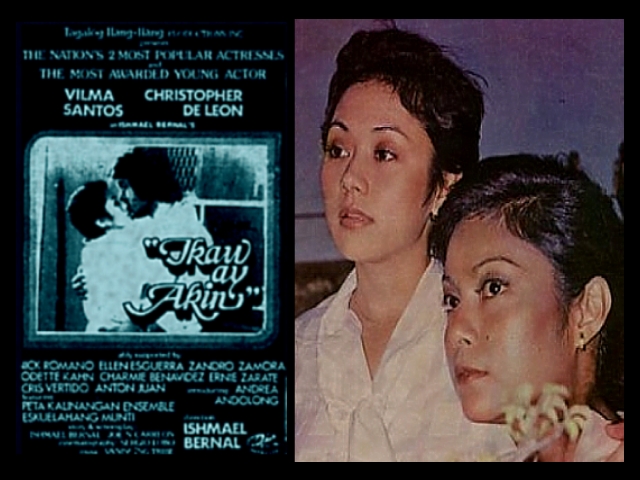
Filmography: Ikaw ay Akin (1978)

“Rex…anong gagawin mo? Ako anong gagawin ko? Ako ba ang nagpapagulo sa otherwise your perfect world?…sure? Rex ang problem ako hindi lang ako eh…si Teresita rin…nasasaktan ko na siya…anong gagawin ko iwasan kita eh de ako naman ang nasaktan? Shit! Bakit? Ewan…nahihiya nako kay Teresita at saka sa’yo eh!…Rex huwag mong sabihin yan, naiintindihan mo ba ako? I need your presence more than anything else. Sabi nila liberated woman raw ako, front lang, kalog raw, front din…alam mo namang kulang-kulang ako eh sinabi ko na sayo nun pa…ninenerbiyos ako kapag hindi kita kasama eh, baka dapuan ako ng kung ano diyan, bery-bery, typoid fever! Pakiramdam ko safe lang ako kapag nariyan ka eh…pag wala ka,huh, nagwawala ako parang manok takbo ng takbo wala namang ulo!…Rex, anong gagawin mo?” – Sandra

This slideshow requires JavaScript.

Basic Information: Directed, screenplay: Ishmael Bernal; Story: Jose Carreon; Cast: Vilma Santos, Nora Aunor, Christopher De Leon, Nick Romano , Ellen Esguerra, Zandro Zamora, Odette Khan, Charmie Benavidez, Ernie Zarate, Cris Vertido, Anton Juan, Sandy Andolong; Executive producer: Experidion Laxa; Original Music: The Vanishing Tribe; Cinematography: Sergio Lobo; Film Editing: Augusto Salvador; Production Design: Mel Chionglo; Sound: Teddy Ramos, Rolly Ruta

Plot Description: Botanist, Tere’s (Nora Aunor) long stable relationship with business executive Rex (Christopher Deleon) was shaken when Sandra (Vilma Santos) came into their lives. A pill popping liberal career minded, Sandra made Rex’s monotonous life colourful and exciting. He later realized that both women complete his existence. – RV

An unusual story of three people caught in the unexplainable intricacies of love and need. The five year old relationship of Rex and Tere is put to a test as Sandra, the kooky, talented and aggressive designer rocks the picture perfect and peaceful relationship. The solid and unruffled engagement cracks as Rex is immediately smitten by Sandra’s dynamic persona. The film features the superstar team-up of award winning artists Nora Aunor and Vilma Santos and the drama king, Christopher de Leon. – Database of Philippine Movies

Ang ‘Ikaw ang Akin’ ay tungkol sa isang paboritong paKsa sa ating puting-tabing: ang trianggulo ng pag-ibig. Si Rex (Christopher de Leon) ay batambatang tagapamahala ng isang pagawaan ng dyipni. Limang taon na silang magkatipan ni Tere (Nora Aunor), isang dalubhasa sa paghahalaman. Mapayapa at maayos ang kanilang pagsasama hanggang makilala ni Rex si Sandra (Vilma Santos), isang designer. Nagsimulang magkaroon ng sigalot ang pagsasama nina Rex at Tere. Hindi makapagpasiya si Rex kung sino ang pipilijn sa dalawa na kapwa naging matimbang sa kanya. Sa huli, nataios ni Rex na ang pag-ibig at pag-aangkin sa isang nilalang ay isang masalimuot na damdaming hindi nararapat sarilinin ng isang tao lamang. – Manunuri

Tagalog movie’s traditional love triangle is told in a sophisticated, unconventional way. Stars three of the country’s younger superstars – Christopher de Leon torn between a quiet, conservative type played by Nora Aunor, and a contemporary “free spirit”, Vilma Santos. Excellent performances by the three principal players with fine support by Ernie Zarate, Ellen Esguerra, and Rene Requiestas. Earned the critics Urian nominations for best actress (Aunor and Santos), supporting actor (Zarate), screenplay (Jose N. Carreon), cinematorgraphy, editing, sound, direction and best picture. Urian awardees for best actor (De Leon), production design (Mel Chionglo) and musical score (Vanishing Tribe). Directed by Ishmael Bernal for Tagalog Ilang-Ilang. – Trigon Video

Film Achievement: 1978 Gawad URIAN Best Actor – Christopher De Leon; 1978 Gawad URIAN Best Music – “The Vanishing Tribe”; 1978 Gawad URIAN Best Production Design – Mel Chionglo; 1978 Gawad URIAN Nomination Best Actress – Vilma Santos; 1978 Gawad URIAN Nomination Best Actress – Nora Aunor; 1978 Gawad URIAN Nomination Best Cinematography – Sergio Lobo; 1978 Gawad URIAN Nomination Best Director – Ishmael Bernal; 1978 Gawad URIAN Nomination Best Editing – Augusto Salvador; 1978 Gawad URIAN Nomination Best Picture; 1978 Gawad URIAN Nomination Best Screenplay – Jose Carreon; 1978 Gawad URIAN Nomination Best Supporting Actor – Ernie Zarate

Film Reviews: “…After 37 years, Ikaw Ay Akin becomes a materialist indictment of the patriarchal deceit cisgender passion must contend with, opening up the queerness that emerges from feminine confidence as zone of alternative feelings. And, of course, Nora still punctures the assault with an imperturbable will to punctuate the sentence, despite the adages of her time failing to utter competitive affection, convincing Vilma that the encounter isn’t just about female rivalry, but also masculine decadence…” – J. Pilapil Jacobo, Young Critics Circle Film Desk, 21 November 2015 (READ MORE)

“Ikaw ay Akin” is the latest addition to Ishmael Bernal’s continuing attempt to portray how people and relationships are at once simple and complex. It is also the most engaging local movie shown this year, once again proving that the marriage of commerce and art can be remarkably fruitful. Those who expect the film to be one of those triangles of the “Sapagkat Kami’y Tao Lamang” variety will be disappointed. Made with taste and finesse uncommon in Pilipino movies. “Ikaw” surveys the interactions of three people caught in the unexplainable intricacies of need and love.

Rex, the young executive of a jeepney-producing firm, has been going steady with Tere, a demure orchid expert, for five years. Theirs is the kind of self-satisfied relationship that results from along, unruffled engagement. That is until he meets Sandra. An artist-designer, Sandra is kooky, talkative, aggressive career girl who is also neurotic, chain-smoking, tranquilizer-gulping, phobia-laden product of a broken family. Rex is immediately attracted to Sandra’s seemingly boundless energy. Compared to her, Tere is a calm, reserved, efficient, level-headed woman who looks totally in control of herself.

The “menage-a-trois” is then sensitively laid out for viewers to look into the hurts and joys, hesitations and decisions, delights and agonies of each character. At film’s end nothing is really resolved. Most loyal viewers will be revolted by this ambiguity. To get their money’s worth, they feel they must be sure “kung kanino talaga napunta si Christopher, kay Nora ba o Vilma?” But Bernal is not so much concerned with fulfilling audience expectations than with putting across his message: that no one can totally, absolutely, fully own another human being. The best thing is to understand the needs of a person and love him according to his limitations. This is evident in the lines of Rex, whose character we completely grasp only as the film nears its conclusion. Rex tells Tere: “Kailangan ako ni Sandra hindi lamang sa pisikal kundi sa emosyonal din. Tulad ng pangangailangan ko sa iyo. Sa kanya, parang nagkaroon ako ng gamit. Kailangan ko kayong dalawa para mabuo ako.” To Sandra, he says later: “Si Tere, tinaggap nang hindi niya ako maaangkin nang buong-buo. Kung sasabihin mong nakuha mo nang buong-buo ang isang bagay, kulang pa rin.”

Unlike other superstar team-ups that fail to exploit the golden opportunity of pulling in sure audiences to watch a serious work, Bernal’s greatest achievement lies not so much in putting his three big stars together but in making use of them to lure their fans and followers intos eeing a mature, sensible film. And his cast serves Bernal very well. In the hands of a capable director, Christopher de Leon proves that his forgettable appearance in such odious films as “Topo-Topo Barega” and “Disco Fever” are mere lapses in judgment that do not entirely discredit his craft. He also shows enough gallantry by not getting into the way of his leading ladies, whose roles are undoubtedly more demanding than his. As the uptight Sandra, Vilma Santos has the script’s choicest, wittiest lines. She makes the most of them and succeeds in giving a fairly accurate portrait of an emotionally insecure young woman. And when she tells Rex: “sabi nila liberated ako, front lang. Kalog daw, front din. Alam mo namang kulang-kulang ako. Pag wala ka, magkakalat ako. Para akong manok, takbo ng takbo wala namang ulo.” She likewise handles her final breakdown exceedingly well. Nora has less lines but she nevertheless manages to conveys her emotions very effectively. In that family reunion-party which is so engrossed in gossip and banter, she remains so detached, speaking nary a word — a triumph for both Bernal and her. The hurt in her eyes continues to build up until that disrupted dinner scene where she rushes to her room and, unable to contain herself, finally cries. The most stable of the three, you could really believe her when she tells Rex: “Galit ako sa ‘king sarili, dahil sinasaktan mo na ako nang todo-todo pero lalo ka namang napapamahal sa akin.”

The film is greatly enhanced by Jose Carreon’s vibrant script, Mel Chionglo’s superb production design, the Vanishing Tribe’s fine musical score, and Augusto Salvador’s brisk editing (few scenes last longer than a couple of minutes). But the lion’s share of credit goes to Bernal. I particularly like his splendid use of meaningful pauses and oppressive silences, as in Sandra and Tere’s accidental first meeting at Rex’s house, Sandra’s soundless dinner with her father that leads to her breakdown, and the long, quiet ending scene where Sandra and Tere never say a word and yet succeed in finally communicating with each other. Our viewers are discomfited by this exhausting process, what with the underdeveloped tastes of our mass audience perpetuated by irresponsible irectors. But one fervently hopes for Bernal, who apparently believes he owes the audience his best even if they are more likely to love his third best more, that they would get the film’s message and, perhaps, even accept and like it. – Mario E. Bautista, Philippine Daily Express, 1978

“…Mas challenging ang role ni Ate Vi rito kumpara kay nora…mas magaganda ang mga dialogues ni Ate Vi na nakakatuwa at magaling ang pagkakadeliver niya ng mga linya. Sexy siya ha at magaganda ang mga damit na ginamit niya rito. Maigsi ang buhok na medyo curly. Bagay na bagay sa kanya. Komento ko lang ay medyo matinis pa ang boses ni Ate Vi rito…Ok din naman si Nora dito kaso nga gaya nga sabi ko, mas malaman ang role na napunta sa kanyang kumareng Vilma. Asiwa rin ako sa wig niya…teka naka wig nga ba siya rito na mahabang makapal? Di ko lang type ang pag-iyak ni nora…ewan ko ha pero wag naman sanang magagalit ang mga Noranians, medyo napapangitan talaga akong umiyak si Nora kahit noong bata pa ako. Pangit na pangit ako sa pag-iyak niya. Parang pinipilit niyang mag emote. Di rin ako sanay na nakikipaghalikan si Nora sa mga movies, sabagay bibihira naman talaga makipaghalikan si Nora sa mga screen partner niya at usually naman si Boyet ang kahalikan niya pero noong pinapanood ko ang halikan scene nila Nora at Boyet, parang naaasi-wa ako. Ewan ko ba…parang nakakadiring tignan ewan…upps, komento ko lang iyan ha…sa sine parang sa tingin ko ay di sabay ito kinunan sa tingin ko lang ay di sila magkaeksena rito bagamat pareho silang nasa sinehan. b) bahay scene – ang ikli ng pagsasama nilang dalawa rito na parang pinasabik ang mga manonood kung may iringan ba or acting sa acting ang magaganap, pero walang naganap na ganun! c) No Dialogue Scene – Grabe!! Ang galing ng eksenang ito. First time kong makanood ng ganitong ending…walang salitaan, sagutan, walang murahan, walang away, wala as in wala except labanan ng facial expression, eye acting ika nga. Kainis lang ang director na ito kasi pinaglaruan lamang ang imahinasyon ng mga manonood at ng mga Vilmanians-Noranians!!! huh… Mas gusto ko pa rin na marami sana silang eksena na magkasama…sayang!…” – Dream Forest, V magazine Nos. 7 2006

“…Makikita sa Ikaw Ay Akin ang dalawang magkaibang estilo ng pagganap na ipinamalas nina Nora at Vilma at kapwa akmang-akma ito sa buong katauhan ng mga karakter na kanilang ginampanan. Sino ang mas mahusay sa kanilang dalawa? Kani-kaniyang opinyon, depende sa mga nakapanood ng pelikula. Maraming nagsabing mas pinaboran daw ni Bernal si Vilma sa dahilang mas maramin itong mabibigat na eksena kaysa kay Nora, ngunit paano makakalimutan ang huling tagpo sa Ikaw Ay Akin kung saan mahabang katahimikan ang naging daan upang higit na magkaintindihan sina Tere at Sandra tungkol sa kanilang pag-ibig kay Rex. Kung totoong mas pinaboran ng direktor si Vilma ay nakabawi naman ito ng husto kay Nora pagdating sa nabanggit na eksena. Kakaiba din ang husay na ipinamalas ni Christopher de Leon, maaring alam niyang ang Ikaw Ay Akin ay pelikula ng dalawang malalaking aktres kung kaya tama lamang ang bigat ng pagganap na ipinamalas ng aktor sa papel ni Rex. Napagwagihan ni Christopher ang Pinakamahusay Na Pangunahing aktor mula sa Manunuri Ng Pelikulang Pilipino nang sumunod na taon samantalang kapwa nakatanggap ng nominasyon bilang Pinakamahusay Na Pangunahing Aktres sina Nora at Vilma sa Ikaw Ay Akin ngunit kapawa sila natalo ni Beth Bautista para sa kanyang mahusay na pagganap sa Hindi Sa Iyo Ang Mundo, Baby Porcuna. Hindi matatawaran ang tagumpay ng mga manlilikhang bumuo sa Ikaw Ay Akin na nagtaas ng kalidad ng dramatikong pelikulang Pilipino, nagturong umintindi ng husto sa damadamin ng mga taong tunay na nagmamahalan.” – Jojo Devera, Sari-saring Sineng Pinoy (READ MORE)

“…“Ikaw Ay Akin,” 1978, Ishmael Bernal. A refreshing change of role for the superstar, cast here as a smart and sophisticated horticulturist at odds with best friend and real-life rival Vilma Santos. Notable for its experimental and long closing shot of the two friends’ reunion, with only their eyes talking…” – Mario A. Hernando, Philippine Daily Inquirer, 01 October 2011 (READ MORE)

Silent Confrontation – “…The movie brings together fierce cinema rivals Aunor and Vilma Santos as well as Aunor’s then-husband, Christopher de Leon. Skydiving enthusiast Rex (De Leon) and horticulturist Tere (Aunor) are in a stable relationship until the arrival of Sandra (Santos), a liberal-minded artist. Rex embarks on an affair with her, then becomes overcome with guilt when Tere discovers the relationship. Ikaw ay Akin is best known for the “silent” confrontation scene between Aunor and Santos, where neither speak a single line and communicate by just staring at each other…” – Coconuts Manila, 27 July 2018 (READ MORE)

RELATED READING:

Filmography: Burlesk Queen (1977)

“Kung Inutil kayo, Di Inutil kayo. Wala naman tayong magagawa kung yan ang gusto ng Diyos para sa inyo.” – Chato

This slideshow requires JavaScript.

Basic Information: Directed: Celso Ad Castillo; Story: Mauro Gia Samonte, Celso Ad Castillo; Screenplay: Mauro Gia Samonte; Cast: Vilma Santos, Rolly Quizon, Rosemarie Gil, Leopoldo Salcedo, Roldan Aquino, Chito Ponce Enrile, Dexter Doria, Yolanda Luna, Joonee Gamboa; Original Music: George Canseco; Cinematography: Benjamin L. Lobo; Film Editing: Abelardo Hulleza, Joe Mendoza; Production Design: Jose Tamayo Cruz; Sound: Gregorio Ella

Plot Description: To support her paralytic father, Chato (Vilma Santos) works as a utility girl at Inday Theater for a burlesque star Virgie Nite (Rosemary Gil). Chato desperately wants to earn money to help her ailing and paralyzed father. When Virgie gets drunk on the night of her scheduled show, Chato pitches in for her, and she becomes an instant sensation. Enthused by the initial acceptance of the audience, she defies her father’s admonitions and presents herself to the manager, thus, becoming the new burlesque queen. The aberrant lifestyle of a burlesque performer leads Chato to a misguided existence. She becomes pregnant and is abandoned by the father of her baby. Desperate for cash, she agrees to appear in a lavish stage show. In front of a screaming male audience, Chato bumps and grinds in a tour de force performance, unaware of the danger to her pregnancy. – wikipilipinas

Film Achievements: Philippines’ Official Entry to the 1978 Berlin Film Festival (official citation not verified); Official Entry to the 1978 Festival del film Locarno (Switzerland); 1977 Metro Manila Film Festival: Festival Revenue Top Grosser; Best Actress – Vilma Santos; Best Picture – Ian Films; Best Actor – Rolly Quizon; Best Director – Celso Ad Castillo; Best Supporting Actress – Rosemarie Gil; Best Supporting Actor – Johnee Gamboa; Best Screenplay – Celso Ad Castillo, Mauro Gia Samonte; Best Production Design – Jose Tamayo Cruz; Editing – Abelardo Hulleza, Joe Mendoza; Best Musical Score – George Canseco; 1977 FAMAS: Best Actress Nomination – Vilma Santos; Best Supporting Actress Nomination – Rosemarie Gil; 1977 Gawad Urian: Best Picture Nomination – Ian Films; Best Actress Nomination – Vilma Santos; Best Director Nomination – Celso Ad Castillo; Best Supporting Actress Nomination – Rosemarie Gil; Best Supporting Actor Nomination – Rolly Quizon; Best Screenplay Nomination – Mauro Gia Samonte; Best Music Nomination – George Canseco; Best Sound Nomination – Gregorio Ella

Film Review: “…Celso Ad. Castillo’s Burlesk Queen (Burlesque Queen) is most famous for Vilma Santos’ noteworthy performance. She plays Chato, daughter of crippled Roque (Leopoldo Salcedo). She works as assistant to Virgie (Rosemarie Gil), current star of the burlesque stage (the film opens with Gil gyrating to the rapid beatings of drums, to the ecstasy of her numerous patrons). Resisting the lofty wishes of her father, Chato succumbs to the lure of the stage and the money it would bring her. It really is a grand performance as Santos was able to deliver the physical requirements of the role with her inate charismatic aura (a skill that earned the actress legions of fans and eventually elected to public office). Santos’ Chato is servile to the men around her (her father, Louie the theater manager (played by Joonee Gamboa in the film’s other equally terrific performance) and Jessie (Rolly Quizon), her boyfriend) but when she dances onstage, it doesn’t come off as merely sensual and titillating. She dances burlesque to make a statement (if there is such a thing), a statement important enough to die for…Burlesk Queen is much more than a gripping commercial melodrama. It is also a scathing commentary on the sarcastic sexual politics that has become the atmosphere of Philippine society: of hardworking women and the good-for-nothing men they serve (in other words, a patriarchal society gone awry). It is also a fervent reminder of the redemptive and equalizing power of art, which is the reason why it will always be a threat to those who hold power. Multi-faceted, committedly acted, and very well-directed, Burlesk Queen, I opine, is an unsung masterpiece…” – Francis “Oggs” Cruz, Lesson from The School Innattention (READ MORE)

“…Simple lamang ang plot. Isang tinedyer si Vilma Santos na alalay ng isang original burlesk queen, si Rosemarie Gil. May tatay na lumpo si Vilma, si Leopoldo Salcedo. Si Rosemarie naman ay may kabit na isang hustler, si Roldan Aquino. Nang iwanan ni Roldan si Rose, nagwala ang huli. Naging lasengga siya at tumangging magsayaw sa tanghalan. Mabibitin ang palatuntunan, kaya’t si Vilma na talaga namang may ambisyong magsayaw ang pumalit. Hit naman sa manonood si Vilma. Sa bahay, pilit kinukumbinsi ni Vilma si Pol na payagan na siyang maging full time dancer. Ayaw ni Pol, mas mahalaga sa kanya ang prinsipyo at delikadesa. Sapagkat wala namang ibang pagkakakitaan, si Vilma rin ang nasunod sa bandang huli. Nag-suicide si Pol nang hindi na niya masikmura ang pasiya ng anak. Si Rollie Quizon naman ang binatilyong masama ang tama kay Vilma. Nagtanan sila at nagsama. Pero hindi sanay sa hirap si Rollie. Sa pagpili sa pag-ibig o ginhawa sa buhay, ang huli ang pinahalagahan niya. Nagkataon namang buntis na si Vilma. Sa pag-iisa sa buhay, nagbalik siya sa pagsasayaw. Nagsayaw siya ng nagsayaw hanggang duguin siya sa tanghalan at malaglag ang kanyang dinadala…Kung matino ang kaanyuan ng pelikula, ay ganoon din ang masasabi sa nilalaman. Makatotohanan at masinop ang pagtalakay sa buhay ng isang abang mananayaw. Tinalakay rin dito kung paano siya tinatanggap ng lipunan at inuusig ng mga tagapangalaga raw ng moralidad. Maging ang empresaryo ng tanghalan na ginampanan ni Joonee Gamboa ay may konsiyensiya rin at nagtatanong sa atin kung anong panoorin ang dapat ibigay sa isang ordinaryong Pilipino na hindi kayang pumunta sa mga mamahaling kainan upang manood tulad halimbawa ng Merry Widow at Boys in the Band. Sila, aniya ng mga ‘dakilang alagad ng moralidad na nagdidikta at kumu-kontrol sa moralidad ng komunidad’, katapat ng munting kasiyahan ng isang Pilipinong hindi ‘kaya ang bayad sa mga ekslusibong palabas ng mayayaman.’ Samantala’y busy tayo sa paglilibang at sa kanila’y walang pakialam ngunit may handang pintas at pula sa mangahas lumabas sa batas ng moralidad ng lipunan…” – Jun Cruz Reyes, Miyembro, Manunuri ng Pelikulang Pilipino, Manila magazine December 1977 (READ MORE)

“…Furor is really an understatement. “Burlesk” swept the awards in that year’s MMFF, resulting in a controversy that led to the wholesale return of trophies. In spite of the scandal, “Burlesk” is still regarded by critics as the “quintessential” Filipino film. “Hinamon ni Brocka si Tinio ng suntukan (Lino Brocka dared Rolando Tinio to a fight),” Celso remembers. “Tinio, who was the head of the jury, heralded “Burlesk as the most beautiful Filipino film” past, present and future.” Vi’s turnaround: Adding fuel to the fire, “Burlesk” had stunned moviegoers because it unveiled a new “Vilma Santos” from ingénue to wanton woman. Vilma says of “Burlesk” – “It marked a transition in my career. Working with Celso Kid is a privilege. He’s a genius.” With good humor, Vilma recalls a “quarrel” on the set of “Pagputi ng Uwak, Pag-itim ng Tagak,” which she produced in 1978. “It took so long to finish. I lost money on that. But we’re still friends.” Burlesk and Pagputi brought a lot of honor to me…” – Bayani San Diego Jr. (READ MORE)

“…It was 1977 with an exceptional film, Burlesk Queen, that Castillo got his first critical recognition. Entered in that year’s Metro Manil Film Festival, it was adjudged the Best Picture, won forhim a Best Director Award as well as nine other artistic awards. It told a young girl in Manila in the 50’s who wanted to become a burlesque dancer. It showed a subdued Castillo. He seemed in this film, to have held back his passion for visual impact to give way to his new mastery of film grammar. His characters cried and whimpered, they did not scream and curse. They delievered dissertations on art, not imprecations of wrath, which had set the pitch of his previous films. The critics fought bitterly over Burlesk Queen. In that festival, he was contending with film makers who enjoyed a high reputation among the country’s most avid film critics. Upon winning the award, Castillo instantly became the favorite beating boy of the critics who did not appreciate Burlesk Queen. To prove to them his worth, Castillo did Pagputi ng Uwak, a 50’s epic set in his favorite Southern Tagalog locale. It was the most lavish of all his productions and had all the elements of a “great” Filipino film. He exploited the many religious and social rituals typical of the region. The film featured the two most critically acclaimed performers of the time, Bembol Roco, Jr. and Vilma Santos, with the cinematography of Romy Vitug complementing Castillo’s visual sense. And it touched on civil unrest to underline the film director’s social awareness. Pagputi ng Uwak was a visual fest, an artistic and socially responsive film aimed at the critics. It was also Castillo’s first commercial failure after a string of more than 20 minor and major box-office hits…In just a decade, Castillo, with all his audacity and dramatic excesses, has claimed his place as one of the most versatile and genuinely interesting filmmakers in the Philippines today…” – Rosauro de la Cruz (READ MORE)

Restoration – “…Two decades ago, it would have cost P15 million to restore an old movie; but with digital technology, the cost of saving our cinematic gems has become less prohibitive. Leo Katigbak, head of ABS-CBN Film Archives, had always wanted to upgrade the network’s library, home to such classics as Peque Gallaga’s “Oro, Plata, Mata” and Ishmael Bernal’s “Himala.” He recalled, “It always boiled down to a question of costs…One film that can never be restored, sadly, is Celso Ad. Castillo’s “Burlesk Queen,” starring Vilma Santos. “The only remaining copy we have of ‘Burlesk Queen’ is on video,” said Katigbak. We can’t restore material that’s on video. We have to go back to the negatives or master print…” – Bayani San Diego Jr. (READ MORE)

Devoid of the “pang-FAMAS” – “…The 1977 Urian Awards further established the reputation of the Manunuris as discoverers of new or ignored talents. Word spread around that “you don’t have to spend a cent for PR to win in the Urian” after Daria Ramirez (Sino’ng Kapiling, Sino’ng Kasiping) bested formidable co-nominee Vilma Santos (Burlesk Queen) for the best actress plum. The choice of Ramirez was not a popular one either, for her portrayal of a middle-class wife was devoid of the “pang-FAMAS” hysterics usually equated with good acting in Philippine movies…” – The Urian Anthology 1970-79 (READ MORE)

“…On Burlesk Queen. “Yes, I will never forget that seven-minute dance in the movie. I postponed the shoot of the scene five times. I was so afraid. I performed the dance in front of a real burlesk show audience. I remember the controversy about the Metro Manila Film Festival Awards and the squabble between Rolando Tinio and Lino Brocka. They wanted us to return the trophies. I didn’t return mine. I deserved it. I worked hard for that trophy…” – Boy Abunda, The Philippine Star, July 31, 2009 (READ MORE)

“…This veritable spiritual co-ownership ostensibly has enriched us all, Asians or Asean. It is no mark of a monarchical hauteur to say, for instance, that the films of Celso Ad Castillo, once dubbed as the Messiah of Filipino movies, are contemporaneous in their being a classic. If all these seem contradictory, Celso can easily point to his filmography to prove that there has always been, and will always be, fire in his filmmaker’s eyes. His “Burlesk Queen” and “Pagputi ng Uwak, Pag-itim ng Tagak,” for one, are now a classic, conscience-searing sociological film tractatus on structutal violence and institutional injustice that probed into the hearts of little people amidst a third world setting as encapsulated in the microscopic life of a poverty-stricken, young woman. It’s Rossellini, you would say? Think again…Pagputi ng Uwak, Pag-itim ng Tagak was sent to Sao Paolo, Brazil for the Latin American Film Festival and represented the Philippines at the Asean Film Conference in 1981…” – Celso Ad Castillo Presents web-site (READ MORE)

“…One of the first Filipino filmmakers to invade foreign film festivals abroad with such output as Burlesk Queen and Alamat ni Julian Makabayan (Berlin Film Festival and World Film Festival in Montreal) and Nympha (Venice Film Festival), among others, Celso The Kid returned to his hometown Siniloan, Laguna where he led a quiet life while working on his autobiography…His 1977 film, Burlesk Queen, won 10 out of the 11 awards of the 1977 Metro Manila Film Festival but the results were contested by Lino Brocka and defended by juror Rolando Tinio (now National Artists for Film and Theater), respectively. He reflected: “I wanted to vindicate myself as a filmmaker in this movie. The media referred to me as a reluctant artist and a filmmaker who has yet to arrive. Not only did the film run away with awards. It was also the top grosser. It broke the myth that quality films don’s make money in the box-office and commercial films don’t win awards…” – Pablo A. Tariman, The Philippine Star, 28 November 2012 (READ MORE)

“…Rosemarie Gil, like her daughter Cherie, was known for her rich socialite-villain roles, but surprisingly, she was introduced in a religious movie in 1958, in the title role of “Santa Rita de Casia (Patrona ng Imposible)”, opposite Lauro Delgado, who portrayed the saint’s wayward husband. This movie turned out to be a hit, but in the 60s, she married Eddie Mesa (Eddie Eigenmann, in real life), putting her stardom on hold, while her husband, known as the Philippines’ Elvis Presley, enjoyed a flourishing career as a singer and actor. The couple would eventually settle in the U.S., separate and then reconcile. Rosemarie went back to make movies for international release in the 1970s, starting with “Manda” (1970), “Night of the Cobra Woman” (1972), “Master Samurai” (1974), and the remake of “Siete Infantes de Lara” (1973). It was in 1977 that she made her presence felt in the 1977 critically-acclaimed “Burlesk Queen”, starring Vilma Santos. For her role as Virgie Nite, Rosemarie earned a Gawad Urian nomination the following year…” – Alex R. Castro, Views from Pangpang, Feb 21 2011 (READ MORE)

“…Celso Ad. Castillo, known as L’Enfant Terrible of Philippine Cinema, was best remembered with his fully independent spirit and out of the box ideas both on narrative and style. I always remember an Ad. Castillo film watching was always crazy in different ways. From the mock-tribal language of Snake Sisters (1984), the living house in Mga Lihim ng Kalapati (1987), to his melodramas charged with socio-political statements (Ang Alamat ni Julian Makabayan (1979), Burlesk Queen, (1977)). His ideas has always been crazy and there are some of those “first” experiences that was only given by his films: the first to see Fernando Poe Jr. die on a film (Asedillo), the first surrealist Filipino film I saw (Mga Lihim ng Kalapati(1987)), and also the first to see historical parallelism realized on both narrative and it’s image (Ang Alamat ni Julian Makabayan (1979)) which he probably used on remaking his own films (Nympha (1971, 2003), Ang Lihim ni Madonna (1979)). Being a lover and creator of Genre, he thinks that aiming for box office success was never a hindrance to make a good film. This he has proven on his body of work. I remember Burlesk Queen as one the film with the best performances ever, both from Vilma Santos and Joonie Gamboa. Especially Joonie Gamboa. Santos starred as Chato, once was an assistant of a dancer on a burlesque bar dreams also of being in the limelight even though her father won’t approve. Chato went from this dilemma to failed relationships until finally realizing her dream. Contains a lot of powerful scenes that would drove my emotions into a mixed state. Burlesk Queen is the proof of Celso’s vision: a success on the artistry and mass reception. Other Celso Ad. Castillo Films to prioritize: Ang Alamat ni Julian Makabayan, Payaso, Pagputi ng Uwak, Pag-itim ng Tagak, Asedillo…” – Epoy Deyto, Kawts Kamote, September 12, 2013 (READ MORE)

“…As for his masterpiece Burlesk Queen (1977)–here’s an excerpt of what I wrote about a moment in the film (Chato’s deflowering), for Chris Fujiwara’s The Little Black Book of Movies: “Celso uses Jessie’s smooth back as both veil and metaphor for Chato’s nudity, the clothes dropping from overhead hangers as metaphor for her failing inhibitions; what makes the scene erotic and nakedly emotional is Chato’s face, glimpsed over Jessie’s left shoulder as terror (the widened eyes), greed (the remote expression, as if she were a starving man wolfing down a steak), pain (the startled look of one who has been kicked in the crotch), guilt (the tears) and finally pleasure (the bit lower lip) flit across and mingle in her eyes.” Ad Castillo was not a genius; he was more interesting than that. His films were often incoherent, often inconsistent, sometimes because he didn’t have the money, sometimes because he told stories that way–apparently narrative was secondary to him, an excuse to flex his prodigious filmmaking muscles. Of his greatest works–which include but are not limited to Ang Alamat ni Julian Makabayan; Pagputi ng Uwak, Pagitim ng Tagak; and Burlesk Queen–his imagery burned incandescent, his filmmaking technique was second to none. If Mike De Leon is Philippine Cinema’s mad intellectual, Lino Brocka its fiery social realist, Ishmael Bernal its skeptic-satirist, Mario O’Hara its nightmare scenarist, Celso was its poet laureate–his images were Filipino lyricism incarnate. His passing is an unimaginable loss…” – Noel Vera, Critique After Dark, 06 December 2012 (READ MORE)

RELATED READING:

Filmography: Rubia Servios (1978)

“Hayup! Hayup! Hayuuuup!” – Rubia Servios

“Nahihibang ako sa pagnanasa sa iyo, ilang libong beses na kitang hinuhubaran sa aking isipan, pinagsasamantalahan sa aking pangarap!…Ito’y isang pagsubok sa ating pagmamahalan, kahit ano pa ang nangyari sa iyo, mahal kita, kailangan kita!…” – Willie Trizon

This slideshow requires JavaScript.

Basic Information: Direction: Lino Brocka; Screenplay: Mario O’Hara; Cast: Vilma Santos, Mat Ranillo III, Phillip Salvador, Estrella Kuenzler, Esther Chaves, Carpi Asturias, Jess Ramos, Leah de Guzman, Mark Verzosa; Cinematography: Conrado Baltazar; Editing: Jose H. Tarnate; Music: Freddie Aguilar; Production Company: Sampaguita Pictures, Inc.; Release Date: December 25, 1978; “Rubia Servios (Case No. 63572)” (1978); Office Entry to The 4th (1978) Metro Manila Film Festival Entry; Based on an “Unforgettable Legal Story” by Aida Sevilla Mendoza; Theme Song: “Pag-subok” composed and sang by Freddie Aguilar

Plot Description: Medical intern Rubia Servios (Vilma Santos) is engaged to Dr. Norman Ignacio (Mat Ranillo III), but persistent suitor Willy Trison (Phillip Salvador) refuses to give up. On the day of the death of Norman’s father, she is abducted by Willy and brought to an island. She is repeatedly raped and offered marriage by Willy. She turns him down and warns him that she will bring matters to the police. However, he is confident that she will not press a case against him as she will not want the stigma of a rape victim. Rubia is released and she brings him to court. Willy is sentenced to six to ten years in prison. Rubia discovers she is pregnant and the steadfast Dr. Norman Ignacio proposes marriage. She gives birth to Willy’s daughter, Vivian, and they leave for Canada. Rubia wants a child by Norman and they have a son. Years later, they return to Manila. There are mysterious calls on the telephone. It is Willy and he wants his daughter. Rubia and Norman hide Vivian and plan to leave for the American continent. However, Willy is able to kidnap the child with the help of an ice cream vendor. She is brought to the island and she begins to look to him as her real father. But she also wants her mother. Willy calls Rubia and tells her to join them in the island. Rubia refuses. There is a confrontation between Norman and Willy. Norman is beaten up. Still Rubia is adamant. She becomes terrified when Willy sets up a headless child in a remote area, the discovery of which is sensationalized in the tabloids. Finally Rubia agrees to join him. She takes the motorized banca with Willy as the pilot. In the middle of the sea, she takes a paddle and hits Willy. Willy falls into the water. Rubia takes her gun and shoots him. The banca reaches the island. Rubia is happy to see Vivian alive. As an epilogue, Rubia and Norman leave for the States where they are presently residing. – Lino Brocka: The Artist and His Times, reposted Simon Santos, Video48, 29 December 2018 (READ MORE)

Sa umpisa ng pelikula, makikitang nag-aaral pa lamang si Rubia (Vilma Santos), Norman Ignacio (Mat Ranillo III) at Willie Trizon (Philip Salvador). Masugid na manliligaw ni Rubia si Willie kahit na alam na nito na may nobyo na siya’t pakakasal na sila sa pagkatapos ng taon. Nang malaman ni Willie na pakakasal na si Rubia ay naging desperado ito’t plinano na kidnapin si Rubia. Isang araw habang naghihintay ito ng taxi sa kalye ay hinablot siya nga pat na lalaki na tauhan ni Willie. Dinalo siya ni Willie sa isang cottage sa Cavite. Nagtangka si Rubia na tumakas at tumakbo sa labas. Duon siya ginahasa ni Willie sa tabing dagat. Matapos gahasain ay nagtangkang magpakalunod si Rubia ngunit pinigil siya ni Willie at binalik sa cottage. Pinag-isipan ni Rubia kung paano niya mapipilit si Willie na pawalan siya. Tinanong niya si Willie kung anong gusto nitong mangyari. Sinabi nitong gusto niyang pakasalan siya. Pumayag si Rubia na magpakasal ngunit kailangan nitong ipaalam sa kanyang mga magulang ang nangyari sa kanya. Natagpuan naman ng pamilya ni Rubia siya sa ospital at duon nito nagpasya na maghabla. Matapos ang hearing sa korte sa kabila ng pagmamakaawa ng pamilya ni Willie ay nasentensiyahan siya ng anim na taon sa bilanguan at magbayad ng 70,000 pesos. Samantala nanatiling nakakulong sa kuwarto si Rubia matapos ang kaso. Pinilit ni Norman na kausapin ang katipan at dito nalaman niya na ang dahilan ng pagkukulong sa kuwarto ni Rubia’y buntis ito. Pinasya ni Norman na bigyan ng pangalan ang pinabuntis ni Rubia at nagpakasal ang dalawa.

Nanatiling tahimik ang buhay ng dalawa’t nagkaroon pa sila ng isa pang anak. Nang 3 years old na ang batang naging anak niya kay Willie’y nag-umpisang mangulo na naman ito. Si Willie’y nakalabas ng kulungan pagkatapos ng tatlong taon lamang. Nung una’y pinagkaila ni Rubia sa asawa ang mga tawag ni Willie. Ngunit napuna na rin ito ni Norman nang mapuna niyang madalas ang asawa na umuuwi ng maaga sa bahay at nag-umpisang uminom ng valium at naging magugulatin ito. Pinagtapat na rin ni Rubia sa asawa ang panggugulo ni Willie at pumayag ito na payagan si Rubia na makipagkita kay Willie. Nang malaman ni Rubia kung saan sila magkikita’y si Norman ang pumunta sa usapan. Ang resulta’y nabugbog ito ng mga tauhan ni Willie. Dahil rito’y naging maliwanag na hindi sila titigilan ni Willie lalo pa’t minsa’y takutin si Rubia nang wala si Norman sa bahay at pumunta si Willie’t pinatay ang aso nila. Wala naman magawa ang mga polis dahil wala silang hard evidence na si Willie nga’y nanggugulo sa buhay nila. Pinasya ni Norman at Rubia na umalis na nang bansa at bumalik sa Canada kung saan sila ilang taon ring nag-aral bago naging doctor. Pinasya rin nila na ibigay sa kanyang mga magulang ang dalawang bata para sa kanilang safety.

Sa kasamaang palad, kinidnap ni Willie ang anak nila ni Rubia na si Vivian. Nagpunta sila sa mga pulis ngunit wala pa ring magawa ang mga ito dahil wala silang ebidensiya. Kinontak ni Willie si Vivian at gusto nitong makipagkita siya rito. Pumayag si Norman ngunit sumonod rin ito sa usapan. Kasama ng kanyang mga alagad iniwanan ni Willie ang magasawa at binantaan na sa susunod magsisisi sila sa kanilang ginawa dahil nga ang usapan ay si Rubia lamang ang gusto niyang makita. Tinakot pa ni Willie si Rubia’t kumuha ito ng bankay na bata at isinuot ang damit ng anak ni Rubia. Nalathala ito sa mga diyaryo at pinuntahan ni Rubia ang bankay laking pasasalamat nito’t hindi ang anak ang bangkay. Dahil rito’y nagpasya na si Rubia na kitain si Willie na hindi alam ni Norman. Kinita nga ni Rubia si Willie ngunit nasundan rin pala si Rubia ni Norman. Sa tulong ng mga alagad ni Willie ay itinali ng mga ito sa puno si Norman at muling ginahasa nito si Rubia sa harap ni Norman. Nagsisigaw ito ngunit walang siyang nagawa. Kahit ayaw ni Rubia ay napapayag rin siya dahil papatayin ni Willie ang kanyang asawa. Pagkatapos nito’y binugbog ng mga tauhan ni Willie si Norman at sinama si Rubia papunta sa kanilang anak. Sa dagat papunta sa isla kung saan naruon si Vivian ay kinausap ni Willie ang dino-dios niyang si Rubia. Pinangako nito na matututunan rin niyang mahalin siya. Hindi napansin ni Willie na nakahawak si Rubia sa sagwan ng bangka at ilang ulit nitong pinalo sa ulo ang nabiglang si Willie habang sinasabi ang salitang “hayup!” Hinanap nito ang baril at pinagbabaril rin niya ang nahulog sa dagat na si Willie. Narating ni Rubia ang isla at duon nito nakita ang kanyang anak na buhay na buhay at tinatawag ang kanyang pangalan. The End. – RV

Film Achievement: 1978 FAMAS: Best Picture Nomination; 1978 Gawad Urian: Best Cinematography Nomination – Conrado Baltazar; Best Editing Nomination – Jose Tarnate; 1978 Metro Manila Film Festival: Best Performer Nomination – Vilma Santos; Best Editing – Jose Tarnate; Best Screenplay – Mario O’Hara; Box Office Revenue – Top Grosser

Film Reviews: Mula sa screenplay ni Mario O”hara, ang Rubia Servios ay may mabilis na paglalahad ng buhay ni Rubia at ang mga kahayupang dumating sa kanya sa palad ng isang anak ng makapangyarihan pamilya. Halatang binusisi ni Lino Brockha ang pelikula’t binigyang pansin ang mga eksenang may pagkabayolente. Dalawang beses na ginahasa ni Philip si Vilma at sa bawat eksena’y makikita ang kahalayan at pagnanasa sa mga mata ni Philip at makikita ang sakit na dulot nito sa katauhan ni Vilma. Maraming eksena kung saan inalagaan ni Lino ang pagarte ni Vilma. Hindi lamang sa rape scenes kungdi sa mga tahimik na eksena. Una na nang umagang gumising siya pagkatapos ng unang rape scene. Makikita sa mukha ni Vilma ang pagkalito at ilang sandali pa’y ang pagtanggap ng nangyari sa kanya ng gabing una siyang ginaahasa sa tabing dagat. Pangalawa, nang pumayag si Philip na pakawalan si Rubia at mapunta ito sa ospital. Pagkabukas nang kanyang mata at makita si Norman, makikita sa mga mata niya ang hirap na dinanas. Sa court scene kung saan sinasabi niya na “gusto ko siyang patayin” ng paulit-ulit. Sa bandang huli kung saan nalaman niya na hindi ang anak niya ang putol putol na batang bangkay makikita sa mata niya’t mukha ang biglang pagkatuwa’t hindi ito ang kanyang anak. At sa bandang huli pa rin kung saan ginahasa siya muli sa harap ng kanyang asawa. Makikita ang pagsuko niya’t pagkatalo. Makikita sa kanyang mukha ang pagod at hirap hanggang sa boat scene kung saan pinalad siyang makuha ang sagwan at nagkaroon ng pagkakataong paluin si Willie ng pa-ulit-ulit at hindi pa ito nasiyahan at binaril pa niya ang nangahasa sa kanya. Sa eksenang ito makikita ang kaibahan ng kakayahan sa pagarte ni Vilma. Sa eksenang ito kung saan sinasabi niya ang salitang “hayup!” sabay palo sa nabiglang si Willie. Buong katawan niya ang umaarte. Ito ay hango sa tunay na buhay. Hindi katulad ng arte ni Nora Aunor sa Ina Ka Ng Anak Mo kung saan nahuli niyang nagsiping ang kanyang asawa sa kanyang ina. Nakapokos ang kamera sa mukha niya at nag-emote ng parehong salita: “Hayup!” ang paulit-ulit niyang salita. Aba kung sa tunay na buhay iyan eh nagkasabunutan na at nagwala na ang mag-ina!

Para sa akin naging matagumpay si Vilma sa kanyang pagganap bilang si Rubia Servios. Isang tour de force. Nuong una ko itong napanood sa Avenida ay namangha ako sa kanyang galing. Ngayon pagkatapos ng dalawanput siyam na taon pinanood ko muli ito’y hindi nababawasan ang aking pagkamangha sa galing niya. Paano mo ba isasalarawan ang babae na nagahasa? Paano mo ba isasalarawan ang babaeng nakidnapan ng anak at muling nagahasa sa harap pa mismo ng asawa mo? Isang mahirap na papel. At naisalarawan ito ni Vilma nang makatotohanan. Walang mga pagpopokos ng kamera para mag-emote. Makatotohanang pagganap. Special mention sina Mat Ranillo III at Philip Salvador. Dapat ay napahalagahan sila sa pamamagitan ng nomination subalit naging maramot ang organisasyon ng pestibal at isang acting awards lamang ang binigay nila. Panalo sana si Philip Salvador ng best actor award rito dahil damang dama mo ang kanyang karakter. Makikita rin kung gaano kaganda ng kanyang katawan. Meron eksena siya na nakaswimming trunks lang at talagang alaga pa niya ang kanyang katawan nuon. Si Mat naman ay sana nanominate bilang best supporting actor. Mahusay rin siya lalo na sa eksena kung saan nakatali siya sa puno at wala siyang nagawa ng pagsamantalahan muli si Rubia sa harapan niya ni Philip.

Technically, nang panoorin ko itong pelikulang ito ay maganda ang resulta ngunit nang panoorin ko muli ng ilang beses ngayon ay makikita ang ilang flaws. Una na ang cinematography ni Conrado Baltazar. Maraming eksena ay hindi nasa tamang angulo. Merong eksena na nagsasalita si Ate Vi pero ang nakikita lamang ay ang kanyang nuo. Ang musical score ni Freddie Aguilar ay parang hindi bagay sa tema ng pelikula. Pati ang theme song na “Pagsubok” parang pang-politika at very “folksy” ang dating. Merong isang butas ang screenplay ni Mario O Harra. Nang umalis si Philip para iwanan si Vivian, ang anak niyang kinidnap, nang umalis ito’y sumakay ito ng kotse, pagkatapos nang dalhin niya si Rubia sa banding huli’y sumakay naman sila ng boat. Medyo nakaligtaan nila ang isang detalye na ito. Mabilis ang pacing na pelikula at maraming mga eksena talaga si Vilma na makikita mo ang pagaalaga ni Lino. Sayang nga lamang at hindi ito nakita ng mga hurado ng pestibal at maging ang mga manunuri ng taong iyon. – RV

Undoubtedly, the two best entries in the 1978 Metro Manila Film Festival are Atsay and Rubia Servios. Atsay is remarkable in several ways. It has a strong social message, aimed at primarily those who forget that house cleaners are also human beings. In the character of Mrs. Anton (Angie Ferro), screenwriter Edgar M. Reyes is able to embody the thousand faults which middle-class housewives are heir to. Atsay can also pride itself on being truly Filipino. Its mood is set by its Pilipino credits (in sharp contrast to the English credits of the other entries). The film deliberately exploits local color, dwelling not only on rural but also on picturesque urban scenes. The story, needless to say, can happen only in the Philippines, where domestics and beerhouses are national institutions. But the most striking thing about Atsay is its cinematography (Romeo Vitug). The slow dissolves, the multiple exposures (such as the brilliant train sequence), the surprising angles, the flawless composition—this border on genius. The cinematography is so extraordinary, in fact, that it covers a multitude of sins. The most grievous sin of all is the ending. In the end, Nelia (Nora Aunor), after having been humiliated, beaten, raped, dehumanized by the vultures of the city, decides to stay in the city anyway in the hope that an impoverished construction worker (Ronald Corveau) will make her live happily ever after. Such ending, while assuring the viewer that human nature is not totally evil, is unmotivated and, in fact, goes against the very theme of the story. For Atsay is the story of how the city dehumanizes, of how human beings become swine (this point is made through blatant symbolism in a shot of Nelia inside a cage-like jeep), of how Manila is a prison (note Vitug’s several shots of cage-like structures). “Atsay” is a story of how individuals are no match against the cruelty of the city. The construction worker, for example, becomes the victim of a construction accident. A young pretty virgin from the province is raped while she’s drugged. A kind-hearted old man is shot down while protesting against exploitation. The ending of Atsay contradicts the film’s affirmations. It would have been much more in keeping with the theme (not to mention the current concerns of the national human settlements program), if Nelia were shown rejecting the city and, in hope, returning to her province for a new life.

Rubia Servios, on the other hand, does not dilute the message. Willy (Phillip Salvador), the son of a powerful and wealthy figure, is portrayed as totally evil, devoid of any redeeming quality. To screenwriter Mario O’Hara and director Lino Brocka, the province is the same as the city. Rubia Servios (Vilma Santos) is raped both in the city and in the country. Rubia kills Willy in the country. Violence unites all places. It is the “unity” of conception, scripting, design, and direction, in fact, that Rubia Servios is superior to Atsay. Lino Brocka does not waste shots in his attempt to create a Filipino classical tragedy. He subordinates everything to the building up of one emotion in the viewer, that of hatred of Willy. So despicable does Willy become at the end that, when he is murdered by Rubia, no viewer can say that Rubia is at fault. And yet, morally speaking, no one is allowed to take the law into his own hands. The law, in fact, put Willy in prison for the first rape. There is no reason to think that the law will not put Willy to death for the second rape. By conditioning the reader to condone Rubia’s revenge, Brocka succeeds in questioning one of our deeply rooted moral beliefs. The unity that characterizes Rubia Servios contrasts sharply with the tendency of Eddie Garcia in Atsay to exploit Vitug’s versatility even at the expense of tightness. There are shots in Atsay, for example, which could easily be cut without hurting the film’s integrity. Even the train sequence, one of the best sequences in Atsay, is far too long. Rubia Servios is Lino Brocka’s film; Atsay is Romeo Vitug’s. Nora does an excellent acting job; but so does Vilma Santos, and Rubia is a much more demanding and difficult role. Edgardo M. Reyes is an established literary figure, but Mario O’Hara is much better screenwriter. Overall, Atsay may be much more impressive than Rubia Servios. In terms of challenging our moral and legal convictions, however, Rubia Servios is much more significant. – Isagani Cruz, TV Times, 1979

Kung uri ang paguusapan, de-kalidad ang Rubia Servios. Kaya lamang, may sabit. Maraming butas ang iskrip ni mario O’Hara. Ang istorya ng Rubia Servios ay batay sa mga legal story ni Aida Sevilla Mendoza, at ito’y pumapaksa sa babaeng ginahasa ng kanyang masugid na manliligaw. Si Rubia (Vilma Santos) ay isang medical student na may kasintahang kaeskuweala, si Norman (Mat Ranillo III). Balak nilang magpakasal pagkatapos ng kanilang pag-aaral. Karibal ni Norman si Willie (Philip Salvador) na ayaw tumanggap ng kabiguan sa pag-ibig. Anak siya ng mayaman at maipluwensiyang pamilya sa Kabite. Kaya nang tapatin siya ng dalaga na wala siyang maaasahan, kinidnap niya si Rubia sa isang bahay-bakasyunan at ginahasa ito. Nang magkaroon ng pagkakataon ang babae, tumakas ito at isinuplong si Willie. Idinemanda ang lalaki at nahatulang mabilanggo ng anim na taon. Paglabas ng lalaki sa bilangguan, ginulo na naman niya ang buhay ng babae na ngayo’y asawa na ni Norman at may dalawang anak (ang una’y anak niya kay Willie). Dahil sa pananakot ng hui, nakipagtagpo si Rubia, at muli na namang ginahasa sa sementeryo sa harapan pa naman ng asawa. Kinidnap ni Willie ang anak niya para gawing pain sa pagtatagpo nila ni Rubia at para sumama na tio sa kanya. Ngunit nagkakaroon na naman ng pagkakaton ang babae na lumaban at sa bangka, hinampas niya si Willie ng sagwan, at pagkatapos ay binaril ang lalaki hanggang sa ito’y tuluyan nang malunod.

Simplistiko ang materyal at lalong simplistiko ang pamamaraan ni O’Hara sa karakterisasyon. Nagmumukha tanga ang mga tauhan (si Rubia at si Norman) samantalang medical students at naturingang doktor pa naman sial. Tinatakot na sila’y hindi pa sila humingi ng proteksiyon sa pulis. Ginahasa na si Rubia ay nakipagtagpo pa sa sementeryong madilim nang nag-iisa at nagpaganda pa mandin siya nang husto. At ang asawa niya’y wala ring utak. Biro mong sinundan ang asawa sa sementeryo nang nag-iisa! Dapat nga palang magkaganito sila kung napakakitid ng kanilang utak. Sa direksiyon ni Brocka, lumitaw ang galing ni Vilma Santos, at nakontrol ang labis na pagpapagalaw ng kanyang labi. Mahusay din ang eksena ng gahasa. Si Philip Salvador naman ay tulad sa isang masunuring estudyante na sinusunod lahat ang direksiyon ng guro. Kitang-kita mo sa kanyang pagganap ang bawat tagubiling pinaghihirapan niyang masunod: kilos ng mata, buntong-hininga, galaw ng daliri, kislot ng kilay. Limitado ang kanyang kakayahan at makikia ito sa kanyang mukha (na limitado rin). Walang-wala rtio si Mat Ranillo III, na parang pinabayaan para lalong lumitaw ang papel at pag-arte ni Salvador. Samantala, ang kamera ni Conrado Salvador ay hindi gaanong nakalikha ng tension at suspense, bukod sa napakaliwanang ng disenyo ng produksiyon ang pagbabago ng mga tauhan sa loob ng pitong taon batay sa estilo ng damit at buhok. – Justino M. Dormiendo, Sagisag, February 1979 (READ MORE)

“…Mula sa isang real life legal story ang Rubia Servios, namumuhunan ito sa ideya na ang masasaksihan ng mga manonood sa iskrin ay hindi likhang-isip lamang kundi talagang nangyari sa tunay na buhay. Hinimok ni Lino Brocka sa kanyang pelikula na pagmasdan ang babae sa konteksto ng ating lipunan. Bakit ganito ang nangyayari sa kababaihan? Dahil tinatanggap nating maging ganoon ang kanilang kundisyon sa lipunan. Kung pagkakasala ang pabayaang maghari ang mayayamang may kapangyarihan, nararapat lamang na ituwid ang pagkakasalang ito. Sa mga nakakaalam ng mga pelikula ni Brocka, pamilyar ang paggamit sa estratehiya ng melodrama. Sa ganitong paraan, ang focus ay ang paghihirap na pinagdaraanan ng pangunahing tauhang babae at ito ang nakababagbag sa damdamin ng manonood. Ngunit sa pagpuntirya ng emosyon, hindi matamaan ang paglinaw sa tunay na isyu. Si Vilma Santos bilang Rubia Servios ay hindi lamang mahusay na gumanap sa buhay ni Rubia kundi naging isa ring makapangyarihang talinghaga na nakapagpalusog sa teksto ng pelikula. Sa kabuuan, inaangkin ng pelikulang Rubia Servios ang kapangyarihan nitong lumikha ng katotohanan mula sa masalimuot na materyal ng reyalidad. Sa ganitong proseso, nailalantad ang isang piraso ng reyalidad upang mapanood, masuri at mabigyang-kahulugan. Sa kabilang banda, hindi rin makakatakas ang pelikula sa mga diskursong kumakanlong sa mismong puinupuna at tinutuligsa nito…” – Jojo Devera, Sari-saring Sineng Pinoy (READ MORE)

The Screenplay – “…Mario Herrero O’Hara (born April 20, 1946 – died 26 June 2012) was an award-winning Filipino film director, film producer and screenwriter known for his sense of realism often with dark but realistic social messages…In 1978, he wrote the screenplay for Lino Brocka’s Rubia Servos. This led to the first award in his film career (Best Screenplay at the Metro Manila Film Festival)…” – Wikipedia (READ MORE)

“…There are certain themes that keep the public captive and enthralled through relentless manufacture of a thematic repertoire which ensures the preponderance of sex in stories and daily narratives. These themes need not be perceived as always proferring false consciousness, but as reiterating the social problems implicated by cinematic and industrial mediation of sexual expression. The theme of rite of passage, from innocence and youth to carnal knowledge, fastens the narrative to the body of the virgin whose initiation into the desires of the world transforms her into a “whore.” The stigma of this rite of passage is exploited from every possible angle, from ablutions in the river to rape scenes and on to the erstwhile virgin suddenly craving flesh herself…Rape likewise presents an occasion for baring the body. Brutal (1980), Rubia Servios (1978), Angela Markado (1980), and even the massacre films hatched in the bizarre mind of Carlo J. Caparas discuss rape almost clinically and therefore subject the body of the woman to another round of autopsy, this time through the prying eyes of a public reared in a daily history of sex…” – Patrick D. Flores, Bodies of Work: Sexual Circulations in Philippine Cinema (READ MORE)

New Screen Persona – “…After years of this unfair competition, Vilma decided to stop playing the also-ran, and opted to essay the roles that Nora preferred not to do, -the other woman, rape victim, burlesque dancer, etc. Vilma’s sexy movies were more suggestive than anything else, but they gave her a new screen persona that made her a distinct movie entity from Nora. Fact is, Nora could also have played sensual characters, but she felt awkward doing so, and Vilma benefited from her reticence. In time, Vilma was also winning acting awards and starring in big hits, so the competition between her and Nora peaked…” – Nestor U. Torre, Philippine Daily Inquirer, 2002 (READ MORE)

RELATED READING:

Filmography: Simula ng Walang Katapusan (1978)

This slideshow requires JavaScript.

Basic Information: Directed: Eddie Rodriguez (Luis Enriquez); Story and Screenplay: Diego Cagahastian, Beybs Pizarro Gulfin; Cast: Vilma Santos, Eddie Rodriguez, Carmen Soriano, Lito Anzures, Renato Robles, Nello Nayo, Patria Plata, Ingrid Salas, Rio Locsin, Ruben Rustria; Original Music: Rudy Arevalo; Cinematography: Ricardo Remias

Plot Description: A love triangle film of Vilma Santos with real life lovers Eddie Rodriguez and Carmen Soriano.

Film Achievement: One of film projects Rodriguez and Santos collaborated. (Ex-Wife 1981 (director), Halik sa Kamay Halik sa Paa 1979, Hindi Nakakahiya 1976 (director), Ikaw Lamang 1971, Kasalanan Kaya? 1968, Nakakahiya? 1975 (director), Simula ng Walang Katapusan (director) 1978) – RV (READ MORE)

Film Review: “…She had the likes of Eddie Mesa, Tony Ferrer and, of course, real-life love Eddie Rodriguez, as leading men on the big screen. With Eddie, two movies stand out in Carmen’s memory: “Malayo Man, Malapit Din” and “Simula ng Walang Katapusan” (the latter co-starred Vilma Santos). The way Carmen remembers it, her own love story with Eddie could rival the best silver screen romances. “We first got together when I was 16. It was just puppy love. My mom adored him, but I thought he was boring, stiff and too formal.” Two decades after that initial encounter, their paths crossed again. “We starred in a film on the life of Gen. Jose Rancudo. We were both separated [from our spouses] then.” That time around, it was a relationship of equals, she says. “We were both successful in our careers and both mature.” Eventually, they also separated…” – Bayani San Diego Jr., Philippine Daily Inquirer 10/09/2008 (READ MORE)

“…Bernal, testing the tensions of triangular love (for geometry books, one of his characters wittily says) for some time now, plunges deeper into character analysis and metaphorizing….Walang Katapusang Tag-araw was a strange reverse of characters for two women and an unusual development of love into hatred and hatred into love, where therefore the triangle was essentially illusions…” – Petronila Cleto, Pelikula, Atbp (READ MORE)

Luis Enriquez aka Eddie Rodriguez first directed a young Vilma Santos in 1968 Kasalanan Kaya, another love triangle genre starring the dramatic trio of Marlene Dauden, Eddie Rodriguez and Lolita Rodriguez. Vilma received an early acting recognitions from this film by receiving a FAMAS Nomination for Best Supporting Actress. When Enriquez directed Vilma again, it was a calculated risk that allowed a still young Vilma into a bikini-clad lead role opposite his director himself, Eddie Rodriguez. The film, Nakakahiya, a may-december affair between an older man and a young woman was an entry to 1975 Bacolod City Film Festival. Aside from making the the film a smash hit, Vilma received the festival’s Best Actress. Enriquez will direct Vilma in five more films, the last one was ExWife in 1981 where surprisingly Luis used in film credits his screen name, Eddie Rodriguez. Theri total number of colloborations were seven (Ex-Wife 1981, Halik sa Kamay Halik sa Paa 1979, Hindi Nakakahiya 1976, Ikaw Lamang 1971, Kasalanan Kaya? 1968, Nakakahiya? 1975, Simula ng Walang Katapusan) – RV (READ MORE)

RELATED READING:

Filmography: Rock, Baby, Rock (1979)

This slideshow requires JavaScript.

Basic Information: Directed, story, screenplay: Oscar Miranda; Cast: Vilma Santos, Junior, Rolly Quizon, Leah Navarro, Tito Sotto, Vic Sotto, Joey de Leon, Lorli Villanueva, Geleen Eugenio, Val Sotto, V.S.T. & Company; Executive producer: Joe Batac; Choreographer: Geleen Eugenio

Plot Description: No Available Data

Film Achievement: “According to reliable reports from varios sources – the public relation men, the bookers, and the producers themselves – the top box office hits of the year are, so far, the first five: 1. RVQ’s “Dancing Master” directed by Jett Espiritu statting Dolphy and Nida Blance; 2. D’Wonder Films’ “Kuwatog” directed by Baby Navoa, starring Nino Muhlach; FPJ’s “Mahal, Saan Ka Nanggaling Kagabi?” directed Pablo Vergara, starring Fernando Poe Jr. and Susan Roces; Lea’s “Rock, Baby Rock!” directed by Oscar Miranda, starring Vilma Santos and Junior; 5. Regal’s “Disgrasyada” directed by Elwood Perez, starring Rio Locsin and Rolly Quizon….” – TV Times Magazine, December 30 – Jan 5 1980

Film Review:  Roger Rigor of VST and Co, when asked who is your friends from the entertainment industry: “Marami kaming barkada sa showbiz…and with respect to the recording industry, kakaunti lang noon ang mga personalities on a contract. So, we practically knew everyone, as the industry was still at its early stages. The guys would be the “studio rats”, having sessions in stretches that would start in the morning and end in the wee hours of the next morning……For us Little Baguio boys, I could only refer to Vilma Santos then as our first legit “barkada” in the film industry, dahil nga sa una naming sine was with her. She was “kalog” and really very smart. I am not surprised that as a mayor, she is able to pull it together. Of course, si Pip was already a friend of the guys kasi nga ka-basketbol na namin siya even before the VST days. And there were many others who were mga batikan sa larangan ng pelikula that we met along the course of time.” – Nostalgia Manila (READ MORE)

RELATED READING:
IMDB: Rock Baby, Rock (1979)
IMDB: Oscar Miranda
IMDB: Junior
IMDB: Rolly Quizon
IMDB: Lea Navarro
Rock, Baby! Rock! (1979)
VST & Co. From Wikipedia
Nostalgia Manila Exclusive Interview with Roger Rigor
Tito, Vic & Joey (Movie Ads Circa 1979-85)
“Step No, Step Yes” “Tayo’y Magsayawan” Film Footage

Filmography: Buhay Artista Ngayon (1979)

This slideshow requires JavaScript.

Basic Information: Directed: Frank Gray Jr.; Story: Roy Vera Cruz; Screenplay: Tony Cruz; Cast: Dolphy, Vilma Santos, Freddie Quizon, Panchito, Babalu, Eddie San Jose, Cachupoy, Bayani Casimiro, Metring David, Georgie Quizon, Amay Bisaya, Danny Catindig, Pons De Guzman, Tatlong Itlog, Ellen Esguerra, Moody Diaz, Odette Khan, Cloyd Robinson, German Moreno, Ike Lozada, Florante, Joe Quirino; Executive producer: Rodolfo V. Quizon; Original Music: Dominic Salustiano; Cinematography: Amado De Guzman; Film Editing: Efren Jarlego; Sound: Gabby Castellano; Theme Songs: “Buhay Artista” performed by Dolphy, Music by Dominic Salustiano Lyrics by Florante

Plot Description: No Available Data

Film Achievement: Dolphy and Vilma Santos did four films together. The first one was in her first year in show biz and in a Dolphy-Chichay film. After six years, the two reunited in one of early films of Nida Blanca and Dolphy. The film was sort of about family planning and birth control. Vi was in minor role and one of the child actors featured in the film. They followed this up with minor roles in the Cirio Santiago’s all-star-cast film. By later part of 1970s, both Dolphy and Vilma became a regular staples in award shows receiving several trophies as box office king and queen. Finally, after almost a decade from their last outings and no longer his film daughter, Dolphy and Vilma did their last film (to this day), this time, Vilma played the leading lady, in a film, ironically, about show business. Also, that year, Doply became the only male actor who portrayed Darna, the female comic-super-heroine in Darna Kuno. Not to be undone, Vilma will reprise the role the following year in her fourth and final film as Darna in Darna at Ding. At present time, both superstars made headlines as contenders for Philippines’ National Artists honors. Vilma respectfully and publicly asked for Dolphy to confer the title ahead of her. – RV (READ MORE)

Film Review: “…Dolphy and Vilma Santos were honored Dec. 28 by the National Council for Children’s Television (NCCT) and the Department of Education (DepEd). The King of Comedy and the Star for All Seasons received the Lifetime Achievement Award during the 1st Lingkod TV Awards held at the Rajah Sulayman Theater in First Santiago in Intramuros, Manila…” – Crispina Martinez-Belen, Manila Bulletin, December 29, 2010 (READ MORE)

“…Talagang poor second lang noon si Vilma kay Nora Aunor, subali’t nang gawin niya ang trilogy film ng Sine Pilipino na Lipad Darna Lipad ay talagang lumipad ng husto ang kanyang box office appeal. Sinundan pa ito ng mga pelikulang Takbo Vilma Dali at Hatinggabi Na Vilma. Anupa’t itinambal din si Vilma sa mga matured leading man na katulad nina Eddie Rodriguez sa mga pelikulang Nakakahiya, Hindi Nakakahiya Part 2 kung saan nagkamit siya ng Best Actress Award sa 1st Bacolod City Film Festival at Simula Ng Walang Katapusan, Dante Rivero sa Susan Kelly Edad 20, Chiquito sa Teribol Dobol, Dolphy sa Buhay Artista Ngayon, Joseph Estrada sa King Khayan & I, Fernando Poe Jr. sa Batya’t Palu Palo at Bato Sa Buhangin, Jun Aristorenas sa Mapagbigay Ang Mister Ko, Dindo Fernando sa Langis at Tubig at Muling Buksan Ang Puso at Romeo Vasquez sa Nag-aapoy Na Damdamin, Dalawang Pugad Isang Ibon, Pulot Gata Pwede Kaya at Pag-ibig Ko Sa ‘Yo Lang Ibibigay…” – Alfonso Valencia (READ MORE)

Filmography: Coed (1979)

This slideshow requires JavaScript.

Basic Information: Directed: Emmanuel H. Borlaza; Story, screenplay: Allan Jayme Rabaya; Cast: Vilma Santos, Jay Ilagan, Celia Rodriguez, Allan Valenzuela, Romeo Enriquez, Romeo Rivera, Jun Soler, Angge, Jojo Santiago, Cora Tanada, Larry Leviste, Marilyn Villarruz, Rosemarie Sarita; Original Music: George Canseco; Cinematography: Mike Accion; Film Editing: Abelardo Hulleza

Plot Description: No Available Data

Film Achievement: Borlaza gave Vilma Santos her very first best actress, winning the 1972 FAMAS for via Dama De Noche. He is also credited in narrowing the popularity gap between her and the musical era’s darling of the 70s, Nora Aunor.

Film Review: “…Sabi ni Mama Santos, ako daw ang “pumatay” sa kanilang Pagputi…eto ang parusa ko, bigyan ko daw sila ng isang Kampus? so I’m making for them Coed. You see, when I was working on Kampus? at UP Los Banos, I realized their problems and lifestyle can be a source of even 10 movie materials. At kapag ang student force pala ang nag-patronize sa Tagalog movie, ang laki ng audience!” Borlaza revealed…I’m very meticulous about is: the audience were to identify itself with my main character, will it be happy with the poetic justice I execute? Will they find it correct and realistic? In Kampus? for instance, students who were pleased with the movie told me they liked the ending very much. They agreed with it. Vilma was bedded first by Mat Ranillo III, but ended up with Bembol who was the right choice after all. They say in real life, the man you walk down the aisle with is not necessarily the first man you had sex with. Also they say the dialouges were very in – like the way actual students would speak them. Siguro, once they sit in the theater, they are not bothered by such questions as ‘Why” or “how come?” Is the star value the main thing in selling movies? “In the case of Kampus?, yes, because Vilma Santos was my main star and she’s the current box office queen…” – Manny B. Fernandez, Expressweek, November 9, 1978 (READ MORE)

“…Borlaza’s films lack the arthouse style and social relevance that critics loves most in a Brocka or Bernal films but who cares about the critics when the paying public loves them. And the producers demand his service, from Doc Perez of Sampaguita Pictures, Atty. Esperidion Laxa of Tagalog Ilang Ilang Productions and later on, Vic Del Rosario of Viva Films and Lily Monteverde of Regal Films. Clearly, his films exists with one purpose, to entertain the masses not to depress or remind them with the country’s sad fate of economy or the below poverty line lives of many. The success of the Vilma-Borlaza films gave Vilma Santos versatility and preparation to a more serious acting career. It also narrowed the popularity gap between her and the musical era’s darling of the 70s, Nora Aunor. These are perhaps, the most significant contributions of Emmanuel Borlaza to Vilma’s career. Vilma who was considered only second to Nora couldn’t matched her singing talent and so, Borlaza countered this lack of singing with films that showcased Vilma’s acting versatility…” – RV (READ MORE)

Jay Ilagan (March 6, 1953 – February 3, 1992) is a Filipino actor. He hosted Stop, Look and Listen and starred in My Son, My Son and Going Bananas. He was married and separated with another popular movie personality Hilda Koronel and a common-law husband of Amy Austria at the time of his death. He died in a motorcycle accident in 1992. He was 39. – Wikipedia (READ MORE)

Filmography: Magkaribal (1979)

This slideshow requires JavaScript.

Basic Information: Directed: Elwood Perez; Story, screenplay: Toto Belano; Cast: Vilma Santos, Christopher De Leon, Alma Moreno; Executive producer: Lily Y. Monteverde; Original Music: Ernani Cuenco; Cinematography: Johnny Araojo; Film Editing: Rogelio Salvador

Plot Description: A story of a woman whose closest friend became her worst rival. They were once very close to each other-almost like sisters. She even confides all her troubles and heartaches to this friend. Later, she sensed some changes in her friend’s attitude towards her which became obvious when this friend of hers tried to outshine her in everything. She tried not to mind this but worse came to worst when she discovered that the other woman in her love one’s life is the very same friend thus a never-ending conflict arised. It stars: Vilma Santos, Christopher de Leon, Alma Moreno. – Trigon Video

A story of a woman whose closest friend became her worst rival. They were once very close to each other, almost like sisters. She even confides all her troubles and heartaches to this friend. Later, she sensed some changes in her friend’s attitude towards her which became obvious when this friend of hers tried to outshine her in everything. Philippines Filipino Tagalog movie. – Amazon (READ MORE)

Film Achievement: Box Office Hit of 1979, The title “Magkaribal” was used into TV series that was not related to this film in 2010 by ABS-CBN.

Film Review: “…Christopher de Leon embodies the physicality and psyche of a sexy beast whose complexity is at par with that of a De Niro or Pacino. De Leon, here in his prime epitomizes the dramatic range and animal magnetism akin to Marlon Brando’s Stanley Kowalski. Alma Moreno’s portrayal of a woman who desires a new life in the face of a very uncertain future is competent. The acting method employed here is able to twist the logic of cliché and reconstitutes the drama of yearning with passion and grace. Vilma Santos shows that the strength of women need not come from the repudiation of “feminine” traits and roles. Neither should they come from brute, shrewish adamance as exemplified by the stereotype, nor from machismo as embodied by her husband. Santos demonstrates that the concept of the beautiful, dainty, feminine and strong are not necessarily mutually exclusive. Rather, these form a character that is finally textured, complex and potentially oppositionist. Magkaribal is commendable for staging clever and well-thought out situations partaking of actual tension and punctuated by defamiliarizing comical scenarios and melodramatic circumventions. A certain style of filmmaking based on genre or other considerations is taken as any distinct mode of creating form in film and is made possible only against a background of options that makes a particular choice significant, meaningful and therefore recognizable stylistically. Film artists work within these possibilities in the process of making art, but are never limited to custom and habit…” – Jojo Devera, Sari-saring Sineng Pinoy (READ MORE)

“…Elwood Perez and Vilma Santos colloborated in seven films (Ibulong Mo Sa Diyos 1988, Lipad Darna Lipad 1973, Magkaribal 1979, Masarap Masakit ang Umibig 1977, Nakawin Natin ang Bawat Sandali 1978, Pakawalan Mo Ako 1981, Pinay American Style 1979). The first one was the trilogy that he co-directed with two other director, Borlaza and Gosiengfiao (these three are the most underrated and under appreciated directors in the Philippines), the remake of Mars Ravelo comic super hero, Darna in Lipad Darna Lipad. The film was a record-breaking hit Box-office Film. They follow this up with a more mature projects as Vilma started to switched her image from sweet to a mature versatile actress, pairing her with Christopher DeLeon in five films starting with Masarap Masakit Ang Umibig in 1977. The Perez-Santos-DeLeon team produced seven blockbuster hits that gave Vilma two FAMAS best actress awards that secured her elevation to FAMAS highest honour, the FAMAS Hall of Fame award. She won in 1979 for Pakawalan Mo Ako and 1988 for Ibulong Mo Sa Diyos…” – RV (READ MORE)

“…Back in the late ’70s, “Magkaribal” was the title of a dream project, casting together for the first time the two reigning box office queens at the time, Vilma Santos and Alma Moreno. Cast as opposing women, they fought for the love of one man, played by Christopher de Leon. TV’s “Magkaribal” is not based on the landmark Regal film directed by Elwood Perez and produced by Lily Monteverde. The title was not part of a film package bought by ABS-CBN from Regal Films a few years ago, explains business unit head Deo Endrinal. At best, “Magkaribal,” the teleserye, can be considered an allusion, if not a homage, to the film version, a big box office hit in its time. By the way, the original “Magkaribal” is available on video, capturing the quite young Vilma, Boyet and Alma in their sexiest best…” – Nestor Cuartero, Manila Bulletin, 20 June 2010 (READ MORE)

Filmography: Pinay, American Style (1979)

“I’m PX, short for Paula Xavier, I’m a Filipina…kyontiii…I can understand Tagalog but I’m having a hard time speaking it…actually, I’m not hungry…but on the second thought, why not?” – PX

“one-fourth Japanese, one-fourth Chinese, one-fourth Indonisian, one-fourth Filipino but I was born in Hongkong…you see my mom was a tourist in Hongkong when she met my Japanese father, my Chinese father, my Indonisian father and my Filipino father!” – PX

This slideshow requires JavaScript.

Basic Information: Directed: Elwood Perez; Story, screenplay: Toto Belano; Cast: Vilma Santos, Christopher De Leon, Bembol Roco, Cocoy Laurel, Rosa Mia, Alexandra Dulaney, Nova Villa, Bella Flores, Angge, Filipino Lou, Gloria Gaynor; Executive producer: Lily Monteverde; Original Music: Demetrio Velasquez; Cinematography: Felipe Sacdalan, Johnny Araojo; Editing: Rogelio Salvador; Sound: Luis Reyes, Ramon Reyes; Theme Songs: “Pinay” performed by Florante

Plot Description: PX, short for Paula Xavier (Vilma Santos) was an illegal alien in New York City. She’s broke and waiting for fiancé, Cocoy laurel to fulfill his promise of marriage despite the fact that Cocoy has already married an American to secure a green card. Hiding from the authorities, PX met two men who are willing to take care of her but conflicts arise as the two wanted to maintain a serious relationship with her. Played wonderfully by Christopher Deleon and Bembol Roco, the film resolved the love quadrangle between ex-fiancé, Cocoy Laurel and the two brothers when the jealous Cocoy reported Vilma to the immigration authorities. PX was deported back to the Philippines. But the films didn’t end in a sour note, PX found herself reunited with Christopher Deleon when the later followed her in the Philippines. – RV

Film Achievement: One of eight box office hit films Vilma Santos did in 1979

Film Reviews: Shot in New York City and directed by Elwood Perez, this film seems to be a precursor to Miss X (1980) ’Merika (1984) starring Nora Aunor and Milan (2004), even Anak (2000) and Dubai (2005). Talaga bang masarap ang buhay sa ibang bansa? Bakit nagpapakamatay sa green card ang mga Pinoy? PX, mahal na mahal kita, PX, I love you walang iba. Paula Xavier or PX (Vilma Santos) is a TNT like boyfriend Victor Laurel (what an effective undersated performance) who leaves her as his live-in to be engaged to an American to get a green card who promises Vilma to divorce the White girl and to marry PX so they could live happily forever after. Not. Vilma is pissed that Laurel dropped her for good and he left her with unpaid rent and a broken heart. Enter Boyet De Leon, as Vilma’s next boyfriend who has two jobs who has been around long enough to know what he wants in life – women and the American Dream. Enter Bembol Roco, in a great performance as Boyet’s Kuya who is a bagito green card holder in America. He was in the opening scene of the movie where he owns his business and lives comfortably even have someone to make him coffee. Rosa Mia are Roco and De Leon’s battered mother who suffers from the physically abusive second husband (a geriatric Irishman), and verbalized regrets for leaving the Philippines. She has the best lines in the movie and summarized the movie’s theme: “Kung uuwi ako sa Pilipinas ay kung patay na ako. Ayokong umuwi ng buhay at malaman nila na ang hirap ng buhay dito – kayod ka talaga to survive, at di pinupulot ang dolyar, ubas at mansanas sa daan. Ang dami kong dinaanang hirap para lang magka green card.”

Vilma Santos as PX is most effective in her scenes as a dumped/bitter girlfriend of Laurel, as a conflicted girlfriend of De Leon, and as a grateful soul who thank Roco for saving her from paying her overdue rent to her white landlord. Her PX is a toned down Sandra of Ikaw Ay Akin. She says to Roco: “Dati, sa konting pagkain, I offer myself to be laid. Napakabait mo.” Roco answers back: “Hindi ganoon kababa ang tingin ko sa sarili ko.” You see, Roco falls for the beautiful PX too and was upset to learn that PX is already making it with his brother, which drove him to drink and was depressed for a while. Panoorin na lang ninyo ang movie. The movie’s hopeful view of America begins with Perry Como singing White Christmas as Roco, in a dream scene, cavorts in the snow in slow motion. In his dying scene in the arms of his brother De Leon, Roco whispers “ni hindi ko man lang nakita ang snow”, and the above Winter Wonderland scene was replayed, while Boyet’s cry for help fell on deaf American ears. Vilma was deported after Laurel clandestinely reported her to the INS which arrested her at her birthday party. Her farewell scene with De Leon, handcuffed and all in a train station was one of the best scenes in the movie. The movie has a happy ending, with De Leon finding Santos, a flower picker amidst a field of white daisies with Benguet/Baguio as a backdrop. In a typical Elwood Perez slow mo fashion, amidst the daisy flower plantation, the box office love team of all time hugged and lived happily ever after. As credits rolled, Florante’s song Pinay played on. Pinay, American Style. Ang ganda! Vilma Santos yata iyan! – Mario O. Garces, V Magazine Issue No. 6 2006 (READ MORE)

Vilma was obviously under utilized as PX in these Elwood Perez experiment. Despite this predicament, Vilma was able to give us a splash of her abilities. While Nora was in full bloom as Mila in these quiet Portes film. She gave us a convincing portrayal of lonely woman who realized that she was being used by a man she truly loves. The contrast of style was the main point why I matched these two roles. As PX, Vilma was talkative, hiding her insecurity and vulnerability with her fragile disguise pretending to be a rich New Yorker with almost caricature gestures.

Regal films’ Pinay American Style was as commercial as one can imagine. Regal films producer, Lily Monteverde hired three leading men to support the most bankable actress of 1979, Christopher DeLeon, Bembol Rocco and Victor Cocoy Laurel. It was a period in Vilma’s career where she is doing one commercial films after the other. Two dance/musical hits Swing it Baby and Rock Baby Rock and a string of sexy films like Rubia Servious the previous year, Coed and Magkaribal mostly targeting the mature adult audience established her status as the number one box office superstar of 1978-79. Vilma in 1979 was a picture of self-assured bankable star. She did two movies with Elwood Perez, Magkaribal and Pinay American Style both were box office hits. She also produced an Eddie Rodrigues starrer Halik sa Paa Halik sa Kamay, and teamed-up with comedy king, Dolphy in Buhay Artista. As the year 1979 ends, she battled the drama queen Charito Solis in the local festival entry, Modelong Tanso. The end of the decade marked her stronghold as the box office queen. Clearly, Vilma Santos’ versatility as an actress was the secret weapon of her box office success. And this weapon was in full display in Pinay American Style.

Pinay American Style was the story of PX, an illegal alien or TNT – “tago ng tago.” Her boyfriend played by Victor Laurel abandoned her for a rich American girl mainly to secure a green card. PX met an Americanized Filipino, Christopher DeLeon but found him not serious of having her as a steady girlfriend. It just so happened that PX also met Christopher’s brother, Bembol Rocco, a new immigrant. PX and Bembol fell for each other. And a love triangle surfaced the screen. Adding to the drama was Victor Laurel’s enraged, jealous appearances. Laurel eventually tipped the police ending PX stays in New York. As Bembol Rocco realized that America doesn’t fit his lifestyle, he reconciled with his brother and advised him to follow PX in the Philippines. Christopher and Vilma reconciled in a farm field in the Philippines. The end.

The film was so forgettable that the critics didn’t even bother to write any reviews. The lack of enthusiasm on the part of the critics was compensated with the box office success of the film. Vilma fits the role as the illegal alien, PX. Her attempt to speak fluent English and pretend that she’s rich when she met the boyish looking Christopher was funny and poignant. She was given enough scenes to shine. One was when she was harassed by her landlady, she promised her the rent money the next day and when she’s gone, she opened her refrigerator and found a staled piece of bread. She took bottled water and ate the staled bread, went to the bedroom and found her mom’s letter. Lying down in bed, she started to break down. A quiet scene without dialogue. A contrast from the earlier scenes where she was talkative as she tried to impress Christopher and telling him she’s rich and from a well-known family. It was obvious in 1979, Elwood Perez wasn’t the kind of director you will expect to produce a serious output. He wasn’t a Bernal or Brocka. He’s a commercial director. It was a better effort though, compared to a much more convoluted Magkaribal or their past successful projects like Nakawin natin ang bawat sandali and masakit masarap ang umibig. In Pinay, Toto Belano’s script wasn’t efficient in ironing out the “love quadrangle” plot twists and establishing the characters of four actors. So the blame can’t be put to solely to Perez’ shoulder. There was a scene were Vilma Santos and Christopher were watching a concert which was obviously not part of the script. – RV

“…Pinay, American Style carries such attributes. Shot entirely in America, it depicts the plight of some Filipinos living there – Filipinos who are obsessed with amassing fortunres and landing high-paying jobs and enjoying the dolce vita in the muchballyhooed “land of the brave and home of the free” and the “land of the mighty dollar.” Compared to foreign movies with explicit sex scenes, Pinay… would not even deserve the “For Adults Only” tag or an “X-rated” classification, according to Elwood. Basically, the movie is a relfection of the typical plight of Filipinos living abroad. It is a plight that runs counter to the optimism and false hopes entertained by potential Filipino immigrants. Arriving in the U.S. as tourists, some Filipinos would choose to stay behind in their search for “greener pastures.” Having done so, they have to play hide-and-seek with immigration authorities, accept odd jobs to survive in the asphalt jungle, get married to ward off deportation, and similar evasive maneuvers. These same incidents are what the cast – Vilma Santos, Christopher de Leon, Bembol Roco and Victor “Cocoy” Laurel – portray in Pinay. Pinay is Elwood’s second movie shot abroad after Lollipops…” – Manny B. Fernandez, Expressweek, July 12, 1979 (READ MORE)

Filmography: Modelong Tanso (1979)

This slideshow requires JavaScript.

Basic Information: Directed: Cirio H. Santiago; Story: Nerissa G. Cabral; Screenplay: Jose Mari Avellana; Executive Producer: Cirio H. Santiago; Cast: Vilma Santos, Charito Solis, Winnie Santos; Original Music: Nonong Buencamino; Cinematography: Manuel Bulotano

Plot Description: Directed by Cirio H Santiago. Serialized from comics story of Nerissa Cabral. Film with Charito Solis.

Film Achievement: Entry to 1979 Metro Manila Film Festival; One of six Solis and Santos’ collaborations (Happy Days are Here Again, Mga Tigre ng Sierra Cruz, Modelong Tanso, Ipagpatawad Mo, Dahil Mahal Kita The Dolzura Cortez Story, Hanggang Ngayon Ika’y Minamahal). – RV (READ MORE)

Film Review: “…The multi-awarded actress even related her personal experience about feeling inadequate when she did the 1979 movie Modelong Tanso with the late Charito Solis who played her mom in the story. “Ako ang naintimidate noon. Naranasan ko yun noong araw kay Ms. Charito Solis na ngayon parang yun naman ang nangyayari sa akin [with the young stars.] So tinuro ko sa kanila na kahit may ka-eksena kayo na senior stars, kapag sinabi ng direktor ni’yo na kailangan niyong sampalin/sigawan sila, wala kayong choice. Gawin ni’yo yun, kahit sabihin niyong senior or respected star man yun, hindi kayo pwedeng magpa-intimidate. Kasi lahat sila kinakabahan lalo na nung pinapasampal ako kay Megan…” – Rachelle Siazon (READ MORE)

“…Sa 1979 FAMAS, Nora bested Lolita, who, with her performance in Brocka’s Tinimbang Ka Ngunit Kulang, beat Aunor in 1974. Ang “katapat” ng Nora-Lolita duo ay ang acting tandem nina Vilma Santos at Charito Solis in Bancom Audiovision’s Modelong Tanso, directed by Cirio Santiago. Sa 1979 Gawad Urian, it was neither Nora nor Lolita as Best Actress; the award instead went to Charito Solis for Brocka’s Ina, Kapatid, Anak…” – William Reyes (READ MORE)

“…the film that defined her 1970s career was not an adult film, but a dramatic film, her specialty. Pitted with the “other dramatic empress” Lolita Rodriguez, she contrasted her usual acting style with Rodriguez’ restrained, quiet style in Ina, Kapatid, Anak (1979). At that time already acknowledged as Philippine Cinema’s Hall of Famer for Best Actress, Charito Solis showed her acting prowess in a way that did not swallow Rodriguez nor did not allow to be shadowed by Rodriguez’ subtle style. Come FAMAS time, she had another Best Actress nod but lost to Nora Aunor for Ina Ka ng Anak Mo, but the “other” awards, the Gawad Urian, granted her its Gawad para sa Pinakamahusay na Pangunahing Aktres (Best Actress). Interesting enough, her penchant for top-billing persisted: the usual tool for billing two actresses demanding top billing was employed (see left). She also appeared with Vilma Santos in Modelong Tanso, a pale competitor to Rodriguez’ and Nora Aunor’s Ina Ka ng Anak Mo. Because Vilma Santos was another actress known for her penchant with billing, the same tool was used…The 1990s saw Charito Solis graduate to mother and grandmother roles, which she had done with frequency in the 1980s. In another nod to her age, she finally allowed herself to be billed above Vilma Santos, then acknowledged as the Longest-Reigning Box Office Queen of Philippine Movies, albeit above-the-title in films such as Ipagpatawad Mo (1992) and Dahil Mahal Kita: The Dolzura Cortez Story (1993)…Charito Solis’ “antics” were the toast of the tabloids when she was younger, from the admirable to the ridiculous. Her volatile outbursts on sets when professionalism was not observed was a common story written in the movie magazines. Ever a stickler for promptness and professionalism, she was said not to allow any one to make a noise during her performances because it detracts from her concentration. She would even go to the lengths of bringing her acting trophies on movie sets so that she can show the younger stars that they were dealing with a competent and award-winning actress that they have to respect in terms of promptness and performance. Both Vilma Santos and Nora Aunor, future FAMAS Hall of Famers, were said to have experienced this…” – FAMAS (READ MORE)

“…Another “good” movie is “Modelong Tanso” directed by Cirio Santiago. It is based on a novel by Nerissa Cabral. This movie has one hell of a different plot: that of an obsessed woman who would get wealth and power against odds. The woman (ably portrayed by Charito Solis), forsakes husband, morals, children, for the sake of the over-riding ambition. The driving force is rooted in an impoverished childhood. She had to beg for food. She would get out of her squalid surroundings by any means. Only trouble was, she was still at it, long after she had left the barung-barong. Ang bigat ng paper ni Solis dito. At believeable siya. The conflict in this film comes off naturally. No issue is forced each incident is the result of a logical buildup in the plot. Vilma Santos, who marries a filthy rich fag in this movie, sees that she is starting to take up to her mother’s ways and stops, in this time, Solis, however, remains “unreconstructed” up to the very last. As teh movie ends, she has assumed command of an even bigger business empires. Nagustuhan ko ang pelikulang ito dahil may sinasabi. It should have won some awards. The fact that it didn’t again speak of the “consistency” of the judges…” – Ros H. Matienzo, JEH Jan 21 1980 (READ MORE)

“…what the non-winning dramatic films (Modelong Tanso, Alabok na Ginto, and Julian Makabayan) have in common are disappointments. Cirio H. Santiago’s Modelong Tanso is another of those Electra-complex explorations which lately have become so strangely fashionable in local cinema: in fact one of the festival winners, Ina Ka, falls in the same category. Modelong Tanso is about the conflict between a materialistic mother and an idealistic daughter, each of whom gets what she wants and pays the proper price for it. Santiago also pays a price: stereotypical acting, carelessly executed multiple roles, and embarrassing approximations of social sophistication. As in the other entries, Modelong Tanso attempts at significance through developmentalisms (i.e., favorable references to the barangay and the Bagong Lipunan Sites and Services program); as in the other entries, the attempts deservedly fail. Antonio C. Martinez’s Alabok na Ginto may have been the festival’s dark horse, a love triangle consistent in many ways, mostly technical. Thematically, it falls short of realizing the ambitious statements it makes about fairness (or the lack of it) in love and war. As its title suggests, the movie glitters, but it certainly isn’t gold. As least it is better than the uneven alloy Modelong Tanso turned out to be…” – Joel David, WHO, 19 January 1980 (READ MORE)