Vilma Santos-Recto is a popular multi-awarded actress and politician in the Republic of the Philippines. *** She is known as "Queen of Philippine Movies," "Queenstar," "Grand Slam Queen," "Box Office Queen," and "Star for All Seasons." *** This website is mostly about her iconic film career.
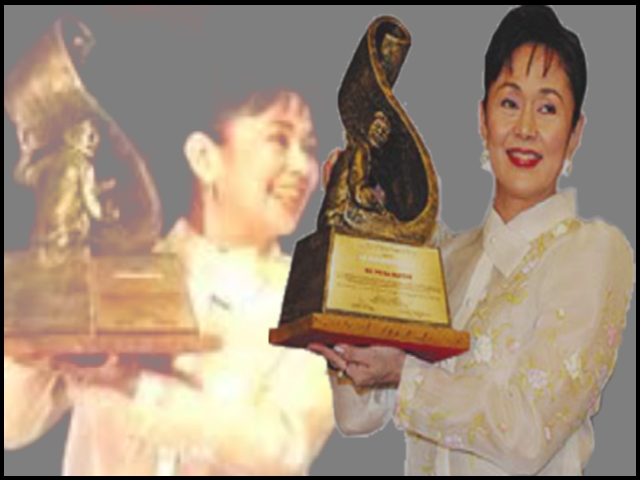
It was a sweet sweep for Sister Stella L., the movie which garnered ten of the twelve trophies at stake during Friday night’s 9th Urian Awards rites. The Regal Films production was hailed the Best Fil; Sister Stella L., herself Vilma Santos, Best Actress; Jay Ilagan, Best Actor; Mike De Leon, Best Director; Laurice Guillen, Best Supporting Actress; and Tony Santos, Sr., Best Supporting Actor; Still Stella L’s Jose Lacaba, Jose Almojuella, and Mike De Leon were cited for the Best Screenplay category; Jess Navarro, for Best Editing; Ding Achacoso, for Best Music; and Ramon Reyes, for Best Sound. This is more than enough to compensate for its poor performance at the box office. ECP’s Misteryo sa Tuwa went home with two remaining awards for Best Production Design by Don Escudero and Rodel Cruz; and for Best Cinematography by Rod Ilacad. For his outstanding contribution to the film industry, the Manunuri ng Pelikulang Pilipino bestowed a special award to William Smith for bringing into the country the first colored film laboratory. Some people could use a lesson in courtesy. At his age, Smith, understandably, could harlly walk, speak well or display clarity of thought, therefore, the need for him to read his remark of thanks from a piece of paper. While national artist Lamberto Avellana and veteran actress Mary Walter paid due respect for Smith, a young man seated beside us took note of this and declared, “Pare, ‘yung speech niya binabasa pa niya, o!” Although the presentation ran smoothly and briefly (yes, of long waits and intermission), notable was the marked seriousness about the atmosphere that night. Champoy’s twosome’s (emcee Cherie Gil and Noel Trinidad) efforts to perk up the audience were futile. The Urian show, furthermore, lacked star luster. Several guest stars failed to attend the ceremony as shown by the many vacant seats. Some presentors even had to go upstage twice. Have we suddenly grown weary of awards rites? Even the major awardees were not present to claim their trophies, thus, only Vilma posed for photographers at the end of the show. (Photos: Luis Garcia Jr.)
When it comes to memorable performances only one actress top my list. Five decades, from being a child phenom to an a-1 caliber actress, Vilma Santos is no doubt the Meryl Streep of the Philippines. And maybe more. Maybe because Ms, Streep, didn’t start her illustrious career as child star.
Vilma Santos endured so many transformations that even Madonna will be pale in comparison. Of course, Vilma is not a singer but Madonna can’t even followed-up her half-decent excursion as Evita. Just a little trivia, Vilma tried successfully to be a singer with her golden album “sixteen” in the 70s but practically decided dancing was her forte hence the successful venture into television musical variety show “Vilma!” in the 80s to 90s. Vilma with her bountiful filmography is second to none. She did a wide variety of roles that even her closest rival can’t match. Listing her most memorable performances is a chore. It will take a true follower to figure out which one should be included in the list. And of course everyone have their favorites particularly Vilmanians who I am dedicating this article.
The fact is Vilma’s closest rival, Nora Aunor who repeatedly ventured into a string of comeback vehicles since the mid 90s failed miserably to capture her lost sparkle. And the fact that her brand of acting have never came to its fruitful evolution since the 70s. Meaning – she became stagnant. As an actress in order to have longevity, one should adapt to changes. Sadly, Nora never learned this concept.
Clearly, if you will list Nora’s best, it will all be films in the 70s and early 80s. Movies like Tatlong Taong Walang and Bona. While Vilma’s list will be from the past five decades. A proof that like Ms. Streep she evolved into much more versatile and serious actress than anyone else in Philippine cinema.
While Vilma is active in public service, film and TV producers are waiting for her availability; and corporate institutions are still lining up for her endorsements. All of these, of course made her still the highest paid actress/product endorser of the land. Should we change her title to the LONGEST REIGNING QUEEN OF PHILIPPINE CINEMA? You be the judge…
Here’s my list of most memorable Vilma Santos performances…
Trudis Liit (1963) – The year…an actress was born! Vilma acted like she’s been doing this craft for a long time eclipsing the dramatic tandem of Luis Gonzales and Lolita Rodrigues. Her most memorable scenes were with villainous Bella Flores which secured her winning the FAMAS best child actress of 1963!
Dama De Noche (1972) – Vilma did 14 films this year and only six were musicals which means her career backers are starting to shift her into a more serious brand of acting. It was also evident that the musical genre was in that stage of phasing out. And Vilma embraced this by accepting a variety of projects from comedy (Ang Kundoctora), a light drama (Bernal’s Inspiration), action (Takbo Vilma Dali), horror (Hatinggabi Na Vilma) and drama (Tatlong Mukha Ni Rosa Vilma and Dama De Noche). Vilma’s portrayal of a twin sister in which one was insane in Dama De Noche signaled her willingness to take new daring projects seriously. This Emmanuel Borlaza melodrama showcased her ripe talents which earned her first best actress award. It maybe not be a full victory for some since she tied her best actress award with Boots Anson Roa but for many it was an honor to share this award to a veteran like Ms. Roa. Ms. Roa later on will confess her admiration for Vilma. She also went on to an extreme degree of explaining Vilma’s brand of acting, her different types of crying. Going back to Dama De Noche, the last scene where Vilma was showed crying and laughing like a true lunatic at the same time came to my mind. This alone, deserved the FAMAS statue all the more.
Lipad Darna Lipad (1973)– The most successful Darna film of all time. Vilma became the standard measurement of success for future Darna. The film was directed by three directors, all successfully gave us three different take on good versus evil, all with three scariest villain portrayed by three multi awardees veterans, Gloria Romero (babaeng impakta), Lisa Lorena (babaeng Lawin) and Celia Rodrigues (babaeng ahas).
Vilma despite her being the shortest darna in history compensate her height with her bubbly almost animated movements which made this film true to its form, like an action hero marvel comics! All the fight scenes minus the high tech computer generated sequences are done the old fashion way, via camera tricks. Even the flying scenes were not bad at all like, I said, considering the medium, they have to use back then.
Ordinary moviegoers will not even think of including this film as one of Ate Vi’s most memorable film/performance but for me, this is one of a good example how versatile Vilma is, even at the start of her illustrious career.
Here’s my list of most memorable Vilma Santos performances…
Tag-Ulan Sa Tag-Araw (1975) – All I can remember about this film was Ate Vi’s last scene in a car with her parents controlling her and Christopher De Leon chasing them in the street while rain falls down. A very melodramatic to some and yet very effective. Ate Vi’s portrayal of a girl who happens to be in love with her first cousin was commendable. She should have won an acting award for this. But of course, critics are all intoxicated by her popular nemesis back then. Falling in love with your first cousin was taboo back then and maybe still taboo in Philippine society today, Tag-ulan was the first film of Christopher De Leon and Vilma Santos. And it clearly show the chemistry between the two actors.
It was the most dramatic and down to earth film by director Celso Ad Castillo. Here there is no over the top production design like the one in Pedro Penduko or the overtly sexual innuendo of Pinakamagandang Hayup sa Balat ng Lupa or even a sexual vulgarity of Virgin People. It was a love story based on a real life situation which made the film more realistic.
Of course being a Castillo project, one can’t escape some creative adventure… like the trend back then, Ate Vi did a the “wet look”. Meaning she done a scene where her blouse got wet and you know what that means. To some, it was vulgar, to many, It’s like she’s testing the water. Will her fans accept her in a more mature daring roles? No more sweet image?
Apparently, we will get more of this “testing” in her strings of films like Nakakahiya 1 & 2 (where she did a two-piece bikini) and Nagaapoy Na Damdamin among others. Her next move will shock the local cinema not even her closest rival can replicate. A transformation of great maneuvering. And this time, another Castillo project…
Burlesk Queen (1977) – The test was over. Vilma Santos, the mature A-1 caliber actress has arrived. And she did it with a big bang.
Burlesk Queen became not only the top box office grosser of the 1977 Metro Manila Film Festival, it also became the most awarded. It got 10 awards out of 13. Like typical sour losers, complaints flew and a big scandal came where the press reportedly said the awards were being returned to the festival organizers.
No such thing happened in fact Ate Vi still possessed the medallion and award she received as the festival’s best actress.
For movie critics, Vilma’s portrayal of not so innocent Chato was so revealing even her opponent’s regular drumbeater came to Ate Vi’s defense saying her acting was surprisingly good enough to win the award.
Truth is, even the feminists applaud her matured performance and Times magazine couldn’t agree more, they featured Ate Vi in a short article, the very first for a Filipina actress.
For a shocked Vilmanians, this movie became a revelation that indeed Ate Vi is embracing her independence. She no longer the sweet virginal teen star of the late 60s to early 70s. She is now an actress willing to conquer any roles. And Vilmanians embraced this transformation with pride. Vilmanians are now ready for Ate Vi’s resurgence on top. We are all ready to support her no matter what the other camp will say.
As for her acting in the film, she proved once again that she has the goods. Critics noticed her multi-dimensional portrayal of a woman in pain. Her reluctant choice to survive poverty. Her father’s condemnation of her career choice. Her lover’s abandonment. All of these emotions captured into a superlative acting coup, surprising even her rival and her fans.
Pagputi Ng Uwak, PagItim Ng Tagak (1978) – Following up the success of Burlesk Queen, Celso Ad Castillo ventured into another love story with the backdrop of hukbalahap. It was a common knowledge now that this film costs Vilma and her film company a lot of money. This was due to Celso Ad Castillo’s lack of control over his film budget. His moody and lack of restrain took this film longer to finish. Later on, VS film company did not recuperate its huge capital, as the film was only a mild hit. Despite this, the film was applauded by critics and won Vilma numerous award as producer.
As Julie Monserrat, a music-loving provincial lass raised by her two prudish, wealthy spinsters aunt (Adul De Leon and Angie Ferro), Vilma convincingly portrayed a woman who was very much in love with Dido Ventura (Bembol Rocco), the poor son of embittered woman (Mona Lisa). Like its earlier love story, Tag-ulan sa Tag-araw, the couple have its struggle to remain together.
Aside from the beautiful scenery, Castillo did a wonderful job of combining poetical music to its scenes. And who can forget that kiss? It was said that Celso asked both Vilma and Bembol to put some condensed milk in their mouth prior to do the kissing scene. This was to signify their lust and love to each other as both have to control their desire as what most common in the Filipino society back in that period of time.
Rubia Servios (1978) – For many Vilmanians, Rubia Servios wasn’t given any recognition its truly deserved. Particularly the performance of Vilma Santos. It was a difficult role. A rape victim who managed to fight back at the end and killed her tormentor. Lino Brocka’s first film with Vilma. And he did it with careful manipulation of grief and emotion. A not so good director will falls into melodramatic scenes but Lino manages to showcase Vilma’s vulnerability with restraints with his carefully selected scenes.
The twists at the end where Vilma was once again being raped by the devilish Philip Salvador this time in front of Vilma’s husband played effectively by Mat Ranillo III was brutal and painful to watch. Vilma’s defeat at the hands of Philip was clearly expressed by her lack of facial emotion and then at the nick of time, when she was able to grasp a piece of wood, a paddle in that boat scene, her face was ignited by terror. She showed revenge in her face and moviegoer will root for her. Kill that bastard! Kill that bastard! One might say.
It was a hell of performance. One might assured her winning the best performer of the 1978 Metro Manila Film Festival. But we were all wrong. We were robbed. It was a painful night for many Vilmanians. I wasn’t able to eat and sleep even the following days after the awards night. Vilma accepted her defeat and learned never to expect any more come future awards night. And so, all Vilmanians did that too. Life is too short to cry over a spilled milk.
Miss X (1980) – Filmed on location in Amsterdam, Netherlands, Miss X was a triumph for its director Gil Portes. It was like seeing a dark European film.
Vilma Santos was exposed in a glass window at the red light district of this part of the world. These scenes alone deserve its being included in my list. A very brave act indeed for an actor who was never been to a place where actual sexual trade between people are legal.
Gil Portes showed his masterful skills pre-Munting Tinig fame. Miss X was dark and moody at the same time which made the exposition of a life of a Filipina illegally recruited as prostitute in this country revealing and disheartening.
Ex-Wife (1981) – Perhaps Eddie Rodriguez’ best film as director, Ex-Wife was actually a psychological drama about marriage and its players. A woman who became victim to a series of bad relationships.
Vilma showcased her acting maturity by portraying a bruised woman. Her scene in the end was reminiscent of Dama De Noche but this time, more restrained and controlled. She was seen, loosing her composure, crying and then laughing in a dinner table. She was a picture of defeat. Another wonderful performance too bad nobody took notice.
In 1981, Vilma did four movies, Hiwalay, Pakawalan Mo Ako, Karma and Ex-wife. Pakawalan earned Vilma a FAMAS best actress while Karma gave her another Metro Manila Film Festival best actress. Of the four movies, she did, I believe Ex-Wife should be the one deserving of any awards not Pakawalan (although she’s really good in her court scene there) and not Karma.
Relasyon (1982) – So many times snubbed by the critics, Vilma Santos emerged out of nowhere as the new darling of award giving bodies via Ishmael Bernal’s poignant take of a story of a mistress in Regal films’ Relasyon.
Prior to this, local films always stereotyped the mistress roles as the villain. Never in the history of local cinema that a societal taboo, the life of a mistress can be portrayed in a down to earth, very sympathetic way, only now in Relasyon.
Vilma Santos did a splendid job as Marilou, an independent, insecure, career woman who happened to fell in love with a chauvinistic, egocentric, typical Filipino married man. It was apparent that Relasyon was a Vilma Santos vehicle and Christopher knows this and did a wonderful job supporting her leading lady.
Perhaps the most memorable part of Relasyon was the death scene of Christopher. The scene wasn’t edited in parts but a continuous take from the shot where Christopher fell to the floor to Vilma’s marathon cry. The outcome was exhilarating. What a splendid decision for Bernal to take that scene as normally called in Philippine Cinematic lingo as “tuhog.” After this scene, Vilma’s look was that of a woman at peace with the outcome of her life. Her tired face indicates pain and we felt it too.
Vilma’s performance here was so realistic that even her rival’s epic portrayal of Elsa in Himala was a no match. And we rejoice. She deserve all the awards. No one complained. No awards being confiscated. Vilma finally got her recognition she truly deserved.
Sinasamba Kita (1982) – Before Meryl Streep did a wonderful job as the bitches of all bitches in the movie the Devil Wears Prada, Vilma Santos did a similar type of role. Produced by the house of glossy films, Viva and directed by Eddie Garcia, Sinasamba Kita broke all the local box office records at that time. Proving that by 1982 not only Vilma was the darling of all award-giving bodies, she was also the box office queen!
Derived from a comic serial, Sinasamba Kita contained so many twist and turns that one might have a headache just figuring out what happens next. But to the credit of Garcia, he was able to make all the twists into a realistic, acceptable ones that midway to the film we are all rooting for Nora (Lorna Tolentino) and hating her bitch sister Divina (Vilma Santos).
We are also amazed by the glossiness of the film’s locations (houses) and Vilma’s sophisticated dresses. All this made the film more credible and realistic. By the time, Divina gave way to her sister’s love for Christopher we also made amends and felt sympathy to the bitchy heiress. Making this film and Vilma’s performance a proof of her versatility as an actress that her rival will never – ever achieved.
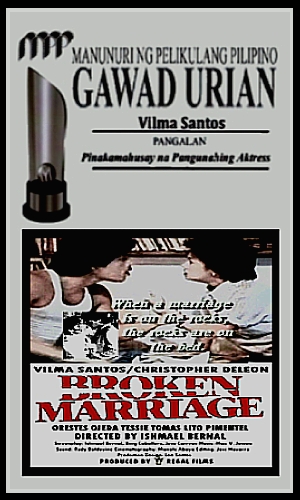
Broken Marriage (1983) – Bernal at his finest. This was our conclusion after seeing Broken Marriage in 1983. And this time the roles of Christopher De Leon and Vilma Santos were even. Meaning unlike Relasyon which was a one-woman show, Broken Marriage was a two persons story. From the point of view of a man, a husband and a woman, a wife. As the title said, it was a marriage destined for failure. The numerous arguments here about marriage life was carefully written with wit giving both Christopher and Vilma shining moments.
As we are talking about Vilma here, I will concentrate on her, she did portray a woman looking for some justice in this unequal world of men and women in Philippine society. She even willingly did a scene where she doesn’t have any make-up on and the result was a realistic glance of a real life Filipina whose struggles were being exploited very realistically by Bernal.
Vilma effectively did a wonderful job that the Manunuri, the local critics, gave her second consecutive Urian Best Actress.
Sister Stella L (1984) – Most established local directors lined up for their turn to direct her, in Sister Stella L, It was Mike Deleon’s turn. And it was one of the most celebrated film of all time. And this was despite its disappointing result at the box office, Lily Monteverde, the producer of Regal films consolation was the numerous awards SSL earned.
And Vilma’s performance here did not disappoint both the critics and her avid fans. Her take on SSL’s awakening was somewhat lacking in hysterics as what her critics always says, she’s always has the hysterical brand of acting. Here, Vilma’s acting was controlled and restrained even her speech scenes at the rallies were calculated. And these made her performance more effective transcending her character bit by bit from an innocent bystander to a militant activist.
SSL was invited to the Cannes Film Festival in 1984 but due to technical problems the films wasn’t showed in there but at the Venice Film Festival which was equally prestigious. At the Venice, SSL was the second Filipino film after Genghis Khan in 1951 to be officially invited for exhibition.
Tagos Ng Dugo (1987) – originally offered to Maricel Soriano, Tagos proved to be another tour de force performance from Vilma Santos. The film was about the psychological state of being of Pina and her sexual needs that’s ends with her desire to kill her sexual partners. A study of mental state where Pina needs to change her physical looks each time she venture into manhunt.
Vilma exposed herself into different characters. Each bate to a possible sexual mate ends into an erotic sex scenes and its graphic death scenes. Vilma did a good job of portraying an psychotic murderer. But perhaps the most visually effective scenes wasn’t that of the ending where she was finally caught by the authorities, it was the quiet scenes in the dirty bathroom while she’s sitting in the toilet bowl and where she took her slipper and slap a cockroach that was crawling in the ground. The shots started from the ceiling and then zoomed down. Then her face was seen smiling at her latest killing -the cockroach. It was a symbol. That’s just like killing men.
Directed by Maryo DeLos Reyes, Tagos Ng Dugo may not be your typical Vilma movies. It was dark and very violent. It was another testament of how varied Vilma’s filmography is. She won two major awards for this, another best actress from FAMAS which elevated her into FAMAS hall of famer and another best actress from CMMA.
Pahiram Ng Isang Umaga (1989) – As the dying Juliet Vilma Santos gave us another tour de force performance. I know, I have said this line so many times in this article but what can I do? It was indeed another tour de force performance. As the premises of this film was already gloomy, about a cancer victim who died at the end of the film, some mediocre director will fall into a soap opera technique but not Bernal. It was the last Bernal-Santos collaboration before Bernal’s sad demise. Bernal successfully controlled Vilma’s tendency to overreact to dramatic scenes. On Vilma’s part it wasn’t that hard, this was 1989 she already matured into a fine a-1 caliber actress.
Most of Vilma’s scene here were really toned down. It’s like her tears where even choreograph falling down in her cheeks at the right moment. When she talked to the father of her child, asking him to take care of him, her voice trembles with regret and pain at the same time tears falls like in perfect connection to each words she delivered. Pahiram earned Vilma her first Star Award from PMPC. It took her nine years to finally earn their respect. Not surprisingly, PMPC consists of so many fans/reporter of her rival. Nowadays, Vilma has the most Star Awards (six compare to four for her rival). How times changes… for the better.
Ipagpatawad Mo (1991) – It was a different diversion from a company who was known for comics adaptation and glossy commercial movies. Finally, Viva films produced a serious film with a simple story. A story with a social message. Ipagpatawad mo penned by Olivia Lamasan and directed by Laurice Guillen was a story about a couple with an autistic child.
Autistism is a neurological condition that affects children in their early developments. The story focuses on the couples struggles with opposites views in how to deal with this misfortunes. The shame attached to it affects the typical Filipino manhood and the unconditional love typical of a caring Filipina woman hood. Another triumph for Christopher DeLeon and Vilma Santos. Christopher shared the spotlight as the insecure husband with the ever-consistent acting of Vilma Santos.
Dahil Mahal Kita (1993) – Another film with social relevance was this powerful true to life story of a woman who was the first person to publicly admit her sickness of AIDS. Typically stereotyped as gay’s disease, Dahil Mahal Kita tackled the ignorance of many Filipinos regarding this disease. Once again, Laurice Guillen gave us an realistic approach to story telling. She chronicled the life of Dolzura Cortez from her early life as a happy go lucky prostitute to the last stage of her life of giving a face to this deadly disease with a careful hand. Each stages gave us the reason to be compassionate.
Vilma Santos gave a powerful, angry performance. Her delivery of lines were crisped. Her emotion overflowed with question about Dulzora’s mortality, about god’s plan and about the people who will read or see Dulzora’s life story. All of these were convincingly seen in Vilma’s Dolzura.
Bata Bata Paano Ka Ginawa (1998) – re-titled as Lea’s Story for international release, Bata bata paano ka ginawa was one of the most successful film of 1998. That was in terms of critics response and box office returns! Bata was based on the award winning 1983 semi autobiographical novel of Lualhati Bautista. Bautista updated the novel to have a more fresh take.
With a superb cast which includes the irresistible Serena Dalrymple as Maya (she reminded us of that child star in the film, the Goodbye Girl), the very innocent Carlo Aquino as Ojie and of course the men in Lea’s life, Albert Martinez, Ariel Rivera and Raymond Bagatsing. Like many Vilma Santos starrer, Bata bata paano ka ginawa was of course belongs to Vilma. She has become the most effective actress in Philippine cinema. Her choice or roles made her the feminists’ kind of woman and ordinary Filipinas’ role model. Roles that yes, struggles… and vulnerable.. .but roles that shows resistance and fighting spirits.
Bata bata paano ka ginawa was showcased Vilma’s maturity as an actress. A proof that she was indeed in command of her choices of roles. Two traits that has never seen in her closest rival. Bata earned Vilma her first international recognition from the prestigious Brussels International Independent Film Festival.
Anak (2000) – The most successful film at the start of the new millennium in terms of box office returns and critical acclaimed. Anak, directed by Rory Quintos was a story of a domestic helper in Hongkong, Josie Agbisit, played masterfully by Vilma Santos and her family headed by her eldest daughter, Carla, played by Claudine Barretto. The story focuses on the mother and daughter relationship.
Two decades ago, Vilma Santos played an ungrateful daughter to the multi awarded veteran, Charito Solis in a drama titled Modelong Tanso. The films was a big disappointment even with the exploitation of Charito slapping Vilma in the face as their promotional stills.
Now comes year 2000, Vilma nows plays the role of the mother and Claudine as the spoiled brat daughter. Yes, there was a scene where the mother slap her daughters face in Anak but Star Cinema who produced it were smarter. They didn’t exploit these scene instead they promote the film as a story about typical Filipino family. The story was the selling point why Anak became one of the most successful film of Star Cinema and Vilma Santos.
Of course and again, despite the excellent performance of Claudine Barretto, Anak belongs to Vilma. And again, It was a tour de force from start to finish.
Dekada 70 (2002) – Chito Rono’s take on the forgotten 70s and the effects of the Marcos dictatorship in the Philippine society, Dekada 70 turned out to be a realistic adaptation of the lives of typical family back then. It features an excellent cast and performances particularly Vilma Santos and Piolo Pascual. Dekada was originally offered to Nora Aunor but for some reason it didn’t materialize. Following the success of Bata, Bata Paano Ka Ginawa, another lualhati Bautista opus, Dekada was offered to Vilma and accepted the project without any hesitation and despite the fact that she wasn’t the first choice for the role of Amanda Bartolome.
As Amanda Bartolome, Vilma Santos delivered an understated, profoundly moving performance deserving of all the awards. Vilma was once again showed here without make-up. Her scene in a room where she’s holding her son’s clothing after the burial of her son was so moving we couldn’t help but cry our hearts out.
All in all, the film (again) belongs to Vilma. Her transformation here from a bystander mother and wife at start to the end where she became a militant activist was so unexpected that we were convinced that her sufferings made her who she was at the end. Dekada earned Vilma her second international recognition. There. What’s in your list? – RV
Our maiden issue (V Mag) is about “Awards”; it is very timely since its still award season in our country. We are very hopeful that Ate Vi will reaped more awards due to her impressive performance in MP3. Who can forget 1983? It’s probably the ultimate win for our idol. 1982 ended with Nora Aunor winning the December film festival (for Himala) and everyone were predicting about her winning all the awards for that year. But Vilma is Nora’s true tormentor because as the award season in 1983 begins (remember they honoring the films from the previous year), all award giving bodies lined up and unanimously gave the best actress awards to Vilma! Bernal may have been a true actor’s director but without ate Vi’s maturing talent, no one can perform Marilou as effective as Vilma in Relasyon! And FAMAS, CMMA, URIAN and FAP, all agreed resulting a true GRAND SLAM! Impressive indeed. This is a vindication of all the heartaches she suffered in the 70s.
The Milestone Move – No longer a sweet teenager, Vilma’s milestone, career move was through Burlesk Queen. By 1977, Vilma’s transformation began with her feminist look at her personal life. She no longer care about the gossips/bad publicity created with past relationships concentrating instead with serious projects. Vilma accepted daring roles like “Dalawang Pugad, Isang Ibon,” “Nag-aapoy Na Damdamin,” “Tagulan sa Tag-araw.” And also, as producer, she created some of the best films of that decade, like “Mga Rosas Sa Putikan,” “Halik sa Paa, Halik sa Kamay,” and the ultimate, “Pagputi Ng Uwak, PagItim ng Tagak” (an almost grand slam winner for best picture). She is one of the very first independent producer in the country. But the most daring of them all was Burlesk Queen. Ian films bet all of its money to this project and it paid off because not only it is the top grosser of the film festival it also reaped almost all of the festival’s awards! Sourgraping, the Nora Aunor camp complained but to no avail, all awards were never returned as what the news said few days after it was given. Burlesk Queen established Vilma Santos name as the number one actress in the Philippines. She was featured in Times Magazine in its coverage of the news around the globe.
The hurtful Lost – Ironically, the following year Ian films went to the other camp and produced one of the most stereotypical film of all times, “Atsay.” Directed by Eddie Garcia, Nora Aunor gave her most over rated performance of all time. Avoiding the scandal of the previous years and aim at vindicating Nora Aunor, the local festival judges gave her the best performer award over Vilma Santos’ impressive performance in “Rubia Servios.” Isagani Cruz, a well respected critics during that time emphasized that Rubia was far more superior than Atsay. Cruz even pointed out that although “Nora and Vilma both gave splendid performances, Vilma’s role was far more demanding and difficult.” And so, as history will tell, it was the “sweetest” victory of Nora Aunor and Noranians over us (the Vilmanians). It was also hurtful because as the victory spread around the archipelago, the news about Ate Vi committing suicide came out. True it was a big disappointment and Marichu Vera Perez attested, she and Vilma cried all night after the awards night but the suicide rumor was just a myth. Vilma will learned from this lost and as we all remember, “lesson learned,” she will never expect to win. She’ll do her job and let them (or fate) decide if she is deserving of their accolades. The 80’s will proves to be more fruitful and kind. Her film efforts gave her fans and movie aficionados every cent of the movie tickets they buy.
From fantasy to reality – As the 70’s Box Office Queen, Vilma reinvented herself so many times. She was the disco queen (Rock Baby Rock, Good Morning Sunshine, Disco Fever), the action hero (Darna, Vivian Volta, Wonder Vi), a hunch back bell ringer (Kampanerang Kuba), and a mermaid (Dyesebel) to name a few. But her most significant career changes was her decision to accept mature roles. Roles that gave her gave her so many acting awards (almost 70 to this date!). Speaking of these roles, theres an intrinsic value, most can be viewed as feminism. Roles that gave way for activism and advocacy to further the cause of women, particularly Filipino women. From the ill fated dancer, Chato in “Burlesk Queen,” to the liberal-minded, suicidal designer, Sandra in “Ikaw Ay Akin” to rebellious-wife, Ellen in “Broken Marriage,” Vilma gave us a true-to-life depictions of what are the most common sufferings of Filipino women.
She also educated us with societal social afflictions with her tour de force portrayals of a modern mistress in “Relasyon,” an activist nun in “Sister Stella L,” a cancer-stricken-career woman in “Pahiram ng Isang Umaga,” a mother of autistic child in “Ipagpatawad Mo,” an AIDS patient in “Dahil Mahal Kita: The Dolzura Cortez Story,” and an awakened mother in “Dekada 70.” From fantasy to reality, her body of works deserves the most important award, the National Artist honor.
The Future – As we all know Vilma has surpassed all of her contemporaries, including Nora Aunor. The future for our idol has become more exciting than ever. Vilma admittedly said that she wanted to stay in show business for as long as she still enjoys it, just like her idol, Gloria Romero, playing grandmother roles. But that’s not gonna happen right now, Vilma still commands the leading roles. She can still carry a film and projects are still pouring-in. And again, unlike her contemporaries, she remained choosy and committed to do “never been done” projects, a well-known secret of her longevity. Indeed, her future remained bright and truly exciting! – RV (READ MORE)
Paano malalaman kung magiging malakas sa takily ang isang pelikula? Isa sa mga sukatan ang premiere ngiht. Hangga’t maari’y ayaw ng ibang produser na magpa-premiere night. Usually kasi, may nag-iisponsor nito, at sa kanila, sa charity – kung tutoo mang sa charity – napupunta ang bayad sa takilya. At siyempre pa, dahil premiere night ekstra ang halaga ng tiket, P25 sa orkestra, P50-100 sa balcony at loge. Bukod sa malaking kawalan din yon sa produser sa regular run ng pelikula, puewede pang mapintas-pintasan ito, at pag kumalat iyon, bagsak ang pelikula! Sa isang dako, kung gustong makatulong ng produser sa charity, at kung sampalataya siya sa kanyang pelukula, mainam magpa-premiere night para higit na maipaalam sa lahat na maganda ito. Iyon ang nasa isip ni Mother Lily nang ipa-premiere night ang “Sister Stella L.” sa Rizal theater sa Makati. Umbrella organization ng mga madre ang nag-isponsor ng premiere night, dalawang screening iyon. Umuulan nang gabing iyon, pero dagsa pa rin ang mga tao. Siksikan. Gayunpama’y disiplinado. Marami rin kasi sa mga ito ang mga madre. Kung karaniwan nang umaasa pa rin sa walk-in ang ibang nagpapa-premiere night, iba naman ang nangyari sa “Sister Stella L.”
Bago pa ang first screening, dakong alas sinko-medya, sold out na ang tiket. Nakikiusap na talaga ang mga hindi nakabili ng tiket na bibili sila, pero ubos na. Dumating doon ang ina ng tunay na Sister Stella L. “No, my daughter is not an activist, she only wanted to help the needy,” sabi nito. Sa kasalukuya’y nasa abroad daw ito, nagtungo roon pagkaraang lumabas mula sa pagkaka-detain ng 11 months sa isang militar camp. Mula sa siyuting ng “Alyas Baby Tsina,” dumating si Vilma Santos. Kagulo sa kanya ang mga tao sa lobby. Magkasabay na pumasok sina Gina Alajar at Michael De Mes, at naisip namin, mali nga ‘ata ‘yung balitang nagkahiwalay sila. Very, very successful ang premiere night na iyon. Katunayan, gusto pa itong masundan ng isang labor sector, tumanggi na lang si Mother Lily. “They will give me raw three hundred thousand, but I said no. Paano naman ang regular run ko?” – Bibsy Estrella, Photos: Peping Mendiola
Unprecedented Stella L PremiereKung ang batayan ay ang premiere night ng Sister Stella L na ginanap sa Rizal theater noong June 22, sigurado nang dudumugin nang masa ang pelikulang ito ni Mike De Leon kapag regula showing na ito sa commercial theaters. Talaga namang very, very successful ang nasabing premiere night at ayon nga sa mga nakakaalam, never in the history of local cinema na ang isang pelikula’y dalawa ang screenings sa premiere showing at parehong SRO. Obviously, maraming A-B crowd nung gabing ‘yon, tulad ng grupo ni Chona Kasten na namataan namin, pero marami ring mga manggagawa at mga miyembro ng iba’t ibang sektaryang pang relihiyon. Ang nag-isponsor ng premiere night na ‘yon ay ang The Organization for the Promotion of Church People’s Right/Response (PCPR). Ang Sister Stella L na pelikula ng Regal Films ay ipapaplabas umpisa sa July 14. – (Photos: Tess Evangelista). Movie Flash July 12 1984
The Plot: After ten years and two children, Rene and Ellen find their marriage on the brink of breaking up. They seem to have fallen out of love and life has become a series of verbal hussies and conflicts. They decide that the only way out is a temporary separation. Rene, a police reporter, and Ellen, who is a television production assistant, begin to live apart from each other. Rene moves into his friend’s apartment while Ellen has to cope with running a household by herself. But they soon begin to feel the effects of their separation. A series of events that follow drastically change their lives. Rene is mauled for his expose of a gambling casino owned by a high ranking government official. He is forced to stay temporarily in the house of Ellen’s mother. As he recuperates from his injuries, both he and Ellen attempt to rebuild their shattered relationship. – Manunuri (READ MORE)
Demanding careers and two children have left Ellen (Vilma Santos) and Rene (Christopher De Leon) with a rocky marriage. A trial separation follows, and soon enough, the consideration of divorce — a serious taboo in Filipino culture in 1983. Orestes Ojeda co-stars as a new flame who lights up Ellen’s life. Prolific director Ishmael Bernal directs a heart-tugging script that he co-wrote with Bing Caballero and Jose Carreon. – Netflix (READ MORE)
The Reviews: Broken Marriage comes as a second wave to the noisy ripple created by Vilma Santos’s award-winning performance in Relasyon. The Regal people have banged their bongos so much harder this time that viewers will expect that Ms. Santos’ cards for this year’s awards derby will be more than secure. The hint is that Broken Marriage is a Vilma Santos movie. Lest the moviegoer expect too much from this year’s quadruple winning best actress, he should be forewarned that the movie is about, well, a broken marriage.
After more than 10 years of marriage, two young persons find each other repugnant. Ellen is a television floor director who hops from one set to the other shooting sitcoms and soaps. Her husband, Rene, complements her rapid lifestyle in investigative reporting. The movie commences with Ellen coming home in the morning from overtime with a crew party on the side. Rene greets her with an ugly nag. The house turns topsy-turvy as they proceed to hurl invectives against each other.
The exchange is extremely exhilarating; and just as the viewer breathes a sigh of relief, another quarrel starts and ensues as if it were the final assault.
Eventually, they decide to separate at the cost of their boy’s understanding nod and their little girl’s distaste. Rene moves to a house populated with such absurd characters as an artist who carves sexy sculptures, a friendly bit-part actor, and a gay art director who cuddles the upstart. Ellen, meanwhile, has to see to it that the children are not left out in their school activities – even standing as an athletic parent during one of her boy’s scouting engagements. She also has to check the advances of her bodyache-complaining producer, to whom she later gives in anyway.
Gradually, the two people realize the great loss that comes with division. Ellen, with the two children, is forced to move to her mother’s place after her house is burglarized, thus realizing the difficulty of an unmanned house. Rene substitutes a whore in the absence of his wife’s caresses. It is when Rene gets beaten up by a city mayor’s goons for nearly publishing a detrimental article and is constrained to recuperate in his mother-in-law’s house that the couple starts patching up the seams of the rent relationship. The ending is of course happy: reconciliation, what else?
Comparisons dawn inexorably: how does Broken Marriage fare as a follow-up to the bravura of Relasyon? This is tough inquiry. If intentions were to be the starting point, then the new movie is a better achievement. Relasyon, judging from its title, was supposed to be about a man and other woman relationship; but the feminist tendencies of our cinema had pinned the movie to a fateful drift: the travails of the modern mistress. Broken Marriage never swerves from its goal; from start to finish it is a portrait of two persons and the bond which they discover smothering and smoldering.
But the ordinary moviegoer does not assess by artist’s intentions – he does not even care about the artist (I mean here the one behind the work. On one hand, the film in front of him is the present; and on the other hand, it is the past. Broken Marriage is made to appear to him as a sequel to Relasyon. The process of integrating the past and the present is a challenge for him. For him are opened two avenues: to start with past and proceed with present; or start with present and proceed with past. If he chose the former, the condemnation for Broken Marriage would clang like a wild cymbal. If he chose the latter, the outcome is a laudatory comment).
Nonetheless, one has to prove that the new movie can stand on its own feet. What Relasyon sadly lacked (albeit not too sadly) was humor. Broken Marriage has tons of it – the caustic swaps, the funny characterizations, the clever plottings – so that the audience’s conditioned response for a supposedly serious movie shifts irrevocably to playful irreverence. Vintage Ishmael Bernal.
It is a masterly stroke – the proverbial Bernal sleight-of-hand at work, this time with more gusto and style. If the Inquisition were still around, he would be branded and burned seven times as a heretic for turning a marriage gone sour into an off-beat frolic suddenly turned sweet – at least, to the viewer’s mirth-hungry belly.
But none may claim that Bernal’s treatment loses its mark of delineating the disadvantages of separation. The humor chisels the message so that it comes to us shining and double-edged, while doing its duty of alleviating an otherwise gloomy impression which accompanies every disillusioning subject matter.
Not only does it come through humorously but also simply. Nowhere is the strain which anyone expects from grave subjects present here. It is as if the dreary topic had been borne on the Lord’s shoulders so that the yoke – and audiences love to be martyrs of maudlin tears – becomes, this rare time, light and easy. The scene where Rene visits his family and finds Ellen and the children agitated by the swift burglary of the house, and the producer wrily comments “Mahirap talaga ang walang lalaki sa bahay”(It’s difficult to have no man in the house) is casual but very biting so that the urgency of the hero returning to his gamily throbs mercilessly like a set clock.
In the same way, Bernal shows Ellen’s retrospective mood minus the conventional flashback: her younger sister is engaged to be married, and Ellen watches the two lovebirds running like children, with a bright but painful smile, even with jealousy, knowing that after the ceremonies, the two will lose the innocence which tradition stifles. This is a repetition of the technique Bernal used in Relasyon – the mistress attending the wedding of her cousin – with just the same effect, namely, sympathy.
The screenplay plunges right into the boiling point, the issues hurled to the foreground like machine-gun fire, the familiar scenes of hatred and division treated like aimless confetti so that the audience neither breathes nor is excused. It jolts us at the outset and after the terrible whipping, when the squabbles lessen and finally ebb into peace, we realize that these two handsome people must have had only one tragic flaw: they did not keep mum for a while.
Manolo Abaya’s cinematography dances with the jetstyle rhythm of the two protagonists. From the clever blocking of the morningjumble scenes to the hurried bustle of the television studio, Abaya’s camera sweeps avidly and flawlessly. In his hands, the incessant quarrels of Rene and Ellen seem like a vengeful lovemaking. The long shots, conventions of a Bernal, are more developed here. Above all, Abaya’s camera has humor and pathos.
The production design never digresses from its limited scope but manages to make poetry out of cluttered rooms and artificial television set-ups. The claustrophobia one feels at the outset of the movie with the couple’s disorderly room easily renders the hopelessness of the two people’s situation. The music filters the emotions of the characters with a detached but effective air. Jesus Navarro’s splendid editing is a breathless canvass of cosmopolitan animation.
The supporting actors are remarkable. Spanky Manikan as a loony reporter getting loonier everyday must not be denied mention; so with the actors who play the sculptor and the gay art director. Lito Pimentel as the gay’s idol is a relaxed performer with a talent for effortlessness.
Christopher de Leon endows the character of Rene with the right sense of machismo and basic weakness. When Rene is compelled to act maturely, De Leon unflinchingly turns him even more childish with useless tantrums; and when Rene finally learns his lesson, De Leon adds a boyish smile as if the lesson were amusing. We watch De Leon, elated and entertained: he is never so old as to appear too distant nor is he too young as to seem undocile. Broken Marriage is a gift to this actor. He is not propelled here to be more manly; since his character is made to contribute to a lot of oversights, De Leon’s doesn’t have to put a mask of strength: he just has to be himself and act with ease.
Vilma Santos is not about to be a letdown, not this time when the most important female roles are coming her way. A new intelligence she infuses in the character Ellen. Like De Leon, she turns Ellen into a woman-child, but the stress is less on her part as she has done similar roles before. Her beautiful face is flush receptive: the quiet moments of just observing the people around her are moments of perfect acting. Her body moves with an agility that is both funny and dramatic. Her two monologues – the first with her friends in the cafe when she informs them that she is bored, and the second with Rene when she tells him that they are not children anymore – are her best scenes: the camera lingers upon her countenance and she enunciates in return with ironic ease. She should watch out for next year’s awards race – there is simply no stopping her at the moment. – Joselito Zulueta, Sine Manila – 1983 (READ MORE)
Mahigit sampung taong nagsasama bilang mag-asawa sina Ellen (Vilma Santos), floor director sa isang programang pantelebisyon at Rene (Christopher de Leon), isang investigative reporter. Sa simula pa lamang ng Broken Marriage (Regal Films, 1983) mapapansing pag-uwi pa lamang ni Ellen mula sa trabaho, pakikipagtalo agad ang isinasalubong ni Rene dito. Ipinakita ng pelikula ang tumitinding alitan sa pagitan ng mag-asawa hanggang sa mapagdesisyunan nilang pansamantalang maghiwalay. Pilit na ipinaintindi ng mga ito ang di pagkakaunawaan sa kanilang dalawang anak. Nanirahan si Rene sa isang bahay na pinamumugaran ng isang grupo ng mga absurd characters na matatagpuan sa pelikula. May iskultor, isang bit player at ang kinakasama nitong baklang art director. Di naglaon, napilitang makisama ni Ellen at ng mga anak sa poder ng kanyang ina sa dahilang pinagnakawan ang kanilang bahay dala ng kawalan ng lalaking magtataguyod dito. Nang mapag-alamang ilalathala ni Rene ang isang artikulong maglalantad sa katiwalian ng isang opisyal ng lokal na pamahalaan ay agad itongipinagulpi upang mapigilan ang pag-publisa ng artikulo. Pansamantalang tumigil si Rene kasama ng asawa’t anak sa bahay ng kanyang biyenan upang magpagaling at dito naayos ng dalawa ang kanilang pagsasama. Ang pagtatapos? Muling nabuo ang kanilang pamilya.
Paano malalampasan ng Broken Marriage ang Relasyon? Kung pagbabasehan ang intensiyon ng direktor, higit itong nakaaangat sa Relasyon. Mula simula hanggang sa pagtatapos nito, hindi lumihis ang Broken Marriage sa mensaheng nais nitong ipahatid. Mahusay ang pagsasalarawan ni Ishmael Bernal sa domestikong suliranin ng mag-asawa bagama’t sumasang-ayon sa patriyarkal na gahum habang pinagbibigyan nito ang di inaasahang pagkamulat ng lalaking protagonista ay nagpakita ding ganap sa semiotikong detalye ng kompleksidad ng resolusyon sa pansariling loob. Ang sensitibong paglikha ni Vilma Santos kay Ellen ay isang marubdob at personal na layon kung ihahambing sa kanyang pagsasakarakter ng papel ni Marilou bilang kerida sa Relasyon. Hinamon ni Ellen ang kumbensiyonal na depinisyon ng pagiging asawa at pagkaina sa paghahanap ng mga alternatibo sa gitna ng makainang pagpapalaki sa mga anak. Ginawan niya si Ellen ng sariling silid kung saan nakahanap ito ng solitaryong kanlungan nang hindi pinuputol ang pakikipag-ugnayan sa asawa. Iniugnay ni Ellen ang ang kanyang pribadong hapdi sa spectrum ng kanyang relasyon. Samantala, nakatutok ang tunggalian sa Broken Marriage hindi lamang kay Vilma Santos kundi kay Christopher de Leon. Nasa asawang lalaki ang bulto ng suliranin kaya sa kanya umiikot ang kuwento, ang relasyon ni Rene kay Ellen at ang relasyon ni Rene sa kanyang mga anak. Ang maalam na pagpasok ni de Leon sa katauhan ni Rene ang lumiligalig sa mga kontradiksiyong talamak sa sistemang patriarkal. Kaakibat ng Broken Marriage ang manipestasyon ni Bernal sa pagbibigay ng representasyon sa reyalidad at partikular na pagsasaayos ng iba’t-ibang elementong kaagapay sa masining na pagbuo ng pelikula. – Jojo DeVera, Sari-saring Sineng Pinoy (READ MORE)
Ishmael Bernal: “…O, bakit parang lutang ka diyan? Porke’t naka-grand slam ka, feeling mo, magaling ka na?…” Bernal scolded Vi when she reported to the set of Broken Marriage, still high after her grand slam wins for Relasyon and a little unmotivated. – Richard Bolisay, Lilok Pelikula, 15 May 2010 (READ MORE)
“… Reportedly Ms. Santos, buoyed by the many acting awards earned by the previous film, was so eager to do well in the new production that Bernal got irritated, locked her in a bathroom, and delivered to her an ultimatum: she was not coming out till she got over her ‘hysteria.’ One sees what made the latter so successful, the same time watching this one sees why Bernal didn’t want to simply duplicate that success. Relasyon was a lean and elegantly told melodrama that took a sidelong glance at the institution of Filipino marriage; in Broken Marriage Bernal wanted to examine the institution directly, without the oblique glances. He didn’t want to film some doomed struggle to keep love alive but something less dramatic, far more difficult to capture: the aftermath of a protracted war, where the ultimate casualty is married love. He in effect didn’t want Ms. Santos at her perkiest and most energetic–he wanted her exhausted, looking for a way out, and to her credit Ms. Santos delivers exactly this with her performance…” – Noel Vera, Critique After Dark, 08 April 2012 (READ MORE)
“…In Filipino melodramas, the heroines often lean on against a hostile environment. Some no less combative women have created a permanent place in the film industry of the country…Lino Brocka and Ishmael Bernal devoted themselves repeatedly with a strong social and political consciousness of the popular form of melodrama. More than Brocka himself Bernal frequently focused on strong female characters that need to manage their lives under unfavorable circumstances. In his films female stars in the spotlight, without the problems of everyday life would go by the board. With Vilma Santos in 1982 he turned Relasyon, wherein the main character wants to escape from a stifling marriage and not only emotionally, but also legally reaches its limits (a year later with Santos Bernal turned the thematically similar mounted Broken Marriage). Was produced Relasyon of Lily Monteverde , who plays an influential role in the Philippine film industry today. Already at the beginning of the 20th century there were in the studios and production companies in the country powerful women who ruled with a firm hand and were addressed by their subordinates even as mothers. “Mother Lily” made his mark as a hard nosed business woman, often more economic than artistic interests followed, understandably, not just friends. The young director Raya Martin let her in his short film Long Live Philippine Cinema! (2009) even to death to save the Philippine cinema…” – Michael Kienzl, Critic.de, 10 Sep 2014 (READ THE TRANSLATION)
“Reportedly Ms. Santos, buoyed by the many acting awards earned by Relasyon, was so eager to do well in the new production that Bernal got irritated, locked her in a bathroom, and delivered to her an ultimatum: she was not coming out till she got over her ‘hysteria.’ One sees what made the latter so successful, the same time watching this one sees why Bernal didn’t want to simply duplicate that success. Relasyon was a lean and elegantly told melodrama that took a sidelong look at the institution of Filipino marriage; in Broken Marriage Bernal wanted to focus on the institution sans oblique glances. He didn’t want to film some doomed struggle to keep love alive but something less dramatic, far more difficult to capture: the aftermath of a protracted war, where the ultimate casualty is married love. He in effect didn’t want Ms. Santos at her perkiest and most energetic–he wanted her exhausted, looking for a way out, and to her credit Ms. Santos delivers.” – Noel Vera, Critic After Dark, 13 September 2014 (READ MORE)
Sing Vilma Sing (1972)
Side A
1. Da Doo Ron Ron – arranged by Orly Ilacad
2. Aba Daba Honeymoon – arranged by Orly Ilacad
3. Tweedlee Dee – arranged by Orly Ilacad
4. A Kookie Little Paradise – arranged by Orly Ilacad
5. Bobby Bobby Bobby – arranged by Orly Ilacad
6. The Ricky -Tick Song – arranged by Orly Ilacad
Side B
1. It’s Been A Long Long Time – arranged by Orly Ilacad
2. Breaking Up Is Hard to Do – arranged by The Music Machine
3. You Made Me Love you – arranged by Orly Ilacad
4. The Birds And The bees – arranged by The Music Machine
5. He’s so Near ( Yet So Far Away) – arranged by The Music Machine
**********************
Vocal Supervision: Bobby Guzman, Ernie De La Pena
Creative Director: Oscar Salazar
Photography: Vicor Studio
Cover Design: Nick B. Fertierra
Back Cover Notes: Baby A. Gil
Sound Engineer: Ric A. Santos, Jun Orenza, Jess Payumo
Recording Studio: Cinema Audio Inc.
Produced by: Vicor Music Corporation
Back cover LP text: – It is common knowledge that a few years ago, Vilma Santos was regarded solely as an up and coming young actress. Without a doubt, a most talented one, for by that time,she was already holding several acting honors under her belt. Not one to be typed, however she turned to recording. Vilma Santos recordrd “Sixteen” and in the process made recording history. “Sixteen” was that year’s biggest hit and resulting acclaim that came along made a singing star out of the actress. Today Vilma Santos is one of the most fabulous figures in show business. Just a hit short of being legendary. Nearly countless is the number of Vilma’s films which made a magnificent killing at the box office. Now a Famas Best Actress Awardee, Vilma is well on her way to becoming the country’s undisputed movie queen.
As a recording artist, she has her credit several hit albums. A Golden Record Award for the song “Palong Palo Ako” and another possible Golden Record Award for “Tweedlee Dee” – which is one of the songs included in this album. This is how for this young actress has come in the recording field. When Vilma decided to try her hand in recording, she wasn’t by a long shot merely trying to prove her versatility. The truth is the girl-Vilma-loves to sing and she wasn’t about to pass up the chance of waxing some of the songs she loves. In every recording session, there emerges in Vilma the inherent desire of every artist to do her work to the hilt. Vilma is a professional who can’t help but give her best. This comes accross with every movie role, with every performance and in this case with every song. It comes accross distinctly with this L.P. Here, Vilma glistens with a different, dazzling kind of brillance, further intensified by the sparkling beauty of the twelve songs contained in this album.
In “He’s so near (Yet So Far Away)” and “It’s been a long, long time, ” Vilma is wishful, in love. In “Abadaba Honeymoon” and “The Ricky-Tick Song,” she is wacky, a kook, impish, even irrepressible. She is all these in “Sing Vilma Sing.” Vilma Santos is indeed so many things to so many people. Superstar, Award-winning actress. A-one recording artist. She is all these and more. And to think that she’s great as any of them! How many Vilma’s are there? Which is the greater one? Well it really depends on who you’re looking for. Here we present Vilma, the singer. Listen to her to your hearts’ delight. So “Sing Vilma Sing” and make this a brighter, lovelier world to live in.







 Star For All Seasons
You must be logged in to post a comment.