Vilma Santos-Recto is a popular multi-awarded actress and politician in the Republic of the Philippines. *** She is known as "Queen of Philippine Movies," "Queenstar," "Grand Slam Queen," "Box Office Queen," and "Star for All Seasons." *** This website is mostly about her iconic film career.
Spanning five decades with 197 films credits and almost two hundred awards, Vilma Santos’ filmography is a kaleidoscope picture of changes in times. Different genres, from teen musicals, folksy fantasies, campy horrors, animated actions to mature adult dramas, her films demonstrated her inner acting talents honed by directors, maneuvered by film producers/benefactors (who some are no longer with us) and supported by her ever loyal fanatics. The results were a long list of film titles that covered several social relevance that capture each decades. A long list of record-breaking box office returns that gave her the title, “the longest reigning box office queen of all time.” A long list of films that sustained her career to different transformation, ensuring her longevity no other Filipino movie queen ever enjoyed. We have painstakingly choose the best of the best. Basing our selection with three criteria. First, the financial success of the film. Cliche it maybe, financial success sustained her bankability and longevity. Second is the critical recognitions the film received. Third, is the other factors that contribute to the overall success of the film, namely, relevance, entertainment value, and the question of, is this film a career milestone or is this film contributed to her popularity. Here are Vilma Santos’ top 100 films.
Total score consists of (A) 10 points for box office records, (B) 10 points for critics recognitions, (C) 10 relevance/longevity, (D) “other factors” that contribute to overall success, gives us total score of 30 points.
40. Batya’t Palu-Palo 1974
SCORE: 6(A) + 10(B) + 7(C) + 0.2(D) = 23.2(T)
Directed by Pablo Santiago, co-starring: Fernando Poe Jr.,Mila del Sol, Janine Frias, Lorna Tolentino, Liza Anzures, Angge, Fred Montilla, Dencio Padilla, Phillip Salvador, Liza Anzures, Paquito Diaz, Max Alvarado, Lito Anzures. FPJ and Vilma Santos first film together. A big box-office hit during its theater run in 1974. Vilma sings the film theme song! – MORE INFO
39. Hindi Nakakahiya 1976
SCORE: 7(A) + 10(B) + 6(C) + 0.3(D) = 23.3(T)
Directed by Luis Enriquez, co-starring: Eddie Rodriguez, Ernie Garcia, Gloria Romero, Marissa Delgado, Patricia Mijares, Renato Robles, Nello Nayo. Part two of the box office hit, Nakakahiya. – MORE INFO (no available video)
38. Nakakahiya? 1975
SCORE: 7(A) + 10(B) + 6(C) + 0.4(D) = 23.4(T)
Directed by Luis Enriquez, co-starring: Eddie Rodriguez, Gloria Romero, Barbara Perez. Vilma received the 1975 Bacolod City Film Festival Best Actress. – MORE INFO (no available video)
37. Bato sa Buhangin 1976
SCORE: 6(A) + 10(B) + 7(C) + 0.5(D) = 23.5(T)
Directed by Pablo Santiago, co-starring: Fernando Poe Jr., Dencio Padilla, Jun Soler, Jumbo Salvador, Phillip Salvador, Rowell Santiago, Millie Mercado, Connie Angeles, Yvonne Salcedo, Tina Monasterio. MORE INFO
36. Ikaw Lang 1993
SCORE: 6(A) + 10(B) + 7(C) + 0.6(D) = 23.6(T)
Directed by Chito S. Roño, co-starring: Ronnie Ricketts, Cesar Montano, with Janine Barredo, Vangie Labalan, Josie Tagle, Evelyn Vargas, Dencio Padilla, Roldan Aquino, Cris Daluz, Mon Fernandez. Written by Bibeth Orteza. Box office hit of 1993. – MORE INFO
35. Miss X 1980
SCORE: 7(A) + 10(B) + 6(C) + 0.7(D) = 23.7(T)
Directed by Gil M. Portes, co-starring: Mark Gil. Filmed in the red district of Armsterdam. – MORE INFO (no available video)
34. Kapag Langit Ang Humatol 1990
SCORE: 7(A) + 8(B) + 8(C) + 0.8(D) = 23.8(T)
Directed by Laurice Guillen, co-starring: Richard Gomez, Gloria Romero, Charo Santos-Concio, Kristine Garcia, Carmina Villaroel, Eula Valdez, Metring David, Lillian Laing, Vangie Labalan, Jeffrey Santos, William Lorenzo, Tony Carreon, Terence Baylon. Written by Salvador Royales. Vilma received a best actress nomination from the Manunuri. – MORE INFO
33. Sister Stella L. 1984
SCORE: 10(A) + 3(B) + 10(C) + 0.9(D) = 23.9(T)
Directed by Mike De Leon, co-starring: Gina Alajar, Laurice Guillen, Anita Linda, Liza Lorena, Adul de Leon, Jay Ilagan, Tony Santos Sr., Ruben Rustia, Eddie Infante, Rody Vera, Pen Medina. Vilma Santos recived her third consecutive Gawad Urian best actress. She also received nominationf from FAMAS and FAP. The film was the official Philippines’ entry to the 1985 Venice International Film Festival. – MORE INFO
32. Dyesebel at ang Mahiwagang Kabibe 1973
SCORE: 6(A) + 10(B) + 8(C) + 0.07(D) = 24.07(T)
Directed by Emmanuel H. Borlaza, starring: Divina Valencia, Mina Aragon, Rossana Marquez, Chanda Romero, Elizabeth Vaughn, Patria Plata, Romeo Miranda, Joseph Sytangco, Lito Calzado, Ricky Valencia, Ike Lozada, German Moreno, Greg Lozano. 2nd Top Grosser of the 8th Manila Film Festival – READ MORE
31. D’ Lucky Ones 2006
SCORE: 7(A) + 10(B) + 7(C) +0.08(D) = 24.08(T)
Directed by Wenn V. Deramas, starring: Sandara Park, Pokwang, Eugene Domingo, Nikki Valdez, Candy Pangilinan, Joseph Bitangcol. Box office hit of 2006. A Vilma Santos tribute film – MORE INFO (no available video)
RECAP:
40. Batya’t Palu-Palo 1974
39. Hindi Nakakahiya 1976
38. Nakakahiya? 1975
37. Bato sa Buhangin 1976
36. Ikaw Lang 1993
35. Miss X 1980
34. Kapag Langit Ang Humatol 1990
33. Sister Stella L. 1984
32. Dyesebel at ang Mahiwagang Kabibe 1973
31. D’ Lucky Ones 2006
Spanning five decades with 197 films credits and almost two hundred awards, Vilma Santos’ filmography is a kaleidoscope picture of changes in times. Different genres, from teen musicals, folksy fantasies, campy horrors, animated actions to mature adult dramas, her films demonstrated her inner acting talents honed by directors, maneuvered by film producers/benefactors (who some are no longer with us) and supported by her ever loyal fanatics. The results were a long list of film titles that covered several social relevance that capture each decades. A long list of record-breaking box office returns that gave her the title, “the longest reigning box office queen of all time.” A long list of films that sustained her career to different transformation, ensuring her longevity no other Filipino movie queen ever enjoyed. We have painstakingly choose the best of the best. Basing our selection with three criteria. First, the financial success of the film. Cliche it maybe, financial success sustained her bankability and longevity. Second is the critical recognitions the film received. Third, is the other factors that contribute to the overall success of the film, namely, relevance, entertainment value, and the question of, is this film a career milestone or is this film contributed to her popularity. Here are Vilma Santos’ top 100 films.
Total score consists of (A) 10 points for box office records, (B) 10 points for critics recognitions, (C) 10 relevance/longevity, (D) “other factors” that contribute to overall success, gives us total score of 30 points.
50. Hatinggabi Na, Vilma 1972
SCORE: 6(A) + 10(B) + 5(C) + 0.9(D) = 21.9(T)
Directed by Joey Gosiengfiao, co-starring: Barbara Perez, Zeneda Amador, Angie FerroRomeo Rivera, Ruel Vernal, Dick Israel, Ernie Garcia, Cloyd Robinson, Subas Herrero, Lito Trinidad – MORE INFO (no available video)
49. Dama De Noche 1972
SCORE: 7(A) + 7(B) + 7(C) + 0.95(D) = 21.95(T)
Directed by Emmanuel H. Borlaza, co-starring: Edgar Mortiz, Lillian Laing, Matimtiman Cruz, Fred Montilla, Cloyd Robinson. Recieved first FAMAS Best Actress and best actress nomination at the 1972 Quezon City Film Festival. – MORE INFO
48. Darna and the Giants 1973
SCORE: 6(A) + 8(B) + 8(C) + 0.2(D) = 22.2(T)
Directed by Emmanuel H. Borlaza, co-starring: Helen Gamboa, Loreta Marquez, Rosanna Marquez, Desiree Destreza, Florence Aguilar Romeo Miranda, Ike Lozada, Pepito Rodriguez, Cesar Ramirez, Zandro Zamora, Max Alvarado. Top Box Office Film of 1973 Metro Manila Film Festival – MORE INFO
47. Kampanerang Kuba 1974
SCORE: 6(A) + 10(B) + 6(C) + 0.3(D) = 22.3(T)
Directed by Nilo Saez, co-starring: Edgar Mortiz, Patria Plata, Metring David, Greg Lozano, Joaquin Fajardo. – MORE INFO
46. Muling Buksan ang Puso 1985
SCORE: 7(A) + 8(B) + 7(C) + 0.4(D) = 22.4(T)
Directed by Leroy Salvador, co-starring: Dindo Fernando, Lorna Tolentino, Sandy Andolong, Coney Reyes, Rowell Santiago, Jimi Melendez. Written by Nerissa Cabral. Vilma received a best actress nomination from 1985 FAMAS – MORE INFO
45. Palimos Ng Pag-ibig 1986
SCORE: 7(A) + 8 (B)+7 (C)+0.5 (D)=22.5(T)
Directed by Eddie Garcia, co-starring: Dina Bonnevie, Cherie Gil, Laurice GuillenEdu Manzano, Pepito Rodriguez. Written by Nerissa Cabral. – MORE INFO
44. Langis at Tubig 1980
SCORE: 7(A) + 8(B) + 7(C) + 0.6(D) = 22.6(T)
Directed by Danny Zialcita, co-starring: Amy Austria, Lucita Soriano, Suzanne Gonzales, Adul De Leon, Martha SevillaDindo Fernando, Ronaldo Valdez, George Estregan, Ruben Rustia, Johnny Vicar, Augusto Victa, Vic Diaz, Vic Silayan, Mario Escudero. Vilma received a best actress nomination from 1980 FAMAS – MORE INFO
43.Pinay, American Style 1979
SCORE: 7(A) + 8(B) + 7(C) + 0.7(D) = 22.7(T)
Directed by Elwood Perez, co-starring: Christopher De Leon, Bembol Roco, Cocoy Laurel with Rosa Mia, Alexandra Dulaney, Nova Villa, Bella Flores, Angge. One of eight box office hit films Vilma Santos did in 1979 – MORE INFO
42.Ibulong Mo Sa Diyos 1988
SCORE: 7(A) + 8(B) + 7(C) + 0.8(D) = 22.8(T)
Directed by Elwood Perez, co-starring: Eric Quizon, Gary Valenciano, Miguel Rodriguez, Eddie Garcia, Nida Blanca, Barbara Perez, Nadia Montenegro, Armida Siguion-Reyna, Perla Bautista, Rachel Ann Wolfe, Deborah Sun, Vangie Labalan, Nena Perez Rubio, Ruben Rustia. Written by Orlando Nadres. Vilma recieved her fifth FAMAS best actress that earned her the FAMAS Hall of Fame award. She also received a film academy nomination. – MORE INFO
41.Haplos 1982
SCORE: 7(A) + 8(B) + 7(C) + 0.9(D) = 22.9(T)
Directed by Antonio Jose Perez, co-starring: Christopher De Leon, Rio Locsin, Delia Razon, Eddie Infante, Rez Cortez, Juan Rodrigo, Jaime Fabregas. Written by Ricardo Lee. The film won the 1982 Metro Manila Film Festival 3rd Best Picture award. – READ MORE
RECAP:
50. Hatinggabi Na, Vilma 1972
49. Dama De Noche 1972
48. Darna and the Giants 1973
47. Kampanerang Kuba 1974
46. Muling Buksan ang Puso 1985
45. Palimos Ng Pag-ibig 1986
44. Langis at Tubig 1980
43. Pinay, American Style 1979
42. Ibulong Mo Sa Diyos 1988
41. Haplos 1982
Spanning five decades with 197 films credits and almost two hundred awards, Vilma Santos’ filmography is a kaleidoscope picture of changes in times. Different genres, from teen musicals, folksy fantasies, campy horrors, animated actions to mature adult dramas, her films demonstrated her inner acting talents honed by directors, maneuvered by film producers/benefactors (who some are no longer with us) and supported by her ever loyal fanatics. The results were a long list of film titles that covered several social relevance that capture each decades. A long list of record-breaking box office returns that gave her the title, “the longest reigning box office queen of all time.” A long list of films that sustained her career to different transformation, ensuring her longevity no other Filipino movie queen ever enjoyed. We have painstakingly choose the best of the best. Basing our selection with three criteria. First, the financial success of the film. Cliche it maybe, financial success sustained her bankability and longevity. Second is the critical recognitions the film received. Third, is the other factors that contribute to the overall success of the film, namely, relevance, entertainment value, and the question of, is this film a career milestone or is this film contributed to her popularity. Here are Vilma Santos’ top 100 films.
Total score consists of (A) 10 points for box office records, (B) 10 points for critics recognitions, (C) 10 relevance/longevity, (D) “other factors” that contribute to overall success, gives us total score of 30 points.
60. Mga Mata Ni Angelita 1978
SCORE: 6(A) + 10(B) + 5(C) + 0.08(D) = 21.08(T)
Directed by Lauro Pacheco, starring: Julie Vega, Gloria Sevilla, Boots Anson-Roa, Alma Moreno, Rosanna Ortiz, Nora Aunor, Trixia Gomez, Marissa Delgado, Etang DischerMat Ranillo III, Roldan Rodrigo, Christopher De Leon, German Moreno, Rez Cortez, Eddie Rodriguez, Dolphy, Fernando Poe Jr. Vilma’s segments made this film in our list of memorable non-lead role. – MORE INFO
59. Rock, Baby, Rock 1979
SCORE: 6(A) + 10(B) + 5(C) + 0.09(D) = 21.09(T)
Directed by Oscar Miranda, starring: Leah Navarro, Lorli Villanueva, Geleen EugenioJunior, Rolly Quizon, Tito Sotto, Vic Sotto, Joey de Leon, Val Sotto, VST & Company – MORE INFO
58. Hiwalay 1981
SCORE: 7(A) + 8(B) + 6(C) + 0.1(D) = 21.1(T)
Directed by Romy Susara, starring: Dindo Fernando, Eddie Rodriguez – MORE INFO (no available video)
57. Susan Kelly, Edad 20 1977
SCORE: 6(A) + 10(B) + 5(C) + 0.2(D) = 21.2(T)
Directed by Maria Saret, starring: Laila Dee, Dante Rivero, Anthony Alonzo, Romeo Enriquez, Chito Ponce Enrile, Cloyd Robinson, Sandy Garcia, Laila Dee, Ramon Zamora – MORE INFO (no available video)
56. Hindi Nahahati ang Langit 1966
SCORE: 7(A) + 8(B) + 6(C) + 0.3(D) = 21.3(T)
Directed by Lauro Pacheco, starring: Lolita Rodriguez, Marlene Dauden, Eddie Rodriguez – MORE INFO (no available video)
55. Masarap, Masakit ang Umibig 1977
SCORE: 7(A) + 8(B) + 6(C) + 0.4(D) = 21.4(T)
Directed by Elwood Perez, co-starring: Christopher De Leon, Mat Ranillo III with Anita Linda, Ma-An Hontiveros, Lillian Laing, Laila Dee, Amado Cortez, Sandy Garcia, Cloyd Robinson. Official Philippines’ entry to the 1981 ASEAN Film Festival and Sydney Film Festival. Official entry to 1978 Asia-Pacific Film Festival in Taipei. – MORE INFO
54. Minsan pa Natin Hagkan Ang Nakaraan 1983
SCORE: 7(A) + 7(B) + 7(C) + 0.5(D) = 21.5(T)
Directed by Marilou Diaz-Abaya, co-starring: Christopher De Leon, Eddie Garcia. – MORE INFO
53. Halik sa Kamay, Halik sa Paa 1979
SCORE: 7(A) + 7(B) + 7(C) + 0.6(D) = 21.6(T)
Directed by Luis Enriquez, co-starring: Rosemarie Gil, Ester Chavez, Angie Ferro, Angge, Virginia Montez, Aurora SalveRonald Corveau, Eddie Rodriguez, Jose Vergara, Roderick Paulate. Vilma recieved a best actress nominationf from 1979 FAMAS. – MORE INFO
52. Alyas Baby Tsina 1984
SCORE: 7(A) + 7(B) + 7(C) + 0.7(D) = 21.7(T)
Directed by Marilou Diaz-Abaya, co-starring: Phillip Salvador, Dindo Fernando withZeny Zabala, Cecille Castillo, Chanda Romero, Raquel Villavicencio, Caridad Sanchez, Maria Isabel Lopez, Dexter Doria, Mary Walter, Vangie Labalan, Harlene Bautista, Rez Cortez, Rolando Tinio, Len Santos, Johnny Delgado – MORE INFO (no available video)
51. T-Bird at Ako 1982
SCORE: 7(A) + 7(B) + 7(C) + 0.8(D) = 21.8(T)
Directed by Danny Zialcita, co-starring: Nora Aunor, Baby Delgado, Rosemarie Gil, Suzanne Gonzales, Odette Khan, Anita Linda, Liza Lorena, Adul de Leon, Rustica Carpio, Anita LindaDindo Fernando, Tommy Abuel, Tony Carreon, Alvin Enriquez. Written by Portia Ilagan. – MORE INFO
RECAP:
60. Mga Mata Ni Angelita 1978
59. Rock, Baby, Rock 1979
58. Hiwalay 1981
57. Susan Kelly, Edad 20 1977
56. Hindi Nahahati ang Langit 1966
55. Masarap, Masakit ang Umibig 1977
54. Minsan pa Natin Hagkan Ang Nakaraan 1983
53. Halik sa Kamay, Halik sa Paa 1979
52. Alyas Baby Tsina 1984
51. T-Bird at Ako 1982
Spanning five decades with 197 films credits and almost two hundred awards, Vilma Santos’ filmography is a kaleidoscope picture of changes in times. Different genres, from teen musicals, folksy fantasies, campy horrors, animated actions to mature adult dramas, her films demonstrated her inner acting talents honed by directors, maneuvered by film producers/benefactors (who some are no longer with us) and supported by her ever loyal fanatics. The results were a long list of film titles that covered several social relevance that capture each decades. A long list of record-breaking box office returns that gave her the title, “the longest reigning box office queen of all time.” A long list of films that sustained her career to different transformation, ensuring her longevity no other Filipino movie queen ever enjoyed. We have painstakingly choose the best of the best. Basing our selection with three criteria. First, the financial success of the film. Cliche it maybe, financial success sustained her bankability and longevity. Second is the critical recognitions the film received. Third, is the other factors that contribute to the overall success of the film, namely, relevance, entertainment value, and the question of, is this film a career milestone or is this film contributed to her popularity. Here are Vilma Santos’ top 100 films.
Total score consists of (A) 10 points for box office records, (B) 10 points for critics recognitions, (C) 10 relevance/longevity, (D) “other factors” that contribute to overall success, gives us total score of 30 points.
20. Tag-ulan sa Tag-araw 1975
SCORE: 8(A) + 10(B) + 7(C) + 0.4(D) = 25.4(T)
Directed by Celso Ad. Castillo, co-starring: Christopher De Leon, Eddie Garcia, Joseph Sytangco, Lorli Villanueva, Odette Khan, Alma Moreno, Eva Darren, Edna Diaz, Nympha Bonifacio, Joonee Gamboa, Rez Cortez, Soxy Topacio. The first film of Christopher Deleon and Vilma Santos, as of 2008, total 23 films. – MORE INFO
19. Sinasamba Kita 1982
SCORE: 7(A) + 10(B) + 8(C) + 0.5(D) = 25.5(T)
Directed by Eddie Garcia, co-starring: Christopher Deleon, Philip Salvador, Lorna Tolentino, Irene Celebre, Loleta Abesamis, Norma Blancaflor, Moody Diaz, Luz Fernandez, Kristina Paner, Yvonne, Ramil Rodriguez, Danny De Cordova, Larry Leviste, Fanny Serrano. Written by Gilda Olvidado. 1982 Top Box Office Record Breaker. The original film became a TV movie in 2007 by GMA Network, directed by Joel Lamangan, starring Sheryl Cruz as Divina and Valerie Concepcion as Nora. – MORE INFO
18. Paano Ba ang Mangarap? 1983
SCORE: 7(A) + 10(B) + 8(C) + 0.6(D) = 25.6(T)
Directed by Eddie Garcia, co-starring: Christopher Deleon, Jay Ilagan, Amy Austria, Perla Bautista, Armida Siguion Reyna, Vic Silayan. Written by Nerissa Cabral. Broke box office record of 1983 – MORE INFO
17. Gaano Kadalas ang Minsan? 1982
SCORE: 8(A) + 10(B) + 7(C) + 0.7(D) = 25.7(T)
Directed by Danny Zialcita, co-starring: Dindo Fernando, Hilda Koronel, Chanda Romero, Suzanne Gonsales, Tommy Abuel, Mark Joseph Enriquez. Broke box office record of 1982, Earned P7.3 million during its first day of showing in Metro Manila – MORE INFO
16. Trudis Liit 1963
SCORE: 7(A) + 10(B) + 8(C) + 0.8(D) = 25.8(T)
Directed by Jose De Villa, co-starring: Luis Gonzales, Lolita Rodriguez, Connie Angeles, Bella Flores, Charlie Davao, Ramon D’Salva. Written by Mars Ravelo. This film is immortalized in small screen in 2010 by GMA 7 . A remake was filmed in the 1990s. Vilma Sanots won a FAMAS Best Child Actress. – MORE INFO (no available video)
15. Pagputi ng Uwak, Pag-itim ng Tagak 1978
SCORE: 10(A) + 5(B) + 10(C) + 0.9(D) = 25.9(T)
Directed by Celso Ad. Castillo, co-starring: Bembol Roco, Angie Ferro, Olivia O’Hara, Mona Lisa, Robert Talabis, Joonee Gamboa, Mario Escudero. As the film producer, Vilma received the highest recognition for best film of the year FAMAS and Gawad URIAN. She also received a nomination for best actress from FAMAS. – MORE INFO
14. Adultery: Aida Macaraeg 1984
SCORE: 10(A) + 8(B) + 8(C) + 0.6(D) = 26.6(T)
Directed by Lino Brocka, co-starring: Phillip Salvador, Anita Linda, Deborah Sun, Alvin Enriquez, Mario Montenegro. Vilma received best actress nomination from PMPC Star Awards. – READ MORE
13. Tagos ng Dugo 1987
SCORE: 8(A) + 10(B) + 8(C) + 0.7(D) = 26.7(T)
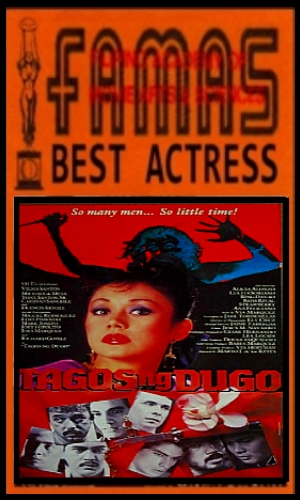
Directed by Maryo J. De los Reyes, co-starring: Caridad Sanchez, Lucita Soriano, Alicia Alonzo, Mia Gutierrez, Raquel VillavicencioMichael De Mesa, Miguel Rodriguez, Francis Arnaiz, Richard Gomez, Mark Joseph, Lito Pimentel, Joey Hipolito, Joey Marquez, Tony Santos Sr. Vilma Santos won the 1987 FAMAS and CMMA Best Actress awards. She also received nomination from FAP. – MORE INFO
12. Anak 2000
SCORE: 8(A) + 10(B) + 8(C) + 0.8(D) = 26.8(T)
Directed by Rory B. Quintos, co-starring: Claudine Barretto, Amy Austria, Cherry Pie Picache, Sheila Mae Alvero, Tess Dumpit, Jodi Sta. Maria Joel Torre, Baron Geisler, Leandro Muñoz, Gino Paul Guzman, Cris Michelena. Philippines’ official entry to 73rd best foreign language OSCAR. Philippines’ official entries to 2001 international film festivals including Fukuoka, San Francisco. Vilma received the 2000 PMPC STAR award for best actress as well as the 2000 PASADO and nomination from FAP. She was also crowned the 2000 GMMSF Box Office Queen. – MORE INFO
11. Imortal 1989
SCORE: 8(A) + 10(B) + 8(C) + 0.9(D) = 26.9(T)
Directed by Eddie Garcia, co-starring: Christopher De Leon, Tommy Abuel, Ricky Davao, Gelli De Belen, Cherie Gil, Jacklyn Jose, Liza Lorena Richard Reynoso, Roi Vinzon. Written by Orlando Nadres. Vilma won the 1989 Metro Manila Film Festival Best Actress. – MORE INFO
RECAP:
20. Tag-ulan sa Tag-araw 1975
19. Sinasamba Kita 1982
18. Paano Ba ang Mangarap? 1983
17. Gaano Kadalas ang Minsan? 1982
16. Trudis Liit 1963
15. Pagputi ng Uwak, Pag-itim ng Tagak 1978
14. Adultery: Aida Macaraeg 1984
13. Tagos ng Dugo 1987
12. Anak 2000
11. Imortal 1989
Spanning five decades with 197 films credits and almost two hundred awards, Vilma Santos’ filmography is a kaleidoscope picture of changes in times. Different genres, from teen musicals, folksy fantasies, campy horrors, animated actions to mature adult dramas, her films demonstrated her inner acting talents honed by directors, maneuvered by film producers/benefactors (who some are no longer with us) and supported by her ever loyal fanatics. The results were a long list of film titles that covered several social relevance that capture each decades. A long list of record-breaking box office returns that gave her the title, “the longest reigning box office queen of all time.” A long list of films that sustained her career to different transformation, ensuring her longevity no other Filipino movie queen ever enjoyed. We have painstakingly choose the best of the best. Basing our selection with three criteria. First, the financial success of the film. Cliche it maybe, financial success sustained her bankability and longevity. Second is the critical recognitions the film received. Third, is the other factors that contribute to the overall success of the film, namely, relevance, entertainment value, and the question of, is this film a career milestone or is this film contributed to her popularity. Here are Vilma Santos’ top 100 films.
Total score consists of (A) 10 points for box office records, (B) 10 points for critics recognitions, (C) 10 relevance/longevity, (D) “other factors” that contribute to overall success, gives us total score of 30 points.
70. Yesterday, Today and Tomorrow 1986
SCORE: 6(A) + 8(B) + 6(C) + 0.4(D) = 20.4(T)
Directed by Emmanuel H. Borlaza, co-starring: Snooky Serna, Maricel Soriano, Liza Lorena, Chanda Romero, Deborah SunGabby Concepcion, Richard Gomez, Eddie Garcia, Jimi Melendez – MORE INFO
69. Kay Tagal ng Umaga 1965
SCORE: 6(A) + 8(B) + 6(C) + 0.5(D) = 20.5(T)
Directed by Lauro Pacheco, starring: Lolita Rodriguez, Eddie Rodriguez, Marlene Dauden with Vilma Valera. Film adaptation of Aning Bagabaldo’s radio drama broadcasted on DZRH. – MORE INFO (no available video)
68. Anak, ang Iyong Ina 1963
SCORE: 7(A) + 8(B) + 5(C) + 0.6(D) = 20.6(T)
Directed by Mar S. Torres, co-staring: Gloria Romero, Rita Gomez, Mario Montenegro, Eddie Garcia – MORE INFO (no available video)
67. Ging 1964
SCORE: 6(A) + 8(B) + 6(C) + 0.7(D) = 20.7(T)
Directed by Cirio H. Santiago, co-starring: Carol Varga, Olivia Cenizal, Jose Padilla jr, Ramon D’Salva. Written by Mars Ravelo. – MORE INFO
66. Karugtong ang Kahapon 1975
SCORE: 5(A) + 8(B) + 7(C) + 0.8(D) = 20.8(T)
Directed by Fely H. Crisostomo, co-starring: Gloria Romero, Celia Rodriguez, Patria Plata, Edgar Mortiz, Eddie Garcia, Jay Ilagan, Romy Mallari, Joseph Sytangco. Entry to the 1975 MMFF. Film was written by Nerissa Cabral. – MORE INFO (no available video)
65. Nag-iisang Bituin 1994
SCORE: 7(A) + 7(B) + 6(C) + 0.9(D) = 20.9(T)
Directed by Jose Javier Reyes, co-starring: Christopher De Leon, Aga Muhlach with Cherrie Pie Picache, Amy Perez, Jao Mapa, Orestes Ojeda. Vilma received a best actress nomination from PMPC’s 1994 Star. – MORE INFO (no available video)
64. Takbo, Vilma, Dali 1972
SCORE: 5(A) + 10(B) + 6(C) + 0.04(D) = 21.04(T)
Directed by Joey Gosiengfiao, co-starring: Rita Gomez, Paquito Diaz, Max Alvarado, Romeo Rivera, Ernie Garcia – MORE INFO (no available video)
63. Vilma Viente Nueve 1975
SCORE: 5(A) + 10(B) + 6(C) + 0.05(D) = 21.05(T)
Directed by Pablo Santiago, co-starring: Anita Linda, Jun Aristorenas, Max Alvarado, Lito Legaspi, German Moreno, Martin Marfil – MORE INFO (no available video)
62. Ibong Lukaret 1975
SCORE: 6(A) + 10(B) + 5(C) + 0.06(D) = 21.06(T)
Directed by Tito C. Sanchez, co-starring: Alona Alegre, Marissa Delgado, Daria Ramirez, Lucita Soriano, George Estregan, Nick Romano, Rudy Fernandez, Arnold Mendoza – MORE INFO (no available video)
61. Bertang Kerengkeng 1976
SCORE: 6(A) + 10(B) + 5(C) + 0.07(D) = 21.07(T)
Directed by Tito C. Sanchez, co-starring: Edna Diaz, Lito Anzures, Rudy Fernandez, Greg Lozano – MORE INFO (no available video)
RECAP:
70. Yesterday, Today and Tomorrow 1986
69. Kay Tagal ng Umaga 1965
68. Anak, ang Iyong Ina 1963
67. Ging 1964
66. Karugtong ang Kahapon 1975
65. Nag-iisang Bituin 1994
64. Takbo, Vilma, Dali 1972
63. Vilma Viente Nueve 1975
62. Ibong Lukaret 1975
61. Bertang Kerengkeng 1976
“haaahhhh…haaahhhh….di ko sinasadya!…di ko sinasadya!” – Pina
This slideshow requires JavaScript.
Basic Information: Directed: Maryo J. De los Reyes; Story: Via Hoffman; Screenplay: Jake Tordesillas; Cast: Vilma Santos, Michael De Mesa, Miguel Rodriguez, Francis Arnaiz, Richard Gomez, Mark Joseph, Lito Pimentel, Joey Hipolito, Joey Marquez, Tony Santos Sr., Caridad Sanchez, Lucita Soriano, Dante Castro, Bing Davao, Alicia Alonzo, Mia Gutierrez, Raquel Villavicencio; Executive producer: Via Hoffman; Original Music: Jaime Fabregas; Cinematography: Ely Cruz; Film Editing: Jess Navarro; Production Design: Cesar Hernando, Lea Locsin; Sound: Joe Climaco, Jun Martinez
Plot Description: A young Pina was traumatized when her family was murdered while she had her first menstruation. She grown up into a serial killer transforming herself to different personalities as she seduced one man at a time grossly killing them while in the act of sexual pleasure. Eventually Pina was caught by the authorities. Considered by some critics as a feminist movie, Tagos ng Dugo has the feeling of claustrophobic but stylized European slasher movie that showcased the wide acting range of Philippines’ cinematic diva, Vilma Santos. The film lacks the usual long dialogue of her previous films but in this film, she was given a chance to show her body movements and “eye” acting that climaxed with tour de force ending, a mad lion being caught by armed hunters. – RV
Film Achievement: 1987 FAMAS Best Actress – Vilma Santos; 1987 CMMA Best Actress – Vilma Santos; 1987 FAP Best Musical Score – Jaime Fabregas; 1987 FAP Best Actress nomination – Vilma Santos
Film Review: “…In Filipino movies, drama is synonymous with exaggeration. In many films, scenes of cruelty, violence and torrid sex are depicted with little restraint so that they border on distasteful. In Tagos ng Dugo (1987), a young girl is raped after her parents are mudered. While she’s being abused, blood from her murdered mother’s body drips through the ceiling and falls on her forehead. In Kapag Napagod and Puso (1988), a harassed movie director (Christopher de Leon) takes out his frustration on his young wife (Snooky Serna) by smashing her face, pounding her head on the wall and punching her pregnant body black and blue. Once it was sufficient to depict adult activities by implication. To speak of sex on screen, it was enough to show a couple closing a door as they entered a room. A passionate embrace or a kiss is always followed by a quick fade to black. But nowadays, with sexual liberation and the heightened sense of realism demanded by viewers, Filipino movies have become more graphic in their treatment of sexual matters. There is now a greater curiousity for the phenomenon of the woman’s body. It is a must to depict menstruation (Tagos ng Dugo), labor pains (Kapag Napagod ang Puso) and a miscarriage (Burlesque Queen, 1977) by showing blood stains on the garment near the area of the vagina and blood trickling down a woman’s leg. The first signs of pregnancy are always dramtized by showing a woman throwing up in asink (Pasan Ko ang Daigdig, 1987). Abortion scenes have a very clinical look: a woman must be shown lying down with her legs in stirrups as a doctor or quack performs the bloody operation. Since abortion is illegal in the Philippines, it is common to depict abortion scenes ending in tragedy. In Celso Ad. Castillo’s Nympha (1971), a woman is left to die naked, wallowing in her own blood on the floor after doctors fail to stop her bleeding following an abortion. Childbirth scenes are just as graphic. In Nunal sa Tubig (1977), a baby’s head is shown emerging from a vagina…” – Emmanuel Anastacio Reyes, Notes on Philippine Cinema (Collected Writings on Cinema)…” – Emmanuel Anastacio Reyes, Notes on Philippine Cinema Collected Writings on Cinema (READ MORE)
First of all, serial murder is almost alien to Philippine crime journalism, a fact that’s due certainly to our police force’s lack of records on such cases. Now, this police record gap may of course in turn reflect a lack of local police coordination towards (or, worse, capability for) determining crime patterns as possibly serial. Unless those determinations have to do with the usual cop-out that goes like this: “it’s another NPA hit” blah blah blah, or “its another murder similar to the one that happened last week, and this is reflective of pornograhy’s…”. My above statements are meant to illustrate a national wont to demean our own police organization’s capability (or, worse, intelligence) that may neither be fair nor productive, but it would be a habit that certainly is not undeserved given the record — official and memorial — of the police prioritizing its own people’s interests and “rackets”.
Given this background, therefore, Tagos ng Dugo can be said to be a demonstration of serial crimes’ possible placement in local shores, and that would certainly be a valid view. Except, of course, that in effect Tagos is also — and probably should be read primarily as — a demonstration of possiblities other than the merely forensic. I say “should be”, since the police is portrayed fairly in the film, albeit not exactly generously. So what could be all the fuss about Tagos’ value? “Production values” is the often-heard reason, needing elucidation. A breakthrough for Philippine psychological movies? Probably. Let me explore a few other angles on this seeming cross between Francois Truffaut’s “The Bride Wore Black” and Luis Benuel’s “Belle Du Joir” — I don’t know if screenwriter Jake Tordesillas or Delos Reyes himself should be congratulated for the cohesion of multi-resultants in this work. Part of this multi-readings would be the movie as a feminist take on womankind’s monthly pains as a form of excuse for female monthly insanities, insanities our macho’s regard as regular terrorism on the whole of mankind (men or society as a whole).
It is with that reading that the ending apologies, by Vilma Santos in the lead role, might be understood as a plea for understanding of how all of woman’s monthly Eve-behavior should not be seen as a Biblical sin but as an equal (to, say, man’s beastly) naturalness… Another feminist reading, more radical perhaps, would treat the film as a view of how Philippine society (the men in it, primarily) approaches provincial innocence, educational weakness, and “female’s weaker sanity” as stimuli for abuse… There is, however, the possibly more general reading of the film as an apologia for insanity qua itself, how it should be treated as a disease instead of as a monster to be eliminated… And finally, there’s the possiblity that the film is actually a depiction of how crazy the world outside the insane mind really is, albeit this view would probably be the least successful direction for the film… As a bonus, maybe we can also bring the movie to more latent, more philosophical territory, say, how it depicts the sanity of innocence.
But, given the validity and possible weight of all those approaches, what finally makes this movie a jewel in Philippine cinema history is how it brings forth — every time you watch it — its case achievements in directorial and film editing dramaturgy ( including the recurring stage-like choreography, Hitchcockish camera positionings, and acting pacing within). For the serious student of third world filmmaking, here is a requisite Philippine movie from where to cull precious fragments. In these fragments, he/she is sure to find sparkles that are in themselves gems. – Eric Nadurata
The story revolves around Pina, a woman haunted by her past traumatic experiences. She always feels afraid at the sight of blood. Whenever she is physically or emotionally injured, she experiences the so-called “post-traumatic syndrome,” which persuades her to kill every man who has hurt her. She disguises herself as a prostitute with different personalities, and becomes a mysterious murderer.
The Review – The future National Artist for Film and recent U.P. Gawad Plaridel and Gawad Suri awardee Vilma Santos has done a gamut of roles. She is the only Filipina actress on record who has the most impressive resume of great performances (and is credible in any role, including Darna, the Pinoy female version of Superman), and has amassed 50 plus acting trophies. The Variety magazine and the world film community has dubbed her the Filipino Cinematic Diva and the Meryl Streep of the Philippines. If her luck continues, she may end up in Guinness’ Almanac as an actor with the most number of acting awards. One of my favorite Vilma characters is that of Pina, a serial killer, in Tagos ng Dugo. Directed by Mario J. Delos Reyes, it won four best actress awards for Vilma: her second CMMA, fourth FAMAS, and two from magazine polls. When it comes to edgy, neurotic, complex roles, leave it to Versatile Vilma, the Meryl Streep-like cerebral and intuitive actress who was born to play them. Vilma’s foray into the “luka-luka” genre began in Dama De Noche where she plays twin sisters, one of which is, you bet, neurotic.
Bernal’s classic Ikaw Ay Akin is best remembered for the manic-depressive, chain-smoking, Valium-popping, liberated, free-spirit Sandra (Vilma). Says critic Mario Bautista in his review: As the uptight Sandra, Vilma Santos has the script’s choicest, wittiest lines. She makes the most of them and gives a fairly accurate portrait of an emotionally insecure young woman. She likewise handles her final breakdown exceedingly well. There is a common thread in classic films like Broken Marriage, Relasyon, Tagos ng Dugo, Bata, Bata, Dolzura Cortez and Hahamakin Lahat. Outstandingfilms, thanks to Vilma’s perfect portrayal of women on the verge of a nervous breakdown. It is no wonder that the late National Artist Lino Brocka quoted: “Vilma can do any role now. She registers like water, she has overtaken Nora Aunor.” The U.P. MassCom jurors concurred with Brocka and gave Vilma that seal of approval by giving her the National Artist award precursor, the prestigious U.P. Gawad Plaridel for excellence in film acting. And oh yes, let us not forget the Gawad Suri Award. In layman’s terms, she is the best in the business, period!
Back to Tagos ng Dugo. At best, it is Vilma’s most emotionally and physically, albeit, draining role. Maryo J. made Vilma succeed to say more with less as we will find out. In the opening scene, Pina’s medical history is revealed: schizophrenia, painful menstruation, manic-depressive. Then we see the pubescent Pina screaming and writhing in pain on her first menstruation, calls out to her mother: “Inay!” The luminous Alicia Alonzo plays her mother and tells her “dalaga ka na!” Menarche and puberty did not sit well with Pina. While menstruating, she discovers of her father’s affair with a circus girl who her father accidentally kills in the “knife roulette” show, as the victim’s blood spills on her face. The girl’s family gets even, kills her whole family one night, while she gets raped. Tagos ng Dugo. Here’s the message: hell hath no fury than a woman violated while having painful menstruation. She has bridges to burn and many losses in her life. She has become a lost and tormented soul. A victim. A monster is born. Oscar best actress Charleze Theron may have taken an inspiration from Vilma’s Pina. Flash forward: Orphan and just released from a mental institution, the grownup Pina is seen staying with her aunt Caridad Sanchez and her husband, a police officer, Tony Santos, Sr. This is where Pina’s “calvary” as victim (again) begins. So many men, so many abusers, or so we thought. Enter Michael De Mesa, Santos, Sr.’s nephew who has lust at first sight on Pina. “Malagu, ’ne?” (She’s beautiful), De Mesa gushes on the coy and evasive Pina. In Kapampangan, Tony tells De Mesa that she was just released from the mental hospital. Michael attempts to enter Pina’s room one night but is unsuccessful.
Next to Dekada ’70 perhaps, this is one movie where Vilma succeeded in quiet scenes, by just using her eyes. Whether she writhes quietly in pain during her period or is scared of the inevitable such as Michael’s evil intent, this is the vintage Vilma now. Less is more. The triumph of restraint and hard work. Versatile, Inc. She meets the nice and good-looking cop (Francis Arnaiz) in the police station where she works as a sloppy, unfocused canteen helper who gets easily rattled by men around her, earning the ire of her boss Lucita Soriano. “Ano ba Pina, ang tanga-tanga mo. Ang dami mo nang nabasag na baso, hah?” Arnaiz is different: caring, sensitive, a gentleman. She is Pina’s crush and hero. She steals her crush’s photo ID and in her secret hideaway, kisses the photo, followed by a nervous, hysterical laugher, reminiscent of her confrontation scene with Gloria Romero in Kapag Langit ang Humatol? Enter a notorious rapist who is now in jail who held Vilma by the neck and mashes her breasts. Vilma becomes hysterical and cries unconsolably even after Arnaiz and the cops come to her rescue. This scene is again Vintage Vilma. When the rapist is released from prison, he chooses Vilma as his first victim and in the rape attempt, Arnaiz shoots him dead. Again, blood droops on Pina’s face. Tagos ng Dugo. Next thing we know, De Mesa almost succeeds in raping her but falls off the window when Vilma fights back. She uses Michael’s knife to scare him off. Now wiser, stronger, sophisticated and smarter, Pina finds solace and a sanctuary in an abandoned house across from where she lives. She learns how to apply mascara and wig. A serial killer is born.
This is where she plans her revenge. So many men, so little time. It’s payback time. In the wise use of flashbacks, we learn that Pina is violated again and again by the very people who should be helping her cope with her unstable mental status, one of which is the evil warden Lito Pimentel. She falls in love with her therapist who politely turns her down. It is a series of painful abuse and rejection for the sad, sad life of Pina. We also learn that she has a brother/sailor who sends her monthly stipend which she never benefits from and in his last visit, Pina begs him to stay with him. In multiple flashbacks, we see a helpless victim, Pina crying out for love and acceptance. Nobody seems to listen. A dysfunctional family. Abused physically and emotionally. Neglected. Rejected. Unwanted. Tormented. Untreated chemical imbalance. A perfect scenario for the birth of a schizophrenic, manic-depressive serial killer. Disguised as a prostitute, she kills her tormentors one by one with a knife she steals from De Mesa, with the exception of a druggie, the excellent Richard Gomez in cameo role. Here is a performance that is Vilma Santos’ gift to the world, right there in the dark theatre and on the silver screen.
Are killers made or born? Is society or family to blame for sociopaths? Are menarche and the drive to kill symbiotic? In a touching scene where she literally shreds Arnaiz’s stolen photo with her teeth (Arnaiz reconciles with and will marry her fiancée) out of jealousy, and rejection, Pina plans to make it out with Arnaiz in a hotel where the cops hang out to have a good time and where Arnaiz will screw a prosti as the boys’ “gift” to him. Vilma is that prosti. When Aranaiz discovers it is the demented Pina, he takes pity on her and prepares to put on his clothes. What, rejected again? Pina pleads Arnaiz to love her, hug her, kiss her. She will take no for an answer. Like a raving lunatic, she strikes Arnaiz with the knife. Meanwhile, little did Pina know that Caridad and Santos, Jr. discovers her dark secret and desperately calls the boys to watch out for Pina, the deranged murderer who might be stalking on Arnaiz. Sanches and Santos, Jr. either fumbles with the phone number or gets a busy signal. Wala pa kasing cell phone noon, eh! Next thing we know, the cops run to save Arnaiz from Pina. The hunter is now the hunted. What they discover in the room is a wounded but still alive Arnaiz who cries: “Huwag!” as his colleagues aim their guns at the crazed woman with thick mascara and wig. In a memorable and touching scene, the camera pans on a screaming, out of control, bloodied, lost her sanity Pina, angry one moment, repentant (“di ko sinasadya!”) the next, and then mumbles incoherently. Prison bars are etched across her whole body, and the movie ends.
Pina is Vilma and Vilma is Pina. This is their story. This is their movie. This is acting at its best. Thank God, Mayor Vilma Santos has come to the rescue of the Pina’s in this world. Unlike the super heroine and fictitious Darna who kicks butt as she battles with the forces of darkness and defend the people, here is Vilma, the philanthropist and the Mother Theresa of her generation, in the flesh, reaching out to the poorest of the poor of her Lipa constituents. Through her loving heart and helping hands, she has actually helped thousands of society’s outcasts, the poor and the needy. This is the Vilma Santos today: successful, revered, in demand, a winner in all fronts. A National Treasure! Who would have thought that the second fiddle to another actress will become the greatest film practitioner of all time and a capable Mayor? A great actress and an excellent Mayor. Nobody does it better. – “Tagos Ng Dugo: The original Naglalayag Revisited” by Mar Garces, published in V Magazine 2006
First of all, serial murder is almost alien to Philippine crime journalism, a fact that’s due certainly to our police force’s lack of records on such cases. Now, this police-records gap may of course in turn reflect a lack of local police coordination towards (or, worse, capability for) determining crime patterns as possibly serial. Unless those determinations have to do with the usual cop-out that goes like this: “it’s another NPA hit” blah blah blah, or “it’s another murder similar to the one that happened last week, and this is reflective of pornography’s . . .”. My above statements are meant to illustrate a national wont to demean our own police organization’s capability (or, worse, intelligence) that may neither be fair nor productive, but it would be a habit that certainly is not undeserved given the record — official and memorial — of the police’s prioritizing its own people’s interests and “rackets.” Given this background, therefore, Tagos Ng Dugo can be said to be a demonstration of serial crimes’ possible placement in local shores, and that would certainly be a valid view. Except, of course, that in effect Tagos is also — and probably should be read primarily as — a demonstration of possibilities other than the merely forensic. I say “should be,” since the police is portrayed fairly in the film, albeit not exactly generously. So what could be all the fuss about Tagos’ value? “Production values” is the often-heard reason, needing elucidation.
A breakthrough for Philippine psychological movies? Probably. Let me explore a few other angles on this seeming cross between Francois Truffaut’s The Bride Wore Black and Luis Buñuel’s Belle du Jour — I don’t know if screenwriter Jake Tordesillas or De los Reyes himself should be congratulated for the cohesion of multi-resultants in this work. Part of this multi-readings would be the movie as a feminist take on womankind’s monthly pains as a form of excuse for female monthly insanities, insanities our machos regard as regular terrorism on the whole of mankind (men or society as a whole). It is with that reading that the ending apologies, by Vilma Santos in the lead role, might be understood as a plea for understanding of how all of woman’s monthly Eve-behavior should not be seen as a Biblical sin but as an equal (to, say, men’s beastly) naturalness. . . . Another feminist reading, more radical perhaps, would treat the film as a view of how Philippine society (the men in it, primarily) approaches provincial innocence, educational weakness, and “females’ weaker sanity” as stimuli for abuse. . . . There is, however, the possibly more general reading of the film as an apologia for insanity qua itself, how it should be treated as a disease instead of as a monster to be eliminated.
And finally, there’s the possibility that the film is actually a depiction of how crazy the world outside the insane mind really is, albeit this view would probably be the least successful direction for the film. . . . As a bonus, maybe we can also bring the movie to more latent, more philosophical territory, say, how it depicts the sanity of innocence. But, given the validity and possible weight of all those approaches, what finally makes this movie a jewel in Philippine cinema history is how it brings forth — every time you watch it — its case achievements in directorial and film editing dramaturgy (including the recurring stage-like choreography, Hitchcockish camera positionings, and acting pacing within). For the serious student of third-world filmmaking, here is a requisite Philippine movie from where to cull precious fragments. In these fragments, he/she is sure to find sparkles that are in themselves gems. – “Tagos Ng Dugo (1987): Maryo J. de los Reyes’ Jewel” by Vicente-Ignacio S. de Veyra III Geocities web-site (VISV III, July 2002 – April 2004)
“…Sa anggulong ito halos umikot ang kabuuan ng pelikula. Masasabing naging matapang ang mga bumuo ng pelikulang Tagos Ng Dugo dahil sa tahasan nitong tinalakay ang sekswalidad ng mga pangunahing tauhan. Mapapansing pinagtuunan ng pansin ang kabuuan ng karakter ni Pina na buong husay ginampanan ni Vilma Santos. Ang aktres ay halos nasa lahat ng eksena sa pelikula. Maituturing na hysterical ang pag-arte ni Bb. Santos ngunit sa pelikulang ito ay malaki ang naitulong nito upang maipahatid niya ang nararapat na emosyon sa epektibong paraan. Malaki ang naitulong ni Direktor Maryo J. de los Reyes sa pagsasalarawan ng kuwento ni Pina. Nailahad niya ng maayos ang mga problemang sikolohikal hindi lamang ni Pina kundi ng buong lipunan. Makikitang binigyang diin ang posibleng solusyon sa mga suliraning ipinamalas sa pelikula. Maaring may ilang pagkukulang ang pelikula sa naging takbo ng istorya ngunit naisalba ito ng mahusay na pagdidirehe ni de los Reyes. Sa anggulong ito naging malaking bahagi sa tagumpay ng Tagos Ng Dugo ang direktor dahil sa tuwiran niyang naipahayag ang patotoo sa mga isyung tinalakay sa buong pelikula. Dito rin natamo ni Vilma ang kanyang ikaapat na FAMAS Best Actress Award bago siya tuluyang naluklok sa Hall Of Fame nang sumunod na taon.” – Jojo Devera, saringsinengpinoy.blogspot.com READ MORE
“…And what do we make out of Maryo de los Reyes’ Tagos ng Dugo, with its grossly improbable tale of multiple schizophrenia and made all the worse by the director’s penchant for pseudo-character changes? Personally, i would rate Vilma Santos here as having been last year’s most colorul character instead of a consumate performer….” – Justino Dormiendo, Manila Standard, Feb 23, 1988 (READ MORE)
“…She has lost some pounds (due to the gruelling shooting of her recent film, Tagos ng Dugo, but she is still the same radiant beauty…Santos is likewise bugged by the observation (presumably by some Nora Aunor supporters) that her performance in Tagos ng Dugo, wherein she portrayed a psychopath, was “Norang-Nora.” She could not divine how the comment was made in the first place. Was it becauise, in the film, she was handled by Maryo de los Reyes who is known to be a close friend and one of the favorite directors of Nora Aunor? Or, was it because her role in Tagos called for a lot of the so called Nora-style acting -expressive eye movements, prolonged byt quiet crying binges? Is she, in the eyes of some Aunor loyalist, as good as actress now as their idol? “Wala akong ginagaya,” defended the actress. “That was Pina, the role, I was acting out. I did not think of Guy or anybody else when I was doing the film. “But you know, that (comment) is good,” she said as an after thought. “Kinukumpara pa rin kami hanggang ngayon. That means kami pa rin – the rivalry is still strong.” On the other hand, one is hard put to imagine Aunor attempting Santos’ “patented” acting style (the ease and confidence in delivering kilometric line, among others). If and when she does in any of her future films, I told the actress, we would also say “Vilmang-Vilma” siya! She burst out laughing…” – Mario V. Dumaual Manila Standard, Feb 19, 1987 (READ MORE)
“…At first, policemen manning the station likened Pina’s arrival in their canteen as a breath of fresh air in the dirty world they work in. Although she is not entirely all right up there she is pretty and quiet. An industrious helper she only absents herself once a month because of extreme dysmennorhea. Then men started getting killed within the vicinity of the police station. A vacationing overseas worker a prisoner on bail a handsome playboy a drug crazed youth… Is it only a coincidence that the murders seem to happen exactly on the days Pina is experiencing her very painful monthly period?…” – Mav Shack (READ MORE)
“…I had actually intended to evaluate the industry’s artistic accomplishments from January to June this year, but the consideration of causes simply overwhelmed the original subject. Anyway, in providing a listing of the more acceptable items, it would serve our purposes well to keep in mind that these titles were originally greeted with expressions of disappointment and frustration, with only passing acknowledgement of their respective merits – to which I now most carefully give mention…Tagos ng Dugo (Maryo J. de los Reyes, dir.): kinkiness rounded out with psychological backgrounding and propelled forward with a sense of conviction and sympathy for the plight of the subject…” – Joel David, National Midweek, 26 August 26, 1987 (READ MORE)





 RECAP:



























 Star For All Seasons
You must be logged in to post a comment.