A Fact

MEMORABILIA - Vilma Santos (10)

It is a fact that Ms. Vilma Santos is the most-loved actress of all time. The longest reigning Queen of Philippine movies is incomparable. She must have stumbled or fell before, but this did not stop her from moving on; instead she used her vast experience as her weapon against tougher situations, she succeeded and the rest is history. Why do people love Vilma? I asked this to myself as well, but I cannot find enough reasons why. It’s hard to explain but my love for Queen Vi comes out naturally and not forcing through. She possesses such a magnetic charm that nobody can’t resist. When I see her, I feel like a fallen leaf in a stream and just goes wherever it would lead me.
Parade – Way back my younger days in the Philippines, I used to go to the assembly point of the floats of the participating films in the MMFF as long as the QueenStar has an entry. And God! Never have I felt a bit of tiredness while looking at the Queen in the float. Vilma is such a thing of beauty that captivates the eyes of every beholder. Until the parade starts, just like other people, I keep on following the flow of the float where she is in without batting an eyelid. Still not satisfied, I will then go to the other lane and wait for the return of the parade from Baclaran.

Grade School – I started to admire Ate Vi when I was still in grade school as influenced by my sister and her friends who were already Vilmanians at that time. I enjoyed it very much every time my sister is bringing me along with her specially when watching Vilma movies of course, until the first time I saw her in person. The sweetness and caring that she showed us is forever etched in my mind. So natural. so human.

Sweet Sixteen – She may not be a singer, but who can sing her Sweet Sixteen with magic? The song fitted her personality and charm perfectly that I have never heard of any rendition that surpasses the fascination delivered by Sweet Vi. And yes, she may not be a singer but she has a gold album or two to her name that can be identified only to her.

Unreachable – Status wise, Queen Vi is an unreachable star as compared to her peers. It is impossible for anybody to do better than or even be on par with Vilma’s achievements as a private individual, a public servant and as a movie star. New stars may come and go but Queen Vi’s throne has remained firm and unthreatened through the years. There will never ever be a star that may outshine the brightness that Ms. Vilma Santos-Recto has bestowed upon the movie kingdom, at least not in the near future. Vilma indeed is the greatest gift that God has given to Philippine Cinema. My gratitude to Mr. Eric Nadurata is worth mentioning as he opened the doors for me to interact with the smart Vilmanians all over the globe. I am in the group of wonderful fellow Vilmanians who always welcome new members with open arms and all at once you will feel comfortable. I am delighted to be with a group of people from all walks of life who are not just mere followers of the QueenStar but real people as well. Real in the sense that they say what they feel, they can make you laugh, they can make you cry, and the best of all you will feel that you are a part of a big family. Though most of us have not met each other personally, it seems that we have known each for so long because of the camaraderie existing within the group.

My congratulations to Rendt for conceiving this newsletter as well as to the initial contributors the V5 themselves composed of Eric Nadurata, Mar Garces, Charlie Gomez, Franco Gabriel and Marcus himself . At the rate things are going, as one of the country’s highest paid actresses, the most sought after star by the producers, with throng of followers, then words are not enough to depict the eminence of the one and only Queen of Philippine Cinema, Ms. Vilma Santos-Recto. VilMANIA is still very much alive, kicking and keeps on getting more amazing by the day, and that is a fact, I swear! – Eddie Lozano (READ MORE)

FILMS - Vi in Hatinggabi na Vilma

Viva La Vilma!

MEMORABILIA - Vilma Santos (2)

We’re back!.” once more to bring you the best of the best on Ate Vi. Fresh from the success of the maiden issue of our newsletter, the V-5 is back. This time they’re not just five, but five times five. The talented and wonderful Vilmanians across the globe have joined forces to come up with more exciting contributions and write-ups to ensure that only a quality and entertaining newsletter is delivered right at your door. Besides, this newsletter is for all of us – you and I, the forever Vilmanians! We thank everyone who have appreciated our first salvo and those who unselfishly imparted suggestions and encouraging words, including the negative ones. We truly appreciate them Rest assured that we would take everything positively and constructively. Our theme for the second issue as Rendt emphasizes to us, is Retro/Nostalgia. What a fitting follow-up indeed!

For there’s so much that can be written of the Philippines’ legendary and ultimate movie queen. Having weathered a successful career that spans for three decades now. Yet, I’m in quandary as to how would I start. Perhaps, words aren’t enough to describe her majestic resume and refreshing persona that anyone who intends to write about her would be taken aback in bewilderment. But alas! As I contemplate in front of my PC, a perfect word came along. And this is it – “Viva La Vilma!” “Perfect!” I said to myself. And the keyboard started to tick. It’s a nomenclature that speaks of the Queen Star’s revered stature in the Philippine movie industry as country’s prime and greatest actress of all times, and Star for All Seasons and Reasons. Likewise, it hails of the diminutive actress’ charm and strength in political arena where she is now serving her third term as Lipa City’s mayor, and the bright promise of an endless possibilities her innate and God-given talents will bring.

What’s in a name anyway? Spelled as capital V-I-L-M-A. Let me put words to each to get the right picture.

V – is for victorious! Indeed she is, right from the start. Her very first outing into celluloid world in 1963 where she was then 9 years old via the film “Trudis Liit” opposite Lolita Rodriguez bestowed her that year’s FAMAS Best Child Actress. Also worth mentioning is – at that same year while filming Trudis, she is wrapping up another movie titled “Anak ang Iyong Ina” where she shared stellar highlights with acting stalwarts, Gloria Romero and the late Rita Gomez. Thus, she’s the only child actress who started her career via two movies. What a feat! And La Vilma did. The winning streak continues. From Trudis Liit (1963) to Mano Po 3 (2005), the victorious La Vilma always emerges triumphant year after year even in the midst of storms that beset her in life, she wears still the crown. Nothing and no one can ever stop the winningest actress of all time, La Vilma. The record speaks for itself: Four-times Grand Slammer for Best Actress – 1982 in “Relasyon,” 1993 in “Dahil Mahal Kita (The Dolzura Cortez Story),” 1998 in “BataBata Paano Ka Ginawa?,” and 2002 in “Dekada 70.” 8 times URIAN awardees for Best Actress (one more is coming up), 6 times in PMPC Star Awards for Movies, and 5 times in FAP. Best Actress Hall of Fame in FAMAS and Lifetime Achievement awardees. Box Office Queen Hall of Fame awardees. Cine Manila and Brussels International Film Festival Best Actress awardees. And lots more. The list goes on and on.

V – is also for versatility! Only La Vilma can essay varied roles in every movie she made with finesse and perfection. This is very true during the early 70’s especially after she won her very first FAMAS Best Actress trophy via “Dama de Noche” in 1972. She was the super Filipino flying heroine in “Lipad, Darna, Lipad,” the all-time favorite and most successful Darna movie ever made, box-office wise speaking. The testament to her effectual performance of this Filipino heroine is her having played the role four times, namely “Lipad, Darna, Lipad,” “Darna and the Giants,” “Darna and the Planet Women” and “Darna at Ding.” That’s another feat unparalleled in the history of movie-making that only La Vilma can deliver.

She was the beautiful mermaid in “Dyesebel at ang Mahiwagang Kabibe,” the champion of the jungle in “Wonder Vi,” and the action heroine in “Vilma Veinte Nueve,” “Phantom Lady”and “Vivian Volta” – all box-office hits of the 70’s.

She’s exciting to watch in heart-pounding, hair-rising suspensehorror movie in “Kamay na Gumagapang” and “Anak ng Asuwang,” and in heart-warming drama-fantasy movie “Kampanerang Kuba,” the latter now being aired as ABSCBN’s latest teleserye. She’s equally refreshing and hilarious in “Kundoktora,” “Teribol Dobol,” “Tok Tok Palatok,” and “Vilma and the Beep Beep Minica” where she played a young socialite opposite a talking minica. The latter movie was truly hilarious. The audience had a great laugh when it was shown in theatres many years back.

She’s so sweet and amorous in “Batya’t Palu-Palo” and “Bato sa Buhangin” opposite the late king of the Philippine movie, FPJ, and in “Nakakahiya” and “Nakakahiya II” opposite the late drama king, Eddie Rodriguez, that you cannot help but fall in love with her. I did, and still am.

She’s riveting and magnificent various award-winning movies she did with country’s finest directors such as in Celso Ad Castillo’s epics, “Tag-ulan sa Tag-araw,” “Pagputi ng Uwak, Pag-itim ng Tagak” and “Burlesk Queen.” In the late Lino Brocka’s “Rubia Servios,” “Aida Macaraeg: Adultery,” and “Hahamakin Lahat,” and in the late Ishmael Bernal’s “Relasyon,” “Broken Marriage,” “Ikaw ay Akin,” “Dalawang Pugad, Isang Ibon” and “Pahiram ng Isang Umaga.” In Mike De Leon’s “Sister Stella L,” Chito Rono’s “Ikaw Lang,” “Bata Bata Paano Ka Ginawa?” and “Dekada 70,” and Gil Portes’ “Miss X.” In Danny Zialcita”s “Gaano Kadalas ang Minsan,” “Langis at Tubig,” “Karma” and “T-Bird At Ako,” and Laurice Guillen’s “Ipagpatawad Mo,” “Kapag Langit ang Humatol,” “Dahil Mahal Kita (The Dolzura Cortez Story).” In Eddie Garcia’s “Sinasamba Kita,” “Paano Ba ang Mangarap?,” and “Imortal,” and in Marilou Diaz Abaya’s “Alyas Baby Tsina” and “Minsan Pa Nating Hagkan ang Nakaraan.”

Indeed, that’s versatility at its peak that only La Vilma possesses. Shall I need to say more? But let’s finish it anyway.

V – is for Victorious and Versatility.

I – is for ingenuity. The QueenStar never stop reinventing herself. She has a lot of creativity in her sleeves. Her latest project would be another off beat role, Star Cinema’s “Flores De Mara.” She will be playing a mother to three gay sons.

L – is for longevity. At 51, she still commands the highest pay in Philippine movie world. She was recently named the All-Time Favorite Actress by Guillermo Mendoza Foundation. What’s the secret of her longevity? It’s her dedication and love to her career and her humility.

M – is for magnanimity. Vilma’s kindness and benevolence to both her family, her constituents in Lipa and to her millions of adoring fans are shining testimonies of her being God-fearing and magnanimity of her heart. She’s both a blessing and a blessed lady.

A – is for affinity. Vilma is not just an actress, an A1 star, Mayor, but a friend, a sister, and a mother to millions and millions of Vilmanias at every nook of the world, and in all strata of life. She is a part of the family. Remember, the adage “We are family?” That’s what we are. Therefore, the next time we say V-I-L-M-A, there’s only one “beautiful woman” that will come up to our mind, none other than the woman of substance, Lady Vilma. Long Live the Queen! Viva La Vilma! – Charles Gomez (READ MORE)

MEMORABILIA - Vilma!

International Picture for Vilma

Friendship and goodwill to man. Ito ang patakaran ng bawat bansang nagsasanig sa buong daigdig. At ang palagayan ng mga tao sa mundo’y minsan pang nabigyan ng katuparan nang ang dayuhang artista (Meng Fei), ang humanga at hinahangan naman ng mga Pilipino. Tulad ng paghanga ni Meg Fei kay Vilma at paghanga naman ni Vilma kay Meng Fei. “Hinahangaaan niya ang mga dalagang Filipina,” simula ni Vilma. “Nang may sabihin si Meng Fei, ang una bang nadama ay pagmamalaki sa aking sarili para sa kapwa ko dalagang Filipino. Hindi ba karangalan nating lahat na madama at marinig mula sa dayuhang ang paghanga nila sa akin?” Napangiti si Vilma nang sabihin niya na amini ang pagiging tunay na maginoo ni Meng Fei. Sa loob ng maraming araw na pagkakalapit nina Vilma at Meng Fei, mula nang magshooting sila sa Cebu City na ginagawa nilang bagong pelikula, ang Two Fists For Justice, ay lubusang nakilala ni Vilma ang tunay na pagkatao at paguugali ng Chinese actor na ito. “Never na never sa pag-uusap namin ay pinuri ko si Meng Fei o ang mga kaugalian nila. Nakikisama ako sa kanya bilang isang kaibigan at siya, bilang isang dayuhan ay pinakitunguhan ko bilang panauhin.” But most of all the time, laging nasasabi ni Meng Fei ang kanyang paghanga sa Filipina at sa mga Pilipino. Sa ganyang paraan ay makakadama ako ng kasiyahan dahil ako’y Pilipino.

Sinisikap ni Meng Fei na makapagsalita at matuto ng wikang Tagalog. Tuwing mag-uusap kami’y ugali ng mga dalagang Filipina ang lagi niyang tinutukoy. At maging kapansin-pansin para sa kanya ang pagkakaroon natin ng mga beauty queens na isang malaking karangalan sa buong mundo.” ani Vilma. “Natuklasan ko ang pagiging edukado at makabayan ni Meng Fei. Bakas na bakas sa kanya ang pagmamahal sa kanyang sariling wika. Kaya nga hindi siya sanay magsalita ng Ingles. Ayong sa kanya, sa kanilang bansa ay higit na hinahangaan ang mga taong nagbibigay dangal sa sarili nilang wika. Naniniwala ako, pagka’t nang makarating ako sa Japan noon ay napansin kong karamihan sa mga Japanese ay hindi makapagsalita ng ibang wika. Sarili nilang wika ang kanilang ginagamit at sa kabila nito ay makikita naman natin ang progreso ng kanilang bansa. Ang hapon ay isa sa maunlad na bansa sa buong mundo. Subalit ang China ay humahabol ngayon sa kanila. Sa kabila nito, ayon kay Meng Fei, ay mayroon silang dapat ipagmalaki ang mga Filipina. Ang kanilang mga katutubong kaugalian. Amg kaugalian natin, ang katahimikan ng ating bansa at pamahalaan, ito ay hinahangaan at pinuring lahat ni Meng Fei.” Ayon naman kay Meng Fei, ang kanilang pelikulang Two Fists For Justice ay naka-booked na for intenational release. Ibig din niyang ipakita sa ibang bansa ang kagandahan ng Pilipinas na nasaksihan niya sa pamamagitan ng pelikulang ito. – Ric S. Aquino, Modern Romances Illustrated Magazine, No. 13, 17 Sep 1973

FILMS - Twin Fist of Justice feat Meng Fei (3)

Ric S. Aquino is a Filipino movie reporter, writer, columnist who was part of Vilma Santos’ circle of movie writers in the early part of her film career. He mostly reports about the latest news about Vilma. He also wrote several pieces about her relationships with Edgar Mortiz and other admirers. His articles, mostly written in Tagalog were mostly published at Movie Queen magazine, a magazine identified with Vilma Santos. – RV

Watching Vilma’s Films

FILMS - Lipad  Darna Lipad

The Beginning – When I was a little kid, I remember watching my very first Vilma movie with my aunt. It was “Lipad Darna Lipad.” The theatre was Cinerama on Claro M Recto near the underpass headin’ towards Quiapo. I remember the crowded theatre. The carpeted floor and velvet curtains. With no more seats and an SRO crowd, we sat on the stairs near the balcony area. People were screaming and into each fight scenes. I remember vividly how my aunt almost got into a fight because she wanted me to sit on one of the seat that was vacated and a man standing in front of us wanted the seat too. Celia Rodriguez was really scary with her head covered with snakes and her voice was so icy cold. Liza Lorena didn’t registered much on me but Gloria Romero was even scarier! This film brought me some nightmares but it also gave me and my cousins something to play about every afternoon after school.

FILMS - Pakawalan Mo Ako 1Pakawalan – The second memorable film experience for me was during early 80s where I saw the free sneak preview of “Pakawalan Mo Ako” at Gotesco Theatre near University of the East. I was one of the lucky ones who managed to get in. My college mates weren’t. They got stocked in the pandemonium outside. I was worried sick as I took the long escalator and saw them being crashed by the crowed. The security guards have to closed the gate of the lobby. Fans became so restless and broke the glass windows (where they displayed posters and still photos) . Inside, It was crowded, hot and wild. We were seeing a more mature Vilma Santos. From the very beginning, the crowed went along the story until one of the climatic scene – the courtroom scene where she cried and swear! Oh my god I still remember the crowd swearing and cursing too! It was so wild!

ARTICLES - Sister Stella L 1OF2 (6)Activism – The third movie experience was when I saw Sister Stella L at Capri near the Philippine Rabbit Bus Station on Rizal Avenue (it is always called Avenida). Now, the total opposite happened to me. The theatre was half empty but most of the people I noticed were students and office workers. This film affected me so much and I started to join rallies and demonstration along Mediola and at our school. I also remember that Sharon Cuneta had a film showing at the same time, and most of my friends watched this film instead. I was so disappointed that they decided to see this film instead of SSL. This film also became my mantra at school. It inspired me to take issues and voice out what I think, I became militant. I rebelled against my family who I believe were too strict. I wanted my freedom and so this film inspired me. The end result was my independence. Up to this day, I will never forget the time when I had an argument with my grandfather, it wasn’t funny back then. I told him: “Tama na, panahon na, hindi habang panahon pipigilan n’yo ako sa pagsasalita” – the line from SSL.

FILMS - Rubia Servios 12Why does he have to rape Rubia? – Another memorable experience was when my aunt got into a huge fight in front of Galaxy Theatre on Avenida. Being a true Vilmanians and with her deadly weapon, her umbrella, my aunt pulled the hair of this two crazy Nora Aunor fans. This was after the two said nasty things about Vilma while passing on in front of the theatre. I ended up on the cement floor hiding near the newspaper stands. Thank god she always came up on top because we were always able to go home uninjured. Rubia Servios was showing at the Galaxy Theatre back then. Again we have to sat down on floor, my aunt’s realized that she can’t put me on her lap anymore as I am a bit heavier now. As I observe, people are more serious this time. No shouting but silence as the story being told to us. The crowd was so into it too but no shouting instead a feeling of sighs and sadness. My aunt cried as she watched Rubia crawled on the sandy side of the beach. Rubia Servious was for adults only but my aunt’s sister was the ticket collector or “takilyera”. So I was able to get in. Philip Salvador was so “hot” in his black swimming trunk, I dreamt of him a number of times. As we watched the film, I remember asking my aunt about why does he (Philip) have to rape Darna? My aunt patiently explained, about love and lust. My innocent mind were corrupted that day. Eventually, I got over that rape scenes but revenge when Vilma killed Phillip using a boat paddle still stucked on my mind.

FILMS - Magkaribal 2Naked Christopher – Lastly, the one that was so special to me, was when I saw Magkaribal at Luneta theatre. I went to so many theatres to get in but at last the woman at the box office was so busy reading comics that she didn’t even bother to ask about my age. The film was “For Adults Only” and I agreed. Christopher De Leon here was so sexy, riding a horse, naked. And Alma Moreno was so young and thin. Even her boobs here are well proportioned to her body, although its already huge. And ate Vi here was at her best, acting wise. The crowd here are more mature, a combination of college students and office workers. The theatre was not SRO but all the seats are taken and it was obvious that the film was catered to couples.  – RV

Mayor Vi’s BAYI Citation

This slideshow requires JavaScript.

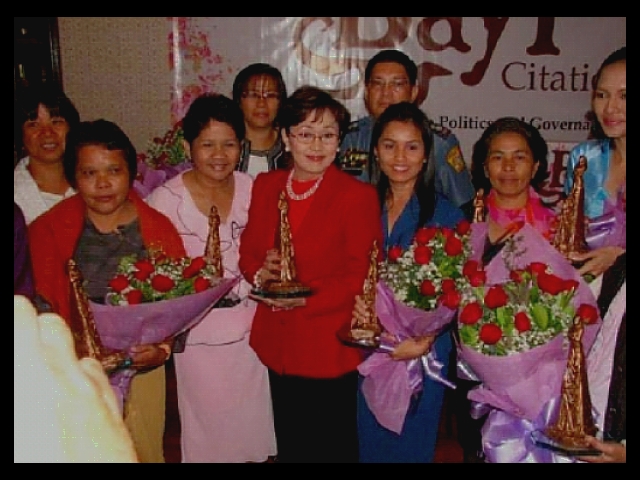
To honor the Women Suffragist Movement and celebrate women’s participation in politics and governance, the Barangay Bayan Governance Consortium and the Institute of Politics and Governance (IPG) are honoring 10 women with the 2007 Bayani Citation. The Bayani Citation is conferred to great women who have gone beyond the suffragist movement to bring forth transformative power. The awarding ceremonies held at the Club Filipino yesterday. Leading the list of awardees was Mayor Vilma Santos-Recto, for her admirable effort to redefine herself from being a star for all seasons to a mayor for all seasons, performing exceptionally well in public administration and meritoriously in delivering education and health services. Congrats to Ate Vi who has given her diehard Vilmanians another reason to crow about and be proud of her. She’s the only actress-turned-politician who was given this kind of honor and even her showbiz colleagues should be proud of her. – ABS-CBN, April 2007 (READ MORE)

ARTICLES - Bayi Citation 8

Vilma Magandang Halimbawa ng Kabataan

Pagka’t mabait masunurin, uliran, masipag, model daughter…a living symbol of a true Filipina, kaya’t napili si Vilma Santos na gawing magandang inspirasyon ng kabataaan ng ating bansa. Iyan ang sabi ni Mrs. Lianina C. Alday, Directress of Bureau of Women and Minors Auxilliary, a goverment-formed entity, in the Department of Labor. The policy of the said entity is welfare beyond protections para sa kabataan ng ating bansa. To extend assistance and help to those hope of our land. Ang paraan ng pagtulong na ginagawa ng bureao ay sa pamamagitan ng Working Youth Centers na nasa iba’t ibang siyudad o provinces. Sa mga ito, tuturuan ang may mga ambisyong maging marangal ang hanap-buhay. At kung ang isang mag-aaral ng trade ay nasa ganoong center sa isang siyudad…ipapadala siya sa center na nakatalaga sa kanya. It will be similar to the procedure done in exchange students programs. In this way, mapuprotektuhan ang kalagayan ng nag-aaral. Lalo na’t kung isang babae. Sa Manila, nakakaroon ng isang main Working Youth Centers where all the activities of the strategically located Working Youth Centers will be centralized. Isa pang tulong na ginagawa ng Bureau of Women and Minors Auxilliary ay ang rehabilitation ng karakter ng mga kabataang napapalungi o kinakapus-palad. Give them moral, legal and if possible, material help. So it can be glanced from the aforementioned explanation na gigantic ang scope ng kilusan ng naturang entity. Nationwide. But to maximize ang realization ng aims ng bureau, nagtatag pa ng entity upang makatulong sa kanyang efforts. The Bureau of Women and Minors Junior Auxilliary was expanded.

After much deliberations, ang officers at members nito’y nagkaisa na si Vilma ang gawing Pangulo ng organisasyon. Napili nila ang superstar because she merits the positions. At bilang President nito, maging magandand inspirations. At incentive ito sa mga kabataang tutulungan ng kanilang samahan. In gact, ng youth of the Philippines na ayong kay Mrs Albay, na siyang nagpa-oath taking kay Vi, sa kanilang tahanan sa Arfel noong Aug 3, the superstar being a shining examples of a model Phillipine youth will be “explited” to the gull. At ito nga raw ay napakaganda kasing inspiration para sa kabataan ng bansa. Vilma was awed by the duty placed upon her by the government. Modest pa man siya at kung bakit siya ang napili sa prestigeous position na naturan. “Pero, I am very much honored. At gagawin ko ang lahat ng aking makakaya upang ako’y maging karapat-dapat sa kanilang pagtitiwala sa aking kakayahan. Ang totoo, I have been pondering the plight ng less fortunate youths ng ating bansa. Kung minsan, nakakalungkot nang talaga ang kanilang kalagayan. And I sincerely want to help them. sa pagiging involved ko sa governement agencies na ang aim ay nasa pagtulong sa ating kabataan, marahil naman magagawa ko ito. Muli, I am honored and thankful at binigyang opportunity ako upang makatulong sa mga ito.” That said, Vilma Santos, Ang magandang inspiration ng ating kabataan. – Deo Fajardo Jr., Topstar Magazine, No. 73, 14 Sep 1973

Special Film: Pagputi ng uwak Pag-itim ng tagak

Pagputi ng uwak…Pag-itim ng tagak (1978) It is the 1950’s at the height of the Huk (local Communist armed forces) movement, in a part of the country beset with agrarian unrest. During the town fiesta of Santa Ines, Julie Monserrat is introduced to Dido Ventura and Maestro Juan Roque, an old musician. Julie, an orphan who comes from the local aristocracy, is on vacation from school in Manila, and is staying with her two spinster aunts Beatriz and Miguela. Dido Ventura, a young man from a poor family, lives with his mother who nurses an old grievance against the Monserrats; she believes they grabbed the Ventura’s property. Maestro Juan Roque, a well-known composer and violinist, has just returned to Santa Ines to finish a zarzuela he has been planning to write for a long time. Dido falls in love with Julie at their first meeting. One night, he sneaks into the spinsters’ house and spends a passionate night with Julie. The brief liaison leads to their elopement. When the two lovers return to ask for the aunts’ blessing, Julie is made to choose between a life of poverty and uncertainty with Dido, or a life of comfort and respectability with her aunts. Julie chooses to stay with her aunts. Dido is shaken by the turn of events. He meets Cristy, his girlfriend, who insults him for the embarrassing situation he has gotten himself into. Dido turns roughly against the girl and beats her up. Cristy’s brother finds out about this and challenges him to a fist fight. Dido kills Cristy’s brother. Cristy’s father, who is the town mayor, decides to dispose of Dido immediately. But when his secret police nab Dido one night, the jeep taking them to Dido’s execution is ambushed by a band of Huk rebels led by Kumander Salome, Dido’s uncle. Saved, Dido decides to join his rebel uncle in the mountains. Meanwhile, Maestro Roque, on a visit to the spinsters’ old house to talk about Julie’s violin lessons, finds out that Julie is actually his own daughter by one of the Monserrat sisters now deceased. Julie herself is pregnant with Dido’s child. The old musician’s visit to her house and the ensuing revelatin make he decide to keep the baby. Maestro Roque arranges for Julie and Dido to meet again. On the night of Good Friday, Dido leaves the rebel camp to see his newborn child. Kumander Salome decides to go along with the young man. Government spies learn of this and an ambush is set. The child of Julie and Dido is the only survivor and witness of the masscre that ends the film. – Rosauro de la Cruz (READ MORE)

“…Furor is really an understatement. “Burlesk” swept the awards in that year’s MMFF, resulting in a controversy that led to the wholesale return of trophies. In spite of the scandal, “Burlesk” is still regarded by critics as the “quintessential” Filipino film. “Hinamon ni Brocka si Tinio ng suntukan (Lino Brocka dared Rolando Tinio to a fight), ” Celso remembers. “Tinio, who was the head of the jury, heralded “Burlesk as the most beautiful Filipino film” past, present and future.” Vi’s turnaround: Adding fuel to the fire, “Burlesk” had stunned moviegoers because it unveiled a new Vilma Santos “from ingénue to wanton woman. Vilma says of “Burlesk?” – “It marked a transition in my career. Working with Celso Kid is a privilege. He’s a genius.” With good humor, Vilma recalls a “quarrel” on the set of “Pagputi ng Uwak, Pag-itim ng Tagak,” which she produced in 1978. “It took so long to finish. I lost money on that. But we’re still friends.” Burlesk and Pagputi brought a lot of honor to me…” – Bayani San Diego Jr. (READ MORE)

Source: gobitz69

FAIR USE NOTICE (NOT FOR COMMERCIAL USE): This site contains copyrighted materials the use of which has not always been specifically authorized by the copyright owner. We are making such material available in our efforts to preserve the film legacies of actress, Vilma Santos, and to make her career information available to future generations. We believe this is NOT an infringement of any such copyrighted materials as in accordance to the the fair dealing clauses of both the Canadian and U.S. Copyright legislation, both of which allows users to engage in certain activities relating to research, private study, criticism, review, or news reporting. We are making an exerted effort to mention the source of the material, along with the name of the author, performer, maker, or broadcaster for the dealing to be fair, again in accordance with the allowable clauses. – Wikipedia (READ MORE)

Remembering Celso Ad Castillo

This slideshow requires JavaScript.

Castillo gave Vilma Santos her first mature role in Burlesk Queen resulting with her first local film festival best actress award. He also directed Pagputi Ng Uwak Pagitim Ng Tagak where Vilma Santos starred and produced. The film received several best picture awards and was considered one of Castillo’s best works. Total Number of collaboration with Vilma Santos: 3 (Burlesk Queen 1977, Pagputi ng Uwak Pag-itim ng Tagak 1978, Tag-ulan sa Tag-araw 1975)

The “Bomba” Movies – “…In the early seventies, these magazines showed a certain boldness in publishing sex-oriented stories, with accompanying explicit illustrations. The big companies reluctantly ignored these stories, and it was the independent film producers who dared bring them to the screen. The bomba movie was born, shaking the whole industry to its very foundations. New directors were tried out. And a new breed of actors and actresses, who were willing to do anything in front of the camera, threatened to put the more established crowd-drawing out of business. Sex became the staple of the film industry. It was during this time that a new film director surfaced – Celso Ad. Castillo, then in his twenties. His vehicle, Nympha, was the simple story of a girl from a very religios family who ran away and got involved with four men. This story has been done over and over again in a number of forgettable movies and is a staple of the comic magazines. In its attempt to ride the bomba bandwagon, it featured enough sex scenes to satisfy the male audiences who expected every new movie to be still more daring. But Castillo had more to offer than steamy sex. He told his story in such a way that details previously considered taboo were exploited. In one of the first scenes, Nympha, the cooped-up virgin, is shown praying with her spinster aunt, when her attention is caught by the illicit coupling between two young lovers just outside their window. The scene of the novena is intercut with the groaning and moaning couple. At the end of the novena (coinciding with the consumation of the sexual act), the image of Christ is shown staring down at her, reprimanding her for her sin. The movie ends with an abortion scene shown in all its gory details, a literal bloodbath which causes the death of the girl. In a strictly Catholic society like the Philippines, a film like Nympha was bound to create a sensation. It was, for the younger generation of Filipinos who missed the so-called Golden Age of Philippine movies in the 50s, their first auteur film. Castillo showed a flair for visual narrative, emphasis and texture never before seen on screen…” – Rosauro de la Cruz, Focus On Filipino Films, A Sampling 1951-1982 (READ MORE)

“The Messiah” – “…Castillo said he had his hair completely shaved to insure the completion of “Pagputi.” The film had been so plagued by problems – production delays, unavailability of stars, bad weather, that they were all set up to give up. He had to stay put in Laguna and finish all the remaining scenes, fearing he might not have the energy and enthusiasm to return to the location sites should he leave for Manila. An effective way of nailing him down in one place was parting with his hair. “It was also a symbolic act of himility, of shedding my vanity,” Castillo added. Which was unusual for one who proclaimed himself “The Missiah and The Uncrowned.” “But they were not meant to be taken seriously. Of course I was kidding when I called myself “The Messiah.” Castillo said. The money and the effort, not to mention frayed nerves and emotions, tears and high blood pressure, poured into “Pagputi” is paying off. The film is making money and reaping accolades from critics and moviegoers alike. The latter are almost unanimous in saying that “Pagputi” is one of the most meaningful film in years and most probably the best of 1978…In fairness to director Castillo, it must be said he could make films, good films, without waiting for over two years (as the case in “Pagputi”) and depleting the producers’ pocketbooks. He finished “Pinakamagandang Hayop sa Balat ng Lupa” in one month, “Burlesk Queen,” the top grosser in last year’s Metro Manila Filmfest, was made in two months. He admitted however that he does not follow scripts rigidly, (even if its his own scripts), but rather improves and relies on his instincts right on the set. He refuses to resort to shortcuts and daya. It may not be the most economical and ideal way of filmmaking, but judging from the results (artistic and money wise) of his movies, it had served director Castillo well…” – Ronald K. Constantino, Expressweek Magazine, 03 August 1978 (READ MORE)

The Vindication – “…As soon as his schedule will permit, he’ll go to Hong Kong and seek a job with Run Run Shaw. He believes this wil pave new roads for him, hopefully a Hollywood assignment. At the moment there’s nothing more he’d like to do than get out and run away from everybody, friends and foes alike, donning the thickest, darkest glasses, bumming around as is his won’t. The film has given him tremendous self-confidence. “I can take it easy now,” he stresses. “After doing Burlesk I won’t have to prove myself to anyone anymore. He talked about the film again, very obviously so close to his heart. “With it I wanted to show some kind of heroism,” he explained. “In the movie Vilma is pregnant and she knows very well that by dancing the striptease she runs the risk of losing not only her baby but her own life. Yet, she goes on, dying in the end. I want to tell the audience – The show is over but the show must go on. Before doing it anything, one should ask himself, ‘Is it worth it?” Vilma loses her life – is it really worth it?” What he fears most now is the sweet smell of success. “I couldn’t imagine myself moving around in a plane or speedboat. When I do this, I will have finally prostituted my art.” Still and all, he coundn’t be happier with the way Burlesk Queen has turned out. “Ngayon, malalaman na kung sinong tunay o hindi,” he gloated…” – Robert Q. Castillo, MOD Magazine, Jan 6 1978 (READ MORE)

Dalang-dala si Leopoldo – “…The last film of Vilma and Leopoldo. He played the crippled father who is against his dauther working as a burlesque dancer. Writer, Ricardo Lee interviewed director Celso Ad Castillo about the directing Salcedo and Santos: “…Tuloy-tuloy ‘yun…(the hospital scense with Vilma and Leopoldo Salcedo) nag-experiment ako noong una, kumuha ako ng second take, pero di ko na rin tinapos. Perfect na iyong una. Alam mo bang nang gawin namin ang eksenang iyon tatlo kaming umiiyak sa set? Ako, si Vilma, at si Leopoldo? Dalang-dala si Leopoldo sa pagsasalita ni Vilma, lumuha siya kahit patay siya dapat doon. Buti na lang di siya nakuha ng kamera…(Kung Nahirapan ka ba kay Vilma?) …Oo, hindi sa acting dahil mahusay talaga siya kundi sa scheduling. Alam mo kasi it takes time before I can really get into the mood of a picture, mga two weeks, tapos kapag nandiyan na, that’s the stage when I’m ready to give my life to the project. Tapos biglang walang shooting ng two weeks dahil busy siya sa ibang pelikula…” – Ricardo Lee, Manila Magazine, Dec 1- 31, 1977 (READ MORE)

“Aktres” Na Talaga – “…“I was shocked,” said Vilma who played the title role in the movie that marked the turning point in her career. “He was too young to go…Celso Kid was the first director who told me na aktres na talaga ako after we shot Burlesk Queen,” added Vilma who won Best Actress at the 1977 Metro Filmfest, but the same award, including those for Best Director and Best Film, were taken back after a controversial Awards Night. “That was the turning point of my career,” said Vilma. After Burlesk Queen, Vilma worked again with Celso in Pagputi ng Uwak, Pag-itim ng Tagak which took three years to finish, causing a big rift between them. “I didn’t only star in the movie, I was also its producer,” recalled Vilma. “I remember Celso Kid as a genius, an intense director. We have forgotten our differences and we resumed our communication. I knew that he was sick. Only a few days ago, I was coordinating with him for his book. He was asking for pictures for the book’s cover. I will pray for the repose of his soul and for his family. I just hope that he was able to finish the book.” Celso also directed Vilma in Tag-ulan sa Tag-araw,” the movie that launched Vilma’s long-running team-up with Christopher de Leon (they have starred in more than two dozen movies since then)…” – Ricky Lo, The Philippine Star, 27 Nov 2, 2012 (READ MORE)

The wisdom and intellect of the Filipino moviegoers – “…”…So the premise goes like this: If it’s good (the film) then why does it fail (at the box-office)? A film makes money because it is effectively communicated visually with its basic intent and purpose within the framework of desired entertainment value, simply saying that if you’re smart, they why aren’t you rich? Also I believe that it is the ultimate idiocy to regard a film as artistic or commercial during the stage of its conception. So that no one may classify a film before or during or after its principal photography. A film only becomes commercial when it has achieved the desired box-office results and only destiny and its timelessness can make a film an art. I dare again say that “classics are not product of presents times but are babies of tomorrow.” And yes, Viriginia, we have indeed in our midst a new breed of moviegoers. In fact it has outgrown our movie industry which up to now still clings to the traditional star and producership systems of the 50’s. The industry still sells the recycled films smorgasbord of Dona Sisang and Dr. Perez to a public has been educated tremendously (sic) by the technology of the 20th century communication arts. Damn those people who insists that the wisdom and intellect of the Filipino moviegoers did not progress even as man had already set foot on the moon and the revolution of modern man had already happened in Asia! For after a thorough theoretical evaluation we can not dismiss the wisdom of acceptance that what precipitated the great awakening of the Filipinos to aesthetic appreciation of modern cinema are: the invasion of television sets in our living rooms which is tantamount to day-to-day exercise of our visual appreciations, the prerogative to chose our line of vision through betamax and the great exports of Filipinos in any capacity to that their return to our homeland bring with them a more civilized attitude towards the intellect of both personal and cinematic arts of existence…” – JC Nigado, Manila Standard, 12 Feb 1987 (READ MORE)

Celso Ad Castillo – “…Born in Siniloan, Laguna 12 Sept 1943. Movie director, scriptwriter, actor. He is the son of Atty. Dominador Ad Castillo, lawyer/writer, and Marta Adolfo. He studied at Manuel L. Quezon University and obtained his Bachelor of Arts degree in English Literature in 1964. Castillo started as a writer for a komiks magazine. With the help of his father, he published his own magazine where he wrote all the stories from cover to cover, using different names as authors. A movie producer commissioned him to write a script on the character of ” James Bandong.” named after Britain’s superspy. The film made money and it was followed by a sequel, “Dr. Yes,” 1965, a spoof on the British film, Dr. No. He wrote and directed his first movie, “Misyong Mapanganib” (Dangerous Mission), in 1966. The most memorable of his earlier films is “Asedillo,” 1971, based on a Filipino rebel of the 1920s who was hunted down as a bandit by the American colonial government. With this film, Fernando Poe, Jr. acquired the image that was to set him off as a legendary gunslinger, a defender of the poor and oppressed. Castillo also made Ang Alamat (The Legend), 1972, with Poe as a reluctant hero who battle a whole private army all by himself to defend his townfolks. Succeeding Castillo films aspired towards thematic originality: small-town perversion in Ang Madugong Daigdig ni Salvacion (The Bloody World of Salvacion), 1975; incest in Tag-ulan sa Tag-araw (Rainy Days in Summer), 1975; political and period gangsterism in Daluyong at Habagat (Tall Waves, Wild Wind), 1976. Even his sex films had a to message to tell. One finds spiritual undertones in the story of an oversexed girl in “Nympha” (Nymph), 1971; a struggle of conscience in a stripteaser who laughed on the outside but cried on the inside in “Burlesk Queen” (Burlesque Queen), 1977; tribal conflict in “Aliw-iw,” 1979; a conflict of family values in “Snake Sisters,” 1983; and the politics of domination in “Isla” (Island), 1983…Castillo won the Filpino Academy of Movie Arts and Sciences (FAMAS) awards for best director and best story for “Pagputi ng Uwak, Pag-itim ng Tagak” (When the Crow Turns White, When the Heron Turns Black), 1978, and also won the Urian awards for best director and best screenplay for the same picture. He shared the story credits with Ruben Nicdao, and the screenplay credits with Lando jacob, Ishko Lopez and Ruben Nicdao. He won the FAMAS best director trophy again in 1985 for “Paradise Inn,” a Lolita Rodriguez-Vivian Velez starrer. He also has a FAMAS best supporting actor award, for “Sampung Ahas ni Eba” (Ten Snakes of Eve), in 1984…” – Excerpts from Encyclopaedia of Philippine Arts by L. Pareja, Celso Ad Castillo Presents web-site (READ MORE)

Related Reading:

Special Film: Burlesk Queen

Burlesk Queen is a 1977 drama film directed by Celso Ad Castillo about a poor girl who finds herself working in the world of burlesque performers in order to alleviate her family’s poverty. The lead role is masterfully played by Vilma Santos, who sheds her good girl image for the first time in this role. To support her paralytic father, Chato (Vilma Santos) works as a utility girl at Inday Theater for a burlesque star Virgie Nite (Rosemary Gil). Chato desperately wants to earn money to help her ailing and paralyzed father. When Virgie gets drunk on the night of her scheduled show, Chato pitches in for her, and she becomes an instant sensation. Enthused by the initial acceptance of the audience, she defies her father’s admonitions and presents herself to the manager, thus, becoming the new burlesque queen. The aberrant lifestyle of a burlesque performer leads Chato to a misguided existence. She becomes pregnant and is abandoned by the father of her baby. Desperate for cash, she agrees to appear in a lavish stage show. In front of a screaming male audience, Chato bumps and grinds in a tour de force performance, unaware of the danger to her pregnancy. – Wikipilipinas (READ MORE)

“…It was 1977 with an exceptional film, Burlesk Queen, that Castillo got his frist critical recognition. Entered in that year’s Metro Manil Film Festival, it was adjudged the Best Picture, won forhim a Best Director Award as well as nine other artistic awards. It told a young girl in Manila in the 50’s who wanted to become a burlesque dancer. It showed a subdued Castillo. He seemed in this film, to have held back his passion for visual impact to give way to his new mastery of film grammar. His characters cried and whimpered, they did not scream and curse. They delievered dissertations on art, not imprecations of wrath, which had set the pitch of his previous films. The critics fought bitterly over Burlesk Queen. In that festival, he was contending with film makers who enjoyed a high reputation among the country’s most avid film critics. Upon winning the award, Castillo instantly became the favorite beating boy of the critics who did not appreciate Burlesk Queen. To prove to them his worth, Castillo did Pagputi ng Uwak, a 50’s epic set in his favorite Southern Tagalog locale. It was the most lavish of all his productions and had all the elements of a “great” Filipino film. He exploited the many religious and social rituals typical of the region. The film featured the two most critically acclaimed performers of the time, Bembol Roco, Jr. and Vilma Santos, with the cinematography of Romy Vitug complementing Castillo’s visual sense. And it touched on civil unrest to underline the film director’s social awareness. Pagputi ng Uwak was a visual fest, an artistic and socially responsive film aimed at the critics. It was also Castillo’s first commercial failure after a string of more than 20 minor and major box-office hits…In just a decade, Castillo, with all his audacity and dramatic excesses, has claimed his place as one of the most versatile and genuinely interesting filmmakers in the Philippines today…” – Rosauro de la Cruz (READ MORE)

Source: gobitz69

FAIR USE NOTICE (NOT FOR COMMERCIAL USE): This site contains copyrighted materials the use of which has not always been specifically authorized by the copyright owner. We are making such material available in our efforts to preserve the film legacies of actress, Vilma Santos, and to make her career information available to future generations. We believe this is NOT an infringement of any such copyrighted materials as in accordance to the the fair dealing clauses of both the Canadian and U.S. Copyright legislation, both of which allows users to engage in certain activities relating to research, private study, criticism, review, or news reporting. We are making an exerted effort to mention the source of the material, along with the name of the author, performer, maker, or broadcaster for the dealing to be fair, again in accordance with the allowable clauses. – Wikipedia (READ MORE)

31st Year Anniversary of “Sinasamba Kita”

FILMS - Sinasamba Kita

1982 was a banner year for Vilma Santos. Aside from the acting gem, “Relasyon,” she also established her bankable status, thanks to Viva film’s “Sinasamba Kita.” This film grossed 6.2 million in just 6 days, a box office record! Directed by Eddie Garcia, the film featured Vilma as the “bitchy-rich” anti-heroine executive, Lorna Tolentino as the younger sister who idolized her older sister, Christopher DeLeon as Gerry the rich executive who work for Vilma’s rival company and Philip Salvador as the obsessed admirer of Lorna.

The intertwined love quadrangle between the four characters enhanced by crisp dialogue, glossy production design and catchy theme song made this movie effective and very commercial. Two scenes stands out, both involved Vi and Lorna. (By the way, Lorna’’s name in this film was Nora and Vilma, Divina, which made us wonder if this is supposed to be a Nora-Vilma film?)

In one scene, Vilma was waiting for her younger sibling Lorna, when she finally arrived, she accused the younger sister of wearing her perfume, the accusation made Lorna defensive and replied: “Hindi Ate…Bumili ako para sa sarili ko nagustuhan ko kasi ang amoy! (No sis, I bought the same perfume because I like the smell!)” In which Vilma countered: “For Godsake, Nora, bakit hindi ka magkaroon ng sarili mong identity!..Hindi kita anino! (For Godsake, Nora, Why don’t you have your own identity! You’re not my shadow!)”

Another scene, Vilma caught Lorna wearing the same designer clothe that her fashion designer, Fanny Serrano design:
Vilma: “Iniinsulto mo ba ako? Anong gusto mong palabasin…bakit ginagaya mo ang damit ko? (Are you insulting me? What are you trying to prove…why are you immitating my clothes?)”
Lorna: “Ate naman ano naman ang masama kung gayahin kita? (Sis, I don’t see anything wrong If I emulate you?)”
Vilma: “Alamin mo muna ang iyong limitasyon…baka nakakalimutan mo kung saan kita pinulot…kinikilala kitang kapatid pero hindi tayo magkapantay! (You have to make sure you know your limit…are you forgeting where I got you…I recognized you as my sibling but we are not equal!)”
Lorna: “napakaliit naman pala ng pagtingin mo sa akin…(I didn’t realized how small am I to you…)”
Vilma: “Imposible naman lumaki ang pagtingin ko sa taong tinutulungan ko lang?…kung sabagay magkaiba tayo ng ina…bakit kaya pinatulan ng papa ang iyong ina? (It’s is impossible for me to treat you like in high regard since I am just helping you…well, it is because we have different mother…it makes me wonder why did my papa had an affair with your mother?)”
Lorna: “huwag mo naming insultuhin ang inay, patay na siya… (don’t insult my mom, she’s already dead…)”
Vilma: “Hindi ko siya iniinsulto sinasabi ko lang sayo ang totoo! Magkaiba tayong dalawa, hindi mo ako matutularan at hindi kita tutularan! Nora, ang hindi mo maabot huwag mog pagpilitang abutin, wala kang pang pakpak kya huwag lumipad ng pagkataas-taas! (I’m am not insulting her, I’m telling the truth! We’re both different, You can never be me and I will never be you! Nora, don’t reach things that you can never reach, you don’t have wings, so don’t fly so high!” – RV (READ MORE)