Vilma Santos-Recto is a popular multi-awarded actress and politician in the Republic of the Philippines. *** She is known as "Queen of Philippine Movies," "Queenstar," "Grand Slam Queen," "Box Office Queen," and "Star for All Seasons." *** This website is mostly about her iconic film career.
Basic Information: Story: Pierre Salas; Screenplay: Allan Jayme Rabaya; Direction: Emmanuel H. Borlaza; Cast: Romeo Vasquez, Vilma Santos, Ma-an Hontiveros, Laurice Guillen, Romeo Enriquez, Mary Walter; Cinematography: Oscar Querijero; Music: George Canseco; Production Company: Lea Productions; Release Date: February 3, 1978; Theme Songs: “Kailangan Kita” performed by Leah Navarro
Plot Description: No Available Data
Film Achievement: No Available Data
Film Review: “Sometime in the mid 70s, matinee idol Romeo Vasquez returned to the movie scene after a long absence, his movie career in limbo after his failed marriage with popular actress Amalia Fuentes. His teamup with Vilma Santos somehow rekindled and revived his career. Their first movie together, Nag-aapoy na Damdamin in 1976 turned out to be a big hit. Despite their age gap, reel and real life sweetheart, Romeo, 34 and Vilma, 23, soon became the hottest love team, doing one hit movies after another…” – Video 48 (READ MORE)
“…Romeo Vasquez is an oddity in Vilma’s life. Hindi akalain ng lahat na ang isang notorious playboy and balikbayan actor would capture the heart of the then elusive Ate Vi. Nagkaroon sila ng affair which lasted for more than a year. Kilala si Bobby sa pagiging bohemyo kaya naman walang kakilala si Ate Vi na bumoto sa aktor. Ate Vi was love struck at talagang na head-over heels in love. Nagsimula ang kanilang affair sa set ng kanilang pelikulang “Nag-aapoy na Damdamin”. True to this title, nagliyab silang dalawa at tunay ngang nag-apoy ang kanilang damdamin. May plano pa nga sila ni Bobby na magpakasal sa Europe. Talagang Ate Vi was ready to give up her life as an actress and would settle with the actor abroad. And with herb relationship with Bobby, nag-surface ang bagong Vilma Santos.Ate Vi realized that she cann’t sacrifice everything for love. Nagising siya sa katotohanan at nagkamali kung kaya nagdesisyon siyang kumalas sa bohemyong aktor…” – Willie Fernandez (READ MORE)
“…But it was with handsome actor Romeo Vasquez that Vilma Santos had her most controversial relationship. Romeo was the former husband of Philippine movie queen Amalia Fuentes. He and Vilma first paired in the movie Nag-aapoy na Damdamin (1976). It was also during this year that they became a couple. They made several movies together, all of which did well at the box-office. Vi and Bobby (Romeo’s nickname) became the most-talked about reel and real love team at the time. The relationship was always on the pages of showbiz magazines and tabloid entertainment section pages because of the intrigues and the personalities who got involved with them…” – Rommel R. Llanes (READ MORE)
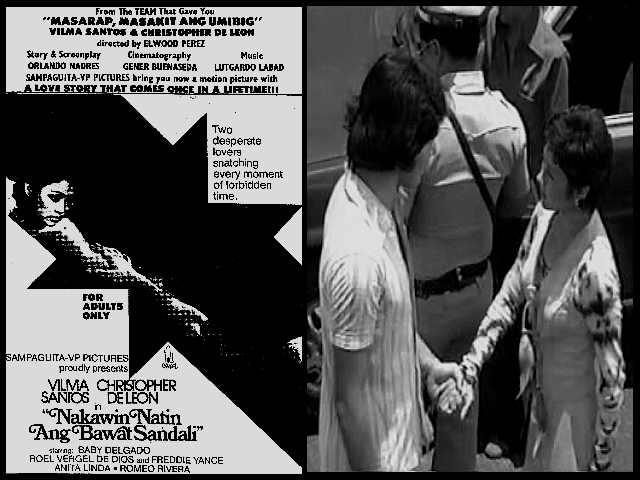
Basic Information: Direction: Elwood Perez; Cast: Cast: Vilma Santos, Christopher De Leon, Baby Delgado, Roel Vergel de Dios, Freddie Yance, Anita Linda, Romeo Rivera, Tony Carreon, Lily Miraflor, Ven Medina, Jose Villafranca, Nina Lorenzo, Yolanda Luna, Mario Escudero, Jimmy Reyes, Vic Santos, Aring Bautista, Nat Mallares, Josefina Morato, Juanita Rodrigues, Rita Flores, The Thunder Boys; Sound: Lino Torres; Editing: Oscar Dugtong; Cinematography: Gener Bueneseda; Executive Producer: Marichu Perez Maceda; Stroy and Screenplay: Orlando Nadres; Music: Lutgardo Labad; Produced by Sampaguita Pictures Inc.; Theme Songs: Dahil Sa Pag-ibig (Music by Lutgardo Abad, Lyrics by George Canseco, Sung by Aloha, Released by Blackgold Records), Nakawin Natin Ang Bawat Sandali (Music by Lutgardo Abad, Lyrics by Orlando Nadres, Sung by Anthony Castelo, Released by Vicor Music)
Plot Description: “A young couple’s affair is marred by their feuding families and small-town intrigues. They meet years after as successful career people only to be drawn into another scandalous liaison.” Bamboo Gods and Bionic Boys (READ MORE)
Film Achievement: One of seven Perez-Santos collaborations.
Film Review: “…It has a uniformly good performance by the cast which includes Baby Delgado, Roel Vergel de Dios, Anita Linda, Jose Villafranca and the two leads Christopher de Leon and especially Vilma Santos who has done a surprisingly intelligent and affecting character portrayal. Not since Eddie Romero’s Sinong Kapiling, Sinong Kasiping? (1977) have we seen characters who think, behave and react to problems and situations like mature, sensitive and intelligent people. The characters do give way to occasional hysterical outbursts, but they somehow wake up to their senses before they completely forget themselves. And they are people in believable situations with real problems and genuine emotions. When they talk, they are seldom silly and when they are silly, they are aware of it. But even when they are silly or trite, they are never unsympathetic…” – Jojo Devera, Sari-saring Sineng Pinoy (READ MORE)
“…Elwood Perez and Vilma Santos colloborated in seven films (Ibulong Mo Sa Diyos 1988, Lipad Darna Lipad 1973, Magkaribal 1979, Masarap Masakit ang Umibig 1977, Nakawin Natin ang Bawat Sandali 1978, Pakawalan Mo Ako 1981, Pinay American Style 1979). The first one was the trilogy that he co-directed with two other director, Borlaza and Gosiengfiao (these three are the most underrated and under appreciated directors in the Philippines), the remake of Mars Ravelo comic super hero, Darna in Lipad Darna Lipad. The film was a record-breaking hit Box-office Film. They follow this up with a more mature projects as Vilma started to switched her image from sweet to a mature versatile actress, pairing her with Christopher DeLeon in five films starting with Masarap Masakit Ang Umibig in 1977. The Perez-Santos-DeLeon team produced seven blockbuster hits that gave Vilma two FAMAS best actress awards that secured her elevation to FAMAS highest honour, the FAMAS Hall of Fame award. She won in 1979 for Pakawalan Mo Ako and 1988 for Ibulong Mo Sa Diyos…” – RV (READ MORE)
Basic Information: Directed: Emmanuel H. Borlaza; Story, screenplay: Tom Adrales, Allan Jayme Rabaya; Cast: Vilma Santos, Bembol Roco, Mat Ranillo III, Allan Valenzuela, Freddie Yance, Liza Lorena, Anita Linda, Lorli Villanueva, Ann Villegas, Angie magbanua, Rosemarie De Vera, Lito Lapid, Leo Pilapil; Original Music: Tito Sotto; Cinematography: Totoy Jacinto; Production Design: George Vail Kabristante
Plot Description: In the film “Kampus?” (1978), Suzette (Vilma Santos) thinks she’s liberated woman who doesn’t believe in marriage matrimony while his boyfriend, Norman keeps on proposing the sacredness of marriage vow. These are two conflicting beliefs of two students undoubtedly in love with each other. Their relationship was put to a test when Suzette met Manny (Matt) who happens to be in accordance with what she thinks she believes in. A campus experiment for Suzette and she was the first to be affected by it. Will she swallow that so called principle and be merry with the one she truly loves? – Kabayan Central (READ MORE)
A cinematic view of campus life dealing with sexual permissiveness among teeners, dormitory life, fraternity affiliations and initiations, teenage crushes, among others. Vilma Santos is a coed torn between the man she really loves (Bemvol Roco) and the man she surrenders her virginity to (Mat Ranillo III), Liza Lorena is the teacher tormented by a student who has a terrible crush on her (Allan Valenzuela). An Emmanuel Borlaza film. – Century Video Inc.
Film Achievement: No Available Data
Film Review: “…But the biggest fear of Borlaza was when Agrix Films’ Kampus? was booked one week after the opening of VS Films’ Pagputi ng Uwak, Pagitim ng Tagak. The Celso Ad. Castillo film was an artistic triumph, and Borlza felt following it up with another Vilma-Bembol starrer would put them at a great disadvantage. The Vilma-Bembol fans might still be raving over Pagputi… instead of discussing Kamput? As it turned out, people let Pagputi…pass and waited for Kampus? judging from the comparative gate receiots of the two movies…Sabi ni Mama Santos, ako daw ang “pumatay” sa kanilang Pagputi…eto ang parusa ko, bigyan ko daw sila ng isang Kampus? so I’m making for them Coed. You see, when I was working on Kampus? at UP Los Banos, I realized their problems and lifestyle can be a source of even 10 movie materials. At kapag ang student force pala ang nag-patronize sa Tagalog movie, ang laki ng audience!” Borlaza revealed…I’m very meticulous about is: the audience were to identify itself with my main character, will it be happy with the poetic justice I execute? Will they find it correct and realistic? In Kampus? for instance, students who were pleased with the movie told me they liked the ending very much. They agreed with it. Vilma was bedded first by Mat Ranillo III, but ended up with Bembol who was the right choice after all. They say in real life, the man you walk down the aisle with is not necessarily the first man you had sex with. Also they say the dialouges were very in – like the way actual students would speak them. Siguro, once they sit in the theater, they are not bothered by such questions as ‘Why” or “how come?” Is the star value the main thing in selling movies? “In the case of Kampus?, yes, because Vilma Santos was my main star and she’s the current box office queen …” – Manny B. Fernandez, Expressweek, November 9, 1978 (READ MORE)
“…Fate would have it that in the space of three days I watched Vilma Santos as June (in Kampus, 1978), the firm believer of ‘free love’ caught between the attentions of two men, and Angel Locsin as the fierce Ces, setting the terms of an affair with a man she decidedly resists. Four decades apart, these representations of strong, independent women caught within obstacles premised on love remain appealing to viewers. The conflicts faced by June and Ces are hinged on unconventional ideas about the conduct of heterosexual relationships. These women characters unequivocally distance themselves from the bind of traditional relationships and the expectations that burden it; June with sophisticated musing and Ces with stoic distance…While Vilma Santos’s June ponders her preference for ‘free love’ intelligently, weighs her dilemmas with pensive introspection, faces her hurdles with sarcasm and humour; Angel Locsin’s Ces is denied this chance, wallows instead in denial which became infuriatingly tiresome. This is not to blame Locsin’s abilities as an actor (adept at she is in portraying conflicted characters, torn in situations not of their making) but on the film’s failure to fully flesh out its characters. The film failed to grasp a deeper vein of feeling…” – Tessa Maria Guazon (READ MORE)
Free Love – “…Fate would have it that in the space of three days I watched Vilma Santos as June (in Kampus, 1978), the firm believer of ‘free love’ caught between the attentions of two men, and Angel Locsin as the fierce Ces, setting the terms of an affair with a man she decidedly resists. Four decades apart, these representations of strong, independent women caught within obstacles premised on love remain appealing to viewers. The conflicts faced by June and Ces are hinged on unconventional ideas about the conduct of heterosexual relationships. These women characters unequivocally distance themselves from the bind of traditional relationships and the expectations that burden it; June with sophisticated musing and Ces with stoic distance…While Vilma Santos’s June ponders her preference for ‘free love’ intelligently, weighs her dilemmas with pensive introspection, faces her hurdles with sarcasm and humour; Angel Locsin’s Ces is denied this chance, wallows instead in denial which became infuriatingly tiresome. This is not to blame Locsin’s abilities as an actor (adept at she is in portraying conflicted characters, torn in situations not of their making) but on the film’s failure to fully flesh out its characters. The film failed to grasp a deeper vein of feeling. Thus, when we find Ces and Macky in strained conversations grappling with their predicaments as individuals and lovers, why do they seem unconvincing, their loneliness and dilemmas so affected?” – Deborah Jermyn, 2011, posted by YCC (READ MORE)
Basic Information: Directed: Maria Saret; Story, screenplay: Jun Posadas, Cecille Larrizabal; Cast: Vilma Santos, Dante Rivero, Anthony Alonzo, Romeo Enriquez, Chito Ponce Enrile, Cloyd Robinson, Sandy Garcia, Laila Dee, Ramon Zamora; Cinematography: Vic Anao
Plot Description: No Available Data
Film Achievement: No Available Data
Film Review: “…Alonzo was one of the busiest actors during that time and made a long list of true-to-life movies based on factual events and police records. Stardom came late for Alonzo. He was already 30 when he was given an important role in Hindi sa Iyo ang Mundo Baby Porcuna in 1978 for which he was nominated for the URIAN Best Supporting Actor. He was nominated in the FAMAS the following year for Dakpin si Junior Bombay (1979). In 1972, he won the FAMAS Best Actor for his role in Bambang. He also won the Best Actor awards in the 3 Metro Manila Film Festival (MMFF) he participated in— for Bago Kumalat Ang Kamandag (1983), The Moises Padilla Story: The Missing Chapter (1985) and Anak Badjao (1987)…” – Wikipedia (READ MORE)
Basic Information: Directed: Nilo Saez; Story, screenplay: Bert Mendoza; Cast: Romeo Vasquez, Vilma Santos, Perla Bautista, Romy Diaz, Rodolfo Boy Garcia, Nello Nayo, Dexter Doria, Ely Roque, Richard Romuldez; Original Music: D’ Amarillo; Cinematography: Alfonso Alvarez; Theme Songs: “Pag-ibig ko sayo ko lang ibibigay” performed by Flippers
Plot Description: No Available Data
Film Achievement: No Available Data
Film Review: “Sometime in the mid 70s, matinee idol Romeo Vasquez returned to the movie scene after a long absence, his movie career in limbo after his failed marriage with popular actress Amalia Fuentes. His teamup with Vilma Santos somehow rekindled and revived his career. Their first movie together, Nag-aapoy na Damdamin in 1976 turned out to be a big hit. Despite their age gap, reel and real life sweetheart, Romeo, 34 and Vilma, 23, soon became the hottest love team, doing one hit movies after another…” – Video 48 (READ MORE)
“…Romeo Vasquez is an oddity in Vilma’s life. Hindi akalain ng lahat na ang isang notorious playboy and balikbayan actor would capture the heart of the then elusive Ate Vi. Nagkaroon sila ng affair which lasted for more than a year. Kilala si Bobby sa pagiging bohemyo kaya naman walang kakilala si Ate Vi na bumoto sa aktor. Ate Vi was love struck at talagang na head-over heels in love. Nagsimula ang kanilang affair sa set ng kanilang pelikulang “Nag-aapoy na Damdamin”. True to this title, nagliyab silang dalawa at tunay ngang nag-apoy ang kanilang damdamin. May plano pa nga sila ni Bobby na magpakasal sa Europe. Talagang Ate Vi was ready to give up her life as an actress and would settle with the actor abroad. And with herb relationship with Bobby, nag-surface ang bagong Vilma Santos.Ate Vi realized that she cann’t sacrifice everything for love. Nagising siya sa katotohanan at nagkamali kung kaya nagdesisyon siyang kumalas sa bohemyong aktor…” – Willie Fernandez (READ MORE)
“…But it was with handsome actor Romeo Vasquez that Vilma Santos had her most controversial relationship. Romeo was the former husband of Philippine movie queen Amalia Fuentes. He and Vilma first paired in the movie Nag-aapoy na Damdamin (1976). It was also during this year that they became a couple. They made several movies together, all of which did well at the box-office. Vi and Bobby (Romeo’s nickname) became the most-talked about reel and real love team at the time. The relationship was always on the pages of showbiz magazines and tabloid entertainment section pages because of the intrigues and the personalities who got involved with them…” – Rommel R. Llanes (READ MORE)
Film Review: “…Joey Gosiengfiao’s films are anything but righteous, much less respectable. That was their glory and greatness, and the reason he could never win an award–Christ, I think, with his abhorrence of respectability, would like the man’s style. Take, for example, the scene between Eddie Gutierrez and Ricky Belmonte in Bomba Star (roughly translated, Porn Star, 1980). Belmonte and Gutierrez are working out in a gym; Gutierrez starts casting looks at Belmonte; Belmonte coyly returns his looks. The two start teasing each other, tickling each other, suddenly find themselves on the floor wrestling with each other…enter Gutierrez’s lover, played by Marissa Delgado–she doesn’t do anything, just strikes a glamour pose, a sardonic expression on her face and the world’s longest cigarette holder between her fingers. I wish I could explain why the moment is so irreducibly funny, but I can’t; if I could, I suspect it wouldn’t be funny at all…” – Noel Vera (READ MORE)
Basic Information: Directed: Al Quinn; Story, screenplay: Maryo De Los Reyes; Cast: Vilma Santos, Christopher De Leon, Victor Laurel, Rio Locsin, Romeo Enriquez, Sandy Garcia, Freddie Aguilar, Sampaguita, Anak Bayan Band; Executive producer: Emilia Blass; Cinematography: Al Quinn, Joe Batac; Film Editing: Nonoy Santillan
Plot Description: Love Triangle (Christopher De Leon-Vilma Santos-Cocoy Laurel) and lots of dancing!
Film Achievement: One of 23 Film collaborations of Christopher and Vilma Santos.
Film Review: “…I was Vilma’s choreographer for her movies (Disco Fever, Good Morning Sunshine, etc.) and at the same time I was also choreographing for Nora on her show Superstar. When Vilma had her own TV show, she got me as choreographer but I stayed with her for only one month. The network bosses told me that I shouldn’t be handling two superstars at the same time. Nora was on Channel 9 and Vilma was on Channel 13. Because of loyalty, I chose to stay with Nora kasi mas nauna naman ako sa kanya. I was with her for four years na at that time. But first, I talked to Vilma who is a ninang of my son Miggy. I left Vilma with a heavy heart…(Asked if she was a Noranian, Geleen thought for a while and smiled), “Noon ‘yon!”…“It’s hard to tell. Nora is good in memorizing dance steps and Vilma is good in the execution.” Other stars Geleen choreographed for included Alma Moreno (for her TV show Loveli-NESS), Maricel Soriano (for Maricel Live! on Channel 13 and Maria, Maria on Channel 4)), Kuh Ledesma and Manilyn Reynes (Manilyn Live!). It was Maribeth Bichara who replaced Geleen as Vilma’s choreographer. Perhaps as an offshoot of their star-mistresses’ rivalry, Geleen (for Nora) and Maribeth (for Vilma) were also pitted against each other and the two dancers tried to ride on the wave of the faked rivalry between them when actually, claimed Geleen, “Maribeth and I were good friends…” – Geleen Eugenio (READ MORE)
“…I’d rather be known as Victor Laurel. But really, this Travolta is a sensation. I met him in Studio 54 and how the crowd loves him. He’s a wonderful actor, singer, and dancer.” Cocoy, too is a seasoned dancer even before the Travolta fever. He has a catlike grace that gives the impression of strenght and his dancing ability has helped tremendously in his career. “The Travolta dance is typical of hero worship even in San Francisco, Los Angeles and other big cities. Mondays, everyone who has caught the fever, even 30 year olds shop and prepare for the disco on Fridays and Saturday and stay up till the wee hours of the morning…We were about to ask another question about Vi, his leading lady in Lea’s Disco Fever but Ate Josie came in to remind Cocoy that the Sampaguita people were waiting with sketches of his costume for Dyesebel, the movie he was going to make for the Gilmore Studio. But didn’t. As a parting shot, Cocoy revealed that he’d soon put a disco. The Third Kind or something in Makati…” – Nena Z. Villanueva, Expressweek, November 16, 1978 (READ MORE)
Basic Information: Directed: Elwood Perez; Story: Orlando Nadres; Screenplay: Elwood Perez, Orlando Nadres; Cast: Vilma Santos, Christopher De Leon, Mat Ranillo III, Amado Cortez, Lilibeth Vera-Perez, Anita Linda, Ma-An Hontiveros, Lillian Laing, Sandy Garcia, Cloyd Robinson, Laila Dee; Executive producer: Marichu Vera Perez; Original Music: Lutgardo Labad; Cinematography: Gener Buenaseda; Film Editing: Jose Tarnate; Production Design: Bobby Bautista
Plot Description: A wealthy couple’s sacrificing adopted son, Alonso (Christopher de Leon) and wayward biological son, Alvaro (Mat Ranillo III) vie for the love of the same woman, Estella (Vilma Santos).
“…Elwood Perez and Vilma Santos colloborated in seven films. The first one was the trilogy that he co-directed with two other director, Borlaza and Gosiengfiao (these three are the most underrated and under appreciated directors in the Philippines), the remake of Mars Ravelo comic super hero, Darna in Lipad Darna Lipad. The film was a record-breaking hit Box-office Film. They follow this up with a more mature projects as Vilma started to switched her image from sweet to a mature versatile actress, pairing her with Christopher DeLeon in five films starting with Masarap Masakit Ang Umibig in 1977. The Perez-Santos-DeLeon team produced seven blockbuster hits that gave Vilma two FAMAS best actress awards that secured her elevation to FAMAS highest honour, the FAMAS Hall of Fame award. She won in 1979 for Pakawalan Mo Ako and 1988 for Ibulong Mo Sa Diyos…Total Number of Films with Vilma Santos: 7 (Ibulong Mo Sa Diyos 1988, Lipad Darna Lipad 1973, Magkaribal 1979, Masarap Masakit ang Umibig 1977, Nakawin Natin ang Bawat Sandali 1978, Pakawalan Mo Ako 1981, Pinay American Style 1979)…” – RV (READ MORE)
Film Reviews: “…Walang ipinagkaiba ang pelikula sa ibang mga sineng tinalakay ang mga suliranin ng pag-ibig at pamilya. Makikitang pinagtuunan ng pansin ni direktor Elwood Perez ang disenyo ng pelikula ngunit hindi naging epektibo ang paggamit nito upang maiusad ang kuwento. Kahit sa pagganap ng mga pangunahing tauhan, animo sila’y nasa entablado. Nanlilisik ang mga mata, walang katapusang pagsisigawan, pagtutulakan at pagbubugbugan. Sa pelikulang ito, unang ipinamalas ang senswalidad ni Vilma Santos. Maraming eksenang sekswal ang aktres at maaari talaga siyang makipagsabayan sa mga tulad nina Alma Moreno at Trixia Gomez. Karamihan ng mga sitwasyong ibinigay sa kanyang karakter ay hindi kapani-paniwala. Nariyang gawin siyang modelo, sa ilang piling tagpo ipinakita din ang pagiging estudyante ni Estella ngunit hindi naman tinahak ang mga ito sa kabuuan ng pelikula. Hindi rin maikakaila ang husay ni Christopher de Leon bilang aktor ngunit sa pelikulang ito ay nasayang lamang ang kanyang pagganap. Hindi nabigyan ng tamang direksyon ang aktor kung kaya’t lumabas na sabog ang kanyang karakterisasyon. Si Mat Ranillo III naman ay tila hindi na natutong umarte. Kadalasa’y pinaghuhubad siya ng direktor sa mga eksena upang mabigyang pansin. Masyadong mahaba ang pelikula dahil na rin siguro sa panghihinayang ni direk Elwood na masayang ang magagandang eksenang kanyang nakunan ngunit hindi naman nakaapekto ang mga ito sa takbo ng istorya. Kadalasa’y nakababad lamang ang kamera at nakatanghod sa susunod na gagawin ng mga artista. Hindi ito nakatulong upang mapabilis ang takbo ng pelikula, nakakainip panoorin ang ganitong mga eksena. Ang Masarap, Masakit Ang Umibig ay basurang nababalot sa kinang ng makintab na sinematograpiya, disenyo at musika na nagbabalatkayong masining na pelikula.” Jojo Devera, Sari-saring Sineng Pinoy (READ MORE)
“…Her metamorphosis began in late 1976 when she agreed to be kissed by Rudy Fernandez in Makahiya at Talahib. It was a “feeler” of sort and when the public clacked its tongue in obvious approval, Vilma shelved her lollipops-and-roses image and proved that she, too, could be a woman – a wise move indeed because at that time her career was on a downswing and her movies were not making money. Then she did Mga Rosas sa Putikan for her own VS Films where she played a country girl forced into prostitution in the big city. The movie did fairly well at the tills. Good sign. And came her romance with Romeo Vasquez, boosting both their stocks at the box office (thier two starrers, Nag-aapoy na Damdamin and Pulot-Gata where Vilma did her own wet style, were big moneymakers). The tandem, although it did help Vilma, actually helped Vasquez more in re-establishing himself at the box office (without Vilma, his movies with other leading ladies hardly create any ripple). In Susan Kelly, Edad 20, Vilma played a notorious-woman role that required her to wear skimpy bikini briefs in some scenes, following it up with two giant sizzlers (Dalawang Pugad, Isang Ibon and Masarap, Masakit ang Umibig) that catapulted her as the newest Bold Queen. Then came Burlesk Queen…” – Ricardo F. Lo, Expressweek Magazine January 19, 1978 (READ MORE)
“…Elwood Perez and Vilma Santos colloborated in seven films (Ibulong Mo Sa Diyos 1988, Lipad Darna Lipad 1973, Magkaribal 1979, Masarap Masakit ang Umibig 1977, Nakawin Natin ang Bawat Sandali 1978, Pakawalan Mo Ako 1981, Pinay American Style 1979). The first one was the trilogy that he co-directed with two other director, Borlaza and Gosiengfiao (these three are the most underrated and under appreciated directors in the Philippines), the remake of Mars Ravelo comic super hero, Darna in Lipad Darna Lipad. The film was a record-breaking hit Box-office Film. They follow this up with a more mature projects as Vilma started to switched her image from sweet to a mature versatile actress, pairing her with Christopher DeLeon in five films starting with Masarap Masakit Ang Umibig in 1977. The Perez-Santos-DeLeon team produced seven blockbuster hits that gave Vilma two FAMAS best actress awards that secured her elevation to FAMAS highest honour, the FAMAS Hall of Fame award. She won in 1979 for Pakawalan Mo Ako and 1988 for Ibulong Mo Sa Diyos…” – RV (READ MORE)
Basic Information: Directed: Leonardo L. Garcia; Story, screenplay: Bert R. Mendoza; Serialized in Wakasan Komiks Magazine published by Nestor Leonidez; Cast: Romeo Vasquez, Vilma Santos, Suzanne Gonzalez, Rodolfo Boy Garcia, Tange, Ruel Vernal, Ricky Manalo Jr., Vanessa Lopez, Tita De Villa, Richard Santiago, Paraluman, Palito; Original Music: Restie Umali; Cinematography: Ricardo Herrera
Plot Description: An intrigued filled love affair between Baby Abueva a poor lass of Baguio and Teddy Burgos a millionaire from Zamboanga. An affair married with the appearance of Lota. – Kabayan Central (READ MORE)
Film Achievement: No Available Data
Film Review: “…And came her romance with Romeo Vasquez, boosting both their stocks at the box office (their two starrers, Nagaapoy Na Damdamin and Pulot-Gata where Vilma did her own wet style, were big moneymakers). The tandem, although it did help Vilma, actually helped Vasquez more in reestablishing himself at the box office (without Vilma, his movies with other leading ladies hardly create any ripple). In Susan Kelly, Edad 20, Vilma played a notorious-woman role that required her to wear skimpy bikini briefs in some scenes, following it up with two giant sizzlers (Dalawang Pugad Isang Ibon and Madakit Masarap Ang Umibig) that catapulted her as the newest Bold Queen…” – Ricardo F. Lo, Expressweek, Jan 19 1978 (READ MORE)
“…Pulot-Gata was one of the several hit films of Romeo Vasquez and Vilma Santos. And one of the forgettable ones. It exploits their real and reel life relationships. Despite the film’s poor material, you can see their screen chemistry in several light comedic scenes. Ruel Vernal’s fight scene with Vasques can be shortened or edited out. Ditto with Susane Gonzales scenes in the hotel room, attempting to seduce back her ex-fiance. In addition to some comedic scenes that can be edited, Vilma’s dramatic scene near end, can also be shortened. A more watchable film of Vi and Romeo were “Dalawang Pugad Isang Ibon” and “Nag-aapoy na Damdamin.” After watching “Pulot-Gata, Puede Kaya?” (literally means, “Sweet-Coconut, Can it be?” which can be assumed about the May-December affair of Santos and Vasquez), one can clearly say, “YES” to the real relationship of Vi and Romeo but NO to this films…” – RV (READ MORE)
Basic Information: Direction, Screenplay and Original Story: Ishmael Bernal; Cast: Romeo Vasquez, Vilma Santos, Mat Ranillo III, Ana Gonzales, Anita Linda, Fred Montilla, Mary Walter, Laila Dee, Roldan Rodrigo, Ann Villegas, Ernie Zarate, Catherine Santos, Val Mallari, Oscar Miranda, Ursula Carlos, Rene Magno, SOS Daredevils, Danie Ramirez, Danny Franco and Rheez Chua’s Models; Art Director: Bobby Bautista; Assistant Art Directors: Emiliano Gonzales, Virgilio Sanchez, and Bert Isleta; Electricians and Gripmen: Corpuz, Romeo Dueñas, Narsiso David, Mariano Guzman, Irinio Flores; Unit Driver: Jose Maigapo; Color Processed: LVN Laboratory; Director of Cinematography: Nonong Rasca; Assistant Cameraman: Felizardo Anastacio; Sound: Luis Reyes; Field Soundman: Jose Fortuno; Boomman: Alberto Dueñas; SFX Technician: Jun Martinez; Film Editor: Nonoy Santillian; Senior Editor: Ruben Pantua; Assistant Editors: Rico Salas, Ariel Quicho, Jun Calaguan; Music: The Vanishing Tribe; Theme Songs: “Puso’y Alinlangan” performed by Vilma Santos, “Torn Between Two Lovers” performed by Gracie Rivera, Dyna Records; Guest Choroeographer: Peter Estocado; Make-up Artists: Dading Ravela and Virgie F. Capulong; Legman: Rodolfo Basco; Publicities: Teresa Santos Blas, Beth Castillo; Stills: Ben Nollora and Lito Morales; Layout Artist: Hannibal Cambel; Title Designer: Marvin B. Panganiban; Production Manager and Assistant Director: Dante Javier; Production Staff: Nelson Sia, Ruben Fernandez, Gloria B. Agustin; Administrative and Sales: Jon Santos Blas, Estrella T. Mendoza, Lea Santos, Fidelio Santos, Julie S. Enriquez; Executive Production: T. Buhain Santos; Executive Producer: Emilia Santos Blas; Produced by Lea Production; 15th Years Anniversary Production; Film Poster Archived: Video48
Plot Description: Dalawang Pugad, Isang Ibon is a 1977 drama film directed by Ishmael Bernal. The film analyzes adultery in a mature way and presents reasons why many modern marriages in bourgeois families slowly dissipate into alienation and lead to adultery. The movie’s main plot involves a fashion model (Vilma Santos) who is torn between two men: her young boyfriend, who is a self-centered, airheaded fashion model (Mat Ranillo III), and an older married man (Romeo Vasquez), who is estranged from his domineering wife (Anna Gonzales). – Wikipilipinas
Film Achievement: 1977 Gawad Urian: Best Director – Ishmael Bernal; Best Editing Nomination – Nonoy Santillan; Best Picture Nomination; Best Production Design Nomination – Bobby Bautista; Best Screenplay Nomination – Ishmael Bernal; Best Sound Nomination – Luis Reyes; Best Supporting Actor Nomination – Mat Ranillo III
Film Review: “…Bernal, testing the tensions of triangular love (for geometry books, one of his characters wittily says) for some time now, plunges deeper into character analysis and metaphorizing… In Lumayo, Lumapit ang Umaga, the triangle was unevenly explored: the first love was sketchily drawn. Dalawang Pugad, Isang become a choice for a more stable relationship. Walang Katapusang Tag-araw was a strange reverse of characters for two women and an unusual development of love into hatred and hatred into love, where therefore the triangle was essentially illusions. Ikaw ay Akin finally sets an interlocked triangle on its bases and looks at it (from all 3 angles) squarely in the face…” – Petronila CletoPelikula, Atbp (READ MORE)
“…Her metamorphosis began in late 1976 when she agreed to be kissed by Rudy Fernandez in Makahiya at Talahib. It was a “feeler” of sort and when the public clacked its tongue in obvious approval, Vilma shelved her lollipops-and-roses image and proved that she, too, could be a woman – a wise move indeed because at that time her career was on a downswing and her movies were not making money. Then she did Mga Rosas sa Putikan for her own VS Films where she played a country girl forced into prostitution in the big city. The movie did fairly well at the tills. Good sign. And came her romance with Romeo Vasquez, boosting both their stocks at the box office (thier two starrers, Nag-aapoy na Damdamin and Pulot-Gata where Vilma did her own wet style, were big moneymakers). The tandem, although it did help Vilma, actually helped Vasquez more in re-establishing himself at the box office (without Vilma, his movies with other leading ladies hardly create any ripple). In Susan Kelly, Edad 20, Vilma played a notorious-woman role that required her to wear skimpy bikini briefs in some scenes, following it up with two giant sizzlers (Dalawang Pugad, Isang Ibon and Masarap, Masakit ang Umibig) that catapulted her as the newest Bold Queen. Then came Burlesk Queen…” – Ricardo F. Lo, Expressweek Magazine January 19, 1978 (READ MORE)
“Sometime in the mid 70s, matinee idol Romeo Vasquez returned to the movie scene after a long absence, his movie career in limbo after his failed marriage with popular actress Amalia Fuentes. His teamup with Vilma Santos somehow rekindled and revived his career. Their first movie together, Nag-aapoy na Damdamin in 1976 turned out to be a big hit. Despite their age gap, reel and real life sweetheart, Romeo, 34 and Vilma, 23, soon became the hottest love team, doing one hit movies after another…” – Video 48 (READ MORE)
“…Romeo Vasquez is an oddity in Vilma’s life. Hindi akalain ng lahat na ang isang notorious playboy and balikbayan actor would capture the heart of the then elusive Ate Vi. Nagkaroon sila ng affair which lasted for more than a year. Kilala si Bobby sa pagiging bohemyo kaya naman walang kakilala si Ate Vi na bumoto sa aktor. Ate Vi was love struck at talagang na head-over heels in love. Nagsimula ang kanilang affair sa set ng kanilang pelikulang “Nag-aapoy na Damdamin”. True to this title, nagliyab silang dalawa at tunay ngang nag-apoy ang kanilang damdamin. May plano pa nga sila ni Bobby na magpakasal sa Europe. Talagang Ate Vi was ready to give up her life as an actress and would settle with the actor abroad. And with herb relationship with Bobby, nag-surface ang bagong Vilma Santos.Ate Vi realized that she cann’t sacrifice everything for love. Nagising siya sa katotohanan at nagkamali kung kaya nagdesisyon siyang kumalas sa bohemyong aktor…” – Willie Fernandez (READ MORE)
“…But it was with handsome actor Romeo Vasquez that Vilma Santos had her most controversial relationship. Romeo was the former husband of Philippine movie queen Amalia Fuentes. He and Vilma first paired in the movie Nag-aapoy na Damdamin (1976). It was also during this year that they became a couple. They made several movies together, all of which did well at the box-office. Vi and Bobby (Romeo’s nickname) became the most-talked about reel and real love team at the time. The relationship was always on the pages of showbiz magazines and tabloid entertainment section pages because of the intrigues and the personalities who got involved with them…” – Rommel R. Llanes (READ MORE)
The first nine months fo 1977 saw the release of bad local movies that are unbelievable for their sheer contempt of the moviegoer and even more unbelievable for their increasing popularity. The few decent ones include Robert Arevalo’s Hubad na Bayani, Eddie Romero’s Sinong Kapiling, Sinong Kasiping, Manuel Cinco’s Hostage…Hanapin si Batuigas, Briccio Santos’ Manikang Papel and Luis Enriquez Malayo Man Malapit Din. These are films that respect their audiences and treat them not just paying patrons but also as thinking individuals. For the past two weeks, however, a film that say something and says it right have been packing moviehouses in competition with the James Bond movie, other “adults” local picture and the Dolphy-Nida comedy. This is a cheerful occassion for the local movie industry because rarely does a director hit two birds with one stone; that is Dalawang Pugad…Isang Ibon, a love-triangle drama that was a pre-sold on account of the publicity generated by the oprivate lives of its two principal stars. Its director and scriptwriter, Ishmael Bernal, however, deserves the greater part of the credit for the picture’s commercial and artistic success. For Beranal has done what was dismissed before as an impossibility – a good Vilma Santos-Romeo Vasquez movie. Dalawang Pugad is not just a good movie, it is a superior movie and the year’s best so far (and take this from one who earlieer wanted to avoid the movie like the plague). It has uniformly good performance by the cast, which includes Mat Ranillo III, Anita Linda, Fred Motnilla, Anna Gonzales, Laila Dee, Mary Walter, Ann Villegas, and the two lead, Vasquez and especially Vilma Santos who has done a surprisingly intelligent and affecting character portrayal.
Not since Romero’s Sinong Kapiling have we seen screen characters who think and behave and react to situations and problems like mature, sensitive and intelligent people. The characters do give way to occassional hysterical outbursts, but they somehow wake up to their senses before they forget themselves completely. And they are people in believable situations with real problems and genuine emotions. When they talk, they are seldom silly, and when they are silly, they are aware of it. But even when they’re silly or trite, they are never unsympathetic. Their conversations, in fact, are the most sophisticated heard in a local movie in a long time – shrewd, wry, loving, crisp and smart. You have to hand it to Bernal for making even a casual advertisement for motorcycle brand sound so much like an indispensable part of the dialogue. The story is simple enough, but the details can be so complicated. Twenty three year old Terry (Vilma) abandons her immature boyfriend and runs away with a married man against the vehement protestations of her parents. This is a common plot reworked to death in other movies. In another writer-director’s hans, the story would walk the tightrope between stale romantic melodrama and sensationalized New Morality expose, but Bernal invests it with such subtlety, sympathy, affection and full understanding, though inevitably with some slight cynicism, too, that he actually elevates the story into a search by intelligent people for meaning in human and personal relationships. – Mario A. Hernando, The Philippines Daily Express, Oct 21 1977 (READ MORE)
“…The 1977 Urian Awards further established the reputation of the Manunuris as discoverers of new or ignored talents. Word spread around that “you don’t have to spend a cent for PR to win in the Urian” after Daria Ramirez (Sino’ng Kapiling, Sino’ng Kasiping) bested formidable co-nominee Vilma Santos (Burlesk Queen) for the best actress plum. The choice of Ramirez was not a popular one either, for her portrayal of a middle-class wife was devoid of the “pang-FAMAS” hysterics usually equated with good acting in Philippine movies. The most significant event of 1977, however, was the debate on which criterion should take precedence in choosing the best film: cinematic style or filmic content? It had been decided before that if two films were equally well-made, the film with the more significant content would be chosen. But the application of the criterion became very difficult with the two films being deliberated on: Robert Arevalo’s Hubad na Bayani and Ishmael Bernal’s Dalawang Pugad, Isang Ibon. Hubad is a truthful portrayal of the peasant uprisings of the 30’s, but it was marred by technical flaws. Dalawang Pugad, centering on the problem of infidelity, was narrower in scope but was just as truthful in its portrayal. Hubad had its good moments but was uneven as a whole, while Dalawang Pugad had a tighter orchestration of cinematic elements. Which film should be given more weight? To an observer, the answer would have been obvious, but, taken in context, at the time when so many tired formula films on “the other woman” were being made, the achievement of Bernal’s film could not be underestimated. The upshot was that Hubad won as best picture and Bernal was awarded best director for Dalawang Pugad…” – The Urian Anthology 1970-79, Video 48, 24 May 2011 (READ MORE)



 Star For All Seasons
You must be logged in to post a comment.