
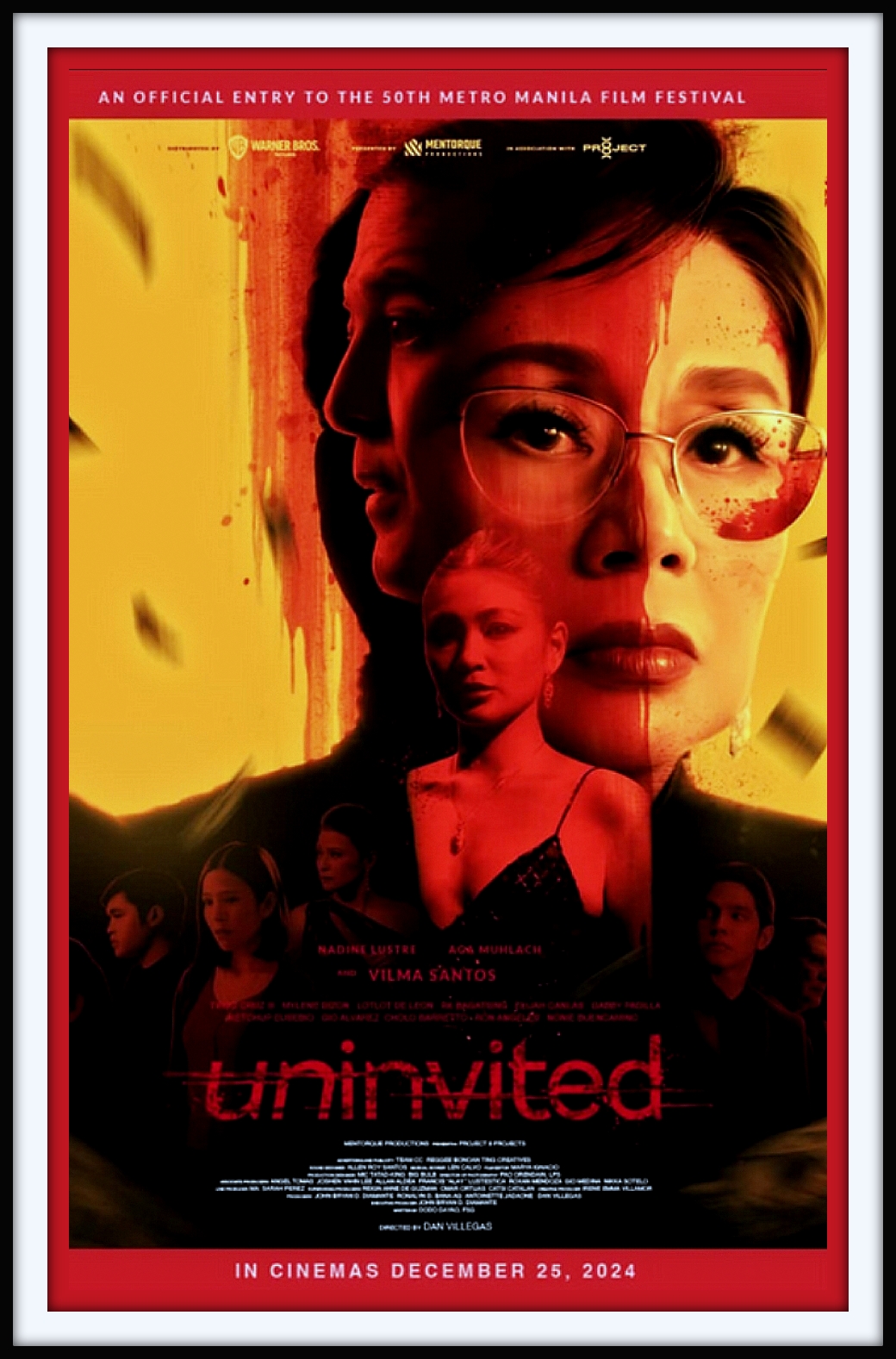
WHAT CRITICS SAID ABOUT UNINVITED?
(Creative License in Effect – Sources: Public Online)
Classic Revenge – “Uninvited is a classic tale of revenge. It follows a familiar storyline—a grieving mother, portrayed by Vilma Santos, sets out to avenge the death of her daughter. But there’s nothing ordinary about its execution. From start to finish, I am riveted. Every line is delivered with precision, each movement executed masterfully, and all emotions are so gripping that I find myself wide awake throughout the movie. I’ve seen many remarkable performances from Vilma Santos, but this feels like the culmination of all her finest acting moments. Perhaps it resonates deeply because I’m also a mother, but I’m blown away by Vilma’s performance. Her pain and sadness are palpable. Her pent-up emotions are so carefully restrained that when the moment calls for an explosive outburst, the impact is devastatingly powerful. Nadine Lustre mesmerizes. Her presence is captivating, and her fluent English radiates the sophistication of Fallon Carrington from Dynasty drama series. The gradual development of her character, Nicole, the daughter of the main antagonist, is as compelling. Aga Muhlach wasn’t bluffing when he said, “Kakaibang Aga ang mapapanood niyo rito.” Indeed, as Guilly Vega, he delivers a performance like never seen before. Surrounded by all the antagonists, he eclipses them all with his madness and wickedness. Watching him feels like witnessing Al Pacino in the 1997 Hollywood film Devil’s Advocate.
The rest of the ensemble cast—Mylene Dizon, Lotlot de Leon, Nonie Buencamino, Elijah Canlas, Gabby Padilla, RK Bagatsing, Gio Alvarez, Cholo Barretto, Ketchup Eusebio, even the relatively newbie Ron Angeles—each has shining moments in the film. Director Dan Villegas leaves no stone unturned. He delivers a storyline everyone can embrace, performances worth talking about, and a cast worthy of praise. Writer Dodo Dayao crafts dialogues so well it will not suprise if they turn into popular memes or catchphrases. The musical score deserves a standing ovation. It heightens my senses throughout the film and, at times, leaves my heart pounding. Save for the mysterious character played by Tirso Cruz, every detail in this film is carefully explained. Make sure to stay until the end of the credits for a crucial revelation. The movie is predictable, yes. But as a revenge story, that’s expected—even if it initially hints at being a hardcore crime thriller. I do feel the final exchange between Vilma and Nadine—while powerful—could have been trimmed for a stronger impact. There are also minor hiccups—such as Lilian’s (Gabby Padilla) birthdate on her grave marker, though I might have just misread it. While high profile actors do have the power to make or break a film , it would be an injustice to discount the impressive performances throughout the film by the rest of the cast who added more dark and interesting layers to the film. Mylene Dizon is the wife who has given up on her husband, Ketchup Eusebio is a local henchman who is a despicable character you’ll love to hate in every scene, Tirso Cruz III proves that you don’t need to say a lot to command presence in every scene he’s in as the colonel, Elijah Canlas (who plays Gabby Padilla’s boyfriend) suffers a fate that devastates his mom (Lotlot de Leon) in unimaginable ways and therefore adds to the drama and inevitable search for justice that Vilma embarks on. But overall, Uninvited is a gripping masterpiece worthy of the four rounds of applause it received during its world premiere held on December 23, 2024. Whether you’re looking to release pent-up emotions or simply need an escape, this film delivers—and it’s so f*uckin’ good. The 50th Metro Manila Film Festival officially opens on Christmas Day, December 25, with 10 films to be shown simultaneously nationwide…” – Karen A.P. Caliwara, PEP, 24 December 2024 (READ MORE)
Best Picture – “With a powerhouse cast, you wouldn’t be wrong to expect a lot from Mentorque Productions’ sophomore offering in this year’s Metro Manila Film Festival. The production house already made a big splash in the industry last year with their horror film based on the Philippines’ first documented serial killer, Mallari. In Uninvited, they have proven that they continue to set their standards high in director Dan Villegas’s latest psychological thriller…Vilma plays her role with a perfect mixture of emotion and restraint as a mother who is driven to vengeance powered by sheer pain. Without denying her vulnerable side, she focuses on her goal, no matter the peril that is about to face her. The Star for All Seasons who was hailed as an MMFF Best Actress last year looks like she is gunning for a back-to-back win with her affecting performance in Uninvited…Nadine’s character as Nicole may seem nonchalant at first, but it looks like the actress definitely had a blast playing the entitled yet chronically disgusted daughter who is privy to her dad’s darker side. Nicole’s lines are almost always bitchy and deliciously delivered, with every snarky dialogue sure to delight both Nadine’s old and new fans alike. Her scenes with her dad Aga are exceptionally entertaining as their private moments slowly reveal more details that make sure to excite and add to the tense vibe present throughout the entire film. We love that Aga finally decided to show his full range as an actor, by fully embracing a role that will leave the audience shocked and impressed with his unapologetic portrayal of a man with no soul…From start to finish, Uninvited will keep you on your toes with its tense and thrilling scenes. Prepare to be impressed with direk Dan’s complete fleshing out of characters, from their strengths to even their weaknesses, and most importantly, expect to be entertained with a solid storyline that is a visual and auditory feast worthy of making it to become MMFF”s Best Picture this year.” – Rhea Manila Santos, ABS-CBN News, 25 Dec 2024 (READ MORE)
The growth of female protagonists – “…From being uninvited, you’re now invited. The film successfully went from chill to thrill. Adrenaline rush is served. You won’t leave this party empty-handed. Tension gradually escalates until reaching its peak. The climax is earned. There’s instant gratification to what’s happening. All the technical elements in this film are utilized well to create a satisfying sensory experience. Aga Muhlach fits the role. His face is charismastic while his actions are untamed. This contrasting combination works well to his advantage. There are times when it’s already hard to watch him because of his wildness. Yet he delivers without hesitation…Vilma Santos is guilty of making us scream, cry, and applaud. It’ll be a crime if she didn’t win the best actress award for her completely engrossing performance in this film. Masyadong maiksi ang buong palabas. Hindi nasulit ang lahat ng mga aktor. Yung iba sa kanila ay napadaan lang. Mabigat sana ang papel nila sa istorya, ngunit hindi ito naipakita nang lubusan. Hindi lahat ng usapan ay masayang pakinggan. Yung iba ay pampalipas-oras lamang. Halatang pinagbangga lang ang ilang mga karakter para magsama sila sa iisang eksena. Nakakapagtaka rin na ang kaunti ng security para sa isang makapangyarihan na tao. Kulang pa sa kwento ang karakter ni Aga Muhlach. Idinaan na lang niya sa akting ang kakulangan ng kwento. Hindi tuloy naging pantay ang laban. Kung nabigyan ng mas malalim na katauhan ang kalaban, baka mas madagdagan ang kagandahan ng pelikula. Gayunpaman, sapat na ang kanilang nagawa para madala ka sa mga nangyayari…Whether you’re invited or not, this film is a once-in-a-lifetime event that’s worth attending. Gatecrash all you want. Let’s put the fate in our hands and crash the gates of hell. Let’s celebrate the growth of female protagonists in the world of Philippine movies. Eva runs the world. Witness her reign. Don’t you dare rain on her parade…” – Goldwin Reviews, December 2024 (READ MORE)
Lavish and Outrageous – “…Uninvited is Mentorque Productions entry to the 2024 MMFF from their successful film last year ‘Mallari’. Now taking things further, they wanted to make a statement with something lavish and outrageous with this movie. From the trailers, we already saw a very feisty Nadine, a ruthless Aga, and a vengeful Vilma. From those characters, I was already sold to watch the film. Aga plays Guilly Vega, a wealthy billionaire who throws an extravagant birthday party with his wife and daughter Nicole (Nadine) along with his partners who were part of underground illegal activities, Vilma is Lilia Capistrano / Eva Candelaria, a mother seeking revenge for the death of her daughter caused by Gully…The dialogue in the movie also hits hard, even harder than the profanity that is spurred almost every minute. Though the scenes will indeed bring out the profanity in us on how intense the story progresses. Guilly (Aga) really feels like a twisted maniac, and it shatters the usual image he has with his previous films. Nicole (Nadine) is so wild and cold caused by the trauma and abuse she had all her life. Eva (Vilma) is so driven and also becomes ruthless with her plans for justice…Uninvited will hit you hard and will make you think that money and power can do really bad things, and justice is just a dream or something you have to prepare as you gatecrash into the house of the devil, err I mean demons. Better have a stress ball in hand while watching as you might want to punch someone of something to vent out some rage or frustration that will build up leading to the final act. Also look out for the mid credit scene that hint for something more…” – Florencio Jusay jr, Manual To Lyf, 25 Dec 2024 (READ MORE)
Smells Like Sequel Brewing – “…The storyline centers on Eva (Vilma Santos), a mother seeking vengeance for her child’s death, Lily played by Gabby Padilla. You’d drop jaws at Aga Muhlach’s portrayal of a corrupt billionaire and the “gigil” starts at Eva (Vilma) first stare at him. The Star for All Seasons, Vilma Santos delivers a powerful performance as a vengeful mother, while Nadine Lustre’s role adds a contemporary edge to the narrative. The two formidable queens looked beautiful and angry. Without a doubt, Aga, Vilma and Nadine deserve nominations. The film’s technical aspects, including cinematography inspired by “The Godfather,” fluid editing, and an evocative musical score, contribute to its overall impact. While some viewers might find the film’s pacing deliberate, the culmination offers a “crazy climax” that has been described as both satisfying and thought-provoking. “Uninvited” stands out in the MMFF lineup for its bold approach to storytelling and its willingness to tackle complex themes, making it a noteworthy addition to Philippine cinema. The movie will make you and your passe discuss the real story and say, “This movie happened in real life and everyone forgot if justice was served” That is one uninvited discussion we should reflect on. Oh Mylene Dizon’s character and Tirso Cruz III’s are still alive. I wonder what will happen next? It smells a sequel after watching the end-credit teaser…” – Josephine Bonsol, Cogito Ergo Sum, December 2024 (READ MORE)
Thrilling, riveting – “…We all love a good revenge story. We love it even more if it was set up well, allowing for a very satisfactory ending. Uninvited checks both boxes. That it was laid out in a simple and straightforward manner sustained the film’s cause. Film director Dan Villegas did right in applying apparent judiciousness in orchestrating the whole affair. A lesser filmmaker could have easily ruined “Uninvited” given the clear-cut if all-too simple narrative but Villegas knows exactly when to push and when to pull, when to take the edge off and when to hit hard, striking a good balance all throughout. In a nutshell, “Uninvited” is about a simple housewife whose daughter was kidnapped, raped and murdered by a powerful individual and his henchmen. As these things go, justice will ultimately prove itself elusive for the mom and her child, leading to a messy, if all-too brutal rampage of retribution. The film’s anchor, the one and only Vilma Santos, allowed for much restraint in her performance as Eva Candelaria, the film’s avenging angel. And it worked. We were actually fearful that she would utilize the usual verbose approach if only to elucidate the pain and the hatred gripping her character but, no. Her Eva is far from being the screaming, gun-toting Sarah Connor-type of heroine. Soft-spoken, mild-mannered, fearful, we actually wondered how her Eva would pull off her grand plan to execute the film’s villains. The yin to her yang is Aga Muhlach. The actor’s all-too manic interpretation of the vile Guilly Vega, even if it swayed towards being caricaturesque at times, was quite effective, eliciting the exact sentiment needed to pin us viewers to our seats, eager to see his eventual downfall…” – Tempo, 28 December 2024 (READ MORE)
The Boldest Roles Yet – When Philippine cinema titans Vilma Santos and Aga Muhlach tell you that you will see them as never before in the 2024 Metro Manila Film Festival entry “Uninvited,” you better believe it. Having watched the world premiere of this crime thriller from Mentorque Productions last December 23, I can guarantee that what they say isn’t just the usual promotional hype. As the film begins in the shadowed corners of opulence and despair, Ate Vi and Aga deliver performances so transformative that they redefine what it means for an artist to step into roles that genuinely push boundaries. It is Ate Vi’s Eva Candelaria, cloaked in elegance and carrying the weight of 10 years of grief and vengeance, who sets the pace of this sinister narrative. She strides through the scene in measured steps to attend the lavish 55th birthday celebration of Aga’s billionaire Guilly Vega. A man whose wealth and charm barely conceal the rot beneath his surface, he is responsible for the death of Eva’s only child — her beloved daughter Lily, portrayed by Gabby Padilla, whose precious life she is there to bring to justice. While the flashbacks could have offered more to fully establish the backstory of mother and daughter Eva and Lily and the unbreakable depth of their bond, the film’s brilliant musical score comes to the rescue, keeping audiences on the edge of their seats and thoroughly intrigued. The same can be said of Aga’s dark inclination. Still, in hindsight, although nothing explicit was shown nor heavy-handed dialogue used to establish his perversion, the seasoned actor expertly rose to the challenge and delivered his role to the hilt. Holding nothing back and going big, his career-defining portrayal magnified the depravity of his character, turning every smirk and gesture into a subtle but chilling revelation. Aga’s grand gestures were definitely the perfect complement to Ate Vi’s controlled and haunting portrayal.
As the layers of the narrative continue to unravel, so do the outstanding performances of the carefully chosen supporting cast. Nadine Lustre’s portrayal of Guilly’s spoiled and rebellious daughter Nicole and Gabby’s rendition of the sweet and simple Lily particularly stand out. Nicole’s cold disdain for her father simmers in every glance and clipped line, adding depth to the tension already brewing, thanks to Nadine’s nuanced performance, while Lily’s quiet sensitivity captures the audience’s empathy, as delivered by Gabby. Ate Vi, though, is the film’s anchor. Every emotion Eva experiences — from grief to rage, fear and bittersweet relief — courses through the one and only Star for All Seasons with an authenticity that grips the audience. Her ability to switch seamlessly between fragility and ferocity is what makes her journey not just believable but profoundly affecting. Especially so when Eva’s mission reaches its crescendo, Ate Vi doesn’t just act — she commands, and her audience eagerly savors her triumph. Tying everything together, while the performances shine bright, the technical aspects further elevate the film’s impact. “Uninvited” is definitely a feast for the senses. From the deliberate cinematography that captures the cavernous luxury of Gully’s mansion to the meticulous sound design that amplifies every creak and whisper, every element employed serves the story well. And again, though the film’s initial pacing may test the patience of some viewers, it ultimately proves intentional in the end mirroring the build-up to a truly grand finale…” – Tessa Mauricio-Arriola, The Manila Times, 28 Dec 2024 (READ MORE)
A Fantasy of Justice – “Uninvited has Vilma Santos attending a party at a mansion. She introduces herself to people as Eva Candelaria, a woman who has made a large contribution to the host’s wife’s foundation. But this is not her real name. Her name is Lilia, and she is attending this party for a very specific reason: to take revenge on the host of the party, Guilly Vega (Aga Muhlach), and the goons that played a part in the death of her daughter. This is all very straightforward. There is no moral ambiguity here: Guilly Vega is a cartoonishly evil villain, at one point described as having committed every capital crime one could think of. To add to that, Muhlach really takes delight in playing him as a complete psychopath, the actor practically twirling an invisible moustache as he carries out his dark deeds. This movie is not about trying to grapple with the righteousness of revenge, or examining the nuances of justice in the country. This movie is driven by the same sentiment that has led people to cheer on Luigi Mangione, the alleged shooter of the healthcare CEO: we all understand that at some point, enough is enough. And it is satisfying, to a degree…The film takes a while to get down to business. It is likely that people will see this movie for the sheer novelty of watching Vilma Santos stabbing people (yes, she’s done it before in Tagos ng Dugo but that’s 37 years ago). The movie does give us that, but it saves it all for the final act. It instead has the Star for all Seasons just wandering around this mansion for a while, interacting with the various characters, forming a vague picture of the relationships between the various people involved in this family. What emerges is kind of interesting, but not a whole lot of it really factors into the story that much. We also get flashbacks to what actually happened with her daughter, further explicating on the anger that would lead her to this place.
Again: the whole thing is very simple, with practically every scene expounding on how bad Vega really is, and how righteous Lilia is for wanting to kill him. At some point, it does get a bit repetitive: the point has been made over and over, and the fact that very little progress is being made in the present just gets a little frustrating. To be fair, the flashbacks feature some strong work from Gabby Padilla, and that helps things along a bit…But then, the movie does get bloody, and it’s pretty delicious. People get stabbed. People get shot. The blood flows freely, and it feels like the movie gets to exhale. And we get to watch Vilma Santos get to do all that stuff. Not all of it makes sense: at the start of the film, a little bit of voiceover narration from Santos mentions that there’s a lot of security around, and in this climactic battle, they are nowhere to be seen. And there are some things that were set up that don’t pay off much at all. It just feels like there ought to have been more characters involved in this part of the film, and they don’t really show up. But in the end, it’s still a good time. Uninvited goes over-the-top, but it seems to understand something about the helplessness that people feel when confronted by the impunity of the powerful and the corrupt. It gives us a vessel in Vilma Santos to release some of that helplessness, playing at a fantasy of justice that doesn’t really seem possible in a normal Filipino’s life.” – Philbert Dy, Spot, 27 Dec 2024 (READ MORE)
Darker than Dark – “…I’ve never seen a Vilma Santos starrer on the big screen. The first time was during a special screening of Uninvited on Christmas Day at Cinema 3 of Gateway Mall in Cubao. No, it’s not because I don’t like her nor her films. Neither is it because I’m a dyed-in-the wool Noranian. So, why? It’s because I’m not really a film buff. It’s because I am a sucker for Hollywood action movies that star Jason Statham, Jackie Chan, Cynthia Rothrock and Jet Li. I like slam-bang action more and drama less. That’s how it is and always been for me. The only time I get to watch Santos’ movies is when they’re shown on TV or when I browse the Internet. Clearly, Santos gave a nuanced performance in Uninvited. She perfectly foiled any attempt to make herself look glamorous. Her age is clearly defined in her role as Eva Candelaria…Santos has a clear and better grip of her character as a mother who vows to avenge her daughter’s traumatic death. While she’s done this before in Tagos ng Dugo, this time, Santos is not the victim herself and she goes to great lengths to clearly define the two roles apart. What’s highly palpable in this obra maestra by Dan Villegas is the way Santos’ character is presented and the way it is navigated in the course of less than 24 hours. Santos flips through her role with characteristic panache and clearly she’s a shoo-in for the best actress plum. Actually, it’s the ensemble acting that sets Uninvited apart from other festival-quality films. Aga Muhlach is unforgettable in the entire acting exercise. He is presented in a never-before-seen scenario that he convincingly portrays with aplomb. Muhlach plays his character with characteristic chutzpah, the kind that will jolt you in your seat. Nadine Lustre may have just a few scenes but she gallops in these with natural flair. Overall, Uninvited is a very dark movie that naturally seeps through the crisp-as-linen dialogues, nuanced personifications and a no-holds-barred narrative that is darker than dark…” – Alex Brosas, Daily Tribune, 26 Dec 2024 (READ MORE)
Brutal Injustice, Vengeance – “…From the get-go, the Metro Manila Film Festival (MMFF) 2024 entry, “Uninvited,” is an emotional battleground that aims to explore all the disturbing themes that can happen in a community, from murders and sexual assaults to the rich getting way with their crimes. This film is visibly a tough movie in spots as everything is heightened to get on the viewers’ nerves. The story centers on a grieving mother, Lilia, aka Eva Candelaria (Vilma Santos), and her relentless pursuit of justice for her daughter, Lily (Gabby Padilla), who is brutally murdered and sexually assaulted by billionaire Guilly (Aga Muhlach). After more than 50 years in the industry, Santos refuses to demote her star status. The Star for All Seasons doesn’t just act; she embodies every emotion. In “Uninvited,” Santos becomes a vision of torment as a mother robbed of her child. Lily represents purity and innocence, while its derivative Lilia symbolizes rebirth and, sometimes, “night” or darkness. After seeing Lily’s light dim, we witness Lilia’s quest for justice and her transition to becoming Eva, the giver of life, except that in this film, she is the taker, snatching them away one by one with seeming poetry. We could literally hear the collective sigh of relief and heave of satisfaction every time one villain falls, providing the viewers with their much-needed catharsis before they file out of the cinema. Santos’ performance elevates the ordinary material into a heartbreaking narrative. Every tremor in her voice, every tear shed stab at the heart of the viewers as if they had been right smack in that very scene, and could literally feel her grief behind the screen. Now this is hardly novel for the veteran artist who has done other slasher films, such as the critically acclaimed “Tagos ang Dugo,” but “Uninvited” allows one to see Santos in a new light. In Uninvited, Muhlach steps away from his good boy image and demonstrate, as he always has, the depth of his artistic talent.
As the main villain, Muhlach dishes equal parts danger and excitement in such a natural way that is almost unbearable to watch. After all, this matinee idol grew up almost before our eyes to become a beloved character in all his films. His character as Guilly Vega is beguiling — a patron for a church foundation, at the same time, a sinister leader of a criminal organization. It’s a sight to see him transform into a monster before one’s eye. His nuanced portrayal deserves at the very least a best actor nomination at the MMFF, as we are sure his onscreen villainy would earn the wrath of viewers, the mob boss who does not even seek redemption. The supporting cast, Padilla, Elijah Canlas, and Mylene Dizon also enhance the film’s emotional weight with their heartbreaking performances. The vulnerability of Padilla’s Lily, the enigmatic personality of Nadine Lustre’s Nicole, the comeuppance of the characters of henchmen Ketchup Eusebio and Cholo Barretto all add layers of complexity to the narrative. The role of each character feels fully realized, painting a wider picture of a world that shows that the accomplices and bystanders are just as wicked as the main perpetrator. However, “Uninvited” isn’t without its flaws. While the film’s emotional impact is clear, it misses an opportunity to delve deeper into the motivations of its characters, and the broader societal implications of the crime are left underexplored. There are also some instances where one might feel the sense of rush in between the scenes, like the production is trying to put everything all at once. Despite this shortcoming, the film still delivers a gut-wrenching story that raises difficult questions about vengeance, morality and the price of sin. It is brave enough to tackle the uncomfortable truth about all the wrongdoings rampant in the world and how people are often capable of doing the unspeakable things in pursuit of justice. Even if it leaves a few unanswered questions in its wake, “Uninvited” is a raw examination of the inherent darkness that can exist within humanity. From the beginning, the intention of the film is to send out the message that sometimes one’s silver lining can be had when justice is served, and one just has to take action to achieve that…” – Jessica Ann Evangelista, 26 Dec 2024 (READ MORE)
Avending Angel – “Revenge movies have always been popular with audiences dating as far back as the “Death Wish” franchise of Charles Bronson to Quentin Tarantino’s “Kill Bill” series to FPJ action flicks like “Isang Bala Ka Lang” and “Hindi Pa Tapos ang Laban.” For moviegoers who love this particular sub-genre, there’s nothing more satisfying than seeing the baddest of the bad guys get their comeuppance for messing with the protagonist’s loved ones. And that’s exactly what audiences are getting with “Uninvited,” an entry in the 2024 Metro Manila Film Festival headlined by no less than the Star for All Seasons, Ms. Vilma Santos. Directed by Dan Villegas and written by Dodo Dayao (arguably his most accessible screenplay to date), the revenge drama is also topbilled by Aga Muhlach and Nadine Lustre. The film is set in what looks like a remote mansion owned by Aga’s character, billionaire Guilly Vega. A lavish party is happening and we later learned the occasion is Guilly’s 55th birthday. In a scene reminiscent of the opening of The Godfather to establish how ruthless and powerful Guilly is, our antagonist is seen discussing “business” in his study and receiving guests that included Red, a high-ranking police officer (Tirso Cruz III) before joining the festivities. Based on their conversation, Red is more of a frenemy (“Colonel! Only my friends call me Red”) keeping an eye on Guilly, who as audiences will later learn from his own rebellious daughter Nicole (Nadine), has committed every crime in the book. Among Guilly’s guests, one that easily stood out is socialite Eva Candelaria (Vilma), a donor to one of the charitable foundations of Guilly’s wife (Mylene Dizon). As the film progresses, we learn that Eva is not really personally acquainted with Guilly, the members of his family, or his equally despicable henchmen (RK Bagatsing, Cholo Barretto, Gio Alvarez). As revealed by her thought bubbles, Eva harbors a deep-seated hatred for these particular revelers, and for good reason. Cut to flashback scenes, Eva is unmasked as Lilia Capistrano, a stay-at-home single mom whose daughter Lily (Gabby Padilla) was sexually abused by Guilly and later killed by his men (which also included Ketchup Eusebio) along with her boyfriend Tofy (Elijah Canlas). Yes, most of us have seen this movie before. And yes, seeing an elderly woman (Vilma is now 71) seeking vigilante justice does require some suspension of disbelief. I won’t be surprised, though, if anyone who has experienced Lilia’s distressing loss would muster enough strength to take her offenders down. And just like the crowd at the film’s advanced screening, I’m willing to bet that audiences will likely cheer and applaud Ate Vi whenever she eliminates one of the bad guys. And yes, spoiler alert, she will eliminate most of them in that single night. Casting actors against type is what sets “Uninvited” apart from other revenge flicks. We don’t always get to see Ate Vi as an avenging angel, the last and perhaps only other time was 37 years ago with “Tagos ng Dugo.”
And the last time we saw Aga Muhlach this bad was when he took on the dastardly role of a serial killer in “Sa Aking Mga Kamay” way back in 1996. Long removed from his “Bagets” days, Aga is clearly having the time of his life with his over-the-top portrayal of Guilly, a personification of pure evil with no redeeming value whatsoever. His boisterous speech at his party and the way he even thanked the lord for his very existence before throwing money at his guests was particularly unsettling…Nadine Lustre, who has been shedding the tweetums image that characterized the early part of her career was also a standout here as Nicole, Guilly’s daughter who deeply resents her old man but could not leave the lavish lifestyle she is accustomed to. Other noteworthy performances include Gabby Padilla as Lilia’s ill-fated daughter, Lotlot de Leon as Tofy’s mother, and in a brief but memorable appearance, Nonie Buencamino as the grieving father of one of Guilly’s other victims. Even as viewers should have a pretty good idea of where the film is heading, it is to Villegas and Dayao’s credit that crucial scenes are staged well enough to keep everyone on the edge of their seats. Even an unexpected twist involving RK and Mylene’s characters further amps up the suspense factor. I wished Ate Vi’s Eva slash Lilia had offed each of these bastards in more creative ways and under different circumstances, but that would probably be a logistical nightmare given the busy schedules of its lead stars. As it is and even with some noticeable but negligible plot holes, “Uninvited” remains one of the standout entries in what is shaping up to be one of the better MMFF editions in recent years. Well-acted, nicely photographed, deftly edited, and aptly scored, I’m not at all surprised the film is already among the festival’s top-grossers this early. Rating: 3.5 out of 4.” – Edwin P. Sallan, Business Mirror, 27 December 2024 (READ MORE)
Vigilante Star For All Seasons – “…Move over, Charles Bronson of Death Wish, take a hike, Liam Neeson of Taken! Vilma Santos is now in the house. And she’s laying claim to the title of vigilante star, manifesting the role of mild-mannered widowed Mom on a mission of vengeance and vigilante justice for the rape and murder of her only child/daughter. Uninvited is directed by Dan Villegas – his first full-length feature film in six years, with a screenplay from Dodo Dayao, and it’s an R-16 MMFF entry. Lilia (Vilma Santos) is a teacher and as grieving mom over the death of her Lily (Gabby Padilla); she assumes the persona of philanthropist Eva Candelaria to attend/infiltrate the birthday party of billionaire Guilly Vega (Aga Muhlach) at his residential mansion and extract her pounds of flesh and justice. Guilly is your cliched, amoral, corrupt, bully, ‘fat cat’ billionaire. Name any non-bailable capital crime, and he’s committed it. His wife (Mylene Dizon) and daughter Nicole (Nadine Lustre) are both victims of Stockholm syndrome, aware of his gross imperfections but keeping a blind eye and sticking close to him because they love his money too much. While there are numerous flashbacks, in the present, the movie takes place during one night, Guilly’s birthday party. His goons and hired help are ever-present, and Aga Muhlach wastes no time in turning Guilly into a reprehensible, abusive, bullying oligarch. He knows what he’s doing, ready to cover it up, bribe whoever needs to be greased, and murder whoever needs to be silenced forever. If some of them think this a daring new move on the part of Aga to go against type and his leading man reputation, I’d like to point out his turn as a lean and mean serial killer in Sa Aking Mga Kamay (1996). Here, he conjures up a richer, confident, and abusive business tycoon, ready at the drop of a pin to engage in criminality.
And what can we say about Vilma Santos? Who else can make the audience erupt into cheering and applause as she repeatedly stabs to death one of the goons of Guilly Vega? Or when she runs over a person three times? Pao Orendain handles the cinematography, and shafts of light and focus offset a dark, murky atmosphere. It all helps create a claustrophobic sense of imminent doom – whether this is the doom of Lily and her boyfriend at the hands of Guilly and his henchmen or the doom that will descend on Guilly as Lilia plays the avenging angel. If I have to level some criticism on the film, I’d point out the very one-dimensional portrayal of the very rich. They all smoke, they all take drugs, and they all have a callous disregard for others. No one on that side has any arc. And we don’t see the steps by which Lilia decided to take justice into her own hands or how she got invited to the birthday bash and amassed the cash needed to be noticed. A Warner Brothers, Mentorque, and Project 8 co-production, the film will have premieres abroad, and I can only guess it will eventually surface on Max, the Warner streaming platform. If you like your justice-meted-out vigilante style, completely disregarding the rule of law or asking law enforcers to do their job, this is the perfect MMFF film to watch. I enjoyed watching Aga have fun going overboard with his Guilly and appreciated how Vilma was doing something entirely different for her at this stage in her illustrious career…” – Philip Cu Unjieng, Manila Bulletin, 24 Dec 2024 (READ MORE)
Avenging Mom – “…It has taken Vilma nearly four decades to accept another anti-villain role, this time as an avenging mom in director Dan Villegas’ “Uninvited,” the sophomore entry of John Bryan Diamante’s Mentorque Productions this time to the 50th anniversary of the Metro Manila Film Festival (MMFF)…“Uninvited” was given an R-16 classification obviously because of its themes of rape, sexual assault, revenge and death. The film tropes adopted by this entry were not easily distinguished from the start, although the ending is predictable. However, as the film unraveled, one could sense the similarity of “Uninvited” with other gripping stories shown in the past. Jennifer Lopez battled with an abusive husband and killed him in “Enough” (2002). The story of “Uninvited” happens in one night at the grand mansion of billionaire Guilly Vega and the lavish celebration of his 55th birthday, complete with his friends, frenemies and henchmen. Exploiting young ladies is the wont of Guilly. In his safety deposit box at home, he collects the school IDs of his young female victims, along with his cash, drugs and guns. It rained bills in Guilly’s birthday party to the delight of guests present. For a change, Aga plays the unromantic lead in “Uninvited.” The last time he essayed a baddie on the big screen was in Rory Quintos’ “Sa Aking mga Kamay” (1995), where he was a serial killer. The suspense-drama was shown nearly three decades ago…Aga expertly rose to the challenge of playing anti-hero in “Uninvited.” He didn’t scrimp on his dialogue and utters invectives when needed, as if he eats those words for breakfast. As Guilly, he is the filthy rich guy who gets anything and everything he wants because of his wealth and power. He sexually exploits even his spoiled and rebellious daughter Nicole (Nadine) and gets away with it.
Dressed to the nines for Guilly’s party, came in Lily Capistrano/Eva Candelaria whose daughter was murdered by the henchmen of Guilly a decade earlier. She showed up in the party apparently prepared to settle the score and exact revenge with Guilly. The vengeful mother turned vigilante. In Vilma’s case, a senior lady is bravely out there to seek revenge for her daughter. She carefully did her research prior to her attack and identified the bad guys — RK Bagatsing as Jigger Zulueta, Cholo Barretto as Celso Batac, Ketchup Eusebio as Jomar Maitim, Gio Alvarez as Randall Ballesteros — subsequently taking them down and vengefully killing them. There were other victims of Guilly’s violence. However, unlike Eva, the others opt to turn a blind eye to Guilly’s wrath, settle for bribes or leave the country instead of filing legal action and fighting Guilly out in court that will surely be for naught. One of them was Nonie Buencamino, who gave an affecting performance no matter how short his screen time was. If at all, “Uninvited” keeps the viewers engaged in the 93 minutes of screen time. There are back stories in between, as direk Dan managed to hold his viewers’ attention throughout the flashbacks he provided within the story. The ensemble cast delivers powerful performances. Even the likes of Mylene Dizon, who plays Guilly’s wife Katrina Vega, Tirso Cruz III as the colonel Red and Lotlot de Leon as Tofy’s mom Norma, respectively, carried out memorable performances…” – Leah C. Salterio, The Philippine Star, 31 Dec 2024 (READ MORE)
Audiences applaud Ate Vi – “Not for the first time, nor the second or third have audiences of “Uninvited” rallied behind the film’s lead star, Vilma Santos, as she embarks on a riveting quest for vengeance. Directed by Dan Villegas, “Uninvited” is a gripping tale that has kept viewers on the edge of their seats since its release. The film’s appeal remains undeniable, drawing crowds to theaters even weeks after its debut. Just last Tuesday, long lines stretched across Gateway cinemas, a clear sign of the audience’s eager anticipation. When the climax arrives, the crowd reacts with applause and cheers — a clear sign of the film’s emotional impact. For all its mystery, it’s the stellar performances that truly breathe life into “Uninvited.” The entire narrative — centered around a mother driven by a singular purpose to avenge her daughter’s death — unfolds in the span of a single evening. What begins as an ordinary night, filled with the usual sounds of laughter and birthday wishes, soon transforms into a harrowing journey as Vilma Santos’ Eva Candelaria fulfills her daughter Lily’s (Gabby Padilla) plea to “leave no one behind.” But the real story takes root long before that fateful evening. While Eva’s quest for revenge is calculated and deliberate, director Dan Villegas takes care to focus on Lilia Capistrano’s subtle transformation into Eva Candelaria.
Rather than bogging down the narrative with unnecessary details, the film lets us observe Eva’s evolution through her actions. We watch as the once-mousy mother trains herself and learns to infiltrate the lives of those who wronged her daughter. Her transformation from a quiet, passive woman to a determined avenger unfolds gradually, building steadily until the tension peaks in the film’s final moments. Much like Eva’s carefully laid plans, the film’s performances are precise and powerful. Vilma Santos masterfully conveys the shift from a grieving mother to a relentless avenger. Aga Muhlach is truly abhorrent as the despicable mastermind Guilly, while Gabby Padilla delivers a haunting performance as the tragic victim. Nadine Lustre manages to captivate and leaves audiences wanting more of both her character and her range. The supporting cast, too, is exceptional. Tirso Cruz III, Mylene Dizon as Katrina Vega, Elijah Canlas as Tofy, RK Bagatsing as Jigger Zulueta, Lotlot de Leon as Norma, Ketchup Eusebio as Jomar Maitim, Cholo Barretto as Celso Batac, Gio Alvarez as Randall Ballesteros, Ron Angeles as Mark, and Nonie Buencamino as Elmer all play their respective roles to perfection, adding layers to the film’s strong ensemble. As Bryan Diamante, the film’s producer, shares, “Uninvited” was a journey that the entire team believed needed to be told: “This story was meant not just to entertain, but to resonate, to provoke thought, and to showcase the immense talent of Filipino storytellers. This film is a testament to the hard work, passion, and creativity of our entire team — from the brilliant cast and crew headed by our talented director, Dan Villegas, to everyone behind the scenes who made this dream a reality.” – Business Malaya, 09 January 2025 (READ MORE)
John Wick – “…Dan Villegas’ Uninvited tackles the dirty side of politics and sexual abuse. At 71, Vilma Santos takes matter into her own hands as she plays Lilia/Eva who violently slays all those who were accomplices to the death of her only daughter. Some netizens compared Ate Vi to John Wick. At her age, she can still thrill her fans doing a crime action film. We witnessed the audience cheering and clapping whenever she would accomplishe her “mission.” Nadine Lustre sizzles as Aga Muhlach’s daughter, fighting off her father’s advances and making a stand against cruelty. All of these films have embedded unique cultural traits of the Filipinos. Our cinema reflects the hopes and fears of the nation. Box office hits or award-winning films are the living proof of our identity as Filipinos and we need to preserve our cinema by creating original content. There is also a need to strengthen our cultural values through storytelling and the 2024 MMFF succeeded in doing it this year…” – Rica Arevalo, Manila Bulletin, 03 January 2025 (READ MORE)
#Uninvited
#VilmaSantosRecto
#AgaMuhlach
#NadineLustre
#DanVillegas
#MentorqueProductions
 Maraming reklamo ang tagasubaybay ng pelikulang Pilipino. ‘Yun nga namang mga paksa noong “nineteen forgotten” at panahon ng kopong-kopong tulad ng pag-iibigan ni mahirap at ni mayaman ay siya pa ring kinagigiliwang tema hanggang ngayon. Sabi nga, ang mga ganitong pelikula ay maikukumpara sa mga dulang panradyo. Puwedeng ipikit ang mga mata sa loob ng sinehan at pakinggan na lamang ang usapang kinargahan ng waring walang katapusang “ngunit papa” at hagulhulan. Kung nakakaasar ang pelikulang mala-radyo ay ganoon din ang pelikulang mistulang pang-TV naman. Ito ang klase ng pelikula na ang mga tauhan ay pirming nasa sala at nagwawalis habang nag-uusap dahil wala nang ibang set na mapuntahan. Sa ganitong pelikula ay waring tinatamad ring kumilos ang isa o dalawang kamera. Sa dalawang salita, ito ang klase ng pelikula na tinipid at pinag-ubra. At siyempre ang resulta ay basta-basta. Mayroon ding pelikula na para namang komersiyal na dadaanin ka sa ganda ng sinematograpiya na sa biglang akala’y parang maganda, pero tulad ng paninda’y walan naman palang lasa. Sa madaling salita nawawala ang tinatawag na pelikulang de-kalidad at ang sangkap nitong “refreshing touch.” Sa pag-eeksperimento ng mga direktor, may ilang nakahulagpos sa pelikulang mala-radyo at mala-pang-TV. Gayumpaman, marami sa nag-eksperimento ang hindi makakapa ng tamang pormula, ang pagtutulungan ng maraming tauhan sa paggawa ng pelikula, tulad ng kombinasyon ng magandang istorya, mahusay na direktor, makinis na sinematograpiya, matinong editing, mahusay na set, angkop na tugtugin at mahusay na pag-arte. Kapag napag-isa ang mga sangkap na ito, nakakapanood na nga tayo ng isang mahusay o namumukod-tanging pelikula.
 Si Celso Ad. Castillo ay marami nang naunang ekspiremento. Pero pumaltos sa pamantayan ng mga manunuri. Maraming nagsuspetsa na may ibubuga siya, pero hindi lang talaga maibuga nang nasa tiyempo. Malimit ang kanyang pelikula ay maingay at maraming sobra. Halimbawa, maraming karahasan na wala namang katuturan ang kanyang Madugong Daigdig ni Salvacion, seksing walang kadahilanan (pinagandang garapal) ang kanyang Pinakamagandang Hayop Sa Balat Ng Lupa, numero unong manggagaya ang kanyang Maligno, at sabog-sabog ang kanyang pinakamagandang nagawa, ang Daluyong at Habagat. Kung may magkamali mang pumuri kay Celso, iyon nama’y halos pakunsuelo-de-bobo lamang, at hindi ito sapat para itaas ang kanyang pedestal sa ranggo nina Bernal, Brocka at Romero. Wari ngang napako sa komorsiyalismo ang direktor na inaabangang maglalabas ng natatagong talino. Lalong nagduda sa kanyang kakayahan ang mga kritiko nang kumalat ang balita na gagawa siya ng serye sa TV na ala-Cleopatra Jones na papamagatan naman niyang O’Hara. Pero ang direktor na ipinapalagay na laos ay biglang pumalag nang walang kaabog-abog. Bigla’y nabalitang may inihanda raw itong pang-festival na ikinataas na naman ng kilay ng kanyang mga kritiko. “Aber tingnan,” ang pasalubong sa balita. At sa preview ng kanyang Burlesk Queen, biglang napa-mea culpa ang ayaw maniwalang may ibubuga nga si Celso. Tiyak na naiiba ang Burlesk Queen, kahit ikumpara sa mga naunang trabaho ni Celso at sa iba pang direktor na nagtangkang tumalakay sa paksang ito. Matagal-tagal na rin namang nauso ang kaputahan sa pelikula, pero walang nakapgbigay ng katarungan sa lahi ni Eva bialng Pilipina at bilang puta. Sa Burlesk Queen, para kay Celso ay hindi nangangahulugan ng pagpapakita lamang ng utong, puwit, o singit, kung hindi isang kapani-paniwalang dahilan na nangyari sa isang makatotohanang kapaligiran.
 Sa kanya, ang tao ay hindi bast maghuhubad at magtatalik. Maraming pangyayari sa buhay ang dapat munang linawin at unawain, at iyon ang basehan ng kasaysayan. Simple lamang ang plot. Isang tinedyer si Vilma Santos na alalay ng isang orihinal na burlesk queen, si Rosemarie Gil. May tatay na lumpo si Vilma, si Leopoldo Salcedo. Si Rosemarie naman ay may kabit na hustler, si Roldan Aquino. Nang iwanan ni Roldan si Rose, nagwala ang huli. Naging lasengga siya at tumangging magsayaw sa tanghalan. Mabibitin ang palatuntunan, kaya’t si Vilma na talaga namang may ambisyong magsayaw ang pumalit. Hit naman sa manonood si Vilma. Sa bahay, pilit kinukumbinsi ni Vilma si Pol na payagan na siyang maging full-time danser. Ayaw ni Pol, mas mahalaga sa kanya ang prinsipyo at delikadesa. Sapagkat wala namang ibang pagkakakitaan, si Vilma rin ang nasunod sa bandang huli. Nag-suicide si Pol nang hindi na niya masikmura ang pasiya ng anak. Si Rollie Quizon naman ang binatilyong masama ang tama kay Vilma. Nagtanan sila at nagsama. Pero hindi sanay sa hirap si Rollie. Sa pagpili sa pag-ibig o ginhawa sa buhay, ang huli ang pinahalagahan niya. Nagkaton namang buntis na si Vilma. Sa pag-iisa sa buhay, nagbalik siya sa pagsasayaw. Nagsayaw siya nang nagsayaw hanggang duguin siya sa tanghalan at malaglag ang kanyang dinadala. Bagama’t simple ang plot ay hindi naman masasabing simple ang pamamaraang ginawa rito ni Celso. Sa kauna-unahang pagkakataon ay nangyari sa isang pelikula ang pagsasama-sama ng magandang istorya, mahusay na direksiyon, magaling na pag-arte ng mga tauhan, masinop na musika, magaling na editing at angkop na sinematograpiya.
 Sa Burlesk Queen ay nagsama-sama ang talino ni Celso (direktor), Mauro Gia Samonte (story and screenplay), George Canseco (musical director), Ben Lobo (cinematographer), at Abelardo Hulleza (editor). Kung may ipipintas sa pelikula, iyon ay ang hindi malinaw na pagbuhay sa panahon na nangyari ang kuwento. Kung minsa’y maiisip na nangyari ito sa panahon ng kasikatan ni Elvis noong 1950s. Pero kapag pinansin na maraming ekstrang may mahabang buhok, may wall paper at sintetikong sako ang bahay nina Vilma ay maari namang sabihing baka naman pa-Elvis craze lamang ang mga tao roon. Pero may pulitiko, at Yabut, at may dagdag pang Connie Francis bukod sa motorsiklong Lambretta at mga kotseng Buick. Kunsabagay, maliliit na detalye lamang ito na agad makakalimutan kapag ang inasikaso ay pagbubuklat sa magagandang punto ng istorya. Tingnan natin ang ilang magagandang eksena sa pelikula. Sa ikalawang eksena ay nagtatanong si Vilma kay Rosemarie kung puwede rin siyang maging danser. Walang malinaw sa sagot ni Rose, pero ang timing ng background music na “It’s Now or Never” ay makahulugan. It’s Now or Never nga, payo ni Elvis. At kung kailan siya maaaring mag-umpisa. Tomorrow, sabi ng kanta. Ang ganitong sagot ay nasa mukha ni Rose, pero hindi na kailangang sabihin.
 Ang ganitong pamamaraan ay tinatawag na creativity ng direktor, na nagdagdag ng ibang pamamaraan sa paghahayag ng damdamin ng tauhan. Sa paglakad ng istorya, dapag ding pansinin kung paano ang karakterisasyon ay binubuhay dito. Halimbawa, sa isang eksena na nangyari sa isang patahian ay nag-abot sina Dexter Doria, ang bagong kabit ni Roldan Aquino, at si Rose. Naroroon din si Vilma at sa hindi kalayuan ay si Rollie. Maliwanag na may kaniya-kaniyang pangangailangan ang mga tauhan at magkakasama sila sa iisang eksena. Walang nakawan ng eksena na naganap dito. Nag-insultuhan sina Dexter at Rose, natameme si Roldan at waring walang pakialam sina Rollie at Vilma na panay-na-panay ang kindatan. Lalo namang walang pakialam ang dalawang pulubi na tumutugtog ng biyolin (na siya ring background music) sa mga nagyayari. Limos ang mahalaga sa kanila. Sa eksenang ito’y may gamit ang lahat ng tauhan, wala sa kanilang nagsilbing dekorasyon, walang nag-o.a. at pare-pareho nilang ginawang makatotohanan ang komprontasyon. Magandang halimbawa ito ng orchestrated acting. Kung allusions naman ang pag-uusapang, marami ritong mga sariwang metapora na mababanggit. Isa rito ang mahusay na pagpapakita ng birhen pa si Vilma sa sex act nila ni Rollie. Habang sa likod ng tanghalan ay may nagaganap sa magkasintahan, sa tanghalan ay nang-aaliw naman ang mga akrobat na sinundan na isang madyikero na tumutusok ng sariling noo, nagbabaon ng pako sa ilong at lumululon ng espada. Masakit tingnan iyon. At ganoon din ang nararanasan ni Vilma sa likod ng tanghalan sa piling ni Rollie. Hindi rin madaldal ang pelikula. Kung itatanong kung paano tinanggap ni Pol ang pasiya ng anak, nagtulos na lamang siya ng isang makahulugang kandila sa altar na para na ring sinabing “bahala na ang Diyos sa iyo.”
 Kung paano naman ipinakitang naging mananayaw na nga si Vilma, sapat nang ipakita ang isang trak na nagbababa ng isang wheel chair na ipapalit sa lumang tumba-tumba ng ama. Maging ang paglakad ng panahon ay nararamdaman din ng manonood kahit hindi ikuwento o ipakita ang kinagawiang pamamaraan at ulat ng “nalalaglag na dahon ng kalendaryo o dahon ng puno kaya.” Sunod-sunod na cuts na nagpapakita sa uri ng palabas sa tanghalang kinabibilangan ni Vilma ang ginawa ni Celso. Saka ito sinundan ng kuha naman sa bahay nina Vilma at Rollie. Nag-iinit ng tubig si Vilma habang nakikinig ng dula sa radyo tungkol sa buhay ng isang asawang tamad at ireponsable. Ganoon nga ang nangyayari sa buhay ng dalawa, at may kasunod ring “abangan sa susunod kabanata.” Sa paghihiwalay ng dalawa, sapat na ring iparinig ang awiting “You’re All I Want for Christmas” para buhayin ang irony na nagaganap sa relasyon ng dalawa. Kung makinis ang eksposisyon at pagbuhay sa tunggalian ng istorya, malinaw rin ang paghahanda sa wakas ng pelikula. Si Rose na laos na ay naging mumurahing puta. Si Dexter kahit hindi ipakita ay maliwanag na sumama na sa ibang lalaki. Si Roldan ay may bago nang kabit at napatay sa spiral staicase ng tanghalan na siya rin niyang dinadaanan sa paghahatid sa dalawang naunang kabit. Si Rollie, ang mama’s boy, ay natural bawiin ng ina. Si Vilma ay nagsayaw nang nagsayaw. Sa simula’y mahinhin at nakangiti at kaakit-akit hanggang sa pagbilis ng pulso ng tambol at pompiyang balakang, upang sa pagbuhay sa damdamin ng manonood ay siya namang maging dahilan ng pagkalaglag ng sanggol na kanyang dinadala. Sa labas, matapos ang pagtatanghal, may tatlong bagabundong naiwan na nakatanghod sa larawang pang come on ng burlesk queen, habang ang kadilima’y bumabalot sa kapaligiran. Kung matino ang kaanyuan ng pelikula, ay ganoon din ang masasabi sa nilalaman. Makatotohanan at masinop ang pagtalakay sa buhay ng isang abang mananayaw. Tinatalakay rin dito kung paano siya tinatanggap ng lipunan at inuusig ng mga tagapangalaga raw ng moralidad. Maging ang empresaryo ng tanghalan na ginampanan ni Joonee Gamboa ay may konsiyensiya rin at nagtatanong sa atin kung anong panoorin ang dapat ibigay sa isang ordinaryong Pilipino na hindi kayang pumunta sa mga mamahaling kainan upang manood halimbawa ng Merry Widow at Boys in the Band. Ang stage show ang munting kasiyahan ng isang Pilipinong hindi “kaya ang bayad sa mga eksklusibong palabas ng mayayaman.” Samantala’y abala tayo sa paglilibang at sa kanila’y walang pakialam ngunit may handang pintas at pula sa mangahas lumabas sa batas ng moralidad sa lipunan. – Jun Cruz Reyes, The URIAN Anthology 1970-79, reported by Simon Santos, Video48 Blogspot, 27 August 2018 (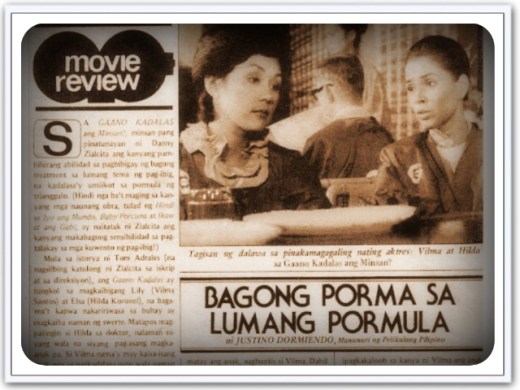
 Ang madalas magpaangat sa pelikula ay ang acting cast. Dahil mas malaman ang kanyang papel at tila naperfect na ni Vilma Santos and agony ng other woman mas nangibabaw ang kanyang performance kay Hilda Koronel. Kahit na mas marami ang nagsasabing si Hilda ang mas angat dito. Pasulpot-sulpot ang papel ni Hilda at may kahinaan ang motibasyon (isipin mong siya pa ang nagtulak sa sariling asawa sa ibang babae!). Medyo nakaka-distract ang kanilang mga kasuotan (mga gawa ni Christian Espiritu), gaya rin ng ayos ng mga bahay at kasangkapang tila nakikipagkumpetensiya sa tauhan. Epektibo rin ang pagganap ni Dindo Fernando bilang Louie na nakati ang puso para sa dalawang babae. Magagaling din ang supporting cast, lalo na si Suzzanne Gonzales, ang yayang sosyal at ang batang si Alvin Joseph Enriquez. Kahit maikli ang kanilang papel, mahusay rin ang rehistro nina Tommy Abuel, ang doktor na nanliligaw kay Vilma, at si Chanda Romero, bilang matalik na kabibigan ni Vilma. – Justino Dormiendo, Manunuri Ng Pelikulang Pilipino, Jingle Extra Hot Magazine 1982, reposted by Pelikula Atbp (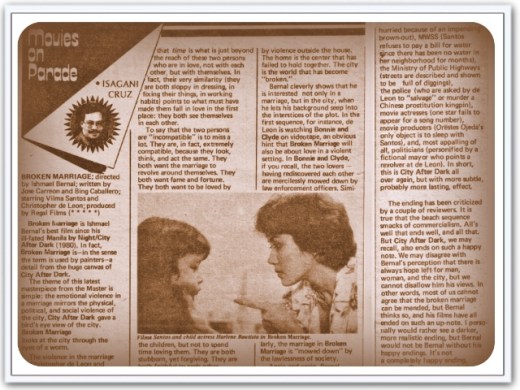
 The ending has been criticized by a couple of reviewers. It is true that the beach sequence smacks of commercialism. All’s well that ends well, and all that. But City After Dark, we may recall, also ends on such a happy note. We may disagree with Bernal’s perception that there is always hope left fro man, woman, and the city, but we cannot disallow him his views. In other words, most of us cannot agree that the broken marriage can be mended, but Bernal thinks so, and his films have all ended on such an up-note. I personally would rather see a darker, more realistic ending, but Bernal would not be Bernal without his happy endings. It’s not a completely happy endings, anyway. Two sequences before the beach scene. Bernal films the wedding scene in a haze, as though he were saying that whatever follows the wedding is mere romance. It is like Bonnie and Clyde. The gansters dream of a happy life together, spinning romantic castles in the air. But as soon as it is time to go out into the real world, violence is right there at the doorstep. The ending is filmed as a romantic interlude, but the reality is waiting around the dark corners of the city, like the mayor’s goons who cannot stand the thought that someone is finally about to tell the truth. – Isagani Cruz, Parade Magazine 1983, reposted by Pelikula Atbp (
 Biggest revelation – “…The iconic actress (Vilma Santos) embraces her character’s flaws and fortitude with affecting clarity in a superlative portrayal that is passionate but never coercive. Her meticulous insistence on honesty guarantees that no tear is unearned—and no emotion manipulated…Angel also comes up with a focused performance that, for the most part, benefits from the film’s propulsive dramatic proceedings…Xian may not have Angel’s earnestness or Vilma’s finely calibrated bravado, but he is the movie’s biggest revelation. He figures in some of the film’s most gripping dramatic sequences—and delivers his moving moments with aplomb. It doesn’t hurt that Xian is cast in a role that fits him to a T: Albert is distant, guarded and spiteful, and is armed with an emotional axe to grind! Bernal makes clever use of those elements to thrust the heretofore phlegmatic performer outside his self-limiting comfort zone. Result: Xian’s finest portrayal to date!…” – Rito P. Asilo, Philippine Daily Inquirer, 30 January 2016 (
 Somewhat Refreshing – “…The film is driven by irony: Vivian (Santos) later finds out she’s afflicted with cancer. Instead of wallowing about it, she accepts it like no other’s business, hires a private nurse, and maniacally, laughs it off—all with enviable and self-confidence and awareness. She’s a strong woman, after all. She’s going to win. Where she drains her strength is on her estranged son, Albert (Xian Lim) who, after many years flies home for a high-tier real estate project for her company. Unbeknownst to her, her private nurse Jaica (Angel Locsin) has made Albert aware of the situation. There it is, a chance for her to rekindle an interrupted relationship with her son, never mind the irony of the timing…This thick, disquieting anxiety carries through a scene in Everything About Her, where Vivian mutters, almost weak-sounding: “Baka nga kailangan ko ng deadline,” she confesses. “Sana lang wag masyadong mabilis.” It’s a great scene, one that requires an actor of Santos’ pedigree to pull off. You take everything Santos says and you’re always sold on her sincerity. A few sequences earlier she speaks of spilling someone’s guts and ripping insides out, and you believe her just the same…The dynamic between Vivian and Jaica is extremely watchable, owing mostly to both Santos and Locsin’s commendable performances. There’s an underplayed gag toward the end where Jaica persuades Albert to stay for his mother, mentioning something about Darna. “Ikaw si Ding,” she exclaims. “Siya si Darna, at ikaw ang bato.” It’s somewhat refreshing to see this in Everything About Her, however random. Punchlines are echoed as poignant monologues, such as in the funny bit where Jaica missends a text message to Vivian, essentially calling her an “impakta”. It’s flourishes like this that pepper the middlebrow story that it has…” – Armando Dela Cruz, Film Police, 02 February 2016 (
 Credit to Make-up Artists – “…That is where I found out from E.R. Tagle that the movie “Everything About Her” was showing at a nearby cinema house. He was all praises for it, so I told him that any movie starring Ms Vilma Santos was worth watching. I am happy to catch a few on TV. The following day, I had to drag myself out of bed, fearlessly cross our busy street, risking life and limb to see the movie. It wasn’t the last full show; it was only 12:15 noontime, and the movie was just starting. But already we had to rise for the Philippine National Anthem. I told our “street facilitators” from the Department of Social Welfare and Development (“The joy of being useful,” Opinion, 1/29/16) that anyone who can sing our national anthem and not choke up with emotions rising from their breasts and leaving a lump in their throats do not love their country enough. They agreed with me, but I have my doubts about the last sentence—about dying for my country. Well, if push comes to shove, maybe. As expected, the movie was excellent despite a few things, but the main thing was I enjoyed the movie, was fully entertained even if more than half of it had tears rolling down my cheeks and, to top it all, I didn’t have any tissues with me. I must say, the cinematography was something to rave about; the acting was superb, the leading man was handsome as he should be, and the two leading ladies’ acting skills were flawless. Some credit must go to the makeup artist whose skilled hands transformed Ms Vilma’s character into a tough and uncompromising business person. I regretted it had to end, and I stayed for the credits to find out who performed the theme song and to give a chance for the crowd in the ladies’ room to clear…” – Shirley Wilson de las Alas, Philippine Daily Inquirer, 16 February 2016 (
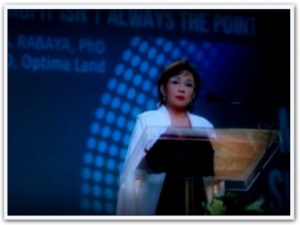 Larger-Than-Life Portrayals – “…Vilma Santos’ latest starrer, “Everything About Her,” is a worthy addition to her pantheon of exceptional screen portrayals. Right from the get-go, she affirms her versatility by playing a “new” character for her, a powerful and abrasive property magnate who reduces her victims to quivering masses of protoplasm….the production’s thespic crown firmly rests on Vilma’s head, due to her daringly strong character choice and ability to come up with a suitable larger-than-life portrayal, despite her slight and light physical frame. Even more compellingly, Vilma is able to dig really deep and summon up the especially strong emotions needed to make her inordinately powerful character believable—while still being able to shift naturally and depict her at her most vulnerable. Finally, “Everything About Her” is a revelatory change of pace and tone for its director, Joyce Bernal, who’s usually identified with more light-hearted and “cheeky” film fare. Her adeptness at humor leavens this film’s tragic scenes, while not diluting them—a tough directorial feat to pull off! It’s a testament to Bernal’s maturing skills that she’s able to do it—and, in the process, show us a bracingly new facet and prism to her directorial scope and oeuvre…” – Nestor U. Torre, Philippine Daily Inquirer, 13 February 2016 (
 Iconic Maternal Roles – “…Everything About Her has good and bad parts. This can probably be said about most Star Cinema movies — as the fulfillment of formula has made these qualities distinguishable, knowing where it goes well and where it nose-dives — but with Vilma Santos and Joyce Bernal, the desire to endorse it, and make a good case for it despite its inevitable shortcomings, is strong. It is convincing at first, from the start when the characters and conflicts are established and all the way through the piling up of challenges for both female characters. But in an effort to close it with something remarkable and leave the audience with warmth, it decides to be generic and resort to platitudes that dilute the inspired moments, in turn weakening what could have been a moving depiction of female (and maternal) strength. Ate Vi gets away with the many times she repeats herself (her approach and sentiment) from her previous movies, and this showcase of recognizable maternal roles makes her iconic in this regard. But Everything About Her does not find its soul in her but in Angel Locsin, delivering what could be one of the best Star Cinema characters in years…” – Richard Bolisay, Lilok Pelikula, 08 February 2016 (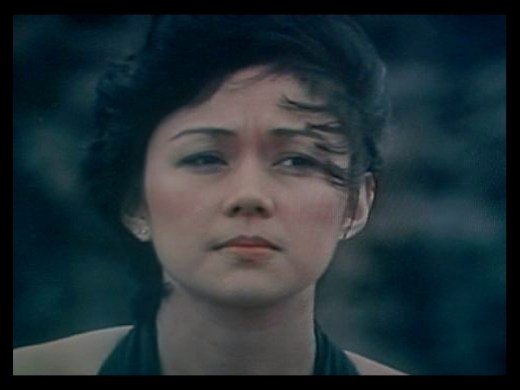
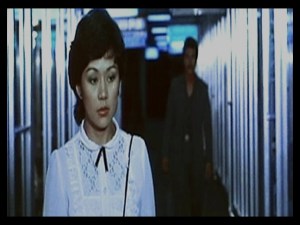 Happily, “Karma” turned out to be as good as I expected. It’s performers are first-rate – Vilma Santos, Ronaldo Valdez, Tommy Abuel, Chanda Romero – so their award-winning acting didn’t surprise me at all. The script was outstanding but even that was expected, coming from director Danny Zialcita. What impressed me was that minor parts were played by name actors. The housekeeper who appeared in one short sequence could have been played by any elderly woman but those who made the movie wanted nothing less than Etang Discher. The psychiatrist could have been played by any decent-looking man but they didn’t settle for anybody less than Vic Silayan. The male lover at the start of the story had to be acted out by Dante Rivero, that at the end by Christopher de Leon.
 Star For All Seasons
You must be logged in to post a comment.