FILM REVIEW: DAHIL MAHAL KITA THE DOLZURA CORTEZ STORY

ARTICLES - Vi in Dolzura Cortez

The Plot: “Dahil Mahal Kita (Because I Love You): The Dolzura Cortez Story 1994, This Philippine drama chronicles the colorful life of Dolzura Cortez, the first publicly recognized AIDS patient in the Philippines. The film begins with a brief examination of Cortez’s pre-AIDS life. Initially she lived in a small village with her cruel husband and three kids. The spunky woman leaves them and moves to the big city where she engages in several affairs. Her second marriage to a rich foreigner does not last long. To support her children, Dolly begins an all woman “contract worker” agency. This also serves to facilitate her love of night-life. Tragedy comes to Dolzura after she collapses on a dance floor one night and learns that she has full-blown AIDS. At a Manila hospital she meets ex-lover Paulo, an AIDS researcher who encourages to tell her story publicly. The courageous woman does and she becomes instrumental in spreading AIDS awareness to the islands.” – Sandra Brennan, All Movie Guide, The New York Times (READ MORE)

The Reviews: This Philippine drama chronicles the colorful life of Dolzura Cortez, the first publicly recognized AIDS patient in the Philippines. The film begins with a brief examination of Cortez’s pre-AIDS life. Initially she lived in a small village with her cruel husband and three kids. The spunky woman leaves them and moves to the big city where she engages in several affairs. Her second marriage to a rich foreigner does not last long. To support her children, Dolly begins an all woman “contract worker” agency. This also serves to facilitate her love of night-life. Tragedy comes to Dolzura after she collapses on a dance floor one night and learns that she has full-blown AIDS. At a Manila hospital she meets ex-lover Paulo, an AIDS researcher who encourages to tell her story publicly. The courageous woman does and she becomes instrumental in spreading AIDS awareness to the islands. It was the first movie on AIDS in the Philippines that provided ‘a name and a face’ among the 50 recorded lives that were lost to AIDS in 1992. This movie was utilized as a focus of discussion by some health care personnel to express their thoughts, opinions and recommendations regarding the use of cinema as a powerful tool for AIDS information dissemination. – You and Aids web-site

The “Dolzura Cortez Story” was the Philippines’ first movie on AIDS that provided ‘a name and a face’ among the 50 recorded lives that were lost to AIDS in 1992. This movie was utilized as a focus of discussion by some health care personnel to express their thoughts, opinions and recommendations regarding the use of cinema as a powerful tool for AIDS information dissemination.

Responding to a newspaper advertisement looking for a person with AIDS, Ms. Dolzura Cortez agreed to have her life story serialized in print and later developed into a movie. The “Dolzura Cortez Story” was subsequently produced as the Philippines’ first movie on AIDS which documented the real experiences of a person living with AIDS in the country. The author reports findings from a study conducted to determine the social impact of the movie as perceived by some health care personnel. Specifically, it aimed to identify the messages that health care providers derived from watching the movie and to make recommendations on how this and subsequent films could serve as an effective tool for AIDS education. 134 health care personnel representing 13 regional hospitals from all over the country watched the film, then answered a questionnaire. The sample was of mean age 35.6 years, 84.3% female, and with mean experience of 10.1 years. 20.1% were doctors, 21.6% nurses, 32.4% social workers, and 25.4% other health personnel. 22.9% had direct experience caring for persons with AIDS and 32.8% knew someone with AIDS. Although these participants perceived some simple and subtle messages from the movie, they also noted its shortcomings. The movie lacked realism; overemphasized the dangers of having multiple sex partners at the expense of warning about other risk factors for HIV transmission; the counsellor pressured the patient and failed to provide enough information on infection control; the psychosocial, economic, and spiritual concerns of people with AIDS were not addressed; and there were some misinterpretations and twisted truths about AIDS facts and the story itself. The respondents suggested that health care providers and people directly involved in AIDS education and counseling be involved in the production of such movies. Moreover, documentary pictures and testimonial footage of the woman would have added realism, while additional basic information about AIDS could have been mentioned in either the movie or a trailer. – NCBI

‘Dolzura Cortez Story’ is an artistic and brilliant film from Manila’s finest director. The movie’s leading actress, Ms. Santos, played her part so powerfully, and is very convincing as Dolzura, the first Filipino HIV/AIDS patient to come- out to the public. The movie is a thought- provoking film, ready to challenge the Filipino idea of what is right and what is wrong. – Jonard, “A thought- provoking, honest film from Philippine’s finest director,” IBDB, March 11, 2000

“…In 1992, wala ni isang pelikulang tinampukan si Nora, samantalang si Vilma starred in only one: Maryo J. delos Reyes’ Sinungaling Mong Puso, na hindi niya pinagtamuhan ng anumang major Best Actress award. In 1993, gumawa si Vilma ng pelikula na ang kuwento’y base sa unang Pilipinang nag-reveal ng pagkakaroon niya ng AIDS (Acquired Immune Deficiency Syndrome), si Dolzura Cortez. Directed by Laurice Guillen for Octoarts Films, Dahil Mahal Kita (The Dolzura Cortez Story) won Vilma the Best Actress honors at the 1993 Manila Film Festival, Star, Gawad Urian and FAP…” – William Reyes (READ MORE)

“Still bearing activist weight is Vilma’s effort in Laurice Guillen’s Dahil Mahal Kita: The Dolzura Cortez Story in which she fleshes out a body and a mind for a person with AIDS. This initiative constitutes an advocacy not only for people afflicted with the dreaded pandemic, but also for women who have to overcome strata of ostracism in the process of survival and resist their being reduced to an aberration, in this case, a pathology.” – Patrick Flores, Manila Standard Today Jan 11, 2003 (READ MORE)

“…Previously, HIV/AIDS “victims” were seen either as homosexual men, or women who worked in the sex industry. The former stereotype was even turned into a mainstream 1993 Hollywood movie Philadelphia that won a best actor Academy Award for Tom Hanks. The latter, on the other hand, was the subject of a 1993 Filipino film The Dolzura Cortez Story starring Vilma Santos. As a disease, AIDS was highly misunderstood two decades ago. Religious fanatics considered it “a punishment from God” for the sexual excesses of its victims. While a complete falsehood, there was some truth to the other mistaken belief about AIDS—that it would lead to certain death for whoever had the disease, which had no known cure. Fast forward to 2013 and Filipinos still generally remain in the dark about HIV/AIDS…” – Beting Laygo Dolor, Manila Times, 14 August 2013 (READ MORE)

Related Reading:

FILM REVIEW: BATA, BATA…PAANO KA GINAWA?

This slideshow requires JavaScript.

The Plot: “A women’s rights activist and mother of two, Lea has been abandoned by the fathers of her children. Her daughter and son are at crucial transitional ages and she struggles to provide for them while maintaining her hectic job at a woman’s crisis center. Soon though, the job and her budding romance with co-worker Johnny threaten Lea’s role as mother when her children’s fathers return to accuse her of neglect.” – The NY Times (READ MORE)

“Lea is a mother of two children from different fathers. She works in a woman’s shelter and helps victims of domestic violence. Her sons are hurt riding their bikes. At the hospital, her principles are threatened when both fathers question her ability as a parent. This film is based on the best-selling Philippine novel of the same name and takes a look at the problems of single mother’s trying to balance work with family.” – Fukuoka (READ MORE)

The Reviews: “Sa tingin ko, sa Bata, Bata… pinakamagaling si Vilma Santos. Sa dami ng kanyang award, may ibubuga pa pala siya. Iba ang akting niya rito…Halatang feel na feel ni Vilma Santos ang kanyang papel dahil, gaya ng karakter ni Lea Bustamante, dalawa ang anak ni Vilma sa magkaibang lalake.” – Marra Pl. Lanot, Diario Uno, Sept. 1998 (READ MORE)

“…Ang international fame, bilang Best Actress, ay nakamit ni Vilma in 1999, when her Star Cinema headliner Bata … Bata … Paano Ka Ginawa? – directed by Chito Rono – was entered as competition entry sa Brussels Film Festival. Released in 1998, Bata won for Vilma the Best Actress honors at the Star Awards, FAP and Gawad Urian, as well as the Best Performance award from the YCC-Film Desk. Dahil nahalal na alkalde ng Lipa City sa Batangas si Vilma Santos-Recto (she married then Batangas Congressman, now Senator Rafael ‘Ralph” Recto in December 1992), naging mas madalang ang paggawa niya ng pelikula. Pero hindi pa rin magmimintis si Vilma na manalo ng acting trophy, kapag din lang may panlabang pelikula, as in 2000 when she did Star Cineman’s Anak by Rory Quintos. Nanalo siyang Best Actress sa Star Awards…” – William Reyes (READ MORE)

“…And Vilma Santosis more than up to the challenge. Gone are the hysterically flapping hands, the melodramatic emoting, all the trademark acting tics. In their place is a heartfelt performance that distills Lea’s essence to an exquisite point-no movements are wasted, no gestures are overwrought. …Vilma rolls them on her tongue like the finest wine; when Lea is on the verge of breaking down, Vilma remains true to the spirit of her character… If the Lipa City mayor decides never to do another movie again, she can retire assured that her last performance-in a career already studded with formidable portrayals-may conceivably have been her best…” – Andrew E. Pardes, Manila Times, Sept 1998 (READ MORE)

“A fiercely independent and unflinchingly candid woman connected with a women’s crisis and survival center has to raise her two kids with different fathers. Her first husband has left her when their career options failed to converge. She is now stuck in an extramarital arrangement with another man who cannot bring himself to respect and commit to their quite unorthodox relationship. – Databases of Philippine Movies (READ MORE)

“A women’s rights activist and mother of two, Lea has been abandoned by the fathers of her children. Her daughter and son are at crucial transitional ages and she struggles to provide for them while maintaining her hectic job at a woman’s crisis center. Soon though, the job and her budding romance with co-worker Johnny threaten Lea’s role as mother when her children’s fathers return to accuse her of neglect.” – Baseline Studio Systems (READ MORE)

“The movie “Bata Bata Paano Ka Ginawa?” is a movie which deals not only with the pains a mother and a wife goes through but also with the people around her as well. The movie which was originally based on the novel of the same title written by Lualhati Bautista, is such a wonderful story. Though it was written during the 1980’s, the material still hasn’t lost it’s appeal and connection to the people, considering that were almost entering the new millenium. What fascinates about the movie is that it did not only revolve around Lea but with the other characters as well. I really felt that all of the actors and actreses in the movie connected with one another. Each of the actors and actresses in the movie had a different story to tell. The movie would not have been as wonderful as it is, had it not been for the stellar performances given by the actors and actresses in the movie. There would be no question in terms of Vilma Santos’ acting prowess. Indeed she has proven be one of the fine actreses this country could ever had. I believe that nobody could ever give justice to the role of Lea had it been portryed by another actress other than Vilma Santos. Most noticeable were the performances given by the two kids. Serena Dalrymple and Carlo Aquino’s performance were just unbelievable. Considering that the two kids’ age and considering that there just neophytes in the acting scene.” – Skyinet (READ MORE)

“In one of the most remarkable performances in Filipino film history, Vilma Santos plays Lea, a woman who defiantly rejects social convention to experience life on her own terms. A woman’s rights activist and mother of two, Lea has been abandoned by the fathers of her children. Her daughter and son are at crucial, transitional ages and she struggles to provide for them while maintaining her hectic job at a women’s crisis center. Soon, however, the job and her budding romance with co-worker Johnny threaten Lea’s role as mother. When the children’s fathers turn up to accuse her of neglect, she must ask herself whether her independence is worth the possibility of losing her children? What role–motherhood or lover–will best satisfy the deepest needs of her soul?” – The 35th Chicago International Film Festival (READ MORE)

“…Lea’s Story, based on Lualhati Bautista’s award-winning novel “Bata, bata paano ka ginawa,” tells the story of Lea, a strong and independent woman who defiantly rejects social conventions to live life on her own terms. Lea, a woman’s rights activist and single mother of two, struggles desperately to provide for her children by working at a woman’s crisis center. Soon her job and romance with a co-worker are threatened when her estranged husband comes back into Lea’s life, accusing her of neglect and abuse. Last year, Lea’s Story swept the Filipino Academy Awards by winning Best Picture, Best Actress, Best Screenplay and Best Director. It stars the Philippines’ top actress and actor, Vilma Santos and Raymond Bagatsing respectively…” – Asian American Film News (READ MORE)

“…As much as people think that this is Vilma Santos’ movie, I beg to disagree. Me thinks it was the children’s show. Serena Dalrymple and Carlo Aquino gave two of the best child acting performances ever. Serena as Maya was a chatty young kid, whose bluntness, frankness, and honesty come across as cute and comical however one can still question as to how she was brought up. Carlo Aquino’s Ojie is a more mature kid, he understood what was going on and was rebelling to the fucked-up-ness of their situation. What pisses me off is that today, there hardly is a movie that Carlo Aquino is in, except maybe for last year’s “Carnivore, “where he was superb in again. Aquino is one of the few great young actors of his time that still is a great actor up to know. He is just not that present anymore. And I kinda wish that he makes more movies, because I know that he is a superb actor…” – Douglas Racso (READ MORE)

“…A free-spirited woman and madre de familia runs her life and raises her children unconventionally. It is one of the best films that espouses feminism without being didactic and self-righteous. Humorous, poignant and insightful, it features a yet-another dazzling performance by Vilma Santos…” – Mario A. Hernando (READ MORE)

“…To best understand how Filipino women have changed in the course of time, let us quote Lea’s final words: “OO, natuklasan ko ang mga bagay na hindi ko siguro natuklasan kung pinahawakan ko lang sa iba ang pagkatao ko. Hindi ako nagpakulong, sinikap kong lumaya. At mula sa paglaya ko sa makitid na papel ng isang babae, natiyak ko na ang kalayaan nga pala, sa higit na pangmalawakang kahulugan nito, ay hindi nahihingi kundi ipinakikipaglaban. Hindi lahat ng hinuhuli’y kriminal, at hindi lahat ng diyos ay may dangal! Hindi ako natatako. Babae ako at malakas ako. Ako ang tagapagsilang ng tao, pambuhay ng sanggol ang dibdib ko. Hindi porke ina na ‘ko’y tumigil na ‘ko sa paglaki. Hindi porke babae ako’y maiiwan ako sa labanan. Para sa kaligtasan ng lipunan at kinabukasan ng mga anak ko sa digmaan ng mga uri’t prinsipyo, sa mapayapa man o madugong pagbabago, magtiwala kayo…sasama ako!” We need more Josies adn Leas in our society tody, The time is ripe for Filipino women to rise above the society’s traditional views and coventions. Although ultimate freedom and due recognition of gender equlity remain a struggle and a serious concern, Filipino women are slowly gaining a strong foothold. In a book dedication written by Bautista to this writer, she wroteL “Ang mga kamay na nag-uugoy ng duyan ay kaya ring magtumba ng alon sa dagat.” And we belive that a freer woman is better mother. And every Filipino family needs her. Every family must have her. We remember what Vilma said in our interview with her during the last shooting day of her film “Bata, Bata…” “I would like to be remembered as a mother who would give her life to her children anytime…” She’s an accomplished actress, and many will remember her for that. But Vilma would rather be a mother in her films, in her life…” – Veron Dionisio, Philippine Daily Inquirer, Jul 29, 2000 (READ MORE)

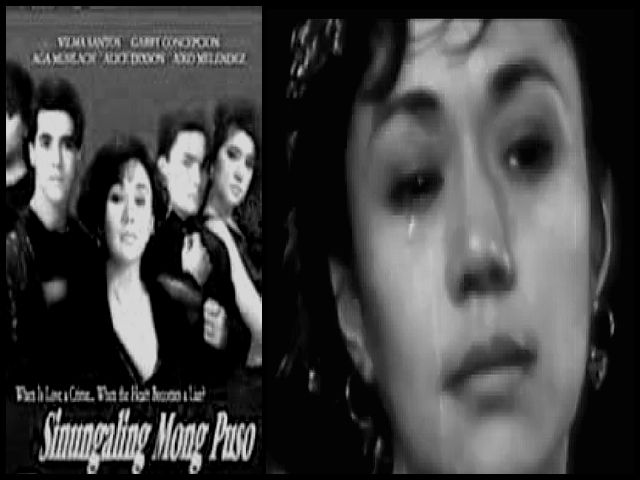
FILM REVIEW: SINUNGALING MONG PUSO


The Plot: An endearing romantic drama that tells of a very curious affair between an older woman (Vilma Santos) and a young unhappily married boy (Aga Muhlach). In between them are Vilma’s husband, Gabby Concepcion and Aiko Melendez as Aga’s wife. All told, the movie proves once again that love does not only happen in the most unexpected times and places. It also makes people do the strangest things. – Regal Films

The Review: Nagsimula ang movie with Clara (Vilma) had a visitor in a jail, ito ay ang ex-wife ng asawa niya. Kasabay nito’y nag-flashback na ang pelikula. Bakit nakulong si Clara? Unang nagkakilala sa isang disco sina Jason at Clara. Inalok ng batang-batang si Jason si Clara ng sayaw ngunit inignore lang nito ang istudyante. Makikita agad na parehong hindi masaya sa buhay may asawa si Clara (Vilma Santos) at Jason (Aga Muhlach). Si Clara ay asawa ng isang malupit at babaerong negosyate, si Roman (Gaby Concepcion). Samantalay si Jason naman ay laging nina-nag ng kasing edad niyang asawa na si Aiko Melendez at pati ang kani-kanilang mga magulang ay nadadaway at madalas na nase-sermunan si Jason dahil rito. Kasabay na pinakita ang problema sa pagaasawa’y ipinakita rin ang mga taong nasasangkot sa pag-iibigan ni Clara at Jason. Ang asawa ni Clara na si Roman ay ubod ng lupit, minsan ay may nahuli ang mga tauhan nito na nagnanakaw sa kanilang bahay ay binaril nito ang magnanakaw. Bukod sa kalupitan ay marami ring naanakan siya at ang laging solusyon nito ay perahan ang mga babae para manahimik ang mga ito.

Nang bumalik sa Pilipinas ang kanyang ex wife na si Leda (Alice Dixon), muling gustong makipagrelasyon ito. Dahil sa mga pambabae ni Roman ay gusto rin sanang makaganti ito sa asawa at maraming mga lalaki na gustong makipagrelasyon sa kanya ngunit napipigilan pa rin nito ang sarili ngunit nang makilala niya minsan ang batang-batang si Jason (Aga) ay hindi na nito napigilan ang sarili. Muling pinagtagpo si Clara at Jason nang masiraan itong una sa kalye at nagkataon na naruon si Jason at tinulungan siya na humantong sa isang dinner date. Nagkaroon sila ng relasyon at nagkikita sa isang apartment na pagaari ng kaibigan ni Clara. Sa kabila ng agwat ng kanilang edad at estado’y natutong mahalin ng dalawa ang kanilang isa’t isa hanggang sa matuklasan ng asawa ni Jason ang relasyon at mag-iskandalo pa ito sa harap ng mga tao’t sa apartment na tagpuan ng dalawa. Bukod sa iskandalo ay nagsumbong pa ito sa asawa ni Clara. Ang naging resulta ng pagsusumbong na ito’y ang pagkakabugbog ni Jason sa malupit na kamay ni Roman. Sinadista nito ang kaawa-awang si Jason. Nang malaman ni Clara ay hindi niya napigilan ang nangyari sa katipan at nang mapuntahan niya’y natuklasan niya ang sinapit ni Jason. Binaril niya ang asawa at pinatay. Dito siya nakulong.

Maayos na nailahad ni Maryo Delosreyes ang istorya nang pag-iibigan ni Clara at Jason. Ito marahil ang dahilan kung bakit tinangihan ni Vilma ang pelikulang Naglalayag na halos kapareho ng istorya, ang pag-ibigan ng isang batang lalaki sa nakakatandang babae. Merong mga eksena rito na hindi kapanipaniwala katulad ng bakit nabuhay pa si Aga Muhlach sa bandang huli dahil nakakapagtaka na sa kabila na sobrang torture na natanggap niya mula sa sadistang si Roman ay nabuhay pa ito. Hindi rin na-isplika ng pelikula kung bakit gustong balikan ni Roman ang ex-wife niyang si Leda (Alice Dixon). Mahusay ang cast ng pelikula, magagalit ka talaga sa kalupitan ni Gabby Concepcion at makikita mo rin na believable siya bilang isang babaerong negosyante. Bilang ex-wife ni Roman, parang tuod si Alice Dixon wala siyang kabuhay buhay na magdeliver ng mga lines. Samantala, litaw na litaw naman ang role ni Aiko Melendez bilang Ana, ang asawa ni Jason. Halos lahat ng eksena niya ay mahusay niyang nagampanan maliban sa bandang huli yung reconciliation scene niya kay Vilma kung saan hindi bagay ang lines niya ba…”pareho natin siyang minahal… blah blah blah…”

Magaling sina Aga Muhlach at Vilma Santos bilang nagtatagong magkasintahan. Lutang na lutang ang pag-arte ng dalawa at nakakatuwa sila sa kanilang mga eksena na nagtatagpo ng palihim tulad ng mag-kita sila sa department store. Dumating si Vilma at hinahanap niya si Aga, hindi nya makita ito hanggang sa mamataan niya ang binata na nakaupo sa may display area. Kinindatan ni Jason si Clara at napatawa na lang ang babae. Mararamdaman mo ang excitement ng mga pagkikitang ito. Nang mahuli ni Ana ang asawa at mag-iskandalo ito, nang umalis na ang asawa at balikan ni Jason si Clara sa loob ng apartment, makikita sa mukha ni Vilma ang pagtatapos ng kanilang affair. Ang sabi niya: “ Hinintay lang kita, guston kong maghiwalay tayo ng maayos…” Bukod sa maraming eksena na lutang na lutang ang pag-arte ni Vilma marahil ang pinaka-memorable ay ang eksena kung saan binaril ni Vilma si Gabby at sabihin niya ang line na: “mamatay kang kasama ng mga baboy mo…” ito ang pagpapatunay na talagang napakahusay niyang artista. – RV

“…In 1992, wala ni isang pelikulang tinampukan si Nora, samantalang si Vilma starred in only one: Maryo J. delos Reyes’ Sinungaling Mong Puso, na hindi niya pinagtamuhan ng anumang major Best Actress award. In 1993, gumawa si Vilma ng pelikula na ang kuwento’y base sa unang Pilipinang nag-reveal ng pagkakaroon niya ng AIDS (Acquired Immune Deficiency Syndrome), si Dolzura Cortez. Directed by Laurice Guillen for Octoarts Films, Dahil Mahal Kita (The Dolzura Cortez Story) won Vilma the Best Actress honors at the 1993 Manila Film Festival, Star, Gawad Urian and FAP…” – William Reyes (READ MORE)

“…Dahil sa tagumpay sa box-office ng pelikulang “Just A Stranger” nina Anne Curtis at Marco Gumabao, muling nauuso ang mga May-December affair film. Sa Urban Dictionary, ang meaning ng “May-December affair” is a relationship between two people where one partner is in the “winter” of their life (old) and the other partner in the relationship is in the “spring” of their life (young). May/December relationships can either be superficial or serious – so the term doesn’t itself say anything about the status of the relationship…Kung tutuusin ay noon pa uso ang May-December affair films at ang iba rito ay naging award-winning pa…Heto nga ang mga pelikulang nagpakilala sa landian, lambingan, harutan ng mga babae/lalaki na may edad sa mga mas batang-batang nilalang…Sinungaling Mong Puso (1992) – Kuwento ito ni Clara (Vilma Santos) na hindi na masaya sa pagsasama nila ng malupit at babaero niyang mister na si Roman (Gabby Concepcion). Nagkataon na nakilala niya ang young father na si Jason (Aga Muhlach) na hindi rin masaya sa nagging wife niyang si Anna (Aiko Melendez). Nabuo ang isang sikretong relasyon na nauwi sa isang madugong trahedya. Mula sa direksyon ni Maryo J. Delos Reyes, nanalo rito si Aga bilang FAMAS Best Actor…” – Anonymous, Abante, 07 Sep 2019

FILM REVIEW: LIPAD DARNA LIPAD


The Plot: After a long period of absence, Vilma Santos resurrected Filipino version of Wonder Woman, Darna, in a fantastic trilogy. Despite the lack of height familiar with previous Darnas, Vilma Santos’ bubbly youthful portrayal as Darna and the alter ego character Narda radiated the screen against Philippine cinema’s senior screen queens, Gloria Romero as the “Babaing Impakta (Vampire Woman),” Celia Rodriguez as “Babaing Ahas (Snake Woman),” and Liza Lorena as “Babaing Lawin (Hawk Woman).” The film was release on March 23, 1973 to a massive crowd in Metro Manila. Tagalog Ilang Ilang Production who produced the film reportedly distributed Darna dolls and Coca-cola drinks to the moviegoers. The film was a trilogy that focuses on the fights scenes between the Darna and her nemesis with great effect and with the help of Darna’s equally perky young brother, Ding portrayed by child star, Angelito. The special effect that’s way ahead of its time in were in full bloom in this film and the make-up goriness particularly Gloria Romero’s was a proof that Filipinos are creative and talented way ahead of Hollywood or even Bollywood. – RV (READ MORE)

The Reviews: In the Silver Age era of Darna, the movie “Lipad, Darna, Lipad!” (“Fly, Darna, Fly!” 1973), played by the lovely Vilma Santos, made a new version of the story. In this time, Narda was a teenager in her late teens. She discovered the magic stone after the event of a falling star landed near her home one night. She discovered that the magic pebble gave her superpowers that made her Darna. She and her brother were the only ones who knew the secret and their grandmother was not aware of it in this version. Narda herself becomes Darna and were not two different characters. She was also not from Planet Marte but was just a champion warrior of the forces of light. Every time Darna turns back to her mortal self, the magic stone reappears in her mouth and she takes it out and hides it until she needs it again. Every time the need arises, she has to swallow the pebble again and say Darna to transform. – Supersexyheroines.com (READ MORE)

In 1951, 2 Darna movies were made starring Rosa Del Rosario, followed by another two starring Liza Moreno in the early 60’s, one by Eva Montes and one by Gina Pareno in 1969. But it was not until 1973’s “Lipad, Darna, Lipad” starring Vilma Santos when “Darna mania” would be rekindled and made this version the highest grossing Darna movie of them all. A feat that has not been equalled to this day. In these 1970s films, Darna’s origin was slightly tweaked with a new twist yet remained faithful to Mars Ravelo’s vision. No longer a little girl, Narda was now in her late teens. Also, she herself becomes Darna, unlike the original where she just “channels” her. Only Ding knows her secret in this version unlike the original where both Ding and their Grandmother knew the secret. Also, the stone comes out of Narda’s mouth every time she changes back from being Darna; she has to swallow it every time she wants to transform (This became standard for following versions). Darna is not specified as coming from Marte, just as a “warrior of Light”. This version of Darna became most people’s idea of the character for about 3 decades. A famous catch phrase by Narda popularized by the movies and NOT the comics version is “Ding, Ang Bato !” (“Ding, the Stone!) – Nostalgia Manila (READ MORE)

The quintessential action-fantasy Pinoy flick that appeals to all ages, from generation to generation. This movie is a major milestone for Vilma because it proved that she could really carry a solo movie and bring in the dough (up to now of course!). Vilma’s Darna franchise is the most memorable and successful of all Pinoy fantasy-action genres. Imitated but never equalled, Vilma’s Darna lives on. Unforgettable. Memorable. It grows on you. No Pinoy kid ever grows up without being a part of the Darna magic. The enormous success of Lipad, Darna, and Lipad led to three more Darna movies with Vilma Santos. As a result, the star for all seasons became the star for all Darnas—Santos played her four times, more than any other actress in the super heroine’s history. Lipad, Darna, Lipad! were thus divided into three separate segments, directed by three different directors. In Darna’s case, the three directors were Maning Borlaza, Joey Goesiengfao, and Elwood Perez—three names that promised an adventure that could do Andy Warhol proud.

First episode: “Ang Impakta” (Vampire Woman) – Starring Gloria Romero as Miss Luna, Narda’s school teacher who has a dark secret. She is actually a flying blood sucking creature at night. In this thrilling episode she knows the secret identity of Narda. The most memorable part was when Ms. Luna asked Narda to help her with some paper works. Little that she know, while she was busy checking the papers Ms. Luna excused herself, she then went to the next room and transformed into a scary vampire. Ding found out that Ms. Luna is the vampire and Narda forgot to bring the magical stone , he rushed to her sister who then was being strugled by the monster. As soon as he got there, he threw the stone to her much terrified sister and she immediately changed to Darna. Followed was the famous aerial fight scene. Nanette Medved and Bing Loyzaga tried to copy the infamous fight scene in 1990 Viva films Darna. Episode one was directed by Maning Borlaza.

Second episode: “Valentina” (Snake Woman) – Vilma also had to battle with Celia Rodriguez, who played a campy Valentina, a supermodel by day and a snake priestess by night. One scene has the actress naked in bed being caressed by a dozen snakes. Indeed, with the likes of Gosiengfao, Perez, and Borlaza at the helm, Darna is sure to get stuck in grotesque situations reminiscent of the Rocky Horror Movie. Their take on Darna is sometimes too risqué and violent for little children; but as a camp fest, the movie works. In this episode Valentina, tried to steal Narda’s magical stone. Also, there was a scene where Valentina dressed up as Darna. I love the exciting part where Darna and Valentina battled on top of a high rise building. Darna, was almost a no match to her mortal enemy. Dangerously armed with lazer beams coming out from Valentina’s eyes, Darna was helpless and knocked down several times. Until, she stumbled upon into a piece of broken mirror and used it as a shield againts Valentina’s deadly lazer beams. Darna quickly made her looked in the mirror. Her lazer beams bounced back and she turned into a stone. From the roof, Valentina fell hard on the ground and broked into shattered pieces. Anjanette Abayarri and Cherrie Gil almost did the same scene in ” Darna, Ang Pagbabalik ! ” Second Episode was directed by Elwood Perez. Vilma Santos with co stars Ernie Garcia and Celia Rodriguez as Dr. Valentina Vrandakapoor, Phd in reptilian zoology from the University of new Delhi. Not to be overlooked is Darna’s arch-rival Valentina. Celia Rodriguez breathed new life to the term antagonist with her classy portrayal of the serpent-haired villainess. Rodriguez set a new standard by which evil women are to be judged.

Third episode: “Babaing Lawin” (Hawk Woman) – Starring Liza Lorena as Babaing Lawin. I barely remember this one, there was this scene where Narda and Ding got caught and almost drowned in a quick sand. In Hawk Woman’s cave there’s this stream, that can make her wings disappear by walking across to it. There was also this character named Agila, a bird man played by Rod Dasco, he’s like the Hawk Woman’s mate. There was some fight scenes in the cave between Hawk Woman and and Darna. At the end of the story Darna and Hawk Woman, mend their ways. – Eric Cueto, Mars Ravelo Darna (READ MORE)

“…In the 1960’s, Gloria Romero portrayed Imelda Marcos in “Iginuhit ng Tadhana” and “Pinagbuklod ng Langit.” In the 1970’s she starred in two memorable movies: Behn Cervantes’s vanished movie, “Sakada” (1976), and earlier, 1973’s “Lipad, Darna, Lipad,” the biggest movie of its time in which she played a “manananggal” to Vilma Santos’s super heroine. Up to now, she considers the last as one of her most unforgettable…” – MPP (READ MORE)

“…Vilma, now 20, still looking virginal and sweet kicked 70’s phenomenal superstar Nora’s butt at the boxoffice and earned her box-office wings via this monumental hit. The Emancipation of Baby Vi. Mariah Carey could not agree more. There was no turning back since then. The Fantasy Queen was born. Fortythree year old Tita Gloria gamely and bravely accepted the role of Ms. Luna, teacher by day and Manananggal by night. Movie Queen Gloria was deglamorized and became the evil incarnate as a vampire. Amalia Fuentes was the original movie queen who bravely accepted a daring role such as a vampire that won her a FAMAS statuette in Gerry De Leon’s Ibulong Mo Sa Hangin, and changed her goody-two-shoe image forever. Was she the original queen of reinvention that gave Vilma an idea to do the same via the landmark movie Burlesk Queen? Hmmm… For the first time, La Santos was billed above La Romero. Times have changed. The tables were turned. Vilma Santos is the New Box-Office Champ and Tita Glo and Co. could only “bow” to the Reel/Real Queen: Ms. Rita Gomez, Helen Gamboa, Boots Anson-Roa, Barbara Perez and others did not have second thoughts to do a movie with the resurgent Vilma. Who wouldn’t want to be famous again and have fun working with the most hardworking and versatile actress? In my book, the aerial Good versus Evil fight of Vilma and Gloria as Darna and Impakta was one of the most thrilling and unforgettable scenes of my movie-going life. How I wish the movie resurfaces from Indonesia or from Timbuktu and my Vilma collection will be complete. That will be heaven! Where, oh, where is that classic movie? The Manananggal episode of Lipad, Darna, Lipad was so good that the two have to followed up their success via Anak Ng Aswang…” – Mario Garces (READ MORE)

“1972 – Lipad, Darna, Lipad…di ko na nakuhang mag-supper and hurriedly went to Coronet 2 bagama’t the film had already started eh uber sa dami ang mga fans sa loob at labas ng sinehan. nakapwesto ako sa dilantera ng sinehan para malapitan kong matanaw sa pagdaan si Ate Vi dahil premier night ng pelikulang Lipad Darna. Nagsalubong ang kilay ko in exasperation nang lapitan ako ng mayordoma ni Johnny Wilson na kalapit-bahay namin sa Paco. May mga kasama sya at tinanong kung Vilmanian din daw ako. Sabi ko’y napadaan lang ako at paalis na nga. tiempong gumagawi ako sa may likuran nang biglang nagkagulo ang mga tao sa pagdating ni Vilma. Ang ganda nya! naka-costume pero naka-kapa para di gaanong malantad ang katawan nya. tuwang-tuwa pa naman ako nang muntik na akong masagasaan. Nasa gitna na pala ako ng E. Rodriguez at namura pa ako ng driver. Potah! Gumawi tuloy ako sa kabilang kalye at kahit malayo ako’y masaya pa rin ako. Sa pakiramdam ko’y ako ang kinakawayan nya. mangilan-ngilan kami sa kabilang kalye na kakaway-kaway rin sa kanya. i went home happy but bone-weary and hungry. kaya lang, nasinturon ako ng tatay ko. Di tuloy ako nakakakain. This sucks! But i will tell nothing of the story of Lipad, Darna, Lipad. Alam kong napanood na yon ng sambayanan. I just have to say kudos to Ate Vilma, she’s so awesome as Darna. There were Gloria, Celia and Liza…all of the evil creatures you need to see in order to make them truly appear as the antagonists of Darna. The story itself is too rich and wonderful, just enough of humor, just enough of banter. The box-office result made history. Almost everyone joined the jubilant partying that is Vilma. She worked hard for it…and effectively captured our national psyche…on her way on top. Some actresses also dared Darna roles, unfortunately, they lacked originality and creativity that we might just view them as a form of flattery. Iba pa rin ang Vilma! Inevitably, it was time for Vilma to take the helm, talagang panahon na nya at wala ng makakaawat pa sa kanyang pagsikat… She was set to eclipse her contemporaries, including the brown girl from Iriga City.” – Bobby Lopez (READ MORE)

“…Maturing as a scriptwriter and film director, in 1973, commercially successful Lipad, Darna Lipad! was released. Award-winning actress Celia Rodriguez essayed the role of Medusa-like villainess, Valentina, nubile Vilma Santos played the Filipino supergirl (a role that launched her in a series of Darna flicks). To Filipino film industry insiders, Perez is known as the most sought-after movie director of his generation…” – Nickie Wang (READ MORE)

“…Elwood Perez and Vilma Santos colloborated in seven films (Ibulong Mo Sa Diyos 1988, Lipad Darna Lipad 1973, Magkaribal 1979, Masarap Masakit ang Umibig 1977, Nakawin Natin ang Bawat Sandali 1978, Pakawalan Mo Ako 1981, Pinay American Style 1979). The first one was the trilogy that he co-directed with two other director, Borlaza and Gosiengfiao (these three are the most underrated and under appreciated directors in the Philippines), the remake of Mars Ravelo comic super hero, Darna in Lipad Darna Lipad. The film was a record-breaking hit Box-office Film. They follow this up with a more mature projects as Vilma started to switched her image from sweet to a mature versatile actress, pairing her with Christopher DeLeon in five films starting with Masarap Masakit Ang Umibig in 1977. The Perez-Santos-DeLeon team produced seven blockbuster hits that gave Vilma two FAMAS best actress awards that secured her elevation to FAMAS highest honour, the FAMAS Hall of Fame award. She won in 1979 for Pakawalan Mo Ako and 1988 for Ibulong Mo Sa Diyos…” – RV (READ MORE)

Sa paggawa ng pelikula, kung maringgan man ng pagdaing si Vilma Santos ay bihirang-bihira. Nangyayari lang ito kung ipagpalagay nating siya’y may dinaramdam, hapong-hapo at talagang hindi na makakaya ng katawang humarap sa kamera kahit ibigin niya. Gayon man, kung nagkataong napakahalaga ng eksena at kinakailangang gawin niya, khait anong sama ng pakiramdam niya’y humaharap siay sa kamera. At sa pagtungo niya sa set o location, lagi siyang nasa oras. Kung maatraso ma’y saglit lang. Ganyan ka-professinal si Vilma Santos. Ngunit sa Lipad, Darna, Lipad ay dumaraing siya. Hindi sa hindi niya enjoy gawin ito. Ang totoo’y sa pelikulang ito lang siya na-involved. Ibig na niyang matapos na ito’t makita ang pinagpaguran niya. Talaga palang mahirap gumawa ng costumes picture. Lalo pa’t kung tulad nito! Una ang naging suliranin namin ay ang Darna costumes ko. Kasi kinakailangan maging maliksi ang kilos ko bilang Darna, kaya kailangang alisin na ang padding. Kaso nga lilitaw naman ang malaking bahagi ng aking katawan. Mabuti na lang at sumang-ayon ang aking fans. “Pangalawa, nag-aalala ako sa mga eksenang bakbakan namin nina Gloria Romero, Celia Rodriguez at Liza Lorena. Kasi baka masaktan ko sila nang di sinasadya. Ang pangatlo ay ang likas ng pagkatakot ko…sa mga ahas. Kasi may bahagi roong tungkol sa Babaing Ahas, si Valentina. Dito, laging kailangan ang ahas sa mga eksena. Mga sari-saring ahas. Maliliit at malalaki. At makamandag! Ang pinakamahirap sa lahat ay ang pag-su-shooting. Kailangan naming tapusin ito anuman ang mangyari. Kaya nasasagap ko ang lamig ng gabi at init ng araw. At ang suot ko nga’y labas ang malaking bahagi ng katawan! At alam n’yo namang kailang lang ay naospital ako dahil sa respiratory defects!” Ito ang daing ni Vilma Santos sa pinakamahirap niyang pelikula, ang Lipad, Darna, Lipad. Ngunit mahihinuha naman ninyo na ang pagdaing niya’y parang paglalambing lang. Dinaraan pa nga niyang lahat sa biro. Pagka’t ang tutoo, mahal na mahal niya ang pelikulang ito. Dahil ito nga ang pinakamahirap. At sa isang artista, kung alin ang pinakamahirap ay siya namang pinakamasarap! – Cleo Cruz, Love Story Magazine, 1973

RELATED READING:

FILM REVIEW: IPAGPATAWAD MO


The Plot: A married couple who try to make their marriage work despite the fact that both of them are career-oriented and that there are tensions created by the prescence of their first-born child, Mike Jr., who turns out to be autistic. – RV (READ MORE)

The Reviews: “…At first, their marriage is close to being one made in heaven. Mike Esquivel (Christopher) is a successful lawyer, while Celina (Vilma) is a popular talkshow hostess. Celina gives up her career to devote fall time as mother to Junjun, the autistic child, played well by both Bennett Ignacio (when Junjun is three years old) and Terence Baylon (when the boy is seven years old). The husband, however, is totally unsympathetic and even considers the child a disgrace. With the wife spending practically all her waking hours to attend to her “special” child, the marriage expectedly begins to crumble. They only give themselves a second chance when Celina finds out that she is again pregnant. The second child – to father Mike’s relief – turns out to be a normal, healthy boy. But with Mike still unable to accept the first child, the marriage is on the rocks once more. The situation worsens when Mike -driven by the abnormal conditions at home and his own self-centeredness – starts an extramarital affair with a balikbayan named Monique (Bing Loyzaga). Finally, a near tragic incident gives Mike another chance to prove himself a worthy husband to Celina and even worthier father to his kids, especially the autistic one. The movie is poignant, nevermushy. It isnotthe run-of-the-mill tearjerker that relies on maudlin theatrics and melodramatic devices to touch the hearts of moviegoers. Surprisingly, despite the frustrating problem facing the movie couple, moviegoers did not seem to be depressed by the movie…” – Butch Francisco (READ MORE)

“What?s the critics said: Payak, makabuluhan ngunit kakaibang pelikula ang ?Ipagpatawad Mo? ng Viva Films. Sapat ngang ipakipaglaban ng Vilma Santos at Christopher de Leon tandem ang paghahanap ng ibang klaseng script na lalo pang mapatingkad sa status nila bilang mga aktor sa makatuturang kahulugan nito. Mapalad sila sa panulat ni Olivia lamasan ng isang story na tumatalakay sa reaksiyon ng isang pamilya sa pagkakaroon ng abnormal na anak. Hinugot ni Ms. Lamasan ang autism syndrome na first time na inilantad sa Pilipino screen, bagamat tinangka na rin itong ipaliwanag sa ?Rain Man? ni Dustin Hoffman sa Hollywood. Sa story, sina Vilma at Christopher ay intelihente (TV broadcaster at lawyer respectively) at matagumpay na indibidwal. Maykaya sila sa buhay ngunit nagkaanak ng autistic. (Ang autism, ayon sa mga modren psychologists na sina Bernard Rimiand at lauretta bender, ay isang uri ng infantile psychosis na kung saan ang sinasapian ay nagwi-withdraw sa reyalidad ng buhay. Nananatili sila sa sariling daigdig na nilikha ng isip at pantasya.) dahil sa autistic child (Edward Carlos Garcia) unti-unting nawasak ang pamilya nina Vilma. Vilma vowed to protect and care for the child because she felt this is the only way a mother can assure herself that everything can be given to the son. (Pinatunayan nga ng pelikula na mas apt ang title na Paano Ba Ang Maging Ina rito kaysa roon sa ginawa ni Nora Aunor). On the other hand, nire-reject ni Chris at ng kanyang family (Delia Razon, et al) ang bata dahil nakababawas ito sa dignidad ng family stature nila. The conflict progresses to give us the different views on how to accept the frailties of people within our family. Para bang kung paano tatanggapin ng magulang na may anak siyang may butas sa puso or worst bakla. The father and mother image were deliberately explored at sa tuwing mag-aaaway sina Vi at Boyet, parang nakikita natin ang ating mga magulang na nagtatalo. the scenes were too real for comfort.

Nadale ng Viva ang kiliti ng masa. Hindi mo nga kailangang bigyan ng heavy stuff ang tao para masabing matino ang pelikula. Tama na nga sa mga politicized films or pa-social relevance. Bugbog na bugbog na ang ganitong tema sa mga diyaryo at sensayunalismo ng TV Patrol ng Channe 2. Mas kinagugusto ng balana ang mga pelikulang nakasentro sa mga karaniwang problema ng tao, lalo na?t may kinalalaman sa ordinaryong relasyong pantao. Napapanahon ang story ng ?Ipagpatawad?. Simple. Natural na pinakilos ng mga tauhan ng dula na halos parang hindi mo namamalayang pelikula lang pala ito. Aakalain mo ngang nakikinood ka lang sa isang scenario sa buhay ng kapitbahay mo. Ganito katindi ang tama ng pelikula sa manonood. This is indeed a very special movie for Boyet and Vi. Santos is again in the running for Best Actress. She was able to sink her teeth to the role of a disturbed mother torn in the love and responsibilities for her husband and the abnormal child. Except for some restless gesticulation of the hands, damang-dama mong buong katawan niya ay nilukuban ng kaakuhan ng role. All her scenes can be considered highlights, because she was consistently good in them. Her duro scene with Boyet was satisfactorily blocked and orchestrated. So far here, Vilma has an edge over Ruffa Gutierrez, Mona Liza, Janice de Belen and Lorna Tolentino in the acting derby next year. De leon was able to regain his acting brilliance in this movie. hindi puwersado. Cool, less facial contortion which became evident in some recent films he made. I like him better here than in ?Salingin? and ?Makiusap sa Diyos?. Nakababagbag-damdamin ?yung paghingi niya ng tawad sa anak. The monologue, which started sa pasakalye to reconcile ended in pained catharsis, that even a man with a heart of stone whould melt in depression. As a team, gamay na gamay na nina Vi at Boyet ang isa?t isa. Actually. sa tender moments nila, you don?t see them as the stars. You are made to believe they were really husbadn and wife.They were too relaxed. Their movements were free and natural. This is really what we call team acting. Walang sapawan.

The movie added more luster with the convincing portrayal of the kids. (Edward Garcia, Bennet Ignacio at Terence Baylon) who played Vi?s children. Special mention dito si Garcia na gumanap na 3-year old Junjun. Ang nuances niya ng ritualistic hand movements and echolalic sppech (symptom ng autism) ay talagang believable. He is not even conscious of the camera. Not to be outdone ay ang great support nina Charito Solis, as the choleric mother of Vi: Joonee gamboa, as the phlegmatic father; Ruby Rodriguez, as the yaya na talagang agaw-eksena, lalo na sa carnival scene; Bing Loyzaga, na mas improved and better version ni Gretchen Barretto sa movie; at Vivian Foz, as the wronged confused sister of Vi. Exceptional din ang cinematography and lighting works ng movie. As usual, expected sa Viva melodrama ang glossy, fabulous setting na nag-capitalized sa affluent house interior. kaya lang, parang di tugma ang theme song ni Janno Gibbs sa story. But more than this, laudable ang script ni Ms. Lamasan. Veritable na may research work ang writer. Dahil na-inform niya nag madla tungkol sa autism na dominant sa mga batang lalaki ngayon. Naipabatid niya na autism is detectable at the first two years, when the child is suffering from hearing and speech impairment In-insinuate din niya na the birth delivery (as specified in the opening scene) can cause oxygen deprivation that may affect the brain development of the child, thus creating immaturity in vasomotor coordination such as hearing, speech and hand movement. nilinaw rin niya na ang emotional refrigeration (yaong rejection nina Chris, Delia at Vivian) can cause the intensification of the disease. However, na-establish din niya ang love and care ng parents (ni Vilma) at sibling (ng kapatid na normal) will be more than enough to push the child to develop little by little. This time Laurice Guillen has hit the pot. The movie turned out to be artistically made and yet the commercial value of it did not suffer. Bumalik na ang aesthetic eye ni Direktora Guillen. Thank God, a film like this comes once in a while to give us enter-educational (learning with pleasure) millieu.” – Ces Ysobel Orsal (READ MORE)

“…The 1990s saw Charito Solis graduate to mother and grandmother roles, which she had done with frequency in the 1980s. In another nod to her age, she finally allowed herself to be billed above Vilma Santos, then acknowledged as the Longest-Reigning Box Office Queen of Philippine Movies, albeit above-the-title in films such as Ipagpatawad Mo (1992) and Dahil Mahal Kita: The Dolzura Cortez Story (1993)…” – Gypsy Baldovino and Yolly Tiangco (READ MORE)

“So much has been said and written about Enter-Educate (Entertainment for Education) but does anyone really know what it all means? As their ad says people in the entertainment industry who ascribe to Enter Education use their appeal to inculcate positive values. Quickly applying this in the movies, It’s the difference between Ipagpatawad MO (Viva Films) and Disgrasyada (Regal Films) both showing at your favorite theaters. Ipagpatawad Mo is a movie about how a family copes with autisitc children. Value: The Family. I haven’t seen Disgrasyada, but given Regal’s track record for gadawful movies, this movie will probably have Ruffa Gutierrez rompling around (wet, most likely) in Mother Lily’s famous kamison. Value: Magic Kamison. I am not saying that Viva makes better movies than Regal. Viva is the same company which brought you Humanap ka ng Panget and Andrew Ford Medina. But it is making an effort to entertain and educate. Which is more than I could say for other movie companies. Ipagpatawad Mo (Direction: Laurice Guillen) is like a training film for parents of autistic children, with lots of drama and fine acting from two name stars. Before anything else, this is the first time I’ve seen a cellular phone (not cordless) in a Filipino movie. (Puh-leeze, I can’t stand people who use cellular phones in their cars, in restaurants, in movie houses, even in church. I hereby propose cellular phone-free zones). This is observation has nothing to do with the rest of this review. In the movie, Vilma Santos plays a successful TV journalist (Must everyone play Loren Legarda in the movies?) while Christopher is a successful lawyer. Everything is perfect until their son Junjun turns three (Are the two children who played Junjun, age 3 and age 8, autistic in real life, or are they actors?) They find out from Lorli Villanueva, who plays a psychiatrist, not a laudrywoman that their son is autistic. Christopher wants to put Junjun in an institution (ala-Rainman).

Instead Vilma takes Junjun to her parent’s house. She gives up her job, stops playing attentive wife to Christopher, and dutifully takes Junjun to a special school. Christopher complaints that Vilma doesn’t pay enough attention to him anymore. Vilma complains that Christopher has forsaken his duties as a father. They breakup, almost. But they reconcile because Vilma is pregnant. She has given birth to Paolo, a normal child. Understandably, Christopher is proud of Paolo and ashamed of Junjun. He doesn’t want his friends to know he has a “defective” son. One day, Junjun humiliates his father in a party. Christopher scolds him, but Junjun doesn’t understand. Instead, he starts to draw his father with a tail and horns. Christopher has an affair with Bing Loyzaga, who tries very hard to do a Nanette Medved, but ends up looking like Gloria Estefan in that Pepsi commercial. Vilma discovers the affair and moves out of the house. Christopher doesn’t want to lose his family so he breaks up with Bing. He begs Vilma to come back and promises to make an effort to accept Junjun. They take a vacation and finally Christopher comes to terms with his feeling for his autistic son. In a touching scene, Christopher and Junjun sit together, but apart in the living room. He tells his son how excited he was when he was born. How he had such great hopes for him. How dissapointed he was when he found out he was autistic. And that he really doesn’t know what to do with him. But he loves him very much. Christopher cries, Vilma, who has eavesdropped, cries too. Junjun who has been toying with a ball, stands up and leaves the room. I guess this sums up the whole situation of what it’s like to be a parent of an autistic child.

Christopher redeems himself from his bad performance in the movie Huwag Mong Salingin ang Sugat ko, shown last week. He is in top form here, and portrays a gamut of emotions, as a father who could not accept that his son is autistic; as comfused husband who turns to another woman for comfort; as a desperate man who implores his wife to give him another chance; and as a transformed father who finally accepts his son is autistic. Vilma is exceptional, as usual. The two stars look good together. (I cannot imagine Christopher and Nora Aunor together). Although, they looke visibly – dare I say it? – old. Not even the soft-focus lens could disguise the bags under their eyes and the lines on their cheeks. Good thing Ipagpatawad Mo is a movie which deals with a more sophisticated subject, other than a man who meets a woman and they fall in love, or a married man falls-in-love with another woman and vice versa. In the future, I would like to see less cellular phones and more mature movies like this, please.” – Elvira Mata, Manila Standard, Oct 23 1991 (READ MORE)

“Countless subjects have been written about this star for all seasons – a fascinating character to her fans. Her calm composure even in the midst of brickbats thrown her way by some members of the press, her acting talents attested by the 16 best actress trophies and her screen image are reasons enough why she has gained a strong foothold in the hearts of the moviegoers. “Being popular in one’s profession or let’s say being successful, is not a shield against the wounds of life. On the contrary, principles come more often and go deeper if one is successful and popular,” she told us when we chanced to talk toher on the set of her latest movie, Ipagpatawad Mo with Christopher de Leon. Moviegoers have always accepted the team-up of Vi and Boyet, acting and box office wise. This is their 16th partnership. Their first was in Tagulan sa Tagaraw.

So what else is new? “There was a time na parang sawa na kami sa subject ng movie namin. Relasyon, Pakawalan Mo Ako, Imortal, Nakawin Natin ang Bawat Sandali, Masarap Masakit ang Umibig, etc. are just some of them. So when we read the script, we said na sana bago naman ang story, not just a love triangle, or legal separation and such subjects. This is the first time in out picture togethertaht involved our child who is autistic. Not many people or only a few of our parents know what an autistic child is. Akala nila mentally retarded na ang mga yon. Which is definitely not true. Autistic children can be taught, can be improved but it takes a lot of patience and determination to make them so. In this movie, Boyet could not believe that he has such a child and he rejects him. But I could not, and that is the bane of our everyday quarrel. I fiercely defend out son here saying to all and sundry that he is not mentally retarded. How did you tackle the subject of autism? “Boyet and I read books about it, saw a movie with its theme, visited a special school for such children in Forbes Park, and spoke to parents of these children.

Ninety percent of these autistic children are very good-looking and are good in numbers but they have a world of their own. If you teach them something, yon kung ang alam nila, no other world exists. Autism is like virus and it is not hereditary. Hindi malalaman na autistic ang isang bata until they are about three or four years old. But doctors know, when a baby is born that he or she is autistic, only they don’t dare tell the parents about it. This movie should be an eye opener for such doctors and parents.” How is it that you and Boyet are so compatible with each other as a love team? To our knowledge, no other team-up has endured such long partnership. “Maybe it’s because we’re comfortable with each other. And one thing more, the moviegoers accepted our team because there’s no personal involvement between us. It’s not necessary that there’s love angle between us. Ang sa amin platonic lang. Not only that, we’re the best of friends. Do you know that Boyet was the first leading man to whom I confided that I’m going to marry Edu? He was also the first to whom I broke the news that I’m pregnant with Lucky. That’s how firm our friendship is.”

In all the years that you’ve been together in the movies, did Boyet ever court you? I heard before that wen you we’re filming a movie with Eddie Rodriguez, he sent you three red roses. “Naku ha! That’s just his way of affirming our friendship. Walang malisya youn.” If in real life, you’re really husband and wife, do you think your marriage will also endure up to the present? ” I just can’t tell, ha. But Boyet and I are both Scorpions. We have the same strong personalities. Siguro magka-clash kami. But in our scenes in the movies, It’s wonderful if Boyet is my partner, because kung intense at high ang feelings ko, kaya ni Boyet na saugtin kung ano ang sinasabi ko with the same intense feeling.” And with the others? “No comment.” In Ipagpatawad Mo, Vi portrays a mother’s love for her child. “I know the feeling because I am a mother. I’ll fight tooth and nail for the care and well-fare of my son, Lucky.” Vi is going full ahead of her movie schedules next year. After this movie, she’ll be shooting Sinungaling na Puso (temporary title), for Regal’s tehn one with Armida’s Reyna Films (The Heiress), and another one schedule for Vision Films.” – Nena Z. Villanueva, Manila Standard, Oct 28 1991 (READ MORE)

FILM REVIEW: MASARAP MASAKIT ANG UMIBIG

Plot Description: A wealthy couple’s sacrificing adopted son, Alonso (Christopher de Leon) and wayward biological son, Alvaro (Mat Ranillo III) vie for the love of the same woman, Estella (Vilma Santos).

Film Reviews: “…Walang ipinagkaiba ang pelikula sa ibang mga sineng tinalakay ang mga suliranin ng pag-ibig at pamilya. Makikitang pinagtuunan ng pansin ni direktor Elwood Perez ang disenyo ng pelikula ngunit hindi naging epektibo ang paggamit nito upang maiusad ang kuwento. Kahit sa pagganap ng mga pangunahing tauhan, animo sila’y nasa entablado. Nanlilisik ang mga mata, walang katapusang pagsisigawan, pagtutulakan at pagbubugbugan. Sa pelikulang ito, unang ipinamalas ang senswalidad ni Vilma Santos. Maraming eksenang sekswal ang aktres at maaari talaga siyang makipagsabayan sa mga tulad nina Alma Moreno at Trixia Gomez. Karamihan ng mga sitwasyong ibinigay sa kanyang karakter ay hindi kapani-paniwala. Nariyang gawin siyang modelo, sa ilang piling tagpo ipinakita din ang pagiging estudyante ni Estella ngunit hindi naman tinahak ang mga ito sa kabuuan ng pelikula. Hindi rin maikakaila ang husay ni Christopher de Leon bilang aktor ngunit sa pelikulang ito ay nasayang lamang ang kanyang pagganap. Hindi nabigyan ng tamang direksyon ang aktor kung kaya’t lumabas na sabog ang kanyang karakterisasyon. Si Mat Ranillo III naman ay tila hindi na natutong umarte. Kadalasa’y pinaghuhubad siya ng direktor sa mga eksena upang mabigyang pansin. Masyadong mahaba ang pelikula dahil na rin siguro sa panghihinayang ni direk Elwood na masayang ang magagandang eksenang kanyang nakunan ngunit hindi naman nakaapekto ang mga ito sa takbo ng istorya. Kadalasa’y nakababad lamang ang kamera at nakatanghod sa susunod na gagawin ng mga artista. Hindi ito nakatulong upang mapabilis ang takbo ng pelikula, nakakainip panoorin ang ganitong mga eksena. Ang Masarap, Masakit Ang Umibig ay basurang nababalot sa kinang ng makintab na sinematograpiya, disenyo at musika na nagbabalatkayong masining na pelikula.” Jojo Devera, Sari-saring Sineng Pinoy (READ MORE)

“…Her metamorphosis began in late 1976 when she agreed to be kissed by Rudy Fernandez in Makahiya at Talahib. It was a “feeler” of sort and when the public clacked its tongue in obvious approval, Vilma shelved her lollipops-and-roses image and proved that she, too, could be a woman – a wise move indeed because at that time her career was on a downswing and her movies were not making money. Then she did Mga Rosas sa Putikan for her own VS Films where she played a country girl forced into prostitution in the big city. The movie did fairly well at the tills. Good sign. And came her romance with Romeo Vasquez, boosting both their stocks at the box office (thier two starrers, Nag-aapoy na Damdamin and Pulot-Gata where Vilma did her own wet style, were big moneymakers). The tandem, although it did help Vilma, actually helped Vasquez more in re-establishing himself at the box office (without Vilma, his movies with other leading ladies hardly create any ripple). In Susan Kelly, Edad 20, Vilma played a notorious-woman role that required her to wear skimpy bikini briefs in some scenes, following it up with two giant sizzlers (Dalawang Pugad, Isang Ibon and Masarap, Masakit ang Umibig) that catapulted her as the newest Bold Queen. Then came Burlesk Queen…” – Ricardo F. Lo, Expressweek Magazine January 19, 1978 (READ MORE)

“…Elwood Perez and Vilma Santos colloborated in seven films (Ibulong Mo Sa Diyos 1988, Lipad Darna Lipad 1973, Magkaribal 1979, Masarap Masakit ang Umibig 1977, Nakawin Natin ang Bawat Sandali 1978, Pakawalan Mo Ako 1981, Pinay American Style 1979). The first one was the trilogy that he co-directed with two other director, Borlaza and Gosiengfiao (these three are the most underrated and under appreciated directors in the Philippines), the remake of Mars Ravelo comic super hero, Darna in Lipad Darna Lipad. The film was a record-breaking hit Box-office Film. They follow this up with a more mature projects as Vilma started to switched her image from sweet to a mature versatile actress, pairing her with Christopher DeLeon in five films starting with Masarap Masakit Ang Umibig in 1977. The Perez-Santos-DeLeon team produced seven blockbuster hits that gave Vilma two FAMAS best actress awards that secured her elevation to FAMAS highest honour, the FAMAS Hall of Fame award. She won in 1979 for Pakawalan Mo Ako and 1988 for Ibulong Mo Sa Diyos…” – RV (READ MORE)

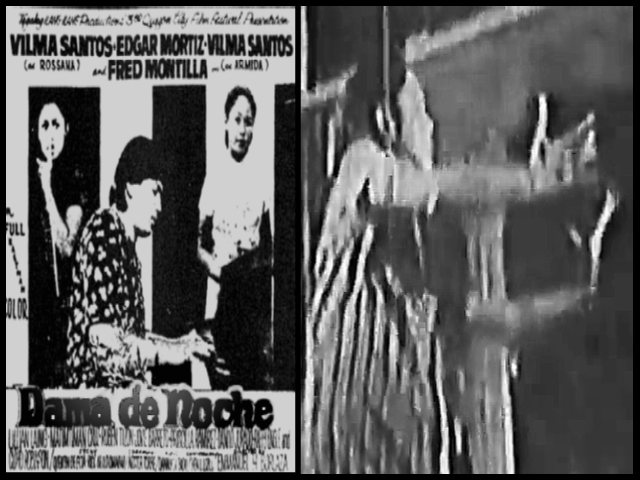
FILM REVIEW: DAMA DE NOCHE


The Plot: A dual role – demented lead. She plays the role of twin sisters, one of whom is a lunatic.

The Reviews: “…Dama de Noche is showing in three theaters– Remar, Delta and Sampaguita. It is, Vilma was quoted as saying, her dream role fulfilled. The very professional Vilma has come out with the resolution than henceforth she will demand to see the script and also see that the script is demanding— or she’ll say nix. Well, Dama de Noche is exactly just that: demanding. In it she delineates the twin-sister roles of sweet Armida and deranged Rosanna. Vilma sobs and screams, giggles, and crazy-dances, claws and clowns, sobs again and screams some more. But she does more than all these things. She acts. In the Filipino movieworld where crying is synonymous with acting, that certainly is being ahead of one’s kind. Vilma as Armida is drab and dry, almost a movie prop. It is in the portrayal of Rosanna that Vilma would tear one’s heart away. The many close-ups so effectively used throughout the movie show the unglamorous Vilma: her frowns, her lip-twitching, her uninhibited and stifled sobs. But Vilma is less successful with the shifty look that is the distinctive trait of the deranged. She compensates for this in the ‘betrayal’ scene when Rosanna suspects that Leo, Armida and the psychiatrist (Fred Montilla) all conspired to imprison her in the hospital. Another outstanding feat is the subdued scene where Rosanna learns that Leo has gone to the Lerma villa to meet Armida. The vivacious Rosanna is just as winsomely pathetic. Watching her is just like seeing a bosom friend trying to pretend she’s happy when both of you know she’s not only in this case, Rosanna is truly happy. Her non-knowledge of her plight is what is particularly heart-curling. Dama de Noche is Tagalog Ilang-Ilang Production’s entry in the QC filmfest which started on Oct.15. It is a very simple story, almost run-of-the-mill, but Nestor Torre, Jr. who wrote the screenplay saved it with his meaningful and amusing lines. However, the movie is occasionally dragging with the Filipino moviemania for spoonfed sequences. Will the memorable Rosanna win for Vilma the most coveted award tonight? Or will Nora the Superstar make it? The die is cast and tonight is the NIGHT. New Frontier Cinema in Cubao was never before so loaded that the fire exits had to be opened to let in air. It was so badly jampacked, one swore it couldn’t be worse. But it was, a ‘stand-mate’ (there were no seats) quipped, ‘Noong first day, mas grabe.’ And so through a snail-pacing 20-yard pila and after exactly one hour, one got inside the theater, at last!…” – The Times Journal (READ MORE)

“…A very young Vilma Santos plays twins—a goody-two shoes and a manic meanie. They fall for the same guy—if I’m not mistaken, a slim Edgar Mortiz. The good twin sings pretty songs, looks morose most of the time, and is often helpless; the bad twin is active, take-charge, and flashes her eyes at the camera a lot. In the end she burns the house down; unfortunately she traps herself in it. Good Vi and Bot escape, and watch the house go down in flames while holding on to each other beside a dama de noche shrub (or at least I assume it’s one). And yes, there is a theme song that goes, “Daaaama de noche… daaaaaaaaamaaaaa de nocheeeeee…” – Joel McVie (READ MORE)

“…We wrote quite a number of scripts for Vilma, including the screenplay for “Dama de Noche,” which turned out to be the first film that gave her an acting award. “This was a big deal for Vi because she was very frustrated at the time due to the fact that she was always losing to Nora in acting derbies in the ’70s. Thus, when she won her Famas trophy, she felt vindicated. It was when “Dama de Noche” was being shot that we had an instructive experience with Vilma. She played a mentally disturbed girl in the story, and there was one scene in which she was supposed to dance her way through a forest. Somebody had interpreted this to mean that the dance would be choreographed number, so a ballet-like dance costume had been made for Vilma! When we got to the movie set that day, Vilma showed us her dance costume, and we were shocked. We explained that the “dance” was supposed to be spontaneous, thus unchoreographed and uncostumed! After our explanation, Vilma returned the costume to the production people, and simply “danced” the scene at her mentally challenged character would, spontaneously. This experience told us that, despite her young age then, Vilma was determined to do her job well, and once she understood how a scene should be done she would insist on doing it the right way, no matter if she ruffled the feelings of some people in the production…” – Nestor U. Torre, Philippine Daily Inquirer, June 6, 2003 (READ MORE)

FILM REVIEW: IGINUHIT NG TADHANA


The Plot: Iginuhit ng Tadhana (Carved by Destiny) is a movie based on the life of Ferdinand Marcos prior to his ascendancy as President of the Philippines. The movie was chronological in setting, featuring Marcos as a young boy in his hometown, as a brilliant student, and up to the time that he was unjustly imprisoned as a suspect in the murder of the political rival of his father. The movie then moves up to his acquittal, his career as a young congressman and senator, and up to the time that he married Imelda Marcos. The movie was shown in Manila as additional campaign material for Marcos’ candidacy for the Presidential race, which he eventually won. The movie portrayed Marcos as a person who is more than just a politician. – Wikipilipinas

The Film: “…Marcos knew the power of the medium of film. Earlier on, Marcos produced a film biography using the most popular stars for his first presidential campaign. He ran against Macapagal who also came up with a film biography to boost his reelection bid. Marcos would also use another film Iginuhit ng Tadhana (Written by Destiny, 1965) to campaign for a second term. The two Marcos film bios would be the only successful political films—commercial and election wise—as other film biographies in the post-Marcos period by senatorial and presidential aspirants would prove dismal, unhelpful for election bids. The post-Marcos period liberalized the political and economic scene. It conventionalized and intensified the election of movie and sports stars, and even television news hosts to national politics. Television stations were sequestered by the government, the largest of which, however, was returned to its pre-martial law owners. ABS-CBN would become the leading television station until after 2000, allowing two of its news anchors to become senators…” – Rolando Tino (READ MORE)

“…In 1965, the Board of Censors suspended the movie exhibition of Iginuhit ng Tadhana (a movie biography of Presidential candidate Ferdinand Marcos). Many believed and suspected that Malacanang had a hand in the board’s decision and such action was a wrong political maneuver and ploy that proved disastrous to the reelection bid of incumbent President Diosadado Macapagal. It practically ensured the Presidential electoral victory of Marcos…The suspension of the showing of a movie on the life of Senate President Ferdinand E. Marcos stirred yesterday a political storm and precipitated the resignation of the chairman of the Board of Censors for Motion Pictures. Officials of the board said that the board voted to suspend the exhibition of the movie, “Iginuhit ng Tadhana” (Destined by Fate) because its producer failed to submit it for preview by the board en banc or by the entire board. The film had been approved for showing by a subcommittee of four headed by Mrs. Rosalina I. Castro last August 24. The board said it interpreted the refusal of the movie company, the 777 Film Productions, to comply with its order as defiance of the Board. The order of the board also suspends the showing of the movie in eight provinces and cities— Camarines Norte, Batangas, Marawi City, Pampanga, Cotabato, Aklan, Masbate, and Sulu. The film has been showing in theaters in these places since Aug. 24, the date of the approval of the picture by the subcommittee of four. In the wake of the suspension of the showing of the film, columnist Jose L. Guevarra, chairman of the board of censors, tendered his resignation. Guevarra did not state his reason for resigning in his letter to President Macapagal, but sources close to him said that the resolution of suspension, which was adopted in his absence, had something to do with it…” – Isagani Yambot, Sept. 3, 1965 (READ MORE)

“…Isa sa paborito ko ay ang Iginuhit ng Tadhana,” ayon pa kay Conrado, “because that film helped President Marcos win the elections in 1965. If you remember, that film was banned by the Macapagal administration and the people naturally became curious. The movie was a big hit.” Iginuhit ng Tadhana was divided into three parts: Marcos as student, Marcos after school and Marcos in his early years in politics. Conrado directed the portion with the President as a young man, during the Nalundasan case, a crucial part in the President’s life. Before he began shooting, according to Conrado, he made his own research and first visited Batac where they shot an important scene…” – Conrado CondeJingle Extra Hot Movie Entertainment Magazine, April 27 1981 (READ MORE)

“This rarely seen, authorized biography of former President Ferdinand Marcos stars Luis Gonzalez, Gloria Romero, Vilma Santos, and Ferdinand “Bongbong” Marcos Jr. as himself. (The film starts with a flash of lighting as he is born on 9/11 in 1917.) ” – Vincent Nebrida (READ MORE)

“…In the 1960’s, Gloria Romero portrayed Imelda Marcos in “Iginuhit ng Tadhana” and “Pinagbuklod ng Langit.” In the 1970’s she starred in two memorable movies: Behn Cervantes’s vanished movie, “Sakada” (1976), and earlier, 1973’s “Lipad, Darna, Lipad,” the biggest movie of its time in which she played a “manananggal” to Vilma Santos’s super heroine. Up to now, she considers the last as one of her most unforgettable…” – Lito Zulueta (READ MORE)

“…And what many people probably didn’t know is that Bongbong played himself in Iginuhit ng Tadhana, produced by Sampaguita Pictures as a campaign pitch for Ferdinand when he first run for president in 1965, with Gloria Romero as Imelda, Luis Gonzales as Ferdinand, (now reelectionist Batangas Gov.) Vilma Santos as Imee and Gina Alajar as Irene (now Mrs. Greggy Araneta). A few years later, a sequel, titled Pinagbuklod ng Langit, was produced also by Sampaguita, directed by Eddie Garcia, with Gloria, Luis, Vilma and Gina reprising their roles and Jose “Jonjie” Aranda (first husband of Bongbong’s fellow Nacionalista, reelectionist Sen. Loren Legarda; their marriage was annulled in 1986) playing Bongbong….” – Ricardo F. Lo (READ MORE)

“…In hid book, Don Jose & The Early Philippine Cinema, Joe Quirino credits jose Nepomuceno pioneer in producing movies that not only entertained but also informed. Wrote Quirino: “His screen adaptation of Noli Me Tangere, Jose Rizal’s novel exposing the social cancer that festered during the Spanish occupation of the Philippines, captured the sardonic and satirical contents of the imflammatory noel.” Satire was a popular device through which producer aired their views on social issues. In 1929, a satirical movie called Patria Amore caught the ire of the local Spanish community who went to court to stop its exhibition. A counterpart incident took place in 1965 when the Liberal Party tried to stop the showing of Iginuhit ng Tadhana, the propagandistic movie of the life of Ferdinand Marcos. The same motion picture propelled Marcos to the presidency. Movies of social significance often face this dillemma on their way to the big screen. Because of their strong public statement, they invite uproar from concerned sectors, an experience that became almost a daily ordeal for the late director, Lino Brocka. In recent years and until his death in 1991, Brocka had been the prime mover of Tagalog movies of social significance. Some of his works that easily fall under this category are, in no particular orderL Orapronobis (about vigilantes and rebels in the countryside), Bayan Ko (on labor unrest), Gumapang Ka sa Lusak and Hahamakin Lahat (on political corruption), Maynila: Sa Mga Kuko ng Liwanag (on moral degradation and exploitation)…” – Nestor Cuartero, Panorama, dated June 13, 1993 (READ MORE)

“…The First Manila Film Festival was held for the first time in 1966. Reserved solely for Hollywood and foreign movies, first-run downtown theaters like Ideal, Odeon, State, Ever, Galaxy, Capitol, Lyric, among others were opened for exhibition to locally-produced or Tagalog movies. The filmfest was the brainchild of then Manila Mayor Antonio Villegas. The 10-day festival which coincided on the city’s foundation day (June 24) was a huge success participated in by big names in the industry…A total of 18 movies (14 new, 4 reissues) were exhibited during the 10-day festival. Iginuhit ng Tadhana, Portrait of the Artist as Filipino and Daigdig ng mga Api, all released in 1965, and Zamboanga, shown a month earlier, were allowed to participate…” – VIdeo48 (READ MORE)

RELATED READING:

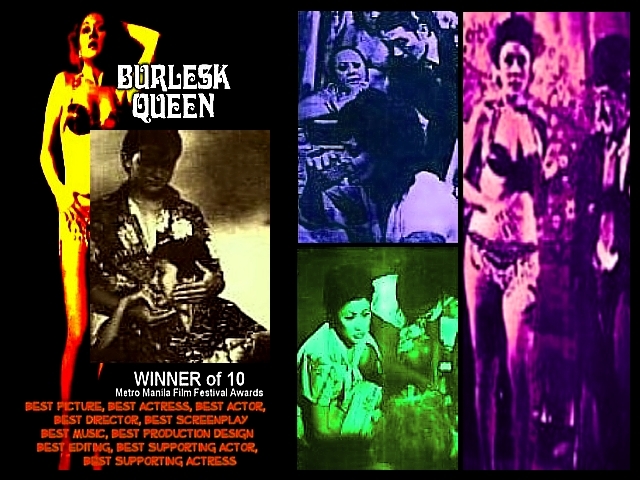
‘Burlesk Queen’ onto the height of pathos (Repost)


The title, Burlesk Queen, with its Tagalized spelling of “burlesque,” immediately striking up an image of novelty and distinction all its own, and inspired by the actual period of Philippine entertainment in the 50s and 60s, is rooted in concrete historical perspective contributing immensely to its achievement of exemplary unity in film art.

To film buffs like Ricky Lee, who at the time was only just beginning to mull the idea of turning scriptwriter, it became necessary to check the shooting script of Burlesk Queen, ostensibly for the festival committee, but in reality, I didn’t bothered to find out. He didn’t get to realize that with Castillo, what script is written on the typewriter is barely half of the work one gets to finally see on film; the other half is written on the spot as an imperative of the limitations in local filmmaking, like creativity on the set, lack of logistics for production design or camera requirements, etc. That—on the spot scriptwriting—happens to be my cup of tea, which figures perfectly with Castillo’s creative style, method of work, whatever you may want to call it. Lee, definitely, won’t get to first base with Castillo in such a methodology.  At any rate, the best proof of the pudding is the tasting, never mind who the baker is.

Burlesk Queen opens with Virgie Knight (Rosemarie Gil) performing onstage. Traditionally movies begin by establishing the main character. Does Virgie’s opening dance defy the tradition? Not at all. Virgie may be taking time a bit too much in her dance so that she impresses the spectator as the main character in the story, but what is transpiring onstage is not an actress delineating a role but rather an image, an idea, of which the dancer is a mere representation. And what is that image, that idea?

Burlesque. And under the principle of montage, when two representations are juxtaposed to each other, i.e., joined together, the juxtaposition produces a qualitatively different theme. By making the idea, image of burlesque as its opening number, Burlesk Queen upholds revered canons for artistic expression. On aesthetics in general, the film conforms perfectly with the Aristotlean test for art: “at once, brilliant, beautiful and whole.” Burlesque is a thematically-hewn visual delight, appearing as sudden as the opening shot.

By literary standard, Burlesk Queen conforms to the dictum of story development proceeding from the development of the main character. The actual start of the story is Chato’s (Vilma Santos’) affectation by the main theme, the burlesque dance.  Adherents of montage will amaze at the theme of burlesque, from scene one onward, permeating every scene and every detail of these scenes with astonishing, exquisite, if tedious, consistency.

Note this story flow. After Virgie’s performance, she and Chato take snack at an eatery, Chato expressing her desire to dance burlesque like Virgie so as to earn a big sum by which to buy her crippled father a wheelchair. Coming home, Chato excitedly relates to her father, Mang Roque (Leopoldo Salcedo), how nice Virgie’s dancing is—burlesque. In relating thus, Chato does hip bumps and gyrations— burlesque. Mang Roque expresses aversion to Chato’s job as attendant to—burlesque. All the way to Mang Roque’s distaste for the food pasalubong Chato brings him which he says he cannot stomach for being a proceed of…burlesque.

Even up to this point only, it becomes clear that the film has had a firm grasp of the tenets of montage, has grappled with, and has overcome, the problem of building compositional structure for achieving organic unity. But the extent of such unity must go all the way to the climax where the desired pathos must be experienced, so that the testing of the validity of this observation must be continued all the way to the finale.

What comes next? Virgie goes home to her own third-rate flat, swinging to a boogie tune from a transistor radio slung by a hand on her shoulder. The gait, the sway, the music, including the erratic electric light that goes on and off — all of these effect a retention of the aura of the burlesque theater. The ensuing quarrel between her and lover Ander (Roldan Aquino) centers on Virgie’s failure to get further advance payment for her dancing, what else but burlesque? For failing to give Ander the money he needs, Virgie is deserted by him then and there, and as he steps out of the house (off-frame), banging the door shut, the impact causes the light to turn off for good—certainly the theatrical way of ending an episode of a show as well as a transition to the next episode.

And what transpires next? In a flat-like Virgie’s, the morning after, a rough-edged, if attractive, cheaply-sexy-looking woman who Ander, in his lines, reveals as a nightclub hostess (Dexter Doria) is urging him to get dressed pronto (he is naked in bed, his front covered only with a pillow—isn’t this burlesque!) and accompany her to the dressmaker to get an outfit she had ordered. In one respect, aside from being exposed (his nakedness does this) now as a gigolo victimizing women in the flesh trade, Ander serves as the unifying thread with the immediately preceding scene with Virgie. In another respect, the club hostess’ urging Ander to accompany her to the dressmaker is a crafty method for making the aberrant Ander to stay on-line, i.e., stay within the theme. For at that very moment, who should be figuring in the dressmaker’s shop but, yes, Virgie, trying on a new costume for her stage act, again yes, burlesque.

This dress shop sequence is a particularly interesting specimen for study. What are its elements? Virgie trying on her new costume. Chato snickering at the window with a friend as she exchanges naughty glances with Jessie (Rolly Quizon, presented here for the first time), who is playing pool with barkada across the street. The arrival of Ander and the club hostess, who engages Virgie in a verbal tussle over burlesque. Lowly folks crowding in the surroundings, as audience in a theater. While a pair of musician beggars endlessly play a violin and percussion instrument, rendering music that completes the theater atmosphere.

Truly, indeed, as montage requires, a film to be art must conform to the law governing organic unity in natural phenomena. Lenin, the great leader of the Russian proletarian revolution under whose influence Eisenstein developed the montage theory, puts it this way: “…the particular does not exist outside that relationship which leads to the general. The general exists only in the particular, through the particular.”

Hence in Burlesk Queen, scene after scene, and detail after detail to their minutest proportions within each scene, nothing exists that is not within the central theme of burlesque.

In this dress shop sequence, Virgie makes like unaffected by Ander’s having completely abandoned her for the club hostess, but in the dressing room where she repairs to after the verbal clash, she gives vent to all her sorrow from having lost Ander forever. At precisely this point, Chato is exchanging love gazes with Jessie. Here we have a pretty lucid illustration of a rule in dramaturgy that has been a tradition of Greek tragedies whereby qualitative leaps in thematic development are always in the opposite. Chato’s joy at a nascent love affair with Jessie is contraposed to Virgie’s grief brought about by the end of her relationship with Ander. Yet though such qualitative leaps go separate ways, they stay confined within a seeming thematic parallel by which both leaps contribute to the building of a compositional structure necessary to maintain the organic unity begun earlier on at the opening. Virgie drops into depression and is so drunk during one burlesque presentation in the theater that she is not able to answer the call when her number comes. Now, who should come onstage to take Virgie’s place just so to placate a maddened crowd but a young dancer—Chato!

Love and hate, joy and sorrow, emotions going their separate ways, but perfectly maintained within the never-for-a-moment-missed parameters of the central theme of burlesque. More than bare feelings, the emotions actually represent images building up for another qualitative leap in the drama by which to finally attain, along strict criteria of Greek tragedies, the ultimate height of pathos. – Mao Gia Samonte, Manila Times, Thursday, February 12, 2009

RELATED READING:
Burlesk Queen WINNER of 10 MMFF Awards
1977 Metro Manila Film Festival
Video 48: Vilma Santos As “Burlesk Queen” (1977)
Vilma Santos’ Top 10 Film Directors (part five)
IMDB: Burlesk Queen (1977)
IMDB: Celso Ad. Castillo
IMDB: Rolly Quizon
IMDB: Rosemarie Gil
IMDB: Leopoldo Salcedo (1912–1998)
Pelikula Atbp: Burlesk Queen (1977)
The Kid, uninterrupted
‘Burlesk Queen’ Onto The Height of Pathos
Vilma Santos as Burlesk Queen (1977)
Amanda Page performs a burlesque inspired number for the MMFF Gabi ng Parangal (Video)
The Classic Vilma Santos Movies

Regalo (TV 2006)

“Kung ang tawag sa mga namamatayan ng asawa ay byudo o biyuda at ang mga anak na nawawalan ng mga magulang ay ulila, ano ang tawag sa mga magulang na namamatayan ng anak?” – Daisy Hernandez

This slideshow requires JavaScript.

Basic Info: Directed: Olivia M. Lamasan; Writing credit: Dado C. Lumibao; Cast: Vilma Santos, Maja Salvador, Ricky Davao, Erich Gonzales, Charo Santos-Concio; Producer: Ginny Monteagudo, Malou N. Santos; Cinematography: Neil Daza, Charlie Peralta; Editing: Aries Pascual; Production Design: Nancy Arcega, Malou Dugtong IMDB

Plot Summary: Daisy Hernandez (Vilma Santos), a mother must divide her time between work and taking care of her daughter April (Maja Salvador) who has cerebral palsy. Daisy’s heart is wrenched every time she sees her eldest child suffer because of her illness. But Daisy never loses hope, and April manages to live a normal life until she is 18. Just when Daisy thought things are doing fine with her daughter’s disability, a tragedy will further test her faith (Wikepedia).

Achievement: 20th Star Awards Best Actress by a Single Performance – Vilma Santos Wikepedia

Reviews: “Though the hurt you felt seeing the Star for All Seasons Vilma Santos excruciatingly depicting the harrowing tale of a mother deeply burdened by the travails of her ailing special daughter has been quite deep, the relatability and inspiration overcome you. But what really moves you apart from the inspiring story of Daisy Hernandez is the Vilma’s legendary and exceptional ability to transform into the character herself. You can see the anguish in her eyes and the profound suffering she felt in each second of her appearance. As such, Maalaala Mo Kaya’s classic 2006 episode “Regalo” is her televised dramatic opus beyond compare. Add to that Maja Salvador’s unprecedented breakthrough performance of Daisy’s precious child and cerebral palsy sufferer April, which made critics turn heads and focus intently on what she can offer as an actress. Maja truly matched the kind of thespic excellence an actor needs to show in the same frame as Vilma Santos, and more…The episode had its astonishing thespic highlights, yet with masterful guidance from Direk Olive Lamasan, who brought incredible emotive dimensions to every character in the story. You would feel their every utterance, dramatic expression, and character validation worthy of thought and emulation…Maja Salvador became an actress of note since this episode, and this started an eventful string of extraordinary dramatic performances both in film and TV. Her superb portrayal of a mentally and physically challenged individual became her rite of passage to the acting big leagues, and rightfully so, she has cornered a respectable and prominent place in the industry. Mere words cannot express or measure the immense dramatic reach of Vilma Santos. You just have to witness her to believe and get astonished with every eye movement, line phrasing, raw emotion, expressive gesture she makes on screen. Vilma just satisfies everyone’s insatiable appetite for drama perfection, great thespic talent personified, and MMK “Regalo” further elevates her as a more illuminating Star for All Seasons.” – Gerry Plaza, ABS-CBN, 04 July 2020 (READ MORE)

“…It’s a vintage Vilma Santos performance, packed full with so much emotion that perhaps only the stone-hearted won’t be moved, especially in the succeeding scene where, hesitantly resigning to her daughter’s final farewell, Vilma delivers the clinching dialogue: Bakit kapag ang asawa ay namatayan ng asawa, ang tawag sa kanila balo o kaya ay biyudo o biyuda? Kapag naman namatayan ng ama o ina ang isang anak, ang tawag sa kanya ay ulila. Ano naman ang tawag nila sa inang namatayan ng anak?  That scene is absolutely heart-tugging and there’s more of similar scenes in the two-part special for which, according to direk Olive, Daisy Hernandez herself (a native of Lipa City where Vilma is the mayor on her third and last term) wrote some of the dialogues in the story that Vilma herself chose as possible movie material (but, said Vilma, “no regrets that it ended up a Maalaala special”).  Regalo (with Ricky Davao as Vilma’s husband) is the 777th episode of Maalaala which has lasted longer than the ABS-CBN executive (now retired) who, 15 years ago when Charo broached the idea of hosting the drama series, told her, “Wala kang alam sa telebisyon; ang alam mo lang ay pelikula…” – Ricky Lo (READ MORE)

“…Vi’s mighty proud of “Regalo,” saying the long wait was worth it. She herself presented the story to Charo and her sister Malou Santos, Daisy being one of her constituents in Lipa City. The mayor describes Daisy as a strong woman, not easily given to tears, despite the plight of her daughter April who had passed away. In memory of her daughter, Daisy works with an NGO which helps sick and needy children in Lipa…Olive requested that Daisy be on the set so that direk could relate the story as accurately as possible. Olive noted that a most moving line said by Vilma, came from Daisy herself. Something like, “Ang babaeng namatayan ng asawa, ang tawag biyuda. Ang anak na namatayan ng magulang, ulila. Subalit ano’ng tawag sa magulang, sa inang nawalan ng anak? Wala…” Vilma said words are not enough to describe the grief of a mother who lost a child. How true. Ask Manay Gina de Venecia, and Ali Sotto. “Regalo” was written by Dado Lumibao with Mel Mendoza-del Rosario as script supervisor. Charlie Peralta is the cameraman…” – Ronald Constantino (READ MORE)

“IT’S obvious that ABS-CBN values Vilma Santos so much. After making a movie that is an unabashed tribute to her from start to finish, “D Lucky Ones,” they now feature her in the 15th anniversary presentation of “Maalaala Mo Kaya.” “We love Vi as she’s not only a nice person but also a true professional, a committed artist who loves her craft,” says Charo Santos, top ABSCBN executive and host of “Maalaala Mo Kaya.” “Fan na niya ako since her Vi and Bobot days and Iove seen her evolution as a person and as an actress. Kahanga-hanga talaga siya at ang kanyang magandang kalooban, it just radiates. You cannot fake that dahil galing talaga ‘yun sa loob. We’ve long been inviting her to guest in “Maalaala” and she was the one who gave us this story of Mrs. Daisy Hernandez, a mother so devoted to her eldest daughter who had cerebral palsy.” “I met Daisy at the SPED, special education school for special children, in Lipa,” says Ate Vi. “I met her daughter, April. Then I didn’t see her for sometime and I found April has died na pala. I told her to write down her story then I gave it to Malou Santos who thought of doing it for “Maalaala.” We started taping this last year, pero magka-conflict ang skeds namin ni Direk Olive Lamasan, so it took 6 and a half days to tape it over a period of one year at natiyempo sa anniversary ng “Maalaala” at pang-Mother’s Day presentation pa.” “This is the show’s 777th episode,” adds Charo. “Maalaala has been made into a film in 1994 that gave awards to its stars, Aiko Melendez and Chin Chin Gutierrez. It has given the break to many directors like Wenn Deramas, Jerry Sineneng, Rory Quintos, Gilbert Perez, Mac Alejandre, Lauren Dyogi, Ricky Davao and Michael de Mesa. We’re proud to have Vi for our anniversary show that will be shown on May 4 and 11.” We’ve seen the preview of the episode, entitled “Regalo,” and it’s really a tearjerker that aims to wring your tearducts dry. Her fans will surely be proud of their idol anew as she shines in several scenes where she gets to deliver kilometric lines.

It’s a great acting vehicle for any actress worth her salt and Ate Vi truly does justice to the role of a mother who does everything to support her disabled child only to lose her later to a viral infection. All throughout the death and wake of April” (convincingly played by Maja Salvador), Vilma is not shown crying at all. She finally breaks down after the funeral while talking to her husband (Ricky Davao, who’s equally great) and delivers some lines that will surely be added to the list of classic dialogues she has uttered in her past films and that were all used in “D Lucky Ones.” If you’re a parent with a special child, you’d be able to identify with her role. But even if you’re not, you’d still be affected by this true story of unconditional love and sacrifice. Incidentally, we finally got to see “D Lucky Ones” and we’d like to congratulate Director Wenn Deramas for succeeding to make us laugh. There are many hilarious scenes in the movie that even non-Vilmanians will appreciate, thanks to the fine performances of Eugene Domingo, Sandara Park and Pokwang. Eugene is the best among them as she doesn’t exert too much effort in tickling us. Sandy is also a natural comedienne, but Pokwang can go over the top at the times she should have been restrained a bit. The film has two highlights. First is the dance showdown between Eugene and Pokwang at the Phi Bar where they get to re-create the intricate production numbers Ate Vi used to do in her TV show. The second one is the film’s climax where Ate Vi makes a special guest appearance to reconcile the warring Eugene and Pokwang and then does a dance number with the entire cast. Most local comedies fail to make us laugh, but this one really works. – Charlie Gomez (READ MORE)

“VILMA Santos had a meeting with her Vilmanians the other Friday at Max’s Libis. She reported that she had finally finished shooting her Maalaala Mo Kaya episode with Ricky Davao and Maja Salvador, directed by Olive Lamasan. “One year in the making ito, bale two episodes, but it’s really worth it and I’m impressed with the work of Direk Olive,” she says. “It’s based on the true story of a woman from Lipa.” She said she got an offer to do a stage play at the CCP. She’s willing to try the theatre but when she was told she has to rehearse for two months, she had to turn it down as she still has her duties as Lipa City mayor to attend to. She revealed she has new movie offers, but most of them are heavy drama. She wants to do something lighter that will be more appealing to the masa. Last March 8, Vilma was given the First Diwata Award in celebration of International Women’s Day. That coincided with the 16th International Women’s Film Festival by the UP Film Institute, the longest-running women’s filmfest in the country. She was cited for her roles in films like Sister Stella L, Relasyon, The Dolzura Cortez Story, Bata, Bata, Paano Ka Ginawa? and Dekada ’70, which are about women empowerment. She was honored with Lily Monteverde, Charo Santos-Concio and writer Lualhati Bautista. Vilma was warmly applauded by an adulating crowd and she delivered a very inspirational message, saying: “I strongly believe in these films with strong messages. It’s about time men believe in women empowerment. Don’t underestimate us, women and artists!” Ate Vi left Thursday with husband Sen. Ralph Recto to attend the investiture rites of our new cardinal in Rome (she was personally invited). After that, she will take a cruise with Ralph and meet with her family in Los Angeles.” – Mario Bautista, People’s Journal March 26 2006 (READ MORE)

“Lipa City Mayor Vilma Santos, a multi-awarded dramatic actress, an exemplary wife and mother and a model public official, is so work-oriented that she can only make a few television appearances every year…Mayor Vi gives a bravura performance, which has become her trademark. She gives up her acting mannerisms for a fresh attack of a mother’s role that makes it an outstanding interpretation. Regalo relives the tale of Daisy Hernandez, a devoted wife and dedicated mother whose child suffers from cerebral palsy…Although screened in black and white, Regalo’s exceptional quality was immediately evident during the media preview. Everything about this episode is non-artsy as director Olive opted for a straightforward presentation to bring out the drama without seeming contrived. Acting is likewise direct to the point, clearly the episode’s main strength. Although Mayor Vi is notches higher in delivering her role, Maja showed that she has the makings of another Vilma Santos. Pitting them together was a casting triumph. Although Regalo is a small story, cast and crew imparted it with enough realism to turn it into a domestic epic of sorts. Regalo, written by Dado Lumibao, is a clear proof of MMK’s superiority as a drama anthology, making it the longest running ABS-CBN show right now. It is not afraid to defy convention, tell real-life stories with themes of rape, homosexuality, or physical disability, just as it delivers contemporary stories of love and sacrifice, family dramas and teen stories. And it does this with critically acclaimed actors and directors, award-winning stories, and visual treats that have semblances of films rarely seen on television (read: high production values unconstrained by small-screen budgetary pegs). This makes Maaalaala Mo Kaya a world-class drama anthology. Regalo is MMK’s Mother’s Day presentation with excellent actors Ricky Davao and Erich Gonzales in supporting roles.” – Edgar Cruz (READ MORE)

“…A special 15th Anniversary prsentation of Maalaala Mo Kaya. “Regalo” is an inspiring story of a woman who goes through a painful journey of finding her fulfillment as a wife, a mother and as a person. Balancing her time between her career and family is rather difficult for Daisy Hernandez. Her eldest daughter April is afflicted with Cerebral Palsy and needs all the love, care and attention only a mother can give. What can a mother sacrifice to raise a daughter like April? How far can she go to fight for her daughter’s battles in life?…” – Kabayan Central (READ MORE)

“…As for Vilma’s “MMK” replay, she and Ricky turned in emotionally charged and committed performances in it as the parents of a girl (Maja) with cerebral palsy. Vilma’s character, in particular, refused to capitulate to the dreaded illness’ terrible demands and tragic consequence, and the portrayal she turned in was one of her career bests. It’s good that our TV channels are replaying iconic shows and performances, because new generations of viewers are made more aware of and grateful for past thespic achievements, which make them more enlightened and demanding viewers today—to keep our TV-film people on their toes!…” – Nestor U. Torre, Philippine Daily Inquirer, 25 April 2015 (READ MORE)

RELATED READING: