Vilma Santos-Recto is a popular multi-awarded actress and politician in the Republic of the Philippines. *** She is known as "Queen of Philippine Movies," "Queenstar," "Grand Slam Queen," "Box Office Queen," and "Star for All Seasons." *** This website is mostly about her iconic film career.
“…PX, short for Paula Xavier (Vilma Santos) was an illegal alien in New York City. She’s broke and waiting for fiancé, Cocoy laurel to fulfill his promise of marriage despite the fact that Cocoy has already married an American to secure a green card. Hiding from the authorities, PX met two men who are willing to take care of her but conflicts arise as the two wanted to maintain a serious relationship with her. Played wonderfully by Christopher Deleon and Bembol Roco, the film resolved the love quadrangle between ex-fiancé, Cocoy Laurel and the two brothers when the jealous Cocoy reported Vilma to the immigration authorities. PX was deported back to the Philippines. But the films didn’t end in a sour note, PX found herself reunited with Christopher Deleon when the later followed her in the Philippines…” – RV (READ MORE)
“…Pinay, American Style (1979) carries such attributes. Shot entirely in America, it depicts the plight of some Filipinos living there – Filipinos who are obsessed with amassing fortunres and landing high-paying jobs and enjoying the dolce vita in the muchballyhooed “land of the brave and home of the free” and the “land of the mighty dollar.” Compared to foreign movies with explicit sex scenes, Pinay… would not even deserve the “For Adults Only” tag or an “X-rated” classification, according to Elwood. Basically, the movie is a relfection of the typical plight of Filipinos living abroad. It is a plight that runs counter to the optimism and false hopes entertained by potential Filipino immigrants. Arriving in the U.S. as tourists, some Filipinos would choose to stay behind in their search for “greener pastures.” Having done so, they have to play hide-and-seek with immigration authorities, accept odd jobs to survive in the asphalt jungle, get married to ward off deportation, and similar evasive maneuvers. These same incidents are what the cast – Vilma Santos, Christopher de Leon, Bembol Roco and Victor “Cocoy” Laurel – portray in Pinay. Pinay is Elwood’s second movie shot abroad after Lollipops…” – Manny B. Fernandez, Expressweek, July 12, 1979 (READ MORE)
FAIR USE NOTICE (NOT FOR COMMERCIAL USE): This site contains copyrighted materials the use of which has not always been specifically authorized by the copyright owner. We are making such material available in our efforts to preserve the film legacies of actress, Vilma Santos, and to make her career information available to future generations. We believe this is NOT an infringement of any such copyrighted materials as in accordance to the the fair dealing clauses of both the Canadian and U.S. Copyright legislation, both of which allows users to engage in certain activities relating to research, private study, criticism, review, or news reporting. We are making an exerted effort to mention the source of the material, along with the name of the author, performer, maker, or broadcaster for the dealing to be fair, again in accordance with the allowable clauses. – Wikipedia (READ MORE)
Mahinhin vs. mahinhin (1981) is a movie directed by Danny L. Zialcita. It was a continuation of the film Si Maganda at Si Mahinhin which was produced in 1980. Produced by Sine Silangan Productions in 1981, the movie featured the late Dindo Fernando, Ronaldo Valdez, Adul de Leon, and Elizabeth Oropesa. The young Carmi Martin and Edu Manzano were also part of the movie. The story revolved around the life of Billy de Gracia (Dindo Fernando), a homosexual who tried to live as a man by marrying Juana (Elizabeth Oropesa). Billy’s life turned upside down as he met Archie (Edu Manzano), boyfriend of Peter Frias (Ronaldo Valdez). Peter, unlike Billy, was a multi-millionaire homosexual. Billy pretended to be woman when he tried to offer Archie some money. When Peter learned about that, he and Billy agreed to share Archie with each other. The following scenes showed how Peter and Billy rivaled for Archie’s attention. – Wikipilipinas (READ MORE)
Danny Zialcita is a fun-loving gifted and colorful filmmaker who left his mark as one of the best in the stimulating era of the ’60s and ’70s. Then without any warning he left the industry. Stories of drug addiction, withdrawal from the world, and worse, loss of sanity dogged his absence until even his colleagues lost touch with him and didn’t know what to believe. Zialcita is a master of improvisation on the set, he also had the knack for casting the right actors, choosing the right material, and pleasing his producers. One of his favorite actors was Dindo Fernando whom he termed “the complete actor” and cast him in such movies as Langis at Tubig, Karma, Gaano Kadalas Ang Minsan, Mahinhin at Mahinhin, its sequel Malakas, si Maganda at si Mahinhin and Ikaw at ang Gabi which gave Dindo his first Urian Best Actor trophy. Other favorites were Vilma Santos cast in Karma, T-Bird at Ako, Langis at Tubig; Pinky de Leon; Laurice Guillen; Ronaldo Valdes; and Beth Bautista who won Best Actress award in Hindi sa Iyo ang Mundo Baby Porcuna. – Bibsy M. Carballo (READ MORE)
FAIR USE NOTICE (NOT FOR COMMERCIAL USE): This site contains copyrighted materials the use of which has not always been specifically authorized by the copyright owner. We are making such material available in our efforts to preserve the film legacies of actress, Vilma Santos, and to make her career information available to future generations. We believe this is NOT an infringement of any such copyrighted materials as in accordance to the the fair dealing clauses of both the Canadian and U.S. Copyright legislation, both of which allows users to engage in certain activities relating to research, private study, criticism, review, or news reporting. We are making an exerted effort to mention the source of the material, along with the name of the author, performer, maker, or broadcaster for the dealing to be fair, again in accordance with the allowable clauses. – Wikipedia (READ MORE)
204 films, 70 directors, 5 decades, Vilma Santos, one of the original Philippine movie queens, rose up to become the versatile actress that has been given the fitting title of “Star for All Seasons” because of her capacity to adapt to the changing mores and values of the Filipino woman, giving a face to their plight and struggles, albeit in success both critically and box-office wise in some of Philippine cinema’s classics such as Trudis Liit (1963), Lipad, Darna, Lipad (1973), Burlesk Queen (1977), Relasyon (1982), Sister Stella L. (1984), Alyas Baby Tsina (1984), Pahiram ng Isang Umaga (1989), Dahil Mahal Kita: The Dolzura Cortez Story (1993), Anak (2000) and Dekada ’70 (2002). This are top ten directors who contributed to her success. – RV (READ MORE)
Roño gave Vilma Santos her first international recognition winning the best actress in 1999 Brussels International Festival of Independent Films. At the same time, he was recognized as the festival’s Best Director both for Bata Bata Paano Ka Ginawa. The film also gave Vilma Santos her third grand slam winning all the best actress awards from several local award giving bodies. In 2003, Vilma received another international recognition, this time from Cinemanila International Film Festival winning the Best Actress for Dekada 70. The film was screened in international film festival circuit and was the official entry of the Philippines in the 76th Academy Awards (OSCAR) for the best foreign language film category. – RV (READ MORE)
Ikaw lang (1993) – “…That year, dalawang movies ang nagawa ni Ate Vi. Ang isa pa ang ang action-dramang Ikaw Lang ni Chito Roño, na in fairness ay mahusay rin siya sa papel ng battered wife ng baliw na si Cesar Montano an naging bank robber kasama si Ronnie Ricketts…” – Mario E. Bautista (READ MORE)
Bata, Bata…Paano Ka Ginawa? (1998) – “Lea Bustamante is torn between two men who are threatening to take her two children away. Lea suddenly begins to doubt her worth as a mother and as a woman, and is forced to confront her needs which the men in her life have never fulfilled. Still, Lea fights to keep her children, to keep her dignity, and to do what is right in a world where everyone accuses her of being wrong.” – BIFF (READ MORE)
Dekada 70 (2002) – “In Chito S. Roño’s superb “Dekada ’70,” a family in the Marcos-era Philippines has a domineering father and five sons, but it is the mother (Vilma Santos) who provides the mental stamina. She fights for her family in ways the father can’t even dream of. “To give birth to these children isn’t enough,” she says. “You have to defend them, protect them.” That’s the ’70s. In 30 years, that kind of woman will deal with difficult questions of divorce and motherhood, one in which women want freedom, yet must be willing to share blame when something goes wrong. The young woman who leaves her husband and thinks about aborting her pregnancy in South Korean filmmaker Gina Kim’s “Invisible Light” is an experimental example. Moon’s great performance in “A Good Lawyer’s Wife” almost makes you believe wrong is right, and, taken with her much-lauded portrayal of a girl with cerebral palsy in “Oasis,” reveals her as one of the world’s best actresses. Hollywood, take note.” – G. Allen Johnson (READ MORE)
The Healing (2012) – “…Pero ang nakakatakot sa pelikula, yun palang tatay ni Vilma, kinukuha niya ang ‘life force’ ng lahat ng mga magiging pasyente nung healer”, dagdag na kuwento pa ni Mama maribel. “Kaya siya nabubuhay, kinukuha naman pala niya ang buhay o energy life force ng ibang mga tao, at yun ang mga magiging susunod na mga pasyente nung faith healer! Shocking, di ba? Naku, sorpresa ang role ko dito, ikatatakot ng lahat. At si Ate Vi, ngayon lang muli kami magkakasama sa isang pelikula. The last movie we made was Alyas Baby tsina during the late ’80′s pa yun!” At kilala naman ng lahat kung gaano kagaling si direk Chito Rono sa paggawa ng mga horror films, no? Isa sa paboritong horror film namin na ginawa ni direk Chtio ay yung remake ng clasic film na “Patayin Sa Sindak Si Barbara!” kung saan si Dawn Zulueta ang naging bida…” – Robert Manuguid Silverio (READ MORE)
Chito S. Roño, also known as Sixto Kayko, is an acclaimed Filipino writer, film producer and film director known for his expansive vision and special-effects-heavy films, most notably Yamashita: The Tiger’s Treasure (2001) for which he won the Metro Manila Film Festival for best director. He is also known for his 1997 film Nasaan ang Puso which earned him his first MMFF for best director. – Wikipedia (READ MORE)
204 films, 70 directors, 5 decades, Vilma Santos, one of the original Philippine movie queens, rose up to become the versatile actress that has been given the fitting title of “Star for All Seasons” because of her capacity to adapt to the changing mores and values of the Filipino woman, giving a face to their plight and struggles, albeit in success both critically and box-office wise in some of Philippine cinema’s classics such as Trudis Liit (1963), Lipad, Darna, Lipad (1973), Burlesk Queen (1977), Relasyon (1982), Sister Stella L. (1984), Alyas Baby Tsina (1984), Pahiram ng Isang Umaga (1989), Dahil Mahal Kita: The Dolzura Cortez Story (1993), Anak (2000) and Dekada ’70 (2002). This are top ten directors who contributed to her success. – RV (READ MORE)
Zialcita’s first movie with Vilma was the 1980 festival entry, a drama about bigamy, Langis at Tubig. The following year, Zialcita and Santos joined forces again in another festival entry, Karma. The film earned Vilma her second Metro Manila Film Festival Best Actress. The following year, Ziacita’s Gaano Kadalas Ang Minsan broke box office record, Earned P7.3 million during its first day of showing in Metro Manila and assured Vilma Santos the box office queen of 1982. – RV (READ MORE)
Langis at Tubig (1980) – “…Muli, binigyan ng magagandang linya si Vilma Santos mula sa umpisa kung saan kinompronta niya ang manloloko niyang ka-live in at sinabing: “namputsa naman nahuli ka na ayaw mo pang aminin” at sa bandang huli nang intindihin niya ang asawa at handing magparaya, sinabi niya “…handa akong magparaya, kung gusto niya isang lingo sa kanya, isang lingo sa akin…” Pero halatang ang pelikulang ito ay pelikula ni Dindo Fernando. Deserving si Dindo sa kanyang pagkapanalo sa Famas bilang pinakamahusay na actor bagamat nang taong ito’y mahusay rin si Christopher Deleon sa Aguila at Taga ng Panahon at Jay Ilagan sa Brutal. Tahimik lang ang pag-arte niya’t makikita ang kanyang intensity sa kanyang eksena kung saan nagtapat na siya sa asawang si Cory tungkol sa kanyang kaso. Mahusay rin siya nang hinarap niya si Pilar at sabihin niyang, “mahal ko kayong dalawa.” Maganda ang location ng pelikula. Makikita ang mga ordinaryong tanawin ng Albay sa Bicol at ang mga ordinaryong manggagawa rito mula sa mga nagtatanim ng palay hanggang sa mga nagtitinda ng mga paninda sa palengke ng bayan. Sa kabila ng ordinaryong istorya ng Langis At Tubig, ang mahusay na direksyon at mahusay na pagkakaganap ng mga artista rito’y nangibabaw ang tunay na karapatan nitong panoorin muli ng mga mahihilig sa pelikulang Pilipino. Sayang nga lang at hindi na gumagawa ng pelikula ang ang gumawa ng obrang ito.” – RV (READ MORE)
Karma (1981) – “…The movie boasted of several bold scenes. Those involving Vilma weren’t much as we know for a fact that Vilma could show only so much. One scene showing Chanda was a different story. It showed her with absolutely nothing on, yet it didn’t offend anybody as it was executed in style, shot with great care. There was just one thing, which looked unnatural to me – the way in which one of the main characters killed himself. “That’s all right,” Danny assured me. “Before we shot it, we double-checked its possibility.” Reincarnation and transference are undoubtedly mind-boggling subjects but, to his utmost credit, Danny managed to present them simply, bringing them down for everybody to understand. “Bala lang yan. Katawan lang ito. Babalik at babalik kami sa mundong ito,” Dante vowed. Come back they did as they promised building the foundation of the story…” – Bob Castillo (READ MORE)
Gaano Kadalas ang Minsan? (1982) – Gaano Kadalas ang Minsan? (1982) – “Gaano kadalas ang Minsan” Grossed 7.3 Million in its few days run in Metro Manila in 1982 outgrossing “Sinasamba Kita” for Philippine movies’ all-time box office tally. With inflation and currency rate in consideration that will be around 95 million. But that’s not the only exciting thing about these film. It was the only film that Vilma Santos and Hilda Koronel did together and when Hilda was still at her peak of her illustrious career. Ofcourse, Ate Vi’s career remained as hot as ever, still able to carry a film while Koronel now accepts supporting roles. It was obvious that when both star did Gaano, Hilda was more glamourous than Vilma but looking at the two right now, Vilma maintained that slim, youthful look while Hilda struggled and visibly gained so much weight she can be mistaken as Ate Vi’s aunt or mother (As of 2012, Hilda shed that pounds and now back to her glamourous looks!)! After Gaano, Hilda did a few more leading roles under Viva Films even co-starred with Nora Aunor but didn’t get the same results as Gaano. Like what William Leary says, “mahirap matalbugan si Vilma, Vilma is Vilma in any seasons and whatever movie!” – RV (READ MORE)
T-bird at Ako (1982) – “…For him, every dialogue is a song,” says Mark. “May intro, may refrain. You don’t go to the refrain right away.” Consider this confrontation scene between Vilma Santos and Nora Aunor in T-bird at Ako. Nora’s character, a lawyer, has just expressed her romantic intentions to Vilma, a nightclub dancer, who responds to the proposition, quietly, with “Nandidiri ako.” Nora: Bakit, sino ka ba? Ano bang pinagmamalaki mo? Katawan lang yan ah, sa’n ba galing yan? Sa putik! Vilma: Putik nga ako pero kahit ganito ‘ko nagsisimba ako kahit papa’no. At ang sabi ng nasa itaas ang sala sa lamig, sala sa init, iniluluwa ng langit, isinusuka ng Diyos! Which takes us back to Mark’s statement. First, you have to be a competent actor to come to work without a script. Danny is famous for not doing scripts, only rough storylines and sequence guides that get revised easily on the set when a new idea strikes him. “I don’t want them coming to the set with a planned line, a planned movement. So that they can surpass their own,” says Danny. Second, you have to be an intelligent actor to deliver lines like the ones above, to convince the audience that the character is capable of churning out knockout philosophical punches at the tip of a hat—which, incidentally, people wore in Zialcita films. …” – Jerome Gomez (READ MORE)
Danny Zialcita is a fun-loving gifted and colorful filmmaker who left his mark as one of the best in the stimulating era of the ’60s and ’70s. Then without any warning he left the industry. Stories of drug addiction, withdrawal from the world, and worse, loss of sanity dogged his absence until even his colleagues lost touch with him and didn’t know what to believe. Zialcita is a master of improvisation on the set, he also had the knack for casting the right actors, choosing the right material, and pleasing his producers. One of his favorite actors was Dindo Fernando whom he termed “the complete actor” and cast him in such movies as Langis at Tubig, Karma, Gaano Kadalas Ang Minsan, Mahinhin at Mahinhin, its sequel Malakas, si Maganda at si Mahinhin and Ikaw at ang Gabi which gave Dindo his first Urian Best Actor trophy. Other favorites were Vilma Santos cast in Karma, T-Bird at Ako, Langis at Tubig; Pinky de Leon; Laurice Guillen; Ronaldo Valdes; and Beth Bautista who won Best Actress award in Hindi sa Iyo ang Mundo Baby Porcuna. – Bibsy M. Carballo (READ MORE)
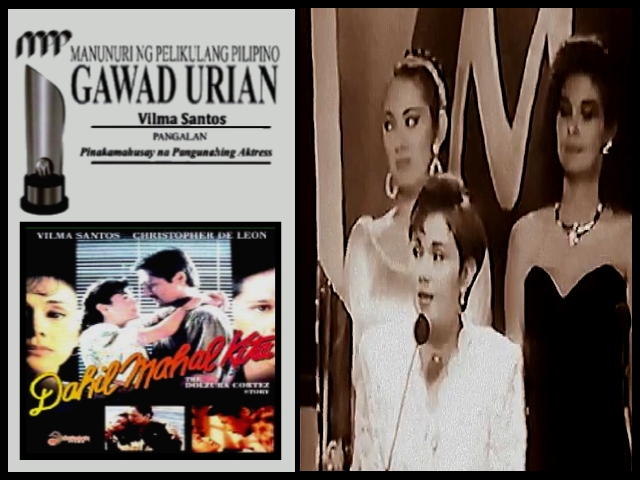
She has won 33 major acting awards, the highest output for any woman thespian in these parts. “Vi did it with the single-mindedness of a homing pigeon,” said Laurice Guillen, director of Dahil Mahal Kita: The Dolzura Cortez Story, which ran away with the lion’s share of the major awards in this year’s Manila Film Festival including, among others, the trophies for Best Picture, Best Actress, Best Actor and Best Director. Laurice, of course, was referring to Vilma Santos, who won the 1993 Manila Filmfest Best Actress plum for reastically portraying a PWA (person with AIDS). “Vi was determined to portray Dolzura Cortez – warts and all – no matter what,” Guillen stressed. “Walang pa-charming. An ectopic pregnancy and a bout with diarrhea only temporarily derailed her train but she reached her destination, and she got a statuette in the process.” When she received her trophy during the glittering awards rites held at the Manila Midtown Hotel last June 25, Vi raised her statuette and declared in Pilipino: “I gave it all I had. To Dolly (nickname of the PWA she portrayed), wherever you are, this is for you.”
Dolly herself (who died shortly after investigative reporter Ceres Doyo wrote the series about her (Dolly’s) life and times in the Philippine Daily Inquirer) had expressed the wish that Vilma portray her in a movie dramatizing her experience as a PWA. People behind the project hope the movie will raise public awareness about Acquired Immune Deficiency Syndrome (AIDS) and how to prevent it. There are an estimated 35,000 people with HIV (human immune-deficiency virus) that caused AIDS in the Philippines although Health Secretary Juan Flavier believes the number is actually higher. Vilma’s triumph in this year’s filmfest was par for the course. In three decades in showbiz, Ate Vi, as the Vilmanians (loyal Santos fans) love to call her, has won 33 major acting awards (the highest output for any woman thespian hereabouts) and has appeared in about 120 movies. “It took us 25 shooting days to wrap up the movie,” Guillen continued. “It would have taken us longer if Vi had not been as dedicated to her work because she was practically in every scene and her stick-to-itiveness helped us a lot because, whenever she was on camera, there was no goldbricking. It was work, work, work for Vi and, although I could say the same thing for the rest of the cast, Vi really set the pace for the others to follow.”
In her thank-you speech at the awards ceremony, Vi acknowledged the fact that “I would have been helpless without Tita Laurice, Tita Chato (Charito Solis, who played Vi’s mother), Boyet (Christopher de Leon) and other members of the cast and crew.” As usual, Vi was generous in her acknowledgments and ever her husband, Batangas Representative Ralph Recto, “above all”, got his share of the kudos. Even the jurors of whom I was one, were impressed by her acting. “She would win in any festival with this kind of performance,” says Gina Alajar, herself a Metro Manila Film Festival Best Actress awardee earlier this year, who pinchhit for Rudy Fernandez as juror. “What I like about her performance,” juror Josefino Cenizal, veteran composer and musical director, chimed in, “is that she never overacted in many scenes where less experienced thespians would have. She gives the impression that she’s not acting but just going through the scenes as if she’s a natural part of the scenery.” There’s only one actress I’ve seen in action who seems not to be aware of any camera (just like Vi) and that’s Julie Christie, the British actress, who did a movie scene in front of several journalists from all parts of the globe, including this writer, in a London pub in the 1960s.
I have to confess that this article is a bit partial to Vilma Santos because I’ve been a Vilmanian from Day One. I remember the first time I saw Vi was in 1962 when Dr. Jose “Pinggot” Perez, Sampaguita Pictures executive, invited me to watch the filming of a movie called Trudis Liit. It was a nine year-old Vilma Santos who played the title role and she was so good, Doc Perez raved: “May kinabukasan ang batang ito (this child has a bright future).” Vi still remembers the reporter “who asked me silly questions like what’s my favorite dish, etcetera”. It was the beginning of a lifetime friendship and during those intervening 31 years, I’ve seen Vi blossom from a shy but hoydenish teenager, to the Vilma Santos of today, a confident woman of 39 “na maraming karanasan sa buhay (her own words)” pero sweet na sweet pa rin like the Vi of old. Some of those experiences would have driven an ordinary woman to perdition but not Vi, who says quietly: “A woman should grow wiser through the years.” Vi had the best teachers in the field of love. During the late ‘60s and early ‘70s, her “puppy love” was Edgar Mortiz which gave birth to the Edgar-Vilma loveteam, the only noteworthy rival of the Pip (Tirso Cruz III)-Guy (Nora Aunor) tandem. Her subsequent romance with Romeo Henares, son of former Inquirer columnist Larry Henares, nearly ended at the altar. “But I was not ready to make a lifetime commitment,” she disclosed. “Commitment” is one of Vi’s favorite words.
And then came Romeo Vasquez. It was during her relationship with Romeo in the mid-70s that what’s not known as the Betamax scandal came about. There was this lurid chismis that Bobby (Romeo’s nickname) and Vi had been captured on Betamax tape while rolling in the hay. I personally investigated this rumor and discovered it was just that -a rumor. I remember the many times that Vi and Bobby guested in my Seeing Stars TV show on Channel 13 where they sang as duet their theme song: Pag-ibig Ko Sa Iyo Lang Ibibigay. After her breakup with Romeo, I used to tease Vi by singing the opening lines of that ditty, and she would squirm and say, “Ayaw ko na, Tito Joe.” Recently, when Marra PL. Lanot and I interviewed Vi at a local recording shop, I sang the opening line and Vi sang it with me without any qualms. It’s because Vi has blossomed into a mature woman who’s confident of the love of her husband, Representative Recto, who’s admittedly 10 years younger that Vi (he’s 29 to Vi’s 39). But before her marriage to Recto was her interlude with Edu Manzano by whom she has a son, Lucky. “Doods and I really tried to preserve our marriage but things went awry,” she now says philosophically. It’s a measure of Vi’s diplomacy that she has remained friends with all her past lovers. – Joe Quirino, Philippine Graphic, June 16, 1993, transcribed and posted by Jeannie Wong (READ MORE)
“Ang hirap dito sa relasyon natin, puro ikaw ang nasusunod, kung saan tayo pupunta, kung anong oras tayo aalis, kung anong kakainin natin, kung anong isusuot ko sa lahat ng oras, ako naman sunod ng sunod parang torpeng tango ng tango yes master yes master!” – Maria Lourdes Castaneda
“Ano ba ako rito istatwa? Eh dinadaan daanan mo na lang ako ah, hindi mo na ako kinakausap hindi mo na ako binabati hindi mo na ako hinahalikan ah…namputsang buhay ‘to. Ako ba may nagawa akong kasalanan hah? Dahil ang alam ko sa relationship, give and take. Pero etong atin, iba eh! Ako give ng give ikaw take ng take! Ilang taon na ba tayong nagsasama? Oo, binigyan mo nga ako ng singsing nuong umpisa natin, pero pagkatapos nuon ano? Wala na! Ni-siopao hindi mo ako binigyan eh dumating ka sa bahay na ito ni butong pakwan hindi mo ako napasalubungan sa akin eh kaya kung tiisin lahat pero sobra na eh…hindi naman malaki hinihingi ko sayo eh konti lang… alam ko kerida lang ako…pero pahingi naman ng konting pagmamahal…kung ayaw mo ng pagmamahal, atleast konsiderasyon man lang. Kung di mo kayang mahalin bilang isang tunay na asawa, de mahalin mo ako bilang isang kaibigan, Kung ayaw mo pa rin nun bigyan mo na lang ako ng respeto bilang isang tao hindi yung dadaan daanan mo lang sa harapan na para kang walang nakikita!” – Maria Lourdes Castaneda
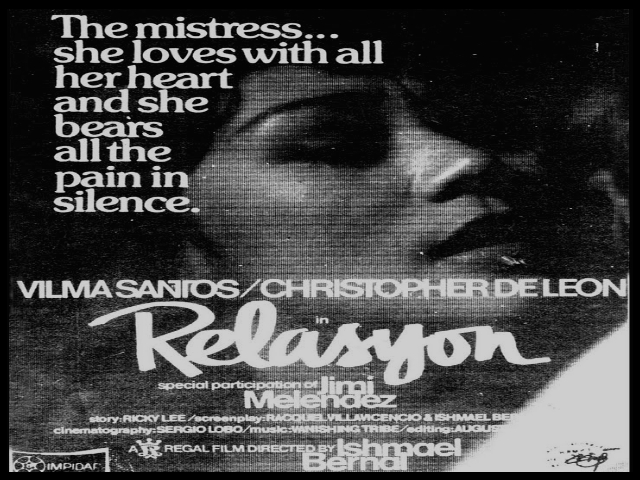
Emil, a young executive, and his mistress Marilou, a planetarium guide, decide to be live-in partners. In the process, they discover each other’s failing, which result in the strain in their relationship, bringing about their temporary separation. When they finally decide to resume their relationship, under a set-up wherein the man devides his time between his family and mistress, he dies frpm an attack of cerebral aneurysm. The woman decides to start a new life abroad, finding strength in the Jove of her departed lover. – Manunuri web-site
The set-up – “In a time when the concept of divorce does not exist, much less imagined possible, we find Marilou, a planetarium guide who decides to pursue an affair with Emil, a college teacher sepatated from his wife. They seem perfect for each other, and soon decide to move in together. Their once happy affair turns sour as Marilou slowly discovers the real Emil, a chauvinistic, domineering, and emotionally abusive man who disctates everything to her, from how she should act and manage her life to the most inconsequentials details of running their house. They soon find themselves in an on-again, off – again relationship, with Malou going as for as laying a let’s meet only three times a week rule to protect herself.” – UP (READ MORE)
The Slam – “…1982, Nauso ang so-called Grand Slam Best Actress in 1983, nang manalo si Vilma Santos for Ishmael Bernal’s Relasyon. That 1982 film was a small, low-budget drama of a husband and his mistress. Nag-hit ang tandem nina Vi at Christopher de Leon, starting in 1978, with Sampaguita Pictures’ Masarap … Masakit ang Umibig and Nakawin Natin ang Bawat Sandali (both by Elwood Perez), after their first pair-up in Celso Ad Castillo’s 1975 romance-drama Tag-Ulan sa Tag-Araw. For Relasyon, Vilma won as Best Actress sa CMMA, Gawad Urian, FAMAS and the debuting Film Academy of the Philippines (FAP) Awards. Maging sa “minor” parangal, like the TV show Let’s Talk Movies ng RPN 9 (hosted by Armida Siguion Reyna, Behn Cervantes and Mario Bautista), si Vilma rin ang Best Actress for the Regal Films drama. With Nora Aunor as Vilma’s main competitor, it was an interesting, but utterly disappointing, acting duel. Sa FAMAS, Nora got nominated for Romy Suzara’s Mga Uod at Rosas – and lost. Sa ibang award-giving bodies, isang malaking pelikula at pagganap ni Nora – sa Himala, as the visionary Elsa – ang natalo kay Vilma. The Ishmael Bernal opus was produced by the Marcos government-established Experimental Cinema of the Philippines (ECP). Some were of the opinion na may bahagi ng pulitika sa pagkatalo ni Nora; marami raw sa movie industry ang anti-administration, kabilang ang sympathizers ng Free the Artists Movement na anti-censors. May malaking rally noon na hindi dinaluhan ni Nora, samantalang nakiisa sa protesta si Vilma. Gayon man, may parangal na natamo si Nora para sa Himala: the 1982 MMFF Best Actress, where it won 9 out of 13 awards, including Best Direction and Best Picture. Naging opening Film ang Himala sa 1983 Manila International Film Festival – organized by then First Lady Imelda Romualdez-Marcos – at inilahok sa Berlin International Film Festival in February 1983. Ayon kay Bernal, Nora lost in Berlin to a Russian actress by a mere vote. Sa 7th Gawad Urian in 1983, nominated in almost all major and minor categories ang Himala but never won a single award. Ilang taon ang lumipas, sa tuwing titingnan ko ang Honor Roll ng Manunuri sa ipinamamahaging souvenir program, sadyang “walang Himala” na nagtamo ng parangal. But in 2002, sa 25th year ng Gawad Urian, kabilang ang Himala sa Pinakamahuhusay (Best Films of the past three decades) na naparangalan, with Nora Aunor personally receiving the overdue award para sa isang totoong klasikong pelikulang Pilipino. At bigla ngang naghimala ang Himala!…” – William Reyes (READ MORE)
The Role – “…Sinasabi ng mga drumbeater ni Vi na ang kanyang role sa pelikulang ito ay pang-award, pang-FAMAS, pang-URIAN o pang-Film Academy Award kung matutuloy ito. Hindi kami tumututol sa kanilang palagay laluna’t napanood namin ang pelikulang ito. Masuwerte si Vi at sa ganitong maselang role ay dinirek siya ng isang katulad ni Bernal. Tulad nang binigyang diin namin sa unang bahagi, ang mga pelikula ni Bernal, ang “Pagdating sa Dulo”, “Nunal sa Tubig”, “Mister mo, Lover Boy ko” at “City after Dark” ay mga malinaw at makatotohang salamin ng buhay. Kaya sa “Relasyon” ay natural lamang na makakita tayo ng mga sitwasyong tila aktuwal na kinuha sa tunay na buhay at inilipat nang buong-buo sa puting tabing…” – Mando Plaridel, Star Monthly Magazine July 10, 1982 (READ MORE)
After the Slam – “…Like 1972 of the previous decade, 1982 turned out to be a repeat in terms of success for Vilma Santos. If critics took noticed in 1972, her performance in Dama De Noche, a decade after, the critics went gagah over her performance in ”Relasyon,” directed by Bernal. The film earned Vilma all the local best actress trophies from all award-giving bodies. Aside from this success, she will also be crowned as the box office queen of 1982 (the next year for her body of work this year) because of the financial success of her six films notably, “Sinasamba Kita” a film directed by Eddie Garcia and “Gaano Kadalas ang Minsan?’ directed by Danny Zialcita. Bernal on the other hand not only was credited for Vilma success for “Relasyon” he also received accolades for “Himala” a film by Nora Aunor, Vilma’s rival. Both “Himala” and “Relasyon” were considered two of Bernal’s signature films. In addition to this, he did two Marecel Soriano films, the comedy “Galawgaw” and the drama, “Hindi Kita Malimot” and finally another Cherrie Gil film, “Ito Ba Ang Ating Mga Anak…Bernal gave Vilma Santos her first grandslam best actress awards and consecutive Gawad Urian best actress (1982 and 1983). Their first film together was Inspiration (1972) and last was Pahiram Ng Isang Umaga (1989).” – RV (READ MORE)
Still Relevant? – “Relasyon was the only film with three screenings at the on-going Pelikua at Lipunan last March 3, 2006. No other films hold this record. We were enthusiastic about the students who reviewed the film of more than two decades. Talagang relevant and timeless ang theme at plot ng nasabing pelikuka at maituturing na isa sa great films of Philippine Movie history. Before the screening of the film ay masaya kaming nag-uusap and at times our attention was called sa mga updates and or instructions ni Jojo Lim for the next group activity like March 8 sa U.P. sa Cine Adarna para sa Diwata Awards kung saan ay confirmed na darating si Ate Vi who is one of 4 distinguised honorees. Tumigil lang kami ng magsimula na ang screening. Wala ka ng makausap pa. Nakatuon lahat sa pelikula. Animo’y mga magagaling na kritiko ng gawad Urian na magre-review ng nasabing pelikula sa unang pagkakataon?! Hmp. For the film’s final highlight, we all sat in real silence. Motionless. Then, the expected tour de force/acting coup cum real drama essayed by Ate Vi. Her solitariness remained absolute in this particular scene with her heart wrenching monolgue. Then I thought I caught a glimpse of some of our co-Vilmanians wiping away “precious tears” in between sobs. Several more moments passed in silence. Tinapos namin ang panonood ng pelikula with an ovation. ’Di lang kaming mga Vilmanians ang pumalakpak! We hope ay nakapag-contribute ang mga Vilmanians in support of Mowelfunds worthy projects. Mabuhay Ms. VILMA SANTOS The Philippines Movie Queen For All Seasons. Mabuhay Vilmanians around the globe.” – June Sison, 5 Mar 2006 (READ MORE)
24 years after its release, Relasyon remained relevant and fresh due to its social topic (the flight of many mistresses in society) and Vilma Santos’ performance in this film made it possible for everyone to sympathize their (mistresses) flight. Even critics agrred Heres what one said: “…Napakahusay ni Vilma Santos sa papel ng pangunahing tauhan, isang dalagang umibig sa isang may asawa. It’s one hell of a role and a heaven of a performance. Kasama si Vilma sa lahat ng eksena sa pelikula at talagang ito na ang pinakamabigat na papel na napaatang sa mga balikat ng isang local actress mula ng gampanan ni Gina Alajar and lead role sa “Salome.” This time, sigurado nang mano-nominate si Vilma sa Urian (ito lamang ang award na hindi niya napapagwagihan) at malamang na ang maging pinakamahigpit niyang kalaban dito ay si Nora Aunor na very demanding din ang role sa “Himala” (na si Bernal din ang direktor). Ito’y kung matatapos ang ECP project na ito sa taong ito na sa palagay namiy hindi kahit gusto ng ECP na isali ito sa filmfest sa Disyembre. Dinalirot ng “Relasyon” ang lahat ng mga anggulong maaaring suutan ng isang babaing nagiging kerida. Maraming madamdaming tagpo sa pelikula, lalo na ang death scene ni Christopher de Leon na tuhog ang pagkakakuha. Bagay na bagay kay Jimi Melendez ang papel niya bilang torpeng talisuyo ni Vilma. Hit na hit siya sa audience…” – Mario Bautista, Puna at Puri People’s Journal July 1982 (READ MORE)
Spanning five decades with 197 films credits and almost two hundred awards, Vilma Santos’ filmography is a kaleidoscope picture of changes in times. Different genres, from teen musicals, folksy fantasies, campy horrors, animated actions to mature adult dramas, her films demonstrated her inner acting talents honed by directors, maneuvered by film producers/benefactors (who some are no longer with us) and supported by her ever loyal fanatics. The results were a long list of film titles that covered several social relevance that capture each decades. A long list of record-breaking box office returns that gave her the title, “the longest reigning box office queen of all time.” A long list of films that sustained her career to different transformation, ensuring her longevity no other Filipino movie queen ever enjoyed. We have painstakingly choose the best of the best. Basing our selection with three criteria. First, the financial success of the film. Cliche it maybe, financial success sustained her bankability and longevity. Second is the critical recognitions the film received. Third, is the other factors that contribute to the overall success of the film, namely, relevance, entertainment value, and the question of, is this film a career milestone or is this film contributed to her popularity. Here are Vilma Santos’ top 100 films. – RV (READ MORE)
Rank
The Top 100 – The Films (click title for link to available film info)
FAIR USE NOTICE: This site contains copyrighted materials the use of which has not always been specifically authorized by the copyright owner. We are making such material available in our efforts to preserve the film legacy of actress, Ms. Vilma Santos-Recto and information available to future generations. We believe this is NOT an infringement of any such copyrighted materials as in accordance to the fair dealing clauses of both the Canadian and U.S. Copyright legislation, both of which allows users to engage in certain activities relating to non-commercial/not for profit research, private study, criticism, review, or news reporting. We are making an exerted effort to mention the source of the material, along with the name of the author, performer, maker, or broadcaster for the dealing to be fair, again in accordance with the allowable clauses. – Wikipedia (READ MORE)
Pre-1979 – 1978 was a very productive for both Nora Aunor and Vilma Santos. Nora did eleven films (Atsay; Bakekang; Das A Las of Nonsense; Huwag Hamakin: Hostess; Ikaw ay Akin; Isinilang Ko ay Hindi Ko Tunay na Anak; Jack N Jill of the Third Kind; Mahal Mo Mahal Ko; Mga Mata ni Angelita; Pinagbuklod ng Pag-ibig; Sa Lungga ng mga Daga) and Vilma, thirteen (Mga mata ni Angelita; Amorseko: Kumakabit, Kumakapit; Bakit Kailangan Kita?; Kampus; Disco Fever; Ikaw ay Akin; Nakawin Natin ang Bawat Sandali; Pag-ibig ko sa iyo lang Ibibigay; Pagputi ng Uwak, Pag-itim ng Tagak; Pinagbuklod ng Pag-ibig; Promo Girl; Rubia Servios; Simula ng Walang Katapusan). They also did four films, Bernal’s “Ikaw ay Akin,” the forgettable “Pinagbuklod ng Pagibig” and two cameo roles, both did “Mga Mata ni Anghelita,” where they did separate episodes and lastly, Vilma appeared in the Alma Moreno-Nora Aunor flop, “Huwag Hamakin Hostess.” From the looks of it, Vilma dominated the year with one hit after another despite the commercial disappointment of critics’ favorite “Pagputi ng Uwak, Pagitim ng Tagak.” Meanwhile Nora’s momentum seem to surged with the film adaptation of comic hit, “Bakekang.” She also had a hit with her second film with Dolphy, “Jack and Jill of the Third Kind.” Come, December, the question remained, after the success of last year’s “Atsay,” where she won the lone acting award, would Nora repeat her success at the local festival? When the news of Brocka doing a Lolita-Nora film, Vilma’s camp answered back with a Charito-Vilma project. Critics noted that the festival is gearing up to be the battle of “dramatic superstars.” Also, the critics noted the director of each project, Brocka is still at his prime as the country’s top director, would Cirio Santiago, a director of previous decades, match up with Brocka? Would it be different if Bernal handled the Solis-Santos project?
Nora-Lolita vs Charito-Vilma – “…In 1979, 1980 and 1981, kapwa maningning ang mga pangalan nina Nora Aunor at Vilma Santos bilang box-office stars at awardwinning actresses. Pero hindi kahigpitan ang labanan nila sa iba’t ibang parangal. May panahong nananalo si Nora na ibang aktres ang mahigpit na kalaban; ganu’n din si Vilma. Nang ma-handle si Nora ni Brocka (in 1979’s Ina Ka ng Anak Mo, produced by Premiere Productions and written by Jose Dalisay Jr.), she was pitted with the formidable Lolita Rodriguez and it was to Nora’s credit na pumantay siya sa parangal – bilang MMFF Best Actress. Sa 1979 FAMAS, Nora bested Lolita, who, with her performance in Brocka’s Tinimbang Ka Ngunit Kulang, beat Aunor in 1974. Ang “katapat” ng Nora-Lolita duo ay ang acting tandem nina Vilma Santos at Charito Solis in Bancom Audiovision’s Modelong Tanso, directed by Cirio Santiago. Sa 1979 Gawad Urian, it was neither Nora nor Lolita as Best Actress; the award instead went to Charito Solis for Brocka’s Ina, Kapatid, Anak…” – William Reyes (READ MORE)
Nora Aunor’s Films (8): (Ang Tsimay at ang Tambay; Annie Batungbakal; Bakit May Pag-ibig Pa; Disco King; Dobol Dribol; Ina Ka ng Anak Mo; Kasal-Kasalan Bahay-Bahayan; Si Mahal, Nakialam Na Naman) – Nora ventured into the dance-craze genre, with “Annie Batungbakal” that even the Santos camp, knowing that Nora can’t dance, were surprised that the film was big hit. She also did few comedies, “Ang Tsimay at ang Tambay,” “Dobol Dribol;” “Kasal-Kasalan Bahay-Bahayan; and “Si Mahal, Nakialam Na Naman,” all were quite a disappointments. Her only serios project was the Brocka film.
Vilma Santos’ Films (8): (Buhay Artista, Ngayon; Coed; Halik sa Kamay, Halik sa Paa; Magkaribal; Modelong Tanso; Pinay, American Style; Rock, Baby, Rock; Swing it, Baby) – For Vilma, after the disappointment of last year’s festival, atleast in the award contest, she concentrated in making sure her film become commercial success, giving what her fans wanted. It showed with all her projects, most were box office hits. The top three were, “Pinay, American Style;” “Rock, Baby, Rock;” and “Swing it, Baby.” The only exception to this were the critic’s favourite, “Pagputi ng Uwak, Pagitim ng Tagak” her reunion film with “Burlesk Queen” director, Celso Ad Castillo. Aside from doing the Charito Solis project, she also did a film with Dolphy, her first after co-starring with him when she was just a child actress.
Nora Aunor’s 1979 acting recognition (3) – Best Actress from Metro Manila Film Festival and FAMAS; and a nomination from URIAN, all for “Ina Ka ng Anak Mo.”
Vilma Santos’ 1979 acting recognition (1) – Best Actress nomination from FAMAS for “Halik sa Kamay, Halik sa Paa.”
Full Confrontations – “…Filipino movies are nothing if they do not have confrontations, and Ina Ka ng Anak Mo has one confrontation after another. The best one occurs when Aunor sees Rodriguez and the baby for the first time. Aunor silently moves from shock to hurt to rage to hysterics.The scene is spoiled only at the end, when she bursts out that she will see the pair in court; in the heat of such passion, no Filipina will think of impersonal legal proceedings. More characteristic would have been a search for a weapon or for an exit door. Brocka specializes in acting vehicles. Aunor clearly deserves the Best Actress Award. In fact, she deserves it more than Rodriguez, if only because she is younger and has less experience. Before Ina Ka Ng Anak Mo, only Charito Solis could stand up to Rodriguez; now Aunor is on par with both veteran actresses. Even Aragon, not one of our best actors, gives an adequate performance opposite the two women; his success must be largely due to Brocka’s direction…” – Isagani R. Cruz, TV Times, January 20 -26, 1980 (READ MORE)
Good Model – “…Another “good” movie is “Modelong Tanso” directed by Cirio Santiago. It is based on a novel by Nerissa Cabral. This movie has one hell of a different plot: that of an obsessed woman who would get wealth and power against odds. The woman (ably portrayed by Charito Solis), forsakes husband, morals, children, for the sake of the over-riding ambition. The driving force is rooted in an impoverished childhood. She had to beg for food. She would get out of her squalid surroundings by any means. Only trouble was, she was still at it, long after she had left the barung-barong. Ang bigat ng paper ni Solis dito. At believeable siya. The conflict in this film comes off naturally. No issue is forced each incident is the result of a logical buildup in the plot. Vilma Santos, who marries a filthy rich fag in this movie, sees that she is starting to take up to her mother’s ways and stops, in this time, Solis, however, remains “unreconstructed” up to the very last. As the movie ends, she has assumed command of an even bigger business empires. Nagustuhan ko ang pelikulang ito dahil may sinasabi. It should have won some awards. The fact that it didn’t again speak of the “consistency” of the judges…” – Ros H. Matienzo, JEH Jan 21 1980 (READ MORE)
Post-1979 – The December festival favoured Lolita and Nora, both were recognized in the festival awards Night. Their rival Charito and Vilma take the consolation of the fact that their film remained one of the top revenue earner. It’s the end of the decade and both Nora and Vilma are looking forward to a brighter career. Both wanted to remain as bankable and popular. For Nora, the end of the 70s cemented her reputation as an actress. For Vilma, the end of the decade seem to be a disappointment, at least in awards derby, as she seems to be snub by the award giving organizations several times. She has promised herself not to expect to win any award.






 Star For All Seasons
You must be logged in to post a comment.