Vilma Santos-Recto is a popular multi-awarded actress and politician in the Republic of the Philippines. *** She is known as "Queen of Philippine Movies," "Queenstar," "Grand Slam Queen," "Box Office Queen," and "Star for All Seasons." *** This website is mostly about her iconic film career.
The Plot: They are half-sisters, connected by blood. But to Divina (Vilma Santos), Nora (Lorna Tolentino) is just her late father’s illegitimate daughter. Yet, despite the harsh treatments she gets, Nora remains awestruck and continues to adulate her strong-willed older sister. But even the meekest of people can only bear so much. Nora leaves the confort of home to hid her own place under the sun, and in due time, she and Divina are to meet again to settle the score once and for all. – Viva Films
They are half-sisters, connected by blood. But to Divina, Nora is just her late father’s illegitimate daughter. Yet, despite the harsh treatment she gets, Nora remains awestruck and continues to adulate her strong-willed older sister. But even the meekest of people can only bear so much. Nora leaves the comfort of home to find her own place under the sun, and in due time, she and Divina are to meet again to settle the score once and for all. But will the scars of yesterday prevail or will they forget the wounds especially now that they direly need each other. – Wikepedia
The Reviews: “Napanood namin ang “Sinasamba Kita” at hindi nga pala kayang iarte ni Lampel Luis ang role na napunta kay Lorna Tolentino. Parang komiks talaga ang istorya ng pelikulang hanggo nga sa nobelang komiks. Melodramatiko at kung minsan ay mahirap paniwalaan ang mga sitwasyon. Pero mapupuri na rin ang iskrip ni Orlando Nadres dahil nagawa niyang credible ang mga tauhan sa istorya. At talagang mahuhusay ang acting ng mga artista. Napakagaling ni Vilma Santos sa papel ng mataray na business executive. Para talagang alam niya ang bawat kilos at hakbang na ginagawa niya. Very sympathetic namang tunay si Lorna sa kanyang role bilang inaaping kapatid. At for once, hindi nasapawan si Christopher de Leon ng kanyang co-star. Kontroladong-kontrolado ang acting niya rito. Si Phillip Salvador nga ang nagmukhang dehado, iba pati ang hitsura niya sa pelikula. Mukha siyang tumandang hindi mawari. Maganda rin ang theme song ng pelikula. At dito kami naniwalang totoo ang kasabihang it’s the singer not the song.” – Mario E Bautista (READ MORE)
“Muli na namang ipinakita ni Vilma Santos ang kanyang husay sa pagganap sa pelikulang “Sinasamba Kita”. Consistent ang characterization ni Vilma sa naturang pelikula, at nagmukhang supporting na lahat ang kasama niyang may malalaki din namang pangalan.” – Arthur Quinto (READ MORE)
“Sobra pala ang lakas ng “Sinasamba Kita.” Tuwang tuwa sina Vic at Mina del Rosario. They started with 38 theatres, by the weekend, 41 theatres na ang nagpapalabas ng pelikula. After 6 days, kumita na ito ng P5,207,416.00. After a week’s time, almost P6 million na ito.” – Billy Balbastro (READ MORE)
“1982 was a banner year for Vilma Santos. Aside from the acting gem, “Relasyon,” she also established her bankable status, thanks to Viva film’s “Sinasamba Kita”. This film grossed 6.2 million in just 6 days, a box office record! Directed by Eddie Garcia, the film featured Vilma as the “bitchy-rich” anti-heroine executive, Lorna Tolentino, Christopher DeLeon and Philip Salvador. The intertwined love quadrangle between the four characters enhanced by crisp dialogue, glossy production design and catchy theme song made this movie effective and very commercial. Two scenes stands out, both involved Vi and Lorna. (By the way, Lorna’s name in this film was Nora and Vilma was Divina, which made us wonder if this is supposed to be a Nora-Vilma film.) In one scene, Vilma was waiting for her younger sibling Lorna, when she finally arrived, she accused the younger sister of wearing her perfume, the accusation made Lorna defensive and replied: “…bumili ako para sa sarili ko nagustuhan ko kasi ang amoy!” In which Vilma countered: “…for godsake, Nora, bakit hindi ka magkaroon ng sarili mong identity!..Hindi kita anino!” Another scene, Vilma caught Lorna wearing the same designer clothes: Vilma: “Iniinsulto mo ba ako? Anong gusto mong palabasin bakit ginagaya mo ang damit ko?” Lorna: “Ate naman ano naman ang masama kung gayahin kita?” Vilma: “Alamin mo muna ang iyong limitasyon…baka nakakalimutan mo kung saan kita pinulot…kinikilala kitang kapatid pero hindi tayo magkapantay!” Lorna: “Napakaliit naman pala ng pagtingin mo sa akin…” Vilma: “Imposible naman lumaki ang pagtingin ko sa taong tinutulungan ko lang?…kung sabagay magkaiba tayo ng ina…bakit kaya pinatulan ng papa ang iyong ina?” Lorna: “huwag mo naming insultuhin ang inay, patay na siya…” Vilma: “Hindi ko siya iniinsulto sinasabi ko lang sayo ang totoo! Magkaiba tayong dalawa, hindi mo ako matutularan at hindi kita tutularan! Nora, ang hindi mo maabot huwag mog pagpilitang abutin, wala kang pang pakpak k’ya huwag lumipad ng pagkataas-taas!” – RV (READ MORE)
“Dahil Father’s Day ngayon, nais nating bigyan ng magandang tribute ang nakilala nang ama ng maraming artista ng iba’t ibang henerasyon na si Eddie Garcia. Hindi lang mahusay na bida at kontrabida si Eddie kundi mahusay rin siya bilang isang film director. Taong 1961 nang idirek ni Eddie ang kanyang unang pelikula titled “Karugtong Ng Kahapon” kunsaan bida sina Mario Montenegro, Rita Gomez, Ric Rodrigo at Marlene Dauden. Higit na 36 movies pa ang dinirek ni Eddie na iba-iba ang tema…Sinasamba Kita (1982), Kuwento ng magkapatid sa ama na sina Divina (Vilma Santos) at Nora (Lorna Tolentino). Hindi buo ang pagtanggap ni Divina kay Nora at trato niya rito ay hindi parang kadugo. Pero iniidolo ni Nora si Divina. Hanggang sa pumagitna sa kanila si Jerry (Christopher de Leon) na lalong magpapalalim sa hidwaan ng magkapatid at galit naman sa manliligaw ni Divina na si Oscar (Phillip Salvador). Nanalo rito si Eddie bilang Best Director sa FAMAS Awards…” – Ruel Mendoza, Abante, 15 June 2019 (READ MORE)
Basic Information: Directed: Tata Esteban; Cast (in credits order) Vilma Santos, Robin Padilla, Roderick Paulate, Raul Zaragosa, Janice de Belen, Susan Lozada, Francis Magalona, Maila Gumila, Cita Astals, Tanya Gomez, Evelyn Vargas; Original Music: Jaime Fabregas; Cinematography: Vic Anao
Plot Description: As modern man continues to plunder our environment, the Engkantos prepare for battle to protect what is left. Always remember: We are not alone in this world! – Kabayan Central (READ MORE)
Film Accomplishments: 1992 Metro Manila Film Festival Third Best Picture
Film Reviews: “…He gave free passes to people from the showbiz industry to earn more clout in the business. He met Celso Ad Castillo, Lino Brocka and Mario O’Hara who opened for him a new world: directing. In 1985, at age 29, he directed his first movie, “Alapaap,” starring Tanya Gomez. It won 13 awards in the Metro Manila Film Festival and was bought later to Japan for the Tokyo Film Festival. Tata Esteban discovered that he had the gift. He was proud of his achievements. “I became a star builder,” he says. “I made many actresses, bold stars, famous. I gave them movies and built their names…” – Aliwan Avenue (READ MORE)
“Lea Salonga’s leading men in Bakit Labis Kitang Mahal, Aga Muhlach and Ariel Rivera won as best actor and best supporting actor in the Metro Manila Film Festival’s Gabi ng Parangal Monday night. Gina Alajar was Best Actress….best supporting actress went to Sylvia Sanchez…Although the Eddie Garcia-Eddie Gutierrez starrer Andres Manambit did not win acting awards, the movie nevertheless won the most number of awards, including the plum Best Picture that came with P250,000.00 cash…Second best picture and P150,000.00 went to Takbo, followed by Engkanto which received P100,000.00 as third best picture…” – Manila Standard, Dec 28, 1992 (READ MORE)
“…Maribuhok is an enchanted place deep in the mountains. The dwellers of Maribuhok are engkantos (nature spirits or elementals) tasked to protect nature. They are headed by Uban (Francis Magalona) the deity of animals and Yorac (Roderick Paulate) the deity of plants. Uban rejuvenates as a young man and proceeds to reinvent himself as a star specializing on cause-oriented environmental songs. He neglects his kingdom and his daughter Karina (Janice de Belen) grows up away from his guidance. Meanwhile illegal loggers continue to denude the forests and Yorac decides to do something about it. He holds some loggers hostages including Carlo (Raul Zaragosa) Karina’s boyfriend. Karina discovers the land of her birth including the fact that Uban is her father. She asks his help regarding Carlo. But Yorac remains unyielding. Uban and Yorac gear up for a showdown until Mother Nature (Vilma Santos) herself intervenes. Her meaningful lesson? We must all work for the preservation of our environment before it is too late…” – Mav Shack (READ MORE)
The Plot: The movie started on how Narda got her power as Darna. As soon as Narda transformed into Darna, she quickly started her adventure with Ding fighting the Hawk Woman. And soon after Darna and Ding found a giant and both lost the fight to Darna. As the story unfold Dr. Vontesberg pretended as a good samaritan with an evil plan to destroy the towns people who killed her grandfather mistakenly accused as a devil worshipper. Dr. Vontesberg summoned the dead and terrorized the townspeople. Narda was captured by the mad Dr. Vontesberg and showed her how she operates her plans. Ding got on time to rescue her helpless sister and they both stopped Vontesberg evil plans. Then, Darna and Ding flew their way to the city. And on their way, they captured a bunch of loose prisoners, after this scene was a long lots of talking non-action scenes. Finally, Lei Ming and Darna measured their strength and powers. Lei Ming created an evil Darna to destroy the real Darna. At the end Lei Ming lose and took her own life. – Super Heroes Lives (READ MORE)
Upon Narda (Vilma Santos) and her younger brother Ding’s (Niño Muhlach) discovery of a glowing stone from the sky, Narda’s life is changed as she turns into a superwoman. From then on, the tandem of Narda and Ding embark on adventures, saving the world from evil. Together, they battle German scientist Dr. Vontesberg (Marissa Delgado), who turns healthy people into zombies. Narda and Ding also take on Chinese witch Lei Ming (Celia Rodriguez), who is out to kidnap children. (READ)
The Reviews: “…On it’s 11th year of presenting Asian cinema to Czech audiences, 2015 FilmAsia, the Czech Republic’s premier Asian film festival, is putting Filipino cinema in focus for the first time. Initiated by Czech Embassy in Manila, in cooperation with the Film Development Council of the Philippines (FDCP), this year’s FilmAsia premieres six Filipino feature films, old and new. Among the films brought to Prague are the recently rediscovered and restored classic Genghis Khan (1950) directed by Manuel Conde which opened the festival on Dec. 4, and the acclaimed political family drama Dekada ’70 (2002) based on the novel by Lualhati Bautista, a film which mirrors the similar experience of the Czechs, who were also fighting for their democracy in the 1970s and 1980s while under communist rule. “As only a single Philippine film, The King of Sulu and the Emperor of China by Eddie Romero, ever entered the Czech film distribution [system] as long as a quarter a century ago, and not more than a dozen, often independent, films have been screened at Czech film festivals in recent years, this very first Philippine selection will be a unique glimpse into otherwise unknown cinematography in my country,” said Czech Ambassador to the Philippines Jaroslav Olša, Jr. The core of the Philippine focus are three independent Filipino films namely Lihis (2013), Sonata (2013), and Badil (2013), all co-produced by the FDCP. And to give the Czech audiences a glimpse of Philippine superhero films, the iconic Philippine superheroine will get the opportunity to fly over Prague with the Czech premier of Darna, starring Vilma Santos. “As the only Asian film festival in the Czech Republic, FilmAsia offers Czechs a glimpse of the best of what Asian cinema can offer,” said Karla Stojáková, the festival´s director and producer who has a long history of cooperation with Asian filmmakers. “Therefore I was happy to share the idea of Ambassador Jaroslav Olša, Jr. to present Filipino cinematography for the very first time in our country. Our festival is entering second decade this year and so it is symbolic and oportunity for our film enthusiasts to discover another Asian cinematography.” In previous years, FilmAsia has featured award-winning works by notable directors in the Asian region, among them Park Chan-wook, Kim Ki-duk, Hou Hsia-hsien, Johnnie To, Wong Kar-wai, Tsai Ming-liang, and Takashi Miike…” – Interaksyon, 07 December 2015 (READ MORE)
“…On it’s 11th year of presenting Asian cinema to Czech audiences, 2015 FilmAsia, the Czech Republic’s premier Asian film festival, is putting Filipino cinema in focus for the first time. Initiated by Czech Embassy in Manila, in cooperation with the Film Development Council of the Philippines (FDCP), this year’s FilmAsia premieres six Filipino feature films, old and new. Among the films brought to Prague are the recently rediscovered and restored classic Genghis Khan (1950) directed by Manuel Conde which opened the festival on Dec. 4, and the acclaimed political family drama Dekada ’70 (2002) based on the novel by Lualhati Bautista, a film which mirrors the similar experience of the Czechs, who were also fighting for their democracy in the 1970s and 1980s while under communist rule. “As only a single Philippine film, The King of Sulu and the Emperor of China by Eddie Romero, ever entered the Czech film distribution [system] as long as a quarter a century ago, and not more than a dozen, often independent, films have been screened at Czech film festivals in recent years, this very first Philippine selection will be a unique glimpse into otherwise unknown cinematography in my country,” said Czech Ambassador to the Philippines Jaroslav Olša, Jr. The core of the Philippine focus are three independent Filipino films namely Lihis (2013), Sonata (2013), and Badil (2013), all co-produced by the FDCP. And to give the Czech audiences a glimpse of Philippine superhero films, the iconic Philippine superheroine will get the opportunity to fly over Prague with the Czech premier of Darna, starring Vilma Santos. “As the only Asian film festival in the Czech Republic, FilmAsia offers Czechs a glimpse of the best of what Asian cinema can offer,” said Karla Stojáková, the festival´s director and producer who has a long history of cooperation with Asian filmmakers. “Therefore I was happy to share the idea of Ambassador Jaroslav Olša, Jr. to present Filipino cinematography for the very first time in our country. Our festival is entering second decade this year and so it is symbolic and oportunity for our film enthusiasts to discover another Asian cinematography.” In previous years, FilmAsia has featured award-winning works by notable directors in the Asian region, among them Park Chan-wook, Kim Ki-duk, Hou Hsia-hsien, Johnnie To, Wong Kar-wai, Tsai Ming-liang, and Takashi Miike…” – Interaksyon, 07 December 2015 (READ MORE)
“Darna at Ding, Vilma’s fourth and final portrayal of Darna, takes her to another wild adventure, this time with her younger brother Ding. When a mysterious stone falls into the hands of Narda, she finds out that the stone is an amulet that gives her super power. This is the start of the many adventures of Darna, that have her battling with the evil sorceress Lei Ming and Hawk Woman. A whole new adventure with the popular Philippine heroine, Darna at Ding is another classic worth watching.” – UP (READ MORE)
“…The famous child actress Vilma Santos grew up as a beautiful young star and was able to maintain popularity from the ’70’s up to the present. Her title “Star for all Seasons” fits her well because among her contemporaries, she is the only one who stays on top. She can choose the roles that she wants, and is still deluge with movie offers complete with top billing and huge talent fee, that even the likes of Claudine or Judy Ann can only hope for. And why not? She is the Queen! And she deserves nothing less! She is considered the Box Office Queen of all time. Blessings continued to pour for Vilma, from film awards to public service recognitions. She is also the only actor to have crossed over from showbiz to politics and was graded satisfactorily. And like what Mar Garces, our famous house writed said, “you ain’t see nothing yet, the best is yet to come.” What do they have in common (Vilma and Nino)? They are both considered as among the richest celebrities in local industry. In wrapping up, we can say that Nino started as a child wonder & ended up as a successful businessman; he is now accepting small roles. Vilma Santos on the other hand, continues to shine her star and is considered as the longest reigning Queenstar of all time. To you Darna at Ding.” – Franco Gabriel, V Magazine Issue No. 5 (READ MORE)
“…produced by D’ Wonder Films Vilma Santos donned her Darna costume for the last time in 1980 with Darna at Ding. For the first time, Ding was mentioned in the title. And why not? The kid was now played by Niño Muhlach, the most popular child star of the day. The company that produced it, DWonder films, belonged to the Muhlachs family. The Wonder films tried to captured the magic of 1973 monster hit “Lipad, Darna, Lipad.” By recasting some of the original cast of Vilma’s first Darna movie. Celia Rodriguez declined to play Valentina, instead they tailored a new character for her as Lei Ming the sorceress. Then Veronica Jones was asked to play Valentina but, ended up playing the role of Hawk Woman. Max Alvarado reprised his role as the Giant. Marissa Delgado also joined the cast as Dr. Vontesberg. The movie started on how Narda got her power as Darna. As soon as Narda transformed into Darna, she quickly started her adventure with Ding fighting the Hawk Woman. And soon after Darna and Ding found a giant and both lost the fight to Darna. As the story unfold Dr. Vontesberg pretended as a good samaritan with an evil plan to destroy the towns people who killed her grandfather mistakenly accused as a devil worshipper. Dr. Vontesberg summoned the dead and terrorized the townspeople. Narda was captured by the mad Dr. Vontesberg and showed her how she operates her plans. Ding got on time to rescue her helpless sister and they both stopped Vontesberg evil plans. Then, Darna and Ding flew their way to the city. And on their way, they captured a bunch of loose prisoners, after this scene was a long lots of talking non-action scenes. Finally, Lei Ming and Darna measured their strength and powers. Lei Ming created an evil Darna to destroy the real Darna. At the end Lei Ming lose and took her own life. Vilma finally relinquished the role of Darna to Sharon Cuneta, who appeared in a cameo role as Darna, in 1986’s Captain Barbel, also a Mars Ravelo classic creation. Years after, Dawn Zulueta was rumored to play Darna but the role of our beloved superheroine went to Nanette Medved who would have preferred to play Valentina…” – Eric Cueto (READ MORE)
“…The climax of this “Darna vs. the Dragon Lady” part of Darna At Ding sees Lei Ming conjure up an evil double of Darna to keep our heroine busy while, elsewhere in her lair, a towering robot bears menacingly down upon Ding. It’s a suitably whiz-bang finale to this loopy, kitchen sink confection, and one that makes the long, strange and circuitous route that we’ve taken to get to it seem perhaps less arduous in retrospect. Still, at a solid two hours, Darna At Ding is an example of a movie that pulls out all the stops, but perhaps shouldn’t have. While it’s combination of horror movie chills, superhero thrills and slapstick spills might have been catnip for the Filipino audience of its day, for the rest of us it might prove mildly exhausting. Nonetheless, I find Vilma Santos so appealing in her role that it’s hard for me to imagine hating any Darna movie that she appears in, and this one’s no exception.” – Todd Stadtman of “luchadiaries” (READ MORE)
“…Darna at Ding is a bit of a mess, even by nonsensical low-budget fantasy standards. The tone is incredibly inconsistent, ranging from broad slapstick comedy [as seen in a Benny Hill inspired speed-up sequence showing townspeople running from zombies], spooky horror [Ding nearly killed by voodoo], and violent action. The segue between the two wildly disparate plots, in which Darna must fend off a truck load of escaped convicts, seems particularly off key with its graphic Peckinpah-esque slow motion shotgun blast and neck-snapping conclusion. Children’s fare this certainly isn’t, though it plays as such for a good chunk of its two hour running time. Frequent shifts in tone and random outbursts of comedy/horror/violence I can deal with, but the sluggish plots really bog Darna at Ding down. The first narrative, in particular, just seems to drag on and on, with various groups of locals running into zombies, getting scared, and running away over and over again. I, for one, could have done with a lot less of that and a lot more of Darna kicking escaped convict ass. And there I think is the film’s biggest flaw – there’s just not nearly enough of Darna in it. She appears at the beginning, middle, and end for a few minutes each and in highly enjoyable setups, but the remaining four fifths of the film is left to languish in entertainment limbo without her.
That’s not to say that there aren’t fun moments to be had in this twelfth Darna outing – quite the contrary. The opening is fantastically absurd [I really dig those forced perspective giant effects], as is the Darna-versus-Darna battle that serves as the climax. But for every moment of overt glee there are twenty or so more in which nothing happens at all. It’s a pity, really, as the potential for entertainment is certainly there, but remains woefully un-tapped. From a production standpoint Darna at Ding was better than I anticipated, and there was obviously at least a little money put behind it. Special effects were about as good as I expected, and work well enough without becoming entirely embarrassing. The cast is quite good too, paltry as the material they have to work with is. Vilma Santos is always a pleasure to have on screen, and Nino Mulhach never becomes tiresome or annoying as Ding. The giant who sees such little action is familiar as well – Max Alvarado, who would go on to play Columbus, one of the multitude of villains in for y’ur height only. The soundtrack is groovy but of dubious legality. I recognized much of what was played, but could only pin down Pink Floyd’s Time for certain…” – Kevin Pyrtle, WTF-FILM (READ MORE)
197 films, 70 directors, 5 decades, Vilma Santos, one of the original Philippine movie queens, rose up to become the versatile actress that has been given the fitting title of “Star for All Seasons” because of her capacity to adapt to the changing mores and values of the Filipino woman, giving a face to their plight and struggles, albeit in success both critically and box-office wise in some of Philippine cinema’s classics such as Relasyon (1982), Pahiram ng Isang Umaga (1989), Broken Marriage (1984) and Ikaw ay Akin (1978). This is the number one director who contributed to her success.
Considered the number one director of Vilma Santos, National Artist, Ishmael Bernal contributed significantly to her success. Their collaborations as actor and director spanned three decades. Eight films in total, almost a dozen best actress for Santos and a several best director for Bernal not including nominations both locally and internationally. He was quoted saying: “In Ikaw ay Akin, Vilma was already conscious of her own particular style of acting…which can be described as minimal, less is more. The fewer and simpler gestures, the greater effect…(Working in Pahiram Ng Isang Umage, Bernal said)…she had become an artist, no longer a movie star and just following the director’s instructions..” Their films are still relevant, timeless and to this day, being celebrated by many. READ MORE
Ishmael Bernal – A filmmaker of the first order and one of the very few who can be truly called a maestro. Critics have hailed him as “the genius of Philippine cinema.” He is recognized as a director of films that serve as social commentaries and bold reflections on the existing realities of the struggle of the Filipino. His art extends beyond the confines of aesthetics. By polishing its visuals, or innovating in the medium, he manages to send his message across: to fight the censors, free the artists, give justice to the oppressed, and enlighten as well as entertain the audience. Among his notable films are “Pahiram ng Isang Umaga” (1989), “Broken Marriage” (1983), “Himala” (1981), “City After Dark” (1980), and “Nunal sa Tubig” (1976). He was recognized as the Director of the Decade of the 1970s by the Catholic Mass Media Awards; four-time Best Director by the Urian Awards (1989, 1985, 1983, and 1977); and given the ASEAN Cultural Award in Communication Arts in 1993 (NCCA.gov.ph). Bernal was born in Manila on September 30, 1938, the son of Elena Bernal and Pacifico Ledesma. He studied at Burgos Elementary School and Mapa High School before entering the University of the Philippines, and graduated in 1962 with a degree of Bachelor of Arts degree in English. For a time he worked with Lamberto Avellana’s documentary outfit. He went on to earn his Licentiate in French Literature and Philosophy at the University of Aix-en-Prevence in France, and then in 1970 his Diplomate in Film Directing at the Film Insititue of India in Poona, under the Colombo plan scholarhip. Bernal was a board member of the Concerned Artists of the Philippines and the Directors Guild of the Philippines, Inc., an organization that studies the role of film as an instrument of entertainment, education and development. He actively crusaded for the rights and welfare of artists for as long as he lived. He died in Quezon City on June 2, 1996 (Wikipilipinas).
HIGHLIGHTS: Bernal gave Vilma Santos her first grandslam best actress awards and consecutive Gawad Urian best actress (1982 and 1983). Their first film together was Inspiration (1972) and last was Pahiram Ng Isang Umaga (1989).
197 films, 70 directors, 5 decades, Vilma Santos, one of the original Philippine movie queens, rose up to become the versatile actress that has been given the fitting title of “Star for All Seasons” because of her capacity to adapt to the changing mores and values of the Filipino woman, giving a face to their plight and struggles, albeit in success both critically and box-office wise in some of Philippine cinema’s classics such as Relasyon (1982), Pahiram ng Isang Umaga (1989), Broken Marriage (1984) and Ikaw ay Akin (1978). This is the number one director who contributed to her success.
Considered the number one director of Vilma Santos, National Artist, Ishmael Bernal contributed significantly to her success. Their collaborations as actor and director spanned three decades. Eight films in total, almost a dozen best actress for Santos and a several best director for Bernal not including nominations both locally and internationally. He was quoted saying: “In Ikaw ay Akin, Vilma was already conscious of her own particular style of acting…which can be described as minimal, less is more. The fewer and simpler gestures, the greater effect…(Working in Pahiram Ng Isang Umage, Bernal said)…she had become an artist, no longer a movie star and just following the director’s instructions..” Their films are still relevant, timeless and to this day, being celebrated by many. READ MORE
HIGHLIGHTS: Bernal gave Vilma Santos her first grandslam best actress awards and consecutive Gawad Urian best actress (1982 and 1983). Their first film together was Inspiration (1972) and last was Pahiram Ng Isang Umaga (1989).
Inspiration (1972) – “…In a musical era of 1970s, “Inspiration” was quite an experimental film, with no musical numbers, better screenplay, well-written characters. Nestor and Bernal works well in establishing the character of Jay and Vilma. Their dialouges are not “corny” and very realistic. There is no over the top dramatic scenes inserted between musical numbers here. The parent played wonderfully by Merle Tuazon and Carlos Salazar were convincing. Although both Vilma and Jay played their roles effectively, Lilian Laing steals the film as Lola Jane. She was bubly and funny, a sex-starved, karate black belter, polo game afficianado, who loves life and considering she playing the old grandma who is also the solution to all the complication in life. Bernal was on his element here, a good story teller, pre-”Dalawang Pugad Isang Ibon, Pahiram Ng Isang Umaga and Relasyon.” Although he is directing a light comedy, written by Nestor Torre Jr., he managed to established all the characters without relying on corny dialouges common in this era…” READ MORE
Now And Forever (1973) – Produced by Tagalog Ilang-Ilang Productions, Now and Forever was the lesser know Bernal-Santos collaboration. Vilma was teamed-up with teen idol, Edgar Mortiz. READ MORE
Dalawang Pugad, Isang Ibon (1977) – “…Dalawang Pugad, Isang Ibon is a 1977 drama film directed by Ishmael Bernal. The film analyzes adultery in a mature way and presents reasons why many modern marriages in bourgeois families slowly dissipate into alienation and lead to adultery. The movie’s main plot involves a fashion model (Vilma Santos) who is torn between two men: her young boyfriend, who is a self-centered, airheaded fashion model (Mat Ranillo III), and an older married man (Romeo Vasquez), who is estranged from his domineering wife (Anna Gonzales)…” READ MORE
Ikaw ay Akin (1978) – “…Unlike other superstar team-ups that fail to exploit the golden opportunity of pulling in sure audiences to watch a serious work, Bernal’s greatest achievement lies not so much in putting his three big stars together but in making use of them to lure their fans and followers intos eeing a mature, sensible film. And his cast serves Bernal very well. In the hands of a capable director, Christopher de Leon proves that his forgettable appearance in such odious films as “Topo-Topo Barega” and “Disco Fever” are mere lapses in judgment that do not entirely discredit his craft. He also shows enough gallantry by not getting into the way of his leading ladies, whose roles are undoubtedly more demanding than his. As the uptight Sandra, Vilma Santos has the script’s choicest, wittiest lines. She makes the most of them and succeeds in giving a fairly accurate portrait of an emotionally insecure young woman. And when she tells Rex: “sabi nila liberated ako, front lang. Kalog daw, front din. Alam mo namang kulang-kulang ako. Pag wala ka, magkakalat ako. Para akong manok, takbo ng takbo wala namang ulo.” She likewise handles her final breakdown exceedingly well. Nora has less lines but she nevertheless manages to conveys her emotions very effectively. In that family reunion-party which is so engrossed in gossip and banter, she remains so detached, speaking nary a word — a triumph for both Bernal and her. The hurt in her eyes continues to build up until that disrupted dinner scene where she rushes to her room and, unable to contain herself, finally cries. The most stable of the three, you could really believe her when she tells Rex: “Galit ako sa ‘king sarili, dahil sinasaktan mo na ako nang todo-todo pero lalo ka namang napapamahal sa akin.” The film is greatly enhanced by Jose Carreon’s vibrant script, Mel Chionglo’s superb production design, the Vanishing Tribe’s fine musical score, and Augusto Salvador’s brisk editing (few scenes last longer than a couple of minutes). But the lion’s share of credit goes to Bernal. I particularly like his splendid use of meaningful pauses and oppressive silences, as in Sandra and Tere’s accidental first meeting at Rex’s house, Sandra’s soundless dinner with her father that leads to her breakdown, and the long, quiet ending scene where Sandra and Tere never say a word and yet succeed in finally communicating with each other…” READ MORE
Good Morning, Sunshine (1980) – The 80’s first Santos-Bernal film, GMS stars Vi with musical idol, Junior and with veteran Liza Lorena and Anita Linda. READ MORE
Relasyon (1982) – “…The writers have fed significance into the conversations by filling them with popular ideas on marriage and relationships, engaging the viewers to respond with their own beliefs. There is irony though in the confessions of Emil and Marilou – in happier times – that each had been a better person upon being loved by the other. But their life together contradicted that statement. Her selfishness is revealed. “Ikaw lang ang iniintindi mo” he says and it uncovered his insensitivity. “Ako rin, may ego”, She replies. Vilma Santos confidently showed she felt the character she was portraying. Her depiction of feelings and emotions easily involve the viewers to share in her conflicts and joys. In this film, she has peeled-off apprehensions in her acting. Christopher de Leon has also been supportive in emphasizing the characterization of Marilou. He suitably complements Vilma’s acting. The director, Ishmael Bernal, displays his flair for taking scenes of Vilma putting on make-up. Unwittingly, he has suggested that whatever make-up is put on over adultery, it is still adultery…” READ MORE
Broken Marriage (1983) – “…Bernal shows Ellen’s retrospective mood minus the conventional flashback: her younger sister is engaged to be married, and Ellen watches the two lovebirds running like children, with a bright but painful smile, even with jealousy, knowing that after the ceremonies, the two will lose the innocence which tradition stifles. This is a repetition of the technique Bernal used in Relasyon – the mistress attending the wedding of her cousin – with just the same effect, namely, sympathy. The screenplay plunges right into the boiling point, the issues hurled to the foreground like machine-gun fire, the familiar scenes of hatred and division treated like aimless confetti so that the audience neither breathes nor is excused. It jolts us at the outset and after the terrible whipping, when the squabbles lessen and finally ebb into peace, we realize that these two handsome people must have had only one tragic flaw: they did not keep mum for a while. Manolo Abaya’s cinematography dances with the jetstyle rhythm of the two protagonists. From the clever blocking of the morningjumble scenes to the hurried bustle of the television studio, Abaya’s camera sweeps avidly and flawlessly. In his hands, the incessant quarrels of Rene and Ellen seem like a vengeful lovemaking. The long shots, conventions of a Bernal, are more developed here. Above all, Abaya’s camera has humor and pathos. The production design never digresses from its limited scope but manages to make poetry out of cluttered rooms and artificial television set-ups. The claustrophobia one feels at the outset of the movie with the couple’s disorderly room easily renders the hopelessness of the two people’s situation. The music filters the emotions of the characters with a detached but effective air. Jesus Navarro’s splendid editing is a breathless canvass of cosmopolitan animation…” READ MORE
Pahiram Ng Isang Umaga (1989) – “…Vi goes to the kitchen to prepare breakfast at habang nagbabati siya ng itlog, doon pa lang ipinakitang una siyang nag-breakdown. And this is shown nang nakatalikod siya sa camera. No overly ornate kind of emoting na akting na akting ang dating. Pero damang-dama mo pa rin…she becomes the part (lalo na sa eksena nila ni Gabby Concepcion sa simbahan na binalikan nila kung paano sila nagkasira), and if you notice that she is good, well, salamat po…Sa second viewing ng movie namin lalong napansin ang subtle nuances ng performance ni Vi, up to her death scene which confirms our supposition that the movie is not really so much about death than a celebration of life..’yan ang opinion namin…” READ MORE
The Plot: Ang Trudis Liit ay isang pelikulang Drama kung saan inaapi ang kaawa-awang si Trudis (Vilma Santos) ng kanyang madrasta (Bella Flores). Ito ay ipinalabas noong Pebrero 21, taong 1963. – Wikipedia (READ MORE)
The Reviews: “This is, of course, Vilma’s first film and it has all the elements of a melodrama – the good guys and one extremely bad woman (Bella Flores). This early, you can already tell that Vilma was to the acting profession born. (She won FAMAS Best Child Actress for this film). She doesn’t allow herself to be eclipsed by her veteran co-stars: Luis Gonzales and the Lolita Rodriguez. But with due respect to Vilma, even if she is the one who plays the title role here and is undeniably good in this Sampaguita Pictures box-office hit, the one who leaves a really lasting impression in the minds of most viewers is the character played by Connie Angeles – Oreng. After all, wasn’t it this girl who gets chewed up by a German Shepherd in the film?” – Butch Francisco, Newsflash.org Feb 2004 (READ MORE)
“Nakihalo lang ako doon sa mga nag-a-audition sa Trudis Liit [1963],” pagbabalik-tanaw ng aktres kung paano siya napasok sa showbiz at naging bida nga kaagad sa nabanggit niyang proyektong iyon. Hindi ako dapat talaga doon [sa audition na iyon]. Nakipila lang ako. Pagpila ko, tinatawag ako ng mommy ko na, ‘Hindi ka diyan! Sabi ko, ‘Andito na, e!’ Makulit na ako no’ng time na ‘yon! So, anyway, tinawag ako ni Doc Perez [of Sampaguita Pictures] at that time. Pinaarte ako. Nag-adlib-adlib pa ako. Nakuha naman ako. So, when I started, dalawa kaagad ang pelikula ko—Trudis Liit at Anak, Ang Iyong Ina [1963]. Ang naaalala ko lang tungkol sa maaga kong pagpasok sa pag-aartista, parang laro lang sa akin iyon. Parang naglalaro lang ako noon kaya hindi trabaho sa akin iyon, e. So, very-very memorable sa akin iyon. At saka no’ng Trudis Liit, every lunch, lagi akong may apple. Lagi akong may chicken. Every lunch talaga ‘yon. Parang… Siguro bata, so ibibigay nila ‘yong gano’ng ano sa ‘yo. Parang may prize ka, gano’n. So, memorable sa akin iyon.” – Vilma Santos (READ MORE)
“This is, of course, Vilma’s first film and it has all the elements of a melodrama – the good guys and one extremely bad woman (Bella Flores). This early, you can already tell that Vilma was to the acting profession born. (She won FAMAS Best Child Actress for this film). She doesn’t allow herself to be eclipsed by her veteran co-stars: Luis Gonzales and the Lolita Rodriguez. But with due respect to Vilma, even if she is the one who plays the title role here and is undeniably good in this Sampaguita Pictures boxoffice hit, the one who leaves a really lasting impression in the minds of most viewers is the character played by Connie Angeles – Oreng. After all, wasn’t it this girl who gets chewed up by a German Shepherd in the film?…” – Butch Francisco, Philippine Star November 3, 2005 (READ MORE)
“Throughout the years, the local film industry saw a continuous parade of child actors and actresses who eventually became adult performers to take their rightful places in the pantheon of movie stars. Hereunder are some of those phenomenal thespian-turned-stars:..Vilma Santos—She was the original Trudis Liit in 1963. Paired with Edgar Mortiz as a loveteam, they appeared in Our Love Affair, My Love at First Sight, Don’t Ever Say Goodbye and Young Love. But her filmography is filled with outstanding films directed by top-notch directors. Her unforgettable films included: Bata..Bata..Paano Ka Ginawa? (Chito Rono) which won for her a best actress award from Belgium directed by Chito Roño; Anak (Rory Quintos); Dekada 70 (Chito Rono) with Christopher de Leon; Pahiram ng Isang Umaga (Ishmael Bernal); Relasyon (Ishmael Bernal) which gave her a gand slam of all local best actress awards from FAP,FAMAS, Star; Broken Marriage (Ishmael Bernal); Hahamakin Lahat (Lino Brocka); Rubia Servios (Lino Brocka); Kapag Langit ang Humatol (Laurence Guillen); Pagputi ng Uwak, Pag-Itim ng Tagak (Celso Ad. Castillo); Burlesk Queen (Celso Ad. Castillo) and Sister Stella L. (Mike de Leon)…” – FAP (READ MORE)
“…Contravida Queen Bella Flores was featured in “Showbiz Central’s” Most Influential segment as she plays a big part in GMA Films’ new movie with Rhian Ramos and Aljur Abrenica, “My Kontrabida Girl.” It’s also a tribute to Bella as she’s celebrating her 60th anniversary in showbiz. The screen name Bella Flores was given to her by the late Sampaguita Pictures’ boss Dr. Jose Perez. “I was so glad when I was told it means beautiful flowers,” she said. Her real name is Remedios Dancel and she was born on Feb. 27, 1936, which means she turned 76 yesterday, Monday (Feb 27/2012). She was only 15 when she did her first villain role maltreating child star Tessie Agana in the blockbuster “Roberta.” She recounted that Vilma Santos auditioned with her for her first movie, “Trudis Liit,” in 1963. “Natakot siya at tumakbo dahil nakita niyang pinahirapan ko ‘yung ibang batang nag-audition,” she said. “Ngayon, governor na siya. Sina Roderick Paulate at Gina Alajar, sa’kin din nagsimula as child stars sa ‘Kaibigan Kong Sto. Nino’…” – Mario Bautista (READ MORE)
“Ang pelikula ni Ate Vi na Trudis Liit ay tandang tanda ng maraming Vilmanians. Nagdulot ito ng unang karangalan para kay Ate Vi at sa murang edad ng siyam. Sa mga Vilmanians ang maraming madramang eksena ni Vilma ritoy natanim sa ating alaala. Ang sabi nga ng isa sa ating Vilmanian na si Henry Llaneza, “the first movie I’ve seen in Black & White TV mula sa bintana ng kapitbahay ay ang “Trudis Liit” na napaiyak ang lahat ng nanonood dito nagsimula ang lahat…” ng kanyang pagiging isang Vilmanian. Katulad ni Henry, dito rin nagsimula ang aking paghanga sa star for all season. Galit na galit ako nuon kay Bella Flores dahil sa pang-aaping ginawa niya kay Trudis. Sa pagkapanalo ni Ate Vi ng FAMAS Best Child Actress sa pelikulang ito, sinundan pa ng Sampaguita Pictures ang tagumpay nito sa pamamagitan ng pelikulang Ging. Dito makikita ang malinaw na talento ni Ate Vi. Hindi lamang sa kanyang hindi pilit na pag-iyak kundi sa pagkanta rin. Dito rin sa pelikulang ito’y nakipagsabayan siya sa pagganap ni Olivia Cenizal at sa pang-aapi ni Carol Varga. Ang dekada ng sisenta ay patuloy na nagbigay ng maraming pelikula kay Ate Vi magmula sa pagiging isang batang artista hanggang sa isang teenager. Umabot ito sa unang karangalan niya bilang isang hindi na batang artista sa pamamagitan ng pagkanominado niya sa Best Supporting Actress muli sa FAMAS at ang kanyang pagkapanalo ng parehong titulo mula naman sa San Beda College…” – RV (READ MORE)
“…Vilma was talking about Trudis Liit, the ’60s Sampaguita tearjerker in which she played the title role, with Luis playing her father, now US-based Lolita Rodriguez her mother and Bella Flores as the kontrabida. Luis, whose real surname is Mercado, died of complications of pneumonia at 11:30 Thursday night, March 15, at the Makati Medical Center where he was confined for the last time (he had been in and out of the hospital). As in the case of movie greats, Luis’ age is confidential and maybe not even his wife Vina Concepcion, who belongs to the clan that owns Concepcion Industries, and their three children can be forced to reveal it. After Trudis Liit, Vilma would star with Luis years later when she was already a teenager, in Iginuhit ng Tadhana and in Pinagbuklod ng Langit, produced by Sampaguita Pictures, believed to have helped Ferdinand Marcos win when he ran for President and then for reelection. In both movies, Luis plays Marcos, with Gloria Romero as First Lady Imelda Marcos and Vilma as Imee Marcos (now Ilocos Norte Governor). In the second, Gina Alajar plays as Irene Marcos (Mrs. Greggy Araneta), Now-Sen. Bongbong Marcos plays himself in the first movie (it was Jonjie Aranda, ex-husband of Sen. Loren Legarda, who plays Bongbong in the second). “I shot Palimos ng Pagibig (a Viva drama, with Edu Manzano and Dina Bonnevie) at Luis’ house,” added Vilma. “I remember him as sobrang kalog, palabiro. Ang tawag namin kay Tito Luis palengke kasi nga Mercado ang real surname niya. I was nine years old then and he always reminded me to just enjoy everything. We were always shooting dramatic scenes at parati akong iyak nang iyak, but after every take, tawa na kami nang tawa because Tito Luis would start cracking jokes…” – RicoJr (READ MORE)
The Plot: A young Vilma Santos starred as Ging. A smart mouth street kid who have to beg for money to support her crippled mother. She was adopted by a deceitful couple who heard her sing in a restaurant. The couple made Ging into a singing sensation but abuse her, limiting her food intake and sleep to prevent her to grow. Ging eventually left them and surprisingly discovered her father. She reconciled with him and her crippled mother.
The Reviews: Ang sarap balikan ng mga pelikula ng the Premier Acress of the Land. Mga pelikulang may mga temang napapanahon kahit sabihin pang luma na ang mga ito. May tatak Vilma Santos. GING (1964) – all of 11 years, here is the newly-crowned FAMAS best child actress sa isa sa mga title roles niya bilang anak ng laos na artista (Olivia Cenizal) na nalumpo after she gave birth to Ging (Vilma). Ang ama ni Ging ay isang bit player na Mama’s boy, si Jose Padilla, Jr.(SLN) whose mother is the screen’s perennial conravida, Etang Discher (SLN), mother of the late Panchito. Padilla abandoned Ging and her mother on her mother’s wishes so he won’t be dropped from her “pamana” (will). Mother and daughter lived in a slum area. Their squalid lives are made bearable with the presence of a cantankerous neighbor Aruray and her son who was sired by a black G.I. named George. Aruray’s son is about Ging’s age. They practically were street urchins who beat the other kids in soliciting alms, thanks to Ging’s histrionics: she would fake syncope (play dead) and “kawawa” by relating her sad plight as an abandoned poor daughter with a paraplegic of a mother – through a song that would drive her audience at a restaurant to tears and pity – and would give her free food and money. The ploy works all the time. Little did Ging realize that an unscupulous couple, racketeers Ramon D’Salva and Carol Varga were observing her in a restaurant and saw in her a goldmine: they would adopt her and make them rich as her talent manager. Talk of child exploitation. Reluctant at first, Ging agrees to go with the evil couple provided she would go to shool and that they would send her alcoholic mother (bagay na bagay ito sa isang artista) to the hospital for treatment. Of course, the evil and scheming couple reneged on their promises. They exploited Ging by forcing her to work overtime and would starve her so she wouldn’t grow up and lose her audience. Luckily, she has a guardian angel in Georgie Quizon, Dolphy’s erthswhile brother who, along with Aruray provided comic relief, and who would protect Vilma from her exploiters. Young Vilma’s raw, innate talent surfaces most especially in her scenes where she vacllates or mulls in leaving her mother. Her final goodbye scene with her mother is heartbreaking, enough a motivation for a Vilma fan Nora Aunor in Iriga city to follow in her footsteps. “One day, I wanna be like Vilma, I will sing and make people cry. Love that “gripo” princess to death. Idol ko siya.” Shot in black and white and adapted from the comics to the screen by Mars Ravelo, the movie was directed by Cirio Santiago and Teodorico Santos. The movie is a must have for any true blue Vilmanian. Listang-lista at ang husay ni Vilma rito. Naroong kumanta siya (the voice over seemed like her singing voice), sumayaw at nagdrama. Luma si Madonna doon sa isang parang La Isla Bonita number niya. One memorable scene was when she was singing her signature song to the audience of her longing to see her mother and her father – the camera captures her pain and agony and the deep wound she suffers from her abusers – a poignant scene, complete with tears and and a well-internalized acting. Bravo! Karapat-dapat na U.P. Gawad Plaridel Awardee – maliit pa lang ang dyaske, ang husay talaga. Sa katunayan, some scenes from Ging were included in the audio-visual presentation at both the FAMAS Hall of Fame awards and the recent U.P. Gawad Plaridel coronation of the Summa Cum Laude of All Philippine Actors. Ang galing-galing mo talaga, Rosa Vilma Tuazon Santos-Recto! – Mario Garces, V magazine 2006
All Vilmanians and even those who just love watching old Tagalog movies must have been glued to their TV screens last Thursday afternoon when Channel 9’s “Premiere Pilipino Klasiks” aired “Ging”, Vilma Santos’ follow-up movie after she was introduced in Sampaguita Pictures’ “Trudis Liit.” Produced by Premiere Productions when Vilma was only 10 (circa 1963), “Ging” casts the now-Star for All Seasons (and Batangas Governor, too!) as a street child who is in charge of taking care of her invalid mother, played by Olivia Cenizal. In flashback fashion, we find out that Ms. Cenizal was once a big movie star who fell in love and married a young rich man (portrayed in the film by Jose Padilla, Jr.) Padilla’s aristocratic mother (Etang Discher), unfortunately, breaks up the union and the two lovers go their separate ways. Vilma, as Ging, was born shortly after. While begging for food scraps from customers at the restaurant of the Chinese Ponga (I doubt if today’s generation have any idea who he is or how he looks like), she is spotted by Ramon D’Salva and his wife, Carol Varga. The couple immediately express their wish to adopt her. Vilma was hesitant at first at the idea – until she was promised by D’Salva that she would be sent to school, and her mother, to the hospital for medical treatment. Once she is in the D’Salva home, the couple show their true colors. They exploit her by making her perform in vaudeville presentations. Although she is a hit and a top money maker, she is still badly treated by Varga. For one, she is not given proper nutrition to stunt her growth (child stars are supposed to be cute and small). Little Vilma rebels when she finds out that D’Salva does not fulfill his promise of sending her mother to the hospital for treatment. She runs away and in the process bumps into people related to her biological father. Padilla and Cenizal are reunited and the little heroine lives happily ever after with her parents. “Ging” was directed by Cirio Santiago and Teodorico Santos. Although it was made in the old-fashioned way of making films (the flashback scenes in particular), the material used here is timeless – especially since there are more street children in our midst now more than ever. As far as the showbiz scene is concerned, there are still a lot of heartless impresarios today exploiting young talents in the business. But what really made “Ging” a delight to watch was the performance of the very young Vilma Santos. Even at the early age, it was clear that she was already brimming with talent. Vilma, apparently, was born into this world to perform, entertain and make people happy. She was utterly convincing in the dramatic scenes and thoroughly graceful in her musical numbers. Listang-lista – as we’d say in the vernacular. Even then, she was already living up to her showbiz title of “Star for All Seasons” because her performance in “Ging” is not only brilliant, but timeless as well. – Butch Francisco, People’s Journal March 04 1999
Basic Information: Directed: Mike De Leon; Story: Jose Almojuela, Mike De Leon, Jose F. Lacaba; Screenplay: Ricardo Lee; Cast: Vilma Santos, Jay Ilagan, Gina Alajar, Laurice Guillen, Tony Santos Sr., Anita Linda, Liza Lorena, Ruben Rustia, Eddie Infante, Adul de Leon, Rody Vera, Pen Medina; Executive producer: Lily Y. Monteverde; Original Music: Ding Achacoso; Cinematography: Rody Lacap; Film Editing: Jess Navarro; Production Design: Cesar Hernando; Sound: Ramon Reyes; Theme Songs: “Sangandaan”, “Aling Pag-ibig Pa?” performed by Pat Castillo
Plot Description: Labor, politics and religion are the issues that come in conflict in Sister Stella L. The film tells the story of Sister Stella Legaspi, a nonpartisan religious, whose pacifist stance is challenged by an older radical colleague, her namesake, and Nick Fajardo, a concerned journalist, her ex-boyfriend, in response to the injustice being perpetrated on a group of factory workers in Barrio Aguho. When a strike is declared at the local oil factory, the young nun is thrown into the thick of the strike and leaves her convent work to help the workers in their efforts against unfair labor practices. While she looks upon the matter as an opportunity to put into practice the teachings of Christ, the strikers on the other hand are quick to realize the strategic advantage of having nuns at the picket line. This utilitarian stage gradually develops into a relationship of deep involvement. Sister Stella begins to think like a worker. She learns to identify with their cause. Denounced by corporate officials, the strikers and the nuns align themselves together to fight off harrassment from management and, para-military agents. On order from higher-up, the group’s labor leader, Ka Dencio, is abducted, tortured, and killed. But his death fails to destroy the spirit of the protest. The workers, Sister Stella L, and the journalist, resolve to carry on the fight. – MPP
The Plot: PX, short for Paula Xavier (Vilma Santos) was an illegal alien in New York City. She’s broke and waiting for fiancé, Cocoy laurel to fulfill his promise of marriage despite the fact that Cocoy has already married an American to secure a green card. Hiding from the authorities, PX met two men who are willing to take care of her but conflicts arise as the two wanted to maintain a serious relationship with her. Played wonderfully by Christopher Deleon and Bembol Roco, the film resolved the love quadrangle between ex-fiancé, Cocoy Laurel and the two brothers when the jealous Cocoy reported Vilma to the immigration authorities. PX was deported back to the Philippines. But the films didn’t end in a sour note, PX found herself reunited with Christopher Deleon when the later followed her in the Philippines. – RV (READ MORE)
The Reviews: Shot in New York City and directed by Elwood Perez, this film seems to be a precursor to Miss X (1980) ’Merika (1984) starring Nora Aunor and Milan (2004), even Anak (2000) and Dubai (2005). Talaga bang masarap ang buhay sa ibang bansa? Bakit nagpapakamatay sa green card ang mga Pinoy? PX, mahal na mahal kita, PX, I love you walang iba. Paula Xavier or PX (Vilma Santos) is a TNT like boyfriend Victor Laurel (what an effective undersated performance) who leaves her as his live-in to be engaged to an American to get a green card who promises Vilma to divorce the White girl and to marry PX so they could live happily forever after. Not. Vilma is pissed that Laurel dropped her for good and he left her with unpaid rent and a broken heart. Enter Boyet De Leon, as Vilma’s next boyfriend who has two jobs who has been around long enough to know what he wants in life – women and the American Dream. Enter Bembol Roco, in a great performance as Boyet’s Kuya who is a bagito green card holder in America. He was in the opening scene of the movie where he owns his business and lives comfortably even have someone to make him coffee. Rosa Mia are Roco and De Leon’s battered mother who suffers from the physically abusive second husband (a geriatric Irishman), and verbalized regrets for leaving the Philippines. She has the best lines in the movie and summarized the movie’s theme: “Kung uuwi ako sa Pilipinas ay kung patay na ako. Ayokong umuwi ng buhay at malaman nila na ang hirap ng buhay dito – kayod ka talaga to survive, at di pinupulot ang dolyar, ubas at mansanas sa daan. Ang dami kong dinaanang hirap para lang magka green card.” Vilma Santos as PX is most effective in her scenes as a dumped/bitter girlfriend of Laurel, as a conflicted girlfriend of De Leon, and as a grateful soul who thank Roco for saving her from paying her overdue rent to her white landlord. Her PX is a toned down Sandra of Ikaw Ay Akin. She says to Roco: “Dati, sa konting pagkain, I offer myself to be laid. Napakabait mo.” Roco answers back: “Hindi ganoon kababa ang tingin ko sa sarili ko.” You see, Roco falls for the beautiful PX too and was upset to learn that PX is already making it with his brother, which drove him to drink and was depressed for a while. Panoorin na lang ninyo ang movie. The movie’s hopeful view of America begins with Perry Como singing White Christmas as Roco, in a dream scene, cavorts in the snow in slow motion. In his dying scene in the arms of his brother De Leon, Roco whispers “ni hindi ko man lang nakita ang snow and the above Winter Wonderland scene was replayed, while Boyet’s cry for help fell on deaf American ears. Vilma was deported after Laurel clandestinely reported her to the INS which arrested her at her birthday party. Her farewell scene with De Leon, handcuffed and all in a train station was one of the best scenes in the movie. The movie has a happy ending, with De Leon finding Santos, a flower picker amidst a field of white daisies with Benguet/Baguio as a backdrop. In a typical Elwood Perez slow mo fashion, amidst the daisy flower plantation, the box office love team of all time hugged and lived happily ever after. As credits rolled, Florante’s song Pinay played on. Pinay, American Style. Ang ganda! Vilma Santos yata iyan! – Mario O. GArces, V Magazine Issue No. 6 2006 (READ MORE)
Vilma was obviously under utilized as PX in these Elwood Perez experiment. Despite this predicament, Vilma was able to give us a splash of her abilities. While Nora was in full bloom as Mila in these quiet Portes film. She gave us a convincing portrayal of lonely woman who realized that she was being used by a man she truly loves. The contrast of style was the main point why I matched these two roles. As PX, Vilma was talkative, hiding her insecurity and vulnerability with her fragile disguise pretending to be a rich New Yorker with almost caricature gestures.
Regal films’ Pinay American Style was as commercial as one can imagine. Regal films producer, Lily Monteverde hired three leading men to support the most bankable actress of 1979, Christopher DeLeon, Bembol Rocco and Victor Cocoy Laurel. It was a period in Vilma’s career where she is doing one commercial films after the other. Two dance/musical hits Swing it Baby and Rock Baby Rock and a string of sexy films like Rubia Servious the previous year, Coed and Magkaribal mostly targeting the mature adult audience established her status as the number one box office superstar of 1978-79. Vilma in 1979 was a picture of self-assured bankable star. She did two movies with Elwood Perez, Magkaribal and Pinay American Style both were box office hits. She also produced an Eddie Rodrigues starrer Halik sa Paa Halik sa Kamay, and teamed-up with comedy king, Dolphy in Buhay Artista. As the year 1979 ends, she battled the drama queen Charito Solis in the local festival entry, Modelong Tanso. The end of the decade marked her stronghold as the box office queen. Clearly, Vilma Santos’ versatility as an actress was the secret weapon of her box office success. And this weapon was in full display in Pinay American Style.
Pinay American Style was the story of PX, an illegal alien or TNT – “tago ng tago.” Her boyfriend played by Victor Laurel abandoned her for a rich American girl mainly to secure a green card. PX met an Americanized Filipino, Christopher DeLeon but found him not serious of having her as a steady girlfriend. It just so happened that PX also met Christopher’s brother, Bembol Rocco, a new immigrant. PX and Bembol fell for each other. And a love triangle surfaced the screen. Adding to the drama was Victor Laurel’s enraged, jealous appearances. Laurel eventually tipped the police ending PX stays in New York. As Bembol Rocco realized that America doesn’t fit his lifestyle, he reconciled with his brother and advised him to follow PX in the Philippines. Christopher and Vilma reconciled in a farm field in the Philippines. The end.
The film was so forgettable that the critics didn’t even bother to write any reviews. The lack of enthusiasm on the part of the critics was compensated with the box office success of the film. Vilma fits the role as the illegal alien, PX. Her attempt to speak fluent English and pretend that she’s rich when she met the boyish looking Christopher was funny and poignant. She was given enough scenes to shine. One was when she was harassed by her landlady, she promised her the rent money the next day and when she’s gone, she opened her refrigerator and found a staled piece of bread. She took bottled water and ate the staled bread, went to the bedroom and found her mom’s letter. Lying down in bed, she started to break down. A quiet scene without dialogue. A contrast from the earlier scenes where she was talkative as she tried to impress Christopher and telling him she’s rich and from a well-known family. It was obvious in 1979, Elwood Perez wasn’t the kind of director you will expect to produce a serious output. He wasn’t a Bernal or Brocka. He’s a commercial director. It was a better effort though, compared to a much more convoluted Magkaribal or their past successful projects like Nakawin natin ang bawat sandali and masakit masarap ang umibig. In Pinay, Toto Belano’s script wasn’t efficient in ironing out the “love quadrangle” plot twists and establishing the characters of four actors. So the blame can’t be put to solely to Perez’ shoulder. There was a scene were Vilma Santos and Christopher were watching a concert which was obviously not part of the script. – RV (READ MORE)
“…Elwood Perez and Vilma Santos colloborated in seven films (Ibulong Mo Sa Diyos 1988, Lipad Darna Lipad 1973, Magkaribal 1979, Masarap Masakit ang Umibig 1977, Nakawin Natin ang Bawat Sandali 1978, Pakawalan Mo Ako 1981, Pinay American Style 1979). The first one was the trilogy that he co-directed with two other director, Borlaza and Gosiengfiao (these three are the most underrated and under appreciated directors in the Philippines), the remake of Mars Ravelo comic super hero, Darna in Lipad Darna Lipad. The film was a record-breaking hit Box-office Film. They follow this up with a more mature projects as Vilma started to switched her image from sweet to a mature versatile actress, pairing her with Christopher DeLeon in five films starting with Masarap Masakit Ang Umibig in 1977. The Perez-Santos-DeLeon team produced seven blockbuster hits that gave Vilma two FAMAS best actress awards that secured her elevation to FAMAS highest honour, the FAMAS Hall of Fame award. She won in 1979 for Pakawalan Mo Ako and 1988 for Ibulong Mo Sa Diyos…” – RV (READ MORE)
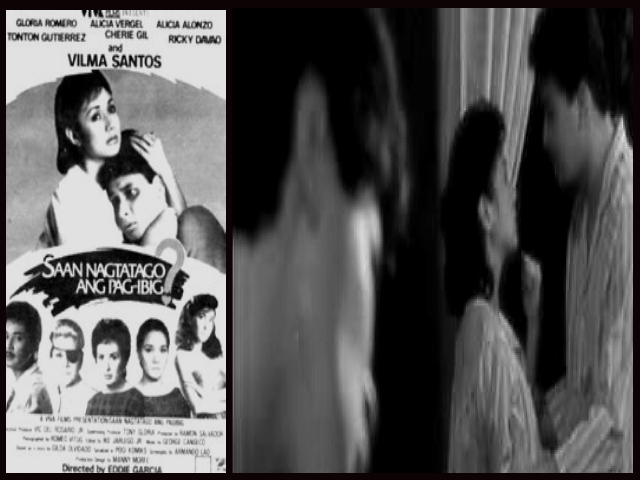
The Plot: Stella got pregnant by boyfriend Rick. Unfortunately, Rick is not willing to gamble on his inheritance. He is tied up with a promise to his super snotty, super rich old grandmother that he have to finish law school before he can get any money. In order to avoid scandal Stella agreed to be married to Rick’s retarded brother, Val. Together with his adopted family Stella learned to love the retarded Val and at the same time discovered that Val is a product of infidelity that cause the suicide of Rick and Val’s father. Unfortunately Stella’s new found love ended when Val accidentally fell from a window when he had a fight with his irrational brother one night. – RV (READ MORE)
The Reviews: Nang malaman ni Stella na buntis siya ay pinilit niyang managot ang kasintahan nitong si Rick, isang law student na tagapagmana na ariarian ng kanyang matapobreng lola. Dahil sa panakot na mag-i-iskandalo’y ipinakasal nila si Stella sa kapatid ni Rick na retarded upang hindi mawala ang mana nito at kasabay ay maiwasan ang kahihiyan ni Stella na mabuntis ng walang asawa at ama ang kanyang dinadalang bata. Kasabay ng pagbubuntis ni Stella ay natutunan nitong mahalin ang retarded na si Val. Kasabay rin nito’y natuklasan ni Stella na si Val ay anak sa labas ng kanilang ina at ito’y hindi sinilang na kulang-kulang. Dahil sa kalupitan ng matapobreng lola ng mga bata’y nahulog ito sa hagdanan ng pagbintangan si Val ng matandang nagnanakaw ng pera. Nahulog ang batang si Val habang pinapalo ito ng kanyang ina. Isang gabi’y nagwala si Val nang Makita nitong nakikipagtalo si Stella kay Rick. Sinunggaban ni Val si Rick at nagaway sila. Ang naging resulta ng pag-aaway na ito’y aksidenteng nahulog sa balkonahe ang kaawa-awang si Val.
Namatay ito at sa araw ng libing ay dumating ang matapobreng matanda para ibigay ang abuloy nito kay Stella. Isinauli ni Stella ang tseke sa matanda at ipinahayag na si Val ang ginawa nilang ama ng kanyang anak pero ang tutoo’y dahil sa takot na mawalan ng mana’y ito ang pinaako ng responsibilidad ni Rick. Galit na umalis ang matanda at tuluyang naglaho ang mana ni Rick. Nagdesisyon na iwan ni Stella ang bahay kasama ng kanyang anak. Mula sa direksiyon ni Eddie Garcia, ang Saan Nagtatago Ang Pag-ibig ay hango sa komiks. Bagama’t mahahalatang puro isang dimensiyon lamang ang halos lahat na karakter ng pelikula’y mahusay naman naihayag ni Direktor Eddie ang komiks na komiks na istorya nito. Bakit kailangang maging binata si Rick habang nagaaral ito ng abogasya? Bakit napakahalaga ito sa matapobreng si Alicia Vergel? Bakit may nakatakip ang isa sa mata ng matanda na parang bandido? Sa ubod ng yaman ng matanda hindi ba puedeng maglagay ng pekeng mata kesa sa bendang itim? Bagamat nakakatawa ang obserbasyon na ito’y dahil sa bisyuwal na kaanyuan ng matapobreng matanda kung kaya naman epektibong makikita ang pagiging kontrabida nito.
Tulad ng “Paano Ba Ang Mangarap,” merong ‘dream sequence” ang pelikula kung saan kunwari’y hinuhusgahan si Val na isang baliw. Kung puputulin ang eksenang ito’y hindi magiging sagabal sa paglalahad ng buong istorya ni Gilda Olvidado. Mula sa lumang bahay hanggang sa eksena sa libingan ay mahusay ang sinematograpiya ni Romy Vitug at disenyong pangproduksiyon ni Manny Morpe. Mahusay ang mga katulong na artista mula kay Cherrie Gil, Alicia Alonzo at Alicia Vergel. Mahusay rin si Ricky Davao bilang Rick at Gloria Romero bilang ina ni Rick at Val. Ngunit ang pelikulang ito’y tungkol kay Val at bilang si Val ay nabigyan ng mahusay na pagganap ni Tonton Gutierrez ang papel na sinto sinto mula sa pagsasalita na utal utal haggang sa pisikal na mukha at pa-ika-ikang paglalakad. Tulad ng inaasahan, mahusay si Vilma bilang si Stella. At tulad ng maraming pelikulang ginawa niya sa ilalim ng Viva at sa direksiyon ni Eddie Garcia ay merong linya o dayalogo siya na hindi malilimutan, ito ay nang bigkasin niya ang linyang, “…si Val, si val na wala naman malay…” na magpahanggang ngayon ay natanim sa mga Pilipino na mahihilig sa pelikulang tagalog. – RV (READ MORE)
“…Viva Films produced a movie adaptation of this story in 1987 that starred Vilma Santos as Stella, Ricky Davao as Rick and Tonton Gutierrez as Val. The movie received five citations in the 36th Filipino Academy of Movie Arts and Sciences including Best Picture, Best Director for Eddie Garcia, and Best Story for Gilda Olvidado. This line from the movie: “Si Val! Si Val! Puro na lang si Val! Si Val na walang malay!”, delivered by Vilma Santos is claimed to be one of the most memorable lines in Philippine Cinema in the June 11 episode of QTV’s “Ang Pinaka”, hosted by Pia Guanio…” – Wikipilipinas (READ MORE)







 Star For All Seasons
You must be logged in to post a comment.